
3D Cosmetic Packaging Mockups: How to Use Them Before Ordering Samples
3D cosmetic packaging mockups validate label scale, format suitability, and brand hierarchy on photorealistic digital models, eliminating costly physical sample revisions before production.
Ordering physical packaging samples is the most deceptive bottleneck in launching a beauty brand. Founders routinely treat sampling as a quick box to check, only to find themselves trapped in a multi-month loop of structural revisions, misaligned label scales, and unexpected shipping fees. When a single custom physical sample run can cost upwards of $100 to $300 per SKU and take several weeks to arrive, guessing on a flat 2D screen is an expensive gamble [1] [2].
A 3D cosmetic packaging mockup is not a decorative marketing asset or a pretty picture for social media. When deployed correctly, it serves as a decision-reduction tool that bridges the gap between creative concept and factory floor reality. By validating structural geometry, brand hierarchy, and regulatory real estate on a photorealistic digital model before spending a single dollar on physical tooling, independent beauty brand founders can eliminate up to 80% of typical sampling errors and cut weeks off their launch timelines.
What a 3D Cosmetic Packaging Mockup Is (and What It Is Not)
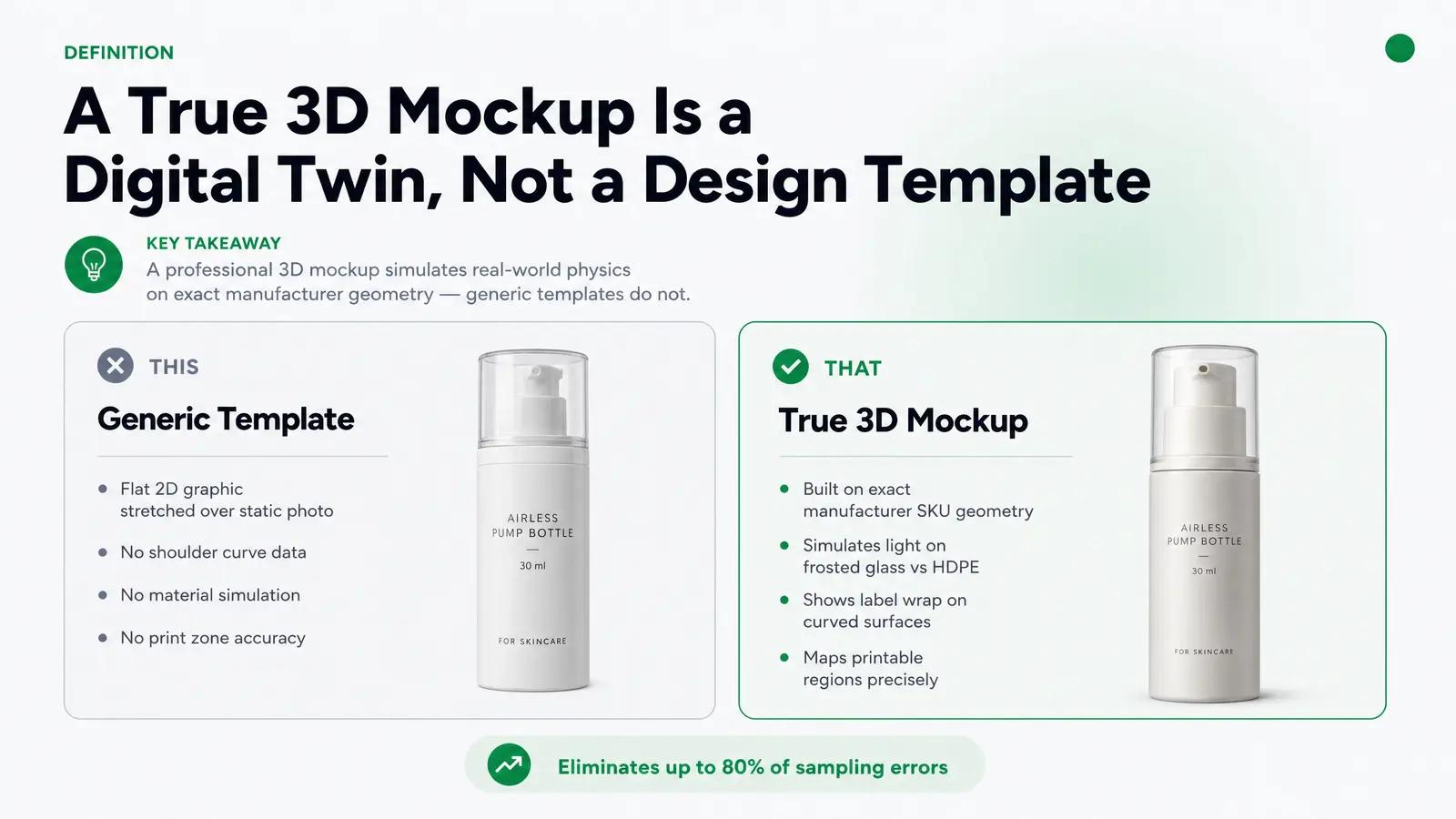
To use 3D mockups as an engineering tool, founders must first distinguish them from standard graphic templates. A true 3D cosmetic packaging mockup is a photorealistic, mathematically accurate digital twin of a specific packaging SKU [3]. It is built on the precise structural geometry of a manufacturer's stock or custom bottle, jar, tube, or pump.
This is fundamentally different from generic flat-template overlays or lifestyle photography mockups found on stock design websites. Generic templates stretch a flat 2D graphic over a static, non-adjustable photograph of a generic bottle. They do not account for the actual shoulder curves, neck dimensions, wall thickness, or material finishes of the physical component you will source.
A professional 3D mockup simulates real-world physics. It maps how light reflects off frosted glass versus high-density polyethylene (HDPE). It shows how a silk-screened metallic foil wraps around a 30 ml cylinder, and how much liquid level is visible through a semi-translucent wall.
"In packaging design, how something looks on screen and how it feels in real life are rarely the same thing. A layout might seem balanced in 2D, but once it wraps around a curved surface or sits under retail lighting, it can tell a completely different story." [4]
A 2D dieline is a flat blueprint showing cut lines, fold lines, and bleed zones. While essential for print shops, a dieline cannot show how text compresses visually on a curved surface or how a closure cap shadows the brand logo. The 3D mockup is the translation layer between the flat dieline and the physical product.
Why Founders Use Mockups Too Late (The Real Cost of the Mistake)
The classic beauty launch mistake is linear: formulate the liquid, design a logo, create a label in Canva, order physical bottle samples, paste a paper printout of the label onto the bottle, and hope it fits. When it inevitably does not, the founder is forced to order another round of samples, adjusting the artwork blindly.
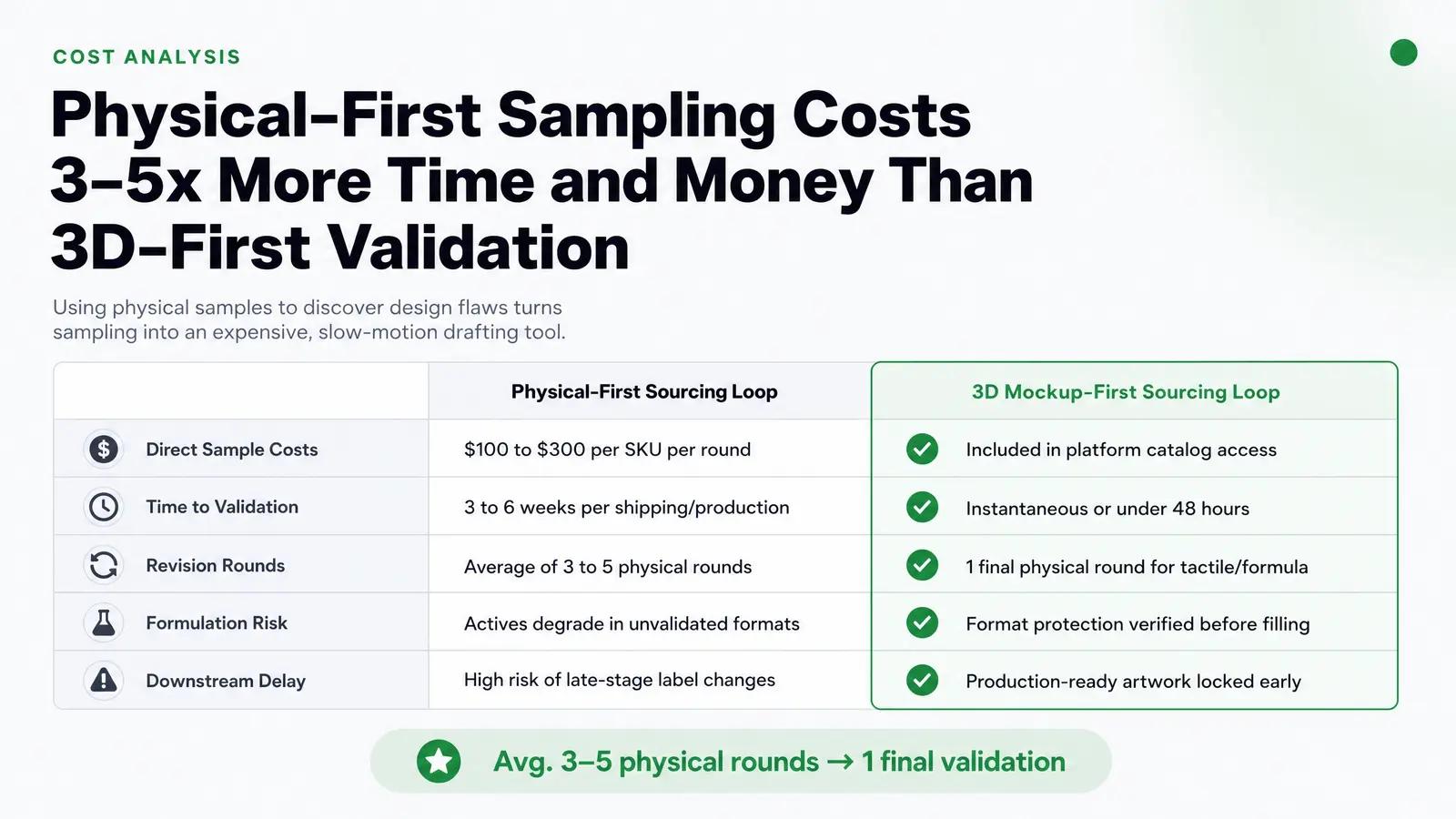
This trial-and-error approach turns physical sampling into an expensive, slow-motion drafting tool. In the cosmetic packaging development process, physical sampling should be the final validation of a fully resolved design, not the starting point for experimentation [5].
When a brand uses physical samples to discover basic design flaws, the costs stack up rapidly:
| Cost Category | Physical-First Sourcing Loop | 3D Mockup-First Sourcing Loop |
|---|---|---|
| Direct Sample Costs | $100 to $300 per SKU per round (plus international shipping) | Included in design software or platform catalog access |
| Time to Validation | 3 to 6 weeks per shipping and production iteration | Instantaneous or under 48 hours digitally |
| Revision Rounds | Average of 3 to 5 physical rounds to correct scale and layout | 1 final physical round for tactile and formula validation |
| Formulation Risk | Actives degrade in unvalidated, non-protective formats | Format protection verified before filling samples |
| Downstream Delay | High risk of late-stage label changes delaying filler schedules | Production-ready artwork locked before filler booking |
Squeezing structural decisions into the late stages of a launch creates a domino effect. If a label must be resized because it overlaps a bottle’s bottom curve, the entire ingredient list must be re-typeset. This can push back filling dates, delay regulatory filings, and cause missed launch windows.
How to Compare Packaging Formats Before Choosing One
Selecting primary packaging is a structural decision that dictates your brand’s shelf presence and formula integrity. Founders often choose formats based on aesthetic trends, ignoring how the format behaves in hand. A 3D mockup allows you to compare different formats side-by-side using the exact same branding elements.
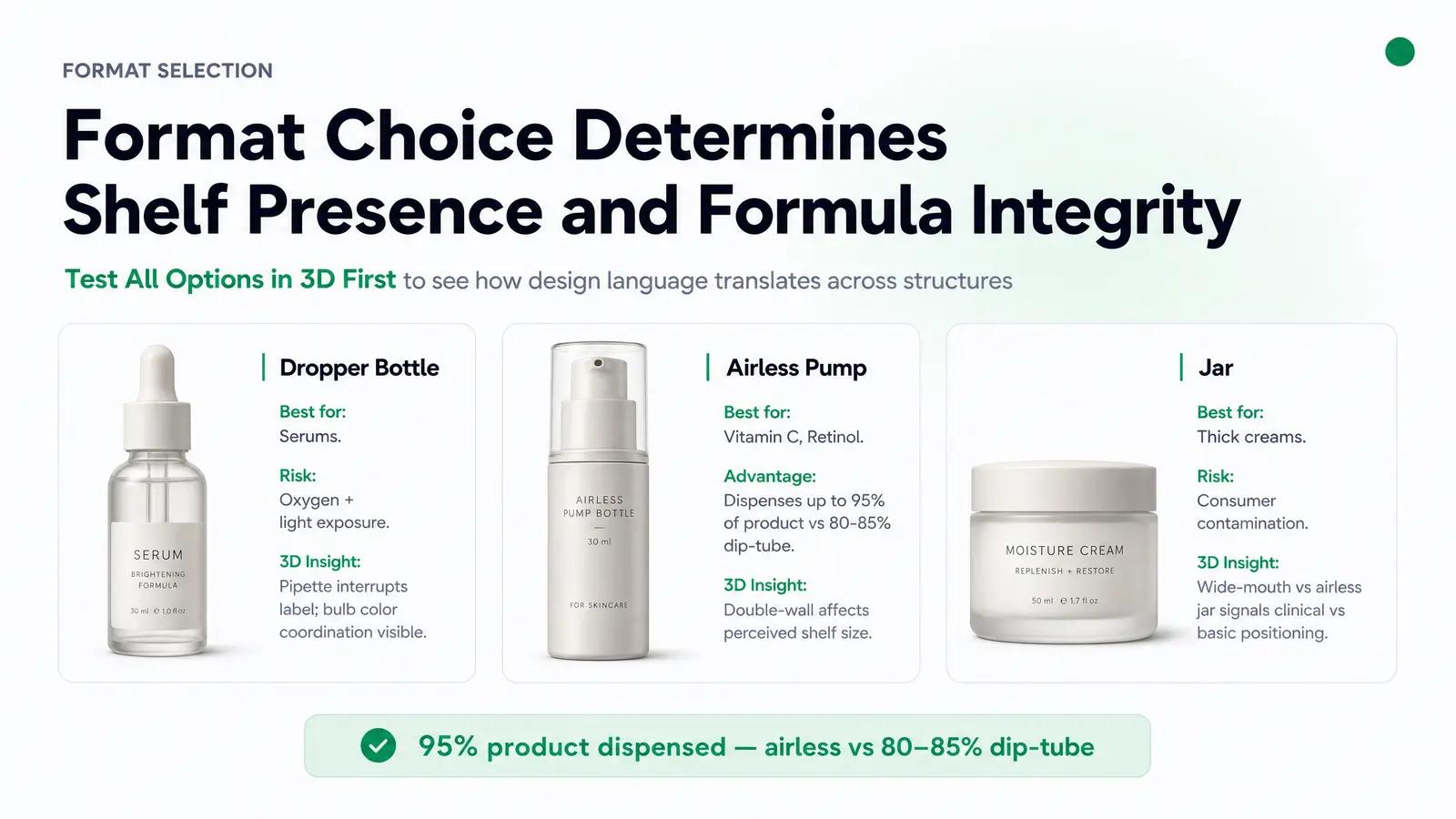
Consider the visual and functional differences between a dropper bottle, an airless pump, and a traditional lotion pump:
- Dropper Bottles: Standard for serums, but they expose formulas to oxygen and light with every use. A 3D mockup reveals how much of your label is interrupted by the dropper pipette inside the bottle and how the bulb color coordinates with your print.
- Airless Pumps: Highly protective for oxygen-sensitive actives like Vitamin C or retinol. The internal piston mechanism pushes the formula upward, dispensing up to 95% of the product compared to 80% to 85% for traditional dip-tube bottles [6]. A 3D mockup shows how the double-wall construction of an airless bottle affects the perceived size of the product on a shelf.
- Jars: Common for thick creams, but they carry a high risk of consumer contamination. A 3D mockup helps you evaluate whether a wide-mouth jar matches your brand's clinical positioning or if an airless pump jar would communicate a more premium, hygienic experience.
By rendering your artwork onto these different formats simultaneously, you can see if your design language translates across structures. A minimalist design that looks elegant on a tall, slender airless pump may look empty and ungrounded on a squat, wide-mouth cream jar.
Validating Label Scale, Print Zones, and Artwork Fit
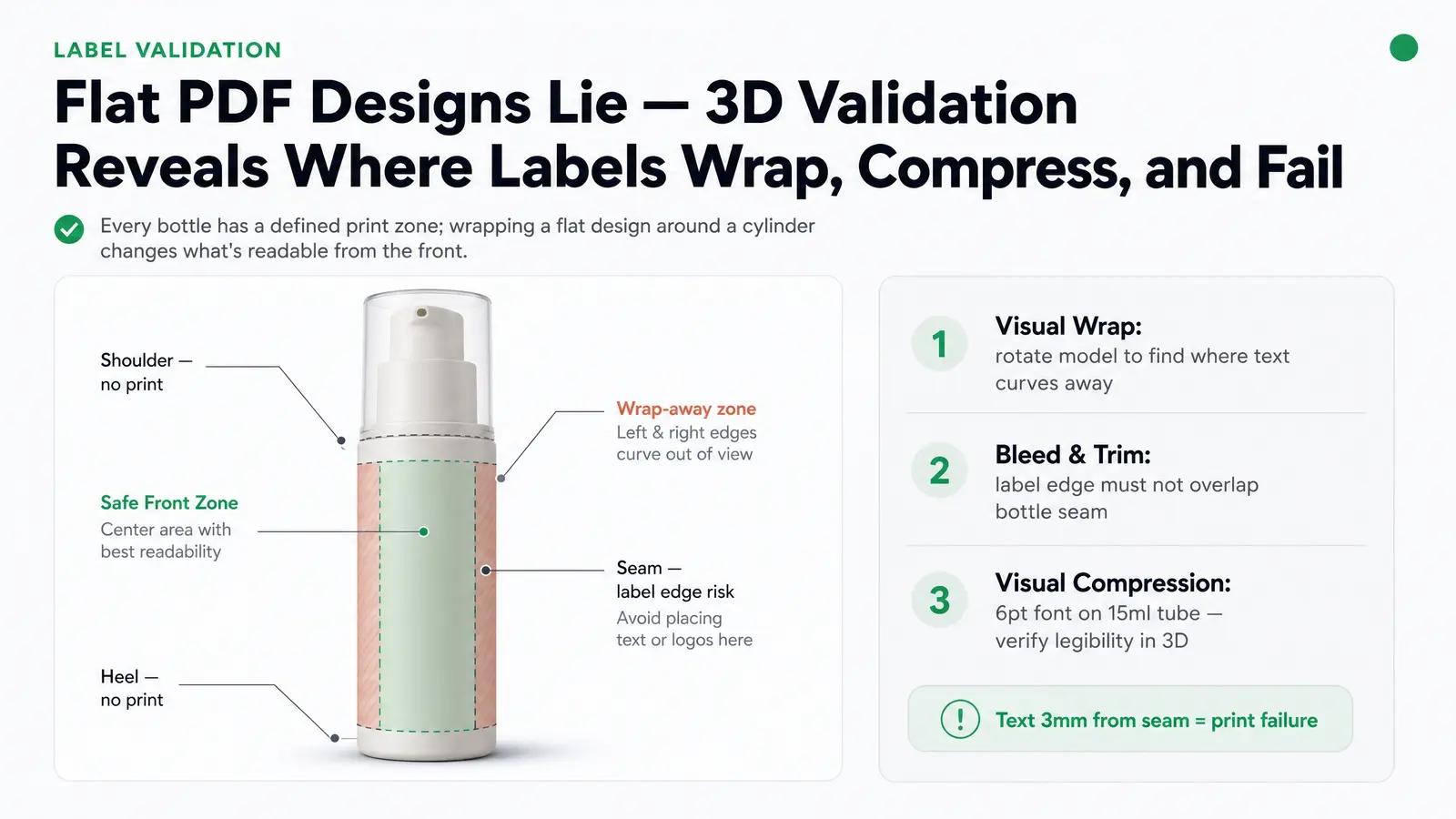
A flat PDF design file is a visual lie. It presents a continuous, unobstructed plane of graphic elements. When that flat plane is wrapped around a physical cylinder, the laws of geometry take over.
The outer edges of your flat design will wrap toward the back of the bottle, disappearing from the consumer’s primary line of sight. If your brand name or key active callouts extend too far left or right, they will become unreadable from a front-facing shelf view.
Using a 3D mockup allows you to map the printable region of a specific SKU. Every bottle has a defined print zone that avoids the curves of the shoulder and the heel, where printing screens cannot make clean contact.
A professional 3D mockup helps you validate:
- The Visual Wrap: You can rotate the model to see exactly where the text begins to curve away from the viewer. This helps you establish the "safe zone" for front-panel brand elements.
- Bleed and Trim Alignment: For adhesive labels, the mockup ensures the label edge does not overlap itself or end too close to a bottle's vertical seam, which causes peeling.
- Visual Compression: Text wrapped around a small diameter, such as a 15 ml eye cream tube, compresses visually. A 3D mockup lets you verify if your 6-point font is still legible when wrapped tightly, or if it turns into a black blur [7].
Reviewing Brand Presence: Hierarchy, Legibility, and Shelf Impact
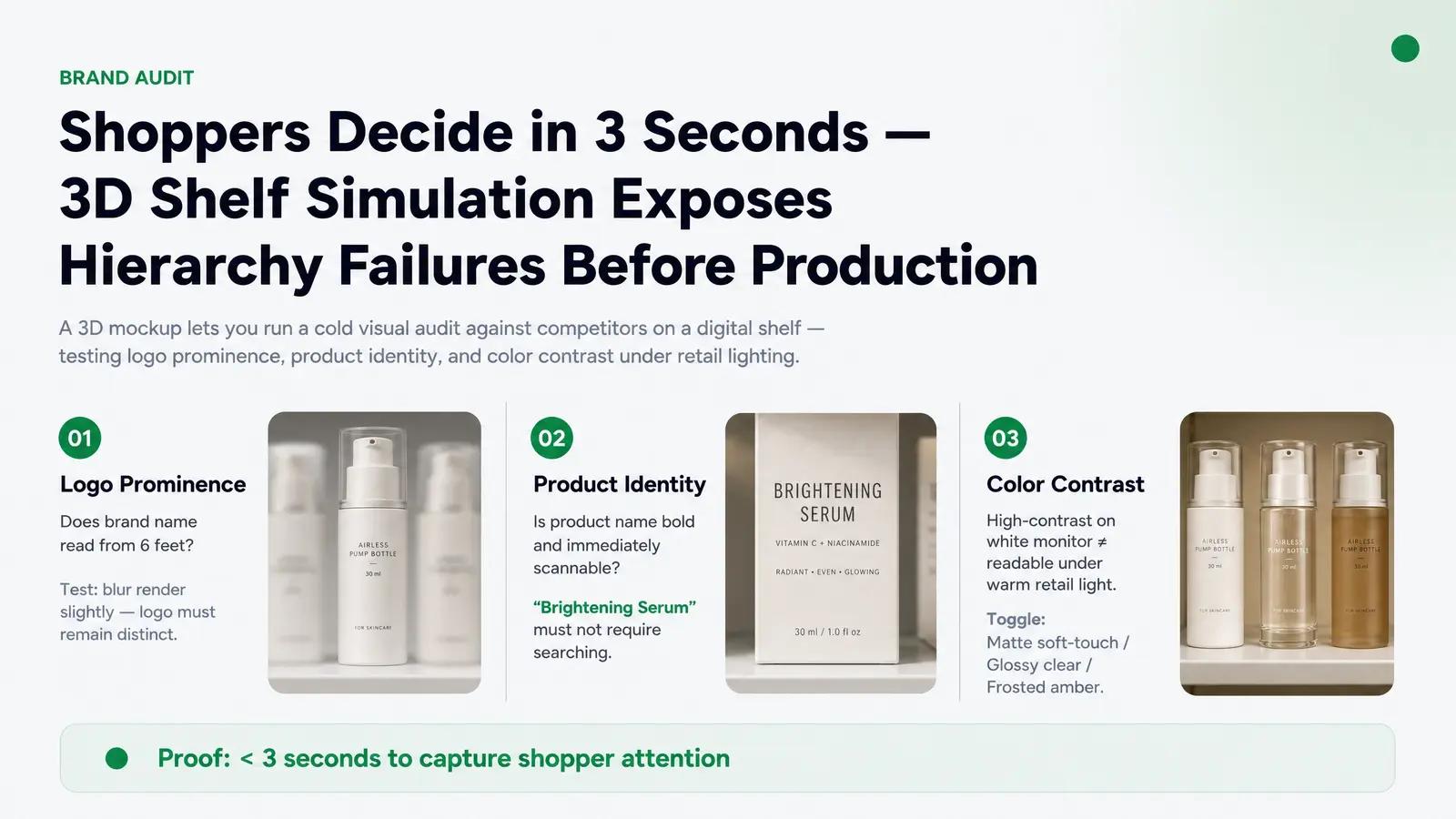
In a retail environment, your product has less than three seconds to capture a shopper’s attention. Your packaging must communicate three things instantly: what the product is, what it does, and why the shopper should care.
A 3D mockup allows you to test this visual hierarchy in a simulated retail environment. By placing your rendered SKU next to competitors’ products on a digital shelf, you can conduct a cold visual audit.
- Logo Prominence: Does your brand name stand out from six feet away, or does it get lost in decorative background patterns?
- Product Identity: Is the product name (e.g., "Brightening Serum") bold and distinct, or does the consumer have to search for it?
- Color Contrast: How does the bottle color behave under different lighting? A design that looks high-contrast on a white monitor back-light may become unreadable under warm retail shelf lighting if the contrast between the text ink and the glass finish is too low [8].
The 3D mockup also lets you evaluate how different finishes impact brand perception. You can toggle between a matte soft-touch finish, a glossy clear glass, and a frosted amber finish. A frosted finish softens the colors of the liquid inside, while clear glass exposes the exact hue of your formula, which can vary between batches.
Using 3D Mockups for Investor Decks and Stakeholder Alignment
For pre-launch beauty brands, capital is the ultimate constraint. Securing funding from angel investors, distributors, or retail buyers often requires showing a finished product before you have the capital to manufacture it.
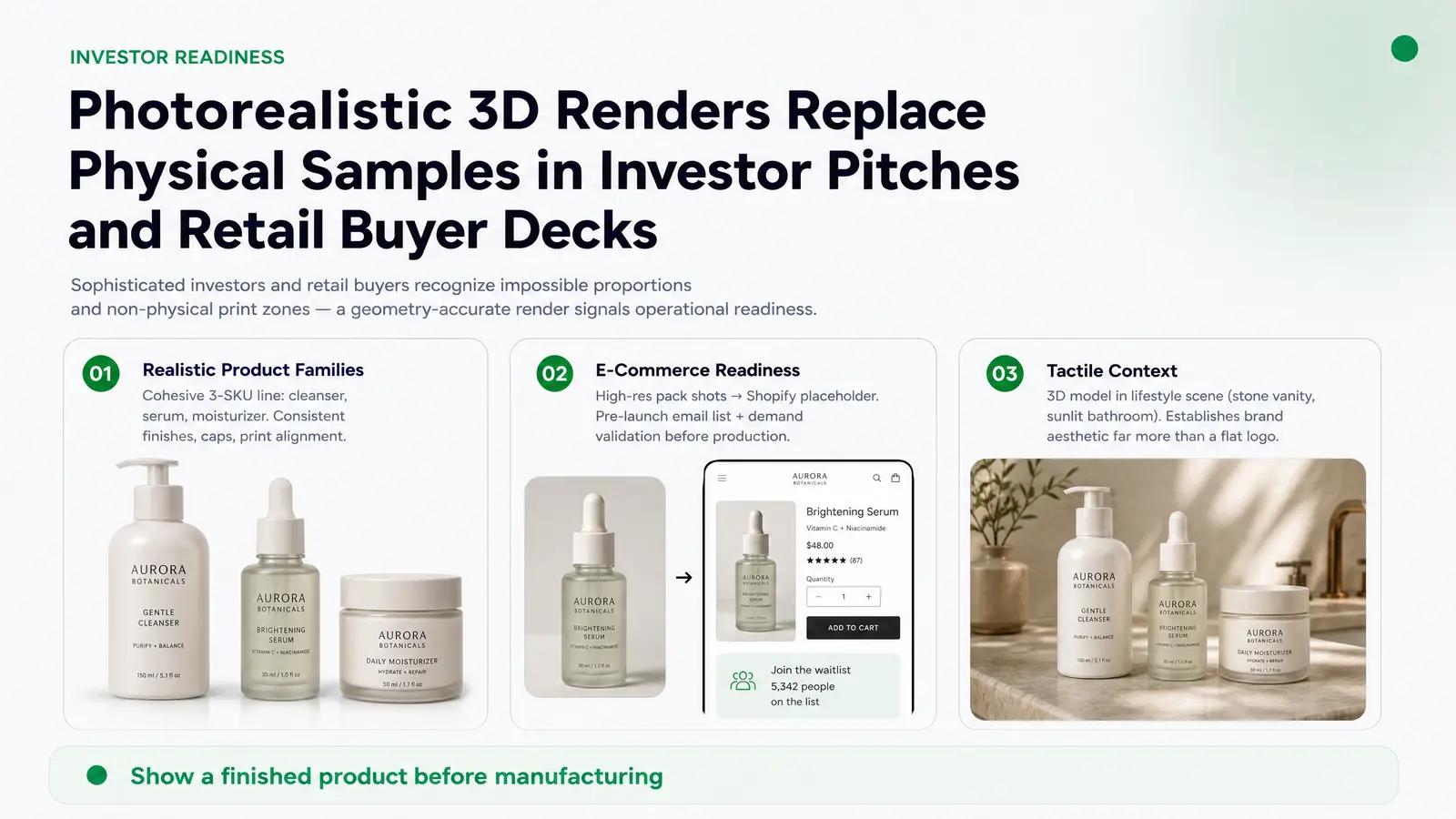
Building investor decks with flat 2D graphics or generic Canva templates can backfire during due diligence. Sophisticated investors and retail buyers know what real packaging looks like. If your pitch deck features a product render with impossible proportions, floating caps, or labels that defy physical print zones, it signals a lack of operational readiness.
A photorealistic 3D mockup built on real SKU geometry allows you to present a market-ready product line. You can show:
- Realistic Product Families: A cohesive line of 3 SKUs (e.g., cleanser, serum, moisturizer) that share consistent material finishes, cap styles, and print alignments.
- E-Commerce Readiness: High-resolution digital pack shots that are ready for a Shopify store placeholder, allowing you to build pre-launch email lists and validate market demand before production.
- Tactile Context: Placing the 3D model in a realistic lifestyle scene, such as a stone vanity or a sunlit bathroom, which establishes your brand's aesthetic positioning far more effectively than a flat logo.
Communicating with Manufacturers to Reduce Sample Revision Rounds
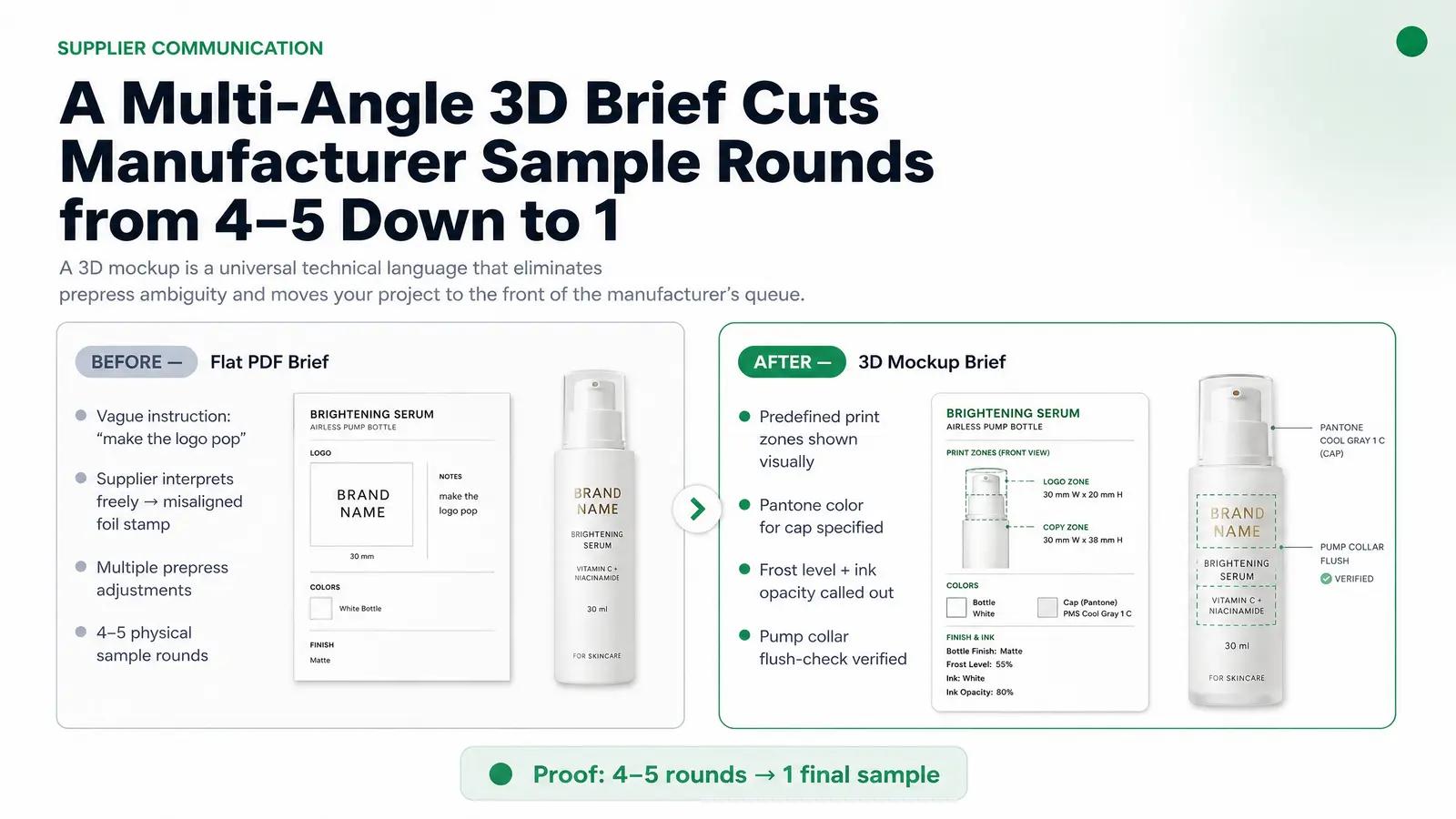
When you source packaging from global manufacturers, language barriers and technical terminology can lead to costly miscommunications. A supplier might interpret a vague instruction like "make the logo pop" by adding a heavy, unaligned foil stamp that ruins your minimalist aesthetic.
A 3D mockup is a universal technical language. Instead of sending a flat PDF and a paragraph of descriptive text, you can send your supplier a multi-angle 3D render showing the exact placement, finish, and scale of your artwork on their specific SKU.
This level of precision changes the dynamic with your manufacturer:
- Predefined Print Zones: You can show the supplier that your artwork fits precisely within their specified print zones, eliminating prepress adjustments.
- Specific Material Callouts: Your render can specify the exact Pantone color for the cap, the level of frost on the glass, and the opacity of the screen-printed ink.
- Tolerance Stack-Up Check: You can visually verify if your pump collar sits flush with the bottle shoulder, preventing "collar gap" issues before the manufacturer cuts steel for the production molds [9].
By presenting a print-ready, visually resolved mockup, you reduce the manufacturer’s prepress work. This often moves your project to the front of their queue and reduces the number of physical sample iterations from four or five rounds down to a single, final validation run.
The Pre-Sample Mockup Validation Checklist
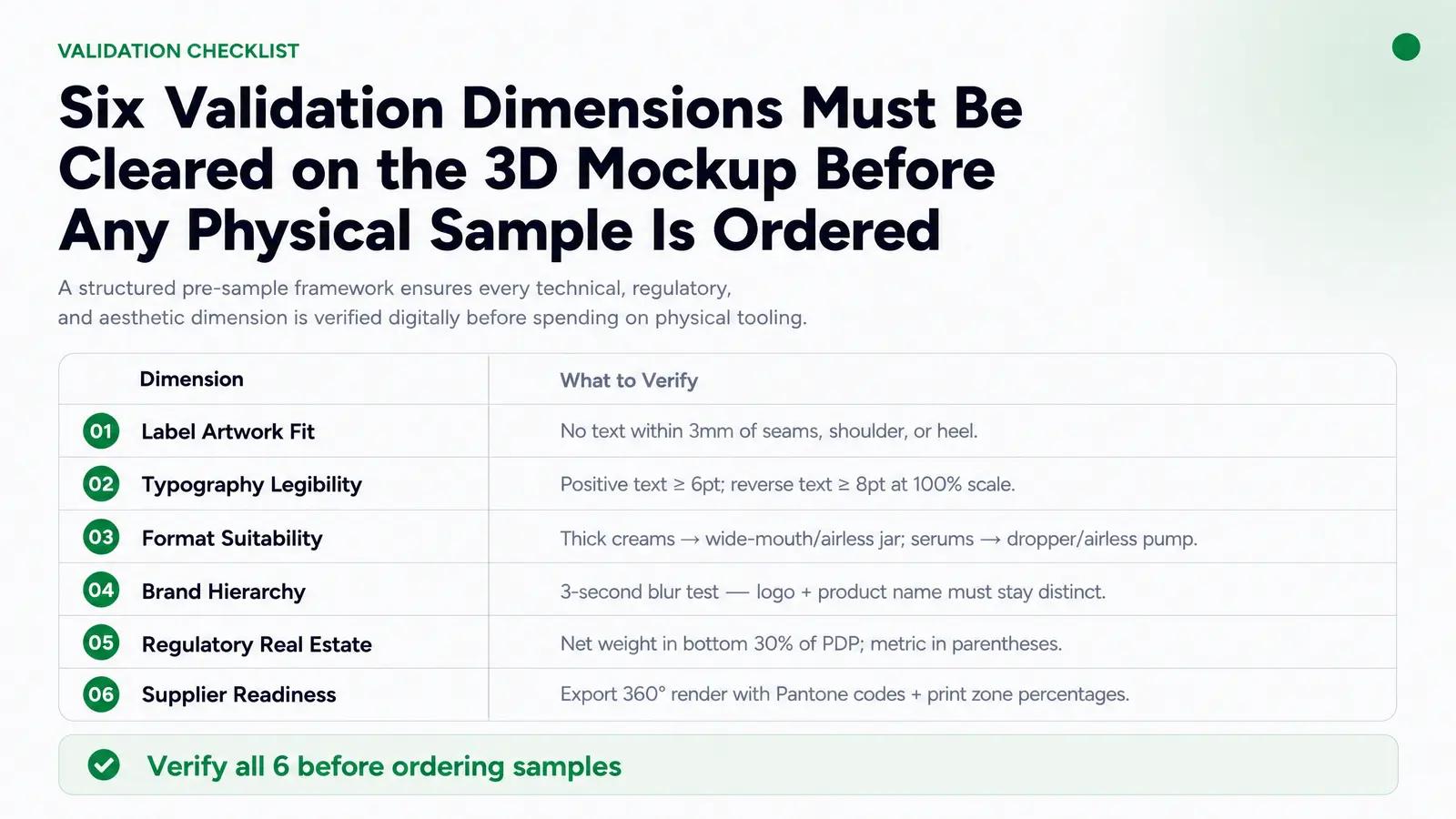
To systematize this process, Packfolio recommends using a structured validation framework before approving any artwork for physical sampling. This framework ensures that every technical, regulatory, and aesthetic dimension of the packaging is verified on the 3D model.
The Pre-Sample Mockup Validation Checklist
| Validation Dimension | Technical Focus | Verification Method on 3D Mockup | Industry Standard Reference |
|---|---|---|---|
| Label Artwork Fit | Print zone boundaries, bleed, and safe zones. | Verify that no text or critical graphics extend within 3 mm of the bottle seams, shoulder curve, or bottom heel [7]. | ISO 22716 / Good Manufacturing Practices (GMP) for packaging alignment [10]. |
| Typography Legibility | Text readability at actual physical scale. | Scale the 3D render to 100% physical size on a calibrated screen. Ensure positive text is $\ge$ 6 pt and reverse text is $\ge$ 8 pt [7]. | FDA Cosmetics Labeling Guide (21 CFR 701.2 prominence standards) [8]. |
| Format Suitability | Compatibility between formula viscosity and packaging. | Verify that thick creams are in wide-mouth jars or airless jars, and low-viscosity serums are in droppers or airless pumps [9]. | PCPC Labeling Manual, 9th Edition guidelines on product category packaging [11]. |
| Brand Hierarchy | Immediate recognition of brand name and product type. | Perform a "3-second blur test" on the render. The brand logo and product identity must remain distinct when blurred slightly. | PMC9123395 (Package design as a branding tool study) [12]. |
| Regulatory Real Estate | Mandatory legal text placement and sizing. | Ensure the Principal Display Panel (PDP) bottom 30% contains the net weight in US customary units, with metric in parentheses [13]. | Fair Packaging and Labeling Act (FPLA) / MoCRA allergen disclosure rules [13] [14]. |
| Supplier Readiness | Completeness of the technical brief for production. | Export a 360-degree turnaround render with callouts for Pantone colors, material finishes, and print zone percentages. | ISO 9001 Quality Management standards for supplier procurement. |
Comparing Mockup Approaches for Beauty Founders
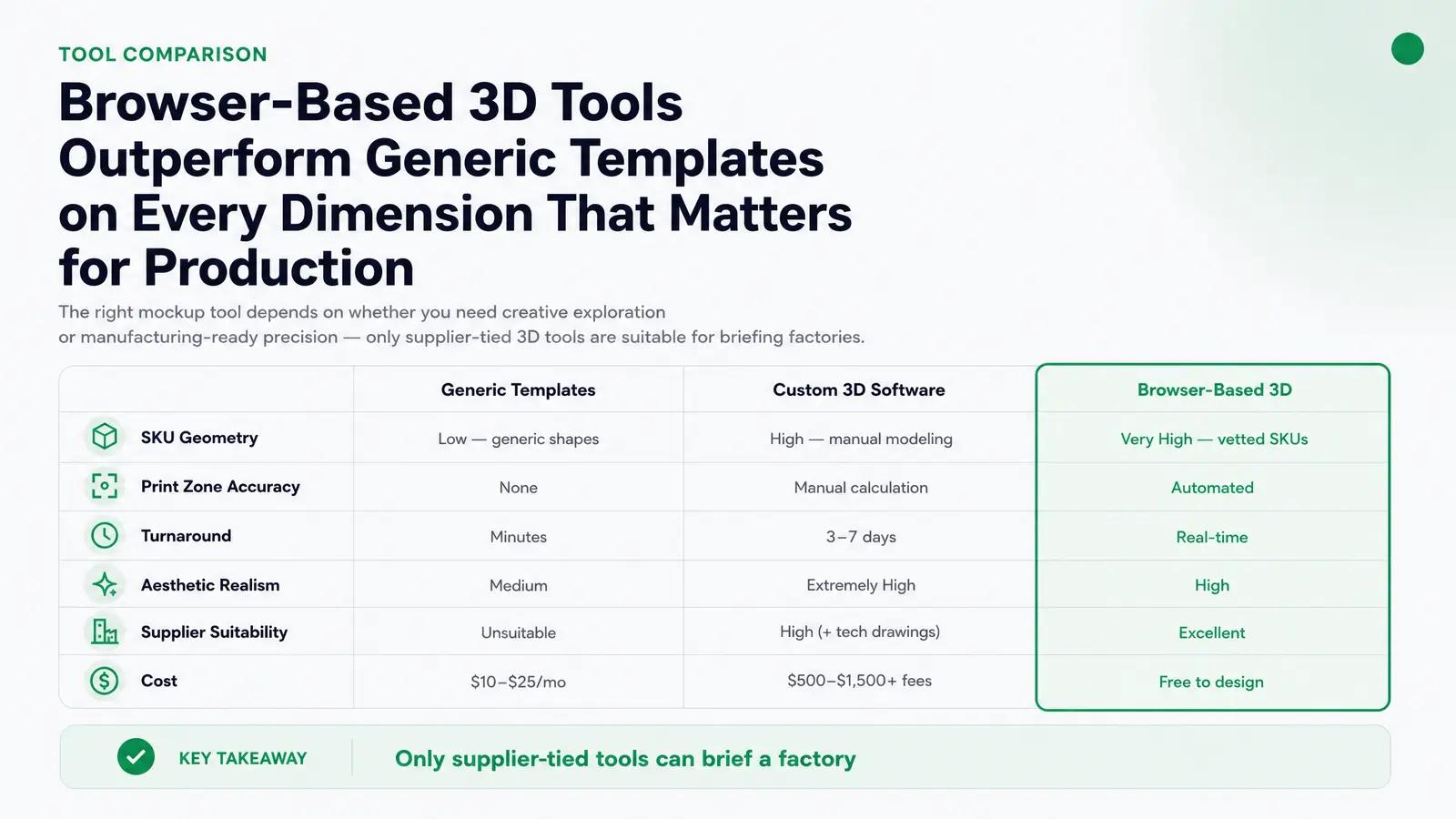
Not all mockup tools are created equal. A founder's choice of tool should depend on their technical design skills, budget, and whether they are using the mockup for creative brainstorming or final manufacturing coordination.
3D Mockup Approaches Comparison
| Mockup Attribute | Generic Graphic Templates (e.g., Freepik, Placeit) | Custom 3D Software (e.g., Blender, Cinema 4D) | Browser-Based 3D Design Tools (e.g., Packfolio) |
|---|---|---|---|
| SKU Geometry Fidelity | Low. Generic shapes that do not match real-world manufacturer components. | High. Can be modeled to exact physical blueprints. | Very High. Built directly on vetted, pre-modeled supplier SKUs. |
| Print Zone Accuracy | None. Artwork is stretched arbitrarily over a static image. | Manual. Requires the designer to manually calculate and map print zones. | Automated. Artwork is locked within predefined, supplier-verified print zones. |
| Turnaround Time | Instant (minutes). | 3 to 7 days (requires professional designer labor). | Instant (real-time rendering in the browser). |
| Aesthetic Realism | Medium (often looks flat or unnaturally glossy). | Extremely High (supports custom ray-traced lighting). | High (photorealistic, real-time web-gl previews). |
| Supplier Suitability | Unsuitable. Cannot be used to brief a manufacturer or coordinate tooling. | High. Requires exporting technical drawings alongside the render. | Excellent. The mockup is tied directly to an active, orderable supplier SKU. |
| Average Cost | Low ($10 to $25/month subscription). | High ($500 to $1,500+ in professional design fees). | Free to browse and design; cost integrated into order flow. |
Worked Example: Sourcing a Vitamin C Brightening Serum
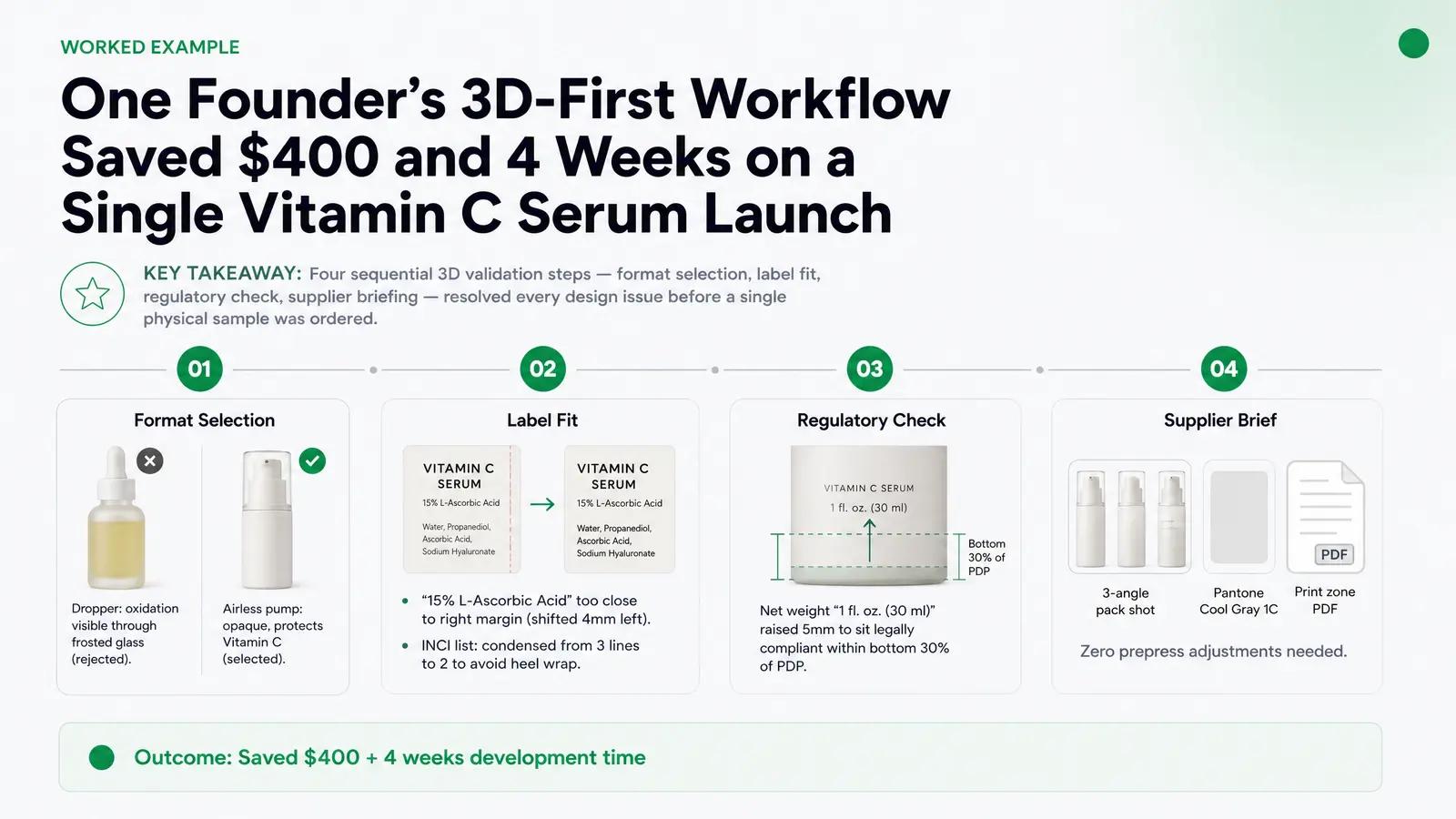
To see this workflow in action, let’s follow a realistic scenario. A founder is developing a high-performance Vitamin C brightening serum. Vitamin C is highly vulnerable to oxidation and UV degradation, meaning the packaging choice directly impacts the shelf-life of the product.
The founder has narrowed the primary packaging down to two 1 oz (30 ml) formats:
- Option A: A Frosted Glass Dropper Bottle with a white rubber bulb and gold collar.
- Option B: A Double-Wall PP Airless Pump Bottle with a matte white outer shell and clear over-cap.
The designer has provided a flat label design file. The label includes the brand name, product name, active ingredient callouts (15% L-Ascorbic Acid), directions, a distributor block, a barcode, and a full INCI ingredient list.
Here is how the founder uses a 3D mockup at each decision point:
1. Format Selection and Formula Compatibility
The founder uploads the flat label artwork onto 3D models of both options.
- On the Dropper Bottle render, the founder notices that the gold collar reflections distract from the minimalist brand typography. More importantly, the clear frosted glass exposes the light-yellow serum inside. Over time, as Vitamin C oxidizes, it turns dark brown. The mockup reveals that this color shift would be highly visible to consumers, damaging brand trust.
- On the Airless Pump render, the opaque double-wall construction completely protects the formula from light exposure. The piston mechanism ensures the formula is dispensed without introducing air. The pump format also matches the clinical, high-performance positioning of the active ingredient.
The founder selects Option B (the airless pump).
2. Label Fit and Scale Validation
The airless pump bottle has a physical diameter of 32 mm and a height of 110 mm. The supplier's technical sheet specifies a maximum print zone height of 75 mm and a wrap width of 96 mm.
The founder imports the flat label artwork into the 3D design tool.
- The Front Panel: The mockup reveals that the text "15% L-Ascorbic Acid" is placed too close to the right margin. On the 3D rotation, this text wraps around the curve of the cylinder and cannot be read when looking at the bottle from the front. The founder shifts this text 4 mm to the left, keeping it within the front safe zone.
- The Back Panel: The INCI ingredient list is set in 6-point font. On the 3D model, the founder zooms in to inspect the text legibility. Because the airless pump has a tight cylinder radius, the small, high-density text is highly legible under direct light, but the distributor block address must be condensed from three lines to two to avoid wrapping into the bottom heel of the bottle.
3. Regulatory Real Estate Check
Under the Fair Packaging and Labeling Act, the net quantity of contents must appear in the bottom 30% of the Principal Display Panel, parallel to the base of the package [8] [13].
- The founder toggles the "PDP Grid Overlay" on the 3D mockup. The overlay reveals that the text "1 fl. oz. (30 ml)" sits exactly 22 mm from the base, placing it within the bottom 20% of the display panel.
- However, because of the bottle's bottom curve, the text is too low and looks ungrounded. The founder uses the 3D preview to raise the net weight text by 5 mm, keeping it legally compliant within the bottom 30% while improving the visual balance of the front panel.
4. Supplier Briefing and Ordering
Instead of sending a flat PDF and hoping the manufacturer aligns it correctly, the founder exports the finalized 3D render from the design tool. The export includes:
- A high-resolution 3-angle pack shot (front, side, back).
- The exact Pantone color code matched to the pump collar (Pantone Cool Gray 1C).
- A technical PDF showing the artwork mapped precisely within the supplier's predefined print zones.
The supplier receives the brief, confirms that the artwork requires zero prepress adjustments, and cuts the sample run on the first try. The brand receives a single physical sample that matches the digital mockup perfectly, saving $400 in redundant shipping and sample fees, and reducing the development timeline by four weeks.
The Non-Obvious Reality of Flat-Template Mockups
The accessibility of free, downloadable graphic templates has created a culture of false confidence among independent beauty founders. Sourcing a PSD file from a stock website and dropping a logo onto it is a satisfying creative exercise, but it is a dangerous production shortcut.
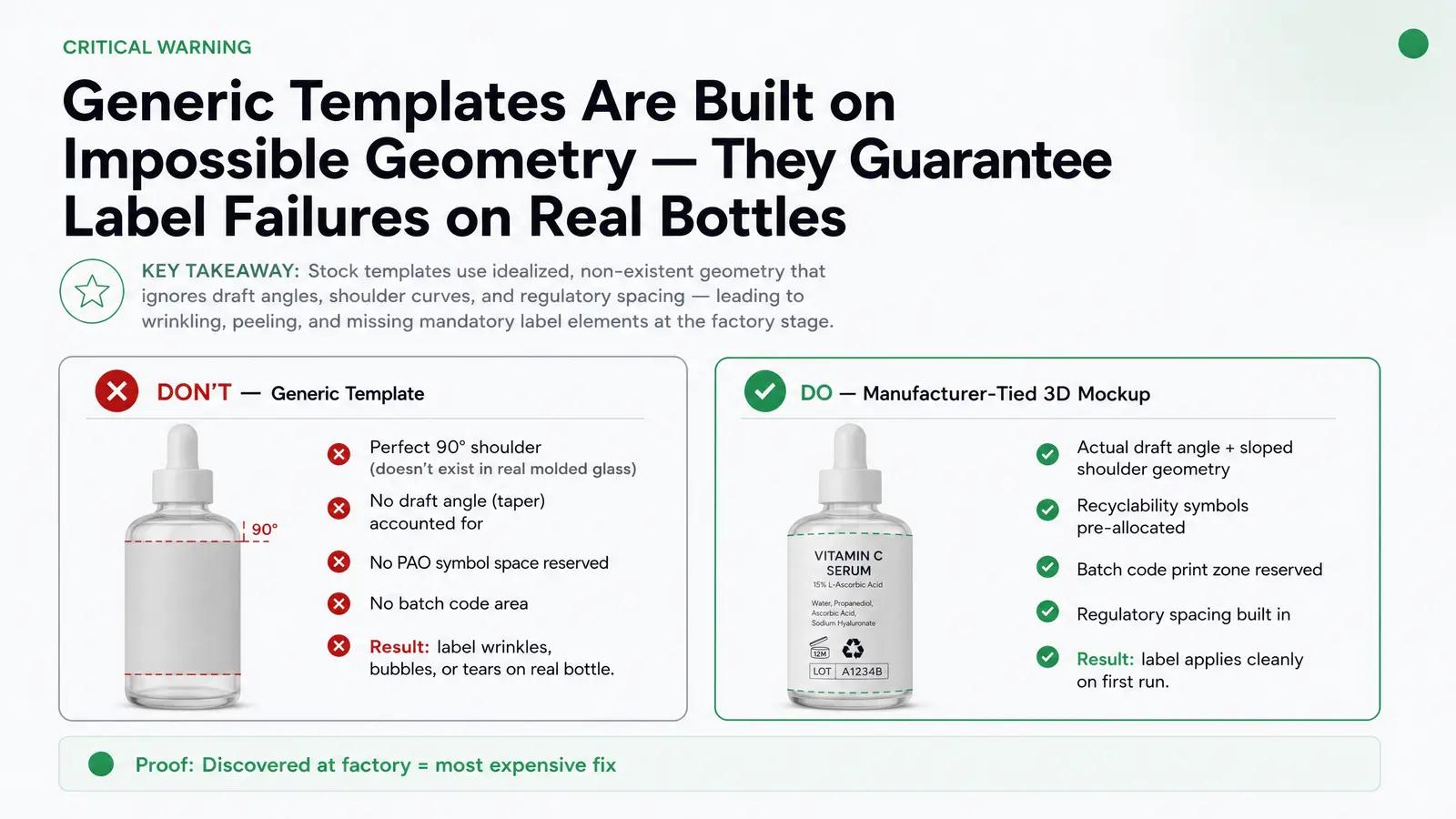
These generic templates are built on idealized, non-existent packaging geometry. They do not account for the mechanical tolerances of real manufacturing.
For example, a generic "1 oz glass dropper" template on a stock site might feature a perfectly straight cylinder wall with a sharp, 90-degree shoulder transition. In reality, a physical 30 ml molded glass bottle has a slight draft angle (taper) to allow it to release from the steel mold during glassblowing, and its shoulder is gently sloped.
If you design artwork to fit the sharp 90-degree shoulder of a generic template, your label will wrinkle, bubble, or tear when applied to the sloped shoulder of the real physical bottle.
Furthermore, generic templates ignore the Period After Opening (PAO) and regulatory spacing requirements. A founder who designs a label on a template often realizes too late—at the factory filling stage—that they have left no room for the mandatory batch code print or the recyclability symbols required by modern packaging standards [10].
Using a 3D mockup that is tied directly to a vetted, real-world manufacturer SKU is the only way to ensure that your digital design is physically manufacturable.
Packaging Sourcing Built for Modern Beauty Brands
At Packfolio, we have eliminated the trial-and-error gap by building a 3D mockup workflow directly into the packaging procurement process. We curate a vetted catalog of cosmetic primary packaging SKUs, including glass dropper bottles, airless pumps, jars, tubes, and closures.
Every SKU in the Packfolio catalog is pre-modeled in 3D with predefined, supplier-verified print zones. When you browse our catalog, you are not looking at generic shapes; you are interacting with real, orderable components.
Our browser-based 3D design tool allows you to upload your artwork, map it directly within the predefined print zones, and preview the result on a photorealistic 3D model in real time. What you see on your screen is exactly what the manufacturer will produce.
Packfolio coordinates the entire production process, including strict quality control, regulatory alignment, and international freight. You never have to contact factories, manage prepress adjustments, or navigate the complexities of global supply chains. We handle the manufacturing, so you can focus on building your brand.
Start Sourcing with Packfolio
The transition from a flat design file to a physical product does not have to be a slow, expensive guessing game. By validating your packaging structure, brand hierarchy, and label scale on a photorealistic 3D model before ordering samples, you can launch your beauty brand faster, eliminate costly design errors, and secure stakeholder alignment with confidence.
Browse Packfolio's curated cosmetic packaging catalog, upload your artwork into the 3D design tool, and preview your label on a photorealistic model before you order a single sample. → packfolio.com/catalog
Frequently Asked Questions
Q: What is the difference between a 3D mockup and a physical pre-production sample?
A: A 3D mockup is a photorealistic digital model used to validate design layout, label scale, and brand hierarchy instantly. A physical pre-production sample is a manufactured component used to verify the tactile feel of materials, closure mechanisms, and formula compatibility before mass production [1] [5].
Q: Can I use a 3D mockup to test if my formula will degrade the packaging?
A: No. A 3D mockup cannot simulate chemical interactions. You must always conduct physical compatibility testing, exposing your formula to the physical packaging material under elevated temperatures for at least 8 to 12 weeks to check for weight loss, stress cracking, or discoloration [9] [10].
Q: What are the FDA font size requirements for cosmetic labels?
A: Under FDA regulations, the net quantity of contents statement must have a minimum font height ranging from 1/16 inch to 5/16 inch depending on the size of the Principal Display Panel. Ingredient declarations must be at least 1/16 inch in height, unless the total available package surface is under 12 square inches, which allows a reduction to 1/32 inch [8] [13].
Q: Why do labels bubble or peel on curved cosmetic bottles?
A: Label bubbling or peeling, known as "winging," occurs when an adhesive label is applied to a compound curve (a surface that curves in multiple directions, like a bottle shoulder) or when the label edge is placed too close to a molded glass bottle's vertical seam [7].
Q: How do airless pump bottles reduce cosmetic product waste?
A: Traditional dip-tube bottles rely on gravity and suction, leaving 15% to 20% of the product trapped at the bottom. Airless pump bottles use a vacuum-activated internal piston that pushes the formula upward, ensuring up to 95% of the product is dispensed cleanly [6].
References
[1] Kuhnel, S. "Packaging Mockup vs. Packaging Sample: What's the Difference?", Global Printing & Packaging, 2022. https://www.gprinting.com/blog/packaging-mockup-packaging-sample-whats-the-difference
[2] Gaweda, M. "Market-Ready Packaging Mockups: How to Present Products for the US, EU, Canada, and Japan", Creatsy, 2026. https://creatsy.com/blog/1424973141-market-ready-packaging-mockups-how-to-present-products-for-the-us-eu-canada-and-japan
[3] Pitomcev, Y. "Packaging visualization for FMCG products: a practical B2B guide", Transparent House, 2026. https://www.transparenthouse.com/post/packaging-visualization-fmcg-3d-rendering-guide
[4] Cheng, C. "How 3D Mockups Elevate the Packaging Design Process", Chandler X Design, 2025. https://www.chandlerxdesign.com/insights/3d-mockups-in-packaging-design
[5] Kwapis, A. "7 Key Phases of Beauty Packaging Development", LinkedIn, 2025. https://www.linkedin.com/pulse/alexander-kwapis-7-key-phases-beauty-packaging-alexander-kwapis-66lbf
[6] Loi, S. S. "Airless Containers vs Traditional Cosmetic Bottles: Which Packaging System Fits Your Product Best?", The Packaging Company, 2026. https://www.thepkgco.com/airless-containers-vs-traditional-cosmetic-bottles/
[7] Scott, J. "Design Prep Essentials for Designing and Sourcing Product Packaging", Printingblue, 2026. https://www.printingblue.com/knowledge-center/posts/packaging-design-preparation-guide
[8] Shameer, M. "The 2026 Guide to FDA Cosmetic Labeling Requirements", Esko, 2026. https://www.esko.com/en/blog/2026-guide-to-fda-cosmetic-labeling-requirements
[9] Dobras, M. "Research Unpacks Cosmetic Packaging Design Process", Global Cosmetic Industry, 2021. https://www.gcimagazine.com/packaging/news/21862809/research-unpacks-cosmetic-packaging-design-process
[10] Lee, J. S. "The Essential Production Process You Must Know Before Launching a Beauty Brand", Nutricare Cosmetics, 2025. https://nutricarecos.com/newsletter/the-essential-production-process-you-must-know-before-launching-a-beauty-brand/
[11] Personal Care Products Council. "Labeling Manual, 9th Edition", PCPC Portal, 2021. https://access.personalcarecouncil.org/Shop/Publications/Product-Details?productid=%7BA59ABDBE-95F0-EB11-BACB-002248219847%7D
[12] Srivastava, P., Ramakanth, D., Akhila, K., Gaikwad, K. K. "Package design as a branding tool in the cosmetic industry: consumers’ perception vs. reality", SN Business & Economics / PMC, 2022. https://pmc.ncbi.nlm.nih.gov/articles/PMC9123395/
[13] U.S. Food and Drug Administration. "Summary of Cosmetics Labeling Requirements", FDA.gov, 2025. https://www.fda.gov/cosmetics/cosmetics-labeling-regulations/summary-cosmetics-labeling-requirements
[14] Registrar Corp. "MoCRA Cosmetic Label Requirements: the Essential Guide", RegistrarCorp.com, 2024. https://www.registrarcorp.com/blog/cosmetics/mocra/mocra-cosmetic-label-requirements/


