
How to Brief a Designer on Real Cosmetic Packaging Constraints
A complete cosmetic packaging design brief must include eight technical constraints—from dielines to decoration methods—so designers produce artwork that actually prints.
If you spend enough time in founder communities on Reddit, you will inevitably see the same frustrated post. A beauty founder hires a talented graphic designer, pays for a premium branding package, and receives stunning, photorealistic mockups of their new skincare line. The designs feature sweeping watercolor gradients, delicate fine-line typography, and intricate metallic gold accents. The founder falls in love, approves the files, and sends them to the packaging supplier. Two days later, the factory replies with a reality check: the gradients cannot be printed via silkscreen, the fine lines will fill in and blur on a flexographic press, and the metallic accents require an expensive hot stamp tool that doubles the unit cost. The beautiful design is completely unprintable on the actual container.
Why Designers Without Packaging Constraints Produce Beautiful Work That Cannot Ship
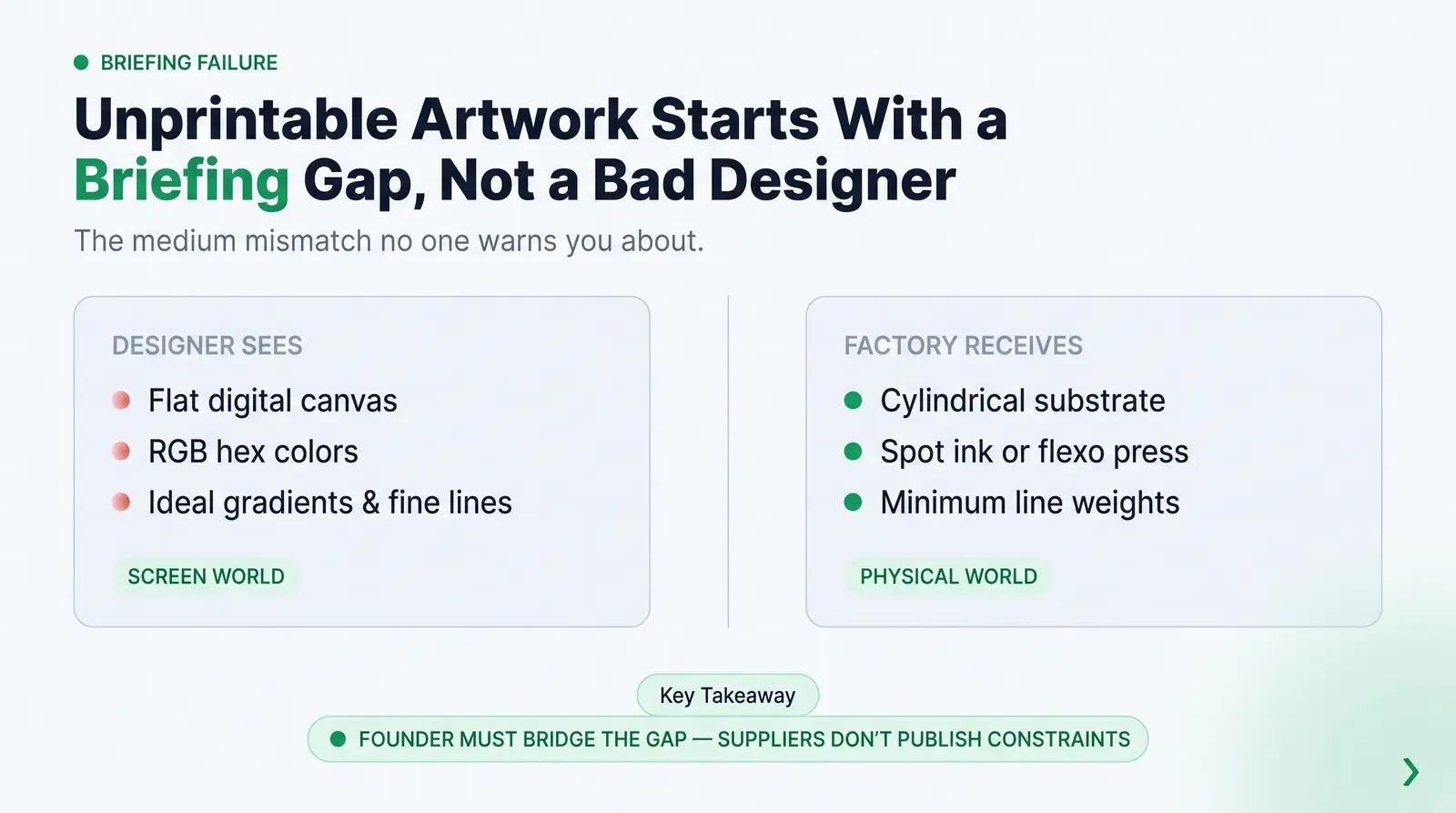
The core problem is a fundamental mismatch in mediums. Graphic designers are typically trained for screen-based digital media or flat commercial print (like brochures and business cards). They are rarely trained for the physics of cylindrical substrates, the distortion of shrink sleeves, the flexographic ink limitations of flexible tubes, or the tight printable areas on a 15 ml (0.5 oz) glass jar.
When a designer opens Adobe Illustrator without technical constraints, they design for an ideal, flat world. They do not know that a two-color spot printing process cannot reproduce a CMYK gradient, or that a barcode wrapped horizontally around a small cylinder will distort and fail to scan at checkout.
This is not the designer's fault; it is a briefing failure. The cost of this failure is a painful revision cycle. The founder must pay the designer to rework the artwork, delaying the launch and burning through capital before a single unit is sold.
The non-obvious truth is that the problem is not that founders hire bad designers. The problem is that even excellent designers cannot self-source accurate packaging constraints because suppliers rarely publish them in a standardized, accessible format. It is the founder's responsibility to bridge the gap between the digital canvas and the physical production line.
The Eight Things Every Cosmetic Packaging Design Brief Must Include
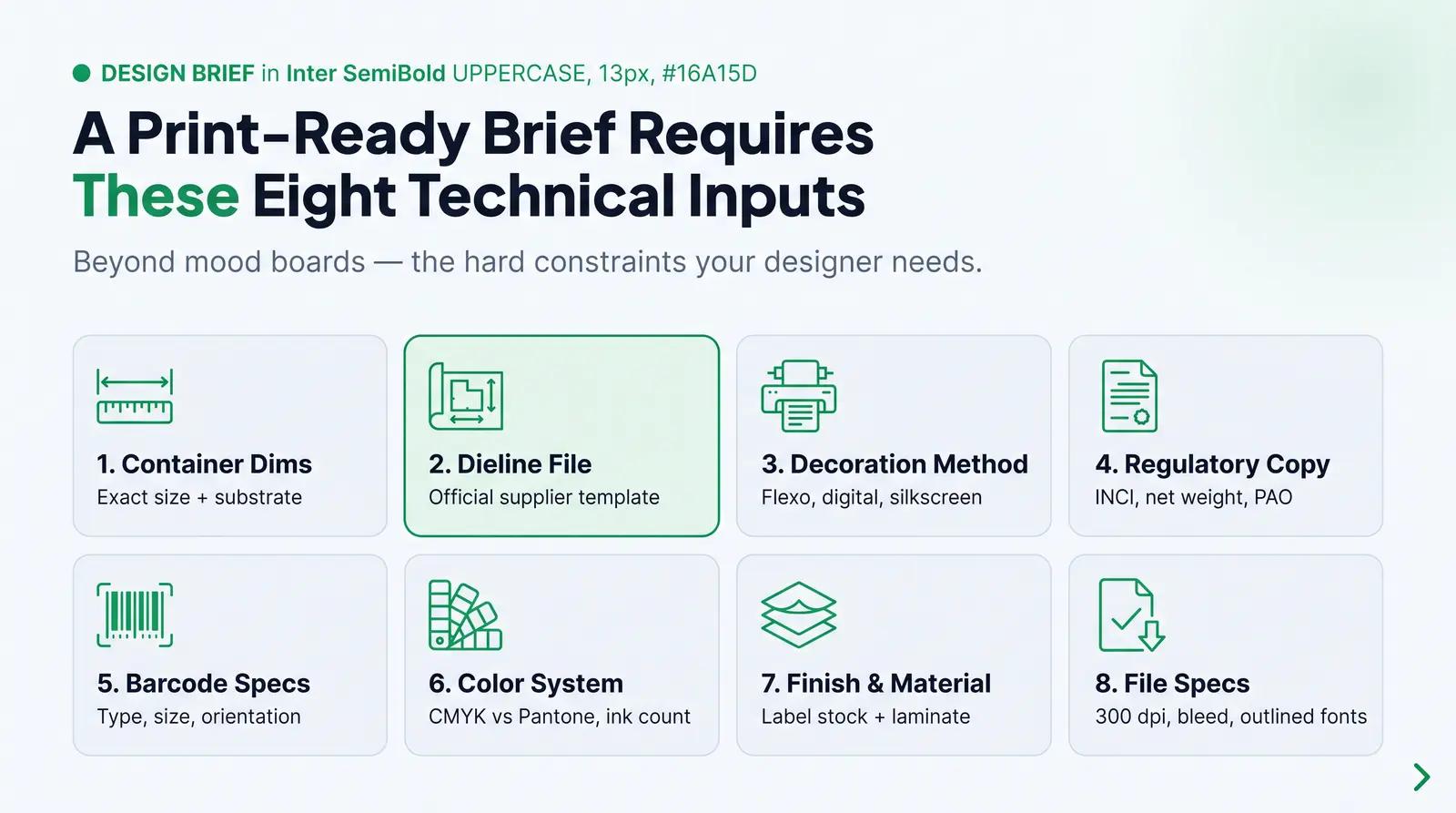
To prevent unprintable artwork, your design brief must move beyond mood boards and brand values. It must include the hard technical constraints of the physical packaging.
Container dimensions and substrate
Designers cannot guess the printable area of a bottle based on its volume. You must provide the exact container dimensions and specify the substrate (e.g., glass, PET, aluminum). Crucially, you must distinguish between the "label area" and the "printable area." The label area is the physical space a label can occupy, while the printable area for direct decoration often excludes the top and bottom curves of a cylinder. For cylindrical containers, you must provide the circumference to determine the flat panel width, and specify whether the design should be a full wrap-around or a front-panel-only application.
The dieline file
The dieline is the architectural blueprint of your packaging. It is a vector file (usually a PDF or Adobe Illustrator .ai file) that shows the exact cut lines, fold lines, and safe zones for the artwork. Your designer needs the supplier's official dieline before they draw a single shape. Without it, they are guessing at the canvas size. Designing without a dieline is the number one cause of unusable artwork files, as the artwork will inevitably bleed into the crimp of a tube or the threading of a jar.
Decoration method
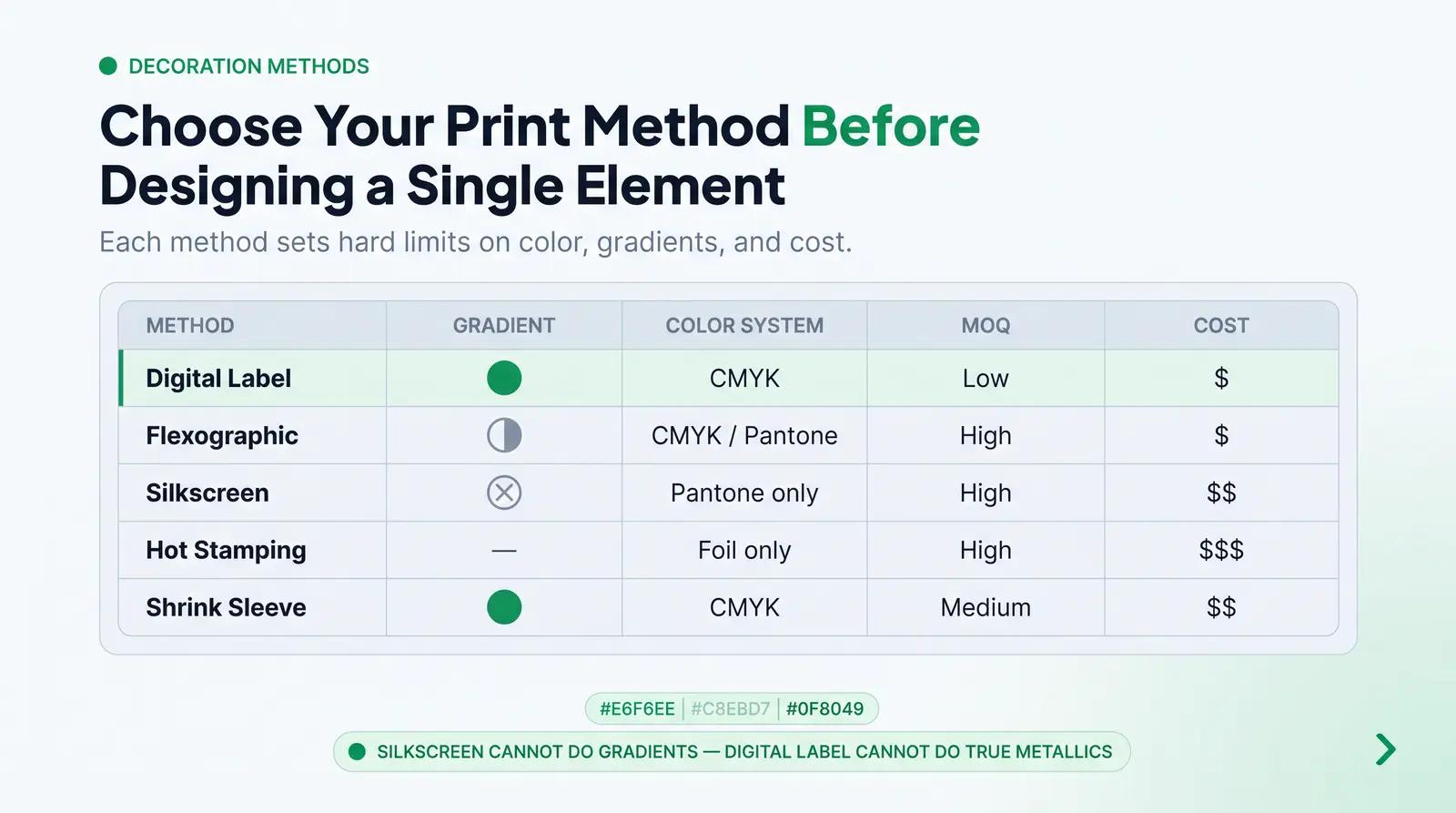
How the artwork is applied to the container dictates what can be designed. You must specify the decoration method upfront. Flexographic label printing requires minimum line weights to prevent ink from filling in [1]. Digital label printing handles gradients and CMYK colors beautifully but may lack the tactile premium feel of direct printing [2]. Direct silkscreen is excellent for bold, solid colors on glass but cannot reproduce gradients [3]. Hot stamping adds metallic luxury but requires custom tooling [4]. Shrink sleeves offer 360-degree coverage but require the designer to pre-distort the artwork to compensate for the shrink ratio over the container's curves [5].
Required regulatory and commercial copy
Cosmetic packaging is highly regulated. Your brief must list every piece of required copy. In the US, under the FDA and the Modernization of Cosmetics Regulation Act (MoCRA), this includes the statement of identity, net weight or volume, ingredient list (INCI), manufacturer or distributor address, country of origin, and any required warning statements [6]. You must also allocate space for the batch code or lot number, the expiration date or Period After Opening (PAO) symbol, and any claim-specific certification marks (like organic or cruelty-free logos).
Barcode specifications
Barcodes are not flexible design elements; they are functional tools with strict requirements. Specify the barcode type (UPC-A, EAN-13, or DataMatrix for very small packs). According to GS1 standards, barcodes must maintain a minimum size and require a "quiet zone" of white space on the left and right sides to scan correctly [7]. Furthermore, you must dictate placement: on cylindrical containers, barcodes should be oriented vertically (ladder style) rather than horizontally (picket fence style) to prevent the curvature of the bottle from distorting the bars and causing scan failures.
Color system and ink limits
You cannot simply hand a designer the RGB hex codes from your website and expect them to match on a physical product. You must specify the color system. CMYK (Cyan, Magenta, Yellow, Black) is used for full-color digital printing and complex imagery [8]. Pantone Matching System (PMS) or spot colors are used for precise brand color matching and direct decoration methods like silkscreen [9]. You must specify the maximum number of colors allowed. If you are using silkscreen, every additional color requires a separate pass and increases the unit cost. If you require metallic or fluorescent inks, these must be specified as spot colors.
Finish and material
The finish of the label or container affects both aesthetics and performance. Specify the label stock (such as BOPP, PE, or paper) and the finish (gloss, matte, soft-touch lamination, or spot UV varnish). The material choice must be compatible with your formula. For example, a standard paper label will absorb moisture and degrade in a shower environment. More critically, oil-based serums can dissolve certain adhesives or cause standard labels to lift at the edges [10]. For direct decoration on glass or aluminum, the "material" refers to the container substrate itself, which dictates which inks will adhere properly.
File specs and proof process
Finally, dictate how the final files should be delivered. Require a press-ready PDF with bleed (typically 1/8 inch or 3 mm) and crop marks [11]. Ensure all fonts are embedded or outlined to prevent typography substitution errors. Specify a minimum resolution of 300 dpi for any raster images. Outline the proofing process: state whether you require a digital PDF proof or a physical press proof before approving the final production run.
The Cosmetic Packaging Brief Handoff Checklist
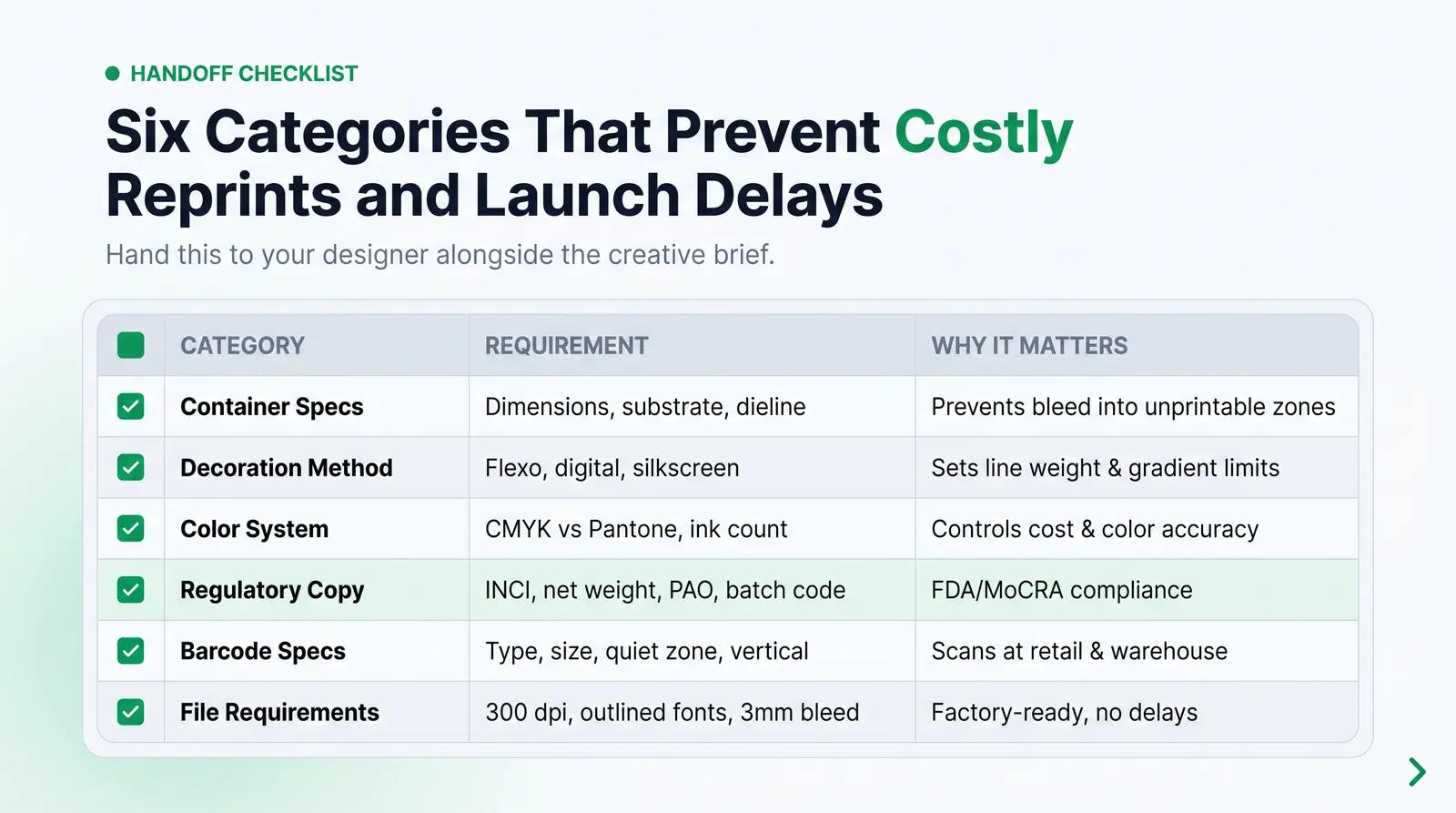
To ensure nothing is missed, we recommend a practical framework at Packfolio. Print or copy this checklist and hand it to your designer alongside your creative brief.
| Category | Requirement | Why it matters |
|---|---|---|
| Container Specs | Exact dimensions, substrate material, and official supplier dieline file. | Prevents artwork from bleeding into unprintable zones or wrapping incorrectly around curves. |
| Decoration Method | Specified printing technique (e.g., digital label, silkscreen, flexo). | Dictates the technical limits for line weights, gradients, and typography size. |
| Color System | CMYK vs. Pantone, and the maximum number of allowable ink colors. | Ensures accurate brand color reproduction and controls per-unit printing costs. |
| Regulatory Copy | INCI ingredients, net weight, distributor address, PAO symbol, batch code space. | Ensures compliance with FDA/MoCRA regulations and prevents costly recalls or reprints. |
| Barcode Specs | Barcode type, minimum size, quiet zones, and vertical orientation for cylinders. | Guarantees the product will scan at retail checkout and warehouse intake. |
| File Requirements | Press-ready PDF, outlined fonts, 300 dpi resolution, and 1/8" (3mm) bleed. | Provides the factory with a flawless file that moves straight to production without delays. |
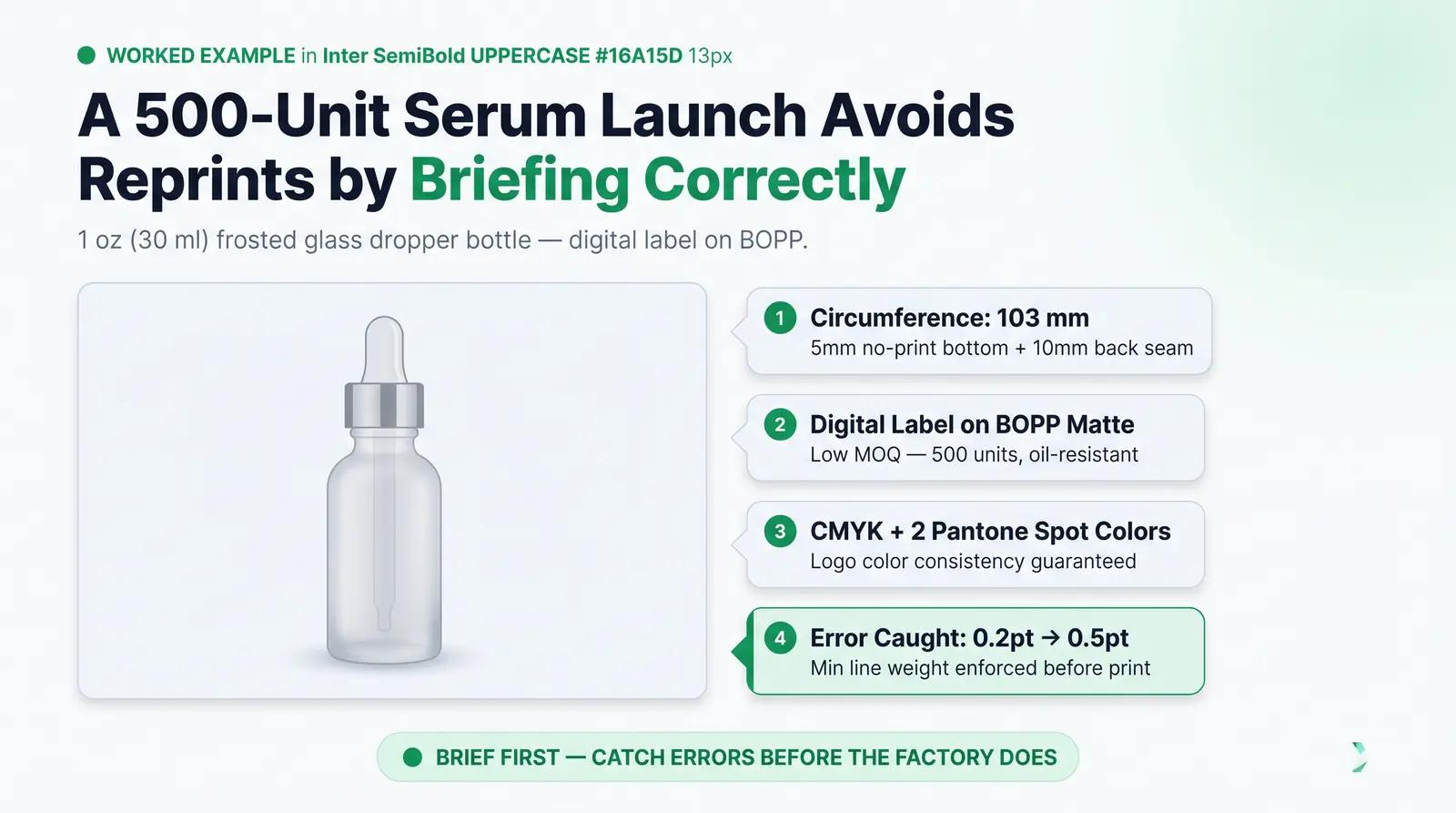
Worked Example — Briefing a Designer for a 1 oz (30 ml) Frosted Glass Serum Bottle
Consider a founder launching a vitamin C brightening serum in a 1 oz (30 ml) frosted glass dropper bottle. She plans a direct-to-consumer launch with 500 units as a first run. She has hired a freelance graphic designer who primarily does brand identity work.
First, she requests the technical drawing from the supplier. The dieline reveals a total circumference of 103 mm, but notes a 5 mm no-print zone near the bottom curve and a 10 mm gap requirement at the back seam.
Because her initial run is only 500 units, she chooses digital label printing on a BOPP substrate with a matte laminate finish. Direct silkscreen would require high setup costs for such a small run, and BOPP ensures the label will not degrade if the oil-based serum drips down the bottle [10].
She instructs the designer to use CMYK for the artwork, but specifies two specific Pantone spot colors for her brand logo to ensure perfect color consistency. She provides a text document containing the exact INCI ingredient list, the net volume (1 fl oz / 30 ml), a PAO symbol (12M), space for a stamped batch code, her distributor address, and the UPC-A barcode.
During the design phase, the designer attempts to use a delicate, 0.2 pt line weight for the ingredient text. Because the founder provided the brief, she catches this error, noting that the minimum line weight for their chosen printer is 0.5 pt to ensure legibility. She requests the final file as an outlined, press-ready PDF with a 3 mm bleed. The file goes to the printer, and the labels arrive perfectly sized and completely legible.
Comparison Table — Decoration Methods vs. Key Constraints
| Decoration Method | MOQ Sensitivity | Color System | Gradient Capability | Metallic/Special Effects | Typical Cost Tier | Best-Fit Containers |
|---|---|---|---|---|---|---|
| Digital Label | Low (Great for small runs) | CMYK | Excellent | Limited (requires specialty stock) | Low to Medium | Jars, standard bottles, tubes |
| Flexographic Label | High (Requires plates) | CMYK or Pantone | Good (minimum dot limits) | Good (cold foil options) | Low at high volume | High-volume bottles, jars |
| Silkscreen (Direct) | High (Setup intensive) | Pantone (Spot) | Poor (Solid colors only) | None directly (use hot stamp) | Medium to High | Glass bottles, premium plastics |
| Hot Stamping | High (Custom tooling) | Foil only | None | Excellent (True metallic) | High | Luxury glass, compacts, closures |
| Shrink Sleeve | Medium to High | CMYK | Excellent | Good (with specialty inks) | Medium | Complex shapes, 360° coverage |
Packfolio's catalog provides the supplier's technical drawing, predefined printable regions, and a 3D preview for every SKU, so founders can hand their designer an accurate brief and then proof the artwork before the order is placed — without coordinating separately with a factory.
Before you finalize your next product launch, ensure your designer has the exact technical constraints they need to succeed. Browse Packfolio's curated cosmetic packaging catalog — every SKU includes a technical drawing, predefined print zones, and a 3D preview tool so your designer has everything they need before they open Illustrator. Explore the catalog →
Frequently Asked Questions
What is a packaging dieline and why is it important? A dieline is a vector-based template that serves as the architectural blueprint for your packaging. It shows the exact cut lines, fold lines, and printable areas, ensuring the designer's artwork fits the physical container perfectly without bleeding into unprintable zones.
Why can't I use CMYK for silkscreen cosmetic printing? Silkscreen printing applies thick layers of ink one color at a time through a mesh screen, which is ideal for solid, vibrant colors. It cannot blend four base colors (CMYK) to create the photorealistic images or smooth gradients that digital printing achieves.
What are the FDA labeling requirements for cosmetics? The FDA requires the principal display panel to show the statement of identity and net quantity of contents. The information panel must include the name and place of business, a declaration of ingredients in descending order of predominance, and any necessary warning statements.
How do I prevent my cosmetic labels from peeling off? Label lift is often caused by a mismatch between the label adhesive and the product formula or environment. For oil-based products or items used in humid environments like showers, use a synthetic substrate like BOPP or PE with a high-solvent-resistance adhesive.
What is the minimum line weight for cosmetic packaging design? Minimum line weights vary by decoration method, but generally, positive lines should be at least 0.35 to 0.5 points, and reverse (knockout) lines should be 0.5 to 0.75 points. Thinner lines risk filling in with ink or disappearing entirely during the printing process.
References
- Flexo-Friendly Design: General Guidelines for Label Printing Rose City Label, 2025.
- Digital vs. Flexographic Printing: Which is Right for Your Labels? Blue Label Packaging, 2024.
- Glass Bottle Decoration Techniques: Enhancing Visual Appeal and Branding Maaricha, 2023.
- Hot Stamp for Fragrance and Glass Cosmetic Packaging ITW CER, 2024.
- What is a Shrink Sleeve Label? Blue Label Packaging, 2024.
- Summary of Cosmetics Labeling Requirements U.S. Food and Drug Administration, 2025.
- Barcode Placement & Printing Guidelines GS1 US, 2024.
- Pantone vs. CMYK for Custom Branded Packaging EcoEnclose, 2024.
- Mastering Pantone Colors: Essential Guide for the Packaging Industry Epackprinting, 2024.
- 6 Label Tips for Cosmetics and Beauty Products Blue Label Packaging, 2024.
- A Quick And Thorough Guide To Creating Label Artwork O.Berk, 2019.


