
AI Label Design for Beauty Packaging: Where It Helps and Where It Fails
AI accelerates beauty label concepting but fails at print readiness, regulatory compliance, and brand consistency, requiring human expertise to bridge the gap to production.
AI tools can generate a beautiful label concept in minutes, but that same file can fail at press, fall short of FDA or EU labeling requirements, and undermine hard-won brand equity if rushed into production. Generative design has compressed the timeline for visual ideation, allowing beauty founders to iterate on aesthetics faster than ever. However, creating a plausible image on a screen is entirely different from producing a print-ready file that complies with international regulations and aligns perfectly with physical packaging dimensions. The tension between creative speed and production reality is where many brands stumble, turning rapid concepting into costly delays.
Understanding where AI accelerates the workflow and where it introduces risk is essential for modern beauty brands. A thoughtful approach leverages AI for what it does best—rapid visual exploration—while relying on human expertise and established systems for the critical back-end tasks of compliance, print specification, and brand consistency.
What AI Label and Packaging Design Tools Actually Do
Current AI tools, including generative image models like Midjourney, AI-assisted layout platforms like Canva’s Magic Studio, and specialized packaging generators like Packify, operate by recognizing and reproducing patterns from vast datasets of existing designs. When prompted, these tools synthesize colors, typography, and layouts to produce a visual concept that matches the user's description. They excel at producing flat images or digital 3D mockups that simulate how a product might look.
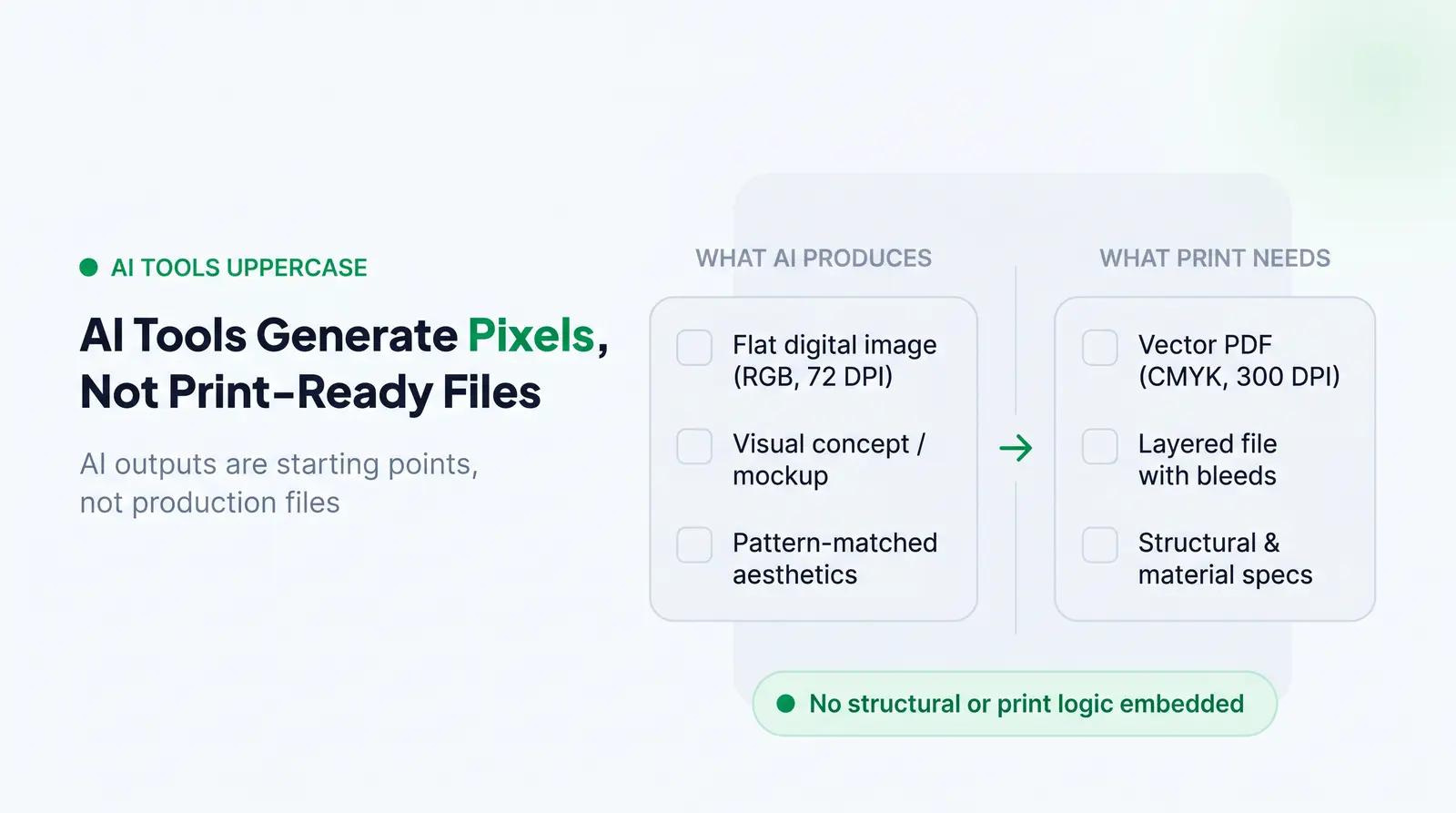
However, these outputs are essentially digital paintings. They do not possess an underlying understanding of structural engineering, material science, or print mechanics. A generative AI tool does not know that a metallic gold accent requires a specific spot color callout, or that a gradient needs a certain resolution to avoid banding on press. It generates pixels arranged to look like a finished label, but it does not generate the functional layers, vector paths, and metadata required by a commercial printer [1]. The output is a starting point, not a destination.
Where AI Genuinely Helps: The Creative Front End
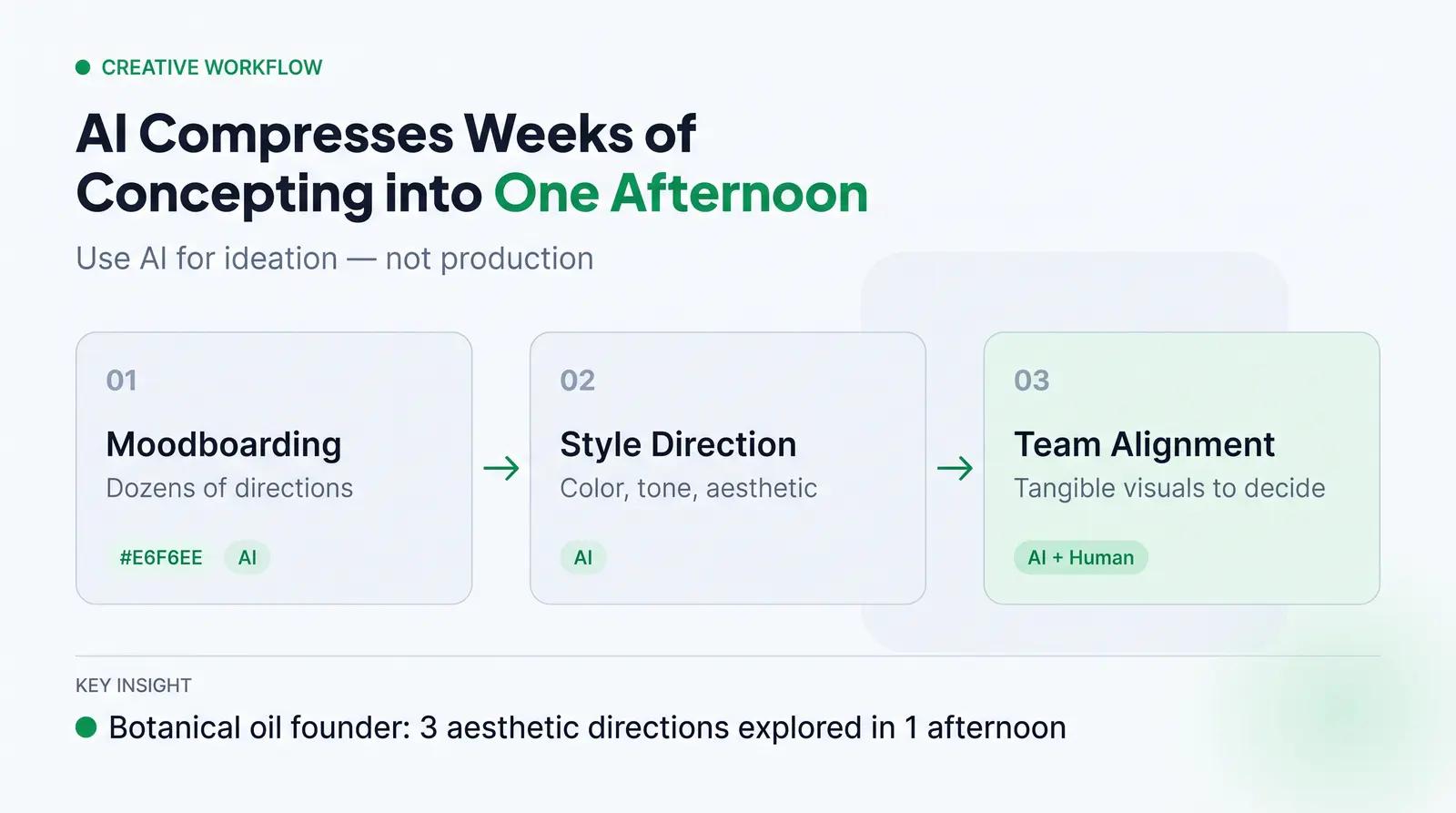
The true value of AI in packaging design lies in the creative front end. Moodboarding, concept generation, rapid iteration, and style direction are areas where AI tools dramatically compress timelines. Instead of spending weeks waiting for initial sketches, a founder can use AI to explore dozens of visual directions in a single afternoon.
Consider a founder launching a new botanical face oil. They want to explore three distinct aesthetic directions: minimalist clinical, vibrant organic, and dark apothecary. Using an AI label generator, they can input these prompts and instantly receive visual concepts for each. This allows the team to evaluate how different color palettes interact with amber glass or frosted dropper bottles before committing to a specific design path. AI serves as a powerful catalyst for decision-making, providing tangible visuals that help teams align on a direction faster and communicate their vision more effectively to a professional designer.
Where AI Fails: The Production and Compliance Back End
While AI excels at generating compelling concepts, it consistently fails at the rigorous requirements of production and compliance. Relying on AI outputs as final files introduces significant risks that can halt production or lead to costly recalls.
Regulatory Compliance
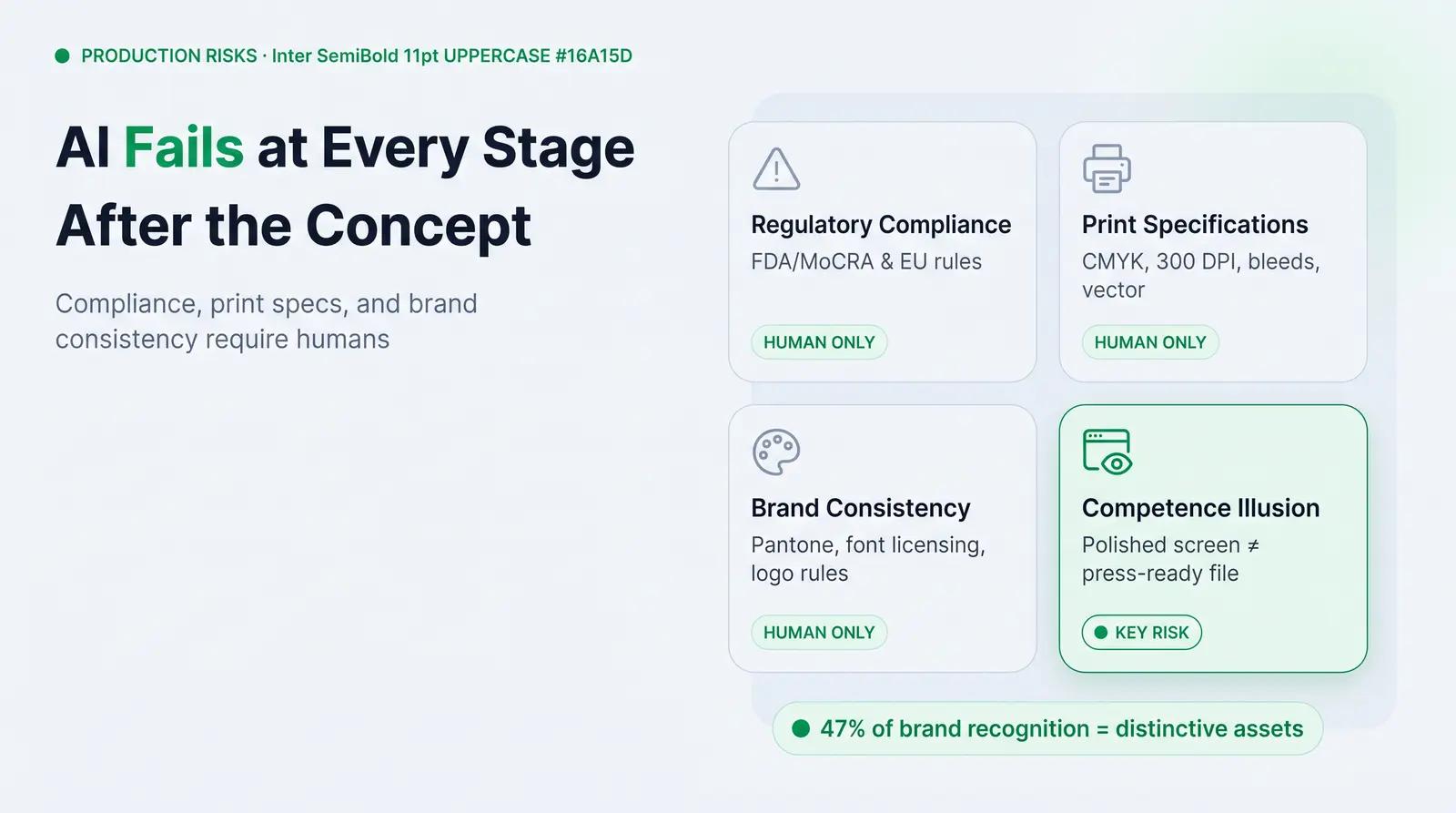
AI tools do not understand regulatory frameworks. They will happily generate a label that looks professional but omits critical legal requirements. In the United States, the Modernization of Cosmetics Regulation Act of 2022 (MoCRA) and existing FDA regulations mandate specific elements on cosmetic labels, including a statement of identity, net quantity of contents, name and place of business, and a proper ingredient declaration using INCI (International Nomenclature Cosmetic Ingredient) names [2] [3]. Upcoming MoCRA rules will also require the disclosure of specific fragrance allergens [4].
Similarly, the EU Cosmetics Regulation 1223/2009 requires strict labeling elements, such as the name and address of the Responsible Person, country of origin, nominal content, date of minimum durability or period after opening (PAO) symbol, batch number, and specific precautions for use [5]. An AI tool might place a barcode or a random symbol where a PAO icon belongs, or invent an ingredient list that fails to follow the required descending order of predominance. Human review is non-negotiable to ensure every legal requirement is met.
Print Production Specifications
AI-generated files are fundamentally incompatible with commercial printing standards. Most AI platforms export images in RGB color mode at 72 or 150 DPI, which is optimized for screens. Commercial printing requires CMYK color mode and a minimum resolution of 300 DPI [1]. Converting a low-resolution RGB image to CMYK often results in dull, muddy colors and pixelated text that looks unprofessional on the shelf.
Furthermore, print-ready files must account for physical realities. They require precise bleeds (typically 0.125 inches) to ensure color extends to the edge of the cut, safe zones to prevent text from being trimmed, and vector graphics for crisp typography and logos [6]. AI tools cannot generate the layered, vector-based PDF files required for proper prepress setup, meaning every AI concept must be meticulously rebuilt by a designer before it can be printed.
Brand Consistency
A critical limitation of generative AI is its tendency toward homogenization. Because these models are trained on existing successful designs, their outputs often converge on generic, category-standard aesthetics—what some researchers call "visual elevator music" [7]. While an AI tool can create a beautiful label for a single SKU, it struggles to maintain strict brand consistency across a complex product line.
AI cannot reliably adhere to a brand's specific font licensing, exact Pantone color matches, or logo treatment rules across different packaging formats. A 2023 Kantar study highlighted that distinctive brand assets drive 47% of brand recognition [8]. Relying on AI to generate packaging risks eroding these distinctive assets, resulting in a product line that looks disjointed or indistinguishable from competitors.
The Competence Illusion
The most non-obvious risk of AI in packaging design is the "competence illusion." AI tools generate files that look incredibly polished and complete on a computer screen. This high level of visual fidelity can trick founders into believing the file is ready for production. However, beneath the surface, the file lacks the necessary resolution, color profiles, and regulatory text. This illusion leads brands to bypass professional prepress review, resulting in files that pass internal approval but fail spectacularly on the printing press.
The AI-to-Press Readiness Framework
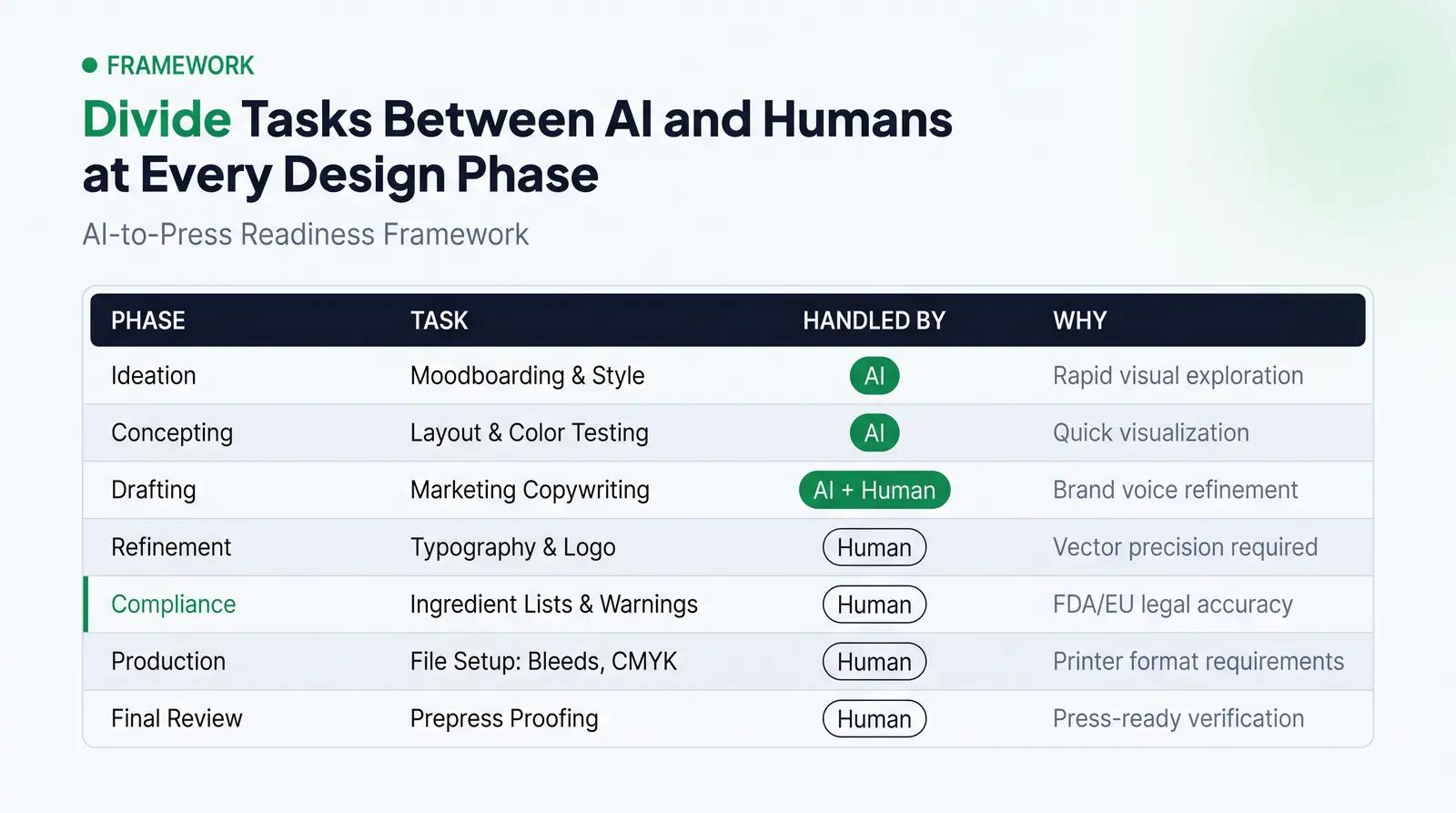
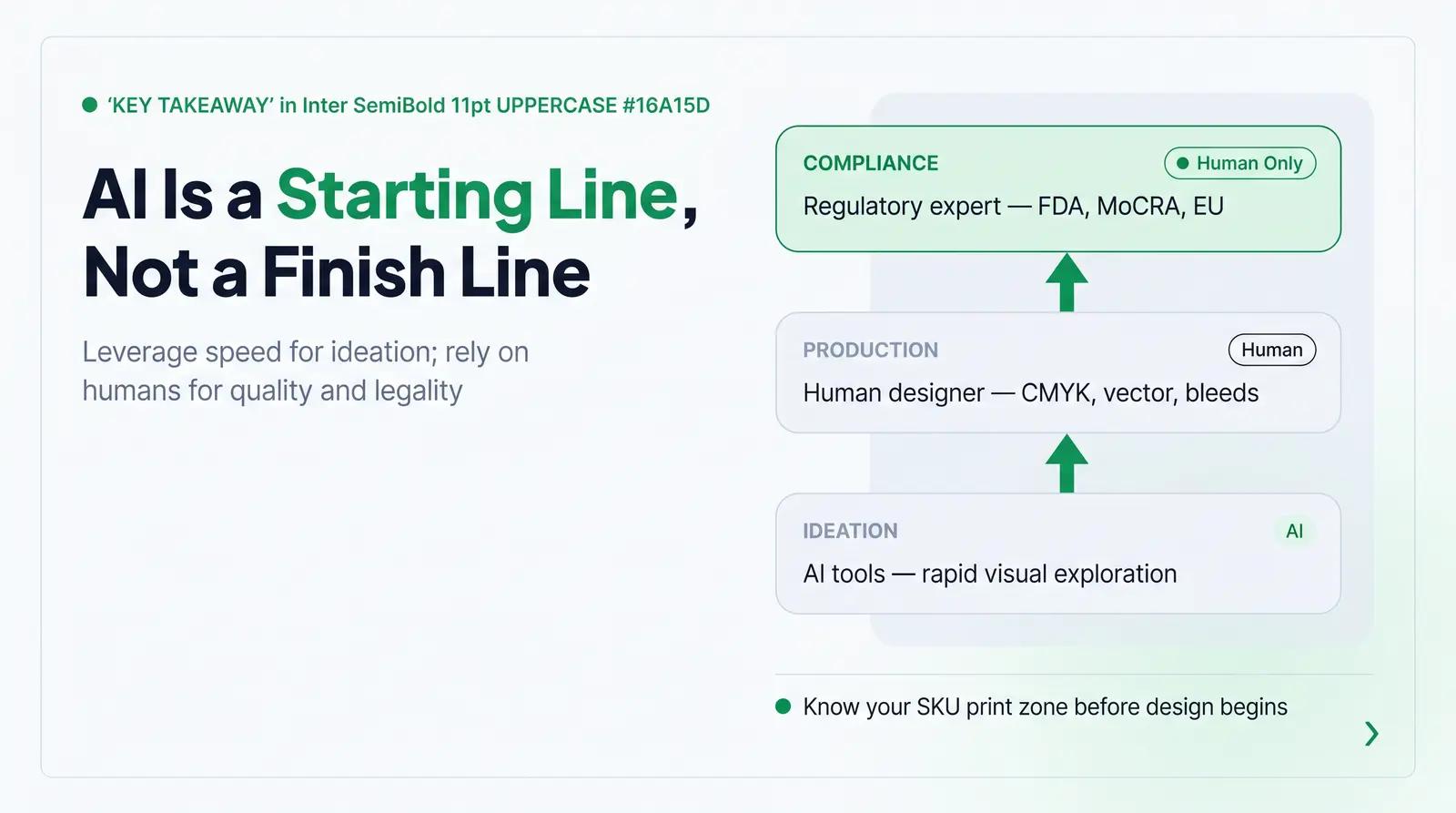
To navigate these challenges, founders need a clear method for dividing tasks between AI tools and human experts. The AI-to-Press Readiness Framework provides a practical guide for integrating AI responsibly into the packaging workflow.
The AI-to-Press Readiness Framework
| Design Phase | Task | Best Handled By | Rationale |
|---|---|---|---|
| Ideation | Moodboarding & Style Exploration | AI | Rapidly generates diverse visual concepts to align team vision. |
| Concepting | Layout & Color Palette Testing | AI | Allows for quick visualization of how elements might look together. |
| Drafting | Copywriting (Marketing) | Human + AI | AI can draft initial copy, but humans must refine for brand voice. |
| Refinement | Typography & Logo Placement | Human | Requires vector precision and adherence to strict brand guidelines. |
| Compliance | Ingredient Lists & Warnings | Human | Must adhere to FDA/MoCRA and EU regulations; AI cannot verify legal accuracy. |
| Production | File Setup (Bleeds, CMYK, Vector) | Human | Commercial printers require specific technical formats that AI cannot generate. |
| Final Review | Prepress Proofing | Human | Final check to ensure colors, dimensions, and compliance are press-ready. |
A Worked Example: The Vitamin C Serum
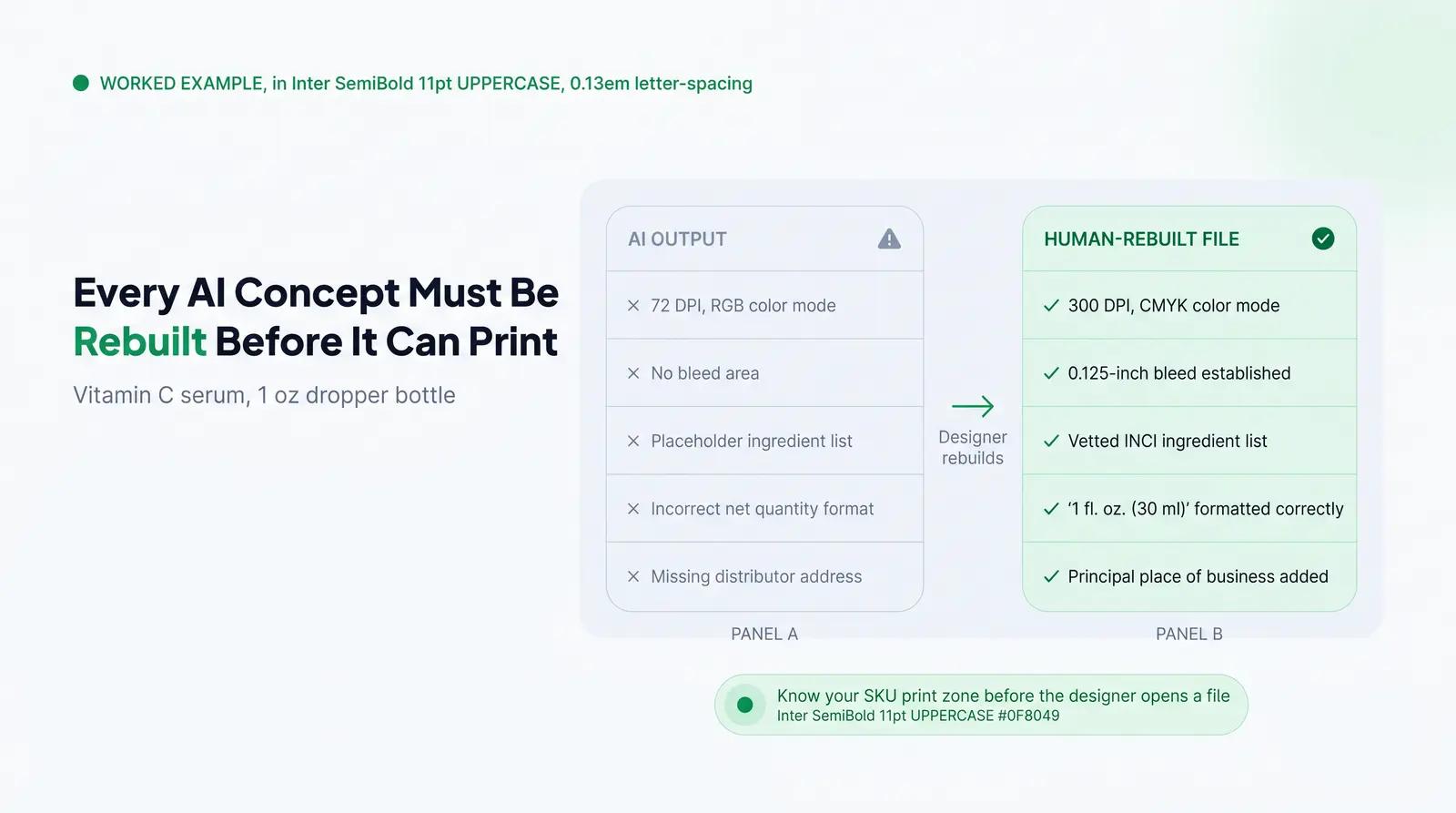
Imagine a founder launching a vitamin C brightening serum in a 1 oz (30 ml) glass dropper bottle. They use an AI tool to generate three label concept directions in an afternoon. The AI produces stunning, photorealistic mockups featuring a minimalist layout, a bold citrus-inspired color palette, and elegant typography.
However, the AI outputs are flat, 72 DPI RGB images. They lack a bleed area, and the ingredient list is a placeholder string of generic chemical names. The "Net Wt." is incorrectly formatted, and there is no mention of the distributor's address or the required MoCRA compliance elements.
To make this print-ready, a human designer must step in. They use the AI concept as a visual reference but rebuild the label entirely in vector software (like Adobe Illustrator). They set the document to CMYK, establish a 0.125-inch bleed, and ensure the resolution is 300 DPI. They replace the placeholder text with the legally vetted INCI ingredient list, format the net quantity correctly as "1 fl. oz. (30 ml)," and add the company's principal place of business. Finally, they ensure the design fits the exact dimensions of the printable area on the specific 1 oz dropper bottle.
This is where understanding the physical constraints of your packaging becomes crucial. Packfolio's catalog provides pre-modeled 3D SKUs with predefined printable regions, so founders know the exact print zone dimensions before their designer opens a file—reducing back-and-forth between design and production. Knowing these dimensions upfront ensures that the human designer rebuilds the AI concept to fit the actual physical container perfectly.
Final Thoughts
AI is a transformative tool for the beauty industry, but it is a starting line, not a finish line. It democratizes visual ideation, allowing brands to explore concepts with unprecedented speed. However, the physical reality of packaging—where regulatory compliance, print specifications, and brand consistency intersect—requires human expertise. By understanding where AI helps and where it fails, beauty founders can leverage the technology to accelerate their vision without compromising the quality or legality of their final product.
Browse Packfolio's packaging catalog, confirm your SKU's print zone dimensions, then bring those specs to your designer or AI tool with confidence → Explore the Catalog
Frequently Asked Questions
Can I send an AI-generated label directly to a commercial printer? No. AI-generated images are typically low-resolution, RGB files that lack the necessary bleeds, safe zones, and vector data required for commercial printing. A designer must rebuild the concept into a print-ready CMYK PDF.
Will AI automatically include FDA or EU compliance information? No. AI tools do not understand or verify legal requirements. You must manually ensure your label includes mandatory elements like the statement of identity, net quantity, distributor address, and correct INCI ingredient lists.
How do I make sure my AI design fits my physical packaging? You must obtain the exact dieline or printable area dimensions for your specific packaging SKU before finalizing the design. The AI concept must be rebuilt by a designer to match these exact physical dimensions.
Can AI maintain my brand's specific colors across different products? AI struggles with strict brand consistency and cannot reliably output exact Pantone matches or adhere to specific brand guidelines across multiple SKUs. A human designer is needed to ensure color accuracy and brand alignment.
Is it safe to use AI for ingredient lists and warnings? Absolutely not. AI is prone to hallucinating information and cannot be trusted to generate legally compliant ingredient lists or safety warnings. All compliance text must be verified by a regulatory expert or legal counsel.
References
- Why AI Isn’t the Best Resource for Label Design (Especially When It Comes to Print), Revolution Print and Packaging, 2024.
- Modernization of Cosmetics Regulation Act of 2022 (MoCRA), U.S. Food and Drug Administration, 2026.
- Summary of Cosmetics Labeling Requirements, U.S. Food and Drug Administration, 2025.
- The 2026 Guide to FDA Cosmetic Labeling Requirements, Esko, 2026.
- Understanding the label, Cosmetics Europe, 2026.
- Are there design requirements for label printing?, Consolidated Label, 2026.
- Autonomous language-image generation loops converge to generic visual motifs, Patterns, Volume 7, Issue 1, 2026.
- What are distinctive assets, and why are they important?, Kantar, 2024.


