
Semi-Custom Cosmetic Packaging: The Middle Path for Indie Beauty Brands
Semi-custom cosmetic packaging layers decoration methods like screen printing, hot stamping, and closure swaps onto stock components, giving indie beauty brands a premium look without custom mold costs.
For a founder launching a new beauty brand, sourcing primary packaging often feels like a trap with only two ways out. On one side, there is the blank, generic stock bottle—functional, accessible, but entirely forgettable on a retail shelf. On the other side sits the fully custom mold, promising true brand differentiation but demanding a 25,000-unit minimum order quantity (MOQ) and a $30,000 tooling investment before a single unit is filled [1].
Most founders assume they must choose between these extremes, compromising either their cash flow or their brand identity. But this "custom or stock" binary is a myth. Between the generic stock bottle and the fully tooled custom component lies a broad, flexible spectrum known as semi-custom packaging. Semi-custom allows brands to take high-quality stock components and apply sophisticated decoration layers—screen printing, hot stamping, closure swaps, and custom labels—to achieve a premium, proprietary look at volumes that align with an indie brand's actual launch trajectory. Understanding how to navigate this middle path is how smart beauty founders protect their capital without sacrificing their aesthetic.
The Customization Layer Map
The secret to semi-custom packaging is understanding that decoration methods are modular. A brand does not need to alter the physical geometry of a bottle to make it unique; they only need to change how the surface is treated. Each decoration method carries its own visual impact, unit cost premium, and MOQ threshold.
Custom Label Printing
Labeling is the most accessible entry point into customization. Modern digital printing on materials like BOPP (Biaxially Oriented Polypropylene) offers photographic quality, durability against oils and water, and low MOQs [2]. Brands can utilize clear labels for a sophisticated "no-label look" or textured papers for an apothecary aesthetic. Because labels are printed separately and applied later, they do not trigger the high MOQs associated with direct-to-bottle printing.
Screen Printing
Screen printing applies ink directly onto the container through a mesh stencil, resulting in crisp, durable graphics [3]. It is the industry standard for applying logos and text directly to glass or plastic. While single-color screen printing can sometimes be secured at MOQs as low as 200 to 500 units on stock components, multi-color designs require precise registration and multiple passes, which often drives the MOQ higher [4].
Hot Stamping
Hot stamping uses heat and pressure to transfer metallic foil—typically gold, silver, or holographic—onto the packaging surface [5]. It instantly elevates the perceived value of a component, signaling luxury. Because the process requires custom metal dies and precise application, it usually commands a higher cost premium and an MOQ starting around 500 units [4].
Closure Swaps
Swapping the cap, pump, or dropper on a stock bottle is frequently the highest ROI customization available to early-stage founders. The visual impact per dollar is massive. A standard flint glass bottle transforms completely when paired with a matte black aluminum collar or a custom-colored dispensing pump. Because closures are often manufactured separately from the primary vessel, suppliers can sometimes mix and match stock bodies with different stock closures without triggering custom tooling MOQs.
Stock Mold Color Fills
Instead of accepting standard clear, amber, or white, brands can request custom color injection for plastic components or custom color spraying for glass. This ensures the component matches the brand's exact Pantone color. However, because this requires cleaning the manufacturing line and mixing a specific resin or paint batch, custom coloring typically pushes the MOQ up to 3,000 to 5,000 units [6].
Sleeve Decoration
Shrink sleeves offer 360-degree graphic coverage, hugging the contours of the container [7]. They are excellent for complex artwork or uniquely shaped bottles where screen printing is impossible. However, shrink sleeves present distinct challenges for low-volume launches: the minimum run for the sleeves themselves is often 5,000 units, hand-application is labor-intensive, and the sleeves can complicate the recyclability of the underlying container [7].
Embossing and Debossing
Embossing raises a design above the surface, while debossing presses it inward [8]. When applied to secondary packaging (like paper cartons), this adds a tactile, premium feel for pennies per unit [9]. However, applying embossing directly to a primary glass or plastic container requires modifying the mold itself, pushing the project out of the semi-custom realm and into full custom tooling [10].
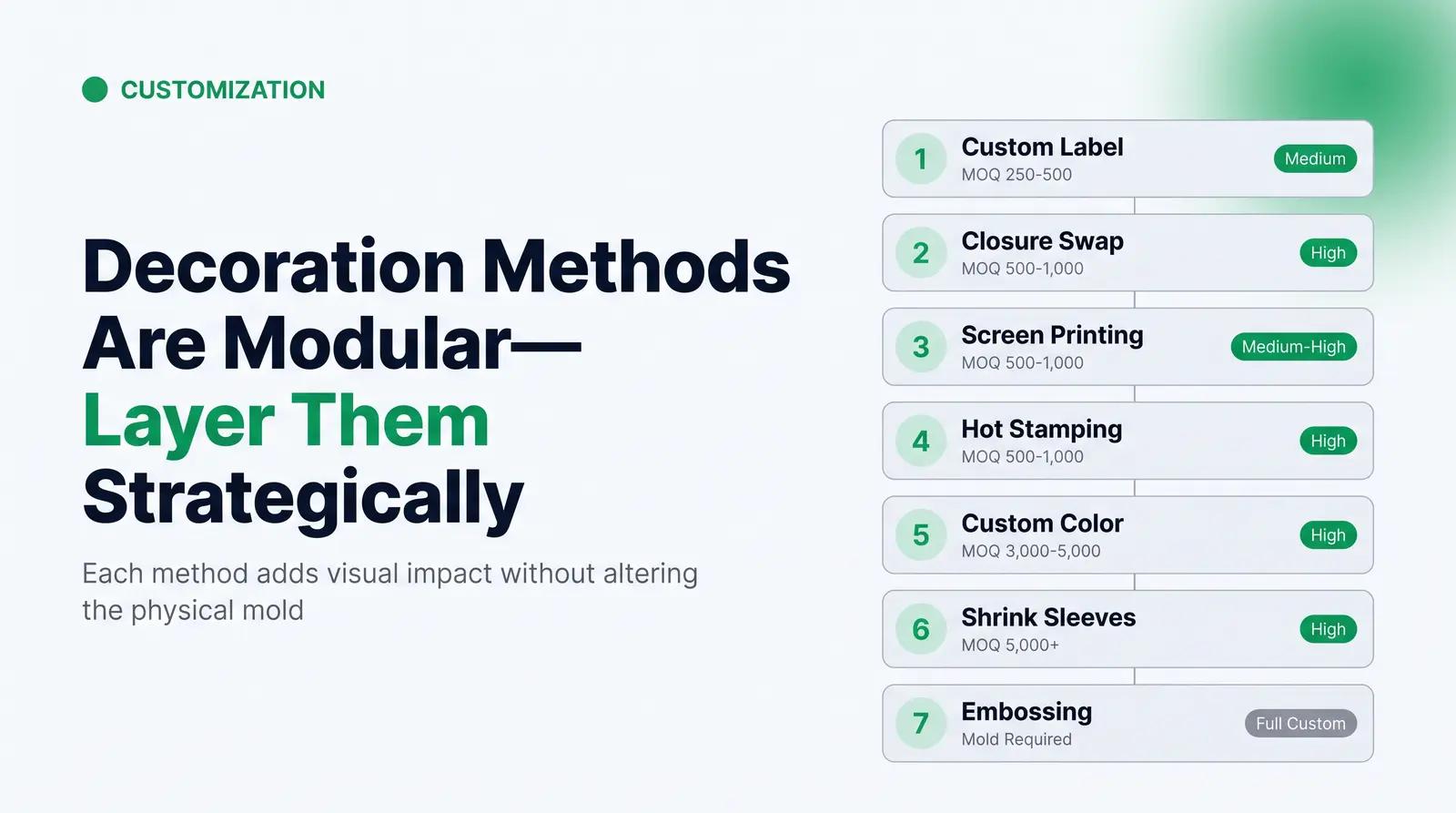
MOQ Economics by Customization Tier
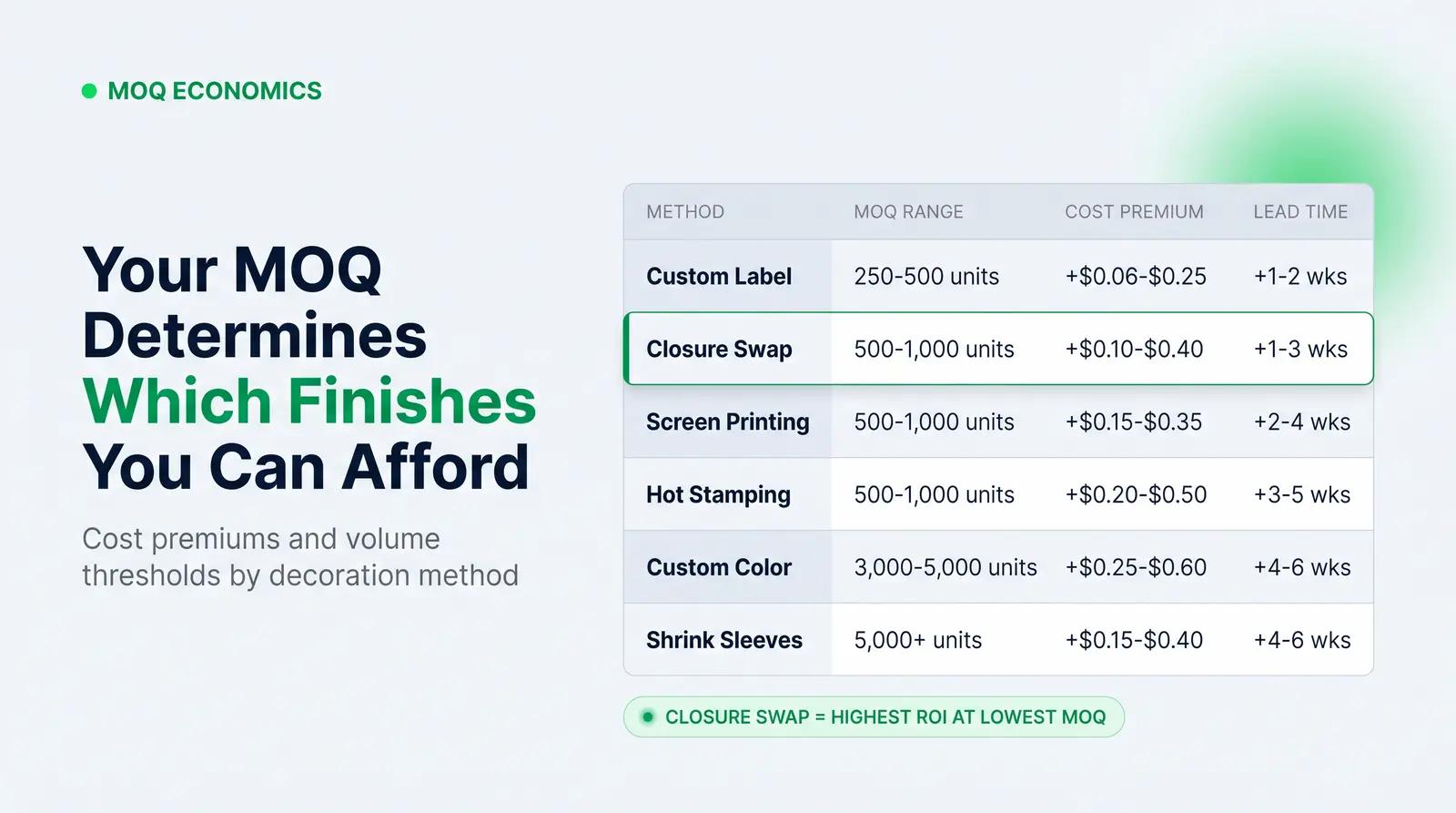
To navigate semi-custom packaging effectively, founders must understand how each decoration layer impacts their unit economics and volume commitments. The table below outlines the typical parameters for various customization methods applied to stock components.
| Customization Method | Visual Impact | Typical MOQ Range | Unit Cost Premium | Lead Time Impact | Best For |
|---|---|---|---|---|---|
| Custom Label (BOPP/Paper) | Medium | 250–500 units | +$0.06–$0.25 | +1–2 weeks | Rapid launches, complex multi-color artwork |
| Closure Swap (Stock) | High | 500–1,000 units | +$0.10–$0.40 | +1–3 weeks | Instant differentiation, premium positioning |
| Screen Printing (1-2 Colors) | Medium-High | 500–1,000 units | +$0.15–$0.35 | +2–4 weeks | Clean, minimalist branding directly on component |
| Hot Stamping (Foil) | High | 500–1,000 units | +$0.20–$0.50 | +3–5 weeks | Luxury accents, metallic logos |
| Stock Mold Custom Color | High | 3,000–5,000 units | +$0.25–$0.60 | +4–6 weeks | Brand color blocking, opaque UV protection |
| Shrink Sleeves | High | 5,000+ units | +$0.15–$0.40 | +4–6 weeks | 360-degree artwork, tamper evidence |
Note: Cost premiums are directional estimates relative to the base stock component cost and vary significantly by supplier, material, and geographic region [4] [6].
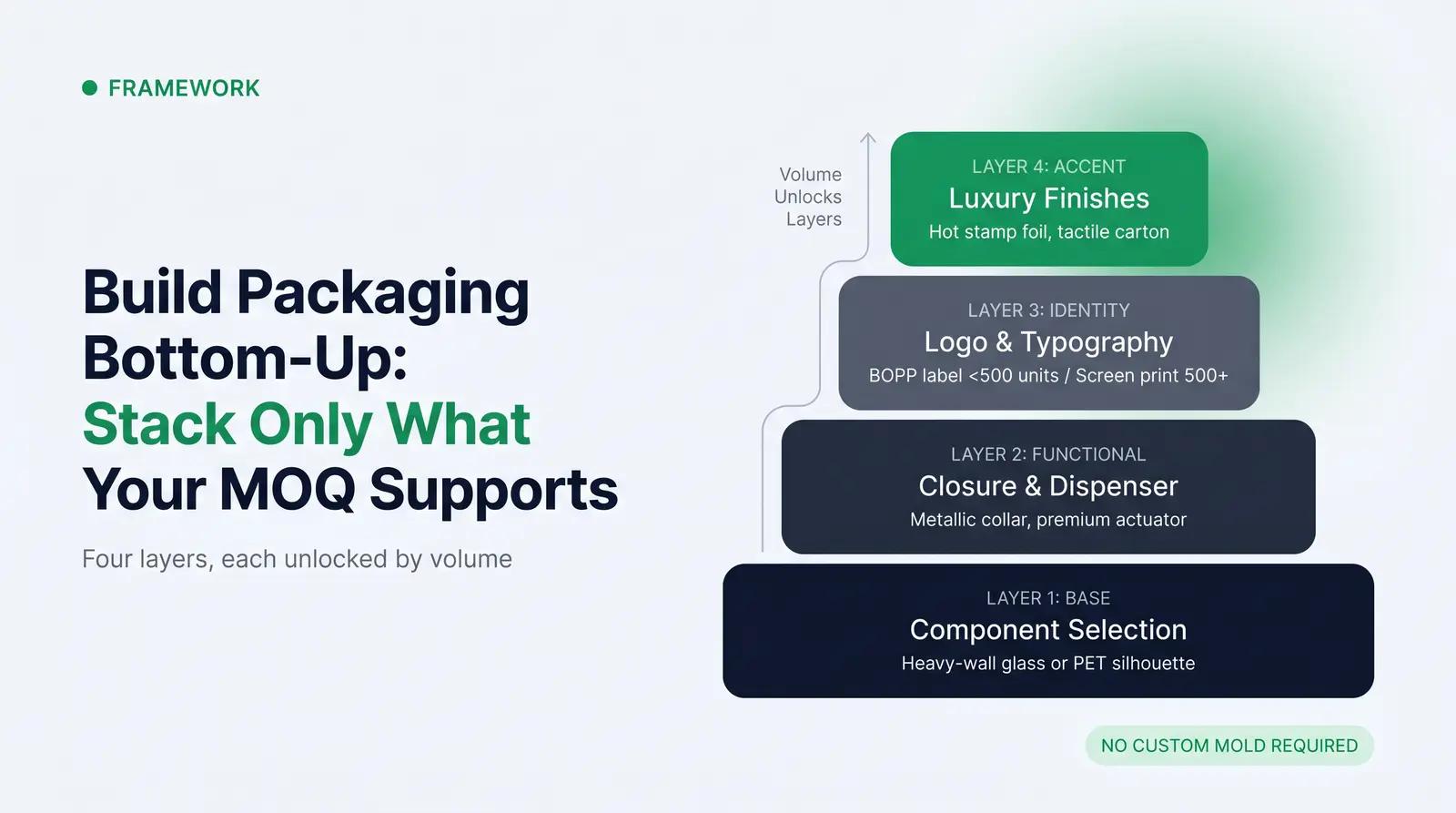
The Semi-Custom Stack Framework
The most successful indie beauty brands do not rely on a single decoration method; they layer them strategically. We recommend using The Semi-Custom Stack Framework to sequence packaging decisions based on launch volume and budget.
The framework operates on a simple principle: build your packaging from the base component upward, only adding layers that your current MOQ can support.
- The Base Layer (Component Selection): Select a high-quality stock mold. The weight, material (e.g., heavy-wall glass vs. standard PET), and silhouette establish the baseline perception of the product.
- The Functional Layer (Closure/Dispenser): Choose a closure that enhances the user experience and visual profile. A premium actuator or a metallic dropper collar can make a stock bottle feel bespoke.
- The Identity Layer (Primary Branding): Apply your logo and core typography. At volumes under 500, use a high-quality BOPP label. At volumes between 500 and 1,000, graduate to single-color screen printing.
- The Accent Layer (Luxury Finishes): If budget allows and the retail price point demands it, add a hot-stamped foil accent or a tactile finish to the secondary carton.
By stacking these elements, a brand achieves a proprietary look without ever paying for a custom mold. Interestingly, a well-executed premium label on a high-quality stock component frequently outperforms a mediocre fully custom component at the same price point. Consumers respond to the cohesive tactile and visual experience of the "stack," not the exclusivity of the plastic injection mold [11].
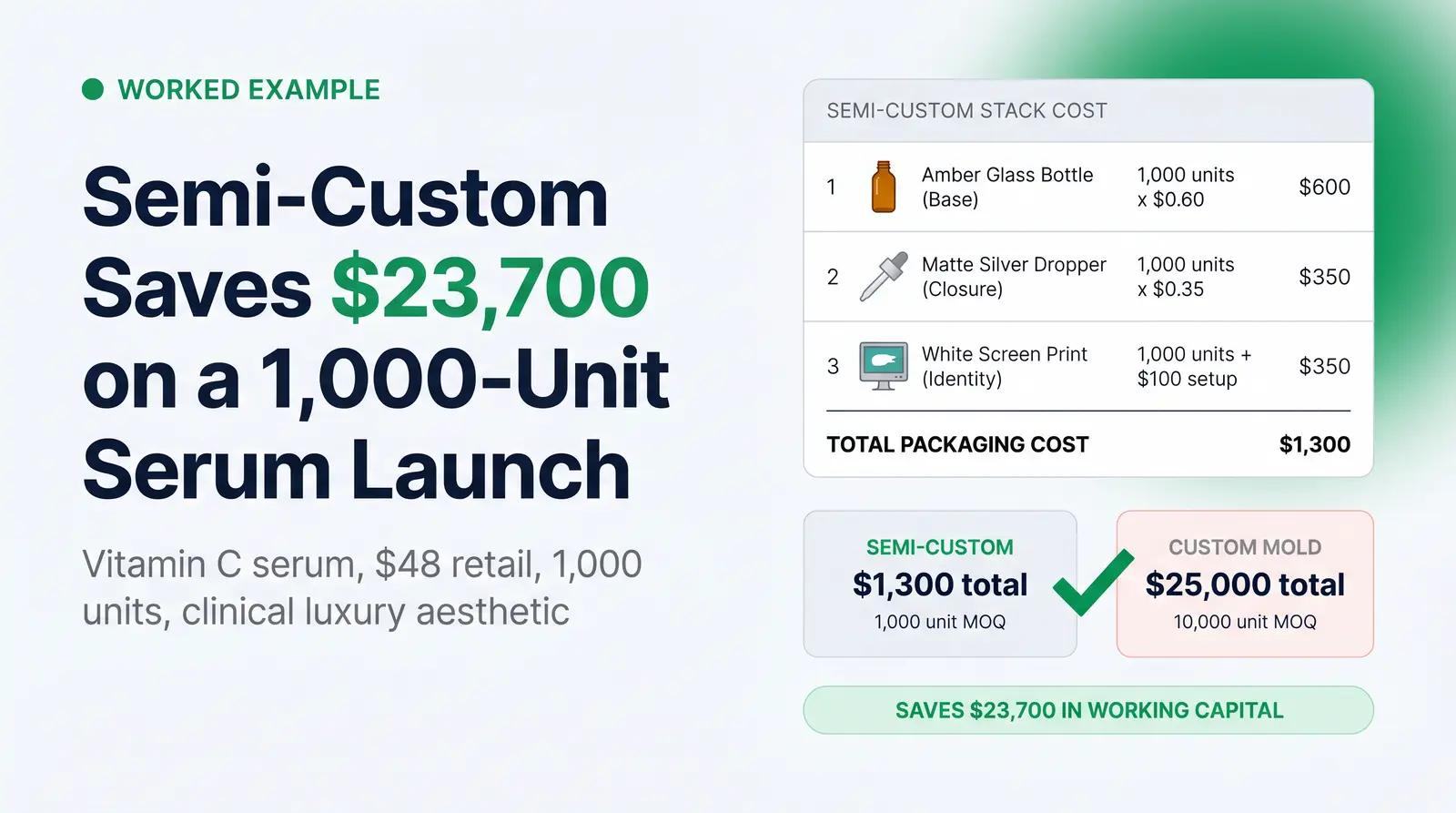
A Worked Example: Launching a Vitamin C Serum
Consider a founder launching a Vitamin C brightening serum. The retail price point is $48, and the initial production run is a conservative 1,000 units. The formula requires UV protection, and the brand aesthetic is clinical luxury.
If the founder pursued a custom glass mold, they would face a $10,000 tooling fee and a 10,000-unit MOQ [1]. At roughly $1.50 per unit, they are committing $25,000 just to packaging, destroying their launch budget.
Instead, they apply the Semi-Custom Stack Framework:
- Base: They select a stock 1 oz (30 ml) amber glass boston round bottle. The amber glass provides necessary UV protection for the Vitamin C. At 1,000 units, the base bottle costs approximately $0.60 [12].
- Closure: They swap the standard black plastic dropper for a matte silver aluminum-collared dropper with a white bulb. This closure swap adds $0.35 per unit but instantly elevates the product to the $48 retail tier.
- Identity: Because 1,000 units meets the threshold for basic decoration, they opt for single-color white screen printing directly on the amber glass, costing an additional $0.25 per unit and a $100 setup fee [4].
The Final Stack: A matte silver dropper on an amber glass bottle with crisp white screen printing. The landed packaging cost is roughly $1.30 per unit (including setup fees). The total packaging investment is $1,300. The founder achieves a premium, differentiated look while preserving $23,700 in working capital compared to the custom mold route.
What Semi-Custom Cannot Do
While semi-custom packaging is highly versatile, it has distinct limitations. Honest planning requires acknowledging where the semi-custom spectrum ends.
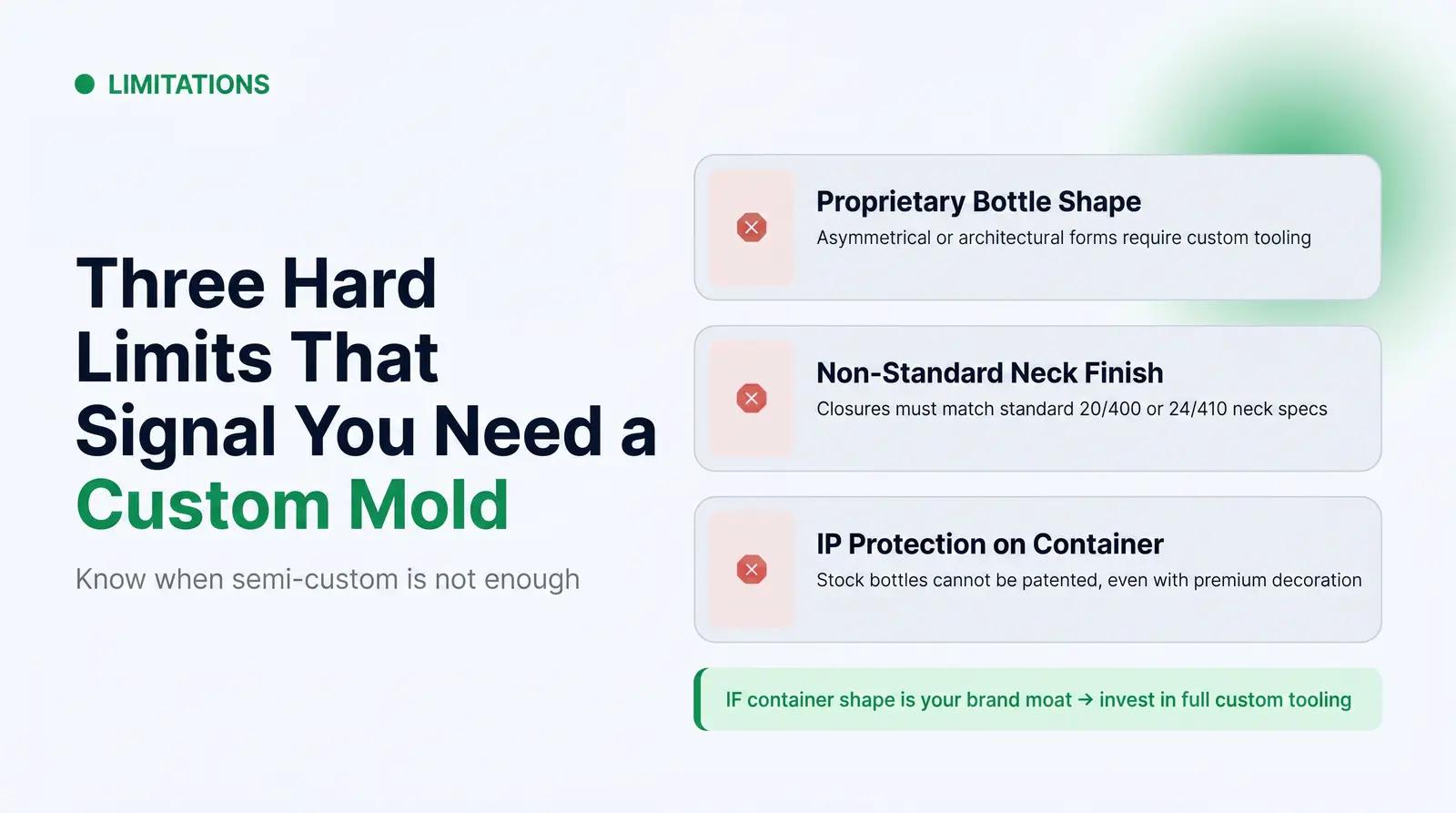
Semi-custom cannot alter the physical geometry of the container. If a brand's core identity relies on a proprietary, asymmetrical bottle shape—like a perfume bottle modeled after a specific architectural form—semi-custom will not suffice. Furthermore, while you can swap closures, you are limited to closures that fit the standard neck finish (e.g., 20/400 or 24/410) of your chosen stock bottle.
Finally, semi-custom does not offer intellectual property protection on the container shape. You cannot patent a stock bottle, even if you decorate it beautifully [10]. For brands where the structural design of the packaging is the primary defensive moat against competitors, full custom tooling is eventually necessary.
How to Evaluate a Semi-Custom Packaging Partner
Executing a semi-custom stack requires coordinating multiple variables: sourcing the stock component, verifying closure compatibility, managing the decorator, and ensuring the artwork aligns perfectly with the printable area of the physical bottle. For a founder, managing this supply chain is a massive distraction from product development and marketing.
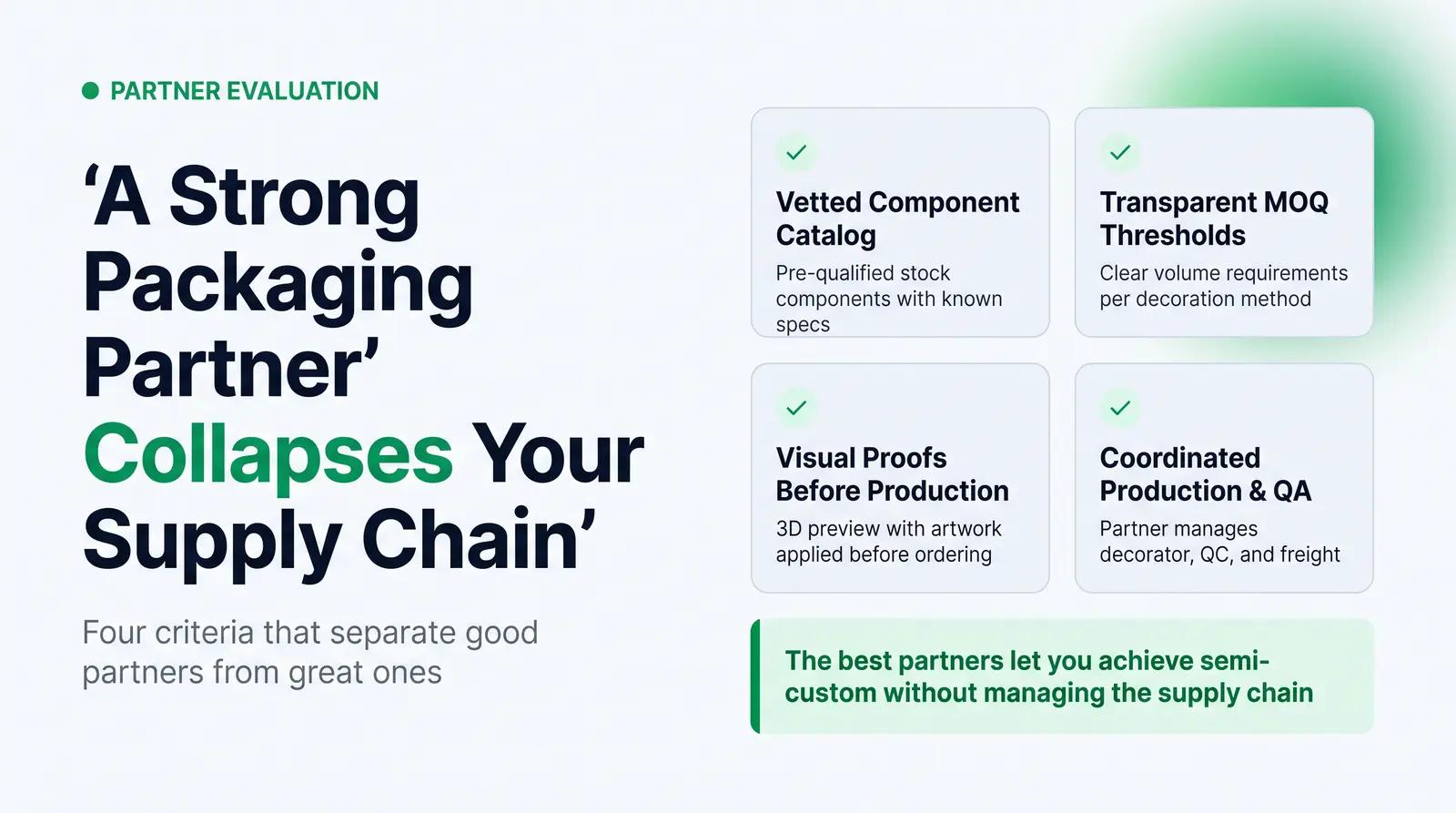
When evaluating a packaging partner, look for platforms that collapse this complexity. A strong partner should offer a vetted catalog of components, transparent MOQ thresholds for different decoration methods, and clear visual proofs before production begins. This is exactly why Packfolio's workflow is designed the way it is. By offering a curated catalog of primary packaging pre-modeled in 3D with predefined printable regions, founders can browse, apply their artwork, and see a photorealistic 3D preview of their exact semi-custom stack before ordering. Packfolio then coordinates the production, quality assurance, and freight, allowing founders to achieve semi-custom differentiation without managing the underlying supply chain.
Browse Packfolio's curated packaging catalog and preview your label in 3D before you commit to a single unit → packfolio.com/catalog
Frequently Asked Questions
What is the minimum order quantity for custom cosmetics packaging? For fully custom molds, MOQs typically start at 10,000 units. However, semi-custom options like screen printing on stock bottles can start at 500 units, and custom labeling can be done for as few as 250 units.
How can I customize my cosmetic packaging without paying for a custom mold? You can customize stock packaging by layering decoration methods. Options include applying high-quality BOPP labels, utilizing screen printing or hot stamping, swapping standard closures for premium alternatives, or adding textured finishes to secondary paper boxes.
Is screen printing or labeling better for low MOQ cosmetic bottles? Labeling is generally better for very low MOQs (under 500 units) or complex, multi-color artwork, as it avoids high setup fees. Screen printing is highly durable and provides a premium "no-label" look, but usually requires a minimum of 500 units and becomes expensive if multiple colors are used.
How much does hot stamping add to the cost of cosmetic packaging? Hot stamping typically adds a cost premium of $0.20 to $0.50 per unit, depending on the complexity of the design and the total order volume. It also requires a custom metal die, which involves a one-time setup fee.
Why are shrink sleeves risky for low volume indie beauty brands? Shrink sleeves often require a high minimum order (5,000+ units) and can be labor-intensive to apply if you do not have automated equipment. Additionally, sleeves can complicate the recyclability of the underlying container, which may conflict with a brand's sustainability claims.
References
[1] Impacked Packaging. (2026). The Complete Guide to Glass Packaging for Cosmetics & Fragrances. https://www.impackedpackaging.com/guides/glass-packaging [2] Pro-Motion Industries. (2021). Labeling vs. screen printing: Which one is right for your cosmetic product?. https://www.pro-motion.ws/blog/labeling-vs-screen-printing/ [3] DSTAR Machine. (2025). pad printing, screen printing, and hot stamping in the cosmetic packaging industry. https://www.printing-machine.com/pad-printing-screen-printing-and-hot-stamping-in-the-cosmetic-packaging-industry/ [4] Blue Line Labels. (n.d.). Short-Run Silk Screen Printing Pricelist | Bottles, Jars & Tubes. https://bluelinelabels.com/short-run-silk-screen-printing-pricelist/ [5] APG Packaging. (n.d.). How does hot stamping enhance brand identity in cosmetic bottles?. https://apackaginggroup.com/blogs/news/how-does-hot-stamping-enhance-brand-identity-in-cosmetic-bottles [6] AHPackaging. (2025). How Does MOQ Affect Cosmetic Packaging Costs (And What You Can Do About It)?. https://ahpackaging.com/how-does-moq-affect-cosmetic-packaging-costs/ [7] Inovar Packaging Group. (2023). Everything You Need to Know About Shrink Sleeves. https://inovarpackaging.com/everything-you-need-to-know-about-shrink-sleeves/ [8] Arkay Packaging. (2026). Embossing vs Debossing: Key Differences and How to Choose. https://www.arkay.com/resources/embossing-vs-debossing [9] JingSourcing. (n.d.). Deboss vs Emboss on Packaging and Fabric: Buyer Guide. https://jingsourcing.com/b-deboss-vs-emboss/ [10] AHPackaging. (2025). Custom Mold or Stock Packaging? A Decision Guide for Cosmetics Brands. https://ahpackaging.com/custom-mold-or-stock-packaging/ [11] Srivastava, P., Ramakanth, D., Akhila, K., & Gaikwad, K. K. (2022). Package design as a branding tool in the cosmetic industry: consumers’ perception vs. reality. SN Business & Economics. https://pmc.ncbi.nlm.nih.gov/articles/PMC9123395/ [12] MadeByGenie. (2025). Low MOQ Cosmetic Manufacturing: The 2025 Guide for Indie Founders. https://www.madebygenie.com/blog/low-moq-cosmetic-manufacturing-guide


