
Airless Packaging for Skincare: The Complete Founder Guide
This guide helps skincare founders evaluate airless packaging by explaining its mechanics, formula compatibility, cost tradeoffs, sustainability considerations, and key technical details to verify before sampling.
When a beauty founder evaluates packaging for a new launch, the default assumption is often a standard dip-tube pump or a glass dropper. But for sensitive or premium skincare, the packaging is not just a vessel—it is an active component of the formula's preservation strategy. Airless packaging has emerged as a critical protection and positioning choice, engineered to shield volatile ingredients from oxygen, prevent contamination, and deliver a high-end user experience from the first pump to the last.
Deciding whether airless packaging is the right format for your formula requires understanding its mechanics, its limitations, and its impact on your bottom line. This guide explains when airless packaging makes sense, what tradeoffs to evaluate, and what founders should verify before committing to a sample order.
How Airless Packaging Works
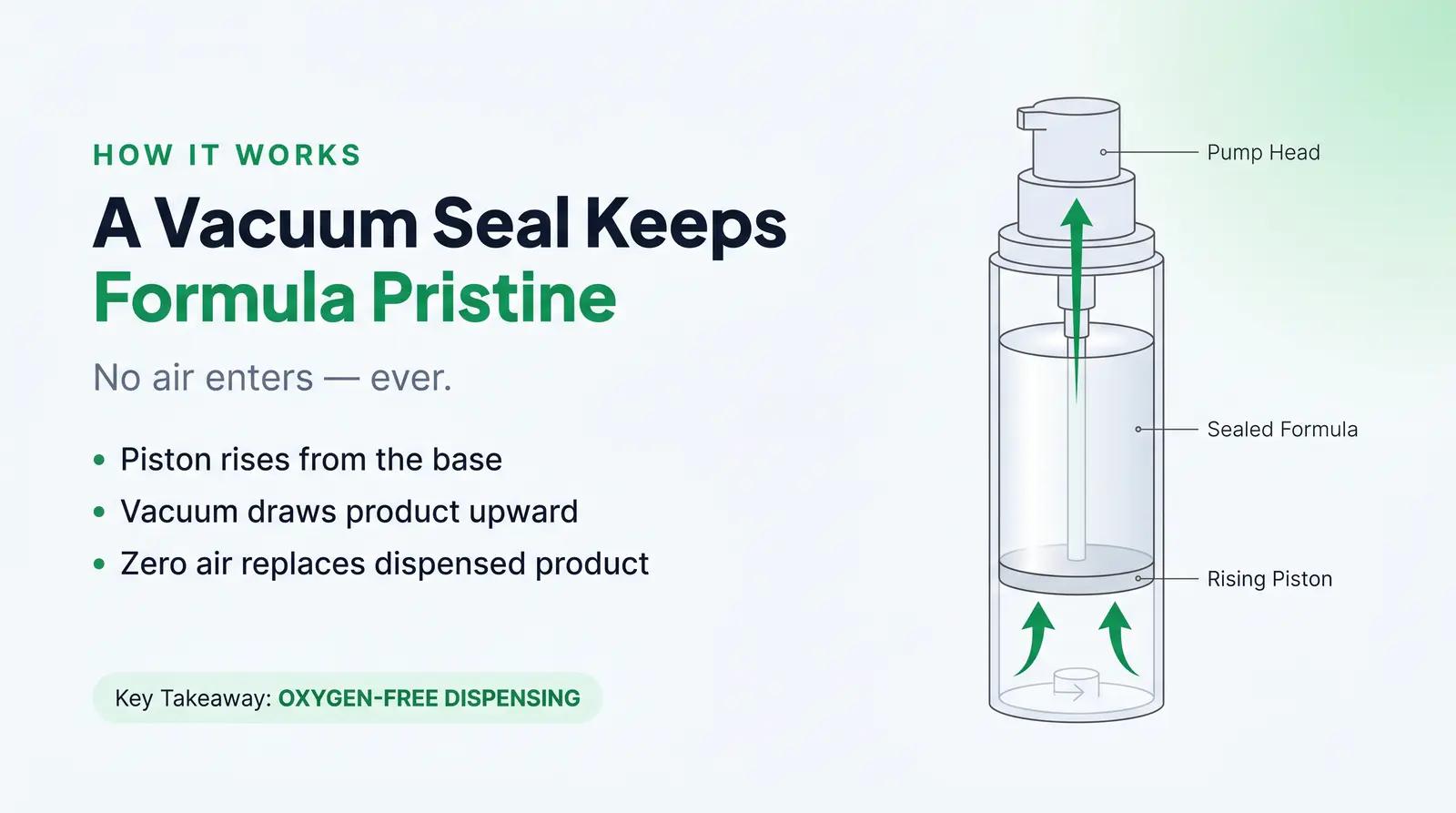
An airless pump bottle is a non-pressurized dispensing system designed to prevent air from entering the container during use. Unlike a conventional lotion pump, which uses a dip tube to draw product up and allows air to fill the void left behind, an airless system operates on a vacuum principle [1].
The core mechanism typically involves a small plastic disc, or piston, located at the base of the inner bottle. As the user depresses the pump actuator, a vacuum effect is created. This pressure differential draws the product upward and simultaneously pulls the piston up from the bottom [1]. Because no air is introduced to replace the dispensed product, the formula remains sealed in an oxygen-free environment throughout its lifecycle.
Some airless formats use a bag-in-bottle system instead of a piston, where a flexible inner pouch collapses as the product is dispensed [2]. Both mechanisms achieve the same goal: isolating the formula from external elements.
The Formula-Format Fit Checklist
Not every product needs, or is compatible with, an airless pump. At Packfolio, we recommend using a practical framework to evaluate whether airless packaging aligns with your formula and brand strategy.
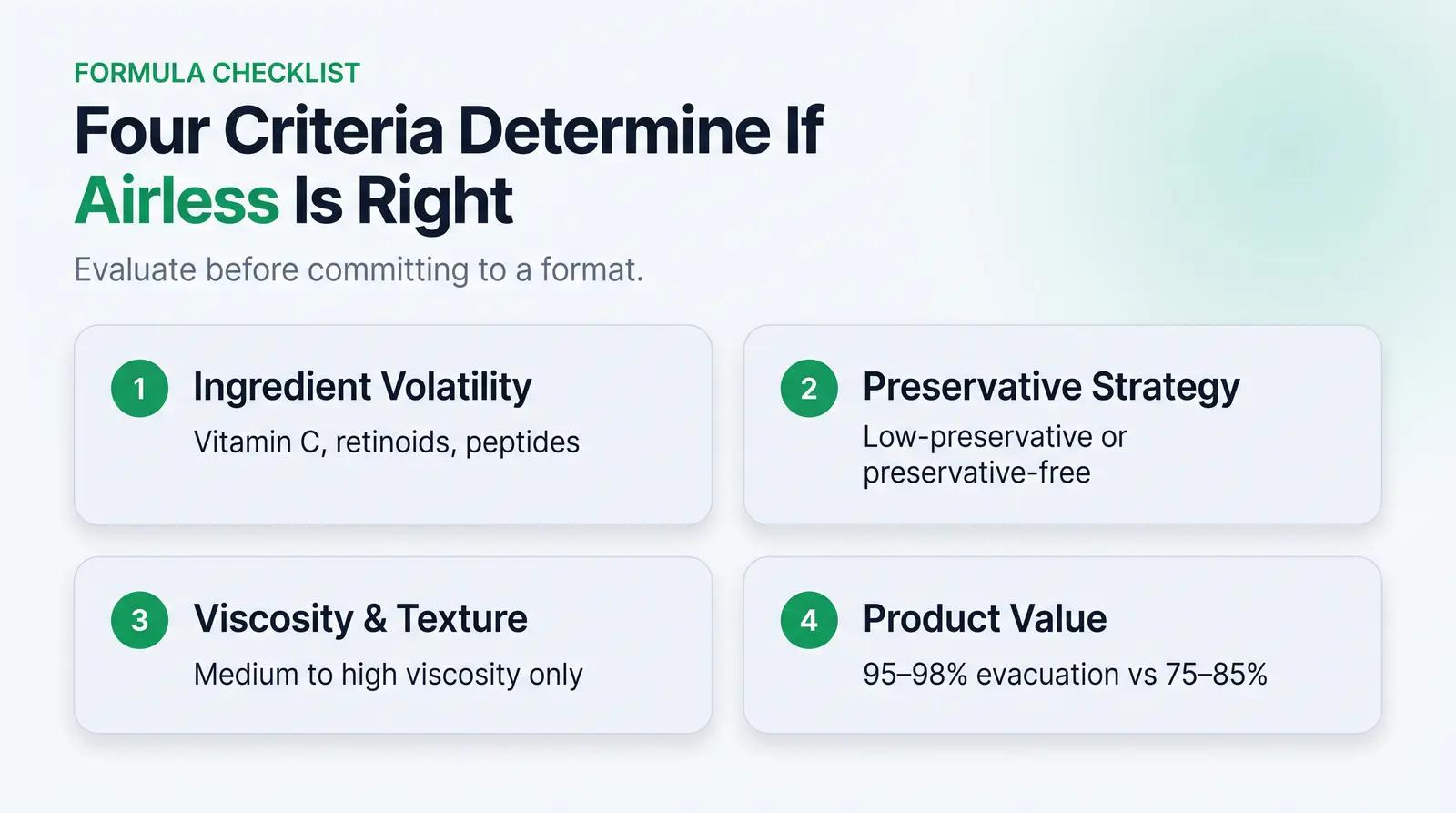
1. Ingredient Volatility
Does your formula contain oxygen-sensitive active ingredients? Airless packaging is highly recommended for unstable antioxidants like L-ascorbic acid (Vitamin C), retinoids, and peptides. Exposure to air can rapidly degrade these actives, reducing their efficacy and potentially altering the product's color and scent [3]. If your formula relies on these ingredients for its core claims, an airless environment is a necessary protective measure.
2. Preservative Strategy
Are you formulating with a low-preservative or preservative-free system? Because airless bottles prevent ambient air and airborne microbes from entering the container, they significantly reduce the risk of bacterial and fungal contamination [4]. This hygienic dispensing method allows formulators to safely reduce the preservative load, which is increasingly important for brands targeting sensitive skin or aligning with "clean beauty" standards.
3. Viscosity and Texture
Is your product a thin liquid, a medium lotion, or a thick balm? Airless pumps excel at dispensing medium-to-high viscosity formulas like creams, gels, and serums. However, they are generally unsuitable for low-viscosity, watery liquids, which can leak through the pump mechanism, or extremely thick, stiff pastes that lack the flow necessary to create a proper vacuum seal [5].
4. Product Value and Evacuation Rate
Is this a premium product where waste is a significant consumer friction point? Standard dip-tube pumps often leave up to 15% of the product stranded at the bottom of the bottle. In contrast, the rising piston mechanism of an airless bottle can achieve an evacuation rate of 95% to 98% [6]. For high-priced serums and treatments, ensuring the customer can access nearly every drop is a crucial element of the premium experience.
Airless Packaging vs. Traditional Formats
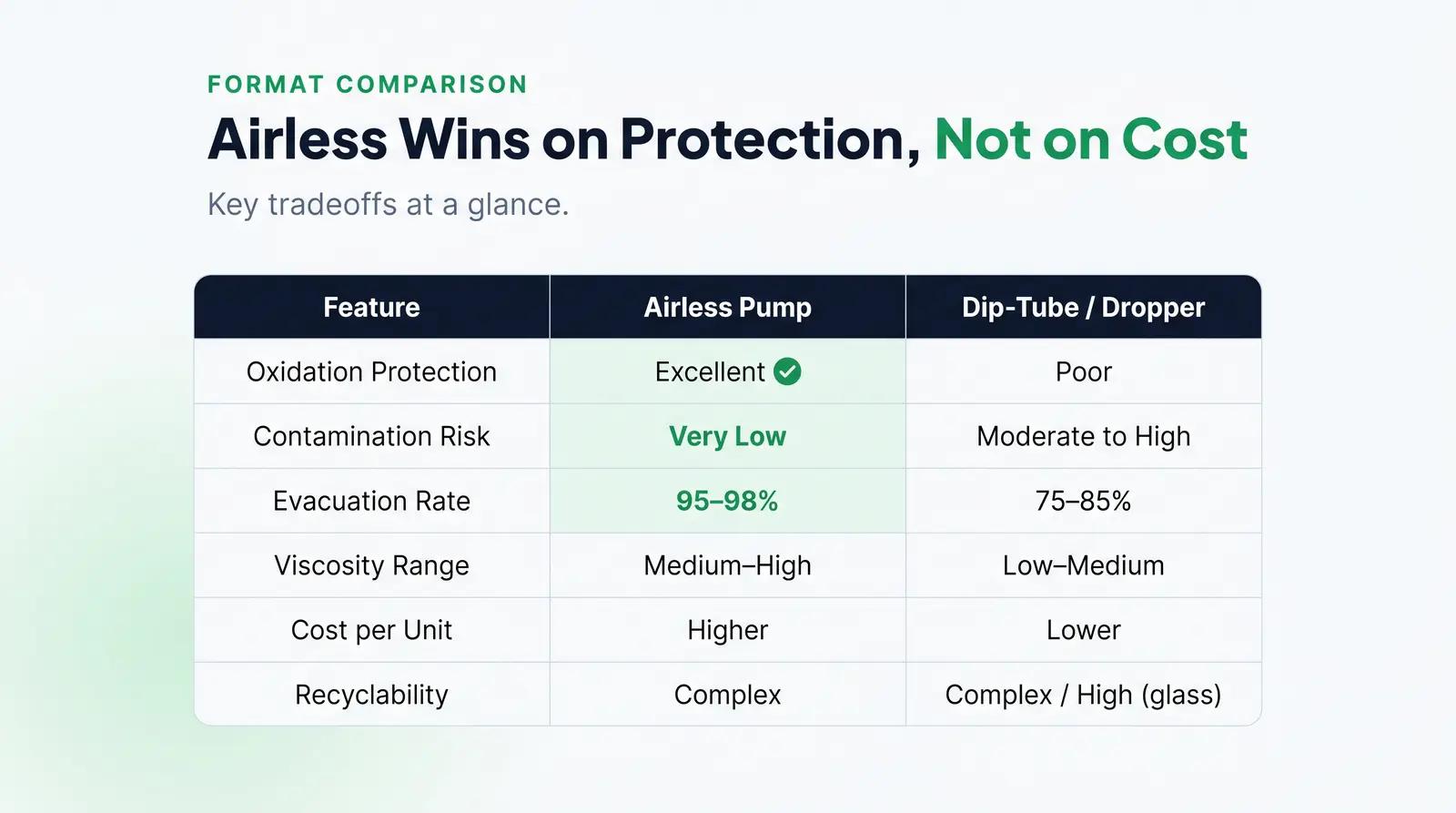
To understand the practical tradeoffs, it helps to compare airless bottles directly against common alternatives.
| Feature | Airless Pump Bottle | Standard Dip-Tube Pump | Glass Dropper Bottle |
|---|---|---|---|
| Oxidation Protection | Excellent (sealed vacuum) | Poor (air enters to replace product) | Poor (opened entirely during use) |
| Contamination Risk | Very Low | Moderate | High (pipette exposure) |
| Evacuation Rate | 95% - 98% [6] | 75% - 85% | Variable |
| Viscosity Range | Medium to High | Low to Medium | Low |
| Cost per Unit | Higher premium | Lower | Lower to Moderate |
| Recyclability | Complex (often mixed plastics) | Complex (metal springs) | High (glass body) |
The Non-Obvious Tradeoff: The Sustainability Paradox
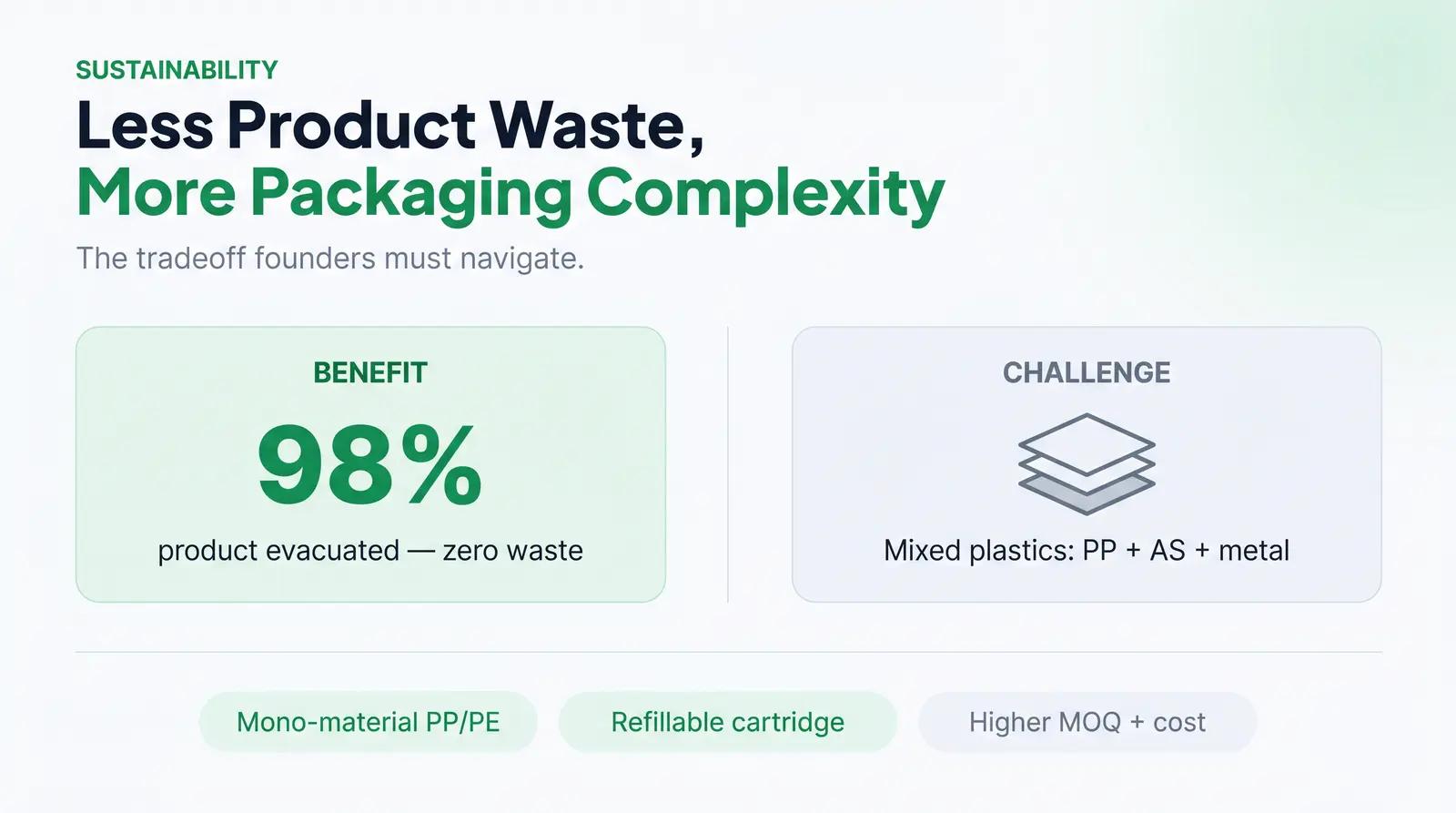
A common assumption is that airless packaging is inherently more sustainable because it reduces product waste. While it is true that achieving a 98% evacuation rate prevents valuable formulas from ending up in landfills, the packaging itself presents a distinct environmental challenge.
The non-obvious insight is that the complex engineering required to create a reliable vacuum seal often necessitates mixed materials. A standard airless bottle might feature a polypropylene (PP) body, an acrylonitrile styrene (AS) outer shell for aesthetics, and a pump engine containing multiple plastic resins and sometimes metal components [7]. This multi-material construction makes traditional airless bottles notoriously difficult for municipal recycling facilities to process, as the layers cannot be easily separated [8].
If sustainability is a core pillar of your brand positioning, you must navigate this paradox. The industry is responding with mono-material airless pumps—constructed entirely from a single plastic type like PP or polyethylene (PE)—and refillable airless systems where the consumer retains a durable outer shell and replaces only the inner cartridge [9]. However, these eco-forward options often carry higher minimum order quantities (MOQs) and increased unit costs.
A Worked Example: The Vitamin C Launch
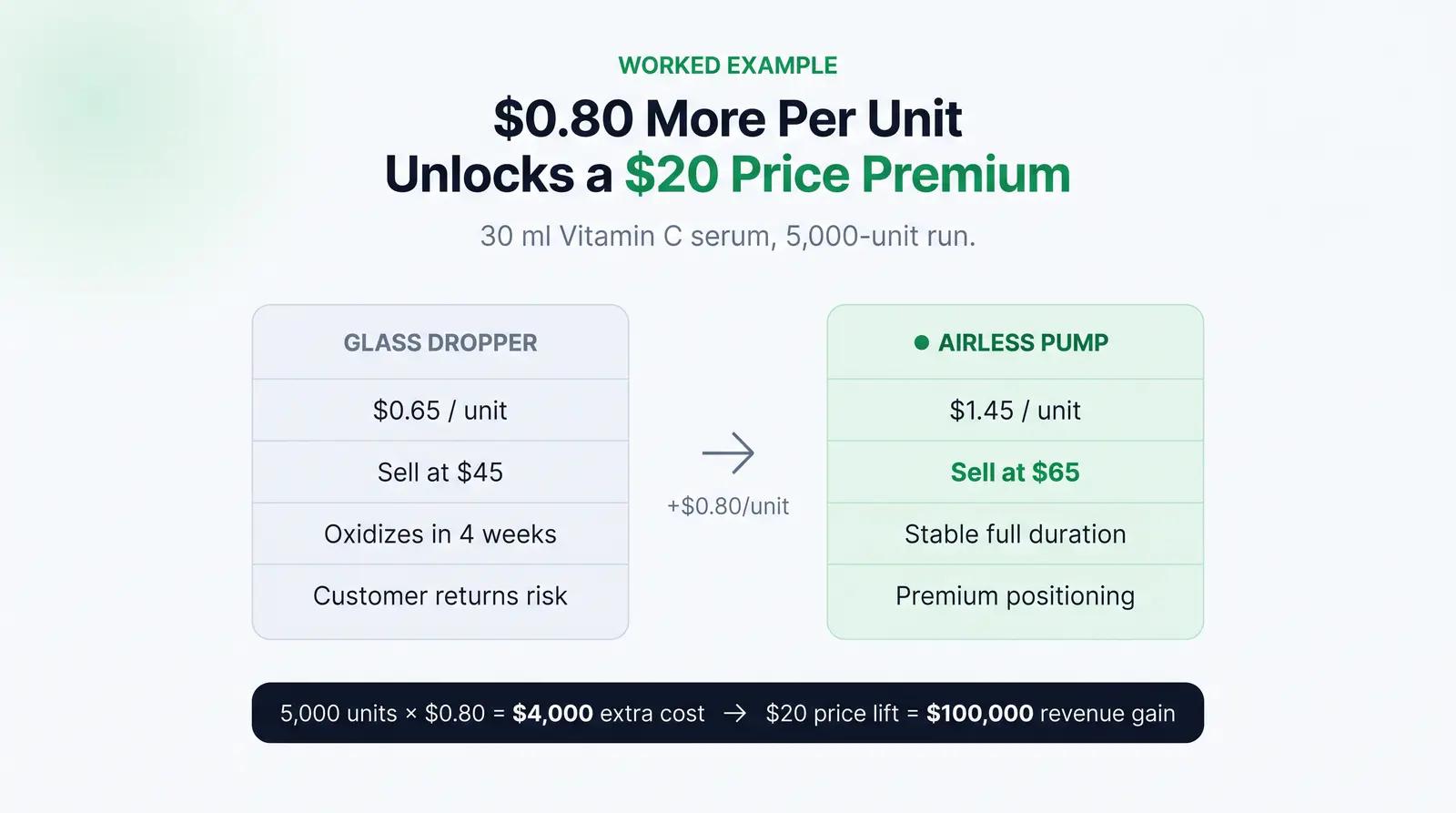
Consider a founder launching a 1 oz (30 ml) L-ascorbic acid brightening serum. The formula is highly effective but notoriously unstable; exposure to oxygen and light causes the ascorbic acid to oxidize into dehydroascorbic acid, turning the serum an unappealing brown and rendering it ineffective [10].
The founder initially considers a frosted glass dropper bottle because it signals a traditional "apothecary" aesthetic and costs $0.65 per unit at a 5,000-unit MOQ. However, every time the customer opens the dropper, oxygen floods the bottle. Within four weeks of use, the serum begins to degrade.
Switching to an opaque airless pump bottle solves the stability issue. The sealed environment prevents oxidation, extending the active shelf life and protecting the brand's reputation for efficacy. The airless bottle costs $1.45 per unit at the same MOQ.
Here is how the decision plays out: The founder must absorb an additional $0.80 per unit in packaging costs. For a 5,000-unit run, this is a $4,000 increase in upfront capital. However, the airless packaging allows the brand to guarantee the serum's potency for the full duration of use. It also elevates the perceived value, allowing the founder to confidently price the serum at $65 rather than $45. The investment in protective packaging directly enables a higher retail price and prevents costly customer returns due to oxidized product.
Before ordering, the founder must also verify the pump's stroke dose. If the pump dispenses 0.5 ml per stroke, the 30 ml bottle will provide exactly 60 pumps—a perfect two-month supply for a once-daily application.
What to Verify Before Sampling
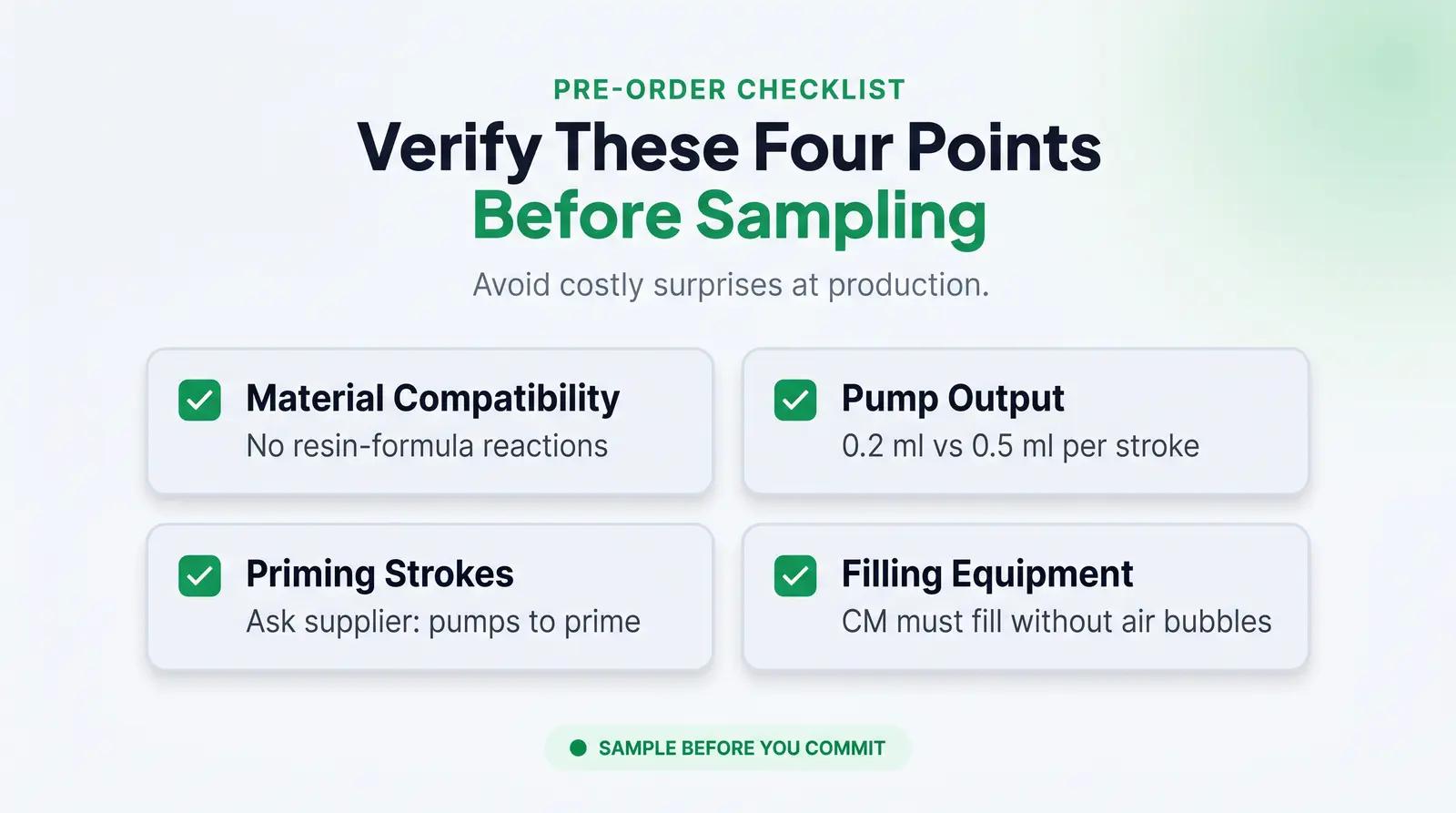
Once you have decided that airless packaging fits your formula, you need to validate specific technical details before placing a sample order.
1. Material Compatibility: Ensure the plastic resins used in the bottle and pump engine will not react with your formula. For example, high concentrations of certain essential oils or aggressive solvents can degrade some plastics [5]. 2. Pump Output: Confirm the exact volume dispensed per stroke (e.g., 0.2 ml vs. 0.5 ml) to ensure it aligns with your recommended application amount. 3. Priming Strokes: Airless bottles require "priming" to initiate the vacuum seal. Ask the supplier how many pumps it takes to prime the bottle; an excessive number of dry pumps can frustrate consumers [11]. 4. Filling Equipment Compatibility: Airless bottles are typically filled from the top before the pump is snapped or screwed into place. Verify that your contract manufacturer has the appropriate equipment to fill airless formats without introducing air bubbles, which can disrupt the vacuum mechanism [11].
Browse Packfolio's curated airless pump catalog and preview your label in 3D before ordering. Because Packfolio coordinates production, quality assurance, and freight delivery directly to your chosen address, you can secure reliable airless packaging without the complexity of managing overseas suppliers.
Browse Packfolio's curated airless pump catalog and preview your label in 3D before ordering → packfolio.com/catalog
Frequently Asked Questions
Why does my airless pump bottle seem empty but nothing comes out? Airless bottles require priming to push the air out of the pump engine and engage the vacuum seal. If it is a new bottle, you may need to pump it 10 to 15 times slowly to draw the product up to the nozzle [11].
Can I refill a standard airless pump bottle? Most standard airless bottles are designed for single use and cannot be easily refilled, as the piston must be manually pushed back down to the bottom of the container. However, purpose-built refillable airless systems are available that use replaceable inner cartridges [9].
Do airless bottles require a specific filling method? Yes, airless bottles must be filled precisely to avoid trapping air bubbles in the formula. If an air bubble sits over the piston, it can compress when the pump is pressed, preventing the vacuum from engaging and causing the pump to fail [11].
Why are airless pump bottles more expensive than regular pumps? Airless bottles cost more because they require complex, multi-part engineering to maintain a perfect vacuum seal. The precision manufacturing of the rising piston and the specialized pump engine drives up the unit cost compared to a simple dip-tube assembly.
What happens if my formula is too watery for an airless pump? Low-viscosity, watery liquids do not create enough resistance to properly engage the vacuum mechanism and can leak through the pump seals [5]. For very thin liquids, a traditional fine mist sprayer or a dropper bottle is usually a more reliable choice.
References
[1] Eurovetrocap. (2025). Airless bottle: what it is and how it works. https://www.eurovetrocap.com/en/airless-bottle-what-it-is-and-how-it-works/
[2] Paramount Global. (2023). 5 Benefits of Airless Pump Technology. https://www.paramountglobal.com/knowledge/benefits-airless-pump-technology/
[3] Ahmad, I., et al. (2011). Photostability and Interaction of Ascorbic Acid in Cream Formulations. AAPS PharmSciTech. https://pmc.ncbi.nlm.nih.gov/articles/PMC3167265/
[4] Halla, N., et al. (2018). Cosmetics Preservation: A Review on Present Strategies. Molecules. https://pmc.ncbi.nlm.nih.gov/articles/PMC6099538/
[5] Ningbo Meichang Packaging Technology. (2024). Airless Bottle Compatibility with Formulas: A Practical Guide for Skincare Brands. https://www.plasticpumpbottles.com/news/airless-bottle-compatibility-with-formulas-a-practical-guide-for-skincare-brands-309685.html
[6] Penning, A. (2014). Total Evacuation. Global Cosmetic Industry. https://www.gcimagazine.com/packaging/article/21849961/total-evacuation
[7] Future Market Insights. (2025). Airless Packaging Market Growth, Trends & Share 2025 to 2035. https://www.futuremarketinsights.com/reports/airless-packaging-market
[8] BeautyMatter. (2023). Mono-Material Airless Pump Unlocks Beauty Recycling Challenges. https://beautymatter.com/articles/mono-material-airless-pump-unlocks-beauty-recycling-challenges
[9] APG. (2025). Why are airless cosmetic bottles popular in skincare packaging?. https://apackaginggroup.com/blogs/news/why-are-airless-cosmetic-bottles-popular-in-skincare-packaging
[10] Yin, X., et al. (2022). Chemical Stability of Ascorbic Acid Integrated into Commercial Products: A Review on Bioactivity and Delivery Technology. Antioxidants (Basel). https://pmc.ncbi.nlm.nih.gov/articles/PMC8773188/
[11] Cosmetics Business. (2023). The airless experience: everything you need to know guide to a flawless airless experience. https://cosmeticsbusiness.com/the-airless-experience-everything-you-need-to-know-guide-to-a-flawless-airless-experience-208178


