
Cosmetic Packaging for TikTok and Shopify Launches
Select cosmetic packaging that performs on TikTok and Shopify by optimizing container format, material, label readability, shipping durability, MOQ, and reorder timing for DTC launches.
A packaging mistake at launch rarely looks like a warehouse disaster. It looks like a conversion problem.
It is the frosted glass bottle that disappears under a ring light, making the product invisible on a TikTok feed. It is the elegant serif label font that cannot be read on a 6-inch phone screen when a creator holds the bottle up for two seconds. It is the aluminum tube that arrives dented at a customer's door, generating a refund request before the formula has even been tried. For independent beauty founders launching a first or second SKU, packaging choices are not just aesthetic decisions. They are the mechanical foundation of visual performance, shipping survival, and early cash flow.
This guide covers how to select cosmetic primary packaging that performs across both channels, survives transit, and leaves enough margin to reorder before you run out.
How TikTok and Shopify Demand Different Things from the Same Package
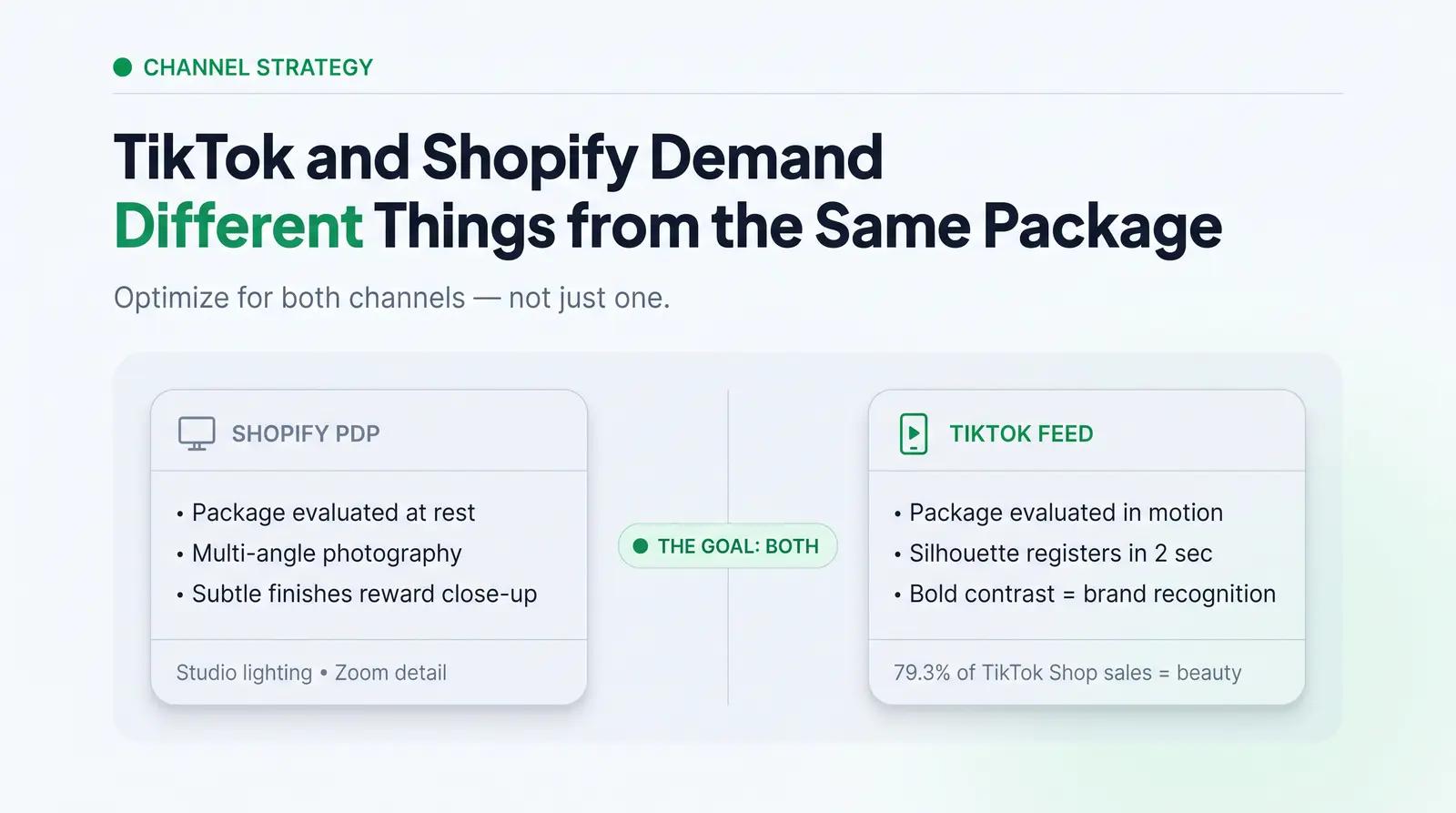
The visual and mechanical requirements for short-form video are fundamentally different from those of an ecommerce product detail page (PDP). Understanding the gap between these two environments is the first step to making a packaging decision that does not compromise one channel to serve the other.
On a Shopify PDP, packaging is evaluated at rest. Customers browse multi-angle photography, zoom into label detail, and assess material texture through studio-lit images. The package must communicate brand positioning, ingredient hierarchy, and perceived value while sitting perfectly still. Surface finish matters here because it affects how light renders in a controlled photography environment. A frosted glass jar with subtle embossing reads beautifully in a flat-lay product shot. A matte tube with clean typography photographs crisply under a softbox.
On TikTok, the same package must perform in motion, under mixed lighting, often held in a moving hand. Health and beauty products accounted for 79.3% of TikTok Shop sales in the U.S. in 2024, totaling $1.34 billion [1]. That volume is driven by creators holding products up to camera for a few seconds. In that window, the package must register its silhouette, communicate the brand name, and signal the product category. Founders who optimize packaging for a Shopify product page and then discover it disappears on camera are not making a design error. They are making a channel error.
The goal is packaging that works in both contexts. That means selecting container formats with strong silhouettes, finishes that diffuse rather than reflect light, and label designs with enough contrast and scale to read at the small sizes a mobile screen delivers.
Label Scale and Video Readability
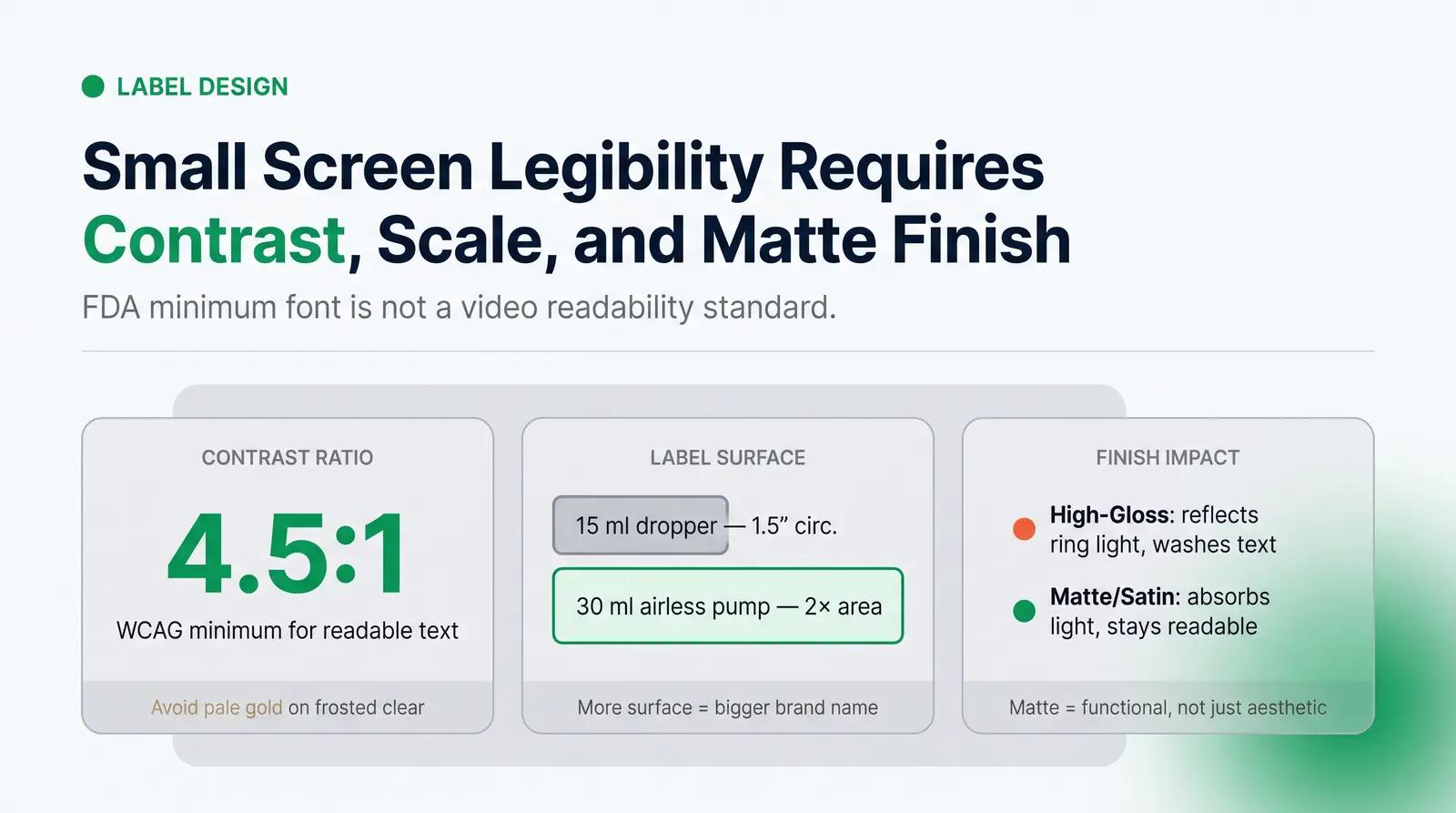
Label legibility on mobile screens is governed by mechanics, not just design preference. When a creator holds a 1 oz (30 ml) serum bottle in a TikTok video, the product may occupy only 10–15% of the screen. If the font size relative to the container diameter is too small, or if the contrast between text and background is insufficient, the brand name and product purpose are invisible to the viewer.
The FDA requires that the ingredient declaration on cosmetic labels be printed in a font size no smaller than 1/16 of an inch in height for most standard packages [2]. That is the regulatory floor, not the readability standard. For video, the practical minimum for brand name and product descriptor text is considerably larger. The Web Content Accessibility Guidelines (WCAG) specify a contrast ratio of at least 4.5:1 for standard text to ensure legibility [3]. Applying this principle to physical packaging means avoiding low-contrast combinations like pale gold text on a frosted clear bottle, or light gray text on a white label.
Finish choice compounds the problem. High-gloss labels reflect light directly back into the camera lens, creating a white flare that washes out text. Matte and soft-touch finishes absorb light, allowing the label to remain readable under ring lights, overhead lighting, and natural window light. For video-first channels, a matte or satin label finish is a functional choice, not just an aesthetic one.
Container diameter also determines how much label surface area is available. A narrow 15 ml dropper bottle has a circumference of roughly 1.5 inches (38 mm). A 30 ml airless pump with a wider body may offer twice the printable surface. Founders choosing between formats should calculate the actual label surface area available for the brand name, product name, and key claims before committing to a container.
Shelf Appeal vs. Scroll Appeal
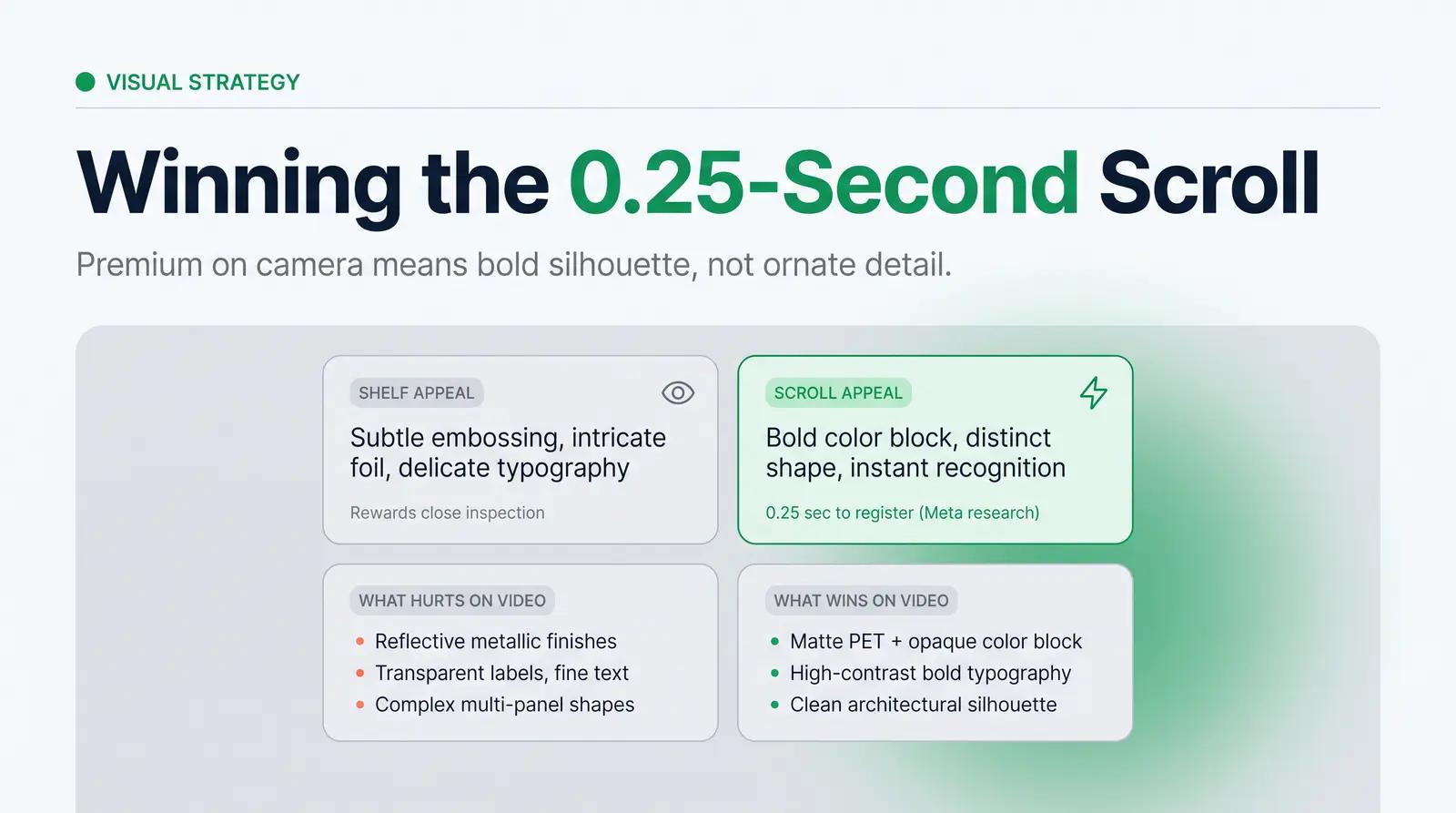
Packaging designed for physical retail shelf adjacency competes with neighbors at eye level, where a shopper can stop and examine it closely. In that environment, subtle embossing, intricate foil stamping, and delicate typography reward close inspection. The container earns its premium positioning through tactile and visual detail.
Scroll appeal operates on a different axis. Packaging designed to interrupt a thumb scroll in 1–2 seconds relies on bold color blocking, a distinct structural shape, and immediate brand recognition. The consumer attention window in a social media feed is measured in fractions of a second. Research from Facebook's advertising team found that it takes as little as 0.25 seconds of exposure for mobile feed content to register at a statistically significant rate [4]. Packaging that requires a second look to decode is packaging that loses the scroll.
Several retail-optimized packaging choices actively hurt in a video-first context. Highly reflective metallic finishes create glare. Transparent labels with fine text disappear against the container. Intricate structural shapes with multiple panels can look cluttered at small screen sizes. A matte PET bottle with a strong, opaque color block and high-contrast typography will consistently outperform an ornate glass bottle with a complex, delicate label when the primary discovery channel is a TikTok feed.
This does not mean premium packaging is incompatible with TikTok. It means the definition of premium must shift. A clean, architectural silhouette in a matte finish with a bold, legible label reads as premium on camera. An ornate bottle that requires a close-up to appreciate its detail does not.
Shipping Durability as a Conversion Variable
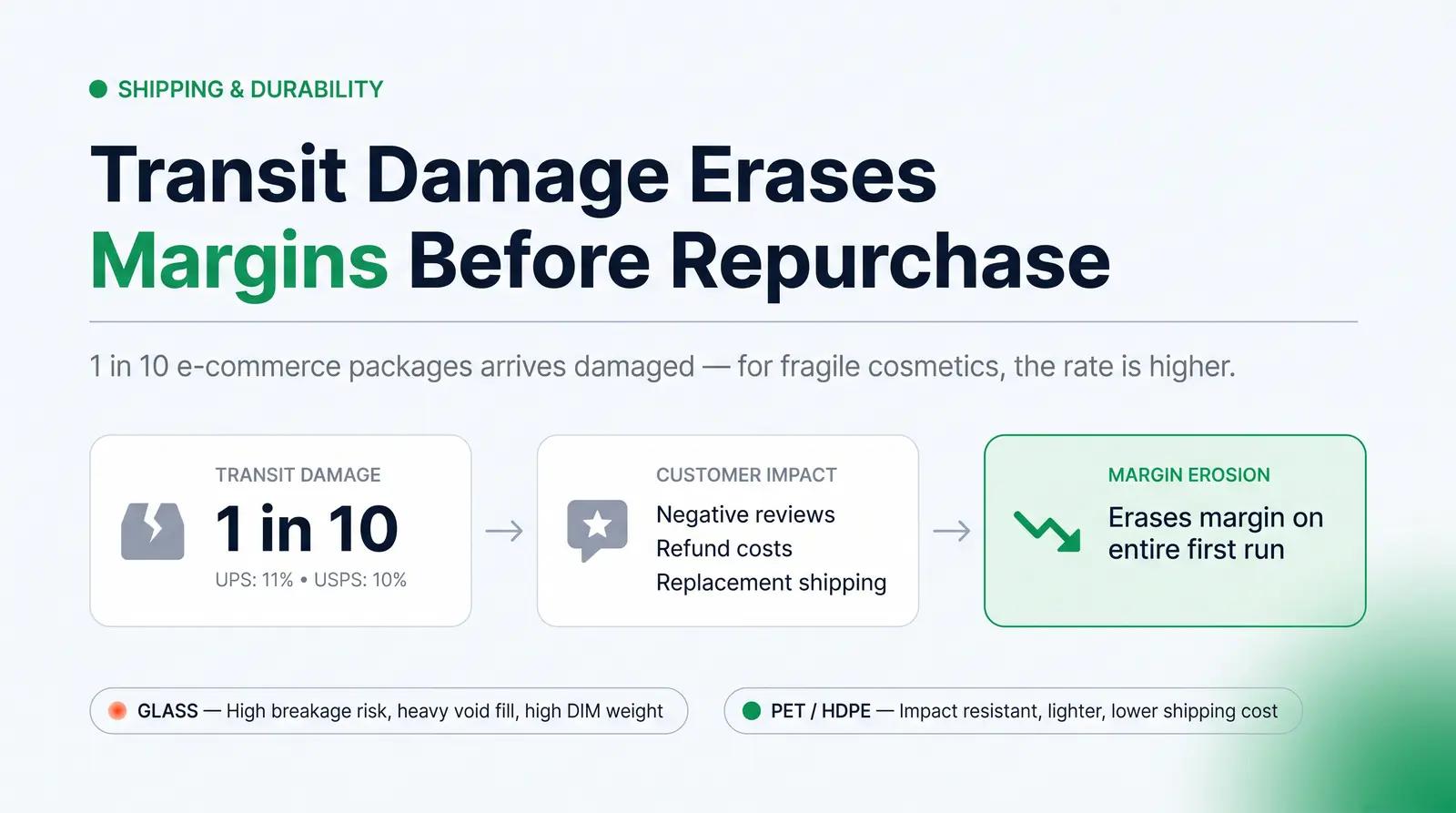
A cracked dropper or a dented aluminum tube is not just a logistics problem. It is a review problem, a refund problem, and a repeat-purchase problem. The mechanics of transit survival directly affect the lifetime value of every customer acquired through Shopify or TikTok Shop.
Industry data suggests that approximately 1 in 10 e-commerce packages arrives damaged, with carrier-specific rates reaching 11% for UPS and 10% for USPS [5]. For fragile cosmetic packaging, the rate can be higher. A single wave of damaged orders generates negative reviews, refund costs, and replacement shipping expenses that can erase the margin on an entire first run.
The packaging mechanics that determine transit survival include wall thickness, material choice, closure torque and liner integrity, and void fill. Glass is chemically inert and premium in feel, but it is the highest-risk material for e-commerce shipping. A glass dropper bottle requires significant corrugated or foam void fill to survive the drops and vibrations of parcel transit. That void fill adds dimensional weight, which increases shipping costs. PET and HDPE plastics offer substantially higher impact resistance at lower weight, reducing both breakage risk and per-shipment cost.
Closure integrity is often overlooked. A pump or dropper that is not torqued to the correct specification can loosen in transit, causing leaks that ruin the secondary packaging and the customer experience simultaneously. Testing closure torque and seal integrity before a full production run is essential. The International Safe Transit Association (ISTA) provides standardized test procedures, including drop tests and vibration simulations, that replicate the hazards a package will encounter in a parcel network [6]. Running a small pre-production test using ISTA 1-Series or 2-Series protocols before committing to a full run is a practical way to identify failure points before they become refund events.
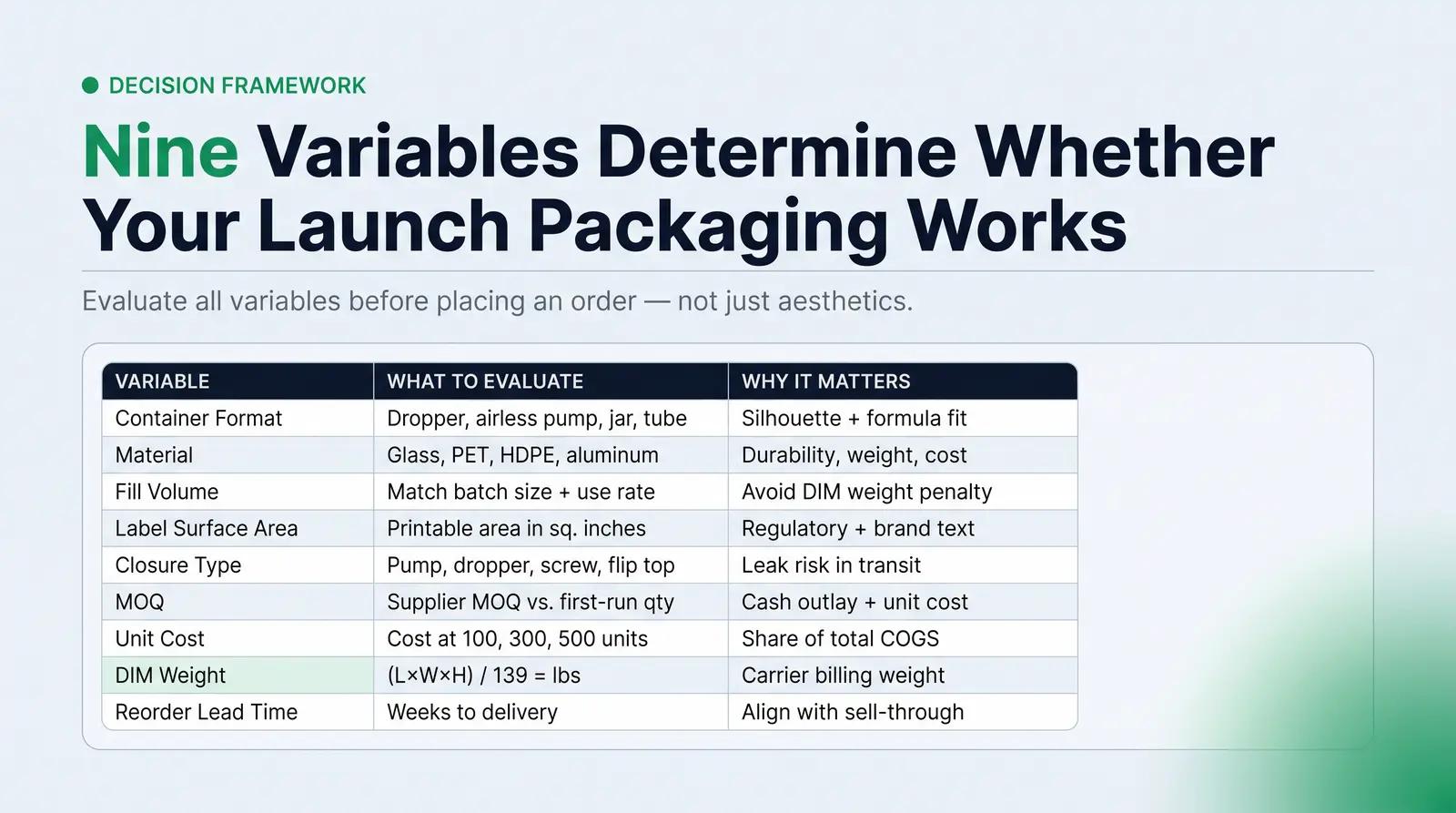
The DTC Launch Packaging Framework
The following framework is a practical decision tool for selecting primary packaging at launch stage. We recommend it at Packfolio as a first-principles approach to evaluating packaging choices before placing an order.
The DTC Launch Packaging Framework
| Decision Variable | What to Evaluate | Why It Matters at Launch |
|---|---|---|
| Container Format | Dropper, airless pump, jar, tube, compact | Determines silhouette, label surface area, and formula compatibility |
| Material | Glass, PET, HDPE, aluminum, acrylic | Affects shipping durability, weight, cost, and camera presence |
| Fill Volume | Match to formula batch size and consumer use rate | Oversizing increases DIM weight; undersizing reduces perceived value |
| Label Surface Area | Printable area in square inches | Must accommodate regulatory text at minimum 1/16" font and brand elements |
| Closure Type | Pump, dropper, screw cap, flip top | Determines leak risk in transit and dosing experience |
| Minimum Order Quantity | Supplier MOQ vs. your first-run quantity | Drives unit cost and total cash outlay |
| Unit Cost at First-Run Quantity | Cost per unit at 100, 300, and 500 units | Determines packaging's share of total COGS |
| Dimensional Weight Impact | (L x W x H) / 139 = DIM weight in lbs | Governs whether actual weight or DIM weight is billed by carrier |
| Reorder Lead Time | Weeks from order placement to delivery | Must align with sell-through velocity to avoid stockout |
This framework is not a guarantee of launch success, but it forces the packaging decision to account for all the variables that matter in a DTC context, not just aesthetics.
MOQ, Cash Flow, and Reorder Planning for First Runs
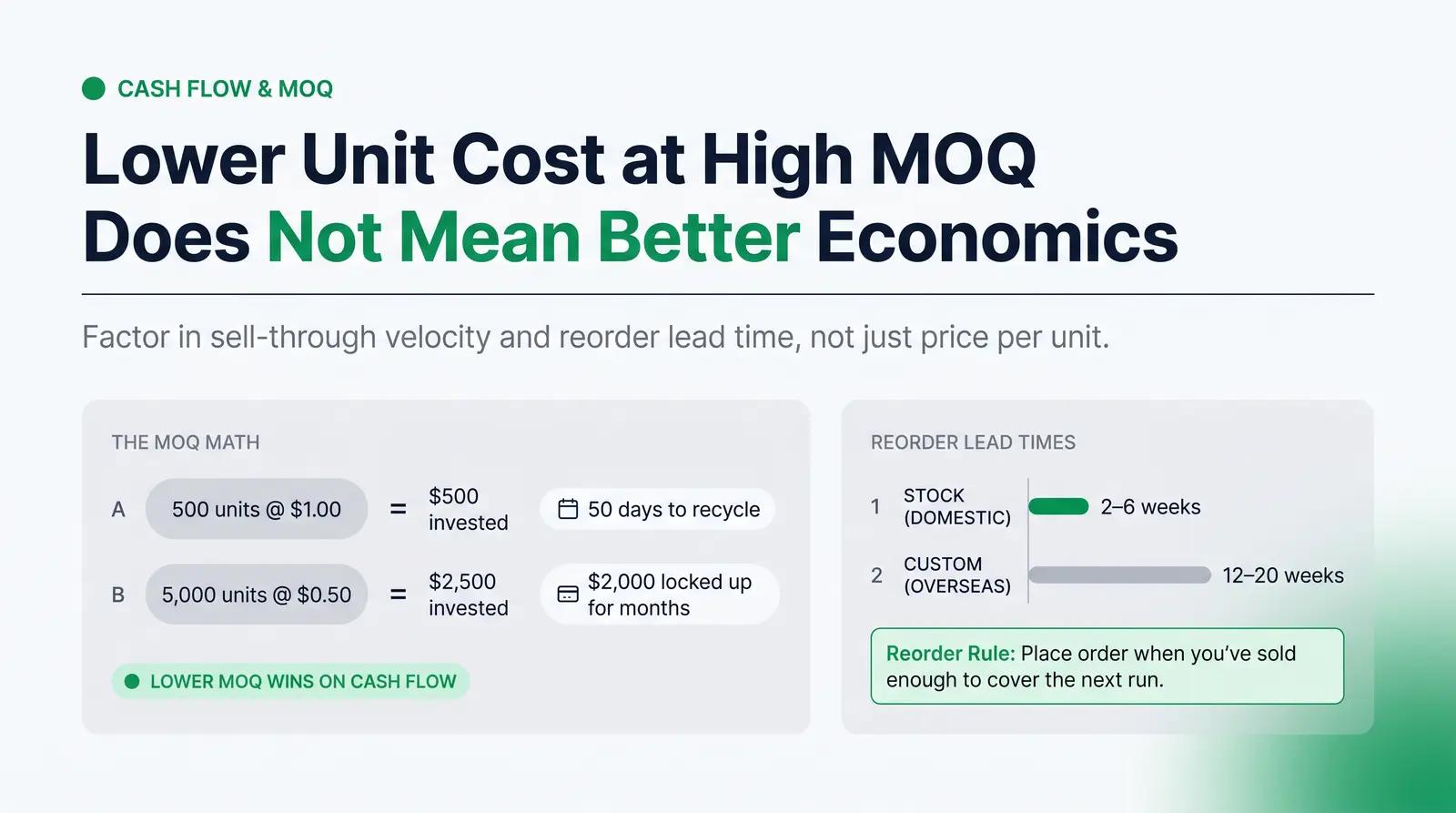
For indie beauty brands at launch, the MOQ landscape is more nuanced than it appears. Traditional cosmetic packaging manufacturers often require 5,000 to 10,000 units per SKU. However, a growing segment of suppliers now offers programs specifically designed for small-batch brands, with MOQs as low as 100 to 500 units using shared or stock molds [7]. These programs carry a higher unit cost, but they allow founders to test the market without tying up all their capital in empty containers.
The counterintuitive math of packaging sourcing is worth examining directly. A founder who orders 500 units at $1.00 per unit spends $500 on packaging and has 500 units to sell. A founder who orders 5,000 units at $0.50 per unit spends $2,500 on packaging and has 5,000 units to store. If the product sells at 10 units per day, the first founder recycles her packaging investment in 50 days. The second founder has $2,000 more tied up in packaging inventory for months, reducing the cash available for marketing, formula inventory, and the operational costs of running a launch. Lower unit cost at higher MOQ does not automatically mean better economics when sell-through velocity and cash flow are factored in.
Reorder lead times are the other variable that founders consistently underestimate. Stock packaging from domestic suppliers can arrive in 2–6 weeks. Custom packaging from overseas production typically requires 12–20 weeks or more, depending on the complexity of the component and the supplier's location [8]. A founder who launches with 300 units and waits until she is down to 50 units before placing a reorder may face a 6–10 week stockout window. That window, if it coincides with a viral TikTok moment, is a permanent loss of revenue.
The structural rule is simple: place the reorder when you have sold enough units to cover the cost of the next run, not when you are nearly out of stock.
Worked Example: 1 oz Vitamin C Serum, 300-Unit First Run
A founder is launching a 1 oz (30 ml) vitamin C serum as her first SKU. She has $3,500 to spend on packaging for a 300-unit first run. She is choosing between a glass dropper bottle and an airless pump.
Formula compatibility: Vitamin C is highly sensitive to oxidation. Airless pump bottles use a vacuum mechanism that prevents air from entering the container, protecting the active ingredient from the first use to the last. Glass droppers expose the formula to air every time the dropper is removed, accelerating degradation of vitamin C by approximately 30% per month in some formulations [9]. For this formula, the airless pump is the correct choice on functional grounds alone.
Unit cost: At a 300-unit low-MOQ tier, a PET airless pump in a 30 ml size typically costs in the range of $1.20–$1.80 per unit, based on industry pricing ranges for small-batch cosmetic packaging [10]. A glass dropper at the same quantity typically costs $0.80–$1.20 per unit. The airless pump is more expensive per unit.
Shipping cost tradeoff: The glass dropper requires substantial void fill to survive transit. A 30 ml glass dropper in a mailer box with corrugated insert might measure 4 x 4 x 6 inches. Using the standard UPS/FedEx DIM factor of 139, that yields a DIM weight of (4 x 4 x 6) / 139 = approximately 0.7 lbs. The actual weight of the filled glass bottle with packaging is likely 0.4 lbs, so the DIM weight governs. The airless pump in a tighter mailer might measure 3 x 3 x 5 inches, yielding a DIM weight of (3 x 3 x 5) / 139 = approximately 0.3 lbs. Over 300 shipped units, the difference in shipping cost is meaningful.
Total packaging cost: At $1.50 per unit for the airless pump, 300 units costs $450. That leaves $3,050 for formulation, labels, and marketing.
Reorder timing: If she sells 10 units per day through Shopify and TikTok Shop, her 300 units last 30 days. Her supplier has a 4-week lead time for stock airless pumps. She should place the reorder on launch day, not when she is running low.
The decision: The airless pump is the correct choice. It protects the formula, ships lighter, and performs better on camera due to its larger printable surface area and cleaner silhouette. The higher unit cost is offset by lower shipping costs and reduced breakage risk.
For founders who want to evaluate vetted, low-MOQ cosmetic packaging SKUs with a 3D label preview before ordering, Packfolio's catalog is built specifically for this stage of the launch process.
The Contrarian Case for Matte PET Over Premium Glass
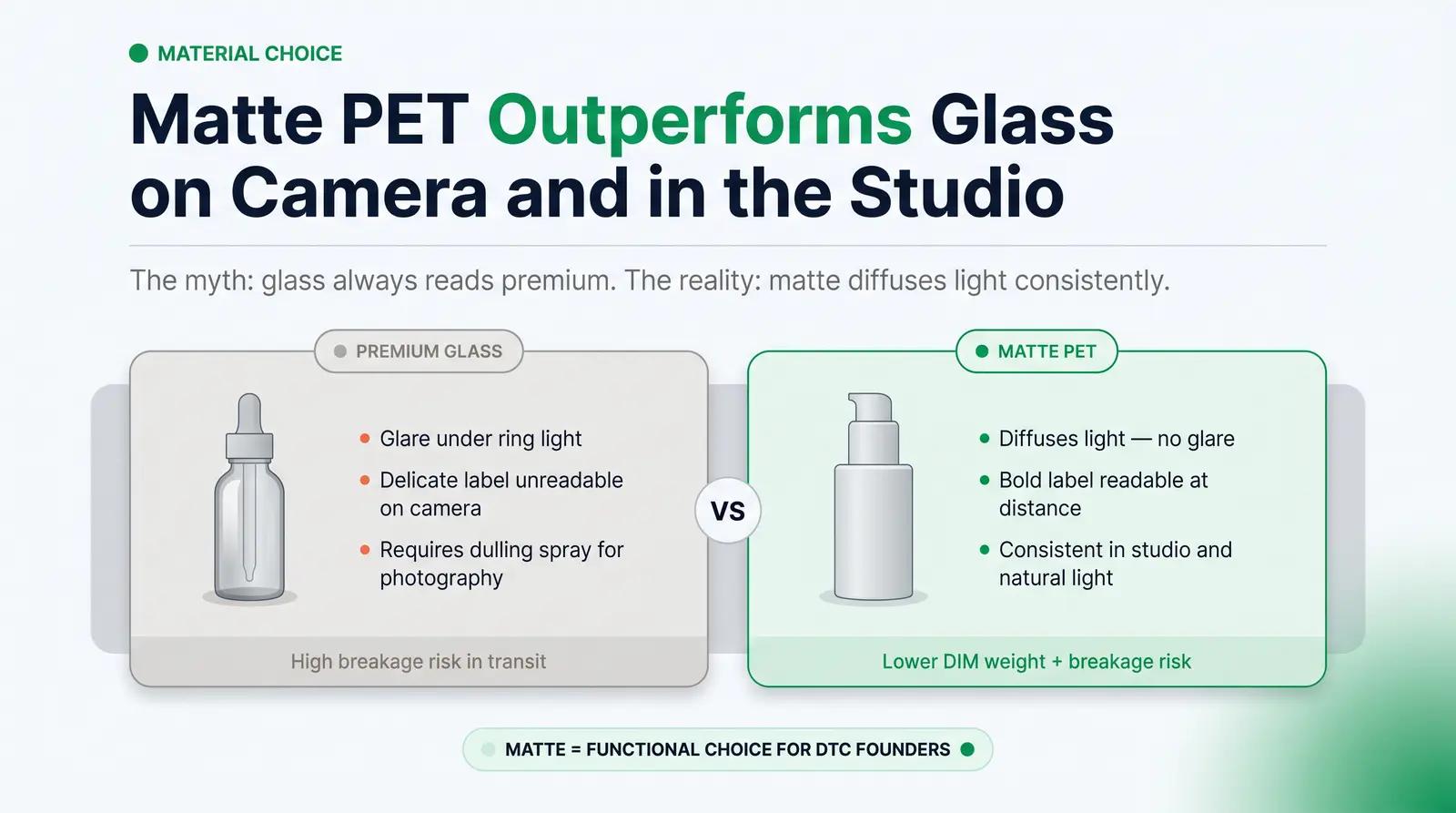
The conventional wisdom in indie beauty is that glass packaging always wins on camera. It reads as premium, it photographs beautifully, and it signals quality to a consumer who has been trained by legacy beauty brands to associate glass with efficacy.
The reality is more nuanced, and it depends heavily on the TikTok content format. In a talking-head or GRWM (Get Ready With Me) video, the creator holds the product close to the camera for a brief moment while speaking. In that format, a matte PET bottle with a strong silhouette and a bold, high-contrast label often outperforms an ornate glass bottle with a complex label. The glass bottle's detail is invisible at that distance. Its glossy surface creates glare under the ring light. The label, if it uses a delicate font, cannot be read.
A matte PET bottle with a clean shape, a solid color block, and a large brand name in a bold typeface registers immediately. The viewer does not need to pause the video to read it. The brand name is legible. The product category is clear. That is scroll-stopping visual presence.
The real reason most first-run packaging fails on Shopify PDPs is related but distinct: founders do not account for how surface finishes render differently under studio lighting versus natural light. A high-gloss finish that looks stunning in a manufacturer's 3D rendering creates harsh white glare spots under studio strobes. Photographers must use dulling sprays or complex lighting setups to make glossy packaging readable in product photography. A matte finish diffuses light evenly, allowing the true color of the container and the crispness of the label to render accurately in both studio and natural light conditions. For a founder who cannot afford a professional photographer for every content piece, matte packaging is a practical choice that performs consistently across environments.
Closing
Packaging for a DTC beauty launch is not a single decision. It is a chain of mechanical choices that determine whether a product converts on a phone screen, survives a parcel network, and leaves enough margin to reorder before momentum stalls.
Browse Packfolio's curated cosmetic packaging catalog and preview your label in 3D before placing your first order: https://packfolio.com/catalog
For a deeper look at the mechanics of specific formats, see our guide to airless pump vs. dropper bottle selection.
Frequently Asked Questions
Q: What packaging formats work best for TikTok beauty content? Formats with strong, recognizable silhouettes and large printable label surfaces perform best on TikTok. Airless pumps, wide-body dropper bottles, and squeeze tubes with matte finishes and high-contrast labels register quickly on a small screen. Avoid highly reflective finishes and complex structural shapes that require close inspection to appreciate.
Q: How do I calculate dimensional weight for cosmetic shipping? Dimensional weight is calculated by multiplying the length, width, and height of the outer shipping box in inches, then dividing by 139 (the standard DIM factor used by UPS and FedEx for domestic shipments). If the DIM weight exceeds the actual weight of the package, the carrier bills the DIM weight. Choosing compact, lightweight primary packaging reduces the outer box size and lowers the DIM weight.
Q: What is a realistic MOQ for a new indie beauty brand launching its first SKU? Traditional cosmetic packaging manufacturers often require 5,000 to 10,000 units per SKU. However, a growing number of suppliers offer low-MOQ programs using stock molds that allow first runs of 100 to 500 units. These programs carry a higher per-unit cost but preserve cash flow and reduce the risk of holding unsold inventory.
Q: Why does glass packaging increase my shipping costs? Glass packaging is heavier than PET or HDPE alternatives, and it requires more protective void fill to survive transit without breaking. Both factors increase the dimensional weight and actual weight of the shipped package, raising the carrier's billed weight. Glass breakage in transit also generates refunds and replacement shipping costs that erode launch margins.
Q: How early should I place a packaging reorder to avoid a stockout? The reorder should be placed when you have sold enough units to cover the cost of the next production run, not when you are nearly out of stock. Stock packaging from domestic suppliers typically has a 2–6 week lead time; custom or overseas packaging can require 12–20 weeks. Founders who wait until they have 50 units left and face a 10-week lead time will experience a stockout that can permanently interrupt sales momentum.
References
[1] "TikTok Shop Beauty Product Statistics 2025," Free Yourself, 2025. https://freeyourself.com/blogs/news/tiktok-shop-beauty-product-statistics
[2] "Summary of Cosmetics Labeling Requirements," U.S. Food and Drug Administration, November 2025. https://www.fda.gov/cosmetics/cosmetics-labeling-regulations/summary-cosmetics-labeling-requirements
[3] "Understanding Success Criterion 1.4.3: Contrast (Minimum)," Web Content Accessibility Guidelines (WCAG) 2.2, W3C Web Accessibility Initiative. https://www.w3.org/WAI/WCAG22/Understanding/contrast-minimum
[4] "Capturing Attention in Feed: The Science Behind Effective Video Creative," Meta for Business. https://www.facebook.com/business/news/insights/capturing-attention-feed-video-creative
[5] "10 Proven Strategies to Prevent Package Damage During Shipping," APG, February 2026. https://www.apg-go.com/feeds/blog/protect-packages-damage
[6] "Test Procedures," International Safe Transit Association (ISTA). https://ista.org/test_procedures.php
[7] "How Does MOQ Affect Cosmetic Packaging Costs," AH Packaging, October 2025. https://ahpackaging.com/how-does-moq-affect-cosmetic-packaging-costs/
[8] "Cosmetics Private Label Lead Time: Concept and Production Process Duration," Next Pangaea, February 2025. https://www.nextpangaea.com/post/cosmetics-private-label-lead-time-concept-and-production-process-duration
[9] "Airless Pump vs. Dropper Bottles: Which Is Best for Your Skincare," HCC Packaging, March 2025. https://hccpackaging.com/airless-pump-vs-dropper-bottles-which-is-best-for-your-skincare/
[10] "What Is The Cost of Custom Cosmetic Packaging?," Cosmetic Packaging Now, September 2025. https://www.cosmeticpackagingnow.com/blogs/learn/how-much-does-cosmetic-packaging-cost


