
Airless Pump Testing: How to Check If an Airless Bottle Actually Works
A hands-on 8-step testing protocol helps beauty founders verify airless pump vacuum function, dose consistency, seal integrity, and formula compatibility before committing to production.
Some airless packaging is only airless-looking. It has the form factor of an airless pump bottle but lacks the functional vacuum mechanism that makes airless packaging worth using in the first place. You unbox a sample, fill it with a sensitive vitamin C serum, and assume your formula is protected from oxidation. Months later, customer complaints roll in about discolored product and pumps that stall out halfway through the bottle. The packaging looked the part, but it failed the functional test.
For beauty brand founders and formulators, an airless pump is an investment in formula stability and premium user experience. When you receive component samples from a supplier, you cannot rely on visual inspection alone. You need a structured protocol to verify that the bottle is genuinely vacuum-driven, that it doses accurately, and that it will perform reliably on-shelf. This guide provides a hands-on testing framework to evaluate airless pump samples before committing to a production run.
What Makes an Airless Pump Genuinely Airless
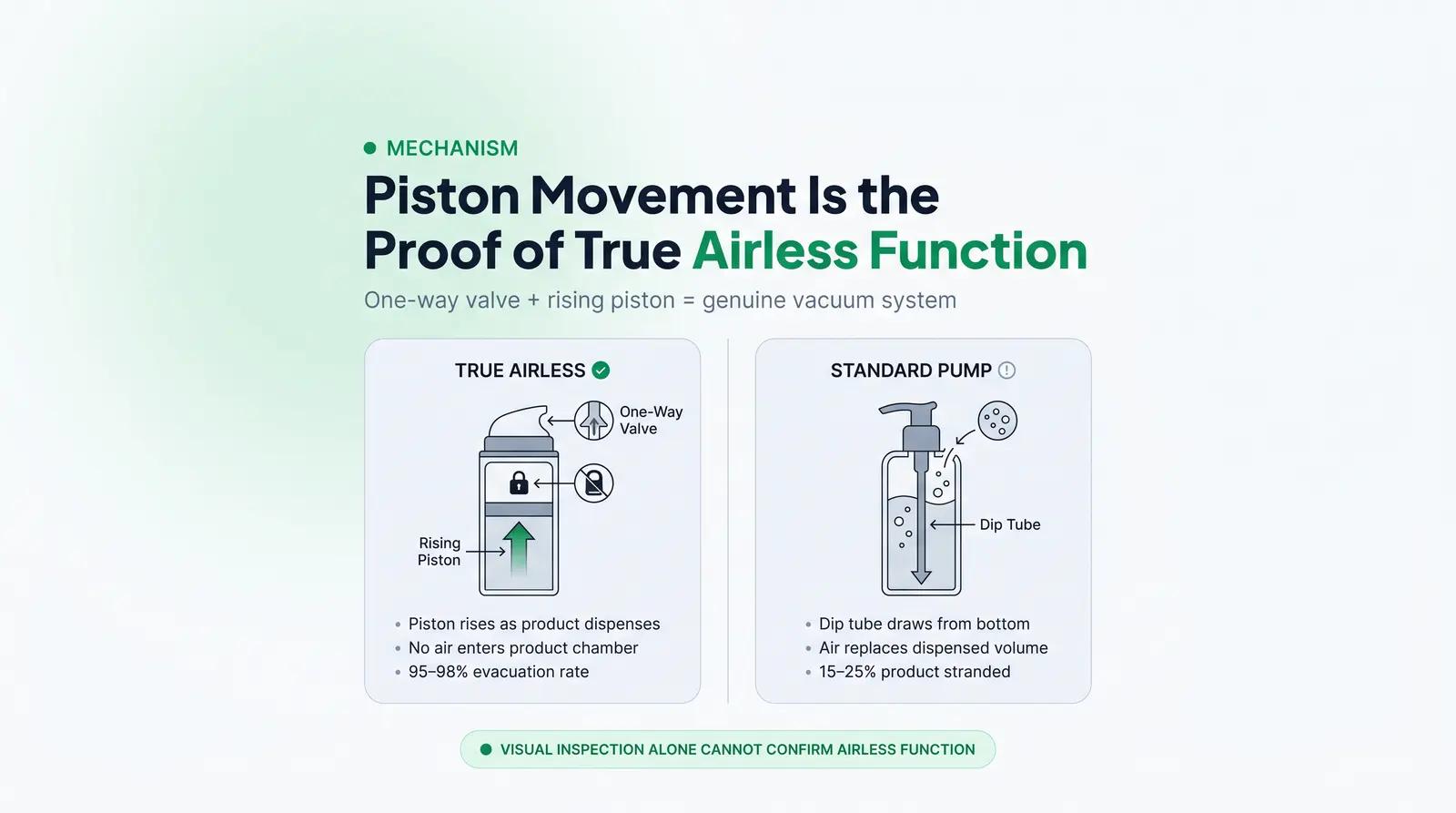
Before testing, it helps to understand what you are actually verifying. A true airless pump bottle uses a sealed internal chamber with a rising piston (or a collapsing inner pouch) that moves upward as product is dispensed. Each pump stroke creates negative pressure, drawing the formula toward the nozzle while a one-way valve prevents air from flowing back into the product chamber [1]. The piston replaces the dispensed volume, maintaining contact with the formula at all times.
This is fundamentally different from a standard lotion pump, which uses a dip tube to draw product from the bottom of the bottle. With every actuation of a standard pump, ambient air replaces the dispensed volume inside the container. For formulas containing vitamin C, retinol, peptides, or natural botanical extracts, this repeated air exposure is a direct threat to ingredient stability and potency [2].
The problem is that some suppliers produce bottles that look identical to genuine airless systems on the outside. They may have the same cylindrical form, the same pump head, and even a similar base vent hole. But internally, they use a standard dip-tube mechanism. The only way to know the difference is to test the bottle systematically, with your actual formula, before you approve the component.
The Airless Pump Functional Validation Checklist
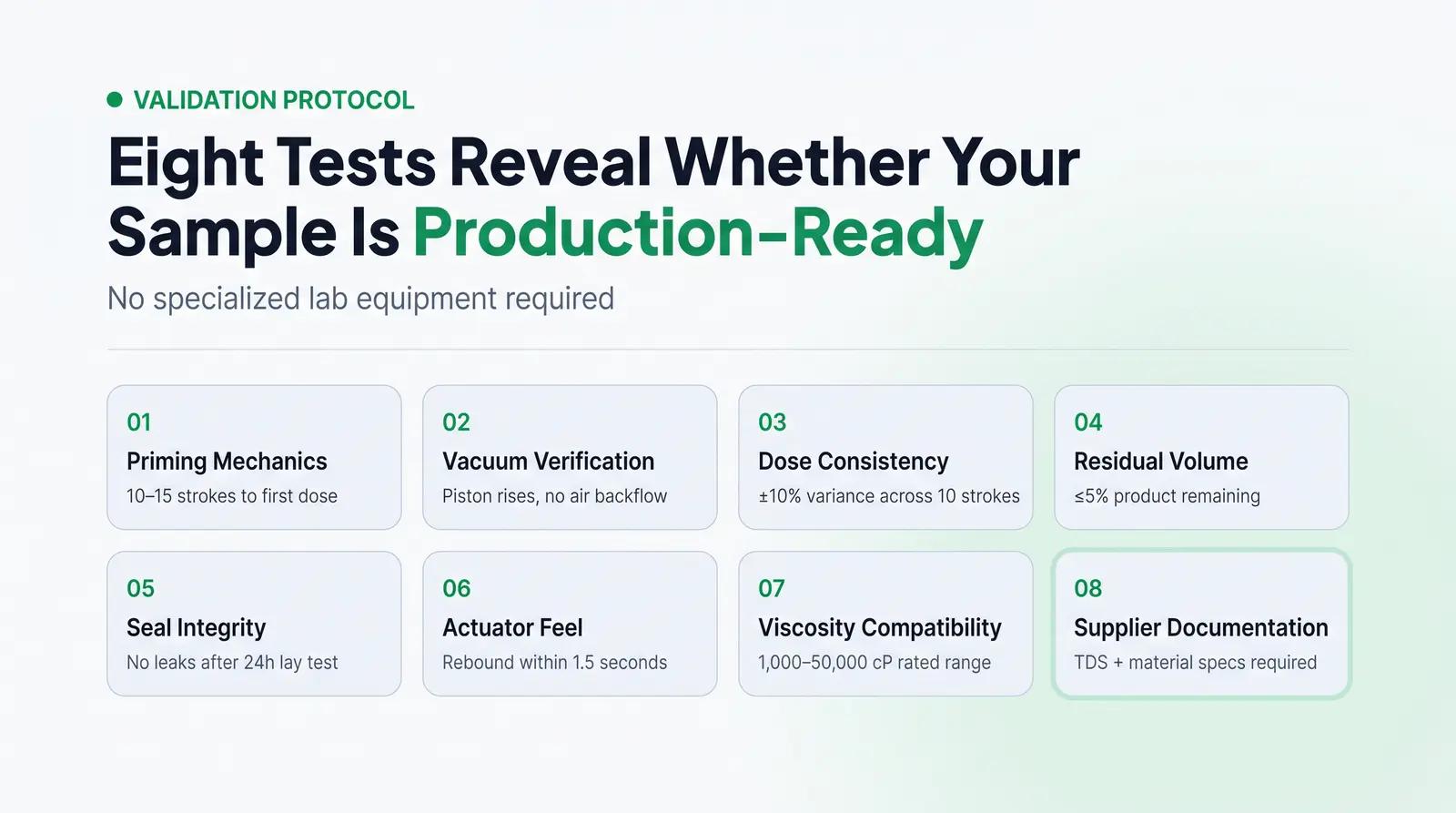
The following framework is a practical protocol we recommend at Packfolio for evaluating airless pump samples. It covers eight discrete test areas that a founder or formulator can work through without specialized lab equipment. Each step produces an observable pass or fail outcome.
Step 1: Priming Mechanics
Priming is the process of evacuating the initial headspace air to draw the product up to the dispensing nozzle. How a bottle primes tells you a great deal about its internal engineering. A well-designed airless pump should prime efficiently, typically requiring 10 to 15 strokes for a standard 30 ml or 50 ml bottle [3].
Hold the bottle upright and press the actuator slowly and fully. Count the strokes. If the pump requires excessive strokes (30 or more), it may indicate a weak vacuum seal, an oversized pump chamber, or a piston that is sticking to the side walls. Problematic priming can also manifest as spitting or sputtering, where the pump dispenses bursts of air mixed with product. This often points to trapped air bubbles during the filling process or a mismatched pump engine that struggles to handle the formula's specific rheology. Smooth, predictable priming within 10 to 15 strokes is the baseline requirement for approval.
Step 2: Vacuum Function Verification
The defining feature of an airless bottle is its ability to dispense product without allowing air to re-enter the chamber. Many "airless-look" bottles use standard dip-tube pumps disguised in sleek outer shells. To verify true vacuum function, you must confirm that the internal mechanism is actually moving the product upward and maintaining a seal.
For transparent or translucent bottles, visual confirmation is straightforward: as you pump, the internal piston should visibly rise from the bottom of the bottle toward the top [1]. If the piston does not move, or if you see air bubbles forming and rising through the product after a pump stroke, the system is allowing air backflow.
For opaque bottles, observe the actuator behavior. After dispensing, the actuator should return to its resting position smoothly and without hesitation. If you hear a distinct hissing sound of air being sucked back into the nozzle, the one-way valve is failing. A genuine airless system relies on negative pressure; if air replaces the dispensed product, the bottle is not airless, and your oxygen-sensitive actives are at risk.
Step 3: Dose Consistency
Consumers expect a predictable amount of product with every pump. Inconsistent dosing leads to frustration and can affect the efficacy of treatments that require specific application volumes, such as retinol concentrations or AHA percentages. Testing dose consistency requires a precision scale accurate to at least 0.01 grams.
Prime the pump until it dispenses a full dose. Then, actuate the pump fully 10 times, weighing the output of each individual stroke. Calculate the average weight and the variance from that average. A high-quality airless pump should deliver a consistent dose with minimal variance, typically within plus or minus 10% of the target output [4]. If the weights fluctuate beyond this threshold, it indicates that the pump chamber is not filling completely between strokes, often due to a weak spring, poor valve sealing, or a formula that is too viscous for the intake port.
Step 4: Residual Product Volume
One of the primary selling points of airless packaging is its ability to evacuate nearly all the product, reducing consumer frustration over wasted formula. A standard dip-tube pump might leave 15% to 25% of the product stranded at the bottom of the bottle. In contrast, a well-engineered airless pump should achieve an evacuation rate of 95% to 98% [2].
To test residual volume, weigh the empty bottle before filling. Fill it with a known weight of your product. Actuate the pump until it completely stops dispensing. Weigh the bottle again. The difference between the final weight and the empty weight is your residual product. Calculate this as a percentage of the total fill weight. If the residual volume exceeds 5%, the internal geometry of the piston and the pump housing are poorly matched, creating dead zones where product gets trapped. This inefficiency directly impacts the perceived value of your product and your cost of goods sold.
Step 5: Leakage and Seal Integrity
Airless bottles must maintain a strict seal to function. A compromised seal not only leads to messy leaks but also breaks the vacuum, allowing air to degrade the formula. Testing seal integrity involves evaluating the bottle under realistic stress conditions.
Professional labs use vacuum chambers for negative pressure testing, typically holding the bottle at -0.06 MPa for 5 minutes [4]. For a practical bench test, fill the bottle, prime it, and lay it on its side on a clean white paper towel for 24 hours. Check for any seepage around the neck thread, the actuator base, and the dispensing nozzle. Next, perform a drop test from a standard counter height (about 3 feet, or roughly 1 meter) onto a hard surface. The bottle should not crack, and the actuator should not pop off or leak. Pay close attention to the base vent, the small hole at the bottom of the bottle that allows ambient air to push the piston up. If product leaks from this vent, the internal piston seal has failed completely.
Step 6: Actuator Feel and Stroke Mechanics
The tactile experience of pressing the pump is a direct reflection of your brand's quality. The actuator feel should be smooth, deliberate, and consistent across every stroke. When testing, pay attention to both the resistance and the spring-back.
A high-quality pump will offer consistent, moderate resistance throughout the downward stroke. If it feels gritty, catches midway, or requires excessive force, the internal components are poorly molded or assembled. The spring-back, meaning the speed at which the actuator returns to its starting position, is equally important. It should rebound promptly, typically within 1.5 seconds [4]. A sluggish rebound indicates that the spring is too weak or that the formula's viscosity is too high, creating a vacuum drag that the pump engine struggles to overcome. This sluggishness not only feels cheap to the end consumer but also delays the user from dispensing a second dose and can cause product to drip from the nozzle.
Step 7: Formula-Viscosity Compatibility
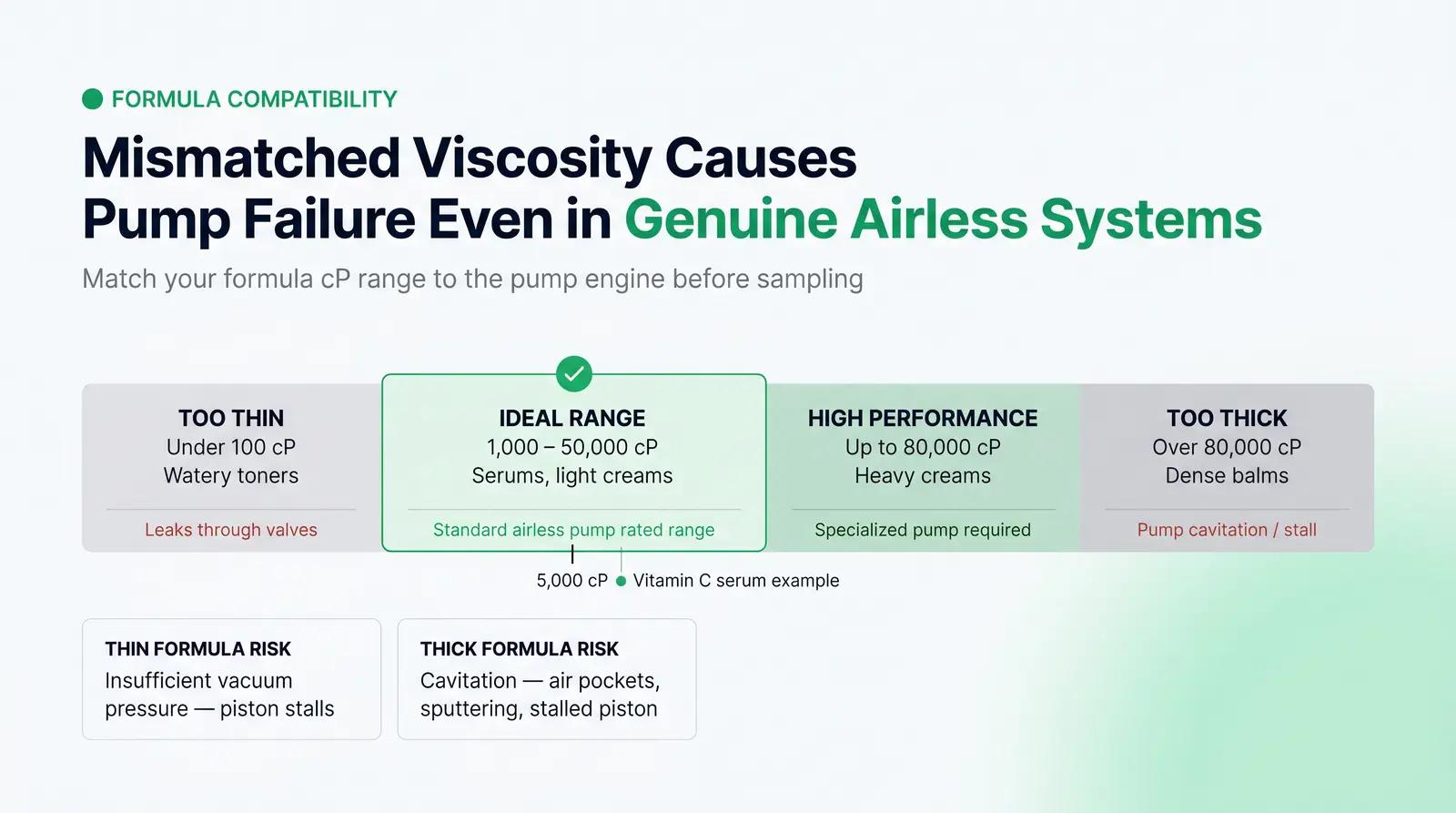
A common misconception is that airless pumps are universally compatible with all formulas. In reality, the success of an airless system is highly dependent on matching the pump engine to the formula's viscosity. Most standard airless pumps are rated for formulas in the range of 1,000 cP to 50,000 cP, while some high-performance systems from major packaging manufacturers handle up to 80,000 cP [5].
If your formula is too thin (like a watery toner under 100 cP), it may leak through the pump valves or fail to create sufficient vacuum pressure to move the piston. Conversely, if a thick cream is paired with a standard pump, the pump may cavitate. Cavitation occurs when the pump draws product faster than the thick formula can flow to fill the void, resulting in air pockets, sputtering, and a stalled piston. When testing, if you observe slow actuator rebound or inconsistent dosing with a thick formula, the pump is not rated for that viscosity, and you must source a component designed for high-viscosity extrusion.
Step 8: Supplier Documentation Review
Before committing to a bulk order, review the supplier's technical documentation. A reputable manufacturer should provide detailed specifications for their components without hesitation.
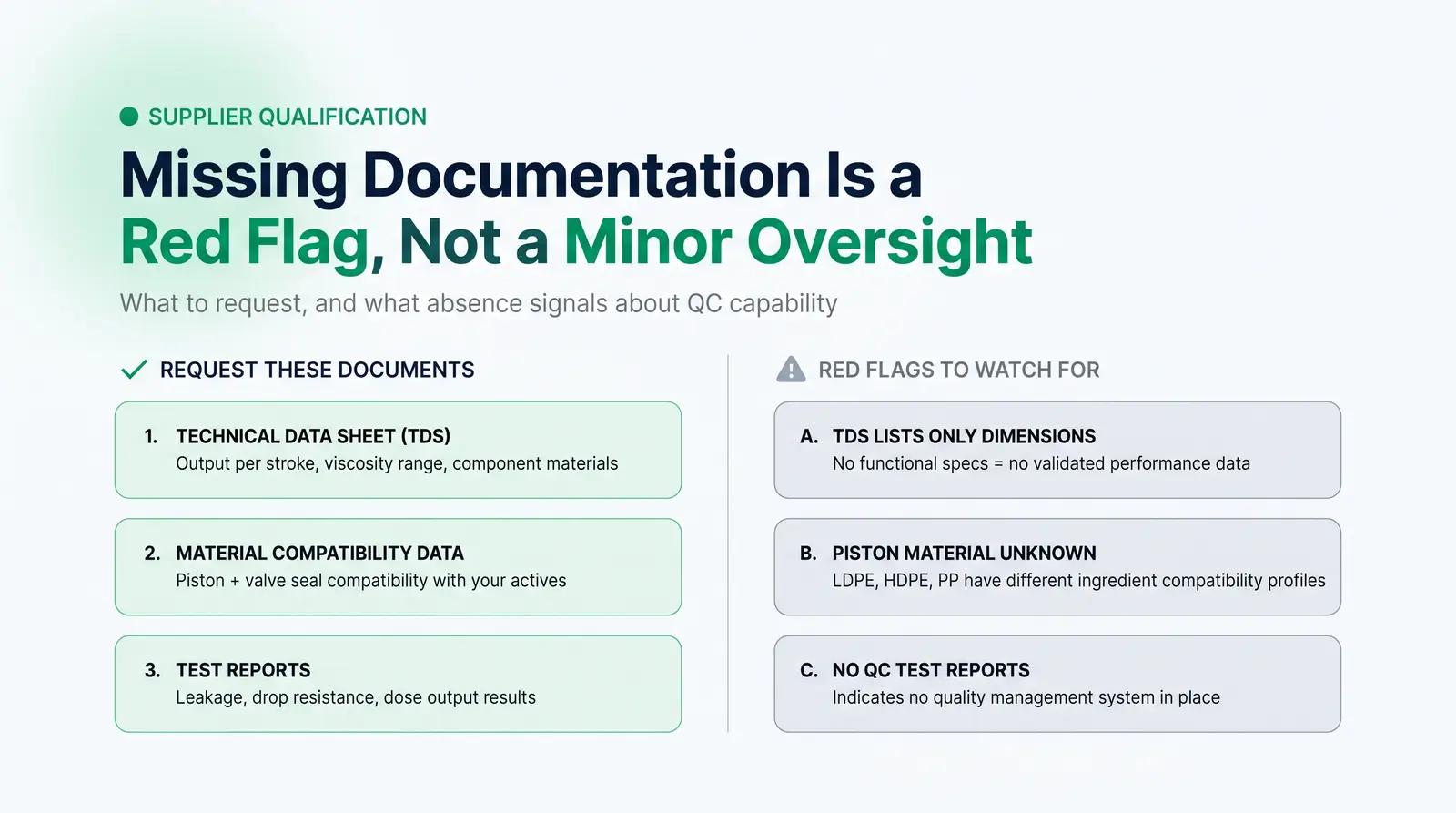
Request the technical data sheet (TDS), which should clearly state the pump's output per stroke (e.g., 0.25 ml or 0.50 ml), the rated viscosity range, and the materials used for each component. You should also ask for material compatibility data, especially concerning the piston and gaskets. Certain aggressive ingredients, like high concentrations of essential oils, alcohol-based formulas, or specific solvents, can degrade silicone seals or cause plastic pistons to swell, leading to mechanism failure [6]. If a supplier cannot provide clear documentation on viscosity ratings or material specifications, treat it as a significant red flag.
Genuine Airless vs. Standard Pump Mechanisms: A Functional Comparison
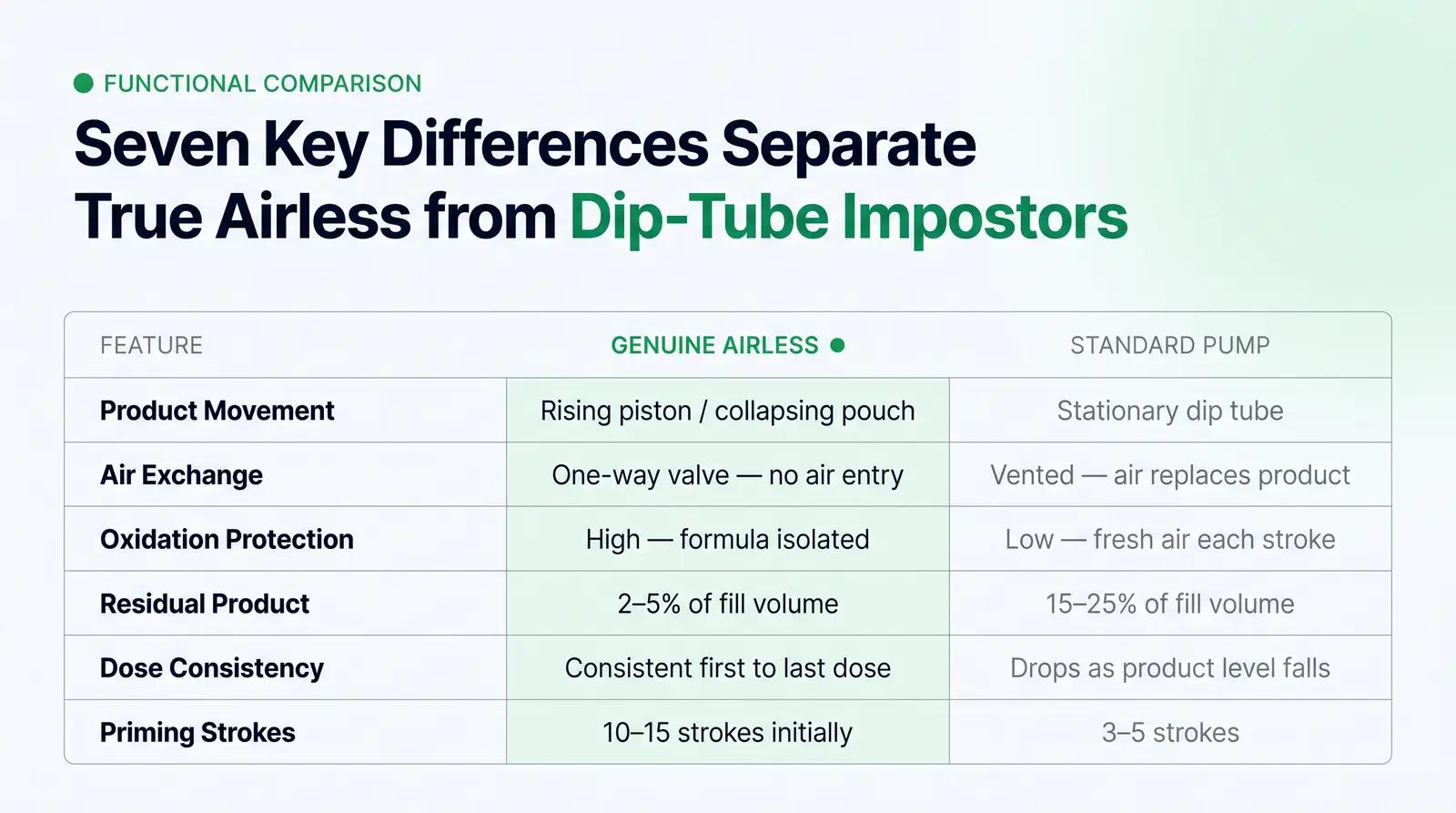
Understanding the functional differences between a true airless system and a standard lotion pump is critical during the evaluation phase. The table below outlines the key distinctions you should observe during testing.
| Feature | Genuine Airless Pump | Standard Lotion Pump |
|---|---|---|
| Product Movement | Internal piston rises or inner pouch collapses as product is dispensed [1]. | Product is drawn up through a stationary dip tube [7]. |
| Air Exchange | One-way valve prevents air from entering the product chamber [8]. | Vented system allows ambient air to replace dispensed product [8]. |
| Dispensing Orientation | Can dispense at most angles once primed; piston maintains contact with formula. | Must be held generally upright to keep the dip tube submerged in product. |
| Oxidation Protection | High; formula is isolated from continuous oxygen exposure throughout use [2]. | Low; formula is exposed to fresh air with every actuation. |
| Residual Product | Typically 2% to 5% of fill volume remains after full evacuation [2]. | Typically 15% to 25% of fill volume is inaccessible below the dip tube [2]. |
| Dose Consistency | Consistent throughout the product life cycle, from first to last dose [2]. | Dose may decrease and become inconsistent as product level drops near the tube inlet. |
| Priming Behavior | Requires 10 to 15 strokes initially; no re-priming needed during normal use [3]. | Usually primes in 3 to 5 strokes; may require re-priming after extended storage. |
A Worked Example: Testing a 30 ml Vitamin C Serum
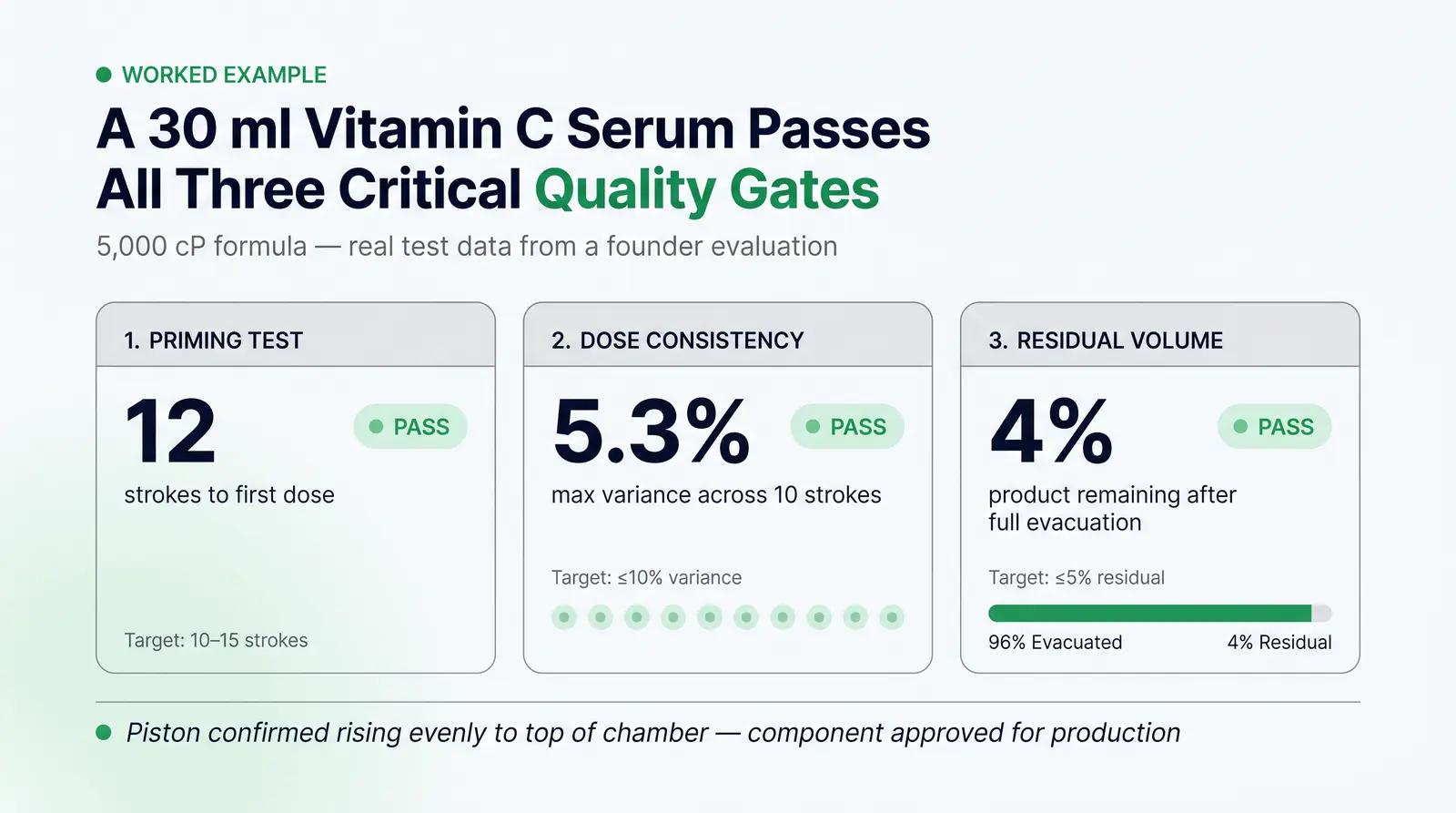
Consider a founder evaluating a 30 ml (1 oz) airless pump bottle for a new vitamin C serum. The serum has a moderate viscosity of approximately 5,000 cP, which falls comfortably within the standard airless pump range. She begins by filling the sample bottle and noting the empty weight (45.00 g) and the filled weight (75.00 g), meaning the net product weight is 30.00 g.
She starts the priming test. The pump requires 12 steady strokes to deliver the first full drop of serum. That is a pass. Next, she tests dose consistency. Over 10 strokes, the scale reads: 0.24 g, 0.25 g, 0.24 g, 0.26 g, 0.25 g, 0.24 g, 0.25 g, 0.25 g, 0.24 g, 0.25 g. The average dose is 0.247 g, and the maximum deviation is 0.013 g, or about 5.3% variance. This is well within the acceptable plus or minus 10% threshold, confirming reliable pump engine performance.
She then pumps the bottle until it stops dispensing. The final weight of the bottle is 46.20 g. Subtracting the empty weight (45.00 g), she finds 1.20 g of residual serum. This represents a 4% residual volume (1.20 g divided by 30.00 g), which falls well within the acceptable 95% or better evacuation standard. She also holds the transparent bottle up to the light and confirms that the internal piston has risen smoothly and evenly to the top of the chamber without tilting or jamming. Based on these empirical results, she confidently approves the component for production.
The Contrarian Insight: Airless Packaging Does Not Eliminate Air Exposure
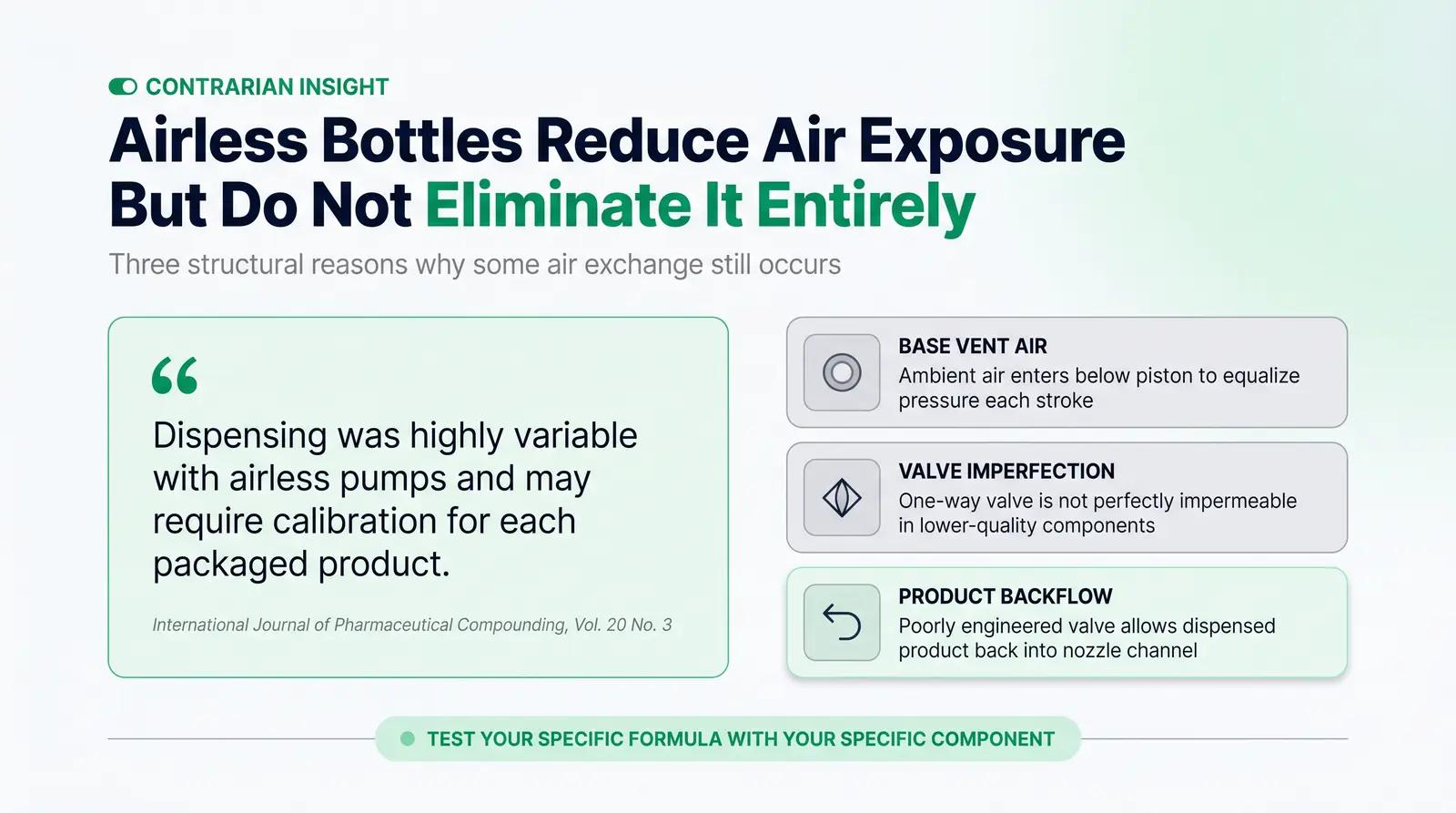
Here is the claim that most packaging guides skip over: airless pump bottles do not eliminate air exposure entirely. They reduce it significantly, but they do not create a hermetically sealed environment.
The reason is structural. Most piston-based airless systems allow a small amount of ambient air to enter the base vent with each actuation. This air travels below the piston to equalize pressure and push the piston upward. It does not contact the product directly, but the one-way valve at the nozzle is not perfectly impermeable. Over time, particularly in lower-quality components, micro-amounts of air can enter the dispensing chamber after each stroke.
More importantly, certain airless designs allow product backflow. When the actuator is released, a poorly engineered one-way valve can allow a small amount of dispensed product to be drawn back into the nozzle channel. This returned product is now exposed to ambient air and can act as a contamination pathway for the next dispensed dose [9]. This is why "no-backflow technology" has become a specific engineering feature that premium airless pump manufacturers highlight as a differentiator.
A peer-reviewed study published in the International Journal of Pharmaceutical Compounding evaluated four commercially available airless pump dispensers and found that dispensing was "highly variable with airless pumps and may require calibration for each packaged product" [10]. The study also found that cream viscosity significantly impacted the dose accuracy of piston-based airless pumps, with thicker formulas producing greater variability. This is not a reason to avoid airless packaging. It is a reason to test your specific formula with your specific component, rather than assuming that any airless bottle will perform identically with any formula.
What to Do When Supplier Documentation Is Absent or Vague
The supplier documentation test is often where the real quality signal emerges. A supplier who can provide a clear, detailed TDS with viscosity ratings, material specifications, and test reports is a supplier who understands their own product. A supplier who responds to documentation requests with vague marketing language or who cannot confirm the piston material is a supplier whose components have not been rigorously validated.
Specific red flags to watch for include: a TDS that lists only the bottle capacity and dimensions without functional specifications; a supplier who cannot confirm whether the piston is made from LDPE, HDPE, or PP (each has different compatibility profiles with cosmetic ingredients); and a supplier who has no test reports for leakage, drop resistance, or dose output. These gaps in documentation are not minor administrative oversights. They indicate that the supplier does not have a quality management system capable of supporting a production run that will carry your brand's name.
At Packfolio, component specifications, rated viscosity ranges, and piston material details are part of the catalog. Founders do not need to chase documentation from a supplier because the QC and coordination are handled before the product reaches them. The 3D preview workflow also means that what you see in the browser is what you receive in production, removing the guesswork from the packaging approval process.
Browse Packfolio's curated airless pump catalog, review component specs, and preview your label in 3D before committing to an order.
For a broader look at how to evaluate cosmetic primary packaging across all formats, see our guide to cosmetic packaging quality checks.
Frequently Asked Questions
How many pumps does it take to prime an airless bottle?
A well-designed airless pump bottle should prime within 10 to 15 full strokes for standard 30 ml to 50 ml sizes. If the bottle requires significantly more strokes, or if it never primes consistently, this is a signal of a weak vacuum seal or a pump engine that is not matched to the formula's viscosity.
How do I know if my airless pump bottle is actually airless?
Look for a small vent hole at the base of the bottle and confirm there is no dip tube attached to the pump mechanism. As you use the product, the internal piston should visibly rise from the bottom of the bottle toward the top. If the piston does not move after repeated pumping, the bottle is likely using a standard dip-tube mechanism in an airless-style outer shell.
Why is my airless pump bottle dispensing inconsistently?
Inconsistent dosing is most often caused by a mismatch between the formula's viscosity and the pump engine's rated range. It can also result from a weak internal spring, a failing one-way valve, or air pockets that formed during the filling process. Testing dose weight across 10 strokes on a precision scale will help you identify whether the variance is within acceptable limits.
What documents should I request from an airless pump supplier before ordering?
Request the technical data sheet (TDS) covering output per stroke, rated viscosity range, and component materials. Also request material compatibility data for the piston and valve seals, and ask for any available test reports covering leakage, drop resistance, and dose output. A supplier who cannot provide these documents should be treated with caution.
Do airless pump bottles prevent all oxidation?
Airless bottles significantly reduce oxidation compared to standard pump bottles and open jars, but they do not create a perfectly sealed environment. Minor air exchange can occur at the nozzle valve, and some designs allow product backflow that exposes a small amount of formula to ambient air. The quality of the one-way valve and the precision of the piston seal are the primary factors that determine how effectively a specific bottle limits oxidation.
References
[1] How Do Airless Pump Bottles Work? - UKPACK. Lucas Ji. Last Updated April 22, 2026.
[2] What Is a Cosmetic Airless Bottle? A Complete Guide to How It Works, Types, and Benefits - Hongsheng Sprayer. (n.d.).
[3] Guide to a Flawless Airless Experience - EPOPACK Co., Ltd. (n.d.).
[4] Quality Inspection Standards for Airless Bottles Packaging - Smile Kuan, LinkedIn Pulse. December 2, 2024.
[5] Aptar Beauty - Airless Packaging - Aptar Group. (n.d.).
[6] What are Drawbacks of Airless Cosmetic Bottles? - JC Cosmopack. March 1, 2026.
[7] What Is an Airless Pump Bottle? Mechanism & Buyer Guide - HCC Packaging. Sunny Wan. June 3, 2025.
[8] Airless Pump Bottles for Cosmetics: Benefits, Common Problems & How to Choose the Right Packaging - The Packaging Company. April 15, 2026.
[9] How No Backflow Technology Improves 150ml Airless Pump Bottles - Topfeelpack. June 10, 2025.
[10] Topical Metered-dosing Dispenser Performance Evaluation - Liu Q, Kupiec TC, Vu NT. International Journal of Pharmaceutical Compounding. Vol. 20, No. 3. May-June 2016. PMID: 28333665.


