
How Much Product Gets Left Behind In Cosmetic Packaging?
Compare residue rates across jars, tubes, pumps, and airless bottles to choose cosmetic packaging that minimizes product waste and protects brand margins.
When beauty brand founders select primary packaging, the conversation typically centers on aesthetics, material costs, and sustainability. However, a critical operational and brand-equity metric is frequently overlooked: the rate of product residue. Residual product—the formula left trapped inside an "empty" container—is fundamentally a margin issue and a consumer-trust issue.
If 15% of a premium face cream remains inaccessible at the bottom of a bottle, the founder is effectively subsidizing formula that the customer never experiences. Simultaneously, customers who feel cheated by a container they cannot scrape clean lose trust in the brand, not the packaging format [1]. They perceive the product as running out too quickly, diminishing its perceived value and making them less likely to repurchase [2].
Understanding how much product gets left behind in cosmetic packaging allows founders to make informed decisions that protect their margins, enhance consumer satisfaction, and align with genuine sustainability goals. This guide systematically compares residue rates across common packaging formats, provides a practical framework for selecting the right container based on formula viscosity, and details how founders can test residue levels themselves before locking in a production order.
Why Residual Product Matters More Than Most Founders Realize
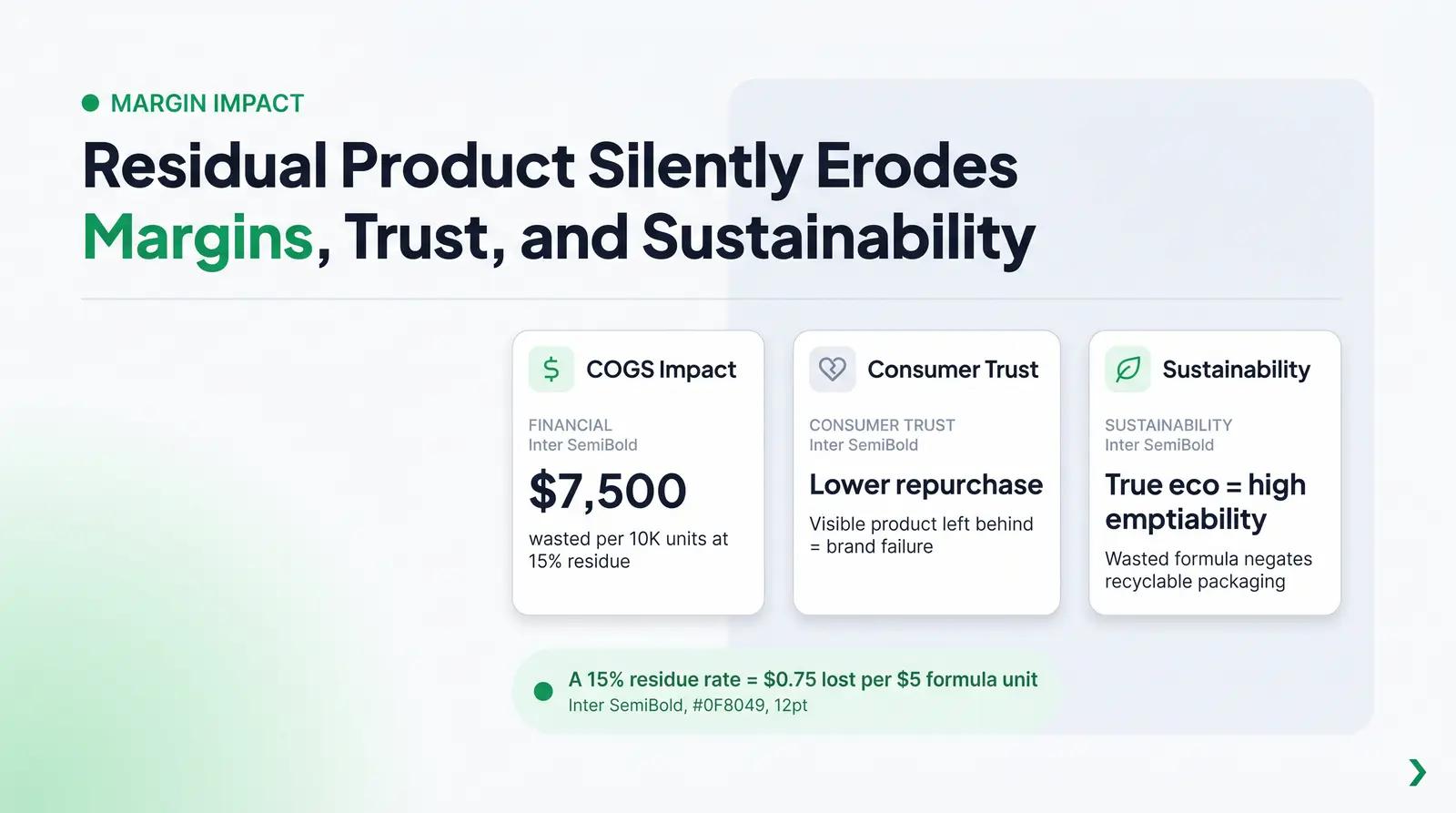
Residual product waste impacts beauty brands on three distinct fronts: cost of goods sold (COGS), consumer perception, and environmental sustainability.
From a financial perspective, formula left in the packaging is lost margin. For a high-end serum costing $5.00 per unit to formulate and fill, a 15% residue rate means $0.75 of formula per unit is essentially thrown away. Across a modest 10,000-unit production run, that equates to $7,500 in wasted COGS. This invisible cost inflates the true price of the packaging format.
More importantly, poor emptiability damages consumer trust. Research on packaging satisfaction indicates that consumers are highly frustrated when they cannot access the entire product [2]. When a consumer pays $80 for a moisturizer and the pump stops dispensing while visible product remains clinging to the walls, the immediate reaction is frustration. A weak first impression or a frustrating end-of-life product experience lowers the perceived value of the cosmetic brand [3].
Furthermore, the packaging format that looks most "sustainable" on a retail shelf is not always the one that delivers the most product to the consumer's skin. For example, a heavy glass pump bottle might appear premium and eco-friendly due to its recyclability. However, if that rigid bottle and standard pump mechanism trap 10–25% of a thick lotion [4], the environmental footprint of the wasted formula (and the resources used to produce and transport it) often outweighs the benefits of the recyclable glass [5]. True sustainability requires high emptiability so that the formula is actually consumed.
The Six Packaging Formats, Compared
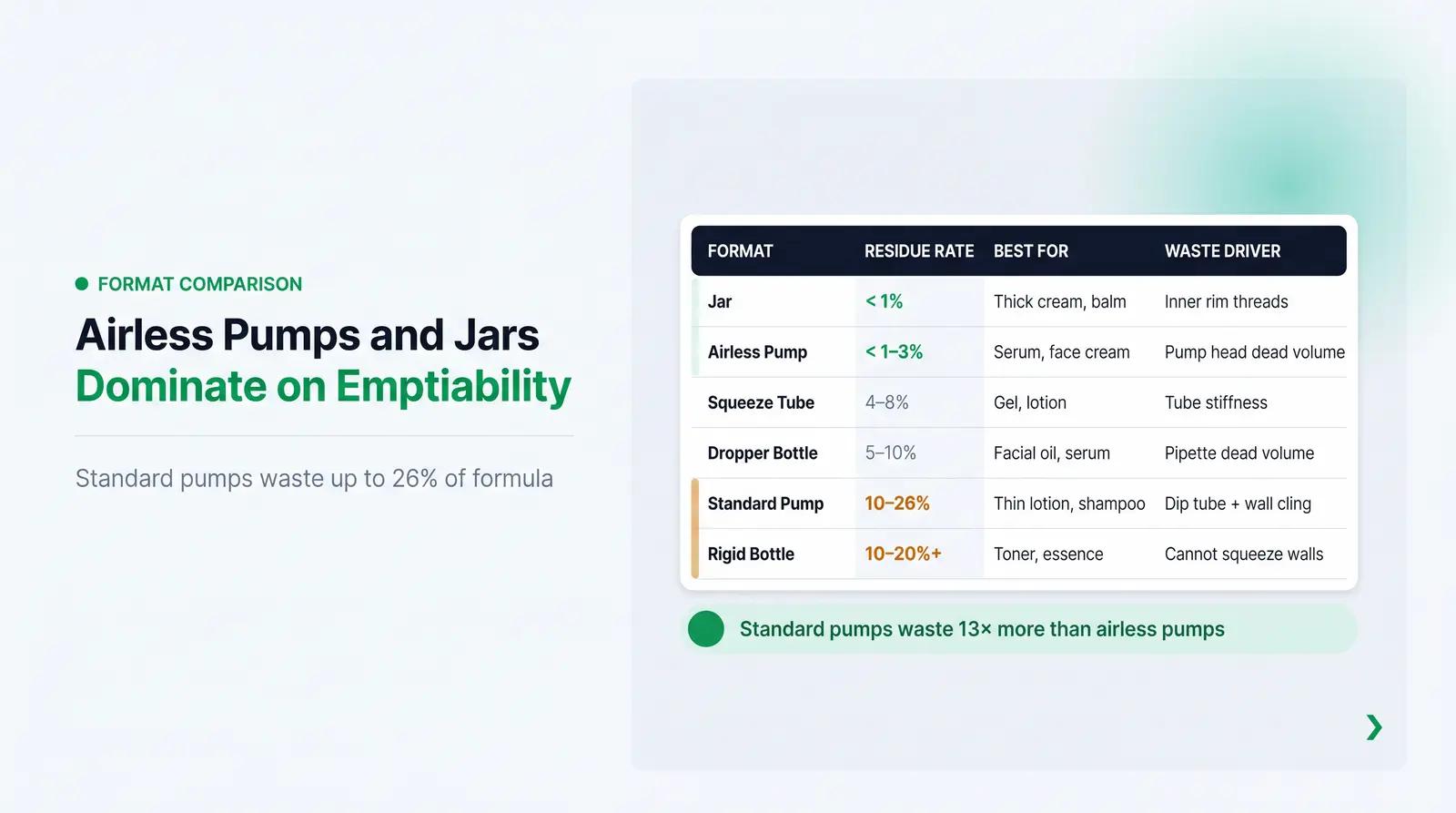
Different packaging systems exhibit vastly different residue rates, driven primarily by the interaction between the container's geometry, the dispensing mechanism, and the formula's viscosity. Below is a systematic comparison of jars, standard tubes, standard pump bottles, airless pump bottles, droppers, and rigid bottles.
Jars Jars offer the highest emptiability of any packaging format because they provide complete, unrestricted access to the product. Consumers can easily scoop out the final remnants with their fingers or a spatula. Studies show jars retain less than 1% of product residue for thick creams [5]. They are best suited for high-viscosity formulas (50,000+ cP) like heavy body butters, balms, and thick night creams. The primary drawback is hygiene; repeated finger exposure increases contamination risk, requiring robust preservative systems.
Standard Squeeze Tubes Squeeze tubes are highly versatile and offer good emptiability. Users can squeeze, roll, and ultimately cut open the tube to access the remaining product. Research indicates the residual content of tubes ranges from 4.23% to 8.45%, with an average value of 5.63% [5]. Tubes are ideal for mid-weight lotions, gels, and creams (10,000–40,000 cP). The key waste driver is the rigidity of the tube material; highly flexible tubes yield lower residue rates than stiff plastic tubes.
Standard Pump Bottles Standard pump bottles utilize a dip tube to draw product upward. This design is notoriously prone to high residue rates, particularly for viscous formulas. The pump cannot reach the product clinging to the walls or sitting below the dip tube. Studies have found pump dispensers can retain up to 26% of product residues, with average residue amounts significantly higher than tubes or pouches [5]. They work best for low-viscosity, flowable liquids (1,000–5,000 cP) like shampoos, liquid soaps, and thin lotions. The key waste driver is the formula's inability to flow down to the dip tube intake.
Airless Pump Bottles Airless pump bottles use a vacuum-based dispensing system with an internal piston that pushes the product upward, preventing air exposure. This design offers excellent emptiability, often leaving less than 1% residue [5]. Airless systems are perfect for sensitive, mid-to-high viscosity formulas (5,000–30,000 cP) like anti-aging serums and premium face creams. While they are highly efficient, a non-obvious contrarian insight applies here: airless pumps are often marketed as zero-waste, but dead-volume in the pump mechanism itself can trap meaningful product—especially for highly viscous formulas—making a simple squeeze tube a lower-waste option for very thick creams at small fill volumes.
Dropper Bottles Dropper bottles are standard for facial oils and thin serums. While the glass bottle itself can be emptied if the user is diligent, the dropper mechanism creates waste. Dropper dead volume—the liquid trapped inside the glass pipette and rubber bulb—can result in the loss of several drops per application [6]. Furthermore, as the product level drops, the pipette may not reach the bottom corners of the bottle. They are strictly for low-viscosity liquids (1–500 cP). The key waste driver is the pipette length and the user's technique.
Rigid Bottles (No Pump) Rigid bottles, such as glass serum bottles with a simple orifice reducer or open neck, rely on gravity and shaking to dispense the product. For anything other than water-thin liquids, these are highly inefficient. Thick products will cling to the rigid walls, and consumers cannot squeeze the container to force the product out. Residue rates are highly variable but generally poor for viscous formulas. They are only suitable for low-viscosity toners and essences.
| Format | Typical Residue (%) | Best Viscosity Range | Consumer Perception of Emptiness | Key Waste Driver |
|---|---|---|---|---|
| Jar | < 1% | Thick cream, balm, butter | High satisfaction; visual confirmation of empty | Product trapped under inner rim threads |
| Airless Pump Bottle | < 1% to 3% | Mid-weight lotion, serum, cream | High satisfaction; piston visually rises | Dead volume in pump head mechanism |
| Standard Squeeze Tube | 4% to 8% | Gel, lotion, mid-weight cream | Moderate satisfaction; requires cutting open | Tube material stiffness preventing flattening |
| Dropper Bottle | 5% to 10% (estimated from geometry) | Thin/watery, oil, light serum | Moderate frustration; hard to reach bottom | Pipette dead volume and inability to reach corners |
| Standard Pump Bottle | 10% to 26% | Thin lotion, liquid soap, shampoo | High frustration; visible product left on walls | Dip tube length and formula clinging to walls |
| Rigid Bottle (No Pump) | 10% to 20%+ (estimated from viscosity principles) | Thin/watery, toner, essence | High frustration; requires violent shaking | Inability to squeeze rigid walls |
The Residue-to-Retail Rubric — A Framework for Choosing the Right Format
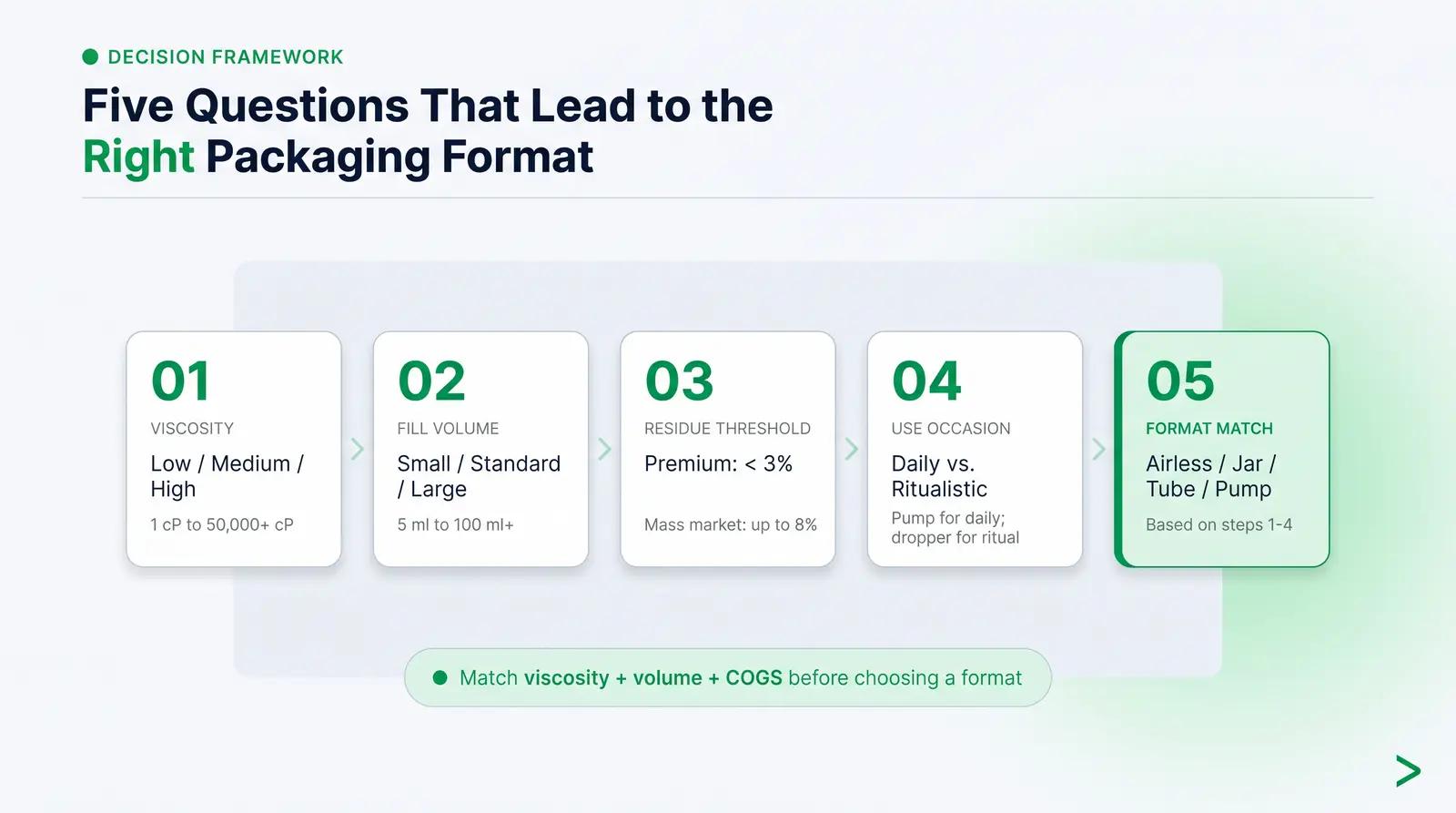
To navigate the complexities of packaging selection, we recommend a practical framework at Packfolio: The Residue-to-Retail Rubric. This rubric guides founders through five critical decision points to match their formula with the optimal packaging format.
1. Determine Formula Viscosity
- Low (1–1,000 cP): Toners, essences, facial oils.
- Medium (1,000–15,000 cP): Serums, light lotions, gels.
- High (15,000–50,000+ cP): Heavy face creams, body butters, balms.
2. Define Target Fill Volume
- Small (5 ml–15 ml): Eye creams, spot treatments. (Dead volume in pumps has a disproportionately high impact here).
- Standard (30 ml–50 ml): Face serums, daily moisturizers.
- Large (100 ml+): Body lotions, cleansers.
3. Establish Acceptable Residue Threshold
- Premium/High COGS: Formula is expensive; residue must be < 3%.
- Mass Market/Low COGS: Formula is inexpensive; residue up to 8% is tolerable if the packaging is cheap.
4. Consider Consumer Use Occasion
- Daily/High Frequency: Requires quick, convenient dispensing (pumps, tubes).
- Occasional/Ritualistic: Can accommodate slower dispensing (droppers, jars).
5. Format Recommendation
- If Low Viscosity + Premium + Daily Use: Choose an Airless Pump or high-quality Dropper Bottle.
- If Medium Viscosity + Standard Volume + Premium: Choose an Airless Pump.
- If High Viscosity + Any Volume + Premium: Choose a Jar or a flexible Squeeze Tube.
- If Medium Viscosity + Large Volume + Mass Market: Choose a Standard Pump Bottle or Squeeze Tube.
A Worked Example — Choosing Between an Airless Pump and a Jar for a 1 oz (30 ml) Face Cream
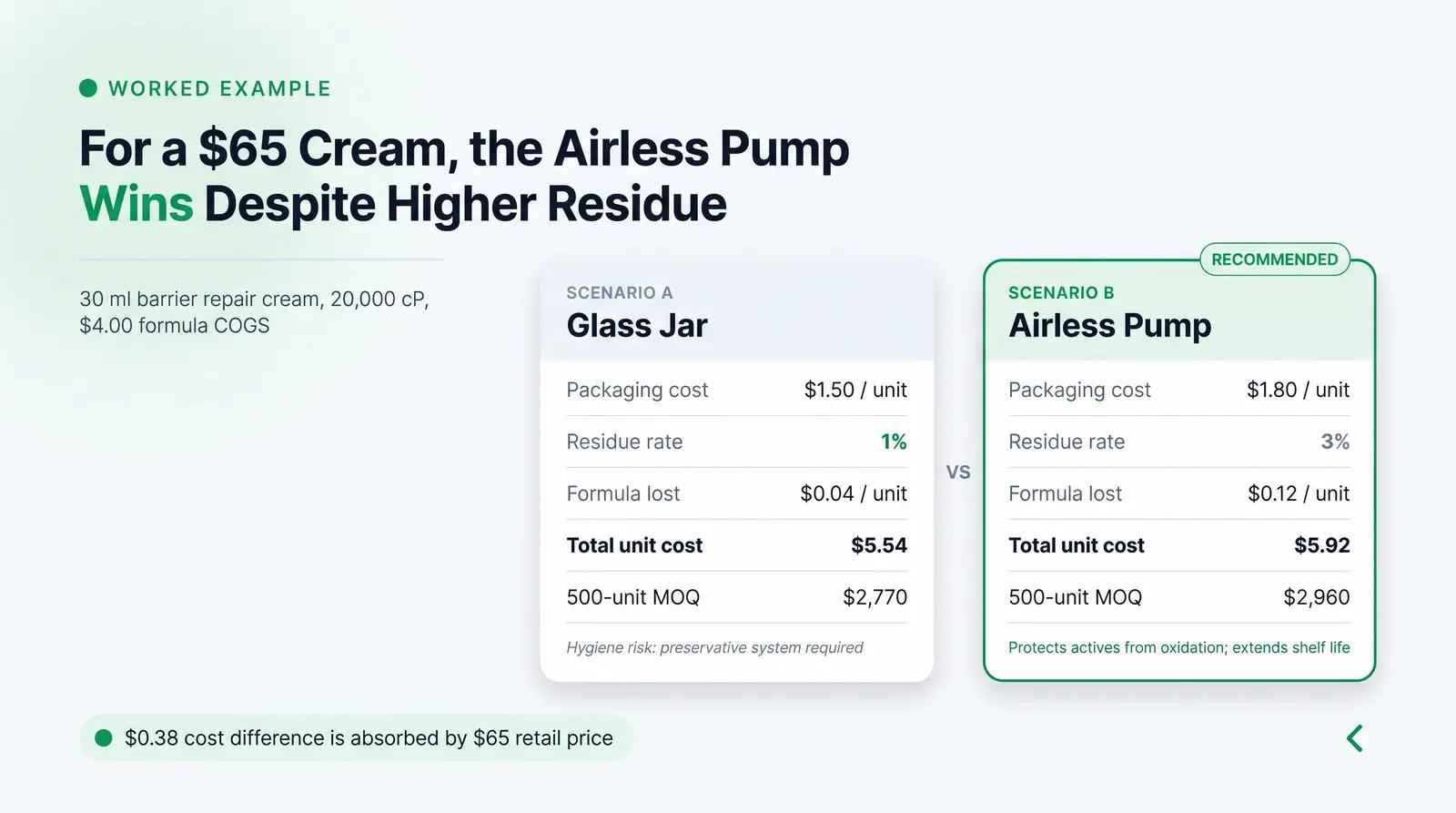
Consider a founder launching a premium barrier repair face cream. The formula is a thick, rich cream with a viscosity of approximately 20,000 cP. The target fill volume is 1 oz (30 ml), and the retail price is set at $65. The formula COGS is $4.00 per 30 ml.
The founder is debating between a heavy glass jar and a sleek plastic airless pump bottle.
Scenario A: The Glass Jar The jar costs $1.50 per unit. Because the consumer can scoop out the thick cream entirely, the residue rate is 1%.
- Formula lost to residue: $0.04 per unit.
- Total unit cost (Packaging + Formula + Residue Loss): $1.50 + $4.00 + $0.04 = $5.54.
- At a 500-unit MOQ, the total investment is $2,770. The consumer experience is highly tactile, but the founder must ensure the preservative system can handle repeated finger dipping.
Scenario B: The Airless Pump The airless pump costs $1.80 per unit. The vacuum piston works well, but because the cream is highly viscous (20,000 cP), the pump requires a larger internal valve and stronger spring return [7]. Even with a good pump, the dead volume in the actuator head traps about 3% of the thick cream.
- Formula lost to residue: $0.12 per unit.
- Total unit cost (Packaging + Formula + Residue Loss): $1.80 + $4.00 + $0.12 = $5.92.
- At a 500-unit MOQ, the total investment is $2,960.
The Recommendation: While the jar is slightly cheaper and yields less residue, the airless pump is the better choice for a $65 barrier repair cream. The airless system protects the sensitive active ingredients from oxidation and contamination, extending shelf life and justifying the premium price point [8]. The 3% residue rate is well within acceptable limits, and the $0.38 difference in total unit cost is easily absorbed by the $65 retail price. The founder chooses the airless pump, prioritizing formula stability and hygienic dispensing.
DIY Residue Tests Founders Can Run at Sample Stage
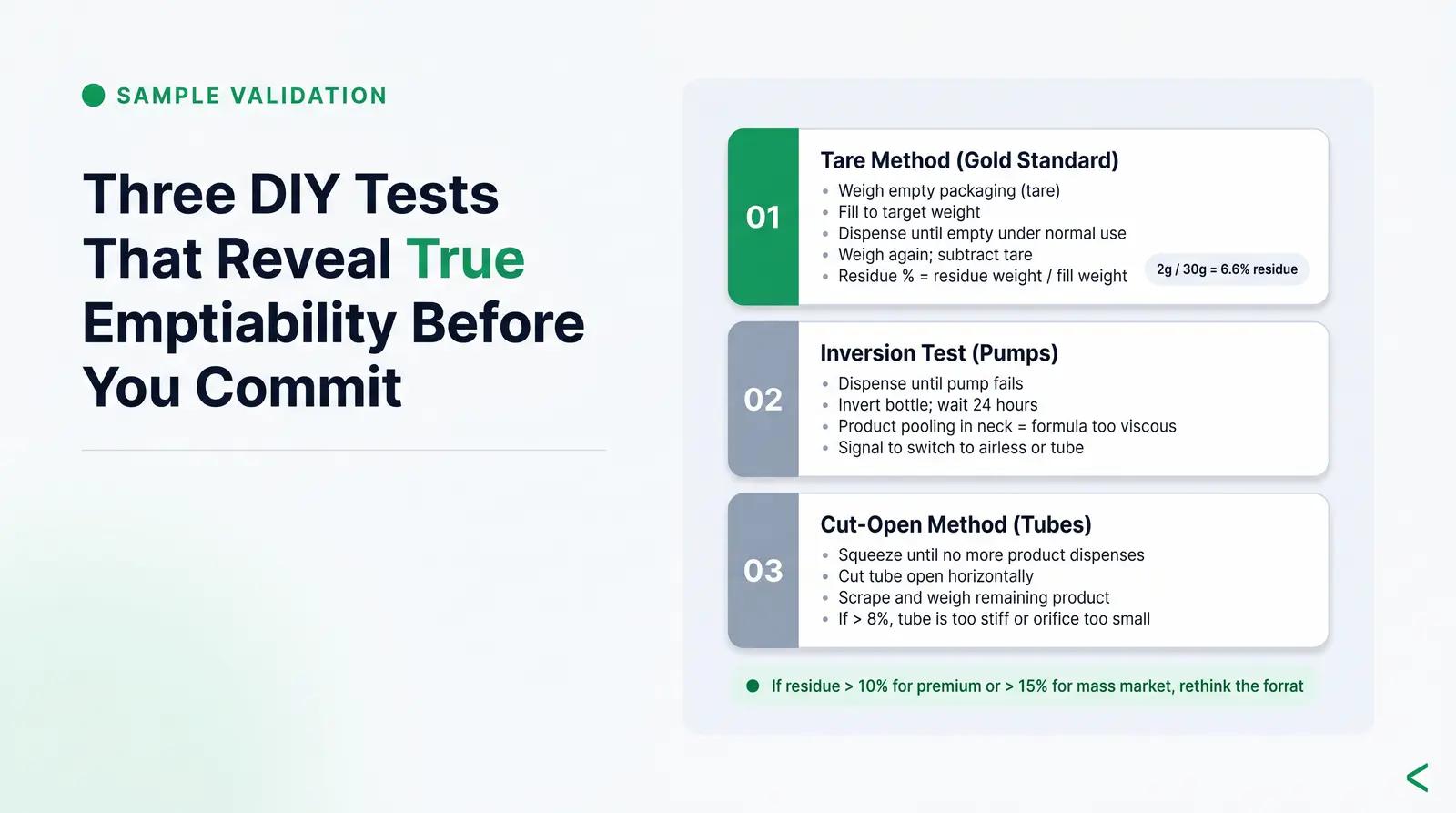
Before committing to a 10,000-unit packaging order, founders should empirically validate emptiability using sample containers and their actual formula. Supplier specifications rarely account for the unique rheology of your specific product.
The Weigh-Empty-Weigh-Used Test (Tare Method) This is the gold standard for calculating residue percentage.
- Weigh the completely empty, clean packaging sample (the tare weight). Record this number (e.g., 20g).
- Fill the packaging with your exact formula to the target fill weight (e.g., 30g of product).
- Weigh the filled package to confirm the gross weight (e.g., 50g).
- Dispense the product exactly as a consumer would, until the packaging stops yielding product under normal use. Do not cut it open or dismantle it yet.
- Weigh the "empty" package again (e.g., 22g).
- Subtract the tare weight from the final weight to find the residue weight (22g - 20g = 2g of residue).
- Divide the residue weight by the original fill weight to get the residue percentage (2g / 30g = 6.6% residue).
The Inversion and Wait Test for Pumps For standard pump bottles, dispense the product until the pump fails. Then, invert the bottle and leave it upside down for 24 hours. If a significant amount of product pools in the neck, the formula is too viscous for the dip tube design, and a substantial portion of the product is being wasted. This indicates a need to switch to an airless pump or a tube.
The Cut-Open-and-Scrape Method for Tubes After a squeeze tube stops dispensing under normal thumb pressure, cut the tube open horizontally across the middle. Scrape the remaining product from the interior walls and the shoulders near the dispensing orifice. Weigh this scraped product. If the residue exceeds 8%, the tube material may be too stiff, or the orifice diameter may be too small for the formula's viscosity.
When to Rethink the Format As a general benchmark, if your DIY tests reveal a residue rate exceeding 10% for a premium product, or 15% for a mass-market product, you should rethink the packaging format or adjust the formula viscosity.
To streamline this evaluation process, browse Packfolio's curated packaging catalog. Our platform allows you to filter vetted primary packaging SKUs, preview your label on a photorealistic 3D model, and order samples for these exact DIY tests without the hassle of managing overseas supplier communications directly. Explore the catalog here.
Before You Lock In a Format
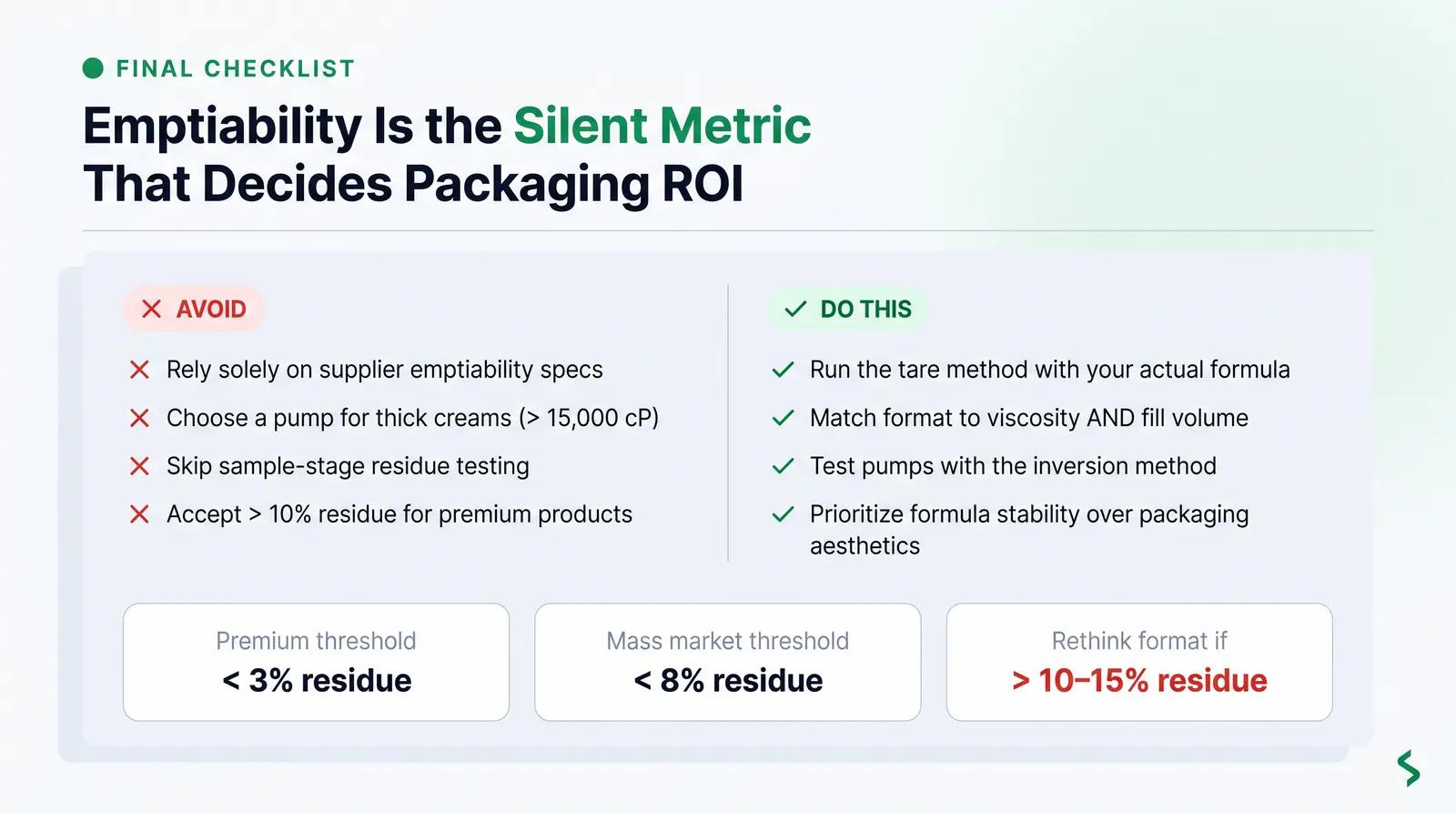
Selecting cosmetic packaging is a balancing act between aesthetics, formula protection, and consumer experience. Residual product waste is the silent metric that undermines all three if ignored. By understanding the typical residue rates of jars, tubes, and pumps, and by matching those formats to your formula's specific viscosity, you protect your profit margins and ensure your customers get exactly what they paid for.
Do not rely solely on supplier promises regarding emptiability. Run the tare method tests with your actual formula during the sampling phase. A container that traps 15% of your product is not a bargain, regardless of the unit price. Choose packaging that respects your formula and your customer.
Browse Packfolio's curated packaging catalog and preview your label in 3D before committing to a format → packfolio.com/catalog
Frequently Asked Questions
What is the average product waste in standard pump bottles? Standard pump bottles with dip tubes can retain anywhere from 10% to 26% of the product, particularly when used with thicker lotions or creams that cannot easily flow to the bottom intake.
Why do airless pump bottles leave less residue? Airless pumps use an internal vacuum and a rising piston mechanism that continuously pushes the product upward toward the dispenser, preventing air pockets and scraping the walls clean, often leaving less than 1% to 3% residue.
How does formula viscosity affect packaging choice? Viscosity determines how a product flows. High-viscosity (thick) creams require jars, squeeze tubes, or specialized high-viscosity airless pumps, while low-viscosity (thin) liquids are better suited for droppers or standard pumps.
Can I recycle cosmetic packaging that still has product inside? Most recycling facilities require packaging to be reasonably clean and empty. Significant product residue (typically over 1-2%) can contaminate the recycling stream, meaning heavily coated bottles or tubes are often diverted to landfills.
How do I test packaging samples for product waste? Use the tare method: weigh the empty packaging, fill it with your product, use it until it stops dispensing normally, and weigh it again. The difference between the final weight and the empty tare weight is your residual product.
References
- Impact of Packaging on the Perception of a Cosmetic Brand
- U.S. consumers expect more from beauty products packaging
- Cosmetic Packaging That Makes Customers Trust Your Product
- How Airless Pump Bottles Solve Common Cosmetic Packaging Problems
- Product Waste Resulting from Insufficient Emptiability of Cosmetic Packaging and Its Economic and Environmental Implications
- Face oil pump bottle versus dropper application waste comparison and cost analysis
- Why does pump viscosity matter for high-end face creams?
- How do airless pump bottles work and why choose them?


