
Beauty Packaging Recyclability Scorecard
A 4-dimension scorecard helps beauty brands evaluate cosmetic packaging recyclability by material, format complexity, documentation, and launch-stage fit before committing to a format.
Your packaging might say "recyclable," but the sorting machine at the materials recovery facility likely disagrees. For independent beauty brand founders, formulators, and contract manufacturers, choosing sustainable primary packaging is rarely as simple as looking for a chasing arrows symbol. It is a practical sourcing and design decision that directly affects your brand's regulatory compliance, retail audit success, and cost structure. Packaging that looks sustainable but fails at curbside collection, retail due diligence, or regulatory scrutiny is a liability. This article gives you a concrete framework for evaluating whether a packaging format or material is genuinely recyclable, and how to make that sourcing decision confidently without being misled by vague "eco-friendly" marketing claims.
Why "Recyclable" on the Label Doesn't Mean What You Think
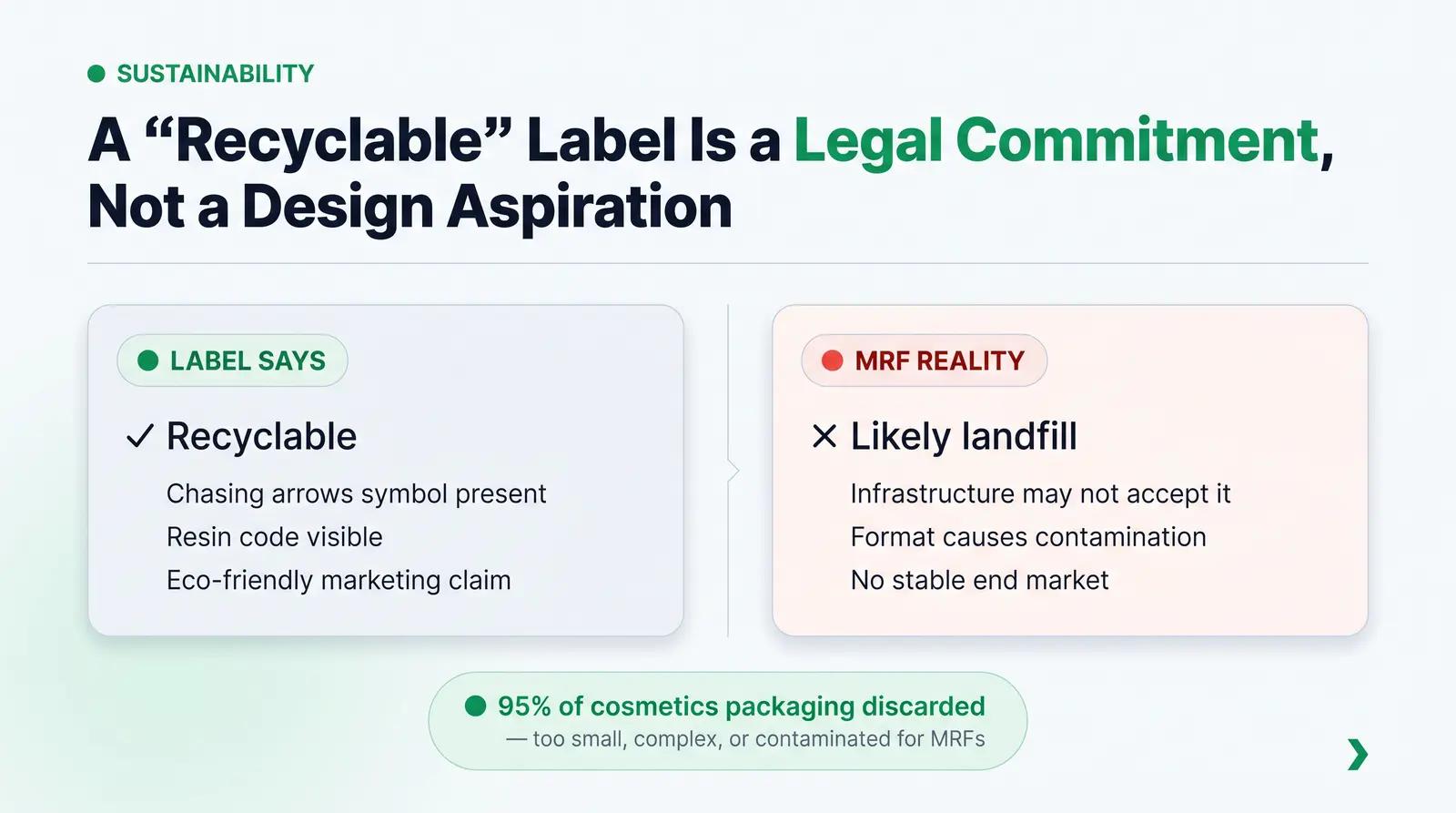
The gap between theoretical recyclability and actual materials recovery facility (MRF) acceptance rates is the most important concept in sustainable packaging sourcing. A material can be technically recyclable, meaning it is made from a resin that can be processed, yet still end up in landfill because local recycling infrastructure does not accept it, the format causes contamination, or there is no stable end market for the material.
The Federal Trade Commission's Green Guides require that recyclable claims be qualified if recycling facilities are not available to a substantial majority of consumers [1]. The European Union's Packaging and Packaging Waste Regulation (PPWR), which entered into force in February 2025 and will generally apply from August 2026, goes further, mandating that all packaging on the EU market be recyclable in an economically viable way by 2030 [2]. These are not aspirational goals. They are regulatory thresholds with legal consequences for brands that overclaim.
The practical reality at MRFs reinforces this. Facilities operate on tight quality specifications: they aim for approximately 1.5% contamination in outgoing bales, while incoming materials often arrive at 15% contamination rates [3]. A format that causes mis-sorts, contaminates a bale, or lacks a stable end market will not be accepted, regardless of what the label says. For beauty brands, this is especially acute. The British Beauty Council estimates that over 1.3 billion units of cosmetic items are produced annually, with up to 95% of cosmetics packaging being discarded, largely because it is too small, complex, or contaminated to be processed by standard recycling facilities [4].
The non-obvious insight here is this: a "recyclable" claim on your packaging is a legal and commercial commitment, not a design aspiration. Making it without documentation, without format-level analysis, and without understanding MRF acceptance realities is a liability, not a selling point.
The Four Dimensions That Actually Determine Recyclability
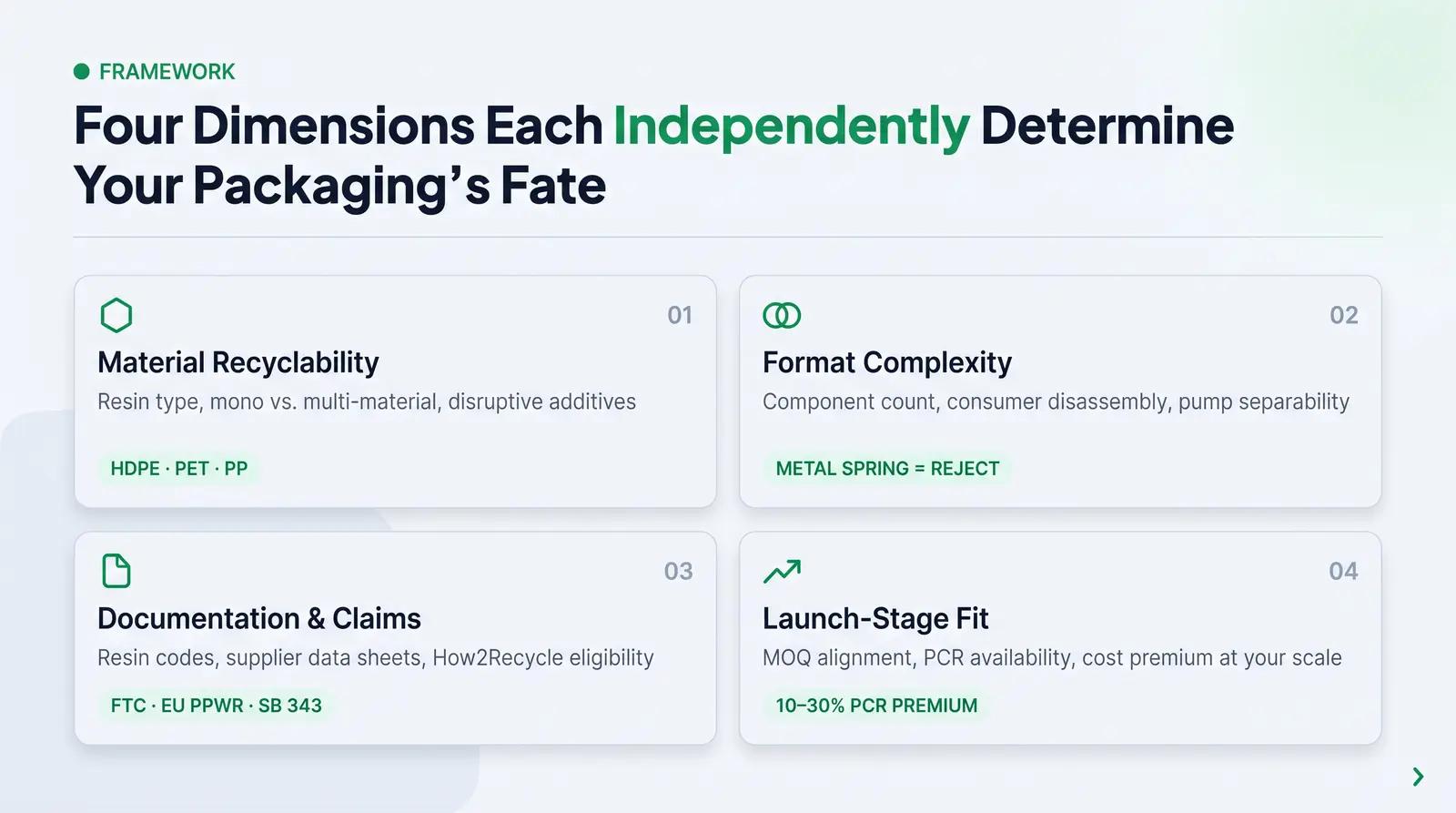
Evaluating packaging recyclability requires looking beyond the resin identification code. A comprehensive assessment covers four key dimensions, each of which can independently determine whether your packaging ends up recycled or in landfill.
Material Recyclability evaluates the resin type, whether the packaging is mono-material or multi-material, and the presence of disruptive additives. Metallic coatings, for example, can act as chemical contaminants in glass recycling, causing optical sorting machines to reject the material or contaminate processed bales [6]. Multi-layer laminate tubes, which bond plastic and aluminum layers together, are generally considered non-recyclable because the layers cannot be separated by standard mechanical recycling processes [7]. The resin itself matters too: HDPE and clear PET are widely accepted by MRFs, while polystyrene (PS) and PVC are not.
Format Complexity assesses the number of components, the ease of consumer disassembly, and pump or closure separability. A format that requires a consumer to disassemble multiple parts before recycling will almost never be recycled correctly in practice. Traditional airless pump dispensers, despite their premium sustainability positioning, frequently score worse than simple aluminum or HDPE formats on this dimension. The reason is structural: most traditional airless pumps contain a steel spring inside a plastic casing, and this mixed-material construction makes them very difficult to recycle effectively [5]. The metal spring contaminates the plastic stream, and the pump mechanism is rarely designed to be disassembled by a consumer.
Documentation and Claims Support covers the availability of resin identification codes, supplier recyclability documentation, and eligibility for programs like How2Recycle. The How2Recycle program, managed by GreenBlue, provides standardized on-package disposal instructions based on nationally harmonized data and is widely recognized by US and Canadian retailers as a credible recyclability claim. Without this documentation, your claims are vulnerable to regulatory action and consumer litigation.
Launch-Stage Fit evaluates MOQ alignment, the availability of post-consumer recycled (PCR) or recycled-content variants, and cost-effectiveness at your current production scale. Sustainable materials, including PCR plastics and mono-material designs, typically carry a 10–30% cost premium over virgin plastic alternatives [8]. Understanding this dimension prevents you from committing to a format that is recyclability-optimal but financially unviable at your current stage.
The Beauty Packaging Recyclability Scorecard
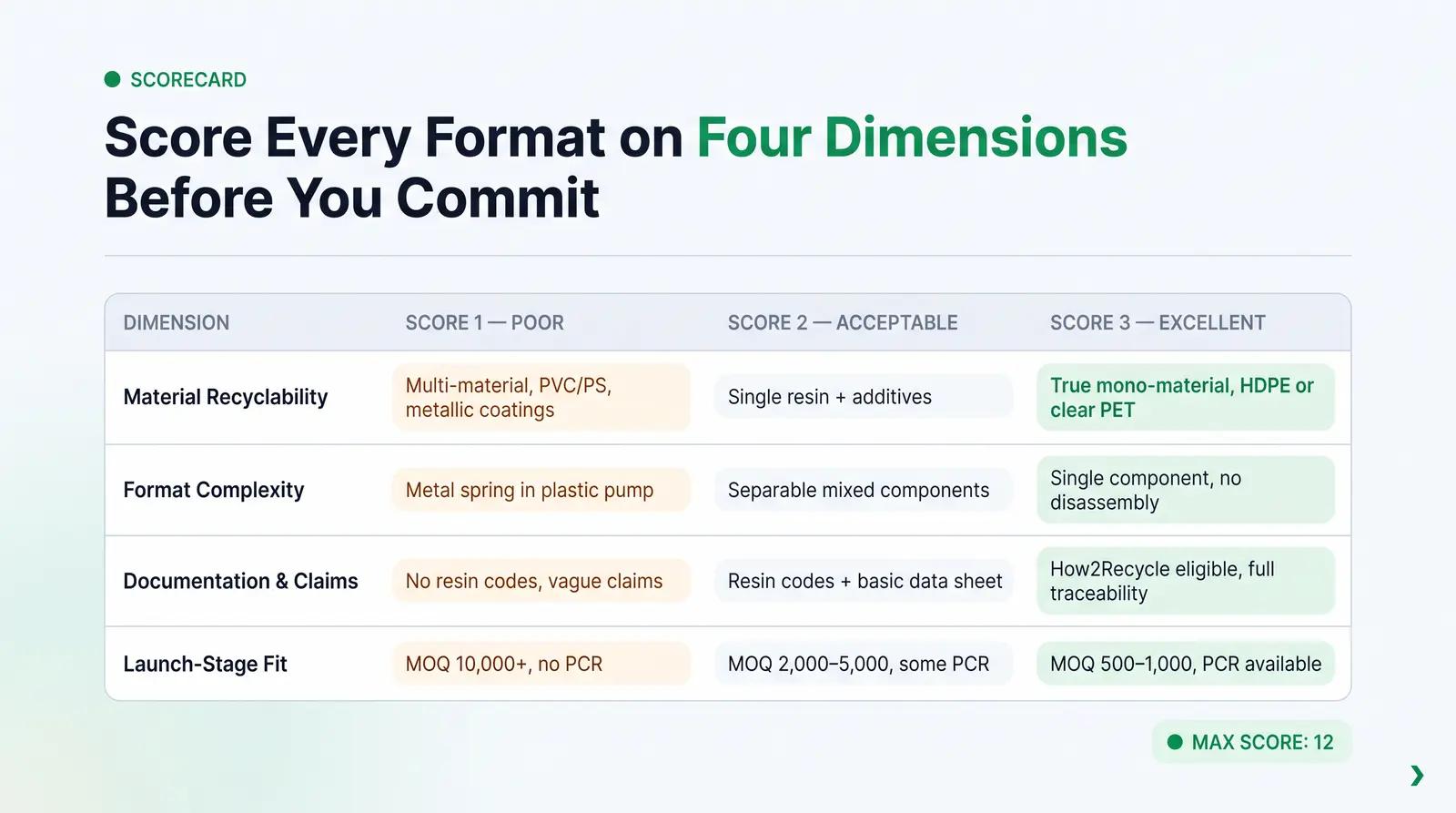
The following is a practical framework we recommend at Packfolio for evaluating packaging recyclability before you commit to a format. Each dimension is scored on a 1–3 scale, giving a maximum total score of 12.
| Dimension | What to Assess | Score 1: Poor | Score 2: Acceptable | Score 3: Excellent | Why It Matters |
|---|---|---|---|---|---|
| Material Recyclability | Resin type, mono vs. multi-material, disruptive additives (metallic coatings, UV inks, silicone valves). | Multi-material with inseparable layers (e.g., ABL laminate), hard-to-recycle resins (PVC, PS), heavy metallic coatings. | Single resin but with disruptive additives, or mixed materials that are easily separable. | True mono-material (100% PP or clear PET), widely accepted resin, no disruptive coatings. | Determines if the material can physically and economically be processed by a MRF without causing contamination or mis-sorts. |
| Format Complexity | Number of components, ease of consumer disassembly, pump and closure separability. | Multiple inseparable components of different materials (e.g., metal spring inside plastic pump, bonded collar). | Multiple components that are easily separated by the consumer before disposal. | Single component or mono-material assembly requiring no disassembly. | Complex formats are rejected by MRFs or require unrealistic consumer effort, meaning they are almost never recycled in practice. |
| Documentation & Claims Support | Resin identification codes, supplier recyclability documentation, How2Recycle or equivalent program eligibility. | No resin codes, vague supplier claims, ineligible for any certification program. | Resin codes present, basic supplier material data sheet available. | Full material traceability, clear supplier recyclability documentation, How2Recycle eligible. | Essential for regulatory compliance (FTC Green Guides, EU PPWR) and for passing retail sustainability audits at Sephora, Ulta, and Credo. |
| Launch-Stage Fit | MOQ alignment, PCR variant availability, cost premium relative to your current production scale. | High MOQs only (10,000+ units), no PCR options available, prohibitive cost premium for early-stage brands. | Moderate MOQs (2,000–5,000 units), some PCR options, manageable cost premium. | Low MOQs available (500–1,000 units), extensive PCR options, cost-effective scaling path. | Ensures the packaging choice is financially viable for your current stage and has a clear upgrade path as volume grows. |
Packaging Format Comparison
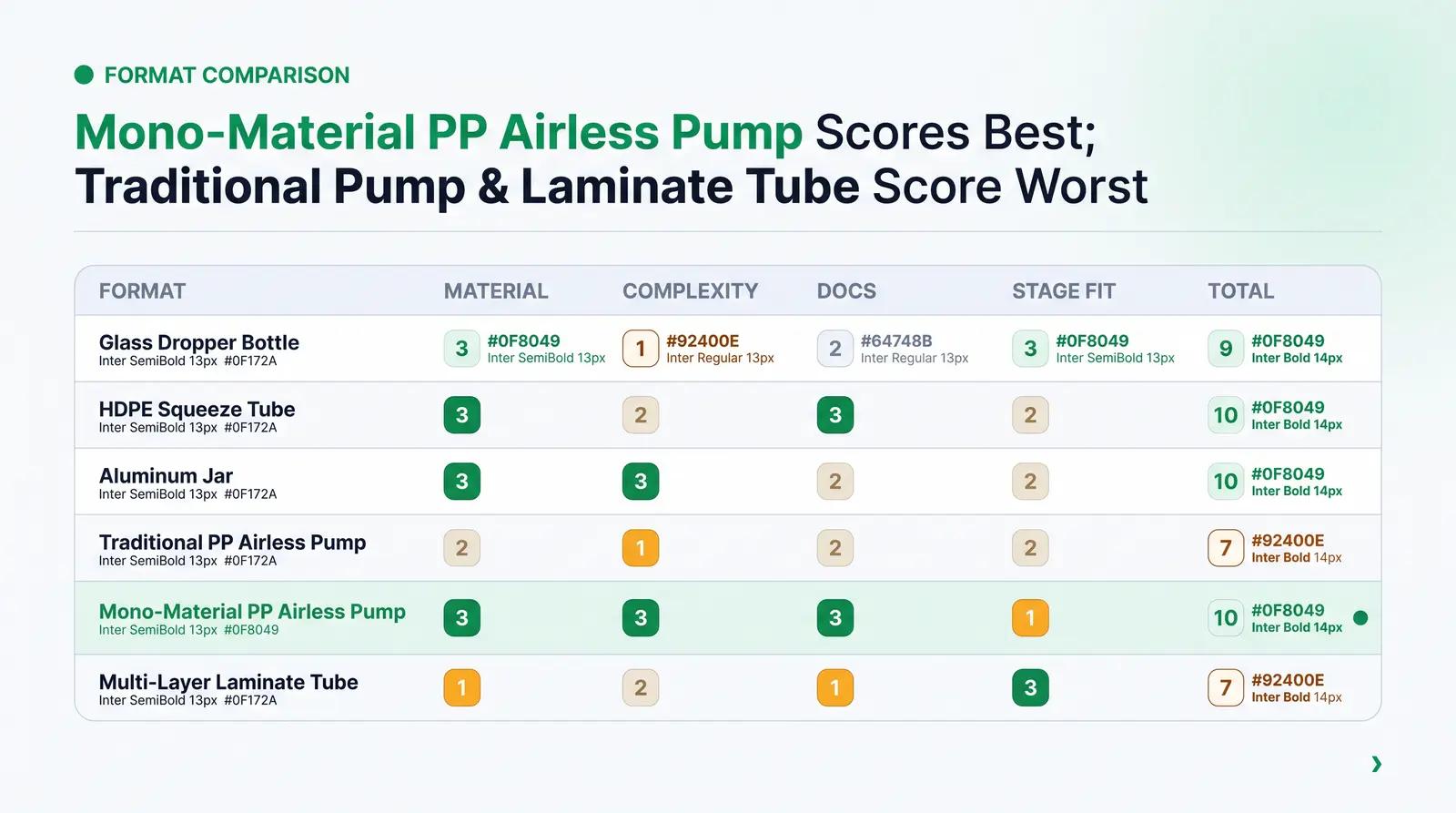
The following table applies the Scorecard to six common cosmetic primary packaging formats. Scores reflect the most common, standard versions of each format. Specialty mono-material variants (noted where applicable) can improve scores.
| Format | Material Recyclability | Format Complexity | Documentation | Launch-Stage Fit | Total (max 12) | Key Consideration |
|---|---|---|---|---|---|---|
| Glass Dropper Bottle (mixed collar) | 3 | 1 | 2 | 3 | 9 | The glass bottle is highly recyclable, but the dropper assembly (glass pipette, rubber bulb, mixed plastic or metal collar) is complex and rarely recycled in practice. Separate discard instructions are needed. |
| HDPE Squeeze Tube | 3 | 2 | 3 | 2 | 10 | Over 75% of HDPE squeeze tubes in the US are now compatible with recycling streams [9]. The cap may be a different resin; confirm with supplier. |
| Aluminum Jar | 3 | 3 | 2 | 2 | 10 | Infinitely recyclable and simple format. Requires proper consumer cleaning to avoid contamination. Supplier documentation on alloy type strengthens claims. |
| Traditional PP Airless Pump | 2 | 1 | 2 | 2 | 7 | The metal spring and complex assembly make this format highly problematic for MRFs [5]. Avoid making recyclability claims for this format without a mono-material certification. |
| Mono-Material PP Airless Pump | 3 | 3 | 3 | 1 | 10 | Solves the recycling problem of traditional pumps entirely [5]. Often requires higher MOQs and carries a cost premium, making it more suitable for scaling brands. |
| Multi-Layer Laminate Tube | 1 | 2 | 1 | 3 | 7 | Generally non-recyclable due to the inseparable plastic and aluminum barrier layers [7]. Cost-effective at scale but incompatible with recyclability claims. |
Worked Example: Choosing Packaging for a Vitamin C Serum at 500 Units
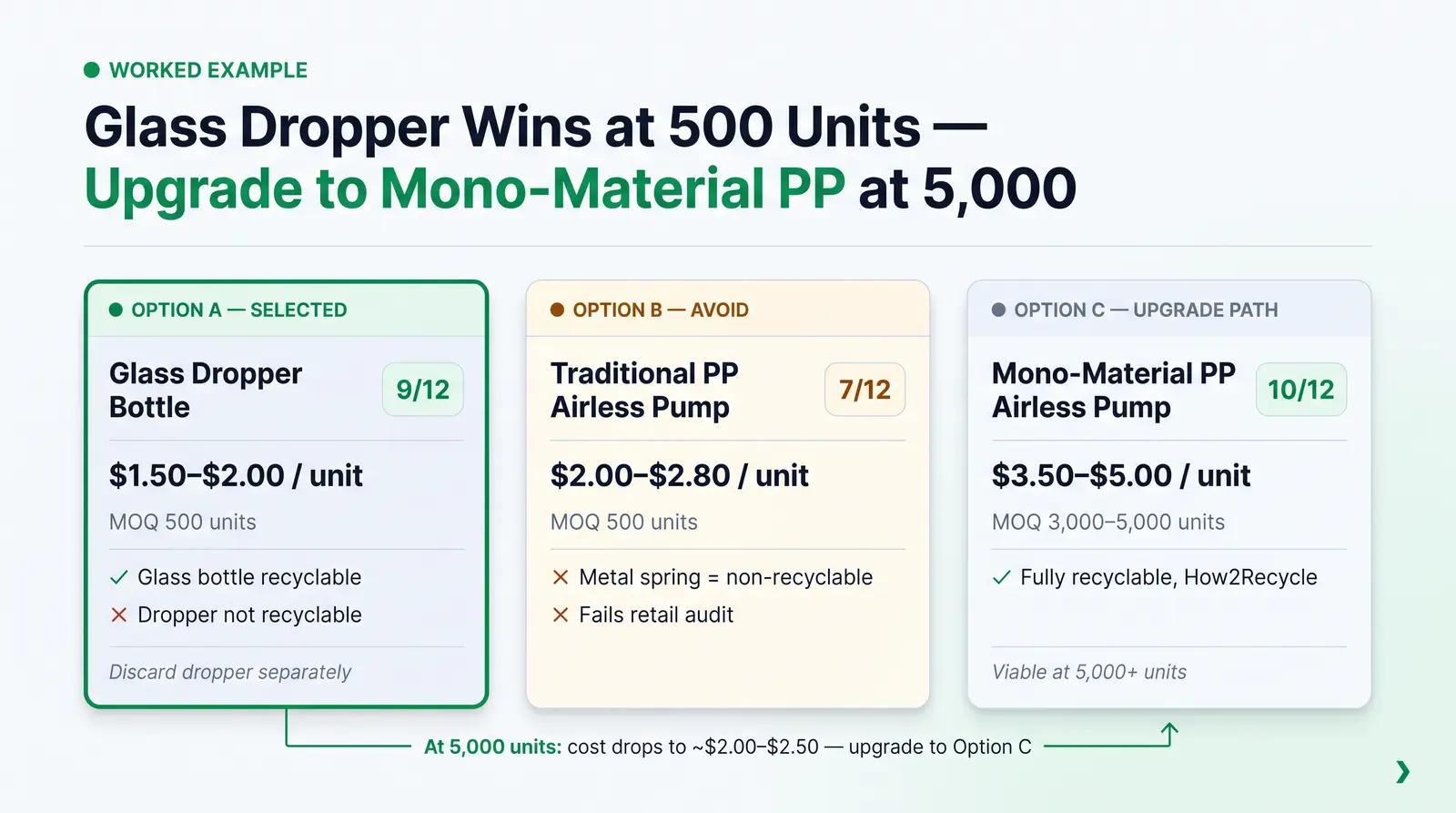
A founder is launching a Vitamin C serum and is at the 500-unit sample stage. They are choosing between three formats: a glass dropper bottle with a mixed-material collar, a traditional PP airless pump, and a mono-material PP airless pump.
Option A: Glass Dropper Bottle (Mixed Collar)
Scorecard: Material 3, Complexity 1, Documentation 2, Fit 3. Total: 9/12.
Per-unit cost at 500 units: approximately $1.50–$2.00 (typical industry range for 1 oz / 30 ml clear glass serum bottles with dropper) [10]. The glass bottle protects the ascorbic acid formula from oxidation and is cost-accessible at low MOQs. The limitation is the dropper assembly, which is not recyclable as a unit. The brand can legitimately say the glass bottle is recyclable, but cannot claim the full package is recyclable without qualifying the dropper.
Option B: Traditional PP Airless Pump
Scorecard: Material 2, Complexity 1, Documentation 2, Fit 2. Total: 7/12.
Per-unit cost at 500 units: approximately $2.00–$2.80 (typical industry range). Provides excellent formula protection and a premium dispensing experience. However, the metal spring inside the pump mechanism makes this format non-recyclable in practice. This is the worst option for sustainability claims and poses the highest risk in a retail audit.
Option C: Mono-Material PP Airless Pump
Scorecard: Material 3, Complexity 3, Documentation 3, Fit 1. Total: 10/12.
Per-unit cost at 500 units: approximately $3.50–$5.00 (typical industry range), often with a minimum order of 3,000–5,000 units. This is the strongest format for recyclability claims and retail sustainability audits. However, the high unit cost and typical MOQ requirements make it financially prohibitive for a 500-unit launch.
The Decision at 500 Units
The founder selects Option A, the glass dropper bottle. It offers the best balance of cost, formula protection, and partial recyclability at this stage. The documentation strategy is clear: the glass bottle is recyclable, the dropper assembly is not, and on-pack instructions direct consumers to discard the dropper separately. This is a defensible, honest claim.
What Changes at 5,000 Units
At 5,000 units, the economics shift materially. The mono-material PP airless pump becomes accessible, with per-unit costs dropping to approximately $2.00–$2.50 at scale. The founder can now upgrade to a fully recyclable format, support a clean How2Recycle label, and enter retail channels with a packaging claim that holds up to scrutiny. The PCR variant of the same pump, typically carrying a 10–30% premium over virgin PP [8], becomes a viable next step at 10,000+ units.
How to Use the Scorecard at Different Launch Stages
The Scorecard is not a one-time exercise. Your application of it should evolve as your brand scales.
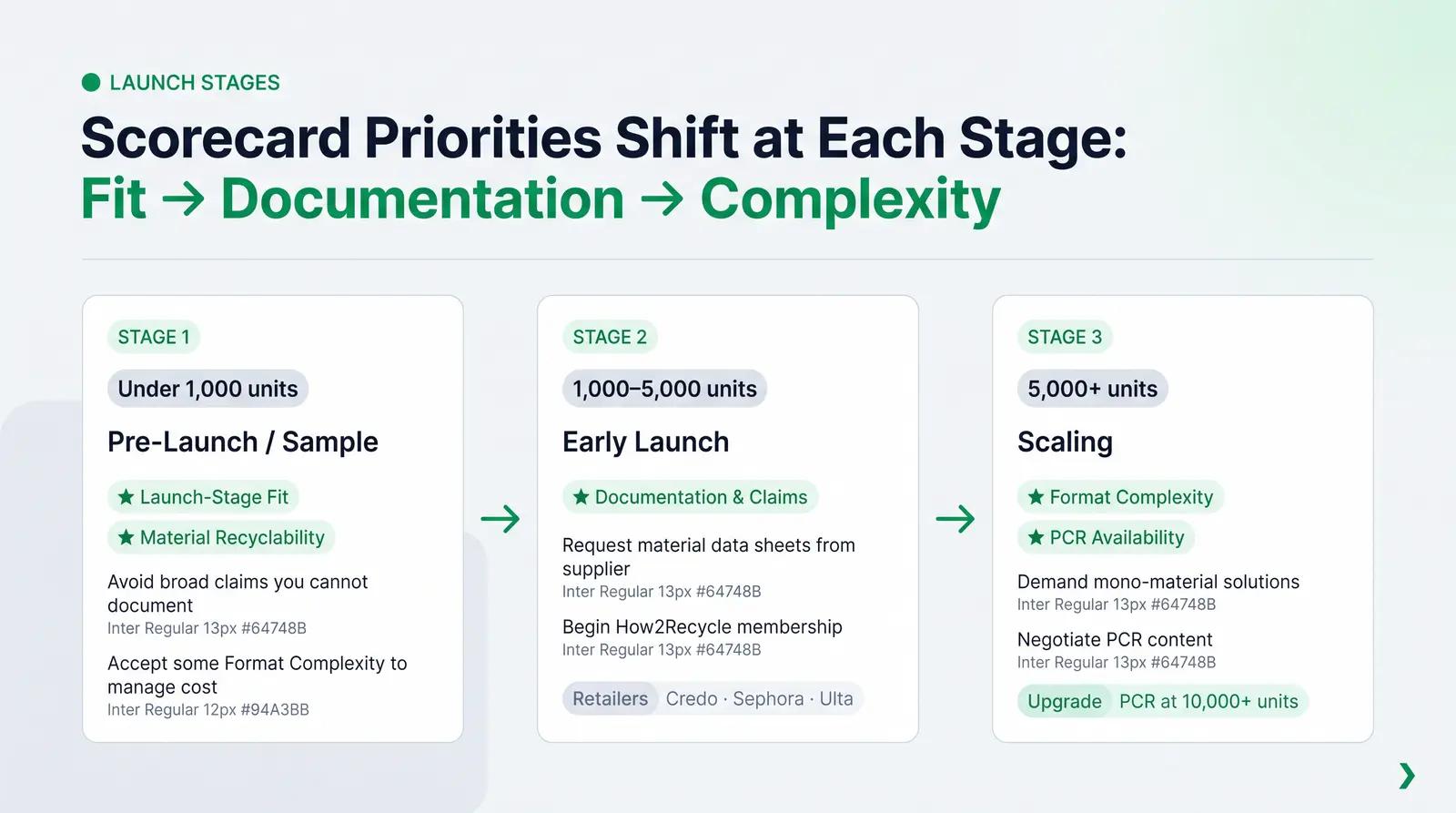
At the pre-launch or sample stage (under 1,000 units), prioritize Launch-Stage Fit and Material Recyclability. You may have to accept some Format Complexity to keep costs manageable. The key discipline is to avoid making broad recyclability claims you cannot document. Choose formats where at least the primary material is genuinely recyclable, and be specific in your language.
At the early launch stage (1,000–5,000 units), Documentation becomes critical. Retailers like Credo, Sephora, and Ulta are increasingly requiring suppliers to substantiate environmental claims. Request material data sheets from your supplier, confirm resin identification codes, and begin the How2Recycle membership process if you plan to label your packaging.
At the scaling stage (5,000+ units), Format Complexity and PCR availability become the focus. You now have the purchasing power to demand mono-material solutions, negotiate PCR content, and build a packaging portfolio that can pass retail sustainability audits without exception.
Packfolio's catalog flags resin type and component count for each SKU, and the 3D preview step lets you finalize label placement before committing to a production run. That means the documentation conversation with your supplier is already handled before the order ships.
Documentation: What "Recyclable" Requires You to Prove
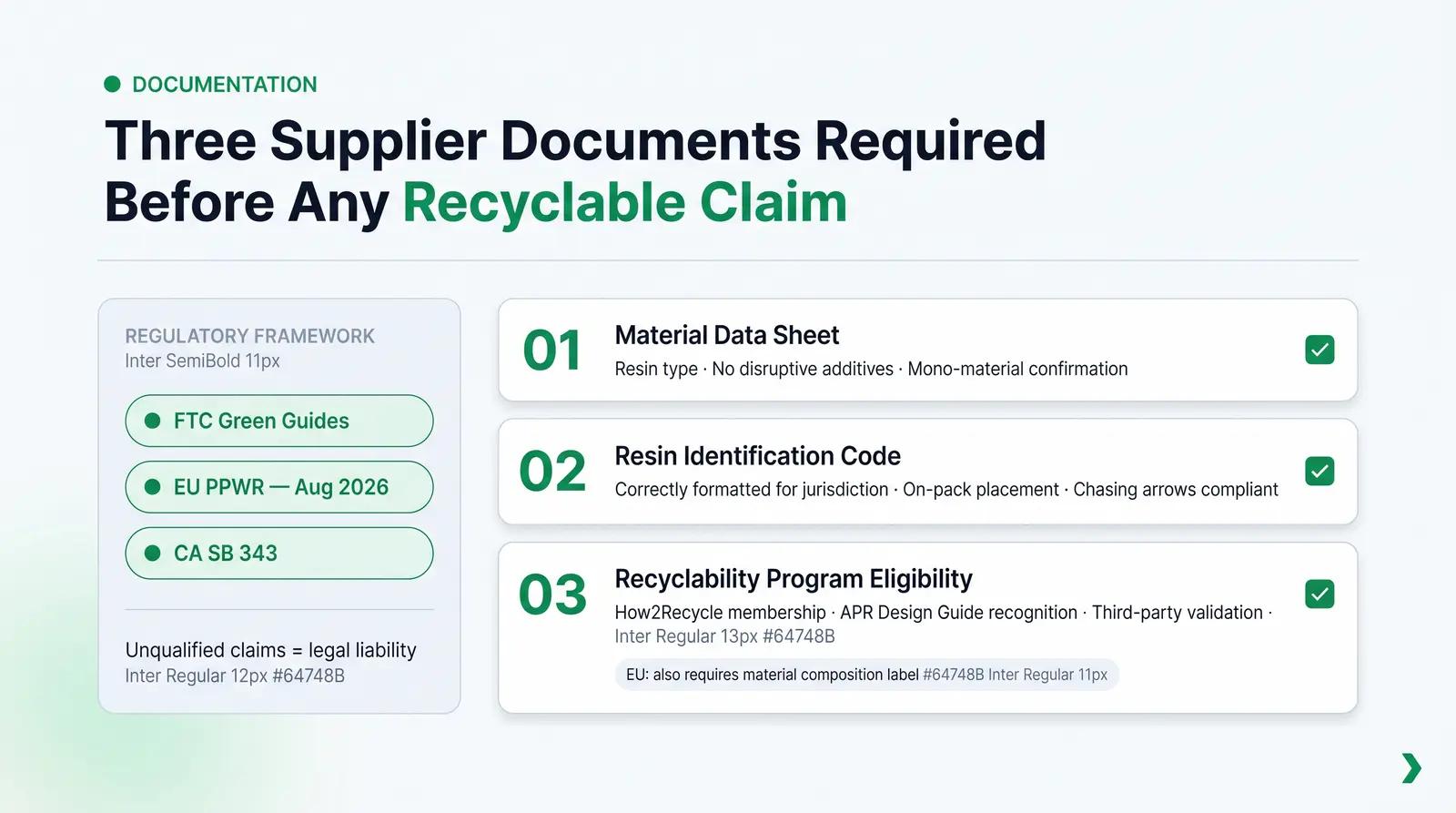
Making a recyclable claim is a legal and regulatory commitment. The FTC Green Guides advise marketers against making unqualified recyclable claims unless the entire product or package, excluding minor incidental components, is recyclable [1]. In California, the SB 343 statute adds further requirements: if a resin identification code appears inside a chasing arrows symbol on a rigid plastic container, the brand must demonstrate that the material meets the state's standard for widespread recyclability.
In practice, this means you need three things from your supplier before you can make a credible claim. First, a material data sheet confirming the resin type, absence of disruptive additives, and mono-material construction where applicable. Second, a resin identification code on the packaging itself, correctly formatted for the jurisdiction where you sell. Third, documentation of recyclability program eligibility, such as How2Recycle membership or APR Design Guide recognition, which provides third-party validation that your packaging design is compatible with North American recycling infrastructure.
For brands selling into the EU after August 2026, the PPWR adds a requirement for physical labels indicating material composition and, where applicable, reusability [2]. Cosmetics Europe has published position papers on how these requirements apply specifically to cosmetic packaging formats, and brands with EU distribution should review those guidelines directly.
A useful internal link for brands exploring mono-material options in more depth: packfolio.com/blog/mono-material-cosmetic-packaging.
Start Sourcing Packaging That Scores Well
Ready to source packaging that scores well before your launch, not after your first retailer audit? Browse Packfolio's curated cosmetic packaging catalog and preview your label in 3D before ordering. packfolio.com/catalog
Frequently Asked Questions
What is the difference between "recyclable" and "recycled" on cosmetic packaging?
"Recyclable" means the packaging can theoretically be collected and reprocessed into new materials. "Recycled" means the packaging contains material that has already been through that process, such as post-consumer recycled (PCR) resin. A package can be recyclable without containing any recycled content, and vice versa. Both claims require documentation to be defensible.
Why do airless pump dispensers score poorly on recyclability despite being marketed as sustainable?
Traditional airless pumps contain a metal spring inside a plastic casing. This mixed-material construction means the pump cannot be processed in a standard plastic recycling stream without contaminating the bale. Mono-material airless pumps, which eliminate the metal spring entirely, solve this problem but typically require higher minimum order quantities and carry a cost premium [5].
What does the How2Recycle label actually require?
To use a How2Recycle label, your brand must become a member of the program and submit your packaging for review. The program evaluates whether your packaging is "Widely Recyclable," "Check Locally," "Store Drop-Off," or "Not Yet Recyclable" based on nationally harmonized data on MRF acceptance rates. The label provides standardized on-package disposal instructions and is recognized by major US and Canadian retailers as a credible recyclability claim.
Can a glass dropper bottle be marketed as fully recyclable?
Not without qualification. The glass bottle itself is highly recyclable and widely accepted by MRFs. However, the dropper assembly, which typically includes a glass pipette, a rubber bulb, and a plastic or metal collar, is a complex, multi-material component that is not recyclable in standard curbside programs. A brand can accurately say the glass bottle is recyclable, but must instruct consumers to discard the dropper assembly separately.
Does switching to PCR resin automatically improve a packaging format's recyclability score?
No. PCR resin means the packaging contains post-consumer recycled material, which is a recycled content claim, not a recyclability claim. A multi-layer laminate tube made with PCR plastic is still non-recyclable at end of life because the laminate structure cannot be separated. Recyclability is determined by format design and material composition at the end of life, not by the origin of the input materials.
References
[1] The FTC Green Guides and Recyclability. The Regulatory Review. December 2024. https://www.theregreview.org/2024/12/01/basila-the-ftc-green-guides-and-recyclability/
[2] Packaging waste. European Commission, Directorate-General for Environment. https://environment.ec.europa.eu/topics/waste-and-recycling/packaging-waste_en
[3] How MRFs Decide What's Accepted: Takeaways for Packaging Decision-Makers. GreenBlue / How2Recycle. December 2025. https://greenblue.org/2025/12/12/how-mrfs-decide-acceptance/
[4] British Beauty Council and MYGroup propel cosmetic packaging recycling. Packaging Insights. December 2025. https://www.packaginginsights.com/news/beauty-packaging-waste-recycling.html
[5] Mono-Material Airless Pump Unlocks Beauty Recycling Challenges. BeautyMatter. September 2023. https://beautymatter.com/articles/mono-material-airless-pump-unlocks-beauty-recycling-challenges
[6] Design for recycling in cosmetic glass packaging. Resource Recycling. October 2024. https://resource-recycling.com/recycling/2024/10/29/design-for-recycling-in-cosmetic-glass-packaging/
[7] Multilayer Packaging in a Circular Economy. Schmidt, J. et al. Polymers (Basel). 2022. https://pmc.ncbi.nlm.nih.gov/articles/PMC9103501/
[8] How to Reduce Cosmetic Packaging Costs Without Sacrificing Quality. Big Sky Packaging. May 2026. https://bigskypackaging.com/blog/how-to-reduce-cosmetic-packaging-costs-without-sacrificing-quality/
[9] Plastic tube recyclability has ramped up rapidly, but not without some tumult. Packaging Dive. May 2024. https://www.packagingdive.com/news/plastic-tube-recyclability-has-ramped-up-rapidly-but-not-without-some-tumu/715127/
[10] How Does MOQ Affect Cosmetic Packaging Costs. AH Packaging. October 2025. https://ahpackaging.com/how-does-moq-affect-cosmetic-packaging-costs/


