
Beauty Packaging Defect Atlas
This beauty packaging defect atlas teaches founders to identify, classify, and document common cosmetic packaging defects across glass, plastic, pumps, droppers, tubes, and closures before production.
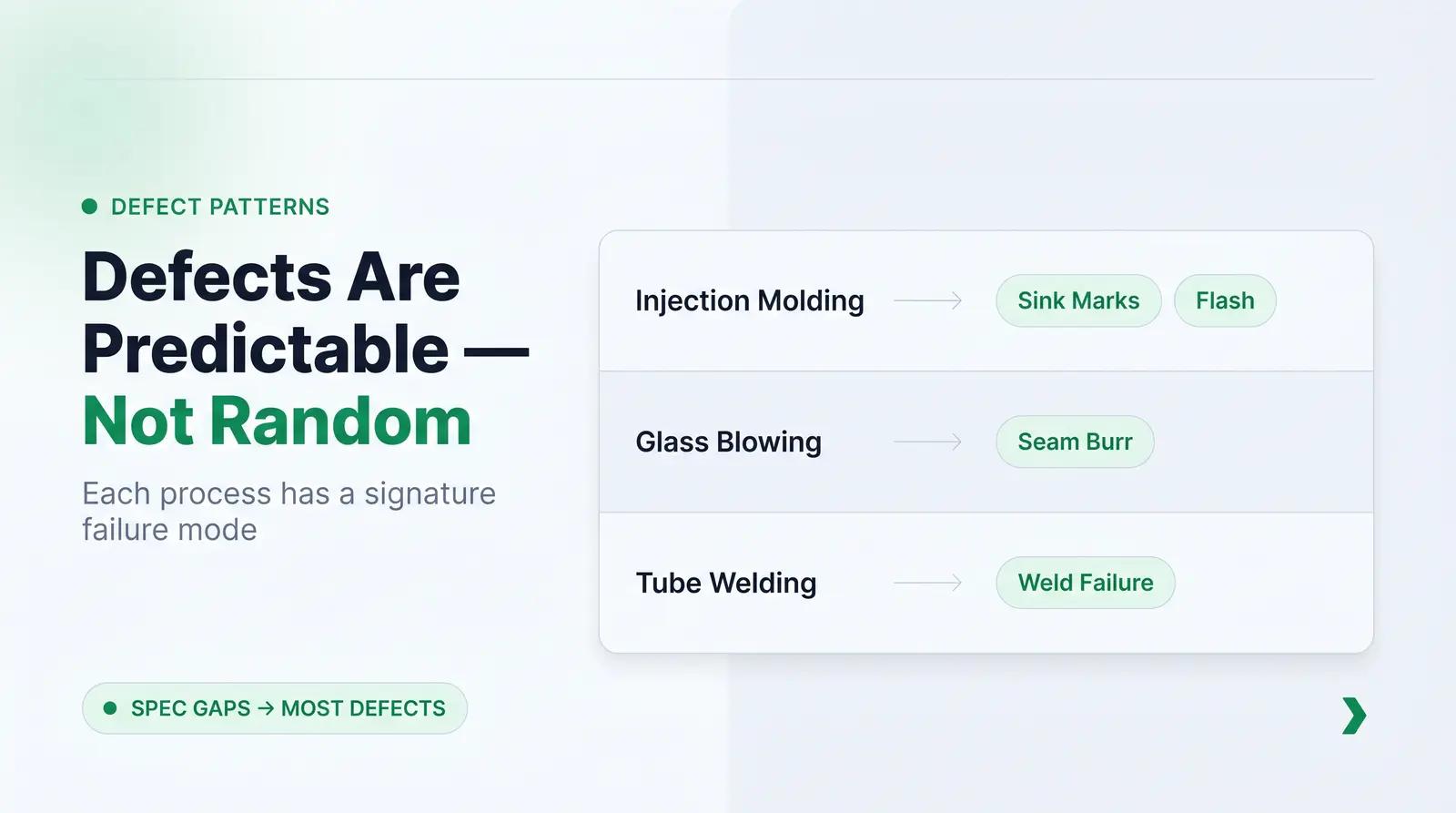
Defects are not random failures. They are learnable patterns that founders can recognize before committing to production.
If you are standing in front of a sample shipment or reviewing a quote and unsure what to look for, you are not alone. Packaging defects often seem unpredictable, but they cluster around specific materials and manufacturing processes. Learn these patterns and you can identify, name, document, and pre-screen defects before production is locked in — without becoming a packaging engineer.
Why Defects Follow Patterns
Most cosmetic packaging defects that reach brands are not manufacturer error. They are specification gaps the brand failed to define [1]. A manufacturer produces exactly what is specified. If a brand does not specify the exact torque requirement for a closure, the supplier will use their default, which might lead to leaking bottles.
Defects follow patterns because manufacturing processes and material properties have inherent limitations.
Injection molding — used for plastic closures, jars, and some bottles — involves injecting molten plastic into a mold under high pressure. This process naturally creates specific defect risks: sink marks, flash, and gate vestige [2]. Sink marks occur when thick sections of plastic cool and shrink unevenly, creating a dimple on the surface. Flash happens when the mold does not close perfectly, allowing plastic to seep out and form a thin ridge.
Glass manufacturing involves blowing molten glass into molds. The seams where the mold halves meet are natural weak points. If the mold is worn or misaligned, the seam becomes prominent or sharp — a defect known as a burr [3]. Flexible tubes are formed by rolling a flat sheet and welding the seam. That weld is a critical failure point: if heat or pressure is incorrect during welding, the seam may be weak, leading to channel leaks or complete failure under pressure [4].
Understanding these patterns lets you anticipate where a component is most likely to fail and focus your inspection efforts there.
The Defect Atlas
Glass Bottles and Jars
Glass is premium but brittle, and its manufacturing process leaves specific signatures.
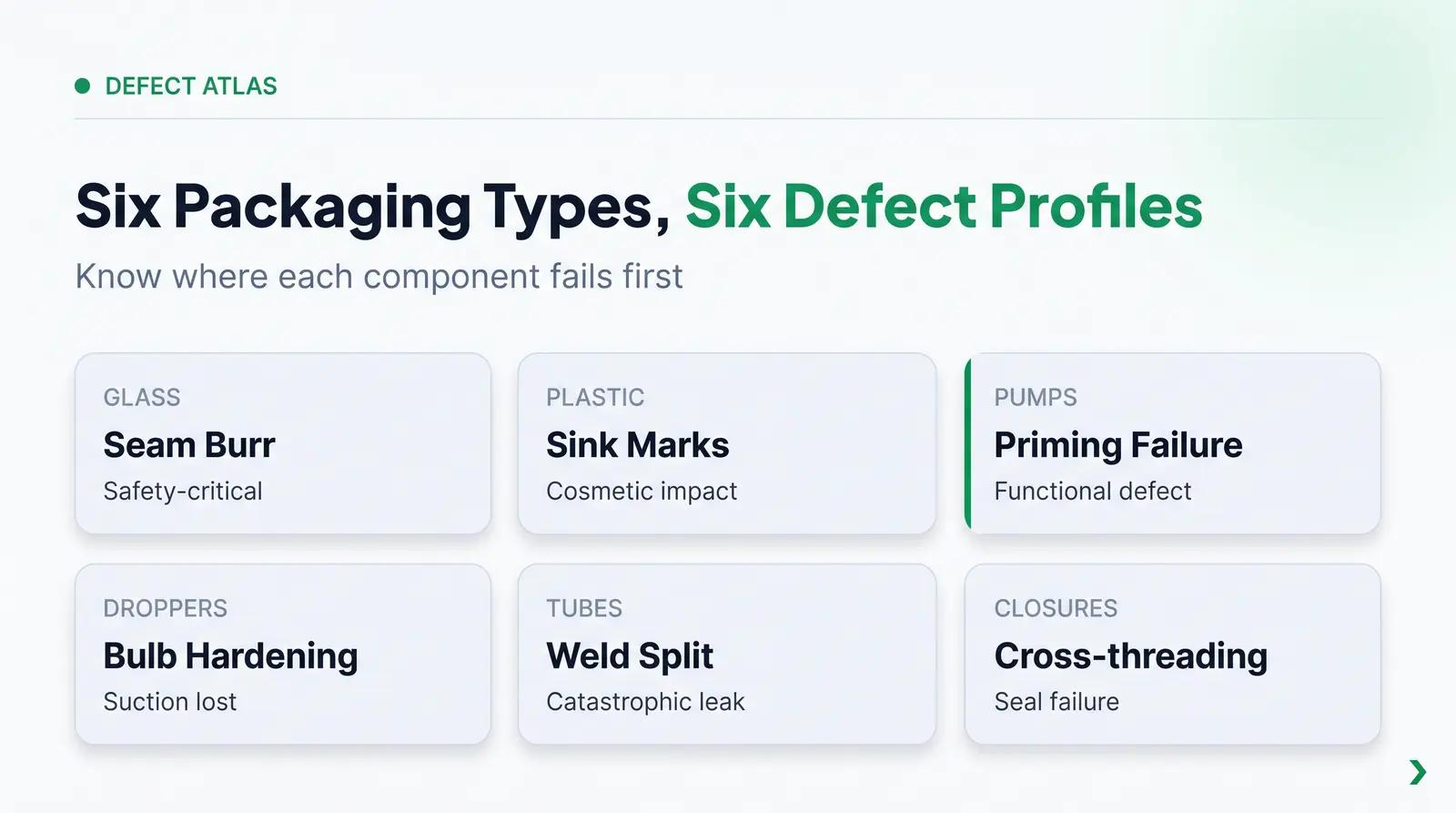
Seam lines and burrs. A prominent or sharp ridge of glass along the parting line where the mold halves joined [3]. Detect it by running a gloved finger along the side of the bottle. Sharp burrs can cut users — a critical safety defect — or interfere with labeling.
Cord and stone inclusions. Cords are visible streaks of different glass composition within the wall. Stones are unmelted batch materials or furnace debris embedded in the glass [5]. Detect visually against a light background. Stones weaken the glass structure and are a major breakage risk.
Thin walls. Uneven distribution of glass leaving one side dangerously thin [3]. Detect by looking at the base or shoulder against light. Thin walls are highly susceptible to breakage during filling or transit.
Coating adhesion failure. Color spray or frosting that flakes or peels. Detect using a standard tape test: apply strong tape, press firmly, and pull off rapidly. This ruins the premium feel and is often caught only after the product ships.
Mouth finish defects. Small chips or vertical cracks on the top sealing surface or threads [3]. Detect visually or by feeling carefully. This is a major functional defect because it prevents an airtight seal, leading to leaks and product oxidation.
Plastic Bottles and Jars (PET, HDPE, PETG, PCR)
Plastic components are ubiquitous but sensitive to cooling rates and mold design.
Sink marks. Shallow depressions or dimples on the surface, usually opposite a thicker internal section [2]. Detect visually by observing light reflections across the surface. Primarily a cosmetic defect that affects perceived quality.
Flash. A thin protrusion of plastic along the mold parting line [2]. Detect visually and tactilely. Flash can interfere with closure sealing (functional) or simply look cheap (cosmetic).
Gate vestige. A rough, raised bump where the plastic was injected into the mold [2]. Detect tactilely, usually on the bottom of the container. If it is too high, the bottle wobbles and will not stand flat on shelf.
Wall thickness variation. Uneven plastic distribution, common in blow-molded PET and HDPE. Detect by squeezing the bottle; one side will yield much more easily than the other. This affects structural integrity and squeeze performance.
Stress whitening and haze. Milky or cloudy patches in clear plastics like PET, often caused by over-stretching during blow molding or uneven cooling [6]. Detect visually. This ruins the clarity of the bottle and signals a structural weakness.
Pumps and Dispensers (Lotion, Airless, Foam)
Pumps are complex mechanical assemblies with multiple moving parts and seals.
Stroke inconsistency. The pump delivers a different amount of product with each press. Detect by pumping 10 times onto a scale and comparing the weights. This is a major functional defect affecting user experience and dosing accuracy.
Suck-back failure. The pump fails to draw product back up after a stroke, leaving a mess at the nozzle. Detect by observing the nozzle after dispensing. This causes product crusting and clogs.
Priming failure. The pump requires an excessive number of presses — more than 15 — to dispense the first drop, or fails to prime at all. Detect by counting presses on a new, filled unit. This is a major functional failure.
Actuator wobble. The pump head feels loose and unstable when pressed. Detect tactilely during use. It gives a cheap feel and can lead to the actuator breaking off.
Spring corrosion. The metal spring inside the pump rusts due to incompatibility with the formula. Detect visually (if the pump is clear) or by observing discolored product being dispensed. This is a critical defect affecting product safety.
Droppers (Glass and Plastic Pipettes, Bulbs)
Droppers rely on a perfect vacuum seal to function. The system has four components: the bulb, the cap, the pipette, and the bottle neck. A failure in any one of them breaks the whole system [7].
Bulb cracking or hardening. The rubber or silicone bulb loses elasticity, hardens, or cracks over time due to formula incompatibility — especially with essential oils and solvents [8]. Detect by squeezing the bulb; it should rebound instantly. This destroys suction capability.
Pipette scoring or micro-fractures. Hairline cracks in the glass tube [7]. Detect visually under strong light. Fractures prevent a vacuum from forming, making the dropper useless.
Dropper collar misalignment. The collar does not sit straight on the bottle neck. Detect visually. This often indicates cross-threading and a compromised seal.
Seal failure. Air enters the system around the bulb or cap, breaking the vacuum [7]. Detect by drawing liquid: if it drips out without squeezing the bulb, the seal has failed.
Calibration drift. Printed measurement lines on the pipette dissolve or rub off. Detect by rubbing the lines with product or alcohol. This affects dosing accuracy and is a compliance risk for products with specific dosing instructions.
Flexible Tubes (Laminate and Aluminum)
Tubes must withstand repeated squeezing and flexing across their entire service life.
Pinhole leaks. Microscopic holes in the tube wall or barrier layer [4]. Detect by squeezing a filled tube firmly; product will ooze from unexpected places. This is a major functional defect leading to contamination and mess.
Weld seam failure. The longitudinal seam splits open under pressure [4]. Detect by squeezing the tube. This is a catastrophic functional failure.
Off-center crimps. The sealed tail of the tube is misaligned with the front artwork. Detect visually. This is a cosmetic defect that ruins shelf presentation.
Shoulder delamination. The tube body separates from the harder plastic shoulder and neck piece. Detect by squeezing near the neck. This causes massive leakage.
Closures and Caps (PP, Aluminum, Child-Resistant)
Closures are the primary defense against leaks. Most closure defects are specification failures, not manufacturing accidents.
Cross-threading. The cap screws on at an angle, failing to engage the threads properly. Detect visually and tactilely; the cap will feel stuck but will not be sealed. This leads to major leaks.
Torque back-off. The cap loosens itself after application, often due to thread mismatch or vibration during transit. Detect by checking the tightness of caps after a simulated transit test.
Liner adhesion failure. The induction seal liner fails to stick to the bottle rim, or the foam liner falls out of the cap [9]. Detect by opening the bottle; the liner should be firmly attached to the rim or securely inside the cap. This compromises product freshness and safety.
Induction seal defects. The foil seal is burned, partially adhered, or missing [9]. Detect visually after removing the cap. This is a major functional defect affecting product integrity.
Decoration and Print (Hot Stamp, Screen Print, Sleeve Label)
Decoration defects are frequently caught post-market because founders do not have the lighting conditions or reference standards to detect them on receipt.
Registration error. Multiple colors or layers — like a hot stamp over a screen print — are misaligned [10]. Detect visually by looking for overlapping or gapped colors.
Adhesion failure. Ink or foil flakes off easily. Detect using the tape test or by rubbing firmly with a thumb.
Color shift (Delta E variation). The packaging color does not match the approved standard. Detect visually under controlled lighting — a D65 daylight bulb — comparing the sample to the golden reference.
Ink bleed. Edges of text or graphics are fuzzy and indistinct. Detect visually.
Wrinkle in shrink sleeve. The sleeve label does not shrink smoothly over the container's curves, leaving folds [10]. Detect visually.
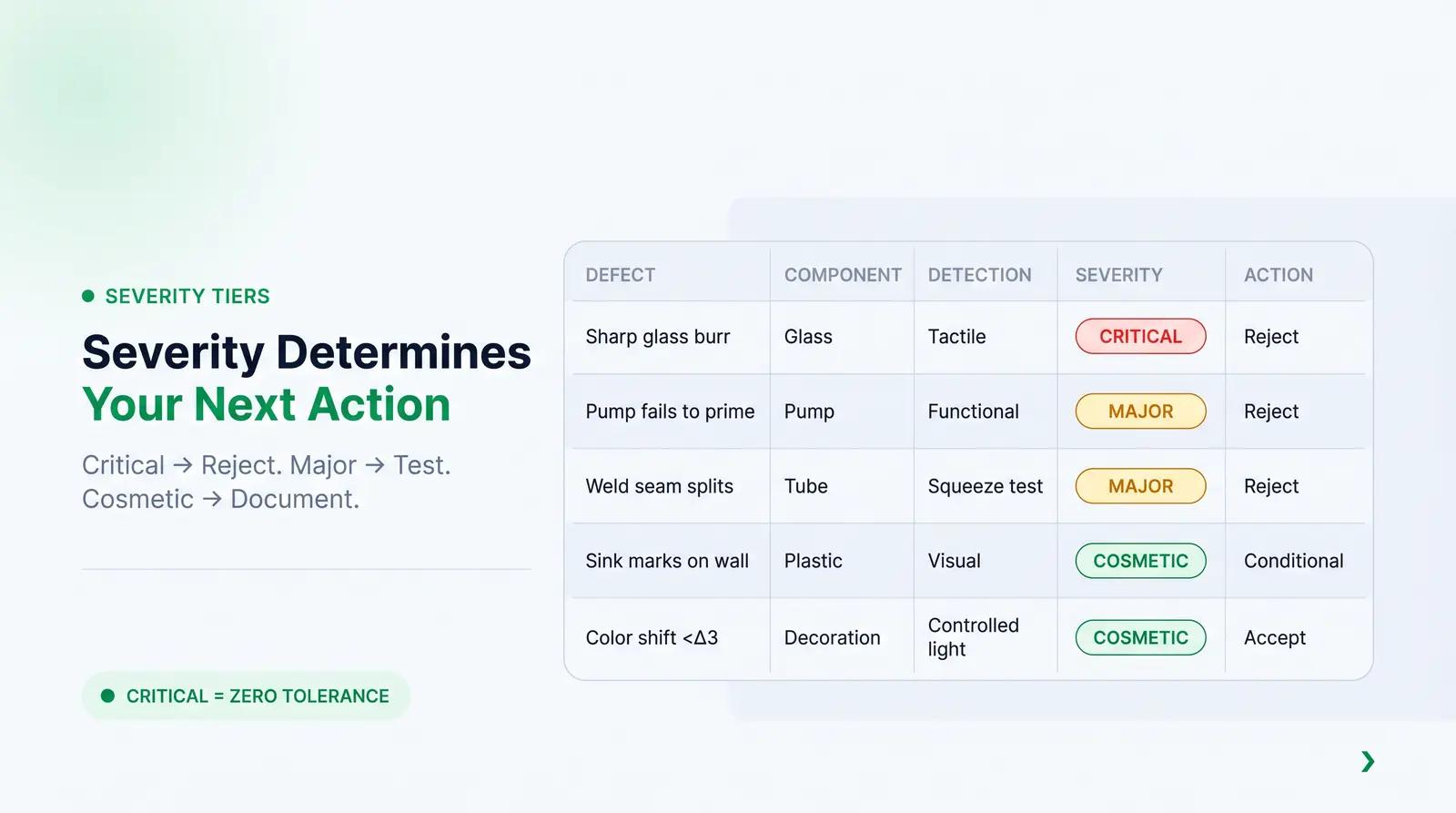
Defect Severity Classification
| Defect | Component | Detection Method | Severity | Action |
|---|---|---|---|---|
| Sharp glass burr on threads | Glass | Tactile (gloved hand) | Critical | Reject |
| Cord or stone inclusion in wall | Glass | Visual (backlit) | Major | Reject |
| Sink marks on side wall | Plastic | Visual (light reflection) | Cosmetic | Conditional Accept |
| Stress whitening or haze | Plastic | Visual | Major | Reject |
| Pump fails to prime after 20 presses | Pump | Functional test | Major | Reject |
| Spring corrosion visible in pump | Pump | Visual | Critical | Reject |
| Bulb hardens and loses suction | Dropper | Tactile (squeeze test) | Major | Reject |
| Pipette micro-fracture | Dropper | Visual (strong light) | Major | Reject |
| Weld seam splits under pressure | Flexible Tube | Functional (squeeze test) | Major | Reject |
| Induction seal partially adhered | Closure | Visual | Major | Reject |
| Cap cross-threading | Closure | Visual and Tactile | Major | Reject |
| Screen print fails tape test | Decoration | Tape test | Major | Reject |
| Off-center tail crimp | Flexible Tube | Visual | Cosmetic | Conditional Accept |
| Slight color shift (Delta E less than 3) | Decoration | Visual (controlled light) | Cosmetic | Accept |
The Packaging QC Triage Framework
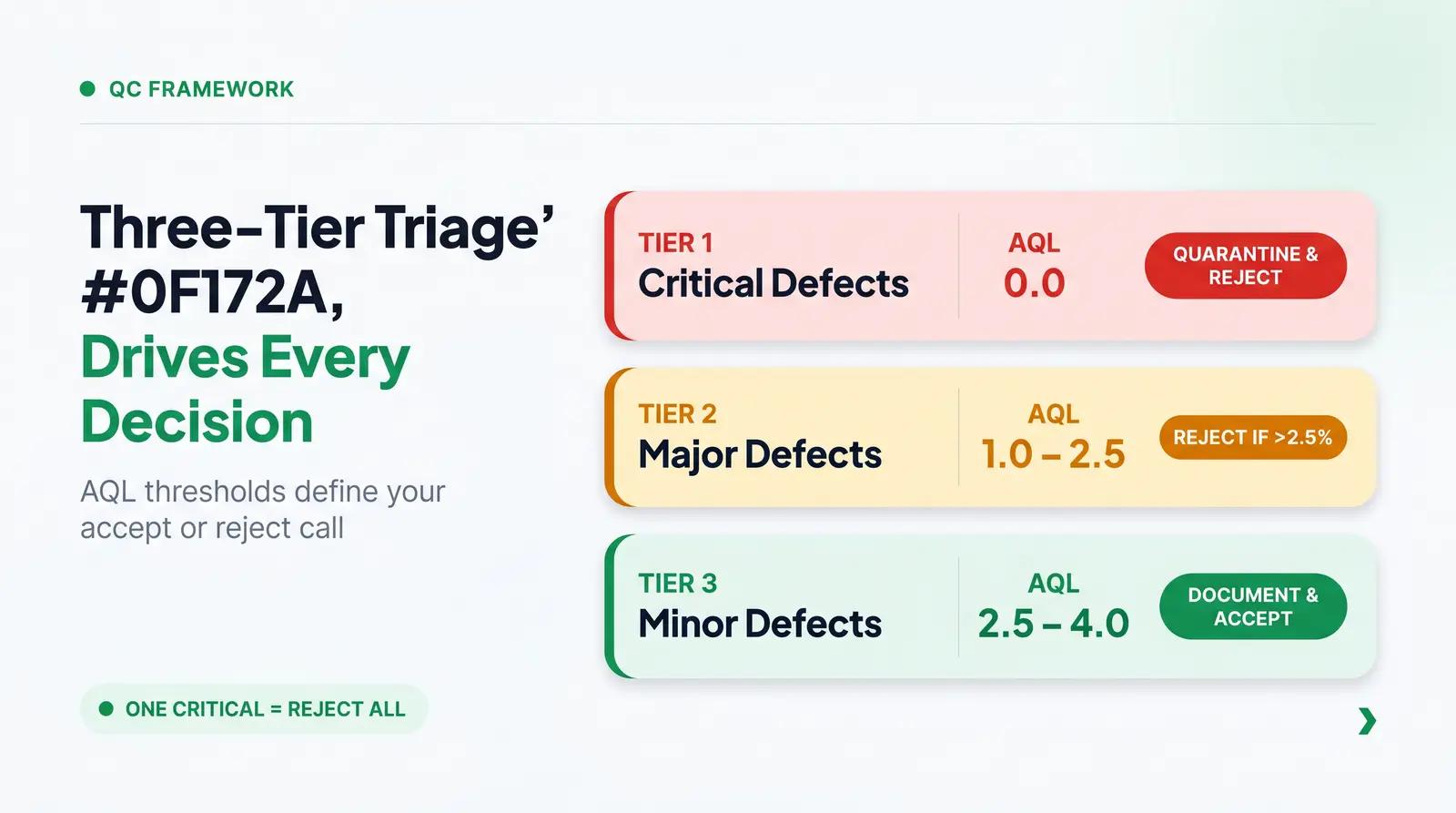
To make informed decisions when inspecting a shipment, use The Packaging QC Triage Framework. This three-tier system helps founders decide what to document, what to test, and what to formally reject before production commitment.
Tier 1: Critical Defects (AQL 0.0)
Definition. Defects that render the product unsafe for the consumer, violate regulations, or pose a severe liability risk [1].
Examples. Sharp glass edges, heavy metal contamination in plastics, rusting pump springs, missing child-resistant features on regulated products.
Action. Zero tolerance. If a single critical defect is found, quarantine and reject the entire lot. Do not negotiate acceptance.
Tier 2: Major Defects (AQL 1.0 to 2.5)
Definition. Defects that cause functional failure, making the product unusable for its intended purpose, or significantly degrading brand value to the point a consumer would return it [1].
Examples. Leaking caps, pumps that will not prime, cracked dropper bulbs, major print adhesion failure, split tube seams.
Action. Document the defect rate. If the defect rate exceeds the Acceptable Quality Limit threshold — typically 2.5% for major defects — reject the lot. If it is below the threshold, you may conditionally accept, but demand corrective action from the supplier for future runs.
Tier 3: Minor Defects (AQL 2.5 to 4.0)
Definition. Cosmetic imperfections that do not affect the function or safety of the product and are unlikely to be noticed by the average consumer unless scrutinized closely [1].
Examples. Slight sink marks, minor flash, small color variations, microscopic scratches.
Action. Document to track supplier consistency. Accept the lot, but use the data to negotiate tighter tolerances or better pricing on subsequent orders if the minor defect rate is consistently high.
What to Document and How
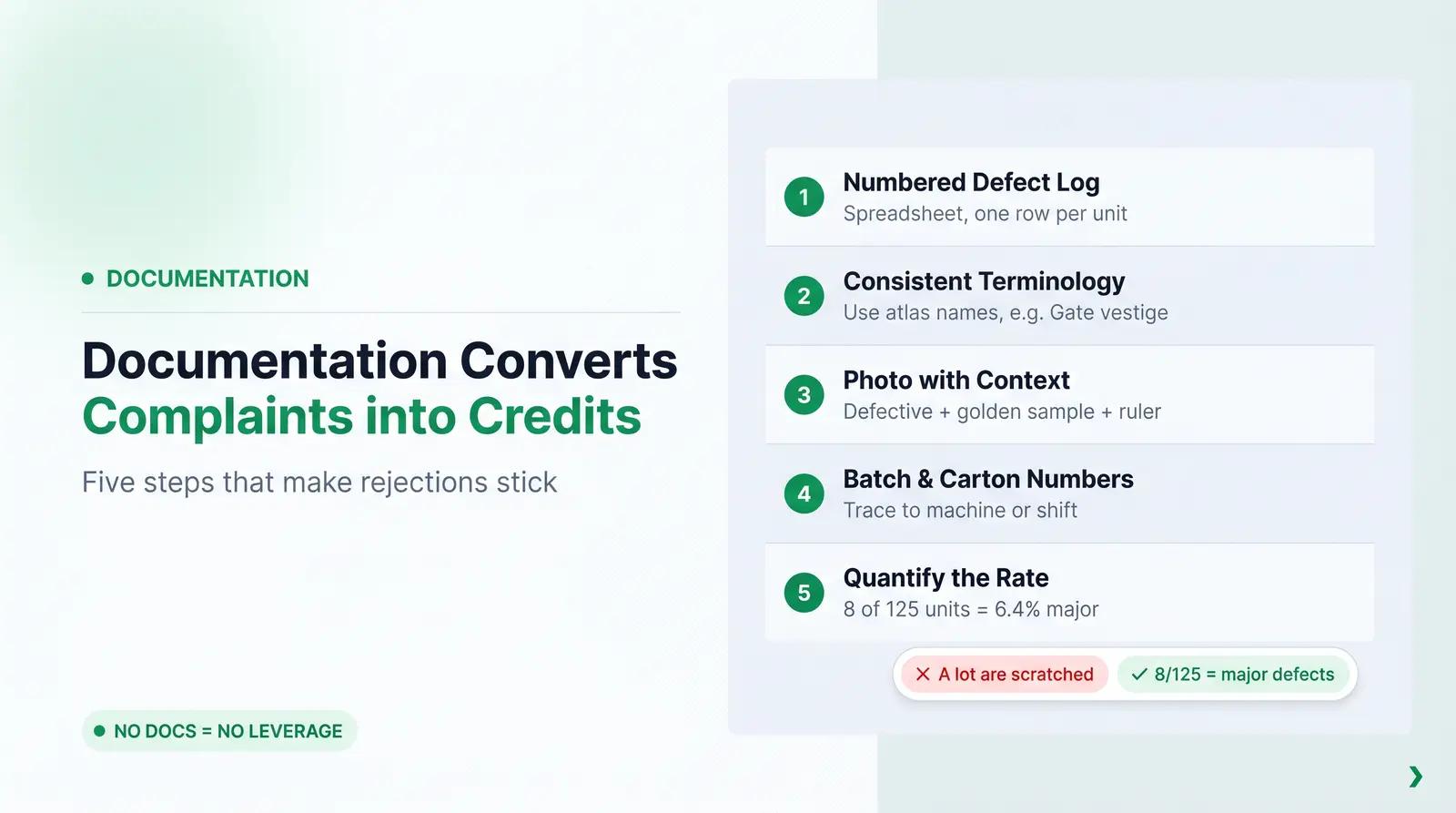
Documentation is your leverage. It converts a frustrated complaint into an actionable rejection and a supplier credit. Without clear documentation, a supplier will claim the damage happened in transit or is within normal manufacturing tolerances.
Create a numbered defect log. Use a spreadsheet. For every defective unit found in your sample, assign a number.
Use consistent terminology. Refer to defects using the specific names from the Defect Atlas — "Gate vestige greater than 2mm" rather than "weird bump on the bottom."
Photograph everything with context. Do not just take a blurry close-up. Take a photo of the defective unit next to a golden (perfect) sample for comparison. Include a ruler or caliper in the frame to show the scale of the defect.
Record batch and carton numbers. Note exactly which shipping carton the defective units came from. This helps the supplier trace the issue back to a specific machine or shift.
Quantify the problem. "A lot of these are scratched" is not actionable. "We inspected a random sample of 125 units from a lot of 3,000, and found 8 units with major functional defects" is actionable.
Questions to Ask Suppliers Before You Order
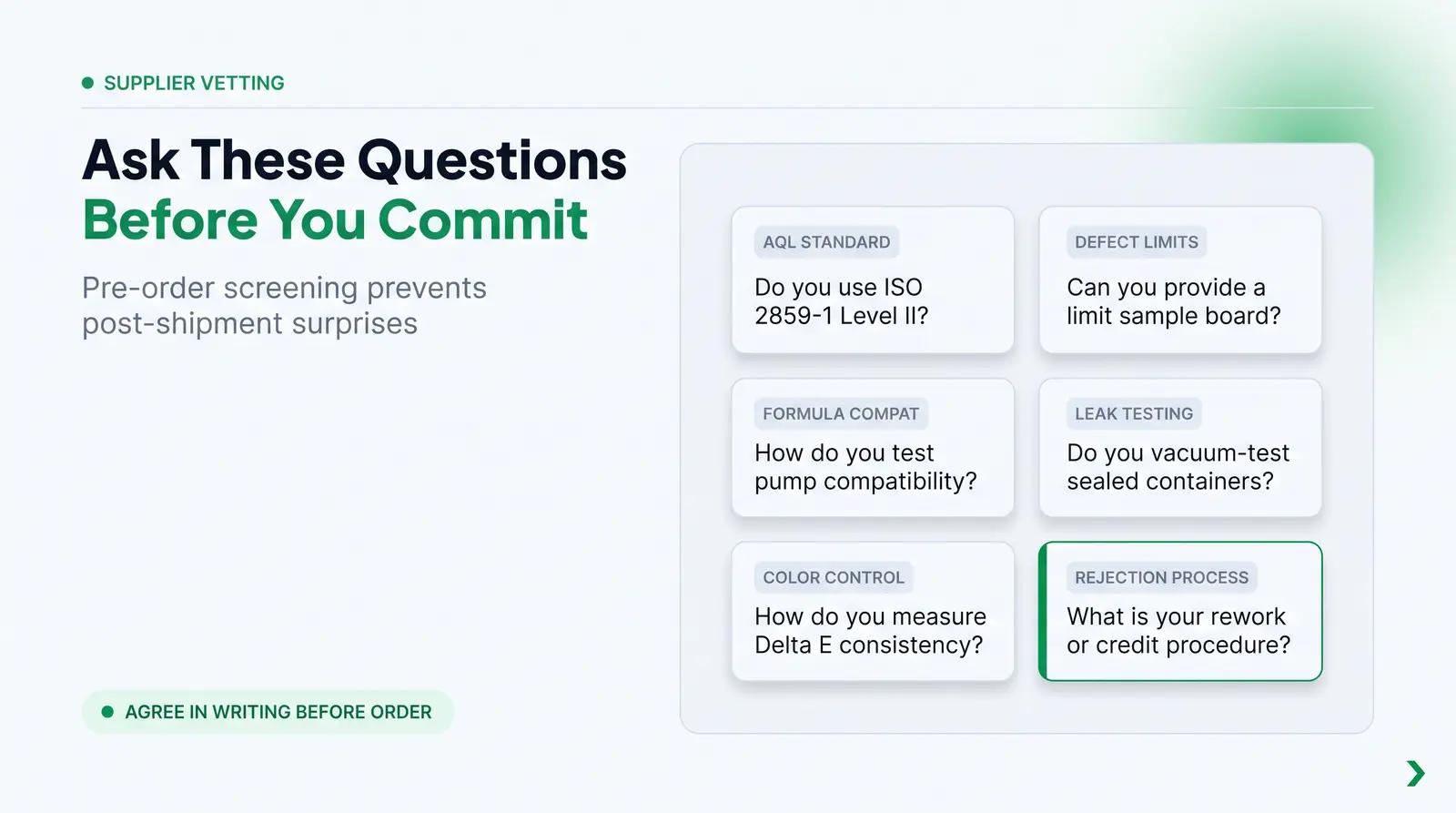
Before committing to a production run, ask these questions to establish quality expectations upfront.
- What is your standard AQL for cosmetic packaging, and do you use ISO 2859-1 Level II sampling?
- How do you define and classify Critical, Major, and Minor defects for this specific component?
- Can you provide a defect limit sample board showing the maximum acceptable level of a minor defect?
- What is your protocol for incoming inspection of raw materials?
- How do you test for formula compatibility with pump mechanisms or dropper bulbs?
- Do you perform vacuum leak testing on sealed containers before shipment?
- What is the process for approving a pre-production sample before mass production begins?
- How do you control and measure color consistency (Delta E) across different production runs?
- If a lot fails our incoming inspection based on the agreed AQL, what is the exact procedure for rework, replacement, or credit?
- Do you provide a Certificate of Analysis with each batch shipped?
Worked Example: Inspecting Airless Pump Bottles
Imagine you are a founder ordering 3,000 units of a 1 oz (30 ml) airless pump bottle for a new vitamin C serum. The shipment arrives.
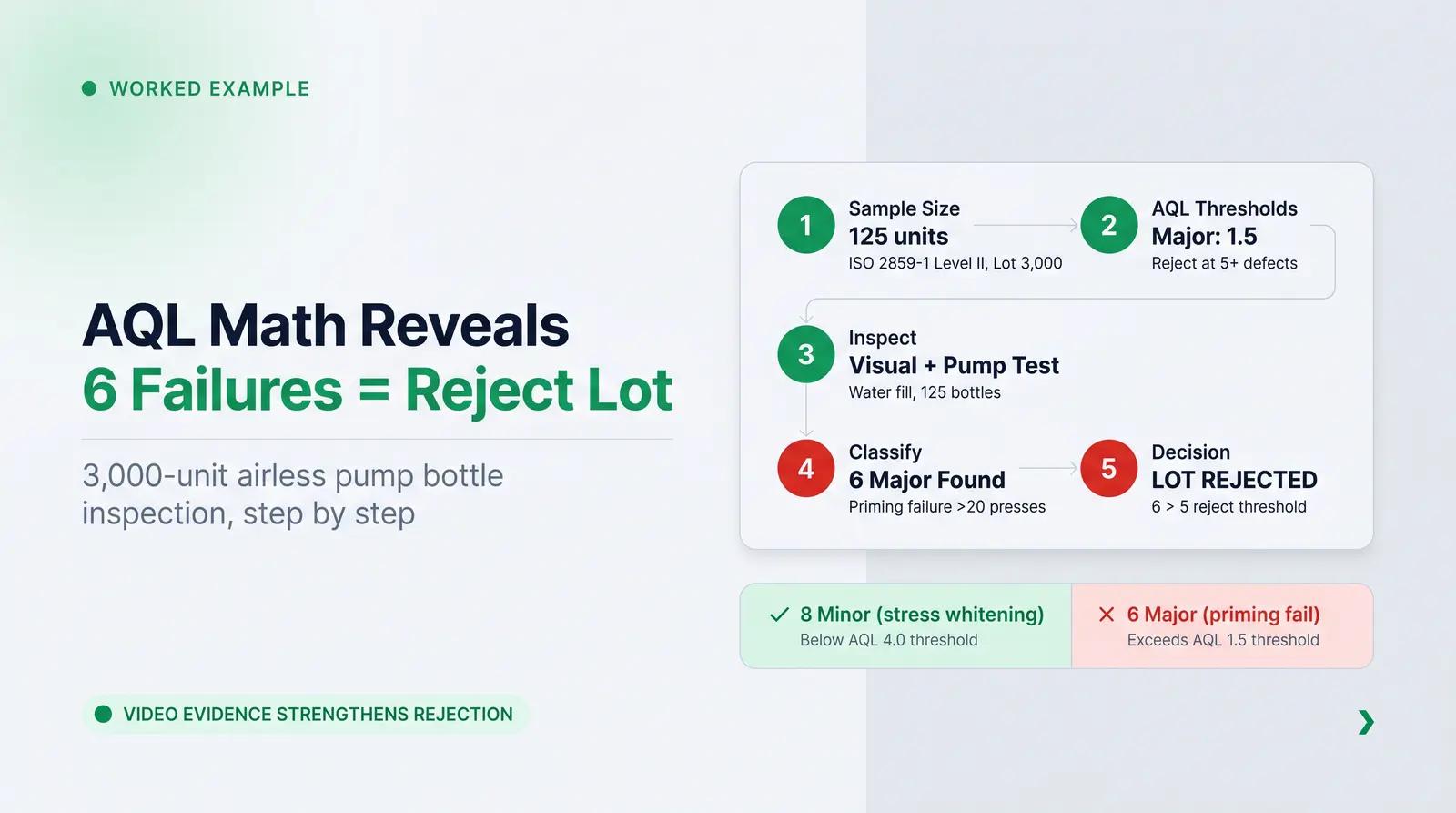
Step 1: Determine the sample size. Using ISO 2859-1 General Inspection Level II for a lot size of 3,000, your sample size code is K, meaning you randomly pull and inspect 125 units [1].
Step 2: Establish the AQL thresholds. You have previously agreed with the supplier on an AQL of 0.0 for Critical defects, 1.5 for Major defects, and 4.0 for Minor defects. For a sample size of 125, the ISO 2859-1 table gives you: Major (AQL 1.5) — accept on 4 defects, reject on 5. Minor (AQL 4.0) — accept on 10 defects, reject on 11.
Step 3: Conduct the inspection. You pull 125 bottles randomly from different cartons. You inspect visually and perform a functional pump test using water.
Step 4: Classify and document findings. You find 6 bottles where the pump fails to prime after 20 presses — a Major defect. You also find 8 bottles with slight stress whitening near the base — a Minor defect.
Step 5: Make the decision. You found 6 Major defects. The rejection number for Major defects at AQL 1.5 is 5. Because 6 is greater than 5, the lot fails. You document the 6 priming failures with video evidence, reference the AQL agreement, and formally reject the lot, requesting replacement.
How Packfolio Handles This for You
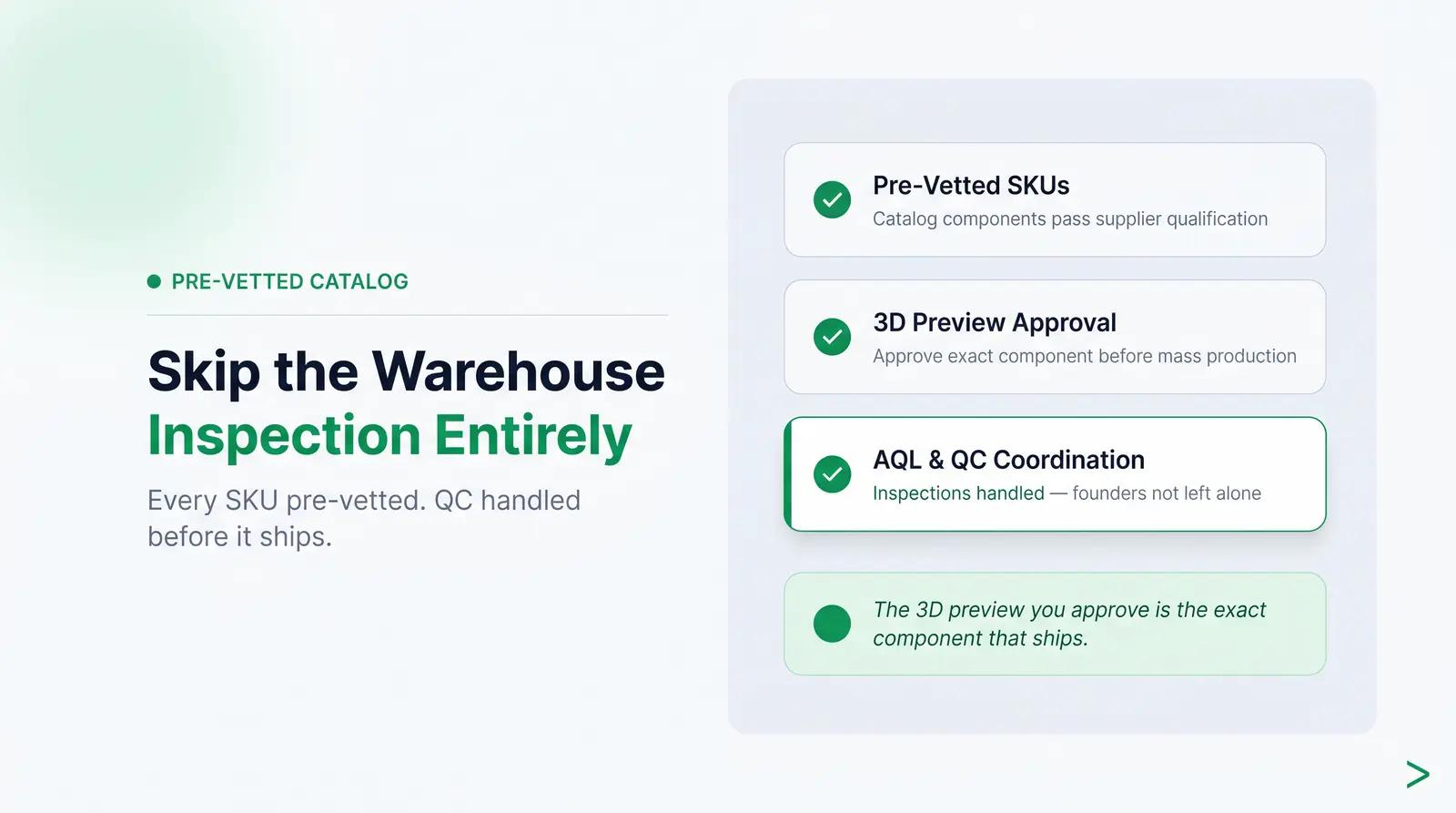
Managing AQL tables, defect classifications, and supplier negotiations is a full-time job. Packfolio's catalog curation and 3D preview workflow address pre-production defect risk at the source.
Every SKU in the Packfolio catalog has been pre-vetted. The 3D preview you approve before ordering is the exact component that ships. Packfolio handles supplier qualification, AQL inspections, and QC coordination — so founders are not left doing incoming inspection alone in a warehouse.
Browse Packfolio's curated cosmetic packaging catalog and preview your label in 3D before ordering at packfolio.com.
Frequently Asked Questions
What is an acceptable defect rate for cosmetic packaging?
There is no single acceptable rate — it depends on your brand positioning and the defect type. The industry standard uses an AQL of 0.0 for critical safety defects, 1.0 to 2.5 for major functional defects, and 2.5 to 4.0 for minor cosmetic defects [1]. Premium brands typically set tighter thresholds for major defects.
How do I inspect pump packaging for functional defects?
Fill a random sample of pumps with your actual product — or a liquid of similar viscosity — and test for priming speed (how many presses to first drop), dose consistency (weigh the output across 10 strokes), and suck-back failure. Also leave filled units on their side for 48 hours to check for leakage.
What is AQL and how does it apply to beauty packaging?
AQL stands for Acceptable Quality Limit. It is a statistical sampling method defined by ISO 2859-1 that determines the maximum number of defective units allowed in a sample batch before the entire production lot is rejected [1]. It helps brands balance the risk of accepting bad product against the cost of inspecting every single unit.
What should I photograph when documenting a packaging defect?
Always photograph the defective unit next to an approved golden sample for clear comparison. Include a ruler or caliper in the frame to show the exact size of the defect, and ensure the lighting clearly highlights the issue. For functional defects like leaking pumps, a short video is more persuasive than a photograph.
How do I formally reject a packaging shipment from a supplier?
Provide a structured defect report detailing the sample size inspected, the specific defect names, the quantity of defects found, and photographic or video evidence. Compare these findings against the previously agreed AQL thresholds to justify the rejection, and formally request a credit or replacement lot in writing.
References
[1] Setting AQL Standards for Cosmetics Packaging — InTouch Quality (Asia Quality Focus), 2021
[2] Tips for Cosmetic Injection Molding Defects — SyBridge Technologies, 2021
[3] Glass Packaging Defects and How to Identify Them — Richmond Group, 2024
[4] Seam Inspection and Defect Classification in Laminated Tube Production — Lami Tube Making Machine, 2025
[5] Understanding Glass Container Defects in Cosmetic Packaging — Glass Bottle Custom, 2024
[6] How to Spot Bottle Defects Before They Ruin Your Product Launch — Propacks, 2026
[7] In Depth: Cosmetic Dropper Pipettes (Part 3 of 3) — Richmond Group, 2024
[8] 3 Important Things Your Pipette Supplier Should Offer — Carow Packaging, 2024
[9] Overcoming Induction Heat Sealing Pain Points — Selig Group, 2024
[10] Overcome Shrink Sleeve Packaging Problems — Fortis Solutions Group, 2024
[11] Packaging Quality Inspection Standards for Cosmetic Bottles: AQL Levels, Defect Classification and Acceptance Criteria — Passenpack, 2026
[12] Acceptable Quality Limit (AQL) Sampling Chart and Calculator — QIMA, 2024


