
Cosmetic Packaging Tariff and HTS Calculator: Estimate Your Import Costs Before They Surprise You
A step-by-step framework helps beauty founders calculate cosmetic packaging landed costs, including HTS codes, Section 301 tariffs, and freight, before placing import orders.
The moment a founder's landed cost materially exceeds the supplier quote they built their COGS around is one of the most painful experiences in launching a beauty brand. You order 5,000 glass serum bottles from a supplier in China at an attractive $0.85 FOB price, expecting freight to add a modest premium. Weeks later, the shipment arrives at a US port, and your customs broker hands you a bill that includes base duties, a Section 301 surcharge, Merchandise Processing Fees, and port handling charges that push your actual cost per unit far higher than planned. The gap between the quoted price and the real cost is not a rounding error. It is the difference between a profitable launch and a COGS crisis.
This article gives you a step-by-step method to estimate your total import exposure before placing a purchase order. By the time you finish reading, you will know how to identify the correct HTS code for your packaging type, calculate the applicable duty stack, build a complete landed cost per unit, and compare at least two sourcing scenarios side by side.
Why Landed Cost Almost Always Exceeds the Supplier Quote
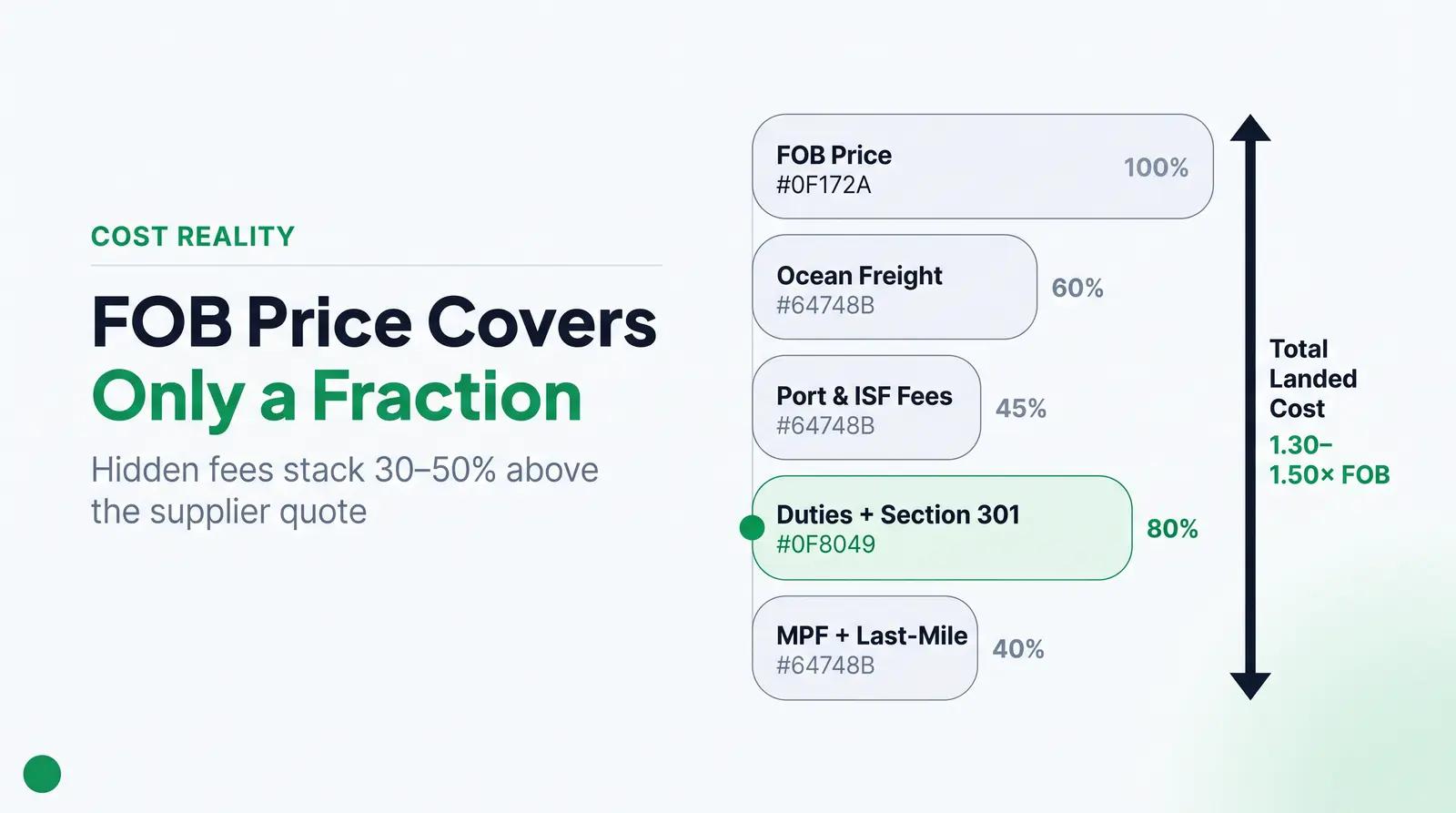
Founders routinely underestimate the gap between the Free on Board (FOB) price quoted by an overseas supplier and the final landed cost. The FOB price covers only the cost of manufacturing the packaging and delivering it to the origin port. It does not include ocean or air freight to move the goods across the world, nor does it account for marine insurance to protect against loss or damage in transit [1].
Once the shipment reaches a US port, a new layer of fees applies. Terminal handling charges, Importer Security Filing (ISF) fees, and customs bond requirements all add to the bill before the goods even clear customs [2]. A licensed customs broker is required for most commercial shipments, and their fees typically run $150 to $400 per entry for standard shipments [2].
The largest unexpected costs often come from the US government itself. Most cosmetic packaging is subject to standard Most Favored Nation (MFN) duty rates based on its Harmonized Tariff Schedule (HTS) classification [3]. For goods originating in China, these base rates are compounded by Section 301 tariffs, which act as a layered surcharge on top of the MFN rate [4]. US Customs and Border Protection (CBP) also assesses a Merchandise Processing Fee (MPF) on all formal entries, calculated at 0.3464% of the entered value, with a minimum of $33.58 and a maximum of $651.50 [5]. Finally, last-mile delivery — moving the goods from the port to your warehouse or contract manufacturer — adds domestic freight costs that are easy to forget when building a cost model.
For small-to-mid volume cosmetic packaging orders, these combined expenses can easily increase the unit cost by 30% to 50% above the initial FOB quote. Understanding each component before you place an order is the only reliable way to protect your margins.
HTS Codes for Cosmetic Primary Packaging: A Classification Guide
An HTS code is a standardized numerical method used to classify traded products for customs purposes. The United States uses a 10-digit version of the international Harmonized System, maintained by the US International Trade Commission (USITC) [3]. Correct classification is critical because it determines the applicable duty rate and whether the goods are subject to additional trade remedies or admissibility requirements. Importing under the wrong code can lead to customs delays, penalties, or unexpected duty bills.
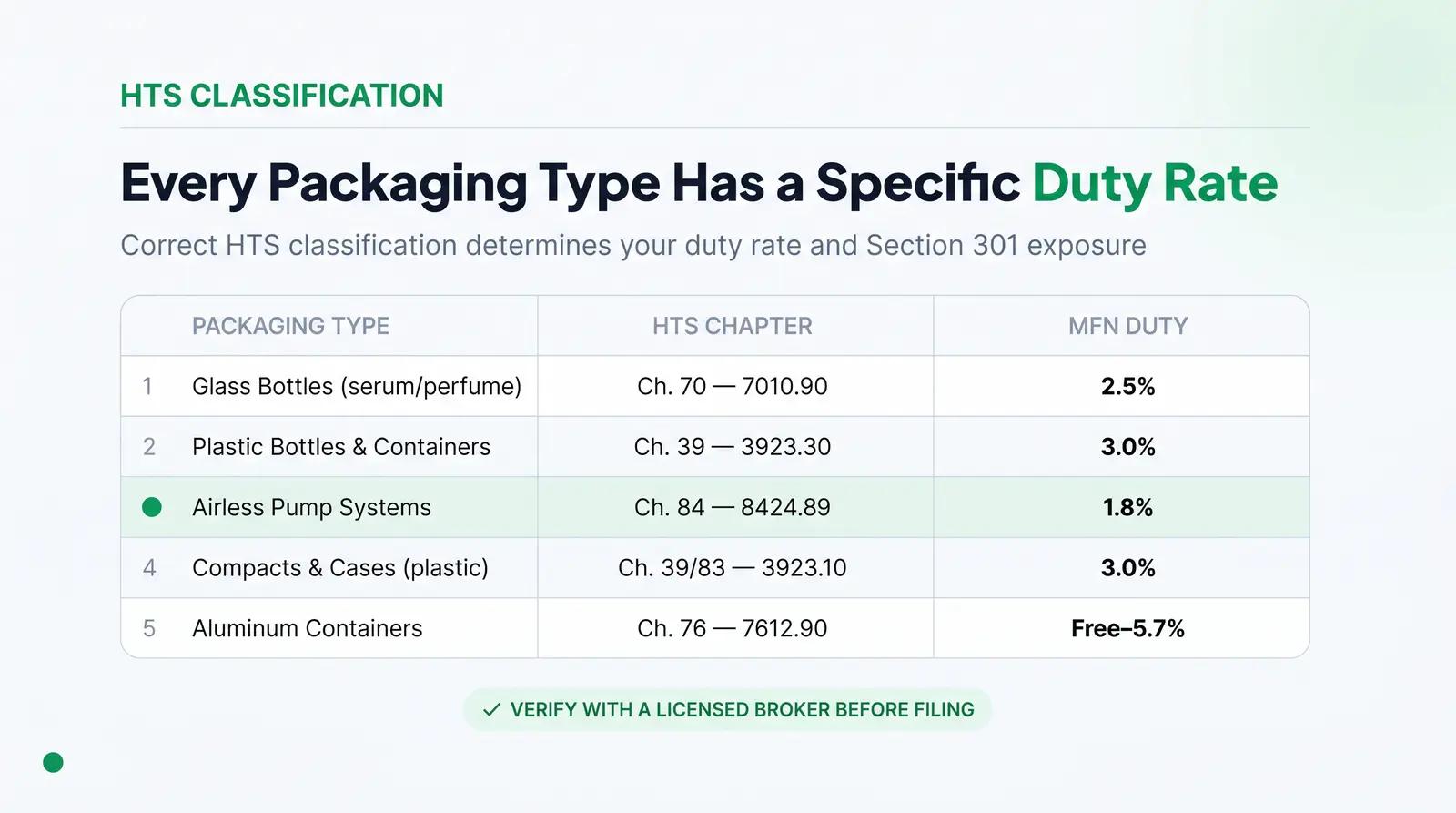
The table below maps the most common cosmetic primary packaging types to their likely HTS chapter, heading range, and general MFN duty rates. These figures are drawn from the USITC Harmonized Tariff Schedule and CBP ruling precedents [3].
| Packaging Type | HTS Chapter | Likely Subheading Range | MFN Duty Rate (Col. 1) |
|---|---|---|---|
| Glass bottles (perfumery/cosmetics use) | Chapter 70 | 7010.90.20 | 2.5% |
| Plastic bottles and containers | Chapter 39 | 3923.30 | 3% |
| Aluminum/metal containers | Chapter 76 | 7612.90 | Free to 5.7% |
| Pumps and dispensers | Chapter 84 | 8413.20 or 8424.89 | Free to 1.8% |
| Compacts and cases (plastic) | Chapter 39 or 83 | 3923.10 or 3923.90 | 3% |
| Tubes (plastic, collapsible) | Chapter 39 | 3923.90 | 3% |
| Droppers and pipettes | Chapter 70 or 90 | 7010.90 or 9018.90 | Free to 4.9% |
| Lip components (lipstick cases) | Chapter 39 or 83 | 3923.90 | 3% |
| Airless pump systems | Chapter 84 | 8424.89 | 1.8% |
These are starting-point classifications only. The correct 10-digit subheading depends on specific product characteristics such as material composition, manufacturing method, and intended use. Founders must verify their exact code with a licensed customs broker or by using the official USITC HTS search tool [3].
Why Classification Matters More Than Most Founders Realize
A misclassification does not just affect the duty rate on a single shipment. It creates a paper trail that CBP can audit retroactively, potentially triggering back-duties and penalties on all prior entries under the same code. For example, a cosmetic container imported with an attached airless pump is classified under HTS 8424.89 as a mechanical appliance, not under the plastic container heading 3923.90, because the pump is the essential character of the assembled unit [6]. This distinction carries a 1.8% duty rate versus 3%, but more importantly, it affects whether Section 301 tariffs apply and at what rate.
Section 301 Tariffs and China-Origin Packaging: What's Currently in Effect
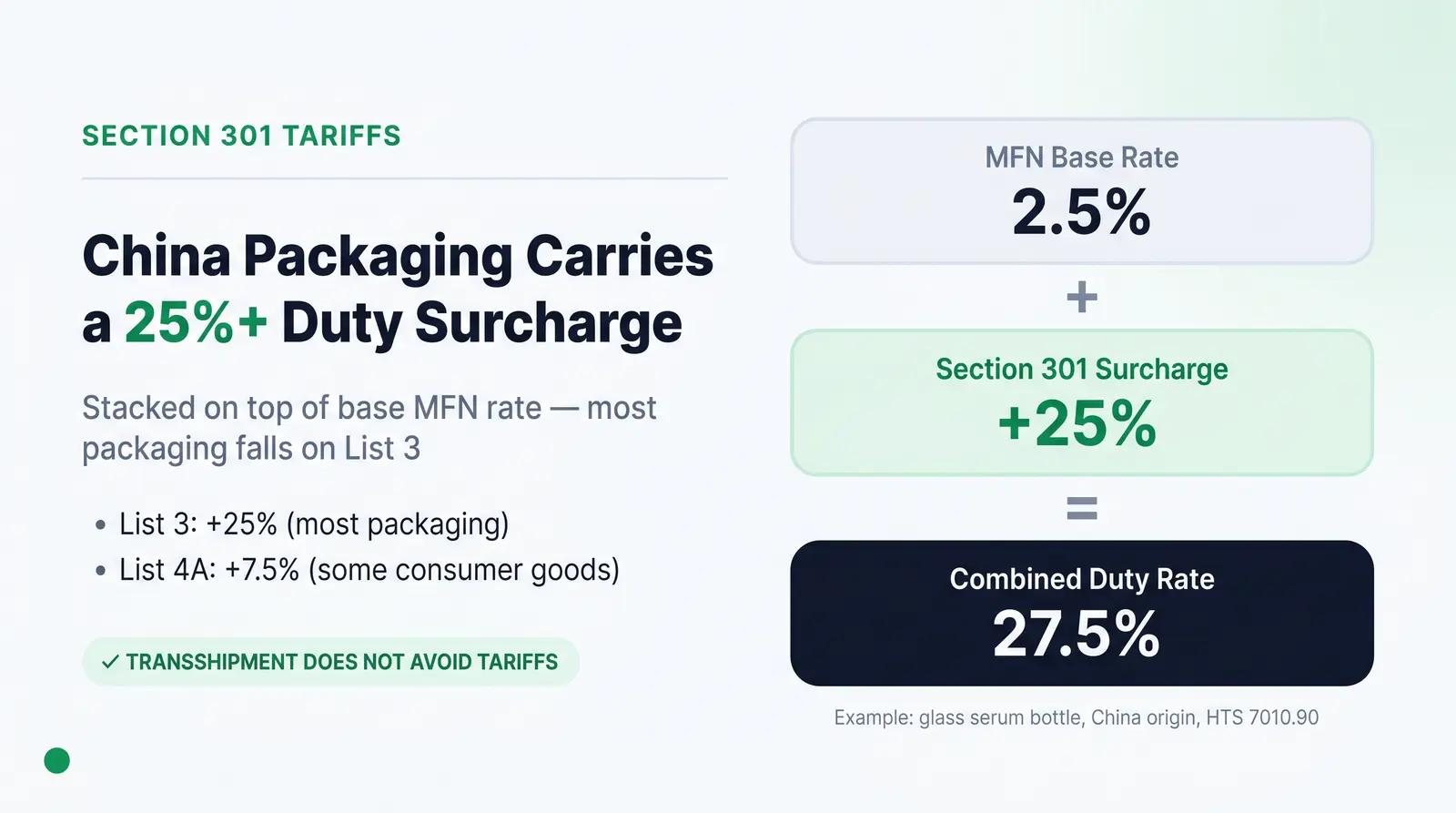
Section 301 tariffs are a layered surcharge applied on top of base MFN duty rates for goods originating in China. Implemented by the Office of the United States Trade Representative (USTR), these tariffs were originally imposed in 2018 after USTR found that China's practices related to technology transfer and intellectual property were unreasonable and discriminatory [4]. They have been maintained and, in some categories, increased through subsequent reviews.
The current Section 301 tariff structure for packaging-relevant HTS chapters is as follows [4] [7]:
| Section 301 List | Rate | Products Covered |
|---|---|---|
| List 1 | 25% | Industrial machinery, electronics components |
| List 2 | 25% | Semiconductors, plastics, chemicals |
| List 3 | 25% | Furniture, auto parts, consumer goods, many packaging components |
| List 4A | 7.5% | Apparel, footwear, certain consumer goods |
Most cosmetic primary packaging components from China fall under List 3 or List 4A, meaning an additional 25% or 7.5% applies on top of the MFN base rate. The 2024 Section 301 four-year review maintained these rates on packaging-relevant chapters [7].
Country of Origin Rules and Transshipment Risk
Section 301 tariffs are based on where a product is manufactured, not where it is shipped from. CBP applies the "substantial transformation" test to determine country of origin: a product originates in the country where it underwent a fundamental change in name, character, or use [8]. Simply relabeling Chinese-made goods as "Made in Vietnam" or routing a shipment through a third country does not change the country of origin for tariff purposes [9].
Goods transshipped through a third country to avoid Section 301 tariffs carry serious legal and reputational risk. CBP actively investigates transshipment schemes, and penalties can include seizure of goods, back-duties on prior entries, and potential criminal liability [9]. Any brand considering alternative sourcing origins must ensure that the manufacturing genuinely occurs in that country.
The Packfolio Landed Cost Build-Up
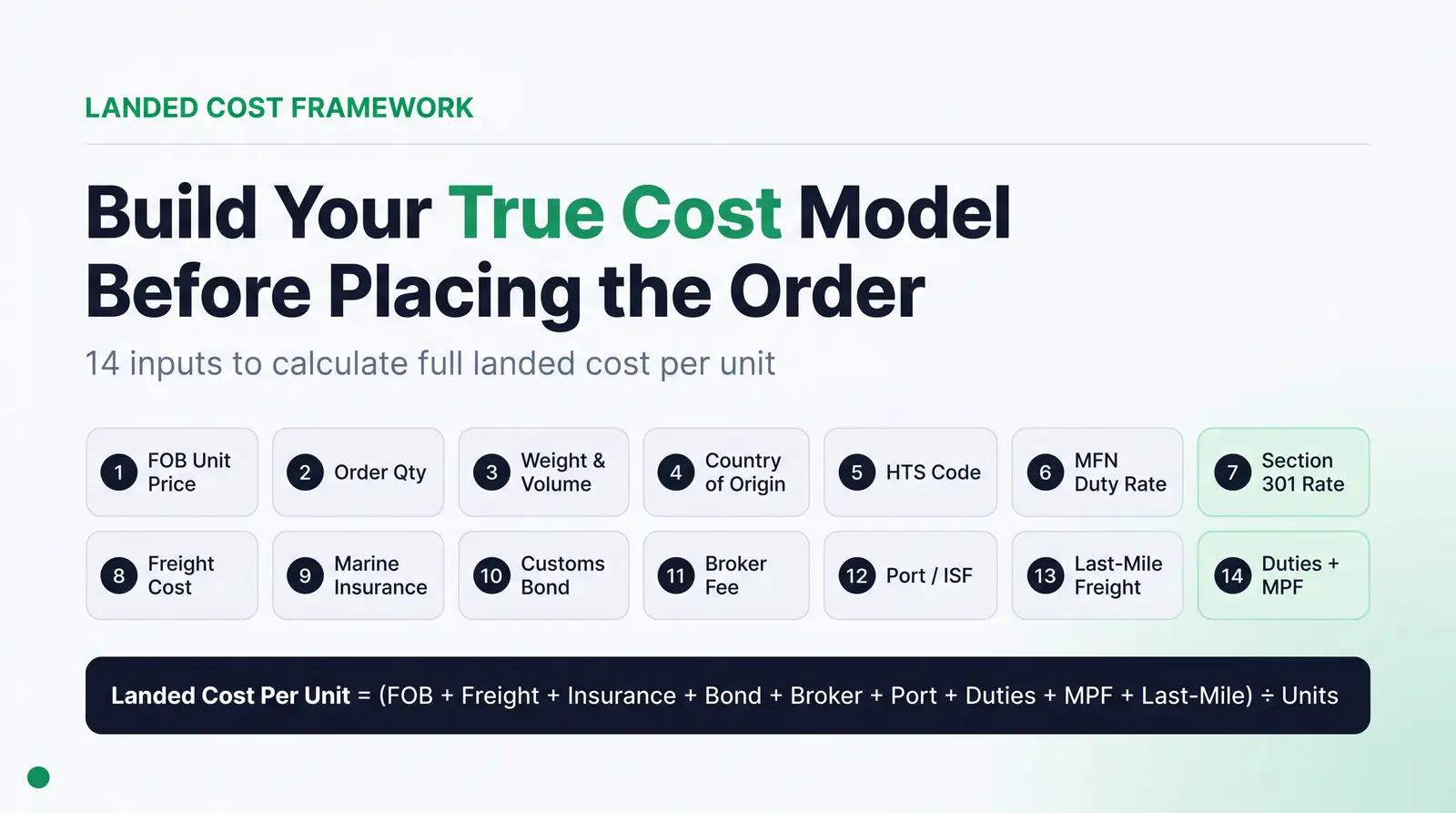
This is a practical framework we use at Packfolio when helping founders understand their total cost exposure before ordering. By gathering these specific inputs, you can build an accurate pre-order cost model and avoid the surprise-customs-bill scenario.
- FOB Unit Price — supplier quoted price at origin port, in USD
- Order Quantity — total units in the shipment
- Gross Shipment Weight and Volume — needed for freight quoting (kg and CBM)
- Country of Origin — where the packaging is manufactured (not shipped from)
- HTS Code (10-digit) — identify using USITC tool or broker
- MFN Base Duty Rate — from USITC HTS Schedule, Column 1
- Section 301 Tariff Rate — if China origin, add the applicable List rate
- Freight Cost — ocean LCL/FCL or air, quoted from a freight forwarder (USD per shipment)
- Marine Insurance — typically 0.5–1.5% of CIF value [10]
- Customs Bond — single-entry bond cost or continuous bond amortized per shipment
- Customs Broker Fee — typically $150–$400 per entry for standard shipments [2]
- Port Handling / ISF Filing — ISF $25–$50, port/terminal handling variable
- Last-Mile Freight — drayage or parcel delivery to warehouse
- Duties and MPF — duty = (FOB + freight + insurance) × combined duty rate; MPF = 0.3464% of entered value, min $33.58, max $651.50 [5]
Total Landed Cost = FOB Cost + Freight + Insurance + Customs Bond + Broker Fee + Port Handling + Duties + MPF + Last-Mile
Landed Cost Per Unit = Total Landed Cost ÷ Order Quantity
To understand the impact on your margins, express the result as a landed cost multiplier. Divide Total Landed Cost by Total FOB Cost. A result of 1.38× means your true cost is 38% above the FOB quote. This multiplier is a useful shorthand when comparing sourcing scenarios or stress-testing your pricing model.
Worked Example: A Glass Serum Bottle Order from China
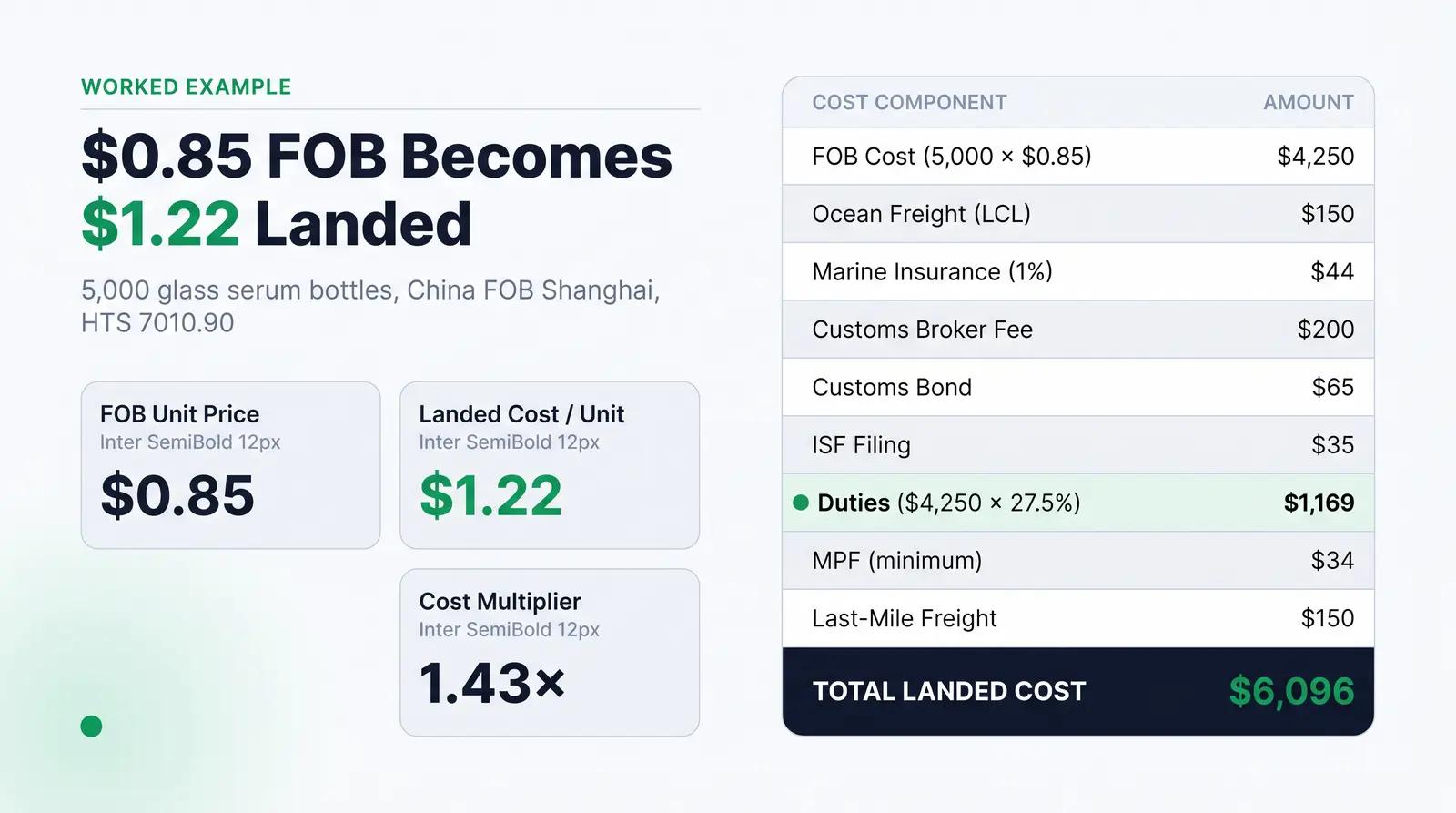
The following scenario walks through a complete, realistic numeric example using the Packfolio Landed Cost Build-Up framework. The product is a 30 ml (1 oz) glass serum bottle with an aluminum dropper cap, sourced from a China-based supplier on FOB Shanghai terms.
Scenario Parameters:
- FOB unit price: $0.85
- Order quantity: 5,000 units
- Total FOB value: $4,250
- HTS code: 7010.90.20.20 (glass containers for perfumery/toilet preparations, machine-made, capacity 0.15–0.33 liter)
- MFN base duty rate: 2.5% [11]
- Section 301 tariff: 25% (List 3, China origin) [4]
- Combined duty rate: 27.5%
- Estimated shipment volume: approximately 0.5 CBM
- Ocean LCL freight: $110/CBM, estimated $150 total [12]
| Cost Component | Calculation | Amount (USD) |
|---|---|---|
| FOB Cost | 5,000 units × $0.85 | $4,250.00 |
| Ocean Freight (LCL) | 0.5 CBM × $110/CBM + handling | $150.00 |
| Marine Insurance | 1% of CIF ($4,250 + $150) | $44.00 |
| Customs Broker Fee | Flat fee, standard entry | $200.00 |
| Customs Bond (single entry) | Estimated | $65.00 |
| ISF Filing | Standard fee | $35.00 |
| Duties | $4,250 × 27.5% | $1,168.75 |
| MPF | $4,250 × 0.3464% (Min $33.58) | $33.58 |
| Last-Mile Freight | Domestic drayage/parcel to warehouse | $150.00 |
| Total Landed Cost | Sum of all components | $6,096.33 |
Landed Cost Per Unit: $6,096.33 ÷ 5,000 = $1.22
Landed Cost Multiplier: $6,096.33 ÷ $4,250.00 = 1.43×
What this means for your COGS: the attractive $0.85 FOB quote translates to $1.22 per unit once landed. If your retail price and margin model were built around a $0.90 packaging cost, this 35% shortfall in your cost assumptions will compress your gross margin significantly. For a brand selling a serum at $45 with a target 70% gross margin, the difference between a $0.90 and $1.22 packaging cost is the difference between hitting your margin target and falling short by several percentage points.
Sourcing Scenario Comparison: China vs. Alternative Origins
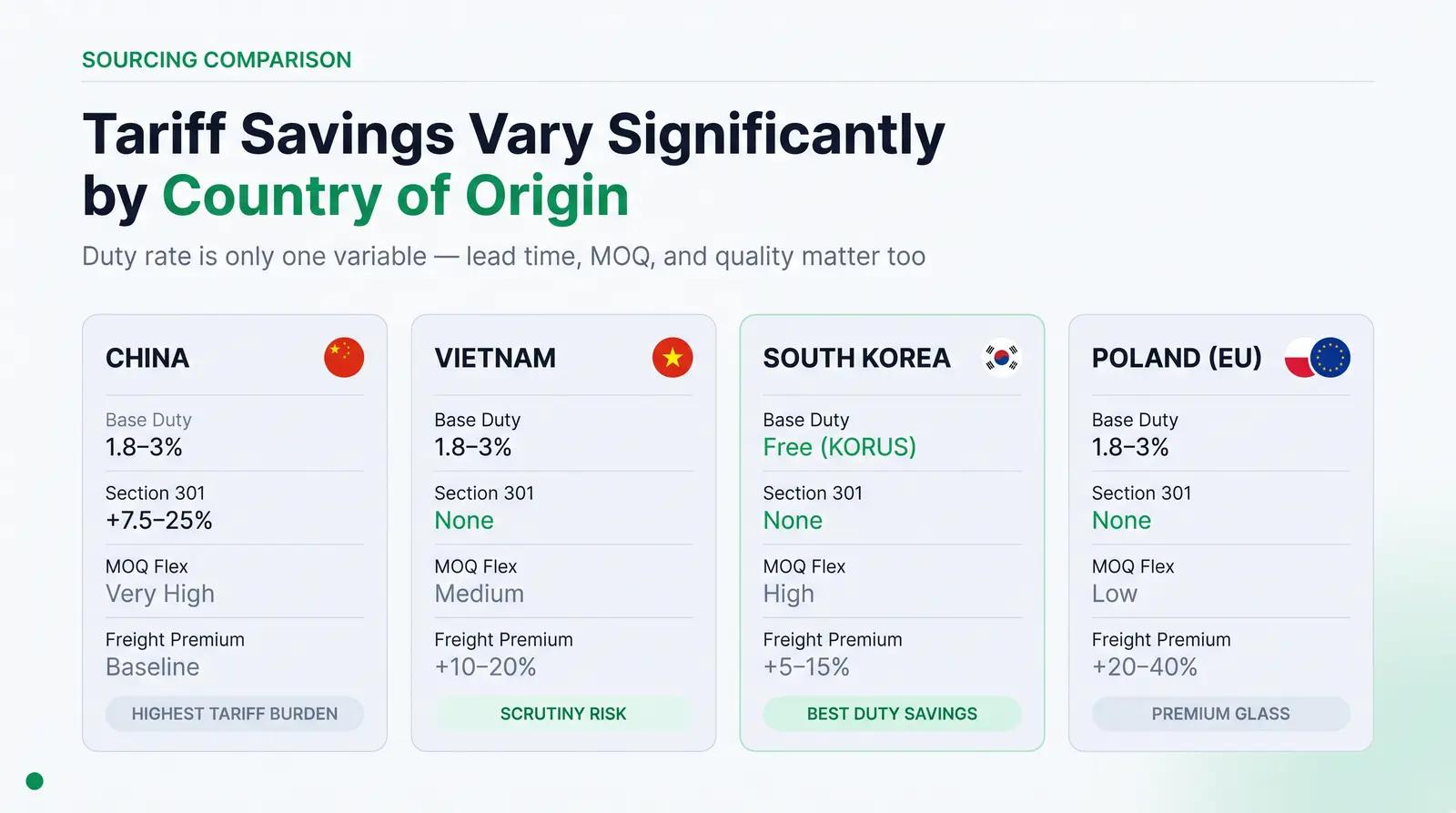
As tariffs reshape the economics of beauty packaging, founders are increasingly evaluating alternative sourcing regions. The table below compares four origin scenarios relevant to cosmetic primary packaging.
| Origin | Typical Base Duty (packaging HTS) | Section 301 Add-On | Estimated Freight Premium vs. China | Relative MOQ Flexibility | Notes |
|---|---|---|---|---|---|
| China | 1.8% – 3% | 7.5% – 25% | Baseline | Very High | Unmatched component variety and supplier density, but highest tariff burden. |
| Vietnam | 1.8% – 3% | None | +10% to +20% | Medium | Avoids Section 301, but subject to strict CBP substantial transformation scrutiny. Goods with predominantly Chinese inputs may not qualify [8] [9]. |
| South Korea | Free (under KORUS FTA) | None | +5% to +15% | High | Excellent quality for premium packaging. Duty-free under the Korea-US Free Trade Agreement. |
| Poland (EU) | 1.8% – 3% | None | +20% to +40% | Low | Strong glass manufacturing heritage, particularly for prestige packaging. Higher FOB prices offset some duty savings. |
Duty rate is only one variable in the sourcing equation. Lead times from Vietnam and South Korea can be 4–8 weeks longer than from China for custom-molded components. MOQ requirements from European suppliers are often significantly higher for bespoke designs. Quality consistency, tooling ownership, and the cost of qualifying a new supplier are all real expenses that must be factored into any honest sourcing comparison.
The Cheapest FOB Quote Can Be the Most Expensive Packaging Decision
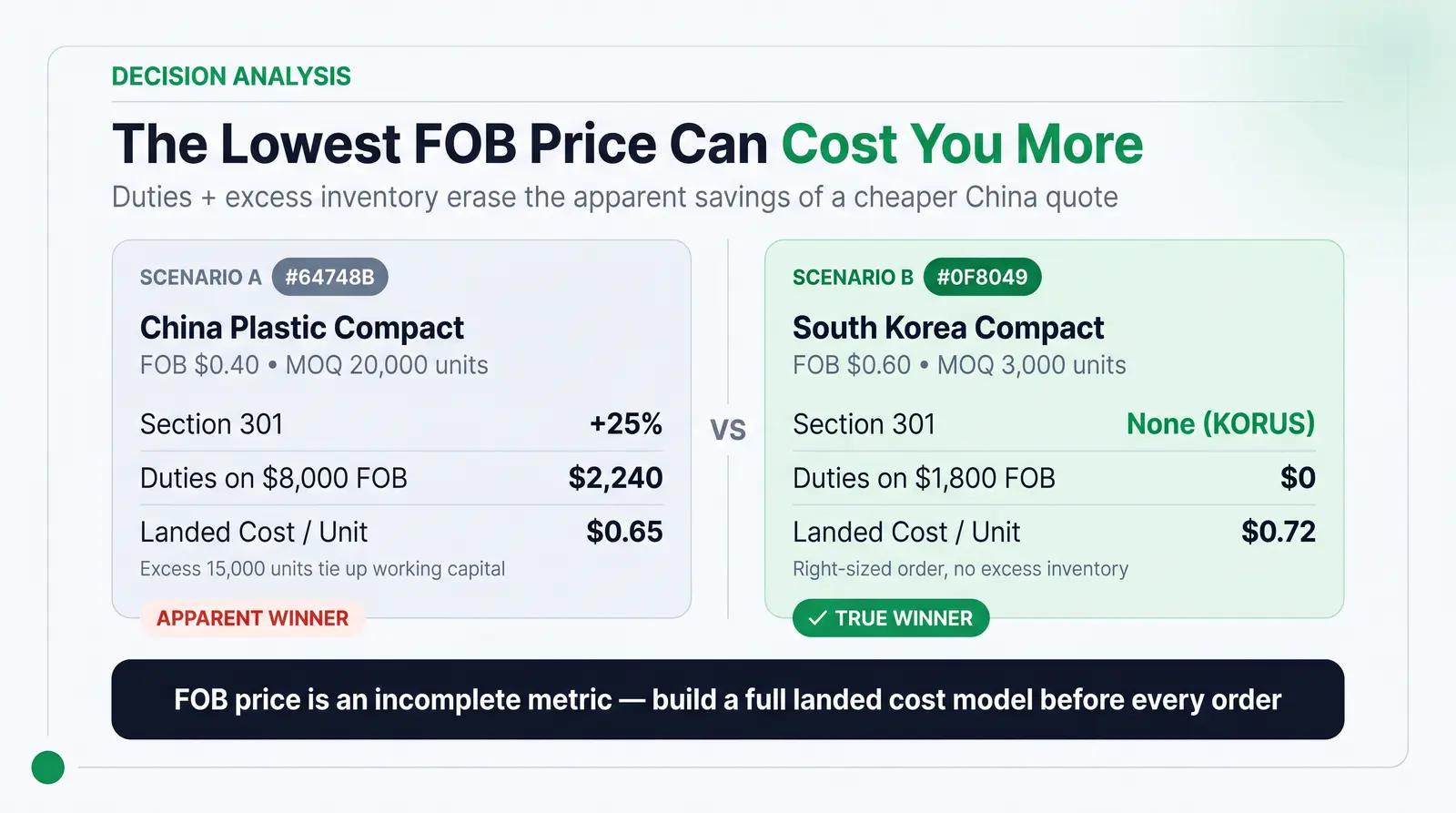
Founders who optimize solely for the lowest FOB price from China often fail to account for the full cost of that decision. Consider a direct comparison using the Packfolio Landed Cost Build-Up framework.
Scenario A: China-sourced plastic compact, FOB $0.40, MOQ 20,000 units
- Section 301 tariff: 25%
- Combined duty rate: 28%
- Total duties on $8,000 FOB value: $2,240
- Excess inventory carrying cost (15,000 units above needed): significant working capital tied up
- Total landed cost per unit at 5,000 units needed: approximately $0.65 after duties, freight, and broker fees
Scenario B: South Korea-sourced equivalent compact, FOB $0.60, MOQ 3,000 units
- Section 301 tariff: None (KORUS FTA)
- Combined duty rate: Free
- Total duties: $0
- No excess inventory required
- Total landed cost per unit: approximately $0.72 after freight and broker fees
The China option appears cheaper on paper at $0.40 FOB versus $0.60 FOB. But once you account for the 25% Section 301 tariff and the capital cost of purchasing 15,000 units you do not immediately need, the South Korean source is competitive on a true landed cost basis. BCG's analysis of the beauty industry notes that the weighted average US tariff rate on beauty products rose from 2.4% in 2024 to approximately 30% in 2025, fundamentally changing the economics of China-sourced packaging [13].
The lesson is not that China is always the wrong choice. It is that the FOB price is an incomplete metric. Founders who build their COGS models on FOB price alone are making decisions with incomplete information.
If you want to eliminate the complexity of coordinating suppliers, managing freight, and calculating duty exposure yourself, Packfolio curates a pre-vetted catalog of cosmetic primary packaging SKUs, coordinates production and freight on behalf of the brand, and ensures the total cost structure is transparent before the order is placed. You can browse the catalog and preview your label in 3D at packfolio.com/catalog.
Knowing your landed cost before you order is the difference between a margin-positive launch and a COGS surprise. The Packfolio Landed Cost Build-Up framework gives you a repeatable process to estimate your import exposure, compare sourcing scenarios, and make defensible decisions before committing to a purchase order. The tariff landscape will continue to evolve, but the discipline of building a complete landed cost model will always be the right approach.
Browse Packfolio's curated cosmetic packaging catalog and preview your label in 3D before ordering → packfolio.com/catalog
Frequently Asked Questions
How do I find the correct HTS code for my cosmetic packaging?
Start with the USITC HTS search tool at hts.usitc.gov using keywords that describe your product's material and function, such as "glass bottles cosmetics" or "plastic containers packing goods." Because classification depends on material composition, manufacturing method, and intended use, it is best to have a licensed customs broker verify the exact 10-digit subheading before filing your first entry.
What is the current Section 301 tariff rate on packaging imported from China?
Most cosmetic primary packaging components from China fall under Section 301 List 3, which carries a 25% additional tariff on top of the standard MFN base duty rate. Some components may fall under List 4A at 7.5%. These rates are applied to the entered value of the goods and stack on top of any base MFN duty.
How do I calculate landed cost per unit for a cosmetic packaging order?
Add together the FOB cost, ocean or air freight, marine insurance, customs bond, broker fees, ISF and port handling fees, applicable duties (MFN base rate plus any Section 301 tariff), the Merchandise Processing Fee, and last-mile domestic freight. Divide that total by the number of units in your order to get the landed cost per unit.
Are there cosmetic packaging suppliers outside China that avoid Section 301 tariffs?
Yes. Sourcing from countries such as South Korea, Vietnam, or EU member states avoids Section 301 tariffs. South Korea benefits from duty-free treatment under the Korea-US Free Trade Agreement for many packaging HTS codes. However, goods must genuinely be manufactured in the claimed country of origin. CBP actively investigates transshipment schemes where Chinese-made goods are routed through third countries without undergoing substantial transformation.
What is the Merchandise Processing Fee (MPF) and how is it calculated?
The MPF is a user fee collected by CBP on formal import entries to offset the cost of processing. It is calculated at 0.3464% of the entered customs value of the goods, with a minimum fee of $33.58 and a maximum of $651.50 per entry as of FY2026. For a small cosmetic packaging shipment valued at $4,250, the MPF would be $33.58 (the minimum applies because 0.3464% of $4,250 is only $14.72).
References
[1] International Trade Administration, U.S. Department of Commerce. "Know Your Incoterms." https://www.trade.gov/know-your-incoterms
[2] EcoEnclose. "What Should I Know About Import Brokerage and Fees?" https://help.ecoenclose.com/en-US/what-should-i-know-about-import-brokerage-and-fees-185605
[3] United States International Trade Commission. "Harmonized Tariff Schedule of the United States." https://hts.usitc.gov/
[4] Office of the United States Trade Representative. "China Section 301-Tariff Actions and Exclusion Process." https://ustr.gov/issue-areas/enforcement/section-301-investigations/tariff-actions
[5] U.S. Customs and Border Protection. "User Fee Table." Last Modified January 22, 2026. https://www.cbp.gov/trade/basic-import-export/user-fee-table
[6] U.S. Customs and Border Protection. "N284174: The tariff classification of a cosmetic container with airless pump from China." March 21, 2017. https://rulings.cbp.gov/ruling/N284174
[7] Office of the United States Trade Representative. "Notice of Modification: China's Acts, Policies and Practices Related to Technology Transfer." Federal Register, September 18, 2024. https://www.federalregister.gov/documents/2024/09/18/2024-21217/notice-of-modification-chinas-acts-policies-and-practices-related-to-technology-transfer
[8] International Trade Administration, U.S. Department of Commerce. "Rules of Origin: Substantial Transformation." https://www.trade.gov/rules-origin-substantial-transformation
[9] U.S. Customs and Border Protection. "Marking of Country of Origin on U.S. Imports." https://www.cbp.gov/trade/rulings/informed-compliance-publications/marking-country-origin-us-imports
[10] GingerControl. "Importing from China: Every Tariff, Duty, and Fee U.S. Importers Pay." March 2026. https://gingercontrol.com/blog/importing-from-china-tariff-guide
[11] Wove. "Serum Dropper Glass Bottle Import Tariff and Duty Rate, HTS 7010.90.20." https://tariffs.wove.com/us/tariff/7010.90.20/serum-dropper-glass-bottle
[12] Sino Shipping. "Shipping from China to USA: June 2026 Freight Rates and Transit Times." https://www.sino-shipping.com/country-guides/shipping-from-china-to-usa/
[13] Boston Consulting Group. "How US Beauty Brands Can Navigate Tariffs and Build Resilience." May 8, 2025. https://www.bcg.com/publications/2025/navigating-tariffs-in-us-beauty-industry
[14] BeautyMatter. "Beauty's Aluminum Reckoning: What Trump's Tariffs Reveal About Beauty's Future." September 25, 2025. https://beautymatter.com/articles/trumps-aluminum-tariffs-beautys-future


