
Cosmetic Packaging MOQ Benchmark Report
This report benchmarks cosmetic packaging MOQs by packaging family, customization level, and supplier type so beauty founders can match order quantities to their launch stage and budget.
Minimum order quantity (MOQ) is often the first hard number that separates a realistic beauty launch plan from an expensive mistake. Founders frequently spend months finalizing a formula and brand identity, only to discover that their chosen packaging requires a 10,000-unit commitment they cannot afford. By benchmarking MOQs across the industry, beauty brands can negotiate smarter, align their packaging strategy with their actual launch volume, and avoid stalling production at the finish line.
Why MOQ Is the First Number That Determines Whether Your Launch Is Viable
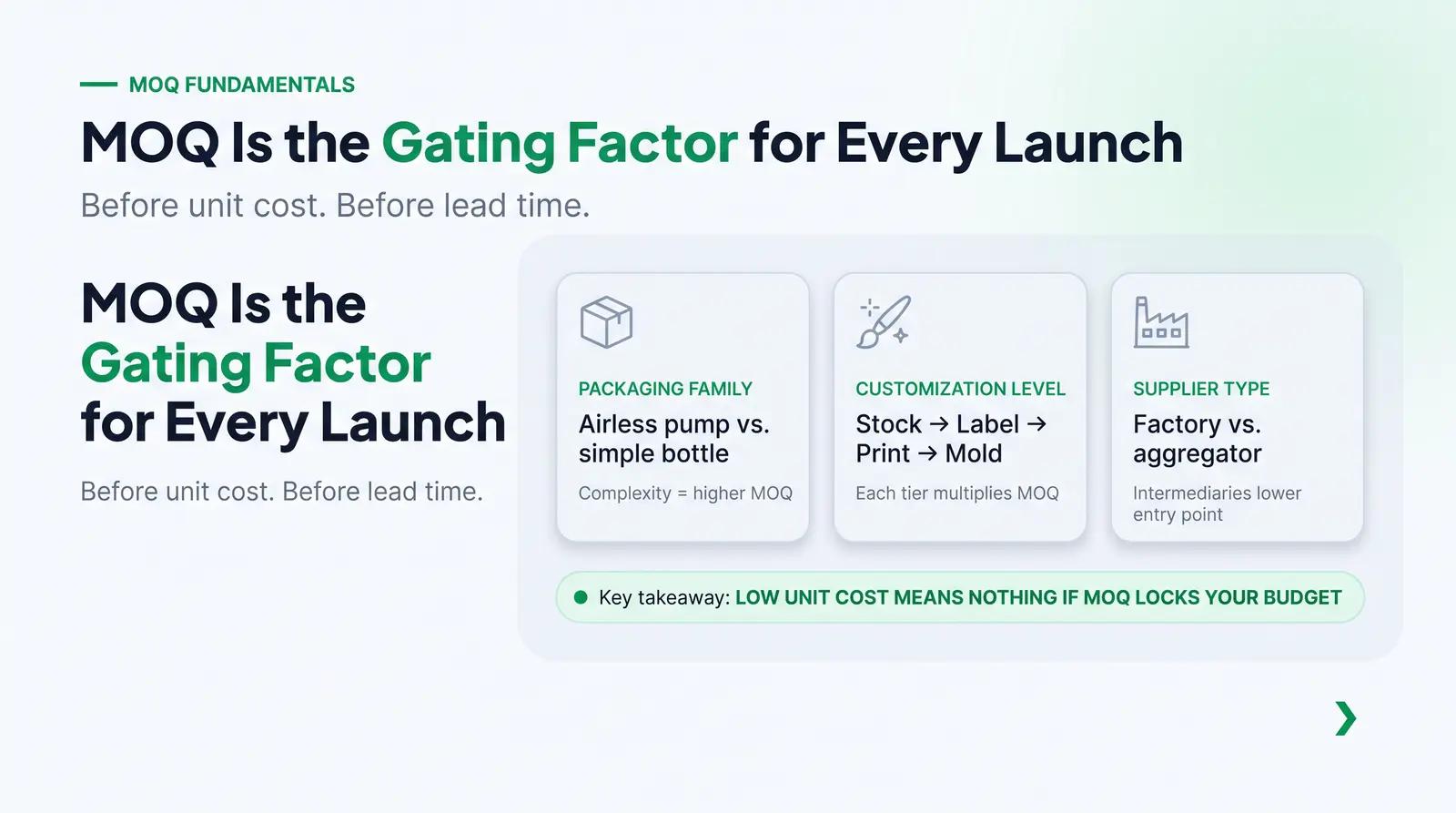
While unit cost and lead time are critical, MOQ is the true gating factor for any beauty launch. A low unit cost is meaningless if the required volume ties up a brand's entire operating budget in empty containers. The minimum order requirement dictates not just cash flow, but storage needs, formula expiration risks, and agility in the market.
Three primary variables drive MOQ in the cosmetic packaging industry. The first is the packaging family—the structural component itself. Simple plastic bottles often have lower minimums than complex airless pumps. The second is the customization level. A stock jar with a label might require 500 units, whereas that same jar with a custom color and silk-screened logo could require 10,000 units to justify machine calibration and setup [1]. The third variable is the supplier type. Direct overseas factories rely on economies of scale and typically demand high volumes, while trading companies or aggregator platforms consolidate orders to offer lower entry points.
How to Read This Report
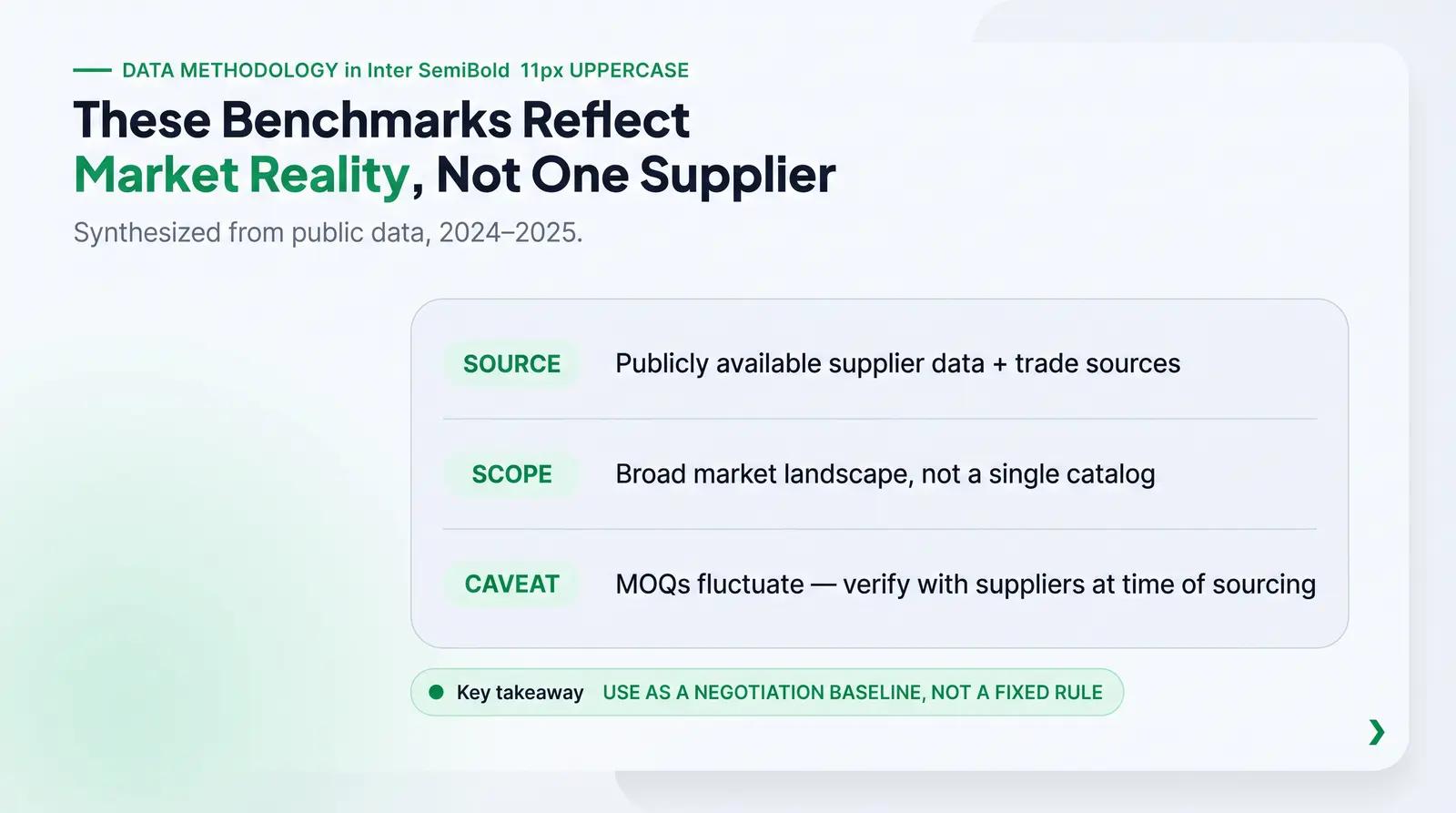
The MOQ ranges presented in this report are synthesized from publicly available supplier data, industry trade sources, and standard market practices as of 2024–2025. This is not a survey of a single supplier's database, but a benchmarked overview of the broader market landscape.
It is important to note that MOQs fluctuate based on factory minimums, raw material costs, and market cycles. A supplier's willingness to negotiate often depends on their current production schedule and inventory levels. All figures should be verified with specific suppliers at the time of sourcing.
MOQ Benchmarks by Packaging Family
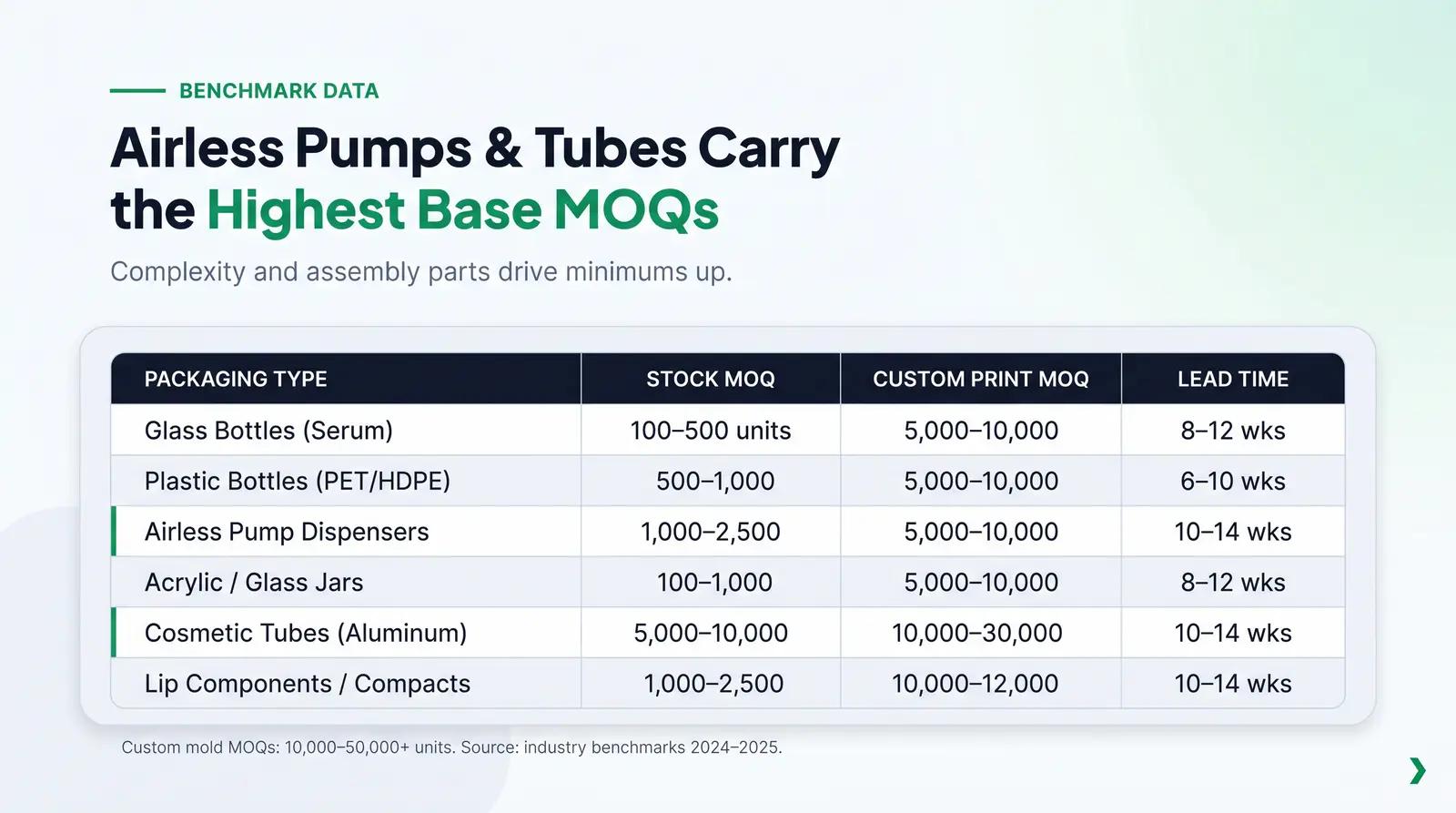
The following table outlines standard MOQ benchmarks across common cosmetic packaging families, segmented by customization level.
| Packaging Family | Stock MOQ (units) | Custom Print MOQ (units) | Custom Mold/Shape MOQ (units) | Typical Lead Time (weeks) | Notes |
|---|---|---|---|---|---|
| Glass bottles (serum/dropper) | 100 - 500 | 5,000 - 10,000 | 20,000 - 50,000 | 8 - 12 | Amber glass is standard for UV protection (e.g., Vitamin C) [2]. |
| Plastic bottles (HDPE, PET) | 500 - 1,000 | 5,000 - 10,000 | 10,000 - 20,000 | 6 - 10 | Widely available; custom colors often require 10k+ [3]. |
| Airless pump dispensers | 1,000 - 2,500 | 5,000 - 10,000 | 20,000+ | 10 - 14 | Complex assembly (6-8 parts) drives higher minimums [4]. |
| Acrylic jars | 500 - 1,000 | 5,000 - 10,000 | 10,000 - 20,000 | 8 - 12 | Often requires thicker walls; high print MOQ. |
| Glass jars | 100 - 500 | 5,000 - 10,000 | 20,000 - 50,000 | 8 - 12 | Heavy to ship; custom molds are capital intensive. |
| Cosmetic tubes (aluminum) | 5,000 - 10,000 | 10,000 - 30,000 | N/A (standard shapes) | 10 - 14 | High setup costs for metal printing [5]. |
| Cosmetic tubes (plastic/laminate) | 1,000 - 5,000 | 10,000 - 20,000 | N/A (standard shapes) | 8 - 12 | Laminated tubes (ABL/PBL) require high volume for printing plates [5]. |
| Lip components (gloss/lipstick) | 1,000 - 2,500 | 10,000 - 12,000 | 20,000+ | 10 - 14 | Multi-part assembly increases base MOQ. |
| Compacts (pressed powder/blush) | 1,000 - 2,500 | 10,000 - 12,000 | 20,000+ | 10 - 14 | Custom molds for pans are highly specialized. |
| Closures (pumps, disc caps, spray) | 1,000 - 3,000 | 10,000+ | 20,000+ | 8 - 12 | Often tied to the bottle MOQ; custom colors require high volume. |
The data reveals clear structural patterns in packaging production. Airless pumps and compacts carry higher baseline MOQs because they are multi-component assemblies. A single airless pump may consist of six to eight distinct parts (actuator, spring housing, gasket, etc.), each requiring its own mold and assembly step [4].
Similarly, cosmetic tubes—especially aluminum—often demand high custom-print MOQs. This is because tubes are typically printed flat before being formed and sealed, requiring expensive setup for printing plates or cylinders [5]. Conversely, basic glass and plastic bottles have lower stock MOQs because their production is highly standardized, and suppliers often hold large inventories of clear or amber variants.
How Customization Level Multiplies MOQ — And When It's Worth It
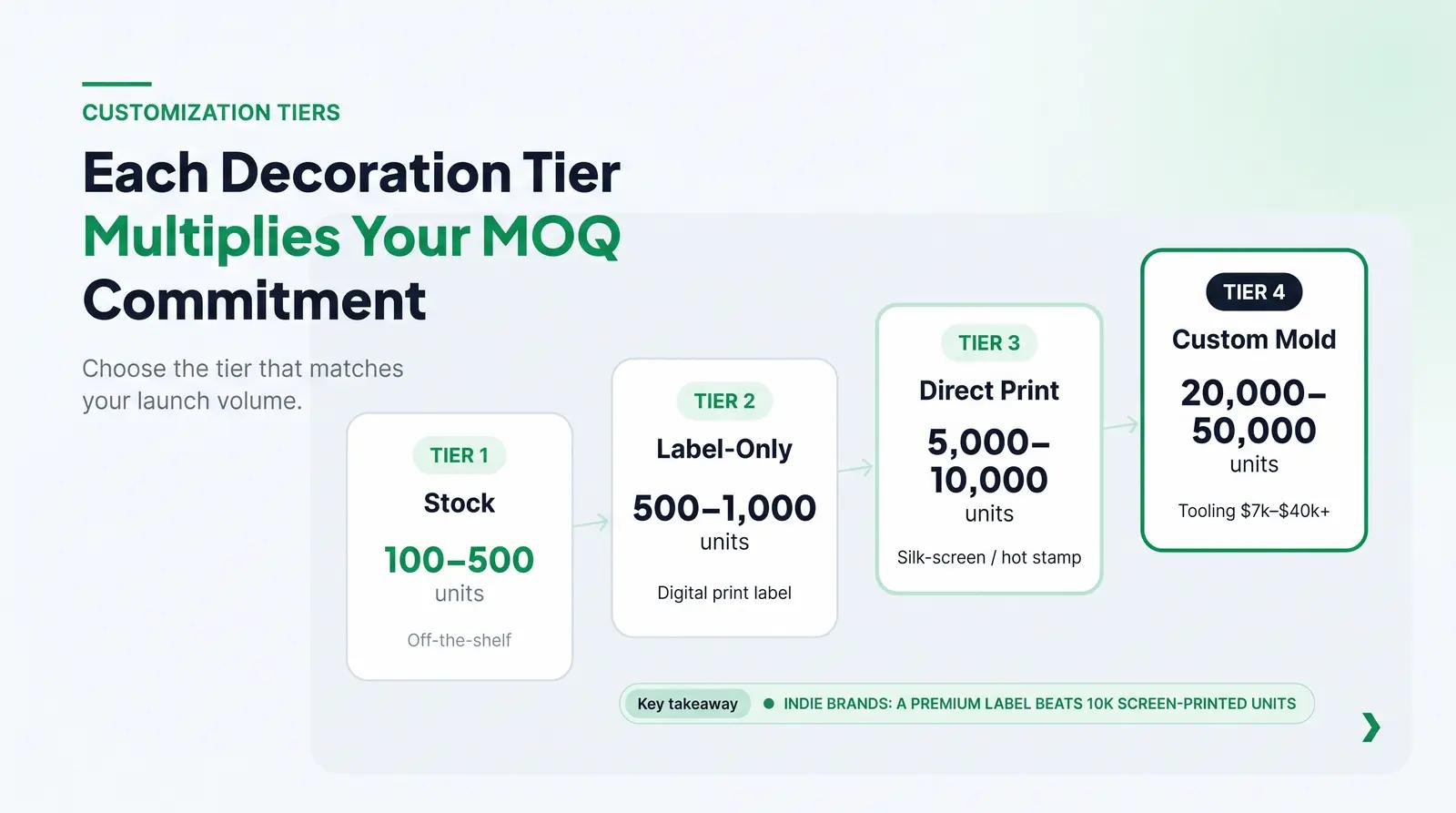
Customization is the primary lever that pushes packaging from a low-risk 500-unit order to a capital-intensive 10,000-unit commitment. Understanding the four tiers of customization helps brands allocate their budget effectively.
Stock (no customization)
Stock packaging represents the lowest barrier to entry. With MOQs often ranging from 100 to 500 units, brands purchase off-the-shelf components in standard colors (clear, white, amber). This tier is ideal for pre-launch testing, sampling, or ultra-niche product runs. The tradeoff is a generic appearance that relies entirely on secondary packaging or labeling for brand identity.
Label-only
Applying a pressure-sensitive label to a stock component is the most cost-effective way to brand a product at low volumes. Labels can be printed digitally in small batches (500–1,000 units) with full-color graphics and applied to stock jars or bottles. This approach keeps the container MOQ low while delivering a professional finish.
Direct print / surface decoration
Direct surface decoration—such as silk-screen printing, hot stamping, or frosting—integrates the design directly onto the container. This tier typically triggers a steep jump in MOQ, often to 5,000 or 10,000 units. The increase is driven by setup costs: each color in a silk-screen design requires a custom screen and machine calibration, and factories must account for a percentage of scrap during the setup process [6].
Custom mold or custom shape
Developing a proprietary bottle or jar shape requires custom steel or aluminum molds. This tier demands the highest MOQs—typically 20,000 to 50,000 units—and involves significant capital outlay for tooling, which can range from $7,000 to over $40,000 depending on complexity [4]. Custom molds generally only make sense for post-Series A brands or high-volume direct-to-consumer companies where the mold cost can be amortized over hundreds of thousands of units.
The Indie Brand Trap: Many indie founders unnecessarily inflate their MOQ requirements by pursuing direct-print decoration on stock components when a high-quality label would suffice. Sourcing evidence indicates that while silk-screening requires MOQs of 5,000+ to absorb setup fees, premium pressure-sensitive labels can achieve comparable shelf presence at 5–10x lower volume [6]. For early-stage brands, the cost of holding 10,000 screen-printed bottles far outweighs the aesthetic difference of a well-designed label.
MOQ by Supplier Type — Trading Companies, Direct Factories, and Aggregator Platforms
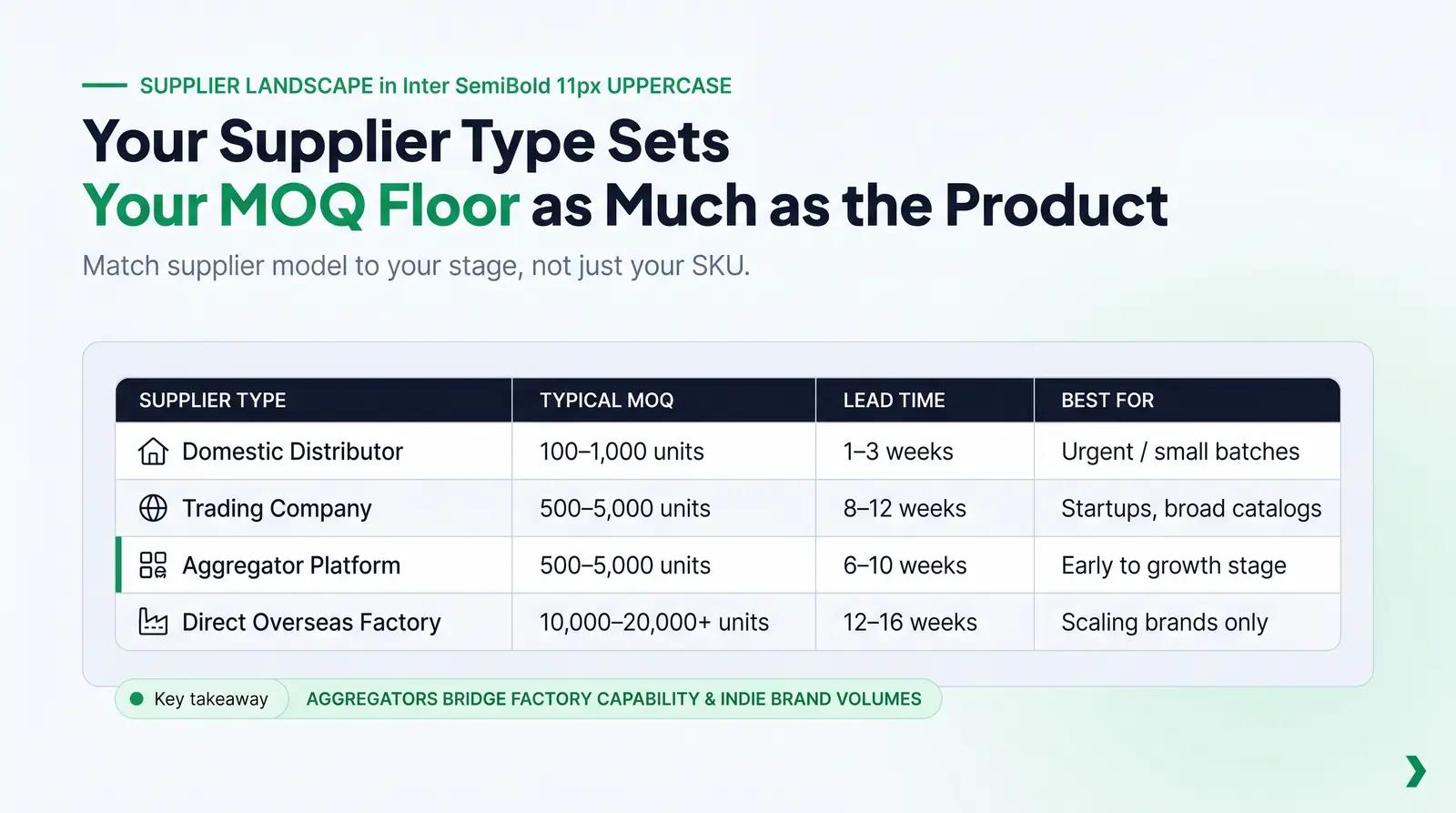
The entity you purchase from dictates the MOQ just as much as the product itself. The market is divided into several distinct supplier models.
| Supplier Type | Typical MOQ Range | Customization Access | Lead Time | QC Responsibility | Recommended For |
|---|---|---|---|---|---|
| Overseas trading companies | 500 - 5,000 | Moderate (mostly stock + print) | 8 - 12 weeks | Dependent on factory | Startups seeking broad catalogs |
| Direct overseas factories | 10,000 - 20,000+ | High (custom molds, complex deco) | 12 - 16 weeks | Direct factory control | Scaling brands with high volume |
| Domestic distributors (US/EU) | 100 - 1,000 | Low (mostly stock) | 1 - 3 weeks | Distributor | Urgent timelines, small batches |
| Aggregator platforms | 500 - 5,000 | Moderate to High (pre-vetted options) | 6 - 10 weeks | Platform manages QC | Early to growth stage brands |
Direct overseas factories offer the lowest unit costs at scale but demand high MOQs to justify machine time. Trading companies act as intermediaries, often aggregating orders to offer lower minimums, though communication and quality control can sometimes be opaque. Domestic distributors hold inventory locally, allowing for rapid shipping and very low MOQs, but their catalogs are limited to stock items. Aggregator platforms streamline the process by curating vetted SKUs and managing the production and quality assurance, bridging the gap between factory capabilities and indie brand volumes.
The MOQ-by-Launch-Stage Matrix
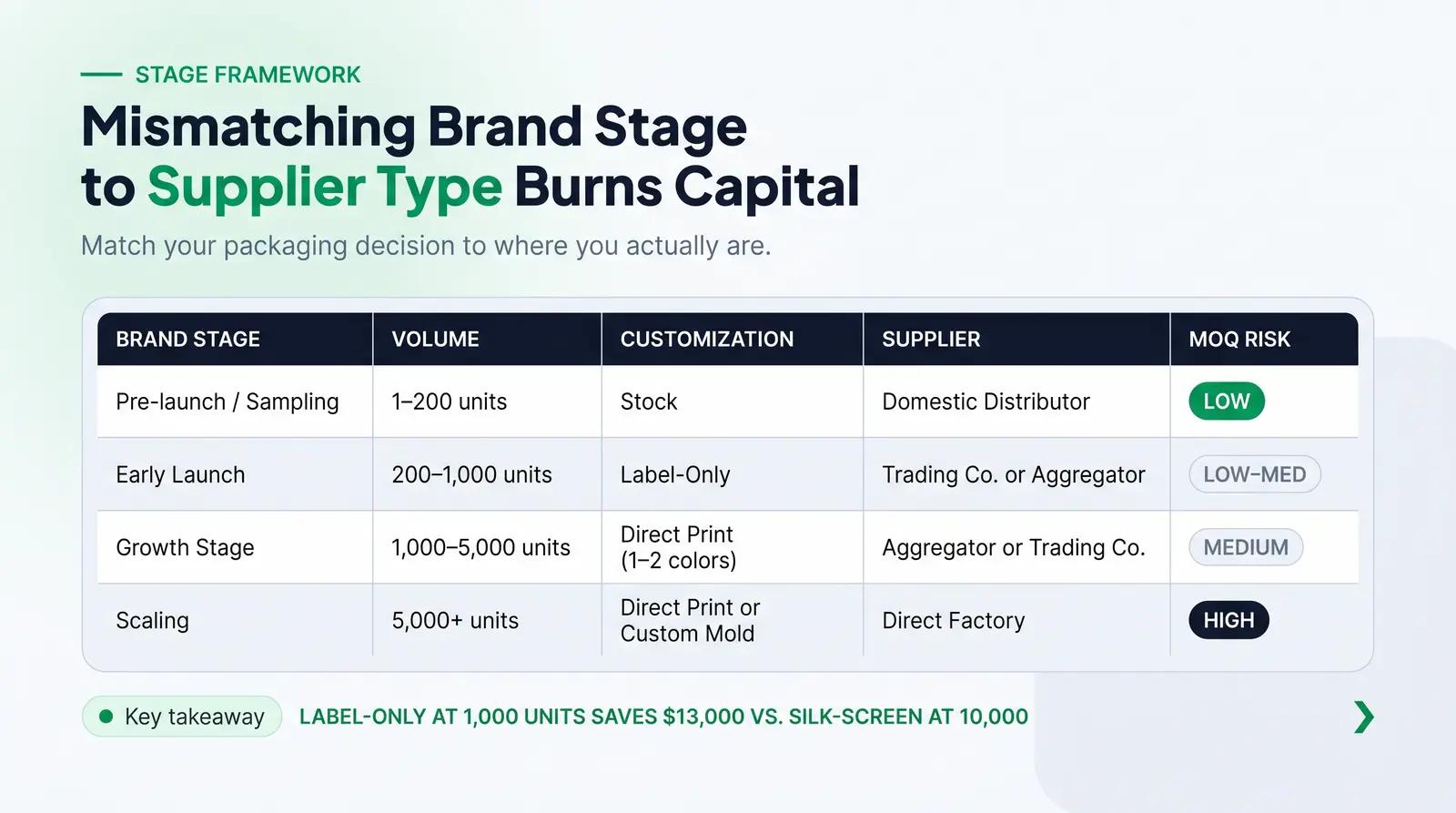
Mismatching brand stage to supplier type is one of the most common and costly sourcing mistakes. A pre-launch founder attempting to negotiate a 5,000-unit custom mold with a direct factory is burning capital, just as a scaling brand buying 10,000 units of stock packaging from a domestic distributor is leaving significant margin on the table. We recommend the following framework for matching packaging decisions to brand stage.
| Brand Stage | Volume Range (units) | Recommended Customization Tier | Recommended Supplier Type | MOQ Risk Level | Key Constraint to Solve |
|---|---|---|---|---|---|
| Pre-launch / Sampling | 1 - 200 | Stock | Domestic distributor | Low | Speed to market, formulation testing |
| Early launch | 200 - 1,000 | Label-only | Trading company or Aggregator | Low-Medium | Cash flow preservation, market validation |
| Growth stage | 1,000 - 5,000 | Direct print (1-2 colors) | Aggregator or Trading company | Medium | Margin improvement, brand differentiation |
| Scaling | 5,000+ | Direct print or Custom mold | Direct factory | High | Unit cost reduction, supply chain stability |
The cost of a mismatch is severe. If an early-launch brand insists on a silk-screened glass bottle, they may be forced into a 10,000-unit MOQ. At $1.50 per unit, that is a $15,000 investment in packaging alone—before formulation, filling, or marketing. By shifting to a label-only strategy on the same stock bottle, they could order 1,000 units at $2.00 each, reducing their upfront packaging capital to $2,000 and preserving $13,000 for customer acquisition.
Worked Example — A Realistic Founder Scenario
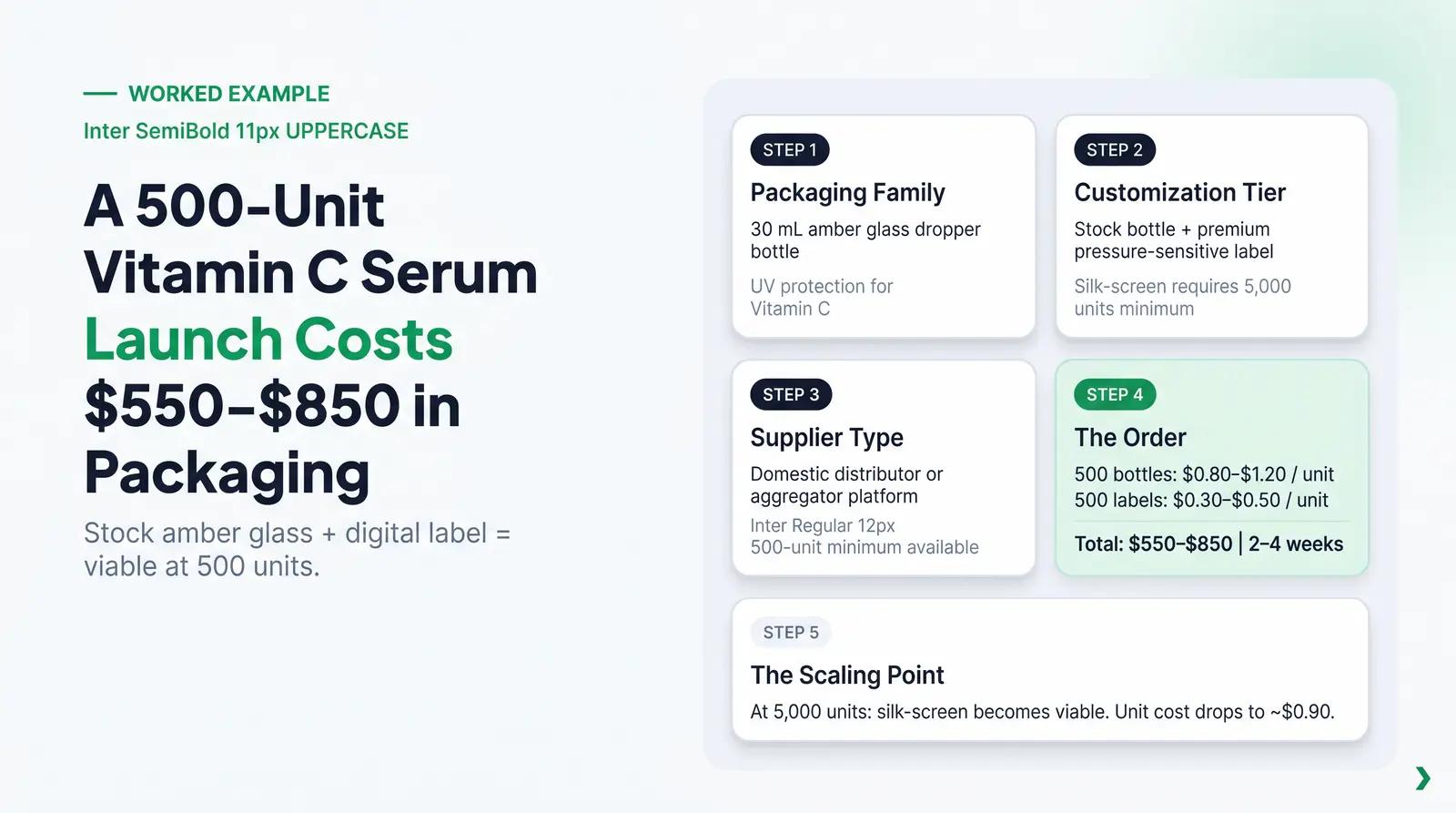
Consider a founder launching a vitamin C brightening serum. She is pre-launch, has budgeted for a 500-unit first run, and wants her logo and brand colors prominently displayed.
1. Packaging Family: She selects a 1 oz (30 mL) amber glass dropper bottle. Amber glass is the industry standard for L-ascorbic acid formulations, as it acts as a natural filter to block UV light and slow oxidation [2].
2. Customization Tier: At 500 units, direct silk-screen printing is economically unviable, as factories typically require 5,000 units to justify the screen setup [6]. The correct decision is to purchase stock amber bottles and apply a high-quality, water-resistant pressure-sensitive label.
3. Supplier Type: A domestic distributor or an aggregator platform is the best fit, as they can supply stock glass and droppers at a 500-unit minimum.
4. The Order:
- 500 stock amber glass bottles + dropper assemblies: ~$0.80 - $1.20 per unit.
- 500 custom labels (digitally printed): ~$0.30 - $0.50 per unit.
- Total estimated unit cost: $1.10 - $1.70.
- Total estimated packaging spend: $550 - $850.
- Lead time: 2 - 4 weeks (domestic stock).
5. The Scaling Point: If the serum succeeds and her next order is 5,000 units, she reaches the threshold where direct silk-screen printing becomes viable. The unit cost of the bottle might drop to $0.60, and a 1-color screen print might add $0.30. Her total unit cost drops to $0.90, improving her margins while upgrading the packaging's tactile feel.
How to Use MOQ Data to Negotiate Smarter
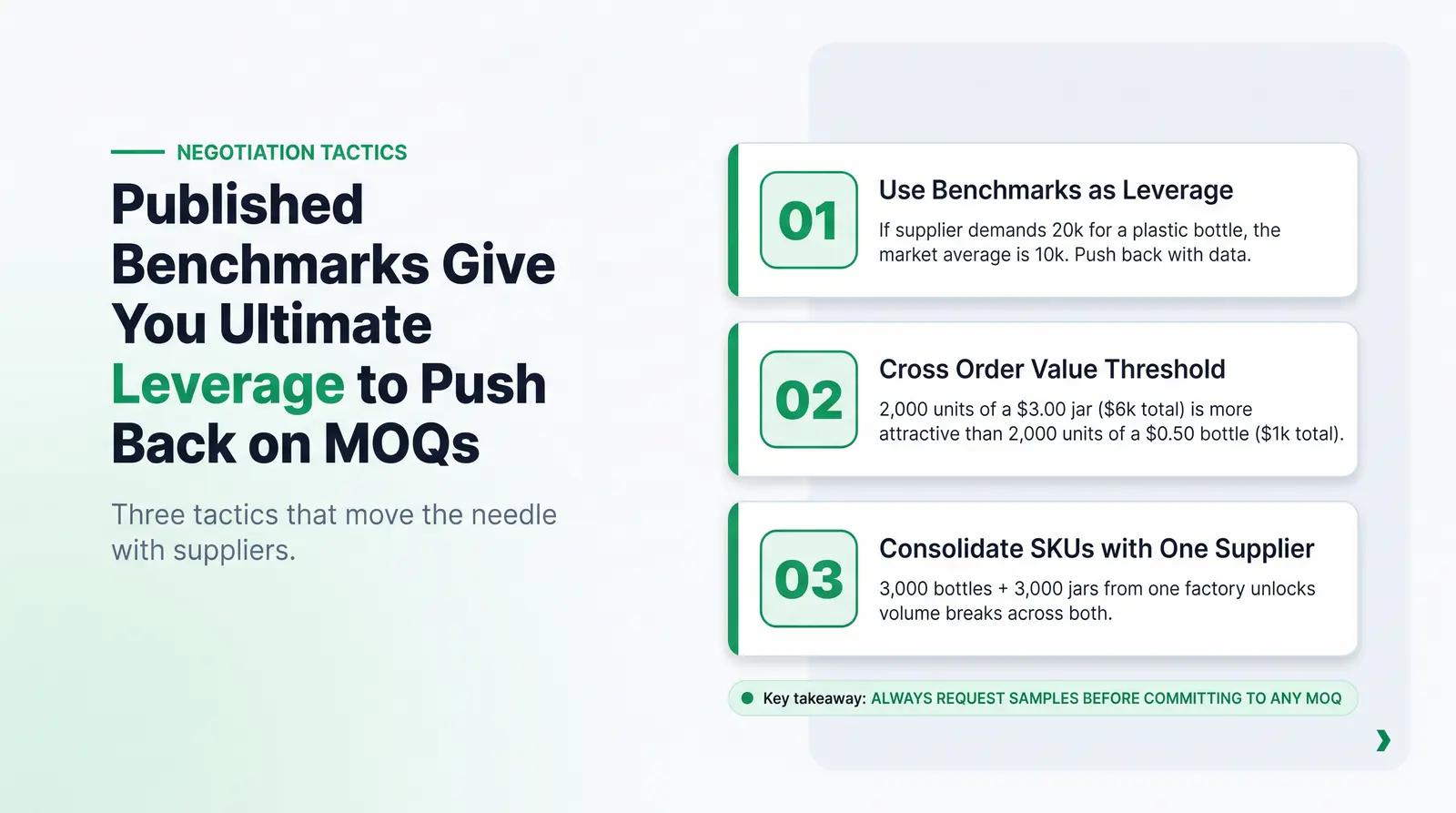
Knowing the market standard prevents founders from accepting inflated minimums as non-negotiable rules. Use published MOQ benchmarks as a baseline during discussions. If a supplier demands 20,000 units for a standard plastic lotion bottle, you know the industry average is closer to 10,000, giving you leverage to push back.
Suppliers are also more flexible on MOQ when the total order value crosses a certain threshold. A factory might refuse a 2,000-unit order for a $0.50 bottle ($1,000 total), but accept a 2,000-unit order for a $3.00 luxury acrylic jar ($6,000 total). Consolidating multiple SKUs with a single supplier can also unlock volume breaks. Ordering 3,000 bottles and 3,000 jars from the same factory makes the combined production run more attractive to the manufacturer.
For brands navigating the transition from early-launch to growth stage, platforms like packfolio.com provide a strategic advantage. Packfolio's catalog structure—featuring pre-vetted SKUs with predefined print zones and a 3D preview workflow—is designed specifically to allow founders to order customized packaging at quantities that direct factories wouldn't typically accommodate, without the burden of managing supplier relationships or freight logistics themselves.
Finally, requesting samples before committing to an MOQ is non-negotiable. Review samples critically for thread fit, closure torque, finish consistency, and fill volume accuracy.
Red Flags in MOQ Negotiations
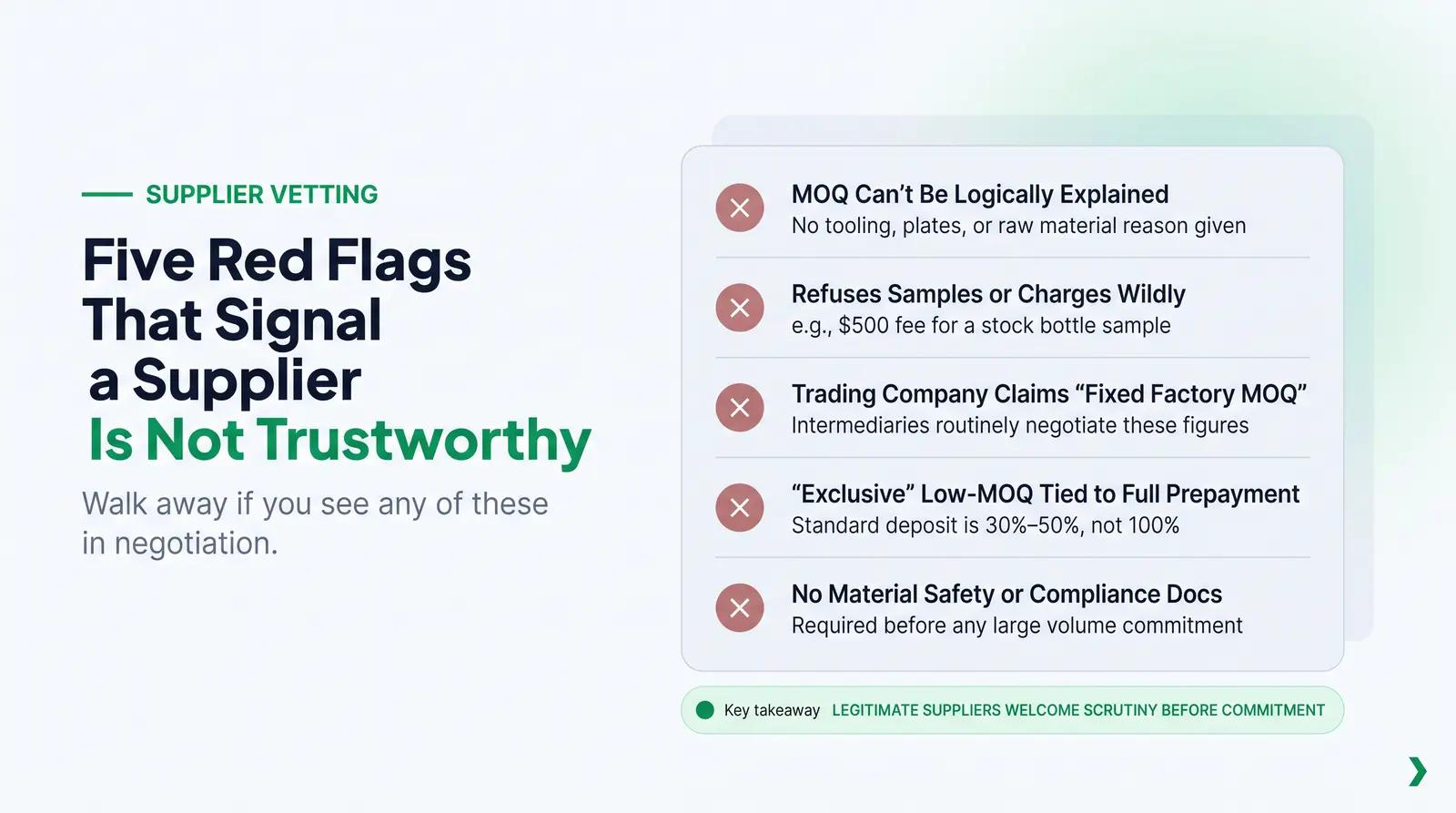
When vetting suppliers, watch for these warning signs:
- An MOQ that cannot be logically explained by tooling, printing plates, or raw material minimums.
- Refusal to provide a sample, or charging a sample fee that wildly exceeds industry norms (e.g., $500 for a stock bottle).
- A high MOQ stated as a rigid factory standard by a trading company, when intermediaries routinely negotiate these figures.
- "Exclusive" low-MOQ offers that are contingent on prepayment terms exceeding the standard 30% to 50% deposit.
- Reluctance to provide material safety data or compliance documentation prior to a large volume commitment.
Browse Packfolio's curated packaging catalog and preview your label in 3D before placing your order → packfolio.com/catalog
Frequently Asked Questions
What is a typical MOQ for cosmetic packaging? Typical MOQs range from 5,000 to 10,000 units for standard plastic or glass containers with direct printing. Custom molds or complex assemblies like airless pumps often require 20,000 units or more, while stock items can be purchased in quantities as low as 100 to 500 units.
Can I order cosmetic packaging with no minimum order quantity? While true "no minimum" orders are rare for custom manufacturing, many domestic distributors and specialized suppliers offer stock packaging with very low minimums (e.g., 50 or 100 units). These are ideal for testing, though they require you to apply your own labels for branding.
How do I negotiate a lower MOQ with a packaging supplier? The most effective negotiation tactics include consolidating multiple product lines into a single order to increase the total order value, utilizing stock molds instead of custom shapes, and simplifying your decoration strategy to reduce factory setup time.
What is the difference between stock and custom cosmetic packaging MOQs? Stock packaging is pre-manufactured and stored in generic colors, allowing suppliers to sell it in small batches of 100 to 1,000 units. Custom packaging involves manufacturing the container specifically for your brand with unique colors, prints, or shapes, which requires machine calibration and pushes the MOQ to 5,000 units or higher.
Is low MOQ cosmetic packaging lower quality? Not necessarily. Low MOQ packaging is often the exact same quality as high-volume packaging, but it is limited to stock shapes and standard colors. The quality risk arises only if you source from unvetted intermediaries who sell rejected overstock rather than dedicated small-batch production runs.
References
[1] "How Does MOQ Affect Cosmetic Packaging Costs (And What You Can Do About It)?," AH Packaging, 2025. https://ahpackaging.com/how-does-moq-affect-cosmetic-packaging-costs/ [2] "Should Vitamin C Serums Be Stored in Dark Glass Bottles? Why Not Plastic?," Panyue Packing, 2025. https://www.panyuepacking.com/blog/should-vitamin-c-serums-be-stored-in-dark-glass-bottles-why-not-plastic_b121 [3] "Low MOQ Cosmetic Manufacturing: The 2025 Guide for Indie Founders," Genie Supply, 2025. https://www.madebygenie.com/blog/low-moq-cosmetic-manufacturing-guide [4] "The True Cost of Custom Molds in Cosmetic Packaging: Explained with Real Numbers," AH Packaging, 2025. https://ahpackaging.com/the-true-cost-of-custom-molds-in-cosmetic-packaging-explained-with-real-numbers/ [5] "How to Order Custom Cosmetic Tubes from China: MOQ, Timeline & Process Guide," Auber Packaging, 2026. https://www.auberpackaging.com/article-5726734067378815.html [6] "Screen Printing vs. Labeling: Choosing the Most Cost-Effective Finish for Your Skincare Line," Lumlun, 2026. https://lumlun.com/screen-printing-vs-labeling-cost-cosmetic-packaging-guide/


