
The Indie Beauty Packaging Landed Cost Checklist
This 7-layer landed cost checklist helps indie beauty founders calculate every hidden cost when importing cosmetic packaging, from tariffs and freight to spoilage and financing.
A supplier quote of $0.85 for a custom glass dropper bottle seems highly attractive when planning a product launch. However, independent beauty founders frequently discover that the final cost of that bottle exceeds $1.60 by the time it arrives at their fulfillment center. According to global logistics data, up to 30% of product shipments from overseas suppliers fail initial quality inspections, which forces expensive rework and shipping delays [1]. Furthermore, fragile materials like glass experience average transit breakage rates of 4% to 8% in standard freight networks [2]. This gap between the initial supplier quote and the actual delivered cost is the landed cost surprise, a financial hurdle that can quickly erode a beauty brand's profit margins.
Understanding your true landed cost is not just an accounting exercise. It is a fundamental requirement for setting wholesale pricing, evaluating supplier options, and avoiding margin surprises at the time of delivery. The primary goal for any operations lead is to convert an Ex Works (EXW) or Free on Board (FOB) unit price into an accurate landed cost per unit. This checklist-style guide provides a comprehensive framework to help you navigate every layer of the packaging supply chain.
The Indie Beauty Landed Cost Stack
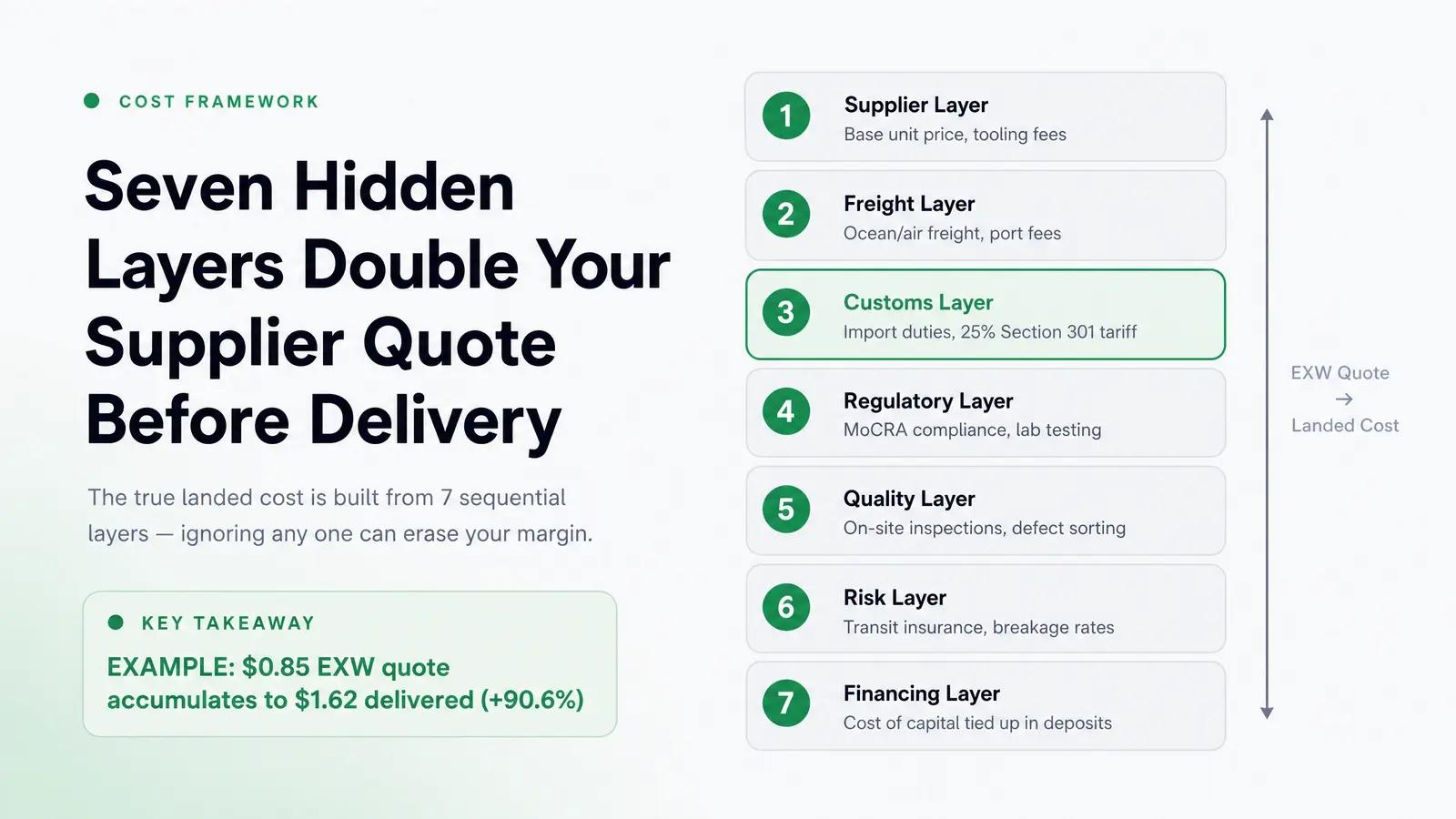
To organize this calculation, we recommend utilizing a structured framework developed at Packfolio. We call this framework The Indie Beauty Landed Cost Stack. It organizes all cost components into logical layers so a founder can work through them sequentially.
The stack consists of seven distinct layers, each representing a specific stage of the procurement and delivery process. By calculating the cost of each layer and adding them to the base product price, you can arrive at an accurate landed cost per unit.
| Layer | Cost Components | Key Considerations |
|---|---|---|
| 1. The Supplier Layer | Base unit price, tooling fees, mold amortization, and setup charges. | Often quoted as EXW or FOB. Tooling fees should be amortized over the first production run. |
| 2. The Freight Layer | Ocean or air freight, terminal handling charges (THC), port fees, and local trucking. | Less-than-container load (LCL) shipments incur higher per-unit local handling fees than full containers. |
| 3. The Customs Layer | Import duties, Section 301 tariffs, Merchandise Processing Fee (MPF), and Harbor Maintenance Fee (HMF). | Section 301 tariffs add an extra 25% duty on many Chinese-origin packaging components [3]. |
| 4. The Regulatory Layer | MoCRA compliance registration, FDA facility listings, and third-party laboratory testing. | Essential for retail entry and safety substantiation under the Modernization of Cosmetics Regulation Act [4]. |
| 5. The Quality Layer | On-site pre-shipment inspections, defect sorting, and laboratory testing. | Third-party quality inspections in China typically cost between $150 and $320 per man-day [1]. |
| 6. The Risk Layer | Transit insurance, material spoilage, and breakage rates. | Glass packaging requires a higher spoilage buffer (5% to 8%) compared to plastic or aluminum [2]. |
| 7. The Financing Layer | Cost of capital tied up in deposits, transit times, and holding periods. | Based on your Weighted Average Cost of Capital (WACC) or borrowing rate over the lead time [5]. |
Incoterms: EXW, FOB, CIF, and DDP Compared
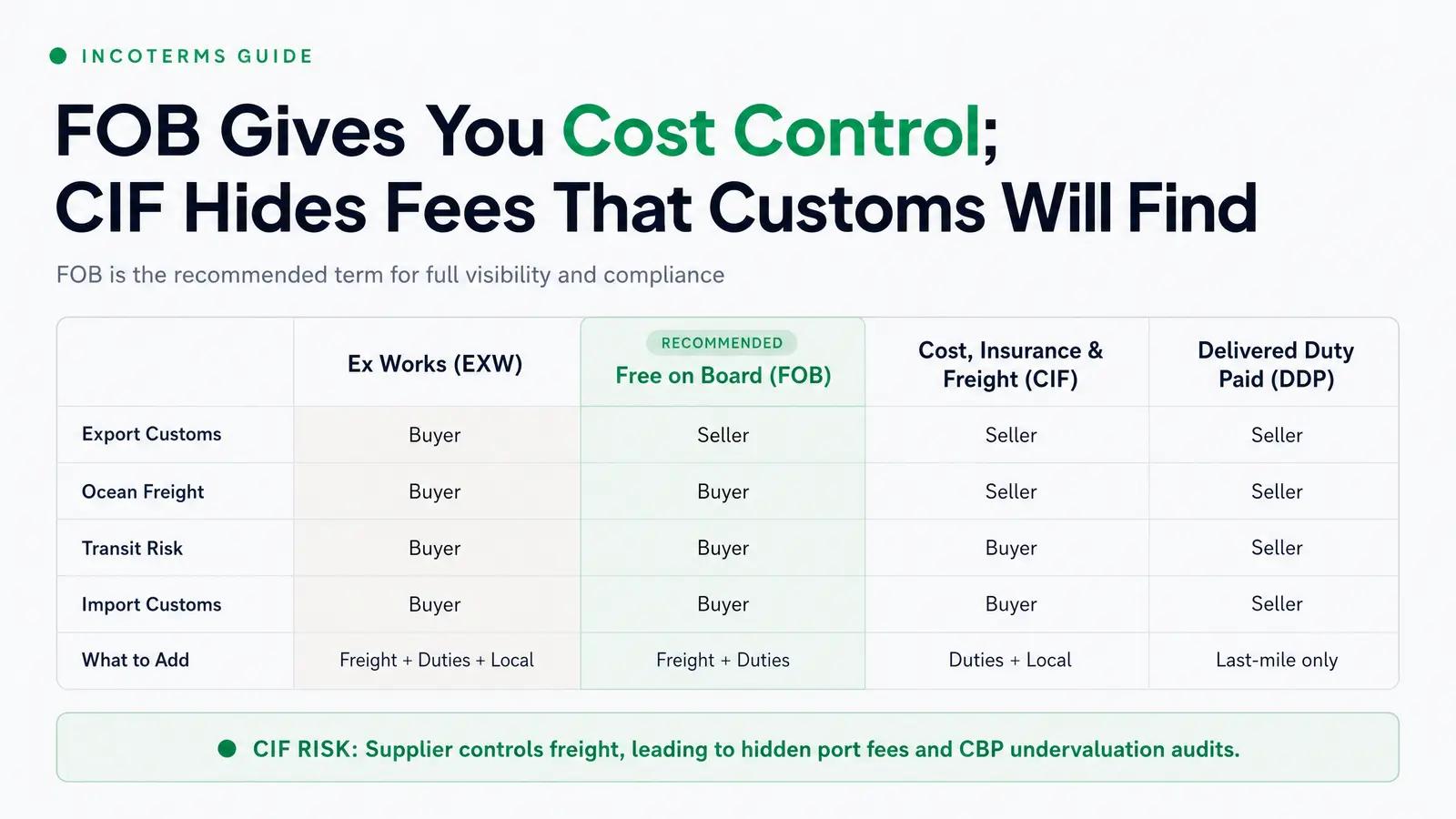
The foundation of any landed cost calculation is the Incoterm negotiated with your supplier. Incoterms define the exact point where costs and risks transfer from the seller to the buyer. Choosing the wrong Incoterm can expose your brand to unexpected fees and customs liabilities.
The table below compares the four most common Incoterms used in cosmetic packaging imports. It highlights who pays for each segment and what a founder must add to the quote to calculate the full landed cost.
| Dimension | Ex Works (EXW) | Free on Board (FOB) | Cost, Insurance & Freight (CIF) | Delivered Duty Paid (DDP) |
|---|---|---|---|---|
| Who Pays Export Customs? | Buyer | Seller | Seller | Seller |
| Who Pays Ocean Freight? | Buyer | Buyer | Seller | Seller |
| Who Bears Transit Risk? | Buyer | Buyer | Buyer | Seller |
| Who Handles Import Customs? | Buyer | Buyer | Buyer | Seller |
| What You Must Add to Quote | Origin handling, ocean freight, duties, customs fees, local delivery, and insurance. | Ocean freight, duties, customs fees, local delivery, and insurance. | Duties, customs fees, local port fees, local delivery, and insurance. | Last-mile delivery (if not included) and domestic storage costs. |
The CIF Undervaluation Trap: A Non-Obvious Risk
A common temptation for beauty founders is to accept Cost, Insurance, and Freight (CIF) terms because the supplier offers to handle the ocean transit. However, experienced trade professionals advise choosing FOB terms instead of CIF to avoid undervaluation risks and unexpected port fees.
Under CIF terms, the supplier controls the freight forwarder and often utilizes low-cost carriers that charge minimal ocean rates but impose exorbitant local handling fees at the destination port. Furthermore, customs authorities closely scrutinize CIF shipments for undervaluation. If the supplier under-declares the freight or insurance value on the commercial invoice to reduce duties, U.S. Customs and Border Protection (CBP) can seize the shipment, issue penalties, or demand retroactive duty payments [6]. Controlling your own freight under FOB terms provides full visibility into transit costs and ensures regulatory compliance.
Tariffs and Regulatory Cost Signals (2024-2025)
Importing cosmetic packaging into the United States requires navigating a complex regulatory and tariff environment. The primary sourcing destination for custom primary packaging remains China, which subjects importers to both standard duties and retaliatory tariffs.
Harmonized Tariff Schedule (HTS) Classifications
Every packaging component must be classified under the correct HTS code to determine its base duty rate. Misclassification can lead to customs delays, audits, or overpayment of duties.
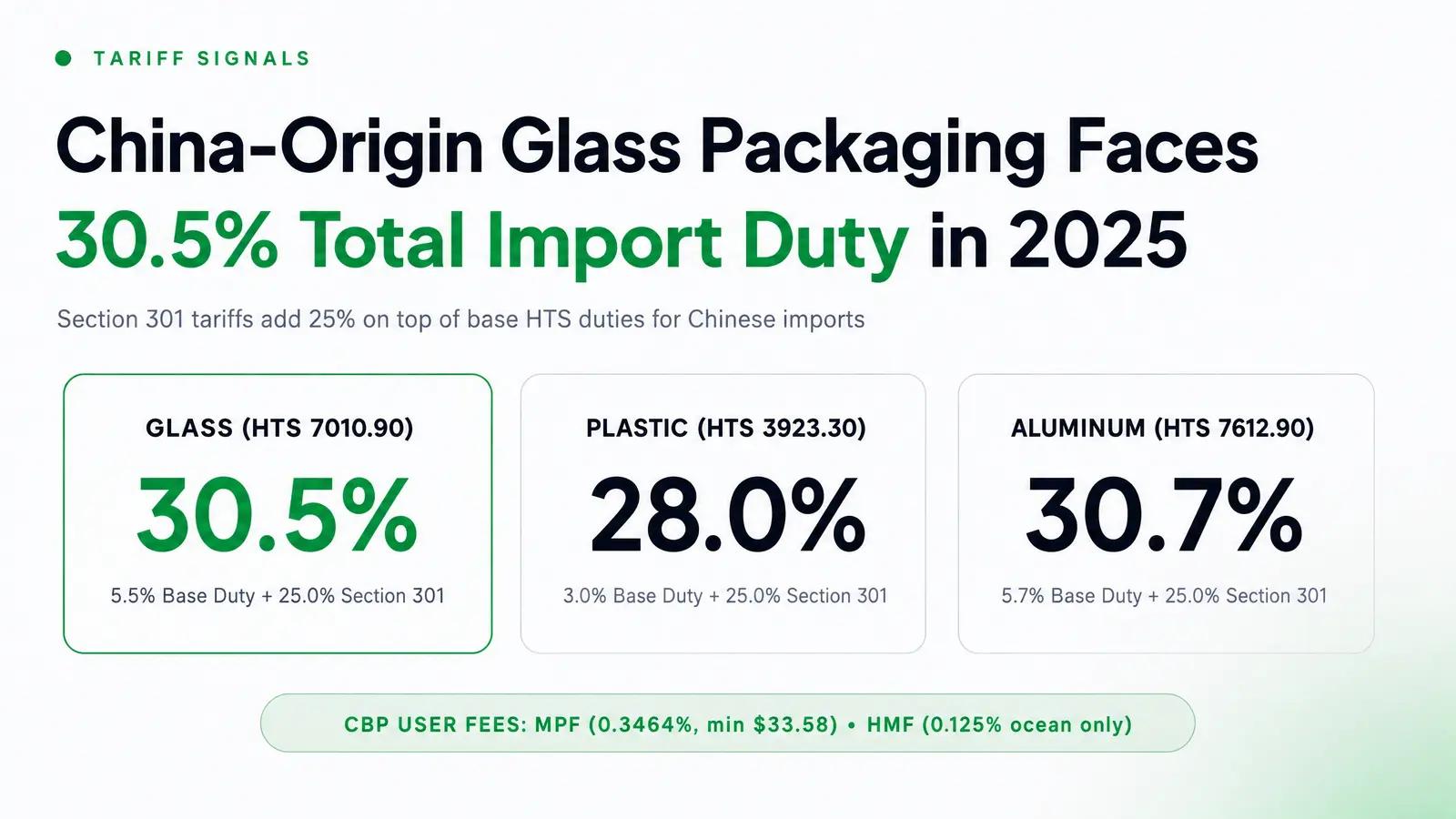
- Glass Containers (HTS 7010.90): Covers glass bottles, jars, and vials used for the conveyance or packing of goods. The general duty rate typically ranges from 5.5% to 6.5% ad valorem [7].
- Plastic Packaging (HTS 3923.30 & 3923.50): Covers plastic bottles, flasks, caps, and closures. The general duty rate is 3% ad valorem [8].
- Aluminum Containers (HTS 7612.90): Covers aluminum tubes, bottles, and canisters. The general duty rate is 5.7% ad valorem [9].
Section 301 Tariffs on Chinese Imports
In addition to base duties, most cosmetic packaging components imported from China are subject to Section 301 tariffs. Following the comprehensive four-year review finalized by the Office of the United States Trade Representative (USTR) in September 2024, these tariffs remain firmly in place at 25% ad valorem for List 3 and List 4A products, which include most glass and plastic packaging formats [3].
This means a glass bottle classified under HTS 7010.90 with a base duty of 5.5% faces a total import duty of 30.5% when sourced from China. These tariffs are calculated strictly on the declared transaction value (the product cost on the commercial invoice), excluding freight and insurance.
CBP User Fees
Beyond duties, CBP assesses two standard user fees on formal entries (shipments valued over $2,500):
- Merchandise Processing Fee (MPF): Assessed at 0.3464% of the product value. Effective October 1, 2025, the minimum fee is $33.58 and the maximum fee is $651.47 per formal entry [10].
- Harbor Maintenance Fee (HMF): Assessed at 0.125% of the product value for ocean shipments. HMF is not collected on air freight shipments [11].
Spoilage, Inspection, and Hidden Cost Components
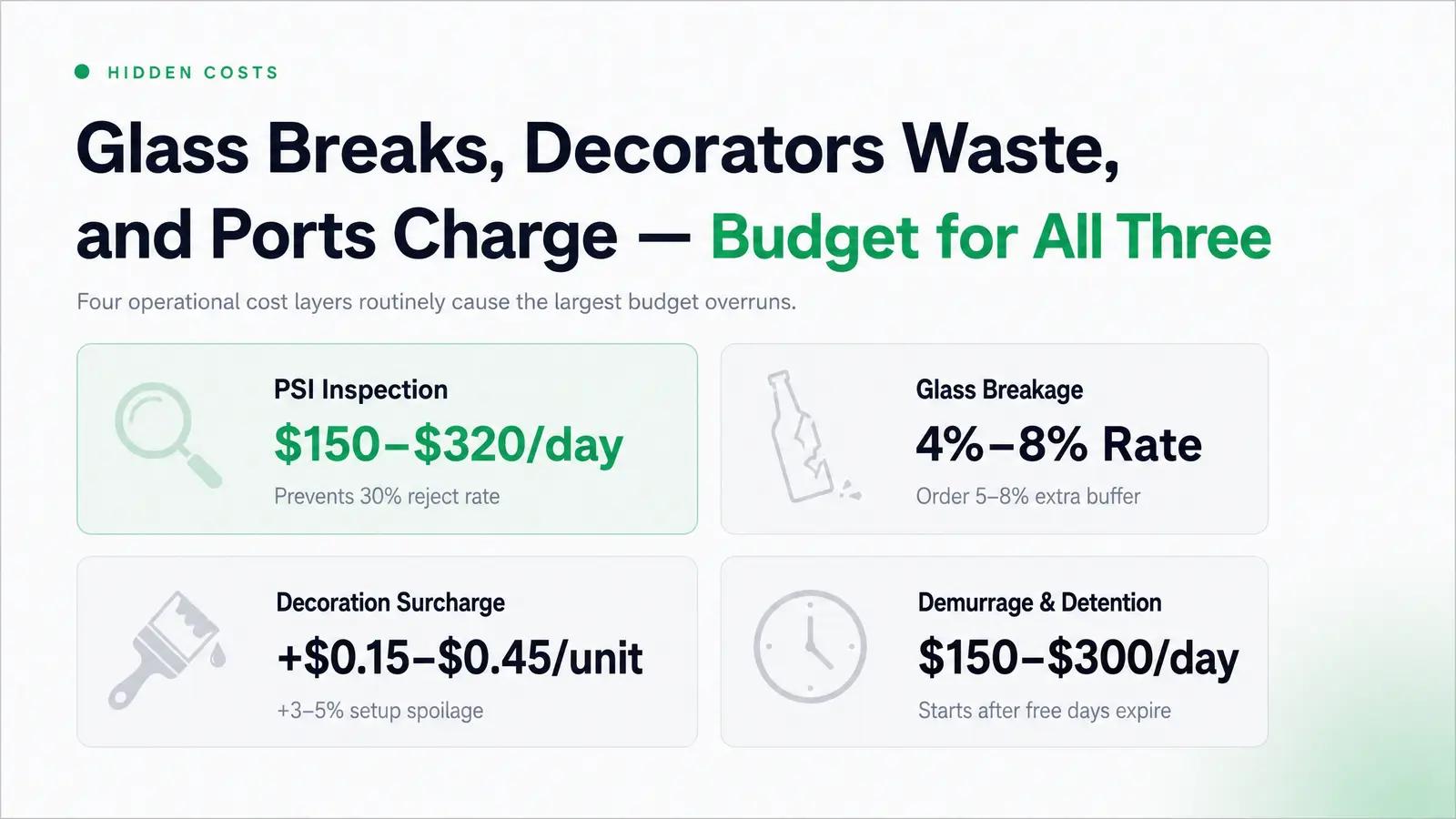
While freight and duties represent the largest cost categories, smaller operational layers often cause the most significant budget overruns. Competitors frequently underweight these hidden components when estimating landed costs.
Quality Inspection Fees
Relying solely on a supplier's internal quality control is a high-risk strategy. Utilizing a third-party inspection agency to perform a Pre-Shipment Inspection (PSI) is critical to verify quality before the goods leave the factory floor.
A standard single-day inspection by agencies like QIMA or Testcoo costs between $150 and $320 per man-day [1]. This inspection verifies dimensions, functional performance (such as dropper suction or pump priming), decoration adhesion, and aesthetic defects against an agreed Acceptable Quality Limit (AQL).
Spoilage and Transit Damage Rates
No shipment arrives completely intact. Fragile packaging materials like glass experience breakage rates of 4% to 8% during ocean transit and subsequent less-than-truckload (LTL) trucking [2]. Even robust plastic and aluminum components suffer from surface scratching, scuffing, or denting, resulting in a typical 2% to 3% spoilage rate. Importers must build this spoilage factor directly into their unit cost calculations, as a 5% breakage rate means you must order 5% more units to receive your required usable inventory.
Decoration Surcharges
If you order blank components from a supplier and ship them to a separate decorator for screen printing, hot stamping, or labeling, you must account for the secondary logistics and decoration surcharges. Secondary decoration typically adds $0.15 to $0.45 per unit, plus a 3% to 5% spoilage allowance for setup waste at the printing facility.
Storage and Demurrage
If your shipment is delayed at the port due to customs exams, documentation errors, or carrier delays, you will face demurrage and detention fees. Demurrage (charged by the port for container storage) and detention (charged by the steamship line for equipment use) can quickly accumulate, often starting at $150 to $300 per day after the standard free days expire.
The Financing Layer: Cost of Capital
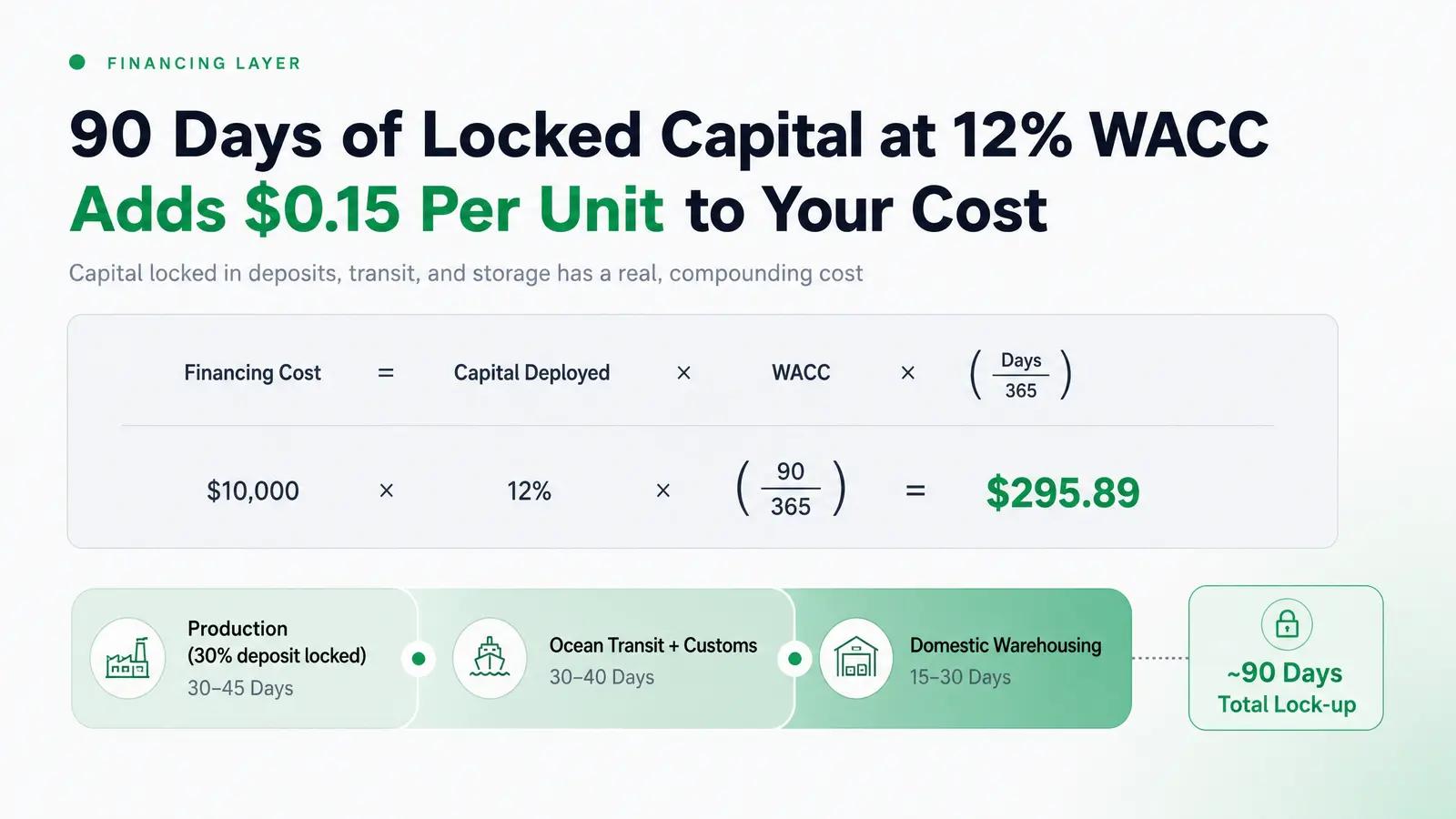
The time elapsed between paying your supplier and receiving revenue from the finished product represents a significant carrying cost. This "financing layer" is the cost of capital tied up in inventory during production, transit, and storage.
Most overseas packaging suppliers require a 30% to 50% deposit before production begins, with the remaining balance due upon shipment. This means your capital is locked up for 30 to 45 days of production, 30 to 40 days of ocean transit and customs clearance, and another 15 to 30 days of domestic warehousing before the packaging is filled and sold.
To calculate this carrying cost, utilize your brand's Weighted Average Cost of Capital (WACC) or the interest rate on your working capital line of credit. For example, if you tie up $10,000 in capital for 90 days at an annual cost of capital of 12%, your financing cost is:
$$\text{Financing Cost} = $10,000 \times 12% \times \left(\frac{90}{365}\right) = $295.89$$
This adds an extra $0.15 per unit to a 2,000-unit order, an expense that directly reduces your realized gross margin.
Simplifying the Stack with Packfolio
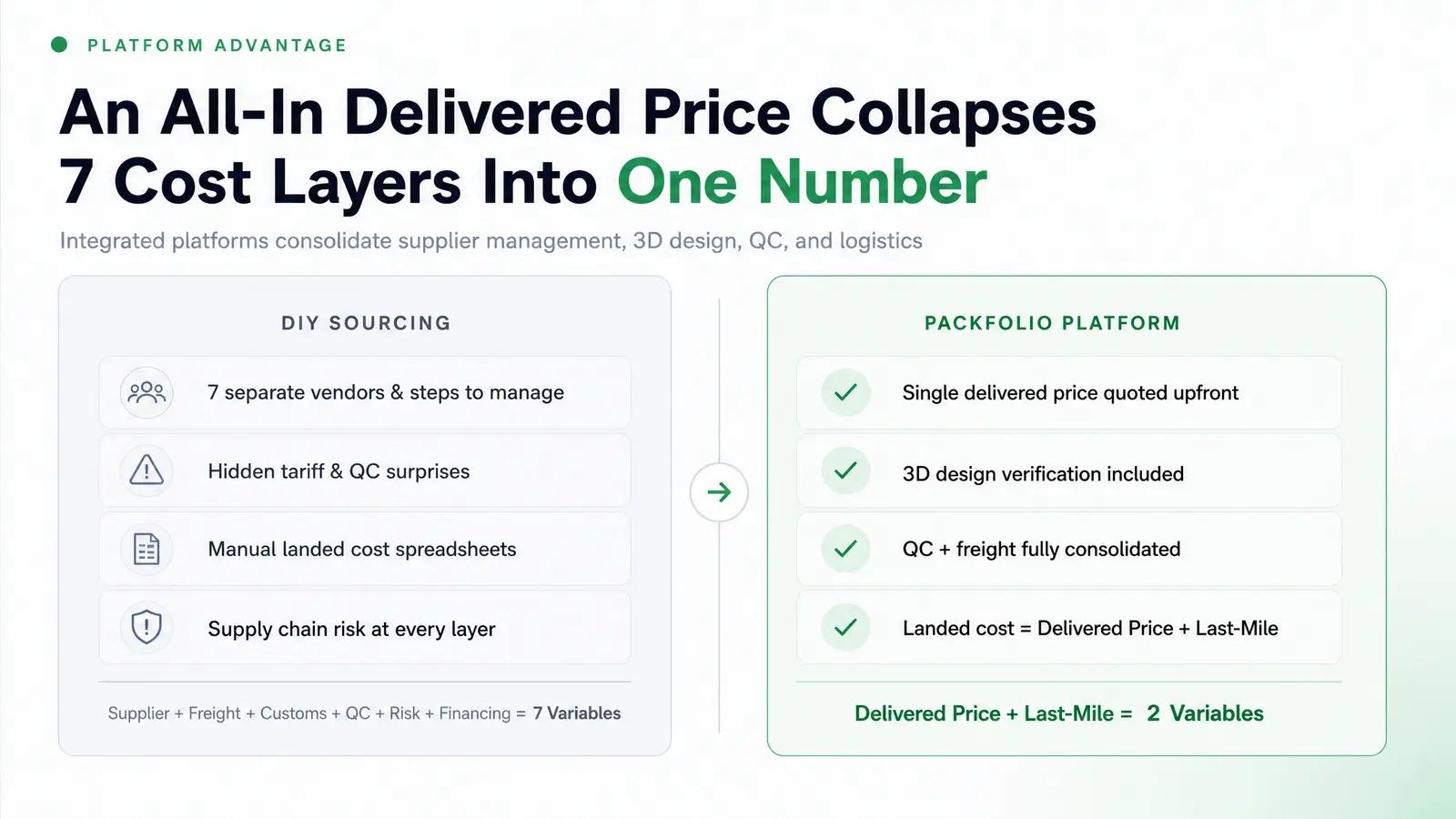
Calculating and managing each of these individual layers requires significant administrative effort and exposes your brand to supply chain risks. This complexity is why many high-growth beauty brands utilize integrated platforms to streamline their sourcing.
Platforms like Packfolio quote an all-in delivered price that already incorporates production coordination, quality assurance, and freight delivery to your door. By consolidating supplier management, 3D design verification, quality control, and international logistics into a single workflow, Packfolio simplifies the landed cost calculation to the delivered price plus any domestic last-mile trucking. This approach removes the risk of unexpected tariff adjustments, port delays, or quality failures, allowing founders to focus on brand growth rather than supply chain administration.
Worked Example: 1 oz Glass Dropper Bottle
To illustrate how these layers accumulate, let us walk through a realistic worked example. A beauty founder is importing 2,000 units of a 1 oz (30 ml) custom amber glass dropper bottle from a supplier in China.
Scenario Assumptions
- Supplier Quote: $0.85 per unit (EXW Shanghai).
- Total Ordered Quantity: 2,000 units.
- Base Product Cost: $1,700.00.
- Shipment Volume: 0.6 Cubic Meters (CBM).
- Shipment Weight: 110 kg (242 lbs).
- Transit Method: LCL Sea Freight (Shanghai to Los Angeles).
- Target Usable Quantity: 1,900 units (assuming a 5% transit breakage rate).
- WACC: 12% per annum.
- Capital Lock-up Period: 90 days.
Step 1: Calculate the Freight Layer
LCL ocean freight rates from Shanghai to Los Angeles average $80.00 per CBM [12]. However, LCL shipments incur origin and destination local handling fees, customs brokerage, and last-mile delivery.
- Base Ocean Freight: $80.00 x 0.6 CBM = $48.00.
- Origin LCL Handling & Export Fees: $150.00.
- Destination Port Fees & Customs Brokerage: $250.00.
- Total Freight & Delivery Cost: $448.00.
Step 2: Calculate the Customs Layer
The glass dropper bottles are classified under HTS 7010.90.5050, which carries a 5.5% base duty [7]. Because the country of origin is China, they are subject to a 25% Section 301 tariff [3].
- Total Duty Rate: 5.5% (base) + 25.0% (Section 301) = 30.5%.
- Import Duties: $1,700.00 x 30.5% = $518.50.
- Merchandise Processing Fee (MPF): $1,700.00 x 0.3464% = $5.89. Since this is below the CBP minimum, the formal entry minimum of $33.58 applies [10].
- Harbor Maintenance Fee (HMF): $1,700.00 x 0.125% = $2.13 [11].
- Total Customs & Duties Cost: $518.50 + $33.58 + $2.13 = $554.21.
Step 3: Calculate the Quality & Risk Layers
To ensure product quality, the founder hires a third-party agency for a single man-day inspection at the factory in China. Additionally, glass packaging has an average transit breakage rate of 5%.
- Third-Party Inspection Fee: $200.00 [1].
- Spoilage / Breakage Loss (5% of product value): $1,700.00 x 5% = $85.00 [2].
- Total Quality & Risk Cost: $200.00 + $85.00 = $285.00.
Step 4: Calculate the Financing Layer
The total capital deployed upfront is the sum of the product cost, freight, duties, fees, and inspection costs. This capital is tied up for 90 days at an annual cost of 12%.
- Total Capital Deployed: $1,700.00 (product) + $448.00 (freight) + $554.21 (customs) + $200.00 (inspection) = $2,902.21.
- Financing Cost: $2,902.21 x 12% x (90 / 365) = $85.87 [5].
Step 5: Calculate the Total Landed Cost per Usable Unit
Now, we accumulate all the layers to find the total landed cost of the shipment and divide it by the usable units delivered.
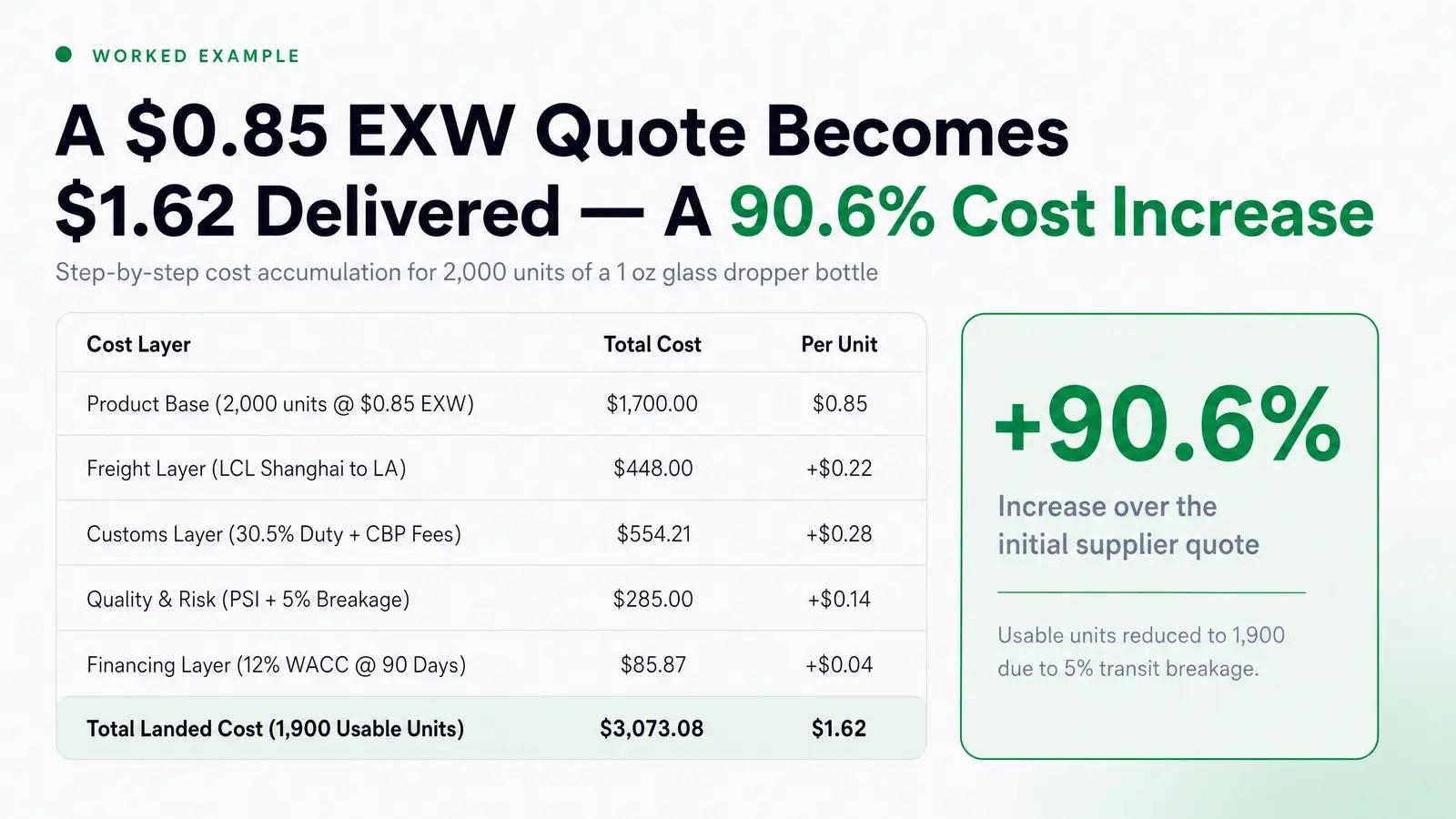
- Product Cost: $1,700.00
- Freight Layer: $448.00
- Customs Layer: $554.21
- Quality & Risk Layer: $285.00
- Financing Layer: $85.87
- Total Landed Cost: $1,700.00 + $448.00 + $554.21 + $285.00 + $85.87 = $3,073.08
- Usable Units Delivered: 2,000 units x (100% - 5% breakage) = 1,900 units.
- Landed Cost per Usable Unit: $3,073.08 / 1,900 = $1.62 per unit
The true landed cost of $1.62 per unit is 90.6% higher than the supplier's initial EXW quote of $0.85. This dramatic increase highlights why calculating the entire landed cost stack is essential before committing capital.
Conclusion
Sourcing cosmetic packaging requires looking beyond the initial unit quote. By utilizing The Indie Beauty Landed Cost Stack, founders can systematically identify and calculate every hidden cost layer, from Section 301 tariffs and CBP user fees to spoilage rates and financing costs. This disciplined approach protects your brand's gross margins, ensures accurate wholesale pricing, and prevents costly supply chain surprises.
Browse Packfolio's curated cosmetic packaging catalog, preview your label in 3D, and get a delivered price that already has the landed cost math done for you → packfolio.com/catalog
Frequently Asked Questions
What is a landed cost and how is it calculated?
Landed cost is the total cost of a product from the factory floor to your warehouse door, including the product price, freight, duties, taxes, insurance, quality control, spoilage, and financing costs. It is calculated by adding all these logistics and regulatory expenses to the supplier's base quote.
What percentage of FOB price does freight typically add for cosmetic packaging imports?
For small packaging shipments (under 5 CBM) utilizing LCL sea freight, local handling and destination fees often make freight highly inefficient, adding 25% to 50% to the FOB price. For larger FCL shipments, freight efficiency improves, typically adding only 10% to 15% to the per-unit cost.
How do I find the correct HTS code for cosmetic packaging to calculate import duties?
You can search the Harmonized Tariff Schedule database maintained by the U.S. International Trade Commission (USITC) or consult a licensed customs broker. Common classifications include HTS 7010.90 for glass bottles and jars, and HTS 3923.30 for plastic squeeze tubes and bottles.
What is the difference between CIF and DDP pricing for packaging imports?
Under CIF (Cost, Insurance, and Freight) terms, the supplier pays for ocean transit to the destination port, but the buyer is responsible for import customs clearance, duties, local port fees, and last-mile delivery. Under DDP (Delivered Duty Paid) terms, the supplier assumes all costs and risks, including customs clearance, duties, and delivery to the buyer's specified address.
How do Section 301 tariffs affect the cost of cosmetic packaging imported from China?
Section 301 tariffs add an extra 25% ad valorem duty on top of the standard HTS base duty rate for most glass, plastic, and aluminum packaging components sourced from China. This tariff is calculated strictly on the declared transaction value of the goods, excluding shipping and insurance costs.
References
[1] Testcoo. "China Quality Control and Inspection: Types, Services and Companies." Testcoo Quality Technical Service, 2024. https://www.testcoo.com/en/blog/top-30-third-party-inspection-companies-in-china-you-can-trust
[2] FleetWorks. "Understanding Freight Damage Rates in Logistics: Statistics and Prevention Guide." FleetWorks AI Resources, 2025. https://www.fleetworks.ai/resources/freight-damage-rates
[3] Office of the United States Trade Representative. "Notice of Modification: China's Acts, Policies and Practices Related to Technology Transfer, Intellectual Property and Innovation." USTR Federal Register Notice, September 2024. https://ustr.gov/sites/default/files/Section%20301%20Modifications%20Determination%20FRN%20%28Sept%2012%202024%29%20%28FINAL%29.pdf
[4] U.S. Food and Drug Administration. "Modernization of Cosmetics Regulation Act of 2022 (MoCRA)." FDA Cosmetics Laws & Regulations, 2024. https://www.fda.gov/cosmetics/cosmetics-laws-regulations/modernization-cosmetics-regulation-act-2022-mocra
[5] CrediLinq. "Scaling Your Skincare Brand? Here's How to Fund Production Batches Smartly." CrediLinq Business Insights, April 2026. https://credilinq.ai/blogs/cosmetics-manufacturing-financing
[6] U.S. Customs and Border Protection. "Importing into the United States: A Guide for Commercial Importers." CBP Publication, 2006. https://www.cbp.gov/sites/default/files/documents/Importing%20into%20the%20U.S.pdf
[7] U.S. International Trade Commission. "Harmonized Tariff Schedule of the United States: Chapter 70 Glass and Glassware." USITC HTSUS Database, 2026. https://www.usitc.gov/publications/docs/tata/hts/bychapter/1000c70.pdf
[8] Clearit USA. "U.S. Customs Guide to Importing Plastic Products: Duties, Compliance, and Risk Management." Clearit Customs Brokerage, March 2026. https://clearitusa.com/import-plastic-products-usa/
[9] U.S. Customs and Border Protection. "CSMS #64384496 - UPDATED GUIDANCE: Import Duties on Aluminum Derivatives." CBP Cargo Systems Messaging Service, March 2025. https://content.govdelivery.com/accounts/USDHSCBP/bulletins/3d66df0
[10] U.S. Customs and Border Protection. "Information on Customs User Fee Changes Effective October 1, 2025." CBP Trade Bulletins, July 2025. https://content.govdelivery.com/accounts/USDHSCBP/bulletins/3eb24a9
[11] U.S. Customs and Border Protection. "What is the Harbor Maintenance Fee (HMF)?" CBP Help Center, November 2025. https://cbpcomplaints.cbp.gov/s/article/Article-1105?language=en_US
[12] Shapiro. "Shipping Rates from China to US: Complete Cost Guide." Shapiro Freight Logistics, 2025. https://www.shapiro.com/shipping-rate-trends/china-to-us/


