
MOQ Strategy for Indie Beauty Brands
This guide helps indie beauty founders navigate cosmetic packaging MOQs with a four-stage framework, reorder point calculations, and capital-saving strategies to launch without stockouts.
A primary challenge of launching an independent beauty brand is not formulating an exceptional product, but navigating the financial and operational realities of the physical supply chain. In the beauty sector, the term Minimum Order Quantity, or MOQ, is often treated as a rigid hurdle imposed by manufacturers to exclude smaller players. Experienced founders understand it differently: MOQ is a lever of cash flow, inventory risk, and capital allocation. Deciding how many units of packaging to purchase is a foundational business decision that shapes a brand's launch timeline, pricing margins, and long-term viability.
Independent beauty brands now represent a formidable segment of the market, controlling approximately 32% of the $125 billion US beauty and personal care industry and growing at 22.3% annually, which is more than three times the pace of established conglomerates [1]. This rapid expansion is driven by consumer demand for authenticity, clean ingredients, and highly targeted formulations. Yet, for an emerging brand, this growth can be throttled by supply chain friction. Managing order quantities strategically allows founders to scale sustainably without tying up precious working capital in unsold inventory.
What MOQ Actually Means in Cosmetic Packaging Supply Chains
In the cosmetic manufacturing and packaging industries, the Minimum Order Quantity represents the lowest number of units a supplier is willing to produce or sell in a single production run. When a packaging manufacturer establishes an MOQ of 5,000 units for a specific glass bottle, it is not an arbitrary restriction designed to discourage startups. It is a mathematical threshold driven by the physical and mechanical realities of industrial manufacturing [5].
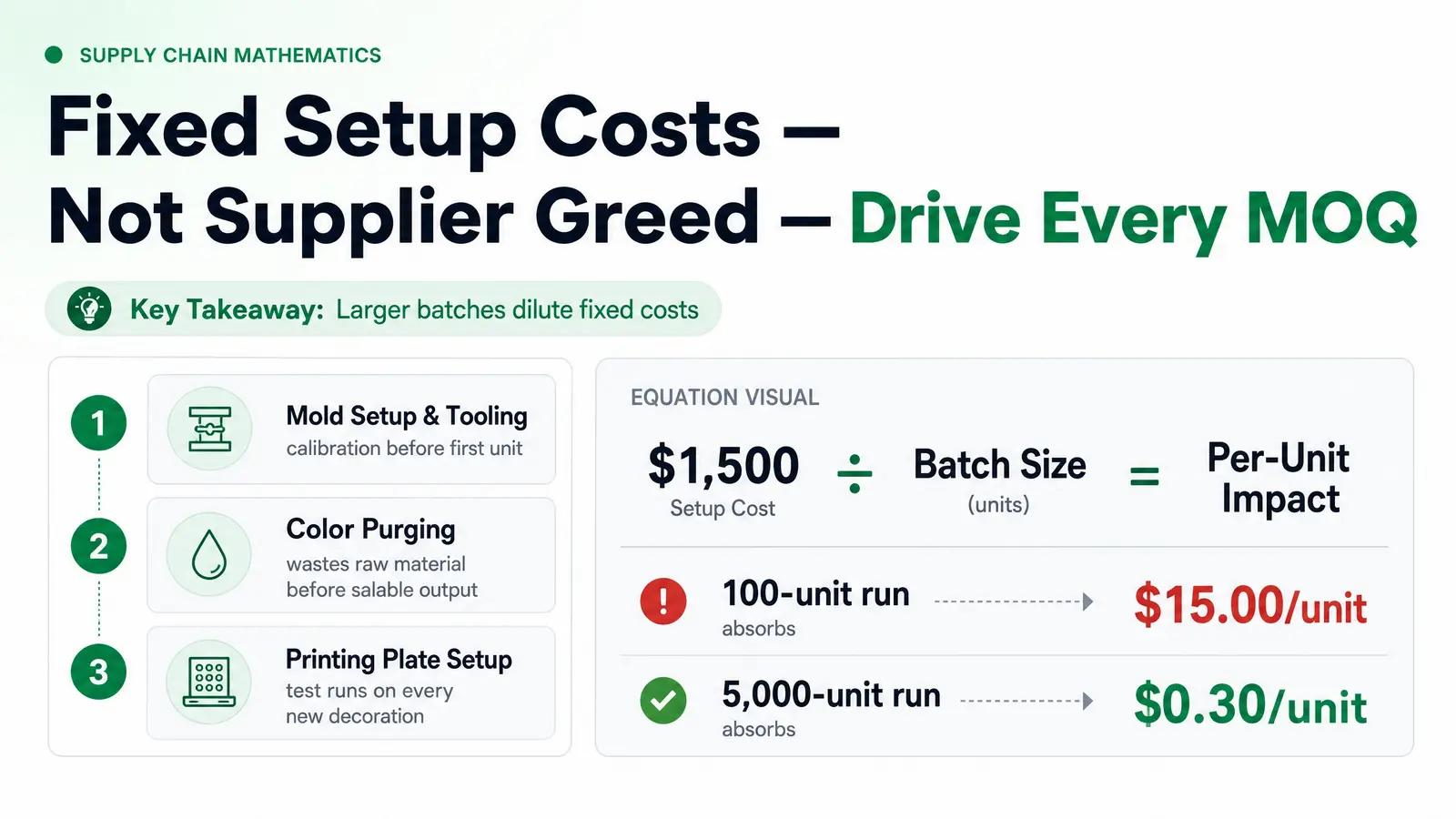
The production of primary cosmetic packaging, such as bottles, jars, tubes, and pumps, relies on highly automated, capital-intensive machinery. Every time a factory switches from producing one component to another, it incurs significant fixed costs that do not vary with the size of the order. These setup costs include several critical phases. Mold setup and tooling requires mounting heavy steel or aluminum molds onto machines and calibrating them precisely. Machine calibration involves adjusting temperature, pressure, and speed settings to ensure consistent wall thickness and structural integrity. Color matching and purging requires mixing colorants with raw resins and purging the machinery of previous colors, a process that consumes raw materials and generates waste before a single salable unit is produced. Printing plate and screen setup for custom decoration like silk-screening, hot stamping, or lithographic printing requires fabricating physical printing plates or screens, aligning them, and performing test runs on the production line [7].
If a manufacturer runs a small batch of 100 units, these setup costs must still be fully absorbed. Spreading $1,500 of setup labor and calibration waste across 100 units adds $15.00 to the cost of each unit, making the economics unviable for both the supplier and the buyer. By enforcing an MOQ of 5,000 or 10,000 units, the manufacturer ensures that these fixed expenses are distributed over a larger volume, bringing the per-unit cost down to a commercial level [5].
For the beauty founder, this creates a direct tension between unit economics and cash flow. Ordering at the supplier's high MOQ minimizes the per-unit cost of packaging and maximizes gross margin. However, it requires a massive upfront cash outlay, leaving less capital available for marketing, formulation, and operational expenses. Conversely, sourcing through low-MOQ channels increases the per-unit cost but preserves cash, allowing the brand to remain agile during its critical early stages [6].
Typical MOQ Norms by Packaging Category
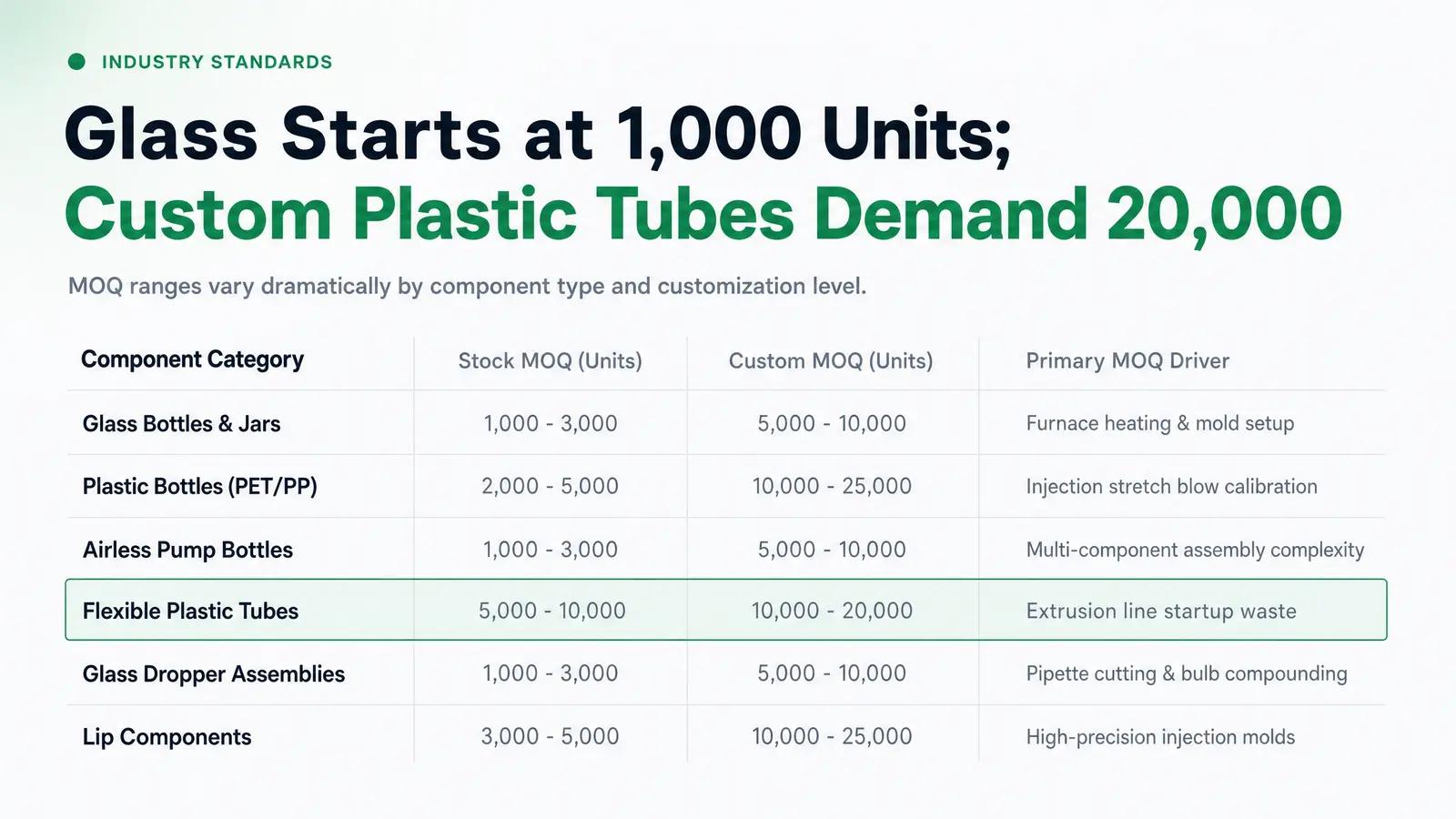
Sourcing primary packaging requires an understanding of the baseline minimums across different component categories. While individual supplier policies vary, the manufacturing process itself dictates standard MOQ ranges across the industry. The table below outlines typical industry norms for stock components versus custom-decorated or custom-molded components, based on global supply chain standards [5] [6] [8].
| Packaging Component Category | Typical Stock MOQ (Units) | Typical Custom/Decorated MOQ (Units) | Primary MOQ Driver |
|---|---|---|---|
| Glass Bottles and Jars | 1,000 to 3,000 | 5,000 to 10,000 | Furnace heating cycles, mold setup, and annealing calibration. |
| Plastic Bottles and Jars (PET/PP) | 2,000 to 5,000 | 10,000 to 25,000 | Injection stretch blow molding calibration and color masterbatch purging. |
| Airless Pump Bottles | 1,000 to 3,000 | 5,000 to 10,000 | Multi-component assembly complexity and piston-fit vacuum testing. |
| Flexible Plastic Tubes | 5,000 to 10,000 | 10,000 to 20,000 | Extrusion line startup waste and inline sleeve printing alignment. |
| Glass Dropper Assemblies | 1,000 to 3,000 | 5,000 to 10,000 | Pipette cutting, rubber bulb compounding, and collar metallization runs. |
| Lip Components (Gloss/Lipstick) | 3,000 to 5,000 | 10,000 to 25,000 | High-precision injection molds and multi-cavity hot runner calibration. |
Glass containers generally have lower stock MOQs than plastic containers because glass factories often run continuous production cycles of standard shapes, allowing them to sell overruns or stock items in smaller pallet quantities. However, custom glass decoration or custom color spraying quickly pushes minimums to 10,000 units or more due to the setup time of the decoration lehrs.
Plastic tubes represent one of the most difficult categories for low-volume sourcing. Because flexible tubes are extruded, printed, and sealed in a continuous, highly integrated process, the material waste generated during initial machine calibration is exceptionally high. Running fewer than 10,000 custom tubes often results in more waste than finished product, which is why tube manufacturers rarely compromise on high minimums.
Airless pump bottles are increasingly popular for active skincare formulations because they protect the product from air exposure and extend shelf life. However, because an airless pump consists of multiple engineered parts, including the outer bottle, an inner piston, a spring-loaded pump engine, and a collar, the assembly process is complex. This multi-component assembly requires specialized high-speed lines, keeping custom airless MOQs firmly in the 5,000 to 10,000 unit range [5].
The Multi-SKU MOQ Stacking Problem
While evaluating a single packaging component's MOQ is straightforward, beauty brands rarely launch with a single product. Most founders introduce a cohesive routine consisting of three to five products, such as a cleanser, a serum, and a moisturizer. This multi-product approach introduces the operational challenge of multi-SKU MOQ stacking.
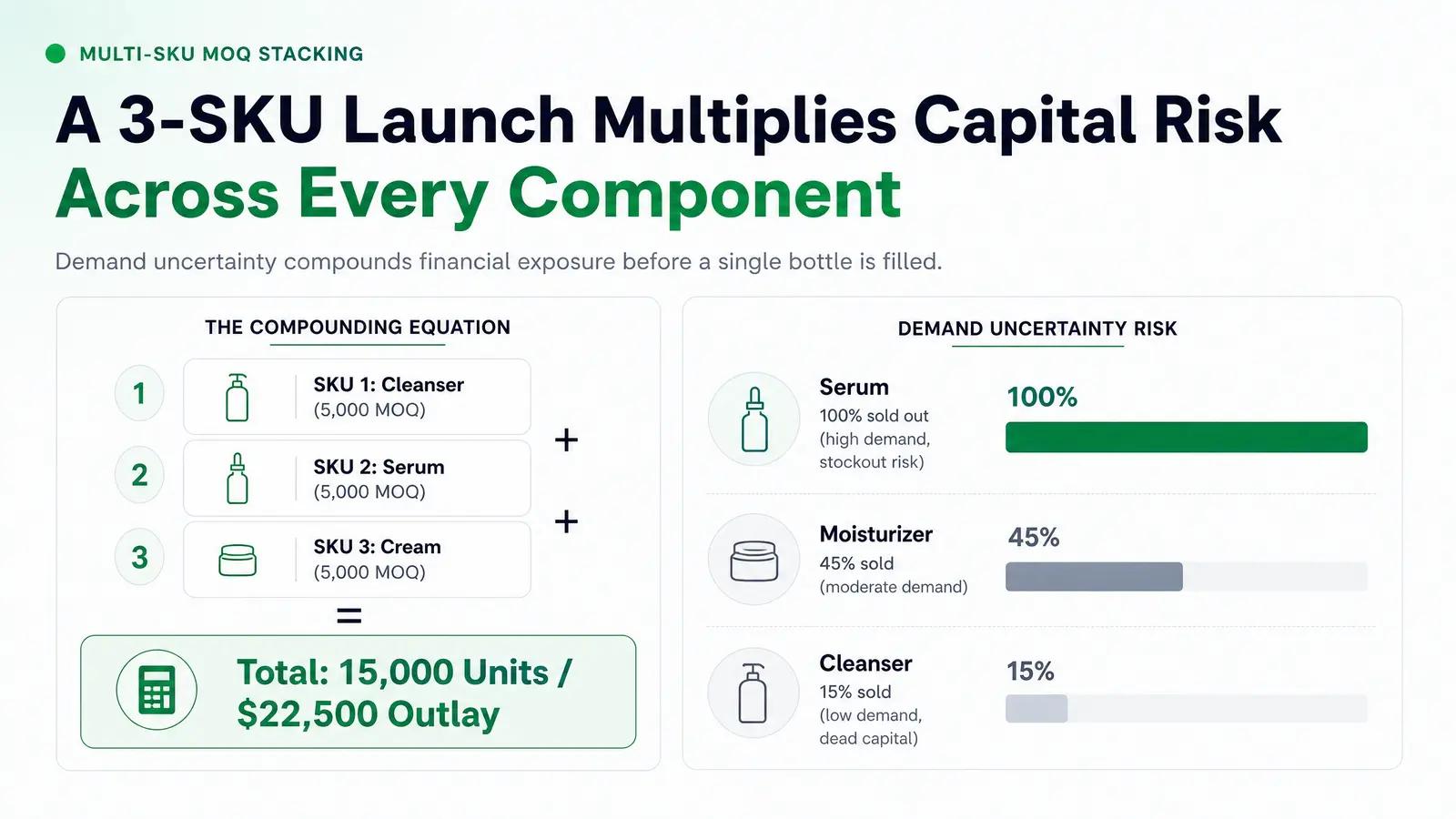
When launching a 3-SKU skincare line, the capital required for packaging does not simply triple, it compounds across every unique component. If each product requires a different primary container, and each container has an MOQ of 5,000 units, the brand must purchase 15,000 total packaging units before filling a single bottle.
The financial compounding becomes clear when analyzing the capital requirements of a typical launch. Consider a startup planning to introduce three products: a 150 ml PET bottle with a lotion pump, a 30 ml glass dropper bottle, and a 50 ml airless pump bottle. If the founder sources these components directly from traditional manufacturers, they will likely face an average MOQ of 5,000 units per SKU. Assuming a blended packaging cost of $1.50 per unit, the initial packaging order requires a capital outlay of $22,500. This capital requirement is only for the empty packaging. The founder must still fund the formulation batches, laboratory stability testing, outer folding cartons, shipping freight, customs duties, and marketing launch campaigns.
Furthermore, multi-SKU stacking introduces severe demand uncertainty risk. In a new product line, sales are rarely distributed evenly across all SKUs. A brand may find that its serum becomes an overnight bestseller while the cleanser sells at a fraction of the expected rate. If the founder was forced to buy 5,000 units of each, they will quickly face a stockout on the serum while thousands of cleanser bottles sit idle in a warehouse, representing dead capital that cannot be reinvested.
The MOQ-by-Launch-Stage Matrix
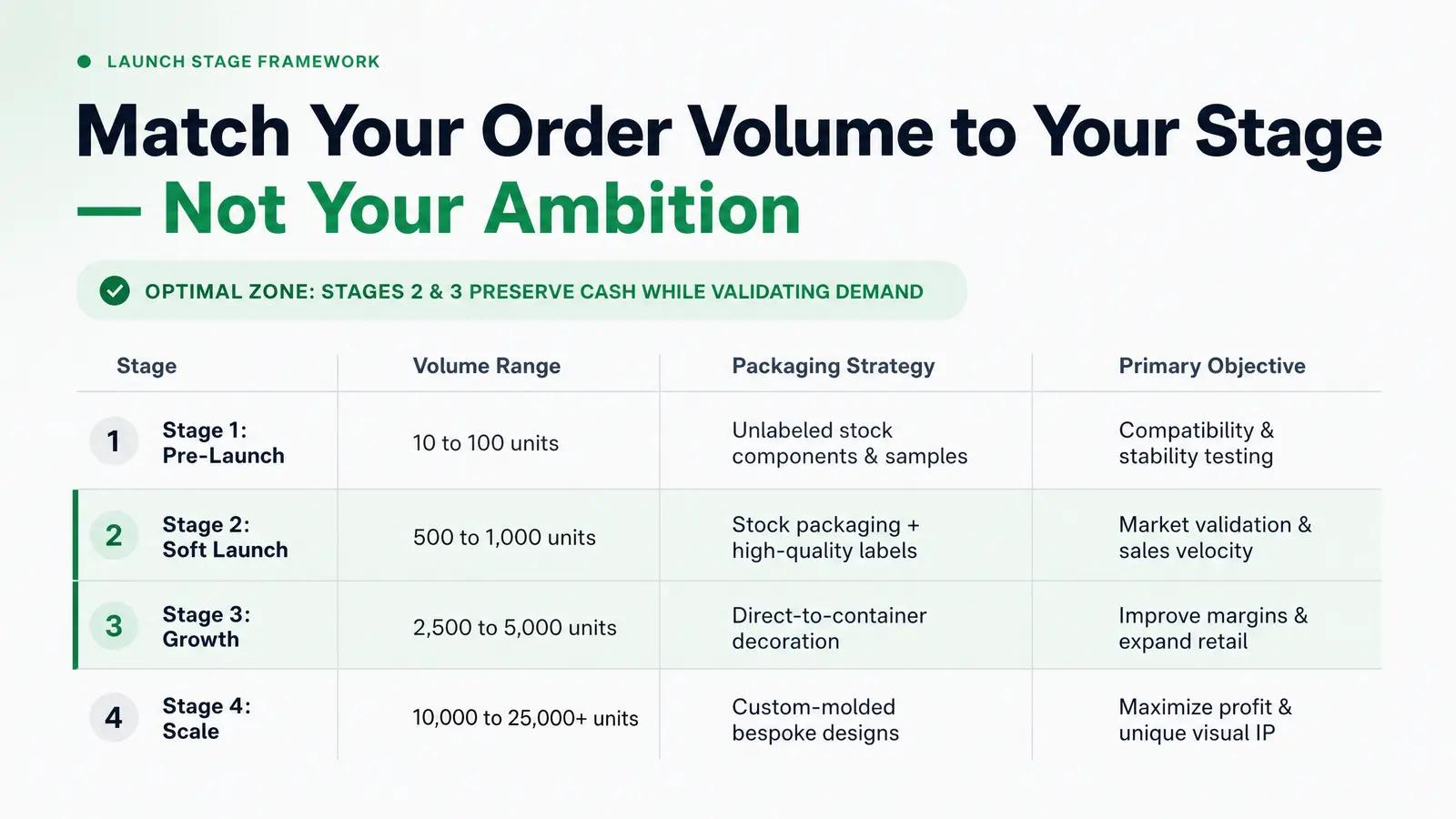
To navigate the tension between order volumes and financial risk, a practical framework can align purchasing strategies with actual market validation and sales velocity. The framework we recommend at Packfolio, called The MOQ-by-Launch-Stage Matrix, divides a brand's journey into four distinct phases, each with its own volume targets, packaging strategies, and primary business objectives.
| Stage | Volume Range | Packaging Strategy | Primary Objective |
|---|---|---|---|
| Stage 1: Pre-Launch and Compatibility Testing | 10 to 100 units | Unlabeled stock components from local distributors or sample runs. | Formulation compatibility, stability testing, and aesthetic prototyping. |
| Stage 2: Soft Launch and Market Validation | 500 to 1,000 units per SKU | Stock packaging with high-quality pressure-sensitive labels or low-minimum digital printing. | Gathering real consumer feedback, testing the marketing message, and establishing initial sales velocity. |
| Stage 3: Growth and Brand Optimization | 2,500 to 5,000 units per SKU | Direct-to-platform sourcing, standardized custom colors, and direct-to-container decoration. | Improving gross margins, stabilizing the supply chain, and expanding retail distribution. |
| Stage 4: Scale and Custom Tooling | 10,000 to 25,000+ units per SKU | Direct-to-factory contract manufacturing, custom-molded components, and bespoke structural designs. | Maximizing profitability, establishing a unique visual identity on retail shelves, and securing global supply chain dominance. |
Stage 1 is purely about risk-free validation. Unit cost is irrelevant here. The goal is to verify that active ingredients do not react with the plastic container, that the dropper bulb does not degrade when exposed to essential oils, and that the product dispenses correctly.
Stage 2 is the minimum viable product phase. Founders should accept a higher per-unit cost to preserve cash. It is far better to absorb a $1.00 margin penalty per unit on 500 units than to write off $5,000 of custom packaging if the product concept fails to resonate with consumers.
Stage 3 marks the transition to commercial operations. Once a product demonstrates consistent monthly sales, the brand can safely transition to larger production runs. At this volume, direct screen printing onto the bottle becomes cost-effective, eliminating the labor and material costs of manual labeling.
Stage 4 is where the brand has the leverage to negotiate custom mold development with manufacturers, creating proprietary shapes that define the brand's visual IP and create a durable competitive moat.
Custom-Decorated vs. Stock Packaging: The Customization Cost Curve
A critical decision point for any beauty founder is choosing between stock packaging and custom-decorated packaging. This choice directly dictates the MOQ requirements and the upfront capital required for a launch.
Stock packaging refers to standard, off-the-shelf components that are pre-manufactured and held in inventory by distributors. Because these items are produced in massive industrial runs of hundreds of thousands of units, the setup costs have already been fully amortized by the distributor. As a result, stock packaging can be purchased with exceptionally low minimums, often as low as a single case of 50 to 100 units [5] [6].
The primary advantage of stock packaging is speed to market and low financial risk. However, because these containers are available to any brand, achieving a premium, differentiated look requires creativity. To overcome this, indie brands rely on high-quality pressure-sensitive labels, custom outer cartons, or unique secondary seals.
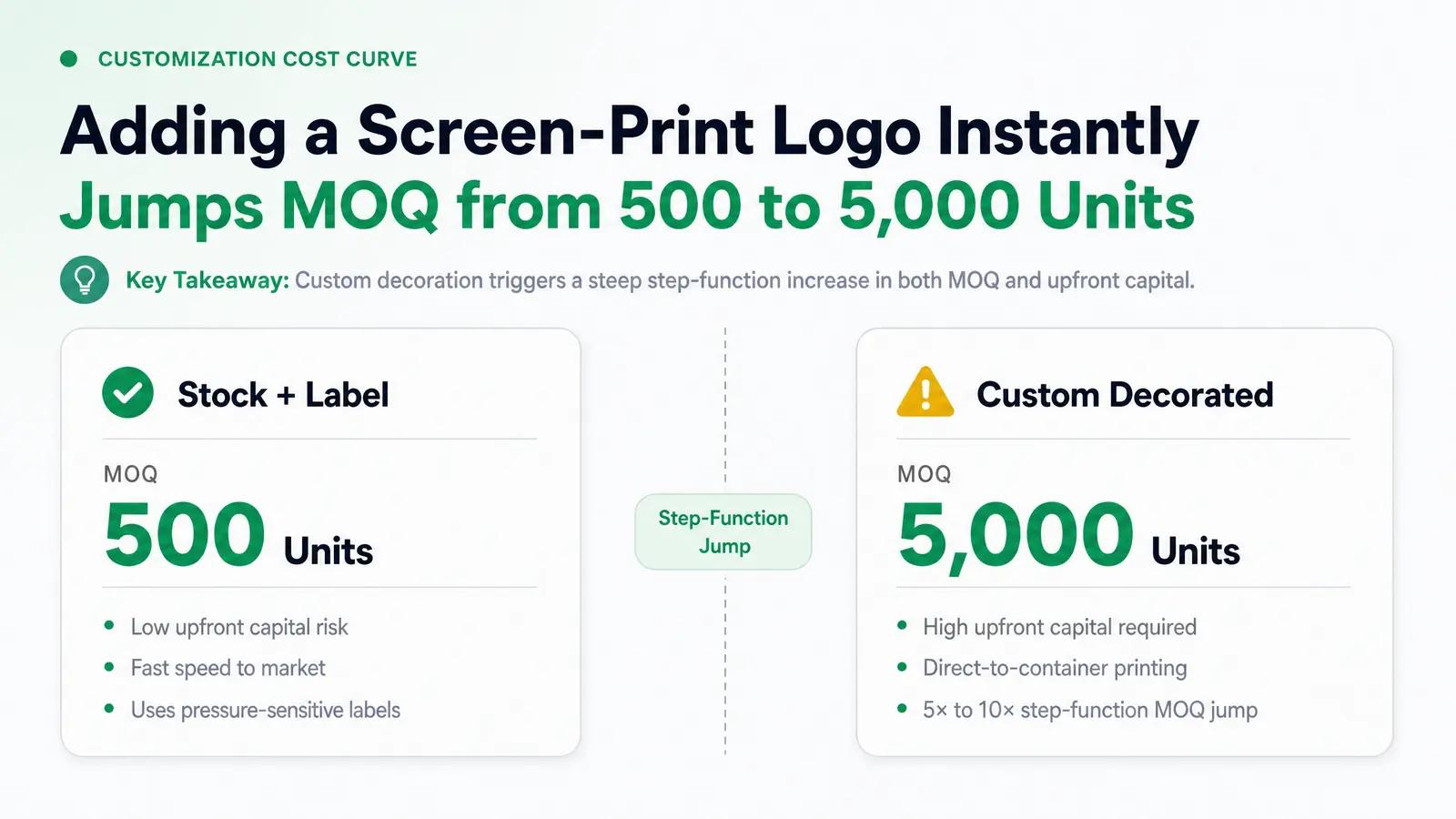
Custom-decorated packaging involves applying custom branding directly to a stock component shape at the factory. This includes silk-screen printing, hot stamping, custom color injection, and frosting or spray coating. Because these decoration methods require the factory to set up specialized printing lines, align registration marks, and perform color-matching test runs, the MOQ for custom-decorated packaging typically starts at 5,000 to 10,000 units per SKU [5].
The transition from stock packaging with labels to custom-decorated packaging represents a steep step-function in both MOQ and upfront cost. While a stock bottle might require an order of only 500 units, applying a simple screen-printed logo directly to that same bottle immediately forces the order quantity to 5,000 units. Founders must carefully evaluate whether their brand positioning truly requires direct-to-container decoration at launch, or if a high-quality label on a stock component can serve as an effective bridge during the market validation phase.
Storage, Shelf Life, and Obsolescence Risk
When evaluating MOQ decisions, founders often focus exclusively on the purchase price of the packaging, ignoring the ongoing costs of holding that physical inventory. In logistics, these expenses are categorized as inventory carrying costs, and they represent a significant drain on a growing brand's profitability.
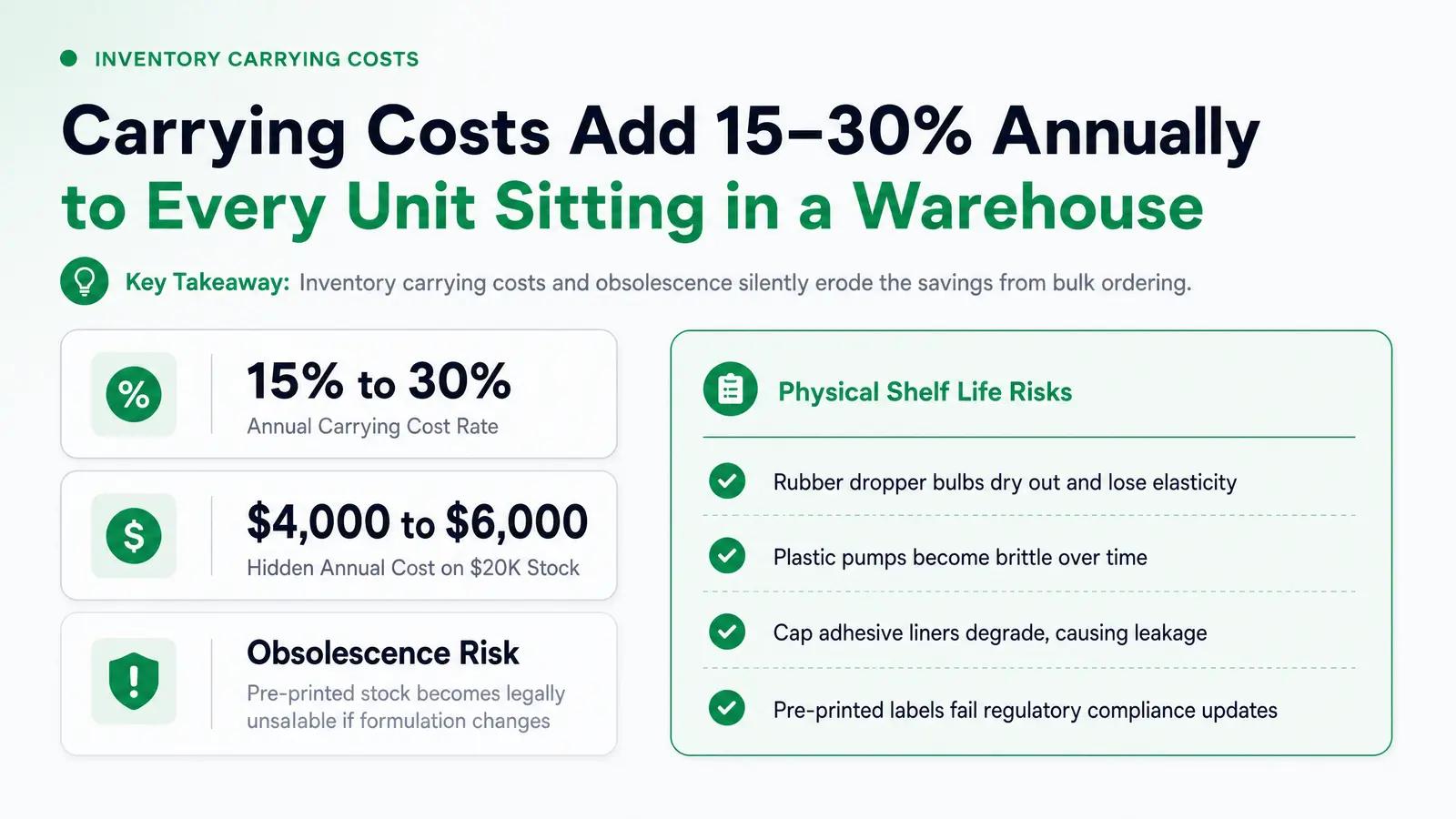
Annual inventory carrying costs typically range from 15% to 30% of the total value of the stored inventory [3]. These costs are comprised of several distinct components: storage and warehousing fees, insurance and taxes, material handling and labor, and the opportunity cost of capital tied up in physical goods rather than invested in marketing or product development [3].
For example, if a brand purchases 10,000 premium glass jars at $2.00 each to secure a lower unit price, it ties up $20,000 of capital. If those jars sit in a warehouse for a year before being filled and sold, the actual cost of those jars increases by $3,000 to $6,000 due to carrying costs, effectively wiping out the volume discount negotiated with the supplier.
Furthermore, cosmetic packaging is subject to strict shelf life and obsolescence risks. While empty glass and certain plastics do not degrade rapidly, secondary components like rubber dropper bulbs, silicone gaskets, and pump engines have a finite shelf life. Over time, rubber can dry out and lose its elasticity, plastic pumps can become brittle, and adhesive liners in caps can degrade, leading to product leakage or contamination when the containers are finally filled.
Obsolescence risk is even higher for decorated packaging. In the fast-moving beauty market, regulatory updates, ingredient reformulations, or brand pivots can happen overnight. If a brand reformulates a serum to comply with updated clean beauty standards, any pre-printed packaging listing the old ingredient deck becomes legally unsalable. Sourcing packaging in smaller, more frequent batches drastically reduces this exposure, allowing the brand to remain compliant and responsive to market changes.
The Contrarian View: The High Cost of Under-Ordering
While preserving cash flow by ordering small is a sensible default strategy, there is a contrarian perspective that beauty founders must consider: the hidden cost of under-ordering can often exceed the cost of modest over-ordering at launch.
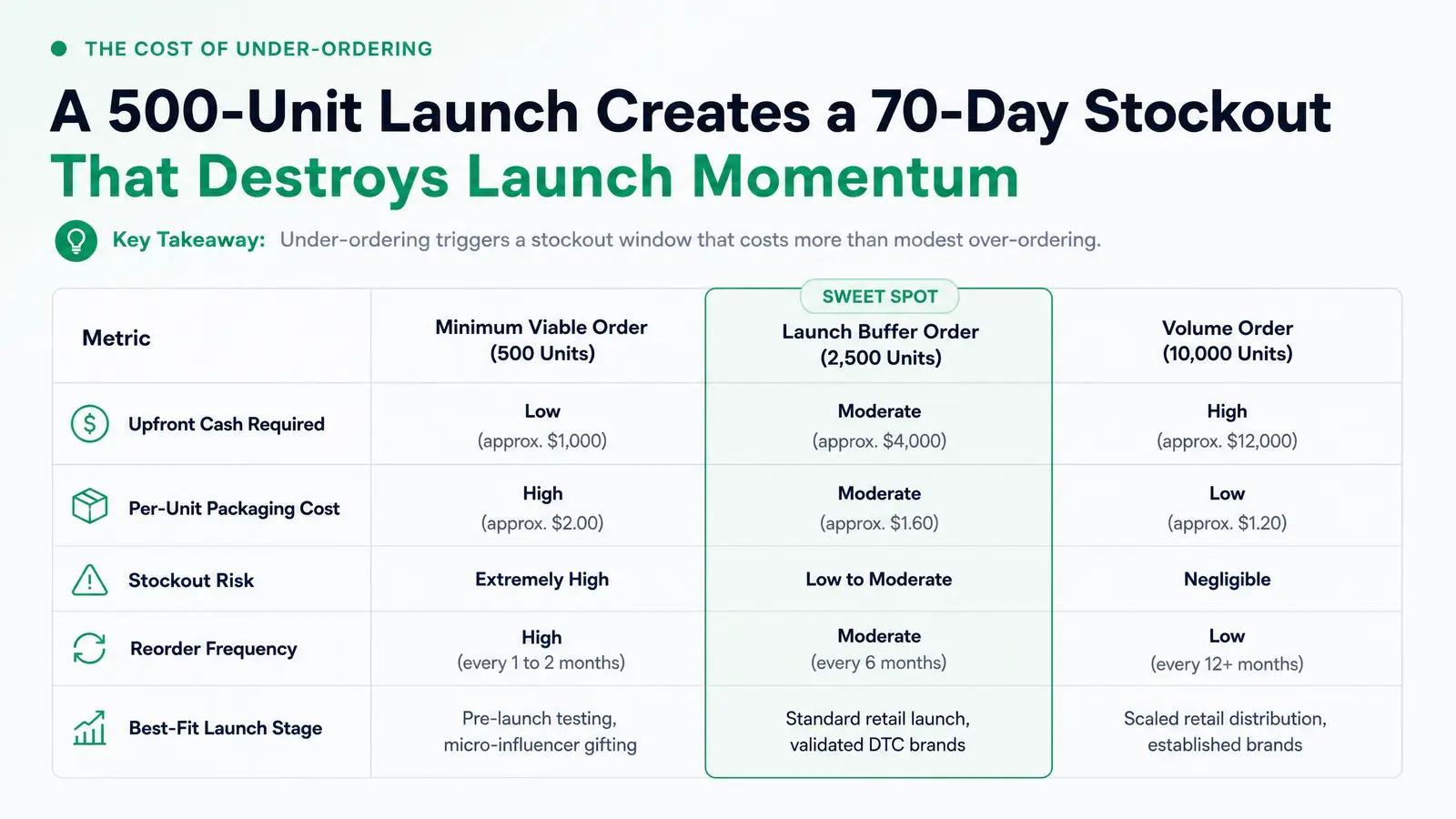
When a brand launches with an ultra-low packaging run of 500 units, it minimizes its initial financial risk. However, if the launch is successful and the product sells out in the first two weeks, the brand faces an immediate operational crisis. In the global beauty supply chain, the lead time to manufacture and ship custom packaging from primary production hubs in Asia is typically 60 to 90 days [8]. Shipping that inventory via ocean freight adds another 30 to 45 days, while air freight is prohibitively expensive for heavy glass or bulky plastic containers.
This lead-time gap creates a devastating stockout window of two to three months. During this period, the brand experiences several severe financial and brand equity penalties. Loss of sales momentum is the most immediate: in the beauty industry, consumer attention is highly fleeting, and a brand that goes out of stock during its launch window loses the momentum generated by initial influencer reviews and press coverage. Customers who are unable to purchase the product will quickly turn to competitors, destroying the lifetime value projection of those initial marketing efforts. For small subsequent runs, the brand must repeatedly pay setup fees and plate charges, which can range from $150 to $500 per run, eroding any margin benefits [7]. To bridge the stockout gap, the brand may also be forced to pay premium air freight rates to rush a small batch of packaging, which can easily double or triple the landed cost of the components.
The table below illustrates this trade-off by comparing three distinct ordering strategies for a new skincare launch.
| Metric | Minimum Viable Order (500 Units) | Launch Buffer Order (2,500 Units) | Volume Order (10,000 Units) |
|---|---|---|---|
| Upfront Cash Required | Low (approx. $1,000) | Moderate (approx. $4,000) | High (approx. $12,000) |
| Per-Unit Packaging Cost | High (approx. $2.00) | Moderate (approx. $1.60) | Low (approx. $1.20) |
| Stockout Risk | Extremely High | Low to Moderate | Negligible |
| Reorder Frequency | High (every 1 to 2 months) | Moderate (every 6 months) | Low (every 12+ months) |
| Best-Fit Launch Stage | Pre-launch testing, micro-influencer gifting. | Standard retail launch, validated DTC brands. | Scaled retail distribution, established brands. |
As the comparison demonstrates, a Launch Buffer Order of 2,500 units often represents the optimal sweet spot for a serious launch. It provides enough inventory to survive the 90-day lead time required to manufacture a second batch, while keeping the upfront capital requirement manageable and protecting the brand's initial sales momentum.
Back-Calculating Your Reorder Point
To avoid both the cash-flow drain of over-ordering and the momentum-killing impact of stockouts, founders must transition from emotional ordering to mathematical inventory planning. The foundational tool for this is the Reorder Point (ROP) calculation [4].
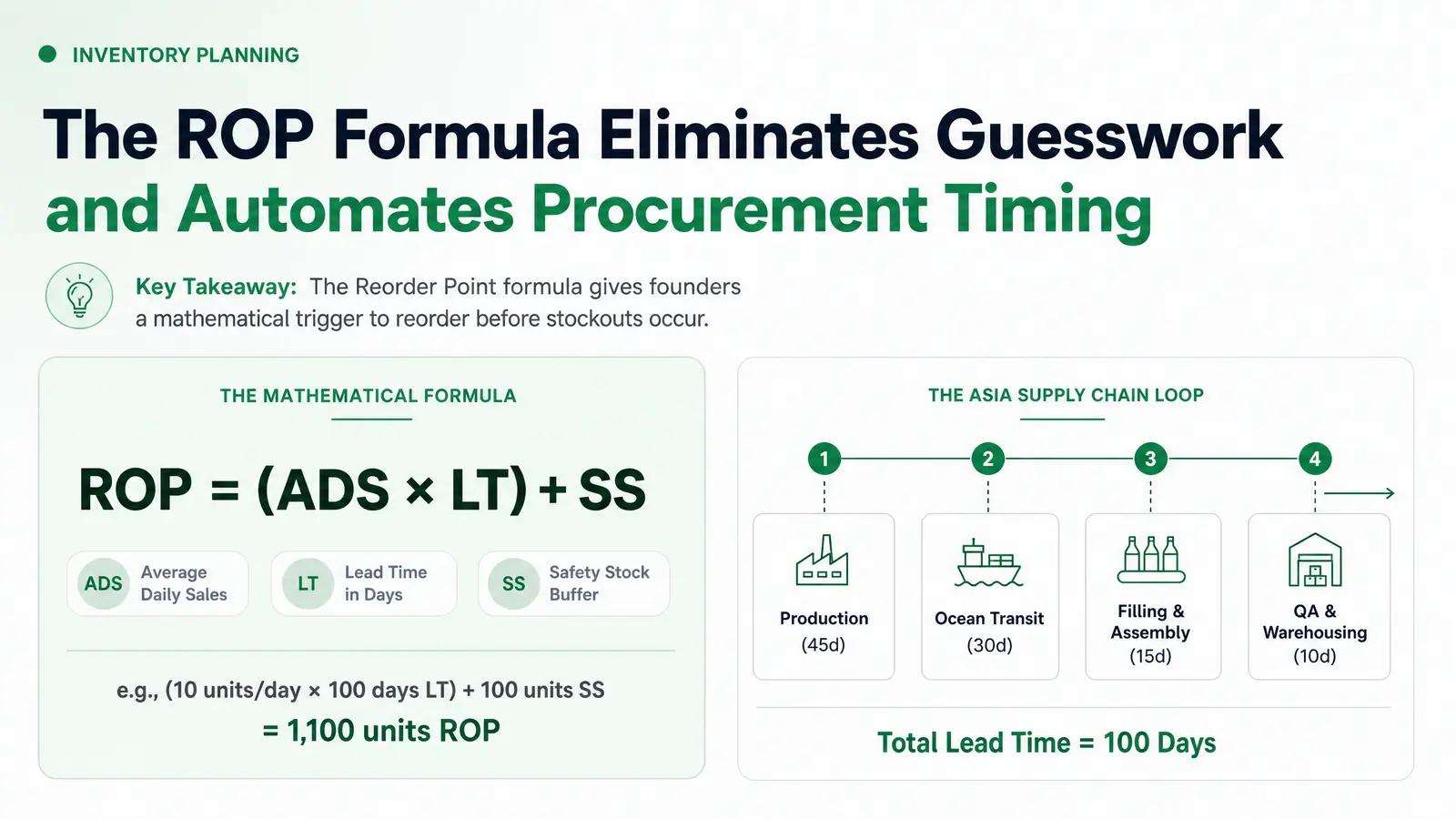
The Reorder Point is the specific inventory level that triggers a new purchase order. To calculate it accurately, a brand must understand three key variables: Average Daily Sales (ADS), which is the average number of units sold per day; Lead Time (LT), which is the total time in days from placing the packaging order to receiving the finished, filled product at the warehouse; and Safety Stock (SS), which is the buffer inventory kept on hand to protect against unexpected shipping delays or sales spikes [4].
The standard formula is:
Reorder Point (ROP) = (Average Daily Sales x Lead Time) + Safety Stock
For imported packaging, the total lead time must encompass the entire supply chain loop. A realistic breakdown for a brand sourcing from Asia might include: packaging production (45 days), transit to filling facility (30 days), formulation and filling (15 days), and quality assurance and warehousing (10 days), totaling approximately 100 days. Safety stock accounts for the worst-case scenario and is calculated as: (Maximum Daily Sales x Maximum Lead Time) minus (Average Daily Sales x Average Lead Time) [4].
By establishing a clear Reorder Point for every SKU, a brand can automate its procurement process. When inventory levels hit the ROP, a new purchase order is generated, ensuring that replacement packaging arrives exactly as the existing stock is depleted, maximizing cash-flow efficiency.
A Worked Scenario: The 3-SKU Skincare Launch
To illustrate the mathematical reality of these concepts, consider a solo founder launching a high-end, 3-SKU skincare line consisting of a Cleanser, a Vitamin C Serum, and a Barrier Cream. The founder expects a modest, steady sales velocity of 10 units per day per SKU across their direct-to-consumer website and boutique retail partners. The packaging lead time from their manufacturing partner is 90 days [8], and the formulation and filling process at their local contract manufacturer takes 30 days, resulting in a total lead time of 120 days for a completed product.
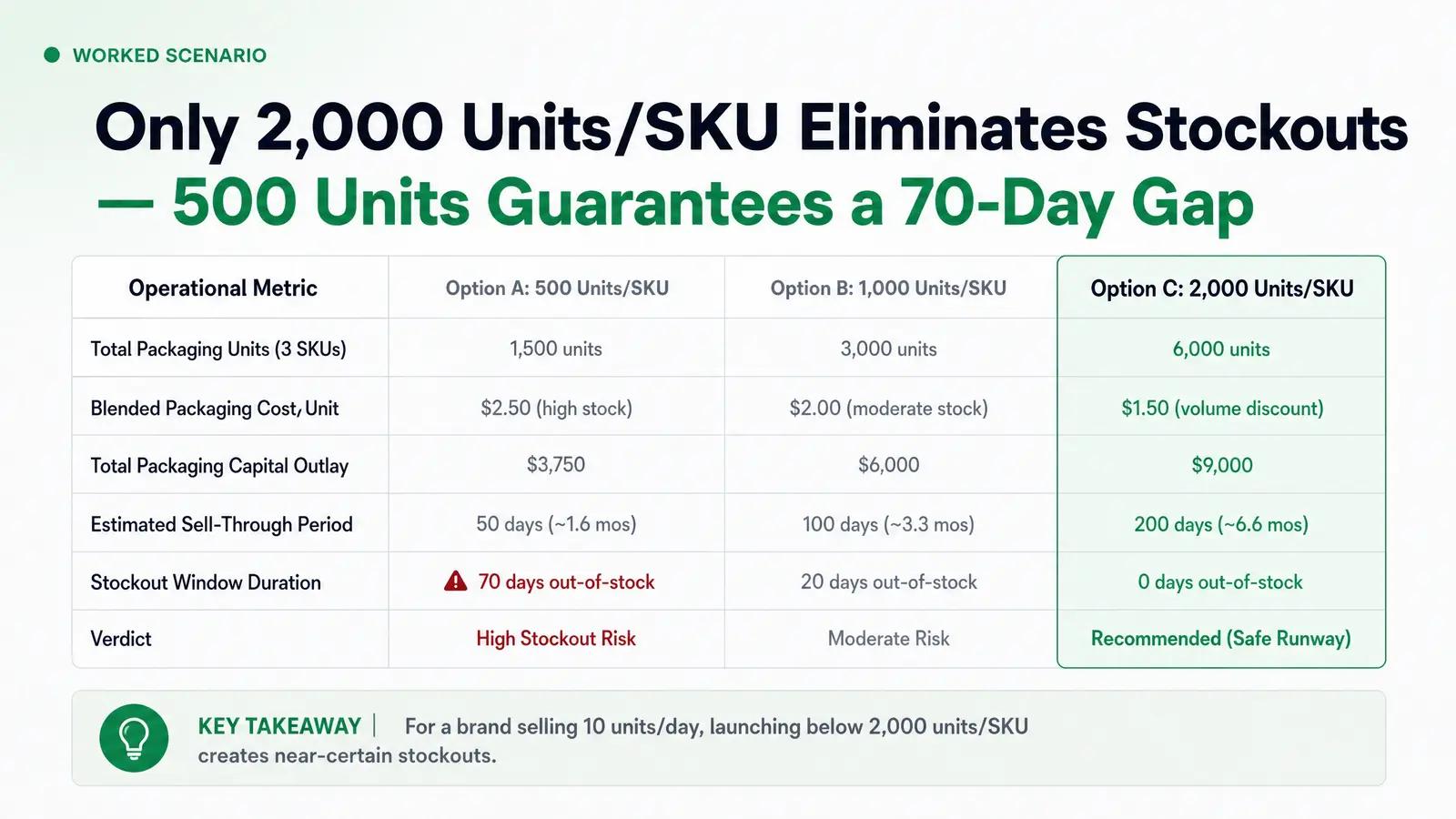
The founder is evaluating three different initial packaging order quantities: 500 units, 1,000 units, and 2,000 units per SKU. The table below outlines the financial and operational reality of each option.
| Operational Metric | Option A: 500 Units/SKU | Option B: 1,000 Units/SKU | Option C: 2,000 Units/SKU |
|---|---|---|---|
| Total Packaging Units (3 SKUs) | 1,500 units | 3,000 units | 6,000 units |
| Blended Packaging Cost per Unit | $2.50 (high stock pricing) | $2.00 (moderate stock pricing) | $1.50 (volume discount pricing) |
| Total Packaging Capital Outlay | $3,750 | $6,000 | $9,000 |
| Estimated Sell-Through Period | 50 days (approx. 1.6 months) | 100 days (approx. 3.3 months) | 200 days (approx. 6.6 months) |
| Total Lead Time to Replenish | 120 days | 120 days | 120 days |
| Reorder Required at Launch? | Yes. Must reorder on Day 1. | Yes. Must reorder on Day 1. | No. Can wait until Day 80. |
| Stockout Window Duration | 70 days out-of-stock. | 20 days out-of-stock. | 0 days out-of-stock. |
| Inventory Carrying Cost (Annual) | Negligible | approx. $1,200 | approx. $1,800 |
Option A (500 Units): While this option requires the lowest upfront cash outlay ($3,750), it creates an immediate operational problem. Because the total sell-through period (50 days) is far shorter than the lead time required to replenish (120 days), the brand will go out of stock on Day 50 and remain out of stock for 70 days.
Option B (1,000 Units): This option improves unit economics and extends the sell-through period to 100 days. However, the brand still faces a 20-day stockout window, which will disrupt initial sales momentum and disappoint early customers.
Option C (2,000 Units): This option requires the highest upfront capital ($9,000) but completely de-risks the launch. The 200-day sell-through period easily covers the 120-day replenishment lead time. The founder does not need to place a reorder until Day 80 of the launch, providing nearly three months of real sales data to adjust their next order quantities. Furthermore, the per-unit packaging cost drops by 40% compared to Option A, significantly improving the brand's initial gross margins.
This scenario demonstrates that for a brand with a projected sales velocity of 10 units per day, launching with fewer than 2,000 units per SKU introduces a near-certainty of stockouts, making Option C the most operationally sound and financially viable strategy.
Strategic Levers for Lowering Your MOQ Burden
For founders who recognize the benefits of larger order runs but are constrained by limited startup capital, several strategic levers can reduce the overall capital requirement.
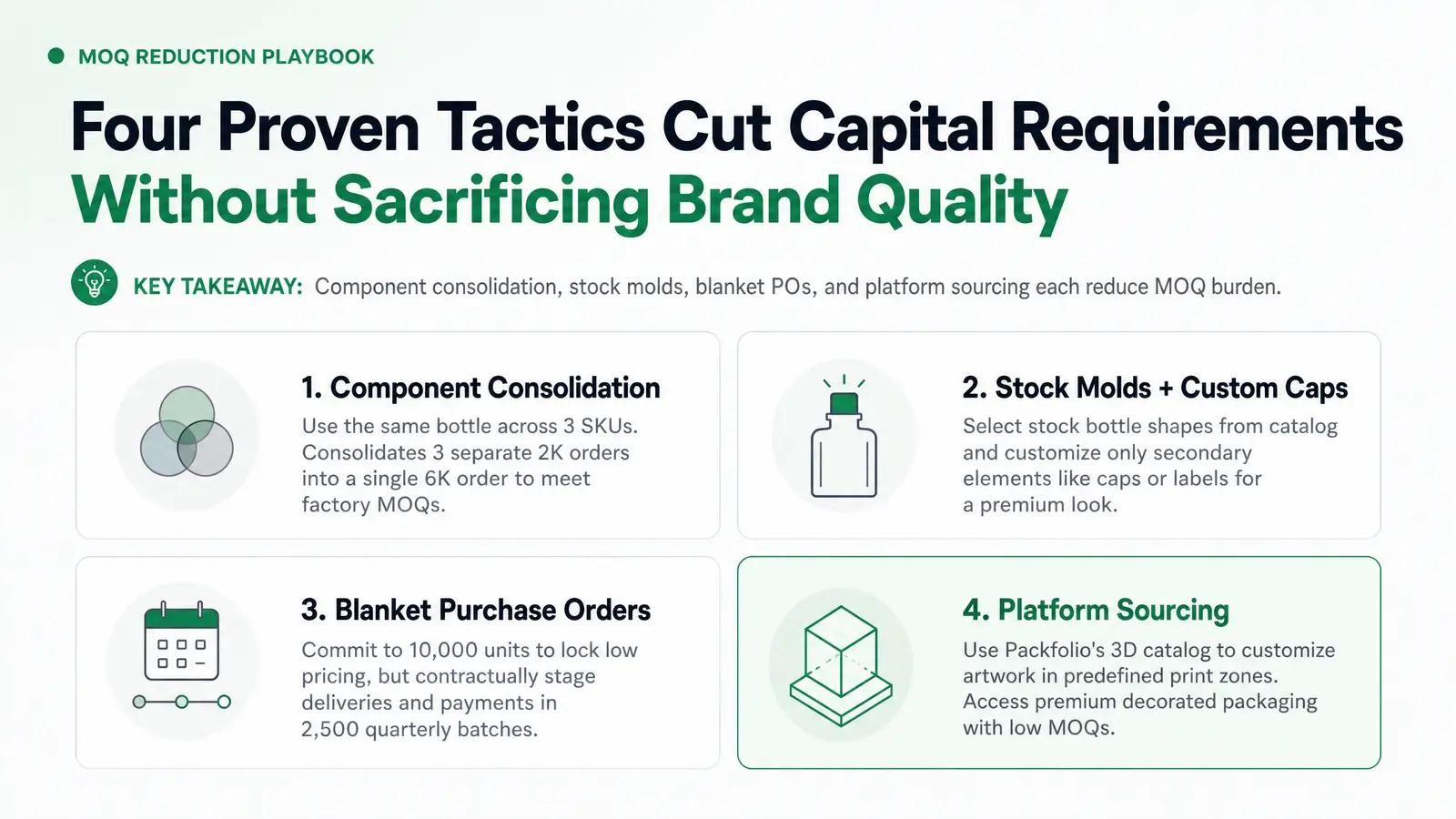
Design standardization and component consolidation is one of the most effective approaches. Using the same primary container across multiple SKUs, differentiating the products through the color of the formulation, custom labeling, or outer cartons, allows a brand to consolidate its packaging needs. Instead of sourcing a unique bottle shape for a serum, an oil, and a toner, a brand can use the same 1 oz (30 ml) clear glass dropper bottle for all three products. By consolidating, the brand can place a single order of 6,000 units of the same bottle rather than three separate orders of 2,000 units, easily meeting the manufacturer's MOQ while securing volume pricing.
Utilizing stock molds with custom secondary elements allows founders to achieve a premium, custom look without the high minimums of fully custom tooling. Selecting stock bottle shapes from a manufacturer's catalog and customizing only the secondary elements, such as a custom-colored plastic cap, a metallized collar, or a uniquely textured label, creates a highly differentiated aesthetic at a fraction of the MOQ required for a fully custom bottle.
Negotiating staged deliveries and blanket purchase orders is a tactic that established packaging manufacturers are often willing to accommodate for promising brands. A founder can negotiate a Blanket Purchase Order for 10,000 units to secure a low unit price, but contractually agree to take delivery and pay for the inventory in staged batches of 2,500 units every quarter. This allows the manufacturer to plan their production runs efficiently, while the brand minimizes its upfront cash outlay and warehouse storage fees.
Sourcing through curated platform models represents the most accessible option for emerging brands that want to bypass the complexity of traditional factory negotiations. Packfolio's curated catalog of cosmetic primary packaging SKUs, each pre-modeled in 3D with predefined printable regions, allows founders to customize artwork inside predefined print zones using a browser-based 3D design tool and preview the results on photorealistic 3D models before placing an order. This platform model coordinates production, quality assurance, and freight delivery directly to the customer's address, eliminating the need to manage multiple suppliers, negotiate complex MOQs, or navigate international logistics. For founders who are not yet ordering at volume, this structured approach provides access to premium, decorated packaging with significantly reduced risk and lower capital requirements. You can explore the full catalog at packfolio.com/catalog.
For a deeper look at how packaging material choices interact with MOQ decisions, see our guide on cosmetic packaging materials.
Browse Packfolio's curated cosmetic packaging catalog and preview your label on a photorealistic 3D model before placing an order. packfolio.com/catalog
Frequently Asked Questions
What is a realistic MOQ for custom-printed cosmetic packaging?
For custom-printed cosmetic packaging, such as bottles with direct silk-screen printing or custom color injection, the realistic industry MOQ typically ranges from 5,000 to 10,000 units per SKU [5]. Some specialized manufacturers or digital sourcing platforms can offer decorated runs starting at 1,000 units, but these smaller runs usually come with a higher per-unit cost penalty to cover the fixed machine setup fees [6].
How do I negotiate a lower MOQ with a packaging supplier?
To negotiate a lower MOQ, offer to standardize your components across multiple products, use stock shapes with custom paper labels, or commit to a long-term purchase agreement with staged deliveries. Suppliers are also more willing to lower minimums if you accept standard stock colors like clear, white, or amber, which do not require extensive machine purging and color-matching runs [5].
What are the hidden costs of ordering the absolute minimum quantity?
The primary hidden cost of ordering the absolute minimum quantity is the steep per-unit price penalty, which severely compresses gross margins. Additionally, low-volume runs often incur separate setup fees, plate charges, and higher shipping rates per unit, while exposing the brand to an extremely high risk of stockouts and lost sales momentum if the product sells faster than expected [7].
How does packaging MOQ interact with contract manufacturer filling MOQs?
Packaging MOQs and contract manufacturer filling MOQs are separate but deeply interconnected supply chain constraints. While a packaging supplier may agree to sell you 1,000 bottles, your contract filler may have a minimum batch requirement of 3,000 units or 100 kg of formulation per run [6]. Your actual launch MOQ will always be dictated by the highest minimum constraint across your entire supply chain.
Can I supply my own packaging to a cosmetic contract manufacturer?
Yes, most cosmetic contract manufacturers operate under an OEM model where they allow you to supply your own primary packaging components [8]. However, you must ensure that your sourced packaging is fully compatible with the filler's automated assembly lines and has passed rigorous leak, pressure, and formulation compatibility testing to avoid production delays or product failures.
References
[1] NIQ: Indie Beauty Hits 32% Of U.S. Beauty Market As Growth Triples Conglomerates' Pace, Beauty Independent, 2026, https://www.beautyindependent.com/niq-indie-beauty-hits-32-u-s-beauty-market-growth-triples-conglomerates-pace/
[2] Indie Brands are a Driving Force in Beauty, Cosmoprof North America, 2023, https://cosmoprofnorthamerica.com/indie-brands-are-a-driving-force-in-beauty/
[3] Inventory Carrying Costs: How To Calculate and Reduce Them, Fishbowl Inventory, 2026, https://www.fishbowlinventory.com/blog/what-is-carrying-cost
[4] Reorder Point Calculator and Formula Guide, inFlow Inventory, 2026, https://www.inflowinventory.com/blog/reorder-point-formula-safety-stock/
[5] How Does MOQ Affect Cosmetic Packaging Costs (And What You Can Do About It)?, AH Packaging, 2025, https://ahpackaging.com/how-does-moq-affect-cosmetic-packaging-costs/
[6] Low MOQ Cosmetic Manufacturing: The 2025 Guide for Indie Founders, Genie, 2025, https://www.madebygenie.com/blog/low-moq-cosmetic-manufacturing-guide
[7] What are Set-Up Fees in Packaging?, How to Buy Packaging, 2021, https://www.howtobuypackaging.com/set-up-fees-in-packaging/
[8] How to Build a Cosmetic Supply Chain from China: The 2025 Complete Guide for Founders and Procurement Leaders, AH Packaging, 2025, https://ahpackaging.com/how-to-build-a-cosmetic-supply-chain-from-china/


