
Why Custom Cosmetic Packaging MOQs Get So High
Custom cosmetic packaging MOQs are driven by mold tooling, color matching, multi-component sourcing, and decoration setup costs, but strategic alternatives help founders launch without massive inventory commitments.
You have finalized the formula, locked in the brand identity, and started sourcing packaging—only to find that securing a custom frosted glass bottle with a matching pump requires a minimum order of 10,000 units. For many independent beauty founders, the sudden realization that packaging, not formula, is typically the real MOQ bottleneck at launch comes as a shock. The math feels punishing. Tying up significant cash flow in empty containers before a single product is sold is a terrifying prospect for any new brand.
But minimum order quantities (MOQs) in the cosmetic packaging industry are not arbitrary hurdles designed to keep indie brands out. They are the mathematical realities of industrial manufacturing. Understanding what drives these high minimums is the first step in deciding whether to negotiate, find an alternative, or rethink your launch packaging strategy entirely.
The True Cost of Custom Molds and Tooling
When a brand requests a unique bottle shape or a custom jar, the factory cannot simply adjust a machine setting. They must engineer a custom mold.
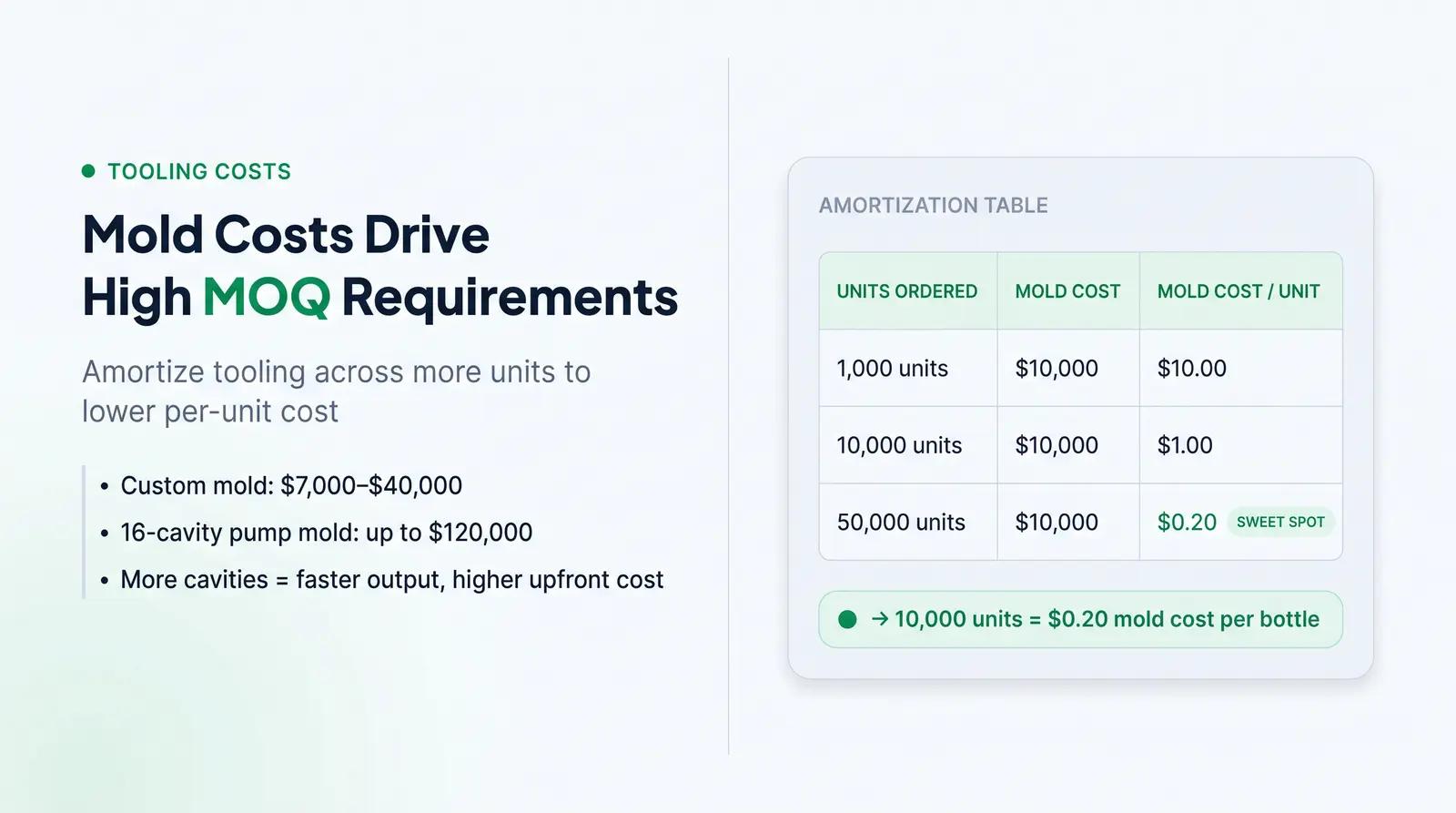
The mold is the most expensive component of glass and plastic packaging manufacturing. Made of precision-machined steel, a custom injection mold for a plastic bottle or a blow mold for glass gives the container its unique shape, details, and finish. According to packaging manufacturers, custom mold costs usually range between $7,000 and $40,000, depending on complexity, cavities, and finishing [1]. A 16-cavity actuator mold for a pump head can reach $120,000 [1].
These substantial upfront investments are why MOQs need to be high. Amortizing a $10,000 mold over 1,000 units adds $10 to the cost of each empty bottle. Amortizing it over 50,000 units drops that fixed cost to just $0.20 per unit. By requiring 10,000 or more units as a minimum, suppliers can recover mold costs over an adequate production volume while offering a competitive unit price [2].
A mold’s cavity count refers to how many parts it produces per machine cycle. More cavities mean faster output and lower per-unit cost, but they also increase initial investment and require more advanced molding machines [1]. For example, a 4-cavity PET blow mold produces four bottles per cycle and is ideal for small to mid-volume runs [1]. A 16-cavity actuator mold is designed for high-volume, automated production lines [1]. As a brand, choosing the cavity count depends on your production volume, lead time, and the manufacturing partner’s machine capability.
According to industry-standard formulas, a mold price includes raw materials (15–30%), design and CAD engineering (10–20%), CNC machining and labor (40–50%), polishing and texturing (5–10%), and trial runs and quality checks (5–10%) [1]. Higher precision molds, like those used for airless pumps or click-on caps, cost more due to tighter tolerances and surface polish requirements [1].
Custom Color and Material Finishing Minimums
Even if a brand uses a stock mold, requesting a custom color or specific finish triggers its own set of MOQs.
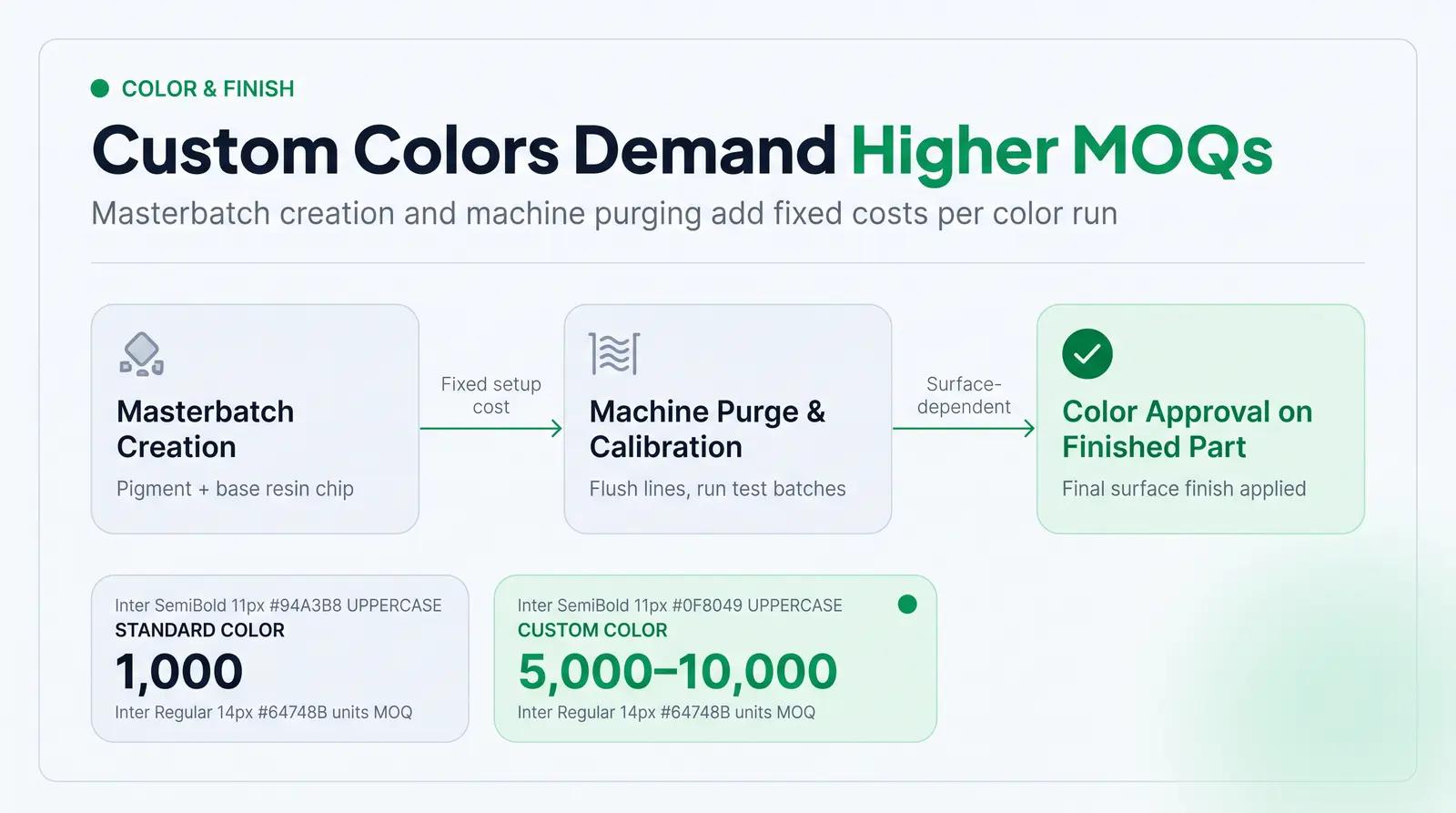
Pantone color codes are designed for printing inks on white paper, not for molten plastic resins [3]. Achieving a specific custom color in plastic packaging requires creating a masterbatch—a resin chip created using the exact pigment and base resin combination [3]. Because different polymers absorb and reflect light differently (PETG looks glossy and vibrant, while PP looks more muted), dialing in the exact color requires extensive trial and error [3].
Every color change requires the factory to purge the machines of the previous color, clean the lines, and run test batches to calibrate the new pigment. If a factory runs machines for a small batch, those fixed setup costs and wasted materials must still be covered [4]. This is why custom-colored or frosted bottles require higher MOQs, often pushing minimums to 5,000 or 10,000 units, whereas standard clear or white stock bottles might be available in batches of 1,000 [5].
Different polymers absorb and reflect light differently, even when infused with the same pigment. Glossy surfaces reflect more ambient light, increasing the perceived brightness of the color. A frosted or matte finish diffuses light, making the same pigment appear darker and flatter [3]. Color approvals must be done on finished parts with the intended surface finish applied, rather than judging color from raw molded blanks [3].
The Complexity of Multi-Component Sourcing
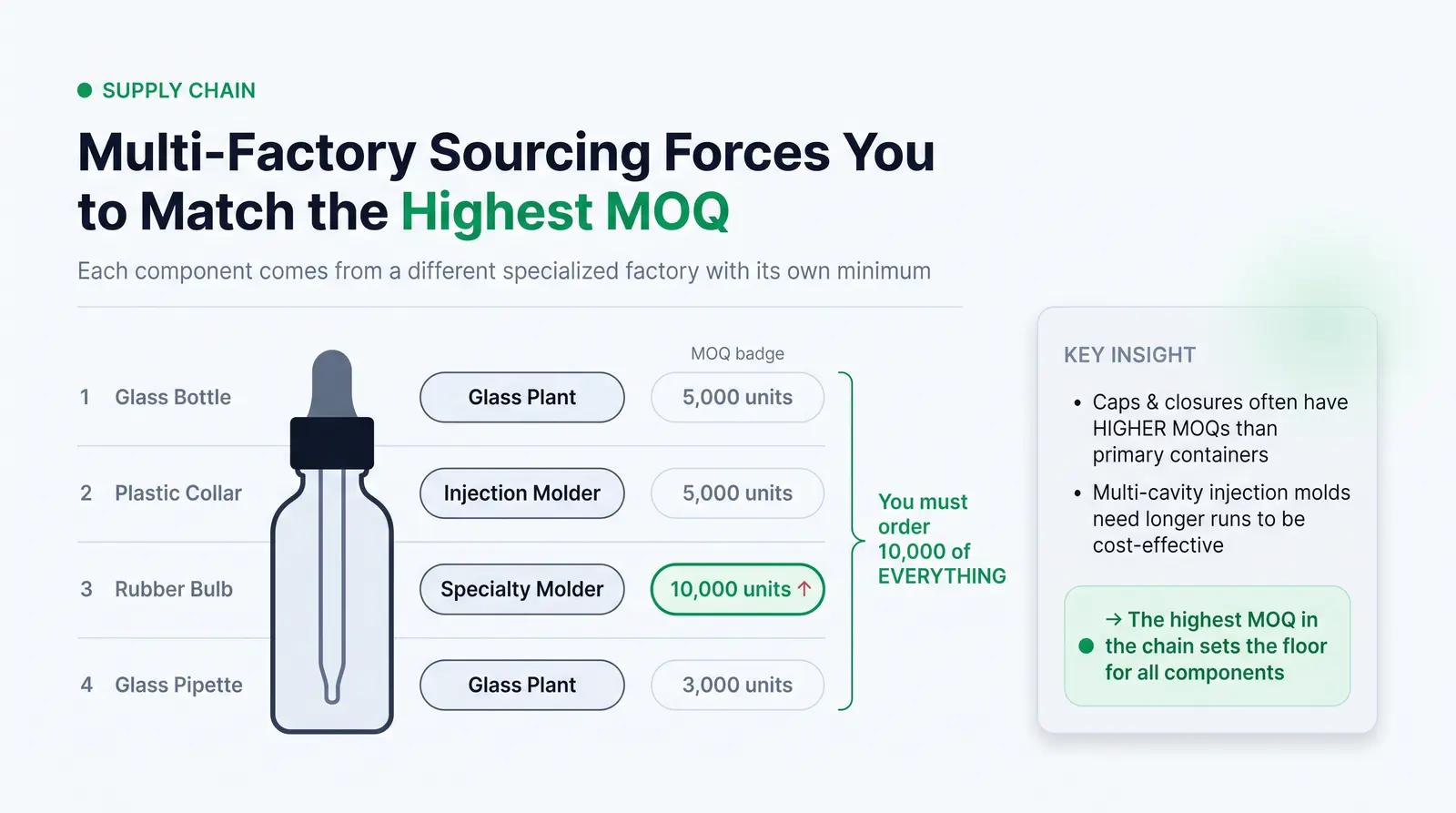
One of the most non-obvious drivers of high MOQs is that cosmetic packaging is rarely manufactured in a single facility. A typical serum bottle consists of the glass bottle, a plastic collar, a rubber bulb, and a glass pipette.
Often, these components come from different specialized factories. A glass plant blows the bottle, while an injection molding facility produces the plastic collar and rubber bulb. Each of these factories has its own minimum efficient run size. You might find a glass supplier willing to run 3,000 bottles, but the factory producing the custom-colored rubber bulb requires a 10,000-unit minimum. Because the final product requires all components, the brand is forced to order to the highest MOQ in the supply chain.
Interestingly, MOQs on caps and closures are often higher than on the primary container itself. A glass bottle might have an MOQ of 5,000 units, but a custom-colored injection-molded cap might require 10,000 units because the multi-cavity injection molds used for small components need longer runs to be cost-effective [1].
Decoration and Print Setup Costs
Once the container is manufactured, it must be decorated. Techniques like hot stamping, silkscreen printing, and UV coating each carry their own setup fees and minimums.
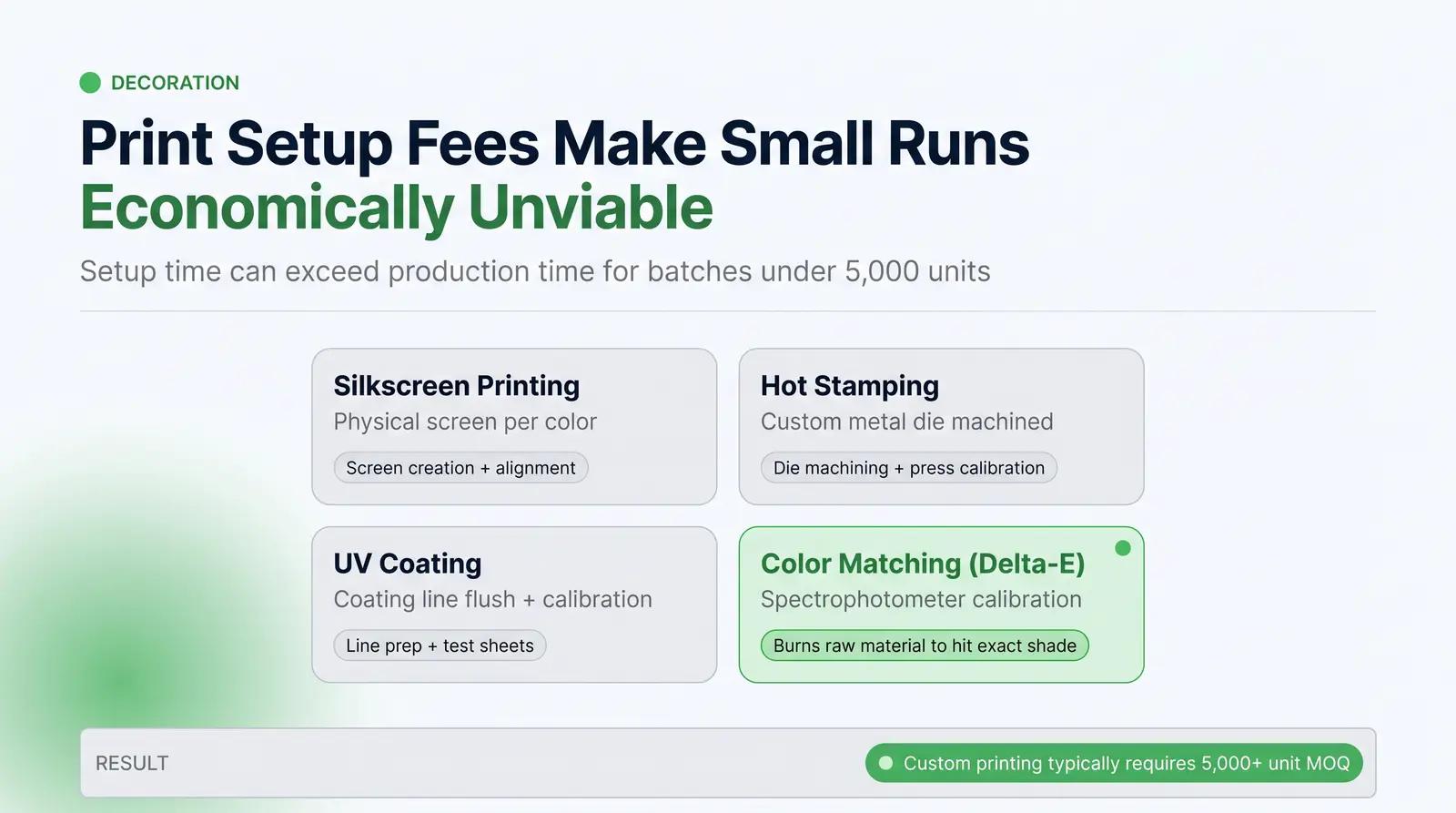
For a process like silkscreen printing, the factory must create a physical screen for each color in the design. For hot stamping, a custom metal die must be machined to press the metallic foil onto the surface. The setup time for these machines can take hours, and the process requires running test units to ensure perfect alignment [6].
If a brand only wants 500 units printed, the setup time might take longer than the actual production run. The factory actually loses money just by turning the machines on for such a small batch [7]. This is why custom printing or metallic finishes typically increase the MOQ to 5,000 or more units [5].
Color matching is also incredibly complex. The physical paper fibers or container surfaces absorb ink unpredictably, and controlling this requires a spectrophotometer to measure the Delta-E color tolerance [6]. That calibration process burns through sheets of raw material before the exact shade is hit [6]. Factory minimums exist precisely so there is enough material allowance to dial in the exact brand colors without wiping out margins [6].
Factory Production Run Economics
At the core of all these constraints is the fundamental logic of industrial manufacturing: machine run efficiency.
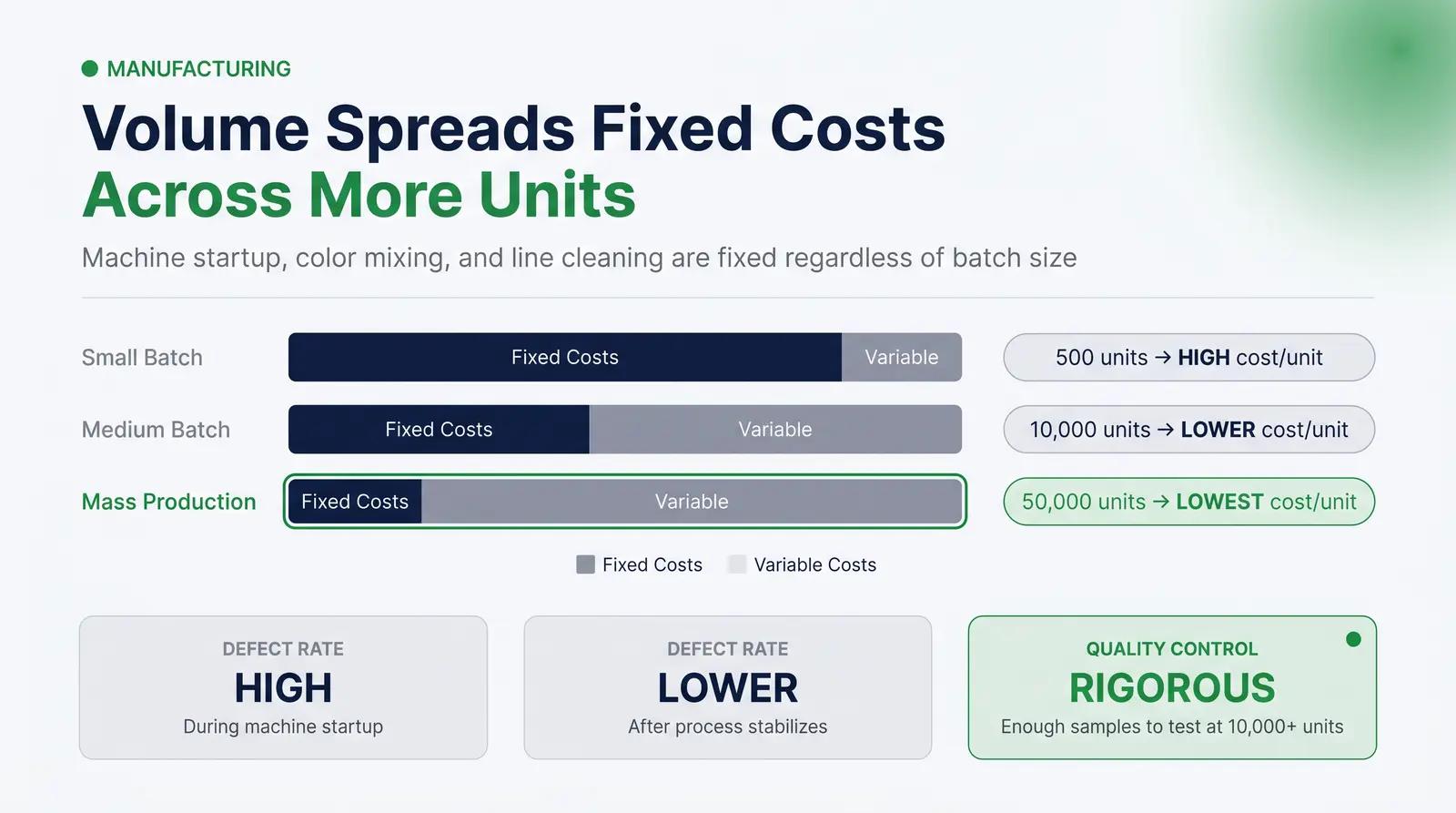
Glass plants, for example, are configured for continuous, high-volume output. The mold machines have lower yield rates when ramping up and shutting down custom bottle production [2]. Defective output is higher at the start of runs as processes stabilize [2]. With MOQs of 10,000 or more, defect and spoilage ratios are minimized as processes improve over sustained production [2].
For small batches, the fixed costs of machine setup, color mixing, and line cleaning are shared by a tiny number of pieces [7]. In mass production, those same fixed costs are spread over 50,000 units [7].
Producing over 10,000 units enables suppliers to implement adequate quality control measures for custom glass [2]. Throughout the run, samples from different batches and time periods can be pulled for dimensional, pressure, and purity testing [2]. Lower minimums mean fewer data points and opportunities to fine-tune processes [2]. High-volume output allows rigorous inspection protocols to be enacted cost-effectively to catch any inconsistencies [2].
A Worked Example: The MOQ Stacking Effect
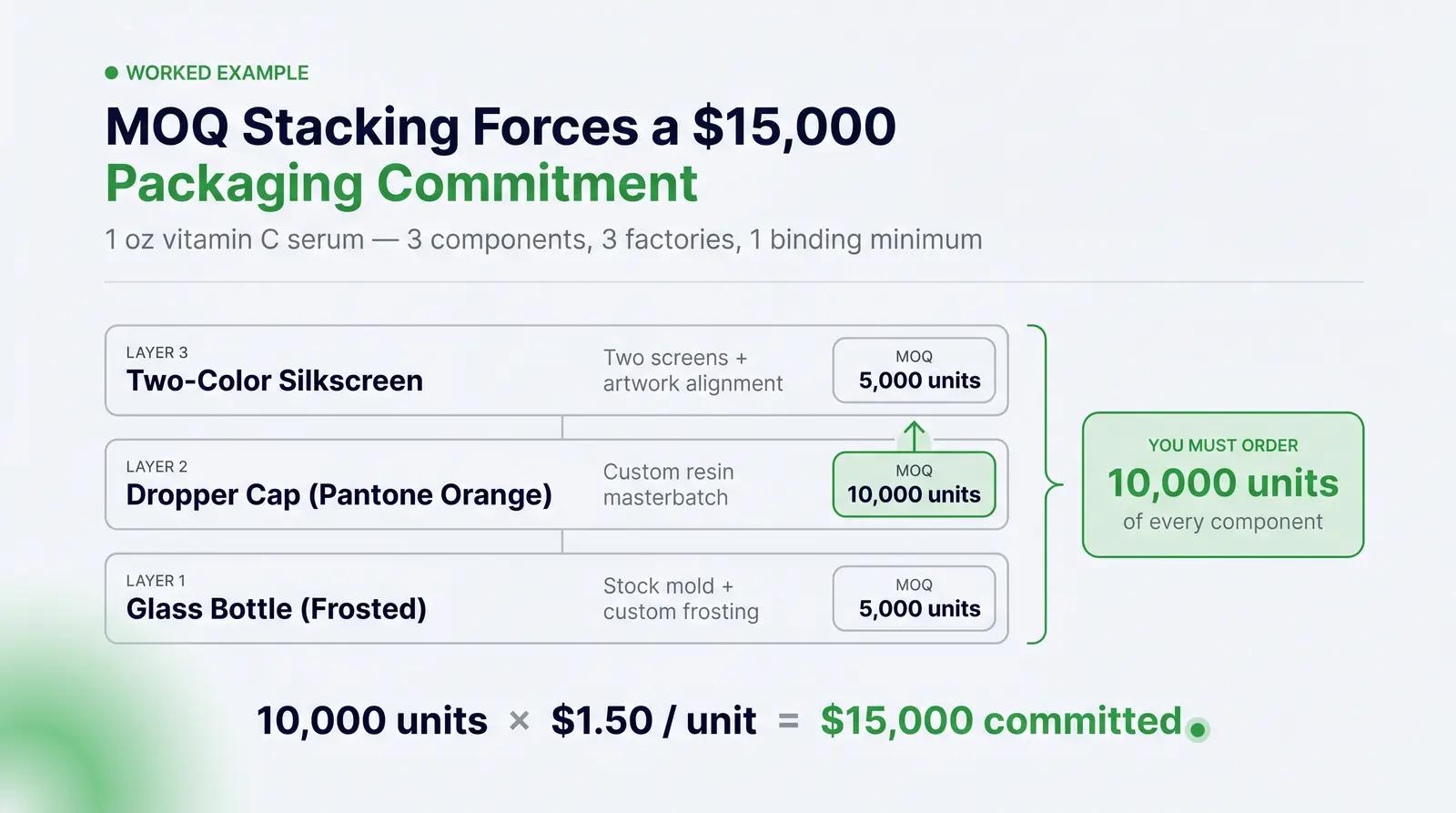
To see how these factors compound, consider a founder launching a 1 oz (30 ml) vitamin C serum. They select a custom frosted glass bottle with a custom-colored Pantone orange dropper cap and two-color silkscreen printing. Here is what each MOQ layer adds up to:
- Primary Glass Bottle (Stock Mold, Custom Frosting): The glass supplier requires a 5,000-unit MOQ for the frosting process.
- Dropper Cap (Custom Pantone Orange): The injection molding factory requires a 10,000-unit MOQ to run the custom orange resin masterbatch.
- Decoration (Two-Color Silkscreen): The printing facility requires a 5,000-unit MOQ to set up the two screens and align the artwork.
Because the brand needs complete, matching units, they are forced to order 10,000 units of everything to satisfy the highest MOQ in the chain (the custom cap). If the unit cost is $1.50, the brand must commit $15,000 just to secure the packaging for a single SKU.
Alternatives for First Launches
For brands that cannot or should not commit to 10,000 units for a launch, several alternatives exist, each with its own trade-offs.
The Launch-Stage MOQ Decision Framework
The framework we recommend at Packfolio helps founders balance customization with cash flow:
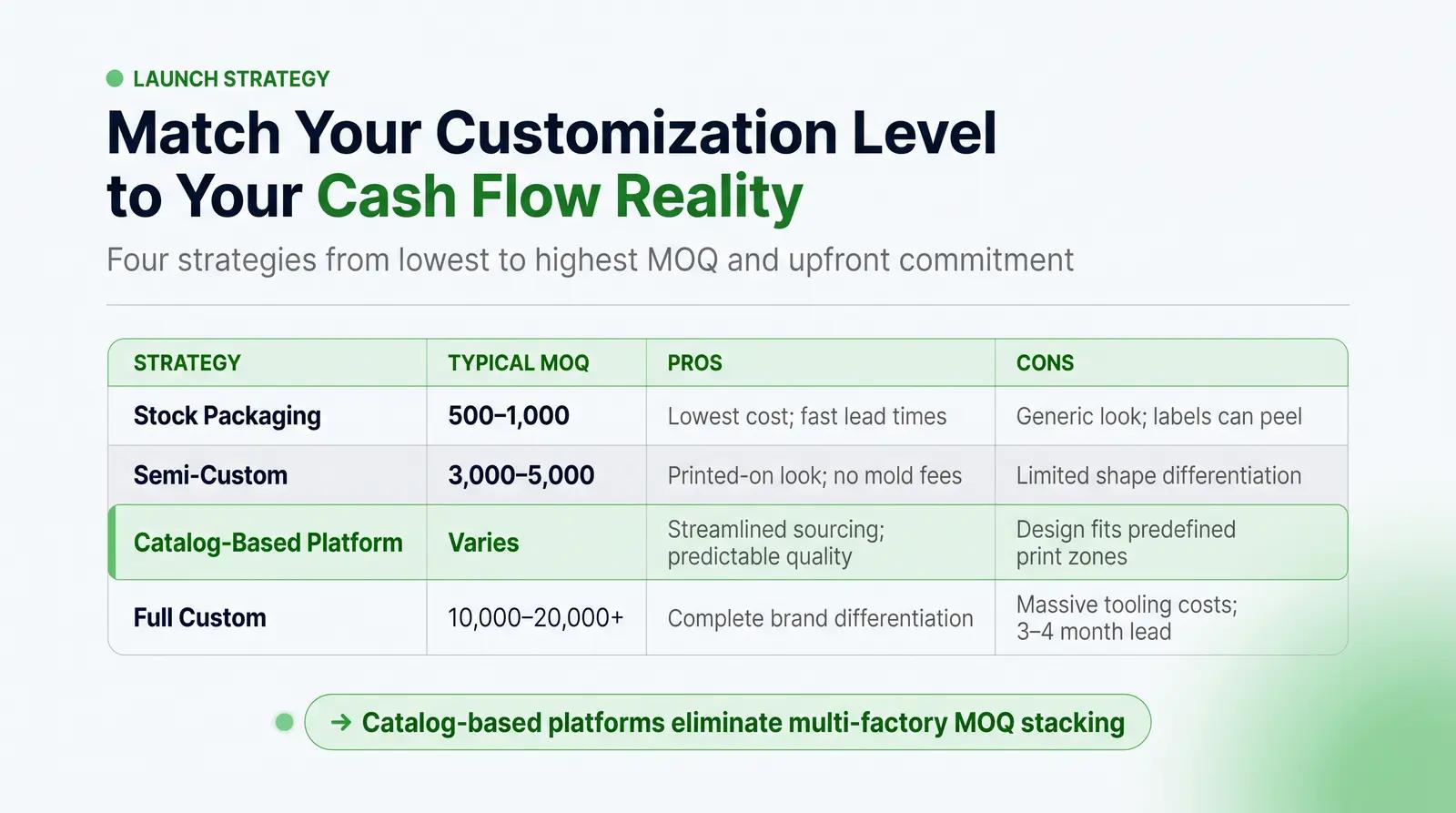
| Strategy | What It Is | Typical MOQ | Pros | Cons |
|---|---|---|---|---|
| Stock Packaging (No Customization) | Off-the-shelf clear/white bottles with paper labels. | 500 - 1,000 | Lowest upfront cost; fast lead times. | Generic appearance; labels can peel or look cheap. |
| Semi-Custom (Stock Mold + Custom Print) | Standard bottle shapes decorated with silkscreen or hot stamping. | 3,000 - 5,000 | Professional, printed-on look without mold fees. | Limited shape differentiation; moderate cash outlay. |
| Catalog-Based Platforms | Pre-vetted stock components with predefined printable regions. | Varies | Streamlined sourcing; predictable quality. | Design must fit within predefined print zones. |
| Full Custom (Custom Mold + Color) | Bespoke shapes, custom resin colors, and complex finishes. | 10,000 - 20,000+ | Complete brand differentiation; lowest per-unit cost at scale. | Massive upfront tooling costs; 3-4 month lead times. |
For many founders, the most strategic move is to avoid multi-factory MOQ stacking entirely. This is where catalog-based platforms provide a genuine next step. By browsing Packfolio's curated cosmetic packaging catalog and previewing your label in 3D before you place a single unit, you can access pre-vetted SKUs with predefined print zones. Packfolio coordinates the production, decoration, and quality assurance across a single vendor, eliminating the need to juggle separate minimums for bottles, caps, and printing. You can explore the options at packfolio.com/catalog.
Understanding the mechanics behind MOQs transforms them from a frustrating barrier into a predictable variable. By strategically choosing where to customize and where to use standard components, founders can launch premium-looking products without tying up their entire operating budget in empty bottles.
Browse Packfolio's curated cosmetic packaging catalog and preview your label in 3D before you place a single unit → packfolio.com/catalog
Frequently Asked Questions
Why is the MOQ for glass bottles usually higher than for plastic? Glass manufacturing requires continuous, high-temperature furnace operation and complex blow-molding processes. Shutting down or changing molds disrupts this continuous flow, so factories require larger runs (often 10,000+ units) to maintain efficiency and minimize the high defect rates that occur during machine startup.
Can I negotiate a lower MOQ with a packaging supplier? Yes, but usually only if you compromise on customization. Suppliers are often willing to lower MOQs if you select stock molds, standard colors (like clear or white), and simplify your decoration to standard labels rather than custom silkscreening.
What is the cheapest way to customize low-MOQ packaging? The most cost-effective method is to purchase stock packaging (standard shapes and colors) and apply high-quality digital labels. This avoids the high setup fees associated with custom molds, custom resin colors, and silkscreen printing plates.
Why do caps and pumps have different MOQs than the bottles? Caps, pumps, and bottles are often made from different materials (e.g., glass vs. plastic) and manufactured in completely different specialized facilities. A factory injection-molding a complex pump mechanism has different minimum run requirements than a factory blowing glass bottles.
Does a custom color cost more than a custom mold? In low volumes, a custom mold has a much higher fixed upfront cost ($7,000+ for tooling). However, custom colors require high MOQs (often 10,000+ units) to cover the cost of machine purging and color calibration. If you cannot meet the color MOQ, the effective cost of securing that custom color can be prohibitively high for a small launch.
References
- Christina. "The True Cost of Custom Molds in Cosmetic Packaging: Explained with Real Numbers." AH Packaging, 2025. https://ahpackaging.com/the-true-cost-of-custom-molds-in-cosmetic-packaging-explained-with-real-numbers/
- Li, Shouyong. "Why Custom Glass Bottle MOQs Are Typically Over 10,000 Units." BottleSales, 2025. https://bottlesales.cn/blogs/why-custom-glass-bottle-moqs-are-typically-over-10-000-units
- Christina. "Why Is It So Difficult to Match Custom Colors for Cosmetic Packaging Bottles?" AH Packaging, 2026. https://ahpackaging.com/why-is-it-so-difficult-to-match-custom-colors-for-cosmetic-packaging-bottles/
- Christina. "How Does MOQ Affect Cosmetic Packaging Costs (And What You Can Do About It)?" AH Packaging, 2025. https://ahpackaging.com/how-does-moq-affect-cosmetic-packaging-costs/
- Christina. "MOQ for Different Packaging Types: Bottles, Jars, Boxes, and More." AH Packaging, 2025. https://ahpackaging.com/moq-for-different-packaging-types/
- Wong, Harvey. "What is the minimum order quantity for custom cosmetics packaging?" POP Display, 2026. https://popdisplay.me/what-is-the-minimum-order-quantity-for-custom-cosmetics-packaging/
- Terry. "The Real Logic Behind Low MOQ Cosmetic Packaging: A Guide for Indie Beauty Brands." BottleMile, 2026. https://bottlemile.com/the-real-logic-behind-low-moq-cosmetic-packaging-a-guide-for-indie-beauty-brands/


