
How Much Does Cosmetic Packaging Cost?
Cosmetic packaging landed costs often exceed quoted unit prices by 30 to 80 percent. This guide breaks down eight cost layers and a step-by-step framework for accurate budgeting.
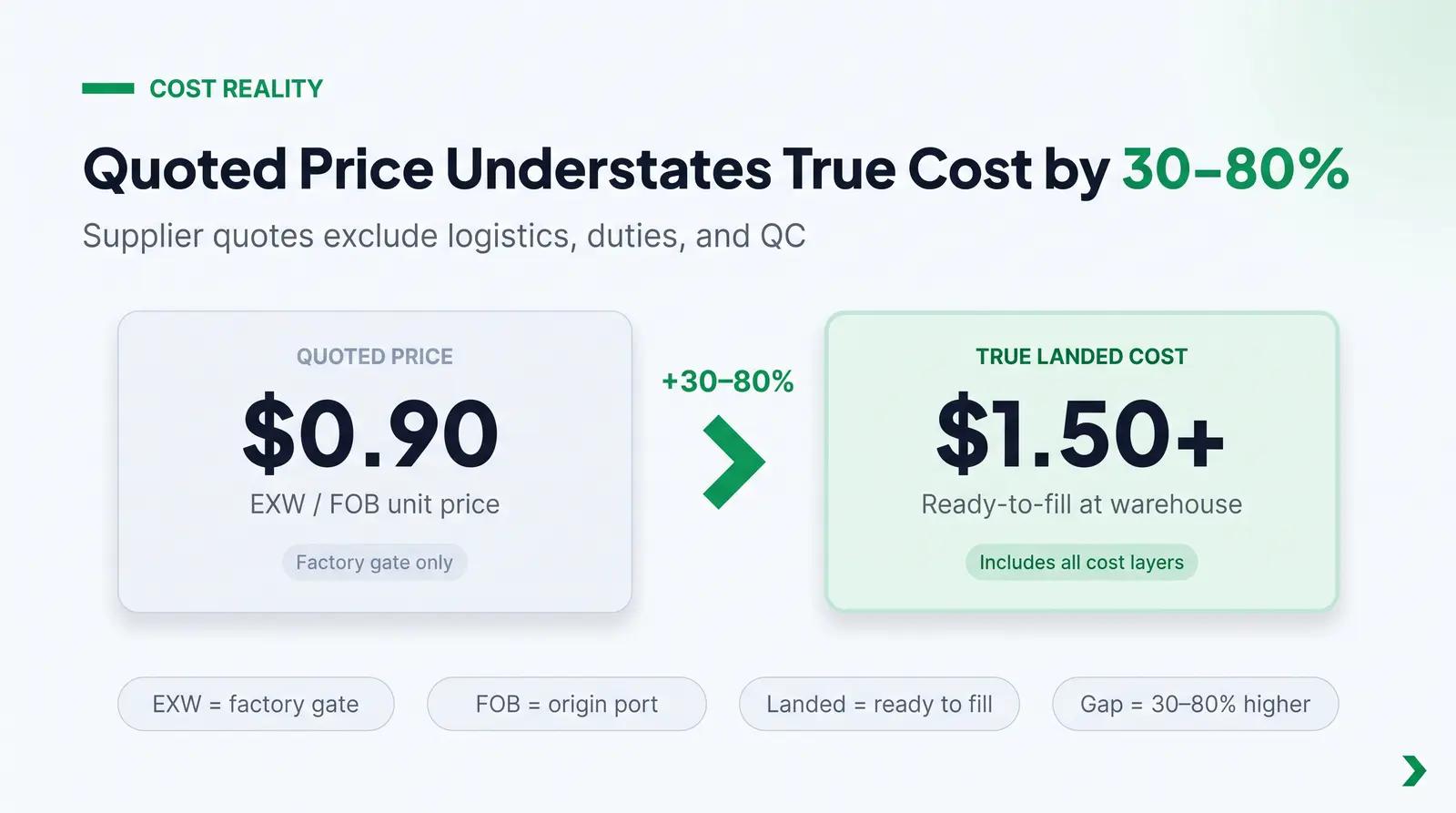
A common trap awaits independent beauty brand founders, formulators, and contract manufacturers when sourcing cosmetic packaging. A founder receives a unit price quote from a supplier, builds a profit and loss statement, and assumes that is the cost of the packaging. This price opacity is the single greatest pain point in beauty product development. Quoted unit prices are almost always lower than the true cost of getting that packaging to a warehouse, ready for filling. The resulting gap, which can easily represent a thirty to eighty percent cost increase, frequently surprises founders at the worst possible moment: pre-launch, during a critical cash-flow crunch.
Understanding the true landed cost of cosmetic primary packaging is essential for protecting margins, setting retail prices, and managing capital. This guide breaks down the major cost drivers, presents indicative market price ranges, introduces a named decision framework for budgeting, and analyzes the cash-flow implications of minimum order quantities for growing brands. For a deeper look at how to choose the right container for your formula, see our guide to cosmetic packaging materials.
Why Quoted Unit Price Is Only Part of the Story
When sourcing bottles, jars, tubes, or droppers, suppliers typically quote an Ex Works or Free on Board unit price. This is the base cost of the physical component sitting at the factory gate. For example, a supplier might quote ninety cents per piece for a custom glass dropper bottle. It is tempting to plug that ninety cents directly into a cost of goods sold model.
However, suppliers quote unit prices in isolation because they do not handle your logistics, custom duties, or quality control. They do not know your shipping destination, your timeline, or your tolerance for defect rates. The true cost of your packaging is its landed cost: the total price of the component by the time it arrives at your contract filler's facility, fully decorated, inspected, and ready to be filled. Treating the quoted unit price as the final cost leads to severe underpricing of the retail product, which directly erodes gross margins.
The Major Cost Drivers in Cosmetic Packaging
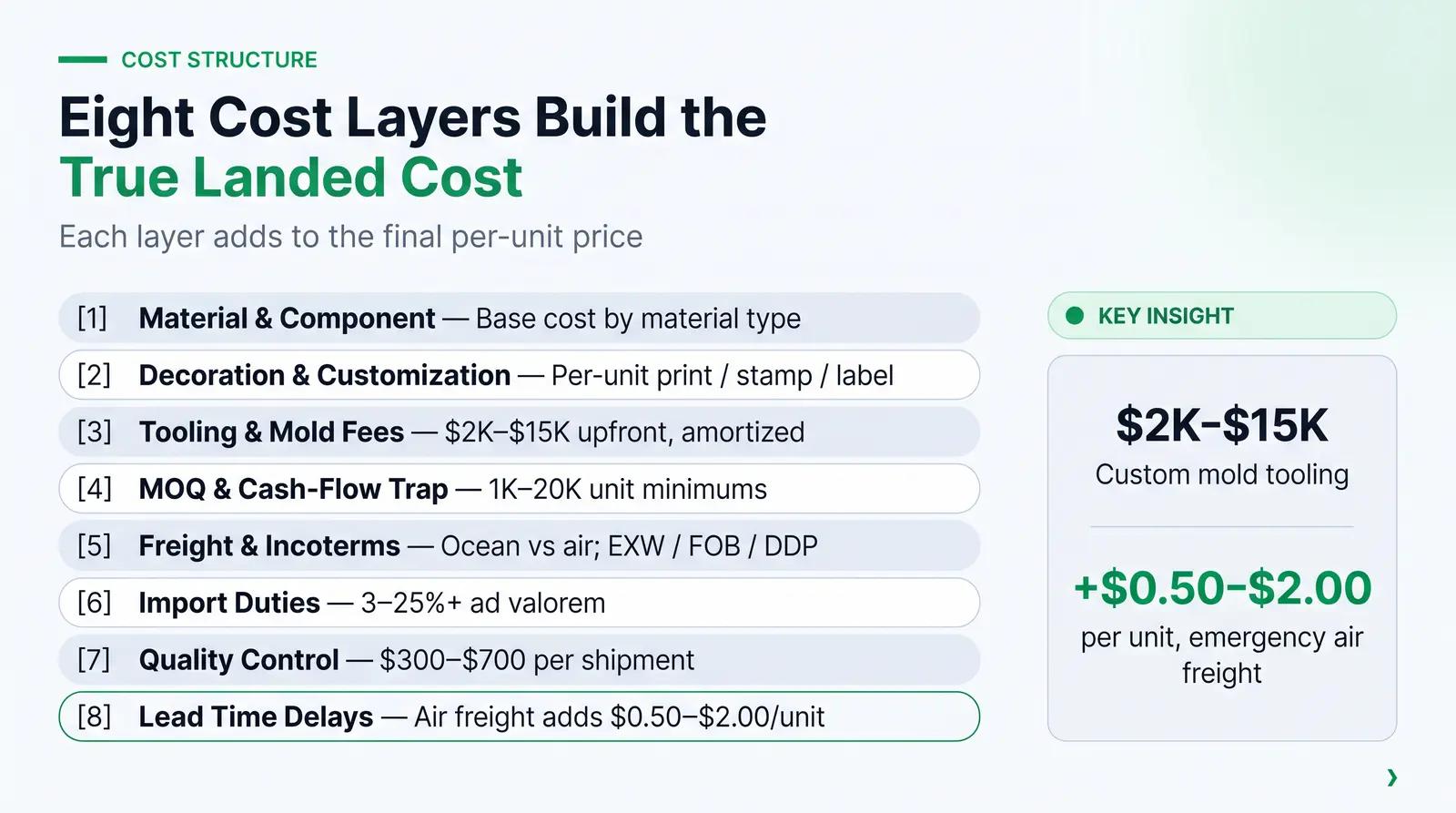
To build an accurate packaging budget, founders must understand the eight distinct cost layers that contribute to the true landed cost of cosmetic primary packaging.
Material and Component Type
The baseline cost of any cosmetic container is determined by its material composition and mechanical complexity [1]. Glass offers a premium, heavy-weight feel and excellent chemical compatibility, but it carries a higher base cost and significantly higher shipping fees due to its weight [1] [2]. Standard plastics like polypropylene, high-density polyethylene, and polyethylene terephthalate are highly cost-effective and lightweight, but they may not convey a luxury brand image [1].
Airless pump bottles represent a mechanically complex category. They utilize a piston mechanism to dispense product without exposing it to oxygen, extending shelf life and protecting active ingredients [1] [3]. This complexity commands a premium compared to simple dip-tube pumps or open-mouth jars [1] [3].
Decoration and Customization Method
An undecorated stock bottle is inexpensive, but branding requires decoration. Each decoration method adds a specific per-unit charge and setup fee [2]:
- Pressure-Sensitive Labeling: The most flexible and cost-effective method for small runs. It allows for multi-color designs but requires the additional cost of the physical label and the labor to apply it [2].
- Silk Screen Printing: Ink is pressed directly onto the container. Single-color printing is highly cost-efficient, but multi-color silk screening requires separate screens and passes, which escalates costs significantly [2].
- Hot Stamping: A metallic foil is heat-transferred onto the container, creating a premium, reflective finish [2]. It requires custom metal dies and precise calibration [2].
- Anodizing and Metallization: Used primarily for aluminum collars, caps, or plastic components to create a metallic sheen. This is a chemical process that carries a higher base premium.
Tooling and Mold Fees
If a brand requires a unique bottle shape or a custom-molded cap, they must pay for the physical steel or aluminum molds used in the injection or blow molding machines [2]. These tooling fees are upfront, non-recurring engineering charges [2]. Custom primary packaging molds typically range from two thousand dollars to fifteen thousand dollars depending on the cavity count and complexity [2]. Even for customized stock packaging, brands must pay setup fees for printing plates and decoration dies, which typically range from three hundred dollars to two thousand dollars [2].
Minimum Order Quantities and the Cash-Flow Trap
Minimum order quantities are the lowest number of units a supplier is willing to produce in a single run [2]. For stock packaging, MOQs can be as low as one case. For custom decorated components, MOQs typically range from one thousand to five thousand units [2]. For fully custom molds, MOQs frequently jump to ten thousand or twenty thousand units [2].
The cash-flow trap occurs when a founder is forced to buy five thousand units of a component to get a lower unit price, even though they only plan to sell one thousand units in their first year. The capital tied up in slow-moving inventory cannot be used for marketing or product development, which increases the risk of business failure.
Freight, Shipping Mode, and Incoterms
International shipping is governed by Incoterms, which define exactly where the seller's responsibility ends and the buyer's responsibility begins [4]. The three most common Incoterms in cosmetic packaging sourcing are:
- Ex Works (EXW): The buyer pays for all transportation from the supplier's factory door to the final destination [4]. This gives the buyer full control but places all logistical risk and cost on them [4].
- Free on Board (FOB): The seller pays to get the goods onto the shipping vessel at the origin port [4]. The buyer pays for the ocean or air freight, customs clearance, and domestic delivery [4].
- Delivered Duty Paid (DDP): The seller handles the entire supply chain, including international freight, import clearance, duties, and final delivery to the buyer's door [4]. While DDP is the most convenient, suppliers often build a significant margin buffer into DDP quotes.
Shipping mode also dictates cost. Ocean freight is calculated by volume (cubic meters) and is highly cost-effective for large shipments, but it requires thirty to fifty days of transit time [5]. Air freight is calculated by weight and is fast (three to seven days), but it carries a massive cost premium [2] [5].
Import Duties and Customs Classification
All imported packaging is subject to customs duties determined by the Harmonized Tariff Schedule of the United States [6]. Packaging must be classified under the correct ten-digit HTS code [6]:
- Glass Containers (HTS 7010.90): Subject to a base duty rate of approximately six and a half percent [7].
- Plastic Packaging (HTS 3923.90): Subject to a base duty rate of approximately three percent [8].
Importing from certain countries, such as China, may subject the shipment to additional Section 301 tariffs, which can add an extra seven and a half to twenty-five percent ad valorem duty on top of the base rate [9]. Misclassifying goods to avoid duties can lead to severe customs holds, audits, and fines of up to ten thousand dollars per shipment [9].
Quality Control and Inspection Costs
Cosmetic primary packaging must meet strict quality standards to prevent leakage, compatibility issues, or aesthetic defects. A scratched logo or a poorly sealing cap can ruin a product launch. Brands importing packaging should hire a third-party quality control agency to perform a pre-shipment inspection at the factory [10]. These inspections typically cost three hundred dollars to seven hundred dollars per shipment [10]. Amortizing this cost across the order volume is a necessary step in calculating the true unit cost.
Lead Times and the Hidden Cost of Delays
The hidden cost of packaging sourcing is time. Custom overseas production typically requires eight to twelve weeks, plus another four to six weeks for ocean transit and customs clearance [2]. If a brand experiences a production delay or a customs hold, they risk missing their launch date. To meet retail commitments, founders are often forced to authorize emergency air freight, which can add fifty cents to two dollars per unit to the shipping cost, completely wiping out the product's profit margin [2].
Typical Cost Ranges by Packaging Type
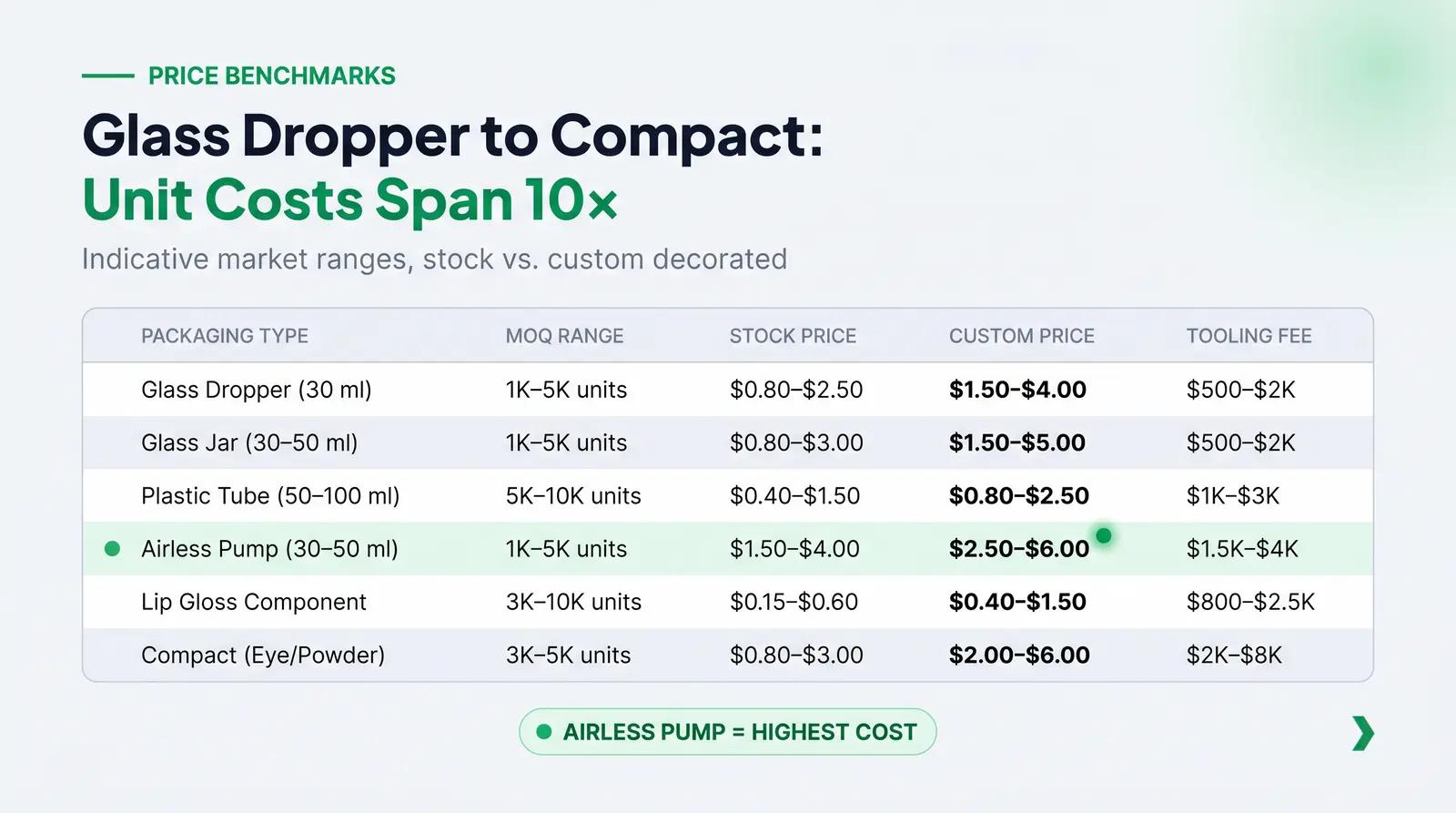
The following table provides indicative market estimates for common cosmetic primary packaging types, based on industry sourcing data [1] [2] [3]. Actual pricing will vary based on raw material fluctuations, decoration complexity, and specific supplier negotiations.
| Packaging Type | Typical MOQ Range | Approximate Unit Price (Stock) | Approximate Unit Price (Custom Decorated) | Typical Tooling/Setup Fee Range | Notes |
|---|---|---|---|---|---|
| Glass Dropper Bottle (30 ml / 1 oz) | 1,000 – 5,000 | $0.80 – $2.50 | $1.50 – $4.00 | $500 – $2,000 | Heavy shipping weight; premium feel; excellent chemical resistance [1] [2]. |
| Glass Jar (30 ml – 50 ml) | 1,000 – 5,000 | $0.80 – $3.00 | $1.50 – $5.00 | $500 – $2,000 | Ideal for creams; requires protective outer packaging [1] [2]. |
| Plastic Tube (50 ml – 100 ml) | 5,000 – 10,000 | $0.40 – $1.50 | $0.80 – $2.50 | $1,000 – $3,000 | Lightweight; cost-effective; high MOQ for custom extrusion [1] [2]. |
| Airless Pump Bottle (30 ml – 50 ml) | 1,000 – 5,000 | $1.50 – $4.00 | $2.50 – $6.00 | $1,500 – $4,000 | High product protection; complex mechanism; premium price point [1] [3]. |
| Lip Gloss Component | 3,000 – 10,000 | $0.15 – $0.60 | $0.40 – $1.50 | $800 – $2,500 | Small volume; highly dependent on applicator type and cap finish [1]. |
| Compact (Eyeshadow/Powder) | 3,000 – 5,000 | $0.80 – $3.00 | $2.00 – $6.00 | $2,000 – $8,000 | Often requires custom insert trays; mirror assembly adds cost [1]. |
The Packaging Landed-Cost Framework
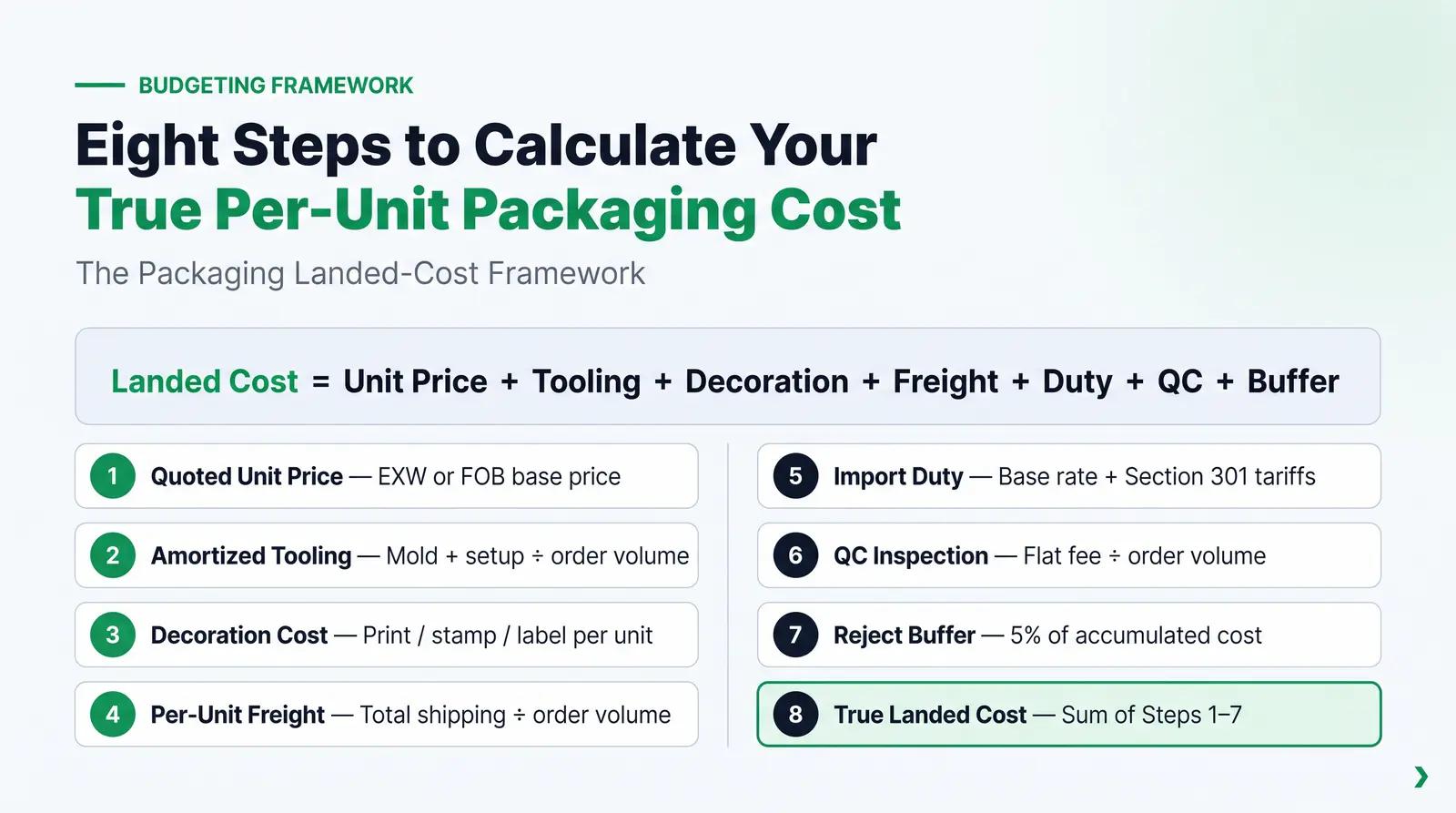
To help beauty founders navigate these layers, we recommend utilizing The Packaging Landed-Cost Framework. This step-by-step methodology allows you to construct a reliable, per-unit packaging cost before committing capital to production. The framework is the approach we use at Packfolio for any founder building a packaging budget.
Landed Cost Per Unit = Quoted Unit Price + Amortized Tooling and Setup + Decoration Cost + Per-Unit Freight + Import Duty + Per-Unit QC Cost + Reject Buffer
Step 1: Establish the Quoted Unit Price
Start with the base price quoted by the supplier. This is typically the EXW or FOB price for the raw, undecorated component.
Step 2: Calculate Amortized Tooling and Setup Costs
Divide all one-time upfront costs (custom mold fees, printing plate charges, screen setup fees, and die creation costs) by the total number of units in the first production run. $$\text{Amortized Tooling} = \frac{\text{Total Tooling & Setup Fees}}{\text{Order Volume}}$$
Step 3: Add the Decoration Cost
Add the direct per-unit charge for printing, hot stamping, labeling, or custom color matching.
Step 4: Calculate Per-Unit Freight
Determine the total cost of shipping the order from the supplier to your warehouse, including ocean/air freight, port handling charges, customs broker fees, and domestic trucking. Divide this total by the order volume. $$\text{Per-Unit Freight} = \frac{\text{Total Freight & Logistics Cost}}{\text{Order Volume}}$$
Step 5: Apply the Import Duty Rate
Calculate the estimated customs duties by multiplying the duty rate (including any Section 301 tariffs) by the quoted unit price of the goods. $$\text{Import Duty} = \text{Quoted Unit Price} \times (\text{Base Duty Rate} + \text{Tariff Surcharges})$$
Step 6: Amortize Quality Control and Inspection Costs
Divide the flat fee of hiring a third-party inspection agency by the total order volume. $$\text{Per-Unit QC} = \frac{\text{Inspection Agency Flat Fee}}{\text{Order Volume}}$$
Step 7: Add a Reject and Delay Buffer
Add a five percent buffer to account for shipping damage, cosmetic defects, or component rejects during the filling process. This ensures you do not run short of components during production. $$\text{Buffer} = (\text{Sum of Steps 1 through 6}) \times 0.05$$
Step 8: Arrive at True Landed Cost Per Unit
Sum the values from Steps 1 through 7 to find the final landed cost per unit.
Worked Example: A Realistic Founder Scenario
To demonstrate the framework in action, let us apply it to a realistic sourcing scenario. A beauty founder is launching a vitamin C serum and orders 1,000 units of a custom-decorated 1 oz (30 ml) glass dropper bottle from an overseas supplier, shipped via ocean freight (LCL) to a US warehouse.
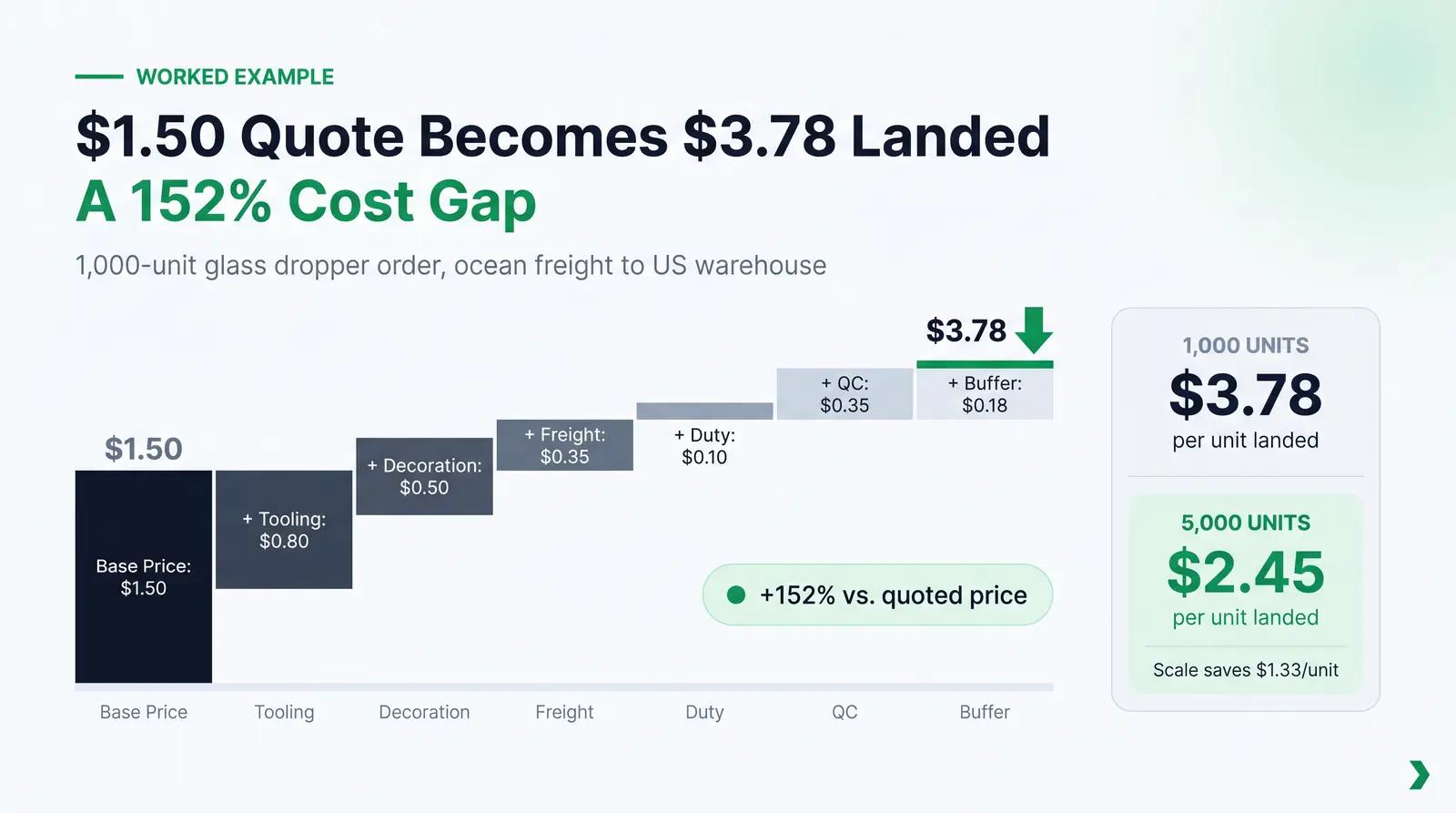
The supplier provides an initial FOB quote of $1.50 per unit for the bottle, dropper assembly, and glass pipette. Let us apply the Packaging Landed-Cost Framework to see how the cost layers accumulate:
- Base Quoted Unit Price: $1.50 per unit.
- Amortized Tooling and Setup: The supplier charges a flat $800 setup fee for the custom printing screens and decoration setup. $$\frac{$800 \text{ setup fee}}{1,000 \text{ units}} = $0.80 \text{ per unit}$$
- Decoration Cost: The supplier charges a per-unit fee of $0.50 for a single-color silk screen print.
- Per-Unit Freight: Ocean shipping (LCL), port fees, customs broker clearance, and final delivery to the warehouse total $350. $$\frac{$350 \text{ freight cost}}{1,000 \text{ units}} = $0.35 \text{ per unit}$$
- Import Duty: Glass bottles are classified under HTS 7010.90, which carries a base duty rate of 6.5% [7]. $$$1.50 \times 0.065 = $0.10 \text{ per unit}$$
- Per-Unit Quality Control: A third-party pre-shipment inspection at the factory costs a flat $350 [10]. $$\frac{$350 \text{ inspection fee}}{1,000 \text{ units}} = $0.35 \text{ per unit}$$
- Reject and Delay Buffer: We calculate a 5% buffer on the accumulated costs: $$($1.50 + $0.80 + $0.50 + $0.35 + $0.10 + $0.35) \times 0.05 = $3.60 \times 0.05 = $0.18 \text{ per unit}$$
- True Landed Cost Per Unit: $$$1.50 + $0.80 + $0.50 + $0.35 + $0.10 + $0.35 + $0.18 = $3.78 \text{ per unit}$$
The gap is stark. The quoted unit price was $1.50, but the true landed cost is $3.78 per unit—a 152% increase. If the founder had priced their serum using the $1.50 figure, they would have severely compromised their gross margin.
However, if the founder scales their next order to 5,000 units, the math shifts dramatically:
- Amortized tooling drops from $0.80 to $0.16 per unit.
- Per-unit freight (utilizing more efficient shipping volume) drops to $0.15 per unit.
- Per-unit QC drops from $0.35 to $0.07 per unit.
- The resulting landed cost falls to approximately $2.45 per unit, demonstrating the power of scale.
What "Wholesale" and MOQ Actually Mean for Small Brands
For independent beauty brands, navigating wholesale tiers and minimum order quantities is a delicate balancing act. Suppliers offer tiered pricing where higher volumes yield lower unit costs. It is easy to look at a wholesale tier and assume that ordering more is always the correct financial decision.
However, for brands with under five hundred thousand dollars in annual revenue, chasing the lowest per-unit price can be a dangerous financial mistake. This is due to inventory carrying costs, which represent the cost of holding unsold stock in storage. Industry data shows that annual inventory carrying costs typically range from fifteen to thirty percent of the total inventory value [11]. This includes the cost of warehouse space, insurance, taxes, handling labor, and the risk of damage or product obsolescence [11].
Consider this non-obvious insight: buying more packaging to lower your unit cost can actually cost you more in the long run. Let us compare two decisions for a brand that sells two thousand units of a serum per year:
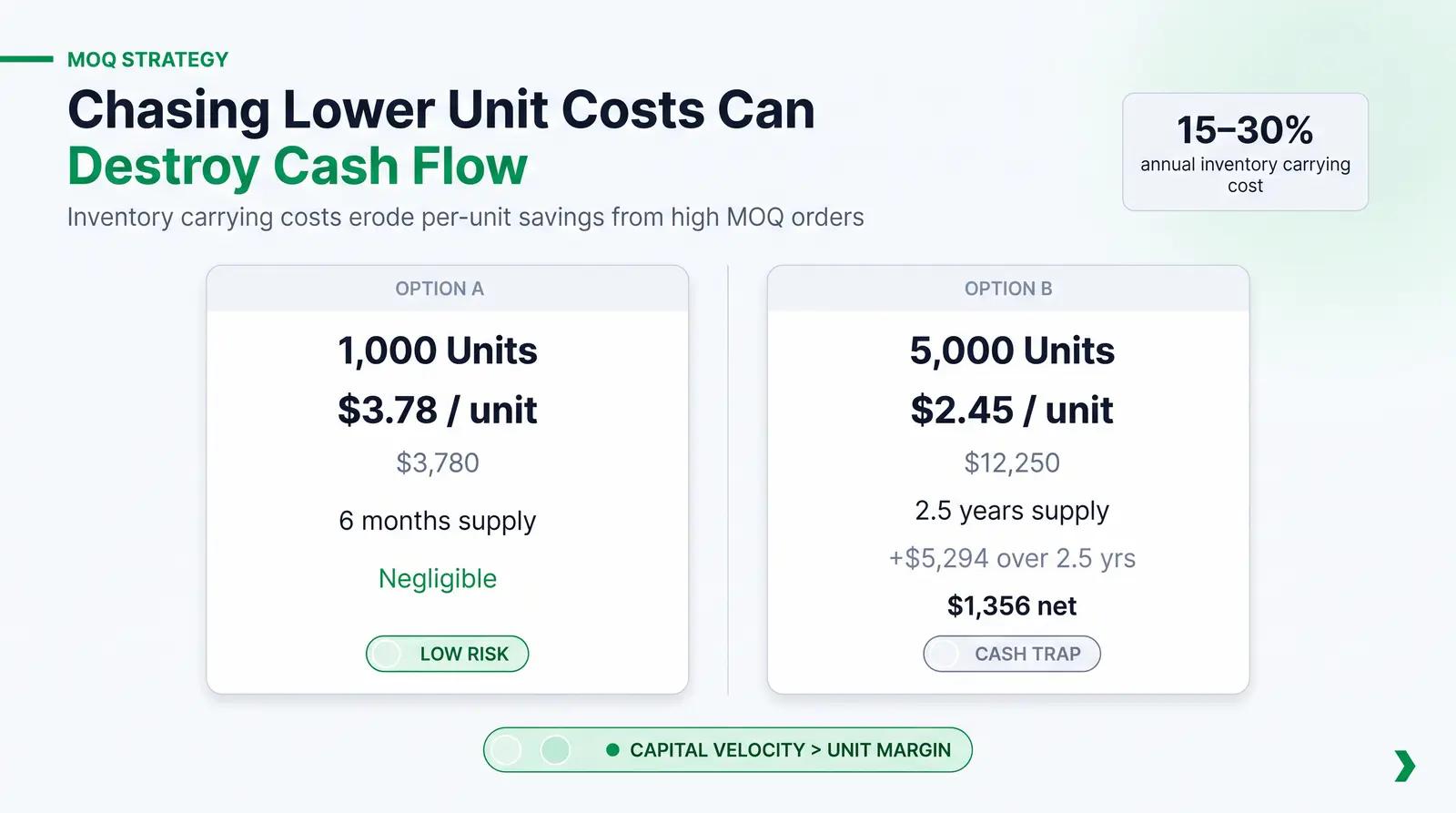
- Option A (Low MOQ Sourcing): Order 1,000 units at a landed cost of $3.78 per unit. The total cash outlay is $3,780. The inventory sells out in six months. The average carrying cost is negligible because the inventory moves quickly.
- Option B (High MOQ Sourcing): Order 5,000 units to unlock a lower landed cost of $2.45 per unit. The total cash outlay is $12,250. This represents two and a half years of inventory.
While Option B saves $1.33 per unit on paper, it ties up an additional $8,470 in cash. Assuming a standard annual carrying cost of twenty-five percent, holding that excess inventory costs the brand money every year [11]. Over the two and a half years required to sell through the five thousand units, the cumulative carrying cost on the slowly moving inventory accumulates to approximately five thousand two hundred and ninety-four dollars [11].
When you subtract the carrying costs from the initial unit savings, the net savings drop from six thousand six hundred and fifty dollars down to just one thousand three hundred and fifty-six dollars. More importantly, the brand has risked its survival by locking up over eight thousand dollars in cash that could have been spent on customer acquisition, advertising, or formulating new SKUs. For early-stage brands, capital velocity is far more important than theoretical unit margins.
At Packfolio, we designed our platform to eliminate this exact operational friction. Our curated catalog surfaces transparent, all-in pricing without requiring founders to chase quotes or navigate complex logistics. By integrating a browser-based 3D design tool directly into the order flow, we ensure that the photorealistic 3D preview you approve is exactly what you receive, eliminating the risk of costly rework and manufacturing errors.
If you are ready to simplify your sourcing and protect your margins, the next step is simple.
Browse Packfolio's curated packaging catalog, customize your label in the 3D design tool, and see your true order cost before committing → packfolio.com/catalog
Frequently Asked Questions
How much does it cost to get custom cosmetic packaging made?
Custom cosmetic packaging costs range from $0.50 per unit for simple stock plastic containers to over $5.00 per unit for custom-decorated luxury glass or airless pump bottles [1] [2] [3]. Upfront tooling and setup fees for custom molds or printing plates can add an additional $500 to $15,000 depending on complexity [2].
What is a typical MOQ for cosmetic packaging?
Typical minimum order quantities range from 1,000 to 5,000 units for custom-decorated stock bottles and jars, and 5,000 to 10,000 units for plastic tubes [1] [2]. Fully custom-molded shapes or specialized luxury components often require an MOQ of 10,000 to 20,000 units [2].
How do I calculate the landed cost of packaging?
To calculate landed cost, sum the quoted unit price, amortized tooling and setup fees, decoration charges, per-unit freight costs, import duties, and third-party inspection fees, then add a five percent buffer for rejects and delays.
Is glass or plastic packaging more expensive for skincare?
Glass packaging is generally more expensive than plastic, with base costs ranging from $0.80 to $3.00 per unit compared to $0.40 to $1.50 for plastic [1]. Glass also incurs significantly higher shipping costs and import duties due to its heavier weight and a 6.5% base duty rate compared to 3% for plastic [1] [2] [7] [8].
Can I order cosmetic packaging with no minimum order quantity?
Yes, some domestic distributors offer stock packaging with no minimum order quantity, allowing you to buy by the case. However, these components are completely undecorated, and the unit price is significantly higher than wholesale rates, making them suitable only for prototyping or very early-stage testing. For brands that want custom-decorated packaging without high MOQ commitments, on-demand platforms like Packfolio offer a more accessible path to market.
References
[1] Skincare Packaging Costs: Complete Price Guide 2026. Luxetubes. 2025. https://luxetubes.com/skincare-packaging-costs-guide/
[2] How to Reduce Cosmetic Packaging Costs Without Sacrificing Quality. Big Sky Packaging. 2026. https://bigskypackaging.com/blog/how-to-reduce-cosmetic-packaging-costs-without-sacrificing-quality/
[3] What Is The Cost of Custom Cosmetic Packaging? Cosmetic Packaging Now. 2025. https://www.cosmeticpackagingnow.com/blogs/learn/how-much-does-cosmetic-packaging-cost
[4] Know Your Incoterms. International Trade Administration, U.S. Department of Commerce. 2024. https://www.trade.gov/know-your-incoterms
[5] Essential Guide to Freight Shipping from China to USA. AEB Logistics. 2026. https://aeblogistics.com/freight-shipping-from-china-to-usa/
[6] Harmonized Tariff Schedule of the United States. United States International Trade Commission. 2026. https://hts.usitc.gov/
[7] Glass Bottle HS Code 7010: Avoid Duty Pitfalls. FreightAmigo. 2025. https://www.freightamigo.com/en/blog/hs-code/hs-code-for-glass-containers/
[8] The tariff classification of plastic cosmetic containers from Taiwan. U.S. Customs and Border Protection. 2020. https://www.customsmobile.com/rulings/docview?doc_id=NY%20N305418&highlight=3923.10.90%2A
[9] Navigating the Complexities of Importing Cosmetics from China to the US: A Comprehensive Guide. FreightAmigo. 2026. https://www.freightamigo.com/en/blog/logistics/navigating-the-complexities-of-importing-cosmetics-from-china-to-the-us-a-comprehensive-guide/
[10] Breaking Down the Real Costs of 3rd Party Quality Inspection in 2025. TradeAiders. 2025. https://www.tradeaiders.com/breaking-down-the-real-costs-of-3rd-party-quality-inspection-in-2025.html
[11] What are inventory carrying costs? QuickBooks, Intuit. 2025. https://quickbooks.intuit.com/global/resources/inventory-management/carrying-costs/


