
Beauty Packaging Regulation Tracker
This regularly updated tracker organizes beauty packaging regulations by jurisdiction and deadline, covering MoCRA, state EPR programs, PFAS bans, and EU PPWR requirements for indie brands.
Regulatory compliance is not a one-time checklist you cross off before launch. For beauty brands, it is an ongoing operating risk that compounds as you grow.
Packaging regulations in particular are shifting fast. They have moved well beyond simple labeling requirements into complex material bans, end-of-life financial obligations, and traceability mandates that touch every component in your supply chain. What kept your brand compliant in 2023 may expose you to fines, market access restrictions, or supply chain disruptions today.
This tracker organizes packaging-related regulatory requirements by jurisdiction, topic, deadline, and founder action. It covers US federal law, state EPR programs, chemical disclosure rules, and EU requirements. We update it regularly to help independent beauty brand founders, formulators, and contract manufacturers stay ahead of the curve. Whether you source cosmetic primary packaging through a platform like Packfolio or manage your own supplier relationships, understanding these rules is non-negotiable.
The Packfolio Compliance Framework
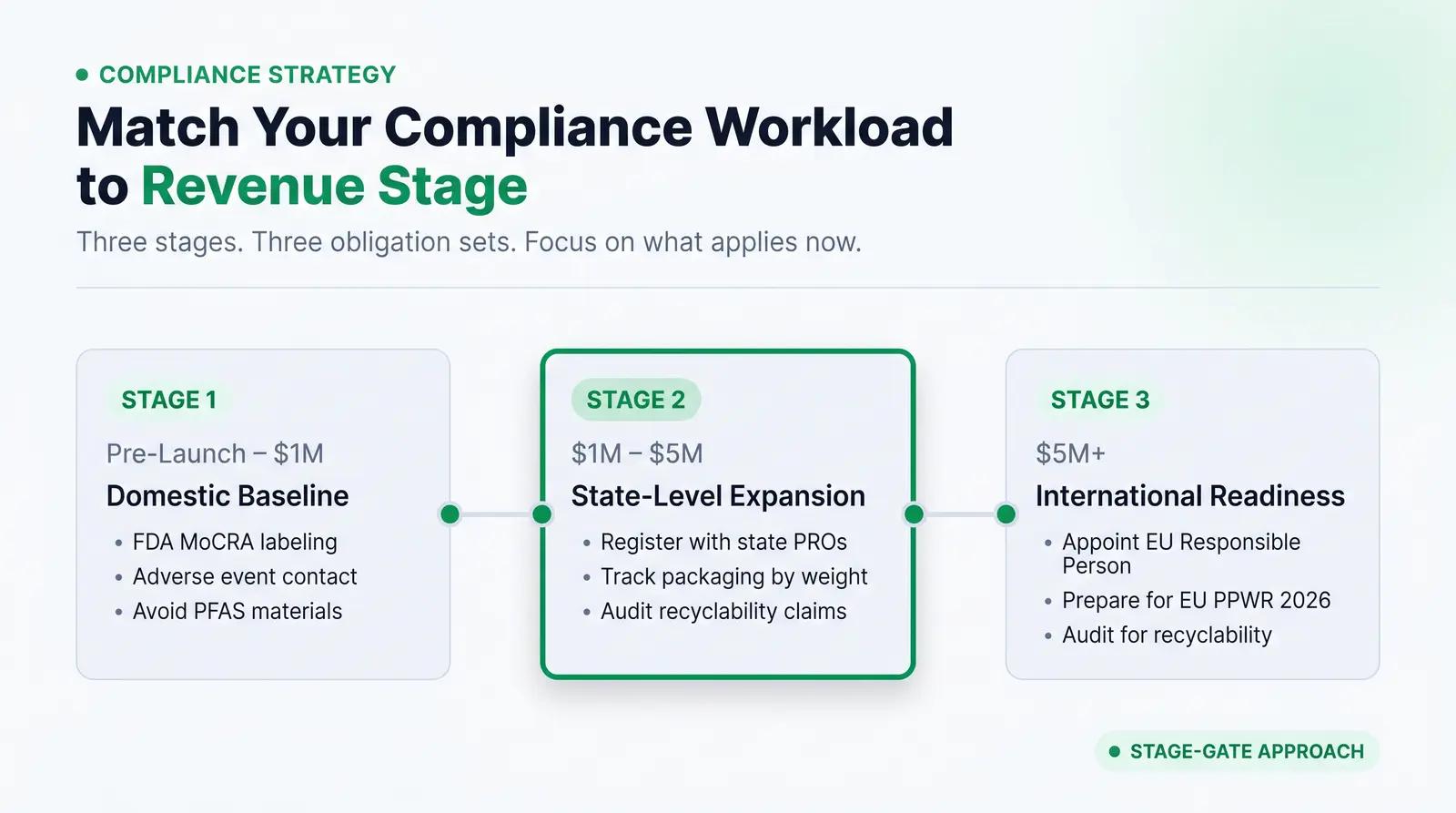
Before diving into individual regulations, it helps to have a mental model for prioritization. We call it the Packfolio Compliance Framework: a stage-gate approach that aligns your compliance workload with your brand's actual market presence and revenue.
The logic is simple. A founder doing $200K in DTC sales does not face the same obligations as a brand doing $4M across 10 states and two international markets. Trying to comply with everything at once leads to paralysis. Trying to ignore everything leads to liability. The framework helps you focus on what actually applies to you right now.
Stage 1: Domestic Baseline (Pre-Launch to $1M Revenue)
At this stage, your primary obligations are federal. Focus on ensuring your packaging meets FDA MoCRA requirements, specifically the inclusion of a domestic address, phone number, or electronic contact information for adverse event reporting [1]. Avoid banned substances like PFAS in your packaging materials, especially if you plan to sell in California [2]. Confirm your labels carry all required elements: ingredient list, net weight, name and address of the responsible person, and any required warnings.
Stage 2: State-Level Expansion ($1M to $5M Revenue)
As your revenue grows, state-level Extended Producer Responsibility (EPR) laws become relevant. You need to track your packaging footprint by weight and material type, not just SKU count. Register with Producer Responsibility Organizations (PROs) in states where you meet the thresholds, such as Colorado or Oregon [3] [4]. Audit your packaging claims. The word "recyclable" on a label now carries legal risk if it cannot be substantiated.
Stage 3: International Readiness ($5M+ Revenue)
If you are expanding into the EU or UK, appoint a Responsible Person (RP) located within the specific jurisdiction [5]. Prepare for the EU's Packaging and Packaging Waste Regulation (PPWR), which imposes strict recyclability and recycled content targets starting in August 2026 [6]. Begin auditing your packaging portfolio for materials that will fail future recyclability assessments.
US Federal Regulations: MoCRA
The Modernization of Cosmetics Regulation Act of 2022 (MoCRA) is the most significant expansion of the FDA's authority over cosmetics since the Federal Food, Drug, and Cosmetic Act was passed in 1938 [7]. While MoCRA is primarily a product safety law, it has direct and immediate implications for packaging and labeling.
What Changed on December 29, 2024
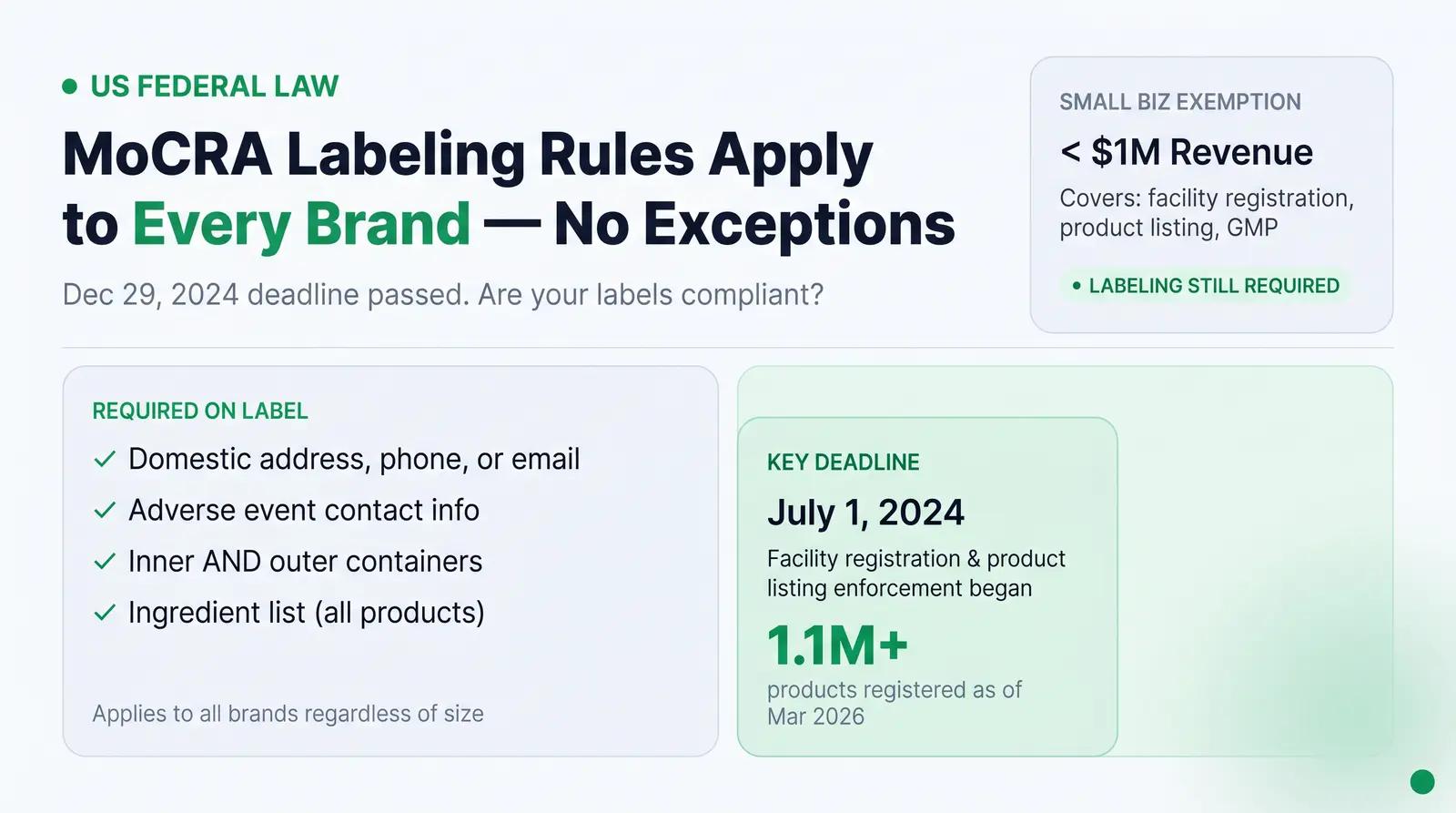
Since December 29, 2024, all cosmetic labels must include a domestic address, phone number, or electronic contact information through which the responsible person can receive adverse event reports [8]. This information must appear on both the inner and outer containers. It is not optional, and it is not limited to brands above a certain revenue threshold.
This is where many small brands have a gap they do not know about. An inactive email address, a generic "contact us" form that goes unchecked, or a PO Box that cannot receive communications may constitute a labeling deficiency. The FDA considers products without compliant contact information to be misbranded, which opens the door to warning letters, import alerts, and market withdrawals.
The practical fix is straightforward: print a working email address or website URL on your packaging. For small components like lip tubes or compact pans where space is limited, the outer carton or secondary packaging can carry the information.
The Responsible Person
MoCRA defines the "responsible person" as the manufacturer, packer, or distributor whose name appears on the label [8]. This entity is legally responsible for maintaining product listings, keeping adverse event records for six years, and reporting serious adverse events to the FDA within 15 business days. If your brand name is on the label, you are the responsible person, regardless of whether you own the manufacturing facility.
Facility Registration and Product Listing
Manufacturers and processors must register their facilities with the FDA and renew that registration every two years [1]. A responsible person must list each marketed cosmetic product with the FDA, including all product ingredients, and provide annual updates. Both registration and listing are managed through the FDA's Cosmetics Direct portal.
Enforcement of these requirements began July 1, 2024. As of March 2026, over 15,000 facilities and more than 1.1 million products have been registered [1].
The Small Business Exemption
MoCRA includes a small business exemption for companies with average gross annual sales in the US of less than $1 million over the preceding three years [9]. This exemption covers facility registration, product listing, and GMP requirements.
However, the exemption has important carve-outs. It does not apply if your products come into contact with the mucus membrane of the eye, are injected, are intended for internal use, or are designed to alter appearance for more than 24 hours. Eye makeup, in particular, is not exempt even for small brands.
Critically, the small business exemption does not exempt you from the labeling requirement to include adverse event contact information. That rule applies to everyone.
What Is Still Coming
Two major MoCRA provisions are still pending FDA rulemaking: mandatory Good Manufacturing Practice (GMP) regulations and fragrance allergen labeling requirements. Both are expected to have direct packaging and labeling implications when finalized. Brands should monitor FDA guidance updates and build flexibility into their label designs accordingly.
State EPR Laws: The Financial Burden of Packaging
Extended Producer Responsibility (EPR) laws shift the financial burden of managing packaging waste from municipalities to the brands that put the packaging into the market. If you sell products in states with active EPR laws, you may be required to register with a PRO, report your packaging data by weight and material type, and pay fees based on the recyclability of your materials.
Many independent brands assume they are exempt because they are "small." This is a dangerous assumption. The exemption thresholds vary significantly by state, and a brand that is exempt in one state may be fully liable in another.
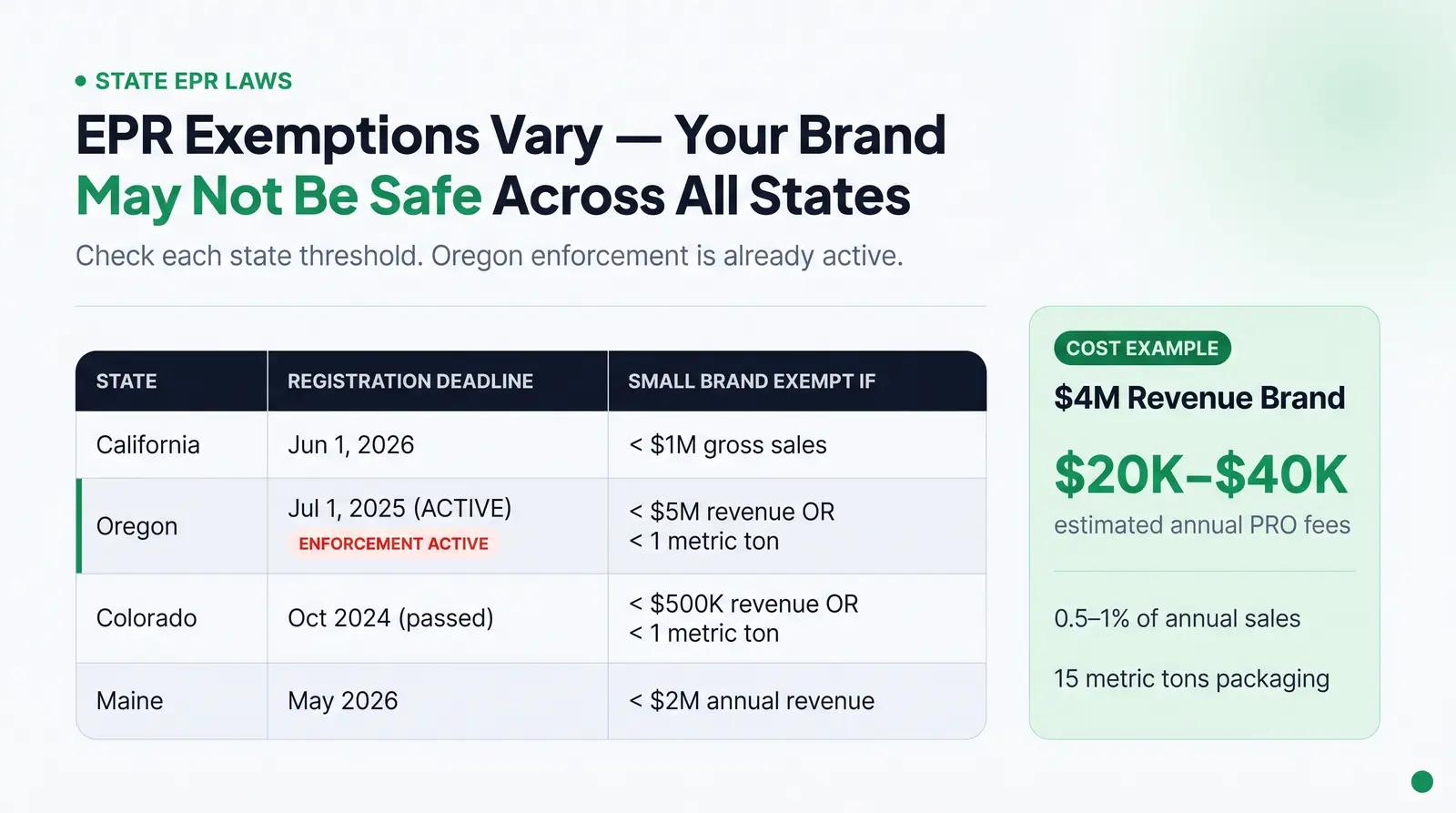
| State | Law | Key Deadlines | Small Brand Exemption Threshold |
|---|---|---|---|
| California | SB 54 | Registration: June 1, 2026. Sales restriction: Jan 1, 2027 | Likely below $1M gross sales (threshold still finalizing) [10] |
| Colorado | HB22-1355 | Registration: Oct 2024 (passed). First fees: Jan 2026 | Below $500K revenue OR below 1 metric ton of packaging [11] |
| Oregon | SB 582 | Registration: July 1, 2025. Enforcement: July 1, 2025 | Below $5M revenue OR below 1 metric ton of packaging [12] |
| Maine | LD 1541 | Registration and reporting: May 2026. Program fully operational: 2027 | Below $2M annual revenue [13] |
In Colorado, brands with revenue between $500K and approximately $5.5 million are classified as "low-volume producers." They still have registration and reporting obligations, even if they pay reduced fees [14]. The revenue threshold is adjusted annually for inflation. This is a gray zone that catches many growing brands off guard.
Oregon's enforcement is already active. Brands that missed the July 1, 2025 registration deadline are technically out of compliance and subject to penalties of up to $25,000 per day [4].
Worked Example: The Cost of EPR
Consider an indie skincare brand generating $4 million in annual revenue. They sell 100,000 units of a glass serum bottle with a plastic dropper assembly per year. The total packaging weight across all products is 15 metric tons.
In Oregon, this brand is exempt. Their revenue is under $5 million, and they can demonstrate they are below the 1 metric ton threshold in Oregon specifically if their Oregon sales are limited.
In Colorado, the picture is different. They exceed the $500K revenue threshold and the 1 metric ton packaging threshold. They must register as a low-volume producer with the Circular Action Alliance (CAA) and report their packaging data. Industry estimates suggest brands should budget 0.5% to 1% of annual sales for PRO fees [15]. For this brand, that could mean $20,000 to $40,000 in new annual compliance costs, before accounting for any internal reporting overhead.
This is why packaging material choices matter beyond aesthetics. Lighter components, mono-material designs, and easily recyclable formats directly reduce your EPR fee exposure. Browsing the Packfolio catalog for components that already meet recyclability criteria is one practical way to get ahead of this.
Chemical Disclosures and Material Bans
Beyond waste management, states are aggressively regulating the chemicals used in packaging materials. California leads this charge, and its laws often become the de facto national standard because brands rarely want to maintain separate packaging runs for one state.
California AB 2771: PFAS in Cosmetics
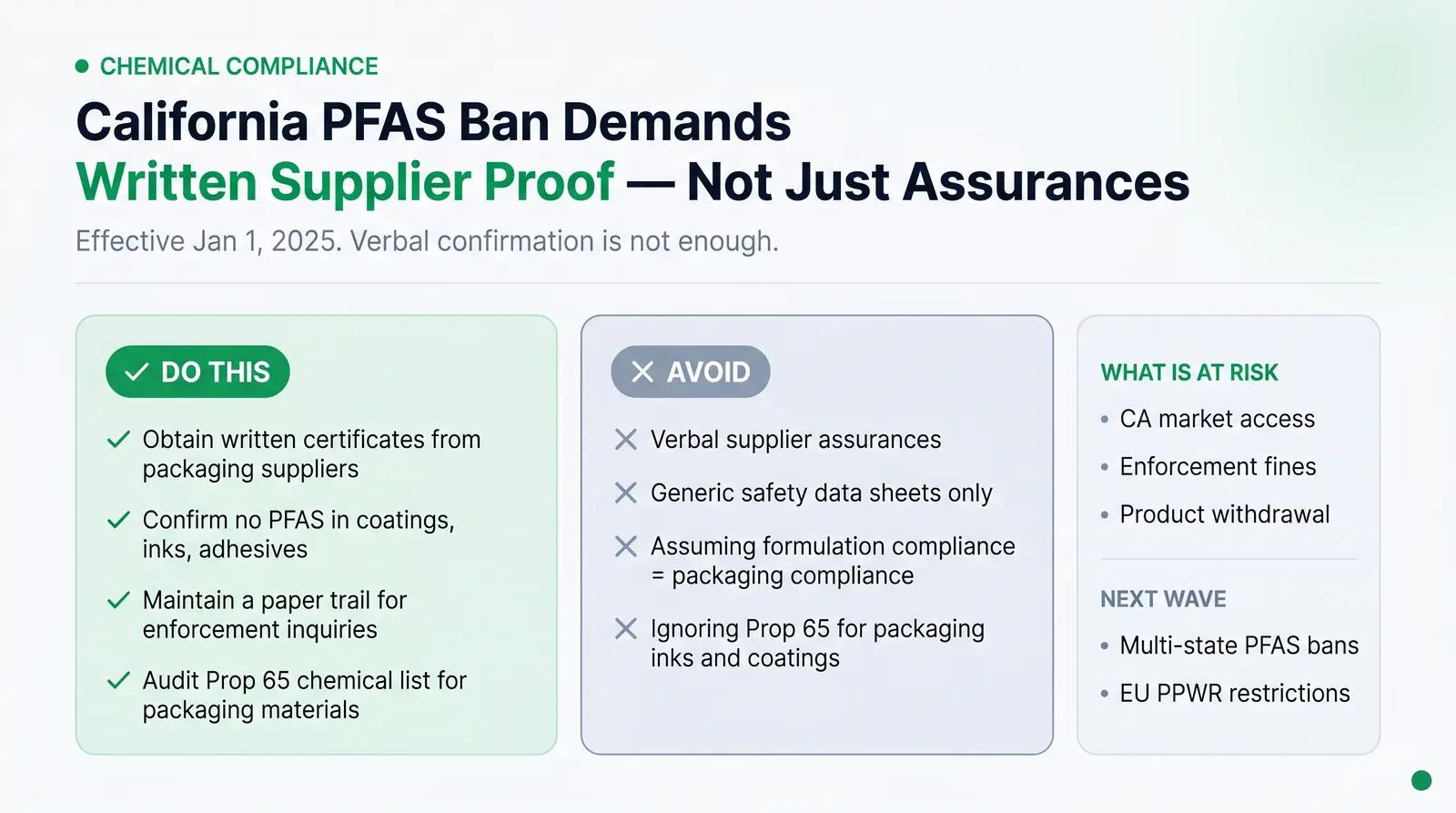
Effective January 1, 2025, California AB 2771 prohibits the manufacture, sale, delivery, holding, or offering for sale of any cosmetic product containing intentionally added PFAS [16]. Per- and polyfluoroalkyl substances are sometimes used in packaging coatings, adhesives, and certain component materials to resist oil and water. If your packaging supplier uses PFAS in any of these applications, your product may be in violation.
The compliance action here is documentation. You must obtain written confirmation from your packaging suppliers that no PFAS were intentionally added to any component, coating, or ink. Verbal assurances are not sufficient if you face an enforcement action.
California Proposition 65
California's Proposition 65 requires businesses to provide warnings to Californians about significant exposures to chemicals that cause cancer, birth defects, or other reproductive harm [17]. This applies not just to formulations but to packaging inks, coatings, adhesives, and plasticizers. In practice, the packaging often triggers a Prop 65 warning requirement before the cosmetic formulation does. Brands selling into California should audit their packaging materials against the Prop 65 chemical list, which is updated regularly.
What Is Coming Next
Several states are considering broader chemical disclosure requirements for packaging materials, modeled on California's approach. The EU's PPWR also restricts certain substances of concern in packaging, including PFAS in food-contact materials [6]. Brands that get ahead of California's requirements now will be better positioned for the next wave of state-level and international chemical restrictions.
International Focus: EU Regulations
If your brand sells into the European Union, the regulatory landscape is more complex and the penalties for non-compliance are more severe. Two frameworks are essential to understand: EU Regulation (EC) No 1223/2009 and the new PPWR.
The EU Responsible Person
Under EU Regulation (EC) No 1223/2009, every cosmetic product placed on the EU market must have a designated Responsible Person (RP) located within one of the 27 EU member states [18]. The RP ensures compliance with the regulation, maintains the Product Information File (PIF) for 10 years, and registers the product on the Cosmetic Products Notification Portal (CPNP) before it goes to market.
The RP's name and address must appear on the packaging. For US brands, this typically means appointing a European distributor, importer, or a specialist third-party compliance firm as the RP.
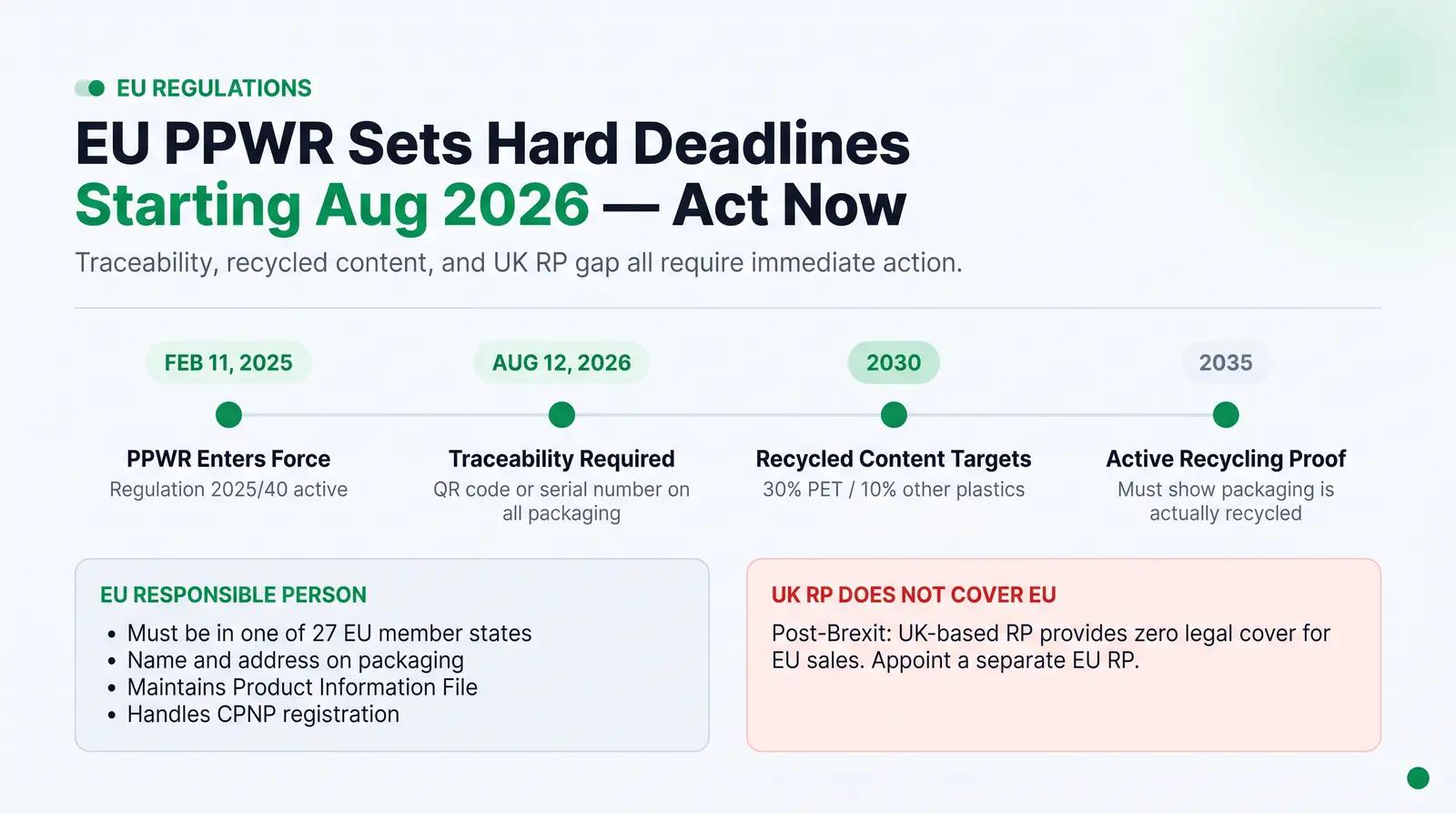
Post-Brexit, a critical compliance gap has emerged. A UK-based distributor or RP does not satisfy the EU requirement. The UK is no longer an EU member state, and a UK RP provides no legal cover for EU sales. Brands that expanded into Europe through a UK partner before 2021 and have not updated their RP arrangements since then may be selling non-compliant products into the EU today.
EU Cosmetics Labeling Requirements
Beyond the RP requirement, EU Regulation 1223/2009 mandates specific labeling on all packaging. The label must include the name and address of the RP, the country of origin for products manufactured outside the EU, nominal content by weight or volume in metric units, the list of ingredients in INCI nomenclature in descending order, the date of minimum durability or Period After Opening (PAO), any precautions and warnings, the batch or lot number, and the cosmetic function of the product [18].
US brands often underestimate how different these requirements are from FDA labeling rules. The INCI ingredient list format, the PAO symbol, and the metric-only weight requirements all require packaging changes that cannot be made at the last minute.
The EU PPWR
The EU Packaging and Packaging Waste Regulation (PPWR) 2025/40 entered into force on February 11, 2025, with general application starting August 12, 2026 [19]. This regulation treats packaging almost as a standalone certified product, with its own documentation, traceability, and performance requirements.
By August 12, 2026, all packaging placed on the EU market must bear a type, batch, or serial number along with the manufacturer's contact details to ensure supply chain traceability. For small cosmetic components where space is limited, this information can be carried on a QR code or other digital data carrier. An EU Declaration of Conformity will be required for each packaging type.
Cosmetic packaging is classified as "contact-sensitive" under the PPWR because it comes into contact with products applied to the body [20]. This classification triggers mandatory recycled content targets by 2030: 30% for PET plastics and 10% for other plastic materials. Sourcing high-quality, safely recycled plastic that meets EU standards for contact-sensitive applications is a significant supply chain challenge. The commission will reassess the feasibility of these targets by 2028, but brands should not count on a rollback.
By 2035, it will not be enough to show that packaging can theoretically be recycled. Brands must demonstrate that their packaging is actively being collected, sorted, and recycled at scale across the EU. Any packaging that fails this assessment will be legally barred from the market.
The window to act is narrow. Brands selling into the EU should start auditing their packaging portfolios now, phasing out complex multi-material designs and small-format components that are frequently rejected by sorting facilities. For more on building a packaging strategy that accounts for these shifts, see our sustainable beauty packaging guide.
Closing: Compliance Is a Packaging Decision
Every packaging decision you make has a regulatory dimension. The material you choose affects your EPR fee liability. The supplier you work with determines whether you can prove PFAS compliance. The label design you approve determines whether your product is misbranded under MoCRA. The RP you appoint determines whether you can legally sell in the EU.
Compliance is not a legal department problem. It is a packaging problem. And it starts at the sourcing stage.
Packfolio curates a vetted catalog of cosmetic primary packaging components, each pre-modeled in 3D with predefined printable regions. When you design your label inside those defined print zones, you are working within a structure that accounts for the physical constraints of compliant labeling. You can preview the result on a photorealistic 3D model before you commit to production. That is not just a design convenience. It is a compliance checkpoint built into the workflow.
Ready to source packaging that works with your compliance requirements, not against them? Browse the Packfolio catalog to find components that fit your brand, your market, and your regulatory obligations.
Frequently Asked Questions
1. Does my brand need to register for state EPR programs if we only sell online?
Yes. eCommerce sales into a state count toward your revenue and packaging weight thresholds in that state. You are considered the producer responsible for all packaging associated with products you sell, including shipping materials like mailers, boxes, and void fill. Selling exclusively online does not create an exemption.
2. Can I use a PO Box for my MoCRA contact information on the label?
A PO Box alone may not be sufficient if it cannot reliably receive adverse event communications. The FDA requires a domestic address, phone number, or electronic contact information where the responsible person can actually be reached. An actively monitored email address or a working website URL is often the most practical and space-efficient choice for small packaging formats.
3. If I am exempt from MoCRA facility registration, am I also exempt from the labeling rules?
No. The small business exemption applies specifically to facility registration, product listing, and GMP requirements. It does not exempt you from the requirement to include adverse event contact information on your labels. That requirement applies to all cosmetic products sold in the US, regardless of the seller's revenue.
4. How do I prove my packaging is PFAS-free for California AB 2771?
You must obtain written documentation or certificates of compliance from your packaging suppliers confirming that no PFAS were intentionally added to any component, coating, or ink. Verbal assurances or general safety data sheets are not sufficient. If you face an enforcement inquiry, you need a paper trail that traces back to the supplier.
5. Does a UK Responsible Person cover my sales in the EU?
No. Since Brexit, the UK is no longer an EU member state. A UK-based RP provides no legal cover for EU market access. To sell legally in the EU, you must designate a separate Responsible Person located within one of the 27 EU member states. Their name and address must appear on the packaging, and they must maintain the Product Information File and handle CPNP notifications.
References
[1] U.S. Food and Drug Administration. "Registration and Listing of Cosmetic Product Facilities and Products." https://www.fda.gov/cosmetics/registration-listing-cosmetic-product-facilities-and-products
[2] California Air Resources Board. "2022 Assembly Bill 2771 (Friedman, Laura), Ban on Perfluoroalkyl and Polyfluoroalkyl Substances in Cosmetic Products." https://ww2.arb.ca.gov/2022-assembly-bill-2771-friedman-laura-ban-perfluoroalkyl-and-polyfluoroalkyl-substances-cosmetic
[3] Colorado Department of Public Health and Environment. "Producer Responsibility Program." https://cdphe.colorado.gov/hm/epr-program
[4] Oregon Department of Environmental Quality. "Plastic Pollution and Recycling Modernization Act." https://www.oregon.gov/deq/recycling/pages/modernizing-oregons-recycling-system.aspx
[5] Registrar Corp. "EU Regulation 1223/2009." https://www.registrarcorp.com/blog/cosmetics/cosmetic-regulations/eu-regulation-1223-2009-regulation-no-ec-1223-2009/
[6] EUR-Lex. "Regulation (EU) 2025/40 of the European Parliament and of the Council on packaging and packaging waste." https://eur-lex.europa.eu/eli/reg/2025/40/oj/eng
[7] U.S. Food and Drug Administration. "Modernization of Cosmetics Regulation Act of 2022 (MoCRA)." https://www.fda.gov/cosmetics/cosmetics-laws-regulations/modernization-cosmetics-regulation-act-2022-mocra
[8] Registrar Corp. "MoCRA Responsible Person." https://www.registrarcorp.com/blog/cosmetics/mocra/mocra-responsible-person/
[9] McGuireWoods. "FDA Publishes Two Key Guidance Documents on Cosmetics Facility Registration and Product Listing." https://www.mcguirewoods.com/client-resources/alerts/2024/1/fda-publishes-two-key-guidance-documents-on-cosmetics-facility-registration-and-product-listing/
[10] EcoEnclose. "EPR Packaging Laws FAQ: What Every Brand Needs to Know (Updated October 2025)." https://www.ecoenclose.com/blog/epr-faq
[11] Colorado Department of Public Health and Environment. "Producer Responsibility Program." https://cdphe.colorado.gov/hm/epr-program
[12] Oregon Department of Environmental Quality. "Recycling Modernization Act Producer Exemptions." https://www.oregon.gov/deq/recycling/pages/rma-exemptions.aspx
[13] Maine Department of Environmental Protection. "Stewardship Program for Packaging." https://www.maine.gov/dep/waste/recycle/epr.html
[14] EcoEnclose. "EPR Packaging Laws FAQ: What Every Brand Needs to Know (Updated October 2025)." https://www.ecoenclose.com/blog/epr-faq
[15] EcoEnclose. "EPR Packaging Laws FAQ: What Every Brand Needs to Know (Updated October 2025)." https://www.ecoenclose.com/blog/epr-faq
[16] California Air Resources Board. "2022 Assembly Bill 2771." https://ww2.arb.ca.gov/2022-assembly-bill-2771-friedman-laura-ban-perfluoroalkyl-and-polyfluoroalkyl-substances-cosmetic
[17] California Office of Environmental Health Hazard Assessment. "About Proposition 65." https://oehha.ca.gov/proposition-65/about-proposition-65
[18] Registrar Corp. "EU Regulation 1223/2009." https://www.registrarcorp.com/blog/cosmetics/cosmetic-regulations/eu-regulation-1223-2009-regulation-no-ec-1223-2009/
[19] EUR-Lex. "Regulation (EU) 2025/40." https://eur-lex.europa.eu/eli/reg/2025/40/oj/eng
[20] Personal Care Insights. "'Unique hurdle for cosmetics': How to prepare for the PPWR." https://www.personalcareinsights.com/news/preparing-for-ppwr-24hourar.html


