
Cosmetic Net Contents and Fill Weight: Labeling Basics for Beauty Brands
This guide covers FDA cosmetic net contents labeling requirements, unit selection, dead volume, fill weight coordination, and a 7-step rubric to ensure label-to-fill compliance before print.
Net contents is one of the smallest details on a cosmetic label, and one of the most reliable sources of production headaches, compliance failures, and rejected retail submissions.
While independent beauty founders often spend the most time on ingredient list formatting and claims substantiation, the declaration of how much product is inside the container triggers a disproportionate share of regulatory warnings and retailer pushback. A single unit error, an improperly sized font, or a discrepancy between the declared quantity and the actual factory fill specification can halt a launch or force a costly label reprint after thousands of units are already in a warehouse.
This guide walks through every dimension of net contents compliance: what the FDA actually requires, how to choose the right units for your product type, how to coordinate your label declaration with your factory's fill tolerances, and how to verify everything before your artwork goes to print.
What the FDA Actually Requires for Net Contents
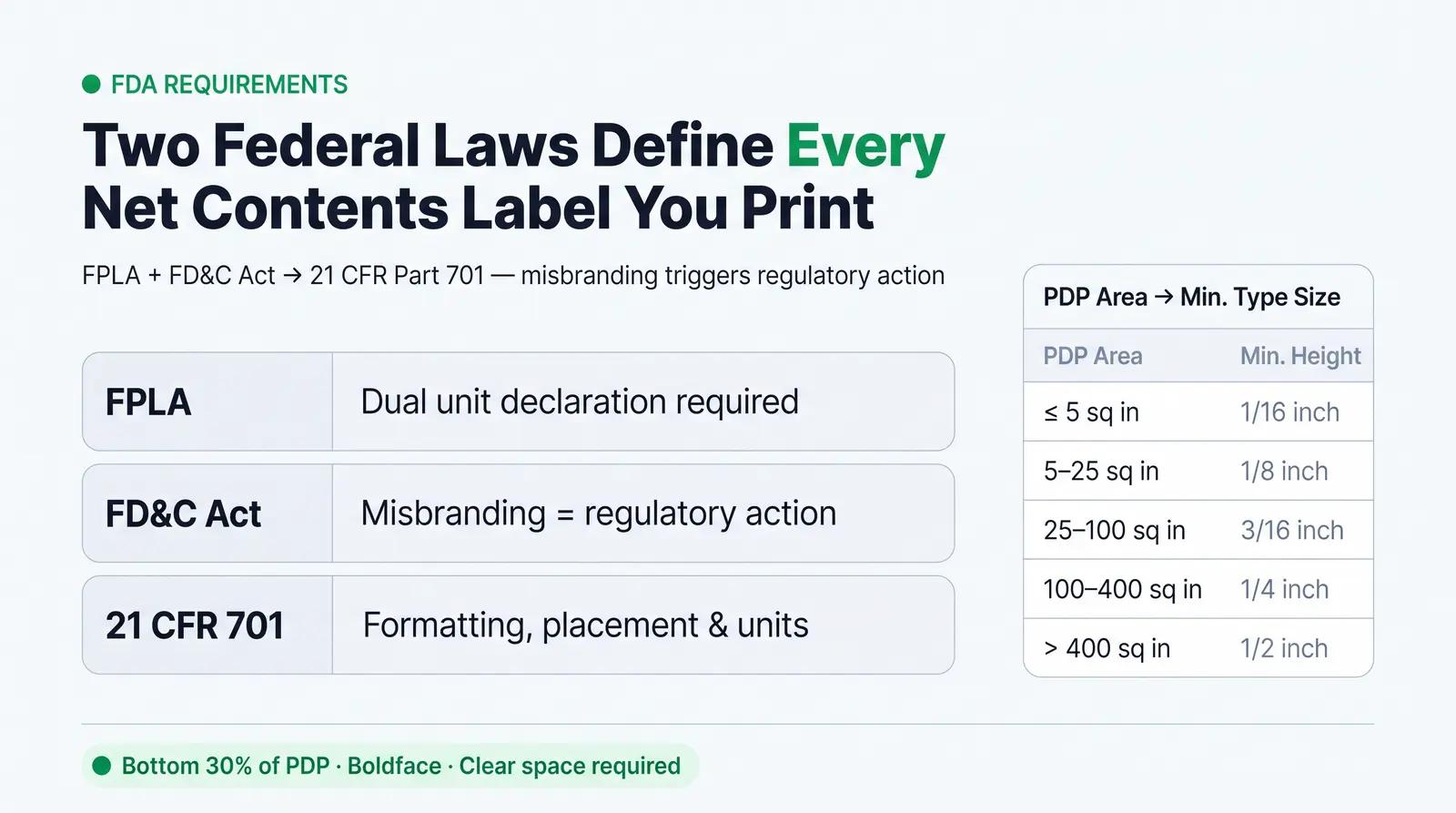
The foundation of cosmetic net contents labeling in the United States is established by two federal laws: the Fair Packaging and Labeling Act (FPLA) [7] and the Federal Food, Drug, and Cosmetic Act (FD&C Act) [2]. The FDA enforces both under 21 CFR Part 701, which codifies the specific formatting, placement, and unit requirements for cosmetic labels [1] [8].
Under these laws, a cosmetic is considered misbranded if its label does not state the net quantity of contents [2]. Misbranding is not a minor administrative issue. It exposes the brand to FDA regulatory action, import detention, and mandatory recall authority that the FDA gained under the Modernization of Cosmetics Regulation Act of 2022 (MoCRA) [6].
The Principal Display Panel
The net contents declaration must appear on the principal display panel (PDP), which the FDA defines as the part of the label most likely to be shown or examined under customary conditions of display for retail sale [2]. For most products, this is the front panel. For cylindrical containers, the PDP is calculated as 40% of the product of the container's height multiplied by its circumference [2].
The declaration must be placed within the bottom 30% of the PDP area, in a line generally parallel to the base on which the package rests [3]. The only exception to the bottom 30% rule applies to packages with a PDP of 5 square inches or less, where the placement requirement is waived as long as all other formatting requirements are met [3].
Type Size Requirements
The minimum type size for the net contents declaration is not a fixed number. It is determined by the total area of the PDP, measured in square inches. The FDA specifies the following minimum heights for the lettering [3]:
| PDP Area | Minimum Type Height |
|---|---|
| 5 sq in or less | 1/16 inch |
| More than 5 to 25 sq in | 1/8 inch |
| More than 25 to 100 sq in | 3/16 inch |
| More than 100 sq in | 1/4 inch |
| More than 400 sq in | 1/2 inch |
The declaration must appear in conspicuous, easily legible boldface print or type, in distinct contrast to other matter on the package. It must be separated from other printed information by a space at least equal to the height of the lettering above and below, and by a space equal to twice the width of the letter "N" to the left and right [3].
Units of Measure: When to Use What
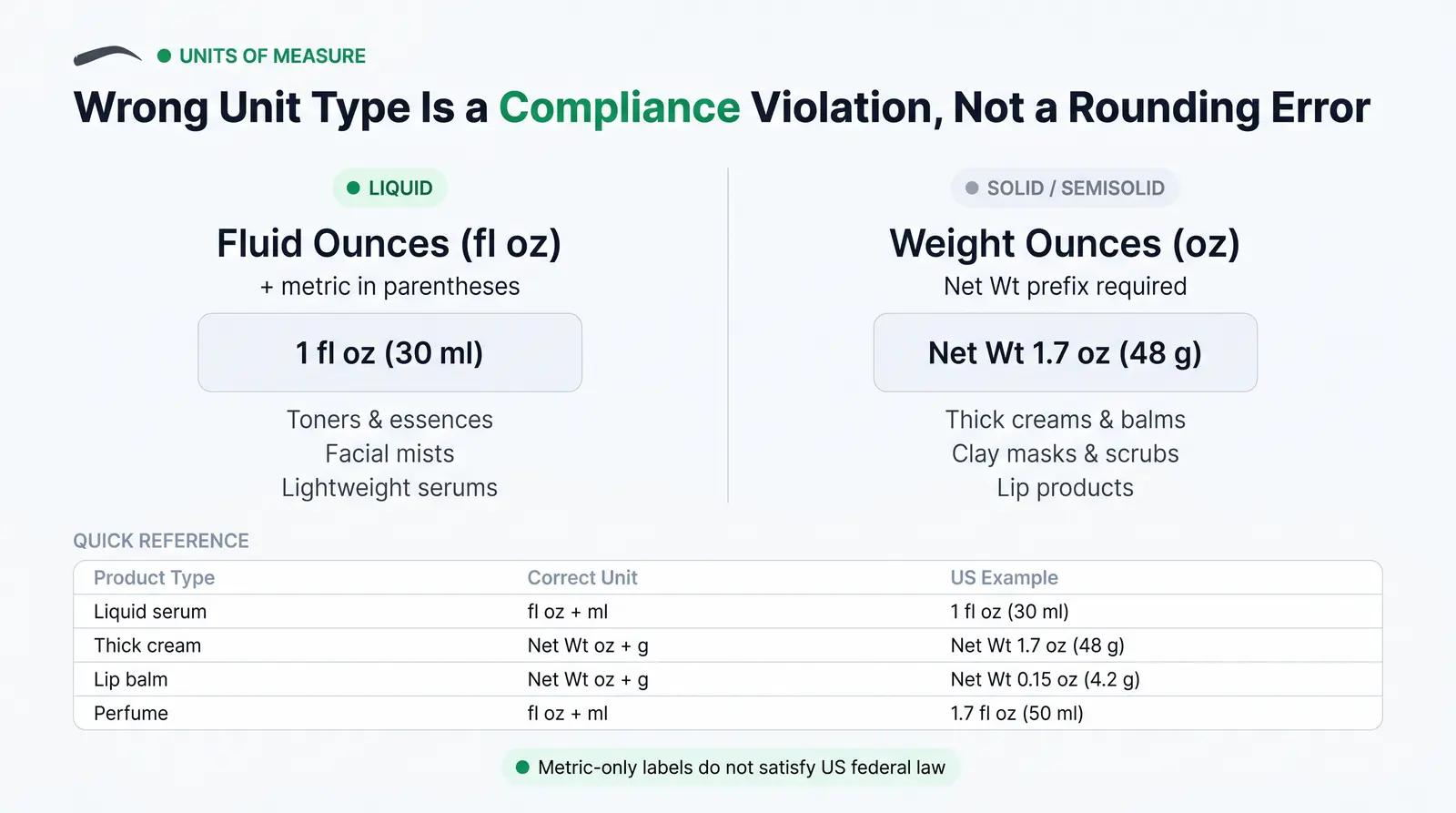
Choosing the wrong unit of measure is one of the most common and consequential net contents errors. The FDA's rule is straightforward: the declaration must be in terms of fluid measure if the cosmetic is liquid, or in terms of weight if the cosmetic is solid, semisolid, or viscous [3].
Liquid Products
Liquid products, including toners, essences, facial mists, perfumes, and lightweight serums, must be declared in fluid ounces (fl oz). Fluid ounces measure volume, specifically how much space the liquid occupies. The FDA specifies that fluid measure must be expressed in terms of the US gallon of 231 cubic inches and its subdivisions: quarts, pints, and fluid ounces [3].
Solid, Semisolid, and Viscous Products
Solid, semisolid, and viscous products, including thick creams, balms, body butters, scrubs, clay masks, and lip products, must be declared in avoirdupois weight ounces (oz). The prefix "Net wt." or "Net weight" is required when declaring by weight [3].
This distinction matters enormously in practice. Fluid ounces and weight ounces are only equivalent when measuring pure water. Most cosmetic formulations are denser or less dense than water. A dense body scrub filling an 8 fl oz jar may weigh 11 or 12 ounces. A whipped body butter in the same jar may weigh only 4 or 5 ounces. Labeling either product in the wrong unit type is a compliance violation, regardless of whether the number seems close.
Dual Declaration: US Customary and Metric
Federal law requires that the net contents declaration include both US customary units and metric units [7]. The metric declaration appears in parentheses following the US customary declaration. For example: "4 fl oz (118 ml)" or "Net Wt 2 oz (56 g)." The metric equivalent is calculated using exact conversion factors: 1 fluid ounce equals 29.5735 ml; 1 avoirdupois ounce equals 28.3495 grams [4].
Metric-only labeling does not satisfy US federal requirements. A label that reads only "50 ml" or "30 g" is non-compliant for the US market, regardless of how common this format is on EU-manufactured products. This is a frequent error when founders source packaging or label templates from European suppliers.
Unit Errors by Product Type
The table below summarizes the correct and incorrect unit choices across common cosmetic product types, and compares US requirements with EU and common retailer expectations.
| Product Type | US Requirement | EU Requirement | Common Retailer Requirement | Correct US Example |
|---|---|---|---|---|
| Liquid serum or toner | Fluid ounces + metric | Metric only (ml) | FDA-compliant; some add French | 1 fl oz (30 ml) |
| Thick cream or moisturizer | Weight ounces + metric | Metric only (g) | FDA-compliant | Net Wt 1.7 oz (48 g) |
| Lip balm or solid stick | Weight ounces + metric | Metric only (g) | FDA-compliant | Net Wt 0.15 oz (4.2 g) |
| Aerosol (dry shampoo, hairspray) | Weight ounces + metric (incl. propellant) | Metric only (g) | FDA-compliant | Net Wt 5 oz (141 g) |
| Setting powder or dry shampoo | Weight ounces + metric | Metric only (g) | FDA-compliant | Net Wt 0.35 oz (10 g) |
| Perfume or eau de toilette | Fluid ounces + metric | Metric only (ml) | FDA-compliant; some add French | 1.7 fl oz (50 ml) |
The Dead Volume Problem: A Non-Obvious Fill Trap
Most guidance on cosmetic net contents focuses on label formatting. Far less attention is paid to the physical relationship between the declared quantity and the actual dispensable product, which is where some of the most costly compliance and customer satisfaction problems originate.
Founders frequently assume that if they purchase a "30 ml" glass dropper bottle, their net contents declaration should be 30 ml and their factory fill specification should be 30 ml. This assumption ignores a critical packaging variable: dead volume.
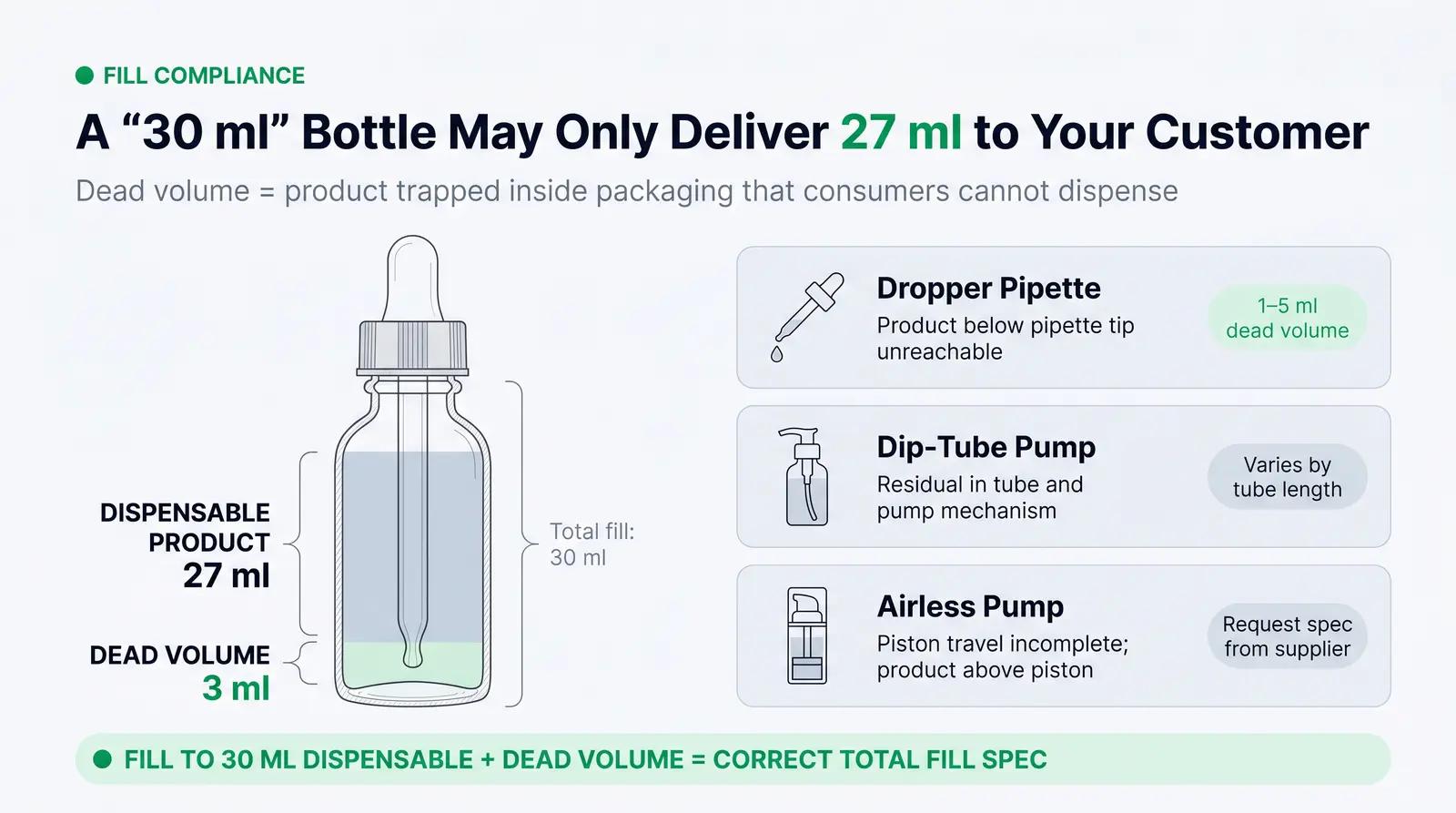
Dead volume refers to the product that remains trapped inside the packaging mechanism and cannot be reasonably dispensed by the consumer under normal use. This is particularly significant in three common cosmetic packaging types.
Standard dropper pipettes leave product at the bottom of the bottle below the pipette tip's reach. Depending on the pipette length and bottle geometry, this can range from 1 ml to 5 ml in a 30 ml bottle. Dip-tube pump dispensers retain product in the dip tube and pump mechanism after the piston bottoms out. Airless pump systems use a rising piston to push product upward, but the piston travel is not always complete, and some product remains above the piston or in the pump head.
Under 21 CFR 701.13(g), the net contents declaration for products in containers designed to deliver the cosmetic under pressure must state the net quantity of contents that will be expelled when the instructions for use are followed [3]. While this provision specifically addresses aerosols, the underlying principle applies more broadly: the declared quantity should reflect what the consumer actually receives.
If your 30 ml dropper bottle has 3 ml of dead volume, and you fill it to exactly 30 ml, the consumer receives approximately 27 ml of usable product. If your label says "1 fl oz (30 ml)," you may be creating a compliance exposure and certainly creating a consumer experience problem. The correct approach is to fill to 30 ml of dispensable product plus the dead volume, meaning a total fill of approximately 33 ml, adjusted upward for mechanical variance.
This is the kind of production detail that founders rarely encounter in general labeling guides, but it is exactly the type of issue that surfaces during retail vendor audits and consumer complaints. Founders who source packaging with pump or dropper components should request dead volume specifications from their supplier before finalizing their fill spec and label declaration.
Coordinating Declared Contents with Actual Fill Quantity
The FDA requires that the net contents declaration accurately reflect the quantity of cosmetic in the package, exclusive of wrappers and other materials [3]. Ensuring this accuracy requires coordinating your label declaration with your factory's fill specification, which in turn requires understanding how fill tolerances work.
The NIST Handbook 133 Framework
The National Institute of Standards and Technology (NIST) Handbook 133, updated in its 2026 edition, provides the procedural guide for compliance testing of net content statements on packaged goods [4]. State and federal weights and measures officials use this handbook when inspecting products at retail. Understanding its framework helps founders set fill specifications that will pass inspection.
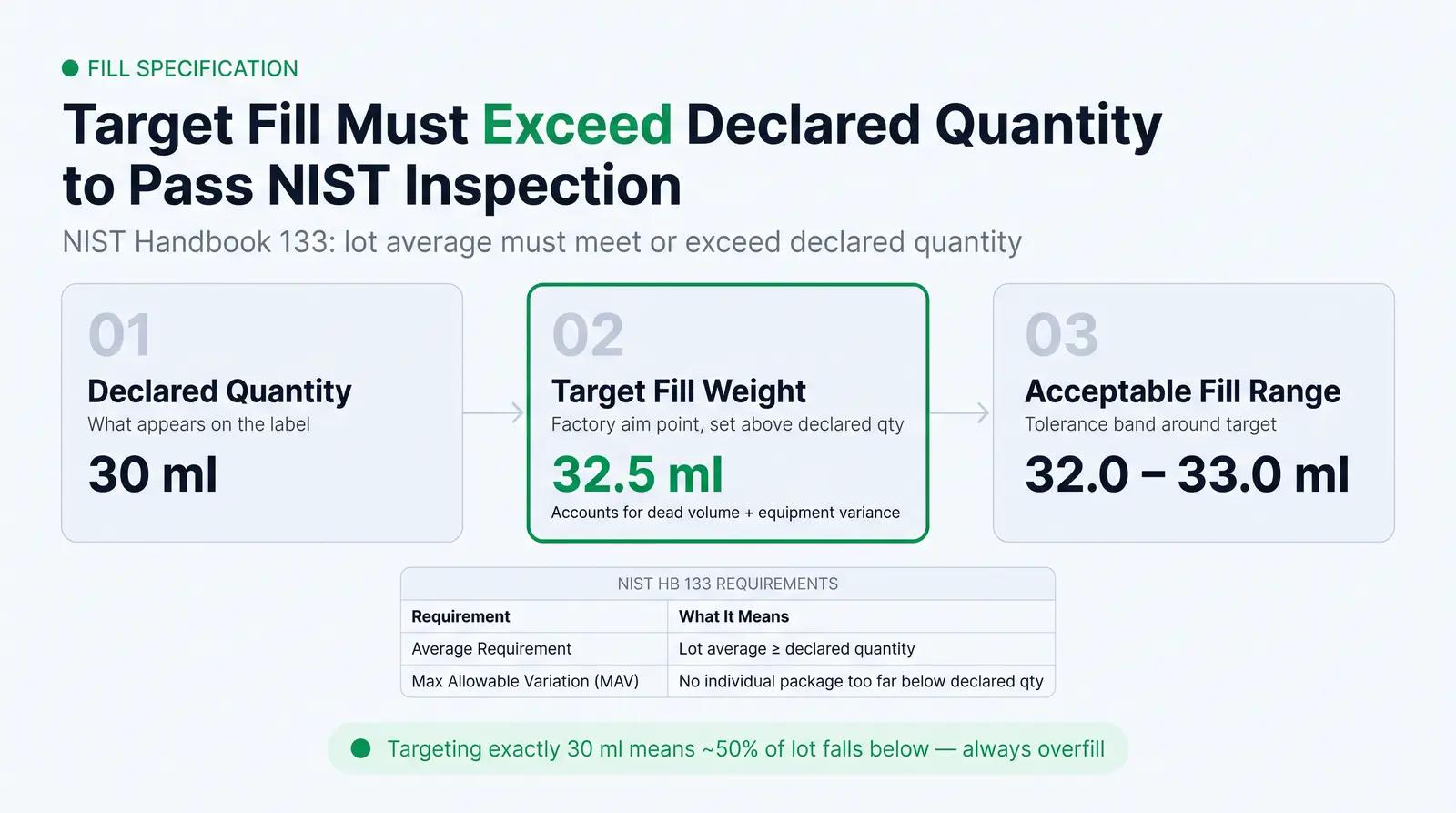
NIST Handbook 133 establishes two core requirements for packaged goods. The Average Requirement mandates that the average net quantity of contents across a production lot must equal or exceed the declared quantity on the label. The Individual Package Requirement sets a Maximum Allowable Variation (MAV), which is the limit of acceptable minus variation for any individual package. A package that falls below the declared quantity by more than the MAV is considered an unreasonably short package and is non-compliant regardless of the lot average [4].
The practical implication is that factories cannot target a fill weight exactly equal to the declared quantity. Normal mechanical variance in filling equipment means that targeting exactly 30 ml will result in roughly half the lot being below 30 ml. Instead, the target fill weight must be set above the declared quantity by enough margin to ensure the lot average remains compliant, accounting for the specific variance of the filling equipment being used.
Communicating Fill Specs to Your Manufacturer
When working with a contract manufacturer, the fill specification should include three elements: the declared net contents (the label quantity), the target fill weight (the factory's aim point, set above the declared quantity), and the acceptable fill range (the tolerance band around the target). This three-number specification prevents the common situation where a factory fills to the nominal volume and the brand only discovers the underfill problem after a retailer audit or consumer complaint.
Retail and Major Retailer Submission Requirements
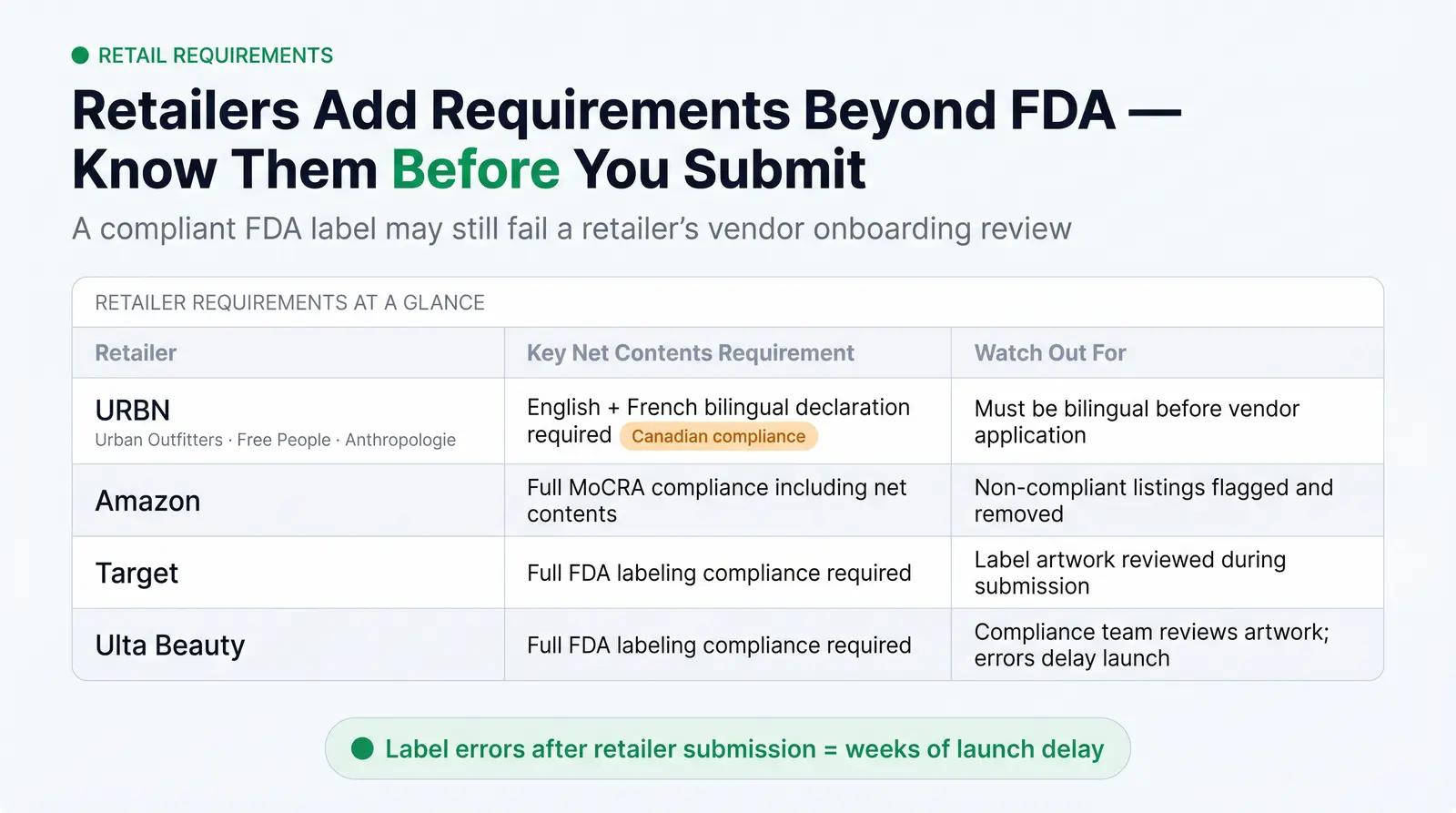
FDA compliance is the minimum threshold. Major retailers add their own requirements, and a label that technically satisfies FDA regulations may still fail a retailer's vendor onboarding review.
URBN (Urban Outfitters, Free People, Anthropologie) requires that the net quantity of contents appear in both English and French, with both metric and imperial units, to ensure compliance with Canadian market requirements simultaneously [5]. This means a product intended for URBN distribution needs a bilingual net contents declaration before the vendor application is submitted.
Amazon requires cosmetic labels to comply with MoCRA standards, including proper net contents declaration and a US-based responsible person contact method [6]. Products that do not meet these requirements are flagged during the listing process and may be removed from sale.
Target and Ulta Beauty both require full FDA labeling compliance as a prerequisite for vendor approval, and their compliance teams review label artwork during the submission process. A net contents error, such as the wrong unit type for the product form or a declaration placed outside the bottom 30% of the PDP, can result in a submission rejection that delays the launch timeline by weeks or months.
The lesson is straightforward: label compliance is not just a regulatory concern. It is a retail readiness concern. Fixing a net contents error after a retailer rejects your submission is significantly more expensive than getting it right before print.
The Fill-to-Label Alignment Rubric
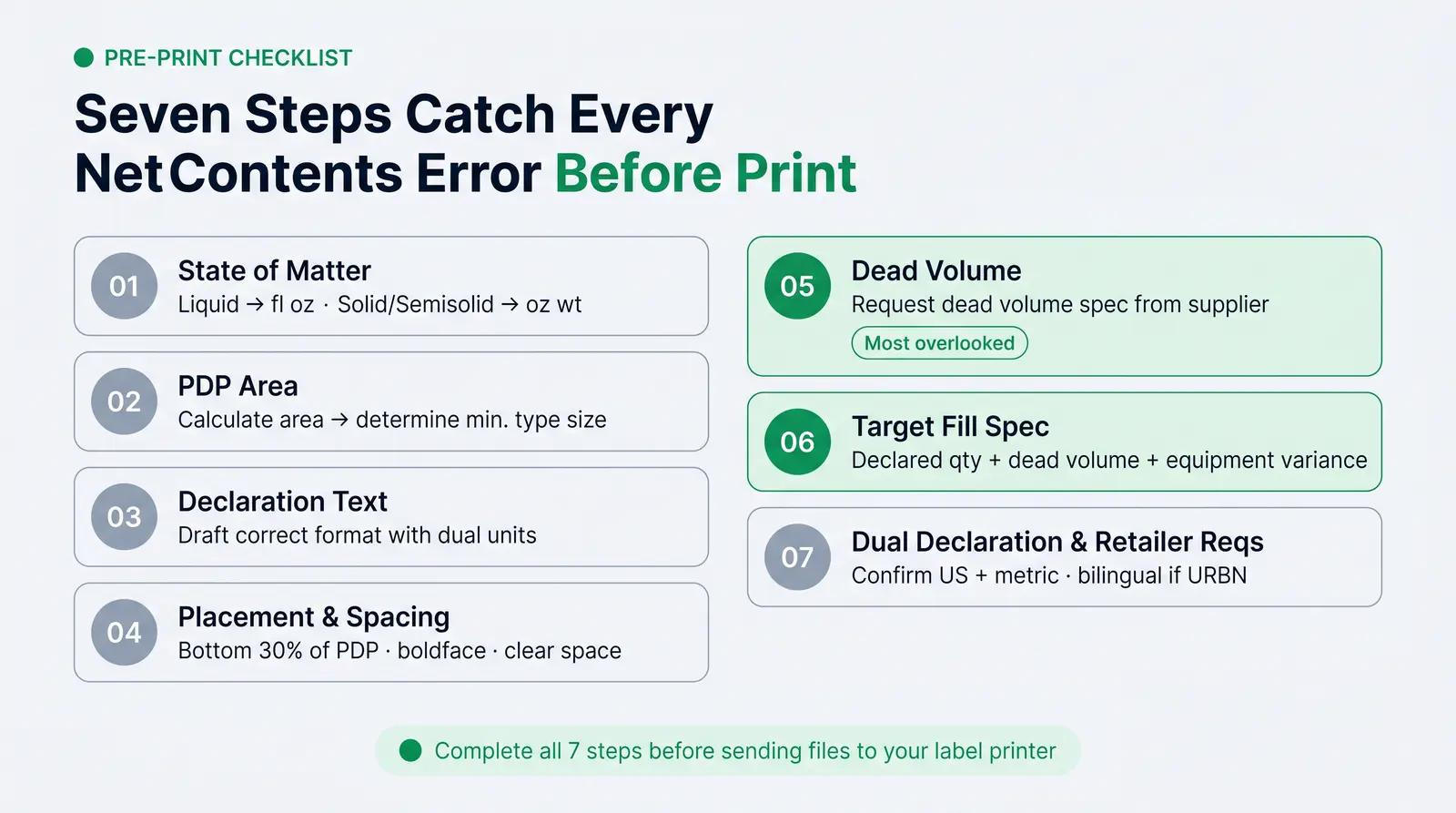
The following practical framework, which we recommend at Packfolio for founders reviewing label artwork before print approval, addresses the most common points of failure in net contents compliance. Work through each step in order before sending files to your label printer or packaging supplier.
Step 1: Determine the State of Matter
Classify your formula as liquid (pourable), semisolid or viscous (thick cream, gel, balm), or solid (pressed powder, stick). This single classification determines whether you use fluid measure or avoirdupois weight.
Step 2: Calculate the PDP Area
Measure the dimensions of your principal display panel. For cylindrical containers, calculate: (circumference x 0.40) x height. For rectangular containers, calculate: width x height. Express the result in square inches and use the type size table above to determine the minimum font height for your declaration.
Step 3: Draft the Declaration Text
Write the declaration using the correct format. For liquids: "[X] fl oz ([Y] ml)." For solids and semisolids: "Net Wt [X] oz ([Y] g)." Use exact conversion factors and round the metric figure down to the nearest whole number. Do not use more than two decimal places for the US customary figure.
Step 4: Verify Placement and Spacing
Confirm the declaration sits within the bottom 30% of the PDP, parallel to the base. Confirm the text is separated from surrounding label elements by the required clear space. Confirm the font is boldface and in distinct contrast to the background.
Step 5: Identify Dead Volume
Request the dead volume specification from your packaging supplier for the specific closure, pump, or dropper component you are using. If the supplier cannot provide this, request sample units and measure the residual product after normal use.
Step 6: Set the Target Fill Specification
Add the dead volume to your declared net contents to establish the minimum fill quantity. Adjust this figure upward based on your contract manufacturer's filling equipment variance to ensure the lot average meets the NIST Handbook 133 Average Requirement [4]. Document this specification in your production brief.
Step 7: Confirm Dual Declaration and Retailer Requirements
Verify that both US customary and metric units appear. If you are submitting to retailers with additional requirements, such as URBN's bilingual requirement, confirm those are addressed in the artwork before submission.
Worked Example: Launching a 1 fl oz Vitamin C Serum
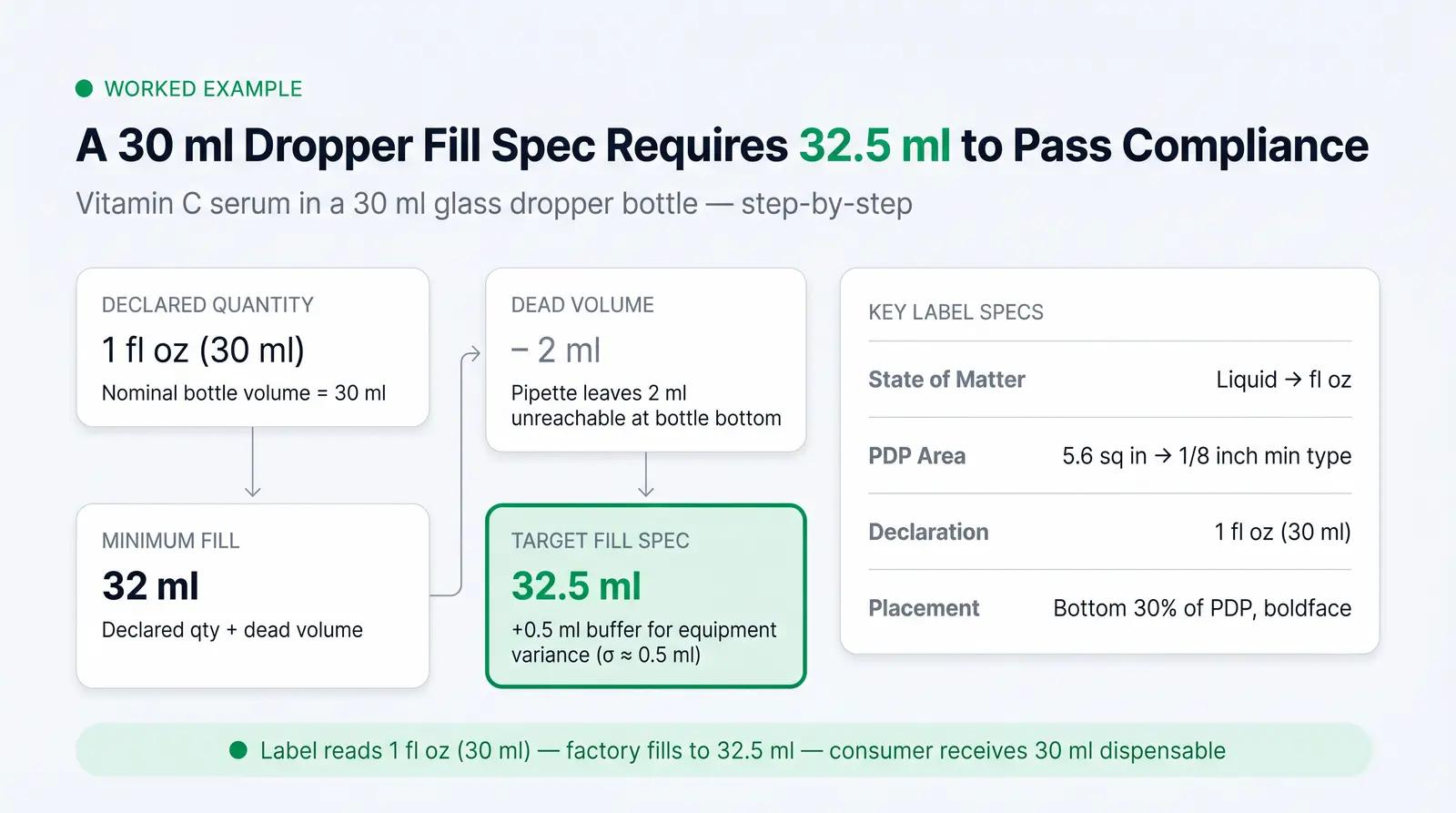
A founder is launching a vitamin C serum in a 30 ml glass dropper bottle. The formula is a lightweight liquid, so the net contents must be declared in fluid measure.
Step 1: State of matter. The formula is liquid. Unit type: fluid ounces.
Step 2: PDP area calculation. The bottle is 4 inches tall. The circumference is 3.5 inches. PDP area = (3.5 x 0.40) x 4 = 1.4 x 4 = 5.6 square inches. Because the PDP is greater than 5 but less than 25 square inches, the minimum type height for the net contents declaration is 1/8 inch [3].
Step 3: Declaration text. The nominal bottle volume is 30 ml, which equals 1.014 fl oz. The correct declaration rounds to "1 fl oz (30 ml)."
Step 4: Placement. The declaration is placed in the lower third of the front label panel, parallel to the bottle base, in boldface type at least 1/8 inch tall, with clear space separating it from the brand name above and the barcode below.
Step 5: Dead volume. The founder contacts the dropper supplier and learns the pipette leaves approximately 2 ml of product unreachable at the bottom of the bottle under normal use. The dispensable product from a 30 ml fill is approximately 28 ml.
Step 6: Fill specification. To ensure the consumer receives 30 ml of dispensable product, the target fill is set to 32 ml. The contract manufacturer's filling equipment has a standard deviation of approximately 0.5 ml, so the target is set to 32.5 ml to ensure the lot average comfortably exceeds 30 ml of dispensable product and satisfies the NIST Handbook 133 Average Requirement [4].
Step 7: Dual declaration confirmed. The label reads "1 fl oz (30 ml)" in the correct location, in the correct type size, with both units present.
When the founder uses Packfolio's 3D design tool to preview the label on the photorealistic model of the dropper bottle, the predefined print zones make it immediately clear whether the net contents declaration fits within the bottom 30% of the PDP without crowding the brand name or the ingredient panel. This visual confirmation step, before any files go to a printer, is where label placement errors are caught most efficiently. Packfolio's catalog includes dropper bottles, airless pumps, jars, tubes, and other primary packaging formats, each pre-modeled with defined printable regions so founders can verify spatial compliance before committing to a production run.
Browse Packfolio's curated packaging catalog and preview your label copy, including net contents placement, in 3D before committing to print: packfolio.com/catalog
Frequently Asked Questions
What is the net quantity of contents on a cosmetic label?
The net quantity of contents is the accurate statement of how much product is in the package, expressed in weight, fluid measure, or numerical count depending on the product type. It must appear on the principal display panel and is required by the Fair Packaging and Labeling Act and 21 CFR Part 701 [3]. It tells the consumer exactly how much product they are purchasing and is one of the mandatory elements of a compliant cosmetic label in the United States.
Does the FDA require both metric and imperial units on a cosmetic label?
Yes. The Fair Packaging and Labeling Act requires the net quantity declaration to include both US customary units (ounces, fluid ounces, pounds) and metric units (milliliters, grams) [7]. The US customary declaration is primary; the metric declaration appears in parentheses. A label showing only metric units does not satisfy US federal requirements, even though metric-only labeling is standard in the European Union.
What happens if the net contents on my label does not match the actual fill?
A product whose actual fill is consistently below the declared quantity is considered misbranded under the FD&C Act and non-compliant under NIST Handbook 133 [4]. This can result in FDA regulatory action, state weights and measures enforcement, retailer chargebacks or product pulls, and consumer complaints. The risk is highest when the label quantity is set to the nominal bottle volume without accounting for dead volume or filling equipment variance.
Can I label a thick cream in fluid ounces?
No. Solid, semisolid, and viscous products must be declared in avoirdupois weight, not fluid measure [3]. A thick cream, body butter, or scrub must be labeled as "Net Wt X oz (Y g)." Using fluid ounces for a viscous product is a compliance error because fluid ounces measure volume, and the volume of a dense cream does not accurately represent the quantity of product the consumer is receiving relative to price.
Where exactly does the net contents statement need to go on a cosmetic label?
The net contents declaration must appear on the principal display panel, which is the front of the package. It must be placed within the bottom 30% of the PDP area, in a line parallel to the base of the package [3]. The only exception is packages with a PDP of 5 square inches or less, where the bottom 30% placement requirement is waived. The declaration must be in boldface type, in distinct contrast to the background, and in the minimum type size specified by the PDP area.
References
-
Summary of Cosmetics Labeling Requirements. U.S. Food and Drug Administration. Updated November 18, 2025.
-
Cosmetics Labeling Guide. U.S. Food and Drug Administration. Updated February 25, 2022.
-
21 CFR 701.13: Declaration of Net Quantity of Contents. Legal Information Institute, Cornell Law School. Electronic Code of Federal Regulations.
-
NIST Handbook 133: Checking the Net Contents of Packaged Goods (2026 Edition). McGuire, J., Sefcik, D., Minnich, L., Benham, E., Baucom, I., and Lippa, K. National Institute of Standards and Technology. Published December 29, 2025.
-
Regulatory Beauty Product Requirements. URBN Vendor Guidelines.
-
Modernization of Cosmetics Regulation Act of 2022 (MoCRA). U.S. Food and Drug Administration. Updated March 13, 2026.
-
Fair Packaging and Labeling Act (15 U.S.C. Chapter 39). U.S. House of Representatives Office of the Law Revision Counsel.
-
21 CFR Part 701: Cosmetic Labeling. Electronic Code of Federal Regulations. U.S. Government Publishing Office.
For a broader overview of FDA cosmetic labeling requirements beyond net contents, see Packfolio.com and the related article on cosmetic label requirements.


