
Sustainable Packaging Claims Evidence Matrix
Maps every major cosmetic packaging sustainability claim to the documentation, third-party certifications, and regulatory standards required to avoid greenwashing liability.
Sustainability language is no longer just a reflection of brand intent. It is a legal and commercial claim that requires concrete evidence.
For independent beauty brand founders, formulators, and contract manufacturers, printing an unsubstantiated "recyclable" or "eco-friendly" claim on cosmetic packaging carries real consequences. Beyond the abstract risk of regulatory action from the Federal Trade Commission (FTC), brands face immediate commercial risks: retailer compliance pullbacks, delayed launches, and the erosion of consumer trust that takes years to rebuild.
If you print a claim you cannot prove, you are exposing your brand to greenwashing liability. The question is not whether to make sustainability claims. It is how to make them with the documentation to back them up.
This guide breaks down the regulatory frameworks, the common pitfalls, and the exact evidence required for each major sustainability claim type. It is designed to help beauty brands communicate their packaging choices honestly and confidently.
Why Beauty Packaging Claims Face Heightened Scrutiny
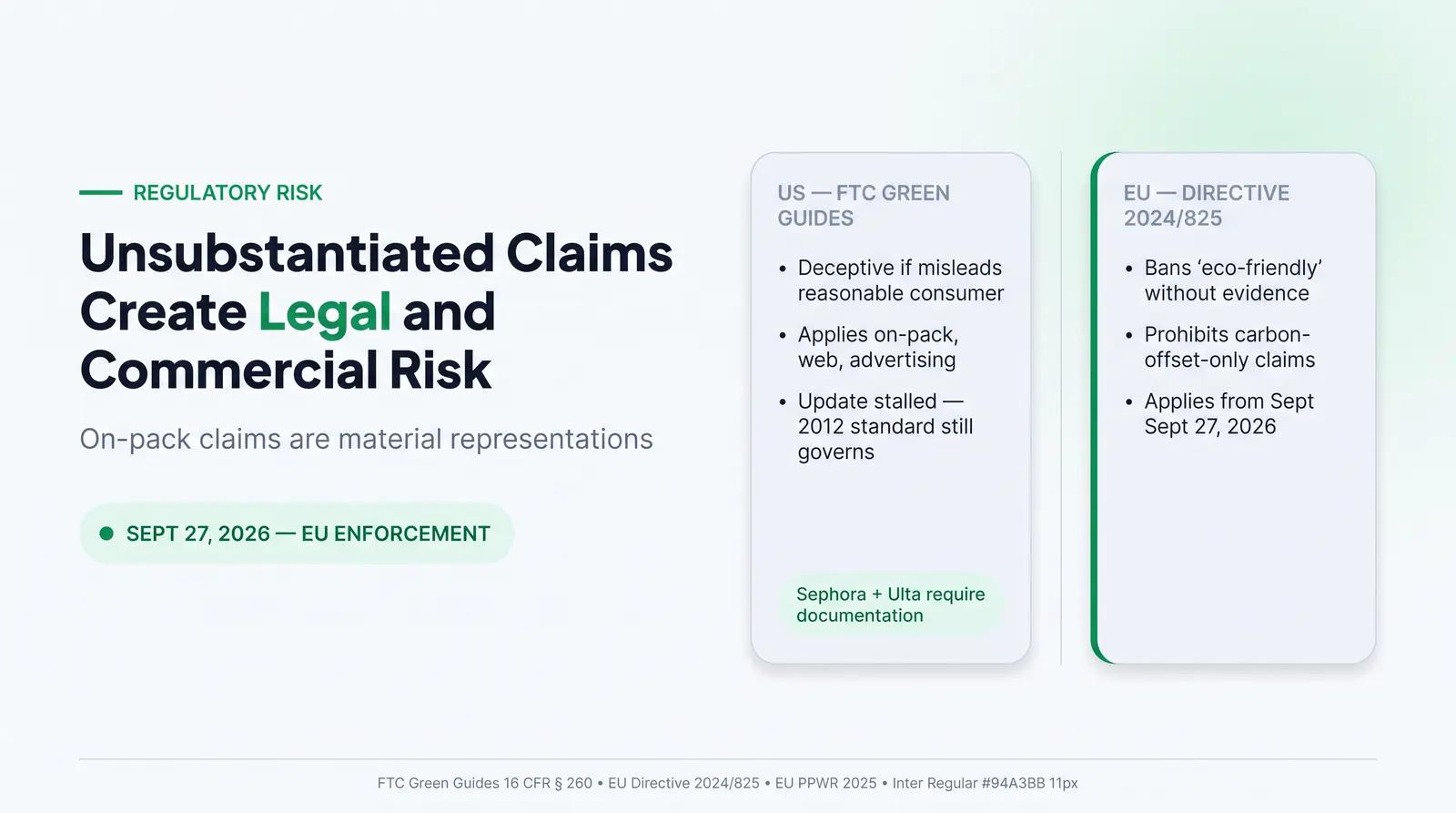
Packaging occupies a unique position in the regulatory landscape. Unlike a brand website or social media post, on-pack claims follow a product into a consumer's home and directly influence disposal behavior. Regulators treat packaging claims as material representations, meaning they are evaluated based on the overall impression a reasonable consumer would take away, not just the technical accuracy of the words used [1].
The FTC's Green Guides, last updated in 2012 and still the governing standard in the US as of 2025 after a proposed update stalled under the current administration [2], establish that a claim is deceptive if it is likely to mislead a reasonable consumer in a way that influences purchasing decisions. This standard applies whether the claim is on-pack, on a website, or in advertising.
In the EU, the landscape has shifted significantly. The proposed Green Claims Directive was effectively suspended in June 2025 after the European Commission announced its intention to withdraw the proposal [3]. However, the Empowering Consumers for the Green Transition Directive (Directive 2024/825) remains fully in force and will begin applying from September 27, 2026. This directive explicitly prohibits generic environmental claims like "eco-friendly," "green," and "nature positive" unless substantiated with specific evidence, and bans claims based solely on carbon offsets [4]. The EU Packaging and Packaging Waste Regulation (PPWR), which entered into force in February 2025 and applies from August 12, 2026, adds mandatory recycled content targets for plastic packaging [5].
For US brands selling in Europe, or brands aspiring to retail at Sephora or Ulta, these frameworks are not optional reading. Sephora's Clean + Planet Aware seal requires brands to provide transparency on the type of materials used in primary and secondary packaging, the percentage of recycled content, and clear recycling instructions on every SKU [6]. Ulta's Conscious Beauty program requires that at least 50% of packaging be made from recycled or bio-sourced materials before a brand can qualify for the sustainable packaging tier [7].
The commercial and regulatory pressure is converging. Brands that build their claims on documentation from the start are the ones that can scale into major retail without rework.
The Packfolio Sustainable Claims Evidence Matrix
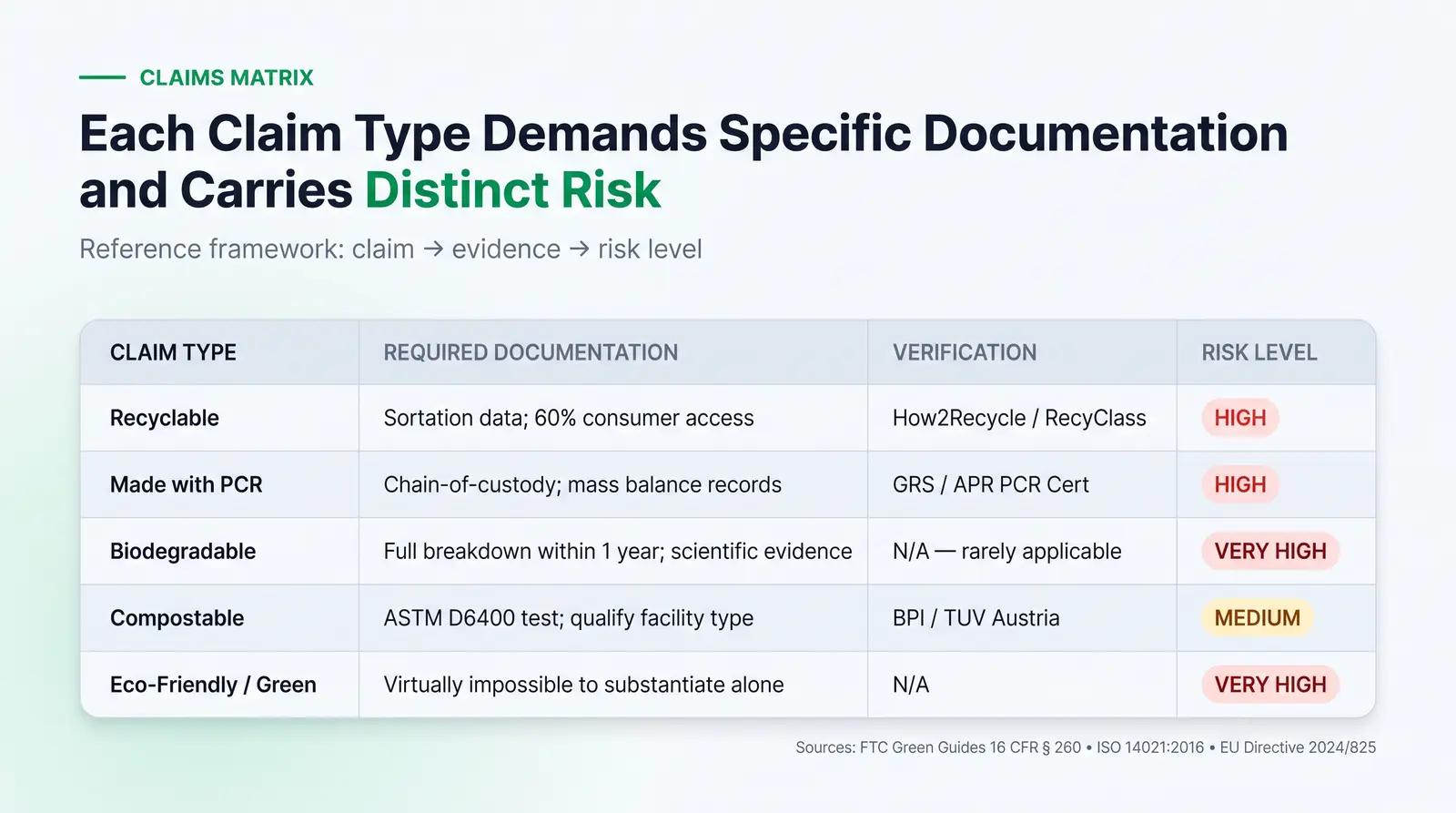
The matrix below is a practical reference framework for beauty brand founders. It maps the most common cosmetic packaging sustainability claims to the documentation required, the third-party verification options available, and the risk level if the claim is made without substantiation.
This framework draws from the FTC Green Guides [1], ISO 14021:2016 [8], the EU Empowering Consumers Directive [4], the EU PPWR [5], and guidance from the Association of Plastic Recyclers [9].
| Claim Type | Regulatory Reference | Required Documentation | Third-Party Verification Options | Risk Level if Unsubstantiated | Key Pitfall |
|---|---|---|---|---|---|
| Recyclable | FTC Green Guides 16 CFR § 260.12; ISO 14021 | Evidence that recycling facilities are available to at least 60% of consumers where sold; sortation data showing the item is recovered in real MRF conditions. | How2Recycle (US/Canada); RecyClass (EU) | High | Small cosmetic containers often fail real-world MRF sortation regardless of material. |
| Made with Recycled Content (PCR) | FTC Green Guides 16 CFR § 260.13; ISO 14021 | Chain-of-custody documentation from resin supplier; mass balance or segregation records; bill of materials with percentage by weight. | APR PCR Certification; Global Recycled Standard (GRS); SCS Recycled Content | High | Must distinguish post-consumer (PCR) from pre-consumer (PIR) material. Percentage must reflect the entire package by weight. |
| Biodegradable | FTC Green Guides 16 CFR § 260.8 | Competent and reliable scientific evidence that the entire package will completely break down and return to nature within one year after customary disposal. | N/A (rarely applicable to packaging destined for landfills) | Very High | Items going to landfills will not degrade within a year. Unqualified biodegradable claims on packaging are almost always deceptive. |
| Compostable | FTC Green Guides 16 CFR § 260.7; ASTM D6400 / D6868 | Scientific evidence that materials break down into usable compost safely and in the same time as composted materials. Must qualify whether commercial facilities are required. | BPI Certified Compostable; TUV Austria OK Compost | Medium | Must specify if commercial facilities are required, as these are not available to a substantial majority of consumers. |
| Ocean Plastic / Ocean-Bound Plastic | FTC Green Guides (general benefit claims); ISO 14021 | Certification tracking collection of plastic waste within a defined distance from shorelines before it enters the ocean; full chain-of-custody records. | Ocean Bound Plastic (OBP) Certification; OceanCycle | Medium | Vague "ocean-friendly" claims are prohibited under the EU Empowering Consumers Directive. Requires strict chain-of-custody. |
| Refillable / Reusable | FTC Green Guides 16 CFR § 260.14 | Proof that a system exists to collect and refill the package, or that a refill product is sold for the original package. | N/A | Low | Claiming "reusable" because a consumer might repurpose a jar is deceptive under the FTC standard. |
| Sustainably Sourced (Paper / Carton) | FTC Green Guides (renewable materials); ISO 14021 | Chain-of-custody documentation proving paper or wood fibers originate from responsibly managed forests, maintained through every link in the supply chain. | Forest Stewardship Council (FSC); PEFC | Low | The entire supply chain from forest to printer must maintain certification to use the logo on-pack. |
| Eco-Friendly / Green / Sustainable | FTC Green Guides § 260.4; EU Empowering Consumers Directive 2024/825 | Virtually impossible to substantiate as a standalone claim. Must be tied to a specific, qualified attribute with supporting data. | N/A | Very High | These terms are explicitly prohibited in the EU from September 2026 unless backed by specific, verified evidence. In the US, the FTC has consistently flagged them as unsubstantiable. |
The Small Format Reality: Why "Recyclable" is Harder Than It Looks
There is a counterintuitive reality in beauty packaging that catches founders off guard. Even if a small jar, lip balm tube, or sample vial is made from perfectly recyclable mono-material PET or PP, it frequently fails real-world sortation at Material Recovery Facilities (MRFs).
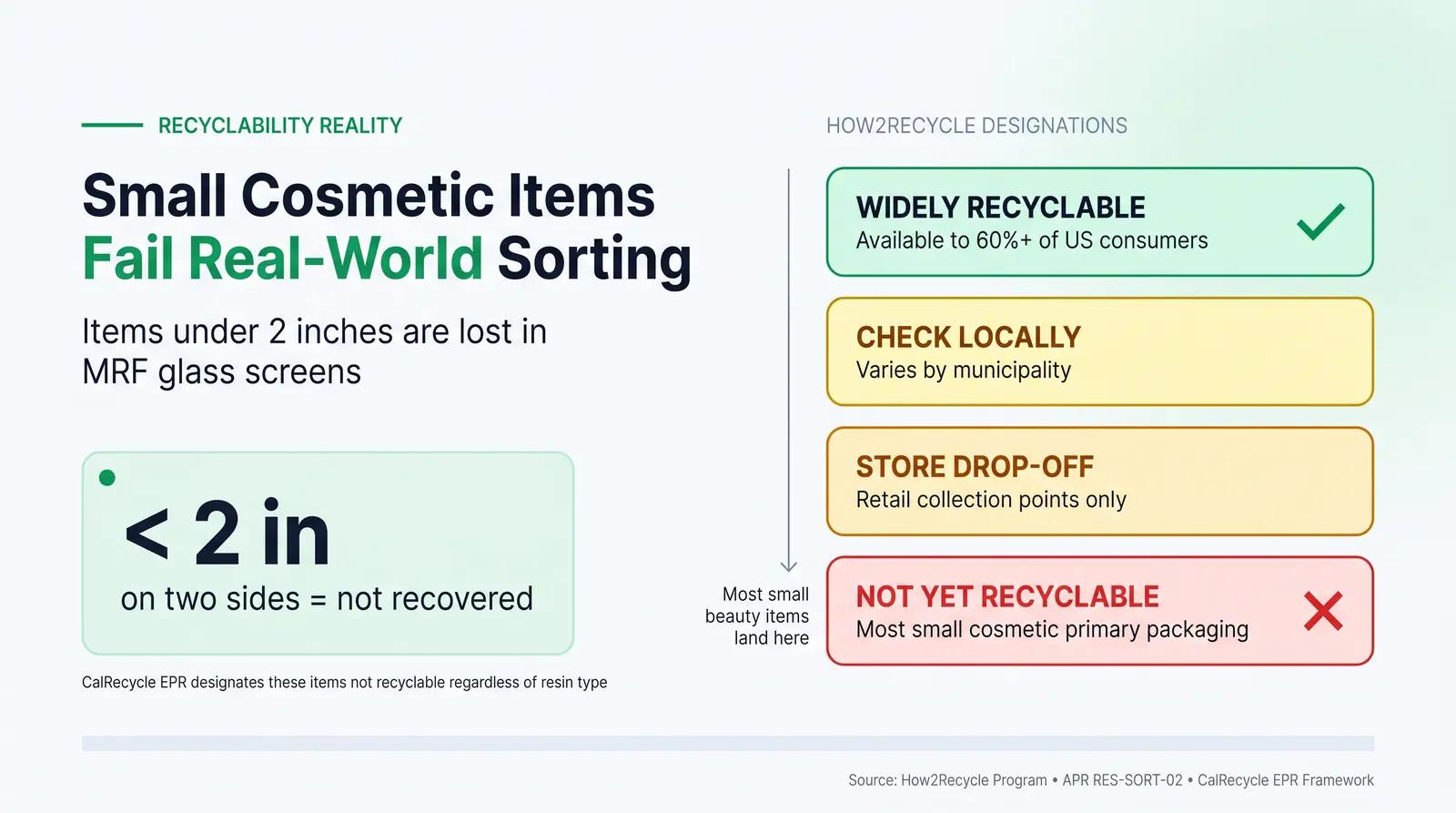
Items with two dimensions less than two inches (approximately 50 mm) are likely to pass through the sorting screens designed to separate broken glass and small contaminants [9]. These screens are not designed to discard recyclable materials, but small plastic items become collateral damage in the glass separation process. If a small plastic item passes through the screen, it ends up in the glass stream or fine residue and is lost to recovery.
According to the SPICE industry initiative, real recyclability at scale for small cosmetics items can only be achieved with mature sorting infrastructure, and current systems globally often discard these formats regardless of their material composition [10]. California's CalRecycle has designated plastic items with two or more sides measuring two inches or less as not recyclable under its EPR framework, regardless of resin type [10].
For founders, this means an unqualified "100% Recyclable" claim on a small component may violate the FTC's requirement that a product must be highly likely to be recycled in the existing system [1]. The standard is not whether the material could theoretically be recycled. It is whether it actually will be recycled given the infrastructure available to the consumer.
The practical path forward is to qualify the claim accurately or obtain a How2Recycle assessment. How2Recycle evaluates four dimensions: collection access, sortation success, reprocessing feasibility, and end market demand [11]. The program assigns one of four designations: Widely Recyclable (available to at least 60% of Americans), Check Locally, Store Drop-off, or Not Yet Recyclable. For most small cosmetic primary packaging, the honest designation is Not Yet Recyclable, and labeling it as such is far less damaging than a false claim.
Third-Party Verification: A Comparison of Major Programs
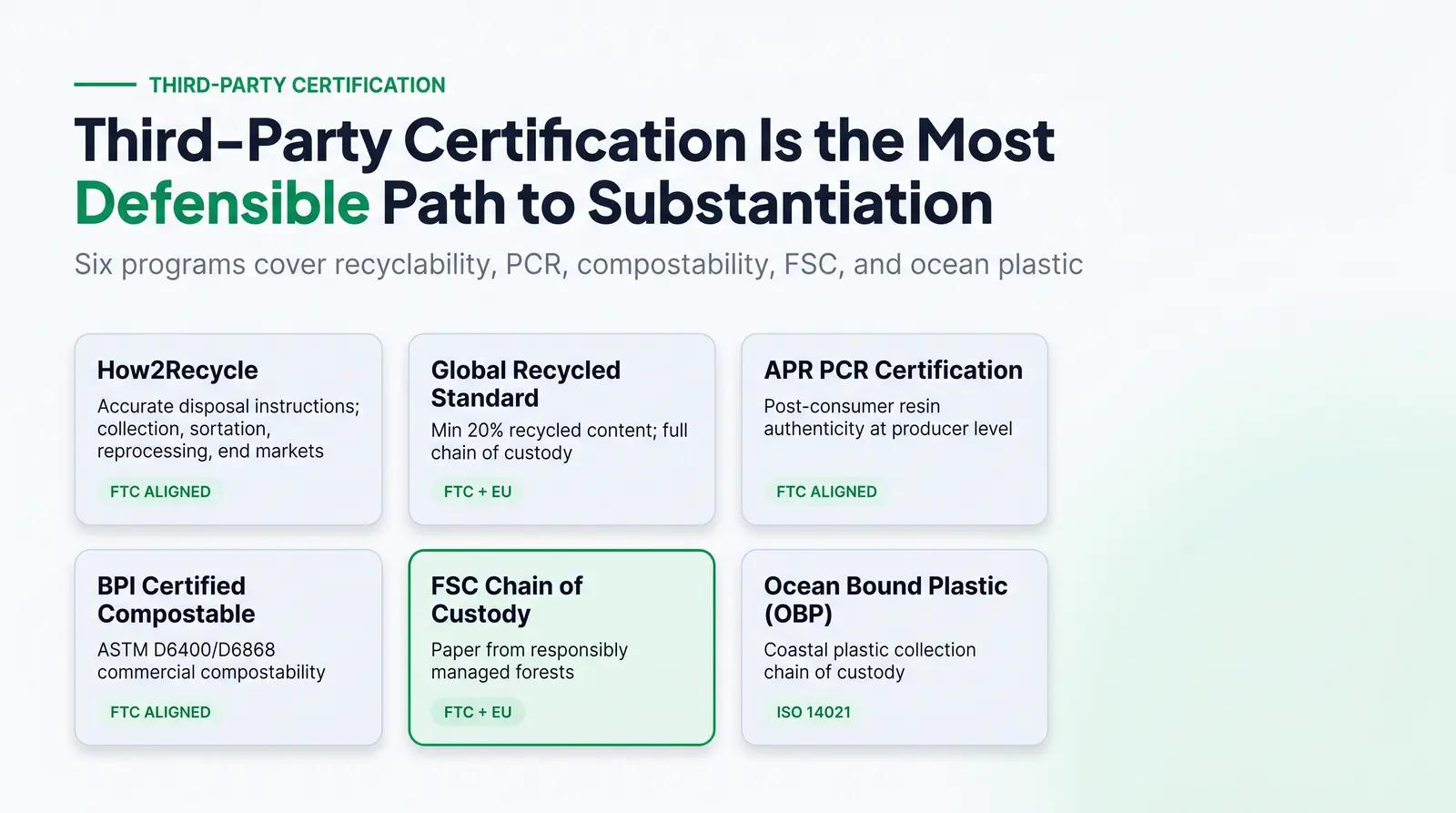
Third-party certification is the most defensible way to substantiate sustainability claims. The table below compares the major programs relevant to cosmetic primary packaging.
| Certification / Program | What It Verifies | Issuing Body | Accessibility for Small Brands | Satisfies FTC / EU Requirements |
|---|---|---|---|---|
| How2Recycle | Accurate on-pack disposal instructions based on collection access, sortation, reprocessing, and end markets. | GreenBlue (Sustainable Packaging Coalition) | Accessible via annual membership; requires packaging assessment per SKU. | Aligns with FTC Green Guides for recyclability qualifications; accepted by major US retailers. |
| Global Recycled Standard (GRS) | Minimum 20% recycled content, full chain of custody, social and environmental practices across the supply chain. | Textile Exchange / SCS Global Services | Moderate to high cost; requires full supply chain auditing. | Provides robust substantiation for FTC and EU PCR claims. |
| APR PCR Certification | Third-party verification for post-consumer resin (PCR) authenticity at the resin producer or converter level. | Association of Plastic Recyclers | Targeted at resin producers and converters; brand owners benefit by sourcing from certified suppliers. | Strong evidence for FTC recycled content claims; supports chain-of-custody documentation. |
| BPI Certified Compostable | Compliance with ASTM D6400 or D6868 for commercial compostability; optional home compostability certification. | Biodegradable Products Institute | Application fee from $1,500; testing can take up to 12 months. | Meets FTC requirements for commercial compostability claims; required by multiple US states for compostable labeling. |
| FSC Chain of Custody | Paper and wood materials sourced from responsibly managed forests, tracked through every link in the supply chain. | Forest Stewardship Council | Accessible through certified packaging suppliers; brand does not need its own certification if sourcing from a certified supplier. | Validates sustainable sourcing claims for secondary packaging and cartons. |
| Ocean Bound Plastic (OBP) Certification | Collection of plastic waste from coastal communities within a defined distance from shorelines before it enters the ocean. | Zero Plastic Oceans | Requires certification of the supply chain; brand must source from OBP-certified suppliers. | Provides chain-of-custody evidence for ocean-bound plastic claims; aligns with ISO 14021. |
The CLAIM Framework: A Named Decision Process for Beauty Founders
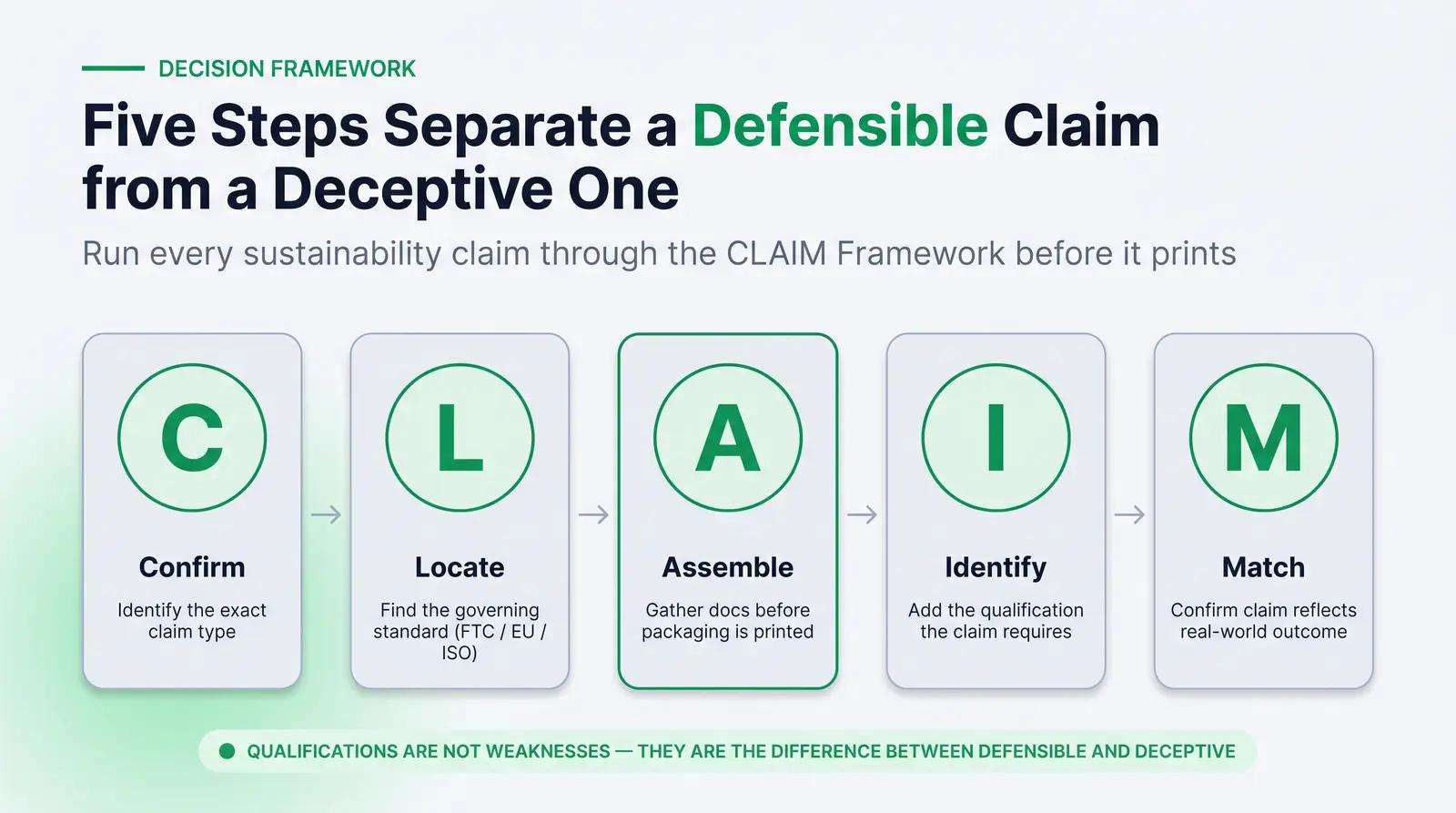
Before printing any sustainability claim on packaging, run it through the following five-step process. This is the Packfolio CLAIM Framework.
C: Confirm the claim type. Identify exactly which type of claim you are making. "Recyclable," "made with recycled content," and "sustainably sourced" are three different claims with three different evidence requirements. Mixing them or using them interchangeably is a common source of compliance risk.
L: Locate the governing standard. Every claim type has a primary regulatory reference. In the US, that is the FTC Green Guides. For brands selling in the EU, it is the Empowering Consumers Directive from September 2026. For specific material attributes, ISO 14021 provides the self-declaration standard. Know which standard applies to your claim before drafting packaging copy.
A: Assemble the documentation. Gather the supplier documentation, test results, or chain-of-custody records that substantiate the claim. This documentation should exist before the claim appears on packaging, not after. For PCR claims, this means a transaction certificate or chain-of-custody record from the resin supplier. For recyclability claims, this means sortation data or a How2Recycle assessment. For compostable claims, this means a BPI certificate or equivalent.
I: Identify the qualification needed. Most sustainability claims require a qualification to be accurate. "Recyclable where facilities exist" is more accurate than "Recyclable." "Made with 30% post-consumer recycled plastic, excluding pump mechanism" is more accurate than "Made with recycled content." Qualifications are not weaknesses. They are the difference between a defensible claim and a deceptive one.
M: Match the claim to real-world conditions. Ask whether the claim reflects what actually happens to the package after a consumer uses it. A package made from recyclable material that ends up in a landfill because it is too small to be sorted is not, in practice, recyclable for that consumer. The FTC evaluates claims based on real-world outcomes, not theoretical material properties.
Worked Example: Launching an Airless Pump with PCR
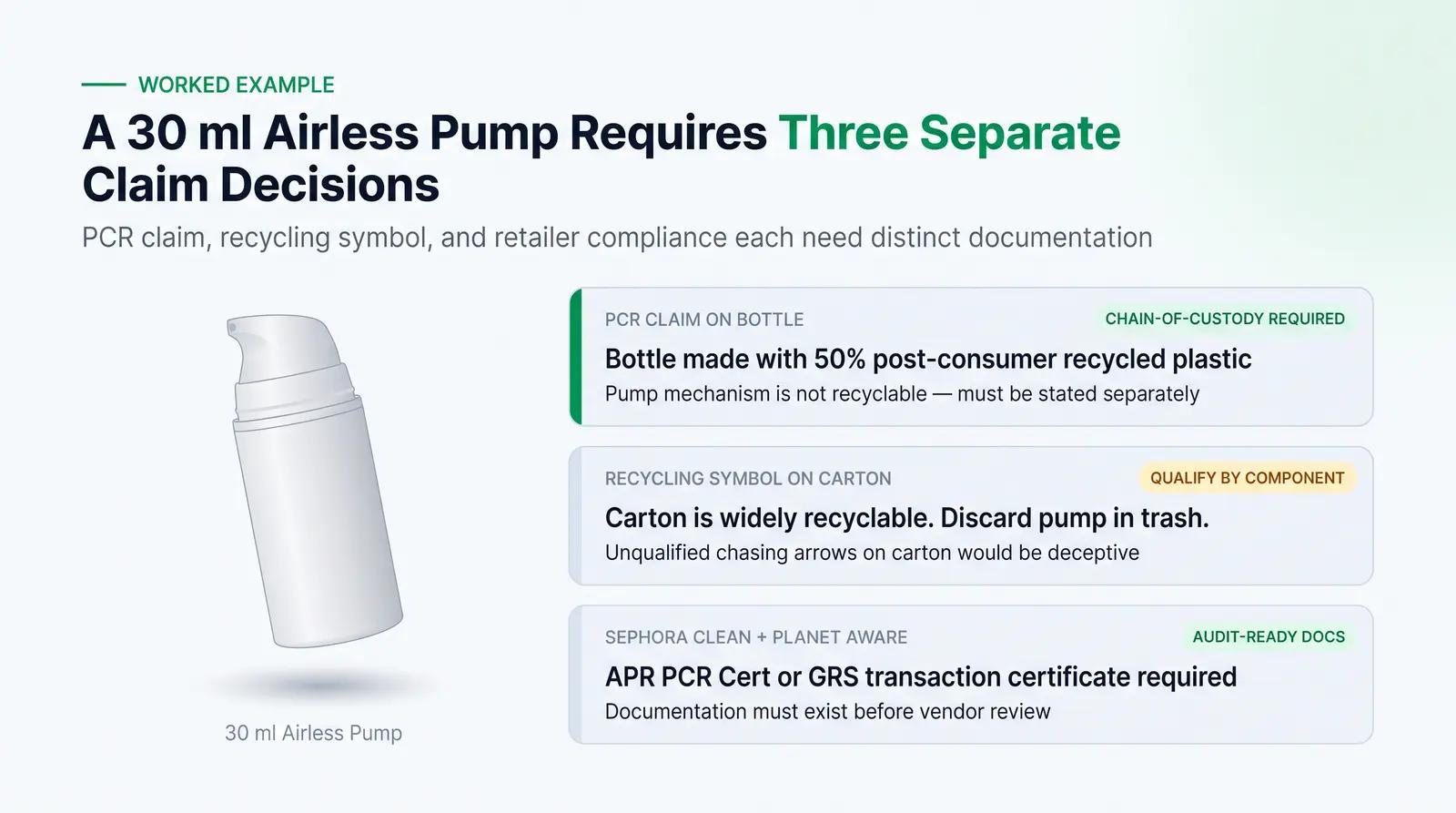
Consider a founder launching a face moisturizer in a 1 oz (30 ml) airless pump. She wants to print "Made with 50% PCR plastic" on the bottle and include a recycling symbol on the outer carton and product page. She is preparing to pitch Sephora for the Clean + Planet Aware program.
The PCR claim on the bottle. To claim "Made with 50% PCR plastic," the founder needs chain-of-custody documentation from the packaging supplier showing that the resin used is post-consumer recycled material, not pre-consumer industrial scrap. Under the FTC Green Guides, if the source includes pre-consumer material, the claim must be qualified accordingly [1]. The 50% figure must reflect the percentage by weight of the entire package, including the pump mechanism. If the pump mechanism contains virgin plastic and metal components, the 50% claim may only apply to the bottle body. The accurate claim might read: "Bottle made with 50% post-consumer recycled plastic. Pump mechanism is not recyclable."
The recycling symbol on the carton. A 1 oz airless pump is typically too small to pass MRF sortation screens [9], and multi-material pumps containing plastic, metal springs, and silicone gaskets are not recyclable as a unit. An unqualified chasing arrows symbol on the carton that implies the primary package is recyclable would be deceptive. The carton itself, if made from FSC-certified paperboard, can carry a recycling instruction. The accurate carton copy would read: "Carton is widely recyclable. Discard pump in trash."
Retailer compliance. Sephora's Clean + Planet Aware program requires brands to provide the type of materials used in primary and secondary packaging and the percentage of sustainable material content [6]. Having the supplier's APR PCR Certification or a GRS transaction certificate on file will satisfy these retailer audits. Without documentation, the brand cannot substantiate the claim during the vendor review process, regardless of what is printed on the package.
Verifying packaging material claims at the sourcing stage is critical, and it can be an administrative burden for small brands without dedicated sustainability teams. At Packfolio, our catalog SKUs come with supplier-sourced material documentation, meaning founders can ask us directly about available PCR content specs, resin identification, and material composition for any SKU in the catalog. The documentation exists before the order is placed, not after.
Browse Packfolio's curated cosmetic packaging catalog and check material specs for PCR content and recyclability before you commit to a claim. packfolio.com
Common Mistakes That Create Greenwashing Exposure
Several patterns appear repeatedly when beauty brands run into compliance issues with sustainability claims.
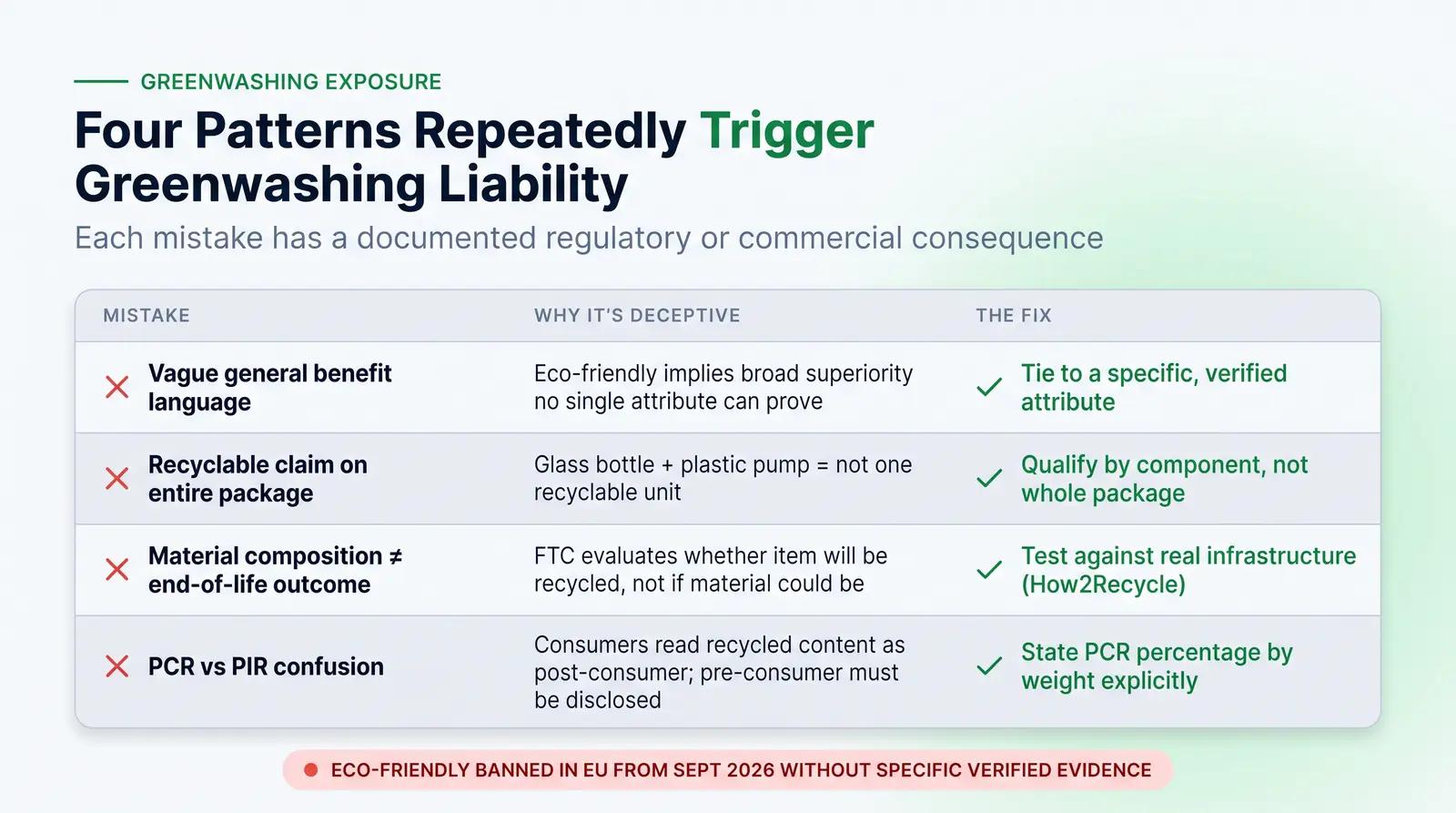
The first is using vague general benefit language. Terms like "eco-friendly," "green," "clean," and "sustainable" imply broad environmental superiority that no single packaging attribute can substantiate. These terms are the highest-risk claims in the FTC framework and are explicitly prohibited in the EU from September 2026 unless tied to specific, verified evidence [4].
The second is applying a recyclable claim to the entire package when only one component is recyclable. A glass bottle with a plastic pump is not a recyclable package. The glass component may be recyclable where facilities exist. The pump is not. Labeling the package as "recyclable" without distinguishing between components is deceptive.
The third is confusing material composition with end-of-life outcome. A package made from recyclable resin is not the same as a package that will be recycled. The FTC evaluates recyclability based on whether the package will actually be recycled in the infrastructure available to the consumer, not whether the material is theoretically capable of being recycled [1].
The fourth is failing to distinguish post-consumer recycled content from pre-consumer. Pre-consumer material is manufacturing scrap that never reached a consumer. Post-consumer material is waste generated by households or end users. Consumers and retailers interpret "recycled content" as post-consumer. If the content is pre-consumer, the claim must say so [8].
Frequently Asked Questions
What documentation do I need to back up a "recyclable" claim on cosmetic packaging?
You need evidence that recycling facilities are available to at least 60% of the consumers where the product is sold, and proof that the package will actually be sorted and recovered by local facilities. For complex or small cosmetic items, obtaining a How2Recycle assessment provides the necessary technical evaluation and standardized labeling that aligns with FTC Green Guides requirements.
What percentage of recycled content qualifies as a PCR claim under FTC guidelines?
The FTC does not mandate a minimum percentage to make a PCR claim, but you must clearly and prominently disclose the amount by weight to avoid deception. A claim like "Made from 30% post-consumer recycled plastic" is defensible. A claim that just says "recycled content" without a percentage implies a higher amount than may be accurate. You must also have chain-of-custody documentation proving the material is post-consumer rather than pre-consumer industrial scrap.
What is the difference between "biodegradable" and "compostable" on packaging?
A "biodegradable" claim requires proof that the entire package will completely break down and return to nature within one year after customary disposal. Because most packaging ends up in landfills or incinerators, this standard is nearly impossible to meet for conventional cosmetic packaging. "Compostable" means the material will safely break down into usable compost in a commercial or home composting facility, supported by standards like ASTM D6400. Compostable claims must specify whether commercial facilities are required, as most consumers do not have access to industrial composting.
How do I avoid greenwashing on cosmetic packaging under the FTC Green Guides?
Avoid broad, unqualified general environmental benefit claims. Every specific claim, such as "recyclable" or "recycled content," must be supported by competent and reliable scientific evidence, clearly qualified where limitations exist, and backed by accurate supplier documentation. The FTC evaluates the overall impression a reasonable consumer would take away, not just the technical accuracy of the words used.
Does the EU Empowering Consumers Directive apply to US beauty brands selling in Europe?
Yes. The Empowering Consumers for the Green Transition Directive (Directive 2024/825) applies to any company making environmental claims directed at EU consumers, regardless of where the company is headquartered. From September 27, 2026, it prohibits generic claims like "eco-friendly" or "green packaging" unless substantiated with specific, verifiable evidence. Brands selling through EU retailers or direct-to-consumer in Europe need to audit their packaging claims before that date.
References
[1] Federal Trade Commission. "Guides for the Use of Environmental Marketing Claims (Green Guides)." 16 CFR Part 260. 2012. https://www.ecfr.gov/current/title-16/chapter-I/subchapter-B/part-260
[2] Packaging Dive. "Green Guides updates still pending as states lead on labeling." February 10, 2025. https://www.packagingdive.com/news/packaging-labeling-recyclable-compostable-green-guides/738514/
[3] Latham and Watkins. "European Commission Announces Intention to Withdraw EU Green Claims Directive Proposal." June 24, 2025. https://www.lw.com/en/insights/european-commission-announces-intention-to-withdraw-eu-green-claims-directive-proposal
[4] Cooley. "Empowering Consumers for the Green Transition Directive: Check Your Sustainability Claims." March 16, 2026. https://products.cooley.com/2026/03/16/empowering-consumers-for-the-green-transition-directive-check-your-sustainability-claims-and-warranty-information-for-compliance-with-new-eu-regime/
[5] European Commission. "Packaging and Packaging Waste Regulation (PPWR) 2025/40." February 2025. https://environment.ec.europa.eu/topics/waste-and-recycling/packaging-waste_en
[6] EcoEnclose. "Guide to Sephora's Packaging and Sustainability Requirements." October 2024. https://www.ecoenclose.com/resources/retailer-guide/sephora
[7] Ulta Beauty. "Conscious Beauty Program." https://www.ulta.com/discover/conscious-beauty
[8] International Organization for Standardization. "ISO 14021:2016 Environmental labels and declarations: Self-declared environmental claims (Type II environmental labelling)." 2016. https://www.iso.org/standard/66652.html
[9] Association of Plastic Recyclers. "Size Sorting in the Plastics Recycling Process (RES-SORT-02)." August 2024. https://plasticsrecycling.org/documents/res-sort-02/
[10] SPICE. "Unlocking recyclability: Addressing gaps beyond Design for Recycling (DfR)." https://open-spice.com/spice-insight-unlocking-recyclability-addressing-gaps-beyond-design-for-recycling-dfr/
[11] How2Recycle. "About the How2Recycle Label." https://how2recycle.info/about-the-how2recycle-label/


