
State-by-State EPR Map for Beauty Brands
Seven US states now enforce EPR packaging laws affecting beauty brands, with eco-modulated fees penalizing hard-to-recycle formats like multi-material tubes and pumps.
You get your formulations right, sort out your MoCRA compliance, and start scaling distribution across state lines. Then a new line item appears: a fee for the jars, tubes, and pumps you just shipped to Oregon and Colorado. This is the reality of Extended Producer Responsibility (EPR) packaging laws. For independent beauty founders, the challenge isn't just that packaging now carries a regulatory cost. It's that the rules change depending on which state line your product crosses.
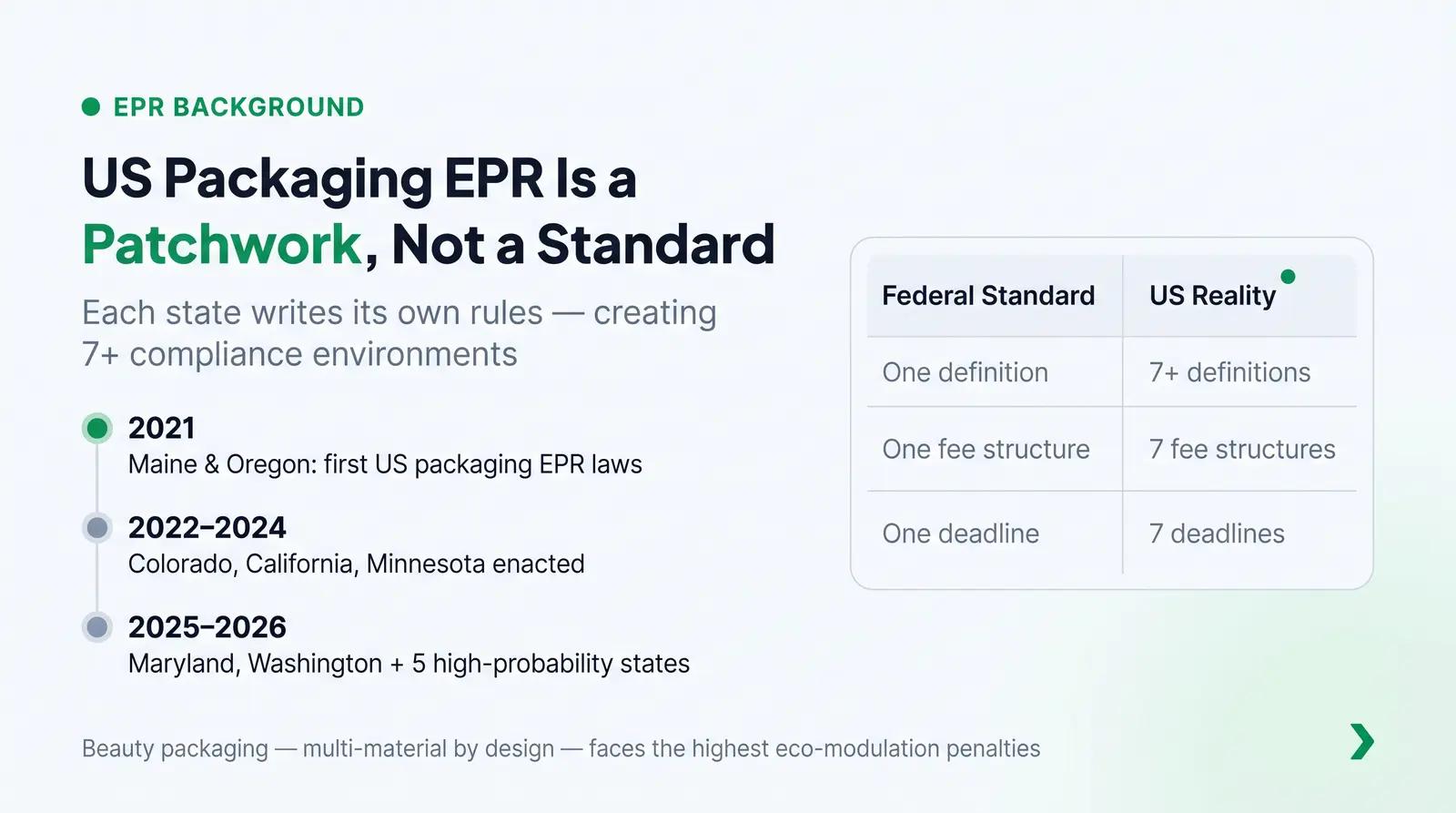
EPR laws shift the financial and operational burden of managing post-consumer packaging waste from local municipalities to the "producers" who put that packaging on the market [1]. Rather than a single federal standard, the US landscape is a fragmented patchwork of state-level legislation. What counts as a covered material in Maine might be handled differently in California. The revenue threshold that exempts your brand in Colorado might not protect you in Oregon. This fragmentation creates a genuinely complex compliance environment, especially for beauty brands whose primary packaging — pumps, droppers, mixed-material compacts — is notoriously difficult to recycle.
Understanding this landscape now, even if you currently fall below the exemption thresholds, is critical. The packaging decisions you make today will directly affect your compliance costs as your brand scales.
Why EPR Exists and Why the US Landscape Is Fragmented
EPR is not a new concept globally. European countries have operated producer responsibility programs for decades. In the US, EPR has long applied to specific product categories like paint, electronics, and mattresses. The extension to consumer packaging is recent, accelerating sharply since 2021 when Maine and Oregon became the first two states to enact packaging-specific EPR laws [2].
The fragmentation is structural, not accidental. Without federal action, states have moved independently. Each state legislature has written its own definitions of "covered material," its own exemption thresholds, its own enforcement timelines, and its own compliance mechanisms. The result is that a brand selling a vitamin C serum in California, Oregon, and Colorado may face three different reporting requirements, three different fee structures, and three different deadlines — all for the same product [2] [3].
For beauty brands specifically, this matters more than it does for, say, a beverage company. Cosmetic primary packaging is often multi-material by design: a glass bottle with a plastic pump, a compact with a metal hinge, a tube with a multi-layer laminate. These formats are standard in beauty but are precisely the packaging types that EPR fee structures penalize most heavily through "eco-modulation" — a mechanism that adjusts fees based on how recyclable or sustainable a material is [4].
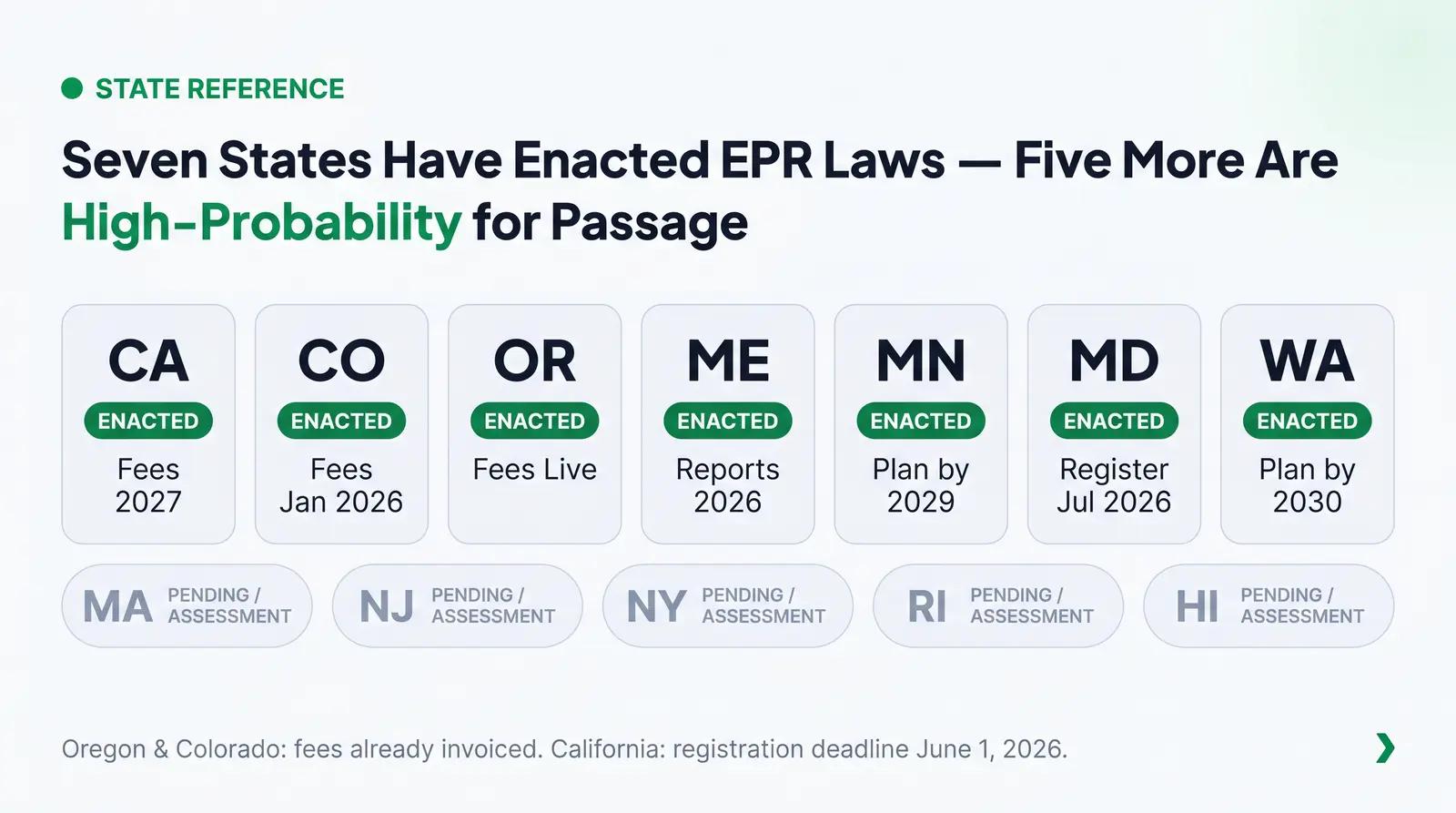
Seven states have now enacted comprehensive EPR packaging laws: Maine, Oregon, Colorado, California, Minnesota, Maryland, and Washington [2]. More are advancing legislation, with Massachusetts, New Jersey, New York, Rhode Island, and Virginia identified as high-probability states for passage in the near term [5].
State-by-State EPR Reference Table
The table below covers all US states with enacted EPR packaging legislation, plus a status note for states with pending or advancing bills. States not listed have no active EPR packaging law or bill as of the date of this article.
| State | EPR Law Status | Key Law / Bill Name | Materials Covered | Producer Obligation Start | Beauty Brand Relevance |
|---|---|---|---|---|---|
| California | Enacted | SB 54 (Plastic Pollution Prevention and Packaging Producer Responsibility Act) | Single-use packaging and plastic food serviceware [6] | Registration by June 1, 2026; Fees begin 2027 [6] | Mandates 100% recyclable or compostable packaging by 2032. Requires 25% plastic reduction. Exempts brands with < $1M gross sales in-state [7]. |
| Colorado | Enacted | HB 22-1355 (Producer Responsibility Program for Statewide Recycling Act) | Packaging materials and paper products [8] | Active since July 2025; First fees invoiced January 2026 [8] | Covers all primary and secondary cosmetic packaging. Exempts brands under $5M revenue or < 1 ton of covered packaging annually [9]. |
| Oregon | Enacted | SB 582 (Plastic Pollution and Recycling Modernization Act) | Packaging, printing and writing paper, food serviceware [10] | Active since July 1, 2025; Fees invoiced [10] | Fees are live. Eco-modulated fee structure. Exempts brands under $5M revenue or < 1 ton packaging [9]. |
| Maine | Enacted | LD 1541 (Stewardship Program for Packaging) | Most consumer packaging materials [11] | Registration/reporting begins 2026; Municipal reimbursements begin 2027 [11] | Municipal cost reimbursement model. Exempts brands under $2M revenue or < 1 ton packaging [12]. |
| Minnesota | Enacted | HF 3911 / SF 3561 (Packaging Waste and Cost Reduction Act) | Packaging, paper products, food serviceware [13] | PRO registration 2025; Full plan by 2029; Recyclability mandate by 2032 [13] | Mandates all covered products be reusable, refillable, recyclable, or compostable by 2032. Exempts brands with < $2M global revenue or < 1 ton packaging [9]. |
| Maryland | Enacted | SB 901 (Packaging Materials and Paper Products: Producer Responsibility Plans) | Packaging materials and paper products [14] | PRO registration by July 1, 2026; First plans due July 1, 2028 [14] | Requires participation in a PRO or individual compliance plan [14]. |
| Washington | Enacted | SB 5284 (Recycling Reform Act) | Packaging and paper products [15] | PRO registration by March 1, 2026; Plan implementation by 2030 [15] | Also includes post-consumer recycled content requirements for certain plastic containers [15]. |
| Massachusetts | Pending | Multiple bills under consideration | TBD | TBD | High-probability state for passage; bill reported favorably to state senate [5]. |
| New Jersey | Pending | S614 (2026) and companion bills | TBD | TBD | Bill reintroduced January 2026; would require packaging product stewardship plans [5]. |
| New York | Pending | Multiple companion bills | TBD | TBD | Bills filed and advanced before stalling; expected to be reintroduced [5]. |
| Rhode Island | Needs Assessment | Study bill signed June 2025 | TBD | TBD | Needs assessment underway; EPR law possible in coming years [5]. |
| Hawaii | Needs Assessment | Needs assessment law enacted 2025 | TBD | TBD | Results due to legislature by end of 2027 [5]. |
| All other states | No active EPR packaging law | N/A | N/A | N/A | No current packaging EPR obligation. Monitor for future legislation. |
Sources for this table are cited inline. Data reflects the most current available information as of mid-2026. Founders should verify current status directly with the relevant state agency or the Circular Action Alliance before making compliance decisions.
The EPR Compliance Tier Matrix for Beauty Brands
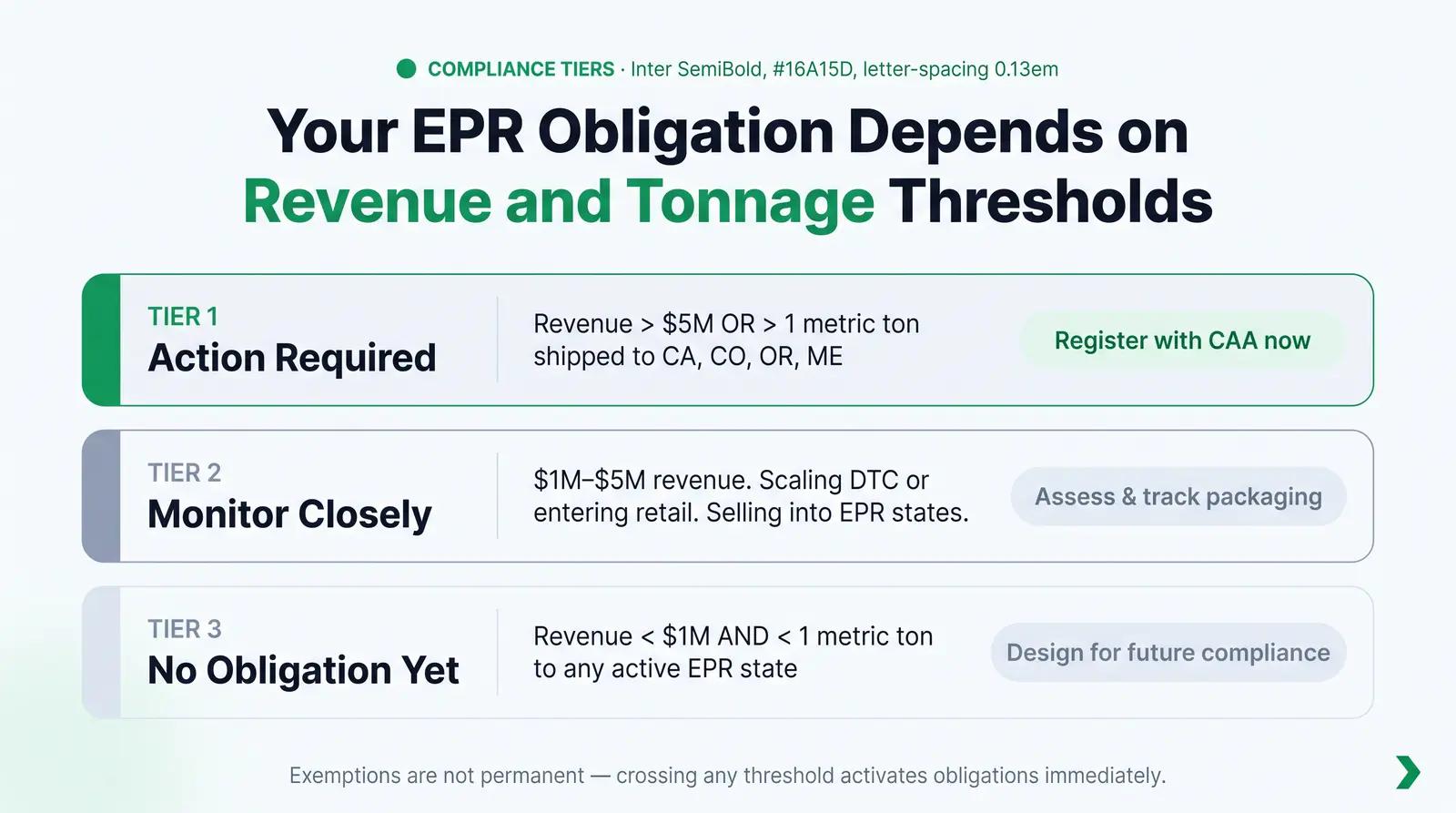
Determining your compliance priority is not a one-size-fits-all exercise. The following framework helps beauty brand founders sort their immediate obligations into three action tiers based on scale and distribution.
| Tier | Criteria | Immediate Action |
|---|---|---|
| Tier 1: Action Required | Annual revenue > $5M globally, OR > 1 metric ton of packaging shipped to CA, CO, OR, or ME in the past fiscal year | Register with the Circular Action Alliance (CAA) now. Audit packaging by SKU, weight, and material type. Meet 2025/2026 reporting deadlines. Budget 0.5-1% of annual sales for PRO fees [9]. |
| Tier 2: Monitor Closely | Annual revenue between $1M and $5M. Scaling DTC or entering national retail. Selling into CA, CO, OR, ME, MN, MD, or WA. | Assess packaging against CA's SB 54 recyclability mandates. Track sales volume by state. You may be exempt from fees but still required to register or attest to exemption status. Begin transitioning to mono-material formats. |
| Tier 3: No Obligation Yet | Annual revenue < $1M AND < 1 metric ton of packaging shipped to any active EPR state | Focus on growth, but design packaging for future compliance. Prioritize mono-materials and recyclable formats. Avoid complex multi-layer laminates and mixed-material closures that will trigger high eco-modulated fees at scale. |
A critical note on Tier 3: exemptions are not permanent. As soon as your brand crosses a revenue or tonnage threshold in any EPR state, obligations activate. Brands that have not been tracking their packaging data will face a scramble to report retroactively. Building the habit of tracking packaging weights and materials by SKU now costs almost nothing. Fixing it later, under a compliance deadline, costs significantly more.
The Contrarian Insight: Fragmentation as a Strategic Advantage
The instinctive reaction to a patchwork of state EPR laws is frustration. Seven different fee structures, seven different reporting timelines, seven different definitions of "covered material" — it reads like a compliance nightmare. However, this fragmentation actually creates a structural advantage for beauty brands that choose packaging with broad recyclability profiles from the start.
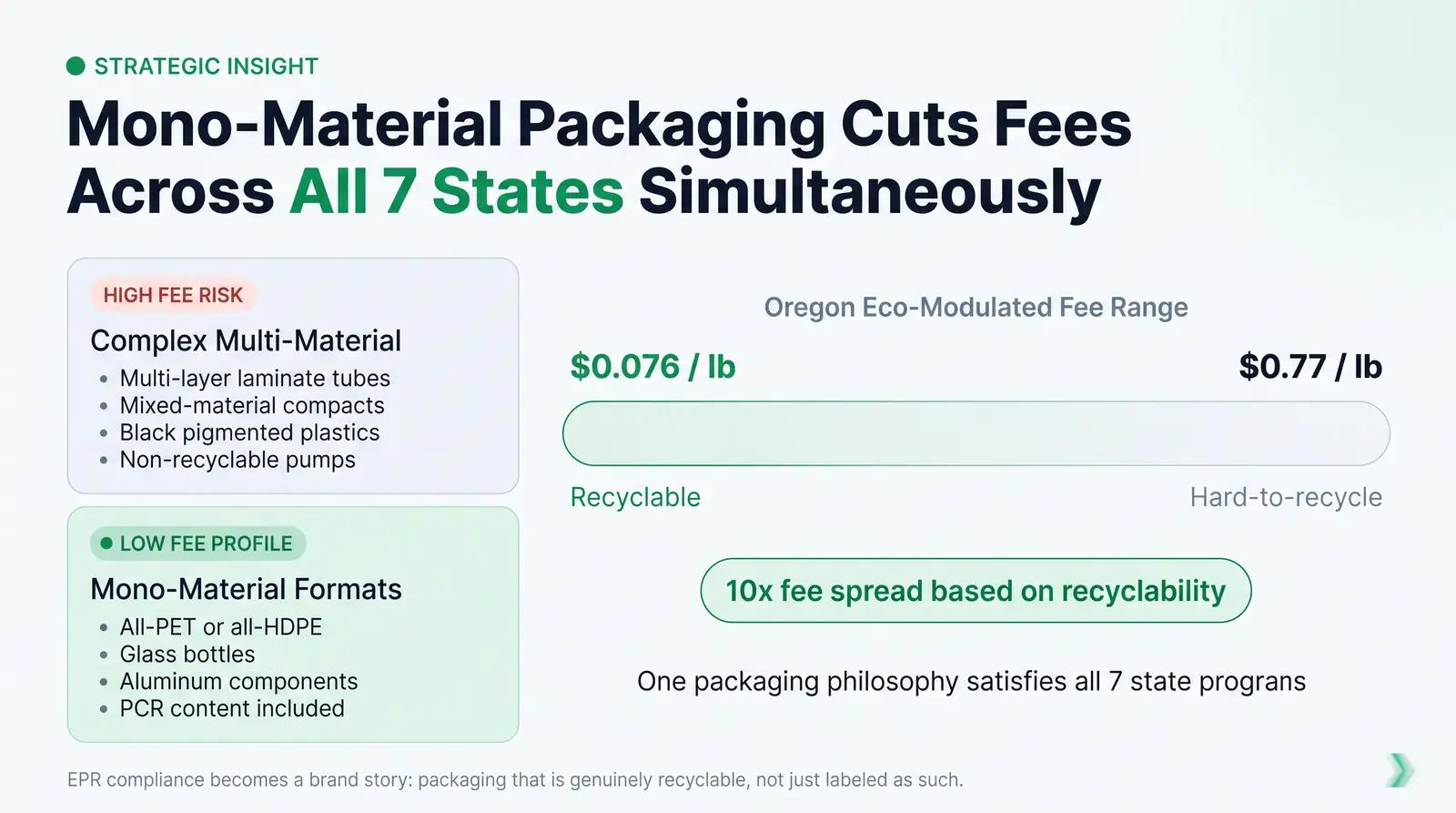
Here is the mechanism: every active EPR program in the US uses eco-modulation, meaning fees are not flat. They are higher for hard-to-recycle materials — multi-layer plastics, black pigmented plastics that confuse sorting equipment, mixed-material formats — and lower for materials that are widely recyclable and include post-consumer recycled content [4]. Oregon's fee structure, the first to go live, ranges from approximately $0.076 to $0.77 per pound of covered material depending on recyclability [9]. That spread is significant at scale.
A brand that designs its primary packaging around mono-material formats — all-PET, all-HDPE, glass, or aluminum — effectively builds a low-fee profile that applies across all seven active EPR states simultaneously. Rather than managing seven different compliance strategies, the brand manages one packaging philosophy that happens to satisfy all of them. Meanwhile, competitors who built their brand identity around complex, multi-material packaging formats will face mounting redesign costs and escalating fees as more states go live.
This is not merely a cost argument. Premium beauty brands already compete on the quality and sustainability of their packaging. EPR compliance, done proactively, becomes a brand story: packaging that is genuinely recyclable, not just labeled as such. That distinction is increasingly meaningful to the retail buyers and DTC consumers who are paying attention [4].
Deep-Dive Comparison: Leading State EPR Laws
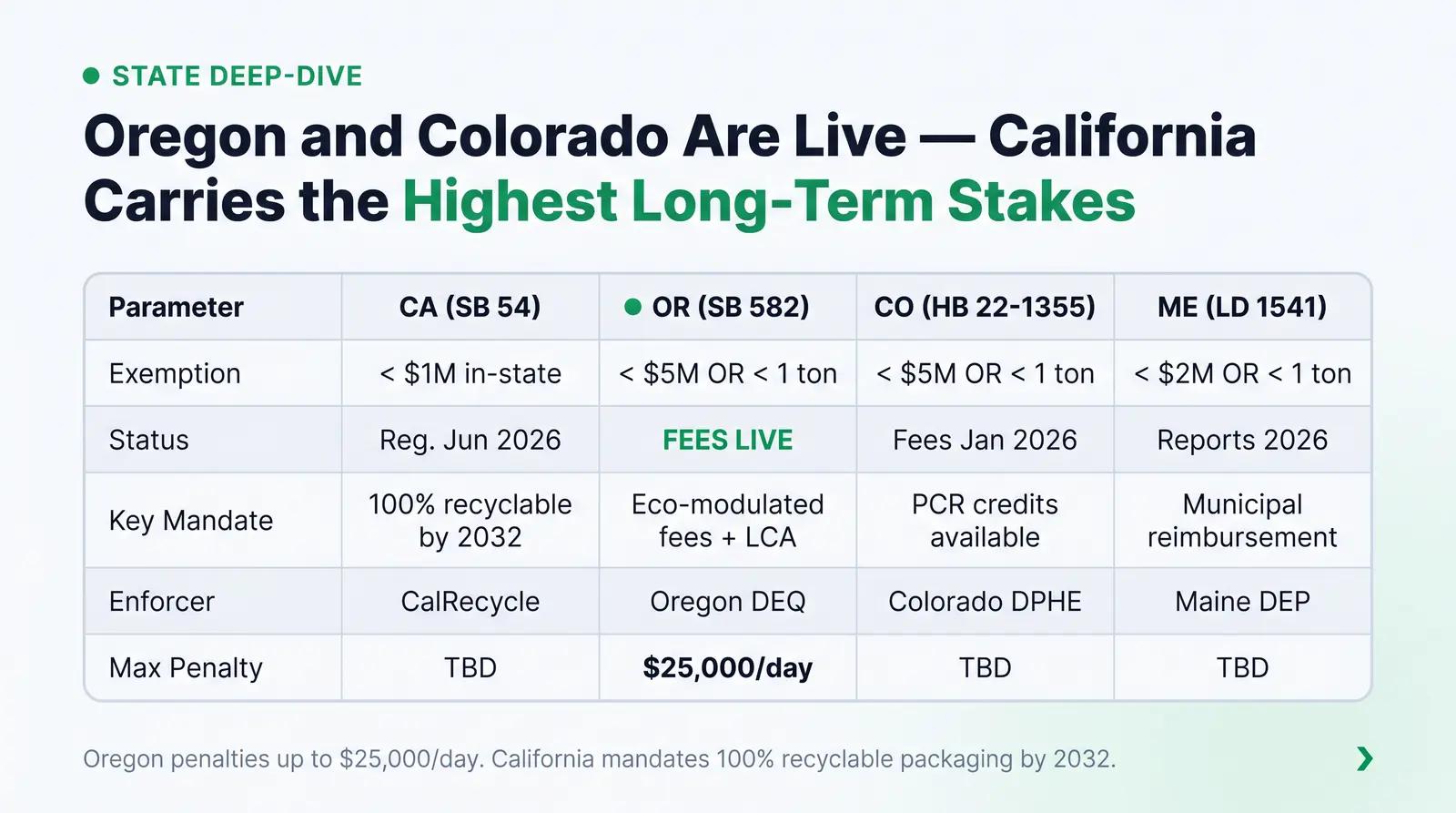
The four states with the most advanced programs differ in meaningful ways. Understanding these differences helps founders prioritize which compliance obligations to address first.
| Parameter | California (SB 54) | Oregon (SB 582) | Colorado (HB 22-1355) | Maine (LD 1541) |
|---|---|---|---|---|
| Small Business Exemption | < $1M gross in-state sales [7] | < $5M total revenue OR < 1 metric ton packaging [9] | < $5M total revenue OR < 1 metric ton packaging [9] | < $2M total revenue OR < 1 metric ton packaging [12] |
| Compliance Mechanism | PRO (CAA) + $5B Plastic Pollution Mitigation Fund over 10 years [6] | PRO (CAA); eco-modulated fees based on LCAs [10] | PRO (CAA); funds 100% of net recycling costs [8] | Stewardship Organization; municipal cost reimbursement [11] |
| Unique Mandate | 100% recyclable/compostable by 2032; 25% plastic source reduction [6] | Eco-modulated fees live; LCA submissions eligible for fee discounts [10] | Eco-modulation credits for PCR content, reuse/refill, and clear labeling [8] | Fees go directly to municipalities, not a PRO-managed program [11] |
| Current Enforcement Status | Regulations effective May 2026; Registration deadline June 1, 2026 [6] | Active; fees invoiced July 2025; penalties up to $25,000/day [10] | Active; first fees invoiced January 2026 [8] | Rulemaking finalized; reporting begins 2026; operational 2027 [11] |
| Enforcement Body | CalRecycle [6] | Oregon DEQ [10] | Colorado DPHE [8] | Maine DEP [11] |
Worked Example: A Founder Scaling Into Three EPR States
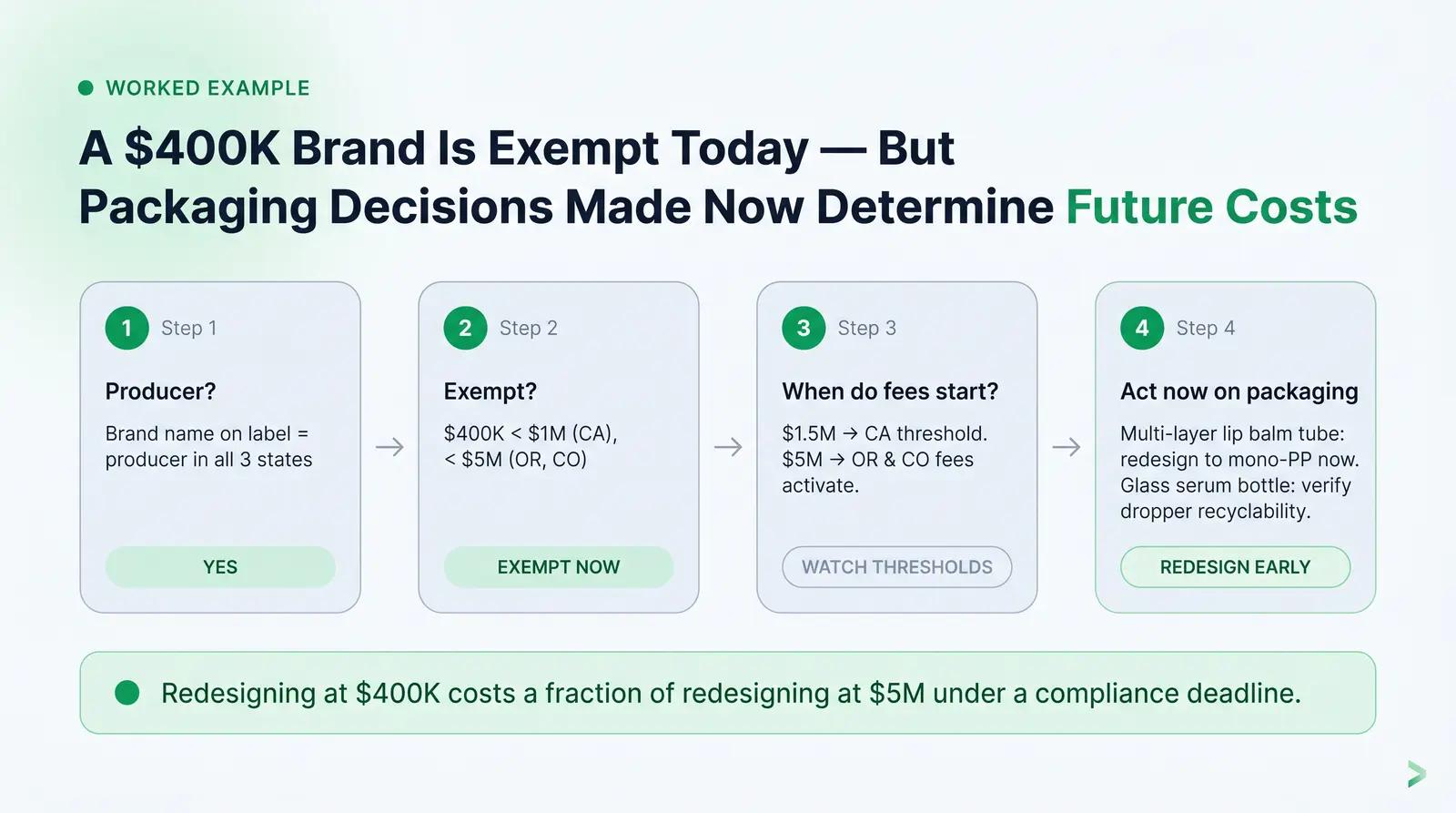
Consider a founder launching two products: a vitamin C serum in a glass bottle with a plastic dropper, and a tinted lip balm in a multi-layer plastic tube. The brand sells direct-to-consumer via its own website and recently secured a retail partner that ships to California, Oregon, and Colorado. Projected annual revenue in year two is $400,000.
Step 1: Are they a "producer" under EPR law? Yes. The brand owner is the entity whose name appears on the product label, which makes them the primary producer in all three states [2]. The fact that a retailer handles some distribution does not transfer the EPR obligation away from the brand owner.
Step 2: Do they qualify for a small producer exemption? At $400,000 in annual revenue, the brand falls below the exemption thresholds for all three states: California (< $1M gross in-state sales), Oregon (< $5M total revenue), and Colorado (< $5M total revenue) [7] [9]. They are currently exempt from paying PRO fees. However, they should confirm they are not placing more than 1 metric ton of packaging into any single state, which would override the revenue-based exemption in Oregon and Colorado [9].
Step 3: When do obligations kick in? If revenue scales to $1.5M in year three, the brand crosses California's $1M threshold [7]. At that point, they must register with CalRecycle and the CAA, and report their 2025 baseline packaging data. If they reach $5M, Oregon and Colorado obligations activate [9]. At each threshold crossing, the brand has a limited window to register before incurring penalties.
Step 4: What packaging decisions should they make now? The multi-layer plastic lip balm tube is the highest-risk component. It will incur high eco-modulated fees in Oregon (where fees are already live) and will not meet California's 2032 recyclability mandate without redesign [6] [10]. Transitioning to a mono-material tube — all-PP or all-PET — now, while the brand is still exempt, avoids a forced redesign under deadline pressure later. The glass serum bottle is widely recyclable and carries a favorable fee profile, but the plastic dropper should be verified as a compatible, recyclable material. A silicone or all-glass dropper would strengthen the recyclability profile further.
The cost of redesigning packaging proactively at $400,000 in revenue is a fraction of the cost of doing it reactively at $5M under a compliance deadline.
What Beauty Brands Should Do Now
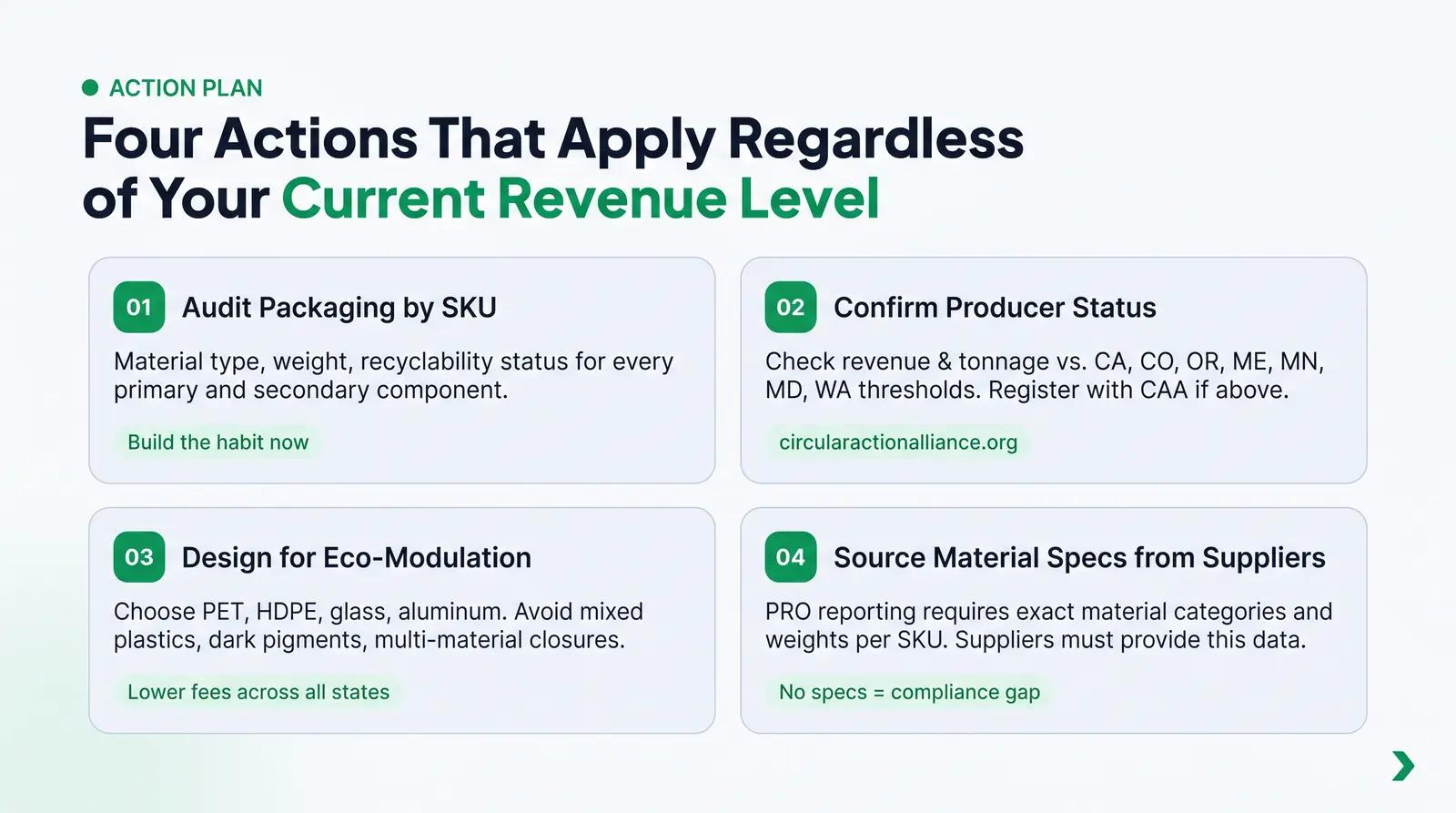
The era of "design first, worry about compliance later" is over. EPR laws mean your packaging choices are now directly tied to your unit economics. The following four actions apply regardless of your current revenue level.
Audit your packaging at the SKU level. Identify every component of every primary and secondary package: material type, weight, recyclability status. This data will be required for PRO reporting when you cross an exemption threshold, and building the habit now is far less disruptive than reconstructing it retroactively.
Determine your producer status in each active EPR state. Assess your revenue and packaging volume shipped to California, Colorado, Oregon, Maine, Minnesota, Maryland, and Washington. If you are already above any threshold, register with the Circular Action Alliance immediately at circularactionalliance.org.
Design for eco-modulation from the start. Move away from mixed plastics, dark pigments that disrupt sorting, and complex multi-material closures. Favor PET, HDPE, glass, and aluminum. These choices lower your fee profile across all active EPR states simultaneously and future-proof your packaging against California's 2032 recyclability mandate.
Source from suppliers who can provide material specifications. PRO reporting requires exact material categories and weights by SKU. Suppliers who cannot provide this data will create compliance gaps when your obligations activate.
At Packfolio, every SKU in the catalog is a vetted cosmetic primary packaging component — bottles, jars, tubes, droppers, airless pumps, lip components, compacts, closures — with defined materials and pre-modeled 3D geometry. The 3D preview step in the order flow means material and format decisions are locked in before production begins, which is exactly the kind of documented packaging record that EPR reporting will eventually require.
Browse Packfolio's curated cosmetic packaging catalog and preview your label in 3D before you order — so material and format decisions are locked in before production begins. packfolio.com/catalog
Frequently Asked Questions
Which states currently have active EPR packaging laws?
As of 2026, seven states have enacted EPR packaging laws: California, Colorado, Oregon, Maine, Minnesota, Maryland, and Washington [2]. Oregon and Colorado are the furthest along in implementation, with active fee collection underway. California's final regulations took effect in May 2026, with producer registration required by June 2026 [6]. Minnesota, Maryland, and Washington are in earlier stages, with full program implementation expected between 2028 and 2030.
Do small beauty brands have to comply with EPR packaging laws?
Most active EPR laws include small producer exemptions, but those exemptions are narrower than many founders assume. California exempts brands with less than $1 million in gross in-state sales [7]. Oregon and Colorado exempt brands with less than $5 million in total revenue or less than 1 metric ton of packaging placed into the state annually [9]. Maine's threshold is $2 million [12]. Importantly, some states require exempt producers to still register or attest to their exempt status, so "exempt" does not always mean "no action required."
What packaging materials are covered under state EPR programs?
All seven enacted state programs cover consumer-facing primary and secondary packaging, including plastics, glass, metal, and paper [3]. California specifically targets single-use packaging and mandates strict recyclability and reduction targets for plastics [6]. Oregon, Colorado, and Minnesota also cover food serviceware. Maine covers most consumer packaging materials regardless of material type [11]. Certain categories are commonly excluded: packaging for prescription pharmaceuticals, medical devices, and hazardous materials.
How does California's packaging EPR law affect beauty brands?
California's SB 54 is the most expansive US packaging EPR law, regulating an estimated 5,741 producers and requiring $500 million per year in contributions to the Plastic Pollution Mitigation Fund beginning in 2027 [6]. For beauty brands, the most significant mandate is that all single-use packaging must be 100% recyclable or compostable by 2032, with a 25% reduction in plastic packaging by the same date [6]. This means complex, multi-material beauty packaging formats — laminate tubes, mixed-material compacts, non-recyclable pumps — will need to be redesigned or replaced before 2032 for any brand selling into California.
What is the difference between EPR and a bottle deposit system?
Bottle deposit systems (commonly called "Bottle Bills") charge consumers a refundable deposit on specific beverage containers, incentivizing return and recycling at the consumer level. EPR packaging laws operate differently: they shift the financial responsibility for managing all covered consumer packaging waste to the producers (brand owners), who fund the system through fees paid to a Producer Responsibility Organization (PRO). The consumer pays nothing directly; the brand pays based on the weight and recyclability of the packaging it places on the market [1].
References
[1] EPR Packaging Laws FAQ: What Every Brand Needs to Know. EcoEnclose. 2025. https://www.ecoenclose.com/blog/epr-faq
[2] Seven States and Counting: The 2025 Guide to EPR Packaging Compliance. Proskauer. October 2025. https://www.proskauer.com/alert/the-2025-guide-to-epr-packaging-compliance
[3] How New EPR Packaging Requirements, Laws, and Recycling Regulations Will Shape Sustainable Packaging in 2026. EcoEnclose. March 2026. https://www.ecoenclose.com/blog/how-new-epr-packaging-requirements-laws-and-recycling-regulations-will-shape-sustainable-packaging-in-2026
[4] The Top 5 Packaging Design Changes That Lower EPR Fees. Group O. August 2025. https://www.groupo.com/the-top-5-packaging-design-changes-that-lower-epr-fees
[5] 10 States To Watch For New Packaging EPR Laws In 2026. PPAI. February 2026. https://www.ppai.org/media-hub/10-states-to-watch-for-new-packaging-epr-laws-in-2026/
[6] SB 54: Plastic Pollution Prevention and Packaging Producer Responsibility Act. CalRecycle. https://calrecycle.ca.gov/packaging/packaging-epr/
[7] California's EPR Regulations In Effect: What You Need to Know. Freshfields. May 2026. https://www.freshfields.com/en/our-thinking/blogs/sustainability/californias-epr-regulations-in-effect-what-you-need-to-know-102msbh
[8] HB22-1355 Producer Responsibility Program For Recycling. Colorado General Assembly. https://leg.colorado.gov/bills/hb22-1355
[9] EPR Packaging Laws FAQ: What Every Brand Needs to Know. EcoEnclose. Updated October 2025. https://www.ecoenclose.com/blog/epr-faq
[10] Plastic Pollution and Recycling Modernization Act. Oregon Department of Environmental Quality. https://www.oregon.gov/deq/recycling/pages/modernizing-oregons-recycling-system.aspx
[11] Stewardship Program for Packaging. Maine Department of Environmental Protection. https://www.maine.gov/dep/waste/recycle/epr.html
[12] Packaging EPR Laws Comparison Series, Part Three: Responsible Party Governance. Product Stewardship Institute. https://productstewardship.us/packaging-epr-laws-comparison-series-responsible-party-governance-part-three/
[13] Extended Producer Responsibility for Packaging. Minnesota Pollution Control Agency. https://www.pca.state.mn.us/air-water-land-climate/extended-producer-responsibility-for-packaging
[14] SB 901 Packaging Materials and Paper Products: Producer Responsibility Plans. Maryland General Assembly. https://mgaleg.maryland.gov/mgawebsite/Legislation/Details/sb0901
[15] Washington Adopts Packaging EPR Law, Marking Major Recycling Reform. Product Stewardship Institute. May 2025. https://productstewardship.us/washington-adopts-packaging-epr-law-marking-major-recycling-reform/


