
Cosmetic Label Compliance Checker: What to Review Before Your Artwork Goes to Print
A structured 8-point pre-print checklist helps beauty brands verify cosmetic label compliance with FDA regulations, MoCRA requirements, and INCI standards before artwork goes to print.
The boxes are packed, the freight is booked, and your new launch is ready to hit the shelves—until a retailer’s compliance team rejects the shipment because the label is missing a mandatory metric conversion on the net weight. Or worse, a customs hold flags an ingredient listed by its trade name instead of its legal INCI designation. The anxiety of realizing a label may be non-compliant after artwork is approved and print files are locked is a rite of passage for many beauty founders. But it doesn’t have to be. A structured pre-print compliance review prevents these costly, time-consuming errors.
Why Label Compliance Fails at the Artwork Stage (Not the Regulatory Stage)
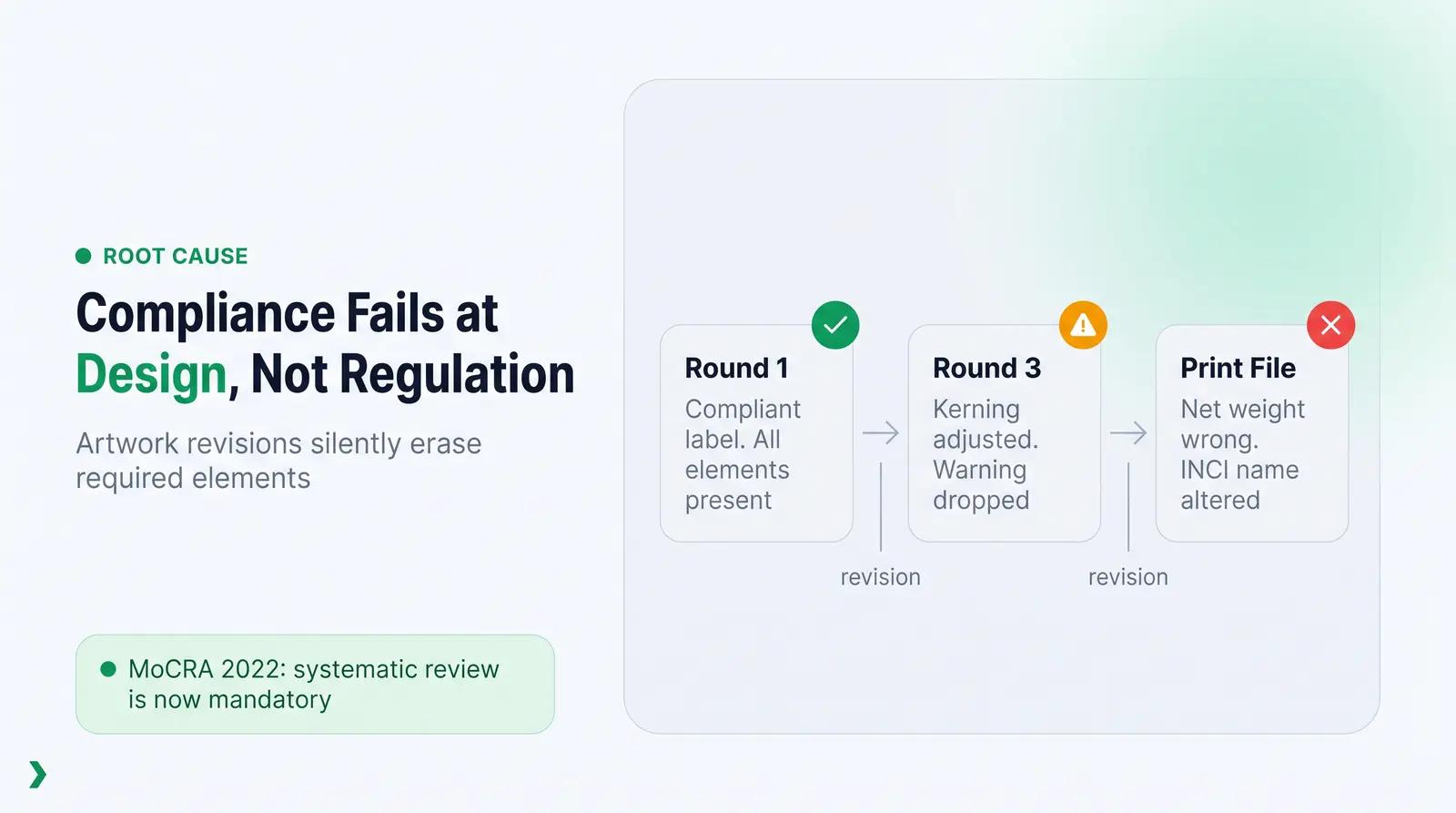
Most cosmetic label compliance failures are design-iteration problems, not regulatory knowledge problems [1]. Founders often know the rules but lose elements in successive rounds of artwork revisions. A warning statement might be accidentally dropped when adjusting kerning, a net weight might be formatted incorrectly to save space, or an ingredient name might be altered to sound more appealing, deviating from mandatory INCI nomenclature.
The Modernization of Cosmetics Regulation Act (MoCRA), signed in December 2022, reinforced the importance of accurate labeling by introducing new requirements, such as mandatory adverse event contact information and impending fragrance allergen disclosures [2]. These updates mean that relying on a label design that "looks right" is no longer sufficient; artwork must be systematically verified against current FDA regulations before files are sent to the printer.
The U.S. Regulatory Framework for Cosmetic Labels (What Governs What)
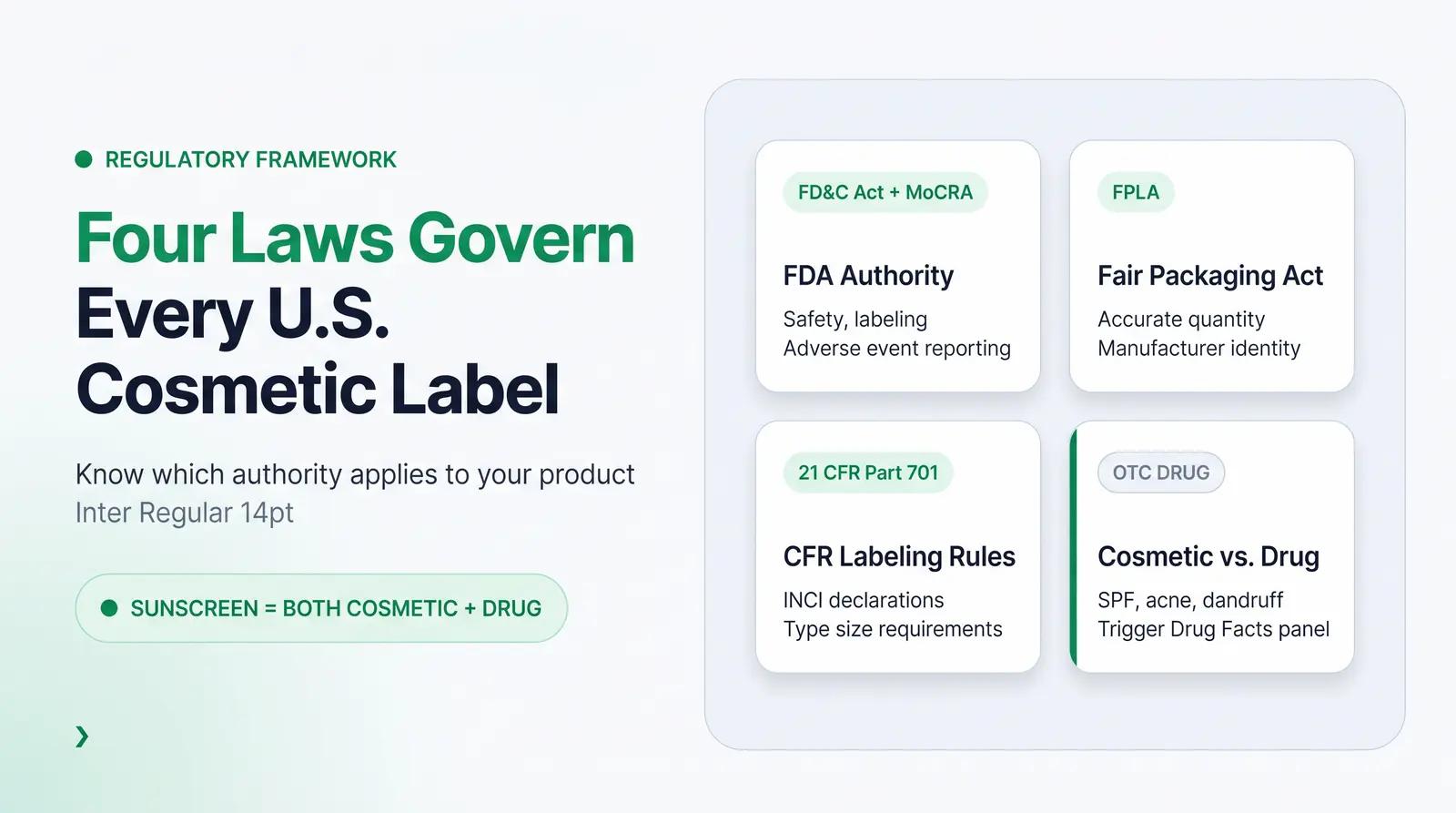
Understanding the regulatory framework is the first step in ensuring label compliance. In the United States, cosmetic labeling is governed by a combination of laws and regulations:
- FDA Authority under the FD&C Act as amended by MoCRA: The Federal Food, Drug, and Cosmetic Act (FD&C Act) gives the FDA authority to oversee cosmetic safety and labeling, prohibiting the marketing of adulterated or misbranded cosmetics [3]. MoCRA expanded this authority, adding new requirements for adverse event reporting and safety substantiation [2].
- Fair Packaging and Labeling Act (FPLA): This act ensures that consumer packages provide accurate information about the quantity of contents and the identity of the manufacturer or distributor, facilitating value comparisons [4].
- 21 CFR Part 701: This section of the Code of Federal Regulations details the specific labeling requirements for cosmetics, including ingredient declarations, net quantity statements, and the prominence of required information [5].
- Cosmetic vs. OTC Drug Distinction: The FDA distinguishes between cosmetics (intended for cleansing or beautifying) and over-the-counter (OTC) drugs (intended to treat or prevent disease, or affect the structure or function of the body). Products like sunscreens, anti-dandruff shampoos, and acne treatments are considered both cosmetics and drugs, and must comply with the more stringent OTC drug labeling requirements [6].
For brands exporting internationally, additional considerations apply. The EU Regulation 1223/2009 mandates specific labeling requirements, including the listing of additional fragrance allergens and a Responsible Person address within the EU [7]. Health Canada also has its own set of bilingual labeling and ingredient declaration rules. However, the primary focus of this framework is U.S. compliance.
The Pre-Print Cosmetic Label Compliance Checklist
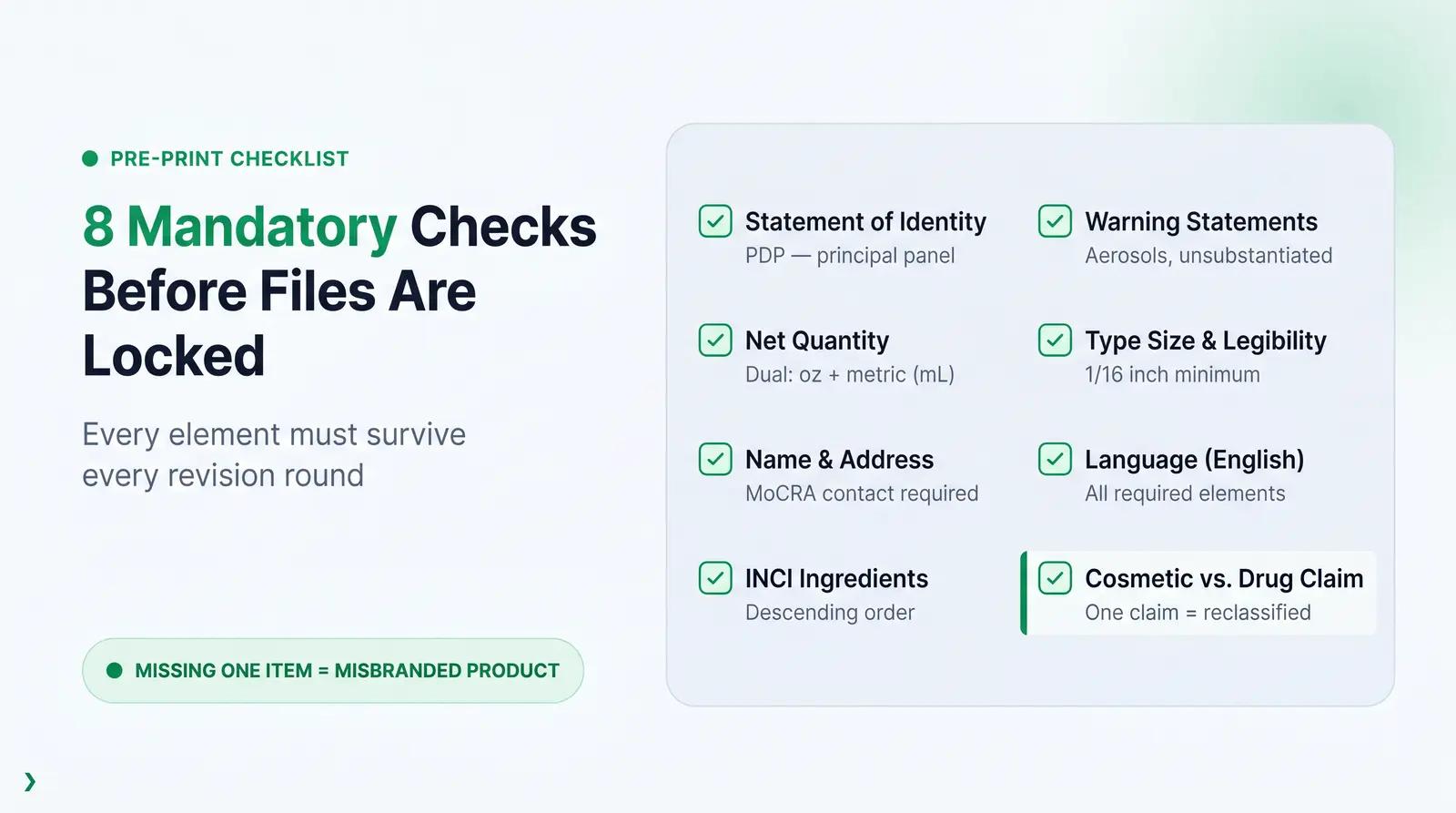
This is a practical framework we recommend at Packfolio for reviewing label artwork before files are finalized. Treat this checklist as a mandatory pre-print safety step to ensure your packaging meets all regulatory requirements.
1. Identity of Product (Statement of Identity)
The statement of identity must appear on the principal display panel (PDP)—the part of the label most likely to be seen by consumers at the time of purchase. It must clearly identify the nature or use of the product (e.g., "Facial Cleanser," "Body Lotion"). If the product makes claims that stray into drug territory, such as treating acne or providing sun protection, the identity statement must reflect its dual status as an OTC drug, triggering additional regulatory requirements.
2. Net Quantity of Contents
The net quantity declaration must also appear on the PDP, within the bottom 30% of the panel area. It requires a dual declaration: the weight or volume in U.S. customary units (ounces, fluid ounces) followed by the metric equivalent in parentheses (grams, milliliters). Common errors include listing gross weight instead of net weight or omitting the metric conversion. The type size for this declaration is dictated by the total area of the PDP [8].
3. Name and Place of Business
The label must state the name and principal place of business of the manufacturer, packer, or distributor. Under MoCRA, the label must also include a U.S. address, U.S. phone number, or electronic contact information (like a website) where the "Responsible Person" can receive adverse event reports [2]. If the address listed is not the manufacturer's, it must be preceded by a qualifying phrase such as "Manufactured for" or "Distributed by."
4. Ingredient Declaration (INCI)
Ingredients must be declared on an information panel in descending order of predominance. The FDA requires the use of standard names, typically those established by the International Nomenclature of Cosmetic Ingredients (INCI) [9]. Ingredients present at 1% or less, as well as color additives, can be listed in any order after the main ingredients. A common trap is using marketing names or "and other ingredients" instead of the precise INCI designations.
5. Warning Statements and Directions for Use
Certain products require specific warning statements. For example, cosmetics in self-pressurized containers (aerosols) must bear warnings about flammability and pressure [10]. If a cosmetic's safety has not been adequately substantiated, it must carry a warning stating: "Warning—The safety of this product has not been determined" [11]. MoCRA also mandates the future disclosure of specific fragrance allergens, with the final rule expected to be enforced in the coming years [2]. Directions for safe use must be included if the product could be hazardous when misused.
6. Type Size and Legibility
Required information must be prominent and conspicuous. The minimum type size for ingredient declarations is generally 1/16 of an inch in height [5]. The background must provide sufficient contrast, and the text cannot be obscured by decorative graphics. What looks legible on a zoomed-in digital design file may fail the physical 1/16-inch minimum when printed, making physical proofs or accurate digital scaling essential.
7. Language Requirements
All mandatory label elements required by the FDA must appear in English. If a label includes any foreign language representation, all required statements must also appear in that foreign language. Adding a translation does not exempt the product from the English language requirements.
8. Cosmetic vs. OTC Drug: The Claim Tripwire
A single claim can reclassify a cosmetic as an OTC drug. Claims like "reduces wrinkles by stimulating collagen," "SPF 15," or "controls dandruff" indicate an intent to affect the body's structure or function, triggering the requirement for a Drug Facts panel [6]. This is a frequent artwork-stage failure where marketing copy overrides regulatory classification.
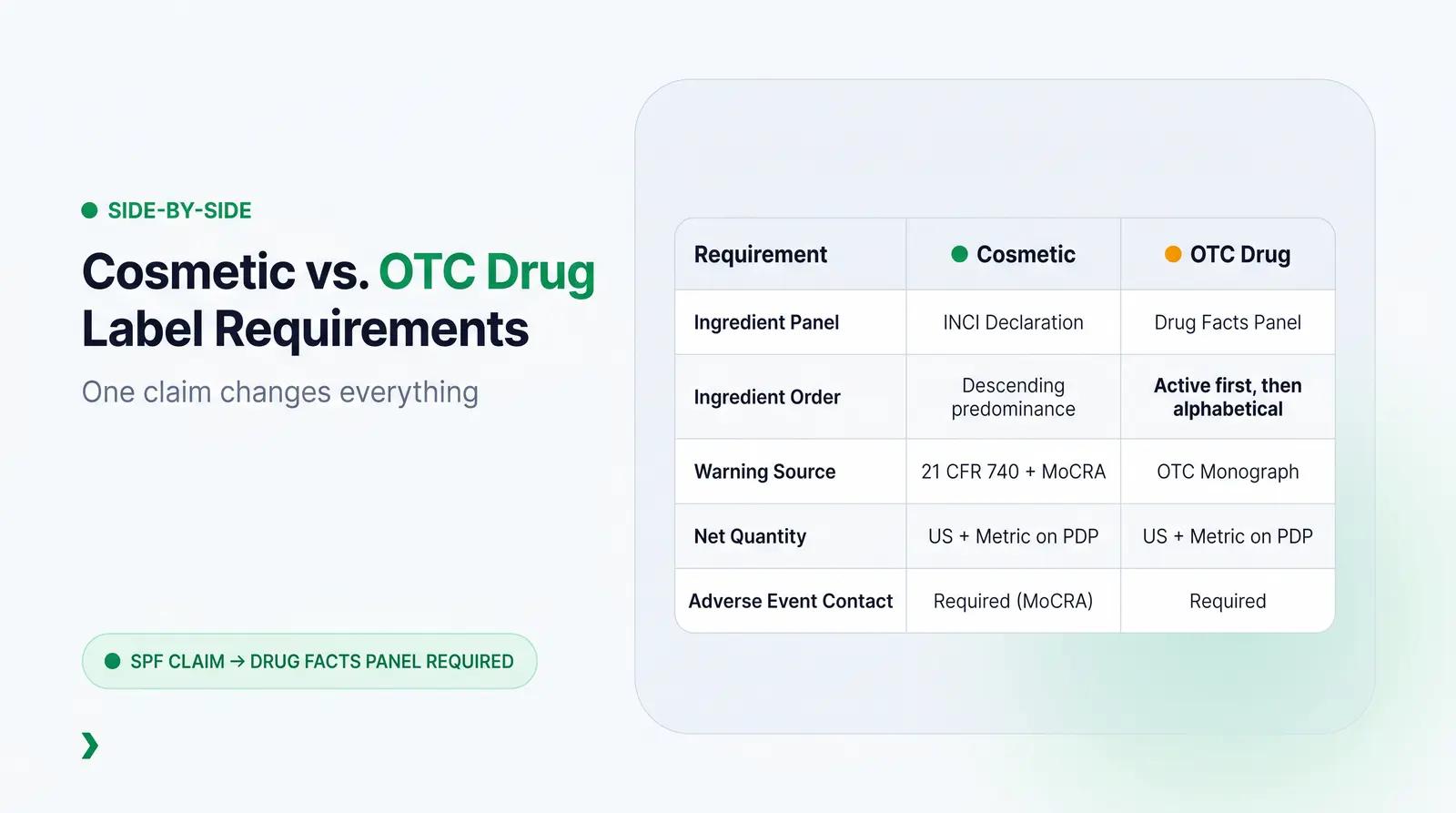
Comparison Table — Cosmetic Label vs. OTC Drug Label Requirements
| Requirement | Cosmetic Label | OTC Drug Label (or Cosmetic/Drug) |
|---|---|---|
| Regulatory Authority | FDA (FD&C Act, MoCRA), FPLA | FDA (FD&C Act, OTC Monographs or NDAs) |
| Required Panel Name | Ingredient Declaration | Drug Facts Panel |
| Ingredient List Format | Descending order of predominance (INCI) | Active ingredients (with purpose/amount) listed first, followed by inactive ingredients in alphabetical order |
| Warning Statement Source | 21 CFR 740, MoCRA | OTC Monograph specific to the drug category |
| Net Quantity Format | U.S. customary units + Metric equivalent (PDP) | U.S. customary units + Metric equivalent (PDP) |
| Responsible Person Labeling | Must include contact info for adverse event reporting (MoCRA) | Must include contact info for adverse event reporting |
Worked Example — Walking a Facial Serum Label Through the Checklist
Imagine a founder launching a 1 oz (30 mL) vitamin C brightening serum in a glass dropper bottle. The label artwork has been designed and is pending final approval. Let's walk through the checklist:
- Identity of Product: The PDP lists "Vitamin C Brightening Serum." This is acceptable for a cosmetic.
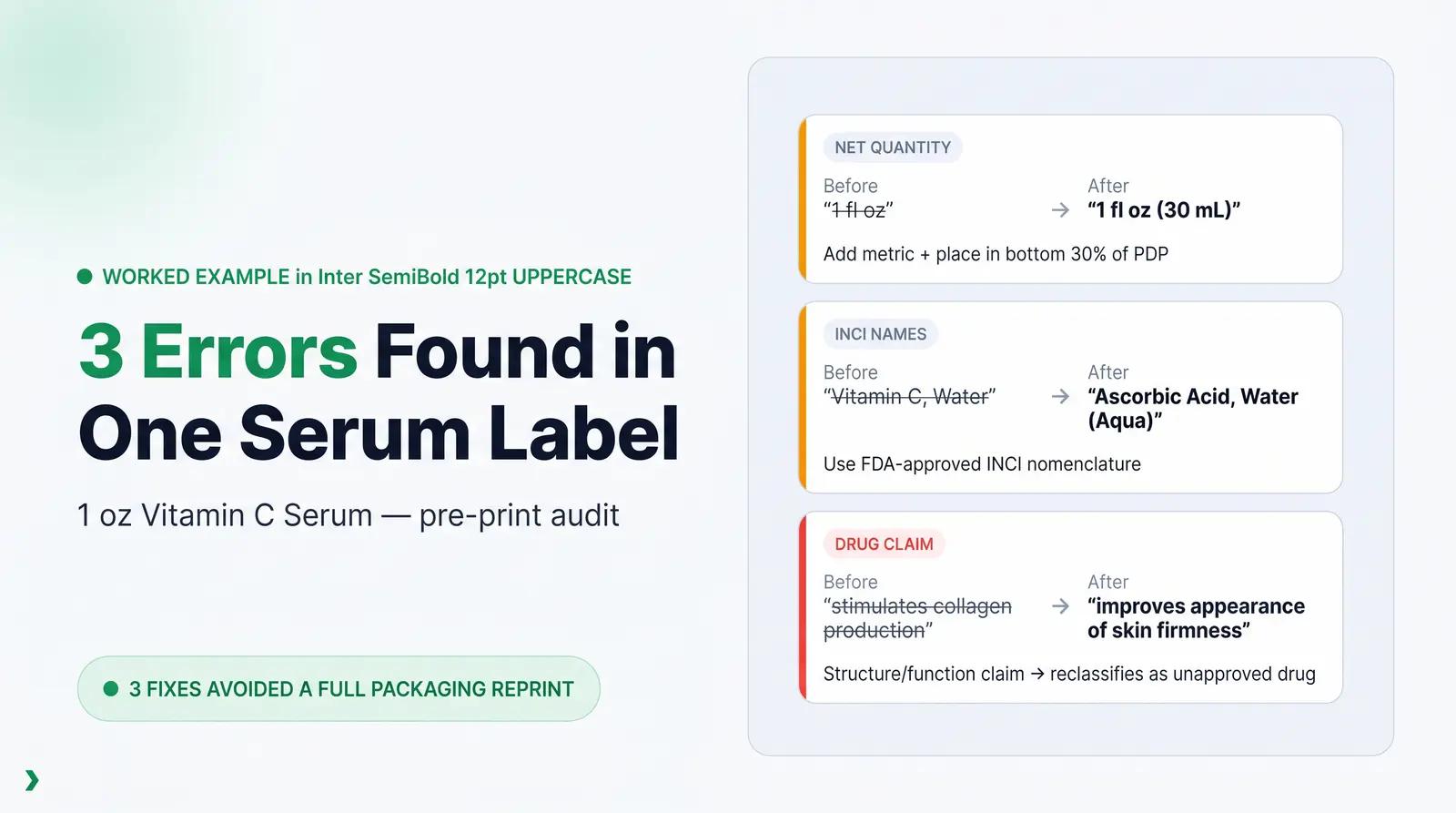
- Net Quantity of Contents: The artwork reads "1 fl oz." Issue: This fails the dual-declaration requirement. It must be corrected to "1 fl oz (30 mL)" and placed in the bottom 30% of the PDP.
- Ingredient Declaration: The list includes "Vitamin C" and "Water." Issue: These are not proper INCI names. They must be corrected to "Ascorbic Acid" and "Water (Aqua)."
- Cosmetic vs. OTC Drug: The marketing copy on the back panel claims the serum "stimulates collagen production to rebuild skin." Issue: This is a structure/function claim, reclassifying the product as an unapproved new drug. The claim must be softened to a cosmetic appearance claim, such as "improves the appearance of skin firmness."
By catching these three issues during the pre-print review, the founder avoids misbranding, potential FDA warning letters, and the cost of a full packaging reprint.
What a Compliance Checker Tool Should Actually Do
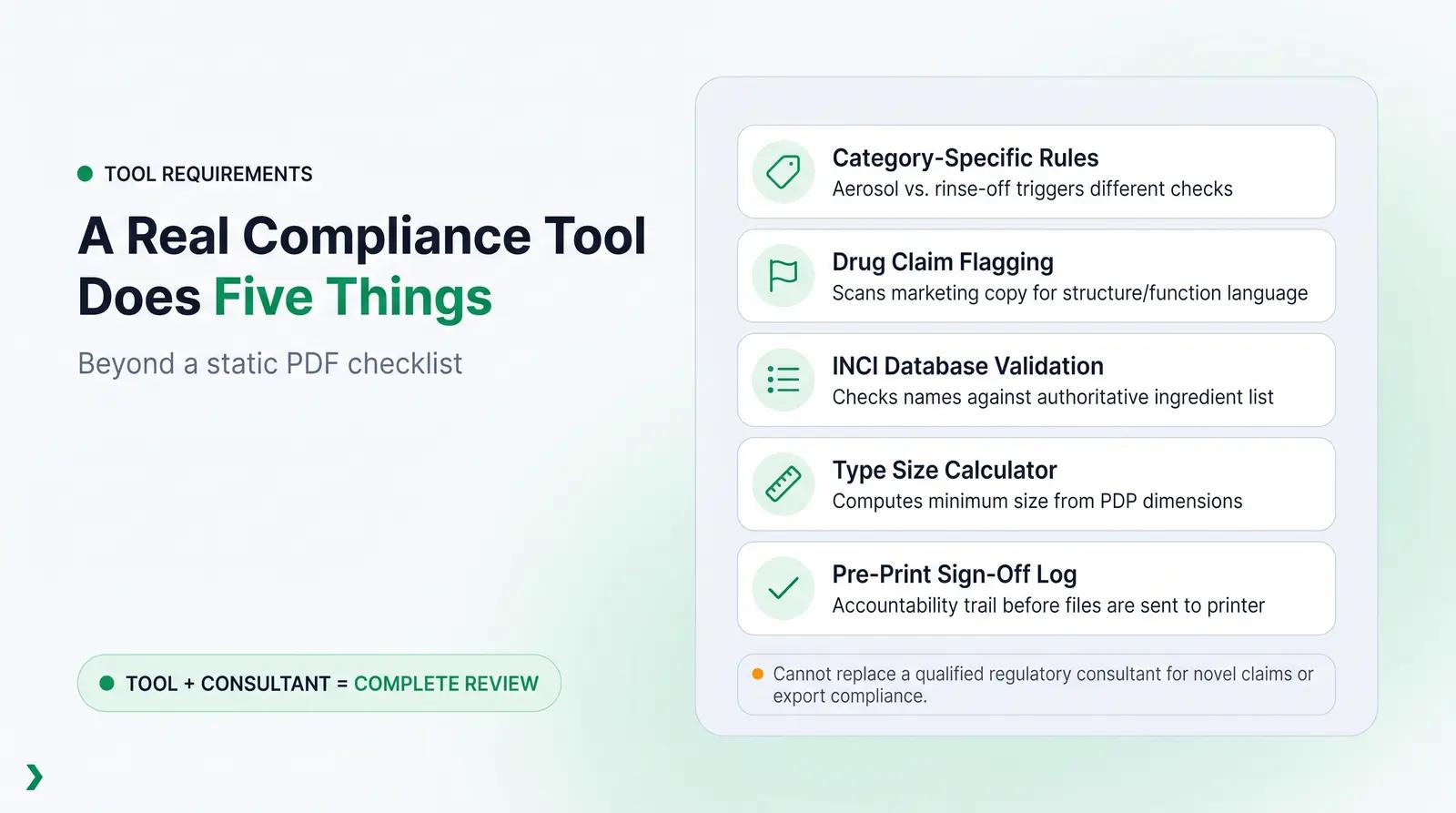
A genuinely useful cosmetic label compliance tool goes beyond a static PDF checklist. It should enable category-specific rule triggering, ensuring that an aerosol product prompts different checks than a rinse-off cleanser. It should flag potential drug claims in marketing copy and validate ingredient lists against an authoritative INCI database. Furthermore, it should calculate required type sizes based on the specific dimensions of the PDP input by the user and maintain a pre-print sign-off log for accountability.
However, a tool cannot replace a qualified regulatory consultant for complex determinations, such as evaluating novel claims, conducting formal OTC drug classifications, or ensuring export compliance for international markets. The checklist provided here is a strong starting framework, but it operates within the bounds of standard cosmetic labeling.
From Compliant Label to Finished Packaging — The Print-to-Production Step
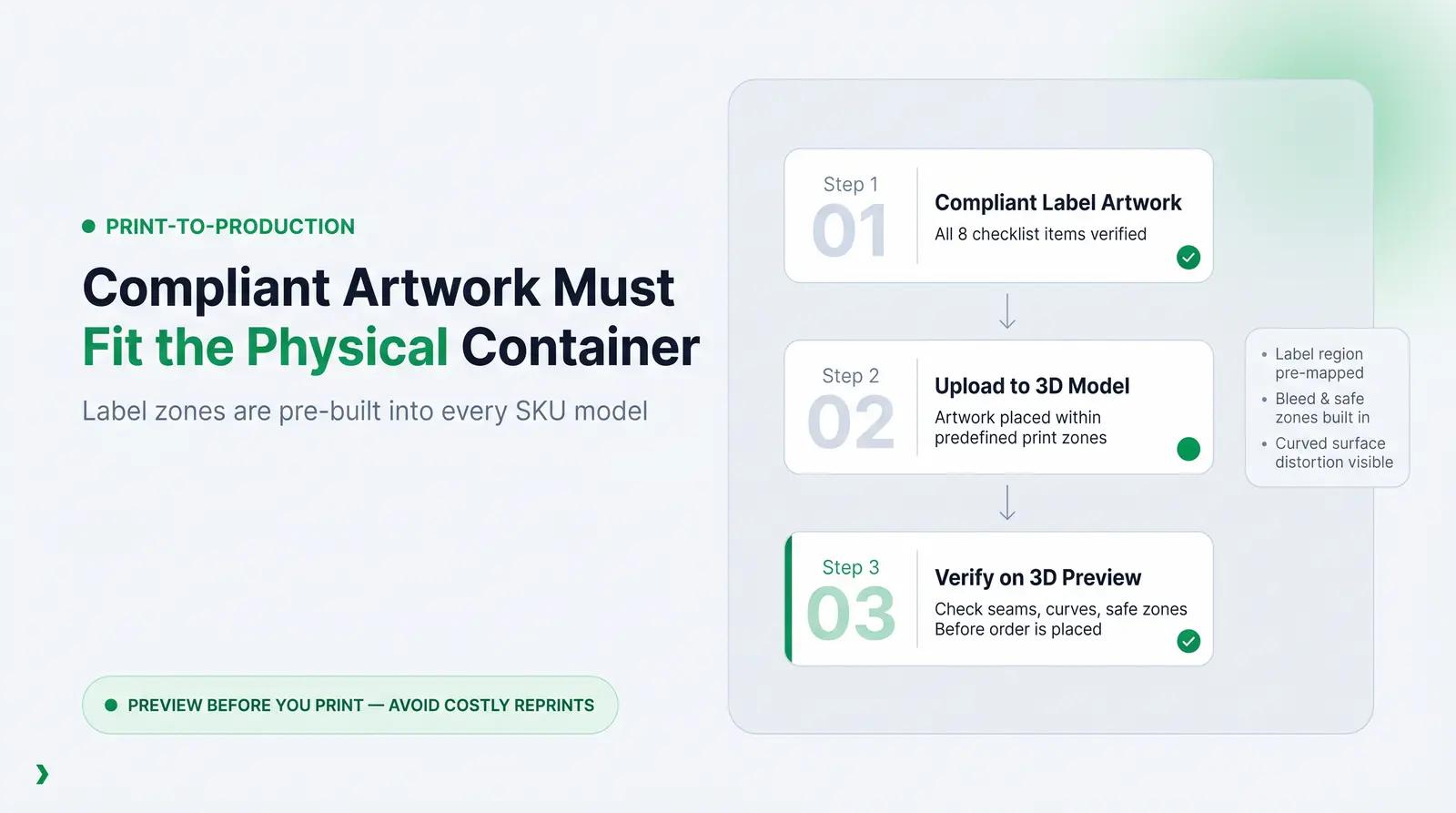
Once you have a compliant label, the next step is ensuring that artwork translates perfectly onto the physical container. At Packfolio, our 3D design tool displays artwork within predefined print zones on each SKU. This means the label region, bleed, and safe zones are already built into the model before you start placing type. This integration reduces a common pre-print failure: artwork that is technically compliant but physically wrong for the container, such as text placed too close to a seam or a warning statement distorted by a curved surface.
Ready to move from compliant artwork to finished packaging? Browse Packfolio's curated cosmetic packaging catalog and preview your label artwork on a photorealistic 3D model before your order is placed → https://packfolio.com/catalog
Frequently Asked Questions
What happens if my cosmetic label is found to be non-compliant after printing? If a label is non-compliant, the product is considered misbranded. The FDA can issue warning letters, request recalls, or detain shipments at the border. Retailers may also refuse to stock the product, forcing you to over-label or completely reprint the packaging at your own expense.
When do the new MoCRA fragrance allergen disclosure rules take effect? The FDA is currently developing the proposed rule for fragrance allergen disclosures. While the exact implementation timeline is still being finalized, the final rule is anticipated to be published and enforced in the coming years, requiring brands to list specific allergens on their labels.
Can I use the INCI name "Aqua" instead of "Water" on my U.S. label? The FDA requires ingredients to be listed by their common or usual English names. While "Water" is required, the FDA does not object to including the INCI name in parentheses, such as "Water (Aqua)."
How do I determine the Principal Display Panel (PDP) area to calculate minimum type size? For rectangular packages, the PDP area is the height multiplied by the width of one side. For cylindrical containers, it is 40% of the height multiplied by the circumference. This area dictates the minimum type size for the net quantity declaration.
Does a U.S. cosmetic label need to be bilingual? No, the FDA only requires mandatory label information to be in English for products distributed in the U.S. (except in territories like Puerto Rico where Spanish is predominant). However, if you choose to include any foreign language on the label, all required regulatory statements must also be translated into that language.
References
[1] "Avoiding FDA Warning Letters: Common Labeling Mistakes to Watch For," Capote Law Firm, 2025. https://capotelawfirm.com/avoiding-fda-warning-letters-common-labeling-mistakes-to-watch-for/ [2] "Modernization of Cosmetics Regulation Act of 2022 (MoCRA)," U.S. Food and Drug Administration, 2026. https://www.fda.gov/cosmetics/cosmetics-laws-regulations/modernization-cosmetics-regulation-act-2022-mocra [3] "Cosmetics Labeling Guide," U.S. Food and Drug Administration, 2022. https://www.fda.gov/cosmetics/cosmetics-labeling-regulations/cosmetics-labeling-guide [4] "Summary of Cosmetics Labeling Requirements," U.S. Food and Drug Administration, 2025. https://www.fda.gov/cosmetics/cosmetics-labeling-regulations/summary-cosmetics-labeling-requirements [5] "21 CFR Part 701 -- Cosmetic Labeling," eCFR, 2026. https://www.ecfr.gov/current/title-21/chapter-I/subchapter-G/part-701 [6] "Is It a Cosmetic, a Drug, or Both? (Or Is It Soap?)," U.S. Food and Drug Administration, 2022. https://www.fda.gov/cosmetics/cosmetics-laws-regulations/it-cosmetic-drug-or-both-or-it-soap [7] "Regulation (EC) No 1223/2009 of the European Parliament and of the Council on cosmetic products," EUR-Lex, 2009. https://eur-lex.europa.eu/eli/reg/2009/1223/oj/eng [8] "21 CFR 701.13 - Declaration of net quantity of contents," eCFR, 2026. https://www.ecfr.gov/current/title-21/chapter-I/subchapter-G/part-701/subpart-B/section-701.13 [9] "Cosmetic Ingredient Names," U.S. Food and Drug Administration, 2022. https://www.fda.gov/cosmetics/cosmetics-labeling/cosmetic-ingredient-names [10] "21 CFR Part 740 -- Cosmetic Product Warning Statements," eCFR, 2026. https://www.ecfr.gov/current/title-21/chapter-I/subchapter-G/part-740 [11] "21 CFR 740.10 - Labeling of cosmetic products for which adequate substantiation of safety has not been obtained," eCFR, 2026. https://www.ecfr.gov/current/title-21/chapter-I/subchapter-G/part-740/subpart-B/section-740.10


