
Beauty Packaging Supplier RFQ Template Library
Five ready-to-use cosmetic packaging RFQ templates help indie beauty founders get accurate, comparable supplier quotes and avoid costly procurement mistakes.
Vague supplier quotes are the core problem in beauty supply chains. Structured, specific RFQ documents are the solution.
When a founder asks a packaging factory, "How much for a 30ml glass dropper bottle?" she is inviting chaos into her procurement process. One supplier might quote a cheap stock PET bottle with a basic plastic collar, assuming zero decoration. Another might quote a premium heavy-wall amber glass option with silk-screen printing bundled in. When the quotes return, they are incomparable. Weeks of back-and-forth communication are wasted, and the launch timeline slips before a single unit is ordered.
For independent beauty brand founders, formulators, and contract manufacturers sourcing cosmetic primary packaging, a Request for Quotation (RFQ) is not just a price check. It is the foundational document that defines product quality, establishes legal protections, and sets the tone for every supplier relationship.
This guide provides a complete library of plug-and-play RFQ templates specifically engineered for cosmetic packaging. Whether you are sourcing stock components, negotiating custom molds, or requesting pre-production samples, these templates ensure you receive apples-to-apples quotes and avoid the costly miscommunications that derail indie beauty launches.
Why Vague Quotes Cost More Than You Think
In cosmetic manufacturing, the details dictate the price. A standard RFQ used for industrial procurement or retail packaging lacks the technical specificity required for primary beauty packaging. The gap between what a founder imagines and what a factory quotes is almost always a specification problem.
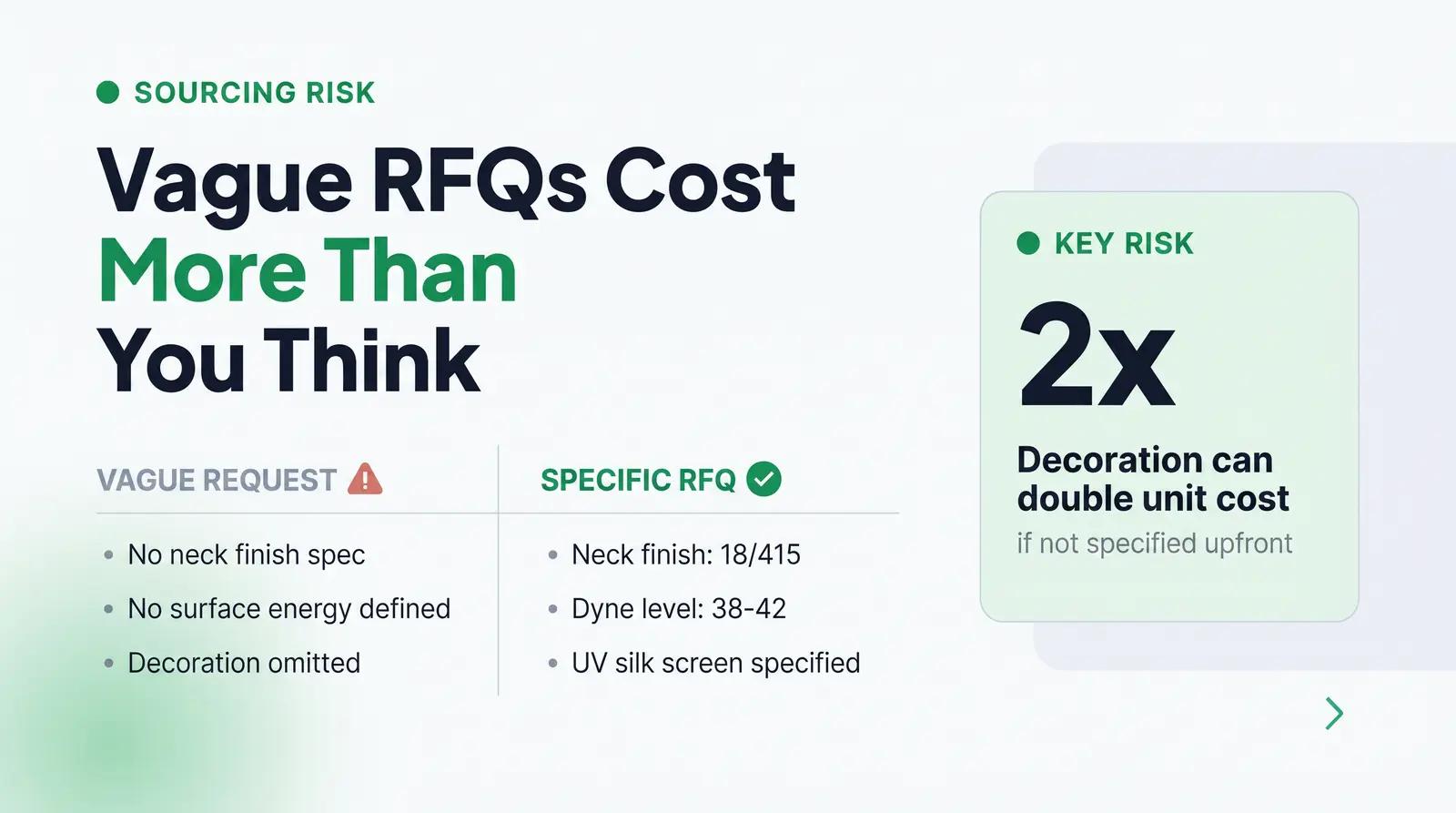
Consider the neck finish. If you fail to specify the neck finish (e.g., 18/415 or 20/410), the pump you source from a secondary supplier may not thread onto the bottle, leading to leakage and a full component write-off. If you neglect to define surface energy requirements for a plastic tube, the silk-screened logo might flake off in the consumer's hands after two weeks of use. These are not hypothetical risks. They are the most common reasons indie brands face costly production delays and re-sampling cycles [1].
The cosmetic packaging industry also operates on tiered Minimum Order Quantities (MOQs) that vary depending on the stage of production, the decoration method, and the material. A factory might accept a 5,000-unit MOQ for a standard unprinted PET tube, but require 20,000 units once hot-stamping decoration is added, because the setup cost for stamping dies must be amortized across a larger run [1]. Without a structured RFQ that specifies decoration requirements upfront, a founder may receive a quote for the component alone and discover the decoration cost doubles her unit price only after she has committed to the supplier.
Without a structured RFQ, suppliers are forced to make assumptions. When suppliers make assumptions, they price in a risk premium. A comprehensive, specific RFQ eliminates ambiguity, reduces the supplier's perceived risk, and consistently produces more competitive, accurate pricing.
What a Cosmetic Packaging RFQ Actually Needs to Include
A highly effective cosmetic packaging RFQ bridges the gap between brand vision and factory reality. It translates aesthetic desires into manufacturing specifications that a production engineer can act on without needing to send a clarifying email.
Most generic RFQ guides cover the basics: product description, quantity, delivery date, and payment terms. What they miss are the cosmetic-specific fields that determine whether the packaging will actually work with the formula, survive the supply chain, and comply with applicable regulations like MoCRA [6] and ISO 22715 [7]. The following framework helps brands evaluate whether their RFQ is ready to send.
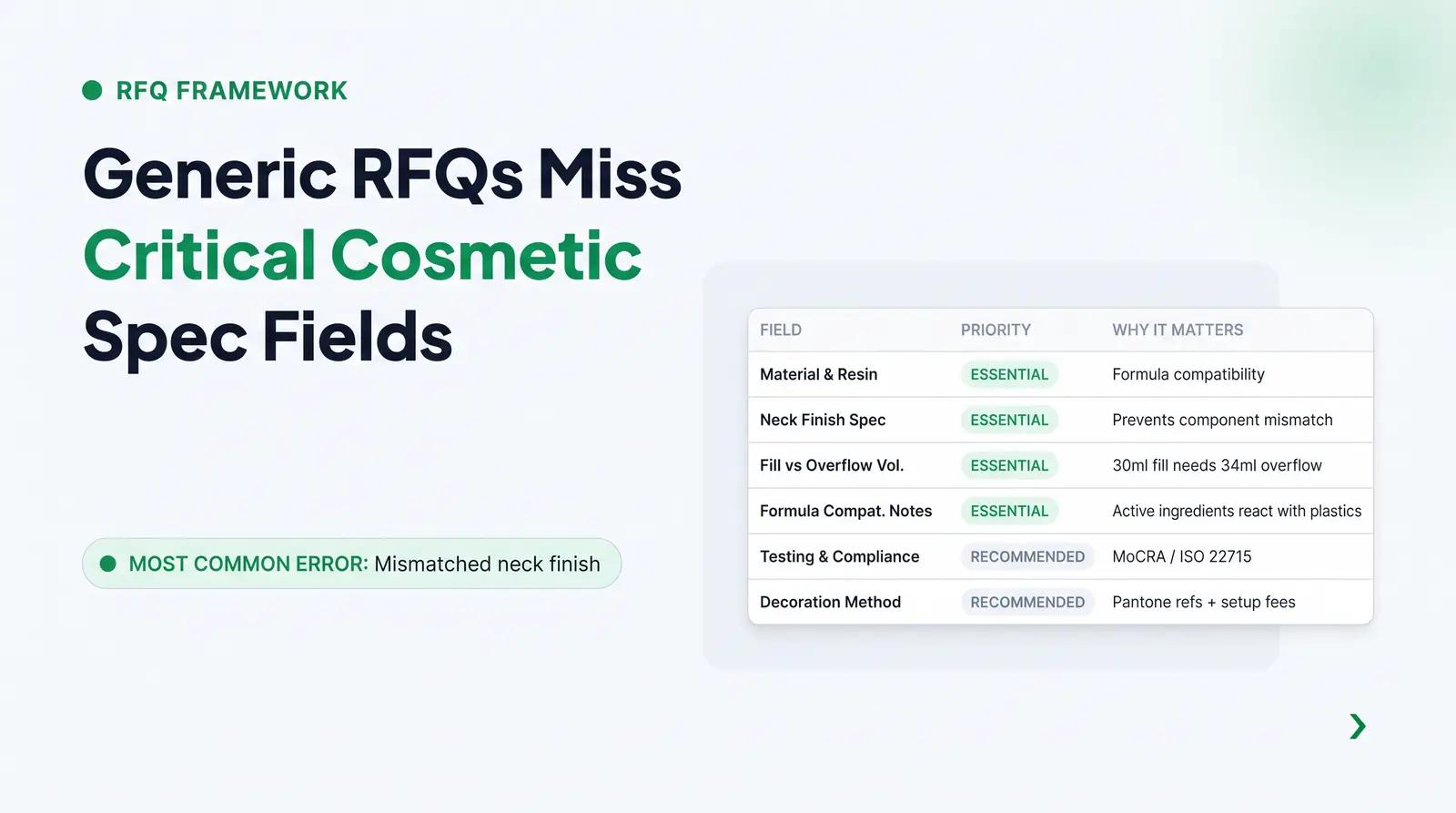
The Packaging RFQ Completeness Rubric
A practical framework we recommend at Packfolio for evaluating whether an RFQ is ready to send.
| Field | Category | Why It Matters |
|---|---|---|
| Material and Resin Specs | Essential | Dictates formula compatibility. A vitamin C serum requires dark glass or specific barrier plastics to prevent rapid oxidation of ascorbic acid [2]. |
| Neck Finish and Thread Spec | Essential | Ensures components from different suppliers fit together without leakage. A mismatch between bottle and pump neck finish is one of the most common and costly sourcing errors. |
| Fill Volume vs. Overflow Capacity | Essential | A "30ml" bottle must have an overflow capacity of 33-35ml to accommodate pump displacement and prevent spilling during filling line operations. |
| Formula Compatibility Notes | Essential | Active ingredients like L-ascorbic acid, retinol, and essential oils can react with certain plastics. Documenting this upfront prevents incompatible material recommendations. |
| Target Unit Cost Range | Recommended | Anchors the supplier's material recommendations and prevents them from pitching luxury heavy-wall glass when the budget only supports standard PET. |
| Lead Time and Delivery Terms | Recommended | Establishes timeline expectations. Typical sea freight from Asia adds 4-6 weeks beyond production time, and total lead times from inquiry to delivery can reach 10-14 weeks [1]. |
| Testing and Compliance Requirements | Recommended | Confirms the supplier can meet MoCRA or ISO 22715 labeling and safety standards before you invest time in sampling [6] [7]. |
| Decoration Method and Ink Specs | Recommended | If requesting printed packaging, specifying the exact method (e.g., UV silk screen) and Pantone references ensures the quote includes the correct setup fees and confirms technical feasibility. |
| Incoterms | Optional | FOB vs. DDP changes who bears freight risk and cost. Specifying this upfront prevents surprises at the invoice stage. |
| Sustainability Requirements | Optional | PCR content, bio-based resins, or mono-material recyclability requirements affect material availability and unit cost. |
The Five-Template Library
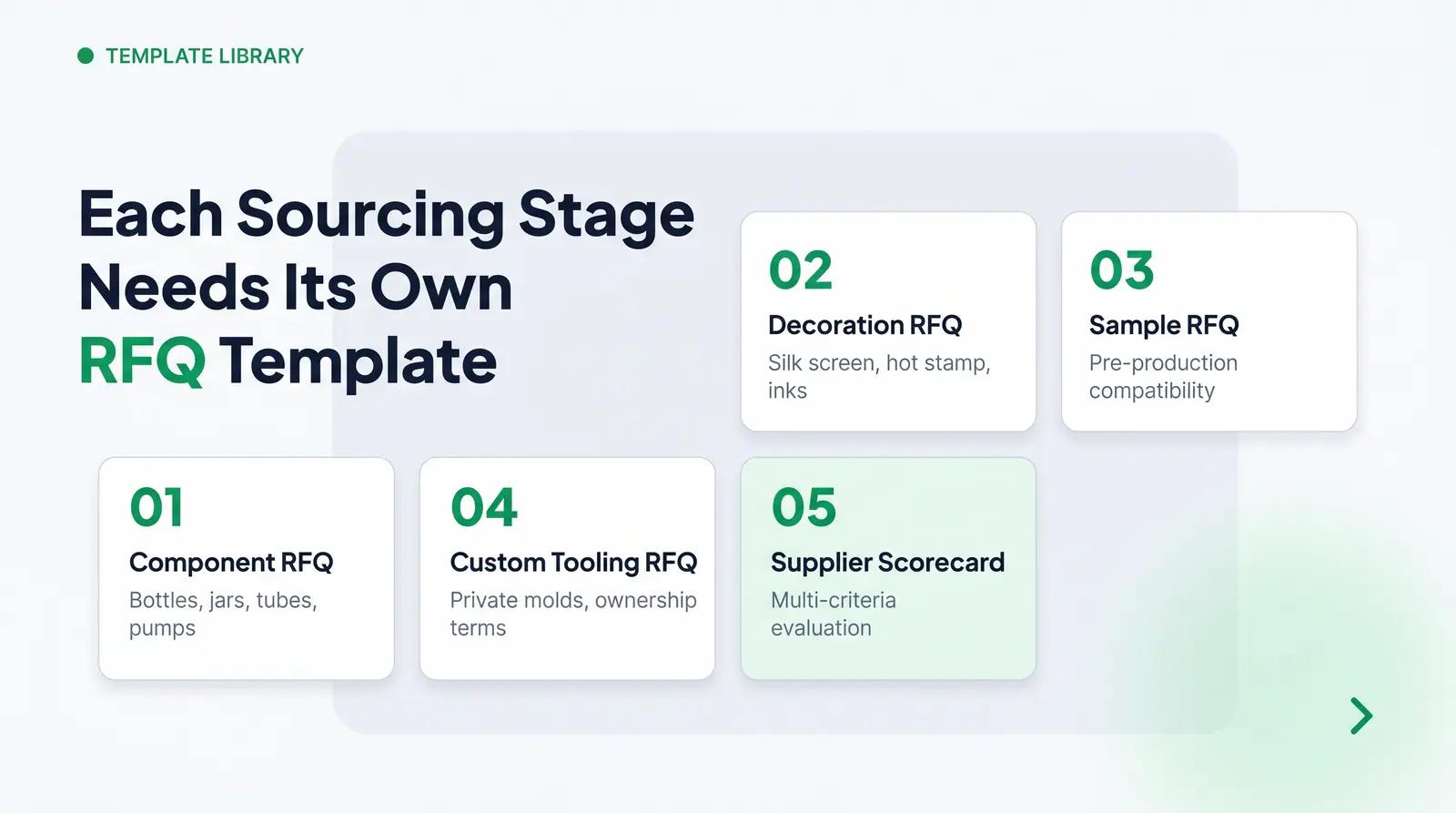
The following templates are designed to be copied, adapted, and sent directly to your shortlisted suppliers. Each template is organized by use case, because a component RFQ and a decoration RFQ require fundamentally different information.
Template 1: Component RFQ
Use this template when sourcing primary packaging bodies (bottles, jars, tubes) and their corresponding closures (pumps, droppers, caps). This is the starting point for any new packaging project.
Cosmetic Component Request for Quotation
Company Information
- Brand Name: [Your Brand Name]
- Contact Person: [Your Name, Title]
- Date of Request: [Date]
- Quote Required By: [Date, typically 7-10 business days from issue]
Project Overview
- Product Type: [e.g., Vitamin C Facial Serum, Body Lotion, Eye Cream]
- Target Launch Date: [Month, Year]
- Estimated Annual Volume: [Total units per year across all SKUs]
Component Specifications
- Component Type: [e.g., Glass Dropper Bottle, Airless Pump Bottle, Squeeze Tube]
- Material Requirement: [e.g., Amber Glass, Frosted PET, Aluminum, PCR HDPE]
- Fill Volume: [e.g., 30ml / 1 oz]
- Required Overflow Capacity: [e.g., 34ml minimum]
- Neck Finish and Thread Spec: [e.g., 18/415, 20/410, 24/410]
- Color and Finish: [e.g., Frosted Matte, Glossy Black, Custom Pantone PMS #]
- Formula Compatibility Notes: [e.g., Formula contains 15% L-ascorbic acid; requires UV-blocking glass or HDPE with UV inhibitor]
- Closure Required: [e.g., Matte black aluminum dropper collar, 18mm neck; or specify pump stroke volume]
Pricing and Delivery Requirements
- Target MOQ: [e.g., 5,000 units]
- Target Unit Cost Range: [$X.XX to $X.XX]
- Delivery Location: [City, State, Zip Code]
- Incoterms: [e.g., FOB Shanghai, DDP Los Angeles]
- Required Delivery Date: [Date]
Please provide in your response:
- Unit price at [MOQ 1], [MOQ 2], and [MOQ 3]
- Estimated production lead time from purchase order to ready-to-ship
- Confirmation of ISO 9001 or equivalent quality certification
- Sample availability and sample cost
Template 2: Decoration and Printing RFQ
Decoration setup costs are frequently hidden in initial component quotes or omitted entirely. Use this template to isolate printing costs, confirm technical feasibility, and prevent artwork-related surprises. Send this alongside Template 1 or separately to a specialist decoration house.
Cosmetic Packaging Decoration Request for Quotation
Decoration Specifications
- Base Component: [e.g., 30ml Frosted Glass Dropper Bottle, 50ml PET Jar]
- Decoration Method: [e.g., UV Silk Screen, Hot Stamping, Offset Printing, Pad Printing]
- Number of Colors: [e.g., 1 Color, 2 Colors]
- Color Specifications: [List exact Pantone Solid Coated references for every color, e.g., Pantone White C, Pantone 877 C Metallic]
- Print Area Dimensions: [Width x Height in mm, or specify "full wrap" for cylindrical components]
- Surface Treatment Required: [e.g., Flame treatment or corona treatment for PP/PE substrates; confirm post-treatment dyne level of 38-42 dynes/cm]
- Ink System Requirement: [e.g., UV-curable ink for maximum scratch resistance; or solvent-based for flexible squeeze tubes]
Technical Artwork Details
- Minimum Line Width in Design: [e.g., 0.3mm minimum to prevent screen breakdown at standard mesh counts]
- Minimum Text Size: [e.g., 6pt sans-serif, 8pt serif]
- Artwork Format: [Confirm you will provide vector AI or outlined PDF files at 100% production scale]
- Color Matching Standard: [e.g., Approve printed color chip against Pantone reference before screens are cut]
Please provide in your response:
- Decoration unit cost at target MOQ
- One-time setup fees (screens, plates, or stamping dies)
- Cost for a fully decorated pre-production sample (PPS)
- Maximum number of colors achievable on this substrate with this method
Template 3: Sample and Pre-Production RFQ
Never proceed to mass production without physical samples. Compatibility testing between your formula and the packaging material is non-negotiable, particularly for formulas containing active ingredients [5]. This template separates the cost of sampling from the bulk order and establishes what you expect to receive.
Sample Request and Pre-Production Quotation
Sample Requirements
- Type of Sample Requested: [e.g., Stock unprinted sample for compatibility testing; Custom color sample; Fully decorated Pre-Production Sample (PPS)]
- Quantity Required: [e.g., 10 units for 4-week stability and leak testing]
- Testing Purpose: [e.g., Formula-packaging compatibility; Artwork review; Filling line compatibility test]
- Compatibility Testing Protocol: [e.g., Fill with formula, store upright and inverted at 40C/75% RH for 4 weeks; observe for leakage, discoloration, and viscosity change]
Shipping Details
- Courier Preference: [e.g., FedEx International Priority, DHL Express]
- Account Number: [Provide your account number, or request the supplier to invoice shipping separately]
- Delivery Address: [Full Address including country]
Please provide in your response:
- Cost per sample unit and any flat sample preparation fee
- Sample production lead time from order confirmation
- Estimated courier transit time to delivery address
- Confirmation: will sample costs be credited toward the mass production order?
- What documentation accompanies the sample? (e.g., material safety data sheet, resin certificate, food contact compliance certificate)
Template 4: Custom Tooling and New Mold RFQ
When stock packaging does not fit your brand identity, you must open a private mold. Mold costs for a single injection mold can range from thousands to tens of thousands of dollars depending on complexity, and private mold lead times typically run 30-60 days before the first sample is available [5]. This RFQ clarifies ownership, amortization, and transferability, which are the three commercial terms most commonly omitted from early-stage custom tooling agreements.
Custom Tooling and Private Mold Request for Quotation
Tooling Specifications
- Component to be Molded: [e.g., Custom geometric cap, Unique bottle silhouette, Bespoke compact case]
- Material: [e.g., Surlyn, PP, ABS, Heavy-wall PET, Acrylic]
- Number of Cavities Required: [e.g., 4-cavity mold to support initial production volume]
- Expected Mold Lifespan: [e.g., Minimum 500,000 shots]
- Dimensional Tolerance Required: [e.g., ±0.3mm on critical fit dimensions]
Design and Engineering
- 3D CAD Files: [Confirm you will provide STEP or IGES files, or specify if you need the supplier to engineer from a 2D sketch or reference image]
- Prototyping Required: [Yes/No. If yes, specify: 3D printed SLA prototype before steel is cut]
- Design Approval Process: [e.g., Digital rendering approval, then physical T1 sample approval before mass production]
Commercial Terms
- Mold Ownership: [State clearly: "Buyer retains 100% ownership of the mold upon final payment of tooling invoice."]
- Mold Transferability: [Confirm the mold can be transferred to another manufacturing facility at the buyer's discretion.]
- Mold Storage: [Specify who is responsible for mold storage and maintenance between production runs.]
Please provide in your response:
- Total cost for mold engineering and tooling (itemized: design, steel, machining, trial shots)
- Tooling lead time from purchase order to T1 sample delivery
- Mold maintenance terms and cost per maintenance cycle
- Amortization option: can tooling costs be refunded or credited after reaching a specific cumulative order volume? If yes, state the threshold.
Template 5: Supplier Comparison Scorecard
Once quotes return from multiple suppliers, the instinct is to select the lowest unit price. This is almost always the wrong decision for indie beauty brands. A supplier with a slightly higher unit cost but faster communication, better quality certifications, and a willingness to provide pre-production samples typically delivers a lower total cost of ownership. Use this scorecard to evaluate suppliers across all relevant dimensions.
Supplier Evaluation Scorecard
| Evaluation Criteria | Weight | Supplier A | Supplier B | Supplier C |
|---|---|---|---|---|
| Unit Price at Target MOQ | 25% | $ | $ | $ |
| Tooling and Setup Fees | 10% | $ | $ | $ |
| Production Lead Time | 15% | [Weeks] | [Weeks] | [Weeks] |
| Communication Speed and Clarity | 20% | [1-5] | [1-5] | [1-5] |
| Quality Certifications (ISO 9001/GMP) | 15% | [Yes/No] | [Yes/No] | [Yes/No] |
| Willingness to Provide PPS | 10% | [Yes/No] | [Yes/No] | [Yes/No] |
| Formula Compatibility Experience | 5% | [Yes/No] | [Yes/No] | [Yes/No] |
| Weighted Total Score | 100% | /100 | /100 | /100 |
How to Send an RFQ and What to Do With the Responses
Sending the RFQ is only the beginning of the process. Once quotes return, the real evaluation work starts.
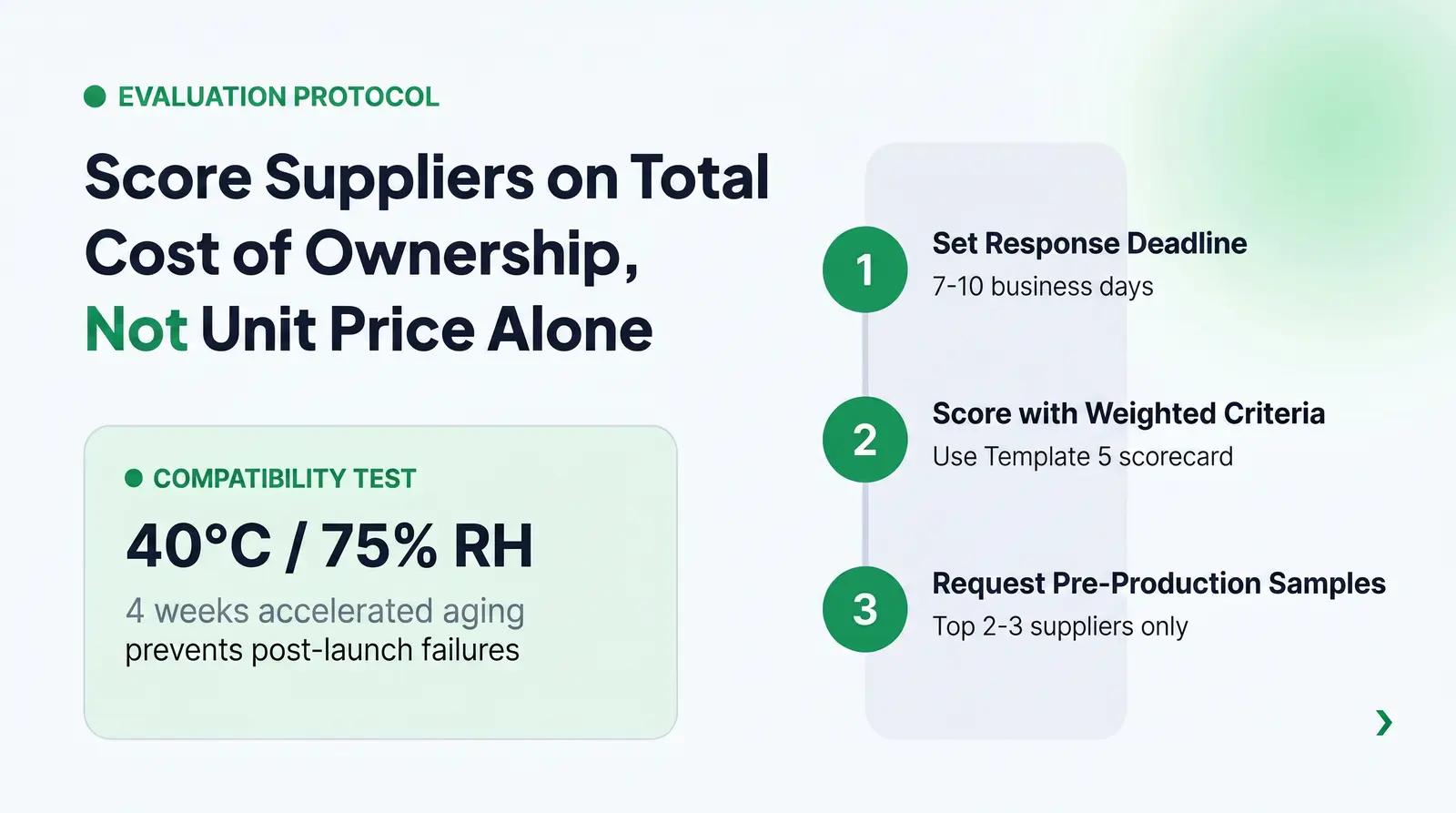
Set a firm response deadline of 7-10 business days in your RFQ cover email. This filters out suppliers who are too busy or unresponsive to meet your timeline. When quotes arrive, resist the temptation to evaluate unit price in isolation. Use Template 5 to score each supplier across all weighted criteria. A supplier offering $0.05 less per unit but requiring a 90-day lead time and no pre-production sample may cost you far more in delayed launches and quality failures than the price difference saves.
Request a pre-production sample from your top two or three shortlisted suppliers before committing to a mass production order. Fill the sample with your actual formula and conduct a 4-week compatibility test at elevated temperature (40°C/75% relative humidity) to simulate accelerated aging [5]. This step is the single most effective way to avoid post-launch packaging failures. For more guidance on evaluating supplier quality and compliance, see How to Vet Cosmetic Packaging Suppliers.
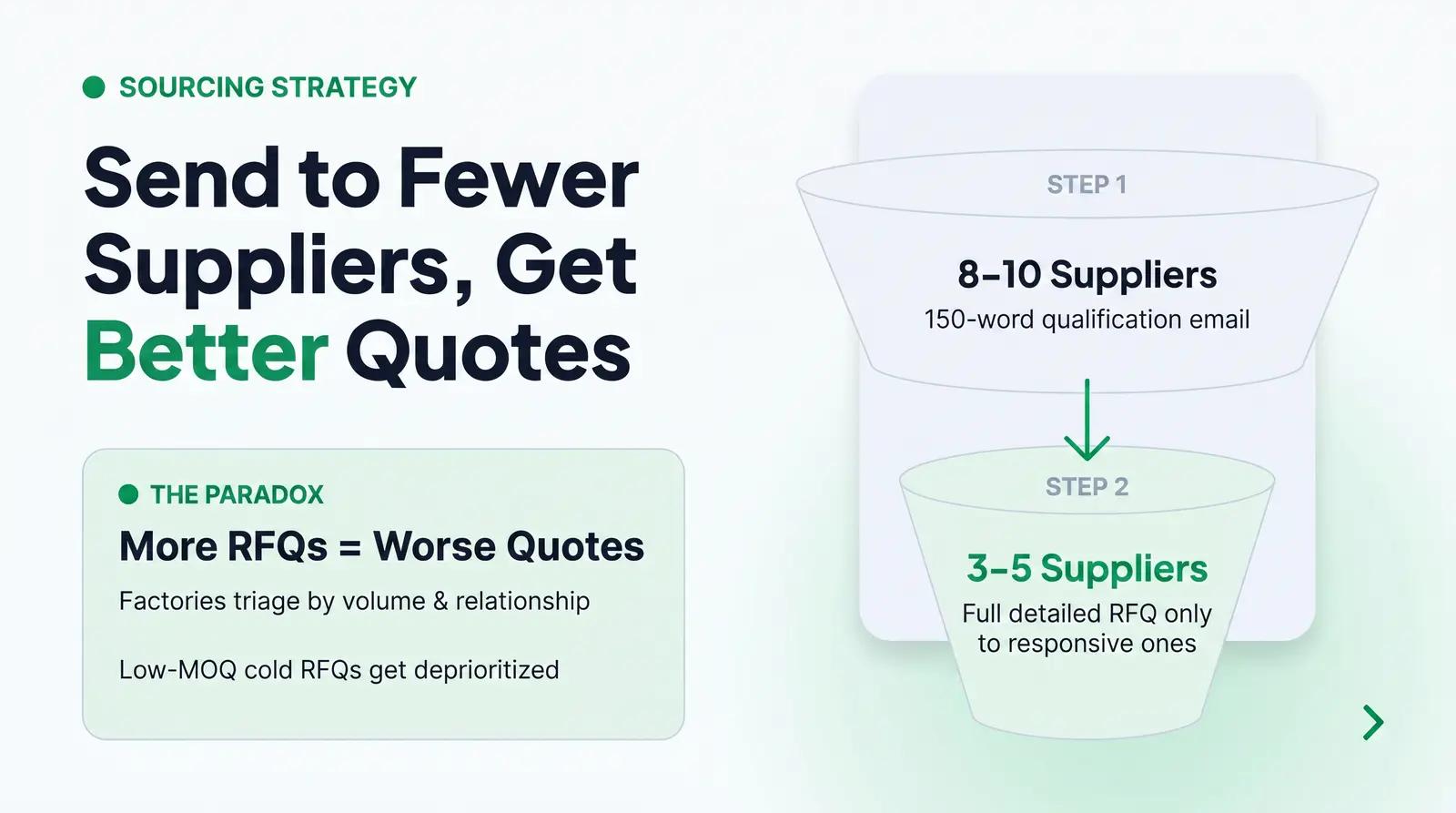
The RFQ Paradox: Why Sending More RFQs Can Produce Worse Quotes
Non-Obvious Insight: Sending a highly detailed, multi-page RFQ to twenty suppliers simultaneously can actually reduce the quality of your quotes. This is the RFQ Paradox, and it is particularly acute for indie beauty founders sourcing at low MOQs.
Factories triage incoming requests. When a busy manufacturer receives a complex, high-effort RFQ from an unknown brand asking for 500 or 1,000 units, they often deprioritize it. The perceived effort to quote the project outweighs the probability of winning the business. Suppliers are rational actors: they allocate their quoting resources to buyers with established relationships, high volumes, or clear signals of serious intent [4]. An unknown brand sending a cold, detailed RFQ to a mass-production factory is frequently ignored or receives a cursory, inflated quote designed to discourage the inquiry.
A more effective approach for indie founders at the early stage is a deliberate two-step process. First, send a brief qualification email of no more than 150 words: state your product type, target MOQ, and ask whether the supplier has relevant stock molds or experience with your specific material and formula type. This low-effort initial contact signals seriousness without demanding a full quoting effort. Second, send your detailed RFQ only to the 3-5 suppliers who respond promptly, answer your questions clearly, and confirm they can meet your basic parameters. These are the suppliers who have self-selected as interested in your business. Your detailed RFQ will receive the attention it deserves, and the quotes you receive will be far more accurate and competitive.
When an RFQ Isn't the Right Tool
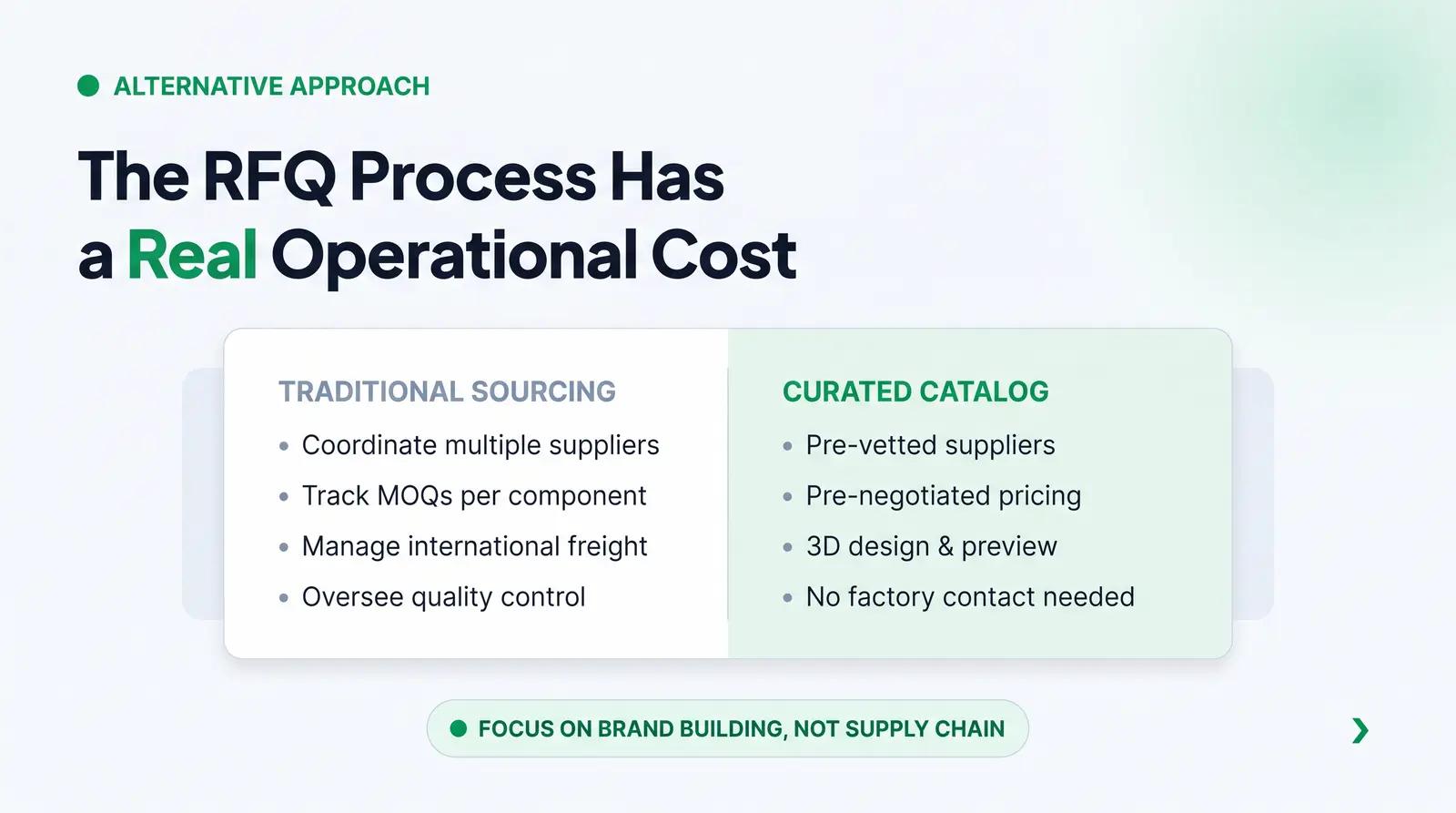
The RFQ templates in this guide are designed for founders who are sourcing packaging directly from manufacturers. But it is worth being honest about what that process actually involves. Managing multiple supplier relationships, tracking down material safety data sheets, negotiating MOQs across bottles, pumps, and closures that each have their own minimums, coordinating international freight, and overseeing quality control is a significant operational undertaking. For many beauty founders, this supply chain work is a distraction from building the brand, formulating products, and marketing to customers.
For the SKUs it carries, Packfolio removes the RFQ process entirely. We curate a vetted catalog of cosmetic primary packaging, including bottles, jars, tubes, droppers, airless pumps, lip components, compacts, and closures. Every supplier is pre-vetted, pricing is pre-negotiated, and each SKU is pre-modeled in 3D with predefined printable regions. Founders browse the catalog, customize artwork using our browser-based 3D design tool, and preview the exact photorealistic result before placing an order. What you see on screen is exactly what you receive. We coordinate production, quality assurance, and freight delivery. Customers never contact a factory.
Browse Packfolio's curated cosmetic packaging catalog and preview your label design in 3D before placing your order. No RFQ required. Explore the Catalog
Worked Example: Sourcing a Vitamin C Serum Bottle
A founder is launching a 1 oz (30 ml) vitamin C face serum. She needs a frosted glass dropper bottle with a matte black aluminum closure, a silk-screened logo in white, and a first run of 500 units. She has a target unit cost of $0.75-$1.00 for the component and wants to launch within 16 weeks.
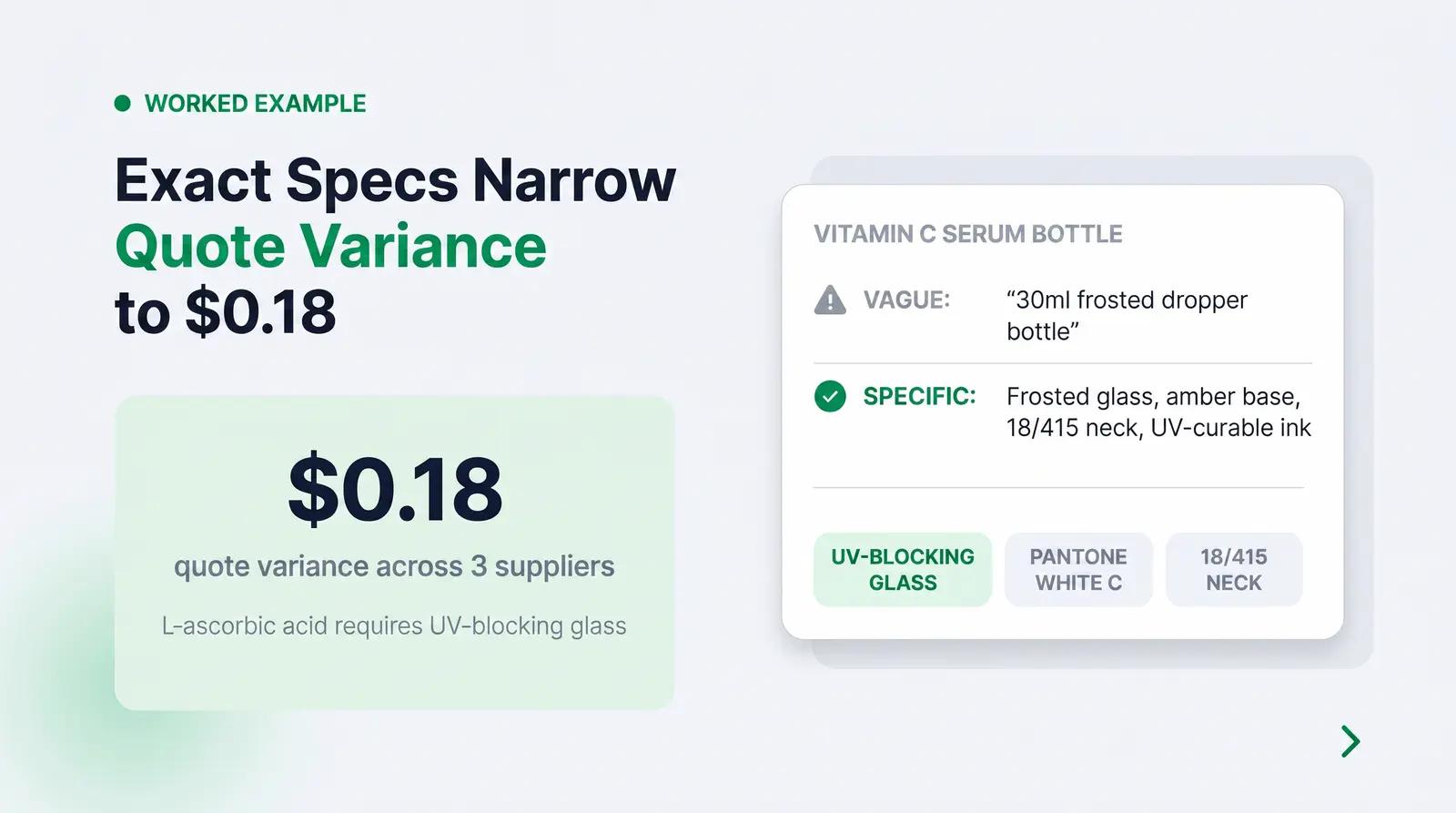
If she sends a vague email asking for "a 30ml frosted dropper bottle," the results are predictably chaotic. Supplier A quotes a standard clear PET bottle because it is the cheapest option in their catalog. But PET is a porous material that allows oxygen transmission over time, accelerating the oxidation of ascorbic acid and degrading the serum's efficacy [2]. Supplier B quotes a premium heavy-wall amber glass bottle at $2.10 per unit, which is more than double her target cost. Neither quote is useful.
Instead, she uses Template 1 and Template 2 together. In Template 1, she specifies:
- Material: Frosted glass with amber or dark glass base beneath the frosting (to block UV light and prevent oxidation of L-ascorbic acid) [2]
- Fill Volume: 30ml / 1 oz
- Overflow Capacity: 34ml minimum
- Neck Finish: 18/415
- Closure: Matte black aluminum dropper collar, 18mm neck
- Target Unit Cost: $0.75 - $1.00
- Target MOQ: 500 units (first run), with 5,000 units projected at 12 months
- Formula Compatibility Note: Formula contains 15% L-ascorbic acid. Requires UV-blocking glass to prevent oxidation.
In Template 2, she specifies:
- Decoration Method: UV Silk Screen
- Number of Colors: 1 (white)
- Color Specification: Pantone White C
- Minimum Line Width: 0.3mm (her logo has fine detail; this ensures the factory uses a 200+ mesh count screen to prevent ink bleed) [3]
- Ink System: UV-curable ink for maximum scratch resistance
- Surface Treatment: Confirm glass surface is clean and free of release agents before printing
Because she provided exact specifications, the quotes return within a tight $0.18 variance from three qualified suppliers. All three understand the UV-blocking requirement for ascorbic acid. She uses Template 5 to score them, and the supplier with the slightly higher unit cost wins on communication speed, ISO 9001 certification, and willingness to credit sample costs toward the production order. She proceeds to order 10 pre-production samples for compatibility testing and is on track for her launch timeline.
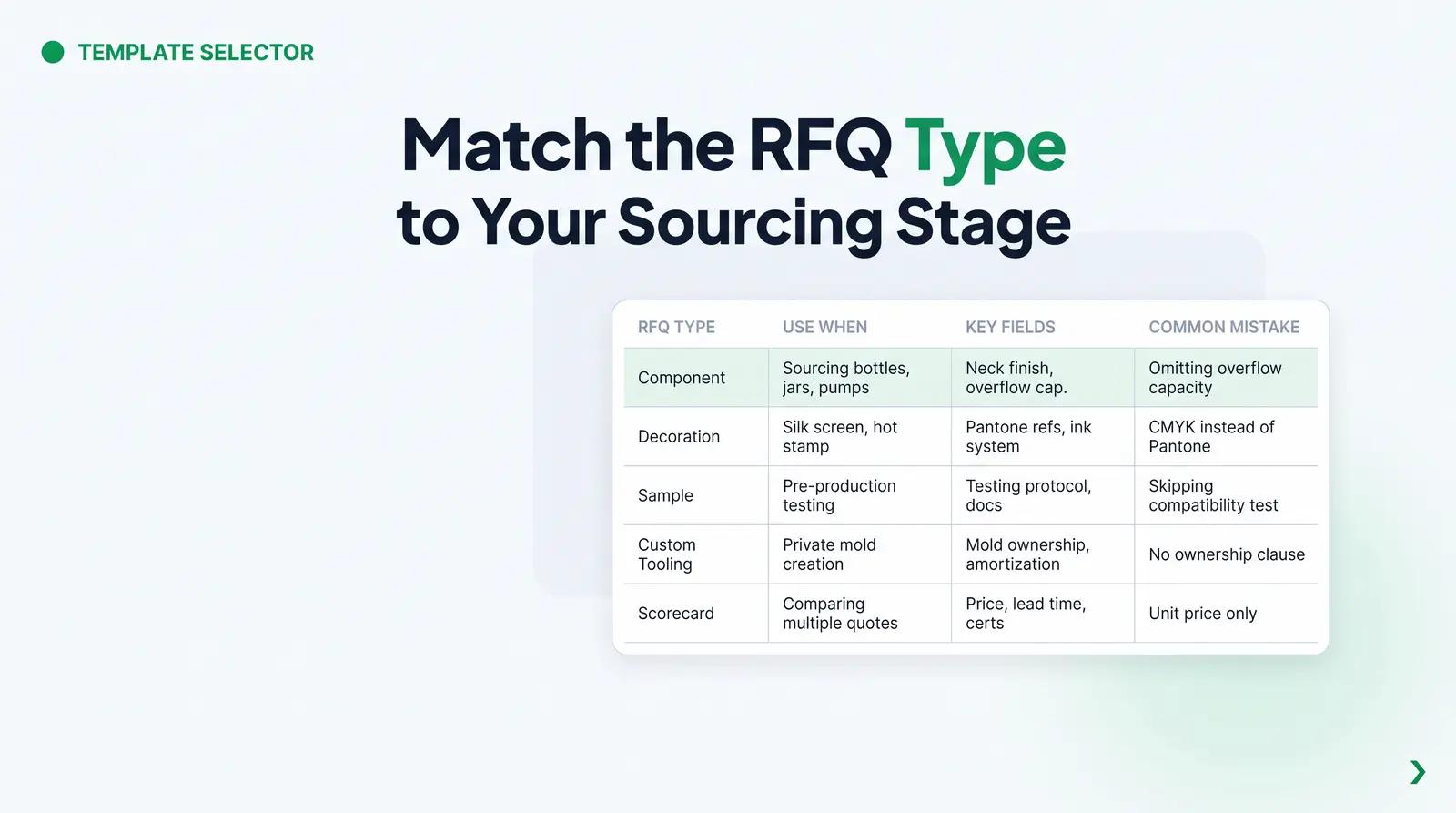
RFQ Type Comparison: Choosing the Right Template
| RFQ Type | Primary Use Case | Key Fields | Typical Supplier Response Time | Common Mistakes |
|---|---|---|---|---|
| Component RFQ | Sourcing bottles, jars, tubes, pumps, closures | Material, neck finish, fill volume, overflow capacity, formula compatibility | 5-10 business days | Omitting neck finish; not specifying overflow capacity vs. fill volume |
| Decoration RFQ | Silk screen, hot stamp, offset, pad printing | Pantone references, ink system, minimum line width, surface treatment | 5-7 business days | Specifying CMYK instead of Pantone; not noting minimum line width for fine logos |
| Sample RFQ | Pre-production samples for compatibility testing | Sample type, testing protocol, documentation required | 3-5 business days for response; 7-15 days for sample delivery | Skipping compatibility testing; not requesting material safety documentation |
| Custom Tooling RFQ | Private molds for exclusive component shapes | Mold ownership, amortization, transferability, cavity count | 10-14 business days | Not specifying mold ownership in writing; omitting amortization terms |
| Supplier Scorecard | Comparing multiple quotes after RFQ responses | Unit price, lead time, certifications, communication quality | N/A (internal evaluation tool) | Evaluating unit price only; ignoring communication quality as a predictor of production quality |
Frequently Asked Questions
What should be included in a cosmetic packaging RFQ?
A complete cosmetic packaging RFQ must include the material specifications, exact dimensions and neck finish, target fill volume versus overflow capacity, formula compatibility notes for active ingredients, decoration methods with Pantone color references, target MOQs at multiple volume tiers, required delivery timelines, and incoterms. It should also request confirmation of quality certifications such as ISO 9001 and ask for the supplier's experience with similar formulas or materials.
How many suppliers should I send an RFQ to?
Use a two-step approach: send a brief qualification email to 8-10 potential suppliers first, then send your detailed RFQ only to the 3-5 suppliers who respond promptly and confirm they can meet your basic criteria. Sending a detailed RFQ to too many suppliers simultaneously often produces low-quality responses from factories that deprioritize low-MOQ requests from unknown brands.
What is a reasonable lead time to expect from a packaging supplier after sending an RFQ?
A professional packaging supplier should acknowledge your RFQ within 24-48 hours and provide a comprehensive quote within 5 to 10 business days. If custom tooling or complex new molds are required, quoting may take up to two weeks as the engineering team evaluates CAD files. From purchase order to delivery, total lead times including production and sea freight typically run 10-14 weeks [1].
How do I compare quotes from different packaging suppliers?
Do not evaluate unit price alone. Use a weighted supplier comparison scorecard to assess the total cost of ownership, which includes one-time tooling and setup fees, sample costs, production lead times, communication speed, quality certifications, and the supplier's willingness to provide pre-production samples. A supplier with a slightly higher unit cost but faster communication and ISO 9001 certification frequently delivers a lower total cost over the life of the relationship.
What's the difference between a sample RFQ and a production RFQ?
A sample RFQ requests a small number of units, typically 10-50, specifically for formula compatibility testing, leak testing, and aesthetic review. Sample units usually incur higher per-unit costs or flat preparation fees, and the primary goal is to validate the packaging before committing to a mass production run. A production RFQ negotiates the terms, unit pricing, and lead times for the full manufacturing run, typically 5,000 or more units, and is only issued after a sample has been approved and signed off [5].
References
[1] Auber Packaging, "How to Order Custom Cosmetic Tubes from China: MOQ, Timeline and Process Guide", 2026, https://www.auberpackaging.com/article-5726734067378815.html
[2] Panyue Packaging, "Should Vitamin C Serums Be Stored in Dark Glass Bottles? Why Not Plastic?", 2025, https://www.panyuepacking.com/blog/should-vitamin-c-serums-be-stored-in-dark-glass-bottles-why-not-plastic_b121
[3] Stocksmetic, "Screen Printing: How It Works and Its Uses in Cosmetic Packaging", 2026, https://www.stocksmetic.com/us/blog/screen-printing-how-it-works-and-its-uses-in-cosmetic-packaging/
[4] JC Cosmopack, "How to Make a Procurement Plan for Cosmetic Packaging?", 2025, https://jccosmopack.com/how-to-make-a-procurement-plan-for-cosmetic-packaging/
[5] Sun-Rain Industrial, "3 Core Processes of Cosmetic Packaging: Mold Opening, Sampling, Mass Production", 2025, https://sun-rain.com/cosmetic-packaging-mold-opening-sampling-mass-production-process/
[6] U.S. Food and Drug Administration (FDA), "Modernization of Cosmetics Regulation Act of 2022 (MoCRA)", Updated March 2026, https://www.fda.gov/cosmetics/cosmetics-laws-regulations/modernization-cosmetics-regulation-act-2022-mocra
[7] International Organization for Standardization (ISO), "ISO 22715:2006 Cosmetics: Packaging and labelling", 2006 (Confirmed 2022), https://www.iso.org/standard/36436.html
[8] Measurlabs, "Cosmetic Packaging Testing by EU Regulations and Industry Guidelines", 2024, https://measurlabs.com/blog/cosmetic-packaging-testing/


