
How to Tell If a Cosmetic Packaging Supplier Is Small-Brand Friendly
Eight verifiable signals help indie beauty founders identify cosmetic packaging suppliers genuinely built for low-volume orders before committing time or capital.
Small-brand friendliness is something you can verify before wasting weeks in supplier chat. It is not something to take a supplier's word for.
Too often, beauty founders lose time, money, and launch momentum to suppliers who claim to support indie brands but are built exclusively for enterprise scale. You find a glass serum bottle you love, spend two weeks discussing decoration options, and only then discover the factory requires a 10,000-unit minimum, does not offer physical proofs, or expects you to navigate US customs on your own.
Most of the signals that reveal a supplier's true capabilities are visible early, if you know what to look for.
Why "Small-Brand Friendly" Has to Be Verified, Not Assumed
The cosmetic packaging industry is fundamentally designed for mass production. Factories invest heavily in steel molds, machine calibration, and printing plate setups. When a supplier runs a batch of 50,000 units, those fixed setup costs are distributed thinly across the order. When they run a batch of 500 units, the exact same setup costs apply, which drastically changes the economics of the run [1].
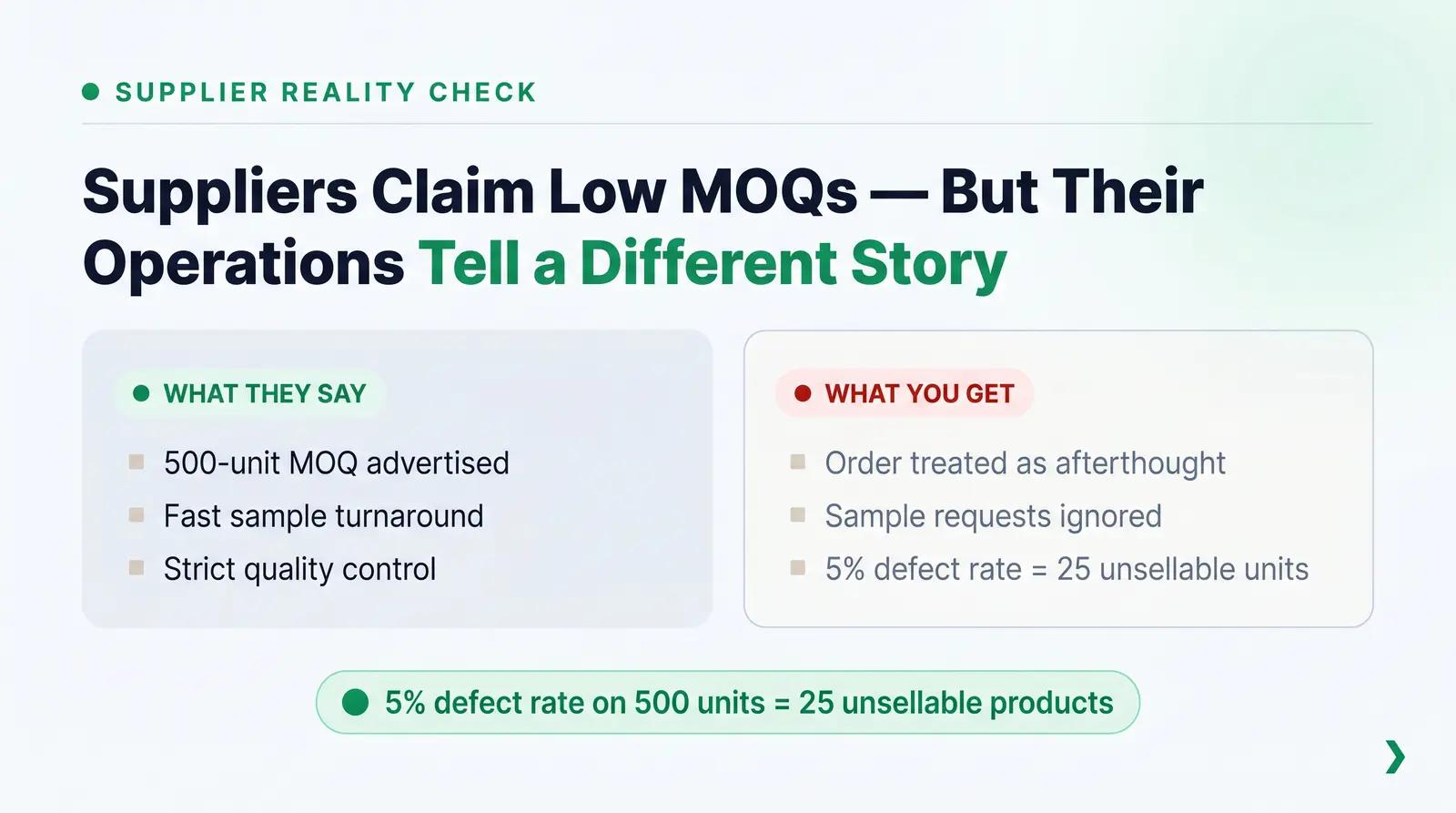
Because of this, many suppliers advertise low MOQs (Minimum Order Quantities) to capture leads, but their operational processes remain rigid. They might agree to sell you 1,000 units, but they will treat your order as an afterthought. Communication lags, sample requests are ignored, and quality control standards are applied loosely.
For a small brand, a 5% defect rate on a 500-unit order means 25 unsellable products. That is a significant hit to the bottom line. Verifying a supplier's friendliness means looking past their marketing copy and evaluating their actual processes for sampling, proofing, and defect resolution.
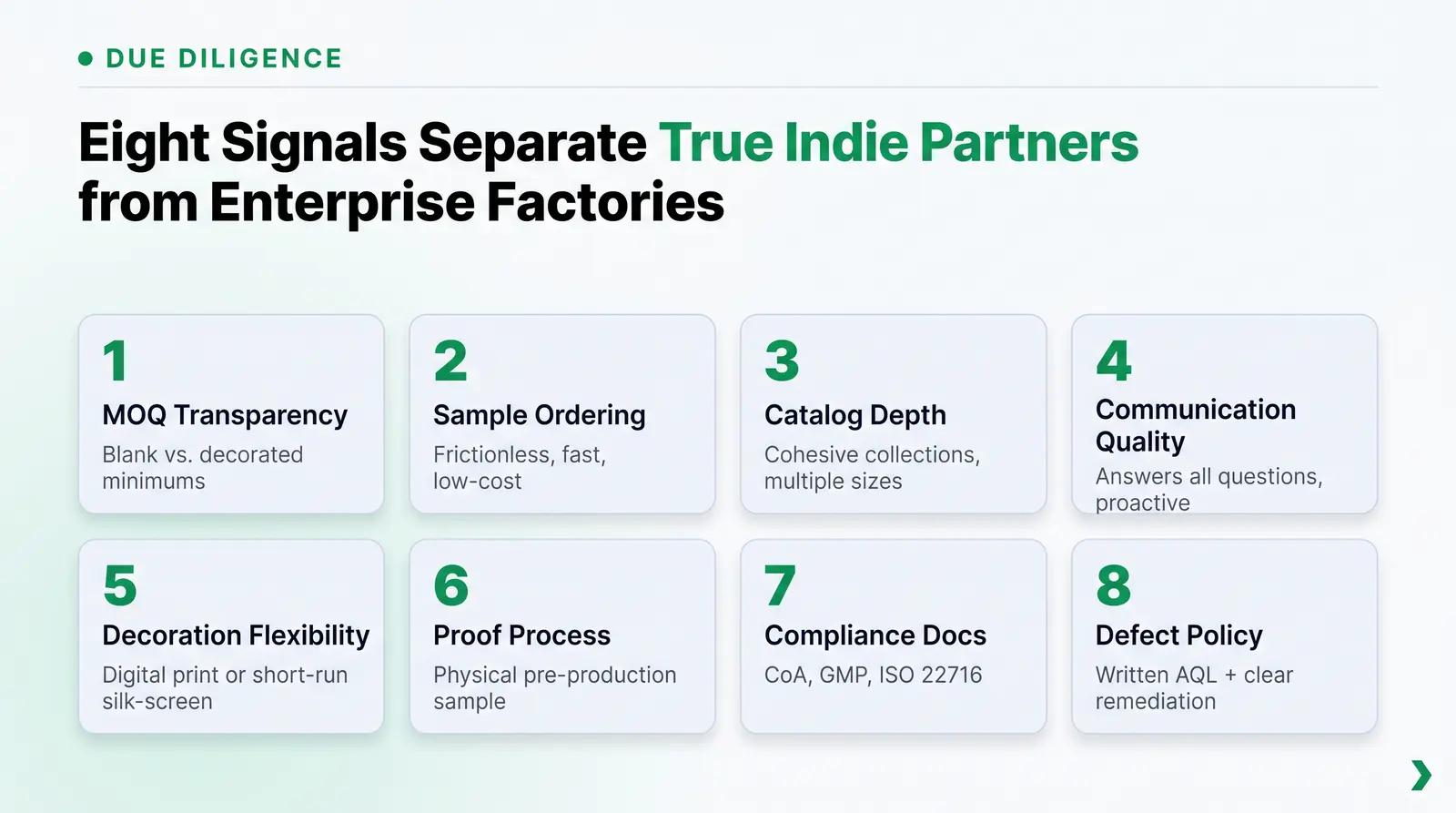
The Eight Signals That Reveal Whether a Supplier Can Serve Small Brands
Evaluating a supplier requires a systematic approach. By testing these eight signals early in the conversation, founders can quickly determine whether a supplier is equipped to handle the realities of an indie beauty launch.
1. Published MOQs and What They Actually Mean
A supplier's published MOQ is the first filter, but it rarely tells the whole story. A supplier might advertise an MOQ of 500 units for a stock acrylic jar, but that number often applies only to blank, unprinted components. The moment you request custom colors, silk-screen printing, or hot stamping, the MOQ can jump to 5,000 or 10,000 units [2].
Small-brand friendly suppliers are transparent about their tiered MOQs. They clearly delineate the minimums for blank stock, labeled stock, and fully custom decoration, allowing founders to plan their cash flow accurately before any conversation goes further.
2. Sample Ordering: Availability, Cost, and Lead Time
You should never commit to a packaging run without holding the component in your hand, testing its weight, and verifying its compatibility with your formula. Suppliers who genuinely support small brands make sample ordering frictionless. They offer pre-assembled sample kits or allow single-unit purchases of stock items, usually charging a nominal fee plus shipping.
If a supplier requires a lengthy approval process just to send a blank sample, or quotes a four-week lead time for a stock component, their logistics are not optimized for agility. That delay will compound at every stage of your launch.
3. Stock Catalog Depth and SKU Diversity
For most early-stage brands, custom molds are prohibitively expensive and time-consuming. The alternative is stock packaging. A robust supplier maintains a deep catalog of stock SKUs, ranging from airless pumps and droppers to heavy-wall PET jars, in various standard sizes [3].
More importantly, a small-brand friendly supplier carries cohesive collections. This allows a brand to source a 30 ml serum bottle, a 50 ml moisturizer jar, and a 150 ml cleanser tube that all share the same aesthetic profile. Without cohesion, your product line looks assembled from different eras.
4. Response Quality and Communication Transparency
When dealing with overseas suppliers, communication is your most critical asset. Pay attention to the quality, not just the speed, of their responses. Do they answer all three questions you asked in your email, or only the easiest one? Do they provide clear, itemized quotes, or vague estimates?
Suppliers accustomed to working with small brands understand that founders are often navigating packaging procurement for the first time. They act as consultants, proactively warning you about potential formula incompatibilities or design limitations, rather than simply taking your order and disappearing.
5. Decoration Flexibility at Low Volumes
Decoration is how your brand identity is applied to the component, and it is where many low-MOQ promises fall apart. Traditional silk-screen printing requires creating a physical screen for each color, making it cost-prohibitive for small runs [1]. Suppliers optimized for small brands offer flexible decoration alternatives. They might provide high-quality digital printing, which requires no setup fees, or they might have dedicated short-run silk-screen lines.
If a supplier insists that custom labels are your only option for an order of 1,000 units, their decoration capabilities are limited. Labels are a legitimate solution, but they should be a choice, not a constraint.
6. Proof Process: Digital, Physical, or None
The proofing process is your safety net against disastrous production errors. A digital proof, which is a PDF showing your artwork mapped onto the component dieline, is standard, but it cannot verify color accuracy or tactile finishes. A true partner will offer a pre-production sample (PPS), which is a physical, fully decorated unit created before mass production begins [4].
While a PPS carries a cost, it is the only way to confirm that the matte varnish feels right and the logo is perfectly aligned. Suppliers who refuse to provide a PPS for small orders are shifting the entire production risk onto the founder.
7. US Export Experience and Compliance Documentation
Packaging compliance is heavily regulated, and the burden of proof falls on the brand. Under the Modernization of Cosmetics Regulation Act of 2022 (MoCRA), the FDA has significantly expanded its authority over cosmetic safety and manufacturing practices [5]. Your supplier must be able to provide compliance documentation, such as Certificates of Analysis (CoA), material safety data sheets, and proof that their facility adheres to Good Manufacturing Practices (GMP) aligned with standards like ISO 22716 [6].
Furthermore, they must understand US import requirements and packaging regulations. If a supplier cannot readily produce these documents, your shipment could be delayed at customs, or your products could be deemed non-compliant before they reach a single customer.
8. Defect Policy: What Happens When Units Arrive Wrong
In manufacturing, perfection is a myth. The industry standard for quality control is the Acceptable Quality Limit (AQL), which defines the maximum number of defective units allowed in a batch before it is rejected [7]. For cosmetic packaging, an AQL of 2.5 for major defects (such as a broken pump) and 4.0 for minor defects (such as a slight surface scratch) is common.
Small-brand friendly suppliers will explicitly state their AQL standards in their supply agreement. They will also have a clear, documented policy for remediation, whether that means replacing defective units, issuing credits, or rushing a reprint, so you are not left absorbing the cost of their mistakes.
The Small-Brand Supplier Vetting Rubric
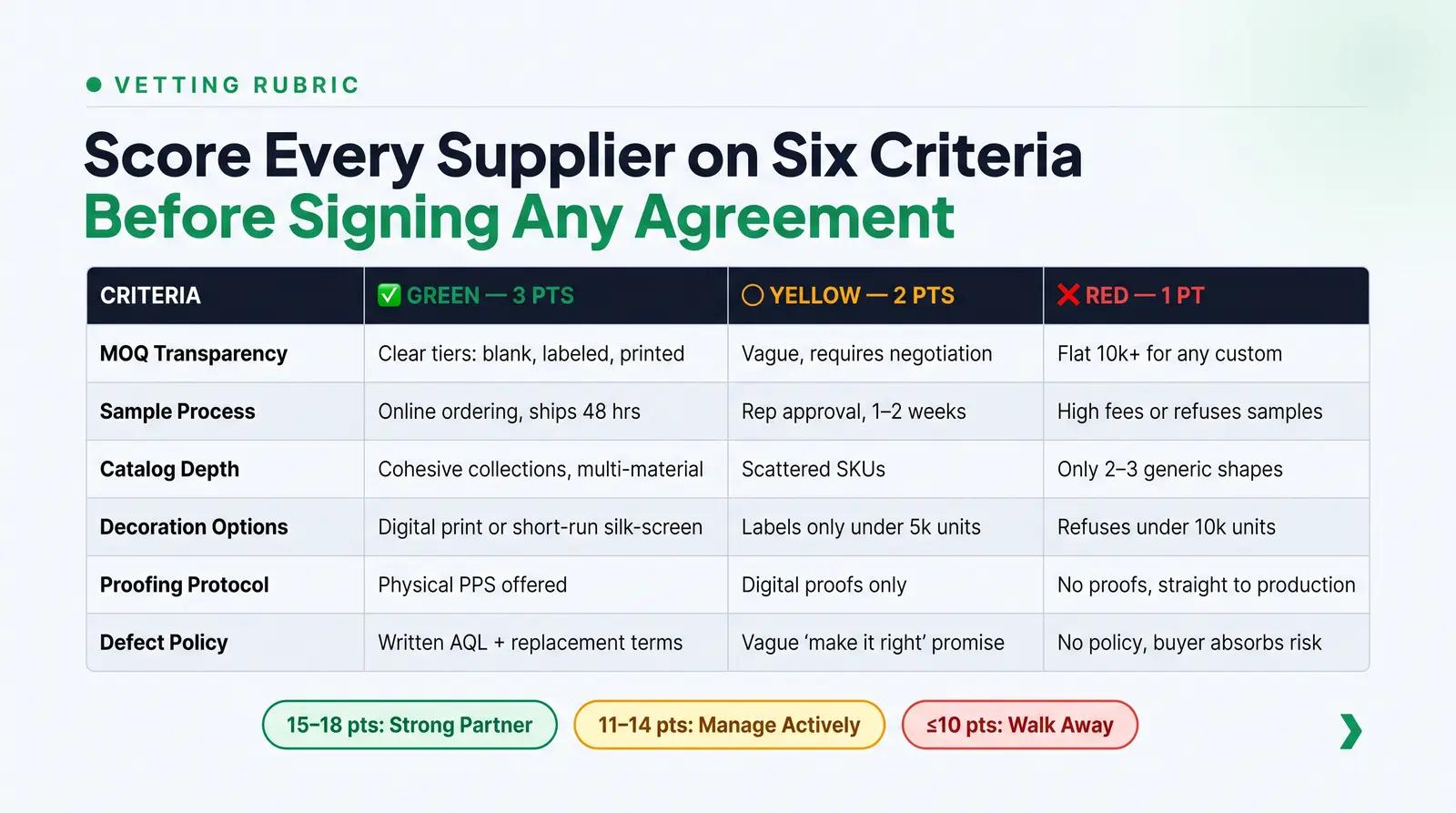
To systematize the evaluation process, founders can use the Small-Brand Supplier Vetting Rubric. This practical framework scores suppliers across the critical signals, providing an objective measure of their suitability for early-stage beauty brands.
| Evaluation Signal | Green (3 pts): Highly Capable | Yellow (2 pts): Acceptable with Caution | Red (1 pt): High Risk |
|---|---|---|---|
| MOQ Transparency | Clear tiers for blank, labeled, and printed stock | Vague tiers, requires negotiation to uncover limits | Flat 10k+ MOQ for any customization |
| Sample Process | Direct online ordering, ships within 48 hours | Requires sales rep approval, ships in 1-2 weeks | High fees or refuses to send blank samples |
| Catalog Depth | Extensive cohesive collections in multiple materials | Scattered SKUs, hard to build a matching line | Only 2-3 generic bottle shapes available |
| Decoration Options | Digital printing or short-run silk-screen available | Only offers labeling for orders under 5,000 units | Refuses decoration for orders under 10,000 units |
| Proofing Protocol | Offers physical Pre-Production Samples (PPS) | Digital proofs only, no physical verification | Refuses proofs, goes straight to production |
| Defect Policy | Written AQL standards and clear replacement terms | Vague promises to "make it right" if issues arise | No stated policy, buyer accepts all risk |
A score of 15-18 indicates a strong partner built for small-batch reality. A score of 11-14 suggests the supplier can work, but the founder must manage the relationship actively. A score of 10 or below means walking away before investing capital.
Worked Example: Qualifying a Supplier for a 300-Unit Skincare Launch
Consider a founder preparing to launch a new vitamin C serum. They need 300 units of a 30 ml frosted glass dropper bottle, fully decorated with their logo and usage instructions. They engage a supplier and apply the vetting rubric.
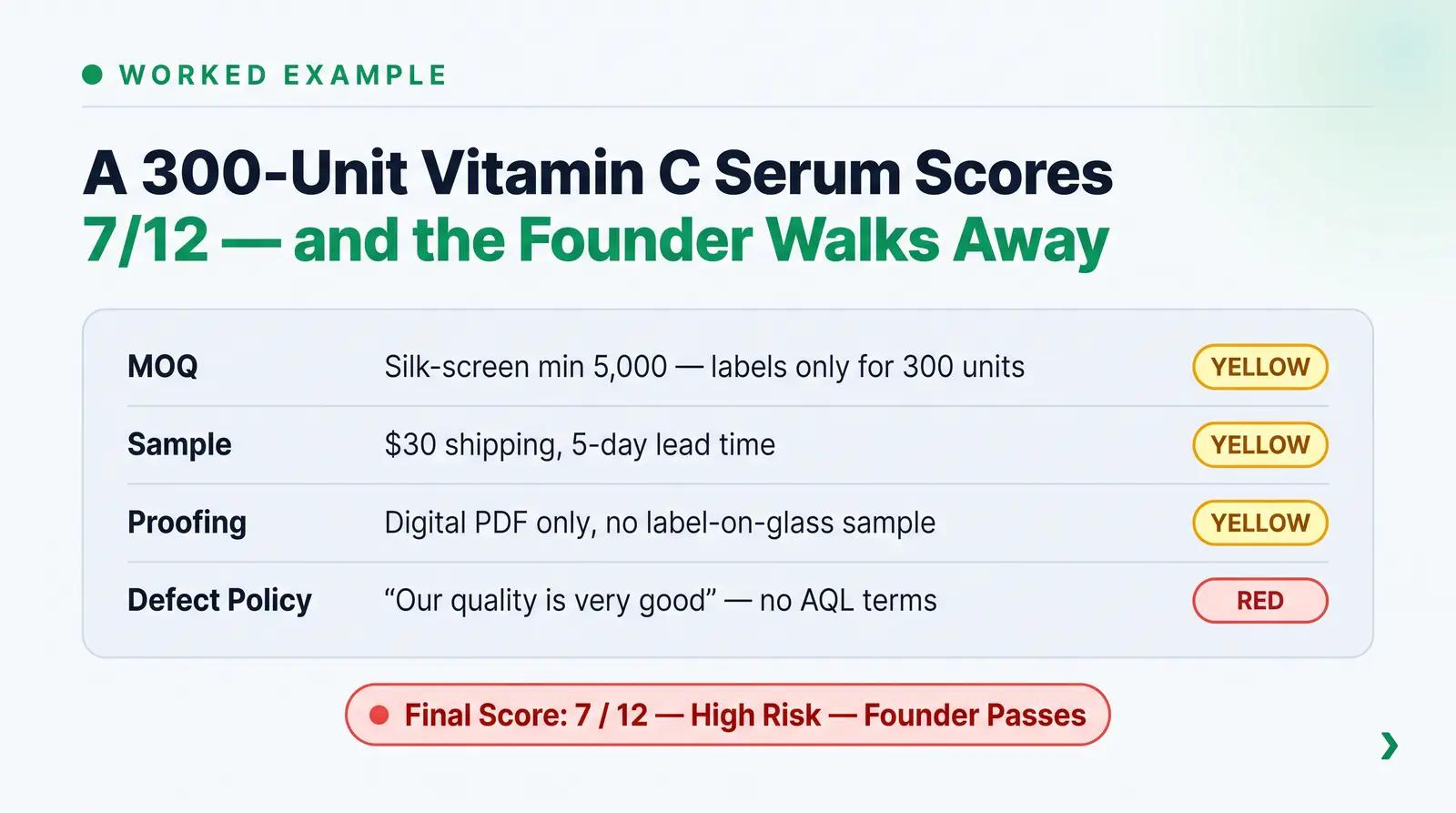
First, the founder checks the MOQs. The supplier advertises a 100-unit MOQ for blank bottles. However, when the founder requests silk-screen printing, the supplier states the printing minimum is 5,000 units. To decorate 300 units, the supplier only offers adhesive labels. That is a Yellow score: the option exists, but it is a constraint, not a choice.
Next, the founder requests a sample. The supplier charges $30 for shipping and sends a blank bottle within five days. Another Yellow: functional but not frictionless.
The founder then asks about the proofing protocol. Because the supplier is only providing blank bottles with applied labels, they offer a digital PDF proof of the label dieline but refuse to send a physical sample of the label applied to the frosted glass, citing the small order size. Yellow again.
Finally, the founder asks for the defect policy. The supplier representative replies: "Do not worry, our quality is very good. If there are broken bottles, tell us." There is no mention of AQL standards or specific credit terms. That is a Red.
Scoring a 7 out of 12 on these four critical metrics, the supplier reveals themselves as a high-risk partner for a 300-unit launch. The risk of receiving misaligned labels on scratched glass, with no recourse for refunds, is too high for a self-funded launch. The founder passes.
The Contrarian Case Against Chasing the Lowest MOQ
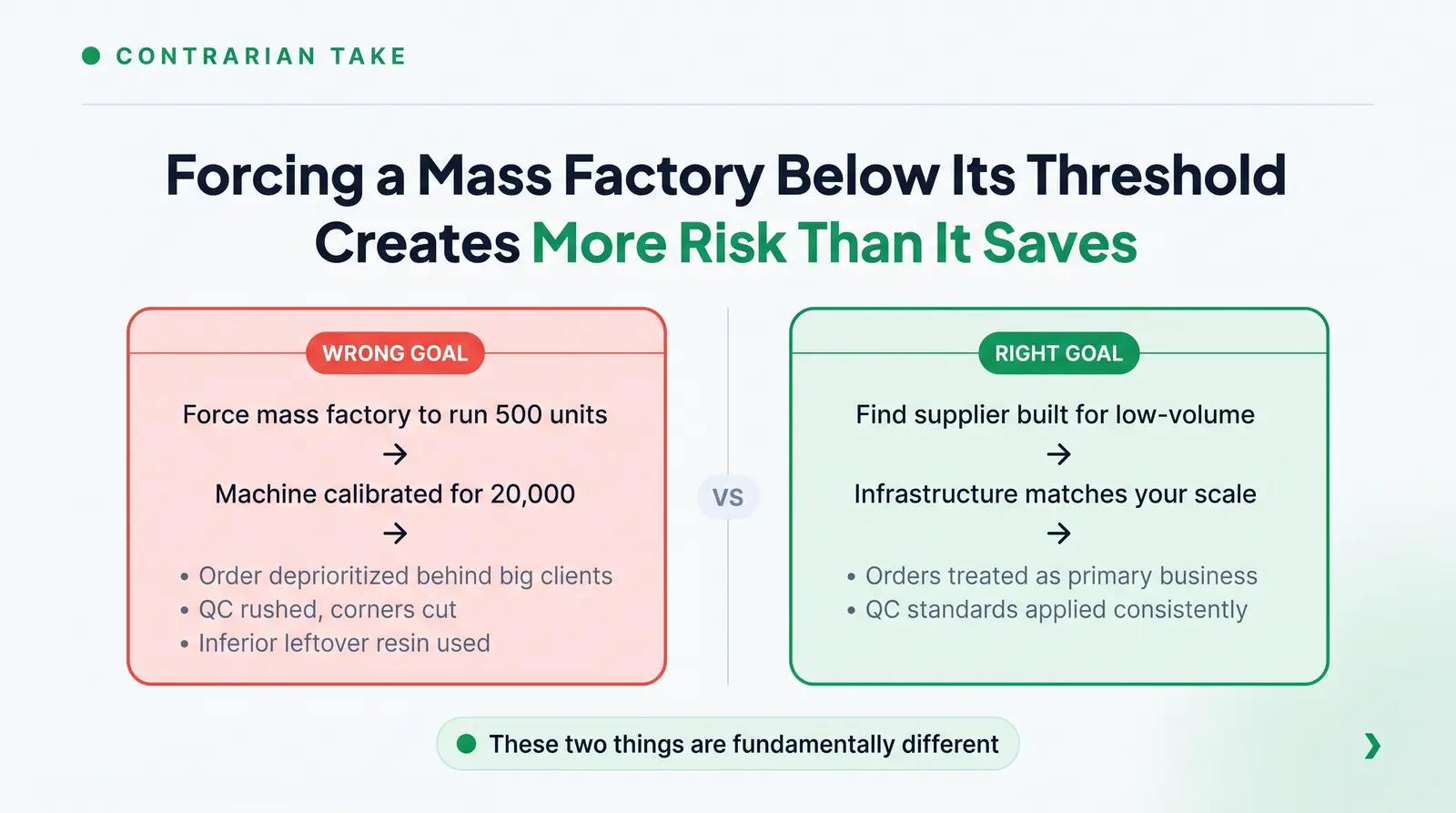
Conventional wisdom dictates that founders should relentlessly negotiate for the lowest possible MOQ to preserve cash flow. However, pushing a traditional factory below their natural operational threshold often creates more risk than it mitigates.
When a factory agrees to an unnaturally low MOQ, say running 500 custom-colored jars on a machine calibrated for 20,000, they are doing so reluctantly. To maintain their margins, they will cut corners. Your order will be deprioritized behind larger clients, leading to delays. Quality control will be rushed, and the factory may use leftover, inferior resin from a previous run to fulfill your small batch [1].
The goal is not to force a mass-manufacturing facility to act like a boutique workshop. The goal is to find a supplier whose infrastructure is actually built for low-volume efficiency. Those two things are fundamentally different, and conflating them is one of the most expensive mistakes an indie founder can make.
What Packfolio Does Differently
Vetting suppliers, negotiating MOQs, and managing overseas quality control is a full-time job, and one that distracts founders from product development and marketing.
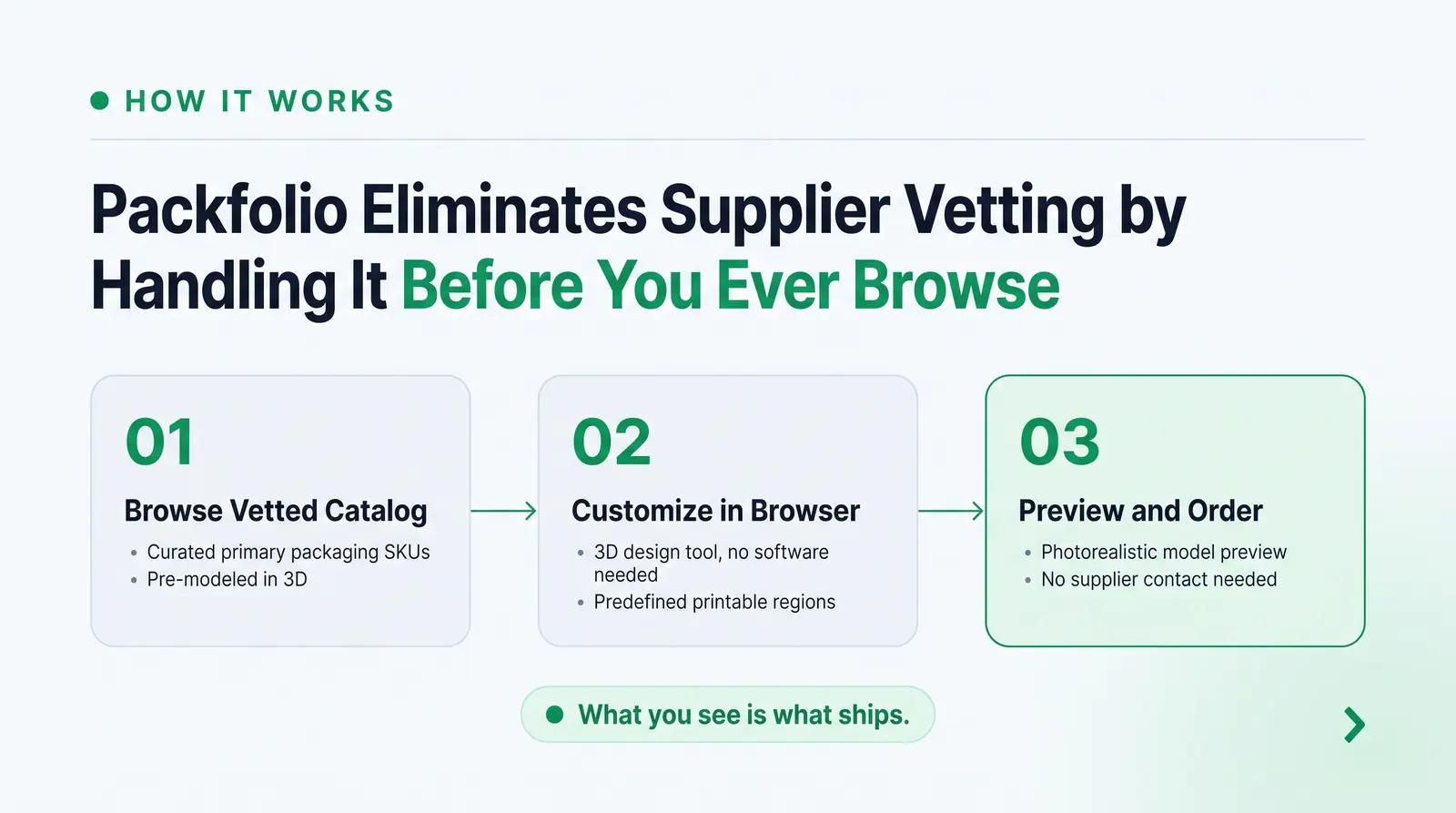
Packfolio removes this friction entirely. The platform offers a curated, vetted catalog of cosmetic primary packaging SKUs, each pre-modeled in 3D with predefined printable regions. Founders browse the catalog, customize their artwork inside the browser-based 3D design tool, and preview the exact result on a photorealistic model before ordering. Because Packfolio coordinates production, quality assurance, and freight delivery across its supplier network, founders never contact suppliers directly or worry about hidden defect policies. The supply chain is handled, so the focus stays on building the brand.
Ready to Skip the Vetting Process Entirely?
Browse Packfolio's curated cosmetic packaging catalog, customize your label in the browser-based 3D design tool, and preview the result on a photorealistic model before you order. What you see is what ships.
Frequently Asked Questions
How do I find a cosmetic packaging supplier with low MOQs?
Look for suppliers that specialize in stock packaging rather than custom molds. Platforms that aggregate stock options, or suppliers that explicitly advertise digital printing and short-run capabilities, are generally more accommodating to low-volume orders. The key is to confirm whether the low MOQ applies to decorated units or only to blank components.
What is the standard lead time for cosmetic packaging?
For stock packaging without custom decoration, lead times can be as short as one to two weeks. For decorated stock or custom runs, expect six to twelve weeks, factoring in pre-production sample approvals and freight transit times. Building buffer time into your launch calendar is essential.
Why are custom cosmetic packaging orders so expensive for small quantities?
Custom orders require physical tooling, such as cutting dies and printing plates. When you order a small batch, the fixed costs of creating those tools are spread across fewer units, significantly driving up the price per piece. Decoration setup costs are the same whether you order 500 units or 50,000.
What is a pre-production sample (PPS) and do I need one?
A pre-production sample is a single, fully finished unit produced before the mass run begins, using the actual molds, materials, and finishing processes that will be used in production. You need one to verify color accuracy, material feel, and print alignment. It is the only reliable way to ensure the final product matches your expectations before thousands of units are made.
How do I handle defective packaging from a supplier?
Before placing any order, ensure your supply agreement includes an Acceptable Quality Limit (AQL) clause, which defines the maximum allowed defect rate for the batch. If defects exceed this limit upon delivery, refer to the agreed-upon remediation policy for credits or replacements. Never place an order without a written defect policy in place.
References
[1] The Real Logic Behind Low MOQ Cosmetic Packaging: A Guide for Indie Beauty Brands, BottleMile, January 2026. https://bottlemile.com/the-real-logic-behind-low-moq-cosmetic-packaging-a-guide-for-indie-beauty-brands/
[2] How Does MOQ Affect Cosmetic Packaging Costs (And What You Can Do About It), AH Packaging, October 2025. https://ahpackaging.com/how-does-moq-affect-cosmetic-packaging-costs/
[3] Strategies for Using Stock Packaging, Beauty Packaging Magazine, July 2025. https://www.beautypackaging.com/strategies-for-using-stock-packaging/
[4] Why Professional Packaging Manufacturers Always Require a Pre-Production Sample Approval, Transmo Packaging, May 2026. https://www.transmo-packaging.com/news/why-professional-packaging-manufacturers-always-require-a-pre-production-sample-approval/
[5] Modernization of Cosmetics Regulation Act of 2022 (MoCRA), U.S. Food and Drug Administration, updated March 2026. https://www.fda.gov/cosmetics/cosmetics-laws-regulations/modernization-cosmetics-regulation-act-2022-mocra
[6] Navigating the Labyrinth of Compliance: Essential Certifications for Cosmetic Packaging Suppliers, EastColor, February 2026. https://eastcolor.com/Navigating-the-Labyrinth-of-Compliance-Essential-Certifications-for-Cosmetic-Packaging-Suppliers-id01391365.html
[7] Acceptable Quality Limit (AQL), QIMA. https://www.qima.com/aql-acceptable-quality-limit


