
Packaging for Reorders: How to Avoid Changing Components Mid-Launch
The Component Lock-In Framework helps beauty brands document specs, verify closures, maintain artwork portability, and calculate safety stock to prevent costly mid-launch packaging changes.
A beauty founder launches a highly anticipated vitamin C serum in a custom frosted glass dropper bottle. The product sells out in four months. The founder contacts their supplier to reorder 5,000 units, only to hear the dreaded words: "That component has been discontinued." Or perhaps the factory retooled, and the new collar finish no longer matches the brand aesthetic. Suddenly, the founder is scrambling for a replacement, redesigning their label to fit a new bottle geometry, and risking confusion among loyal customers with a mid-launch packaging change.
This scenario is not rare. As global trade uncertainty, shifting tariffs, and supply chain disruptions continue to pressure packaging manufacturers, suppliers frequently alter or discontinue components to manage costs and minimum order quantities [1]. For a beauty founder, ordering packaging is not a one-time event. It is the beginning of a continuous supply chain relationship. Ensuring that every packaging component ordered for launch can be reordered consistently, without changing the product's look, fill compatibility, or customer experience, requires a concrete system.
This article walks through that system in full: component spec documentation, closure compatibility, artwork portability, backup supplier strategy, reorder lead times, safety stock math, and a named framework you can apply starting with your next order.
Why Suppliers Discontinue Components
Before building a continuity strategy, it helps to understand why discontinuation happens in the first place.
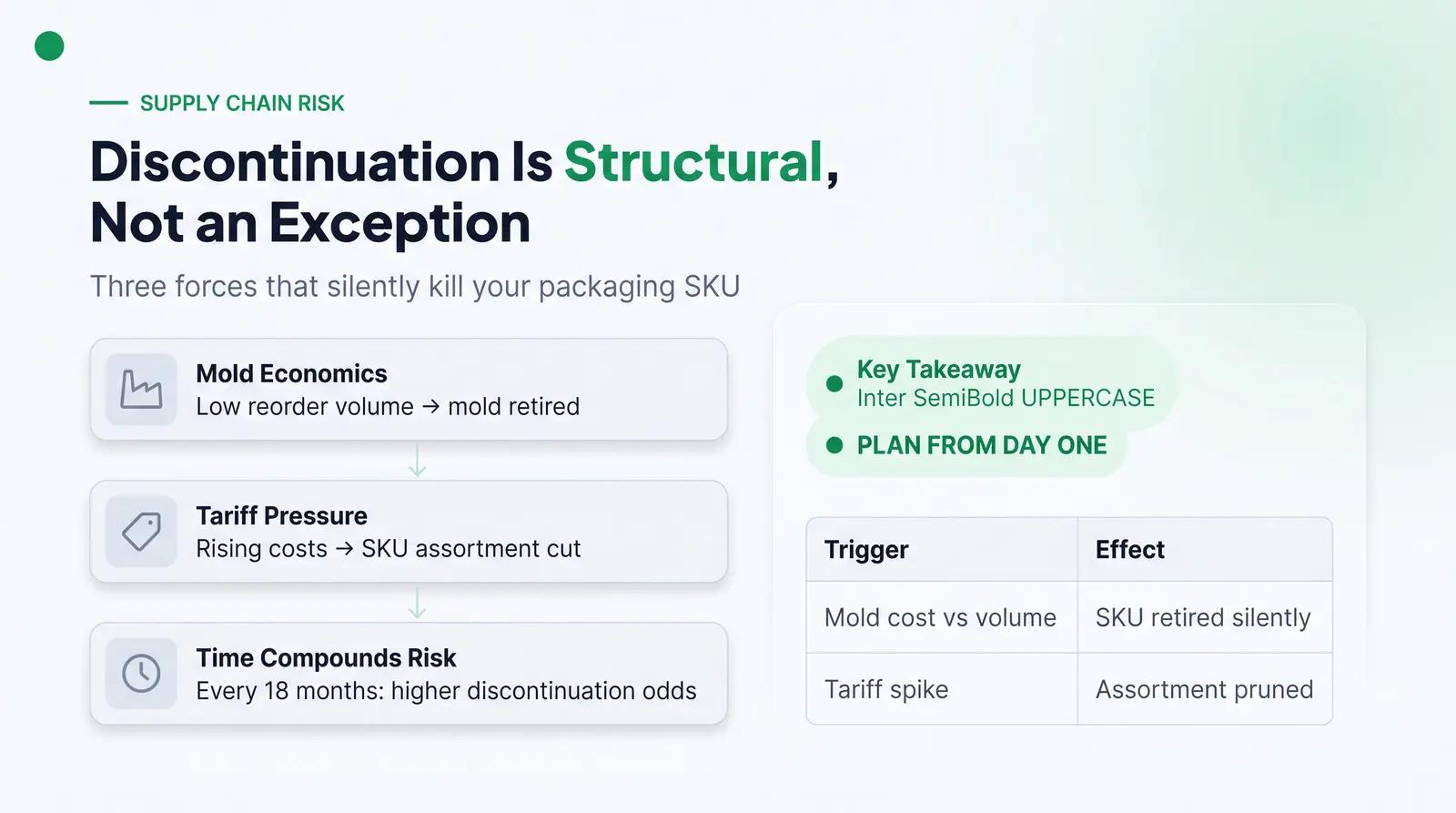
Cosmetic packaging factories operate on volume economics. A single injection mold can cost thousands of dollars to produce and maintain. If a particular bottle shape or closure style does not generate enough reorder volume across the factory's client base, the economics of keeping that mold active eventually tip negative. The factory retires the SKU, often without formal notice to the brands that depend on it [2].
Tariffs and raw material price shifts accelerate this process. In 2025, a wave of US tariffs significantly altered the economics of beauty packaging, increasing costs for raw materials like aluminum and steel, as well as finished components imported from overseas [1]. To protect margins, some suppliers pared down their assortments to essential SKUs, reducing complexity but leaving brands that rely on niche or semi-custom components exposed to sudden stockouts [2].
The risk is not hypothetical. It is structural, and it compounds with every year that passes between your launch order and your first reorder. A component that exists today may not exist in 18 months. The brands that survive this reality are the ones that plan for it from day one.
The Component Lock-In Framework
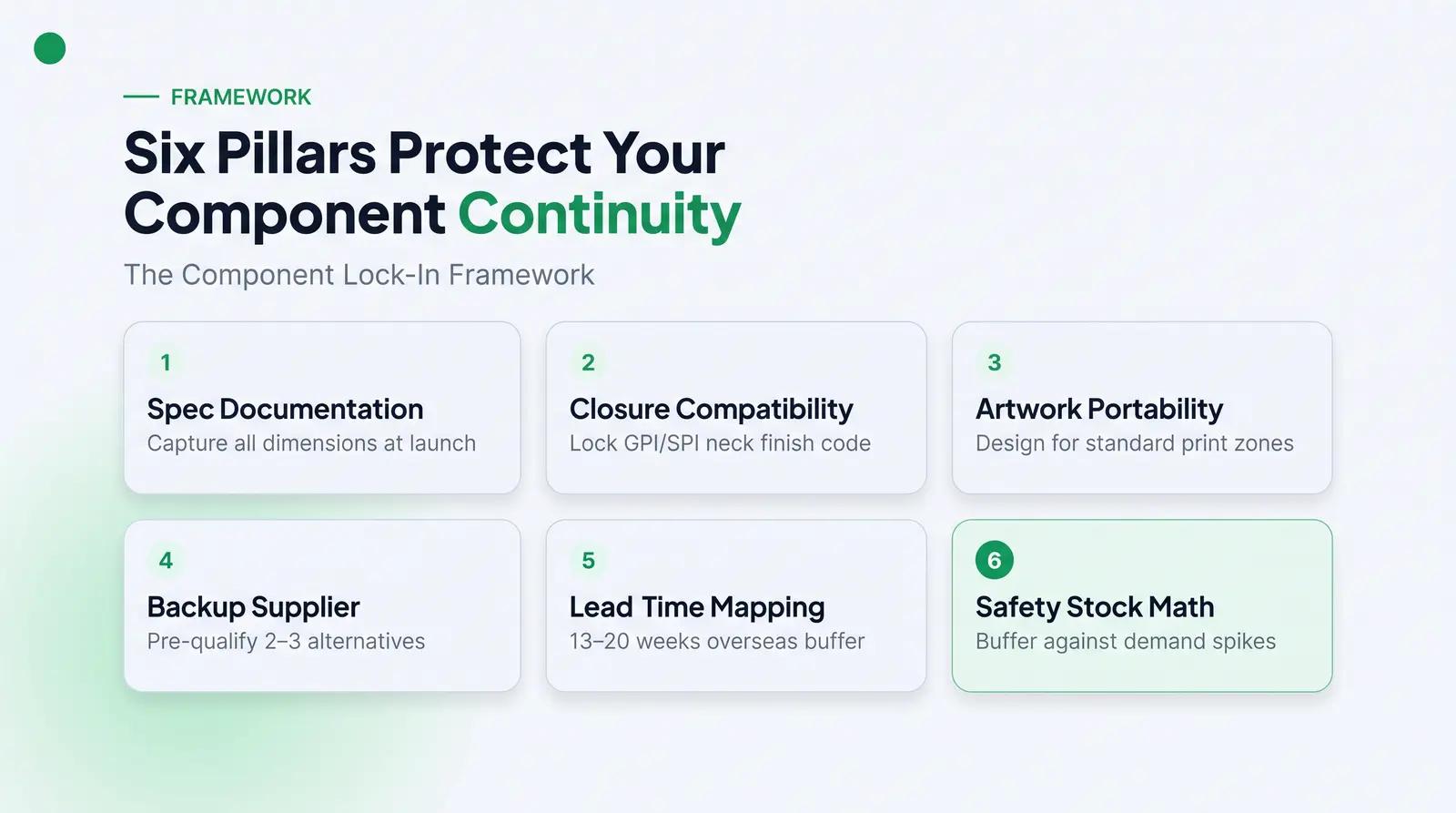
To protect your brand from mid-launch packaging crises, you need a systematic approach to specification and reordering. We call this The Component Lock-In Framework. It ensures you have the data and strategy necessary to maintain component continuity, even if your original supplier changes their catalog. The framework has six pillars.
1. Component Spec Documentation
At the time of your first order, capture detailed specifications for every component. This data should live with your brand, not just the supplier. If you ever need to find an alternative, you need the exact measurements to ensure the new component is functionally equivalent.
The core specs to document are:
| Spec Field | What to Record | Why It Matters |
|---|---|---|
| External Dimensions | Height, diameter, shoulder profile | Determines label fit and secondary packaging compatibility |
| Fill Volume | Overflow capacity and recommended fill level | Ensures fill line settings remain unchanged on reorder |
| Neck Finish | GPI/SPI standard code (e.g., 24-410, 28-400) | Controls closure compatibility across suppliers [3] |
| Wall Thickness and Material | Resin type (PET, HDPE, glass grade) | Affects label adhesion, product stability, and weight |
| Closure Torque Spec | Application force in inch-pounds | Prevents thread damage and inconsistent sealing |
| Secondary Components | Wand length, pipette diameter, pump stroke volume | Ensures dispensing performance is replicated exactly |
Treat this spec sheet as a living document. Update it every time you receive a new production sample, because even a "reorder" from the same supplier can introduce minor dimensional changes if the factory has recalibrated its tooling.
2. Closure Compatibility Verification
The bottle and closure must be specified and reordered as a system. The neck finish refers to the outer threads on the container that hold the cap in place [3]. The Glass Packaging Institute (GPI) and Society of the Plastics Industry (SPI) establish uniform standards for these finishes, ensuring that bottles and closures from different manufacturers can function together reliably [3].
For example, a 24-410 finish means a 24 mm thread diameter with a 1.5-turn thread profile [3]. If a supplier changes the thread profile from a 410 to a 400 series (1 thread turn), your existing closures will not seal properly, leading to leaks and product degradation [3]. The two series are not interchangeable even when the diameter is identical. A 28-400 cap applied to a 28-410 finish may appear to thread on but will fail to compress the liner sufficiently, creating a seal that looks correct but leaks under pressure [3].
Brands that lock in a bottle often forget to document neck finish tolerances, making closure compatibility a harder continuity problem than the bottle itself. Always request the GPI or SPI finish designation in writing from your supplier and verify it against the closure spec sheet before approving any production run.
3. Artwork Portability
Artwork portability is the hidden variable that determines how expensive a component switch actually is. Are your print files tied to a specific container's 3D geometry, or are they format-flexible?
If your label design relies on the exact curvature of a proprietary semi-custom bottle, switching to a stock alternative triggers a full rebrand. This means new dielines, new press proofs, new photography, and potentially new secondary packaging. The cost of a "simple" component switch can balloon into tens of thousands of dollars when artwork portability has not been considered.
Designing artwork with predefined, standard print zones ensures that if you must migrate to an alternative SKU, it requires a simple file adjustment rather than a costly redesign. This is a principle built into how platforms like Packfolio structure their catalog, where every SKU ships with a predefined printable region so your artwork stays portable by default.
A practical rule: if your label design cannot be adapted to a standard 30 ml Boston Round or a standard 50 ml airless pump without a full redesign, your artwork portability is low. That is not necessarily a problem, but it means your safety stock requirements and backup supplier strategy must be proportionally more aggressive.
4. Backup Supplier and Alternative SKU Identification
Identify functionally equivalent components before you need them. "Functionally equivalent" means the same neck finish, the same fill volume range, compatible closure torque, and similar wall thickness. A true backup allows you to transition seamlessly without altering the consumer experience, whereas a forced compromise might require changing your fill line or label size.
Diversifying your supplier base is one of the most effective risk mitigation strategies available to a beauty brand [2]. A single-supplier dependency for a critical packaging component is a known vulnerability. Building a short list of two or three qualified alternatives for each key component costs almost nothing upfront and can save an entire product launch.
When evaluating backup suppliers, request a physical sample and run a full compatibility test with your existing closure and fill formula before adding them to your approved vendor list. Do not wait until you are in a crisis to discover that the "equivalent" bottle has a slightly different shoulder profile that causes your label to wrinkle.
5. Reorder Lead Time Mapping
Realistic lead times dictate your reorder schedule. For cosmetic packaging sourced from China, a realistic timeline from concept to mass production runs 10 to 14 weeks, covering design, sampling, and production [4]. Sea freight from China to the US adds another 3 to 6 weeks depending on the destination coast [5]. That means a brand sourcing overseas needs to place a reorder 13 to 20 weeks before their current inventory runs out.
Most founders underestimate this timeline because they focus only on production time and ignore sampling, QC, and logistics. A common mistake is planning only for factory days while ignoring the sampling and shipping stages [5]. Add a 2 to 4 week buffer to your planned lead time to account for customs delays, port congestion, or supplier scheduling conflicts.
Map your lead time against your current inventory and weekly sell-through rate. If you are selling 200 units per week and have 2,000 units in stock, you have 10 weeks of inventory. If your lead time is 14 weeks, you are already late.
6. Safety Stock Calculation Logic
Safety stock is the buffer inventory carried to prevent stockouts caused by demand variability or supply delays [6]. The standard formula used in inventory management is:
Safety Stock = (Maximum Daily Sales x Maximum Lead Time in Days) - (Average Daily Sales x Average Lead Time in Days) [6]
This formula accounts for both demand spikes and supplier delays simultaneously. It is not a static number. Recalculate it every time your sales velocity changes significantly or your supplier's lead time shifts.
For a brand selling an average of 100 units per week with a maximum spike of 150 units per week, and an average lead time of 70 days with a maximum of 98 days:
(150/7 x 98) - (100/7 x 70) = (21.4 x 98) - (14.3 x 70) = 2,097 - 1,001 = approximately 1,100 units of safety stock [6]
That is roughly 11 weeks of average demand held as a buffer. For a brand with tight cash flow, this may feel excessive. But the cost of carrying 1,100 extra units of packaging is almost always lower than the cost of a stockout, an emergency air freight shipment, or a forced mid-launch packaging change.
The Cost of "Just Enough"
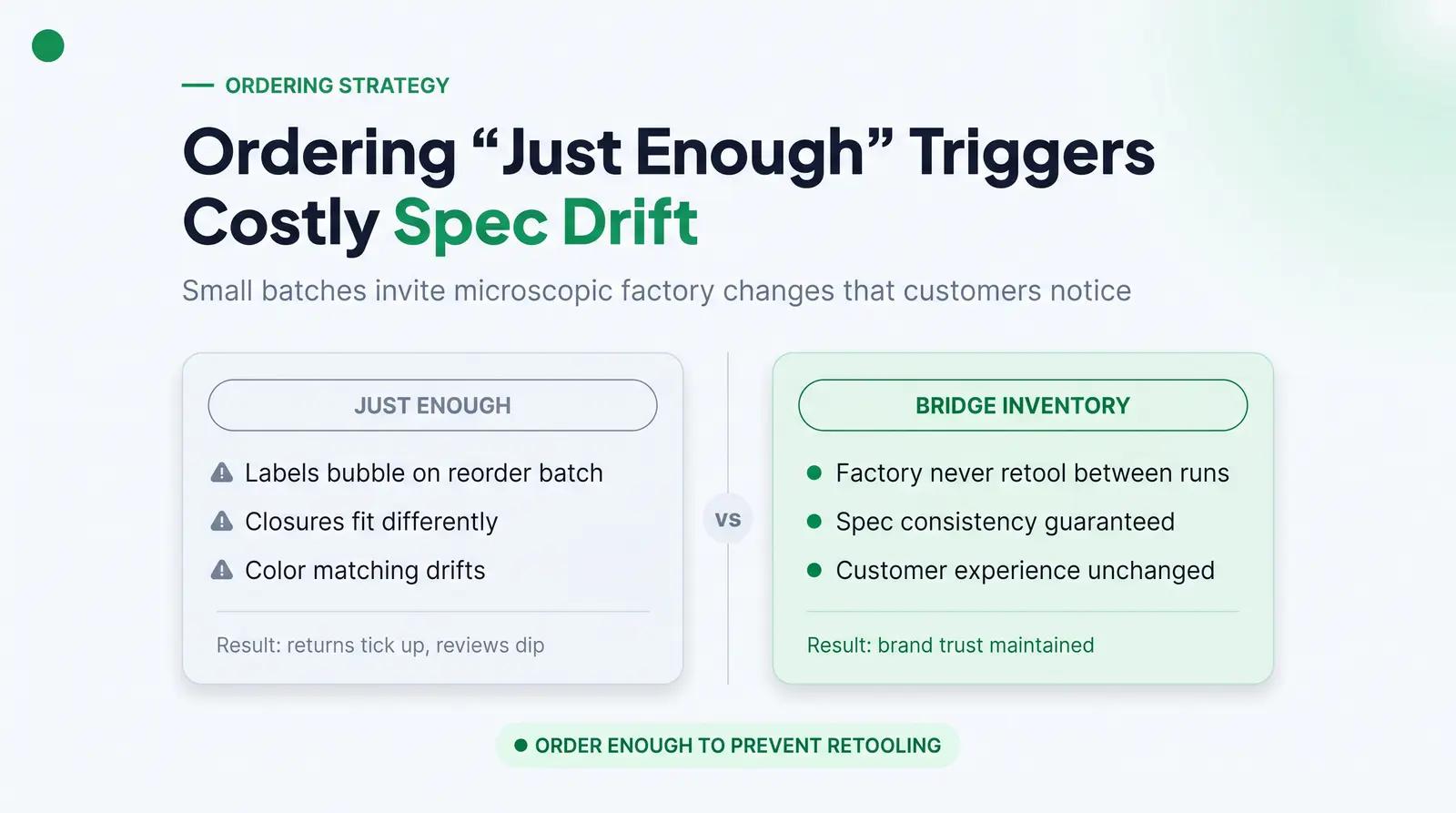
A non-obvious insight that pushes against conventional wisdom: ordering "just enough" packaging for launch is one of the costliest decisions a founder makes. This is not merely because of higher per-unit costs associated with low MOQs. It is because of spec drift between production runs.
When you order a small batch of 3,000 units for a market test, and then reorder six months later, the factory may have recalibrated their machines, changed resin suppliers, or slightly altered the mold. These microscopic shifts can cause your labels to bubble, your closures to fit differently, or the color matching to be slightly off. Customers who buy the "new" batch notice the difference, even if they cannot articulate it. The product feels cheaper. Returns tick up. Review scores dip.
Securing enough inventory to bridge the gap to your first major reorder, or working with a platform that guarantees spec consistency, is vital. The goal is to reach a volume where you are ordering frequently enough that the factory never has a reason to retool between your runs.
Reorder Risk Levels by Packaging Type
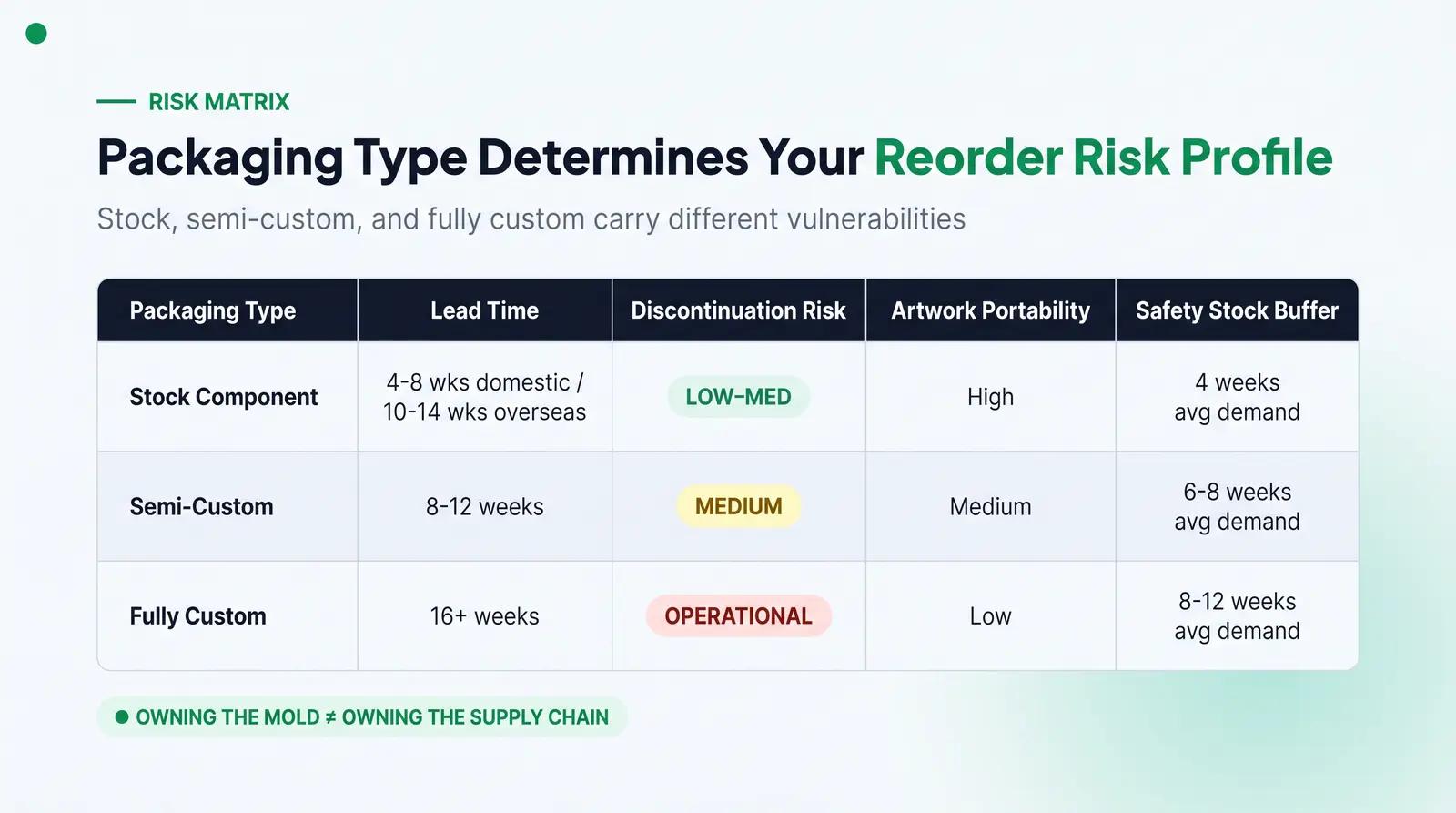
Understanding the risk profile of your chosen packaging type helps inform your safety stock and backup strategies.
| Packaging Type | Typical Lead Time | Discontinuation Risk | Artwork Portability | Recommended Safety Stock Buffer |
|---|---|---|---|---|
| Stock Component (Standard Molds) | 4-8 weeks domestic / 10-14 weeks overseas | Low to Medium | High: standard dimensions allow easy migration | 4 weeks of average demand |
| Semi-Custom (Stock mold, custom color or finish) | 8-12 weeks | Medium: factory may change base mold | Medium: color matching required on new SKU | 6-8 weeks of average demand |
| Fully Custom (Proprietary Mold) | 16+ weeks including mold creation | Low: you own the mold, but factory reliance is high | Low: artwork is tied to unique geometry | 8-12 weeks of average demand |
Note that fully custom packaging carries low discontinuation risk because you own the mold, but it carries high operational risk because you are entirely dependent on one factory's capacity and willingness to run your mold. If that factory closes, relocates, or loses your mold in a fire, your lead time resets to zero. Owning the mold does not mean owning the supply chain.
A Worked Example: The Vitamin C Serum Crisis
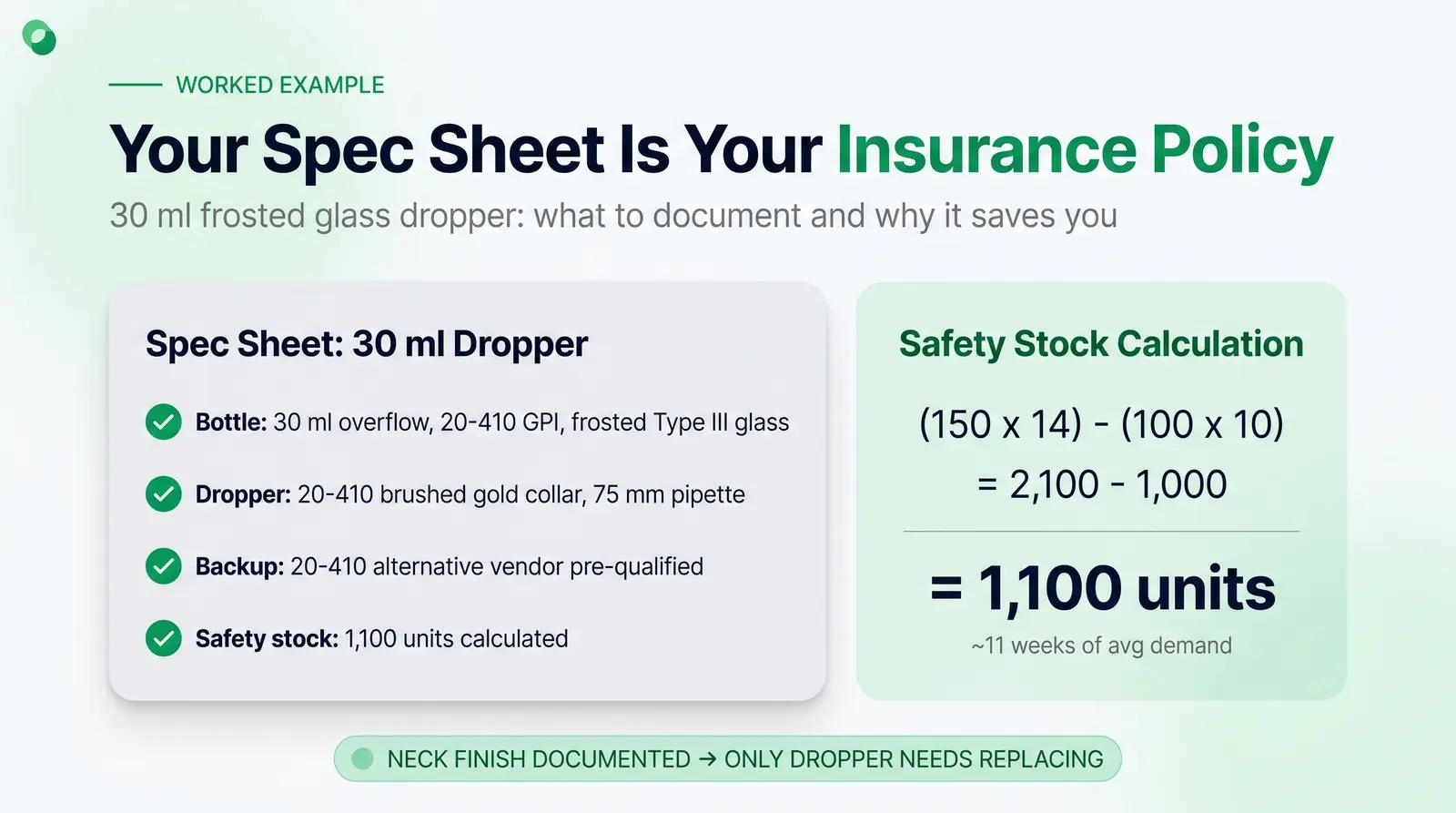
Let's revisit our founder who launched a vitamin C serum in a 1 oz (30 ml) frosted glass dropper bottle with a brushed gold collar and a black pipette. Six months post-launch, selling an average of 100 units per week, they go to reorder 5,000 units.
The supplier informs them that the brushed gold collar with the 20-410 neck finish has been discontinued due to a factory retooling.
What they should have documented at launch:
- Bottle: 30 ml overflow capacity, 20-410 GPI neck finish, frosted Type III glass.
- Dropper: 20-410 brushed gold collar, 75 mm glass pipette length, 0.8 ml draw capacity.
- Backup supplier: one alternative vendor with a 20-410 dropper assembly in brushed gold or a compatible metallic finish.
Safety Stock Calculation:
Assuming a maximum sales spike of 150 units per week and a maximum lead time of 14 weeks, versus an average of 100 units per week and an average lead time of 10 weeks:
(150 x 14) - (100 x 10) = 2,100 - 1,000 = 1,100 units of safety stock [6]
Because they only ordered "just enough" for launch and held no safety stock, they are now facing a stockout during the 12-week scramble to find a replacement.
The Migration Scenario:
Because the founder documented the 20-410 neck finish, they know they do not have to replace the frosted glass bottle. They only need a new 20-410 dropper assembly. That narrows the search significantly and reduces the redesign risk.
However, if the bottle itself had been discontinued, their artwork portability would be tested. If their label was designed for a standard 30 ml Boston Round, they could migrate to an alternative supplier's Boston Round with minimal rework. If the label was custom die-cut to fit a proprietary curved shoulder, they would face a costly graphic redesign, new photography, and potentially a secondary packaging update.
The lesson: the spec sheet is not a formality. It is your insurance policy.
How Packfolio Supports Consistent Reorders
Navigating MOQs, factory retooling, and spec drift is a full-time job. Packfolio is an on-demand custom packaging platform built to remove that burden for beauty brands.
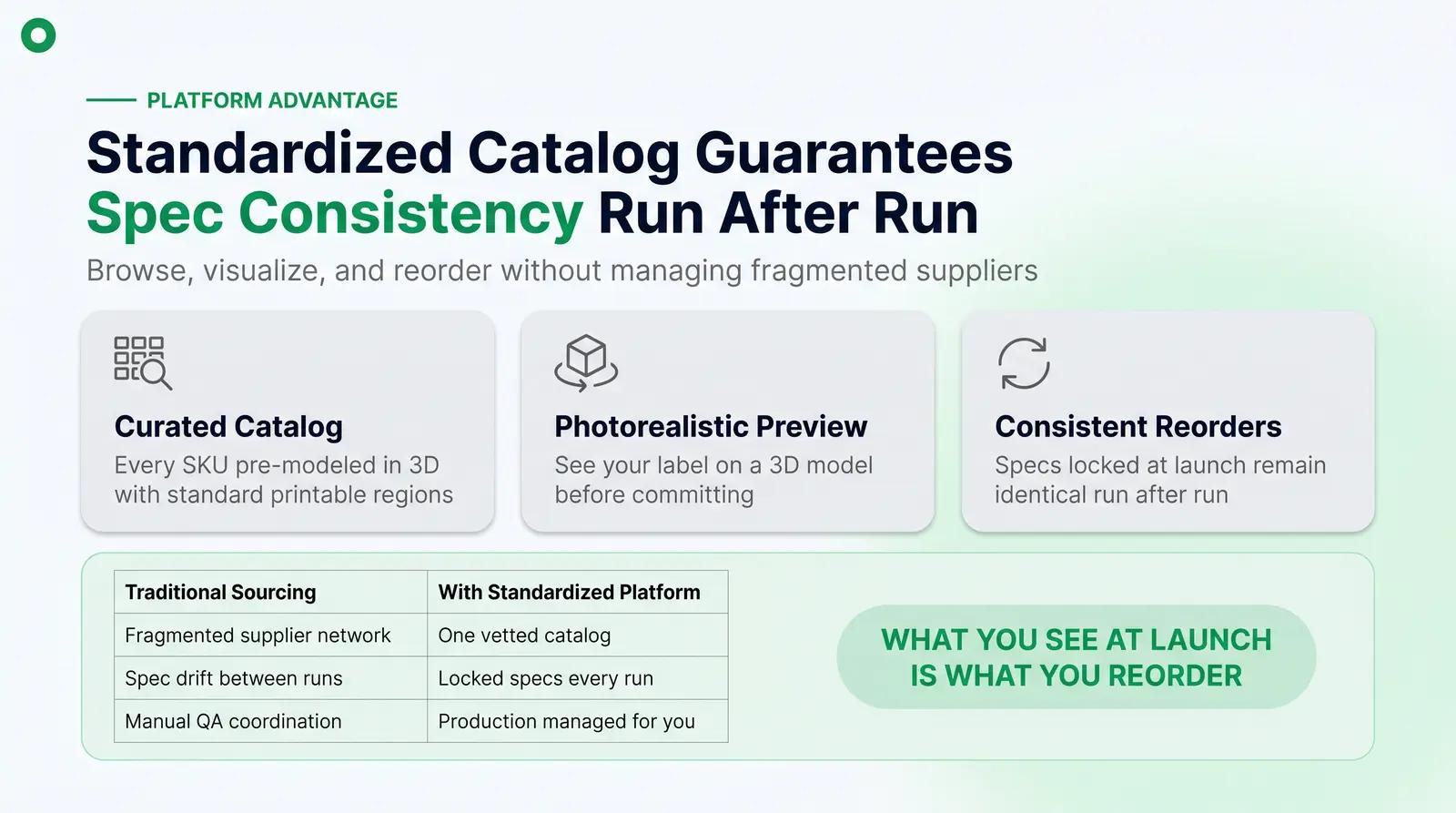
Browse the curated catalog of cosmetic primary packaging SKUs, each pre-modeled in 3D with predefined printable regions. Preview your label on a photorealistic 3D model before committing to a component. Because every SKU in the Packfolio catalog is standardized and vetted, the specs you lock in at launch remain consistent run after run. Packfolio coordinates production and quality assurance directly, so you are not managing a fragmented supplier network or chasing down spec sheets from a factory in a different time zone.
What you see at launch is exactly what you can reorder.
Explore the catalog at packfolio.com
Frequently Asked Questions
How far in advance should I reorder cosmetic packaging?
You should reorder based on your supplier's maximum lead time plus your safety stock buffer. For overseas suppliers, this typically means placing a reorder 12 to 16 weeks before you expect to run out of inventory. For domestic suppliers, 6 to 8 weeks is a reasonable minimum. Build in an additional 2 to 4 week buffer for customs delays, port congestion, or supplier scheduling conflicts [5].
What happens if my packaging supplier discontinues a component?
If a component is discontinued, identify an alternative SKU with the exact same functional specifications, particularly the neck finish code and fill volume. Having your specs fully documented allows you to source a replacement without changing your product's performance or label size. If you have pre-qualified a backup supplier, the transition can happen in days rather than weeks.
How do I calculate safety stock for cosmetic packaging?
Safety stock is calculated by multiplying your maximum daily sales by your maximum lead time in days, then subtracting the product of your average daily sales and average lead time [6]. This formula provides a buffer against both demand spikes and shipping delays. Recalculate it whenever your sales velocity or supplier lead times change materially.
Can I switch packaging suppliers without changing my label design?
Yes, provided your label design is format-flexible and you source a replacement component with identical external dimensions and printable area. Designing artwork for standard print zones rather than highly custom bottle geometries ensures high artwork portability and makes supplier switching far less painful. Platforms that standardize printable regions across their catalog make this process significantly easier.
What specs do I need to document before reordering packaging?
You must document the external dimensions, overflow fill volume, neck finish standard (e.g., 24-410), wall thickness, material grade, and any secondary component details like dip tube length, pump stroke volume, or closure torque specifications [3]. Store this information in a brand-owned spec sheet, not just in supplier emails. The spec sheet should be updated after every production run to capture any changes the factory may have introduced.
References
[1] "How US Beauty Brands Can Navigate Tariffs and Build Resilience," Boston Consulting Group, May 2025. https://www.bcg.com/publications/2025/navigating-tariffs-in-us-beauty-industry
[2] "Common Challenges in the Cosmetics Supply Chain," Long Beach Breeze, December 2025. https://www.longbeachbreeze.com/2025/12/31/common-challenges-in-the-cosmetics-supply-chain/
[3] "Glass Neck Finish Dimensions," Evergreen Resources, February 2026. https://evergreenresources.com/glass-neck-finish-dimensions/
[4] "How to Build a Cosmetic Supply Chain from China: The 2025 Complete Guide," AH Packaging, November 2025. https://ahpackaging.com/how-to-build-a-cosmetic-supply-chain-from-china/
[5] "Lead Time Explained: How Long It Really Takes To Get Products Made," Sourcy, 2026. https://www.sourcy.ai/sourcing/lead-time
[6] "Safety Stock Formula: How to Calculate Inventory Levels Properly," Pallite Group, 2026. https://pallitegroup.com/us/news/safety-stock-formula/


