
What To Ask Before Buying Cosmetic Packaging on Alibaba
A structured vetting rubric helps beauty founders ask the right questions about MOQs, samples, defect policies, and certifications before buying cosmetic packaging on Alibaba.
Opening Alibaba to source cosmetic packaging feels like unlocking the global supply chain. The reality is that the platform's vastness creates a dangerous information asymmetry between a first-time beauty founder and an experienced factory sales rep. A supplier might offer a stunning frosted glass serum bottle for thirty cents, but without asking the right technical questions, that bottle could arrive with a leaky pump, a peeling logo, or lead times that destroy a launch calendar.
The difference between a profitable packaging run and a costly write-off lies entirely in what is verified before placing a sample order or committing to a minimum order quantity.
Why Alibaba is a Real (But Risky) Sourcing Channel
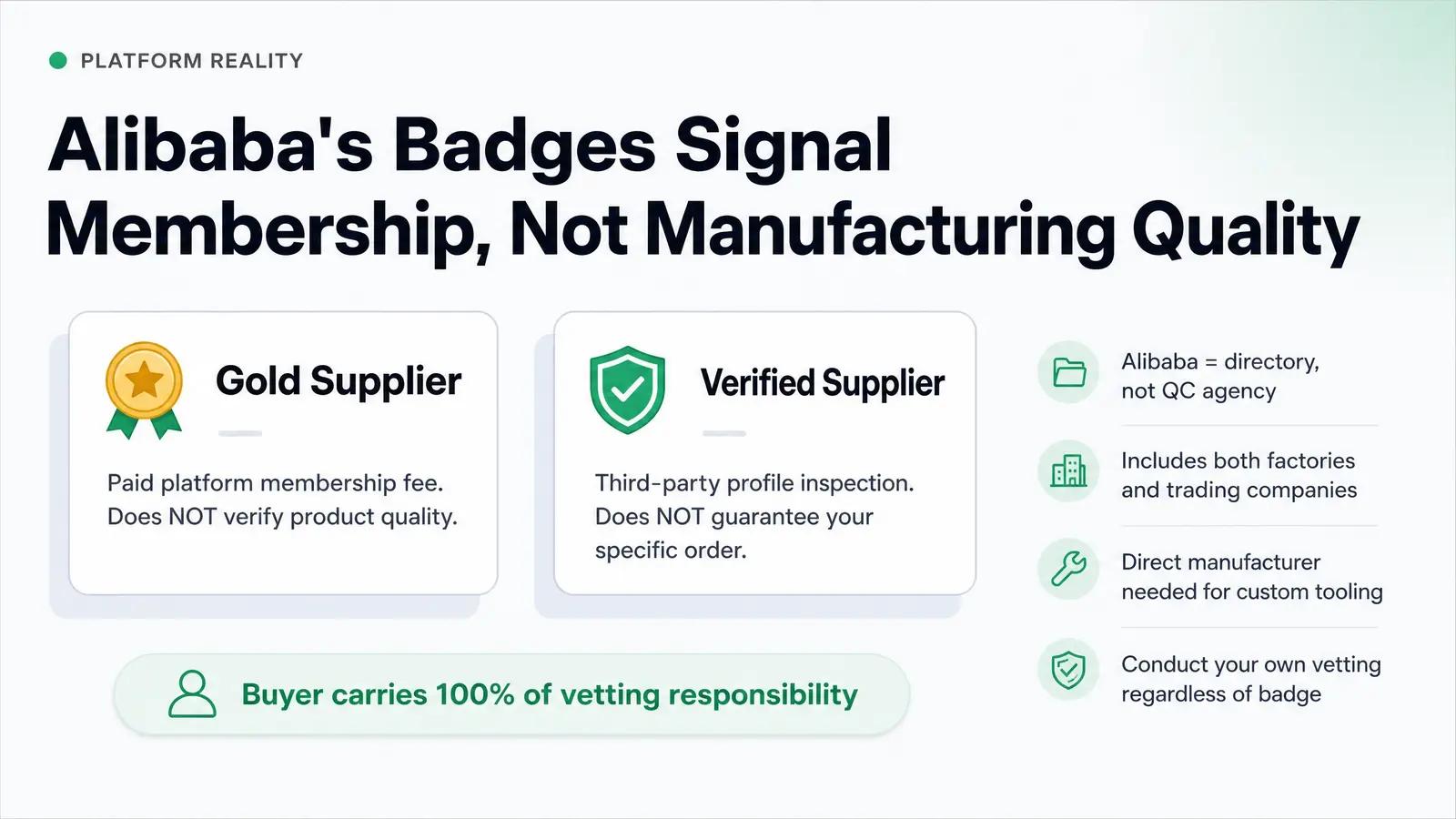
Alibaba is a legitimate sourcing tool used by thousands of beauty brands, but it is fundamentally a directory, not a quality control agency. The platform connects buyers with both actual manufacturers and trading companies acting as middlemen. While traders can be useful for small brands needing lower minimums or consolidated shipments, buying direct from a manufacturer is usually necessary for custom tooling or strict quality control.
The platform's verification badges are often misunderstood. An Alibaba Gold Supplier badge primarily indicates that a company has paid a premium membership fee to the platform, not that they produce flawless cosmetic packaging [1]. Even the more rigorous "Verified Supplier" status, which involves a third-party inspection of the company's profile and production capabilities, does not guarantee the quality of the specific goods you order [2]. Founders must conduct their own vetting regardless of badge status.
The Alibaba Packaging Supplier Vetting Rubric
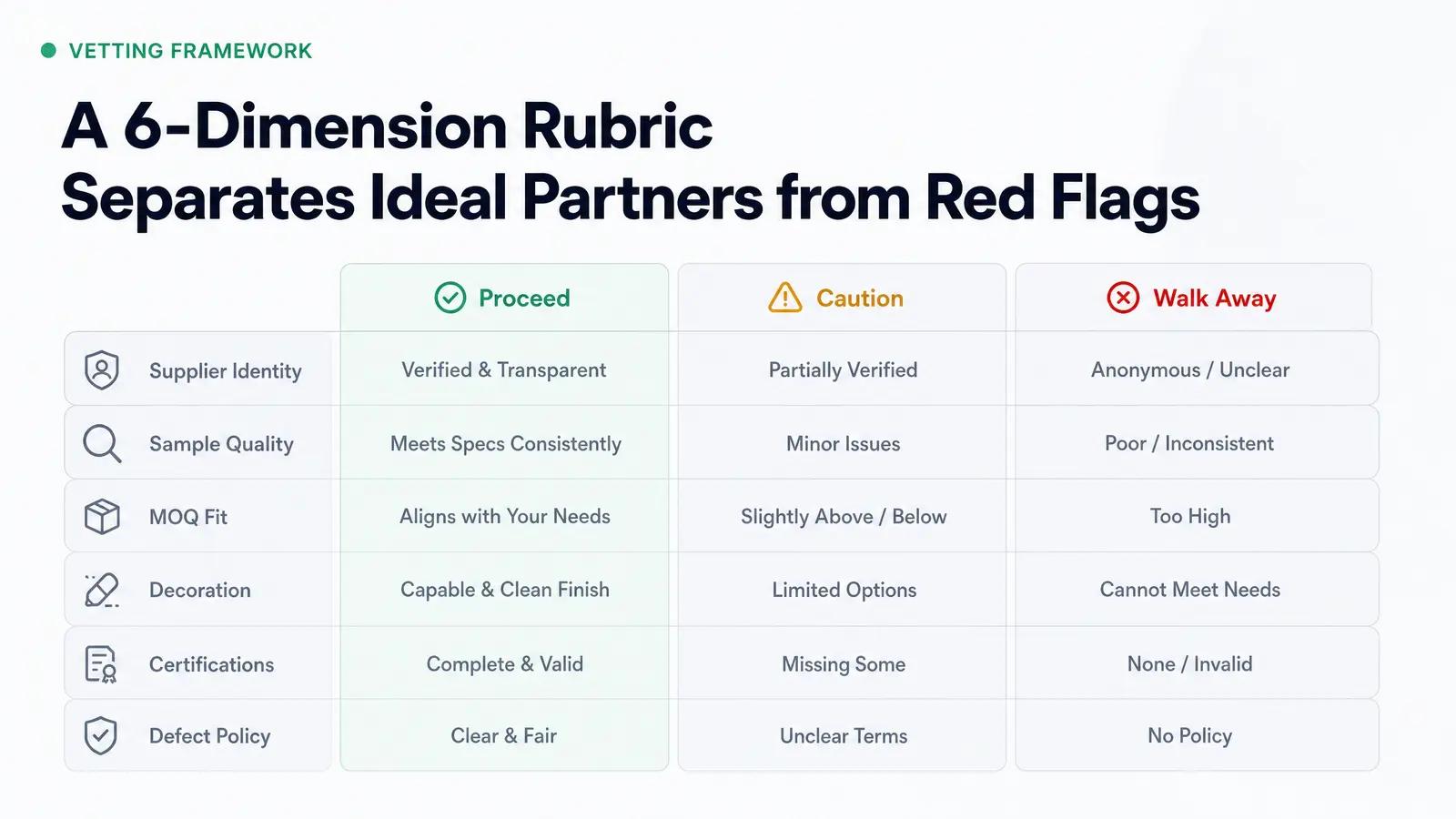
To navigate this complexity, founders need a structured approach to evaluate potential partners. The following framework covers the six most critical dimensions and maps each one to three outcome tiers: proceed, proceed with caution, or walk away.
| Vetting Dimension | Tier 1: Ideal Partner | Tier 2: Acceptable with Caution | Tier 3: Red Flag |
|---|---|---|---|
| Supplier Identity | Direct manufacturer with a verifiable factory audit report and clear specialization in cosmetic packaging. | Trading company transparent about their status, offering consolidated shipping and low MOQs. | Claims to be a factory but refuses video tours or gives vague answers about production lines. |
| Sample Quality | Provides pre-production samples (PPS) using the exact mold, material, and decoration specified for the bulk order. | Provides off-the-shelf stock samples that match the intended material but lack custom decoration. | Refuses to send samples or pushes aggressively for a bulk order based only on photos. |
| MOQ Fit | Flexible MOQ structure (e.g., 1,000 units for stock, 5,000 for custom color) that aligns with the brand's launch budget. | High MOQ (10,000+ units) but willing to negotiate a trial order at a slightly higher unit cost. | Rigid, excessively high MOQ with no room for negotiation or trial runs. |
| Decoration Capability | In-house printing (silk screen, hot stamp) with clear artwork templates and proof approval processes. | Outsourced decoration with a slightly longer lead time but verifiable quality control. | Vague about printing methods or unable to provide examples of past decoration work. |
| Certification Status | Provides current, verifiable testing reports (SGS or Intertek) for REACH, Prop 65, or heavy metals compliance. | Claims compliance but takes weeks to produce outdated or irrelevant certificates. | Cannot provide any compliance documentation or dismisses regulatory concerns entirely. |
| Defect and Approval Policy | Agrees in writing to an AQL standard (e.g., 2.5 for major defects) and requires golden sample approval before mass production. | Has a general return policy but resists defining specific defect thresholds in the contract. | Refuses to accept responsibility for defects or demands 100% payment upfront with no quality guarantees. |
Stock Availability vs. Made-to-Order
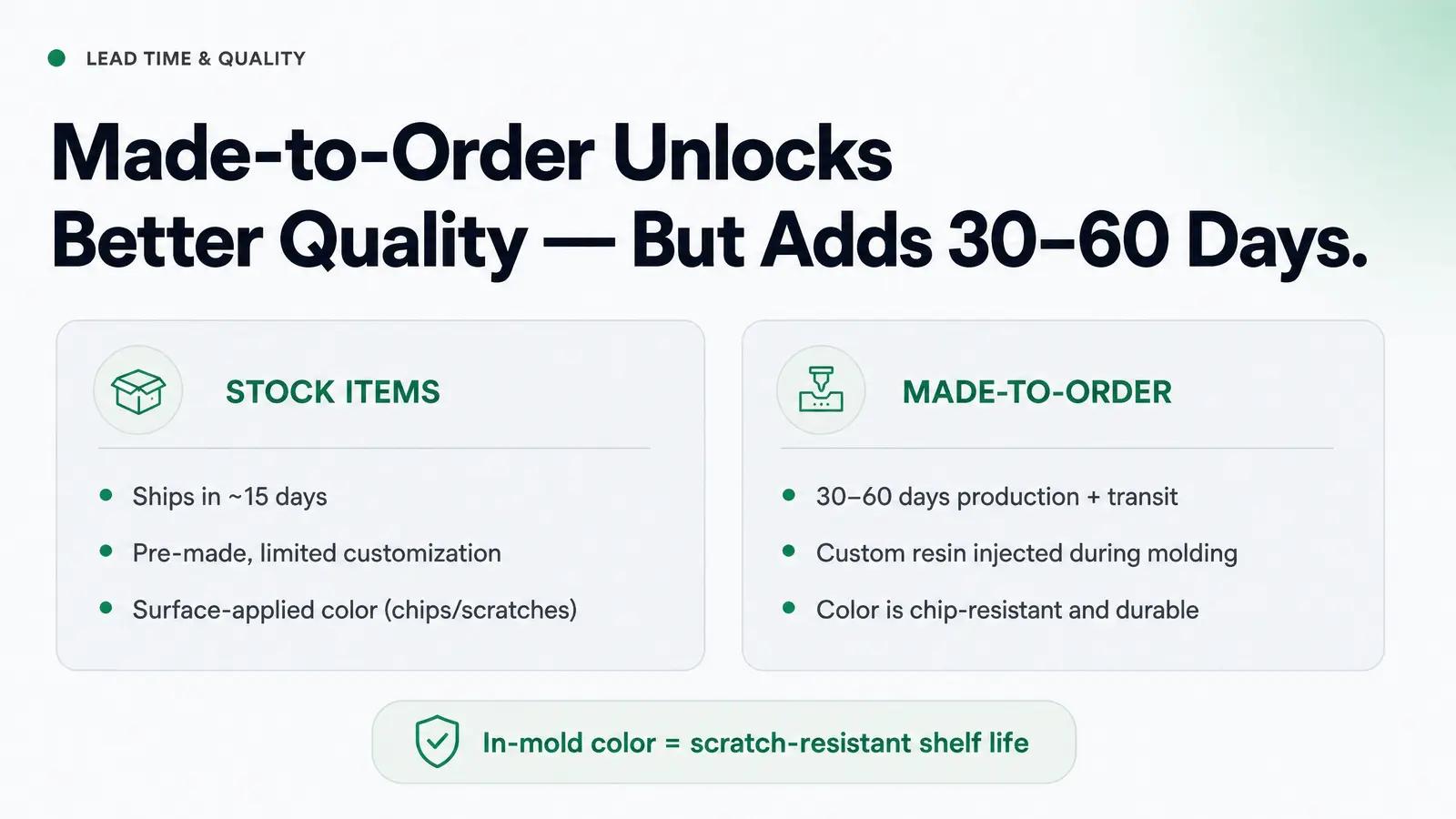
When a supplier lists a product on Alibaba, it is rarely sitting in a warehouse ready to ship. Most cosmetic packaging is made-to-order. Asking whether an item is in stock is critical because it dictates lead times. Stock items might ship in 15 days, whereas made-to-order packaging requires 30 to 60 days for production, plus transit time.
Made-to-order also opens up a meaningful quality advantage. Custom resin colors are injected into the plastic during molding rather than applied as a surface coating, which means they resist chipping and scratching far better over the product's shelf life.
Sample Types and What They Actually Prove
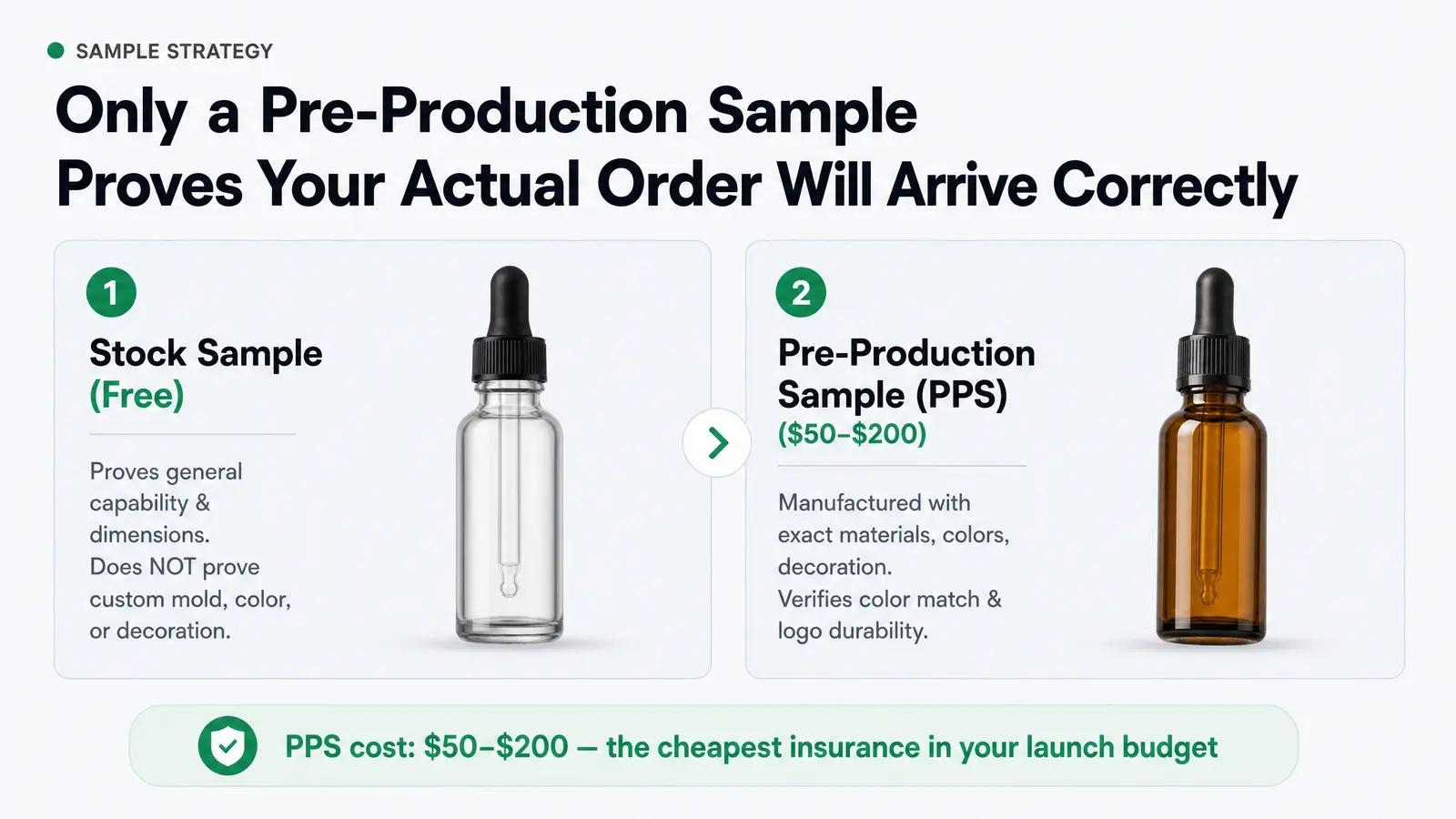
Ordering a "free sample" from an Alibaba supplier often means receiving a pre-made stock item that does not represent the actual mold or resin used in production [3]. A stock sample proves the supplier's general capability and the physical dimensions of the container. It does not prove that your specific order will arrive correctly.
To mitigate this risk, founders must eventually order a pre-production sample (PPS). A PPS is manufactured using the exact materials, colors, and decoration methods specified for the bulk order. While a PPS can cost between $50 and $200 due to setup fees, it is the only way to verify that a custom-colored dropper cap matches the glass bottle, or that the silk-screened logo will not rub off during transit.
Decoding MOQ Structures
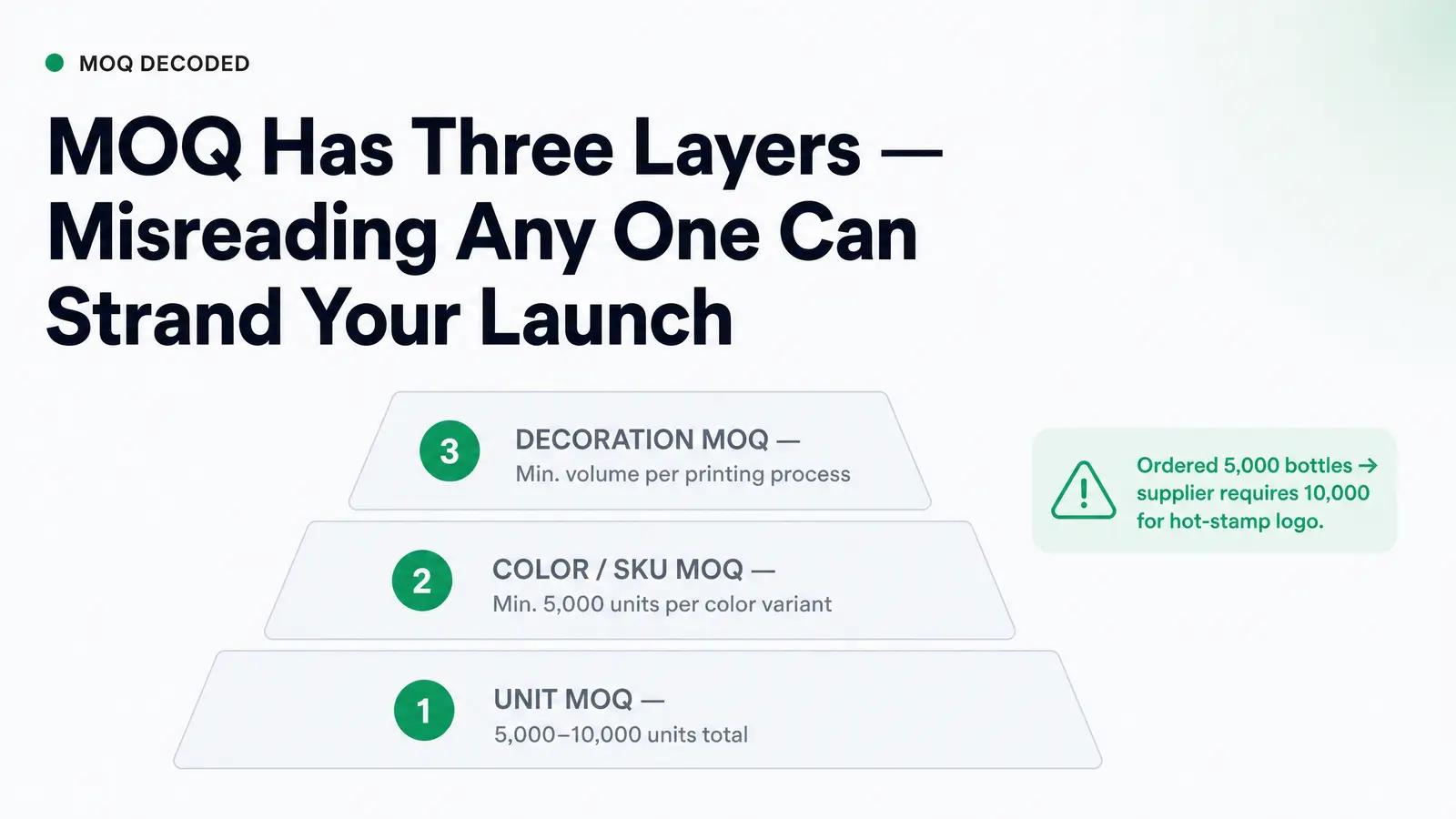
Minimum Order Quantity (MOQ) is rarely a single number. In cosmetic packaging, MOQ is typically structured across three levels [4]:
- Unit MOQ: The minimum number of physical containers required, often 5,000 to 10,000 units for custom production.
- Color or SKU MOQ: The minimum number of units per specific color or variant. A supplier might accept 10,000 total units but require a minimum of 5,000 per color.
- Decoration MOQ: The minimum volume required to run a specific printing process, such as hot stamping or silk screening.
Understanding this structure prevents a scenario where a founder orders 5,000 bottles, only to discover the supplier requires 10,000 units to apply a hot-stamped logo.
Decoration and Customization: Beyond the Blank Bottle
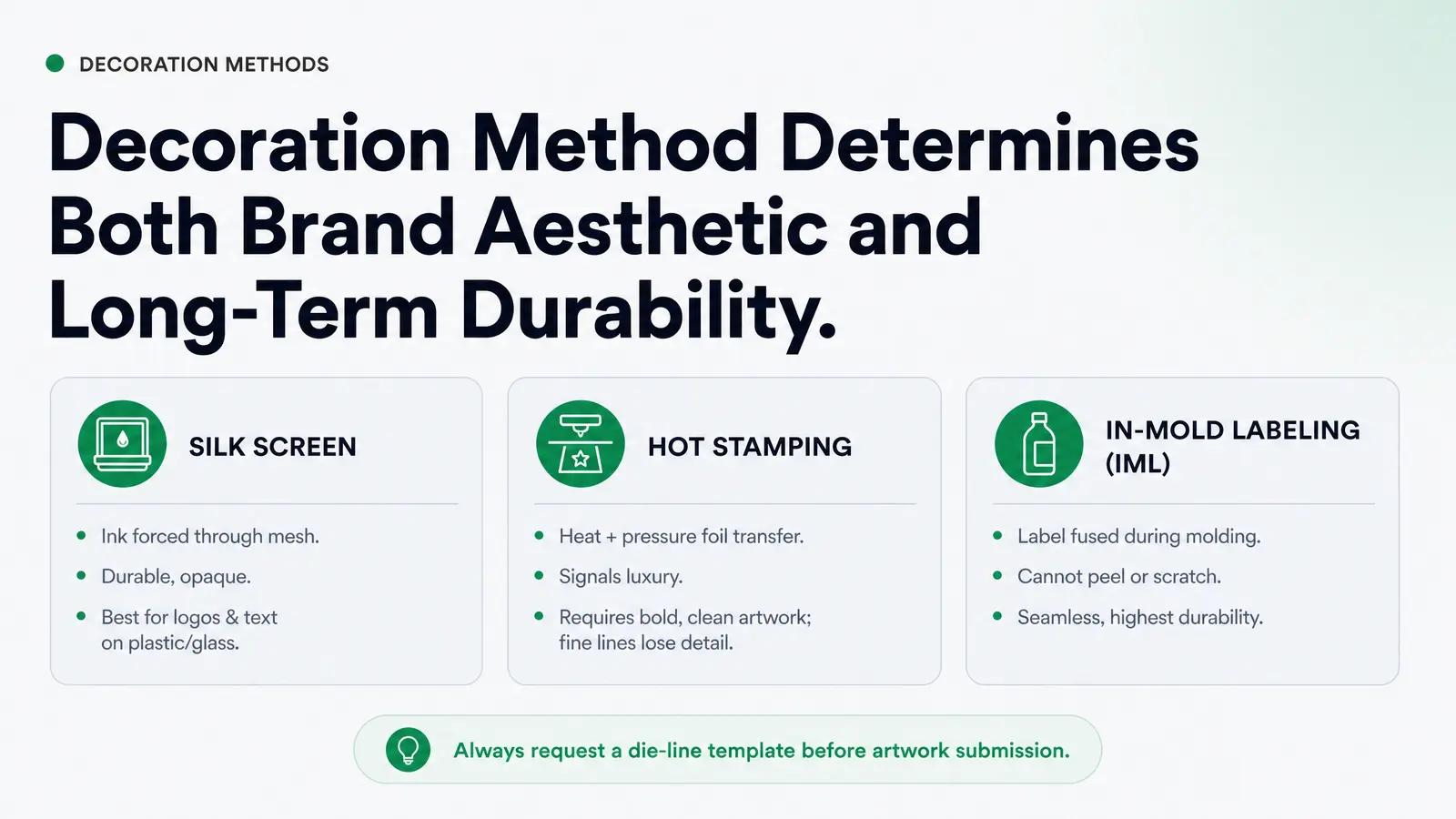
Decoration transforms a generic container into a brand asset. The chosen method impacts both the aesthetic and the durability of the finished packaging.
Silk screen printing is the workhorse of cosmetic packaging. It forces ink through a mesh screen, providing durable, opaque colors ideal for logos and text [5]. It performs well on plastic and glass across large production runs.
Hot stamping uses heat and pressure to apply metallic foil (gold, silver, rose gold) to the surface. It signals luxury but requires clean, bold artwork to avoid losing detail at the foil transfer stage [6]. Very fine lines or small text will lose clarity.
In-mold labeling (IML) fuses a label directly into the plastic during the molding process, creating a seamless, highly durable finish that cannot peel or scratch off.
Before ordering, always request a defined print zone or die-line template to ensure the artwork fits the physical curvature of the container without distortion.
Export Packaging and Inner Pack Specs
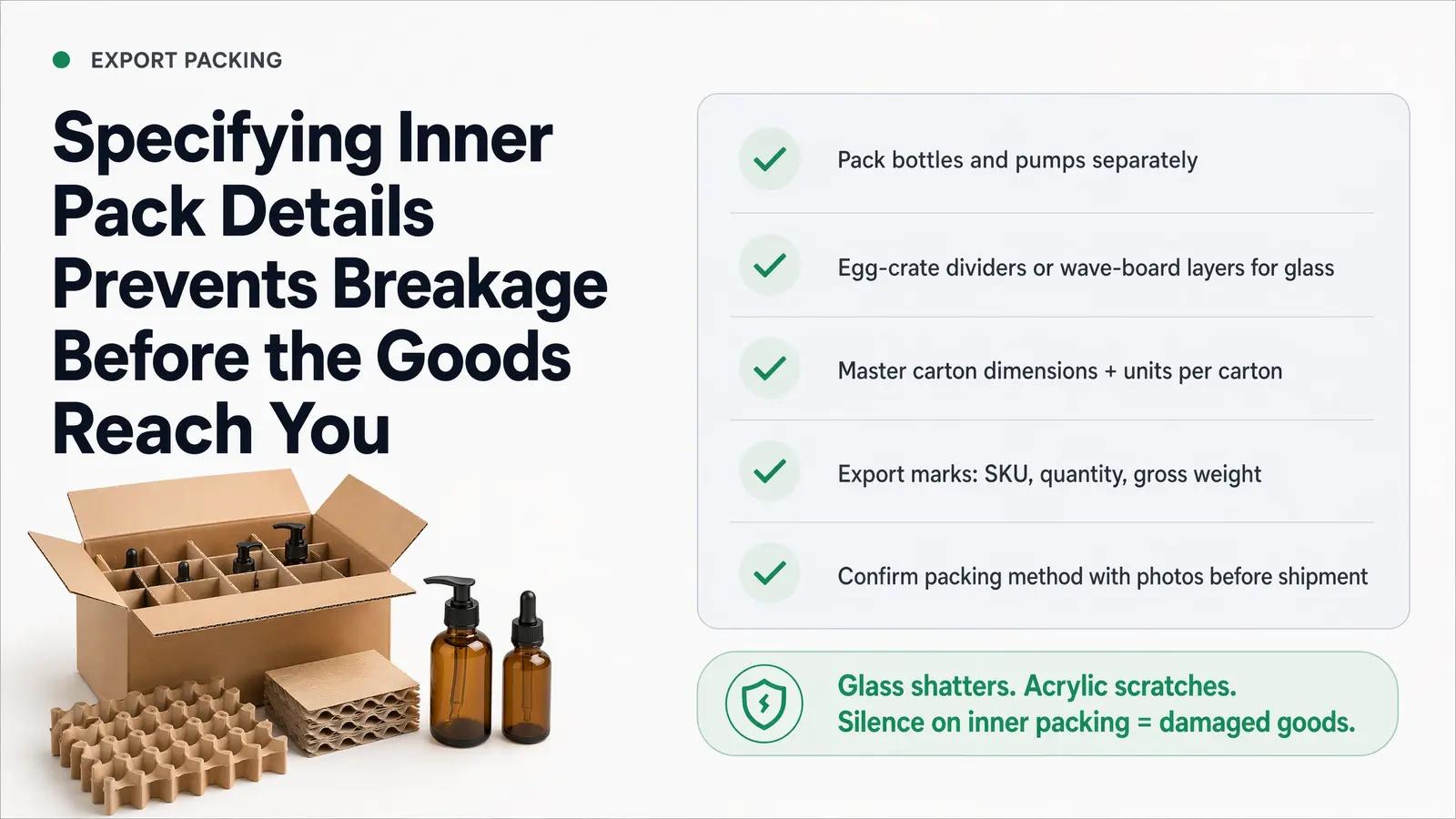
Cosmetic packaging is fragile. Glass shatters, and acrylic scratches easily. A founder must ask exactly how the empty packaging will be packed for the journey from China.
Specify that components such as bottles and pumps should be packed separately. Request egg-crate dividers or wave-board layers to prevent glass bottles from clinking together. Ask for the master carton dimensions and the number of units per carton to accurately calculate freight costs. Ensure the supplier applies clear export marks to the outer cartons, identifying the SKU, quantity, and gross weight.
Incoterms: Who Pays for What?
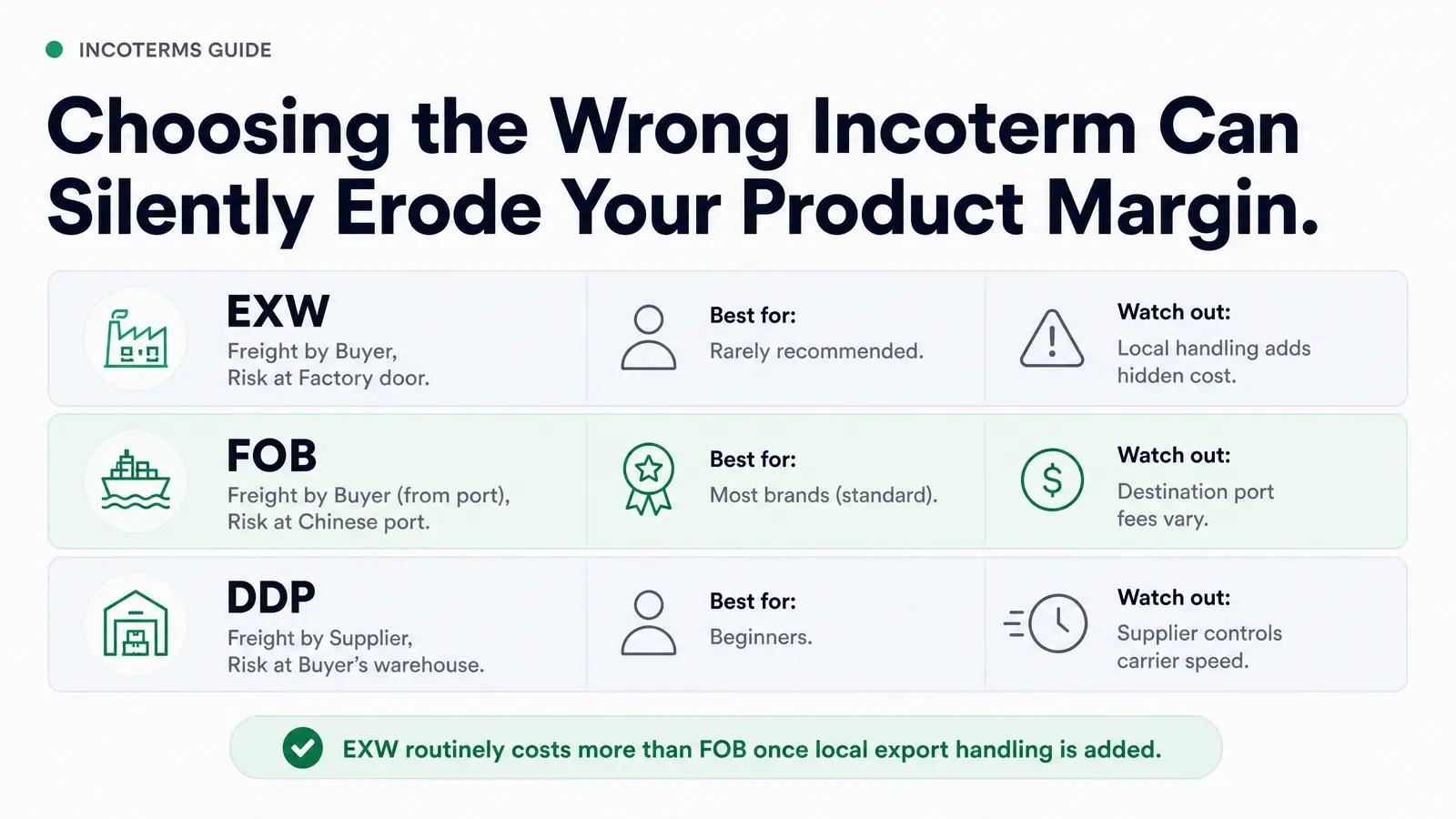
Incoterms define exactly when the risk and cost of shipping transfer from the supplier to the buyer. Choosing the wrong term can significantly erode a product's profit margin.
| Incoterm | Who Arranges Freight? | Who Pays Customs and Duties? | Risk Transfer Point | Best Use Case | Hidden Cost Risks |
|---|---|---|---|---|---|
| EXW (Ex Works) | Buyer | Buyer | Supplier's factory door | Rarely recommended unless the buyer has an experienced freight forwarder in China | EXW pricing looks cheap but routinely costs more than FOB once local export handling and inland freight are added [7] |
| FOB (Free on Board) | Buyer (from port to destination) | Buyer (import duties) | Once goods are loaded onto the ship at the Chinese port | The standard choice for most brands. The supplier handles local transport and export clearance | Destination port fees can be higher than expected if not negotiated upfront with the forwarder |
| DDP (Delivered Duty Paid) | Supplier | Supplier | Buyer's warehouse door | Ideal for beginners or small test orders who want a single, predictable landed cost | The supplier controls the shipping method, which may result in slower transit times or less reliable carriers |
Defect Policy and AQL Standards
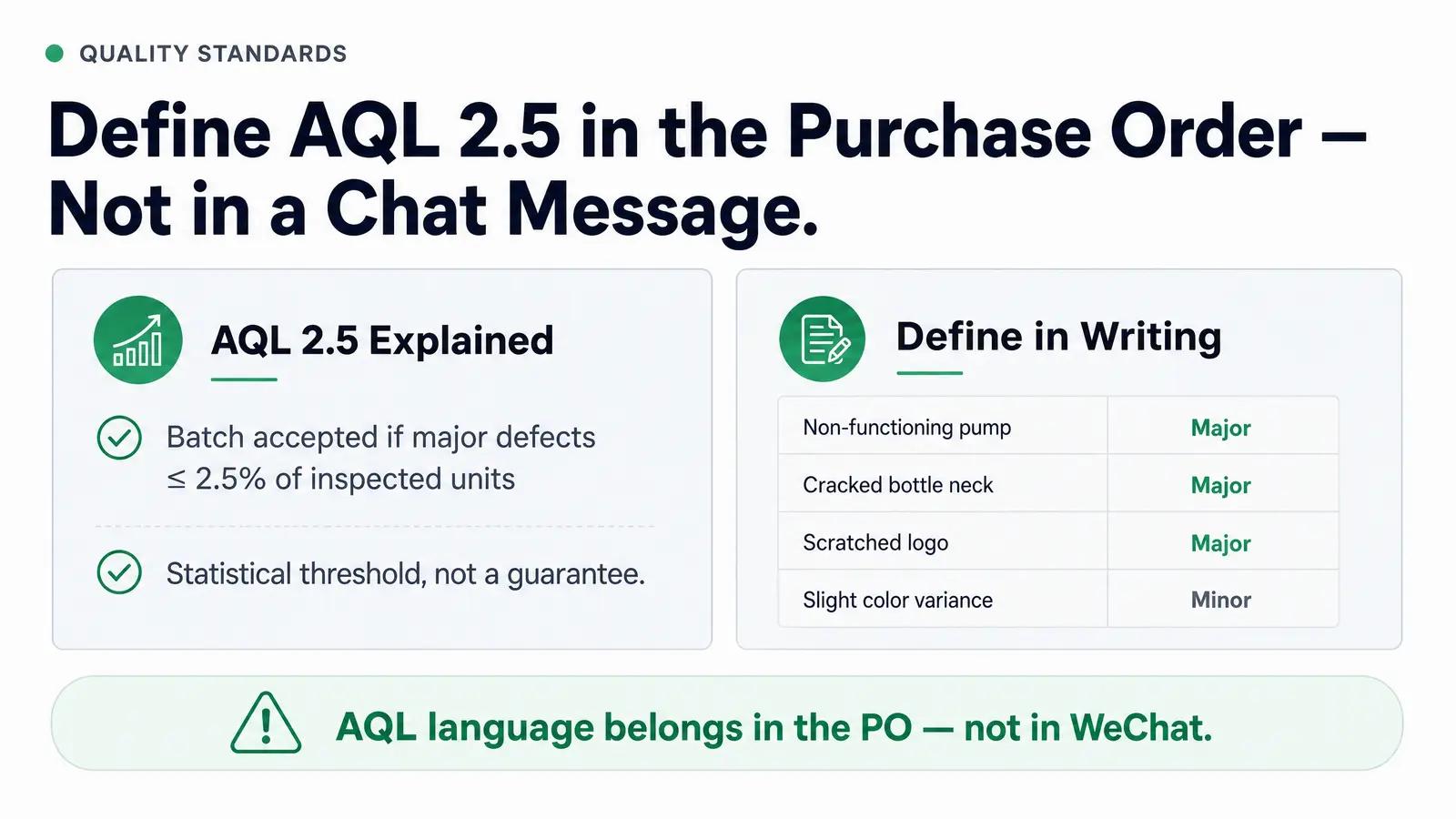
No manufacturing run is perfect, which is why establishing an Acceptable Quality Limit (AQL) before production starts is mandatory. AQL 2.5 is the industry standard for major defects in consumer goods, meaning a batch is acceptable if major defects affect 2.5% or fewer of the units inspected [8]. A non-functioning pump or a cracked bottle neck would both qualify as major defects.
AQL 2.5 is not a guarantee of flawless goods. It is a statistical threshold. Founders should define acceptable defect categories in writing before paying the deposit. For example, specify that a scratched logo is a major defect, while a slight color variance on the inside of a cap is a minor defect. This language belongs in the purchase order, not in a chat message.
Certifications and Regulatory Compliance
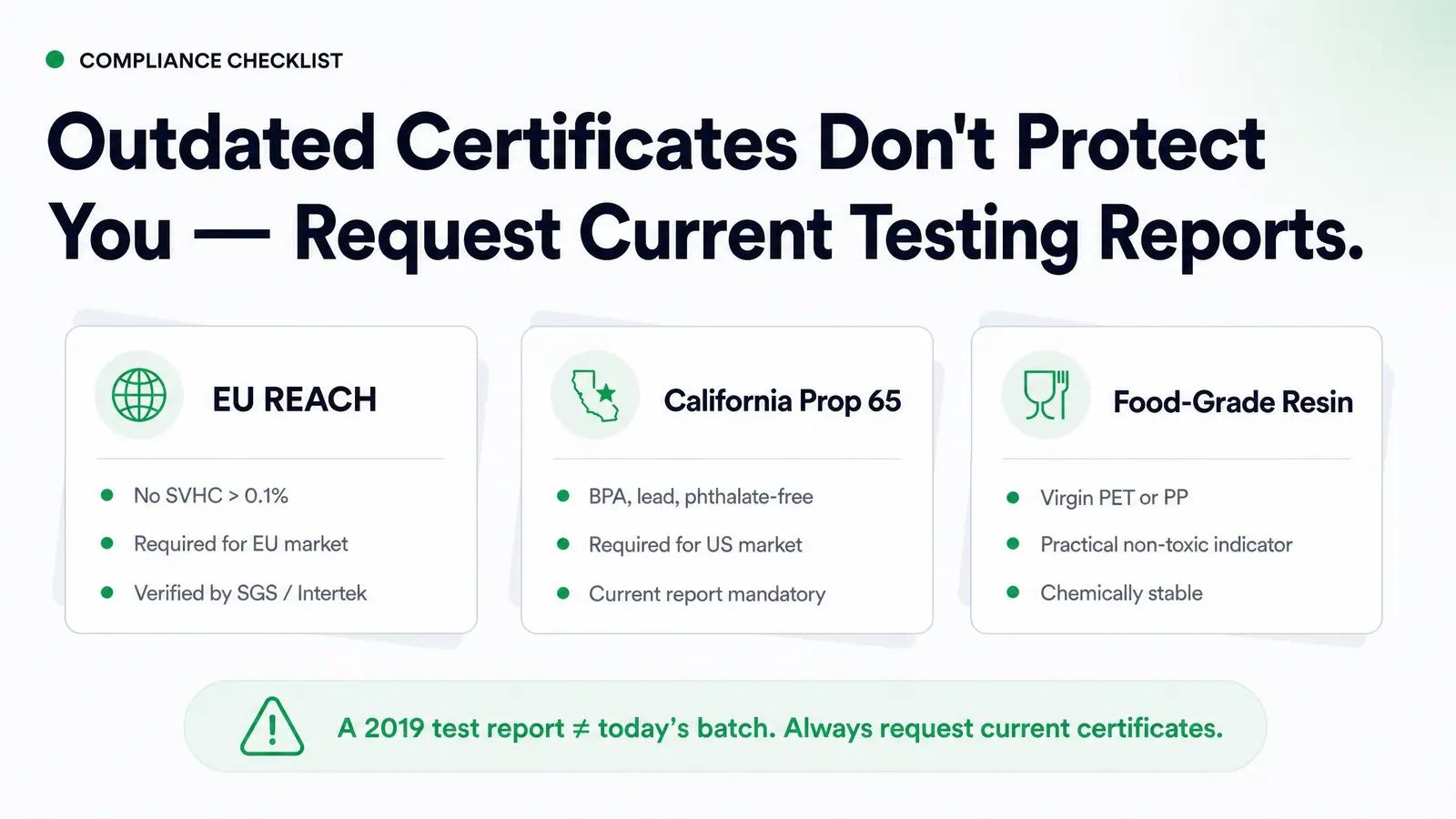
Cosmetic packaging must not leach harmful chemicals into the formulation. When vetting a supplier, ask for testing reports from internationally recognized third-party labs like SGS or Intertek [9].
Key compliance areas include the following. REACH compliance is required for the EU market, ensuring the packaging does not contain Substances of Very High Concern (SVHC) above 0.1% by weight [10]. California Proposition 65 is crucial for the US market, restricting consumer exposure to chemicals including BPA, lead, and phthalates [11]. Food-grade resin is a practical shorthand: while cosmetics are not food, requesting FDA food-grade plastics such as virgin PET or PP is a reliable indicator that the material is non-toxic and chemically stable.
Certificates should be current. A testing report from 2019 does not confirm that the batch being produced today uses the same resin formulation.
Proof and Pre-Production Approval
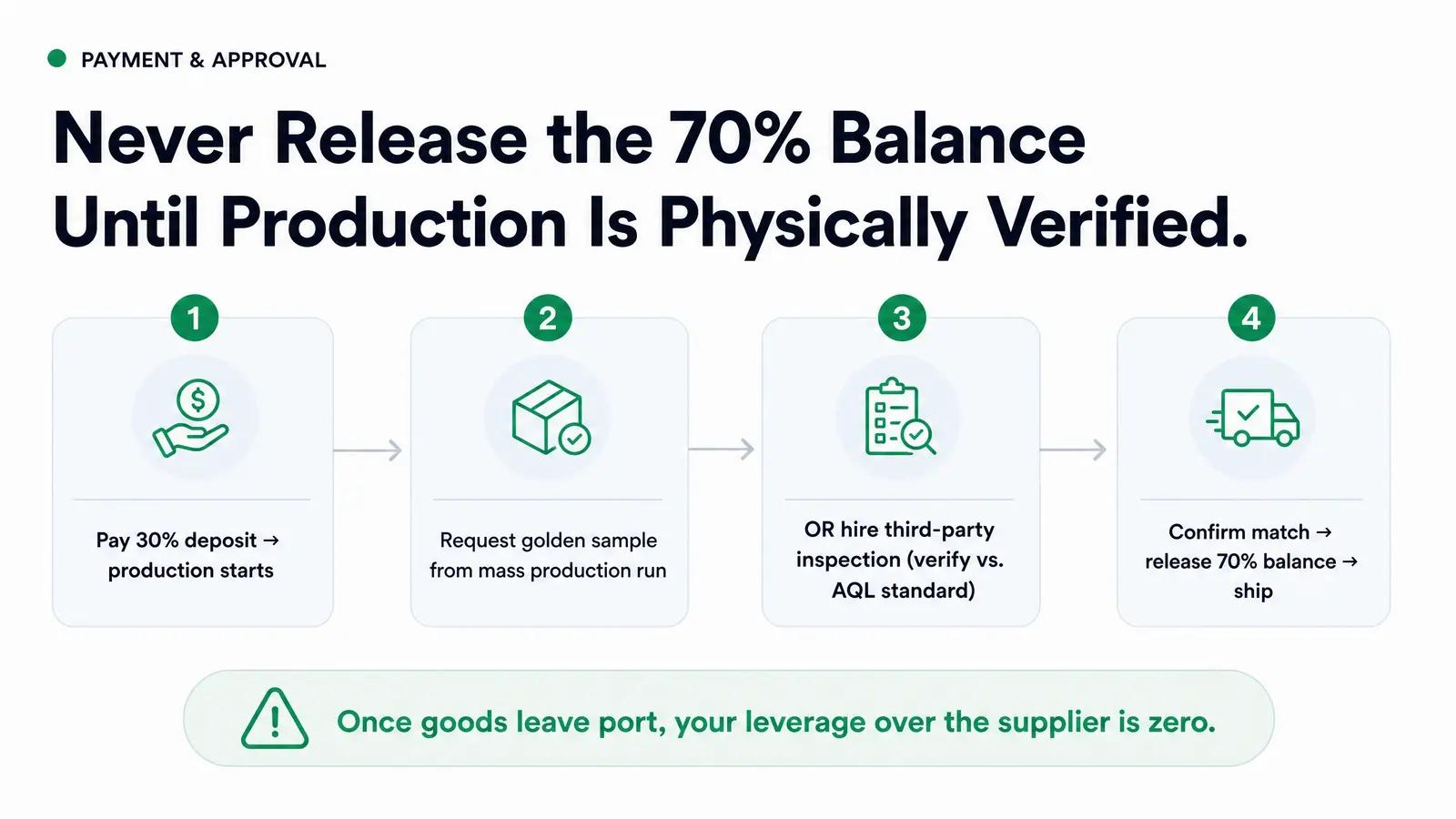
Never release the final balance payment until production is verified. The standard payment structure on Alibaba is a 30% deposit to start production and a 70% balance before shipment.
Before paying the balance, require the supplier to send a golden sample from the actual mass production run. Alternatively, hire a third-party inspection service to visit the factory and verify the goods against the agreed AQL standard. Once goods leave the port, leverage over the supplier drops to zero.
A Realistic Worked Example
A founder is launching a vitamin C face oil in a 1 oz amber glass dropper. She finds two Alibaba suppliers offering similar bottles.
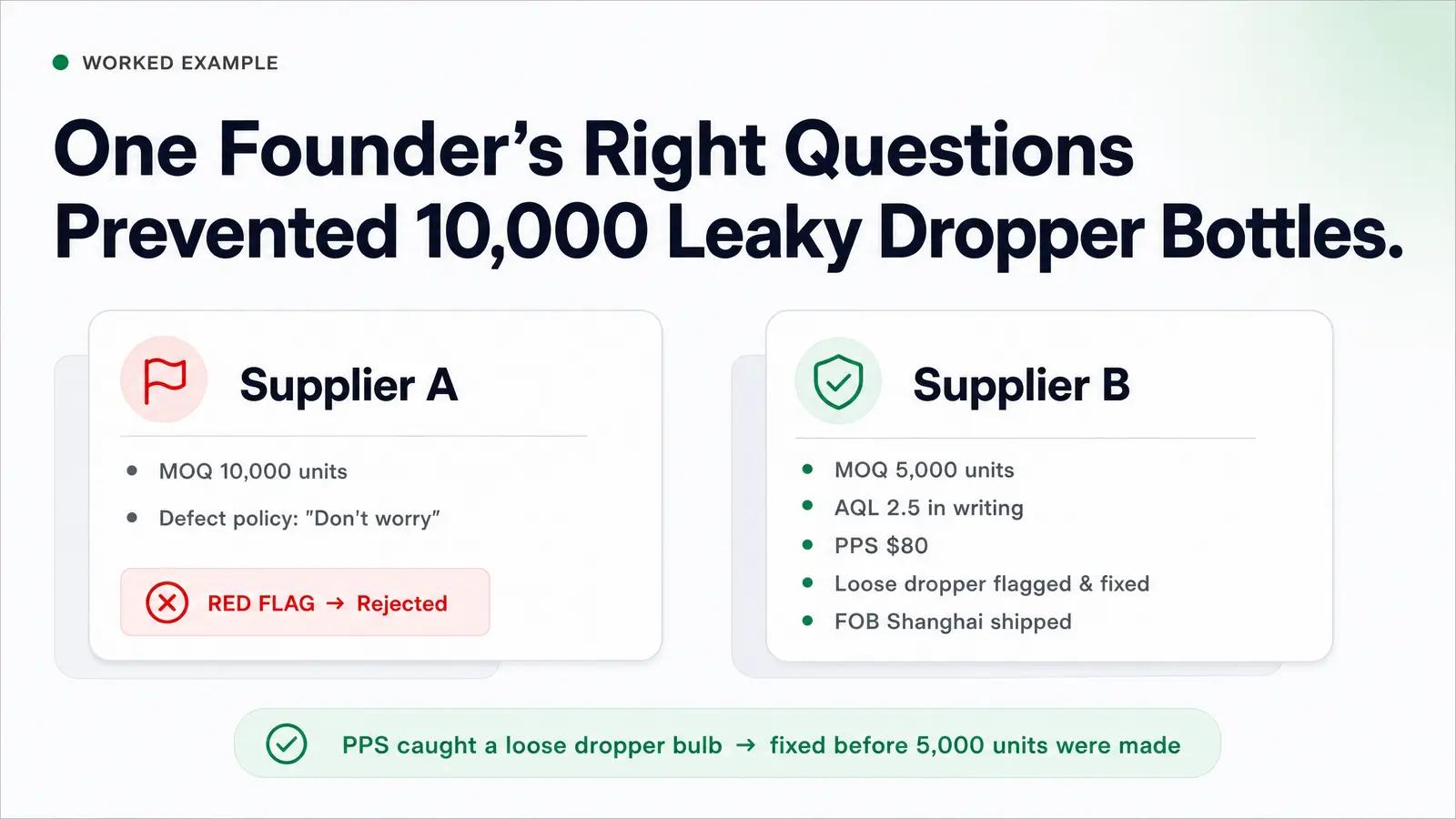
She asks Supplier A about their MOQ. They quote 10,000 units for a custom frosted amber finish. She asks about their defect policy, and they reply, "We have good quality, don't worry." That response is a red flag.
She asks Supplier B the same questions. They require a 5,000 unit MOQ for the frosted finish and agree to an AQL 2.5 standard in writing. She pays $80 for a pre-production sample with her silk-screened logo. When the sample arrives, the frosted finish is smooth, but the dropper bulb feels loose. She flags this to Supplier B, who adjusts the mold tolerance before mass production begins. She pays the 30% deposit, and 45 days later the bulk order is ready. She requests photos of the egg-crate inner packing and a final golden sample. Everything matches, so she releases the 70% balance and her forwarder ships the goods FOB Shanghai.
By asking the right questions, she avoided 10,000 units of leaky dropper bottles.
All of this vetting is necessary when sourcing from Alibaba because the buyer carries the full burden of supplier management, quality control, and logistics coordination. Packfolio is built for founders who want the output, not the process. Every SKU in the Packfolio catalog is pre-vetted, pre-modeled in 3D, and available with predefined printable regions. Customers upload artwork, preview it on a photorealistic 3D model, and order. Packfolio handles production, QC, and freight delivery. No supplier emails, no AQL negotiations, no golden sample chasing.
Browse the Packfolio catalog and preview your packaging in 3D.
Frequently Asked Questions
Is it safe to buy cosmetic packaging from Alibaba?
Yes, it is safe if you treat Alibaba as a directory rather than a guaranteed marketplace. Safety comes from vetting suppliers thoroughly, ordering pre-production samples, defining AQL standards in writing, and using secure payment methods like Alibaba Trade Assurance.
What is the minimum order quantity for cosmetic packaging on Alibaba?
For custom cosmetic packaging, MOQs typically range from 5,000 to 10,000 units per SKU. Many suppliers offer pre-made stock packaging with MOQs as low as 500 to 1,000 units, though customization options on these smaller runs are limited.
How do I verify that an Alibaba cosmetic packaging supplier is a real manufacturer?
Ask for a live video tour of the factory floor or request their business license and ISO 9001 certification. A genuine manufacturer will answer detailed technical questions about mold tooling and resin types directly. A trading company will typically need to "check with the engineers" before responding.
What certifications should cosmetic packaging from China have?
At a minimum, the materials should be tested for heavy metals and restricted substances. Look for SGS or Intertek testing reports confirming compliance with EU REACH regulations and California Proposition 65, particularly verifying that plastics are BPA-free and free of restricted phthalates.
What is the difference between EXW and FOB when buying packaging from China?
Under EXW (Ex Works), the buyer pays for all transportation from the factory door in China to the final destination, including local export handling. Under FOB (Free on Board), the supplier pays to transport the goods to the Chinese port and clear them for export, leaving the buyer responsible only for ocean freight and import logistics from that point forward.
References
[1] Jingsourcing. "Practical Guide to Alibaba Gold Supplier and Verified Supplier. Can I Trust Them?" 2021. https://jingsourcing.com/b-alibaba-gold-supplier/
[2] QualityInspection.org. "An Alibaba Gold Supplier Status Doesn't Mean Anything." 2014. https://qualityinspection.org/alibaba-gold-supplier/
[3] Reddit. "How I vet Chinese Manufacturing Companies on Alibaba, no-fluff checklist." 2023. https://www.reddit.com/r/Alibaba/comments/1qqxbk6/how_i_vet_chinese_manufacturing_companies_on/
[4] Gidea Packaging. "Everything you need to know about Minimum Order Quantity in the cosmetic packaging industry." https://gideapac.com/everything-you-need-to-know-about-minimum-order-quantity-in-the-cosmetic-packaging-industry/
[5] APG Packaging. "How can decoration methods like silk-screening and hot stamping be used effectively in cosmetic bottles?" https://apackaginggroup.com/blogs/news/how-can-decoration-methods-like-silk-screening-and-hot-stamping-be-used-effectively-in-cosmetic-bottles
[6] OthilaPak. "Cosmetic Packaging Finishes Explained: A Beauty Brand's Guide to Decoration Techniques." 2026. https://othilapak.com/blogs/trends-insights/cosmetic-packaging-finishes-explained-a-beauty-brands-guide-to-decoration-techniques/
[7] Jingsourcing. "Ex Works or FOB, Which Works for Your China Sourcing?" https://jingsourcing.com/b-exw-vs-fob/
[8] QIMA. "Acceptable Quality Limit (AQL)." https://www.qima.com/aql-acceptable-quality-limit
[9] Intertek. "Cosmetics Packaging Testing." https://www.intertek.com/beauty-personal-care/cosmetics-packaging-testing/
[10] Measurlabs. "Cosmetic Packaging Testing by EU Regulations." 2024. https://measurlabs.com/blog/cosmetic-packaging-testing/
[11] Acquis Compliance. "Prop 65 for Article Manufacturers." 2026. https://www.regilient.ai/blog/california-proposition-65-product-compliance-guide-article-manufacturers


