
How to Choose Packaging For A Skincare Starter Line
This guide shows skincare founders how to select cohesive packaging across a six-product starter line by balancing formula compatibility, MOQs, visual unity, and label real estate.
You have finalized the formulas for your first six products. The cleanser foams perfectly, the vitamin C serum is stable, and the moisturizer has exactly the right slip. Now comes the hard part: putting them in containers. A founder launching a skincare starter line faces a unique tension. You want the cleanser, toner, serum, moisturizer, face oil, and mask to look like a cohesive family, but each product requires a different container format. You want premium packaging, but you are constrained by minimum order quantities (MOQs) that can trap your launch budget in dead stock. You need labels that tell a compelling brand story, but you are suddenly realizing a 1 oz dropper bottle has drastically less printable surface area than a 2 oz airless pump.
The problem with most packaging advice is that it treats container selection as a series of isolated choices rather than a system design challenge. Choosing packaging for a multi-SKU line requires balancing formula compatibility, visual consistency, label real estate, and inventory risk across the entire range simultaneously. This guide breaks down how to build a coherent, purchasable packaging system for a skincare starter line without over-leveraging your budget.
Why Packaging Architecture Matters Before You Order Anything
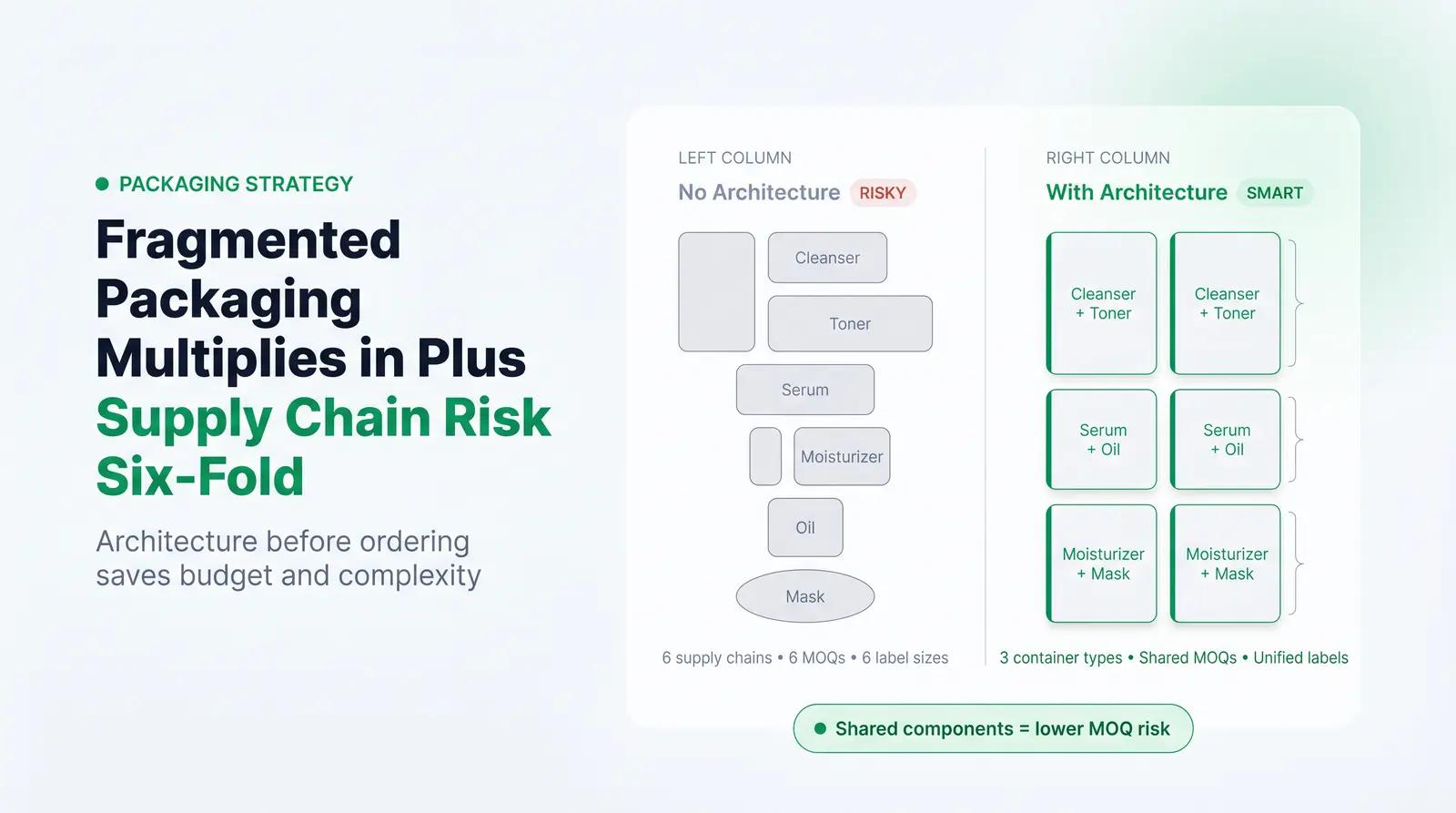
Packaging architecture is the logic that governs how your containers work together. When you order packaging without an architectural plan, you end up with a fragmented line: a tall, skinny cleanser bottle next to a squat, wide serum dropper, topped with mismatched caps. This fragmentation destroys the premium perception of your brand. Furthermore, disjointed packaging decisions compound your supply chain risk.
If every SKU in your six-product line requires a completely different container shape, cap size, and label dimension, you are managing six separate supply chains, six distinct MOQs, and six different label printing minimums. By standardizing components—such as using the same bottle silhouette for both your toner and cleanser, or sharing a cap size across multiple jars—you reduce complexity. A unified packaging architecture lowers your upfront inventory risk and makes reordering manageable as your brand scales [1].
The Six Core Formats: Matching Container to Product
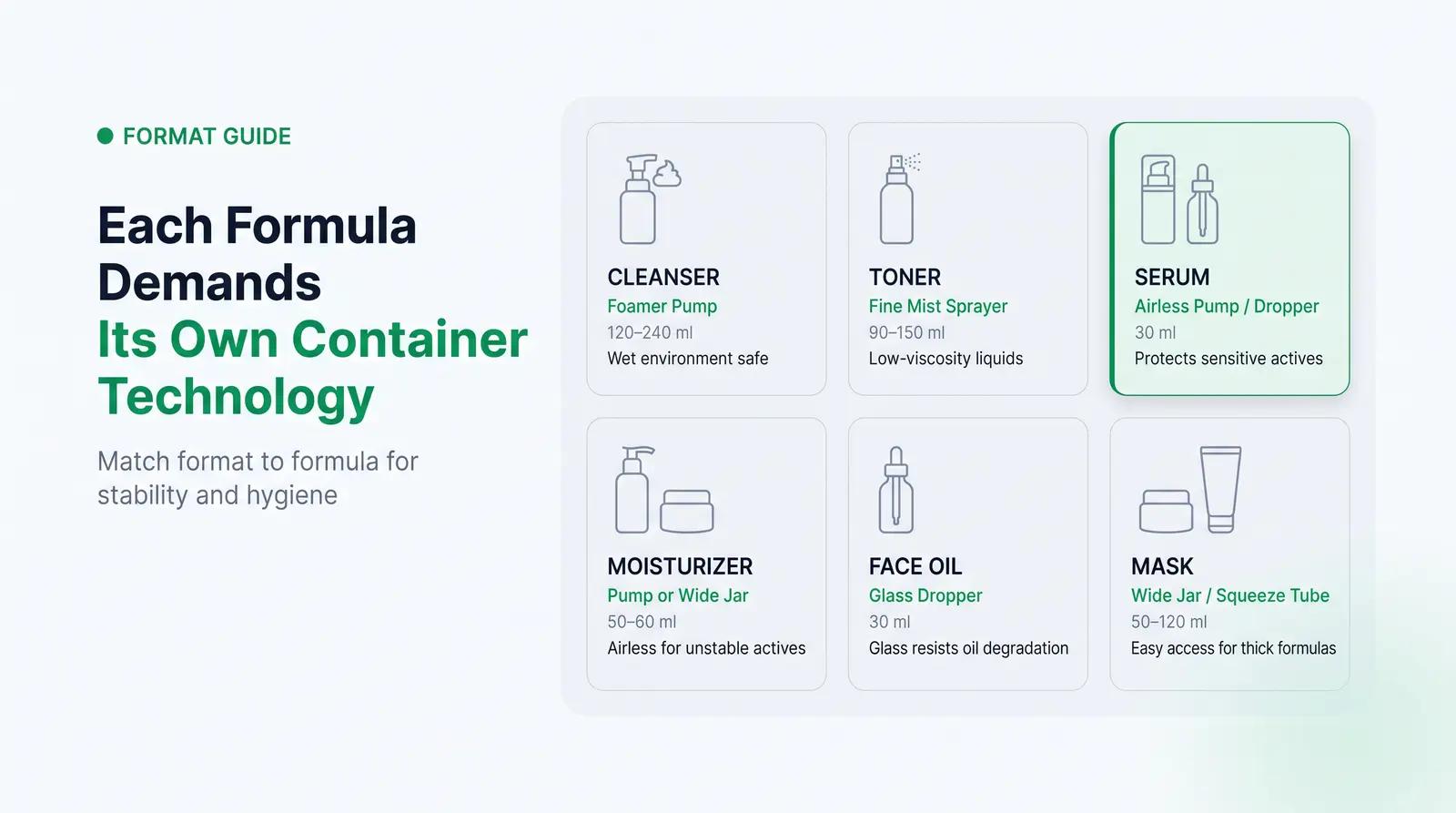
Different skincare formulas demand specific packaging technologies to ensure stability, hygiene, and proper dosing. The goal is to select the right functional format for each product while keeping the overall aesthetic unified.
Cleanser
Cleansers require packaging that can live in a wet environment like a shower without degrading or leaking. For gel or cream cleansers, a plastic tube or a PET bottle with a locking pump dispenser is ideal. Foaming cleansers require specialized foamer pumps that mix liquid and air. Because cleansers are used generously, typical fill volumes range from 4 oz to 8 oz (120 ml to 240 ml).
Toner
Toners and essences are low-viscosity liquids that need controlled dispensing. Depending on the application method, they are best housed in bottles with fine-mist sprayers or bottles with reducer plugs (orifice reducers) for splashing onto cotton pads. Tubular glass or high-density polyethylene (HDPE) bottles work well here, typically in 3 oz to 5 oz (90 ml to 150 ml) sizes.
Serum
Serums contain concentrated, often sensitive active ingredients like vitamin C or retinol. These formulas require protection from light and air. Airless pump bottles offer the highest level of protection by preventing oxidation and contamination [2]. Alternatively, heavy-walled glass dropper bottles are the industry standard for serums, providing precise dosing and a premium feel, usually in 1 oz (30 ml) volumes.
Moisturizer
Moisturizers range from lightweight lotions to heavy creams. Lotions dispense well from standard pump bottles or airless pumps. Thicker creams are traditionally packaged in wide-mouth jars. While jars offer a luxurious user experience, they expose the formula to air and fingers. If your moisturizer contains sensitive actives, an airless cream jar or airless pump is a safer choice to maintain efficacy [3]. Standard volumes are 1.7 oz to 2 oz (50 ml to 60 ml).
Face Oil
Face oils require packaging that prevents leakage and handles low-viscosity, slippery formulas. Glass dropper bottles are the dominant choice, allowing users to dispense exactly two or three drops. Rollerball applicators are also an option for targeted oils. Because oils can degrade certain plastics and adhesives, glass is the most reliable material. The standard fill volume is 1 oz (30 ml).
Mask
Wash-off masks, such as clay or gel formulations, are thick and require easy access. Wide-mouth jars (glass or PET) are the standard, allowing users to scoop the product with fingers or a spatula. For more fluid masks, squeeze tubes are a hygienic and travel-friendly alternative. Mask volumes typically range from 1.7 oz to 4 oz (50 ml to 120 ml).
Packaging Formats at a Glance
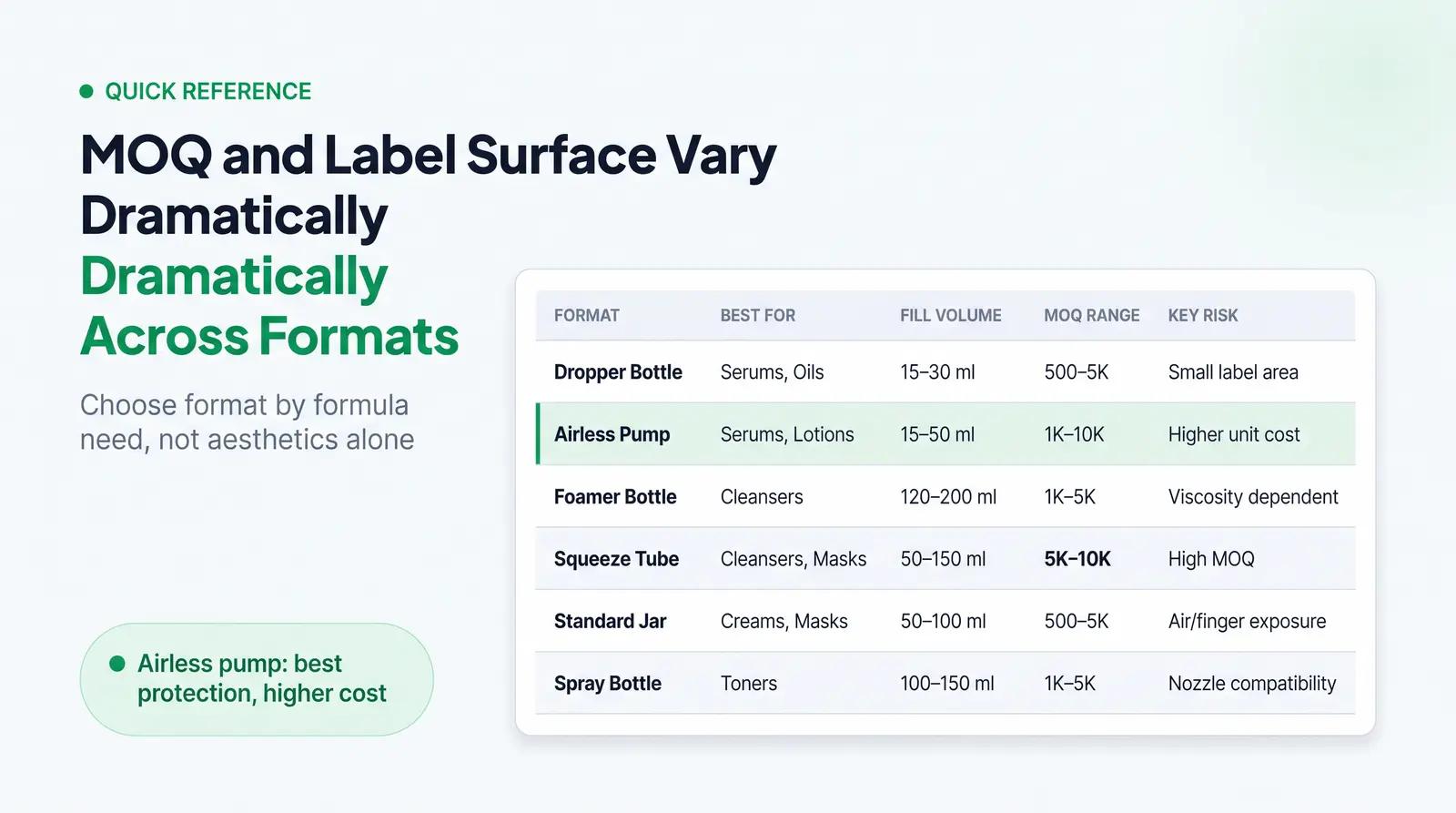
| Packaging Format | Best Product Fit | Typical Fill Volume | Label Surface | MOQ Range | Formula Compatibility Notes |
|---|---|---|---|---|---|
| Dropper Bottle | Serums, Face Oils | 15 ml – 30 ml | Cylindrical wrap | 500 – 5,000 | Glass is highly compatible; protects from chemical leaching. |
| Airless Pump | Serums, Lotions | 15 ml – 50 ml | Cylindrical wrap | 1,000 – 10,000 | Prevents oxidation; ideal for sensitive actives like Vitamin C. |
| Foamer Bottle | Liquid Cleansers | 120 ml – 200 ml | Cylindrical wrap | 1,000 – 5,000 | Requires specific liquid viscosity to foam correctly. |
| Squeeze Tube | Cleansers, Masks | 50 ml – 150 ml | Full wrap/print | 5,000 – 10,000 | Excellent for thick gels and creams; minimal air exposure. |
| Standard Jar | Heavy Creams, Masks | 50 ml – 100 ml | Wrap + Lid | 500 – 5,000 | High air and finger exposure; avoid for unstable actives. |
| Spray Bottle | Toners, Essences | 100 ml – 150 ml | Cylindrical wrap | 1,000 – 5,000 | Good for watery liquids; check nozzle compatibility with acids. |
The Starter-Line Packaging Selection Framework
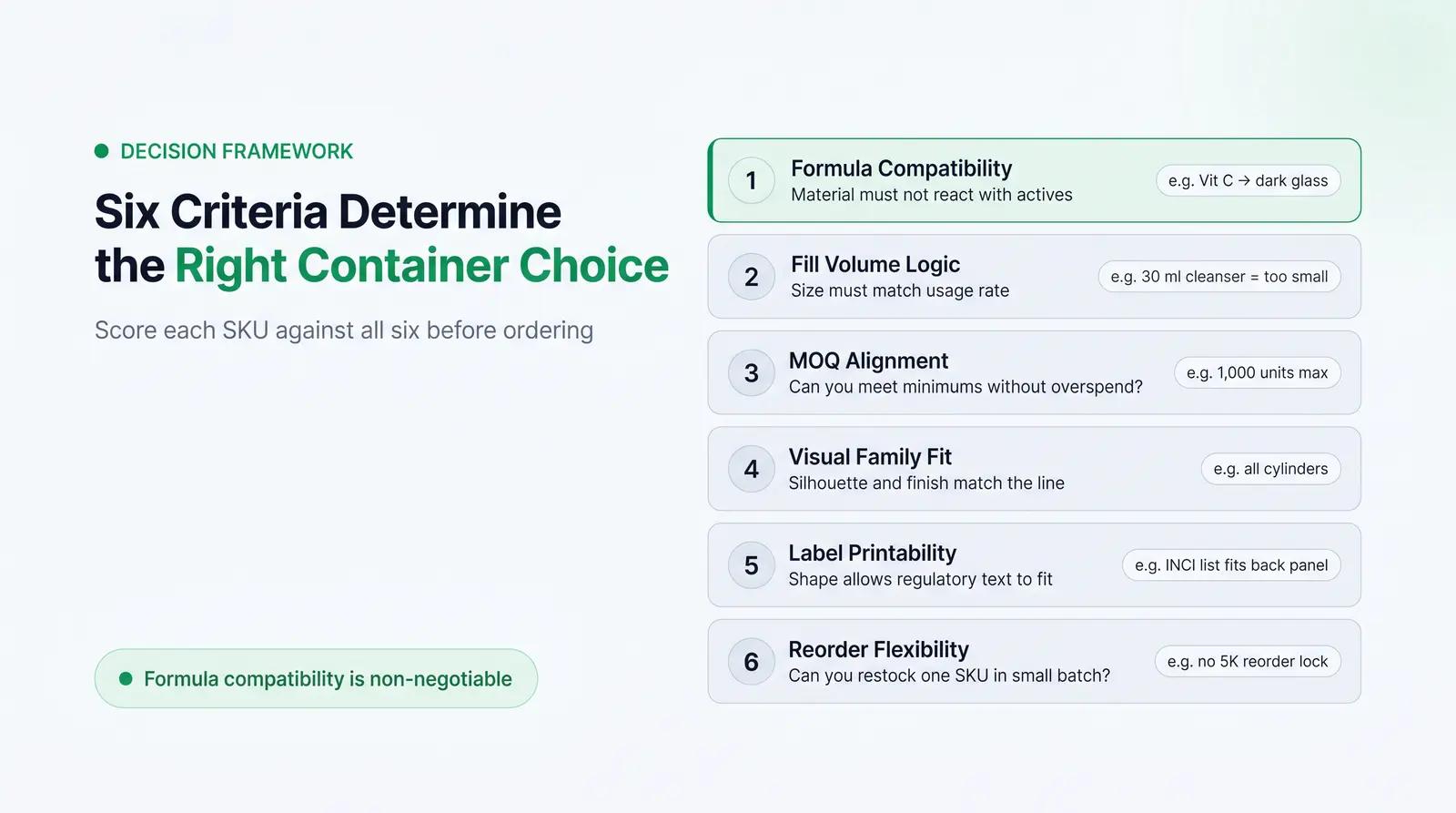
To avoid disjointed decisions, use this multi-factor rubric when selecting containers for your line. We recommend this practical framework at Packfolio to help founders balance functionality with business reality.
- Formula Compatibility: Does the material react with the ingredients? (e.g., Vitamin C requires UV-blocking dark glass or opaque airless pumps; essential oils can degrade certain plastics) [4].
- Fill Volume Logic: Does the container size match the product's usage rate? (e.g., a 30 ml cleanser will run out too fast, angering customers; a 120 ml face oil will go rancid before it is finished).
- MOQ Alignment: Can you meet the manufacturer's minimums for this specific container without exhausting your budget?
- Visual Family Fit: Does the silhouette, finish, and closure style of this container match the rest of the line?
- Label Printability: Does the shape of the container allow for a label large enough to hold required regulatory information (INCI list, warnings, net weight) at legible font sizes?
- Reorder Flexibility: If one SKU sells out faster than the others, can you reorder this specific container in a small batch, or are you locked into a massive minimum?
Managing MOQ Across a Multi-SKU Line
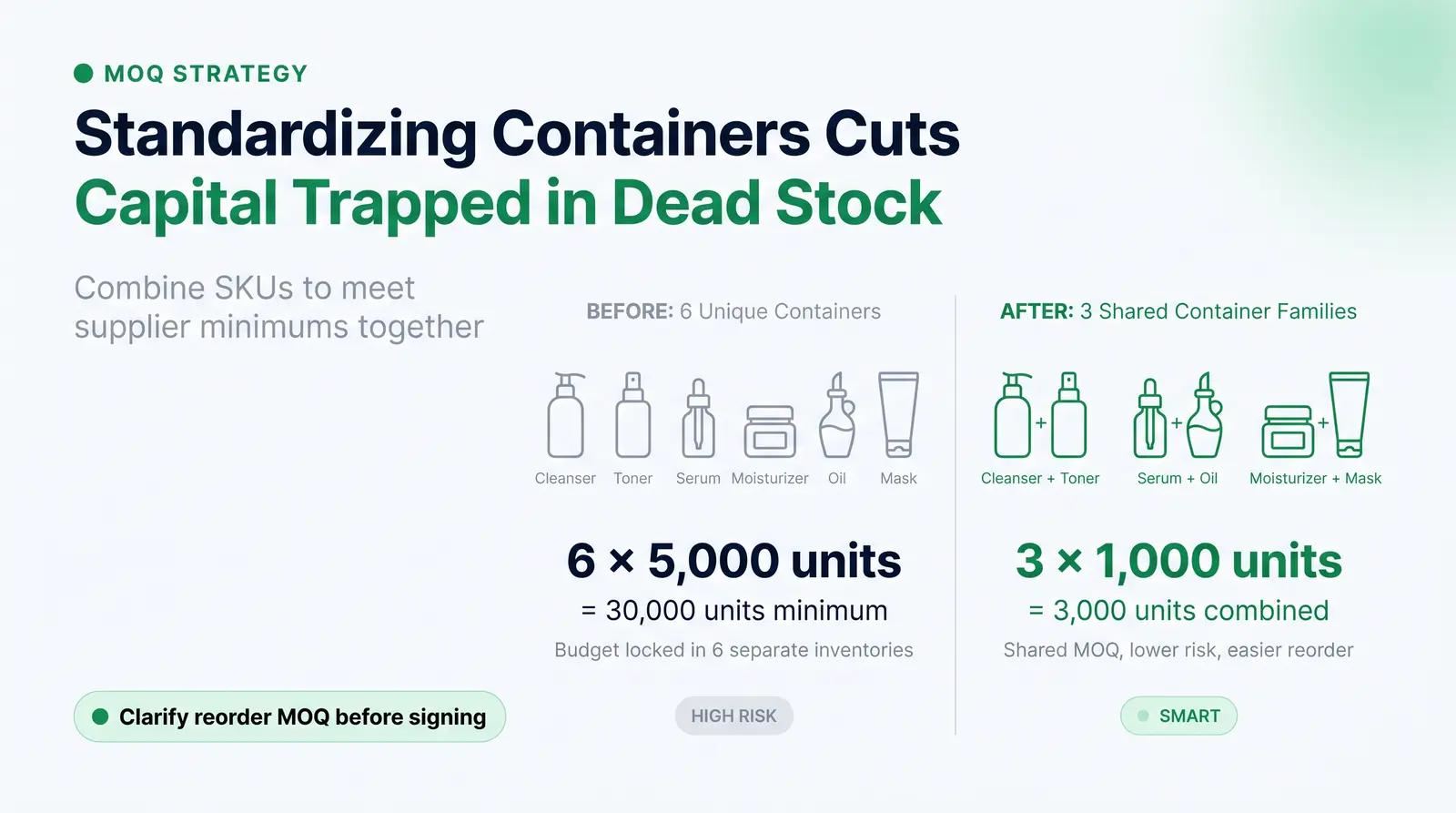
Minimum order quantities are the primary barrier for indie brands. When launching six products, managing MOQ is an exercise in risk mitigation. Standard MOQs for custom packaging run from 5,000 to 10,000 units per SKU [5]. If you are forced to order 5,000 units of six different containers, your capital is trapped in empty plastic and glass.
The most effective strategy to manage this risk is standardizing fewer container shapes across the line. For example, rather than buying a 30 ml dropper for your serum and a 50 ml jar for your moisturizer, you could package both in 30 ml and 50 ml airless pumps from the same supplier family. This approach allows you to combine your order volume to meet supplier minimums, or at least negotiate better terms because you are buying a cohesive system. Furthermore, be aware that reorder MOQs are often different from initial MOQs; clarify with your supplier what happens when you only need to restock the cleanser packaging, not the whole line.
Building Visual Cohesion Without Redesigning Every Container
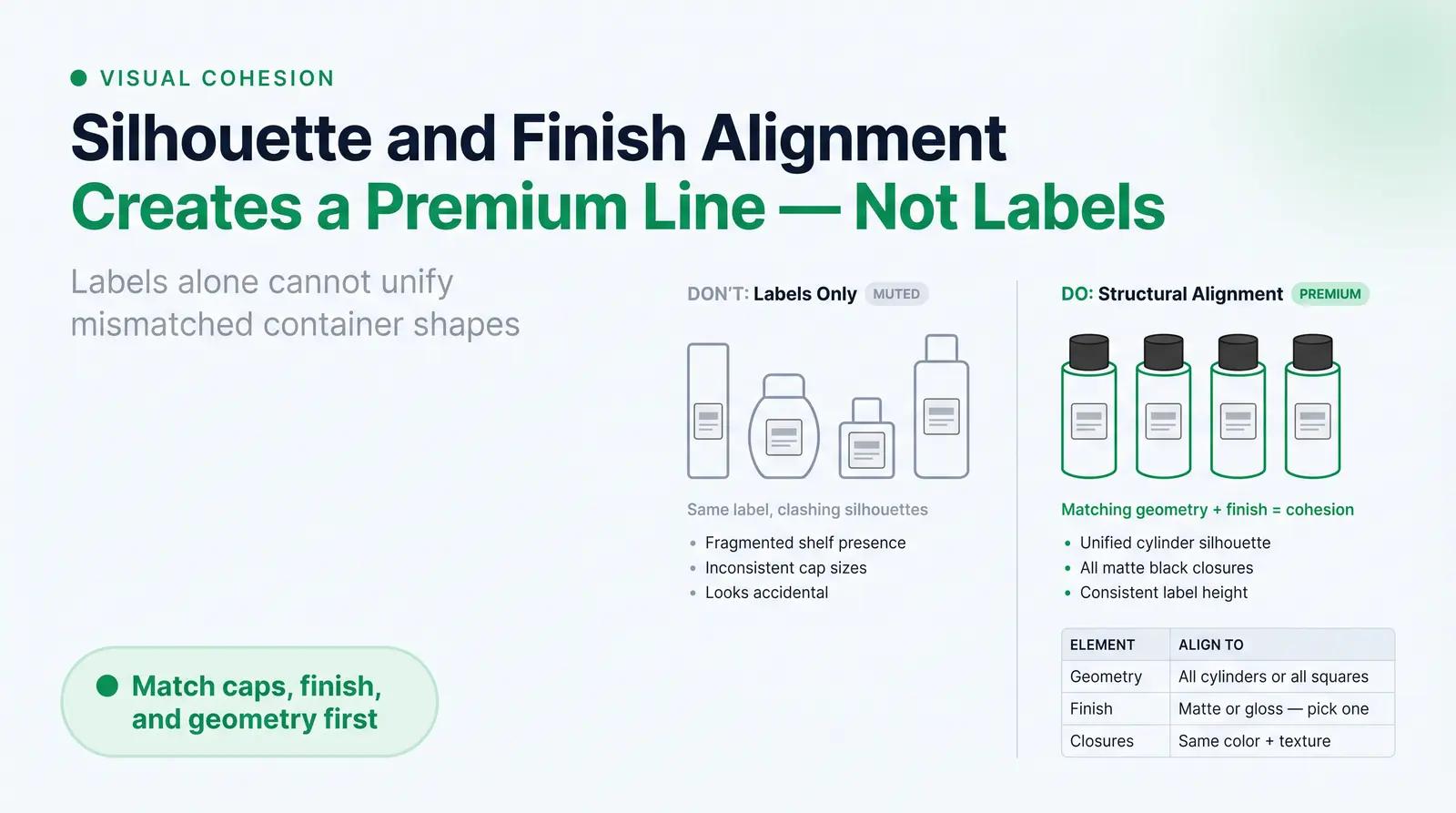
A common mistake is assuming that applying the same label to six different bottle shapes creates a cohesive brand. It does not. Matching everything visually through labels alone often backfires at a small scale because the underlying container silhouettes clash. Visual cohesion is achieved through structural alignment.
To build a unified family, focus on silhouette and finish. If your serum is in a frosted glass cylinder, your toner should be in a frosted plastic or glass cylinder, not a clear square bottle. Coordinate your closures: if the moisturizer jar has a matte black lid, the serum dropper collar and the cleanser pump head should also be matte black. By aligning the finish (matte vs. glossy) and the geometry (cylindrical vs. square) of the containers, the line looks intentional and premium, even if the formats differ.
Label Real Estate: What Your Container Shape Allows
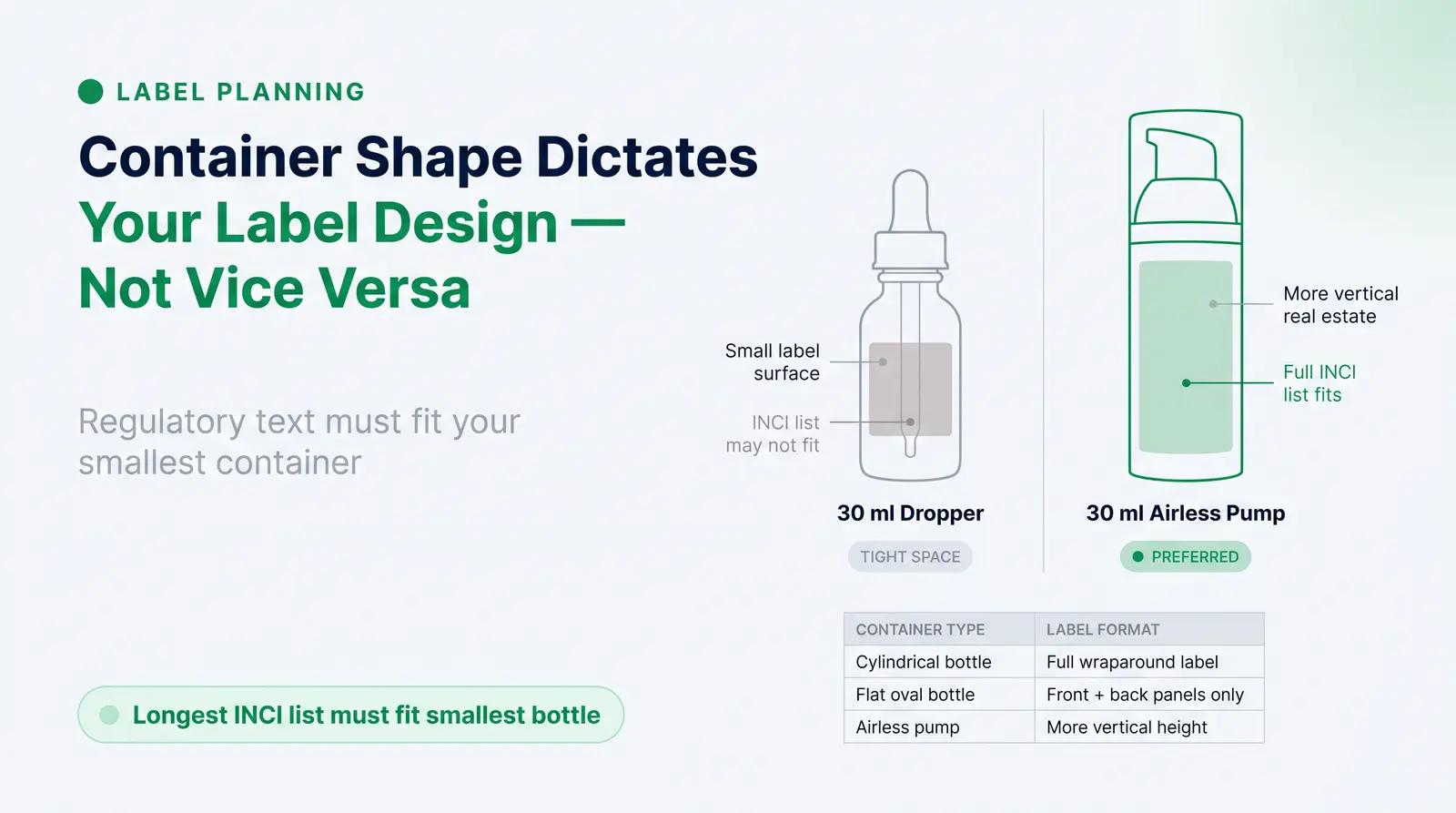
Your container shape dictates your label design, not the other way around. Regulatory requirements—such as the INCI ingredient list, net weight, distributor address, and necessary warnings—take up a fixed amount of space.
A 1 oz (30 ml) dropper bottle has very little printable surface area. If you design a beautiful, minimalist front panel, you may find that the required regulatory text does not fit on the back without shrinking the font below legal limits [6]. Conversely, an airless pump of the same volume is taller and offers significantly more vertical label real estate. Flat oval bottles only allow for front and back panel labels, whereas cylindrical bottles can take a continuous wraparound label. When planning a starter line, a consistent label template across the line is as important as container choice. You must ensure your longest ingredient list (often the moisturizer or mask) fits on your smallest container (the serum or oil).
Worked Example: A 6-SKU Launch at 250 Units Per SKU
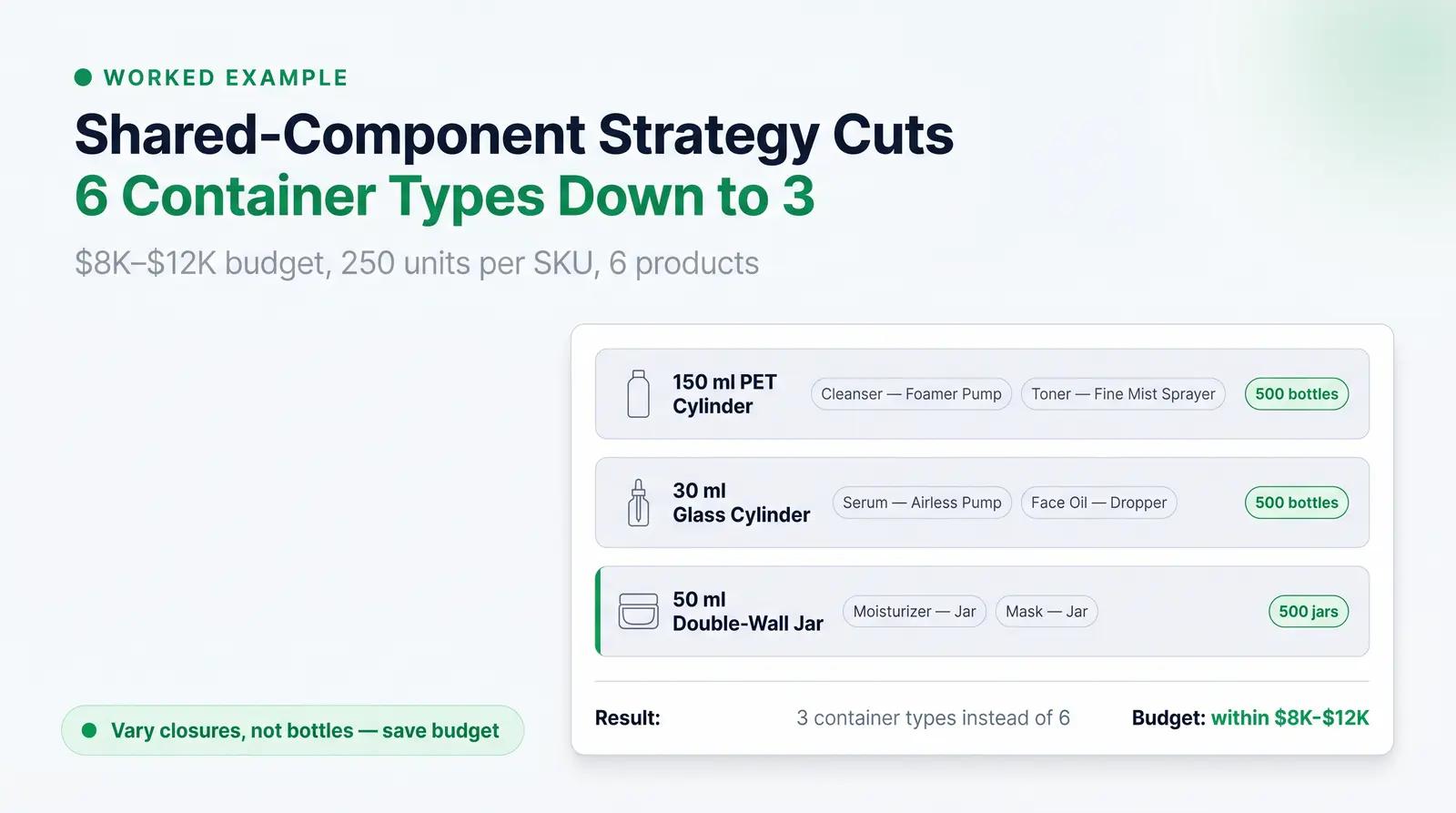
Consider a founder launching a 6-SKU core line: a foaming cleanser, hydrating toner, vitamin C serum, moisturizing cream, facial oil, and a clay mask. She has a launch budget of $8,000–$12,000 for packaging and targets 250 units per SKU at launch.
If she sources six completely different custom containers, she will hit a wall, as most custom MOQs start at 5,000 units. Instead, she uses a shared-component strategy. She selects a stock packaging family that offers multiple formats in the same cylindrical silhouette and matte white finish.
- Cleanser (150 ml) & Toner (150 ml): She uses the exact same 150 ml PET cylinder bottle for both. The cleanser gets a foamer pump closure; the toner gets a fine mist sprayer. By combining these, she orders 500 identical bottles, meeting a lower tier for stock pricing.
- Serum (30 ml) & Face Oil (30 ml): She uses the same 30 ml heavy-walled glass cylinder. The serum gets an airless treatment pump closure; the oil gets a glass dropper closure. Again, she orders 500 identical bottles.
- Moisturizer (50 ml) & Mask (50 ml): She uses the same 50 ml double-walled jar.
By standardizing the base containers and only varying the closures, she reduces her packaging inventory from six distinct bottle types to three. She standardizes her label heights across the cylinders, ensuring the brand looks perfectly aligned on the shelf. This strategy keeps her well within budget and drastically lowers her reorder risk.
Packfolio's catalog is organized around pre-vetted packaging families with predefined printable regions, so founders can preview their full line in 3D before committing to an order.
Browse Packfolio's curated skincare packaging catalog and preview your label on a photorealistic 3D model before you order → packfolio.com/catalog
Frequently Asked Questions
What packaging formats work best for a skincare starter line? For a starter line, focus on functional formats that protect the formula: airless pumps for sensitive serums, dropper bottles for face oils, pump bottles for cleansers, and jars or tubes for moisturizers and masks. Keeping the container silhouettes (like all cylinders) consistent across these different formats creates a cohesive look.
What is a realistic MOQ for skincare packaging when launching a small brand? While custom manufacturing often requires 5,000 to 10,000 units, small brands can find stock packaging with MOQs as low as 100 to 500 units. Using stock bottles and customizing them with high-quality labels or silk screening is the most realistic path for a launch budget.
How do I make my skincare line look cohesive if I'm using different container types? Align the finishes and closures. If you use a frosted bottle for your serum, use frosted materials for your jars and toner bottles. Ensure all caps, pumps, and dropper collars share the same color and texture (e.g., all matte black), and use a consistent label template across the line.
Can I use the same packaging supplier for all six products in my starter line? Yes, and it is highly recommended. Working with a single supplier who offers a "packaging family" allows you to source jars, droppers, and pump bottles that share the same design language, simplifying your supply chain and helping you reach volume discounts.
What should I check for formula-packaging compatibility before ordering? You must verify that your active ingredients do not react with the container material. For example, Vitamin C requires UV protection (dark glass or opaque plastic), and certain essential oils or acids can degrade low-grade plastics or label adhesives over time.
References
[1] Low MOQ Cosmetic Manufacturing: The 2025 Guide for Indie Founders, Genie, 2025
[2] How to choose the right packaging for functional skincare products, Cosmetics Business, 2022
[3] Which Packaging Is Suitable for Serums, Creams, and Lotions? A Professional Guide, Xumin Packaging, 2025
[4] The Science of Compatibility: Why Your Formula Deserves Better Packaging, APC Packaging, 2025
[5] Understanding MOQ (Minimum Order Quantity) in Third-Party Cosmetics Manufacturing, Glint Cosmetics, 2025
[6] Summary of Cosmetics Labeling Requirements, U.S. Food and Drug Administration, 2025


