
How to Compare Cosmetic Packaging Quotes Side by Side
Compare cosmetic packaging quotes by normalizing eleven cost variables into a single Total Landed Cost per unit to reveal the true cheapest supplier.
Supplier quotes are rarely apples-to-apples — a quote that looks cheaper often has hidden costs buried in freight, mold fees, decoration minimums, and defect policy language that only surfaces after the purchase order is signed. Imagine a founder receives three quotes for a 1 oz (30 ml) airless pump bottle. The unit prices range from $0.48 to $0.91. At first glance, the $0.48 option is the obvious choice. However, that cheapest quote omits decoration, carries a $1,200 mold fee, requires 100% prepayment, and charges freight separately at actuals. By the time the bottles arrive, the true cost per unit has ballooned well past the $0.91 quote.
Why Cosmetic Packaging Quotes Are Almost Never Apples-to-Apples
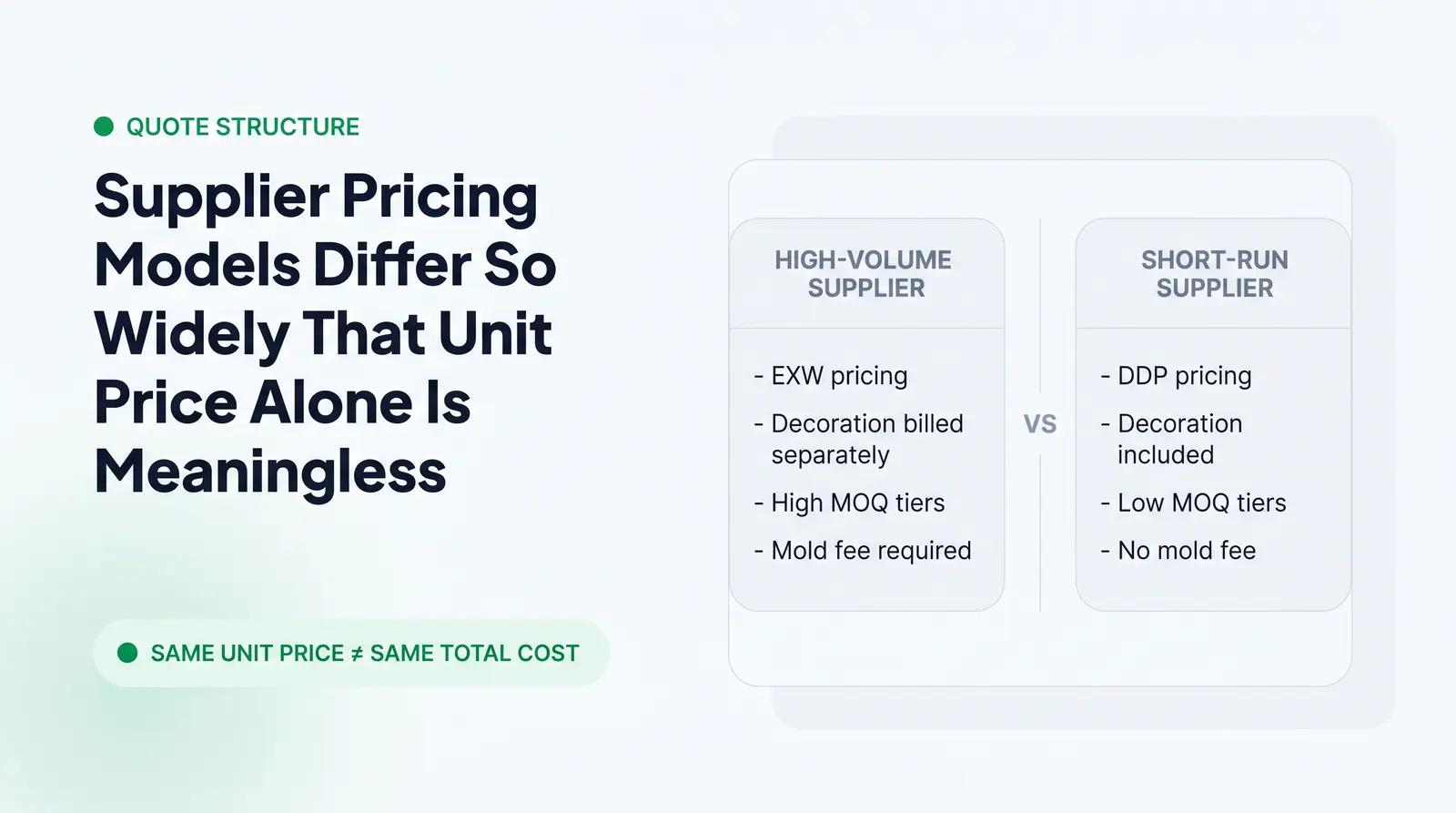
The primary reason packaging quotes resist simple comparison is that suppliers structure their pricing models differently based on their operational strengths and target clientele. A supplier specializing in massive volume runs for multinational brands will quote very differently from a supplier set up to handle agile, short-run orders for indie beauty launches. This divergence shows up immediately in the shipping terms they use. Some suppliers quote EXW (Ex Works), meaning the buyer assumes all risks and costs the moment the goods leave the factory floor. This leaves the founder responsible for arranging trucking to the port, ocean freight, customs clearance, and final delivery. Others quote FOB (Free on Board) or DDP (Delivered Duty Paid), which shifts various degrees of freight responsibility and customs clearance onto the seller [1].
Beyond Incoterms, the line items themselves vary wildly. Decoration methods like screen printing, hot stamping, or labeling might be bundled into the unit price by one supplier but billed as a separate setup fee by another. A quote might look incredibly cheap until you realize the supplier expects you to pay $200 per color for printing plates. Some quotes include pre-production samples, while others charge hundreds of dollars for them, refusing to credit that amount toward the final bulk order. Minimum Order Quantity (MOQ) assumptions also differ, fundamentally altering the amortization of fixed costs like tooling and setup. Furthermore, defect policies and Acceptable Quality Limits (AQL) are rarely standardized. This lack of standardization means a cheap quote might offer zero recourse if 5% of the bottles leak during transit or fail on the filling line [2]. Without a systematic way to unpack these variables, founders are left guessing, often making decisions based on incomplete data that will inevitably compress their margins.
The 11 Cost Variables Every Quote Must Disclose
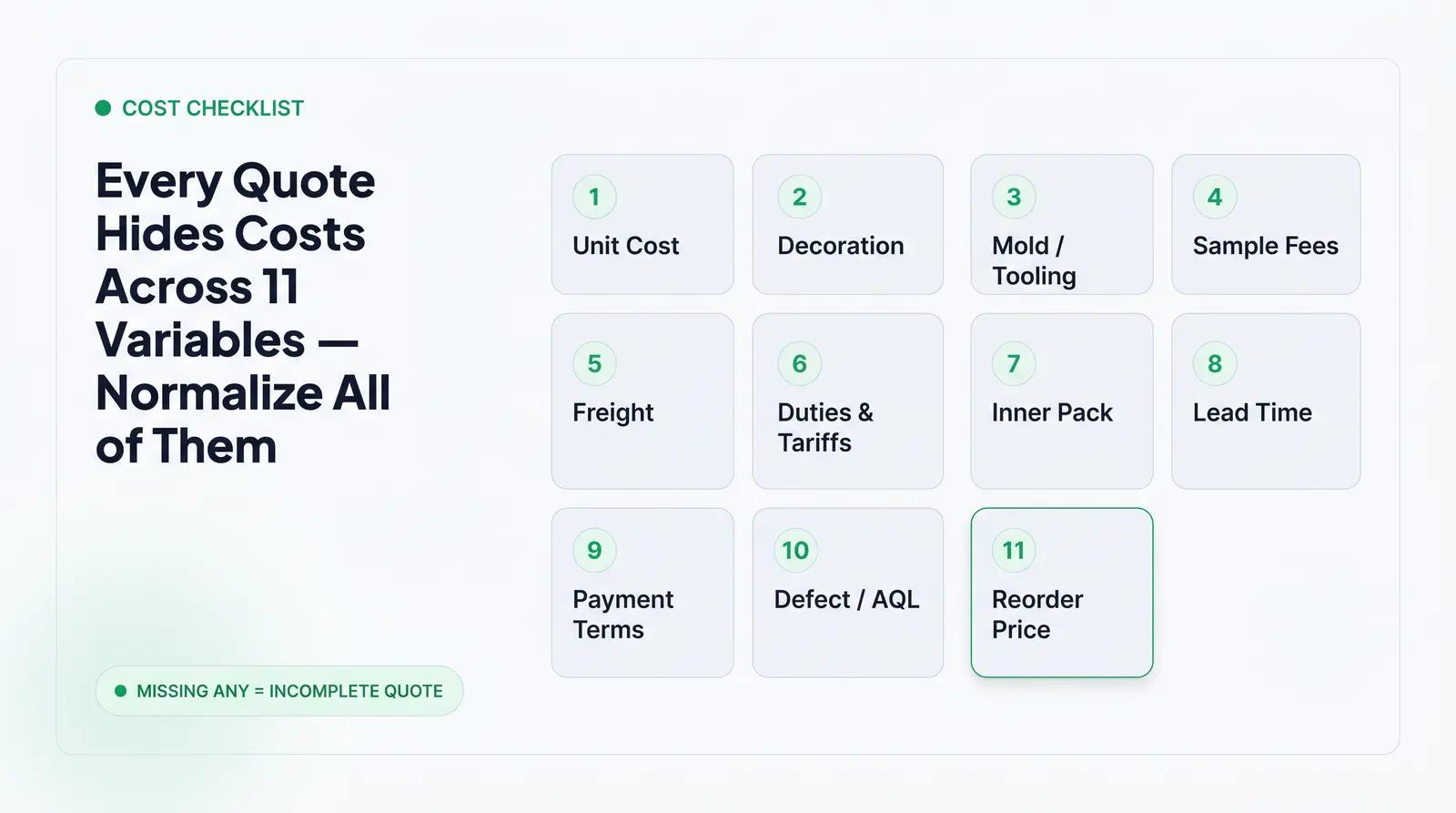
To compare quotes accurately, founders must normalize the data. Every quote must be broken down into these eleven variables.
1. Component Unit Cost
The base price of the physical container is just the starting point. You must ask: at what exact MOQ is this price valid? Does it step down at higher quantities? A quote of $0.50 at 5,000 units is very different from $0.50 at 10,000 units. Suppliers often quote their most attractive tier to win the business, even if they know your initial run will be much smaller.
2. Decoration Cost
Is screen printing, hot stamping, foiling, or labeling included, or is it a separate line item? At what MOQ does the decoration price apply? Some suppliers charge a flat setup fee for printing plates, while others bake it into the per-unit cost. If your design requires multiple colors or specialized finishes, these costs can compound quickly and distort the base component price.
3. Mold / Tooling / Setup Fees
These are often the largest hidden costs for custom shapes or caps, sometimes running into thousands of dollars. Are these fees one-time or amortized across the order? Crucially, who owns the tooling after it is paid for? If you switch suppliers down the road, can you take the mold with you, or are you locked into that specific factory forever?
4. Sample Fees
Pre-production samples are essential for color matching, compatibility testing, and fit testing with your specific formula. Are these fees credited against the first bulk order, or are they sunk costs? Paying $200 for samples across three different suppliers adds up, so knowing which suppliers credit that cost back is vital.
5. Freight Cost
Is the quote EXW, FOB, or DDP? If it is EXW or FOB, what is the estimated freight cost per carton and per unit to get the goods to your filling facility? Freight can easily add 10-30% to the landed cost [3]. A supplier offering a slightly higher unit price but quoting DDP might actually be saving you money and massive logistical headaches.
6. Duties and Tariffs
What is the HS code classification for the component? What is the current US import duty rate for that category? Recent tariff exposure for China-origin goods under Section 301 can add significant percentage points to the cost [4]. Ignoring duties until the goods arrive at the port is a surefire way to wreck your product margins.
7. Packaging Material and Inner Pack
How are the components packed for transit? Are export cartons, inner poly bags, and foam inserts included, or are they billed as extras? Poor inner packing leads to scuffed bottles and scratched caps, rendering them unusable for retail. Ensuring the quote covers robust export packaging is non-negotiable.
8. Lead Time
What is the production lead time versus the total lead time (including ocean freight and customs)? What exactly triggers the clock—the receipt of the deposit, or the final approval of the artwork? A supplier quoting a four-week lead time might actually mean four weeks from the day they finally approve your print files, adding weeks to your launch schedule.
9. Payment Terms
What is the deposit percentage? When is the balance due? Are the payment methods acceptable, and who bears the currency exchange risk? Standard terms are often 30% deposit and 70% before shipment, but some suppliers demand 100% upfront, which severely impacts your cash flow and leverage if quality issues arise.
10. Defect and AQL Policy
What AQL level applies to the order? For cosmetics, an AQL of 0 for critical defects, 1.5 for major, and 2.5 for minor is standard [5]. What is the remedy for out-of-spec goods—replacement, credit, or nothing? If a supplier refuses to state an AQL or outline a clear remedy process, you are assuming 100% of the quality risk.
11. Reorder Pricing
Is the quoted price locked for reorders, and for how long? Is the mold fee waived on subsequent runs? Securing a great price for launch means nothing if the supplier hikes the unit cost by 20% on your first restock. Always establish the parameters for future orders before signing the initial purchase order.
The Total Landed Cost Per Unit Framework
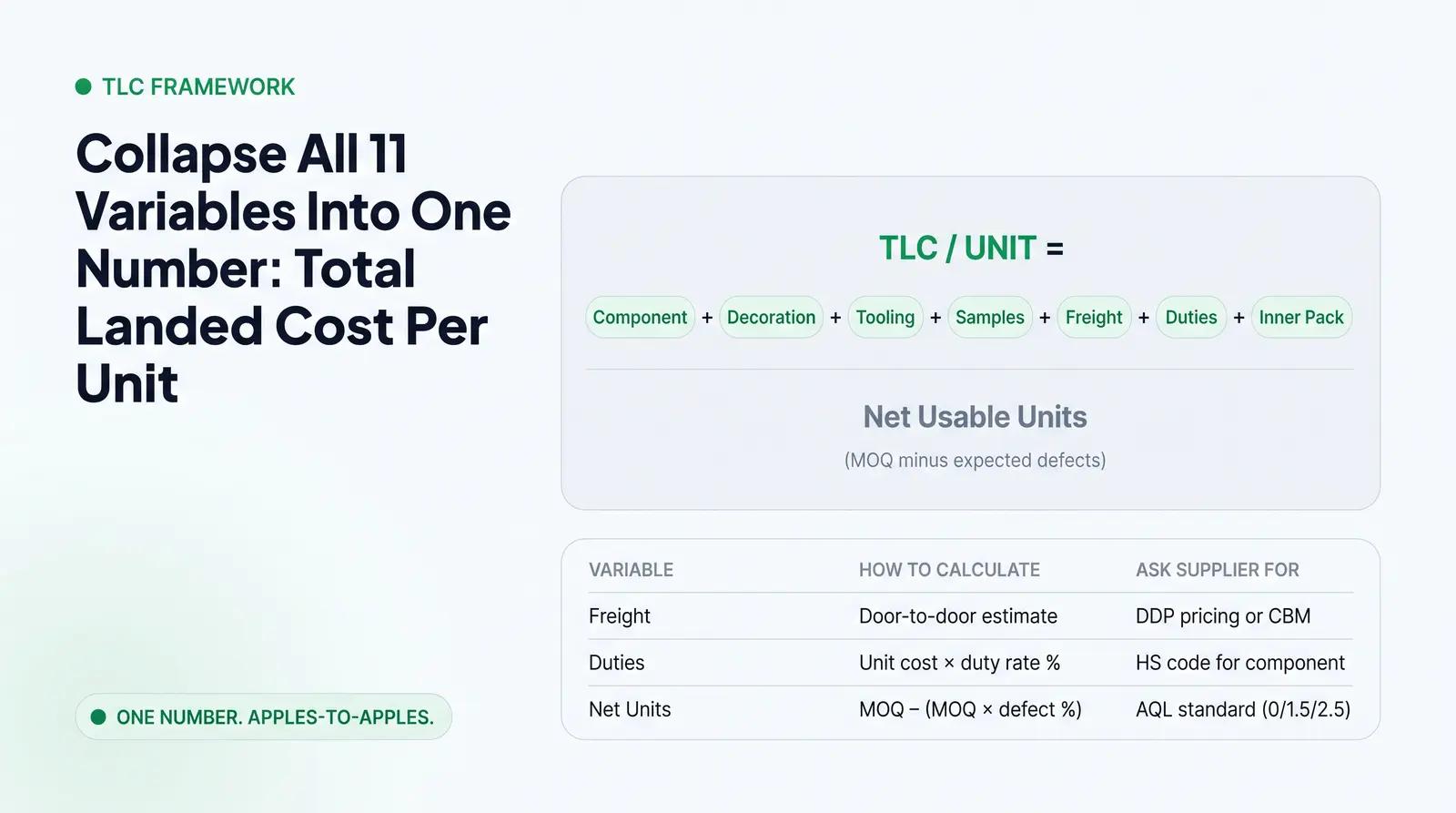
A practical framework we use at Packfolio to normalize supplier quotes before evaluation is the Total Landed Cost Per Unit Framework. This approach collapses all eleven variables into a single, comparable number: the total landed cost per unit (TLC/unit) at a given order quantity.
The formula logic is straightforward:
TLC/unit = ( (Component cost × MOQ) + Decoration cost + Mold/tooling fee + Sample fees + Freight + Duties + Inner packaging ) ÷ Net usable units (MOQ minus expected defect allowance)
| Cost Variable | How to Calculate | What to Request from Supplier if Missing |
|---|---|---|
| Component Cost | Unit price × MOQ | Explicit pricing tiers for different MOQs |
| Decoration | Setup fees + (Per unit print cost × MOQ) | Plate charges, screen fees, and per-color costs |
| Tooling/Mold | Total flat fee | Tooling ownership terms and lifespan |
| Samples | Total flat fee minus any bulk credits | Cost for pre-production and production samples |
| Freight | Estimated door-to-door freight cost | DDP pricing or estimated volume/weight for freight quotes |
| Duties | (Component Cost × Duty Rate %) | HS Code for the specific component |
| Inner Pack | Total flat fee or per-carton cost | Export carton specs and insert materials |
| Net Usable Units | MOQ - (MOQ × Defect Allowance %) | Explicit AQL standard (e.g., 0/1.5/2.5) |
Worked Example — Three Quotes for a 30 ml Airless Pump Bottle
Consider a founder sourcing a 30 ml (1 fl oz) airless pump bottle with a screen-printed logo for a vitamin C serum launch. She plans to order 3,000 units. She receives three quotes: Quote A, Quote B, and Quote C.
| Variable | Quote A | Quote B | Quote C |
|---|---|---|---|
| Unit Price (Base) | $0.45 | $0.65 | $0.85 |
| Decoration | $150 setup + $0.10/unit | Included | Included |
| Mold/Tooling | $1,200 | $0 | $0 |
| Sample Fee | $200 (Not credited) | $150 (Credited) | Included |
| Freight Terms | EXW (Est. $600 freight) | FOB (Est. $400 freight) | DDP (Included) |
| Duties (Est. 5%) | $67.50 | $97.50 | Included |
| Defect Policy | No remedy over 3% AQL | Replacement at 1.5% AQL | Credit at 1.5% AQL |
| Net Usable Units | 2,910 (3% loss) | 2,955 (1.5% loss) | 2,955 (1.5% loss) |
Calculating the Total Landed Cost (TLC):
Quote A TLC:
- Component: $0.45 × 3,000 = $1,350
- Decoration: $150 + ($0.10 × 3,000) = $450
- Tooling: $1,200
- Samples: $200
- Freight: $600
- Duties: $67.50
- Total Cost: $3,867.50
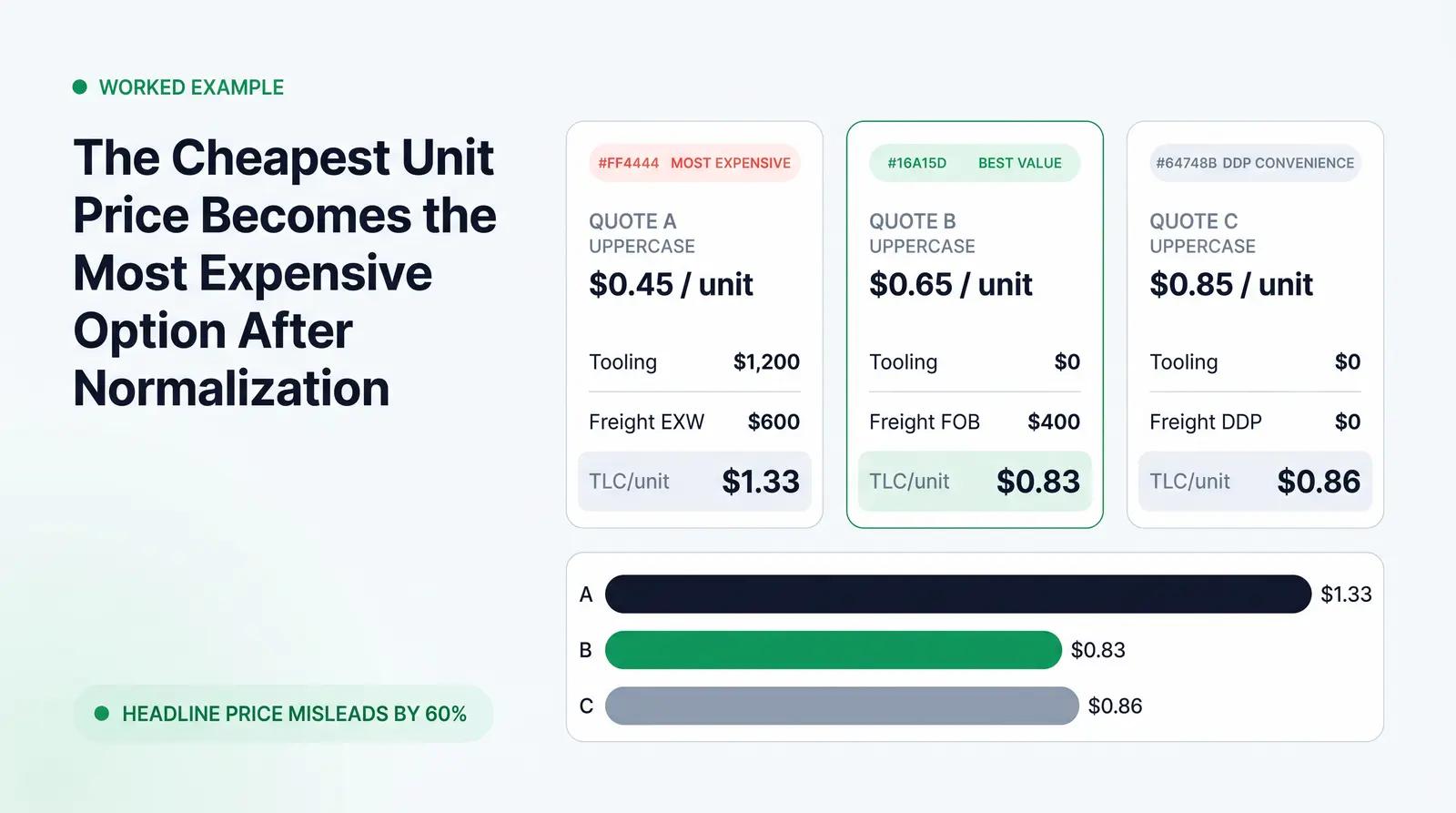
- TLC/unit: $3,867.50 ÷ 2,910 usable units = $1.33 per unit
Quote B TLC:
- Component: $0.65 × 3,000 = $1,950
- Decoration: $0
- Tooling: $0
- Samples: $0 (Credited)
- Freight: $400
- Duties: $97.50
- Total Cost: $2,447.50
- TLC/unit: $2,447.50 ÷ 2,955 usable units = $0.83 per unit
Quote C TLC:
- Component: $0.85 × 3,000 = $2,550
- Decoration: $0
- Tooling: $0
- Samples: $0
- Freight: $0 (DDP)
- Duties: $0 (DDP)
- Total Cost: $2,550
- TLC/unit: $2,550 ÷ 2,955 usable units = $0.86 per unit
Despite having the lowest headline unit price, Quote A is the most expensive option by a wide margin due to tooling, uncredited samples, and freight. Quote B is the cheapest landed option, but Quote C offers DDP convenience for only three cents more per unit. Furthermore, Quote A's defect policy is a major risk; at 3,000 units, accepting a 3% loss with no remedy means paying for 90 defective bottles.
The Contrarian Insight — Why the Lowest MOQ Is Often the Most Expensive Option
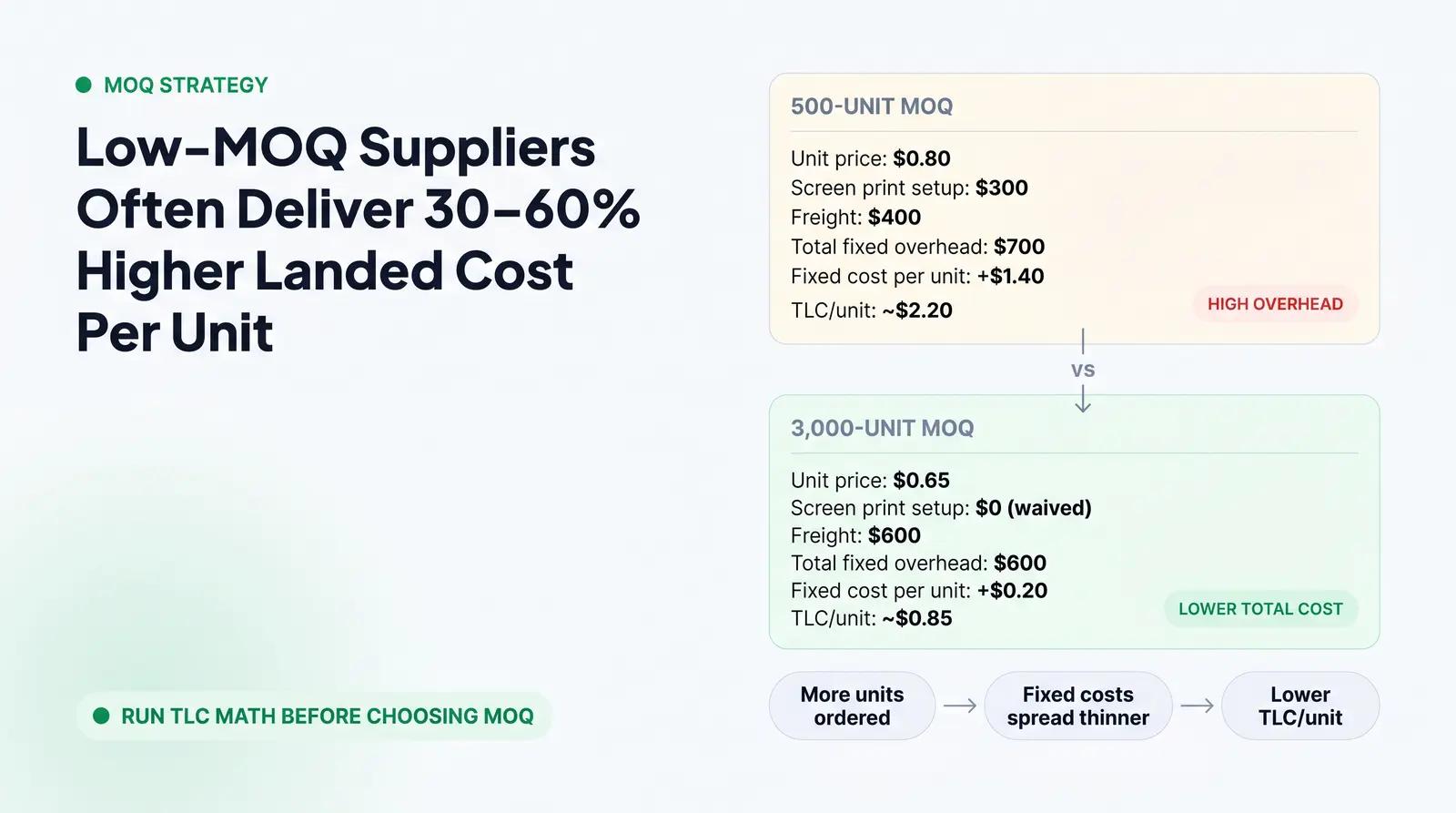
Founders optimizing purely for low Minimum Order Quantities without running the TLC/unit math often pay 30–60% more per unit once mold fees, decoration minimums, and freight per-unit costs are factored in. This cost structure can make a higher-MOQ supplier cheaper at launch than a "low MOQ" supplier [6]. The beauty industry is saturated with advice telling founders to start as small as possible to minimize risk. While lean inventory is generally a smart strategy, applying it blindly to custom packaging procurement can backfire spectacularly.
For example, a supplier offering a 500-unit MOQ might charge a $300 setup fee for screen printing and $400 for freight. At 500 units, that adds $1.40 to the per-unit cost. A different supplier might require a 3,000-unit MOQ but waive the setup fee and charge $600 for freight. The freight and setup burden drops to $0.20 per unit. The "low MOQ" option severely inflates the landed cost, eating into the product's gross margin before it even reaches the shelf. When you factor in the reality that smaller runs often receive less priority on the factory floor, the "safe" low-MOQ option can quickly become the most expensive and frustrating path. By running the TLC/unit framework, founders can identify the true break-even point where ordering slightly more inventory actually reduces their overall cash outlay and dramatically improves their unit economics.
Red Flags in Cosmetic Packaging Quotes
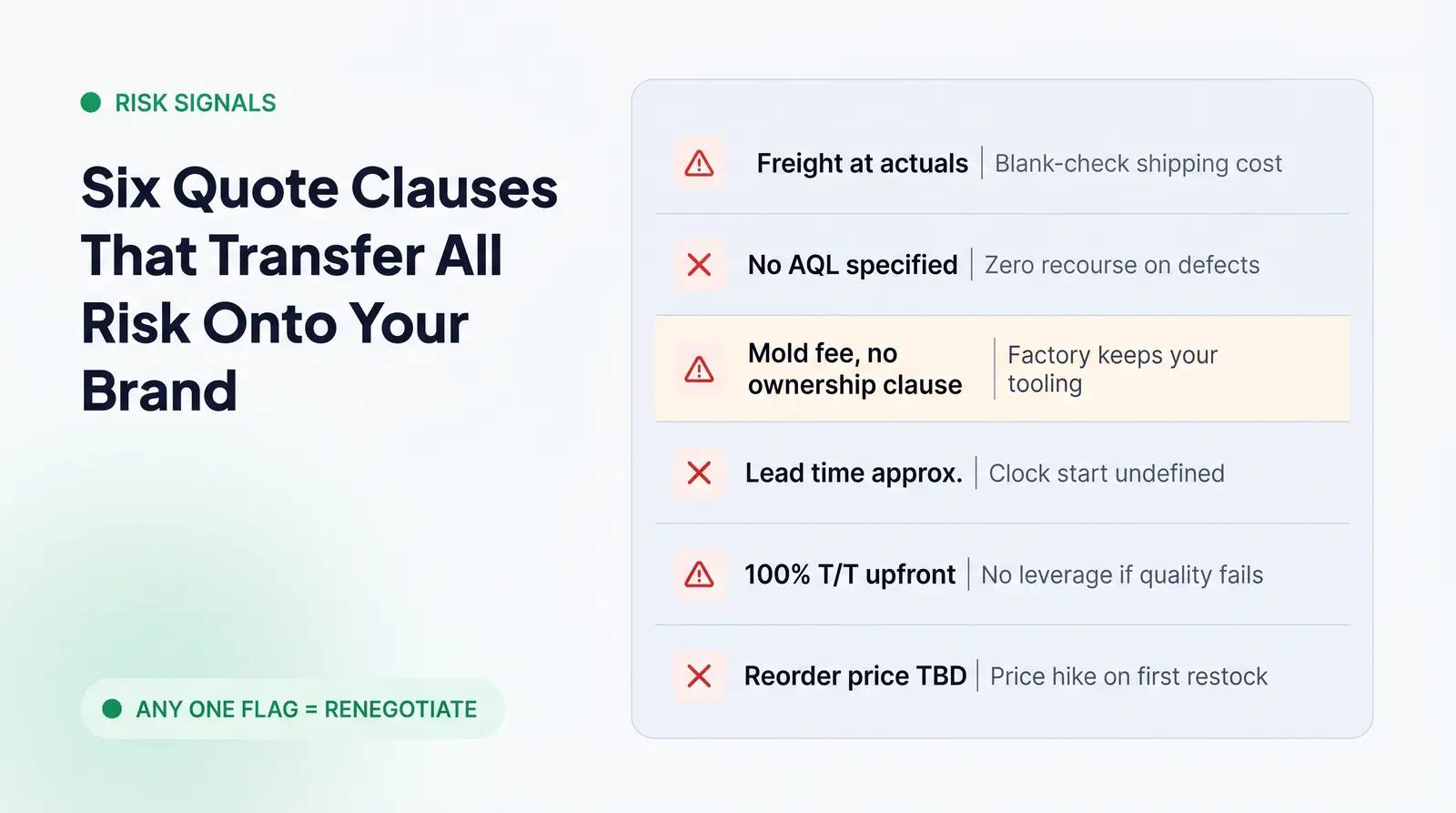
When reviewing quotes, watch out for these specific warning signs. These clauses often indicate a supplier who is shifting all the operational and financial risk onto your brand:
- "Freight at actuals" with no estimate provided: This gives the supplier a blank check to pass along exorbitant shipping costs right before delivery.
- No AQL level specified: Without a documented Acceptable Quality Limit, you have no contractual basis to reject a batch of leaking or scuffed components.
- Mold fee listed but tooling ownership not stated: You might pay thousands for a custom mold only to discover the factory owns it and can use it to produce packaging for your competitors.
- Lead time stated as "approx." with no definition of the start trigger: "Approx. 30 days" means nothing if the clock doesn't start until they process your wire transfer, which might take a week.
- Payment terms of 100% T/T in advance with no sample or inspection provision: You lose all leverage to demand corrections if the final goods do not match the agreed specifications.
- Reorder price listed as "TBD" or "subject to market conditions": This is a setup for a massive price hike the moment your product gains traction and you urgently need a restock.
How Packfolio Eliminates the Quote Comparison Problem
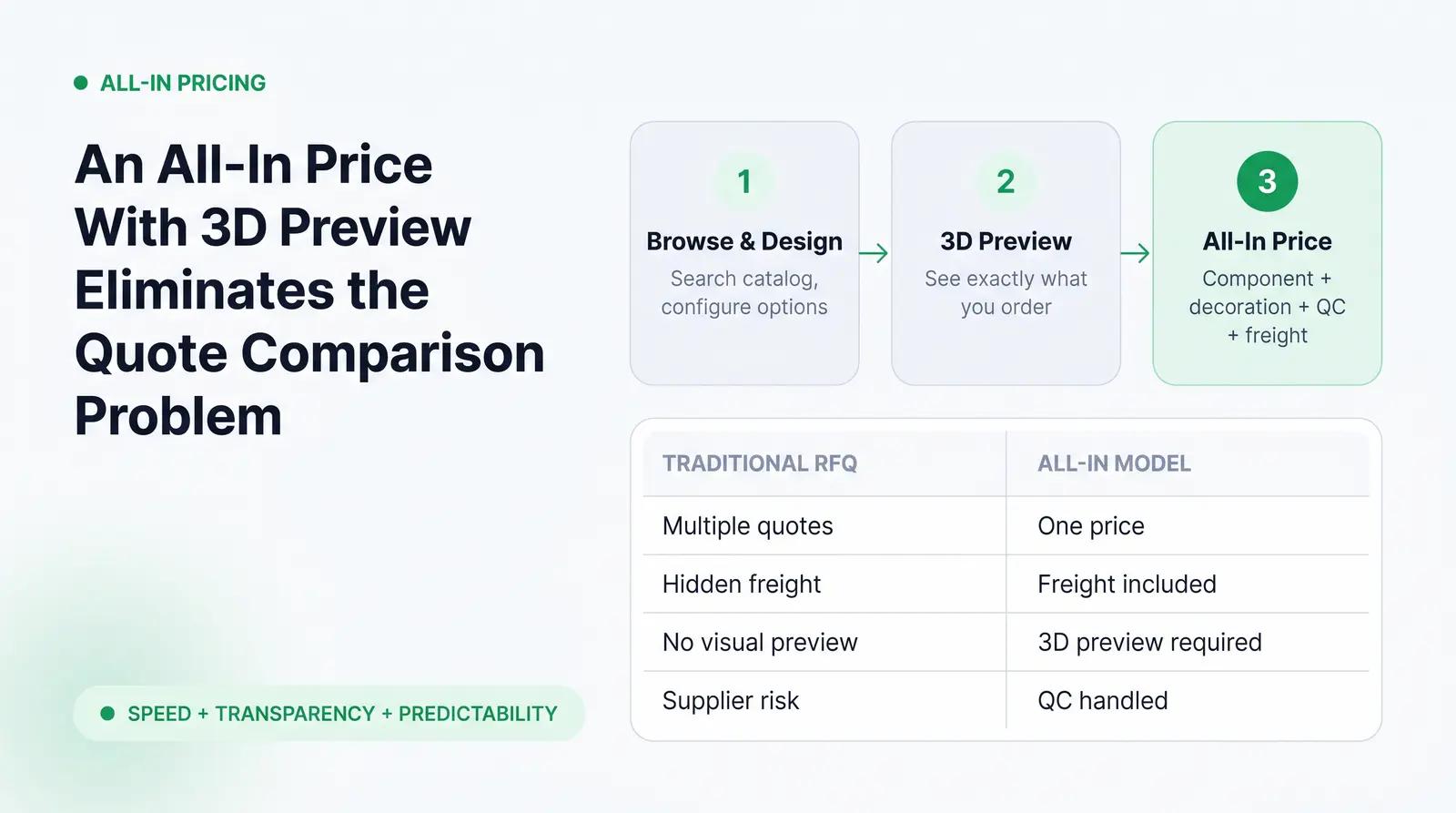
Packfolio removes the need for RFQ-based quote comparison by presenting a single, all-in price that covers the component, decoration within predefined print zones, production coordination, quality assurance, and freight to the customer's address. The 3D preview is a required step—founders see exactly what they are ordering before they pay. Packfolio handles supplier coordination, vetting, QC, and freight, meaning customers do not manage supplier relationships. This model works best for founders who want speed, transparency, and predictability; founders running custom tooling programs at very high volume or those still navigating their sourcing decisions may need a direct factory relationship.
Closing CTA Block
Total landed cost per unit is the only number that matters when comparing packaging quotes. Building the habit of normalizing every quote against the eleven variables above will save a founder from the most common sourcing mistakes.
Browse Packfolio's curated cosmetic packaging catalog — every SKU is priced all-in with 3D preview before you order. Explore the catalog →
Frequently Asked Questions
What is included in a cosmetic packaging quote? A comprehensive quote should include the base component price, decoration fees, tooling or mold charges, sample costs, freight estimates, and duties. If any of these are missing, you must ask the supplier to provide them to calculate your true landed cost.
How do I calculate landed cost for cosmetic packaging? Add the total cost of the components, decoration, tooling, samples, freight, duties, and inner packaging, then divide that sum by the net usable units (your order quantity minus the expected defect rate). This gives you the Total Landed Cost per unit.
What is AQL in cosmetic packaging quality control? AQL stands for Acceptable Quality Limit, which defines the maximum number of defective units allowed in a batch before the entire order is rejected. For cosmetics, a standard AQL is 0 for critical defects, 1.5 for major defects, and 2.5 for minor defects.
What is the difference between EXW and FOB in packaging quotes? EXW (Ex Works) means the buyer pays for all shipping and assumes all risk from the moment the goods leave the factory. FOB (Free on Board) means the supplier covers the cost and risk of getting the goods onto the shipping vessel at the port of origin, after which the buyer takes over.
Why are tooling and mold fees so expensive for custom packaging? Tooling fees cover the cost of machining solid steel or aluminum molds required to shape custom plastic or glass components. These are high-precision, one-time engineering costs that can range from $1,500 to over $10,000 depending on the complexity of the design.
References
[1] Know Your Incoterms. International Trade Administration. 2024. https://www.trade.gov/know-your-incoterms
[2] Acceptable Quality Limit (AQL). QIMA. 2025. https://www.qima.com/aql-acceptable-quality-limit
[3] The Hidden Costs of Custom Cosmetic Packaging: What Brands Need to Know. Luxetubes. 2026. https://luxetubes.com/the-hidden-costs-of-custom-cosmetic-packaging/
[4] U.S. Customs Guide to Importing Plastic Products: Duties, Compliance, and Risk Management. Clearit USA. 2026. https://clearitusa.com/import-plastic-products-usa/
[5] Setting AQLs for Cosmetics: ISO 2859‑1 Sampling Plans Made Simple. Amarrie. 2025. https://www.amarrie.com/blogs/b2b-skincare-insights/setting-aqls-for-cosmetics-iso-2859-1-sampling-plans-made-simple-1
[6] How Does MOQ Affect Cosmetic Packaging Costs (And What You Can Do About It)? AH Packaging. 2025. https://ahpackaging.com/how-does-moq-affect-cosmetic-packaging-costs/


