
Cosmetic Packaging Incoterms Explained for Beauty Founders
Beauty founders learn how EXW, FOB, CIF, and DDP Incoterms affect cosmetic packaging landed costs, risk transfer, and which term fits each brand growth stage.
You open the email from a potential packaging supplier, excited to see the quote for your new glass dropper bottles, only to find the pricing listed as "$0.85/unit FOB Shanghai." Suddenly, the math gets murky, and you realize you have no idea what that $0.85 actually covers, when you assume responsibility for the cargo, or what your true landed cost will be by the time the pallets reach your warehouse door.
Understanding freight terms is not just a logistics exercise. It is a critical margin-protection skill.
What Incoterms Actually Are, and Why They Matter for Packaging Buyers
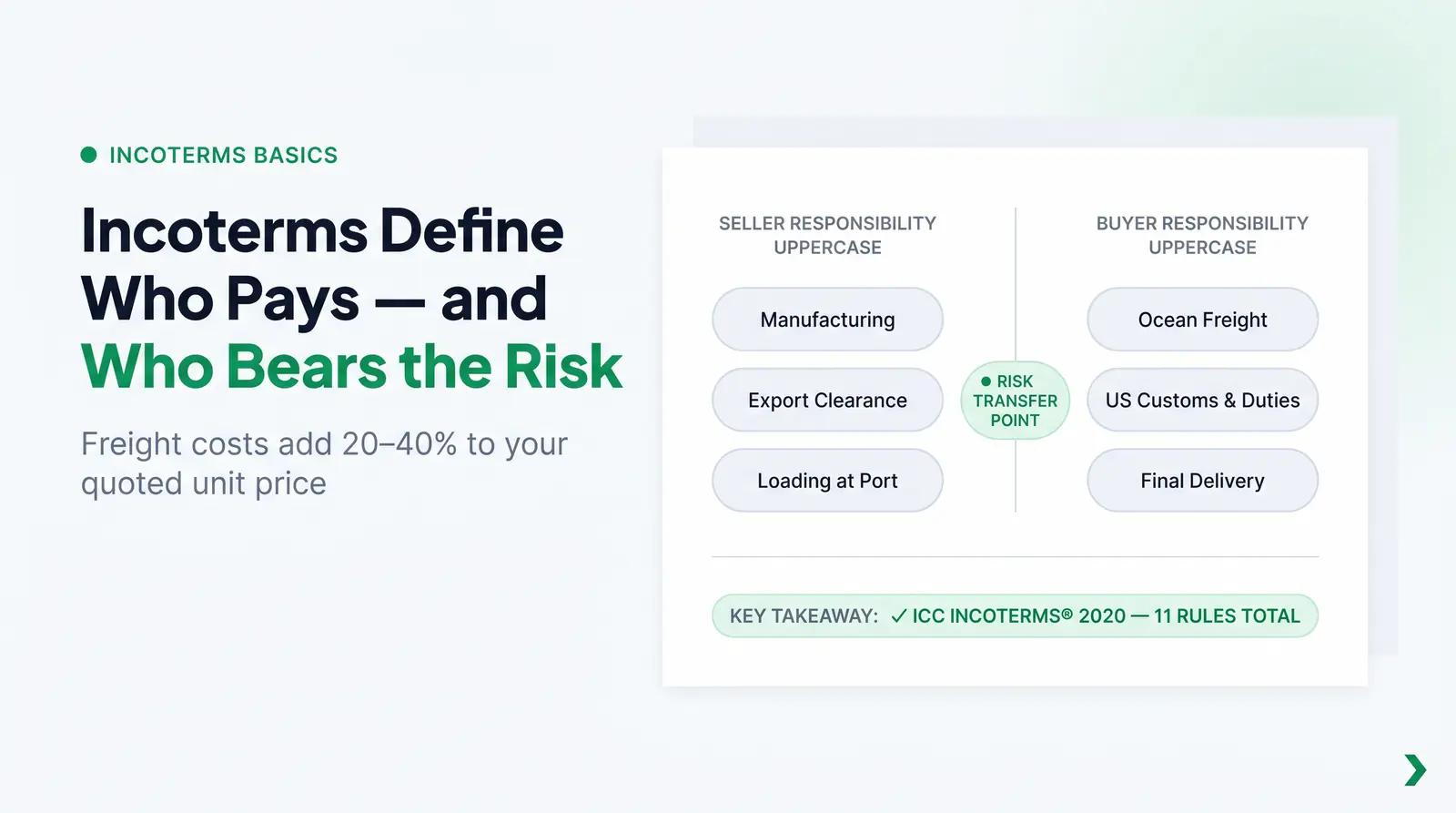
Incoterms are a standardized set of international trade terms published by the International Chamber of Commerce (ICC), currently operating under the Incoterms® 2020 rules [1]. These rules define the contractual obligations between buyers and sellers in global trade.
Every Incoterm defines two critical elements of a transaction. First, it dictates exactly where the seller's responsibility ends and the buyer's begins. Second, it clarifies who pays for freight, insurance, and customs clearance at each stage of the journey [1].
For beauty founders sourcing cosmetic primary packaging, understanding these terms is essential. Cosmetic packaging is predominantly manufactured in Asia, primarily China. The costs associated with ocean freight, US import duties, and cargo insurance between the factory floor and your US warehouse can add 20% to 40% to the per-unit price quoted by the supplier. Without knowing your Incoterms, you cannot accurately calculate your landed cost or compare quotes from different manufacturers.
The Four Terms You Will Actually Encounter: EXW, FOB, CIF, and DDP
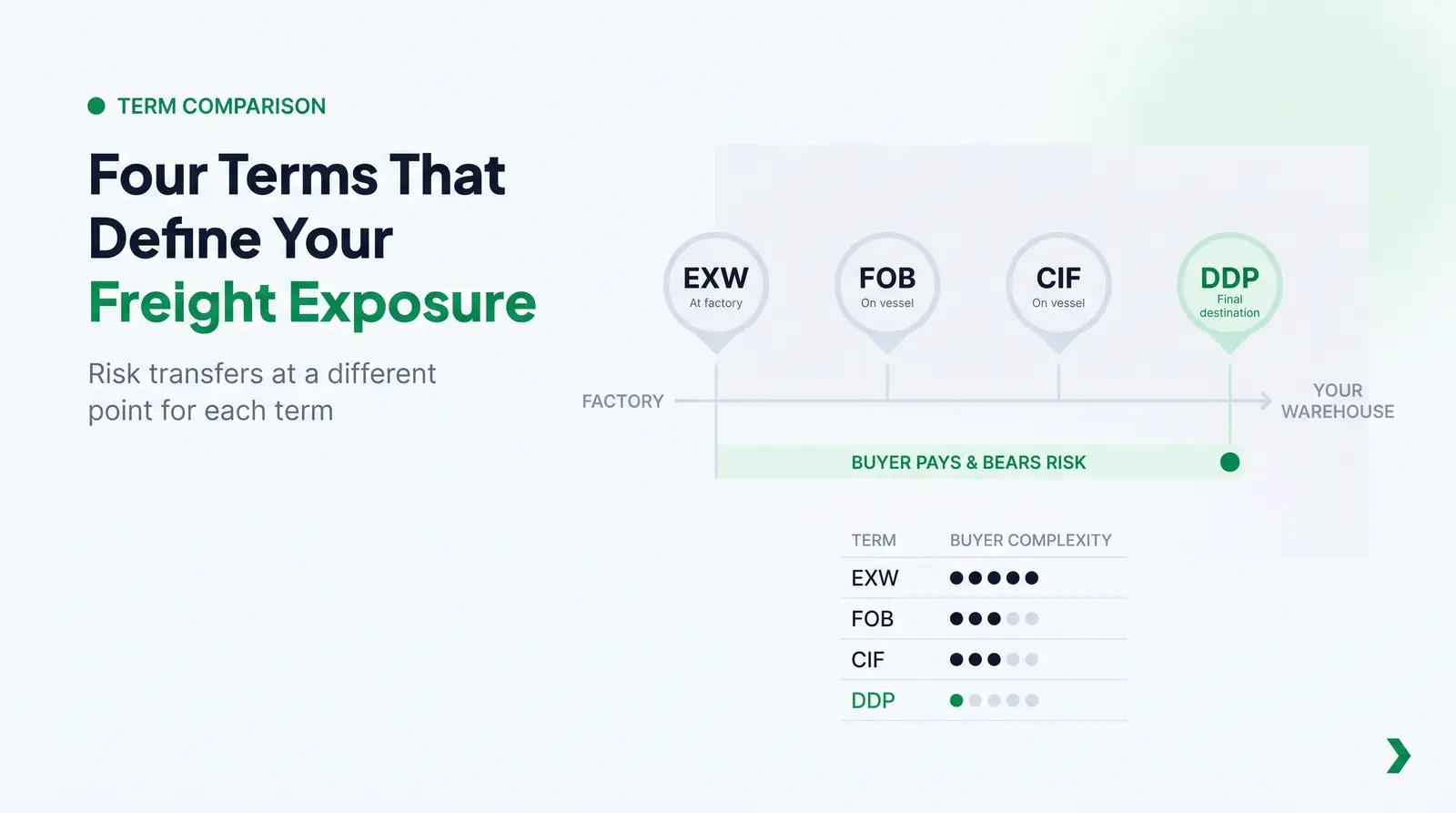
While there are 11 Incoterms in total, packaging buyers typically only need to navigate four primary terms.
EXW (Ex Works)
Under EXW, the seller's responsibility ends the moment the goods are packaged and made available at their factory or warehouse [2].
The buyer must arrange and pay for everything from that point forward. This includes loading the goods onto a truck at the factory, export customs clearance, ocean freight, insurance, US import duties, and final delivery [2]. Risk transfers to the buyer immediately at the seller's premises.
For a small beauty brand without an in-house logistics team, EXW requires coordinating multiple freight forwarders and customs brokers.
- Pro: You have complete control over the shipping process and can negotiate the best freight rates directly.
- Con: You bear maximum risk and administrative burden from the very beginning of the journey.
FOB (Free On Board)
FOB means the seller is responsible for the goods, including export clearance and loading costs, until they are safely loaded onto the vessel at the named port of shipment (e.g., "FOB Ningbo") [2].
From the moment the goods rest on the ship's deck, the buyer takes over. The buyer pays for the ocean freight, cargo insurance, US import clearance, and final delivery [2]. Risk transfers to the buyer once the goods are on board the vessel.
FOB is the most common term for sea freight. It balances responsibility, requiring the supplier to handle local export logistics while letting the buyer control the main international transit.
- Pro: You control the ocean freight costs and transit times without having to navigate foreign export customs.
- Con: You are still responsible for managing US customs clearance and the final delivery leg.
CIF (Cost, Insurance, and Freight)
Under CIF, the seller arranges and pays for the ocean freight and minimum cargo insurance to bring the goods to the named port of destination (e.g., "CIF Los Angeles") [3].
However, the risk transfers to the buyer much earlier: as soon as the goods are loaded onto the vessel at the origin port [3]. The buyer must arrange and pay for unloading at the destination port, US customs clearance, import duties, and final delivery.
While the seller pays for the freight, the buyer assumes the risk during transit. If the ship encounters a storm and the cargo is damaged, the buyer must file the insurance claim.
- Pro: You do not have to book the ocean freight or origin insurance.
- Con: The insurance provided by the seller is often the minimum required, which may not fully cover fragile cosmetic packaging.
DDP (Delivered Duty Paid)
DDP places the maximum obligation on the seller. The seller handles everything: export clearance, ocean freight, insurance, US import customs, duty payments, and final delivery to your specified address [2].
Risk transfers to the buyer only when the goods are delivered and ready for unloading at the final destination [2].
For a beauty founder, DDP offers a hands-off approach. It provides a single, predictable price for the entire journey.
- Pro: It is the simplest option, requiring no logistics coordination or customs management from the buyer.
- Con: You pay a premium for this convenience, and you have no visibility into or control over the shipping timeline or customs compliance.
The Landed-Cost Reality: What You're Actually Paying Per Unit
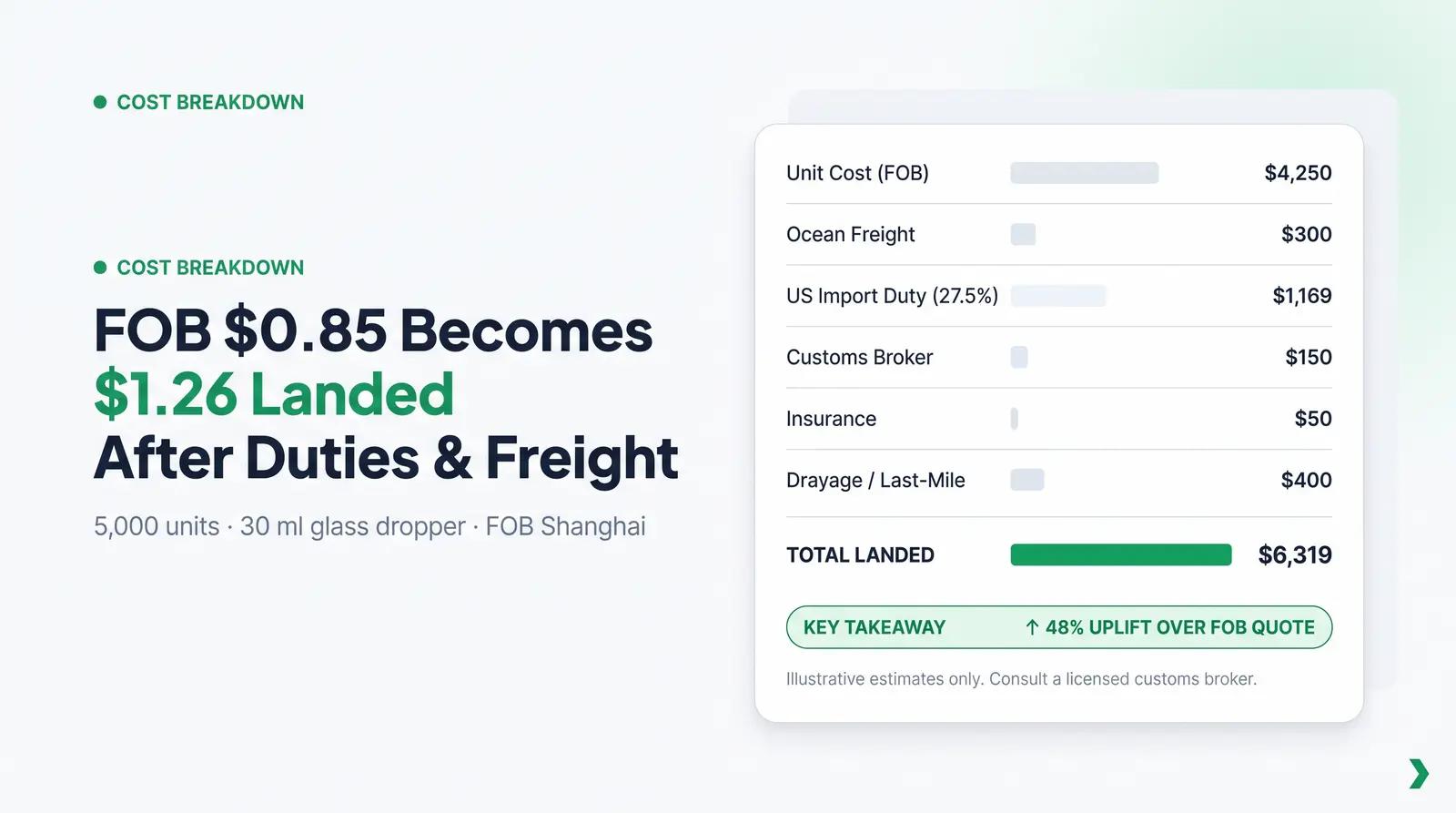
The price on the supplier's quote is rarely what you actually pay. Your true expense is the landed cost, which equals the unit price plus freight, customs duties, insurance, customs broker fees, and drayage (last-mile trucking from the port).
Consider a beauty founder ordering 5,000 units of a 30 ml (1 oz) glass dropper bottle. The supplier quotes $0.85 per unit FOB Shanghai.
- Unit Cost: $4,250.00 (5,000 units at $0.85)
- Ocean Freight (LCL): $300.00 (approximate LCL rate for 2 CBM) [4]
- US Import Duty (estimated): $1,168.75. Glass cosmetic bottles produced by automatic machine (HTS 7010.90.20) carry a 2.5% base MFN duty. China-origin goods are also subject to a 25% Section 301 tariff, bringing the combined rate to approximately 27.5% [5] [6]. All duty figures are estimates; consult a licensed customs broker for your specific HTS classification.
- Customs Broker Fee: $150.00 [7]
- Insurance: $50.00
- Drayage/Last-Mile: $400.00
Total Landed Cost: $6,318.75 Actual Cost Per Unit: $1.26
In this scenario, freight and duties add approximately $0.41 per unit, representing a roughly 48% uplift over the initial FOB quote. All figures above are illustrative estimates.
If the same order were quoted DDP, the supplier might price it at approximately $1.35 per unit. While that DDP price appears significantly higher, it bundles all the hidden logistics costs and shifts the transit risk back to the supplier, offering price certainty.
The Launch-Stage Incoterm Framework
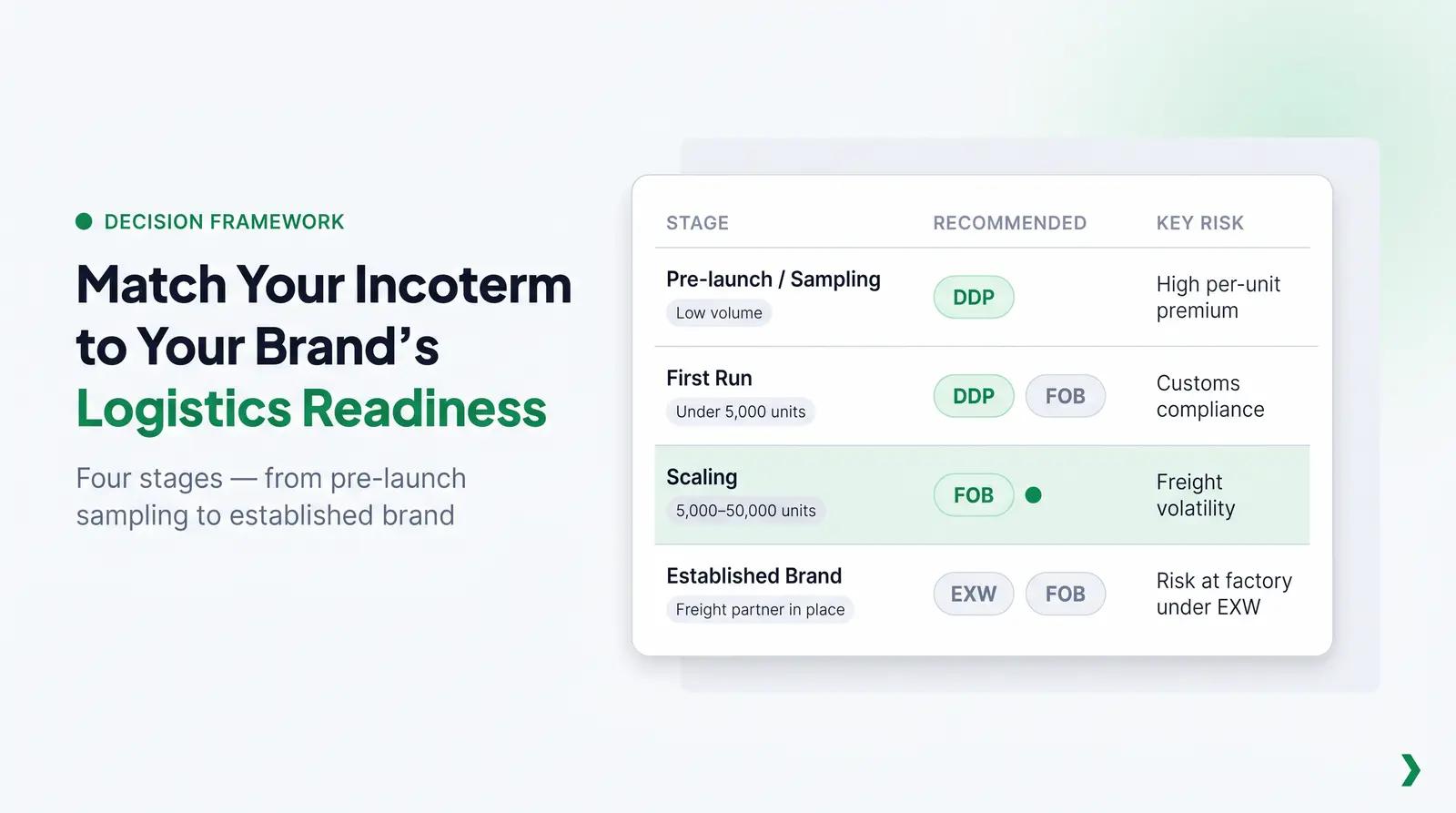
The framework we recommend at Packfolio matches freight terms to your brand's logistics readiness.
| Launch Stage | Recommended Term | Why | Key Risk to Manage |
|---|---|---|---|
| Pre-launch/sampling | DDP | Simplifies the process when volume is low and logistics infrastructure is non-existent. | High per-unit premium built into the DDP price. |
| First production run (under 5,000 units) | DDP or FOB | DDP provides cost certainty; FOB is viable if you have engaged a reliable US customs broker. | Customs compliance if the foreign seller acts as the US importer of record under DDP. |
| Scaling (5,000–50,000 units) | FOB | You gain control over freight costs and transit times, allowing for better margin optimization. | Managing ocean freight volatility and coordinating drayage from the port. |
| Established brand with freight partner | EXW or FOB | You can leverage your freight forwarder's volume discounts for origin-to-destination control. | Assuming risk of loss or damage immediately at the factory under EXW. |
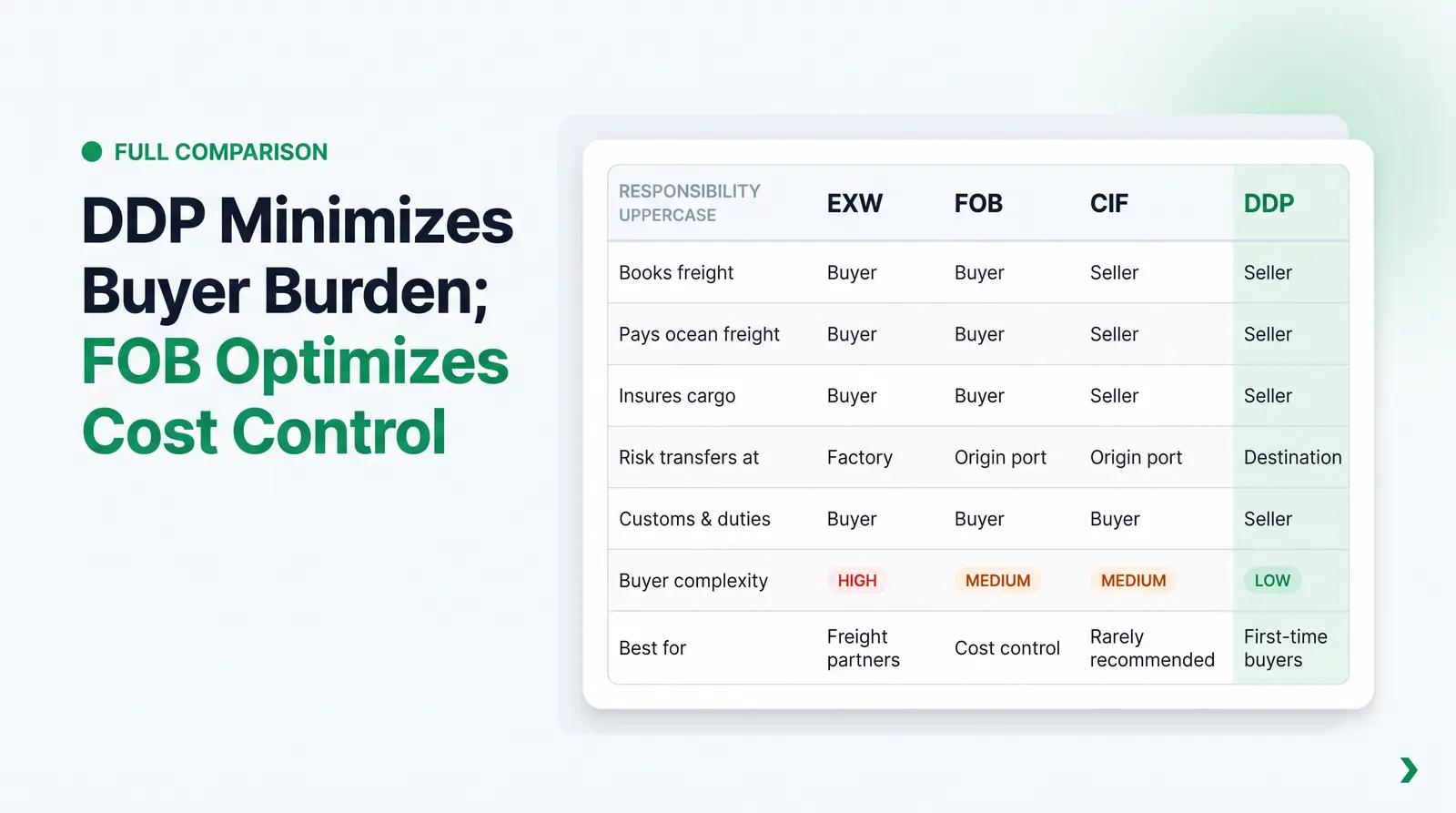
Comparison Table: EXW vs. FOB vs. CIF vs. DDP
| Responsibility | EXW | FOB | CIF | DDP |
|---|---|---|---|---|
| Who books freight | Buyer | Buyer | Seller | Seller |
| Who pays ocean freight | Buyer | Buyer | Seller | Seller |
| Who insures cargo | Buyer | Buyer | Seller | Seller |
| Risk transfers at | Factory floor | Origin port (on vessel) | Origin port (on vessel) | Final destination |
| Customs/duty responsibility | Buyer | Buyer | Buyer | Seller |
| Complexity for first-time buyer | High | Medium | Medium | Low |
| Best for | Brands with strong freight forwarders | Brands wanting freight control | Rarely recommended for fragile goods | First-time buyers wanting simplicity |
Three Non-Obvious Things Beauty Founders Get Wrong About Incoterms
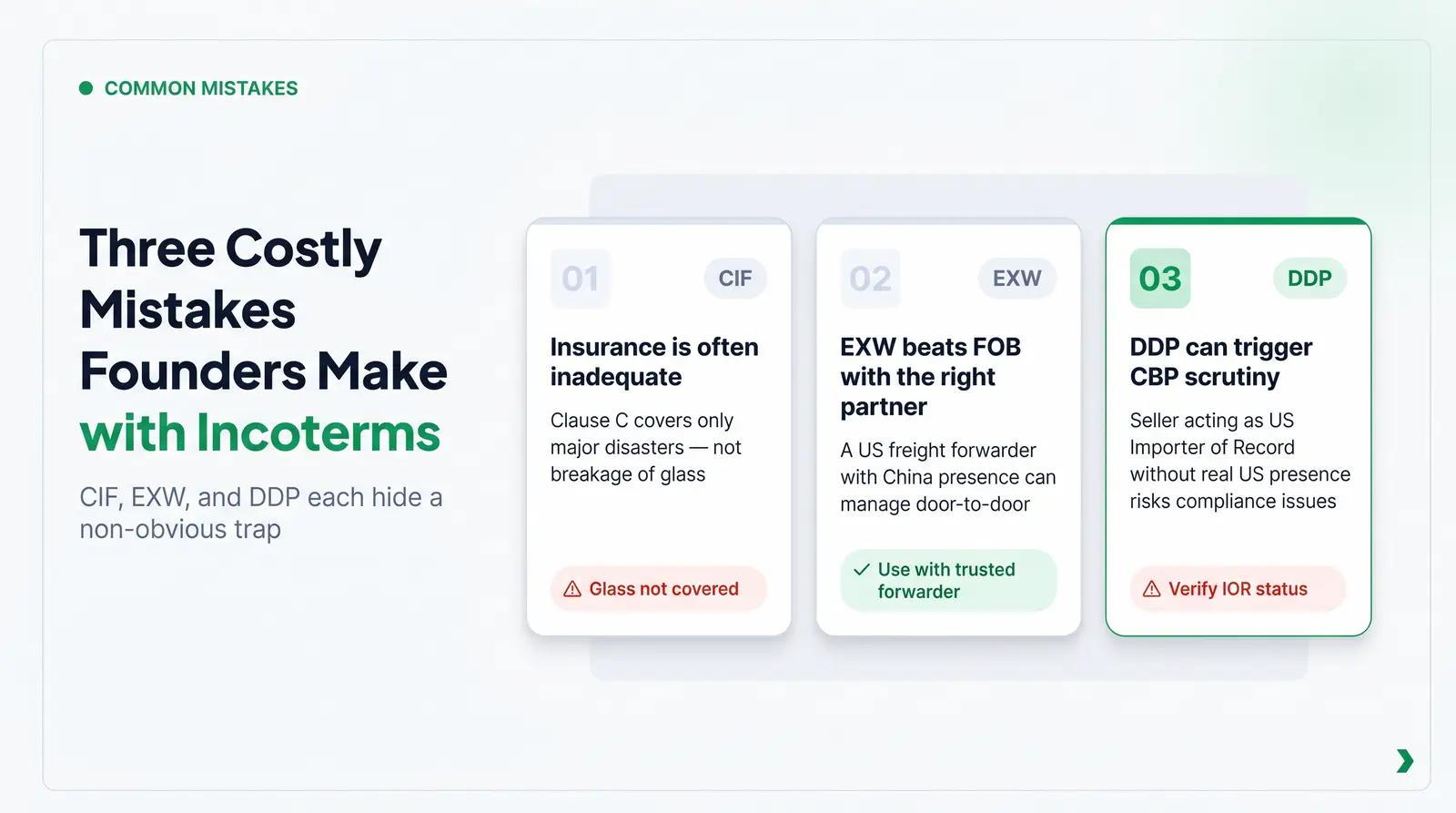
- CIF insurance is often inadequate for fragile packaging. Under Incoterms® 2020, the default insurance requirement for CIF is Institute Cargo Clauses (C) [3]. Clause C provides highly restricted, "named perils" cover, protecting against major disasters like the vessel sinking or catching fire [8]. It generally does not cover rough handling or breakage during transit. If you buy glass jars CIF, you may find that standard breakage is entirely uninsured.
- FOB is the standard, but EXW can be better if you have a partner. Conventional wisdom suggests FOB is the gold standard for first-time importers. However, if you have an established relationship with a US-based freight forwarder who has a strong presence in China, EXW allows your forwarder to manage the entire process door-to-door, potentially finding efficiencies that the factory's local trucking company misses.
- DDP can create hidden customs compliance issues. DDP sounds effortless, but it requires the foreign seller to clear US customs. If the seller acts as the Importer of Record without a real US presence, or uses a shell entity, it can trigger scrutiny from US Customs and Border Protection (CBP) [9]. Furthermore, if the supplier undervalues the invoice to reduce duties, the buyer as the ultimate consignee can still face supply chain disruptions or compliance complications if the goods are flagged [9].
The Pre-Acceptance Incoterm Checklist
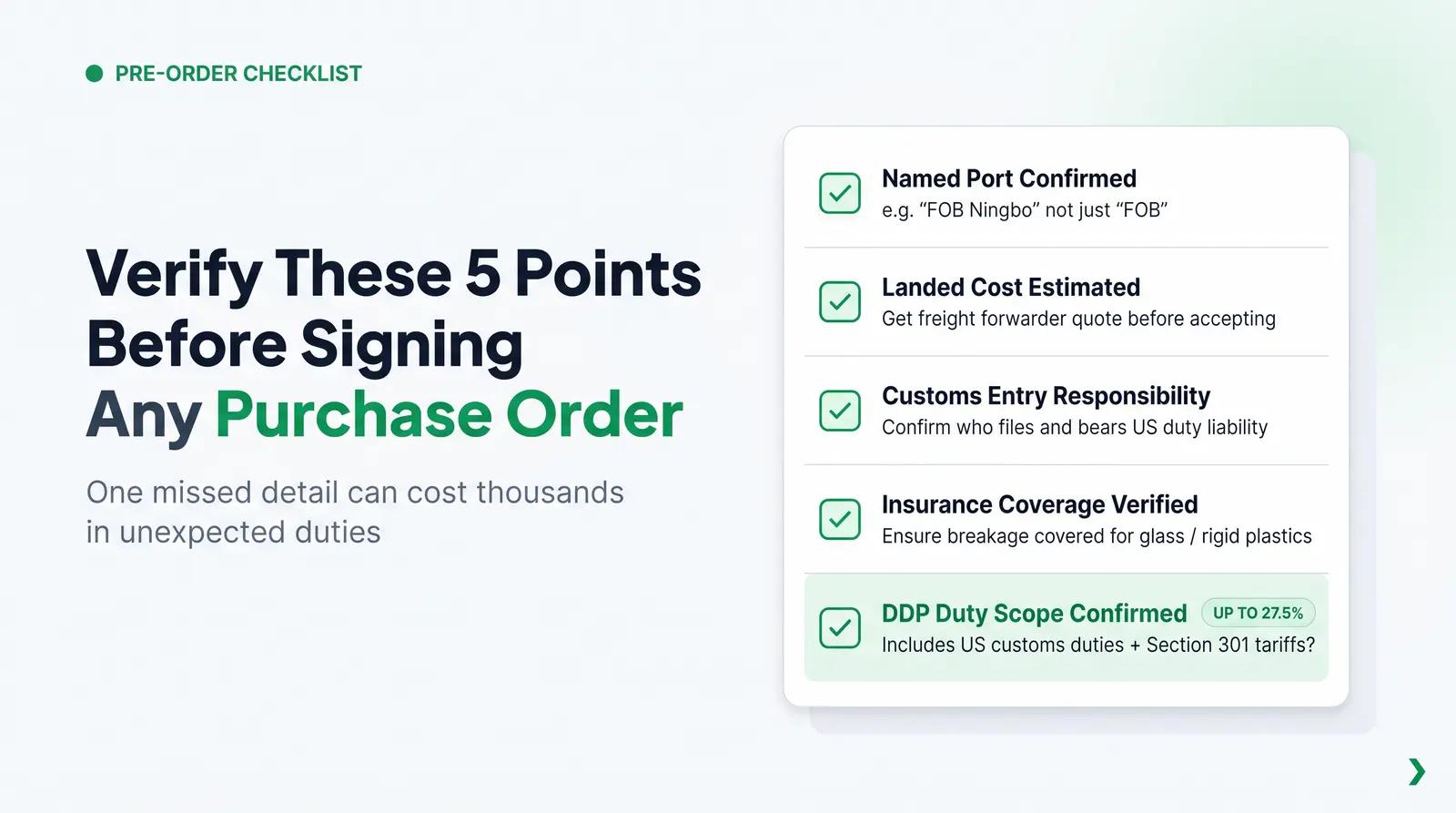
Before signing a purchase order or accepting a quote, verify these details:
- Confirm the named place or port (e.g., ensure the quote says "FOB Ningbo," not just "FOB").
- Ask your freight forwarder for a shipping estimate to calculate your true landed cost.
- Confirm exactly who is filing the customs entry and who bears the liability for US import duties.
- Verify the cargo insurance coverage level (ensure it covers breakage for glass or rigid plastics, not just catastrophic loss).
- If quoted DDP, explicitly confirm whether the price includes US customs duties and Section 301 tariffs, or only origin-side costs.
At Packfolio, we recognize that managing international freight, customs brokerage, and cargo insurance distracts founders from building their brands. We coordinate production, quality assurance, and freight delivery directly. Customers receive a single, transparent price and a delivery to their address without having to negotiate supplier freight terms, manage customs entries, or calculate landed costs separately.
Browse Packfolio's curated cosmetic packaging catalog and get a photorealistic 3D preview of your label before ordering. No freight-term negotiations required. Explore the catalog
Frequently Asked Questions
What is the difference between FOB and DDP? FOB (Free On Board) means the supplier pays to load the goods onto a ship in their country, but you pay for ocean freight, US customs duties, and final delivery. DDP (Delivered Duty Paid) means the supplier handles and pays for everything, delivering the goods directly to your door with duties cleared.
Do I have to pay import duties if my quote says FOB? Yes. Under FOB terms, the buyer is responsible for all costs once the goods are loaded onto the vessel, which includes paying US import duties and customs broker fees when the goods arrive in the United States.
Why is my DDP quote so much higher than the EXW price? The EXW price only covers the cost of manufacturing the empty packaging. The DDP quote includes the unit price plus origin trucking, export clearance, ocean freight, cargo insurance, US import duties (which can be up to 27.5% for Chinese glass), customs brokerage, and final delivery to your warehouse.
Is cargo insurance required for ocean freight? Insurance is only strictly required by the Incoterms rules under CIF and CIP. However, it is highly recommended to purchase comprehensive "All Risks" (Institute Cargo Clauses A) insurance for all ocean shipments, especially for fragile cosmetic packaging, regardless of the Incoterm used.
How do I find the duty rate for my cosmetic packaging? You must determine the Harmonized Tariff Schedule (HTS) code for your specific packaging material and use. For example, glass cosmetic bottles often fall under HTS 7010.90.20. You can then look up the base duty rate and any applicable Section 301 tariffs on the official USITC website.
References
[1] Incoterms® 2020, International Chamber of Commerce, 2020, https://iccwbo.org/business-solutions/incoterms-rules/incoterms-2020/ [2] What Does EXW, FOB & DDP Mean? A Detailed Incoterms Guide, Silq, 2025, https://www.onesilq.com/blog/what-does-exw-fob-ddp-mean-a-detailed-incoterms-guide [3] Incoterms® 2020: CIP or CIF?, ICC Academy, 2024, https://academy.iccwbo.org/incoterms/article/incoterms-2020-cip-or-cif/ [4] Shipping from China to the United States, Freightos, 2026, https://www.freightos.com/shipping-routes/shipping-from-china-to-the-united-states/ [5] The tariff classification of glass bottles from China (NY N279582), U.S. Customs and Border Protection, 2016, https://www.customsmobile.com/rulings/docview?doc_id=NY%20N279582&highlight=7010.90.2040%2A [6] Comments for the Notification of Potential Termination of Actions under Section 301, Glass Packaging Institute, 2022, https://www.gpi.org/sites/default/files/content-files/Testimony/JULY%205%2C%202022%20GPI%20Comments_In_Support_of_25__Tariff.pdf [7] Customs Clearance Pricing and Rates, Clearit USA, 2026, https://clearitusa.com/customs-clearance-pricing-rates/ [8] Institute Cargo Clauses A, B and C Differences, James Hallam, 2024, https://jameshallam.co.uk/institute-cargo-clauses-a-b-c/ [9] To DDP or Not to DDP? That is the Question, Mohawk Global, 2024, https://mohawkglobal.com/trade-translation/to-ddp-or-not-to-ddp-that-is-the-question/


