
Cosmetic Label Generator: What It Should Check Before You Print
A cosmetic label generator handles design but not FDA compliance. This 8-check pre-print checklist verifies INCI order, font sizes, net quantity placement, warnings, and MoCRA requirements.
Launching a beauty brand requires a balance of art and science. Founders spend months refining formulas, testing textures, and selecting primary packaging. When it comes to the label, the temptation is to focus entirely on aesthetics.
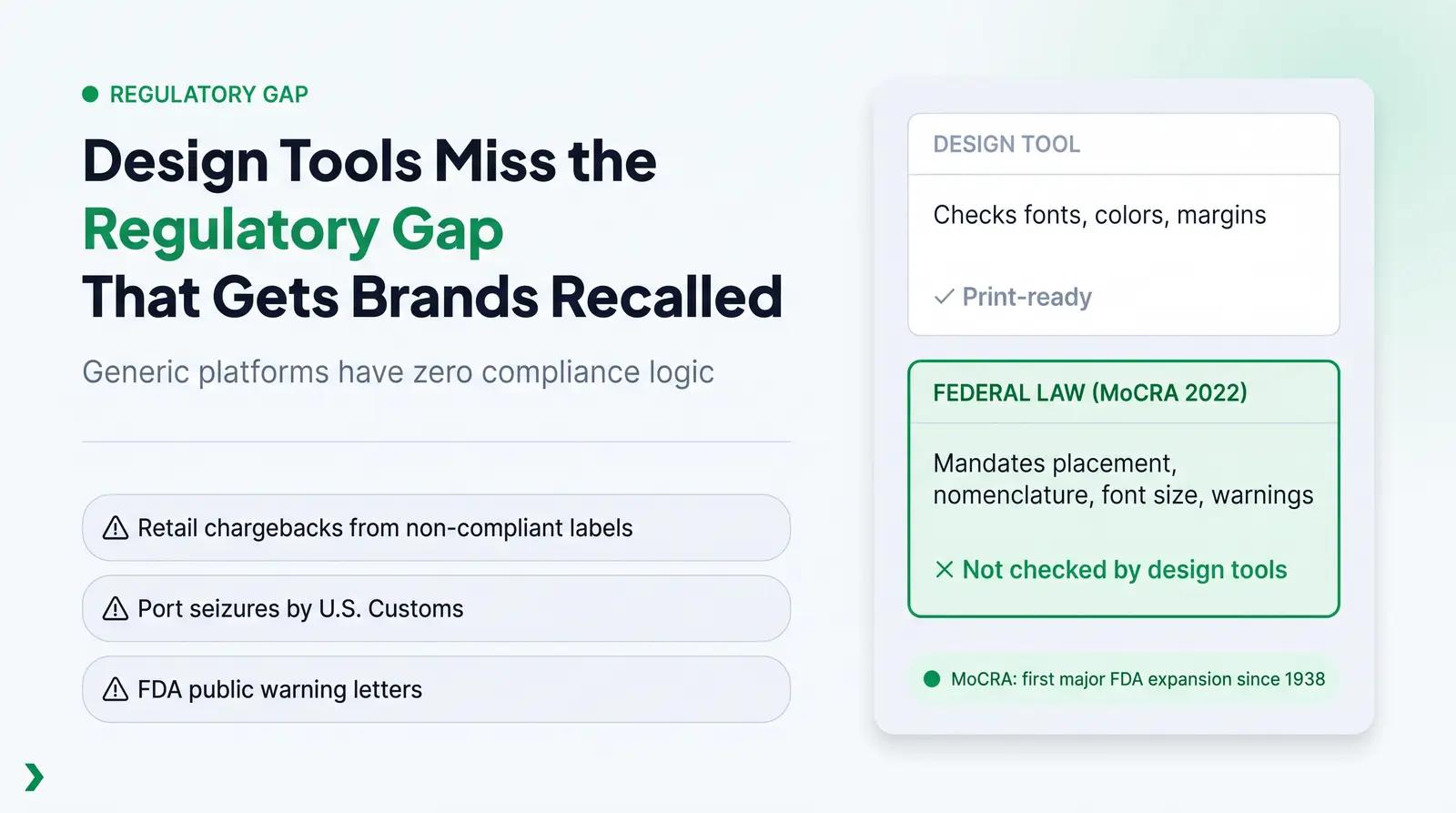
Generic design tools make it easy to create beautiful layouts. However, a visually stunning label can still be completely illegal under federal law.
A standard cosmetic label generator handles fonts, colors, and margins. It does not check if your text meets federal font size minimums. It does not verify if your ingredient list uses official nomenclature. It cannot tell you if your net quantity statement is placed in the correct location.
For modern beauty brands, the stakes of labeling errors are higher than ever. Misbranded products can lead to retail chargebacks, seized port shipments, and public warning letters.
A compliant label is not just a regulatory hurdle. It is the protective shield that stands between your inventory and a costly recall.
Why Most Label Generators Stop Too Early
Most online design platforms are built for visual layout, not regulatory compliance. They operate under a simple assumption: if the design fits on the screen, it is ready to print.
This gap between graphic design and federal law is where many independent beauty brands run into trouble.
In the United States, cosmetic labeling is governed by the Federal Food, Drug, and Cosmetic Act [1] and the Fair Packaging and Labeling Act [3]. These laws establish strict rules for what must appear on a package, how it must be written, and exactly where it must be placed.
A generic label maker cannot evaluate these rules. It will happily let you print a label with missing warnings, incorrect units, or illegible text.
The regulatory landscape became even more demanding with the passage of the Modernization of Cosmetics Regulation Act of 2022, known as MoCRA [2]. This legislation represents the most significant expansion of the authority of the Food and Drug Administration to regulate cosmetics since 1938.
Under MoCRA, the FDA has the power to order mandatory product recalls if a cosmetic is misbranded or adulterated and poses a safety risk [2].
MoCRA also introduced the concept of the "responsible person" [2]. This is the manufacturer, packer, or distributor whose name appears on the product label.
The responsible person is legally liable for ensuring product safety, maintaining safety substantiation records, and reporting serious adverse events to the FDA within 15 business days [2].
If your brand name is on the label, you are the responsible person. You carry the personal and professional liability for any compliance failures.
The financial consequences of a labeling error can be devastating for an emerging brand. Major beauty retailers like Sephora and Target enforce strict vendor compliance policies.
If a shipment arrives at their distribution centers with non-compliant labels, the retailer may issue severe financial penalties, known as chargebacks, or reject the entire shipment outright.
For international brands, U.S. Customs and Border Protection regularly detains imported cosmetics that fail to meet FDA labeling guidelines, leading to costly storage fees or product destruction.
What the FDA Actually Requires on a Cosmetic Label
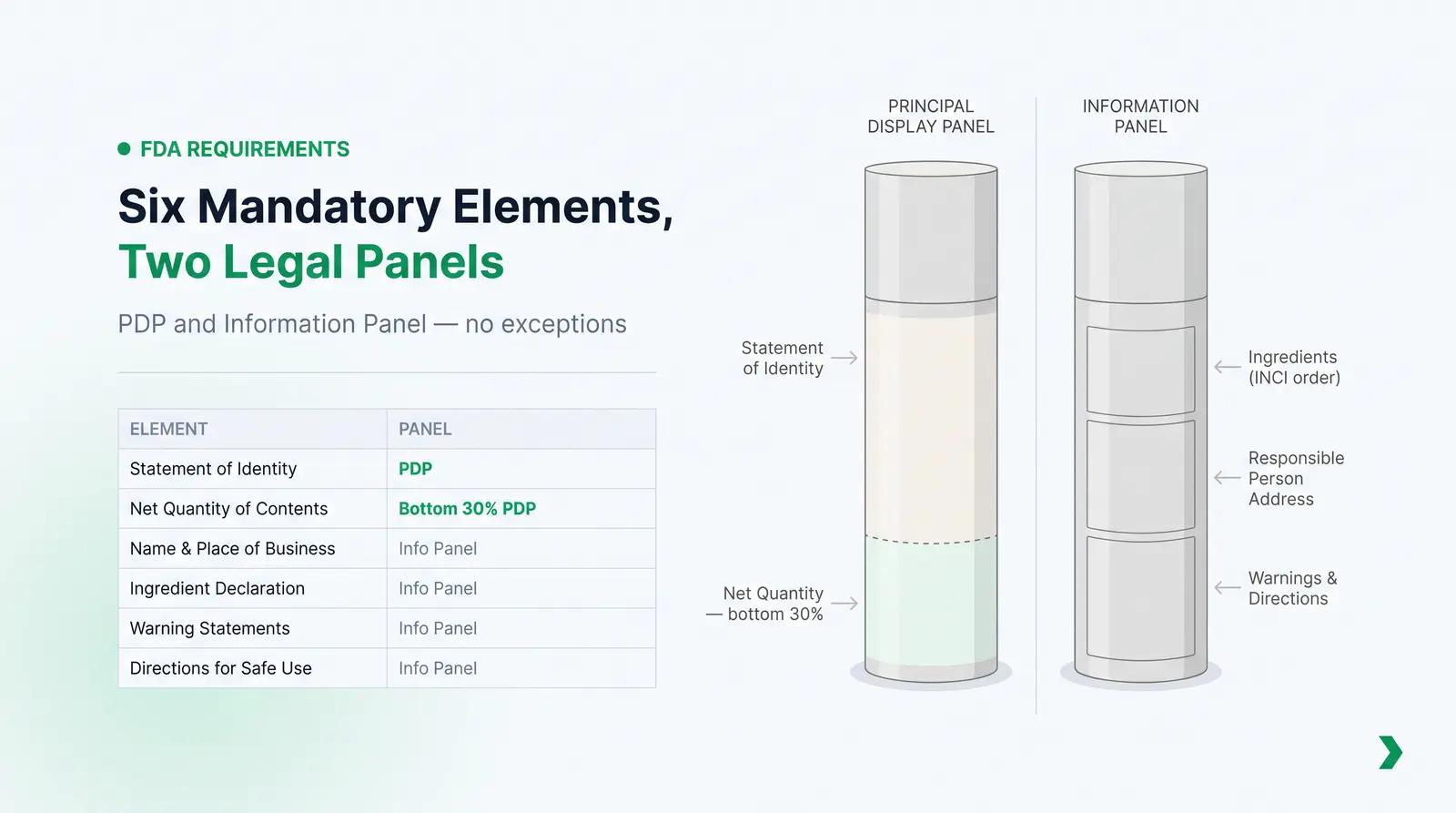
To build a compliant label, you must understand the specific components required by federal law. The FDA divides a cosmetic package into two primary areas: the Principal Display Panel and the Information Panel [3].
The Principal Display Panel, or PDP, is the part of the label most likely to be displayed or examined by consumers under customary conditions of retail sale [1] [3]. On a standard bottle or jar, this is the front face of the packaging.
The Information Panel refers to any other panel of the label, typically the back or sides, where detailed technical information is presented [3].
Federal regulations under 21 CFR Part 701 mandate that specific information must appear on these panels [1]. The table below outlines the core mandatory elements and their legal locations.
| Mandatory Label Element | Legal Basis (21 CFR) | Required Location |
|---|---|---|
| Statement of Identity | 21 CFR 701.11 | Principal Display Panel (PDP) |
| Net Quantity of Contents | 21 CFR 701.13 | Bottom 30% of the PDP |
| Name and Place of Business | 21 CFR 701.12 | Information Panel (or PDP) |
| Ingredient Declaration | 21 CFR 701.3 | Information Panel (or PDP) |
| Warning Statements | 21 CFR 740 | Prominent on Information Panel |
| Directions for Safe Use | 21 CFR 701.2 | Prominent on Information Panel |
The Statement of Identity must clearly identify the nature of the cosmetic product [3]. This is typically expressed as the common or usual name of the product, such as "facial moisturizer" or "body wash." It cannot be obscured by brand names or marketing claims.
The Net Quantity of Contents must express the accurate weight or measure of the product in the package [3]. This statement must be distinct, placed in the bottom 30% of the PDP, and run generally parallel to the base of the container [3].
The Name and Place of Business must state the street address, city, state, and ZIP code of the responsible person [3]. If the listed entity is not the actual manufacturer, the name must be preceded by a qualifying phrase such as "Distributed by" or "Manufactured for" [3].
The Ingredient Declaration must list every ingredient in the formula in descending order of predominance [1]. Ingredients present at concentrations of 1% or less, as well as color additives, may be listed at the end of the declaration in any order [1].
Warning Statements are legally required on certain categories of cosmetics, such as aerosols and bubble baths, or when the safety of the product has not been fully substantiated [3]. These warnings must be highly conspicuous to prevent consumer misuse [3].
The Label Compliance Checklist: 8 Checks a Good Workflow Runs Automatically
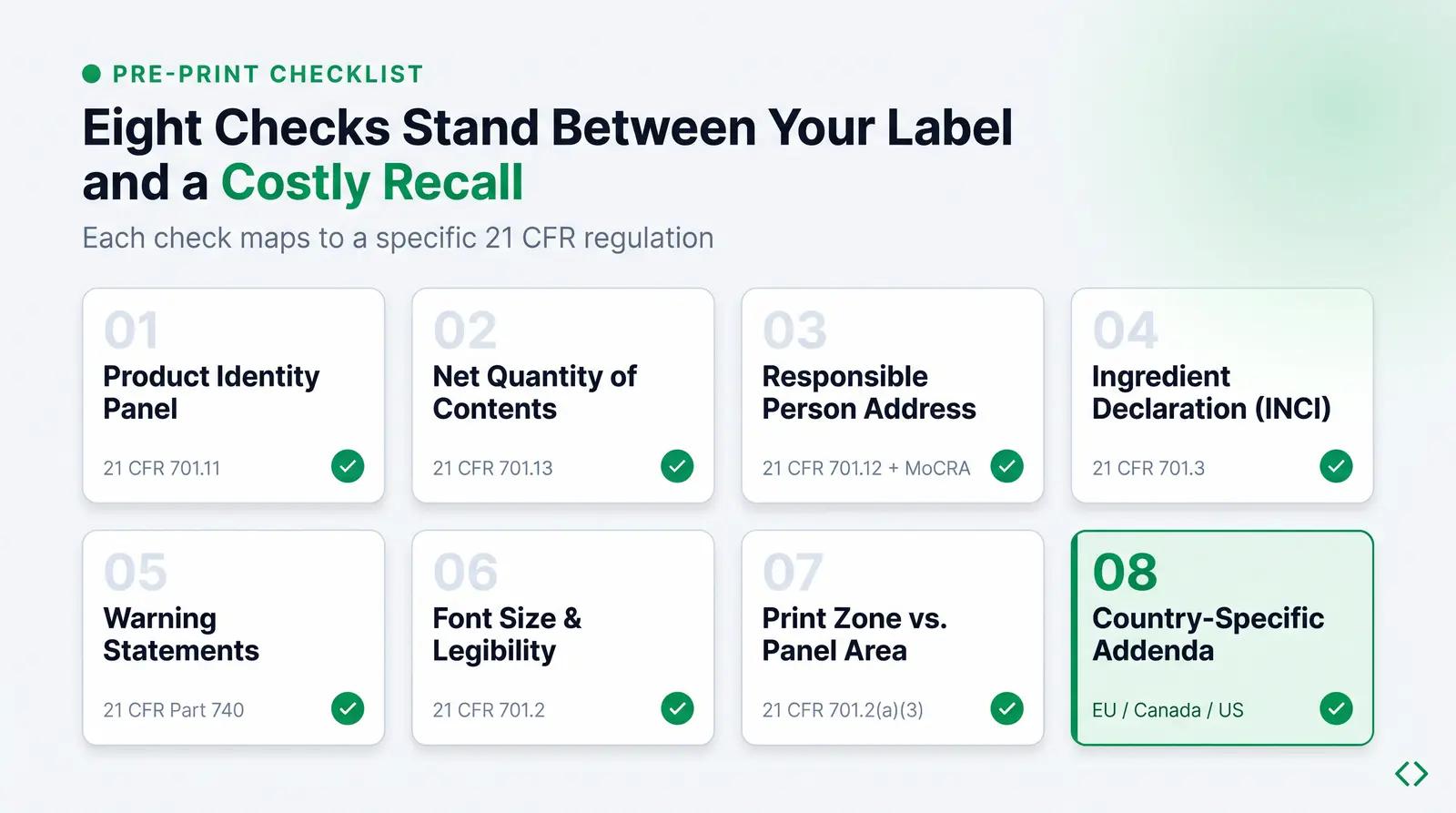
To bridge the gap between design and law, we recommend implementing a structured verification process. The Pre-Print Label Compliance Checklist is a practical framework we recommend at Packfolio for any brand moving from formula to finished packaging.
This checklist consists of eight automated or manual checks that verify every element of your label before it goes to the printing press.
Check 1: Product Identity Panel
The product identity check verifies that the Statement of Identity is prominent, easy to read, and correctly positioned on the Principal Display Panel [3].
- The Rule: The Statement of Identity must appear on the PDP in a bold, reasonably sized font, running parallel to the base of the package [3]. It must use the common name of the product, a descriptive phrase, or an illustrative graphic that makes the product's use immediately clear to a consumer [3].
- Regulatory Basis: 21 CFR 701.11 [1].
- Common Mistake: Founders often use highly creative, fanciful names without including the actual product identity. For example, labeling a product solely as "Ocean Breeze" instead of "Ocean Breeze Body Lotion" makes the product technically misbranded.
Check 2: Net Quantity of Contents
The net quantity check ensures that the weight or volume statement is accurate, uses the correct units, and is placed in the legally mandated zone [3].
- The Rule: The net quantity must be expressed in U.S. customary units, such as fluid ounces for liquids or avoirdupois ounces for solids [3]. Metric units, like milliliters or grams, are permitted and highly recommended, but they must appear in parentheses next to the U.S. units [3]. The declaration must be placed within the bottom 30% of the PDP, in a type size determined by the total surface area of the PDP [3].
- Regulatory Basis: 21 CFR 701.13 [1].
- Common Mistake: Many brands place the net weight at the very top of the bottle or omit U.S. customary units entirely, using only metric units. Another frequent error is using "oz" for liquids instead of "fl. oz." or "fluid oz."
Check 3: Responsible Person / Distributor Address
This check verifies that the contact information on the label is complete and complies with MoCRA requirements [2].
- The Rule: The label must state the name and business address of the manufacturer, packer, or distributor [3]. Under MoCRA, this address must include a domestic street address, city, state, and ZIP code, or a domestic telephone number or electronic contact information through which the responsible person can receive adverse event reports [2]. If the product is imported, the country of origin must be clearly stated in English [3].
- Regulatory Basis: 21 CFR 701.12 [1] and FD&C Act Section 609(a) [2].
- Common Mistake: Omiting the street address. The FDA only allows the omission of the street address if the business is listed in a current city or telephone directory under that exact name [3]. Since physical phone books are obsolete, modern brands must list their full physical address or provide the MoCRA-compliant digital contact option.
Check 4: Ingredient Declaration (INCI Order)
The ingredient check verifies that every raw material is declared using its official International Nomenclature Cosmetic Ingredient name, known as the INCI name, and sorted in the correct regulatory order [1].
- The Rule: Ingredients must be listed in descending order of predominance by weight down to 1% [1]. Any ingredient present at 1% or less can be listed in any order at the end [1]. Color additives must be listed at the end of the deck, regardless of concentration, using their FDA-approved names, such as "Red 40" or "Titanium Dioxide" [1]. Fragrances and flavors can be declared simply as "Fragrance" or "Flavor" [1].
- Regulatory Basis: 21 CFR 701.3 [1].
- Common Mistake: Listing ingredients by their common or trade names, such as "water" instead of "Water (Aqua)" or "shea butter" instead of "Butyrospermum Parkii (Shea) Butter." Another common error is listing active ingredients at the very top of a cosmetic ingredient list when they are present at less than 1% concentration.
Check 5: Warning Statements
This check evaluates whether the product formula or category requires specific cautionary text to protect consumer safety [3].
- The Rule: Certain product categories must carry specific, federally mandated warnings [3]. For example, cosmetic aerosols must warn against spraying in eyes, puncture, incineration, and high temperatures [3]. If a cosmetic product's safety has not been fully substantiated through testing or historical data, it must carry this exact warning on its PDP: "Warning: The safety of this product has not been determined" [3].
- Regulatory Basis: 21 CFR Part 740 [1].
- Common Mistake: Failing to include the safety substantiation warning when a formula has not undergone formal safety testing. Another error is failing to use the exact, legally required phrasing for category-specific warnings, which can lead to immediate misbranding charges.
Check 6: Font Size and Legibility Minimums
The legibility check ensures that all required regulatory text is large enough to be easily read by an average consumer at the point of purchase [1] [3].
- The Rule: All mandatory information on a cosmetic label must appear with such prominence and conspicuousness that it is likely to be read under normal conditions of purchase [1]. The FDA enforces a strict minimum font height of 1/16 of an inch for the ingredient declaration and other mandatory information [3]. If the total package surface available for labeling is less than 12 square inches, the minimum font height may be reduced to 1/32 of an inch [3].
- Regulatory Basis: 21 CFR 701.2 and 701.3(b) [1].
- Common Mistake: Using extremely small, light-colored fonts on a busy or low-contrast background to maintain a minimalist design. Even if the text is technically present, if the contrast is poor or the font size is below the 1/16-inch threshold, the label is non-compliant.
Check 7: Print Zone vs. Physical Panel Area
This check bridges the gap between digital graphic design and the physical realities of three-dimensional packaging.
- The Rule: The printable region of a label must be carefully calibrated to the physical dimensions of the primary container. The design must account for the curvature of the bottle, the neck taper, the label overlap seam, and the safety bleed zones.
- Regulatory Basis: 21 CFR 701.2(a)(3), which prohibits the failure of a label to extend over a sufficient area of the container to provide space for required information [1].
- Common Mistake: Designing a flat label in a software tool that looks perfectly readable, but when printed and wrapped around a small dropper bottle, the text wraps too far around the curve, hiding mandatory ingredient or warning information from direct view.
Check 8: Country-Specific Addenda for International Brands
For brands selling in multiple global markets, this check identifies critical regulatory differences between the United States, Canada, and the European Union.
- The Rule: If you plan to sell your products internationally, a single U.S.-compliant label will not suffice. The European Union requires a registered European Responsible Person, a Product Information File, and CPNP notification [5]. Furthermore, the EU requires the individual disclosure of specific fragrance allergens in the ingredient list if they exceed 0.001% in leave-on products or 0.01% in rinse-off products [6]. Health Canada requires fully bilingual labeling in English and French, as well as the submission of a Cosmetic Notification Form within 10 days of first sale [7].
- Regulatory Basis: EU Cosmetics Regulation EC 1223/2009 [5] and Canadian Cosmetic Regulations C.R.C., c. 869 [7].
- Common Mistake: Exporting standard U.S. inventory to Canada or Europe without updating the label. This often leads to immediate customs detentions because the labels lack French translation or fail to disclose the required fragrance allergens.
A Worked Example: Labeling a 1 oz (30 ml) Vitamin C Serum for US Retail
To see how these rules apply in practice, let us walk through a realistic scenario. Imagine an independent beauty brand launching a high-performance Vitamin C Serum packaged in a standard 1 oz (30 ml) amber glass dropper bottle.
The brand plans to sell the product directly to consumers online and eventually pitch the formula to major retailers like Sephora.
The formula contains 15% L-ascorbic acid, a popular and highly effective form of Vitamin C. The complete ingredient deck consists of 12 ingredients: Water, L-Ascorbic Acid, Ethoxydiglycol, Glycerin, Propylene Glycol, Laureth-23, Tocopherol, Ferulic Acid, Panthenol, Triethanolamine, Sodium Hyaluronate, and Phenoxyethanol.
Let us apply the Pre-Print Label Compliance Checklist to this specific product.
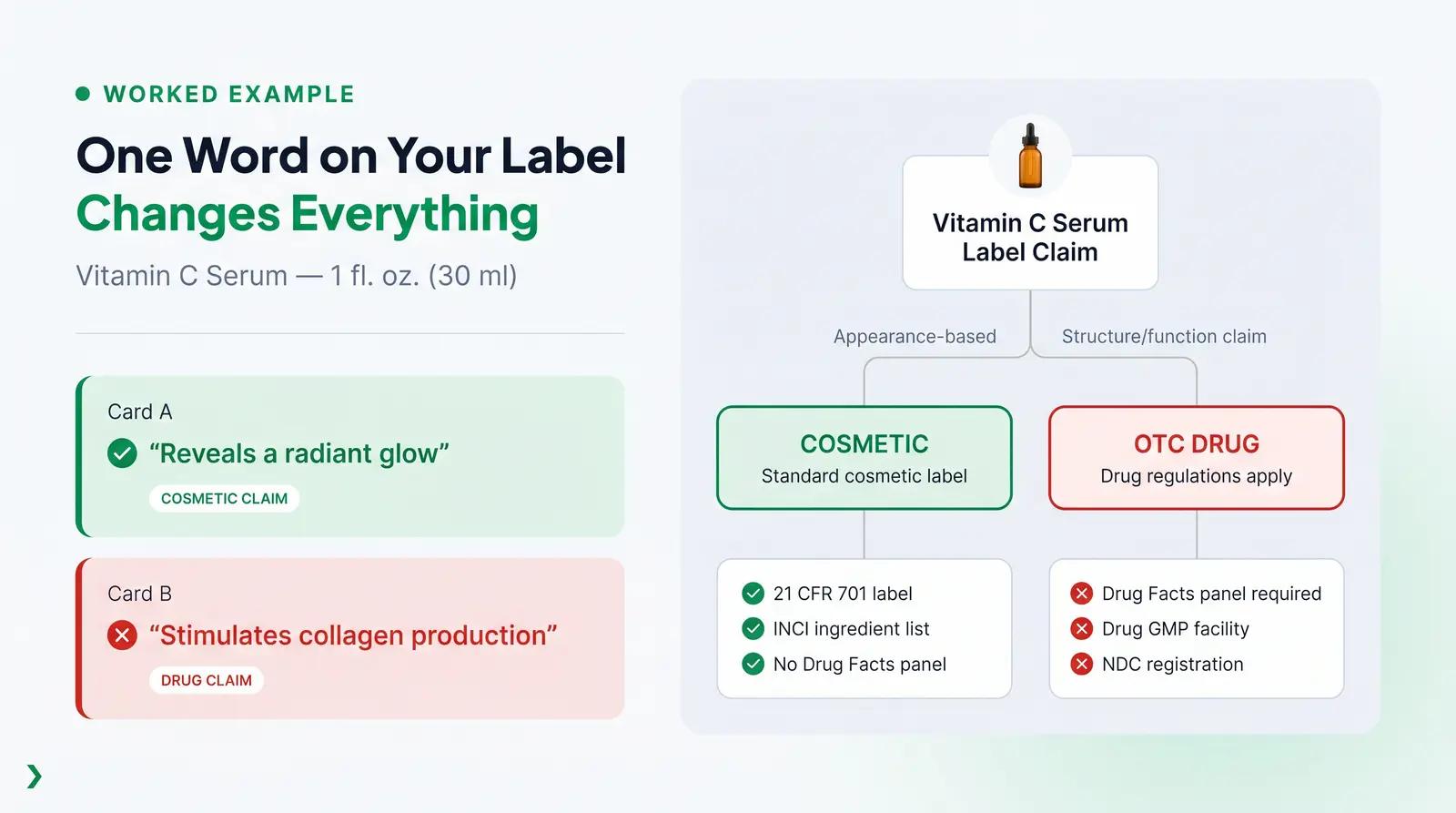
First, we must evaluate a critical regulatory decision point: does this product qualify as a cosmetic, a drug, or both? The answer depends entirely on the product's intended use, which is established by its label claims and ingredient marketing [9].
L-ascorbic acid is a potent antioxidant. If the label states "brightens skin tone" or "improves the appearance of fine lines," these are cosmetic claims because they describe beautifying or altering the appearance [9].
However, if the label claims "treats hyperpigmentation," "heals acne scars," or "stimulates collagen production to rebuild skin structure," these are drug claims [9].
Under the FD&C Act, articles intended to affect the structure or function of the body are classified as drugs [9].
If the brand makes structure-function claims, the Vitamin C serum becomes a combination drug-cosmetic. It would then be subject to the much stricter regulations governing Over-the-Counter drugs [9].
This includes manufacturing in a drug-registered facility under drug GMPs, registering the product listing with a National Drug Code, and formatting the label with a standard "Drug Facts" panel [9].
For our worked example, the brand chooses to keep the product classified strictly as a cosmetic. They carefully draft their marketing copy to focus on cosmetic benefits, using phrases like "reveals a radiant glow" and "smooths the appearance of skin texture."
Now, let us apply the remaining checklist checks to the physical label design:
- Identity Check: The front label must feature the brand name, the product name, and the clear Statement of Identity. The brand selects "C-Glow Serum" as the product name. To comply with Check 1, they place the phrase "Vitamin C Facial Serum" in bold, prominent type directly beneath the product name, running parallel to the bottle's base.
- Net Quantity Check: The bottle holds 1 oz (30 ml) of liquid. To comply with Check 2, the brand must place the net quantity statement in the bottom 30% of the front label. The correct format is: "1 fl. oz. (30 ml)" or "Net Contents 1 fl. oz. (30 ml)." Note that liquids use "fl. oz." not "Net Wt.", which is reserved for solids. The text must run parallel to the base of the bottle.
- Responsible Person Check: On the back label, the brand must list the name and address of their business. Since they use a contract manufacturer, they use the qualifying phrase: "Distributed by: Glow Botanicals LLC, 123 Beauty Lane, Suite A, Los Angeles, CA 90012."
- Ingredient Declaration Check: The ingredients must be listed in descending order of predominance. Since Water, L-Ascorbic Acid, Ethoxydiglycol, and Glycerin are present at concentrations above 1%, they must be listed first in exact order of weight. Ferulic Acid, Tocopherol, Panthenol, Sodium Hyaluronate, and Phenoxyethanol are present at less than 1%, so they can be listed in any order at the end of the deck. The brand writes the INCI-compliant list: "Ingredients: Water (Aqua), Ascorbic Acid, Ethoxydiglycol, Glycerin, Propylene Glycol, Laureth-23, Phenoxyethanol, Tocopherol, Triethanolamine, Ferulic Acid, Panthenol, Sodium Hyaluronate."
- Warning Statements Check: Because the formula contains a high concentration of L-ascorbic acid, which has a low pH and can cause mild irritation on sensitive skin, the brand includes a voluntary warning and usage directions on the back panel: "Directions: Apply 3 to 5 drops to clean skin in the morning. Follow with moisturizer and sunscreen. Caution: For external use only. Avoid direct contact with eyes. Discontinue use if irritation occurs."
- Font Size Check: A standard 1 oz dropper bottle has a very small printable surface area, typically around 3.5 inches wide by 1.75 inches high. The total label area is under 12 square inches. Under Check 6, the brand is permitted to reduce the font size of the ingredient list to 1/32 of an inch in height, but they must ensure the text remains sharp, high-contrast, and highly legible.
The Contrarian Case: Minimalist Labels Are Harder to Make Compliant
There is a widely held assumption in beauty branding that a clean, minimalist label is the safest design choice. Fewer elements on the label means less risk of errors, the thinking goes.
The opposite is often true.
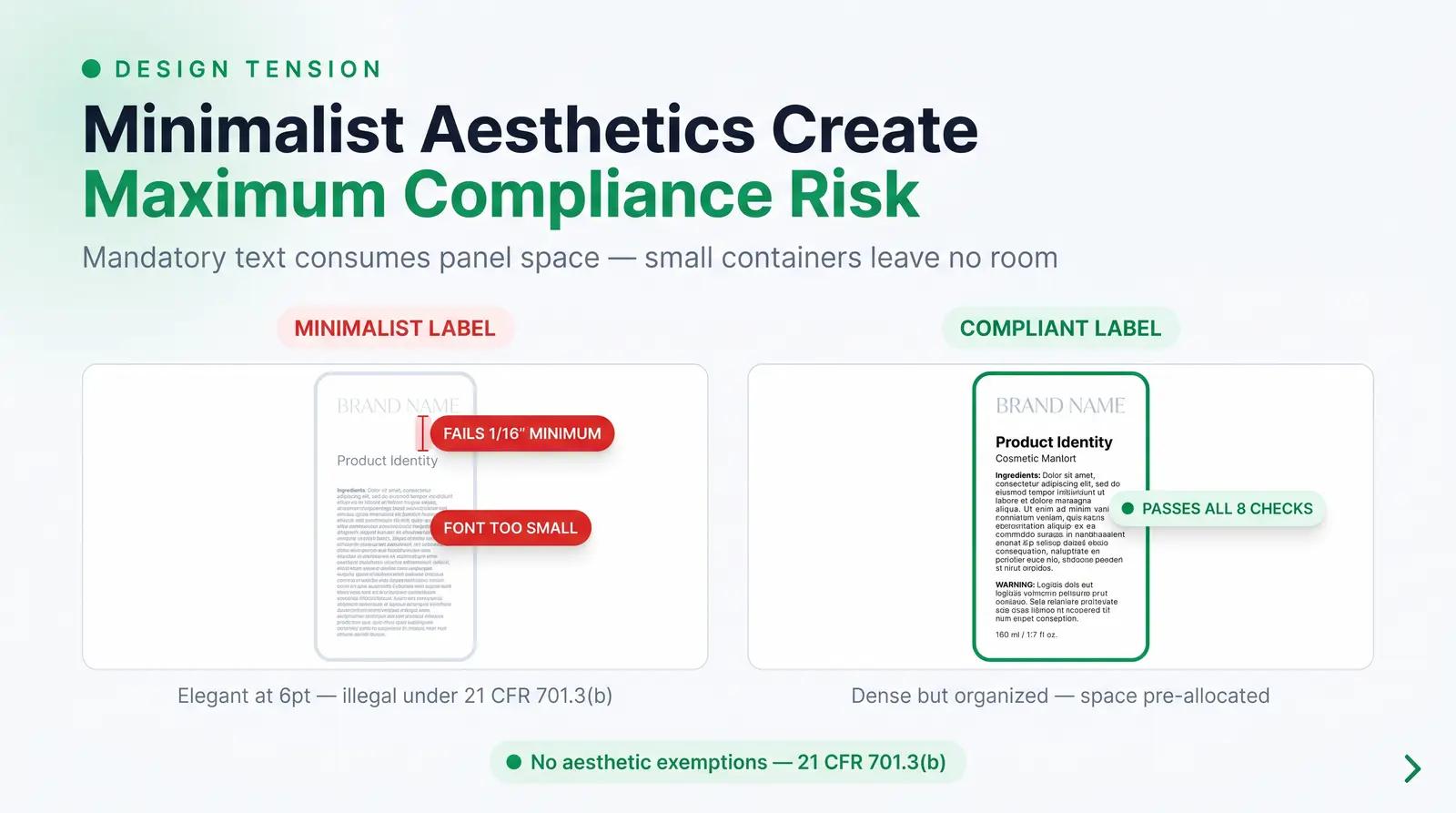
A minimalist label creates a design tension that is difficult to resolve legally. The FDA's font size minimums, the mandatory placement zones for the net quantity statement, the ingredient declaration, and the responsible person address all require a certain amount of dedicated panel space. On a small container, such as a 0.5 oz (15 ml) lip balm tube or a 1 oz (30 ml) serum bottle, the required regulatory text can consume a significant portion of the available label area.
When a founder commits to a minimalist aesthetic, they often reduce the size of the required text to preserve white space. This is where labels fail. A font that is visually elegant at 6pt may measure well below the 1/16-inch height threshold required by 21 CFR 701.3(b) [1]. The FDA does not grant aesthetic exemptions.
The practical implication is significant. A label with dense, well-organized regulatory text is often easier to make compliant than a sparse, design-forward layout, because the dense label has already allocated space for the required elements. The minimalist label has not.
This tension is compounded by a retailer-driven trend that goes beyond federal minimums. Sephora's 2023 Public Chemicals Policy requires all Clean at Sephora brands to disclose the 24 EU-defined fragrance allergens on their product pages, and the policy strongly encourages full fragrance ingredient disclosure down to 100 ppm for all brands by 2030 [8].
This means a label that uses "Fragrance" as a single INCI declaration is technically compliant under current U.S. federal law [1], but it may cost a brand placement in Sephora's Clean program or require additional digital disclosure on the retailer's website [8]. Compliance-minimum labeling and retail-ready labeling are not always the same thing.
Comparison: Generic Label Tools vs. a Compliance-Aware Label Workflow
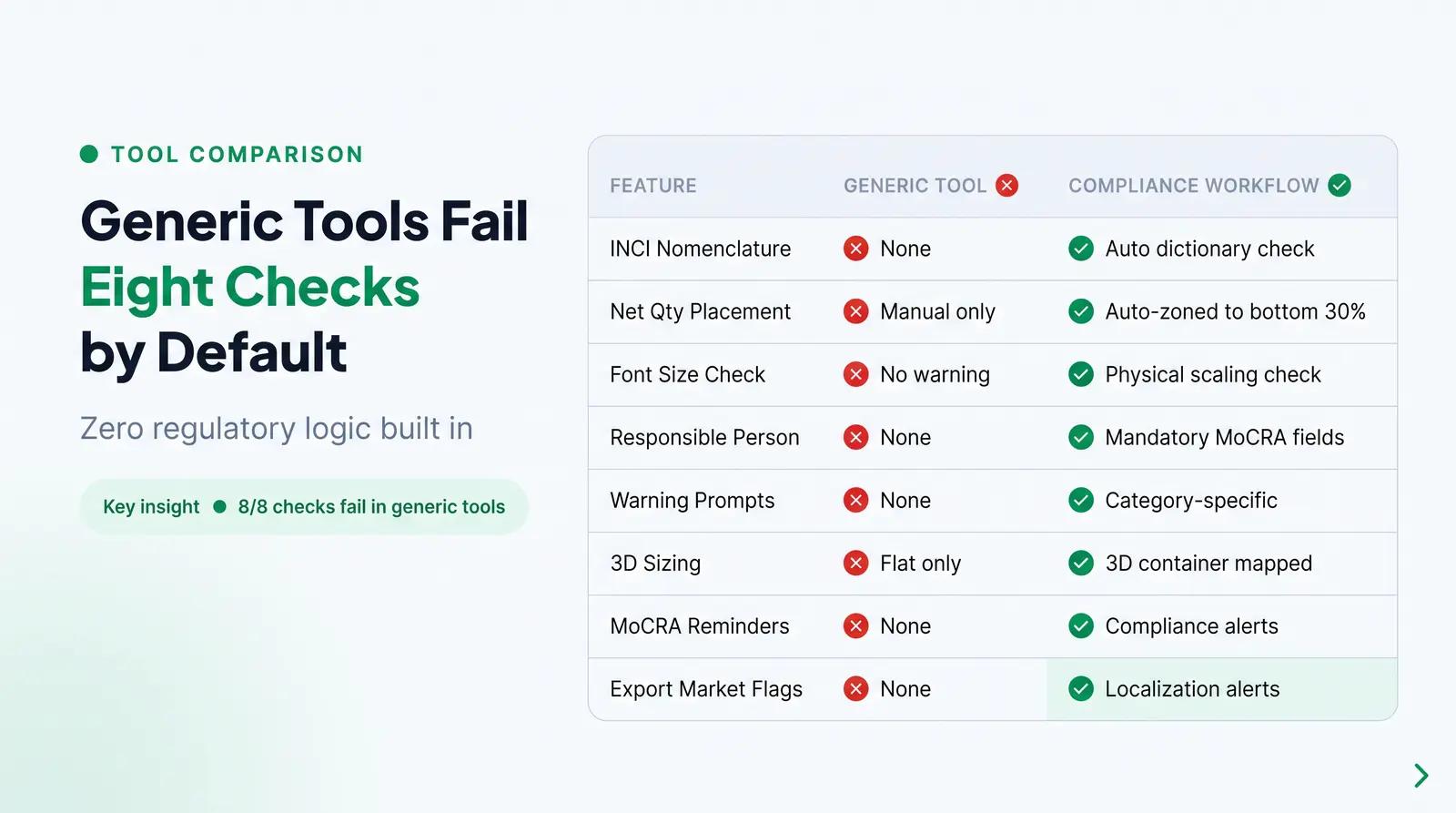
When choosing a tool to generate or verify your packaging artwork, it is helpful to compare the capabilities of standard graphic design platforms against a compliance-aware label workflow.
The table below outlines how these two approaches handle critical regulatory and physical design requirements.
| Feature | Generic Design Tool (e.g., Canva) | Compliance-Aware Label Workflow |
|---|---|---|
| INCI Nomenclature Check | None. Accepts any text input, including incorrect or trade names. | Automated dictionary check. Flags non-standard ingredient names. |
| Net Quantity Placement | Manual placement. No warnings if placed in the wrong zone. | Automated zoning. Restricts net quantity text to the bottom 30% of the PDP. |
| Font Size Enforcement | Standard point sizes. No warning if font height falls below 1/16 inch. | Physical scaling check. Flags if text height is illegal for the container size. |
| Responsible Person Prompts | None. Up to the designer to remember to include contact details. | Mandatory fields. Prompts for MoCRA-compliant address or digital contact. |
| Warning Statement Prompts | None. No guidance on required cautionary text. | Category-specific prompts. Suggests warnings based on product type. |
| Physical Sizing Calibration | Flat dimensions only. Does not account for bottle curvature or seams. | 3D mapping. Aligns artwork directly to the printable regions of the SKU. |
| MoCRA Registration Reminder | None. No awareness of federal facility registration rules. | Compliance alerts. Reminds brands of biennial facility registration updates. |
| Export Market Flagging | None. No awareness of international regulatory differences. | Localization alerts. Flags missing bilingual text or EU fragrance allergens. |
What to Do After Your Label Passes All 8 Checks
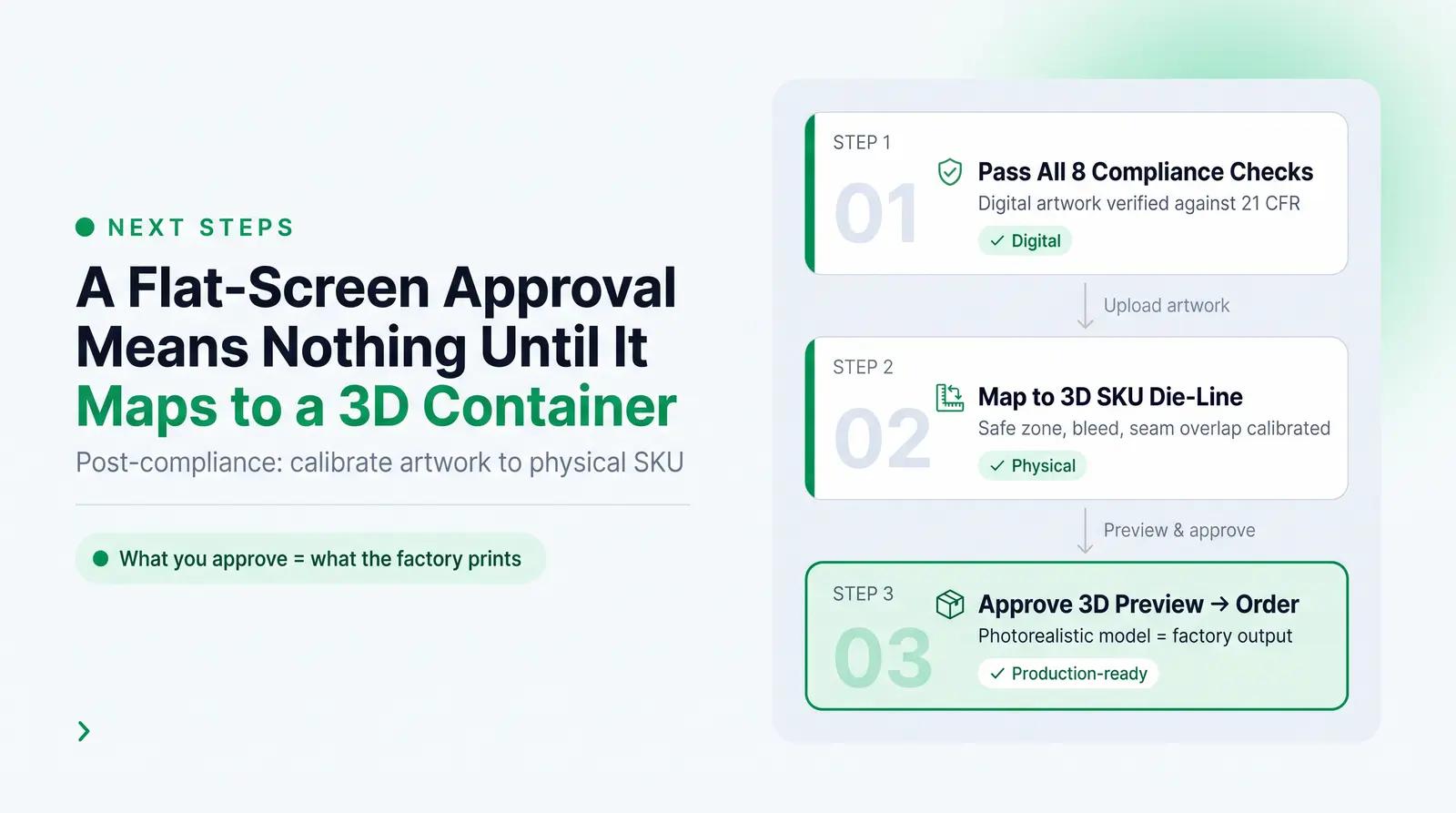
Once your label design has successfully passed all eight checks of the compliance checklist, you are ready to transition from digital artwork to physical packaging. This transition is where many brands experience unexpected errors.
A design that looks perfect on a flat computer screen can shift, warp, or clip when applied to a physical, three-dimensional container.
To prevent these physical errors, your digital artwork must be perfectly calibrated to the actual dimensions of your chosen packaging SKU. This requires working with precise die-lines that define the safe zone, the bleed area, and the overlap seam.
At Packfolio, we eliminate this technical friction structurally.
Packfolio provides a curated catalog of cosmetic primary packaging SKUs, including bottles, jars, tubes, and droppers, each pre-modeled in 3D with predefined, mathematically accurate printable regions.
Instead of guessing how a flat label will wrap around a curved bottle, founders can upload their artwork directly into Packfolio's browser-based 3D design tool. The system maps the artwork to the physical print zones of the selected SKU, allowing you to preview a photorealistic, 3D model of the finished container from every angle.
This 3D preview is a required step in our order flow. What you see on the screen is exactly what the factory will print and deliver.
By integrating compliance checks with physical packaging dimensions, you protect your brand from the most common printing errors. For a deeper dive into selecting the right containers for your formulas, read our guide on cosmetic packaging requirements.
A compliant label is the final, critical step between a finished formula and a finished product. Getting it right protects your brand, your retail relationships, and your customers.
Browse Packfolio's curated packaging catalog and preview your label artwork in 3D before you order, so what you approve is exactly what arrives. packfolio.com/catalog
Frequently Asked Questions
Is a cosmetic label generator enough to make my label FDA-compliant?
No, a standard cosmetic label generator is simply a design tool that helps with visual layout and text placement. It does not possess the compliance logic required to verify ingredient nomenclature, calculate font height based on physical packaging dimensions, or prompt you for required warning statements. You must combine design tools with a rigorous compliance checklist or use a packaging-specific workflow to ensure full FDA compliance.
What is the correct order for ingredients on a cosmetic label?
Cosmetic ingredients must be listed in descending order of predominance by weight for any ingredient present at a concentration greater than 1% [1]. Ingredients present at 1% or less, as well as color additives, may be listed in any order at the end of the ingredient declaration [1]. Active drug ingredients must always be listed separately at the very top of the label as "Active Ingredients" before the cosmetic ingredients are declared [1].
Does MoCRA change what has to appear on a cosmetic label?
Yes, MoCRA introduced several new labeling requirements that went into effect at the end of 2024 [2]. Cosmetic labels must now include a domestic street address, domestic telephone number, or electronic contact information through which the "responsible person" can receive adverse event reports [2]. Additionally, labels must clearly disclose any fragrance allergens that the FDA designates as requiring disclosure, and professional-use cosmetics must be labeled as such [2].
What font size is required on a cosmetic label by the FDA?
The FDA requires all mandatory label information, including the ingredient declaration, to appear in a font height of at least 1/16 of an inch [3]. If the total surface area of the package available for labeling is less than 12 square inches, the minimum font height may be reduced to 1/32 of an inch [3]. The net quantity of contents statement has separate minimum font size requirements based on the total square-inch area of the Principal Display Panel [3].
Do I need different labels for the US and EU?
Yes, the United States and the European Union operate under different cosmetic regulatory frameworks, making a single universal label highly impractical. The EU requires a registered European Responsible Person, CPNP notification, and the individual listing of up to 82 specific fragrance allergens if they exceed established thresholds [5] [6]. The U.S. has different address requirements under MoCRA and does not yet require the same extensive fragrance allergen disclosures [2].
References
[1] U.S. Food and Drug Administration. "Code of Federal Regulations Title 21, Part 701: Cosmetic Labeling." Last updated June 2026. https://www.ecfr.gov/current/title-21/chapter-I/subchapter-G/part-701
[2] U.S. Food and Drug Administration. "Modernization of Cosmetics Regulation Act of 2022 (MoCRA)." Last updated March 2026. https://www.fda.gov/cosmetics/cosmetics-laws-regulations/modernization-cosmetics-regulation-act-2022-mocra
[3] U.S. Food and Drug Administration. "Cosmetics Labeling Guide." Last updated February 2022. https://www.fda.gov/cosmetics/cosmetics-labeling-regulations/cosmetics-labeling-guide
[4] U.S. Food and Drug Administration. "Registration & Listing of Cosmetic Product Facilities and Products." Last updated April 2026. https://www.fda.gov/cosmetics/registration-listing-cosmetic-product-facilities-and-products
[5] European Commission. "Regulation (EC) No 1223/2009 of the European Parliament and of the Council on Cosmetic Products." https://health.ec.europa.eu/system/files/2016-11/cosmetic_1223_2009_regulation_en_0.pdf
[6] Obelis Group. "Preparing for the July 2026 EU Deadline on Fragrance Allergens Disclosure: Best Practices." Last updated April 2026. https://www.obelis.net/news/eu-cosmetics-fragrance-allergens-requirements/
[7] Health Canada. "Industry Guide for the Labelling of Cosmetics." Last updated April 2026. https://www.canada.ca/en/health-canada/services/consumer-product-safety/reports-publications/industry-professionals/labelling-cosmetics.html
[8] Sephora. "Sephora Public Chemicals Policy 2023." Last updated December 2023. https://www.inside-sephora.com/sites/default/files/2023-12/Sephora%20Public%20Chemicals%20Policy%202023.pdf
[9] U.S. Food and Drug Administration. "Is It a Cosmetic, a Drug, or Both? (Or Is It Soap?)" Last updated September 2024. https://www.fda.gov/cosmetics/cosmetics-laws-regulations/it-cosmetic-drug-or-both-or-it-soap


