
Cosmetic Packaging Claims Checklist: Recyclable, PCR, Refillable, and Eco-Friendly
This checklist helps beauty founders substantiate recyclable, PCR, refillable, and eco-friendly cosmetic packaging claims against FTC Green Guides and EU regulations to avoid greenwashing enforcement.
The risk of making broad sustainability claims without enough support has never been higher for beauty brands. Slapping "eco-friendly" or "100% recyclable" on a cosmetic jar might feel like a necessary marketing move to appeal to conscious consumers, but vague or unsupported claims expose brands to FTC scrutiny, state attorney general enforcement, and class-action lawsuits. When a small indie brand faces a regulatory inquiry or consumer backlash over misleading packaging copy, the financial and reputational damage hits disproportionately hard. Smaller brands rarely have dedicated legal teams reviewing every word before a production run, which means the cost of getting it wrong lands entirely on the founder.
This guide breaks down exactly what the FTC Green Guides and emerging regulations like the EU Green Claims Directive require from beauty founders. We will walk through the specific evidence needed to substantiate the four most common packaging claims—recyclable, PCR, refillable, and eco-friendly—and provide a practical checklist to audit your packaging language before it goes to print. Whether you are launching your first SKU or refreshing an existing line, this is the framework to work through before your copy is finalized.
Why Packaging Claims Are Legally Consequential
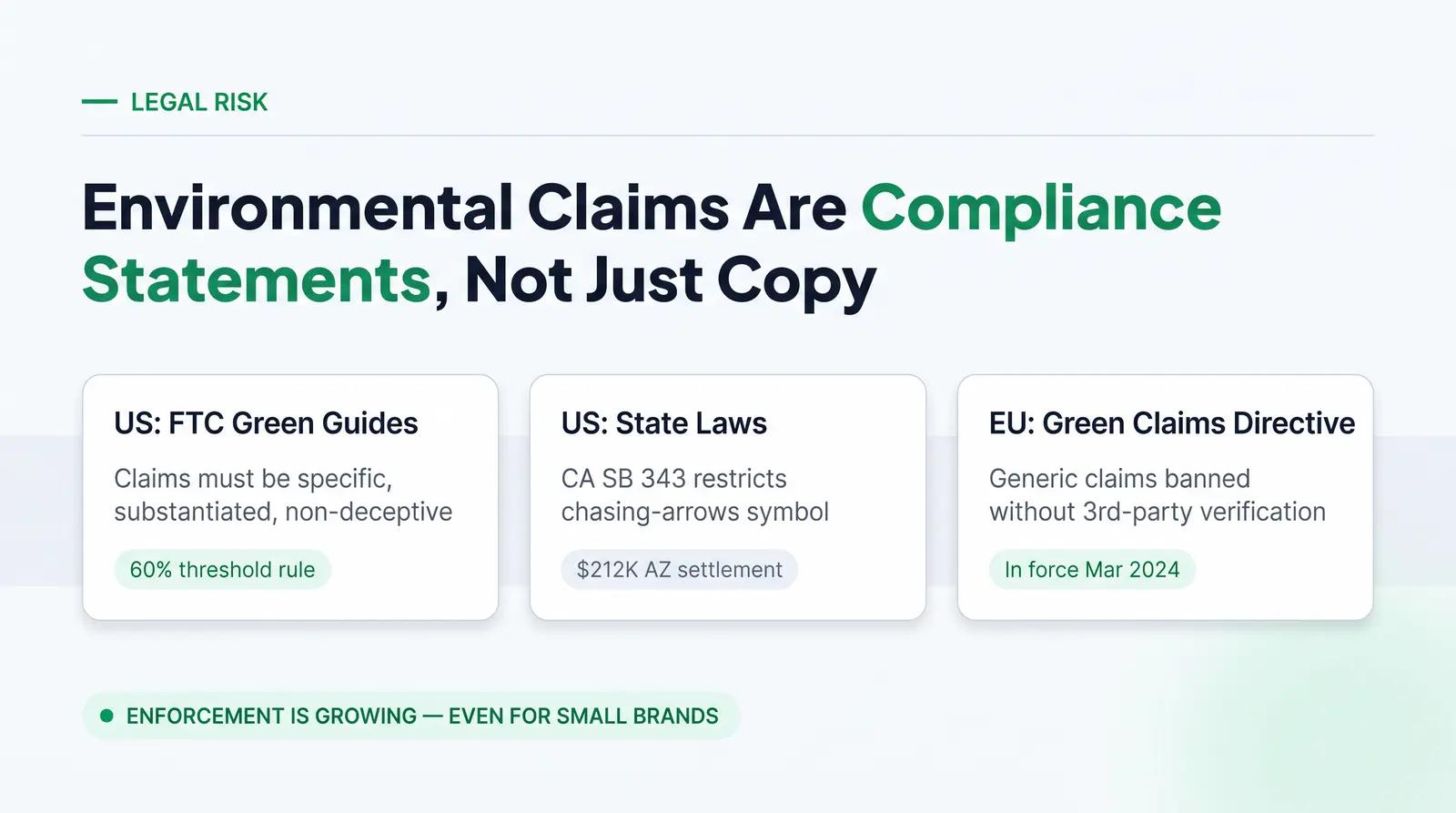
Environmental marketing claims are not just advertising copy; they are compliance statements. In the United States, the Federal Trade Commission enforces consumer protection laws that prohibit deceptive or misleading claims on product packaging. The agency uses its Green Guides (16 CFR Part 260) to evaluate whether sustainability language crosses the line into greenwashing [1]. The core requirement is that environmental claims must be specific, substantiated by competent and reliable scientific evidence, and non-deceptive to the reasonable consumer [1].
The Green Guides were first issued in 1992 and last updated in 2012. The FTC initiated a formal review process in 2022, soliciting public comments and hosting a workshop in May 2023 specifically focused on recyclability claims [2]. As of early 2025, the updated version had not yet been released, and state regulators are not waiting for federal action [2]. California's SB 343 law, for example, strictly regulates the use of the chasing-arrows recycling symbol on packaging, and CalRecycle is actively working to finalize the material characterization study that will govern which materials qualify [3]. State attorneys general have also demonstrated a clear willingness to pursue litigation over misleading packaging claims. Connecticut sued Reynolds Consumer Products over "recycling" bags that were not actually recyclable in the state's facilities, and Arizona reached a $212,000 settlement with the same company over the same product [4].
For brands selling into European markets, the regulatory landscape is even stricter. The EU's Empowering Consumers Directive (Directive (EU) 2024/825), which came into force in March 2024 and is set for member-state implementation by September 2026, explicitly bans generic environmental claims like "biodegradable" or "eco-friendly" unless they are supported by rigorous, independent verification [5]. The proposed Green Claims Directive, still under legislative development, would go further by requiring pre-market verification of all explicit environmental claims by an accredited third party [5]. The days of using sustainability as a casual marketing differentiator are over. Every claim must be backed by a verifiable chain of custody and accurate end-of-life realities.
The practical implication for indie beauty founders is this: the enforcement risk is not theoretical. It is growing, it is reaching smaller brands, and it is increasingly driven by state-level action that does not require the FTC to move first.
The Four Claim Categories (and What Each Actually Requires)
Recyclable
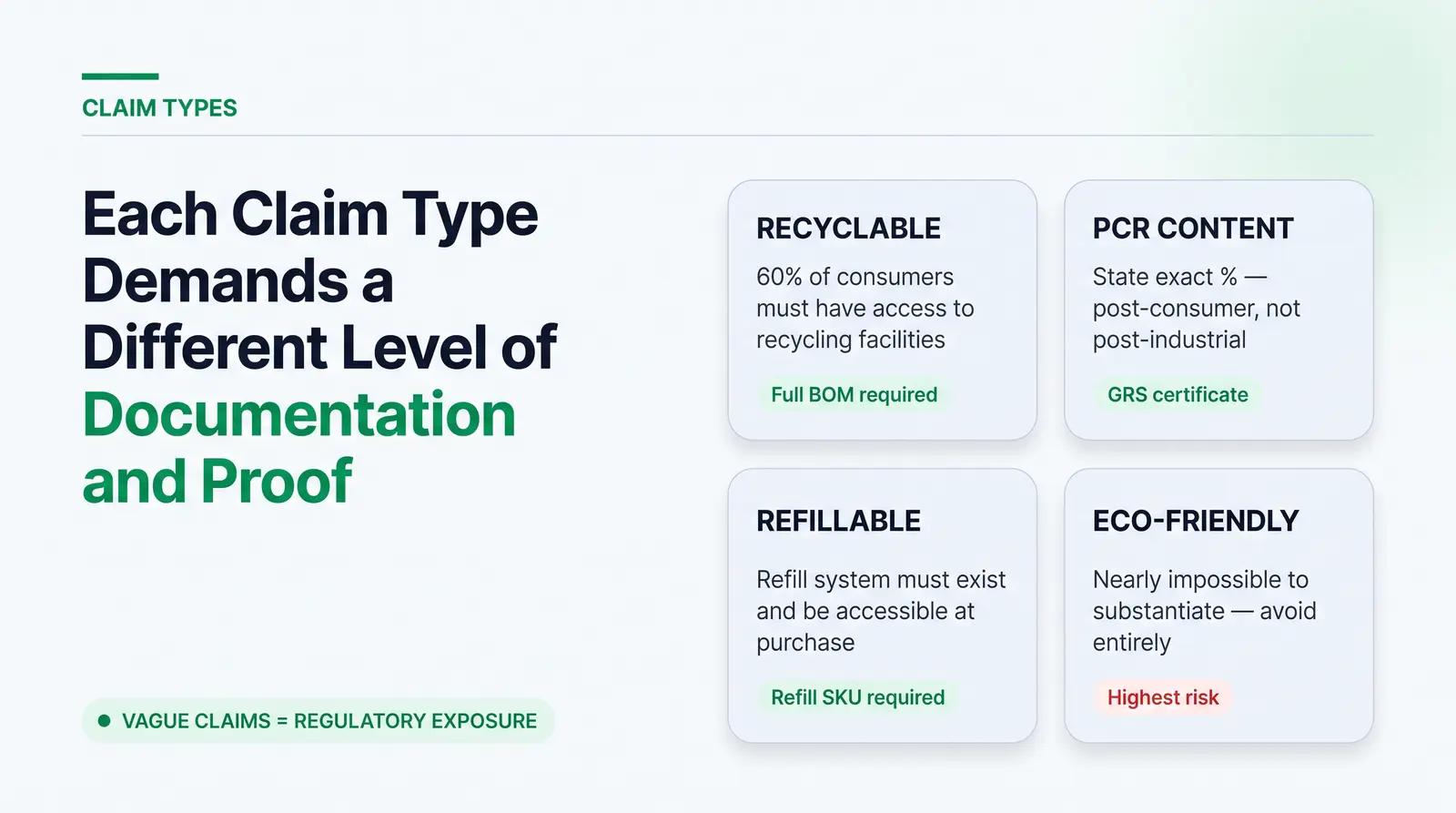
A common misconception among founders is that if a packaging component is made from a recyclable material like PET or HDPE, it can automatically be labeled "recyclable." This is legally risky. The presence of a resin identification code—the number inside a solid triangle on the bottom of a container—merely identifies the plastic type. It does not mean the package will actually be recycled [3]. California's SB 343 specifically addresses this: if a brand places the RIC inside a chasing-arrows symbol, the packaging must meet the state's requirements for demonstrating widespread recyclability. As of 2024, even HDPE and PET are not automatically deemed "widely recyclable" in California under that standard [3].
Under the FTC Green Guides, a marketer should only make an unqualified "recyclable" claim if recycling facilities are available to a "substantial majority" of consumers or communities where the product is sold—defined by the FTC as at least 60% [1]. If access is lower, the claim must be qualified. The FTC provides specific example language: "This product may not be recyclable in your area" for limited access, or "This product is recyclable only in the few communities that have appropriate recycling programs" for very limited access [1].
Cosmetic packaging introduces additional complications because it frequently uses multi-material assemblies. A standard lotion pump might contain a PP head, a PE dip tube, a metal spring, and a glass ball. Municipal recycling facilities generally cannot separate these small, mixed-material components, which means the pump is not recyclable in practice, regardless of what the individual resins are [7]. Claiming the entire package is recyclable when only the bottle body can be processed is deceptive. Laminate tubes—common in skincare—face the same problem. The aluminum-plastic laminate construction makes them nearly impossible to process in standard recycling streams.
PCR (Post-Consumer Recycled Content)
Post-consumer recycled (PCR) content refers to materials that have been recovered from the waste stream after consumer use, cleaned, and reprocessed into new packaging [8]. The FTC requires that recycled content claims be qualified if the entire package is not made from recycled material [1]. "Made with 30% PCR plastic" is acceptable and specific. A vague "Contains recycled content" without a percentage is a yellow flag that invites regulatory scrutiny, because it implies more than it delivers.
To make a defensible PCR claim, a brand must possess chain-of-custody documentation verifying the origin and percentage of the recycled material. The gold standard for this is the Global Recycled Standard (GRS), a voluntary product standard administered by Textile Exchange that tracks and verifies the content of recycled materials through every stage of the supply chain [9]. The GRS requires a minimum of 50% recycled content for consumer-facing claims and mandates third-party certification at each stage of the supply chain [9]. Without a GRS certificate or equivalent documentation from the supplier, a brand cannot confidently prove its PCR percentage if challenged.
It is also crucial to distinguish between post-consumer and pre-consumer (post-industrial) waste. Pre-consumer recycled content refers to manufacturing scrap—off-cuts, trimmings, and defective parts that never reached a consumer. Post-consumer content, by contrast, is material that has been used, discarded, and recovered from the waste stream. Post-consumer content generally carries a higher environmental benefit because it diverts waste from landfills and closes the circular loop [10]. A supplier who offers "recycled content" without specifying which type is providing incomplete information, and a brand that repeats that claim without clarification is taking on unnecessary risk.
Refillable
The claim "refillable" implies a circular system, but it is frequently misused. According to the FTC Green Guides, a brand should not make an unqualified refillable claim unless it actually provides the means for refilling the package [1]. This means the refill system must exist and be accessible to the consumer at the time of purchase. The FTC's guidance is explicit: a marketer can state "This is a refillable container. Please bring it to ABC Corp. to have it refilled," but cannot claim a container is refillable simply because it is physically capable of being refilled if no program exists to facilitate that [11].
A heavy, luxurious glass jar is not "refillable" just because a consumer could theoretically wash it out and put something else inside; that is "reusable." To claim "refillable," the brand must sell refill pods or pouches, or offer a take-back and refill program [11]. This distinction matters because "reusable" is a weaker claim under FTC guidance—it does not imply the original product can be purchased again in a refill format.
The infrastructure requirement makes refillable one of the harder claims to substantiate in practice. Launching a refillable line requires tooling and inventory for two separate components: the primary container and the refill unit. If the refill pods themselves generate excessive waste or are impossible to recycle, the brand risks greenwashing accusations. The consumer backlash against SKKN by Kim's refillable packaging system is a clear illustration: consumers criticized the system as generating unnecessary plastic waste because the refill mechanism required inserting a solid pack into an outer container, adding material rather than reducing it [12].
Eco-Friendly / Sustainable / Green
Broad, unqualified terms like "eco-friendly," "sustainable," or "green" are the highest-risk claims a brand can make. The FTC explicitly cautions against them because they imply a far-reaching environmental benefit that is nearly impossible to substantiate [1]. Consumers interpret these words to mean the product has no negative environmental impact across its entire lifecycle—from raw material extraction through manufacturing, distribution, use, and disposal. That is an extraordinarily high bar.
The FTC's guidance states that broad, unqualified general environmental benefit claims are "difficult to substantiate, if not impossible" [1]. If a brand wishes to use these terms, it must qualify them clearly and prominently with the specific environmental benefit. "Eco-friendly packaging: made from 100% recycled paperboard" is defensible because the claim is scoped to a specific attribute. "Eco-friendly packaging" alone is not. Under the EU's Empowering Consumers Directive, generic environmental claims are now explicitly prohibited unless backed by recognized certification [5]. For brands with any European distribution, this is not a guideline—it is a legal requirement.
The safest approach is to avoid these broad terms entirely and let the specific material attributes speak for themselves. "Packaged in 100% aluminum" is more credible, more specific, and more defensible than "sustainable packaging"—and it is a stronger marketing claim because it is concrete.
The Packaging Claims Verification Checklist
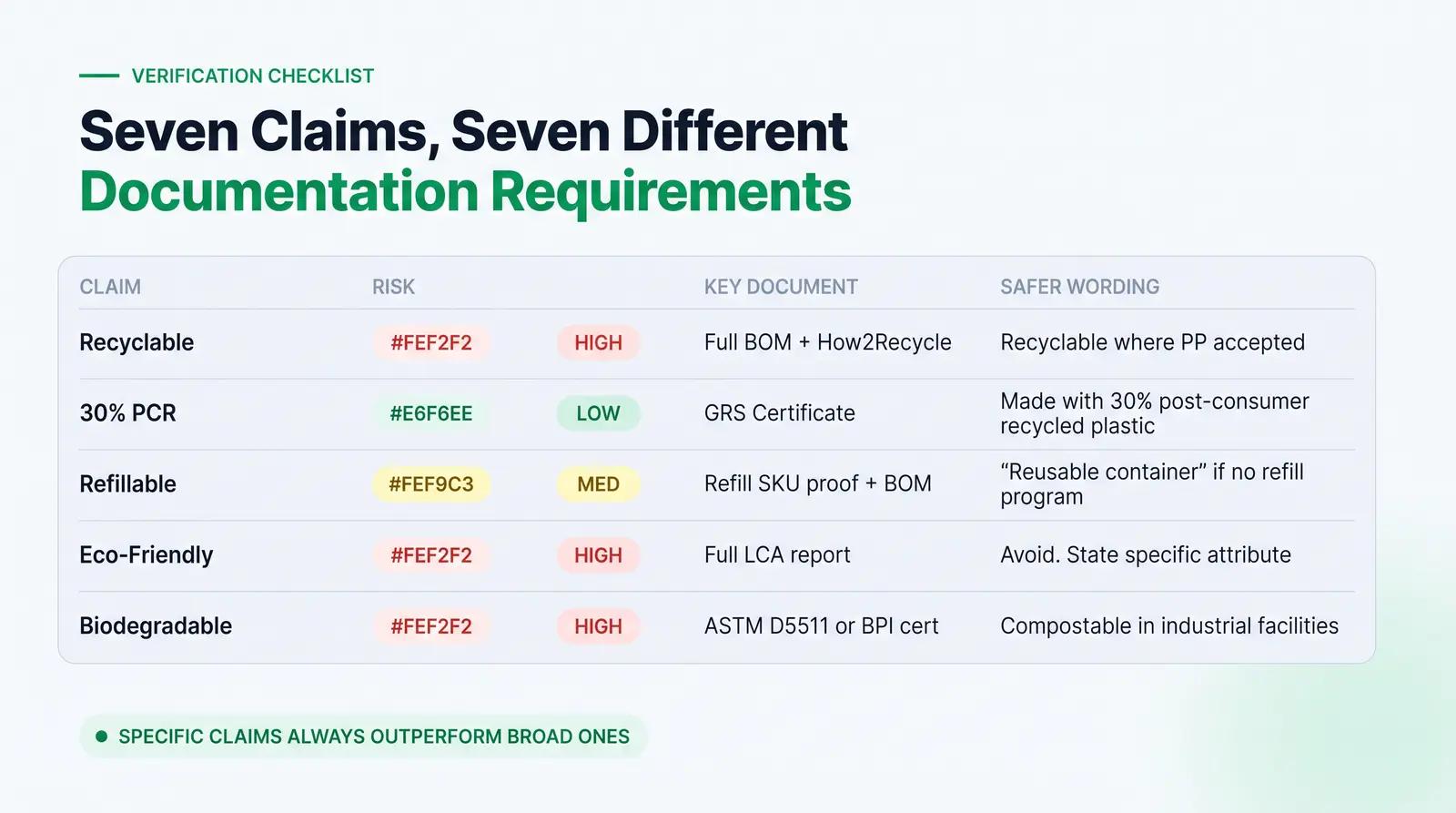
To help beauty founders navigate this complex landscape, we developed a practical framework we recommend at Packfolio when curating packaging SKUs and helping founders think through their labeling. The Packaging Claims Verification Checklist allows you to audit each claim you intend to make against the required supplier evidence, legal risk level, and safer alternative wording.
| Claim | What it requires to be defensible | Supplier documentation to request | Legal review recommended? | Safer alternative wording if documentation is incomplete |
|---|---|---|---|---|
| Recyclable | Proof that the specific material is accepted by at least 60% of municipal recycling programs where sold; the component must not be a multi-material assembly. | Resin identification (full BOM); How2Recycle pre-qualification if applicable; confirmation that no incompatible materials are present. | Yes, especially for multi-material pumps, droppers, or laminate tubes. | "Check locally for recycling options" or "Recyclable bottle; remove pump before recycling." |
| Made with X% PCR | Chain-of-custody proof that the stated percentage is genuinely post-consumer waste, not post-industrial scrap. | Global Recycled Standard (GRS) certificate or equivalent; supplier batch testing records specifying PCR vs. PIR content. | No, but verify wording carefully. | "Packaging utilizes recycled materials" (though specific percentages are always more defensible). |
| Refillable | An active, accessible system for the consumer to purchase refills or return the empty container to be refilled at the time of purchase. | Design specifications confirming the refill mechanism; proof of production for refill units; evidence the refill SKU is available in the same markets as the primary product. | Depends on scope; yes if the refill program is limited by geography. | "Reusable container" if the consumer is meant to repurpose it themselves, with no brand-supported refill system. |
| Eco-Friendly / Sustainable | A comprehensive lifecycle assessment (LCA) proving a net-positive environmental impact across sourcing, manufacturing, and end-of-life disposal. | Full LCA report from an independent, accredited third-party auditor. | Yes. High risk. | Avoid entirely. State the specific benefit: "Packaged in 100% aluminum" or "Made with 30% PCR plastic." |
| Biodegradable | Scientific proof that the entire package will completely break down and return to nature within one year after customary disposal in the conditions where it will actually be disposed. | ASTM D5511 or ISO 15985 test results for anaerobic biodegradation; BPI certification if compostable. | Yes. | Avoid entirely unless certified by BPI or equivalent. "Compostable in industrial facilities" if that is accurate and certified. |
| Carbon Neutral | Verified measurement of the product's full lifecycle emissions, with credible offset purchases or reductions to reach net zero; offsets must not be double-counted. | Third-party verified carbon accounting report; offset registry documentation (e.g., Gold Standard, Verra VCS). | Yes. | "We are working to reduce the carbon footprint of our packaging" if the process is ongoing but not yet verified. |
| Plastic-Free | The package contains zero petroleum-based plastics, including hidden elements like cap liners, adhesives, pump mechanisms, or laminates. | Full bill of materials (BOM) detailing every sub-component and any coatings or adhesives used. | Depends on scope. | "Housed in glass and aluminum" or "No plastic bottle or jar"—let the materials speak for themselves. |
Comparing Packaging Claims by Risk and Effort
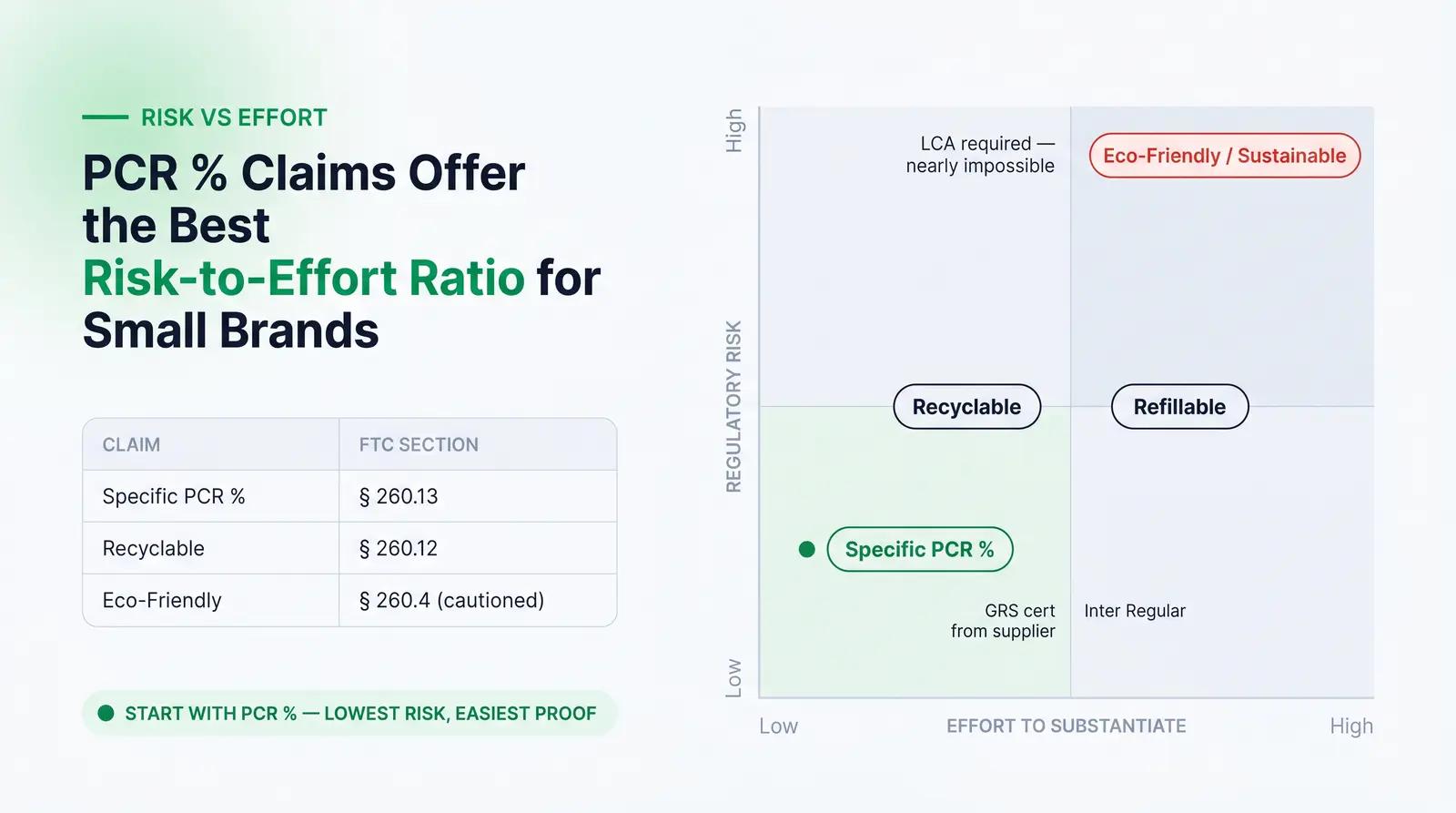
Not all claims require the same level of investment or carry the same regulatory risk. The following table compares specific claim types to help founders prioritize their sustainability messaging and understand where to focus their documentation efforts.
| Claim Type | Regulatory Risk Level | Ease of Substantiation for Small Brands | Cost/Effort to Obtain Documentation | Addressed by FTC Green Guides? | Addressed by EU Green Claims Directive? |
|---|---|---|---|---|---|
| Specific PCR % (e.g., "30% PCR") | Low | High, if supplier holds GRS certification | Low; GRS certificate should be provided by the supplier at no cost to the brand | Yes (§ 260.13) | Yes |
| Recyclable | Medium | Medium; depends on component complexity and geography | Medium; requires researching municipal access or joining How2Recycle | Yes (§ 260.12) | Indirectly |
| Refillable | Medium | Low; requires launching a secondary refill SKU | High; requires tooling, inventory, and logistics for two components | Yes (§ 260.14) | Yes |
| "Eco-Friendly" / "Sustainable" | High | Very Low; nearly impossible to prove a general lifecycle benefit | Very High; requires full LCA from an accredited third party | Yes (§ 260.4, cautioned) | Yes (banned without proof) |
A Worked Example: The 30% PCR Airless Pump
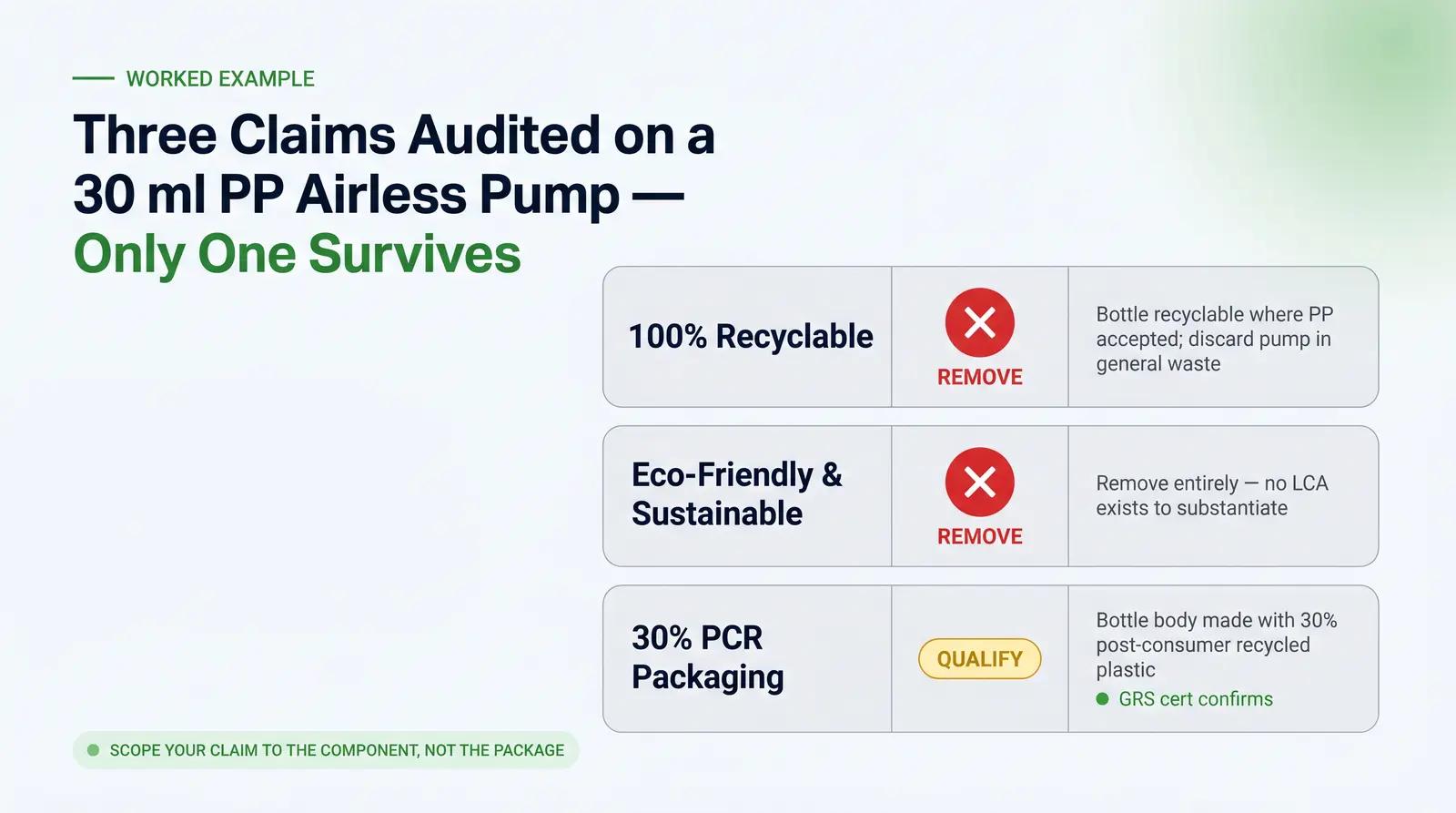
A founder is launching a 1 oz (30 ml) face serum. They select an airless pump bottle made from Polypropylene (PP), and their supplier mentions that the bottle contains 30% PCR content. The founder wants to print "100% Recyclable, Eco-Friendly, and Sustainable 30% PCR Packaging" on the outer carton before going to print.
Here is how to audit each of those claims using the checklist above.
Claim 1: "100% Recyclable." An airless pump is a multi-material assembly. Even if the outer bottle body is PP, the internal piston is typically a different plastic, the spring is metal, and the dispensing head may include a metal ball or additional polymer components. Municipal recycling facilities cannot separate these components at scale. The claim "100% Recyclable" is not defensible for this component type. The documentation request to the supplier should include a full bill of materials for every sub-component of the pump. The safer wording, once the BOM is confirmed, would be: "Bottle body is recyclable where PP is accepted; discard pump mechanism in general waste."
Claim 2: "Eco-Friendly and Sustainable." These are broad, unqualified claims. The founder does not have a lifecycle assessment proving the PP airless pump is environmentally superior to alternatives. Under the EU Green Claims Directive, this is strictly prohibited without third-party verification. Under FTC guidance, it is nearly impossible to substantiate. Decision: remove these terms entirely from the packaging copy.
Claim 3: "30% PCR Packaging." The founder requests documentation from the supplier. The supplier provides a GRS certificate confirming that the PP resin used in the outer bottle body contains 30% post-consumer recycled content. However, the pump head and overcap are made from virgin plastic. The claim "30% PCR Packaging" implies the entire package contains 30% PCR, which is inaccurate. The safer, defensible wording is: "Bottle body made with 30% post-consumer recycled plastic." This is specific, accurate, and directly supported by the GRS certificate.
The final, compliant label copy becomes: "Bottle body made with 30% post-consumer recycled plastic. Bottle recyclable where PP is accepted; discard pump in general waste." This is less punchy than the original, but it is legally defensible, accurate, and still communicates a genuine sustainability effort.
The Contrarian Insight: Lightweighting Often Outperforms Recyclability
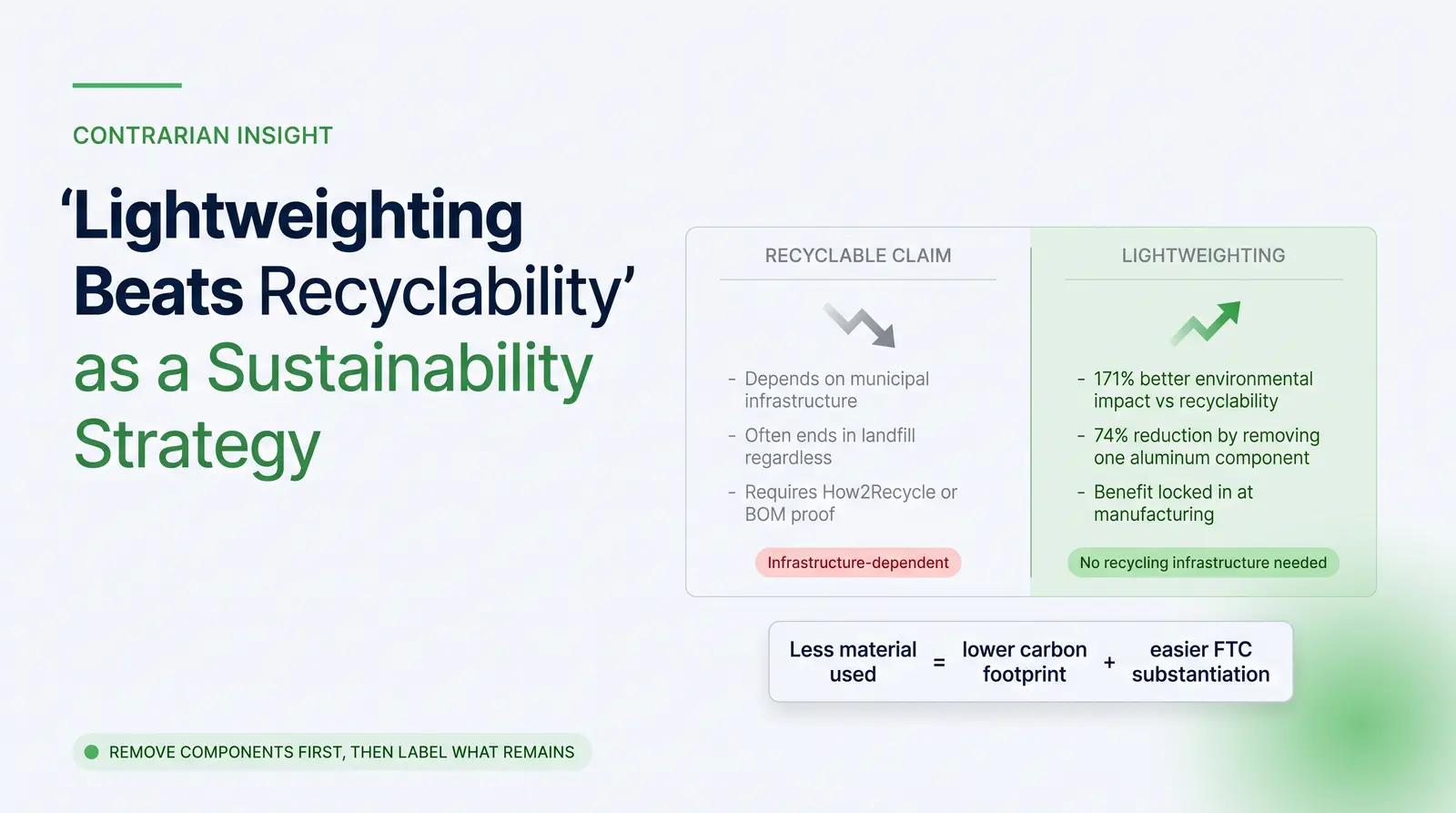
Founders frequently obsess over achieving a "100% recyclable" claim, treating it as the gold standard of sustainable packaging. The reality is more complicated. The chasing-arrows symbol on packaging does not mean the product is actually recycled in most US communities; for many plastic types, the material ends up in a landfill regardless of what the label says [6]. A contrarian but highly effective approach is source reduction—specifically, lightweighting.
Lightweighting means redesigning the package to use less material overall. A peer-reviewed lifecycle assessment study evaluating plastic cosmetic packaging found that dematerialization (using less material) and prioritizing reusability significantly outperformed standard recyclability in reducing environmental impacts [13]. The study found that reusability resulted in a 171% improvement in environmental impact compared to dematerialization alone, and that removing a single aluminum component from a package resulted in a 74% reduction in impacts when the remaining materials were fully recycled [13]. Removing unnecessary components—a heavy acrylic overcap, a double-walled jar, an outer sleeve—immediately reduces the carbon footprint of manufacturing and freight, and that benefit is realized regardless of what happens at end-of-life.
Furthermore, the FTC Green Guides explicitly cover source reduction claims, and they are among the most straightforward to substantiate. A brand simply needs to state the percentage of material reduced compared to the previous version, with a clear basis for comparison [1]. For example: "This bottle uses 20% less plastic than our previous formula." No municipal recycling infrastructure is required. No chain-of-custody documentation is needed. The environmental benefit is locked in the moment the package is manufactured, making it one of the most defensible and genuinely impactful claims available to small brands.
What to Verify with Your Packaging Supplier
Sustainability claims are only as strong as the documentation behind them. When sourcing cosmetic packaging, request specific proof before finalizing any marketing copy.
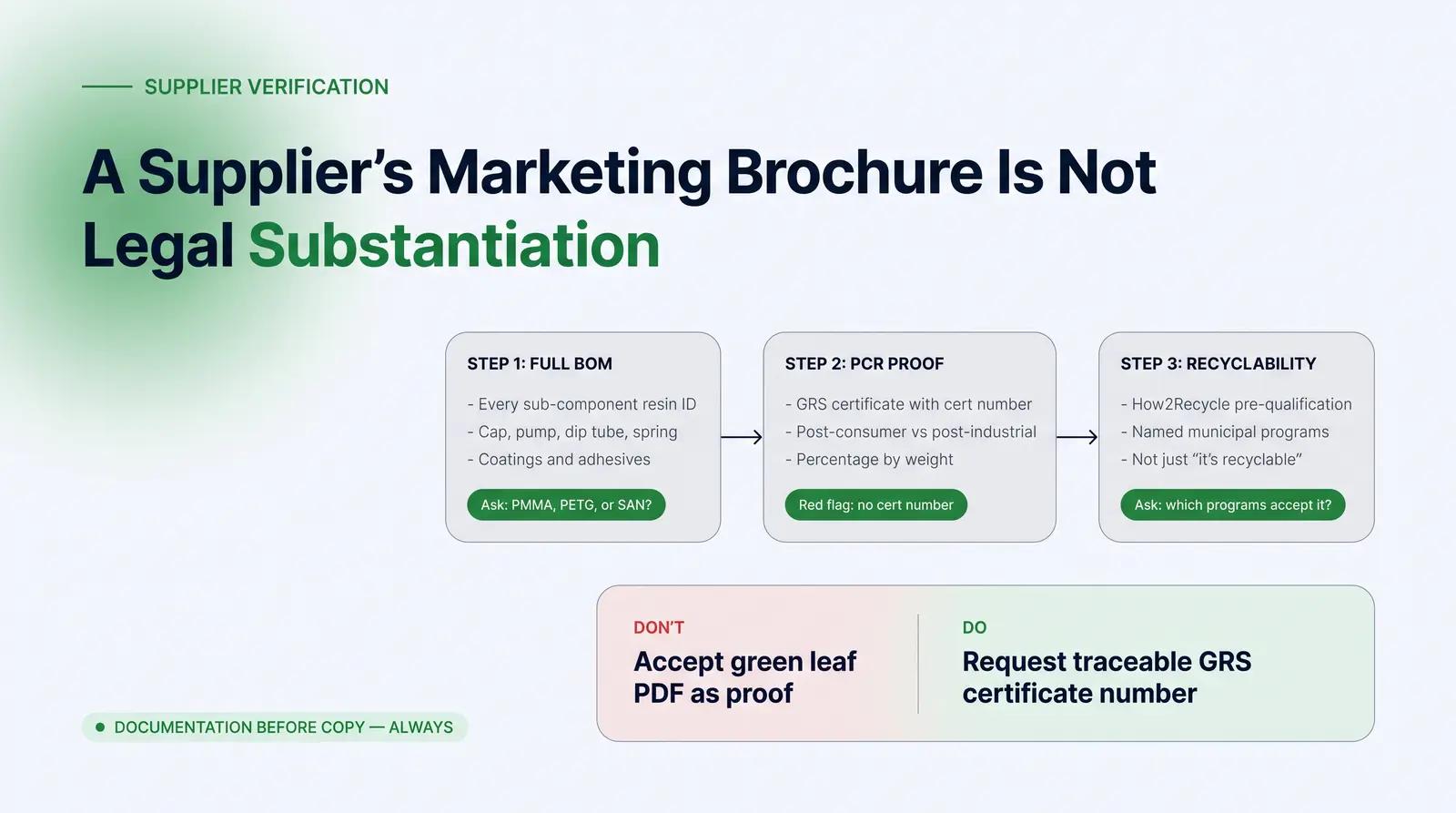
Start with the full bill of materials. Ask for the exact resin identification for every sub-component—not just the bottle body, but the cap, pump mechanism, dip tube, spring, and any coatings or adhesives. If a supplier describes a jar as "acrylic," ask whether it is PMMA, PETG, or SAN, since these have different recyclability profiles. If a supplier describes packaging as "eco-friendly" without specifying the material, that is a red flag.
For recycled content claims, demand the GRS certificate or equivalent chain-of-custody documentation. Ask specifically whether the recycled content is post-consumer or pre-industrial, and request the percentage by weight. A supplier who cannot provide this information is either not using certified recycled content or does not have the documentation to prove it—and in either case, the brand cannot make the claim.
For recyclability claims, ask whether the supplier has conducted any How2Recycle pre-qualification assessment or equivalent recyclability testing. Ask which specific municipal programs accept the material. A supplier who says "it's recyclable" without being able to name the resin or identify the programs that accept it is providing marketing language, not verified data.
The difference between a supplier's marketing brochure and a verified certification matters enormously in a regulatory context. A PDF with green leaves and a sustainability tagline is not legal substantiation. A GRS certificate with a traceable certificate number is.
At Packfolio, our catalog curation process includes verified resin identification and material specifications for every SKU. Founders can enter conversations about claims with accurate baseline information already in hand, rather than having to extract it from an unfamiliar supplier relationship. For more on how to evaluate specific packaging materials for sustainability, see our guide at packfolio.com/blog/sustainable-beauty-packaging-guide.
Next Steps for Your Brand
Making defensible packaging claims requires precision, documentation, and a clear understanding of the materials you are working with. Vague supplier assurances are not enough. The regulatory environment is tightening at both the federal and state level in the US, and it is already strict in the EU. Getting the language right before a production run is far less expensive than a redesign, a regulatory inquiry, or a consumer backlash after launch.
Browse Packfolio's curated cosmetic packaging catalog — every SKU includes material specifications and a 3D preview of your label before you order. →
packfolio.com/catalog
Frequently Asked Questions
What does "recyclable" actually mean on cosmetic packaging?
Under FTC guidelines, "recyclable" means the packaging can be collected, sorted, cleaned, and processed into a new product by recycling facilities available to at least 60% of consumers where the product is sold [1]. For cosmetics, this is often difficult to achieve because multi-material components like pumps, droppers, and laminate tubes cannot be processed by standard municipal facilities, even if the individual materials are technically recyclable.
Does the recycling symbol mean my packaging is recyclable?
No. The chasing-arrows symbol with a number inside is a Resin Identification Code (RIC) that identifies the type of plastic used to make the item. It does not guarantee that local recycling programs accept that specific plastic, that the item will actually be recycled, or that the item meets any state or federal recyclability standard [3]. California's SB 343 specifically restricts the use of the chasing-arrows design to packaging that meets defined recyclability criteria.
What is PCR content in cosmetic packaging?
PCR stands for Post-Consumer Recycled content—plastic or other materials that have been used by a consumer, disposed of, recovered from the waste stream, and reprocessed into new packaging [8]. This differs from pre-consumer (post-industrial) recycled content, which is manufacturing scrap that never reached a consumer. Post-consumer content is generally considered to have a higher environmental benefit because it diverts waste from landfills. To make a defensible PCR claim, brands need chain-of-custody documentation such as a GRS certificate from their supplier [9].
Can I say my packaging is "eco-friendly" without certification?
It is highly risky. The FTC warns that broad terms like "eco-friendly" imply a general environmental benefit that is nearly impossible to substantiate, and cautions marketers against using them without specific qualifications [1]. In the EU, the Empowering Consumers Directive (2024/825) explicitly prohibits generic environmental claims that are not backed by recognized, independent verification [5]. The safest approach is to replace broad terms with specific, verifiable material attributes.
What regulations apply to sustainability claims on beauty product packaging?
In the US, the FTC Green Guides (16 CFR Part 260) govern environmental marketing claims, requiring them to be specific, substantiated, and non-deceptive [1]. State laws—particularly California's SB 343—add additional requirements around recyclability labeling. Internationally, the EU's Empowering Consumers Directive (2024/825) bans unverified generic environmental claims, and the proposed Green Claims Directive would require pre-market third-party verification of all explicit environmental claims [5].
References
-
Federal Trade Commission. "Guides for the Use of Environmental Marketing Claims (16 CFR Part 260)." FTC.gov, 2012. https://www.ftc.gov/sites/default/files/attachments/press-releases/ftc-issues-revised-green-guides/greenguides.pdf
-
Rachal, Maria. "Green Guides updates still pending as states lead on labeling." Packaging Dive, February 10, 2025. https://www.packagingdive.com/news/packaging-labeling-recyclable-compostable-green-guides/738514/
-
Keller and Heckman LLP. "Personal Care Packaging, RIC, and Recyclability." PackagingLaw.com, December 13, 2024. https://www.packaginglaw.com/ask-an-attorney/personal-care-packaging-ric-and-recyclability
-
Office of the Attorney General, Connecticut. "Attorney General Tong Sues Reynolds Over Non-Recyclable Hefty 'Recycling' Trash Bags." CT.gov, June 14, 2022. https://portal.ct.gov/ag/press-releases/2022-press-releases/ag-tong-sues-reynolds-over-hefty-recycling-bags
-
NATRUE. "Cosmetics and Sustainability: the new EU Directives to tackle greenwashing." NATRUE.org, 2024. https://natrue.org/eu-directives-tackle-greenwashing/
-
Steckman, Symphony. "What Are Greenwashing Packaging Regulations? FTC Compliance for Brands." EcoPackables.com, January 6, 2026. https://www.ecopackables.com/blogs/news/what-are-greenwashing-packaging-regulations-ftc-compliance-for-brands
-
Spicer, Maggie. "How the FTC's Green Guides Shape Environment-related Product Claims." Cosmetics & Toiletries, June 27, 2023. https://www.cosmeticsandtoiletries.com/magazine/article/22865981/cosmetics-toiletries-magazine-how-the-ftcs-green-guides-shape-environmentrelated-product-claims
-
StopWaste.org. "Recycled Content Claims: Environmental Claims on Packaging." StopWaste.org. https://guides.stopwaste.org/packaging/environmental-claims/recycled-content-claims
-
Textile Exchange. "The RCS and GRS: Recycled Claim Standard and Global Recycled Standard." TextileExchange.org. https://textileexchange.org/recycled-claim-global-recycled-standard/
-
Federal Trade Commission. "Environmental Claims: Summary of the Green Guides." FTC.gov, October 2, 2012. https://www.ftc.gov/business-guidance/resources/environmental-claims-summary-green-guides
-
StopWaste.org. "Refillable and Reusable Claims: Environmental Claims on Packaging." StopWaste.org. https://guides.stopwaste.org/packaging/environmental-claims/refillable-reusable-claims
-
Bargh, Becky. "Kim Kardashian in hot water over SKKN 'greenwashing' claims." Cosmetics Business, June 16, 2022. https://cosmeticsbusiness.com/kim-kardashian-in-hot-water-over-skkn-greenwashing-claims--201583
-
Gatt, Isaac Jordan, and Paul Refalo. "Reusability and recyclability of plastic cosmetic packaging: A life cycle assessment." Resources, Conservation & Recycling Advances, vol. 15, November 2022. https://www.sciencedirect.com/science/article/pii/S2667378922000360


