
Cosmetic Packaging Lead Times: From Samples to Production Launch
This guide maps the full cosmetic packaging timeline across nine production stages and provides a backward-planning framework to prevent launch delays.
Founders routinely underestimate calendar risk before launch, and the packaging timeline is almost always where that risk lives. The gap between how long founders assume packaging takes and how long it actually takes is the single biggest reason beauty launches miss their target dates. A founder might budget four weeks for custom packaging, only to discover that artwork revisions, formula compatibility testing, and sea freight delays have stretched the timeline to four months or more.
The problem is not that founders are careless. It is that the industry does not explain the full picture. Most resources give vague week ranges without breaking down what happens at each stage, which stages carry the most risk, or how a single delay compounds into a launch-threatening cascade. This article fixes that. It maps the true timeline of cosmetic packaging production from initial research to final delivery, identifies where the hidden delays actually happen, and provides a practical framework for planning backward from your desired launch date.
Why the Timeline Is Longer Than You Think
The instinct to underestimate packaging lead time is understandable. When you look at a finished bottle, it looks simple. But that bottle has traveled through at least nine distinct production stages before it reaches your warehouse, and each stage has its own delay risk. The stages do not all run in sequence; some overlap. But a failure at any early stage can halt everything downstream [1].
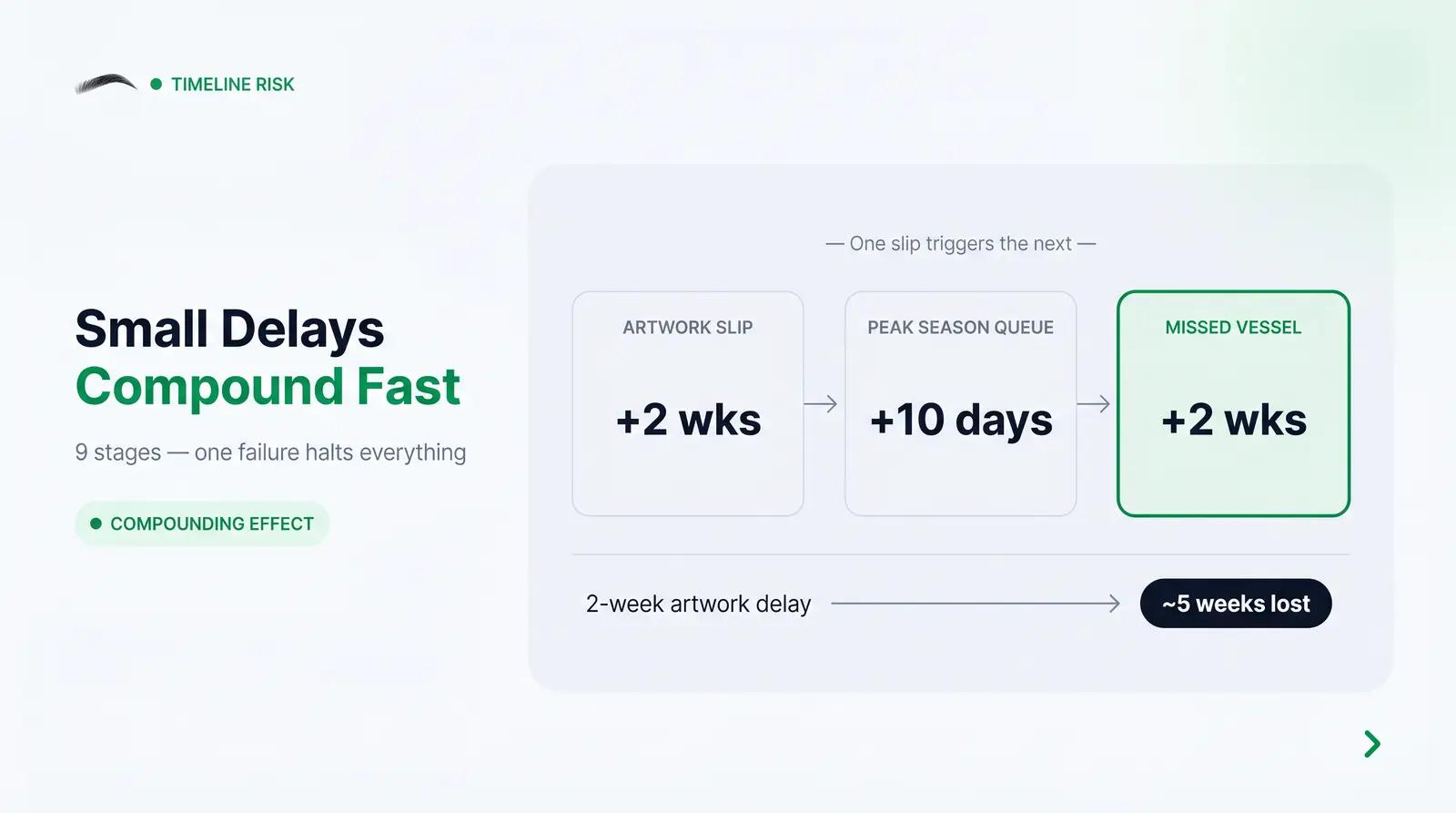
The other factor founders consistently underestimate is the compounding effect of small delays. A two-week slip in artwork approval does not just cost two weeks; it can push the production order past a factory's peak-season cutoff, which adds another 10 to 15 days just to get back on the production schedule [2]. That same delay might mean the shipment misses a vessel booking, adding another week or two to the freight leg. By the time the packaging arrives at your co-packer, you have lost a month, not two weeks.
Understanding this compounding dynamic is the first step toward building a realistic launch calendar.
The Stage-by-Stage Timeline Map
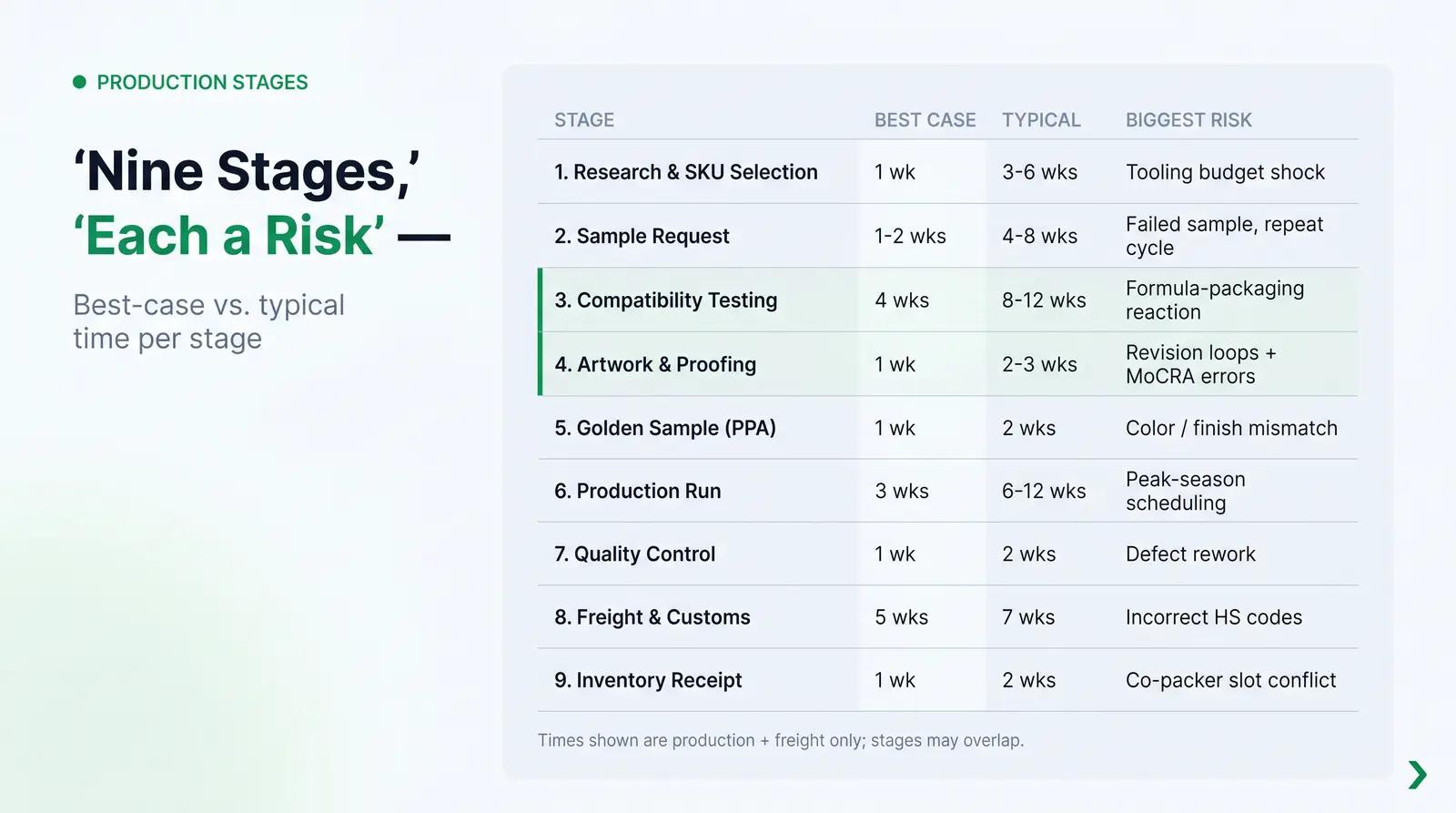
Cosmetic packaging production is a series of overlapping stages. Here is a realistic breakdown of each major sourcing step, with best-case and typical-case time ranges, the most common delay risk at each stage, and what founders can do to protect the window.
Stage 1: Initial Packaging Research and SKU Selection
Before ordering anything, founders must select the right format, material, and dispensing mechanism for their formula. This means deciding between glass and plastic, choosing a pump, dropper, or disc cap, and determining whether to use stock packaging, customized stock, or a fully bespoke mold.
Realistic Time Range: 1 to 2 weeks (stock selection); 3 to 6 weeks (custom mold research and quoting).
Most Common Delay Risk: Discovering that a desired custom mold requires tooling costs of $2,000 to $15,000 or more, which breaks the budget and forces the founder to restart the selection process [3].
How to Compress: Opt for customized stock packaging instead of bespoke molds wherever possible. Customized stock provides the premium look of a custom component without the 16-to-20-week lead time of building a new mold. Brands achieve roughly 80% of the brand differentiation at a fraction of the cost and timeline [3].
Stage 2: Request for Samples and Pre-Production Samples
Physical samples are required to verify the look, feel, and function of the packaging before committing to a production order. This stage is often the first place founders realize the timeline is longer than expected.
Realistic Time Range: 1 to 2 weeks for existing molds (including sample production and international air shipping); 4 to 8 weeks for custom molds, where the factory must first produce a prototype [2].
Most Common Delay Risk: International shipping times for samples. Air freight from China to the US typically takes 8 to 10 days, but customs clearance can add additional days [4]. If the first sample fails and a second sample must be produced, the cycle repeats.
How to Compress: Request samples from multiple suppliers simultaneously rather than sequentially. This parallel approach can save two to three weeks compared to evaluating suppliers one at a time.
Stage 3: Sample Evaluation and Formula-Compatibility Testing
This is the most critical and most frequently overlooked stage in the entire process. Packaging must be tested to ensure it does not react chemically or physically with the formula inside it. This is not optional; it is a scientific requirement for product safety.
Realistic Time Range: 4 to 8 weeks for accelerated testing; up to 12 weeks for a full compatibility study [5].
Most Common Delay Risk: Failing the compatibility test. If a formula degrades the plastic, clogs a pump, or causes the container to crack under temperature stress, the founder must source a new packaging material and restart the testing clock entirely [6]. Compatibility testing evaluates chemical reactions (changes in pH, color, or odor), physical interactions (leakage, cracking, dissolution), and biological safety (migration of harmful substances from the packaging into the formula) [6].
How to Compress: Work with packaging suppliers who provide pre-tested compatibility data for standard cosmetic bases. Running accelerated stability testing at elevated temperatures (40°C and 50°C) can simulate long-term wear in a shorter window [5]. However, there is a floor below which testing cannot be compressed without compromising the validity of the results.
Stage 4: Artwork Finalization and Print-File Approval
Founders must submit press-ready artwork files and approve digital or physical proofs before the factory can set up its printing equipment.
Realistic Time Range: 1 to 3 weeks, but highly variable depending on revision cycles.
Most Common Delay Risk: Endless revision cycles. Artwork and proofing are almost always underestimated by founders [7]. A minor adjustment to a logo position or a UV gloss iteration can add 5 to 7 days per cycle [2]. Regulatory requirements under the FDA's Modernization of Cosmetics Regulation Act (MoCRA) also require specific ingredient declarations, allergen warnings, and manufacturer information to be correctly formatted on the label [8]. A compliance error means the file must be rejected and resubmitted.
How to Compress: Ensure artwork is completely finalized and press-ready before submitting to the factory. Treat the proofing stage as a confirmation step, not a design iteration phase.
Stage 5: Pre-Production Approval (PPA) and Golden Sample Sign-Off
The factory produces a small batch of the final, fully decorated packaging for the founder to review and approve before mass production begins. This is the last checkpoint before the full order is manufactured.
Realistic Time Range: 1 to 2 weeks for the factory to produce and ship the golden sample; additional time if revisions are required.
Most Common Delay Risk: The physical golden sample does not match the digital proof in terms of color accuracy, finish quality, or dimensional fit. Each revision cycle adds 3 to 7 days [2].
How to Compress: Be highly specific in your initial technical brief regarding Pantone colors, surface finishes, and dimensional tolerances. The more precise the brief, the fewer revision cycles the golden sample requires.
Stage 6: Production Run
The factory manufactures the full order. This stage is heavily dependent on the type of packaging and the Minimum Order Quantity (MOQ).
Realistic Time Range: 3 to 6 weeks for customized stock packaging; 6 to 12 weeks for custom-molded components [3].
Most Common Delay Risk: Peak-season scheduling conflicts. Factories experience a surge in orders ahead of major e-commerce events and holiday seasons. If a founder does not lock in a production slot 1 to 2 months in advance, they may wait 10 to 15 days just for a place on the production schedule. Between-process waiting times during peak seasons can run 30% higher than during off-peak periods [2].
How to Compress: Place orders well in advance of peak seasons. Avoid the weeks immediately preceding Chinese New Year, when factories begin slowing production, and the post-holiday restart period, when backlogs compound [1].
Stage 7: Quality Control and Inspection
The finished goods are inspected for defects, proper assembly, and compliance with the approved golden sample.
Realistic Time Range: 1 to 2 weeks.
Most Common Delay Risk: Discovering a defect rate that exceeds acceptable thresholds, requiring the factory to rework or remake a portion of the order before it can be shipped.
How to Compress: Hire a third-party inspection agency to review the goods at the factory before they are loaded into shipping containers. Catching defects before the goods leave the factory is far less disruptive than discovering them after arrival.
Stage 8: Freight and Customs Clearance
The packaging is shipped from the factory to the brand's warehouse or co-packer.
Realistic Time Range: Sea freight from China to the US West Coast takes 18 to 25 days; to the East Coast, 30 to 40 days [9]. Air freight takes approximately 8 to 10 days [4]. Adding customs clearance, inland delivery, and standard handling, a realistic door-to-door estimate via sea freight is 5 to 7 weeks.
Most Common Delay Risk: Customs holds due to incorrect or incomplete documentation. Incorrect HS codes, undervalued goods, or vague product descriptions are the leading causes of international shipping delays [9]. Even a small mismatch between the commercial invoice and the bill of lading can trigger an inspection and hold the shipment for days or weeks.
How to Compress: Ensure your freight forwarder has all commercial invoices, packing lists, and compliance documents perfectly aligned before the vessel departs. Prepare customs documentation in parallel with the production run, not after the goods are ready to ship.
Stage 9: Inventory Receipt and Launch-Ready Status
The goods arrive at the warehouse, are unloaded, counted, and prepped for filling and assembly.
Realistic Time Range: 1 to 2 weeks.
Most Common Delay Risk: Co-packer scheduling conflicts. If the packaging arrives late, the brand may lose its reserved slot on the filling line and wait weeks for the next available opening [7].
How to Compress: Share real-time freight tracking with your co-packer so they can adjust their schedule dynamically. Communicate proactively; do not wait until the packaging is on the water to confirm the filling date.
Lead Time Comparison by Packaging Type
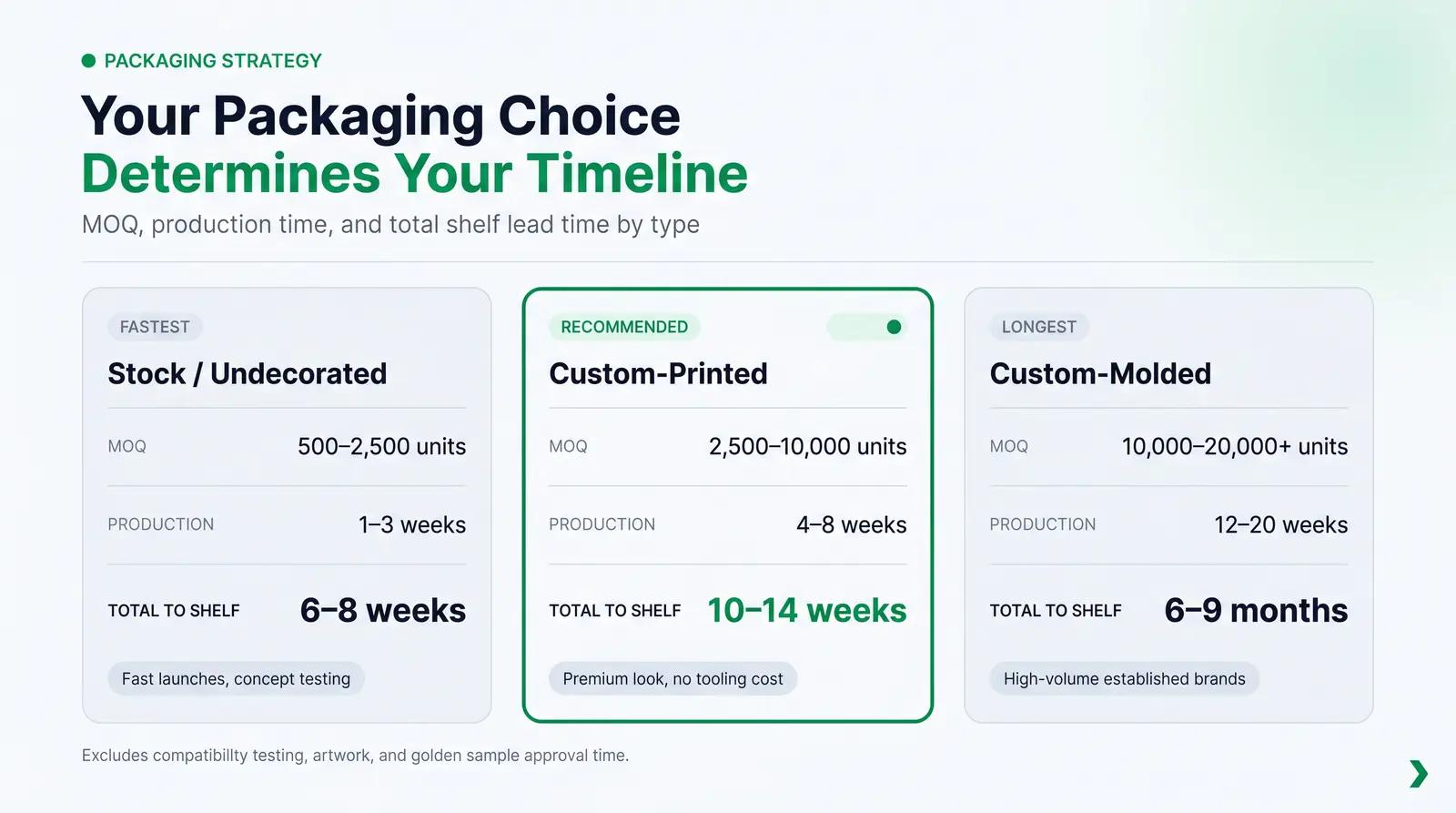
The type of packaging you choose fundamentally determines your timeline. Here is how lead times compare across stock, custom-printed, and custom-molded options, based on industry-typical figures.
| Packaging Strategy | Typical MOQ | Production Lead Time | Total Time to Shelf (Approx.) | Best For |
|---|---|---|---|---|
| Stock / Undecorated | 500 - 2,500 units | 1 - 3 weeks | 6 - 8 weeks | Fast launches, concept testing, limited budgets |
| Custom-Printed (Stock Mold) | 2,500 - 10,000 units | 4 - 8 weeks | 10 - 14 weeks | Brands needing a premium look without tooling costs |
| Custom-Molded (Bespoke) | 10,000 - 20,000+ units | 12 - 20 weeks | 6 - 9 months | Established brands with high volume and capital [3] |
The figures above represent production and freight time only. They do not include the time required for compatibility testing, artwork finalization, or golden sample approval, all of which must be completed before the production order is placed.
The Launch-Backward Planning Matrix
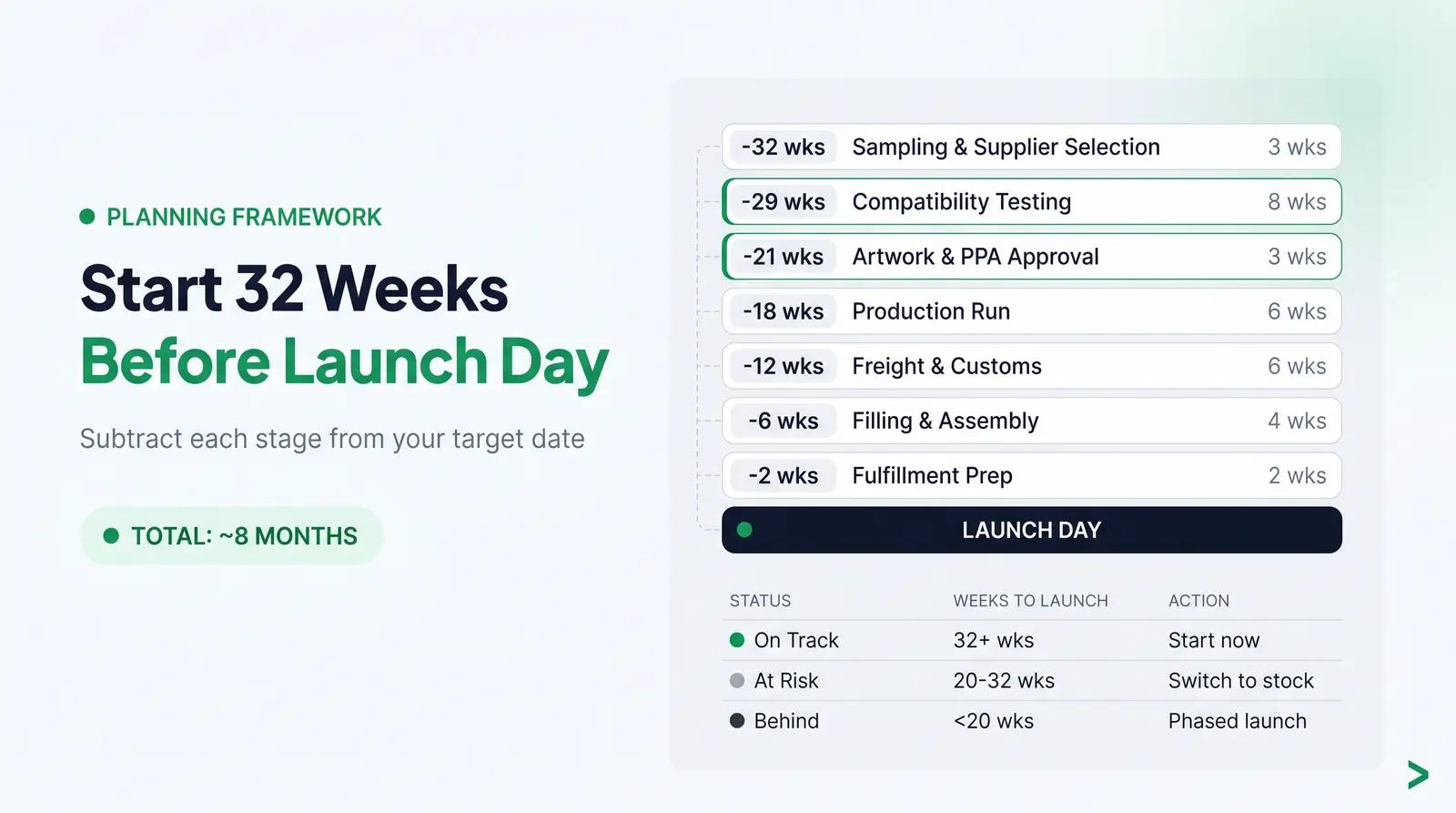
The framework we recommend at Packfolio for managing this complexity is the Launch-Backward Planning Matrix. Instead of starting from today and hoping the packaging arrives in time, this framework requires founders to start with their non-negotiable launch date and subtract the maximum realistic time for each stage. The result is the true "drop-dead" date for placing a packaging order.
How to Apply the Matrix
Step 1: Define the Launch Date. The day the product must be live on your website, in retail stores, or available for shipping. This is your fixed point.
Step 2: Subtract Fulfillment and Prep Time (2 weeks). Time to pack orders, ship to retail distribution centers, or transfer stock to a 3PL.
Step 3: Subtract Filling and Assembly (4 weeks). Time for the co-packer to fill the packaging, apply secondary labels, and box the finished product.
Step 4: Subtract Freight and Customs (6 weeks). Assuming sea freight from overseas and a standard customs clearance process.
Step 5: Subtract Production Run (6 weeks). Assuming customized stock packaging with a standard production schedule.
Step 6: Subtract PPA and Artwork Revisions (3 weeks). Time to finalize proofs, approve the golden sample, and address any revisions.
Step 7: Subtract Compatibility Testing (8 weeks). Time to ensure the formula is stable and safe in the chosen packaging component.
Step 8: Subtract Sampling and Selection (3 weeks). Time to receive and evaluate physical samples.
Total Lead Time: 32 weeks, or approximately 8 months.
Assessing Your Status
Use the matrix to determine where you stand relative to your launch date.
| Status | What It Means | Recommended Action |
|---|---|---|
| On Track | You are 32+ weeks from launch and have not yet placed an order | Begin compatibility testing and supplier selection immediately |
| At Risk | You are 20-32 weeks from launch and have not placed a production order | Evaluate switching to customized stock; compress testing with accelerated protocols |
| Already Behind | You are fewer than 20 weeks from launch without a confirmed production order | Consider a phased launch with stock packaging first; budget for air freight |
This matrix is a planning tool, not a guarantee. Actual timelines vary based on supplier location, formula complexity, and seasonal factors. The value of the matrix is that it forces a realistic conversation early, before the calendar makes the decision for you.
A Worked Example: The Vitamin C Serum Launch
This is an illustrative scenario, not a real brand case study, but the numbers and dynamics are representative of what independent beauty founders routinely experience.
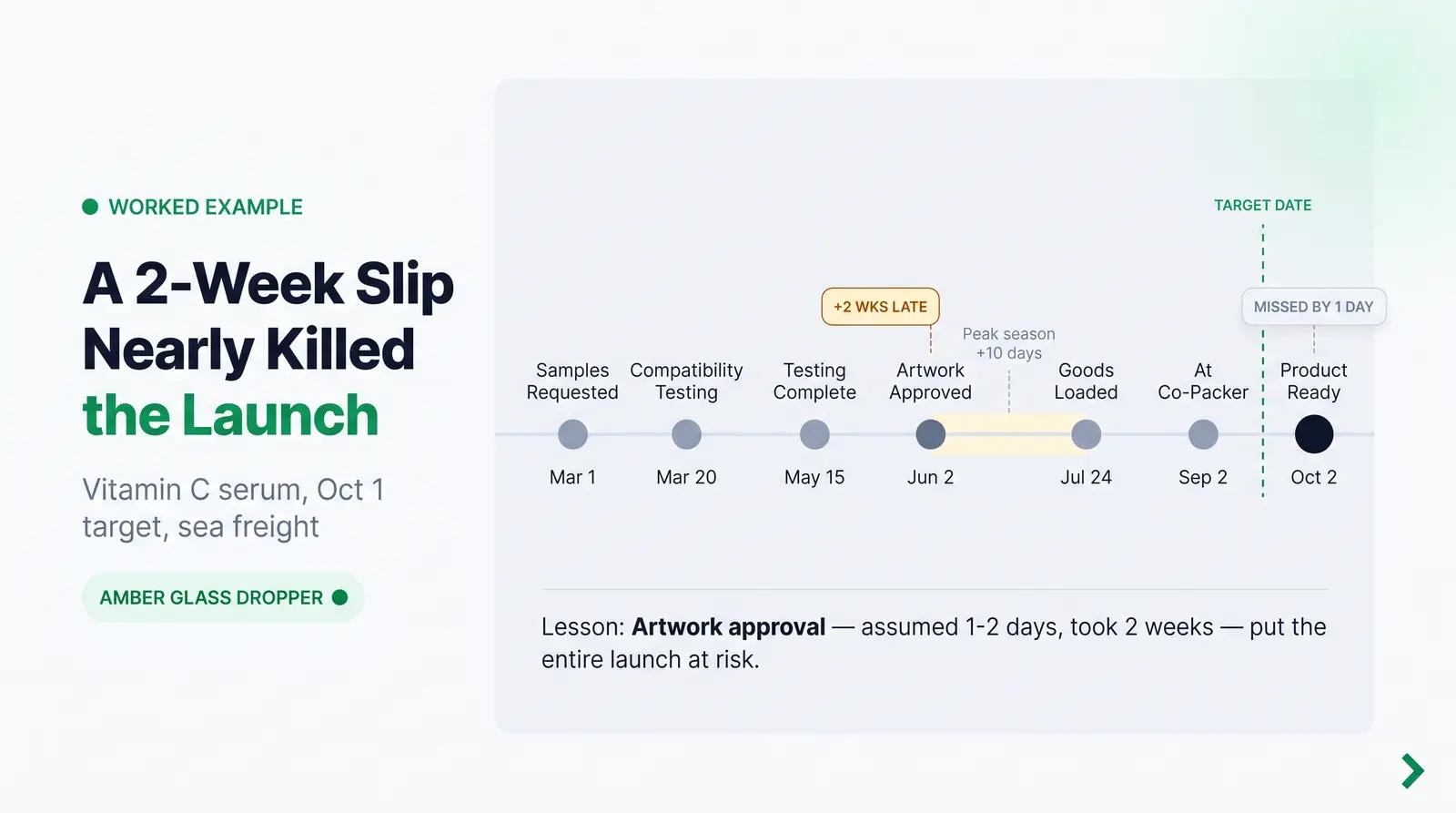
A founder is launching a Vitamin C serum in a 1 oz (30 ml) custom-printed amber glass dropper bottle. The target launch date is October 1st, timed to capture the holiday gifting season. Using the Launch-Backward Planning Matrix, the founder calculates that the production order must be placed no later than early June to hit the October launch date via sea freight.
The founder begins the process in early March, feeling confident that seven months is more than enough time.
March 1: The founder requests samples from three suppliers. Two suppliers respond within a week; one takes two weeks to reply.
March 15: Samples arrive via air freight. The founder selects a preferred bottle.
March 20: Compatibility testing begins. The founder's Vitamin C serum contains ascorbic acid at a high concentration, which requires careful testing against the glass and the dropper assembly's rubber bulb.
May 15: The 8-week compatibility test completes. Results are positive. The founder submits artwork files to the factory.
The First Delay: The factory's artwork team flags that the requested white screen-print cannot be applied to the curved shoulder of the bottle at the specified size. The founder's graphic designer takes five business days to revise the file. The factory sends a revised digital proof, but the amber glass is making the white ink appear cream-colored in the proof. The founder requests a physical color swatch. Another week passes.
June 2: The artwork is approved, two weeks past the drop-dead date.
The Cascade Begins: The order is placed in early June, just as the factory enters its pre-summer peak production period. The factory confirms a 10-day scheduling delay before the production run can begin. The production run itself takes 5 weeks.
July 17: Production is complete. Quality inspection takes one week.
July 24: The goods are loaded onto a vessel. Sea freight to the US East Coast takes 35 days.
August 28: The goods arrive at the port. Customs clearance takes 5 days.
September 2: The packaging arrives at the co-packer's warehouse. The co-packer's next available filling slot is September 22nd, three weeks away.
September 22: Filling begins. The process takes 10 days.
October 2: The product is ready to ship. The October 1st launch date has been missed by one day, but more critically, the founder has no buffer for any further delays.
The artwork revision cost the founder two weeks. That two weeks pushed the order into peak season, which added 10 days. Those 10 days compressed the freight buffer to zero. The founder got lucky; a single additional delay at any point would have pushed the launch into November. And because the founder chose sea freight to protect margin, there was no room to absorb the cascade.
The lesson is not that the founder made a catastrophic error. The lesson is that a two-week delay in artwork approval, a step most founders assume takes a day or two, was enough to put the entire launch at risk.
Where Delays Actually Happen: The Artwork Illusion
There is a contrarian reality in cosmetic packaging production: the step founders assume will be the fastest is often the most variable.
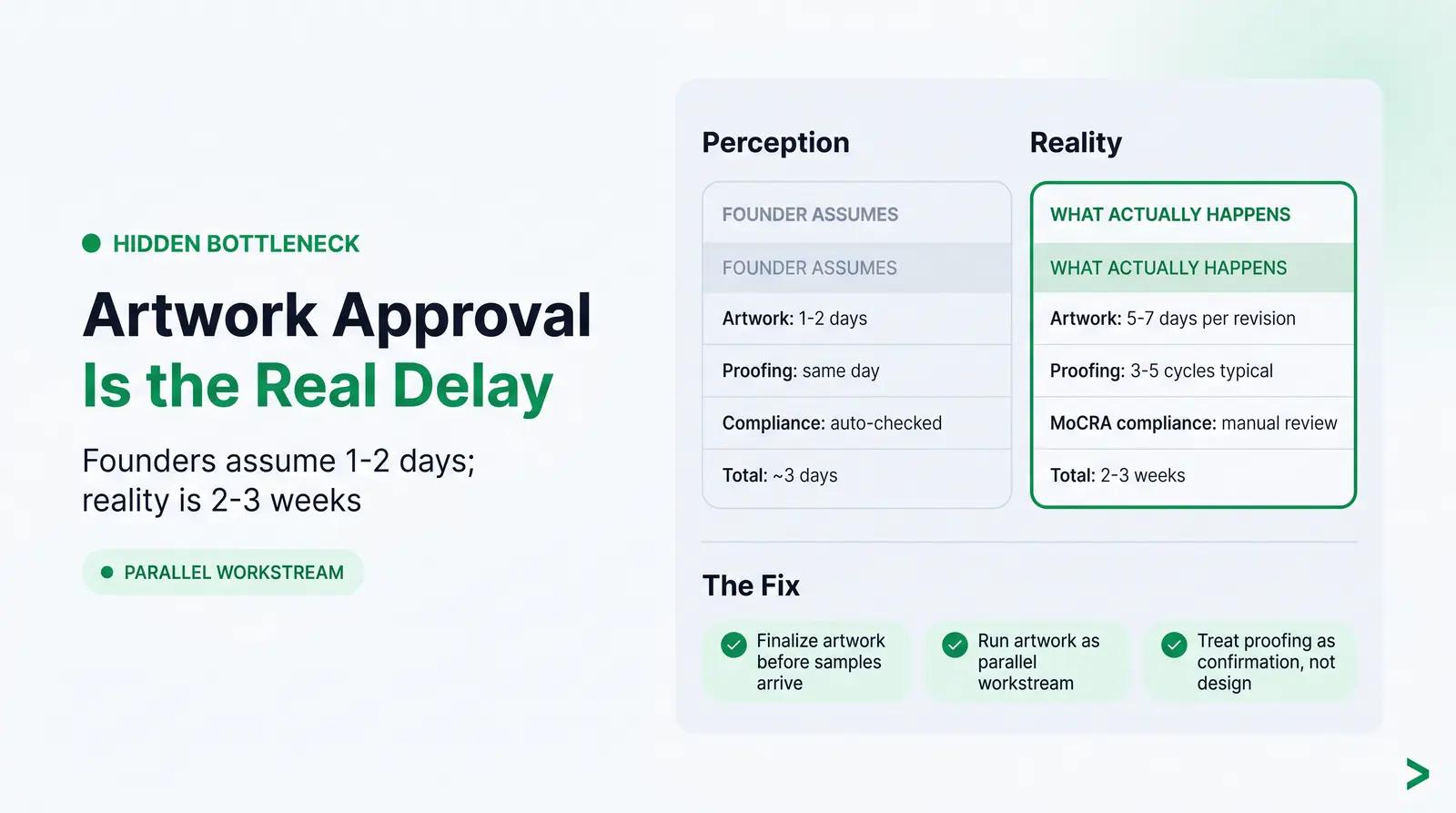
Founders frequently focus their anxiety on shipping times and production speeds, assuming that approving artwork will take a day or two. In practice, artwork approval is one of the most common bottlenecks in the entire supply chain [7]. The reason is structural, not accidental.
Packaging artwork is not just graphic design; it is technical engineering. A label file must account for bleed areas, print tolerances, and the physical curvature of the container. It must comply with regulatory requirements under MoCRA, which mandates specific ingredient declarations, allergen disclosures, and manufacturer information formatted to FDA standards [8]. A single compliance error means the file must be rejected, revised, and resubmitted. Each sampling and adjustment cycle adds 5 to 7 days to the timeline [2].
There is a second, less obvious dimension to this problem. Ordering samples earlier does not compress your overall timeline if formula compatibility testing is the bottleneck. Compatibility testing has a biological floor; accelerated protocols can compress the window to 4 to 6 weeks, but they cannot be eliminated. If a founder receives samples in week two and begins compatibility testing immediately, they still cannot place a production order until week ten at the earliest. Rushing the sample selection stage saves days, not months.
The real compression opportunity is in the artwork stage, specifically by ensuring that artwork is press-ready before samples even arrive. Founders who treat artwork as a parallel workstream rather than a sequential one can save two to three weeks without any additional cost.
Holiday Disruption and the Compounding Calendar
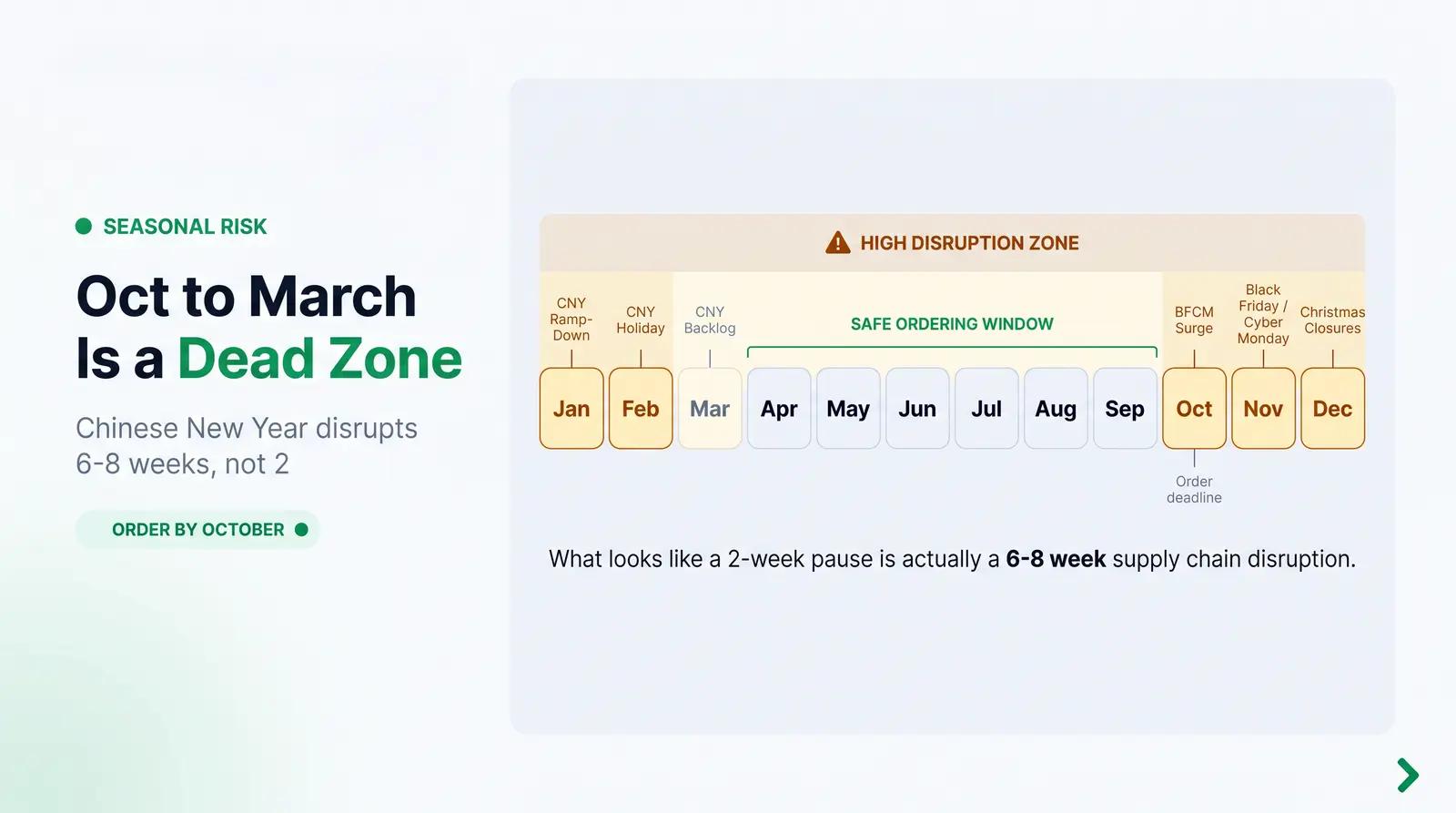
One additional risk that most lead-time guides understate is the predictable disruption caused by global manufacturing holidays. Chinese New Year is the most significant. Officially, the holiday runs for approximately two weeks, but the actual disruption to production and freight spans six to eight weeks [1].
The pattern is consistent: factories begin slowing production in the weeks before the official closure as workers prepare to travel home. Final orders are rushed through, creating scheduling pressure. Shipping lanes tighten. When factories reopen, they do not restart fresh; they restart under pressure, with a backlog of orders competing for space on the production floor. Freight rates fluctuate. Port congestion builds. What looks like a two-week pause on the calendar is actually a six-to-eight-week disruption to the supply chain [1].
For beauty brands planning a Q1 launch, this compounding effect is particularly dangerous. The sequence of Black Friday and Cyber Monday surge orders in November, Christmas closures in December, factory ramp-down in January, and Chinese New Year in February leaves almost no reliable production window between October and March [1]. Founders planning a spring launch who have not placed their packaging orders by October are already at risk.
Compressing the Timeline with the Right Platform
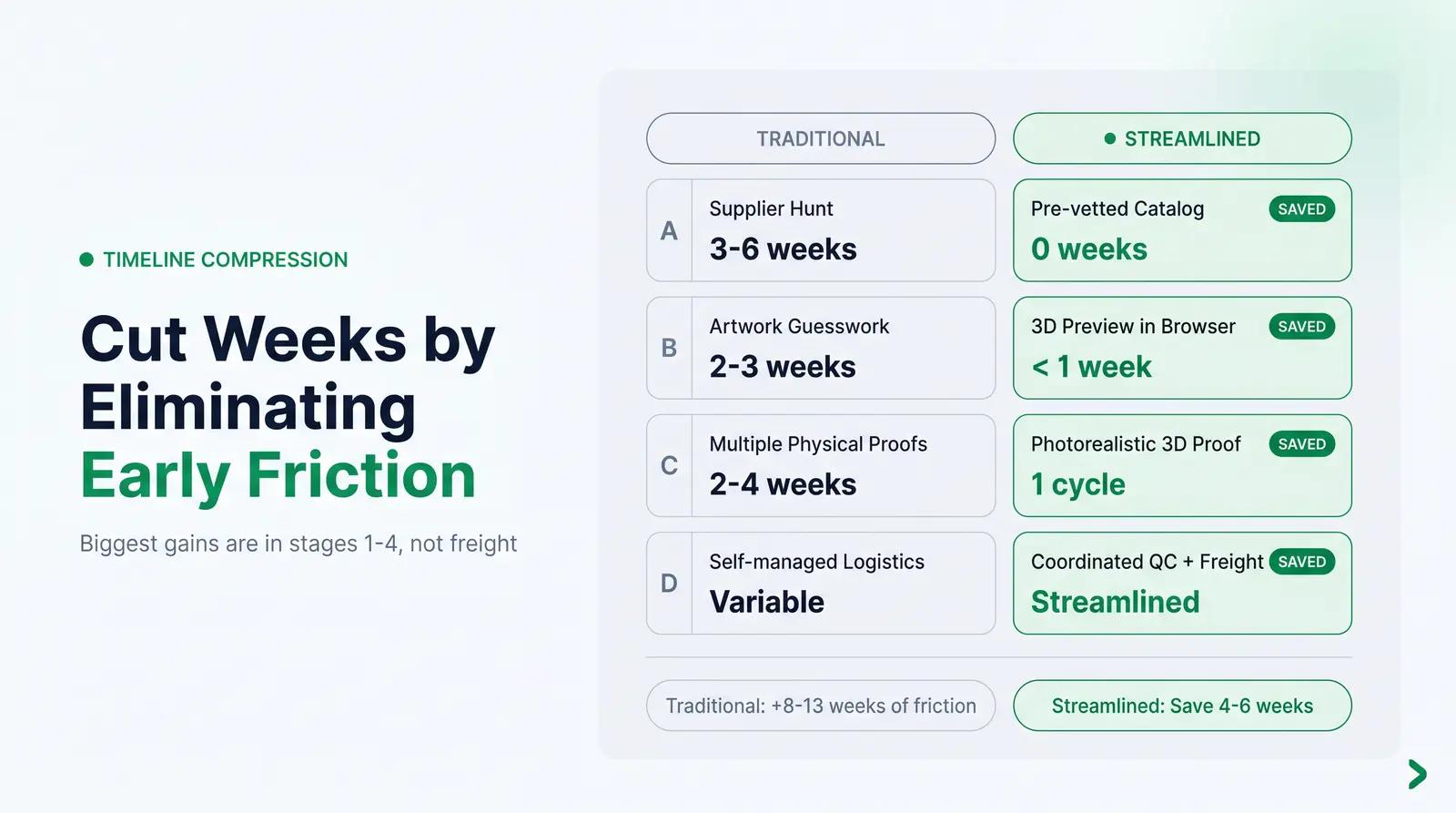
So how do you actually shortcut some of this? The most effective way to reduce lead time is to eliminate friction in the early stages: supplier sourcing, sample fishing, and artwork iteration.
Packfolio's pre-vetted catalog of 3D-modeled packaging SKUs means founders can skip the traditional supplier hunt entirely. Because every component is pre-modeled with predefined printable regions, you can preview your label in photorealistic 3D directly in the browser before committing to production, eliminating the guesswork of artwork placement and reducing the need for multiple physical proofing cycles. Packfolio also coordinates quality control and freight, streamlining the final stages of the supply chain so you can focus on your formulation and your launch plan. For more on selecting the right packaging format for your formula, see our guide to custom cosmetic packaging.
Closing Thoughts
Cosmetic packaging lead times are unforgiving, but they are entirely predictable. By understanding the true duration of each stage, using a backward-planning framework, and recognizing that artwork approval and compatibility testing are your biggest calendar risks, you can protect your launch date and your margins. The founders who consistently hit their launch targets are not the ones who found the fastest suppliers; they are the ones who started the process earlier than felt necessary.
Browse Packfolio's curated cosmetic packaging catalog and preview your label in 3D before placing your production order → packfolio.com/catalog
Frequently Asked Questions
How long does custom cosmetic packaging take from order to delivery?
Custom-printed packaging on an existing mold typically takes 10 to 14 weeks from the time the production order is placed to final delivery at your warehouse, including production, quality inspection, and sea freight. If you are developing a completely new bespoke mold, expect the process to take 6 to 9 months, as tooling, prototyping, and extended testing phases add significant time before production can begin [3].
What is the lead time for cosmetic packaging samples?
For stock or existing molds, factories can usually dispatch samples within a few days of receiving a request, and international air shipping from China to the US takes approximately 8 to 10 days [4]. If you require a custom-made prototype or a fully decorated golden sample, the process can take 2 to 4 weeks, including production and shipping time [2].
How do I plan a beauty product launch timeline backward from my launch date?
Start with your target launch date and subtract the time required for each stage in reverse order: fulfillment prep (2 weeks), filling and assembly (4 weeks), freight and customs (6 weeks), production (6 weeks), artwork and PPA (3 weeks), compatibility testing (8 weeks), and sampling (3 weeks). For a typical custom-printed order shipped via sea freight, you should begin the process at least 7 to 8 months before your desired launch date.
What causes the most delays in cosmetic packaging production?
Artwork revisions and customs clearance issues are the two most common hidden delays. Minor design adjustments can add weeks to the proofing stage, while incorrect HS codes or missing commercial invoices can leave shipments stranded at the port for days or weeks [7] [9]. Formula-compatibility testing failures are less common but the most disruptive, as they require sourcing a new packaging material and restarting the testing clock.
Can I reduce cosmetic packaging lead time without paying for air freight?
Yes. The most effective way to reduce lead time without incurring air freight costs is to use customized stock packaging instead of bespoke molds, which cuts the production phase from 12-to-20 weeks down to 4-to-8 weeks [3]. You can also compress the overall timeline by ensuring your artwork is press-ready before samples arrive, running compatibility testing in parallel with the artwork process, and placing your production order well before peak manufacturing seasons.
References
[1] Labwork. (February 2026). How Chinese New Year Disrupts Cosmetic Manufacturing. Labwork Lab Notes. Retrieved from https://labwork.com.au/blogs/lab-notes/chinese-new-year-planning
[2] Nicer Packaging. (November 2025). Differentiating Cosmetic Packaging Lead Time: Existing Molds vs. No Existing Molds. Retrieved from https://www.nicerpackaging.com/2025/25-11-03differentiating-cosmetic-packaging-lead-time-existing-molds-vs-no-existing-molds/
[3] Big Sky Packaging. (May 2026). How to Reduce Cosmetic Packaging Costs Without Sacrificing Quality. Big Sky Packaging Blog. Retrieved from https://bigskypackaging.com/blog/how-to-reduce-cosmetic-packaging-costs-without-sacrificing-quality/
[4] Freightos. (n.d.). Shipping from China to the United States: Shipping Times and Freight Costs. Freightos Shipping Routes. Retrieved from https://www.freightos.com/shipping-routes/shipping-from-china-to-the-united-states/
[5] ADSL Laboratories. (March 2024). Compatibility Testing: Is your packaging a good fit? ADSL Blog. Retrieved from https://adslaboratories.com/compatibility-testing-is-your-packaging-a-good-fit/
[6] Cosmopacks. (January 2024). The Importance of Package Compatibility Testing for Cosmetic Packaging. Cosmopacks Blog. Retrieved from https://www.cosmopacks.com/the-importance-of-package-compatibility-testing-for-cosmetic-packaging/
[7] CarePac. (n.d.). How to Manage Lead Times for Overseas Packaging. CarePac Blog. Retrieved from https://www.carepac.com/blog/how-to-manage-lead-time-for-overseas-packaging/
[8] U.S. Food and Drug Administration. (March 2026). Modernization of Cosmetics Regulation Act of 2022 (MoCRA). FDA.gov. Retrieved from https://www.fda.gov/cosmetics/cosmetics-laws-regulations/modernization-cosmetics-regulation-act-2022-mocra
[9] SeaRates. (April 2026). Sea Freight from China to USA and Back: 2026 Guide. SeaRates Blog. Retrieved from https://www.searates.com/blog/post/shipping-from-china-to-usa-sea-freight-guide-2026
[10] Next Pangaea. (February 2025). Cosmetics Private Label Lead Time: Concept and Production Process Duration. Next Pangaea Blog. Retrieved from https://www.nextpangaea.com/post/cosmetics-private-label-lead-time-concept-and-production-process-duration
[11] KBL Cosmetics. (October 2025). How long does it take to develop a custom cosmetic formulation from concept to finished product? KBL Cosmetics Blog. Retrieved from https://kblcosmetics.com/blogs/news/how-long-does-it-take-to-develop-a-custom-cosmetic-formulation-from-concept-to-finished-product
[12] APackaging Group. (n.d.). How long does it take to design beauty packaging? APackaging Group Blog. Retrieved from https://apackaginggroup.com/blogs/news/how-long-does-it-take-to-design-beauty-packaging
[13] Gidea Pac. (n.d.). Everything you need to know about Minimum Order Quantity in the cosmetic packaging industry. Gidea Pac. Retrieved from https://gideapac.com/everything-you-need-to-know-about-minimum-order-quantity-in-the-cosmetic-packaging-industry/


