
Generic Sample vs Pre-Production Sample: What Beauty Founders Need to Know
Beauty founders must understand that generic samples validate form factor only, while pre-production samples confirm decoration, color, and material accuracy before committing to bulk production.
A beauty founder launches a new 1 oz vitamin C serum. They request a sample of a frosted glass dropper bottle from a supplier. The supplier sends a blank, undecorated bottle from their stock room. The founder tests the dropper, likes the weight of the glass, and signs off on the order. Six weeks later, 10,000 units arrive. The frosted finish feels rougher than the sample. The brand's logo, printed directly on the glass, is registered 2 millimeters off-center, making the entire run look slightly misaligned. When the founder complains, the supplier points out that the approved sample was generic. It was never meant to validate decoration or production-run material consistency.
This scenario plays out constantly in the beauty industry. Founders routinely confuse the two primary sample types, approving a generic sample as though it were a production proof. They believe a generic sample confirms exactly what they will receive, only to face surprises when the final production units arrive with decoration mismatches, color drift, failed actuators, or material substitutions.
Understanding what each sample type can and cannot validate is the only way to avoid the downstream surprises that come from confusing or skipping these critical sourcing steps. This article breaks down both sample types in full, maps them to the specific validation dimensions that matter for cosmetic primary packaging, and gives you a practical framework for deciding which sample to request at each stage of your project.
What Is a Generic Sample?
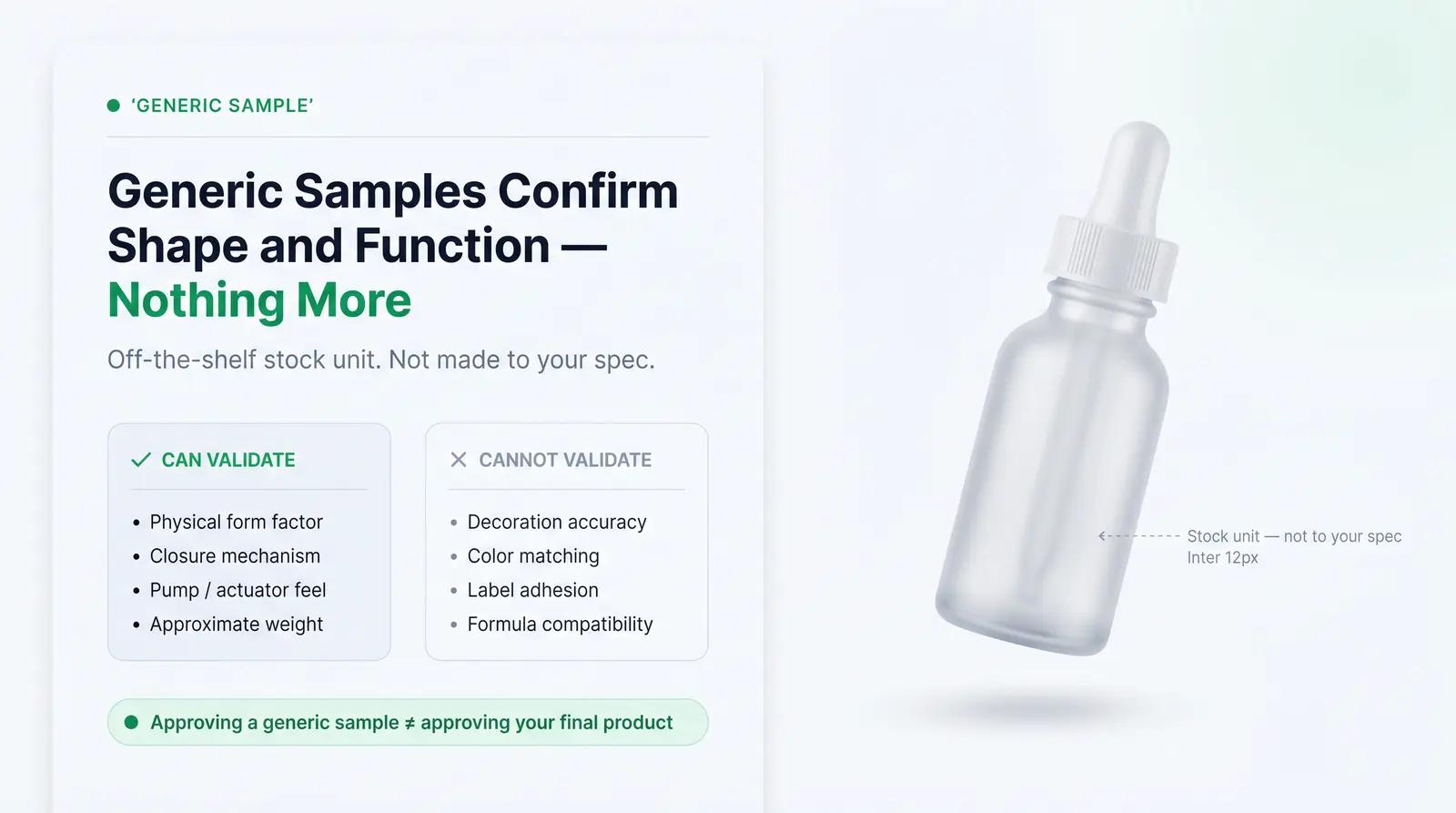
A generic sample (also called a stock sample, reference sample, or market sample depending on the supplier) is an off-the-shelf, undecorated, or pre-decorated unit pulled from existing inventory. It is not made to the buyer's specification. It exists simply to demonstrate the supplier's general capability or to provide a physical reference for a standard mold [1].
What it can validate: A generic sample is useful for early-stage evaluation. It validates the physical form factor, the basic closure mechanism, and the general pump or actuator feel. It provides a sense of the approximate weight and material hand-feel. It also confirms basic component fit, for example, whether a dropper bulb collapses correctly or whether an airless pump primes properly when empty. If you are comparing two different bottle shapes or deciding between a pump and a dropper format, a generic sample is the right tool for that decision.
What it cannot validate: Because it is pulled from stock, a generic sample cannot validate decoration accuracy, such as print registration or foil stamping alignment. It cannot validate color matching to your specific brand standard. It cannot confirm label adhesion on the actual substrate you intend to use. Furthermore, it cannot indicate fill compatibility with your specific formula, production-run material consistency, or shipping and drop-test performance [2]. Approving a generic sample only means you approve the general shape and function of the component, not how it will perform when customized for your brand.
A critical distinction worth noting: the term "generic sample" is sometimes used loosely by suppliers to describe any sample that is not a full production run. Always clarify with your supplier exactly what the sample represents. Ask directly: "Is this sample made from the same tooling, materials, and decoration process that will be used for my bulk order?" If the answer is no, you have a generic sample, regardless of what the supplier calls it.
What Is a Pre-Production Sample (PPS)?
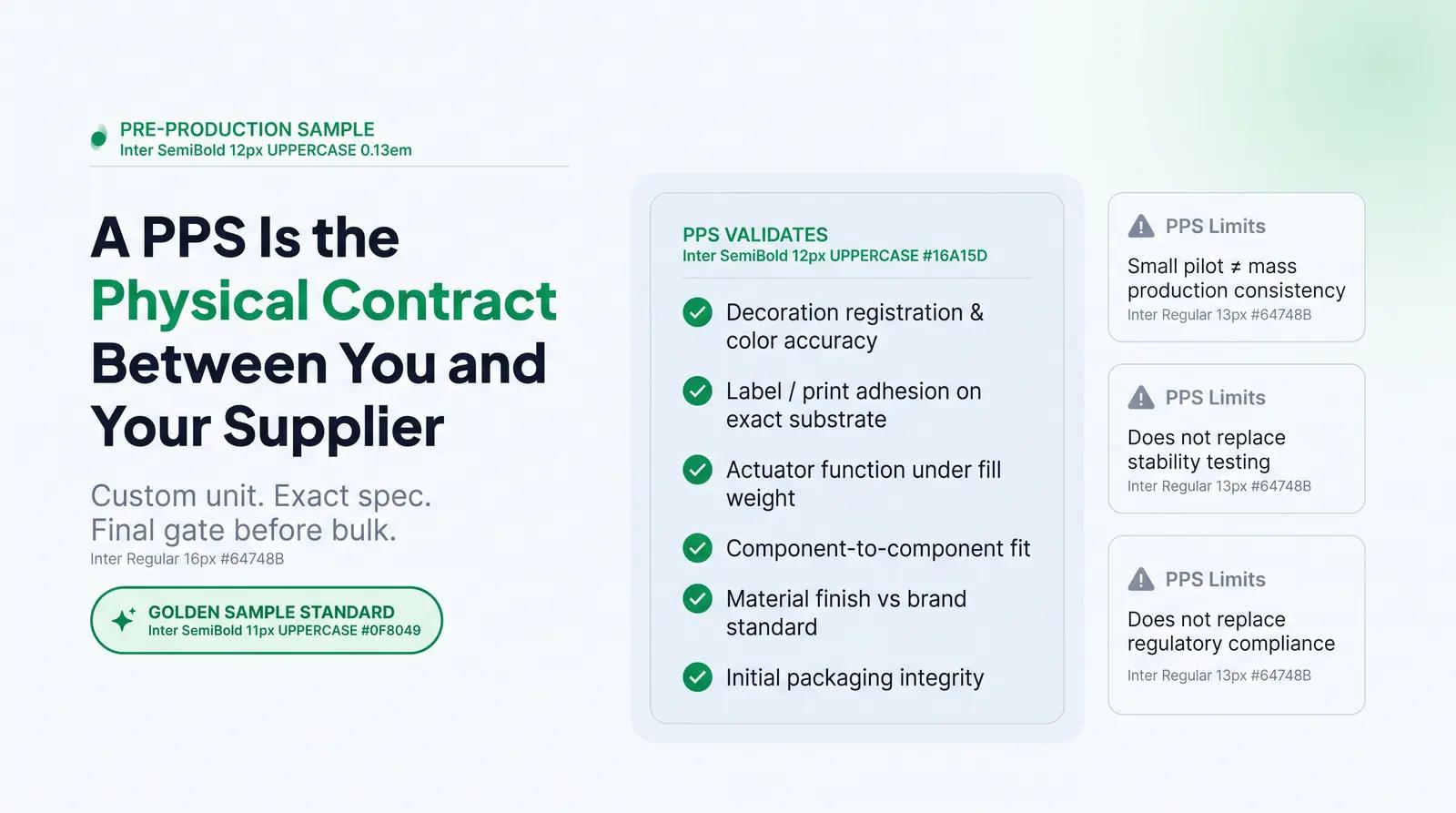
A pre-production sample (PPS) is a unit, or a small run of units, manufactured to the buyer's confirmed specifications before the main production order is released. It uses the actual mold, the actual substrate, the buyer's confirmed decoration artwork and colors, and ideally the buyer's formula or a close proxy [3]. It is the final signed project standard that tells the workshop exactly what to make [4].
What it validates: The PPS is the definitive physical proof of your order. It validates decoration registration and color accuracy. It confirms label or print adhesion on the exact substrate. It allows you to test actuator function under actual fill weight. It verifies component-to-component fit at the specified dimensions. It confirms material color and finish against your brand standard, and it establishes the initial packaging integrity before bulk manufacturing begins [5].
What it cannot validate: While the PPS is comprehensive, it has limits. A PPS from a small pilot run may not perfectly predict high-volume production consistency, because mass production introduces variables that a single-unit setup does not replicate. It also does not substitute for full stability or compatibility testing over time, nor does it replace necessary regulatory compliance testing under frameworks such as ISO 22716 or MoCRA [6]. Think of the PPS as the final gate before production, not the final gate before launch.
The PPS is sometimes called a golden sample, approval sample, or confirmation sample. Whatever the name, its function is the same: it is the physical contract between you and your supplier that defines the acceptable standard for every unit in the bulk run.
Side-by-Side Comparison
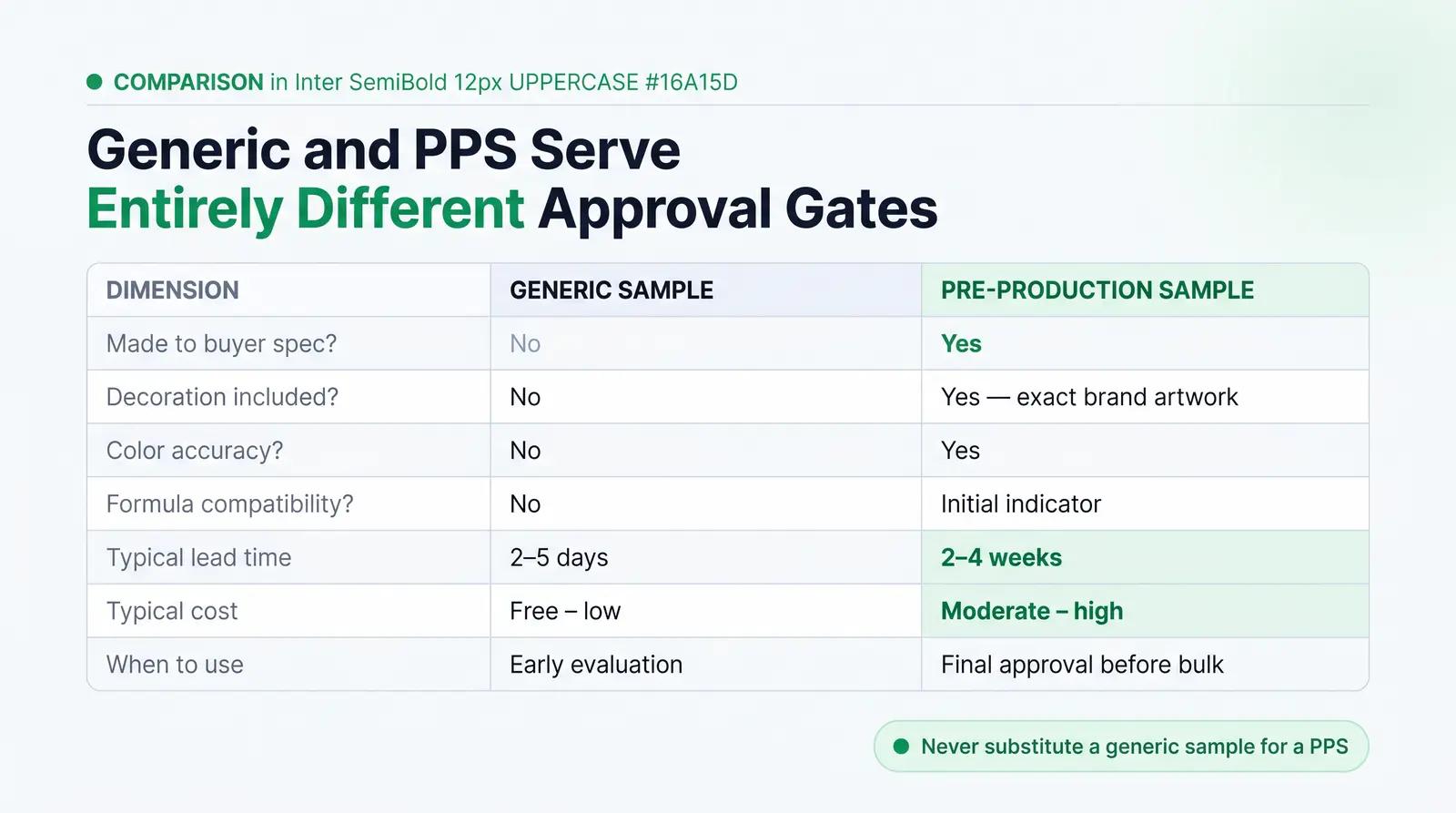
| Validation Dimension | Generic Sample | Pre-Production Sample (PPS) |
|---|---|---|
| What it is | Off-the-shelf stock unit from inventory | Custom unit made to exact order specs |
| Made to buyer's spec? | No | Yes |
| Decoration included? | No (or random pre-existing decoration) | Yes (exact brand artwork) |
| Color accuracy validated? | No | Yes |
| Pump/actuator validated? | Basic mechanical function only | Yes, under fill weight |
| Formula compatibility indicator? | No | Yes (initial interaction) |
| Production-run material confirmed? | No | Yes |
| Shipping/drop-test applicable? | No | Yes |
| Typical lead time | 2–5 days | 2–4 weeks |
| Typical cost to buyer | Free to low cost (shipping only) | Moderate to high (tooling/setup fees) |
| When to use it | Early evaluation, supplier vetting, form factor selection | Final approval before releasing bulk production order |
The Sample Validation Ladder
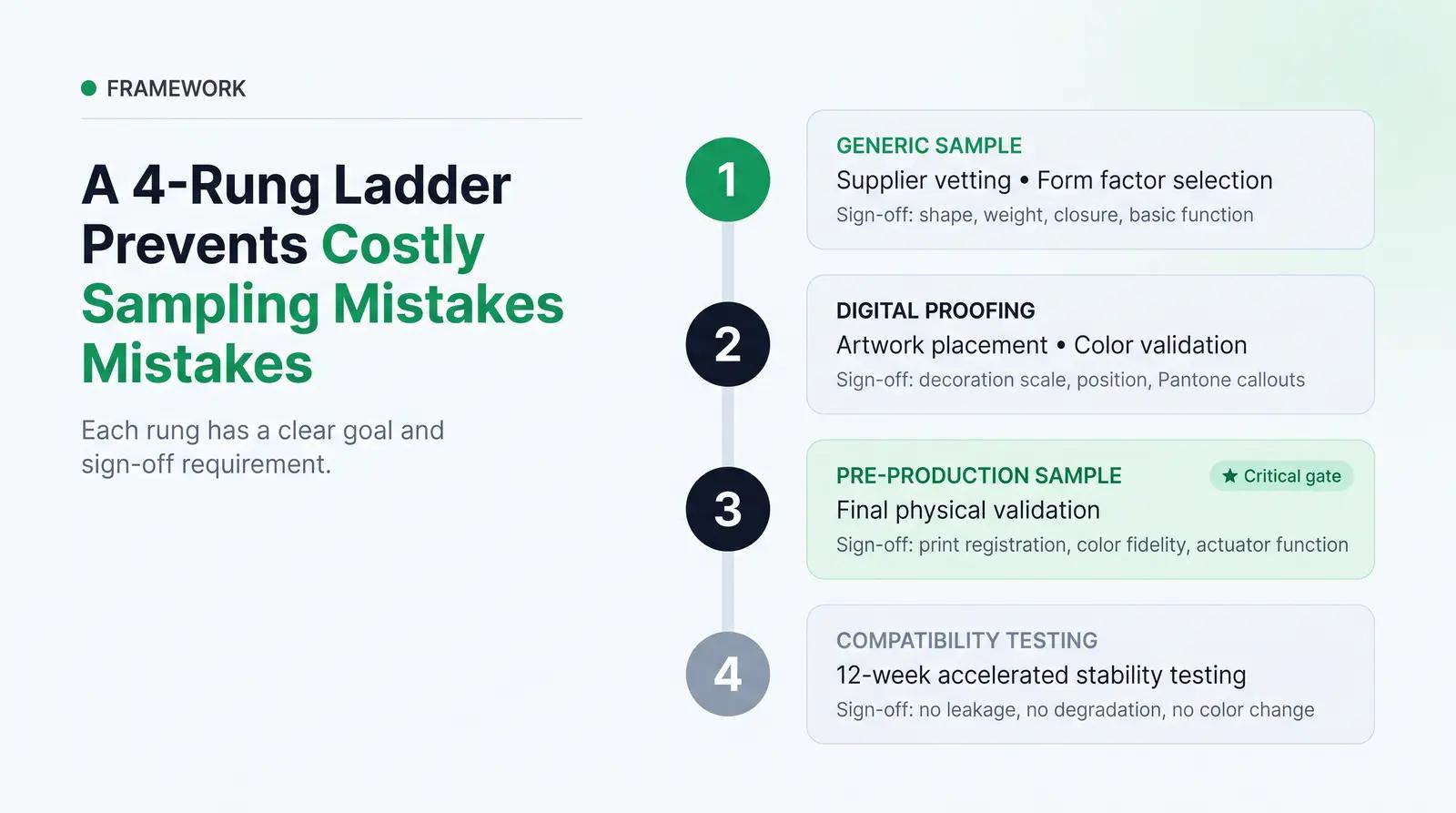
To navigate the sampling stage without overspending or under-testing, we recommend a structured approach at Packfolio. The Sample Validation Ladder gives founders a practical framework for deciding which sample type is needed at each stage of a project, and what must be signed off before advancing to the next rung. The framework is grounded in the quality management principles outlined in ISO 22716, the internationally recognized Good Manufacturing Practice standard for cosmetics, which emphasizes that quality must be built into the production process through structured checkpoints rather than inspected in at the end [6].
Rung 1: The Generic Sample Stage
Goal: Supplier vetting and form factor selection.
Action: Request 2–3 generic samples of the desired component, for example a 30 ml frosted glass dropper or a 50 ml airless pump bottle. Compare samples from multiple suppliers if you are still in the selection phase.
Sign-off requirement: Approve the general shape, weight, closure mechanism, and basic mechanical function. Confirm that the dropper draws up cleanly, the pump primes without excessive effort, and the cap threads engage smoothly. Do not advance to Rung 2 until the physical format is finalized and a supplier is selected.
Common mistake: Treating the generic sample approval as a final production approval. It is not. It is only a form factor decision.
Rung 2: The Digital Proofing Stage
Goal: Artwork placement, scale, and color validation.
Action: Review a 3D digital render of the component with your artwork applied to the actual component geometry. This step catches obvious registration errors and scale mismatches before any physical setup costs are incurred [7].
Sign-off requirement: Approve the decoration scale, position, and Pantone callouts on the digital model. Confirm that the artwork fits within the printable region of the component, that no text wraps awkwardly around curves, and that the color callouts are clearly specified.
Why this matters: Digital proofing on an accurate 3D model of the actual component geometry can catch decoration registration and color placement errors earlier and more cheaply than waiting for a physical PPS. This is only true, however, if the 3D model accurately reflects the substrate's surface finish and print behavior. A generic 3D render that does not account for the matte-diffuse properties of a frosted glass surface, for example, will not accurately predict how a dark ink will appear on that finish.
Rung 3: The Pre-Production Sample (PPS) Stage
Goal: Final physical validation of the customized component.
Action: Request a physical PPS manufactured to the exact specifications approved in Rung 2. The PPS must be produced using the actual production tooling, actual inks, and actual substrate.
Sign-off requirement: Approve the print registration, color fidelity on the actual substrate, material finish, and pump or dropper function under fill weight. Any deviation from the approved digital proof must be documented and either corrected with a revised PPS or formally accepted in writing.
Important: Do not release the bulk production order until the PPS is physically in your hands and formally approved in writing. A verbal approval or photo approval is not sufficient for complex decoration [10].
Rung 4: The Compatibility Testing Stage
Goal: Long-term stability and regulatory compliance.
Action: Use the approved PPS, or early production units, to conduct 12-week accelerated stability testing with the actual formula. This tests whether the formula interacts negatively with the substrate, liner, or closure over time.
Sign-off requirement: Confirm no leakage, no material degradation, no formula separation, and no change in viscosity or color. This step often runs concurrently with bulk production for fast-tracked launches, but doing so carries inherent risk. A stability failure discovered after bulk production has begun is a costly problem.
What Each Sample Type Can and Cannot Validate
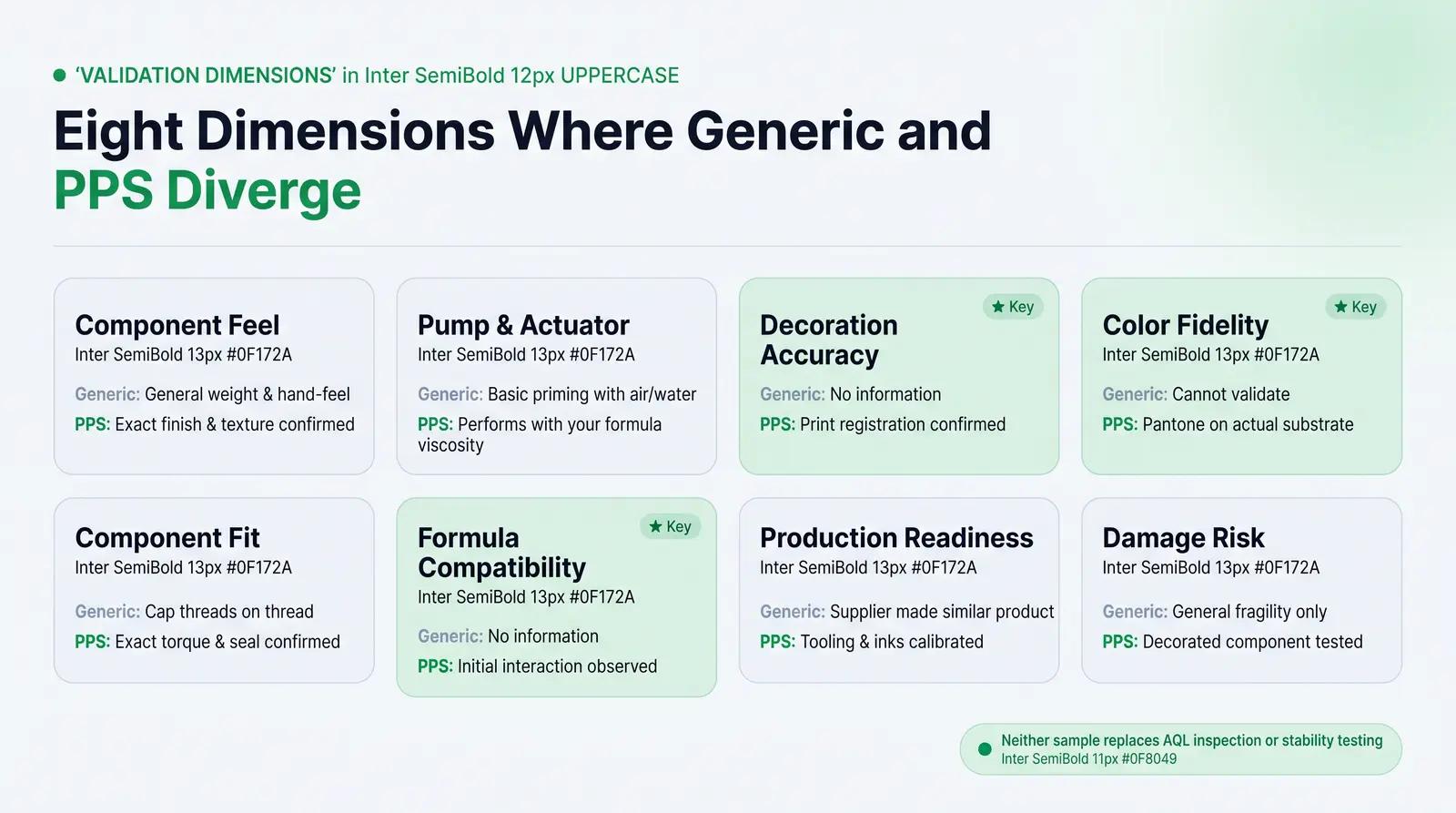
Understanding the specific technical limits of each sample type is critical for quality control. Here is how generic and pre-production samples perform across the eight most important validation dimensions for cosmetic primary packaging.
Component Feel and Material Quality
A generic sample tells you the general weight and hand-feel of the material category, for example standard PET plastic versus heavy-wall glass. However, a pre-production sample tells you the exact finish and texture of the final production run. A generic frosted glass bottle might use a different acid-etching depth or sandblasting process than your final order, resulting in a noticeably different tactile experience. Only the PPS confirms the exact feel your customer will have when they pick up the product. Neither sample type can replace batch-to-batch quality control inspections during mass production, which are necessary to catch material substitutions that sometimes occur mid-run when a supplier's raw material source changes.
Pump and Actuator Function
A generic sample tells you if a pump primes and if the spring mechanism functions when pumping air or water. This is useful for confirming that the basic mechanism is not defective. A pre-production sample tells you how that exact actuator performs when pushing your specific formula viscosity under actual fill weight. A pump that primes perfectly with water may struggle with a high-viscosity cream or a low-viscosity oil, because the spring tension and valve design are calibrated for a specific viscosity range. Neither sample type can replace long-term mechanical cycle testing, for example confirming that the pump does not fail after 300 uses or that the spring does not fatigue under repeated compression.
Decoration Accuracy
A generic sample tells you nothing about your decoration. A pre-production sample tells you if your silk screening is perfectly registered, if your foil stamping aligns with the deboss, and if your label sits flat without bubbling on the specific curvature of the bottle. Decoration accuracy is one of the most common failure points in cosmetic packaging production, because the printing setup for a curved glass surface requires precise jig calibration that varies by component geometry. Neither sample type can guarantee that every single unit in a 50,000-piece run will be perfectly registered. That requires an Acceptable Quality Limit (AQL) inspection during production, where a statistically valid sample of units is pulled from the line and checked against the approved PPS [8].
Color Fidelity
A generic sample cannot validate color. A pre-production sample tells you exactly how your chosen Pantone color looks when applied to your specific substrate. This is a dimension where many founders are surprised. A Pantone 375 C green printed on clear acrylic looks significantly different from the same Pantone printed on frosted glass, soft-touch silicone, or matte-coated plastic, because the substrate's surface finish affects how light reflects off the ink. The PPS is your only physical proof of color fidelity on the actual material. Neither sample type can replace a spectrophotometer reading for strict batch color consistency across multiple production runs.
Component Fit
A generic sample tells you if the cap screws onto the thread. A pre-production sample tells you the exact closure torque required to achieve a leak-proof seal, whether the dropper bulb sits flush with the collar, and whether the overcap aligns perfectly with the base. Component fit issues are particularly common when a founder sources the primary container from one supplier and the closure from another. The PPS is the only way to confirm that all components fit together as specified. Neither sample type can replace a vacuum leak test on the final production line, which confirms seal integrity under the conditions of a filled, pressurized container.
Formula-Container Compatibility
A generic sample tells you nothing about compatibility. A pre-production sample gives you an initial indicator of how your formula interacts with the substrate or liner. For example, a high-concentration vitamin C serum may degrade a natural rubber dropper bulb over time, while a silicone bulb remains stable. The PPS allows you to fill the component with your actual formula and observe any immediate interaction, such as discoloration, swelling, or leakage. However, neither sample type can replace formal 12-week accelerated stability testing, which is the only way to confirm long-term compatibility and shelf life [6].
Production Readiness
A generic sample tells you the supplier has made a similar product before. A pre-production sample tells you that the supplier has successfully set up the tooling, calibrated the printing machines, and sourced the correct raw materials for your specific order. This is a critical distinction. A supplier who produces excellent generic samples may still struggle with your specific decoration requirements if they lack the right printing equipment or if your Pantone color requires a custom ink mix that they have not previously formulated. Neither sample type can guarantee that the factory will not face equipment breakdowns or material shortages during the bulk run. That risk is managed through supplier audits and production monitoring.
Packaging Damage Risk
A generic sample tells you the general fragility of the component shape. A pre-production sample tells you how your specific finished component, with its specific coatings, decorations, and closures, withstands scratching, scuffing, or dropping. A frosted glass bottle with a silk-screened logo, for example, may be more susceptible to surface scratching during transit than an undecorated bottle, because the ink layer adds a surface that can chip or scuff. Neither sample type can replace formal ISTA transit testing of the fully packed master carton, which simulates the vibration, compression, and drop conditions of real-world shipping.
The Supplier Blind Spot
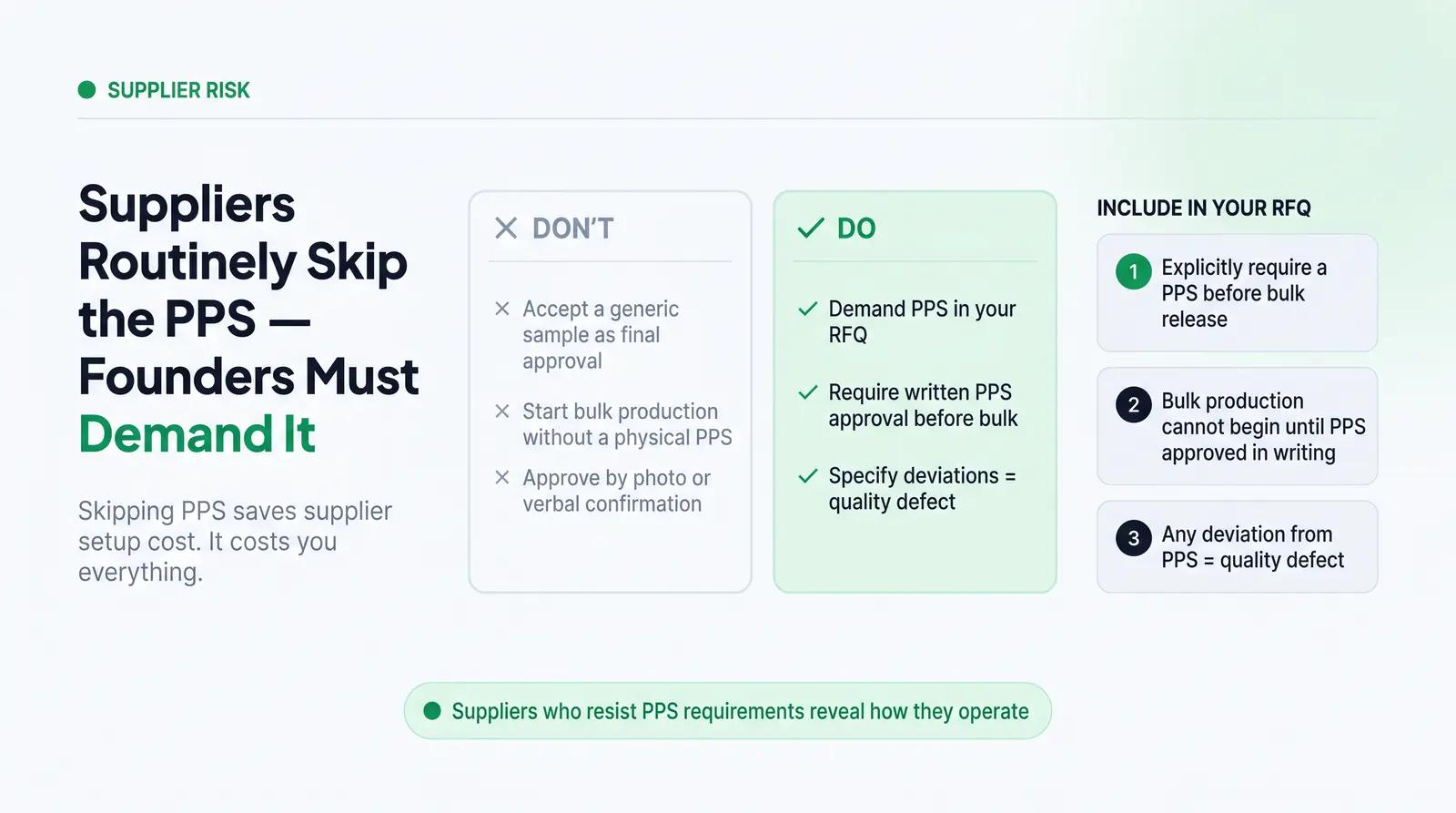
There is a critical, often-overlooked reality in the cosmetic packaging supply chain: the pre-production sample approval step is frequently skipped not because founders actively choose to skip it, but because suppliers quietly omit offering it.
Producing a PPS requires interrupting a mass-production line to run a single unit or a tiny batch. It requires setting up printing screens, mixing custom inks, and calibrating machines, all for a sample that generates no immediate revenue. To reduce their own lead times and avoid setup costs, many suppliers will send a generic sample, secure the deposit, and move straight to bulk production [9]. Founders, especially those new to sourcing, simply do not know to demand a PPS. They assume the generic sample is the final approval gate.
This blind spot is responsible for a significant share of the misprints, color errors, and functional failures that plague independent beauty launches. The fix is straightforward but must be deliberate: explicitly demand a PPS in your initial Request for Quote (RFQ), specify that bulk production cannot begin until the PPS is physically received and approved in writing, and include a clause that any deviation from the approved PPS in the bulk run constitutes a quality defect [10]. Suppliers who push back on this requirement are telling you something important about how they operate.
For founders sourcing through Packfolio, the 3D preview workflow addresses a significant portion of this risk at the digital stage. Because every SKU in the Packfolio catalog is pre-modeled in 3D with accurate component geometry and predefined printable regions, customers can review their artwork on a photorealistic model of the actual component before ordering. This catches decoration registration and color placement issues digitally, before any physical setup costs are incurred, compressing the sampling cycle and reducing the number of PPS revisions required. Browse the Packfolio catalog to see how this works in practice.
A Worked Example: The Frosted Glass Dropper Bottle
Consider a beauty founder launching a 1 oz (30 ml) vitamin C serum in a frosted glass dropper bottle. This is one of the most common formats in the independent skincare market, and also one of the most technically demanding from a decoration standpoint, because the frosted surface creates specific challenges for print adhesion and color accuracy.
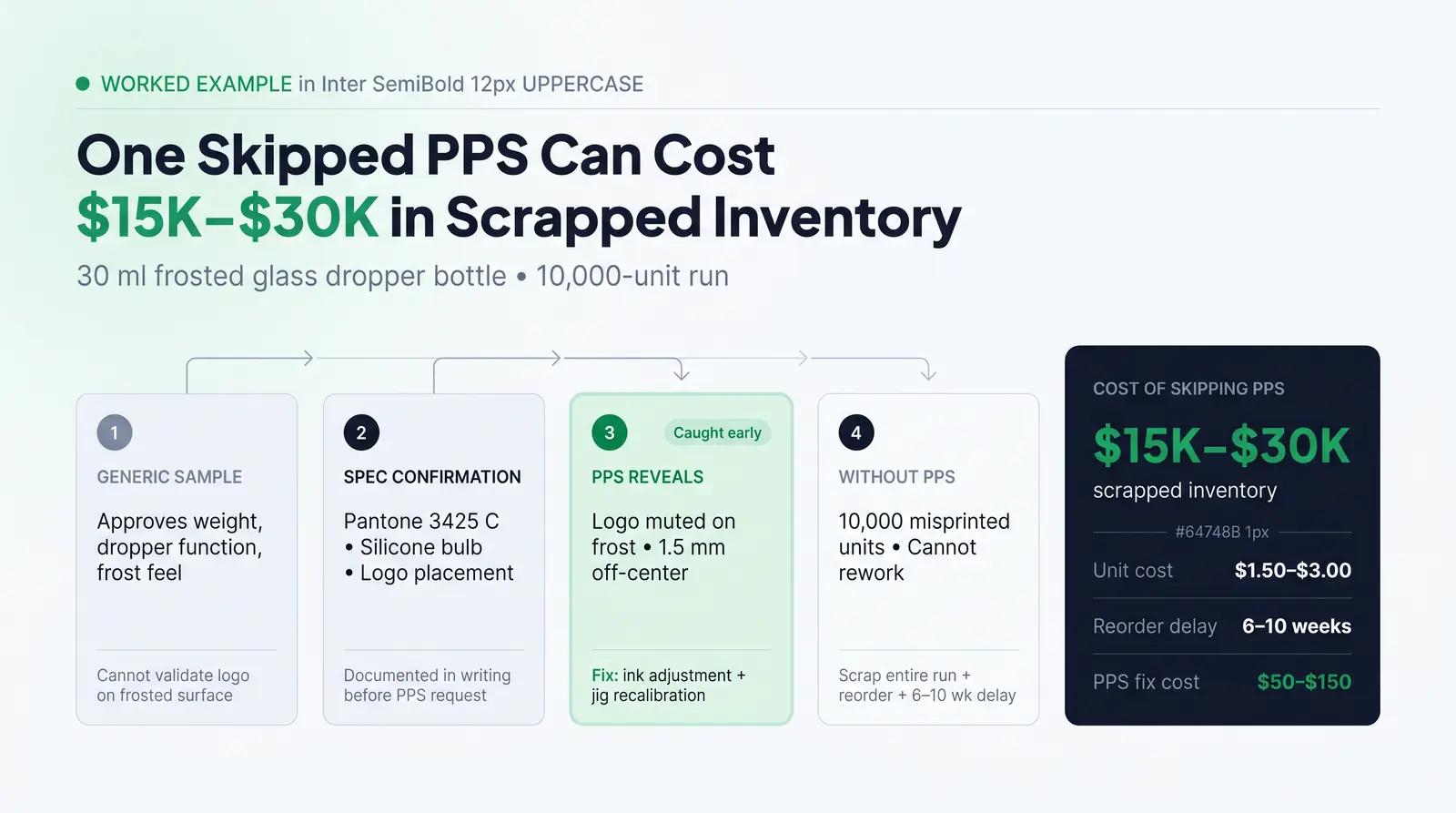
At the generic sample stage, the founder receives an unprinted, frosted glass bottle with a standard white dropper assembly. The founder approves the weight of the glass, confirms the dropper draws up water effectively, and likes the matte feel of the frost. This tells them the supplier's basic mold is acceptable. What it does not tell them is anything about how their brand's dark green logo will look on that frosted surface, or whether the nitrile dropper bulb will remain stable in contact with a high-concentration L-ascorbic acid formula.
Before releasing the pre-production sample, the founder must confirm the exact Pantone color for the brand logo (in this case, Pantone 3425 C), the specific material for the dropper bulb (silicone, given the formula's low pH), the exact length of the glass pipette, and the precise placement of the logo on the bottle. These specifications must be documented in writing and submitted to the supplier as part of the PPS request. For a related guide on managing packaging specifications and quality control checkpoints, see the Packfolio blog on packaging quality control.
When the PPS arrives, it reveals what the generic sample could not. The brand's dark green logo, when silk-screened over the frosted finish, looks slightly muted and lacks the required contrast against the pale grey of the frosted glass. Furthermore, the PPS shows the printed logo is registering 1.5 mm off-center due to the slight curvature of the frosted substrate at the printing zone.
The decision moment: Because this was caught at the PPS stage, the founder has two clear options. First, request a color adjustment to a darker, more opaque green ink formulation, and ask the factory to adjust the printing jig to correct the registration. This adds approximately one week to the timeline and a minor revision fee, typically $50 to $150 for a jig adjustment. Second, formally accept the slight offset as within tolerance if the visual impact is negligible.
What would have happened without a PPS: If the founder had skipped the PPS and these errors were only caught at bulk delivery, the cost impact would be substantially higher. Reworking 10,000 misprinted frosted glass bottles is often technically impossible, because the silk-screened ink bonds directly to the glass surface. The entire run would likely need to be scrapped. At a unit cost of $1.50 to $3.00 for a decorated frosted glass dropper bottle, that represents $15,000 to $30,000 in lost inventory, plus the cost of reordering, plus a launch delay of 6 to 10 weeks. These figures are illustrative estimates based on typical cosmetic packaging unit costs [11], but they reflect the real scale of risk that a single skipped PPS can introduce.
Ready to see your decoration on the actual component before committing to production? Browse Packfolio's curated cosmetic packaging catalog and preview your artwork in 3D on a photorealistic model, before you place a single order. Browse the Packfolio catalog
Frequently Asked Questions
What is the difference between a generic sample and a pre-production sample? A generic sample is an off-the-shelf, uncustomized unit used to check the basic shape and function of a container. A pre-production sample (PPS) is a custom-made unit produced to your exact specifications, including your brand's colors, materials, and decoration, serving as the final physical proof before mass production begins. Approving a generic sample does not substitute for approving a PPS.
Do I need a pre-production sample if I already approved a generic sample? Yes, always. Approving a generic sample only confirms the physical shape and basic mechanical function of the bottle or jar. You still need a pre-production sample to validate that your specific artwork, colors, and finishes will look correct and adhere properly to the actual production substrate. These are two separate approval gates with entirely different purposes.
How much does a pre-production sample cost for cosmetic packaging? PPS costs vary widely depending on the complexity of the decoration and the tooling required. While a generic sample typically costs only shipping, a PPS for cosmetic primary packaging generally ranges from $100 to $500 or more, because the factory must set up printing screens, mix custom inks, and run the sample through the actual production equipment for a single unit. Some suppliers will reimburse the PPS cost against a qualifying bulk order.
How long does it take to get a pre-production sample for beauty packaging? A pre-production sample typically takes 2 to 4 weeks to produce and ship internationally. This lead time is necessary because the supplier must source your specific raw materials, create the printing screens or calibrate the printing jig, and run the sample through the actual production equipment. Build this window into your launch timeline from the start, and add at least one week for potential revision rounds.
What should I check when approving a pre-production sample? When reviewing a PPS, check the accuracy of the print registration against your artwork file, the fidelity of the colors against your Pantone standards under neutral lighting, the function of the pump or dropper when filled with your actual formula, the closure torque and fit of all components, and the surface finish and material texture against your specification. Document your approval or revision requests in writing. This is your last opportunity to request changes before bulk manufacturing begins.
References
[1] Types of Packaging Samples. G-Printing. 2022. https://www.gprinting.com/blog/types-of-packaging-samples
[2] Generic vs. Custom Packaging: When to Choose Each. Brown Packaging. 2025. https://brownpackaging.com/generic-vs-custom-packaging-when-to-choose-each-2/
[3] Pre-Production Sample. PackMojo. https://packmojo.com/samples/pre-production-sample/
[4] Pre-Production Sample Approval Checklist for GWP Bags. Ecorivta. 2026. https://www.ecorivta.com/pre-production-sample-approval-checklist-for-cosmetic-bag-gwp-orders/
[5] 5 Benefits of a PP sample. QC Advisor. 2019. https://www.qcadvisor.com/blog/5-benefits-of-a-pp-sample/
[6] Quality Assurance for Cosmetic Products. ECQA. 2025. https://ecqa.com/quality-assurance-for-cosmetic-products/
[7] 3D Proofing of Packaging Design for Printing and Packaging Converters. Significans Automation. https://significans.com/blog/3d-proofing-of-packaging-design-for-printing-and-packaging-converters/
[8] Print-Ready Cosmetics Packaging: 10 Must-Do Checks. ManageArtworks. https://www.manageartworks.com/fr/blog-post/print-ready-cosmetics-packaging-10-must-do-checks
[9] PP Samples: Why Pre-Production Samples Are So Important For Buyers. IPQC. https://www.ipqcco.com/blog/pp-samples-why-pre-production-samples-are-so-important-for-buyers
[10] Pre-Production Sample Order Terms: A Complete Guide. Techpacker. 2022. https://techpacker.com/blog/manufacturing/pre-production-sample-order-terms-a-complete-guide/
[11] The Number One Mistake New Brands Make With Cosmetic Packaging. The Packaging Lab. 2026. https://www.thepkglab.com/blog/220/the-1-mistake-new-brands-make-with-cosmetic-packaging


