
Should You Source Packaging Through Your Cosmetic Manufacturer or Separately?
Compares four cosmetic packaging sourcing paths—CM-supplied, buyer-sourced, distributor, and factory-direct—helping founders choose based on volume, capital, and operational capacity.
Your contract manufacturer has just sent over a pre-production quote. Buried in the line items is a packaging cost you did not budget for, on a bottle you did not choose. It is a standard 30ml airless pump that looks identical to three other serums already on the market. You can accept it and move forward, or you can push back, source the packaging yourself, and add weeks of coordination to a launch timeline that is already tight.
This is the moment the convenience-versus-control dilemma becomes real. It is not a theoretical exercise. It happens at the pre-production stage of nearly every first or second product launch, and most founders are not prepared for it.
The decision you make here will shape your unit economics, your brand differentiation, your regulatory exposure, and your launch timeline. It will also determine how much of your operational bandwidth gets consumed by packaging logistics versus brand building. This guide breaks down the four distinct paths for cosmetic packaging sourcing, compares them across every dimension that matters, and provides a practical framework for choosing the right path based on where your brand actually is today.
The Four Packaging Sourcing Paths
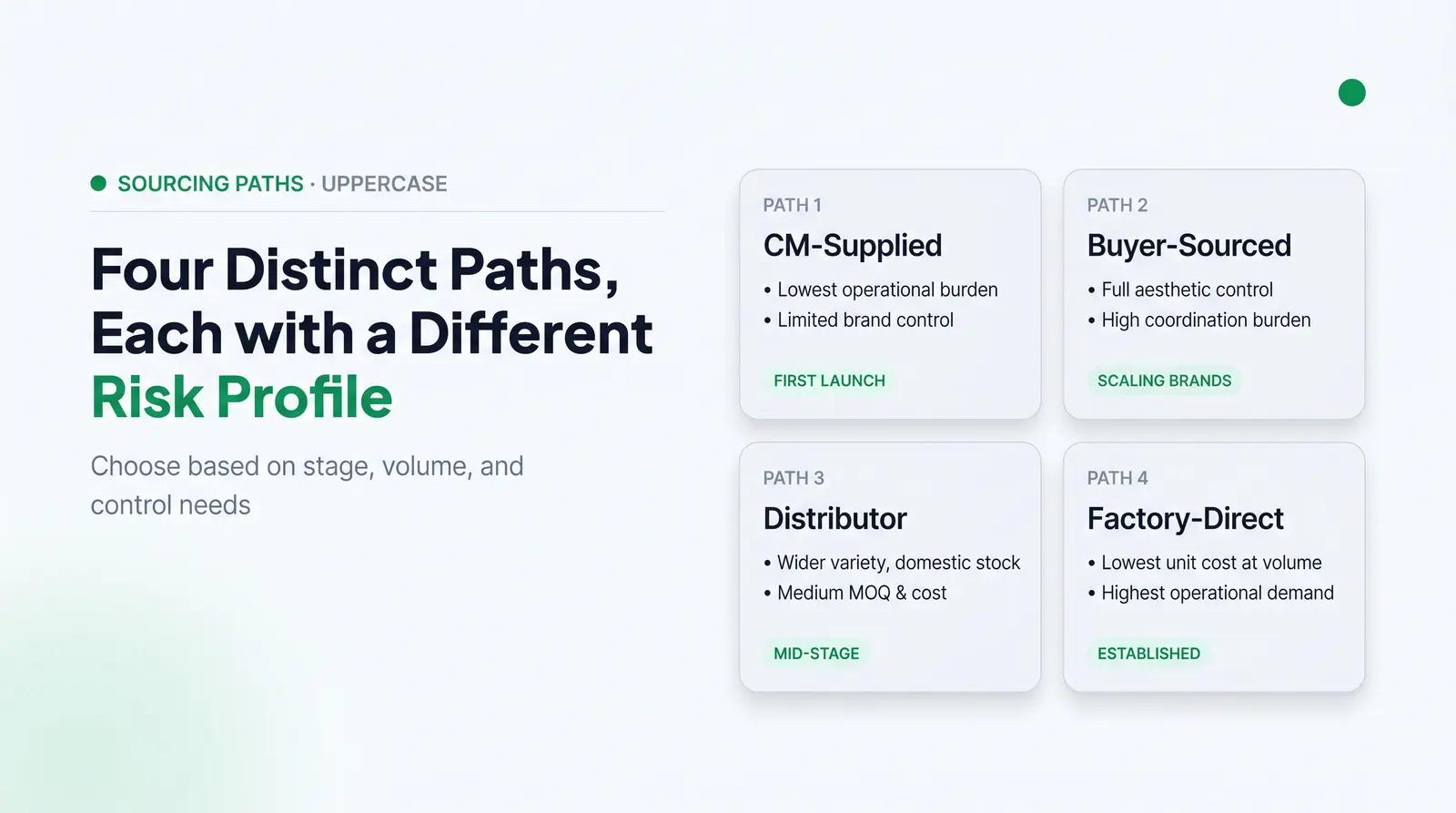
Most discussions of contract manufacturer packaging treat the decision as binary: either you let the CM handle it, or you source it yourself. The reality is more nuanced. There are four distinct models, each with a different risk profile, cost structure, and operational requirement.
Path 1: CM-Supplied Packaging
In this model, the contract manufacturer selects, procures, and owns the supplier relationship for your primary packaging. The CM typically maintains a curated catalog of stock components from their established supplier network. You choose from those options, and the CM handles compatibility testing, documentation, and quality control as part of the production workflow.
This is the path of least operational resistance. The CM is accountable for ensuring the packaging works with your formula, and the lead time is typically compressed because components are either stocked locally or sourced through relationships the CM has maintained for years. The tradeoff is brand differentiation. You are limited to what the CM carries, which is often a narrow range of stock components shared across multiple clients. If your brand identity depends on a distinctive silhouette, a specific material finish, or a closure mechanism that communicates premium positioning, CM-supplied packaging will likely disappoint.
Path 2: Buyer-Sourced Packaging
Buyer-sourced packaging means the founder sources components independently and ships them to the CM for filling and assembly. This approach grants full control over aesthetics, material selection, and brand differentiation. You can specify a frosted glass dropper bottle, a matte-black airless pump, or a custom-colored cap that no competitor is using.
The tradeoff is that you assume full responsibility for the supplier relationship, production timeline coordination, compatibility testing, and documentation. You must also confirm that the packaging dimensions, neck finishes, and cap torque requirements are compatible with your CM's automated filling equipment before committing to an order. A mismatch discovered after 5,000 units have been produced is a costly mistake that falls entirely on you.
Path 3: Distributor Sourcing
Distributor sourcing involves purchasing packaging through a US or EU-based distributor who imports components from overseas factories. Distributors act as aggregators, consolidating demand across multiple clients to offer minimum order quantities that individual factories would not accommodate directly. They manage international freight, customs clearance, and often provide basic quality inspection services.
This path offers a practical middle ground. You gain access to a wider variety of components than a CM might offer, without the intense management burden of a direct factory relationship. Distributors typically carry stock in domestic warehouses, which compresses lead times compared to factory-direct sourcing. The unit cost is higher than factory-direct due to the distributor's margin, but lower than CM-supplied pricing in many cases. Documentation is generally more accessible than with factory-direct sourcing, as established distributors maintain compliance records for their catalog items.
Path 4: Factory-Direct Sourcing
Factory-direct sourcing requires the founder to contract directly with an overseas packaging manufacturer, typically in China, South Korea, or Eastern Europe. This model offers the lowest possible unit cost at scale and the highest degree of customization, including bespoke mold tooling, unique structural designs, and proprietary finishes.
The operational demands are substantial. You must navigate language barriers, manage international freight and customs, coordinate quality control inspections, and meet MOQs that often start at 3,000 to 10,000 units per SKU [1]. For a brand at the 500-unit trial stage, this path is almost never appropriate. For an established brand placing repeat orders of 20,000 units or more, the unit economics can be compelling.
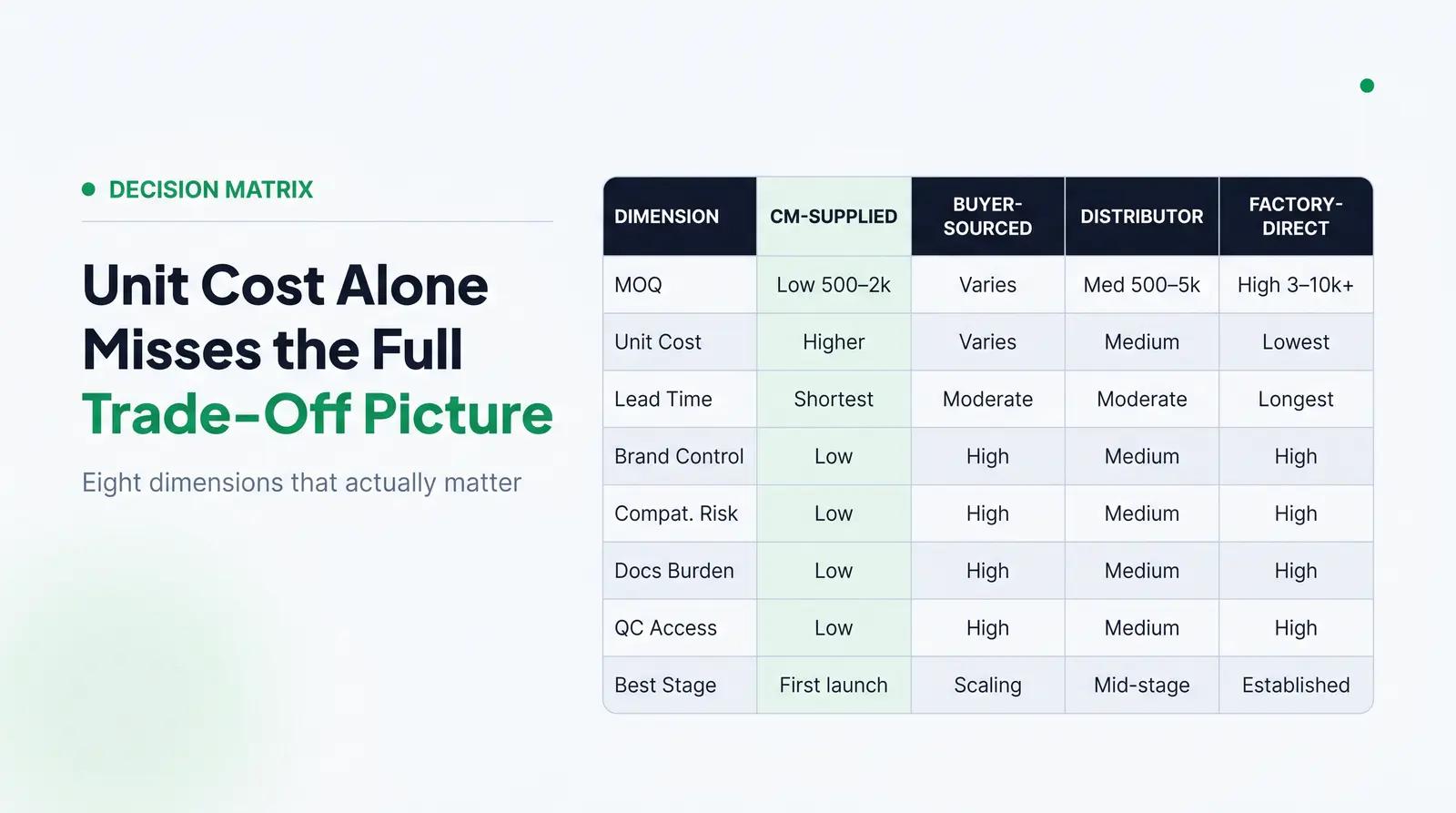
Comparison Table
The table below compares all four sourcing paths across the dimensions that matter most to a founder making this decision at the pre-production stage.
| Dimension | CM-Supplied | Buyer-Sourced | Distributor | Factory-Direct |
|---|---|---|---|---|
| MOQ | Low (matches formula run, often 500-2,000 units) | Depends on source | Medium (500-5,000 units typical) | High (3,000-10,000+ units) |
| Unit Cost | Higher (includes CM markup) | Varies by source | Medium (distributor margin included) | Lowest at volume |
| Lead Time | Shortest (often stocked) | Moderate to long | Moderate (domestic stock available) | Longest (production plus sea freight) |
| Brand Control | Low (limited to CM stock options) | High (full aesthetic control) | Medium (broad catalog, limited custom) | High (full custom tooling possible) |
| Compatibility Risk | Low (CM manages testing) | High (founder must verify) | Medium (founder tests, distributor provides specs) | High (founder manages full protocol) |
| Documentation Burden | Low (CM maintains records) | High (founder must secure COA, SDS, TDS) | Medium (distributor provides standard docs) | High (founder must demand and audit records) |
| QC Access | Low (CM manages internally) | High (founder inspects before shipping to CM) | Medium (distributor manages initial QC) | High (founder must arrange third-party inspection) |
| Recommended Stage | First launch, proof of concept | Scaling brands with specific aesthetic requirements | Mid-stage brands seeking variety with manageable MOQs | Established brands with high volume and capital reserves |
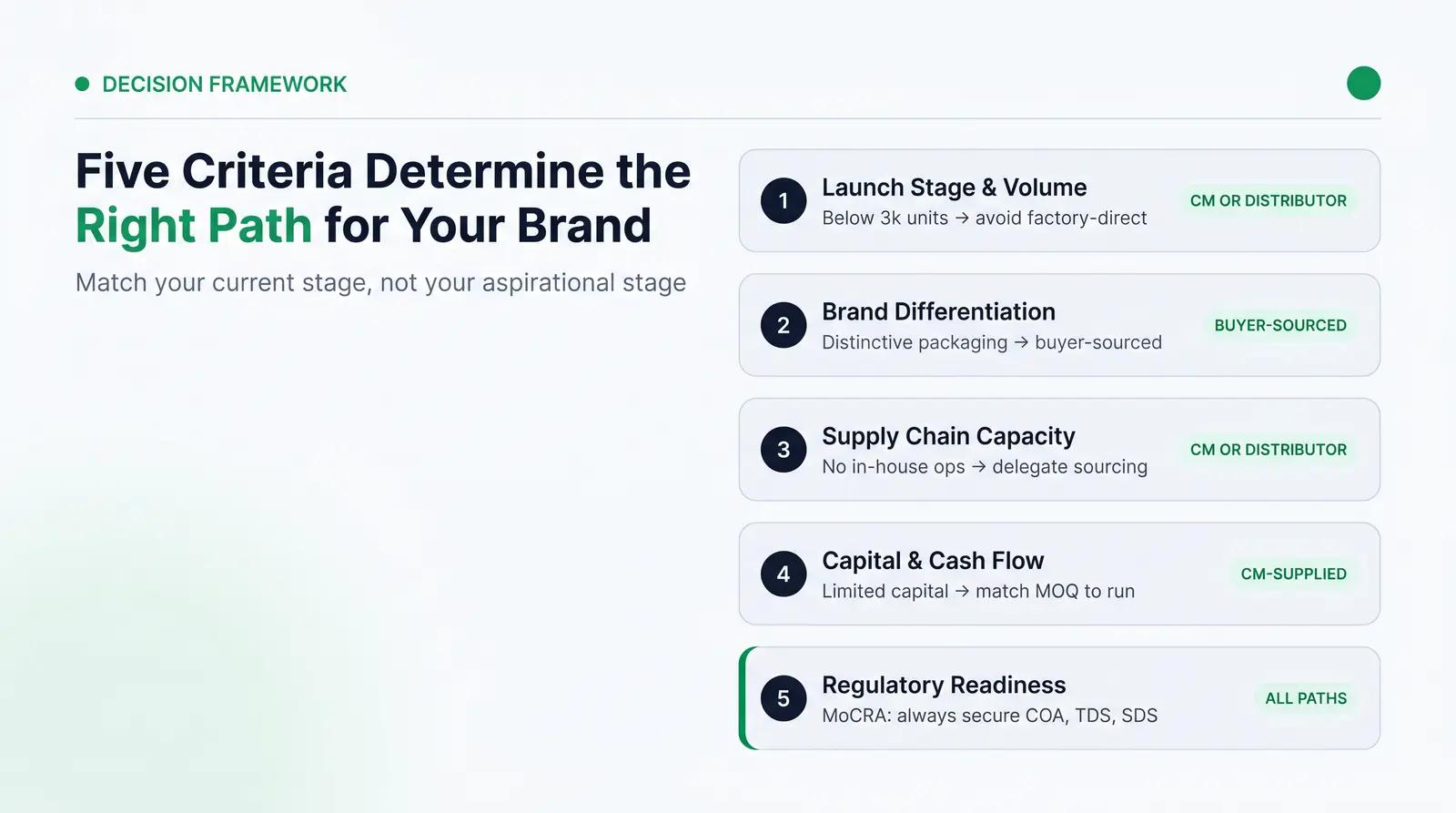
The Packaging Sourcing Decision Framework
Choosing the right path is not a matter of preference. It is a function of where your brand is today across five specific criteria. The following framework, which we recommend at Packfolio for founders navigating this decision, assigns a practical weight to each factor and maps it to the appropriate sourcing path.
Criterion 1: Launch Stage and Volume
The single most important variable is your current order volume. For a 500-unit proof-of-concept run, the capital efficiency of CM-supplied or distributor sourcing is difficult to beat. For a 20,000-unit reorder of a proven SKU, factory-direct sourcing begins to justify its operational complexity.
A useful threshold: if your packaging order is below 3,000 units, factory-direct sourcing will almost always require you to purchase more inventory than you need, tying up capital in excess stock [1]. At that stage, CM-supplied or distributor sourcing is the more rational choice.
Criterion 2: Brand Differentiation Requirements
Does your brand identity depend on packaging that is visually distinctive? Research consistently shows that packaging design is a primary driver of purchase decisions at the point of sale [6]. If your product will compete on shelf or in a crowded digital marketplace, a stock bottle shared with three competitors is a brand liability.
If differentiation is a strategic priority, buyer-sourced or factory-direct paths are necessary. If you are launching a functional product where the formula is the differentiator and packaging is secondary, CM-supplied components may be entirely sufficient.
Criterion 3: In-House Supply Chain Capacity
Managing international freight, coordinating production timelines across multiple vendors, and handling customs clearance is a full-time operational role. If you do not have that capacity in-house, attempting factory-direct or buyer-sourced packaging at the early stage is a predictable failure mode.
Founders who underestimate this criterion often discover it the hard way: a packaging shipment arrives two weeks after the CM's filling window, the launch is delayed, and the cost of the delay far exceeds any unit cost savings.
Criterion 4: Capital Availability and Cash Flow
Factory-direct sourcing requires significant upfront capital. At 10,000 units and $0.65 per unit, you are committing $6,500 to empty packaging before a single unit of formula is produced. For a first launch, that capital is often better deployed toward marketing, sampling, and working capital.
CM-supplied packaging, by contrast, typically aligns with the formula MOQ, meaning you are not purchasing excess inventory. The higher unit cost is offset by the lower total capital commitment.
Criterion 5: Regulatory and Documentation Readiness
Under MoCRA, the brand owner is typically the "responsible person" required to maintain records supporting adequate safety substantiation [2]. This means that regardless of which sourcing path you choose, you are accountable for ensuring the packaging does not adulterate the formula, and you must be able to produce documentation proving it.
If you are sourcing packaging independently, you must secure the Certificate of Analysis (COA), Technical Data Sheet (TDS), and Safety Data Sheet (SDS) from your supplier [5]. If you are relying on a CM, you must confirm they are maintaining these records and that you have access to them. Founders who delegate this responsibility entirely to a CM without verifying the documentation chain create a compliance gap that can surface during an FDA inspection.
The Contrarian Case: CM-Supplied Packaging Is Not Always More Expensive
The conventional wisdom in beauty sourcing circles is that CM-supplied packaging always costs more due to the manufacturer's markup, and that founders should pursue factory-direct sourcing as quickly as possible to protect their margins. This assumption is frequently wrong, particularly for early-stage brands.
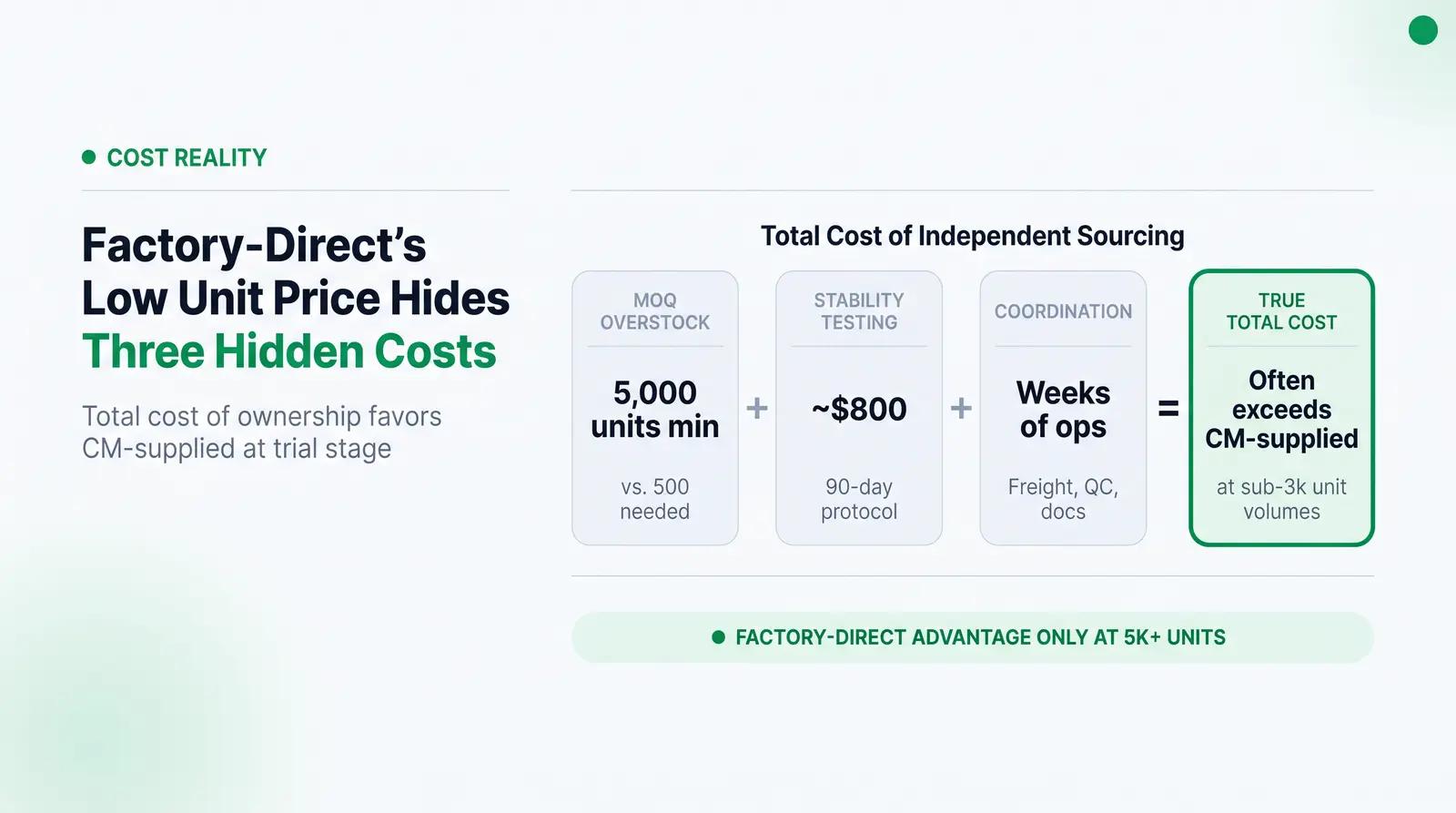
The error lies in comparing raw unit costs without accounting for the full cost of independent sourcing. Consider the actual cost structure for a founder attempting factory-direct sourcing at the 500-unit trial stage.
First, the MOQ problem. Packaging component MOQs from overseas factories typically range from 3,000 to 10,000 units per SKU [1]. A founder launching a 500-unit trial run who sources factory-direct must purchase between six and twenty times more packaging than they need. The capital tied up in that excess inventory is a real cost, even if it is not reflected in the unit price.
Second, the testing cost. When a founder sources packaging independently, they assume full responsibility for compatibility testing. A formal 90-day stability protocol run by a third-party laboratory is not inexpensive [4]. That cost must be added to the unit economics.
Third, the coordination cost. Managing an overseas factory relationship requires time, communication overhead, and often the services of a freight forwarder. These costs are invisible in a unit price comparison but very visible in a founder's weekly schedule.
CMs with high-volume supplier relationships can often negotiate pricing that individual small brands cannot match. When you factor in MOQ-driven overstock, testing costs, and coordination overhead, CM-supplied packaging frequently delivers a lower total cost of ownership for trial-stage launches. The factory-direct advantage only materializes reliably at volumes where the MOQ is aligned with your actual production run and where you have the operational infrastructure to manage the relationship.
Worked Example: Launching a Vitamin C Brightening Serum
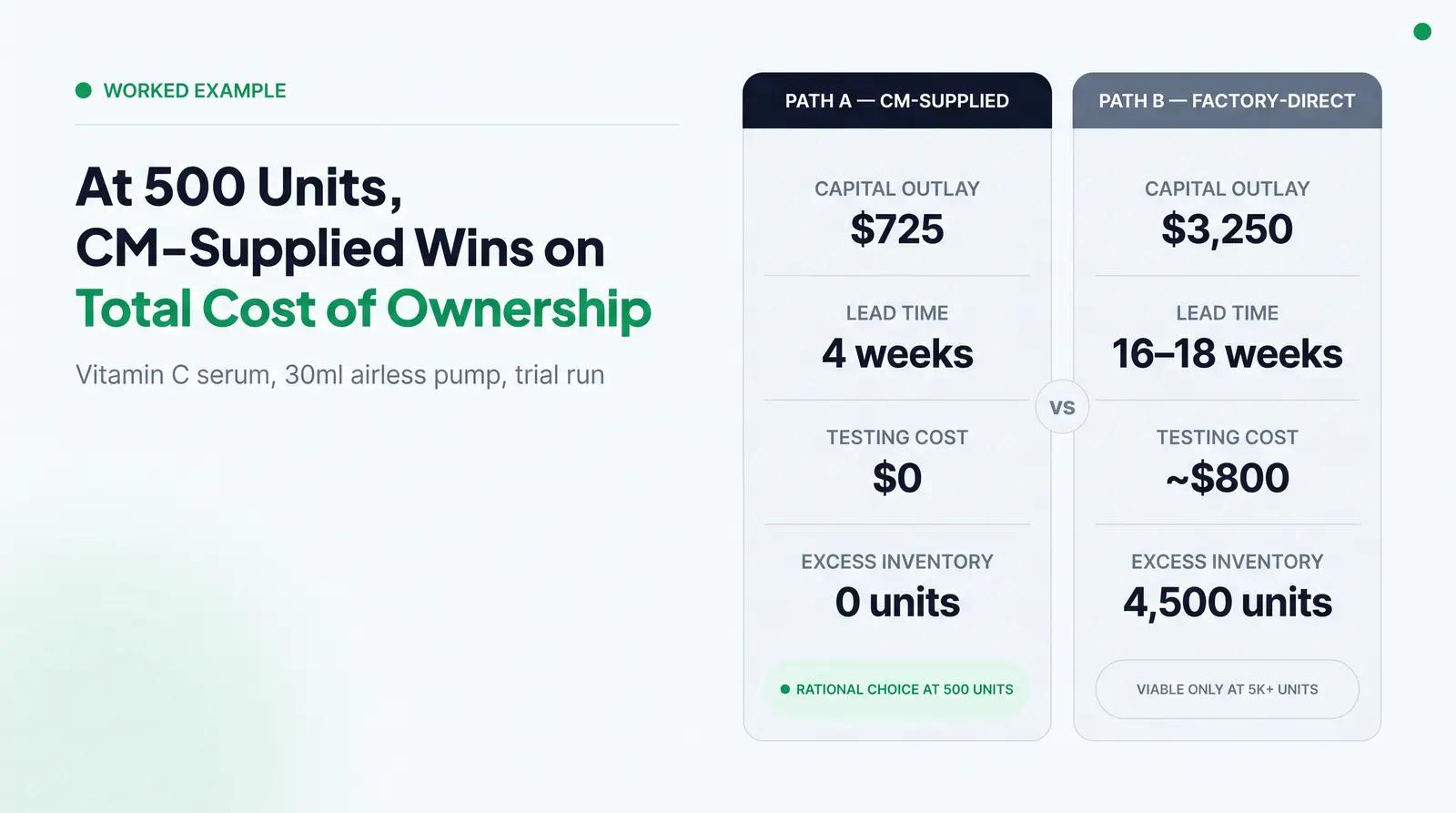
Consider a founder launching a vitamin C brightening serum in a 1 oz (30 ml) airless pump bottle. She is at the 500-unit trial stage and is weighing two options: accepting her CM's stock airless pump, or sourcing a custom frosted pump directly from an overseas factory.
Path A: CM-Supplied Packaging
The CM offers a standard 30ml white airless pump from their stock catalog. The unit cost is $1.45 per unit, which includes the pump, filling, and the CM's supplier markup. Because the component is stocked, the lead time is four weeks. The CM has already validated compatibility with a range of vitamin C formulations at concentrations up to 20% L-ascorbic acid. No additional testing is required.
Total packaging capital outlay (500 units): $725 (illustrative). Total lead time to filled product: 4 weeks (illustrative). Compatibility testing cost: $0. Documentation: Maintained by the CM.
Path B: Factory-Direct Sourcing
The founder identifies a visually distinctive frosted 30ml airless pump from an overseas factory. The unit cost is $0.65 per unit. However, the factory's MOQ is 5,000 units. She must purchase 5,000 units to access that price.
Total packaging capital outlay (5,000 units): $3,250 (illustrative). Total lead time to filled product: 16-18 weeks (production plus sea freight plus compatibility testing). Compatibility testing cost: approximately $800 for a 90-day third-party stability protocol (illustrative). Documentation: Founder must secure COA, SDS, and TDS from the factory.
The factory-direct unit cost is 55% lower. But the total capital outlay is more than four times higher, the launch is delayed by three to four months, and the founder now holds 4,500 units of excess packaging inventory. For a 500-unit trial, Path A is the rational choice. The factory-direct option becomes compelling only when the founder has validated the formula, confirmed market demand, and is placing a reorder of 5,000 units or more.
This example illustrates a broader principle: the right sourcing path is not the one with the lowest unit price. It is the one with the lowest total cost of ownership given your current volume, capital position, and operational capacity.
What to Verify Before Committing to Any Path
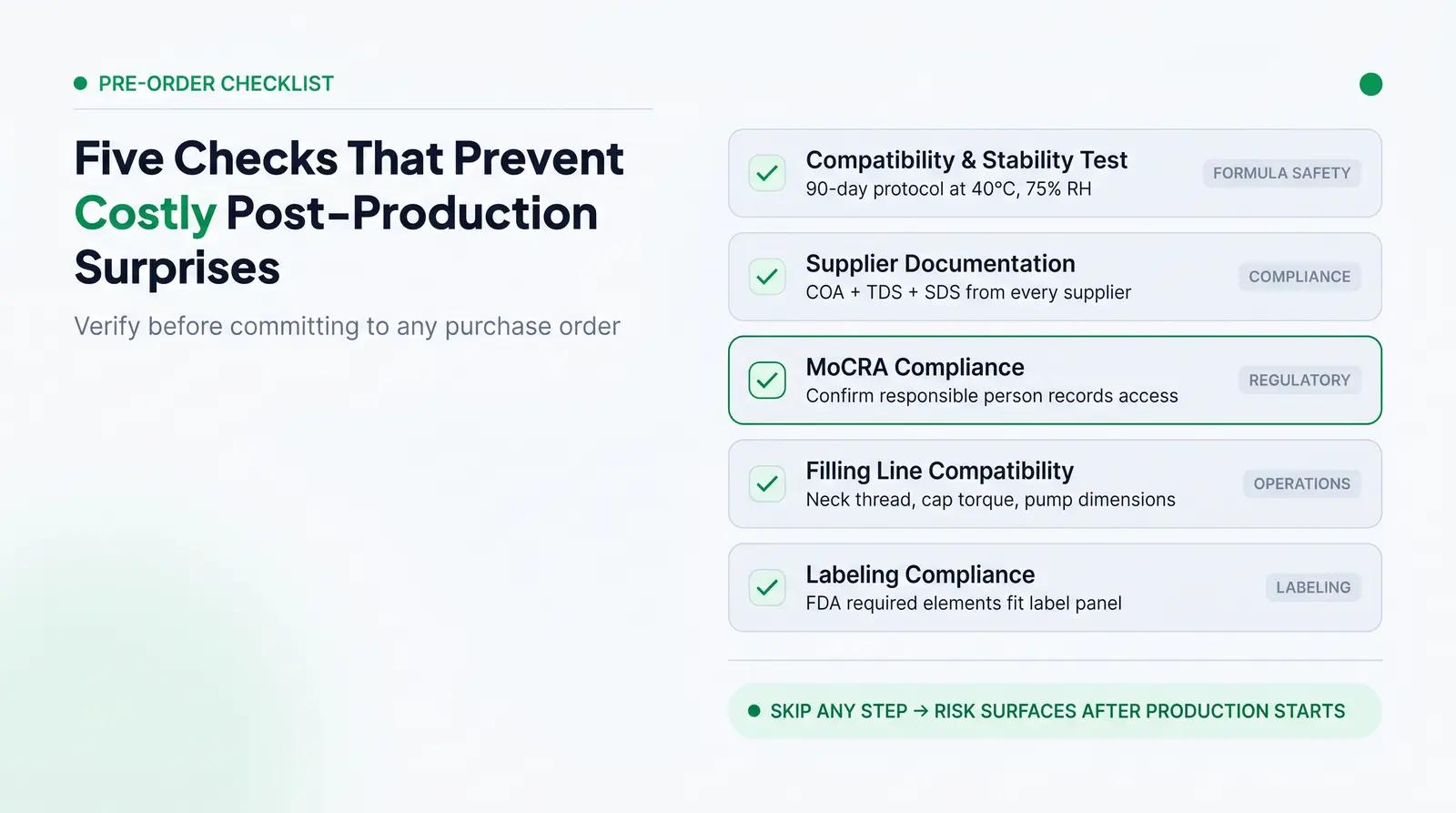
Regardless of which sourcing path you choose, the following checklist covers the questions you must answer before committing to a purchase order. Skipping any of these steps creates risk that surfaces at the worst possible moment, typically after production has started.
Compatibility and Stability Testing
Confirm that a formal compatibility test has been conducted using the actual formula at its production concentration. The standard protocol involves filling the packaging with the formula, sealing it, and storing it at elevated temperature (typically 40°C and 75% relative humidity) for 90 days, with evaluations at 30, 60, and 90-day intervals [4]. Certain active ingredients, including high-concentration vitamin C, AHAs, retinol derivatives, and ethanol-based formulas, are particularly prone to packaging interactions that are not visible at the time of filling [3].
Supplier Documentation
Demand the following documents from your packaging supplier before placing an order: the Certificate of Analysis (COA) for the specific production batch, the Technical Data Sheet (TDS) detailing physical and chemical properties, and the Safety Data Sheet (SDS) covering hazard identification and handling requirements [5]. For packaging intended for US distribution, confirm that the materials comply with applicable FDA regulations for cosmetic contact materials.
MoCRA Compliance
Under the Modernization of Cosmetics Regulation Act, the responsible person for a cosmetic product must maintain records supporting adequate safety substantiation [2]. This includes documentation related to the packaging materials. If you are sourcing packaging independently, you are responsible for securing and maintaining this documentation. If you are relying on a CM, confirm in writing that they will provide you with access to all relevant records.
Filling Line Compatibility
If you are buyer-sourcing, confirm with your CM that the packaging dimensions, neck thread specifications, and cap torque requirements are compatible with their filling line before placing an order. A 30ml airless pump that is 2mm wider than the CM's filling head requires manual filling, which dramatically increases labor costs and production time.
Labeling Compliance
Ensure the packaging provides adequate surface area for all required label elements. FDA labeling requirements for cosmetics include the product identity statement, net quantity of contents, name and place of business, and ingredient declaration in descending order of predominance [7]. Confirm that the printable surface area and label panel dimensions accommodate these requirements before committing to a packaging design.
For founders who want the benefits of buyer-sourced packaging without the supplier management burden, Packfolio curates a vetted catalog of cosmetic primary packaging SKUs, each pre-tested for compatibility with common formula types and pre-modeled in 3D with defined printable regions. You browse the catalog, customize your artwork inside the predefined print zones using the browser-based 3D design tool, preview the result on a photorealistic model, and order. Packfolio coordinates production, quality assurance, and freight delivery. You do not manage a supplier relationship. For a deeper look at airless pump options and how to evaluate them for your formula, see the airless pump bottles guide.
The sourcing path you choose for your cosmetic packaging is one of the most consequential decisions in your product launch. It shapes your unit economics, your brand differentiation, your regulatory exposure, and your operational bandwidth. The right choice is not the one with the lowest unit price. It is the one that aligns with your current stage, capital position, and in-house capacity, while protecting you from the compatibility and documentation risks that derail launches.
Browse Packfolio's curated airless pump and primary packaging catalog, preview your label in 3D before committing to production, and order without managing a supplier relationship. packfolio.com/catalog
Frequently Asked Questions
What is the typical MOQ for cosmetic packaging from a contract manufacturer?
Contract manufacturers typically align packaging MOQs with their formula production minimums, which commonly range from 500 to 2,000 units per SKU for stock components. Custom or specialty packaging may require higher minimums. Factory-direct sourcing typically requires 3,000 to 10,000 units per SKU, making it impractical for trial-stage launches.
How long does cosmetic packaging compatibility testing take?
A standard compatibility and stability testing protocol takes approximately 90 days. The product is filled into the final packaging, stored under accelerated conditions (typically 40°C and 75% relative humidity), and evaluated at 30, 60, and 90-day intervals to confirm no degradation in formula integrity, packaging structure, or seal performance [4].
What documents should I request from a cosmetic packaging supplier?
Request the Certificate of Analysis (COA) for the specific production batch, the Technical Data Sheet (TDS) detailing physical and chemical properties, and the Safety Data Sheet (SDS) covering hazard identification and handling requirements [5]. For US distribution, also confirm that the materials comply with applicable FDA regulations for cosmetic contact materials.
Does MoCRA affect my packaging sourcing decisions?
Yes. Under MoCRA, the brand owner is typically the "responsible person" required to maintain records supporting adequate safety substantiation for their cosmetic products [2]. This means you are accountable for the safety of your packaging materials, regardless of whether you sourced them through a CM or independently. Ensure you have access to all relevant documentation from your packaging supplier.
Is it cheaper to source cosmetic packaging through a distributor or factory-direct?
Factory-direct sourcing offers the lowest raw unit cost at volume, but it requires meeting high MOQs that can result in significant excess inventory for early-stage brands. Distributor sourcing typically offers lower MOQs and domestic stock availability, which reduces capital risk and lead times. For orders below 3,000 units, distributor sourcing often delivers a lower total cost of ownership when MOQ-driven overstock, testing costs, and freight coordination are factored in [1].
References
-
Sourcy. "Sourcing Challenges In Beauty: What Brands Need To Know." Sourcy.ai, 2024. https://www.sourcy.ai/sourcing/beauty
-
U.S. Food and Drug Administration. "Modernization of Cosmetics Regulation Act of 2022 (MoCRA)." FDA.gov, updated March 2026. https://www.fda.gov/cosmetics/cosmetics-laws-regulations/modernization-cosmetics-regulation-act-2022-mocra
-
Othilapak. "Cosmetic Jar Supplier vs. Manufacturer: The Difference That Could Make or Break Your Beauty Brand." Othilapak.com, May 2026. https://othilapak.com/blogs/trends-insights/cosmetic-jar-supplier-vs-manufacturer-the-difference-that-could-make-or-break-your-beauty-brand/
-
Certified Laboratories. "Guide to OTC and Cosmetic Stability Testing." Certified-laboratories.com, 2024. https://certified-laboratories.com/blog/guide-to-cosmetic-stability-testing/
-
Kasey Beauty. "Key Compliance Documents in the Cosmetics Industry: MSDS, COA, and TDS Explained." Kaseybeauty.com, June 2025. https://www.kaseybeauty.com/key-compliance-documents-in-the-cosmetics-industry-msds-coa-and-tds-explained/
-
Srivastava, P., Ramakanth, D., Akhila, K., and Gaikwad, K.K. "Package design as a branding tool in the cosmetic industry: consumers' perception vs. reality." SN Business and Economics, 2022. https://pmc.ncbi.nlm.nih.gov/articles/PMC9123395/
-
U.S. Food and Drug Administration. "Summary of Cosmetics Labeling Requirements." FDA.gov, updated November 2025. https://www.fda.gov/cosmetics/cosmetics-labeling-regulations/summary-cosmetics-labeling-requirements
-
U.S. Food and Drug Administration. "Registration and Listing of Cosmetic Product Facilities and Products." FDA.gov, updated April 2026. https://www.fda.gov/cosmetics/registration-listing-cosmetic-product-facilities-and-products


