
Cosmetic Packaging Sample Fees: What Is Normal and What Is a Red Flag
This guide breaks down normal cosmetic packaging sample fee ranges, explains refundable credit negotiations, and identifies red flags that signal fraudulent or unreliable suppliers.
You have finally found the exact heavy-bottomed glass dropper bottle you envisioned for your serum launch, but before the supplier will send a physical unit with your branding, they are asking for a $250 sample fee wired to a personal account. This is the moment where buyer anxiety peaks. Without holding the physical component, you cannot verify if the pump mechanism works with your viscosity, if the glass has air bubbles, or if the print alignment is precise. Yet wiring money overseas before seeing a finished decorated sample feels inherently risky. The challenge is distinguishing between a legitimate supplier covering their setup costs and a bad actor using sample fees as a standalone revenue stream.
For beauty founders and product developers sourcing primary packaging, understanding the mechanics of sample fees is a necessary defense. Legitimate suppliers charge fees to cover real costs: tooling, setup labor, and priority courier shipping. Fraudulent suppliers, however, exploit the information gap, charging exorbitant fees for generic units or demanding payment before critical artwork files are even exchanged. Evaluating these requests requires knowing what each sample type should cost, what deliverables must accompany the fee, and how to structure refundable credits to protect your cash flow.
Sample Types Defined Clearly
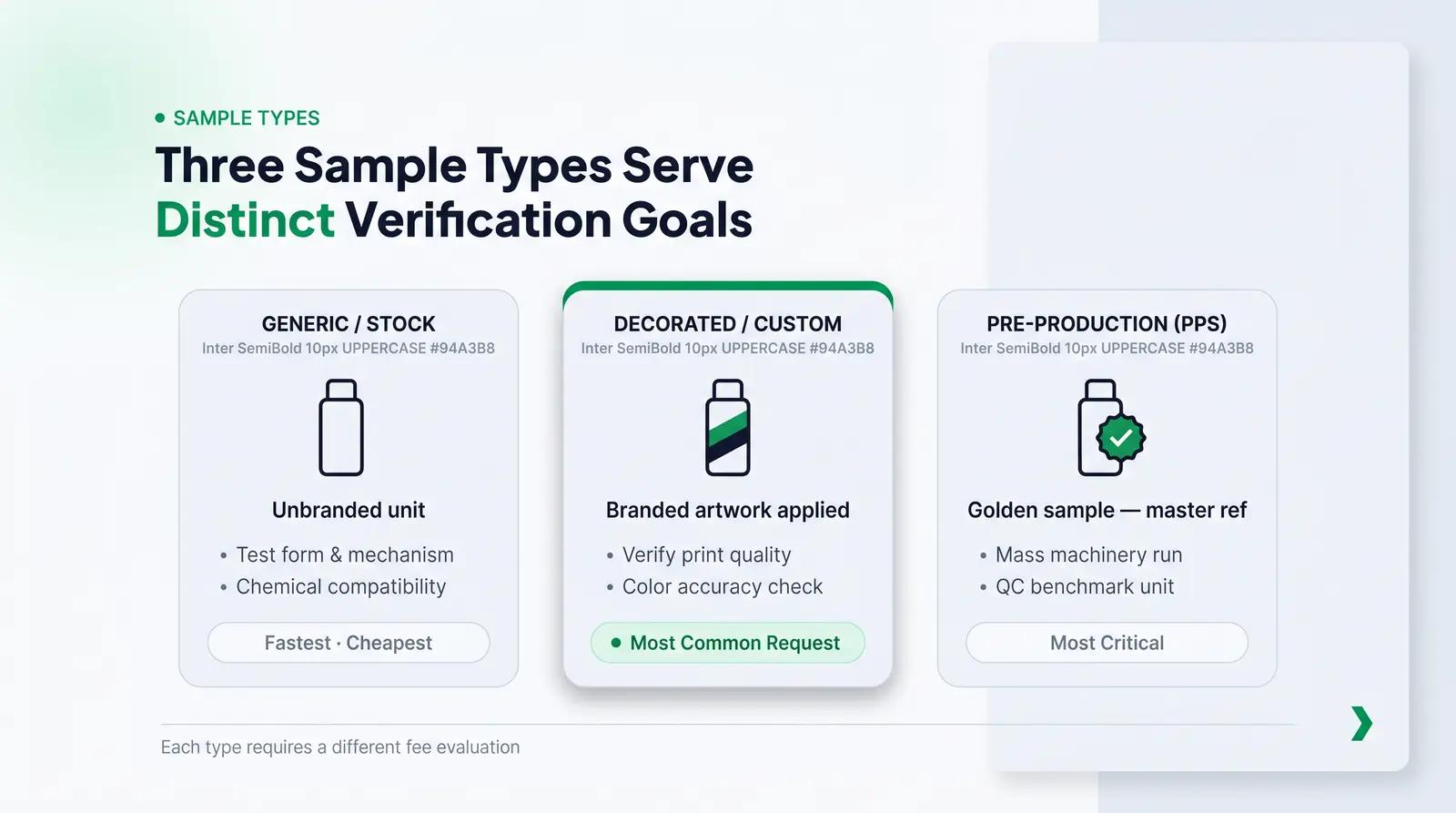
Not all samples serve the same purpose, and they should not carry the same cost. In cosmetic packaging, buyers will encounter three primary sample categories. Distinguishing between them is the first step in evaluating a fee request [1].
Generic or stock samples are undecorated, unbranded units pulled directly from existing inventory. They are typically produced in a standard color (often white, clear, or natural) without any custom finishes. The purpose of a generic sample is purely functional and tactile. Buyers use these to evaluate the form factor, material weight, mechanism performance (such as pump actuation or dropper suction), and chemical compatibility with the product formula. Because these require no custom setup, they are the fastest to ship and the cheapest to acquire.
Decorated or custom samples are units produced with the buyer's specific artwork, label, or custom color applied. These require the supplier to set up printing machinery, mix custom colors, or calibrate silk-screening equipment for a run of perhaps only five or ten units. Buyers request decorated samples to evaluate print quality, color accuracy against brand guidelines, and the overall premium feel of the execution before committing to a bulk order [2].
Pre-production samples (PPS), sometimes referred to as golden samples, represent the final, fully approved decorated unit. A PPS is produced at production scale using the exact tooling and materials that will be used for the mass run. This sample serves as the master reference model or quality benchmark [3]. Once approved, the PPS is signed and dated, with one copy kept by the buyer, one by the factory, and one used by quality control inspectors during the final pre-shipment inspection [4]. Because it requires pausing the mass production line for a single run, the PPS is the most critical and often the most expensive sample type.
What Sample Fees Actually Cover
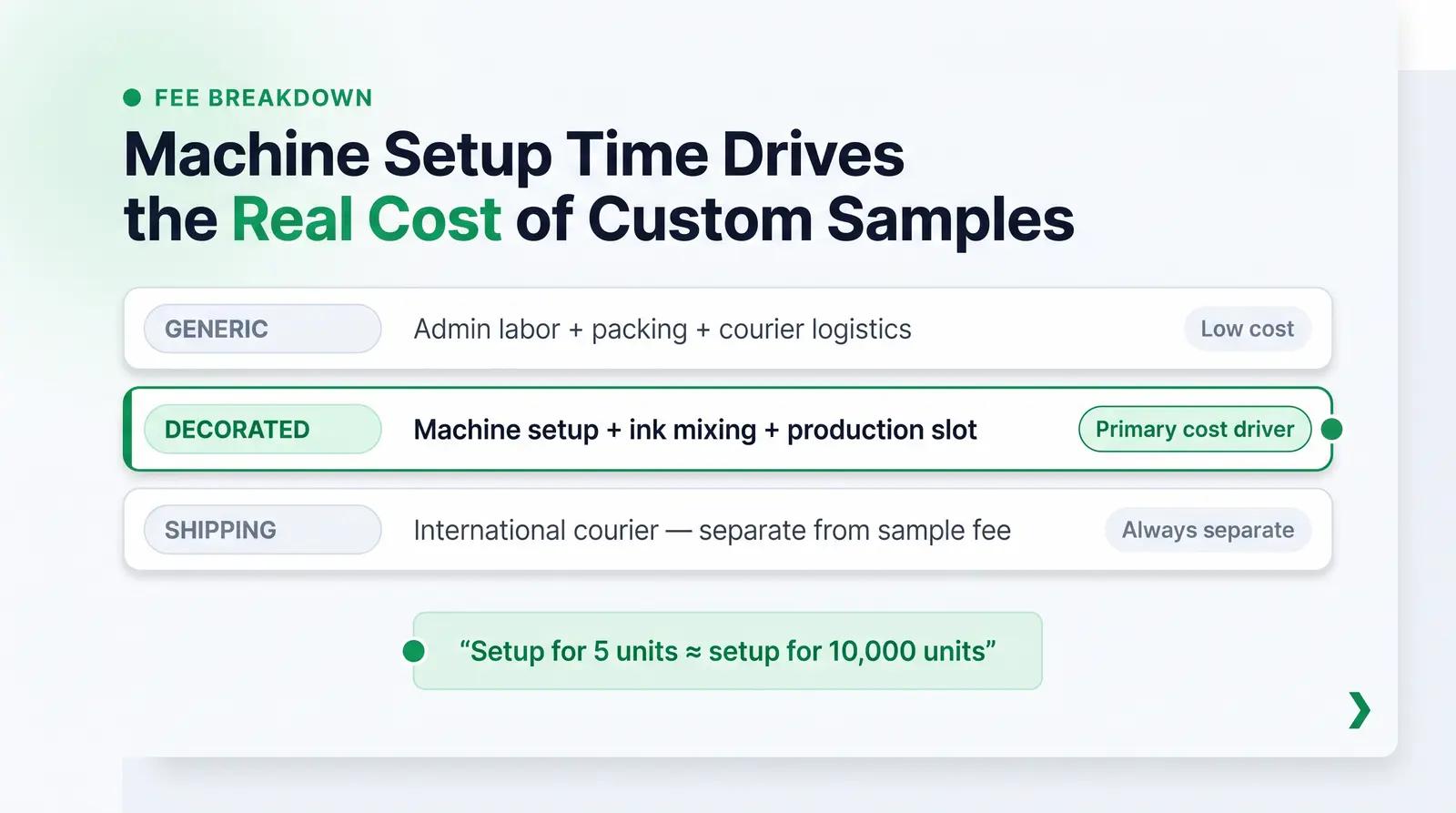
When a supplier requests a sample fee, it is crucial to understand what that money is funding. For generic samples, the fee rarely covers the cost of the unit itself, which is often negligible. Instead, the fee covers the administrative labor of pulling the unit, packing it securely to prevent transit damage, and managing the international courier logistics.
For decorated samples, the costs escalate rapidly due to machine setup. In manufacturing, the primary cost driver is not the material, but the time required to calibrate equipment. Setting up a silk-screen printer for a five-unit sample run takes nearly as much labor as setting it up for a 10,000-unit mass production run. The sample fee compensates the factory for the machine downtime, the custom ink mixing, and the priority production slot [2]. In cases where custom molds are required (such as a uniquely shaped cap), the sample fee may also include amortized tooling costs.
It is also important to distinguish the sample fee from the shipping fee. Both are real, legitimate costs, but they cover entirely different services. A supplier offering a "free sample" will still legitimately require the buyer to cover the international freight.
Typical Fee Ranges
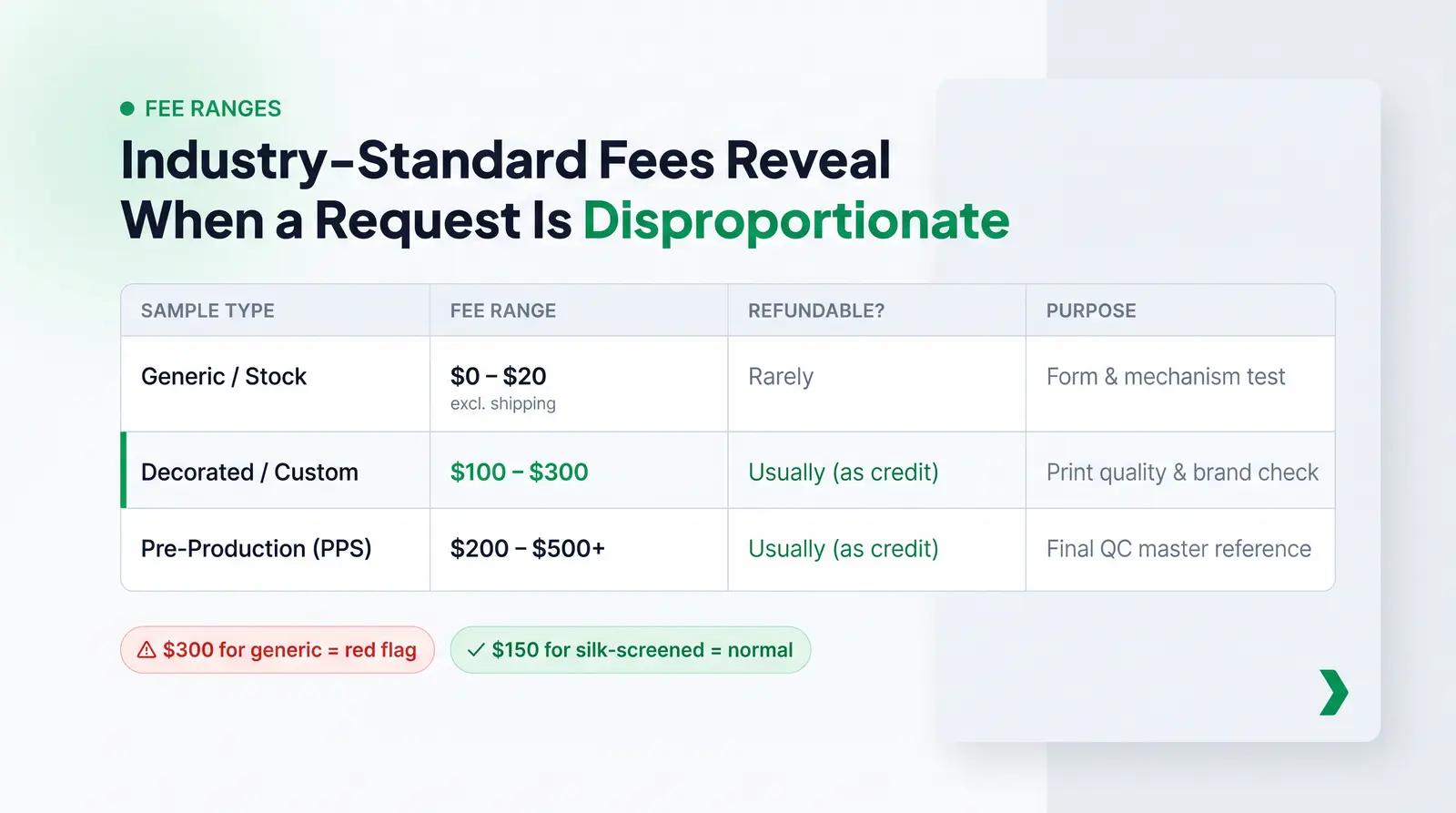
Industry norms provide a baseline for evaluating fee requests. While costs fluctuate based on material complexity and global logistics, the ranges below reflect standard practices for cosmetic primary packaging. These are informed estimates based on current manufacturing standards [2] [5].
| Sample Type | Typical Fee Range | What It Includes | Refundable? | When You Need It |
|---|---|---|---|---|
| Generic / Stock | $0 – $20 (excluding shipping) | 1–5 unbranded units in standard colors. | Rarely | Initial supplier vetting; compatibility testing. |
| Decorated / Custom | $100 – $300 | 1–5 units with custom print, color, or finish. | Usually (as credit) | Verifying brand execution and print quality. |
| Pre-Production (PPS) | $200 – $500+ | Final master unit produced on mass machinery. | Usually (as credit) | Final approval before mass manufacturing begins. |
If a supplier requests $300 for a generic, undecorated stock bottle, the fee is disproportionate to the labor involved and signals a potential issue. Conversely, a $150 fee for a fully silk-screened custom glass jar is well within standard industry parameters.
Shipping Fees: A Separate Line and Normal Practice
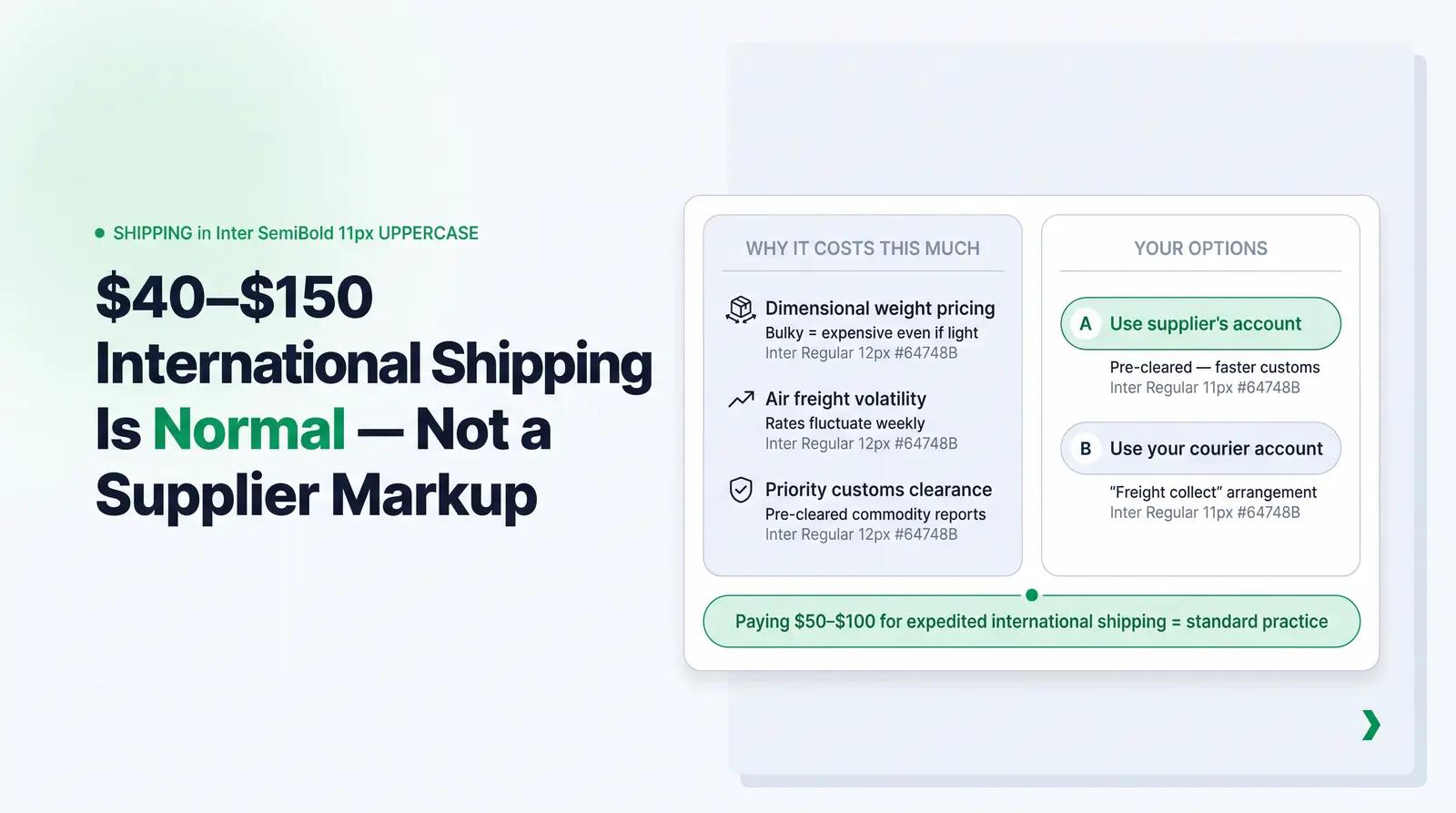
A common point of friction for new buyers is the cost of shipping. International express courier services (such as DHL, FedEx, or UPS) frequently charge $40 to $150 or more for a small parcel shipped from manufacturing hubs in Asia to North America or Europe [6]. This is entirely normal. Air freight pricing is volatile, and couriers charge based on dimensional weight, meaning even a lightweight but bulky box of empty plastic bottles can incur high shipping fees.
Buyers with their own corporate courier accounts can often request that the supplier ship the samples "freight collect" using the buyer's account number. However, some suppliers prefer to use their own accounts because they hold pre-cleared commodity inspection reports for cosmetics, which can bypass lengthy customs delays that might occur on a buyer's personal account [5]. In either scenario, paying $50 to $100 for expedited international shipping is standard practice and should not be viewed as a supplier markup.
Refundable Sample Credits: How They Work
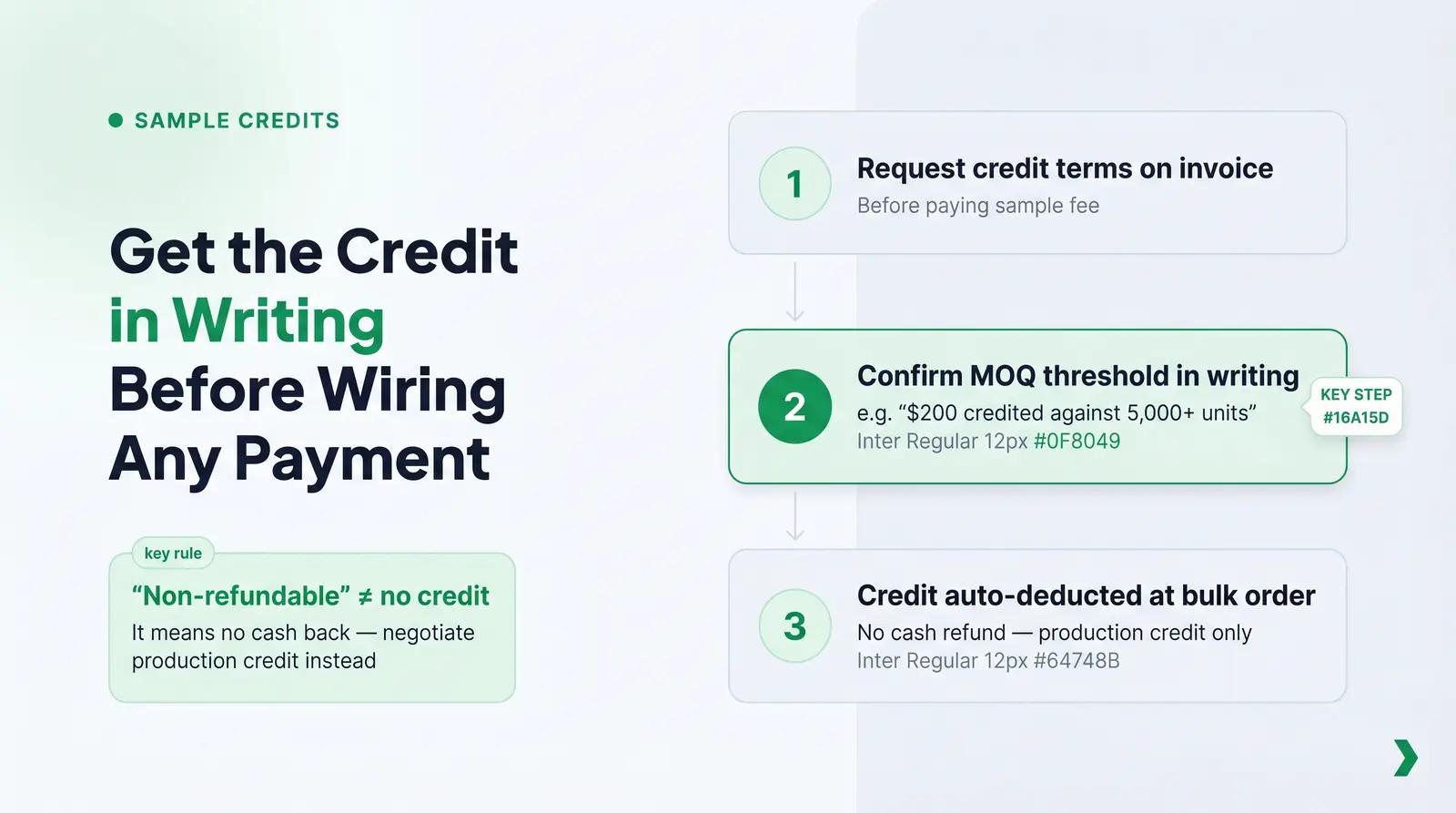
In the packaging industry, sample fees are rarely treated as sunk costs. The established convention is to credit the cost of the decorated sample or PPS against the first mass production order [7]. This practice protects the supplier from buyers who are merely fishing for free prototypes, while ensuring the serious buyer does not lose money on the evaluation phase.
Understanding how to negotiate this credit is vital. "Non-refundable" in supplier terminology usually means they will not issue a cash refund to your bank account if you decide not to proceed. It does not necessarily mean they will refuse a production credit.
To secure this protection, buyers must get the credit terms in writing on the pro forma invoice before paying the sample fee. A reasonable threshold is typically tied to the Minimum Order Quantity (MOQ). For example, the invoice should state: "The $200 decorated sample fee will be credited in full against the first production order of 5,000 units or more." Having this documented ensures the credit is automatically applied when the bulk order is finalized.
The Sample Fee Legitimacy Rubric
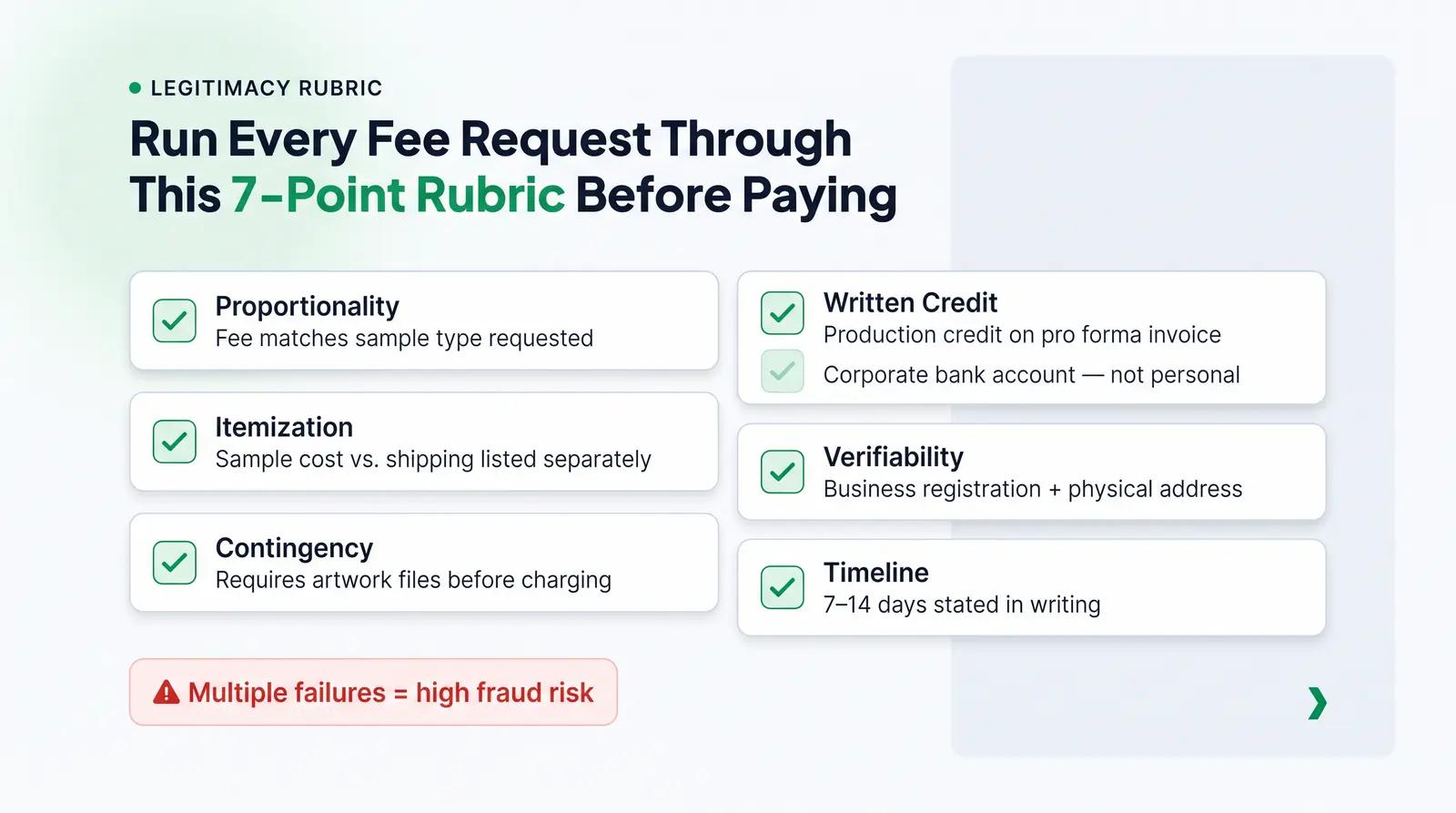
To systematize the evaluation process, buyers should rely on a structured approach. The following criteria represent a practical framework for evaluating sample fee requests, the same framework we apply at Packfolio when vetting suppliers for our catalog. Before authorizing any payment, run the supplier's request through this rubric:
- Proportionality: Is the fee proportional to the sample type requested? (e.g., $150 for a decorated unit is reasonable; $150 for a generic unit is not).
- Itemization: Has the supplier provided a clear, itemized breakdown distinguishing the sample production cost from the courier shipping cost?
- Contingency: Is the decorated sample fee contingent on the supplier actually receiving confirmed, print-ready artwork files from the buyer?
- Written Credit: Is a production order credit explicitly offered and documented in writing on the pro forma invoice?
- Traceability: Is the requested payment method traceable to a named business entity (e.g., a corporate bank transfer or verified platform escrow), rather than a personal account?
- Verifiability: Has the supplier provided a verifiable business registration number, physical address, or industry trade references?
- Timeline: Is the sample production timeline stated in writing, and is it realistic (e.g., 7–14 days for a custom print, rather than an implausible 48-hour promise)?
If a supplier fails multiple checks on this rubric, the risk of a substandard outcome or outright fraud increases significantly.
Red Flags: Specific and Actionable
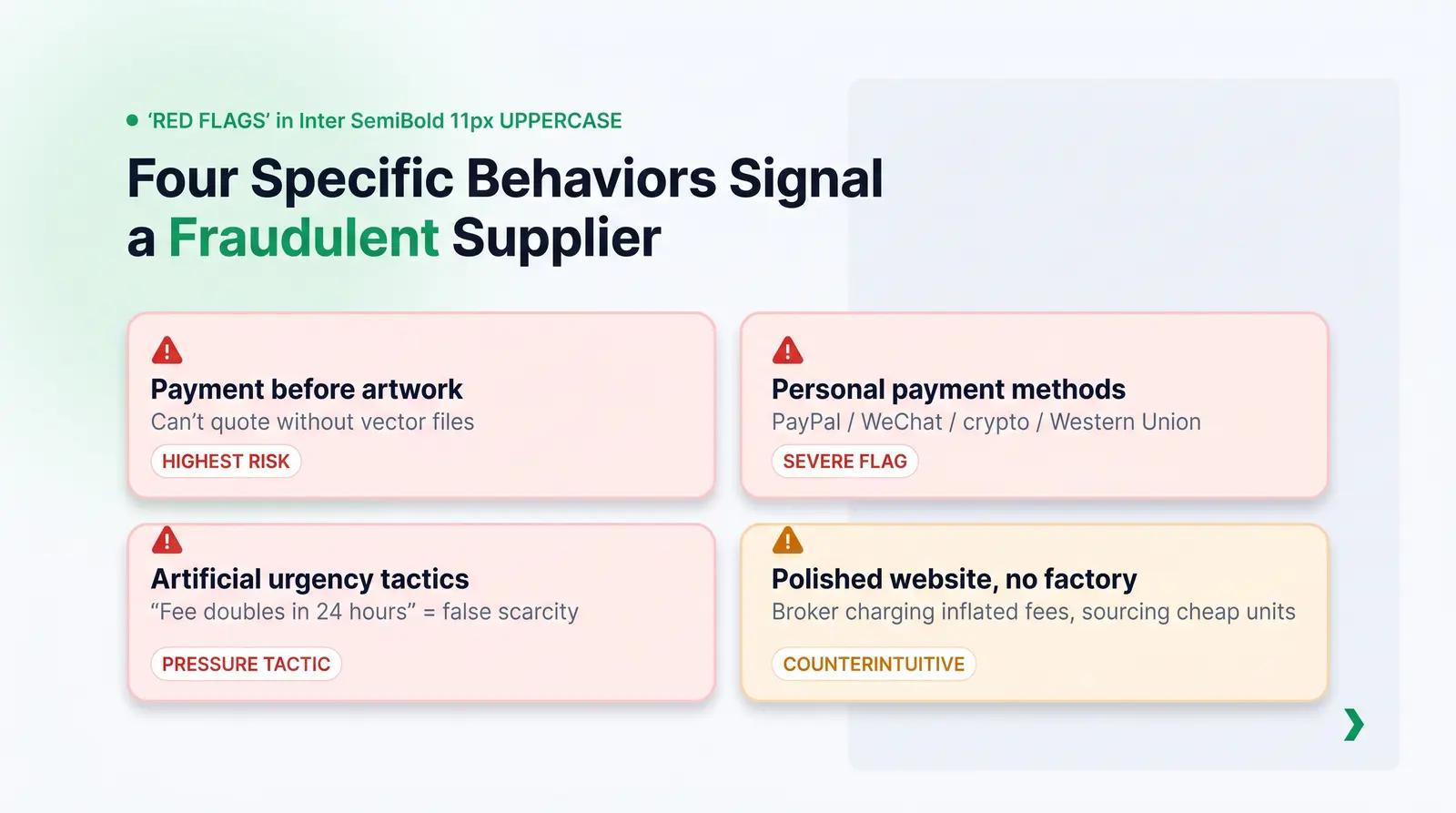
While generic warnings about "too-good-to-be-true" pricing are common, cosmetic packaging sourcing carries specific risk patterns. Identifying these behaviors early prevents costly mistakes [8].
The most glaring red flag is a supplier requesting payment for a decorated sample before they have received or reviewed the buyer's artwork files. A manufacturer cannot accurately quote, let alone produce, a custom-printed sample without analyzing the vector files to determine the number of ink passes, the required machinery, and the technical feasibility of the design. A supplier asking for money before seeing the art is likely a middleman with no technical capability [9].
Payment methods offer another clear warning. Requests to route funds through personal PayPal accounts, WeChat Pay, cryptocurrency, or Western Union are severe red flags. Legitimate manufacturers operate corporate bank accounts and issue formal pro forma invoices. Similarly, a refusal to provide a written record of what the fee covers, or relying solely on personal messaging apps without a verifiable company email domain, signals high risk [8].
High-pressure sales tactics are also indicative of bad actors. If a supplier claims that a sample fee will double if not paid within 24 hours, or insists that another buyer is about to purchase the last available stock, they are manufacturing false urgency. Legitimate B2B manufacturing operates on deliberate timelines, not flash sales.
Counterintuitively, some of the highest-risk sample fee scams originate from suppliers with highly polished, English-language websites. These entities often act as unverified brokers rather than actual factories. They present beautifully rendered digital catalogs but lack physical manufacturing capacity. When buyers request samples, these brokers charge inflated fees, only to source subpar generic units from a secondary factory. Paying a higher upfront fee for a decorated sample from a verified factory is almost always cheaper in the long run than paying a low fee to a polished broker who eventually delivers a mismatched mass production run.
What a Legitimate Proof and Deliverable Looks Like
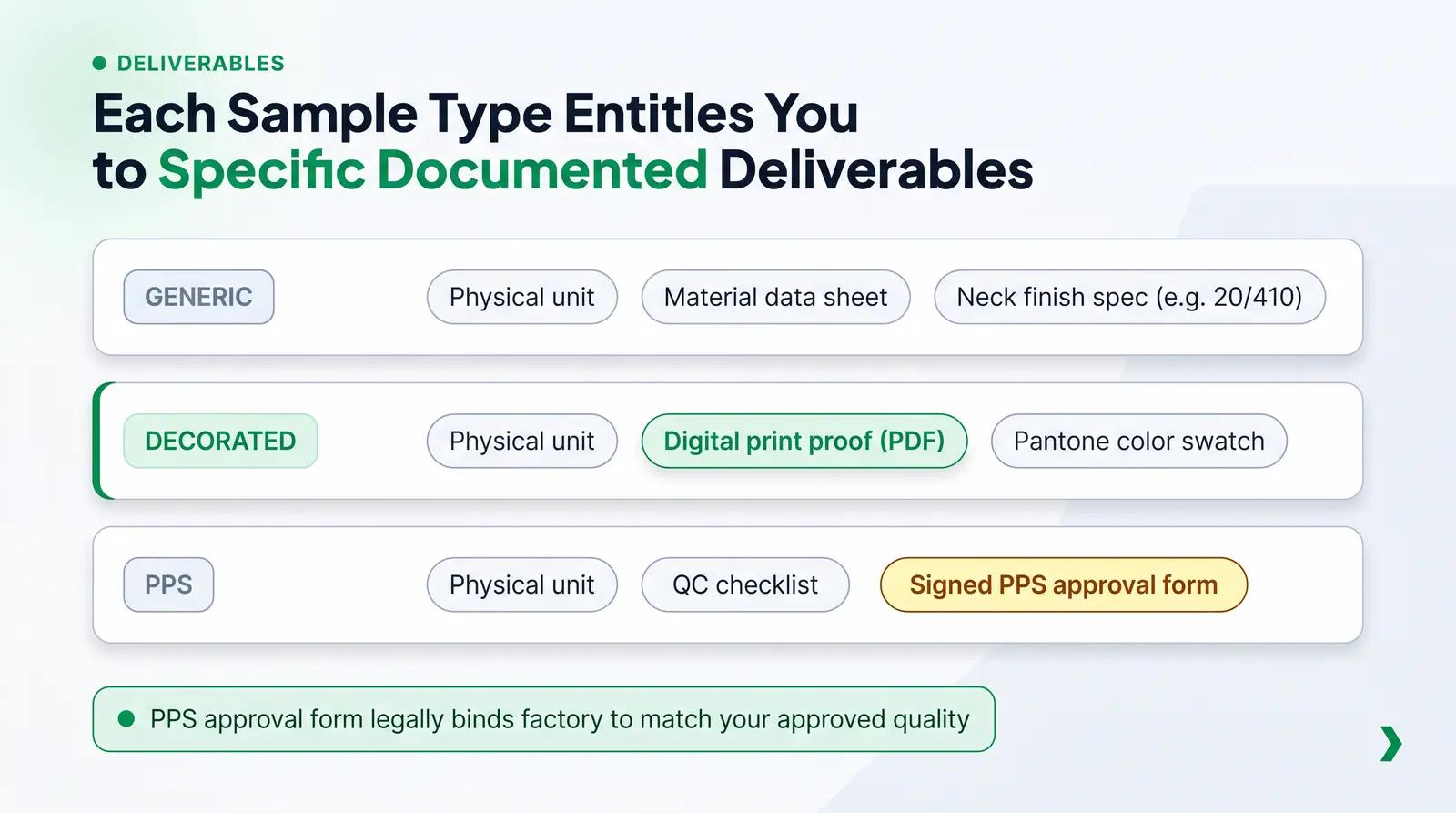
Paying a sample fee entitles the buyer to specific deliverables. Knowing what to expect ensures the supplier is held accountable for the fee charged.
For a generic sample, the buyer should receive the physical unit, properly packed to avoid scuffing. Upon request, the supplier should also provide a material data sheet (confirming the plastic resin code or glass grade) and a specification sheet detailing the exact neck finish dimensions (e.g., 20/410) [9].
For a decorated sample, the physical unit is only part of the deliverable. Before the physical sample is produced, the supplier must provide a digital print proof (often a PDF overlay showing exactly where the artwork will sit on the component). If color matching was specified, the deliverable should include a physical color swatch reference (such as a Pantone-matched plastic chip) alongside the printed unit [3].
For a pre-production sample (PPS), the deliverable is highly formalized. The buyer receives the physical unit, a detailed quality control (QC) checklist, and a formal PPS approval form. This form must be signed by the buyer to authorize the release of mass production, legally binding the factory to match the approved sample's quality [4].
A Realistic Sourcing Scenario
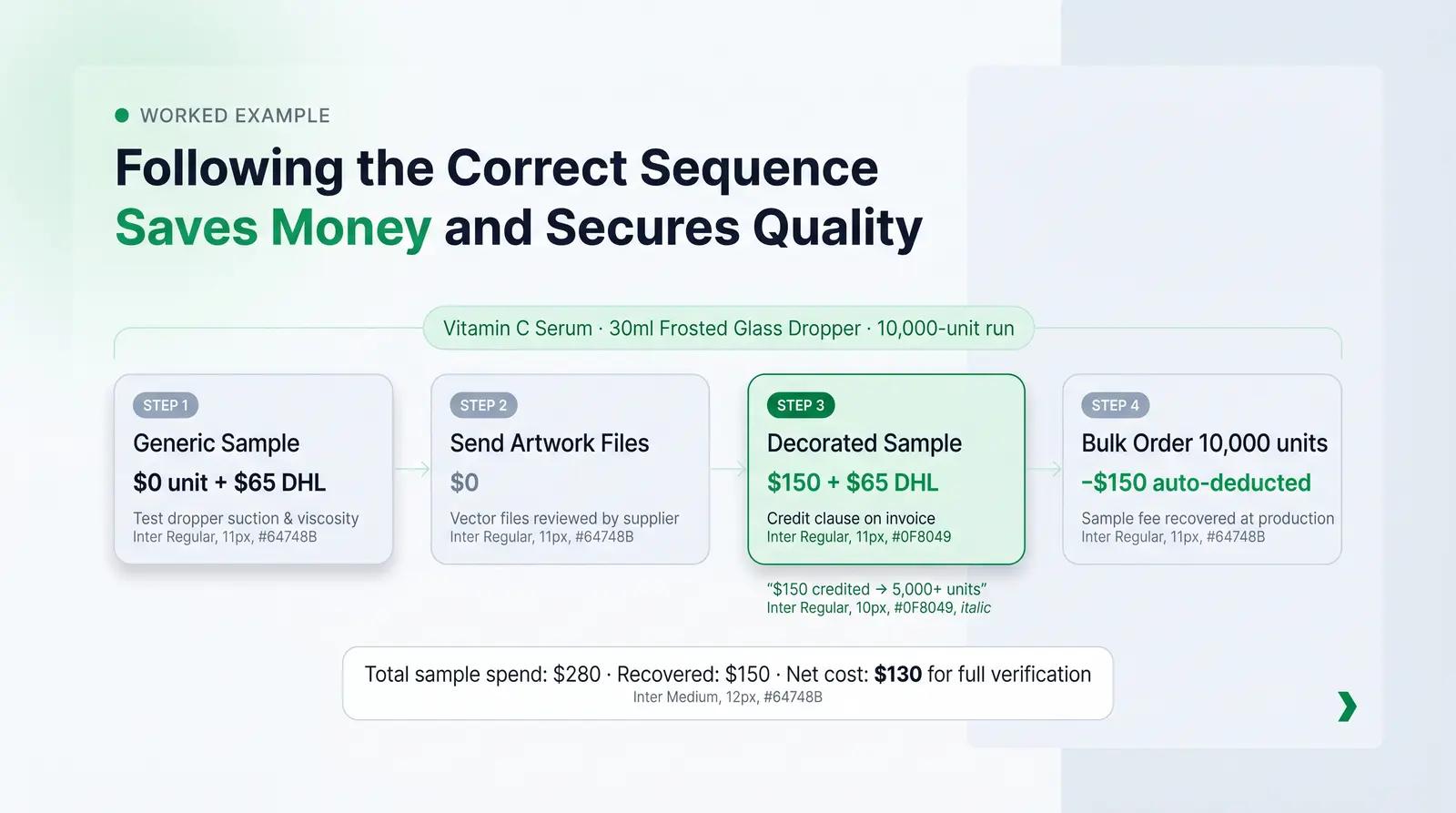
To illustrate how these principles apply in practice, consider a founder launching a vitamin C face serum. She identifies a 30 ml (1 oz) frosted glass dropper bottle in a supplier's catalog and wants to evaluate the component before committing to a 10,000-unit run.
First, she requests a generic sample to test the dropper's suction with her serum's viscosity. The supplier charges $0 for the generic bottle, but requires $65 for DHL express shipping from their facility. The founder pays the $65 via a secure corporate payment link.
After testing the generic unit and confirming compatibility, she decides to proceed with a decorated sample featuring her brand's two-color silk-screened logo. She sends her vector artwork files to the supplier. The supplier reviews the files and issues a pro forma invoice for $150 to cover the custom machine setup and ink mixing, plus another $65 for shipping. Crucially, the founder negotiates a clause on the invoice stating: "The $150 decorated sample fee will be credited against the first production order exceeding 5,000 units."
Two weeks later, she receives the decorated sample. It includes a digital proof sign-off sheet and the physical bottle. The print is sharp, the frosted finish is consistent, and she approves the design. When she places her bulk order for 10,000 units, the supplier automatically deducts the $150 sample fee from the final invoice. By following the correct sequence, she verified functionality cheaply, protected her custom sample investment, and secured a high-quality production run.
Navigating supplier relationships and sample negotiations requires vigilance, but it does not have to be the only way to source. Packfolio's catalog approach addresses the sample uncertainty problem differently. Every SKU is pre-modeled in 3D and the customer previews their artwork on a photorealistic render as part of the order flow, so the visual proof step happens before any production commitment. By coordinating production and freight internally, Packfolio ensures customers receive exactly what they previewed without having to manage overseas supplier logistics or negotiate sample credits directly. You can explore the pre-vetted components at packfolio.com/catalog.
Understanding the mechanics of sample fees transforms a moment of buyer anxiety into a structured evaluation process. By demanding itemized invoices, securing written production credits, and recognizing the specific red flags of the packaging industry, beauty founders can protect their capital and ensure their final product looks exactly as intended.
Browse Packfolio's curated cosmetic packaging catalog and preview your label in 3D before you commit to a production order → packfolio.com/catalog
Frequently Asked Questions
Why is the shipping cost for a small sample so high? International couriers like DHL and FedEx charge based on dimensional weight, and expedited air freight from overseas manufacturing hubs typically costs between $40 and $150. This fee covers priority customs clearance and rapid delivery, which is a legitimate logistical cost, not a supplier markup.
Should I pay for a sample using a personal payment app? Avoid using personal payment methods such as Western Union, cryptocurrency, or personal WeChat Pay accounts. Legitimate manufacturers use corporate bank accounts or secure B2B escrow platforms, providing a traceable record of your transaction.
What does a "non-refundable" sample fee mean? In the packaging industry, "non-refundable" usually means the supplier will not issue a cash refund if you walk away from the deal. However, it is standard practice to negotiate this fee as a credit applied toward your first bulk production order.
Can a supplier produce a custom sample without my artwork? No. A legitimate supplier cannot accurately quote or produce a decorated sample without first reviewing your vector artwork files to determine the required printing method and setup costs. Requests for payment before artwork review are a major red flag.
What is a golden sample? A golden sample, or pre-production sample (PPS), is the final approved unit produced on mass machinery before full production begins. It serves as the master reference model for quality control inspectors to ensure the bulk run matches your exact specifications.
References
[1] How to request samples before placing a wholesale order on Alibaba.com. Alibaba. 2021. https://activity.alibaba.com/page/resources/How_to_request_samples.html
[2] What Is The Cost of Custom Cosmetic Packaging? Cosmetic Packaging Now. 2025. https://www.cosmeticpackagingnow.com/blogs/learn/how-much-does-cosmetic-packaging-cost
[3] What Is a Golden Sample in Manufacturing & Why It’s a Must-Have. Silq. 2025. https://www.onesilq.com/blog/what-is-a-golden-sample-in-manufacturing-for-quality-assurance
[4] How Importers Minimize Product Defects by Establishing a Golden Sample. InTouch Quality. 2017. https://www.intouch-quality.com/blog/how-importers-minimize-product-defects-by-establishing-a-golden-sample
[5] Shipping Samples Internationally: Declaring Value, MSDS/SDS, and Clearance Tips. Amarrie Cosmetics. 2025. https://www.amarrie.com/ru/blogs/b2b-skincare-insights/shipping-samples-internationally-declaring-value-msds-sds-and-clearance-tips
[6] Shipping from China to the US: Shipping Times and Freight Costs. Freightos. 2026. https://www.freightos.com/shipping-routes/shipping-from-china-to-the-united-states/
[7] Sampling Instructions & Sample Cost Refund Conditions. SindeBella. https://sindebella.com/pages/sampling-instructions-sample-cost-refund-conditions-sindebella
[8] Red Flags & Sourcing Scams: How Sourcy Protects Your Brand. Sourcy AI. https://www.sourcy.ai/sourcing/scams
[9] Why Packaging Samples Matter: 5 Supplier Red Flags. RentraSpa. 2026. https://rentraspa.com/blogs/fg/why-packaging-samples-matter


