
Cosmetic Packaging Payment Terms: Deposits, Balances, Samples, and Trade Assurance
Structure cosmetic packaging payment terms using milestone documentation and pre-shipment inspections to reduce financial risk on international supplier orders.
Your cursor hovers over the "Send" button. You have spent weeks vetting a new supplier, reviewing technical drawings, and approving a physical sample. The pricing works, the lead time fits your launch schedule, and the communication has been solid. Now the supplier is asking for a 30% deposit wired to a bank account in Guangdong. That hesitation, the very real anxiety of sending thousands of dollars overseas with no absolute guarantee of what will arrive, when it will arrive, or whether it will arrive at all, is a rite of passage for independent beauty brand founders.
This feeling is the core tension of sourcing cosmetic primary packaging. When you are operating without the leverage of a multi-million dollar corporate procurement budget, payment terms are not just financial logistics. They are your primary risk management tool. This article explains what normal looks like, what documentation to request at each stage, and how to structure transactions to reduce financial exposure without demanding terms that no serious factory will accept.
Why Cosmetic Packaging Payment Terms Feel Riskier Than They Are, and When They Actually Are Risky
The anxiety founders feel when wiring deposits is entirely valid. The FBI's Internet Crime Complaint Center (IC3) reported over $55 billion in global exposed losses from business email compromise and wire fraud between 2013 and 2023 [1]. International bank transfers to overseas accounts are irreversible once processed, which means a mistake or a scam leaves you with very limited recourse.
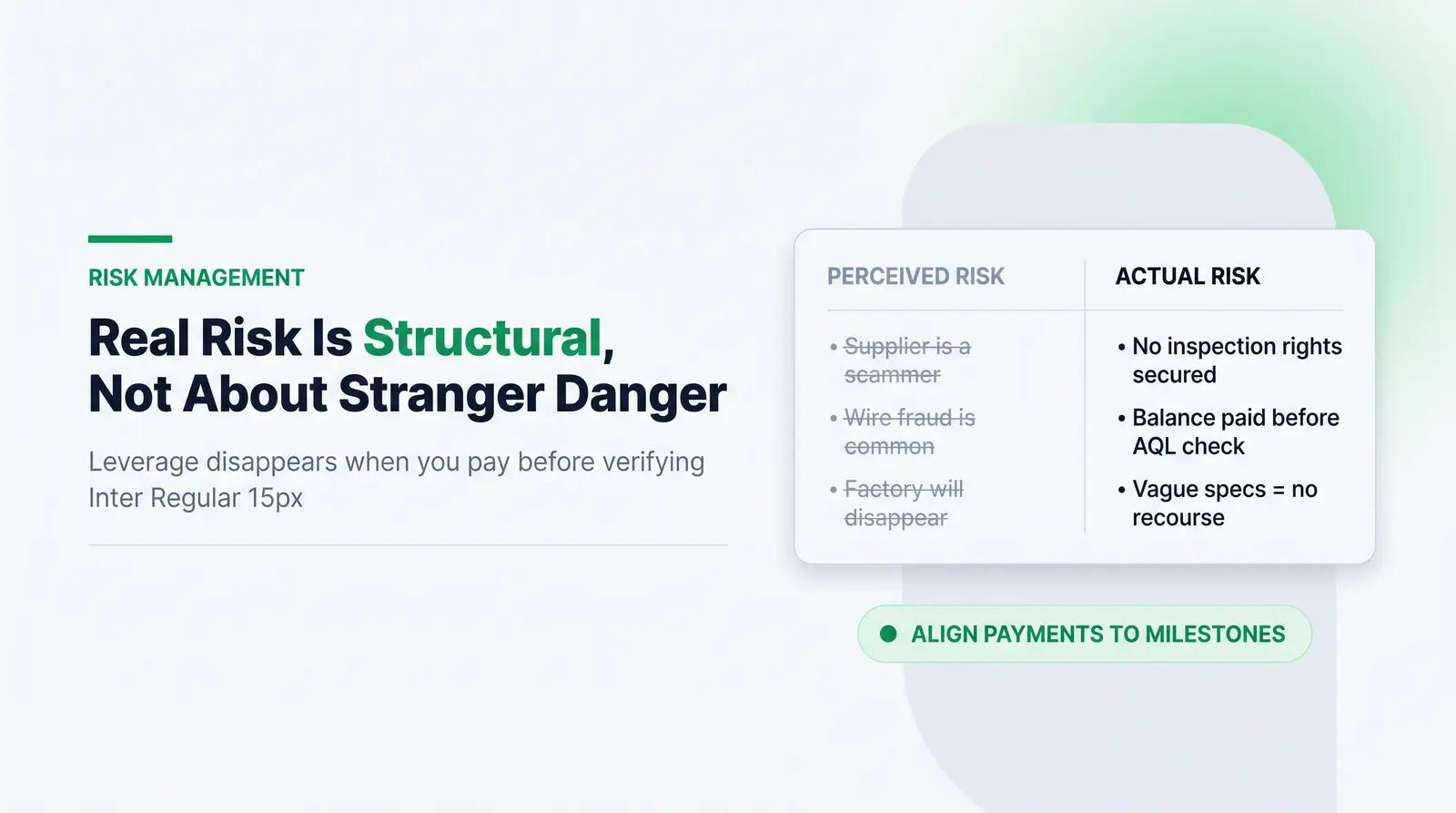
However, it is important to separate the perceived risk of "stranger danger" from the actual structural risks of international trade. Most established cosmetic packaging manufacturers are legitimate businesses looking for long-term clients. They typically price initial orders at break-even or a small loss, expecting to generate profit on reorders and relationship volume [2]. The real risk is rarely outright theft. Instead, the risk is structural. Paying a deposit without securing inspection rights, failing to tie the balance payment to a contractual milestone, or relying on vague quality specifications that leave you with no recourse if the final product is substandard.
A transaction becomes structurally risky when you surrender all financial leverage before verifying the outcome. If you pay 100% upfront, you have no leverage if the supplier prioritizes larger orders and delays your production. If you release the final balance before a third-party inspection confirms the acceptable quality limit (AQL), you have no leverage if the glass bottles arrive with critical defects like cracks or non-functioning pumps [3]. The goal of a well-structured payment schedule is not to distrust your supplier. It is to align financial incentives with production milestones so that both parties are protected.
The Standard Payment Structure for Sample Orders
Before committing to a bulk production run, ordering a pre-production sample (PPS) is non-negotiable. The payment structure for samples is straightforward but often misunderstood by new founders.
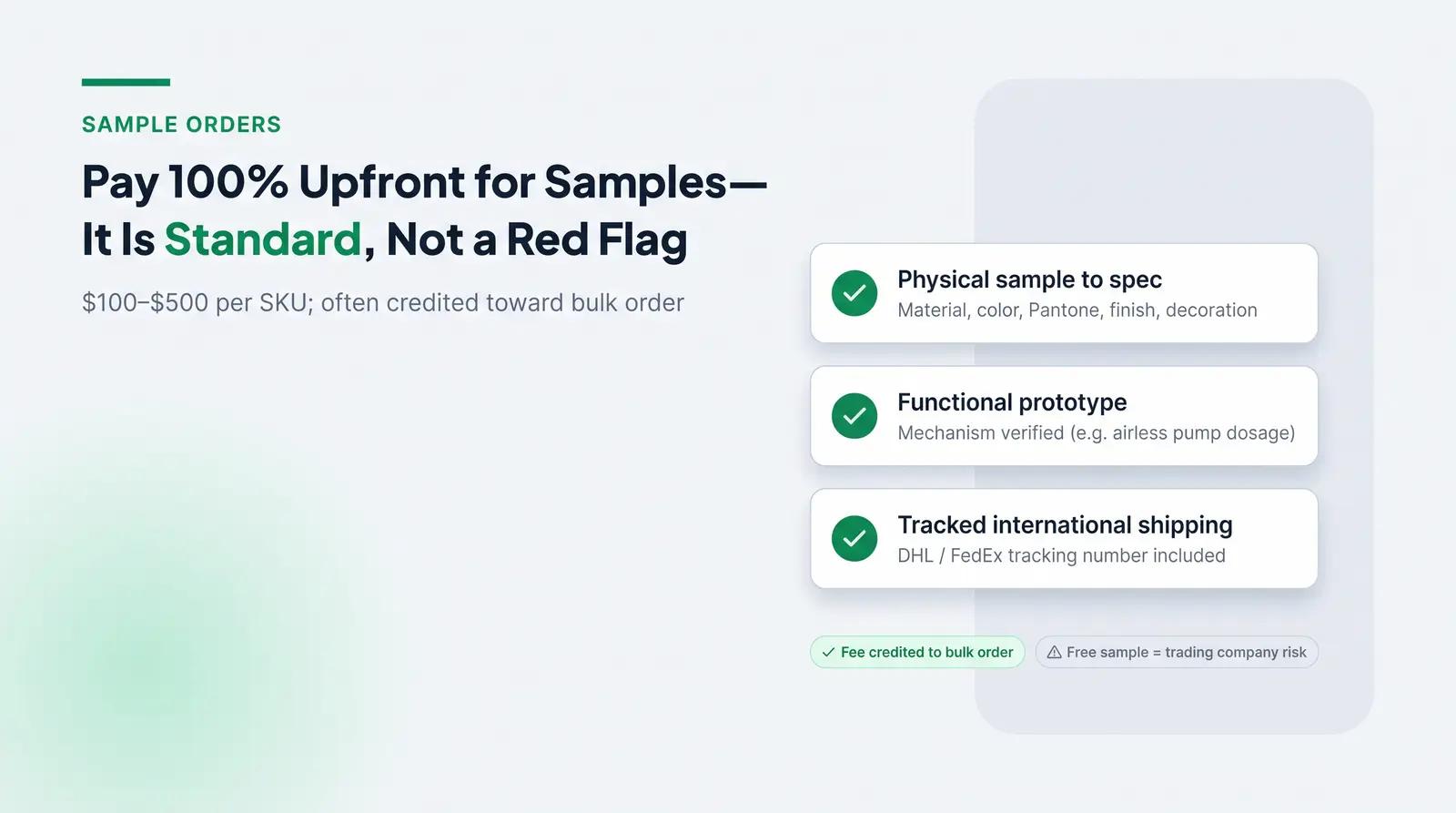
Suppliers typically require 100% payment upfront for sample orders. This is standard practice and not a red flag. The cost covers the setup time to produce a small batch, the customized decoration (such as silk screening or hot stamping), and expedited international shipping with tracking. Sample fees for custom cosmetic packaging typically range from $100 to $500 per SKU, depending on the complexity of the decoration and the material [4].
When paying for a sample, ensure the payment unlocks specific, documented deliverables. You should receive a physical sample matching your exact specifications (material, color, decoration, and finish), a functional prototype that demonstrates the mechanism works correctly (for example, an airless pump that dispenses the correct dosage), and shipping with a tracking number. The sample should be produced from the same materials and decoration methods that will be used in mass production.
If a supplier offers a "free custom sample" without any prior relationship, treat it as a yellow flag. Legitimate factories incur real costs to halt mass production lines to run a small sample batch. A free offer often indicates the supplier is a trading company sending a generic stock item rather than a custom design, or that the sample cost will be buried in the bulk unit price. Conversely, many reputable suppliers will credit the sample fee toward your bulk order if you proceed with production [4]. This is worth confirming in writing before you pay.
The Standard Payment Structure for Bulk Production Orders
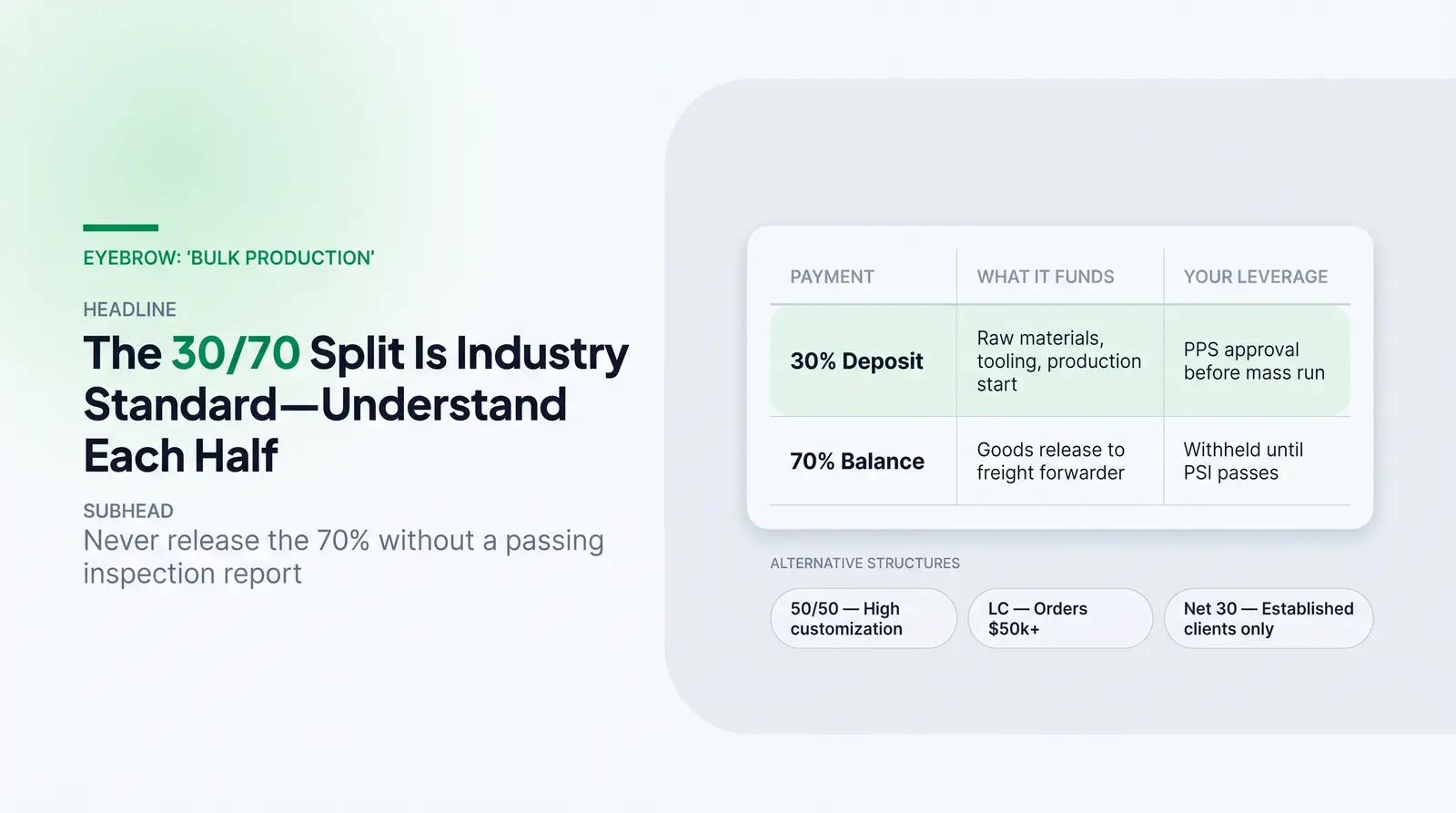
For bulk cosmetic packaging orders, the industry standard is a 30/70 split: a 30% deposit to initiate production, and the 70% balance paid before shipment [5]. This structure reflects the factory's need for working capital and the buyer's need to retain leverage until the order is complete.
The 30% deposit is not pure profit for the factory. It provides the working capital needed to procure raw materials (glass, plastics, resins, and printing inks) and to cover initial setup costs like printing plate creation [6]. In return, this deposit should unlock the official start of production and the creation of a final pre-production sample (PPS) for your approval before mass manufacturing begins. Requesting written confirmation of the production start date is a reasonable expectation at this stage.
The 70% balance is typically due when production is complete, but before the goods are loaded onto the vessel. This is often expressed in contracts as "against copy of shipping documents" or "before shipment." The critical point is that you should never release this balance without first reviewing the results of a quality inspection.
While 30/70 is the standard, other structures exist:
50/50 Split. Common for highly customized orders requiring expensive new molds or tooling, or for very small initial orders where the factory's risk is higher. Some suppliers will propose this for first-time buyers as a compromise.
Letter of Credit (LC). An LC is a bank-backed payment guarantee governed by the International Chamber of Commerce's UCP 600 framework [7]. It is one of the most secure instruments in international trade because the buyer's bank guarantees payment to the supplier once specific shipping documents are presented. However, LCs incur significant bank fees: typically 0.75% to 1.5% of the order value for issuance, plus amendment fees, document handling fees, and potential discrepancy fees that can total $1,500 to $5,000 or more per transaction [8]. They also require strict documentary compliance, where even a minor inconsistency in paperwork can delay payment. For these reasons, LCs are generally impractical for orders under $50,000 and are rarely used by independent beauty brands sourcing cosmetic packaging [8].
Net 30/60 Terms. Payment is due 30 or 60 days after delivery. These terms are highly desirable for cash flow management but are almost never offered to new buyers. Factories reserve extended credit terms for established clients with a proven track record of consistent, high-volume orders over a long-term relationship [2].
Demanding 0% upfront or Net 30 terms as a new, low-volume buyer is not a realistic expectation. Conversely, any supplier demanding 100% upfront for a bulk order is a significant red flag and should be avoided.
What Each Payment Should Unlock — A Milestone Documentation Checklist
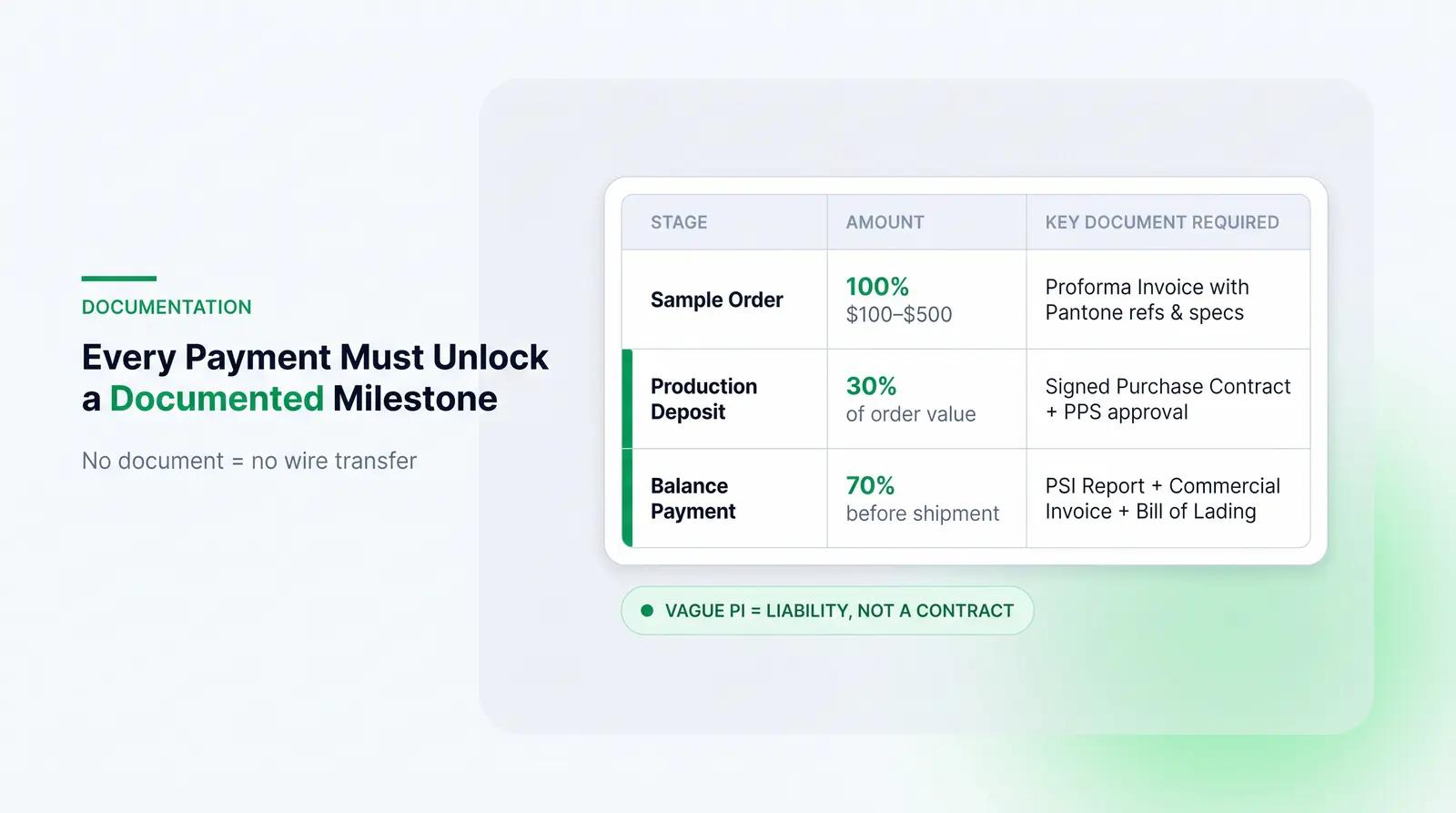
To protect your investment, tie every payment to a specific, documented milestone. Never wire funds based on a verbal promise or a casual message in WhatsApp. The documentation you collect at each stage is also the evidence you will need if a dispute arises through Trade Assurance or any other dispute mechanism.
| Payment Stage | Typical Amount | Documents to Request Before Paying | What This Milestone Unlocks |
|---|---|---|---|
| Sample Order | 100% of sample fee ($100–$500) | Proforma Invoice (PI) specifying exact sample specs, colors, Pantone references, and decoration method. | Production of custom sample and expedited shipping with tracking number. |
| Production Deposit | 30% of total order value | Signed Purchase Contract or PI detailing full specifications, lead times, AQL inspection rights, and pre-production sample (PPS) approval process. | Procurement of raw materials, tooling (if applicable), and mass production scheduling. Confirmation of production start date. |
| Balance Payment | 70% of total order value | Passed Pre-Shipment Inspection (PSI) Report from a third party, Commercial Invoice, Packing List, and Bill of Lading (or Airway Bill for air freight). | Release of goods to the freight forwarder. |
The Proforma Invoice is the cornerstone document for any custom order. It should specify material type, capacity (e.g., 30 ml), finish (e.g., frosted glass), decoration method (e.g., silk screen printing, Pantone 186C), quantity, unit price, total value, lead time, and payment terms. A vague PI is a liability, not a contract.
Alibaba Trade Assurance — What It Actually Covers (and What It Does Not)
Many founders use Alibaba to find suppliers and rely on Alibaba Trade Assurance for peace of mind. Trade Assurance is a free order protection service designed to guarantee money back if a supplier fails to meet the terms of the order contract regarding delivery delays or quality discrepancies [9]. The program has been available since 2014 and covers orders placed and paid through the Alibaba platform.
Mechanically, Trade Assurance works as follows: the buyer places an order through the Alibaba platform, makes payment to a designated Alibaba-managed bank account (typically a Citibank virtual account), and the funds are held until the order is completed. If a dispute arises, the buyer can apply for a refund within 30 days of the delivery date (or 60 days for Enterprise-tier buyers) [13]. The supplier has 3 to 30 days to negotiate a resolution, after which Alibaba can step in to mediate [12].
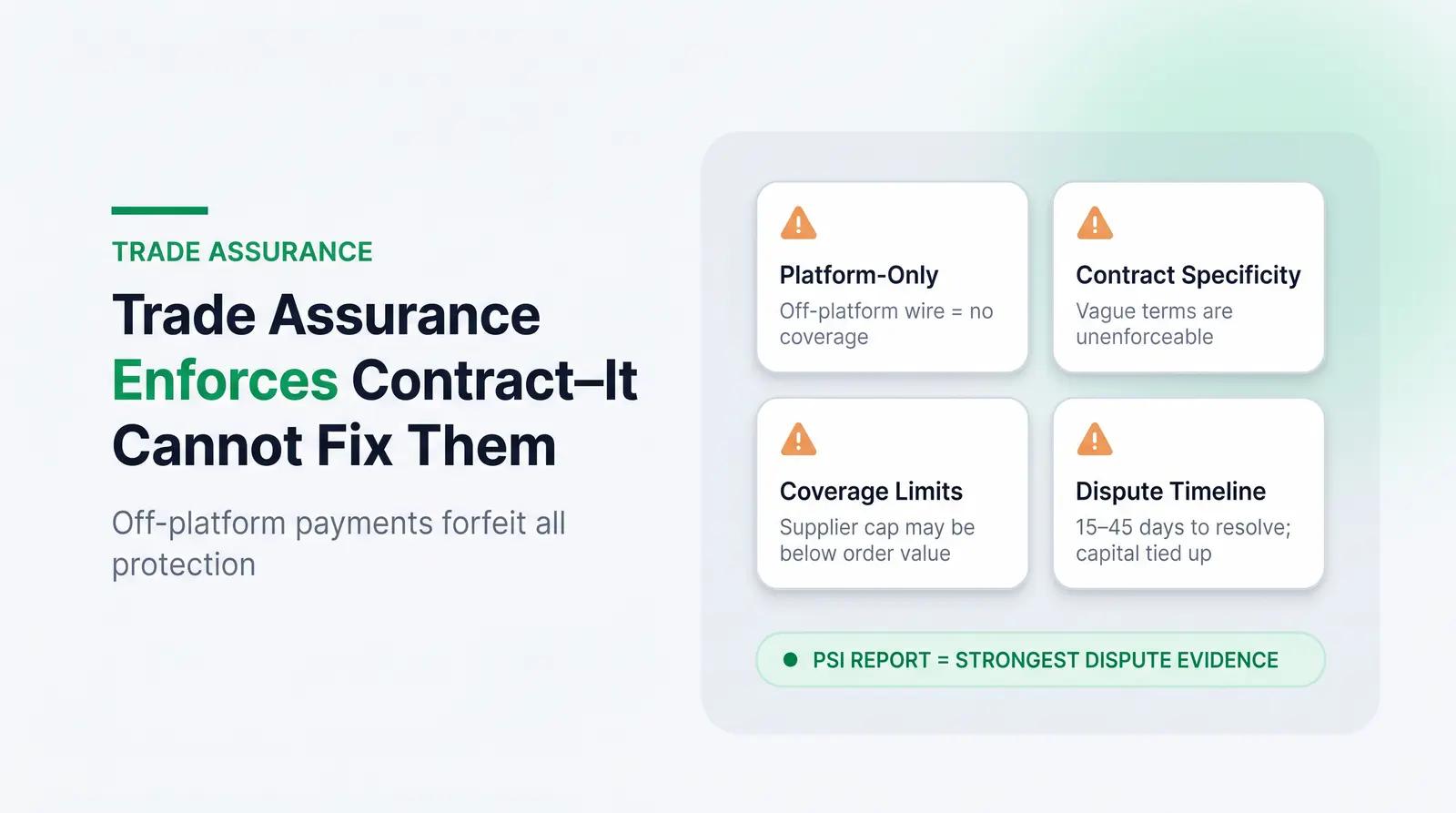
However, Trade Assurance is not a comprehensive guarantee. Its limitations are significant and often misunderstood:
Platform Exclusivity. Trade Assurance only protects payments made through the Alibaba platform's designated payment gateways. If a supplier asks you to wire money directly to their private bank account—even if you found them on Alibaba—you forfeit all Trade Assurance protections [10]. This is the most common way founders lose coverage.
Contract Specificity. Coverage is entirely dependent on what is written in the Alibaba order contract. Vague terms like "high quality" or "prompt shipping" are unenforceable. You must specify measurable criteria: Pantone color codes, exact dimensions, material specifications, and AQL defect thresholds [10]. Alibaba will default to the supplier's interpretation of anything left open to interpretation.
Coverage Limits. Suppliers are assigned a specific Trade Assurance coverage limit based on their transaction history. If your $20,000 order is placed with a supplier who only has a $10,000 coverage limit, your maximum potential refund is capped at $10,000 [11]. Buyers cannot see a supplier's coverage limit before placing an order, which makes pre-shipment coverage with a low initial deposit the safer strategy for larger orders.
Dispute Timelines. The mediation process can take 15 to 45 days, depending on claim complexity and evidence quality [13]. This ties up your capital and delays your launch while the dispute is resolved. A passing pre-shipment inspection report is the most powerful piece of evidence you can have in any dispute.
Trade Assurance is a helpful tool for enforcing a well-written contract. It cannot fix a poorly defined order, and it cannot protect payments made outside the platform.
The Packaging Payment Risk Matrix
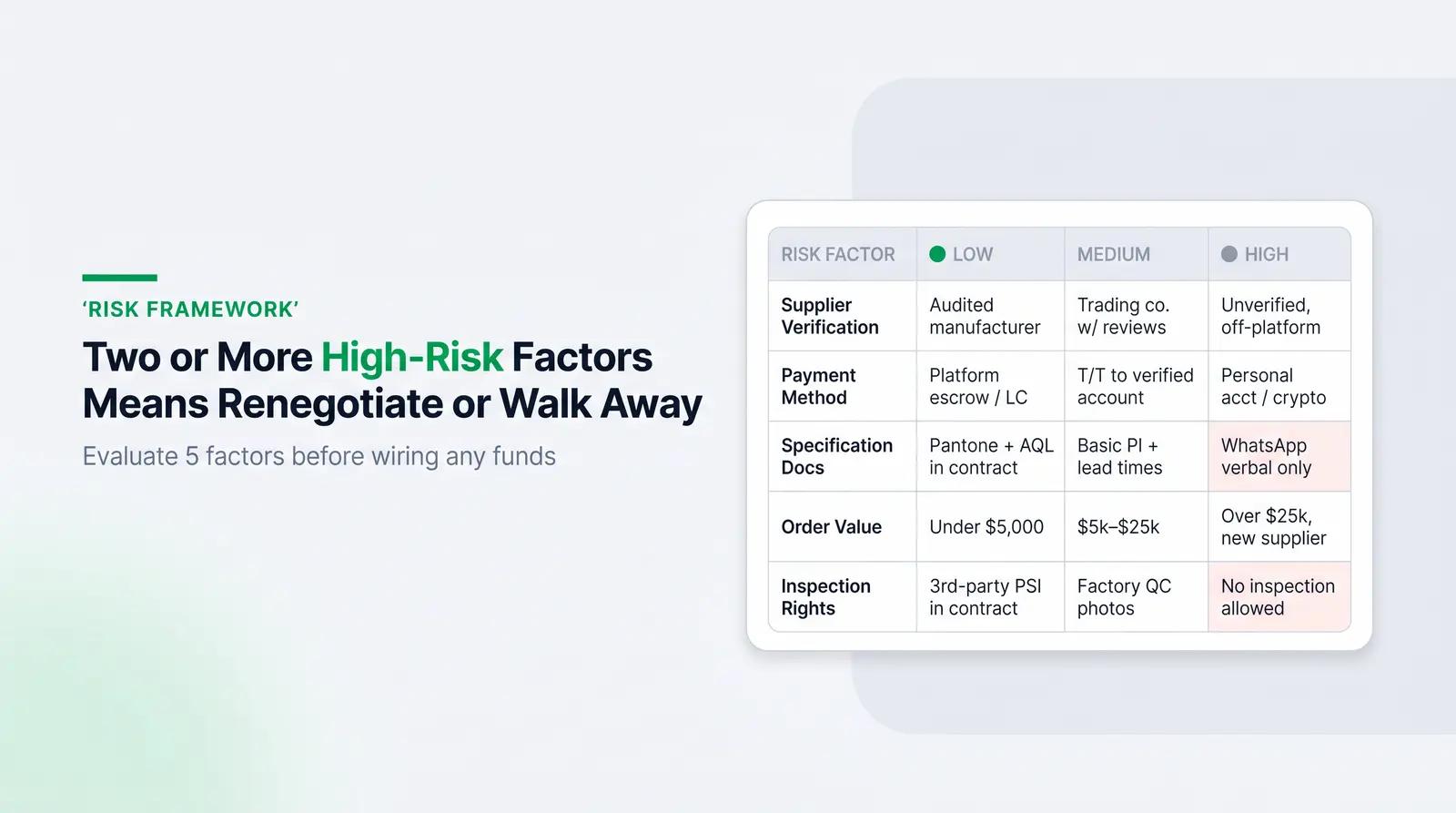
To help founders evaluate supplier relationships before committing funds, we recommend using The Packaging Payment Risk Matrix. This practical framework categorizes the risk level of a transaction based on five key structural factors, allowing you to adjust your payment strategy and documentation requirements accordingly.
| Risk Factor | Low Risk | Medium Risk | High Risk |
|---|---|---|---|
| Supplier Verification | Audited manufacturer with years of verified export history and platform certifications. | Trading company with positive platform reviews and responsive communication. | Unverified supplier requesting off-platform communication immediately after initial contact. |
| Payment Method | Platform escrow (Trade Assurance) or Letter of Credit for high-value orders. | Standard T/T wire transfer to a verified business bank account with a formal PI. | Wire transfer to a personal bank account, Western Union, or cryptocurrency. |
| Specification Documentation | Highly detailed contract with Pantone codes, material specs, functional requirements, and AQL limits. | Basic Proforma Invoice with general descriptions and agreed lead times. | Verbal agreements via WhatsApp or WeChat with no formal PI or purchase contract. |
| Order Value | Under $5,000 (limited exposure). | $5,000 to $25,000 (moderate exposure). | Over $25,000 with a new, unverified supplier (high exposure). |
| Inspection Rights | Third-party Pre-Shipment Inspection (PSI) written into the contract and balance withheld pending results. | Factory-provided QC photos and videos before shipment with right to request re-inspection. | No inspection allowed; balance required before seeing final goods or inspection report. |
If your transaction falls into the "High Risk" column in any two or more categories, pause and renegotiate the terms or find a different supplier. A single high-risk factor can be managed; multiple high-risk factors in combination represent a transaction structure that removes your ability to respond if something goes wrong.
The Non-Obvious Insight: Inspection Trumps Negotiation
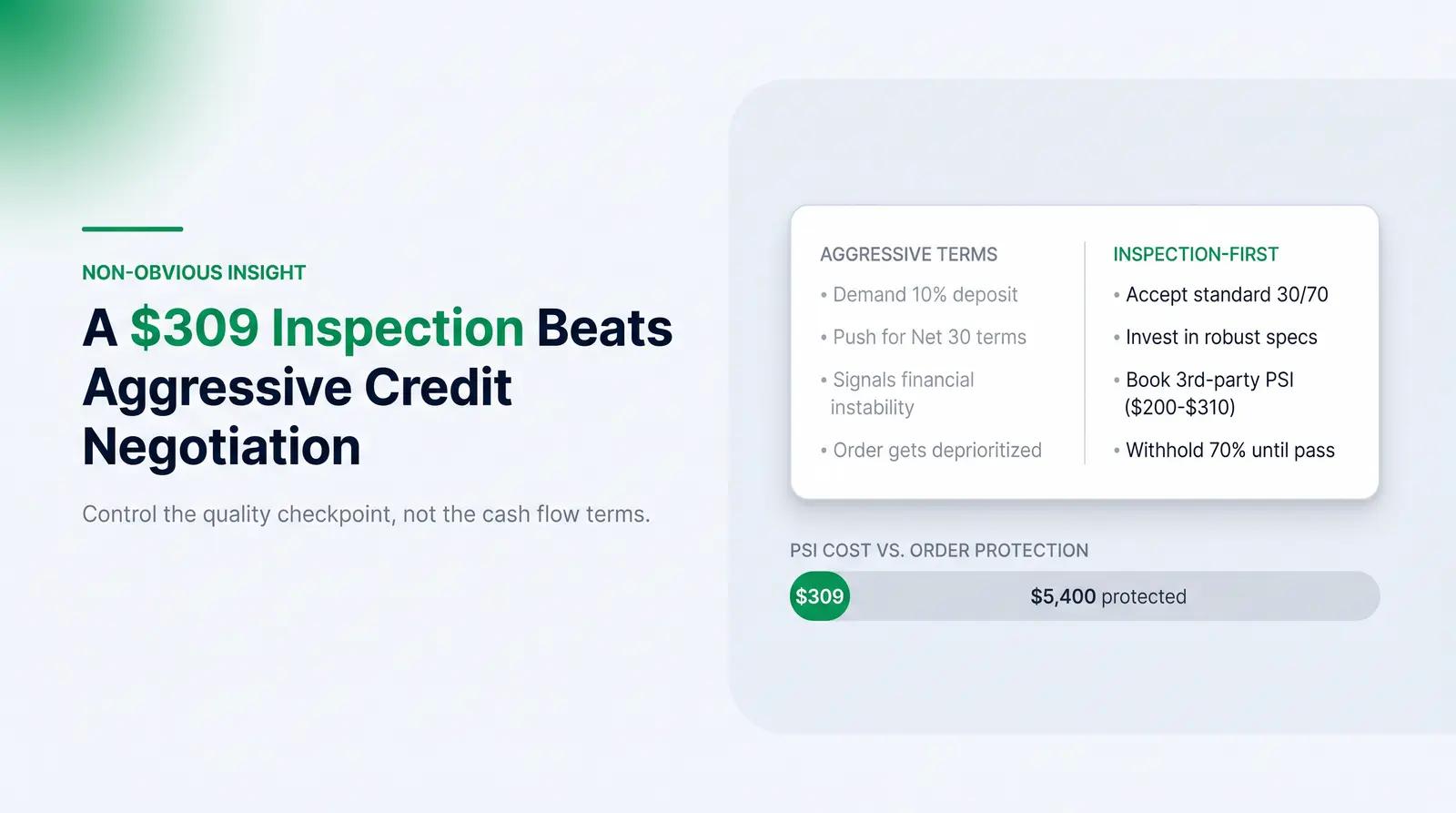
There is a common misconception that the best way to reduce financial risk is to aggressively negotiate payment terms—demanding a 10% deposit, Net 30 terms, or an LC on a first order. The logic seems sound: the less money you have at risk at any given time, the safer you are.
The contrarian truth is that demanding aggressive credit terms from a small-to-mid-sized factory as a new, low-volume buyer is more likely to damage the relationship and get your order deprioritized than to protect you [2]. Factories allocate production capacity to their most reliable, highest-volume clients. A new buyer who opens negotiations with aggressive payment demands signals either financial instability or bad faith—neither of which earns you priority scheduling or attentive quality control.
The far better risk-reduction move is to accept the standard 30/70 terms, but invest heavily in two things: robust specification documentation and a third-party pre-shipment inspection (PSI). A PSI conducted by a reputable third party typically costs between $200 and $310 per man-day [14]. This inspection verifies the AQL, checks functionality, confirms quantities, and ensures packaging compliance before you pay the 70% balance [15]. Controlling the quality checkpoint gives you infinitely more leverage than trying to squeeze a factory on cash flow terms. A passed inspection report is also your strongest evidence in any dispute. A failed inspection report is your legal basis for withholding payment until defects are remedied.
For founders sourcing through platforms like Packfolio, supplier vetting and quality assurance are handled upstream, removing the need to negotiate these terms independently.
Worked Example — A Realistic Bulk Order Scenario
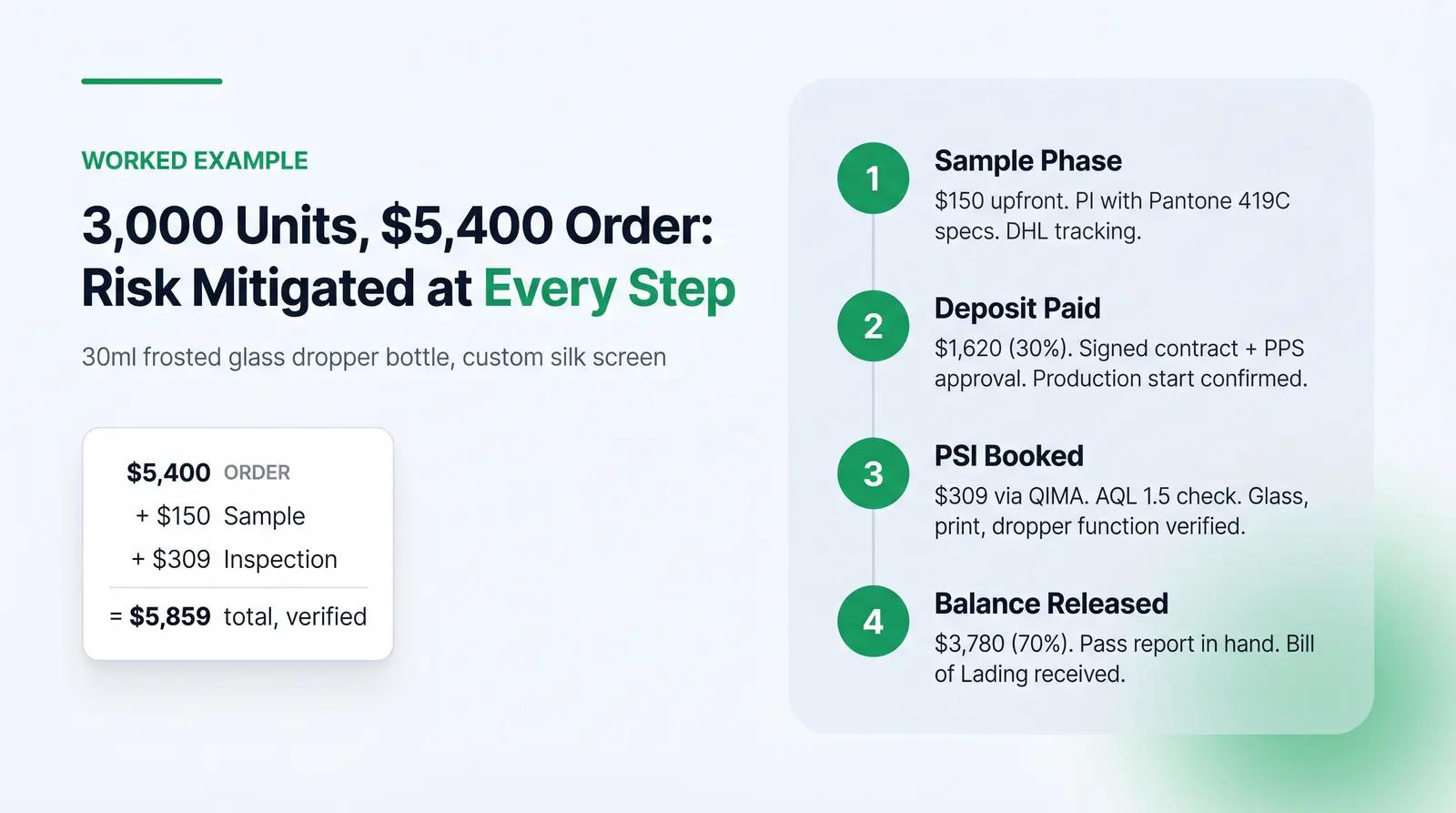
Let's walk through a realistic scenario for a founder ordering 3,000 units of a custom-printed 1 oz (30 ml) glass dropper bottle from a new supplier.
The Order Details:
- Unit Cost: $1.80 per bottle
- Total Order Value: $5,400
- Terms: 30% Deposit / 70% Balance before shipment
Step 1: The Sample Phase
The founder pays a $150 sample fee upfront after receiving a Proforma Invoice specifying the frosted glass material, a 30 ml capacity, a matte black screen-printed logo in Pantone 419 C, and a black aluminum dropper cap. The supplier produces the sample and ships it with a DHL tracking number. The sample arrives in 12 days. The dropper functions correctly, the color matches the Pantone reference, and the founder approves it in writing via email.
Step 2: Placing the Bulk Order and Paying the Deposit
The supplier issues a formal Purchase Contract and Proforma Invoice specifying the approved sample as the quality benchmark, a 35-day production lead time, and the right for the buyer to arrange a third-party inspection before the balance is released. The founder wires the 30% deposit ($1,620) to the supplier's verified business account. The supplier confirms the production start date in writing.
Step 3: Booking the Pre-Shipment Inspection
On day 28, the supplier notifies the founder that production is 95% complete and goods are being packed. The founder books a third-party inspection through QIMA for $309. The inspector visits the factory on day 33, pulls a random sample based on AQL 1.5 standards for major defects, checks for scratches and cracks in the glass, tests the dropper suction on 10 units, verifies the screen-print color against the Pantone reference, and confirms the carton count. The inspector issues a "Pass" report with photos the same day.
Step 4: Releasing the Balance
With the passing inspection report in hand, the founder wires the 70% balance ($3,780). The supplier receives the funds, releases the goods to the freight forwarder, and provides the Commercial Invoice, Packing List, and Bill of Lading. Total spend: $5,400 (order) + $150 (sample) + $309 (inspection) = $5,859 for 3,000 units of a verified, custom-printed glass dropper bottle.
The founder successfully mitigated risk not by changing the payment terms, but by controlling the milestones.
A Simpler Way Forward
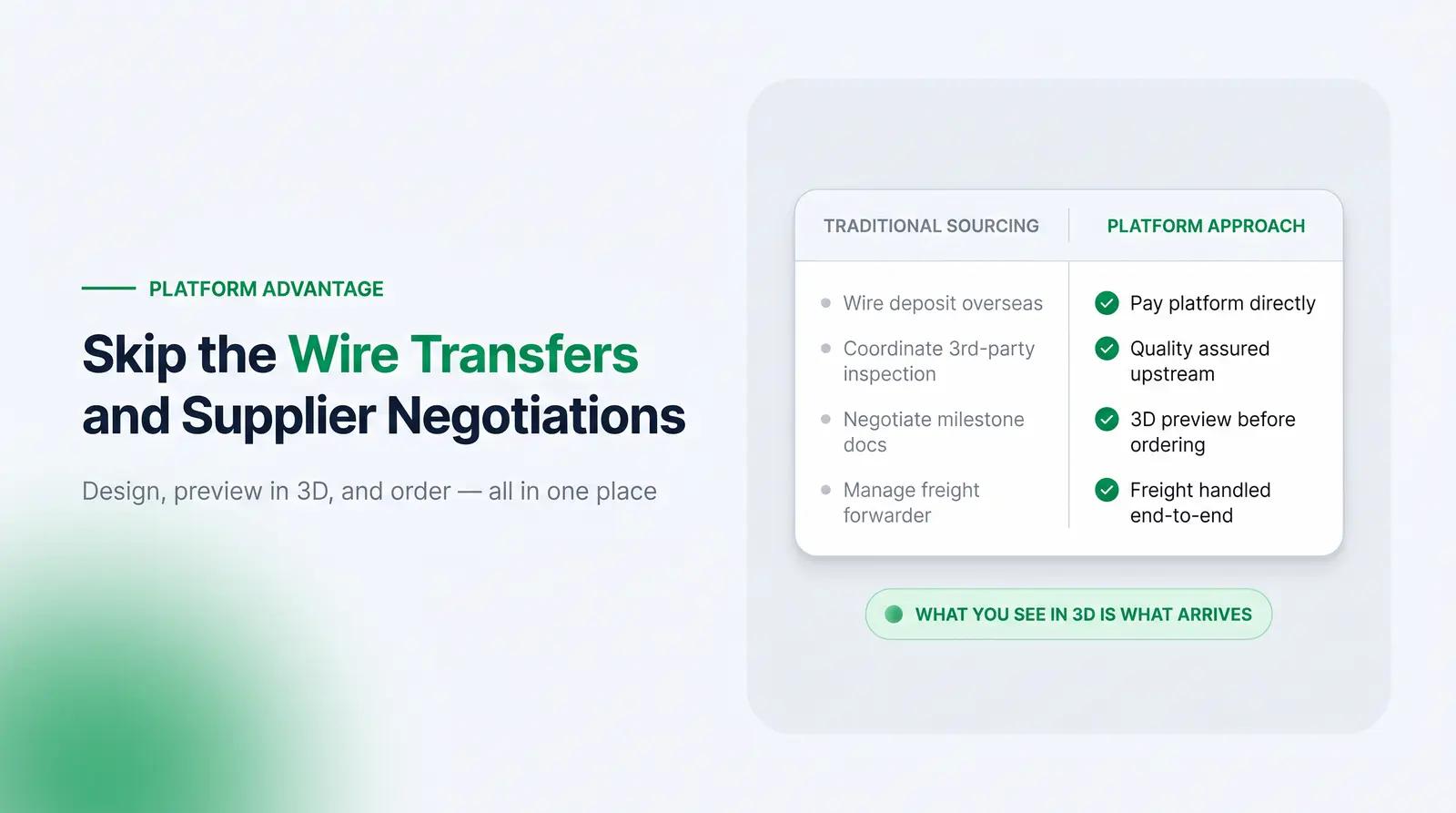
Managing international wire transfers, coordinating third-party inspections, and negotiating milestone documentation requires significant time and operational bandwidth. That is bandwidth that early-stage founders rarely have in abundance. For founders who prefer to focus on product development and marketing, Packfolio eliminates this entire payment structure. When you order through the platform, you pay Packfolio directly. Packfolio coordinates production, manages quality assurance, and handles freight. The mandatory 3D preview step, where you design your artwork inside predefined print zones and see it rendered on a photorealistic model before ordering, ensures that what you see on screen is exactly what you receive, removing the supply chain uncertainty and the anxiety of wiring deposits overseas.
Browse Packfolio's curated packaging catalog and preview your label in 3D before ordering. No supplier negotiations, no deposit wiring, no supply chain uncertainty. Explore the catalog
Frequently Asked Questions
What is the standard deposit for cosmetic packaging? The industry standard deposit for bulk cosmetic packaging orders is 30% of the total order value. This provides the factory with the working capital needed to procure raw materials and begin production. The remaining 70% is typically paid before the goods are shipped, ideally after a passing pre-shipment inspection.
Should I pay for cosmetic packaging samples? Yes, paying for custom samples is standard practice and typically costs between $100 and $500 per SKU. This fee covers the factory's setup time and expedited shipping. It is not a red flag; it is a sign that the supplier is running a legitimate manufacturing operation. Reputable suppliers will often credit this amount toward your final bulk order.
Does Alibaba Trade Assurance cover off-platform payments? No. Alibaba Trade Assurance only protects payments made directly through the Alibaba platform's designated payment gateways. If you wire money to a supplier's private bank account outside the platform—even if you found the supplier on Alibaba—you forfeit all Trade Assurance protections.
How do I protect my balance payment? The most effective way to protect your 70% balance payment is to require a third-party Pre-Shipment Inspection (PSI) before releasing the funds. This ensures an independent inspector verifies product quality, quantity, and packaging compliance against your contract specifications before the goods leave the factory. Write this right into your purchase contract from the start.
Can I get Net 30 payment terms as a new brand? It is highly unlikely for a new brand to secure Net 30 or Net 60 payment terms on an initial order. Factories reserve extended credit terms for established clients with a proven track record of consistent, high-volume orders over a long-term relationship. Pushing for these terms on a first order is more likely to damage the relationship than to protect your cash flow.
References
[1] Business Email Compromise: The $55 Billion Scam - Federal Bureau of Investigation, Internet Crime Complaint Center (IC3), 2024.
[2] How do I negotiate better payment terms and lead times with Chinese packaging manufacturers? - PassenPack, 2026.
[3] Setting AQL Standards for Cosmetics Packaging - InTouch Quality (Asia Quality Focus), 2021.
[4] The Hidden Costs of Custom Cosmetic Packaging: What Brands Need to Know - LuxeTubes, 2026.
[5] What Are The Stages Of Payment In Bulk Clothing Orders? - Shanghai Garment (cross-industry standard applicable to cosmetic packaging).
[6] What is the Cost of Custom Cosmetic Packaging? - Cosmetic Packaging Now, 2025.
[7] Key trade finance products: Definitions and use cases - ICC Academy, International Chamber of Commerce, 2024.
[8] Letters of Credit for U.S. Importers: A Working Guide - Slash, 2026.
[9] Trade Assurance Guide - Alibaba.com.
[10] Alibaba Trade Assurance: What It Covers and When to Use It - Guided Imports, 2026.
[11] Alibaba Trade Assurance: Top 5 Buyers' Concerns Solved - Jing Sourcing, 2024.
[12] Alibaba.com Transaction Dispute Rules - Alibaba.com, updated 2025.
[13] Money-back policy - Trade Assurance - Alibaba.com, 2024.
[14] SGS Pre-Shipment Inspection Alternatives: 6 Options That Cost Less - TradeAider, 2026.
[15] What is a Pre-Shipment Inspection: Definition, Procedure and Steps - QC Advisor, 2025.


