
Factory Holidays and Beauty Packaging Sourcing: A Planning Calendar
Map factory holiday closures, apply lead time padding, and use an annual sourcing calendar to prevent costly beauty packaging delays from Chinese New Year and other shutdowns.
Holiday-driven supply disruption is a hidden launch risk—one that frequently catches independent beauty brand founders off guard. When a founder places an order for custom dropper bottles in early January, assuming a standard six-week lead time will easily support a mid-March launch, they often receive a rude awakening: their supplier is closing for Chinese New Year, pushing delivery into late April. Most beauty founders do not model factory closures into their timelines until it is already too late, leaving them scrambling for expedited freight or facing empty shelves during peak season.
Why Factory Holidays Hit Packaging Orders Harder Than Most Founders Expect
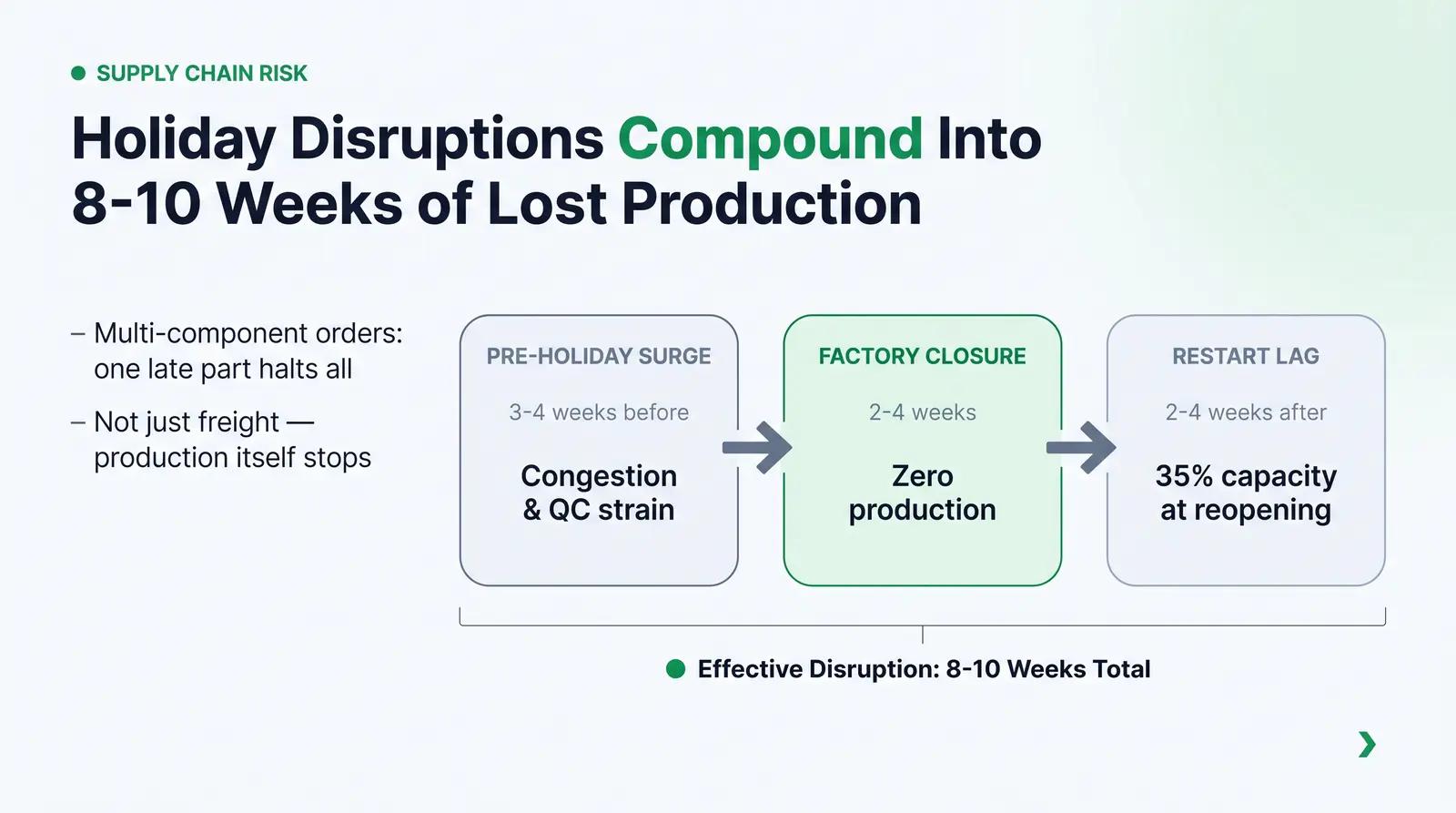
The structural reality of global manufacturing means that factory closures in cosmetic packaging supply chains cause disproportionate disruption. The issue is not merely the days the factory doors are locked; it is the compounding effect of the pre-holiday surge and the post-reopening lag. In the three to four weeks before a major holiday, factories experience a massive pre-holiday surge as brands globally attempt to front-load orders before the closure [1]. This congestion compresses effective lead times even before the holiday begins, stretching quality control teams and increasing the likelihood of production errors [2].
After the holiday concludes, factories face a re-start lag. They do not resume at full capacity immediately. Worker return rates are notoriously unpredictable after major holidays like Chinese New Year, with some facilities operating at only thirty-five percent capacity during the first few weeks of reopening [3]. Material restocking, machine calibration, and training new staff all take time, meaning normal lead times may not stabilize until a month after the official holiday ends [2].
Cosmetic primary packaging is particularly vulnerable to these disruptions because of its multi-component nature. A single finished product—such as a luxury serum—might require a glass bottle, a plastic collar, a rubber bulb, and a glass pipette. These components are often produced by different sub-suppliers before final assembly. If just one component vendor closes early or faces a post-holiday backlog, the entire order is held hostage. It is critical to distinguish this from freight delays; while port congestion and blank sailings certainly occur around holidays [3], the primary risk to beauty packaging is a fundamental halt in production.
The Major Factory Holiday Windows to Build Into Every Sourcing Calendar
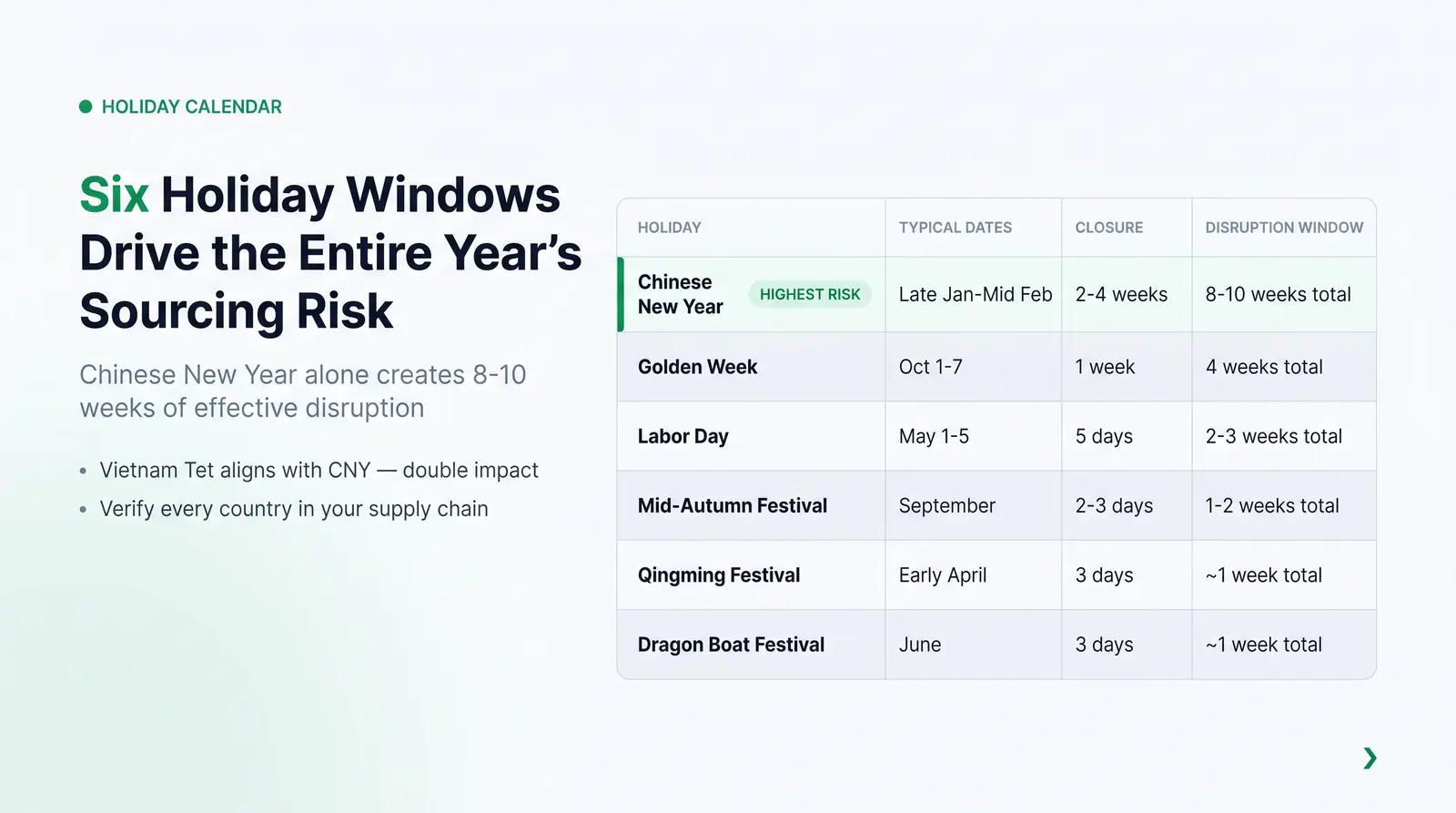
To build a resilient sourcing calendar, founders must map the major factory holiday windows that reliably disrupt production. While the exact dates of lunar holidays shift annually, the pattern of disruption remains consistent.
- Chinese New Year (Spring Festival): This is the most disruptive event in the global supply chain. While the official government holiday typically lasts seven to nine days, most factories close fully for two to four weeks [2]. Because the date shifts each year based on the lunar calendar, founders must look it up annually [4].
- Golden Week (National Day): Occurring October 1–7, this week-long closure creates a significant Q4 bottleneck, complete with pre-holiday congestion and a post-reopening lag [5].
- Labor Day Golden Week: Landing in late April or early May, this five-day holiday is frequently overlooked by Western brands but reliably halts production lines [4].
- Qingming Festival: Taking place in early April, this shorter holiday still causes brief disruptions, particularly when adjacent to weekends [4].
- Dragon Boat Festival: A shorter closure in June that can delay mid-summer production runs [4].
- Mid-Autumn Festival: Usually falling in September, this holiday is often adjacent to National Day, creating a clustered disruption period in early autumn [4].
It is also vital to remember that supply chains are geographically distributed. Brands sourcing components from Vietnam must account for Tet (Vietnamese Lunar New Year), which typically aligns with Chinese New Year and shuts down manufacturing hubs simultaneously [3]. Similarly, founders sourcing components from India must factor in Diwali, which heavily impacts autumn production schedules. Founders should verify holiday calendars for every country in their supply chain.
| Holiday | Typical Dates | Factory Closure Duration | Pre-Holiday Surge Starts | Post-Reopening Lag | Effective Disruption Window |
|---|---|---|---|---|---|
| Chinese New Year | Late Jan to Mid-Feb (Shifts annually) | 2–4 weeks | 3–4 weeks prior | 2–4 weeks after | 8–10 weeks total |
| Golden Week (National Day) | October 1–7 | 1 week | 2 weeks prior | 1 week after | 4 weeks total |
| Labor Day | May 1–5 | 5 days | 1 week prior | 1 week after | 2–3 weeks total |
| Mid-Autumn Festival | September (Shifts annually) | 2–3 days | 1 week prior | Few days after | 1–2 weeks total |
| Qingming Festival | Early April | 3 days | Few days prior | Few days after | 1 week total |
| Dragon Boat Festival | June (Shifts annually) | 3 days | Few days prior | Few days after | 1 week total |
The Packaging Lead Time Baseline — Before You Add Holiday Padding
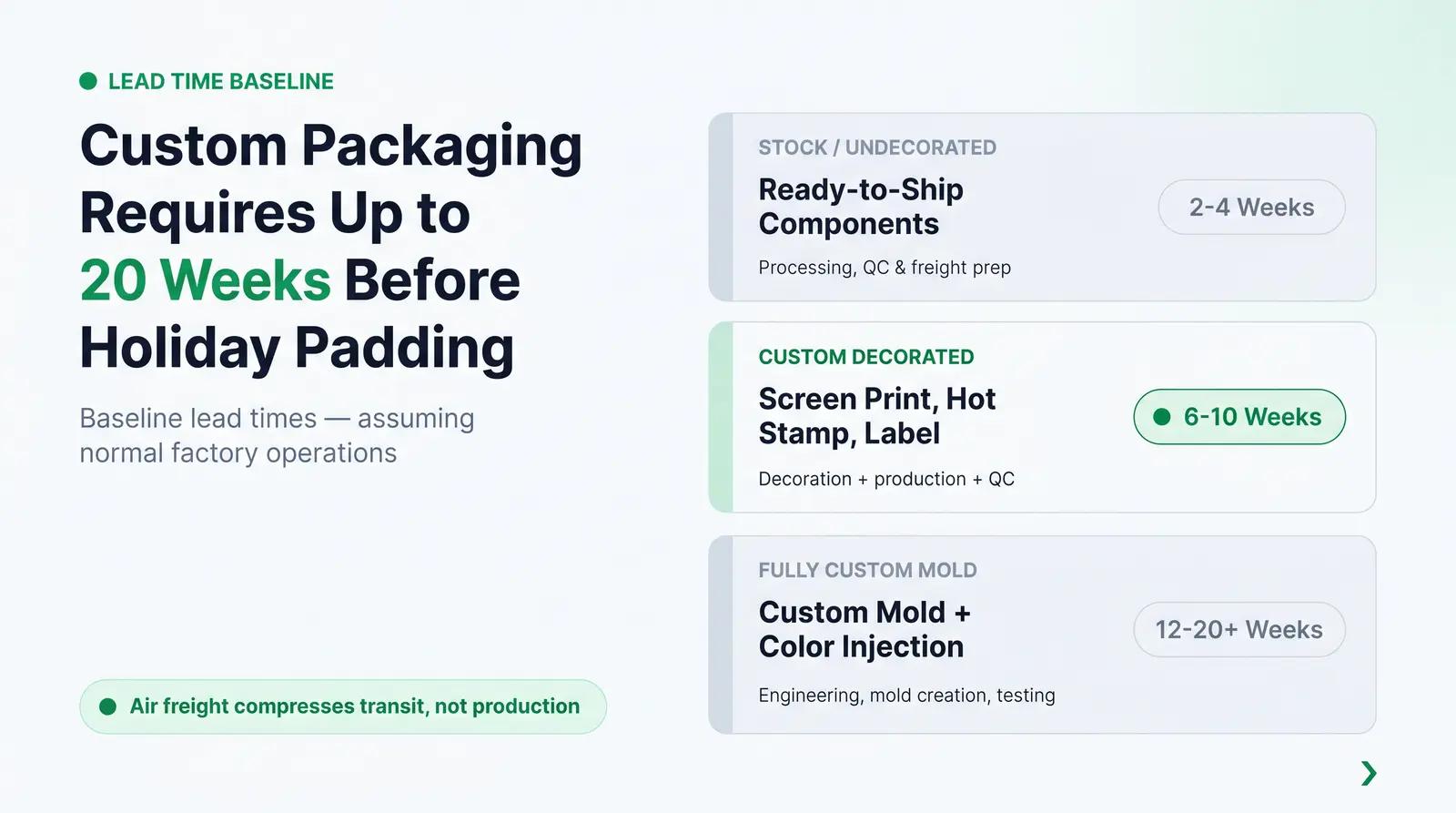
Before factoring in holiday disruptions, founders must establish realistic baseline lead times for cosmetic primary packaging. These baselines assume factories are operating normally and standard ocean freight is utilized.
Stock or undecorated components are the fastest option, typically requiring two to four weeks for processing, quality control, and freight preparation [6]. However, most beauty brands require custom decoration to stand out. Custom-decorated components—which involve processes like screen printing, hot stamping, or custom labeling—typically carry a baseline lead time of six to ten weeks [6].
For brands requiring fully custom-manufactured components, such as a custom mold or custom color injection, the timeline extends significantly. These projects generally require twelve to twenty weeks or more, as they involve engineering, mold creation, and extensive testing before mass production can begin [6].
These ranges form the foundation onto which holiday padding is added. It is worth noting that while air freight can compress transit time from weeks to days, it does absolutely nothing to compress the production timeline on the factory floor.
The Factory Holiday Lead Time Adjustment Framework
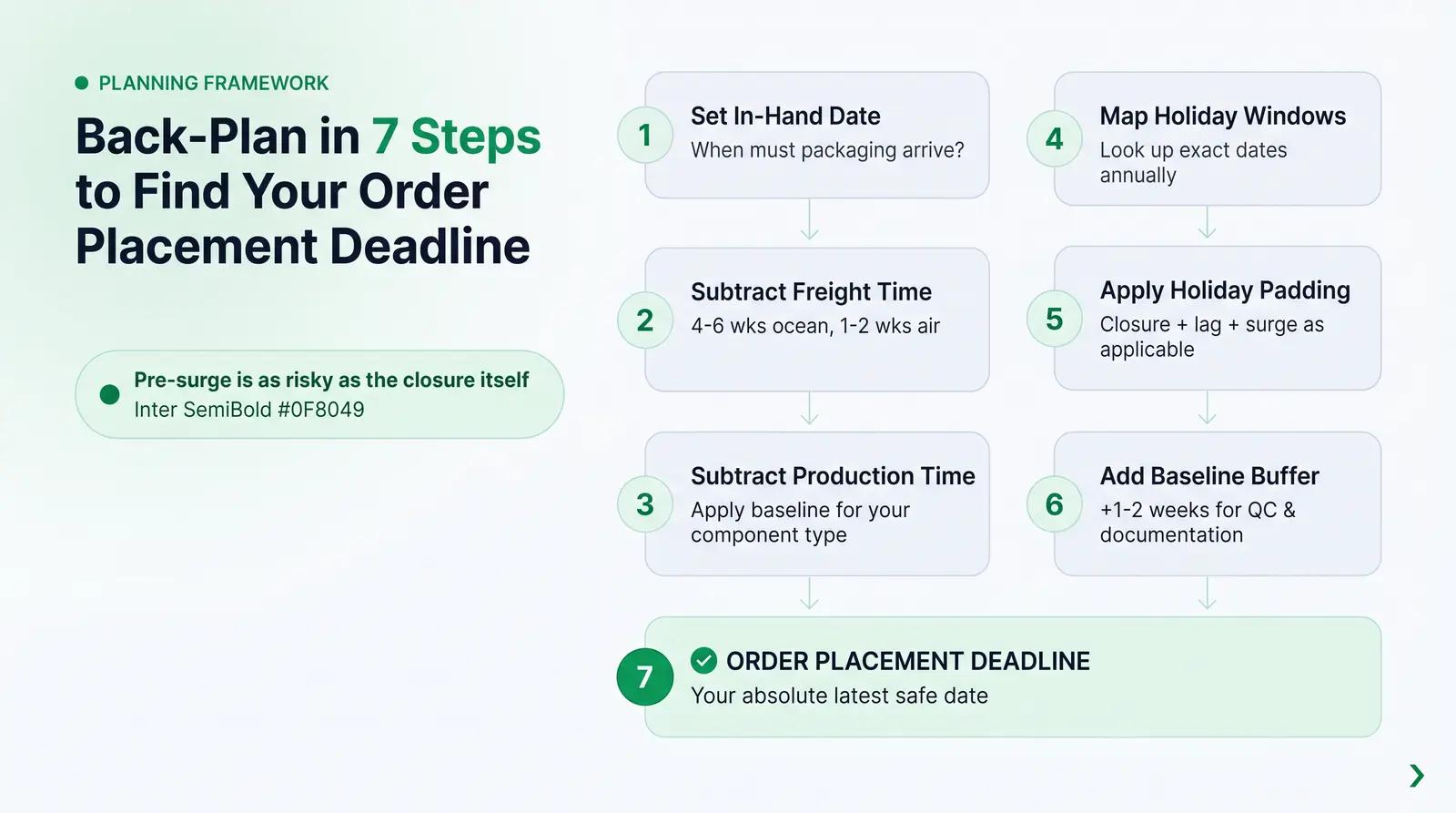
To systematically manage these variables, we utilize a practical framework for back-planning cosmetic packaging orders around factory closures. The Factory Holiday Lead Time Adjustment Framework ensures that no closure window catches a brand by surprise.
Step 1: Identify your target in-hand date
Determine the exact date the packaging must physically arrive at your facility or contract manufacturer.
Step 2: Subtract freight transit time
Deduct the transit duration: typically four to six weeks for ocean freight from Asia, or one to two weeks for air freight. Always assume customs clearance will add a buffer of several days.
Step 3: Subtract production lead time
Apply the baseline production ranges appropriate to your component type (e.g., eight weeks for custom-decorated glass).
Step 4: Identify all holiday windows
Look up the exact dates for the calendar year in question using an authoritative holiday calendar source, and map them against your calculated production window [4].
Step 5: Apply holiday padding
- If your production window overlaps the factory closure itself: add the closure duration plus the post-reopening lag (typically one to two weeks extra after reopening).
- If your production window falls in the three to four weeks before a holiday: add one to two weeks for pre-holiday surge congestion.
- If both apply (production starts pre-holiday and runs through reopening): add closure, lag, and surge padding cumulatively.
Step 6: Add a baseline buffer
Add a final baseline buffer of one to two weeks to account for general quality control holds, documentation delays, or unexpected friction.
Step 7: Result: your order placement deadline
The resulting date is the absolute latest you can safely place your purchase order.
The non-obvious insight revealed by this framework is that placing an order just before a holiday is often a trap, as the pre-holiday surge can be just as disruptive as the closure itself.
Worked Example — Back-Planning a Serum Bottle Order Around Chinese New Year
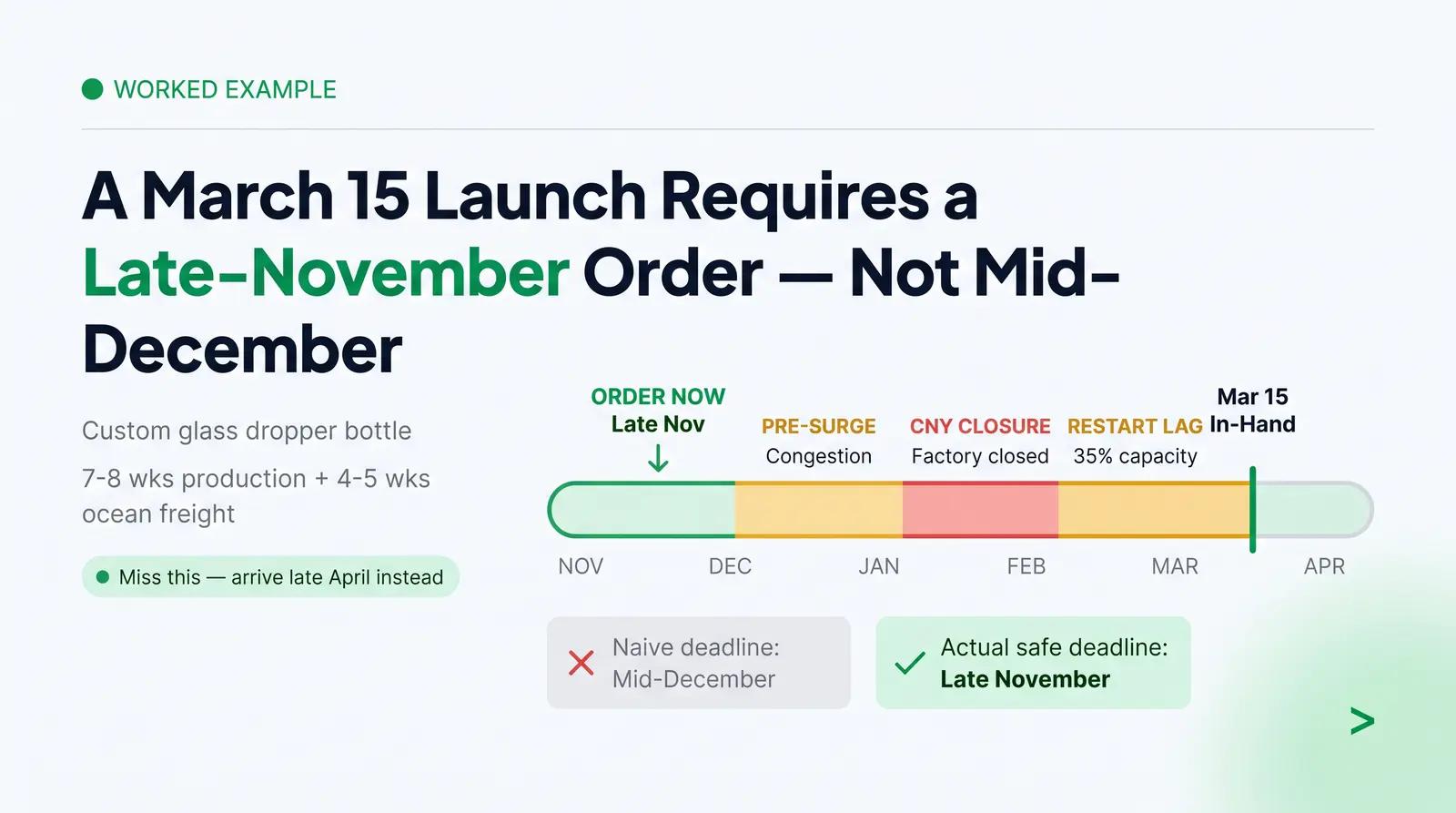
Consider a founder who wants to launch a vitamin C serum in custom-decorated glass dropper bottles, with a target in-hand date of March 15. She is sourcing from a China-based packaging supplier. For this specific year, Chinese New Year falls on January 29, with factories closing approximately January 24 and most fully operational again by February 17.
Applying the framework: The component type is a custom-decorated glass dropper bottle, establishing a production lead time baseline of seven to eight weeks. Using ocean freight requires approximately four to five weeks port-to-door, including customs clearance.
Working backward from the March 15 in-hand date, standard math (without holiday padding) suggests production must finish by early February, meaning the order should be placed in mid-December.
However, this production window lands directly on top of the Chinese New Year closure. Applying the framework's closure padding adds approximately three and a half weeks for the closure and subsequent lag. Furthermore, because a mid-December order would land in the factory during the peak pre-holiday surge, an additional week of surge padding is required. Adding a one-week baseline buffer completes the calculation.
The result: the order placement deadline lands in late November or early December—roughly fifteen to sixteen weeks before the in-hand date. A naive calculation suggesting mid-December would result in the order getting caught in the pre-holiday backlog, sitting untouched on the factory floor for weeks, and likely arriving in late April instead of mid-March.
The Contrarian Insight — Pre-Holiday Isn't Always the Safe Window
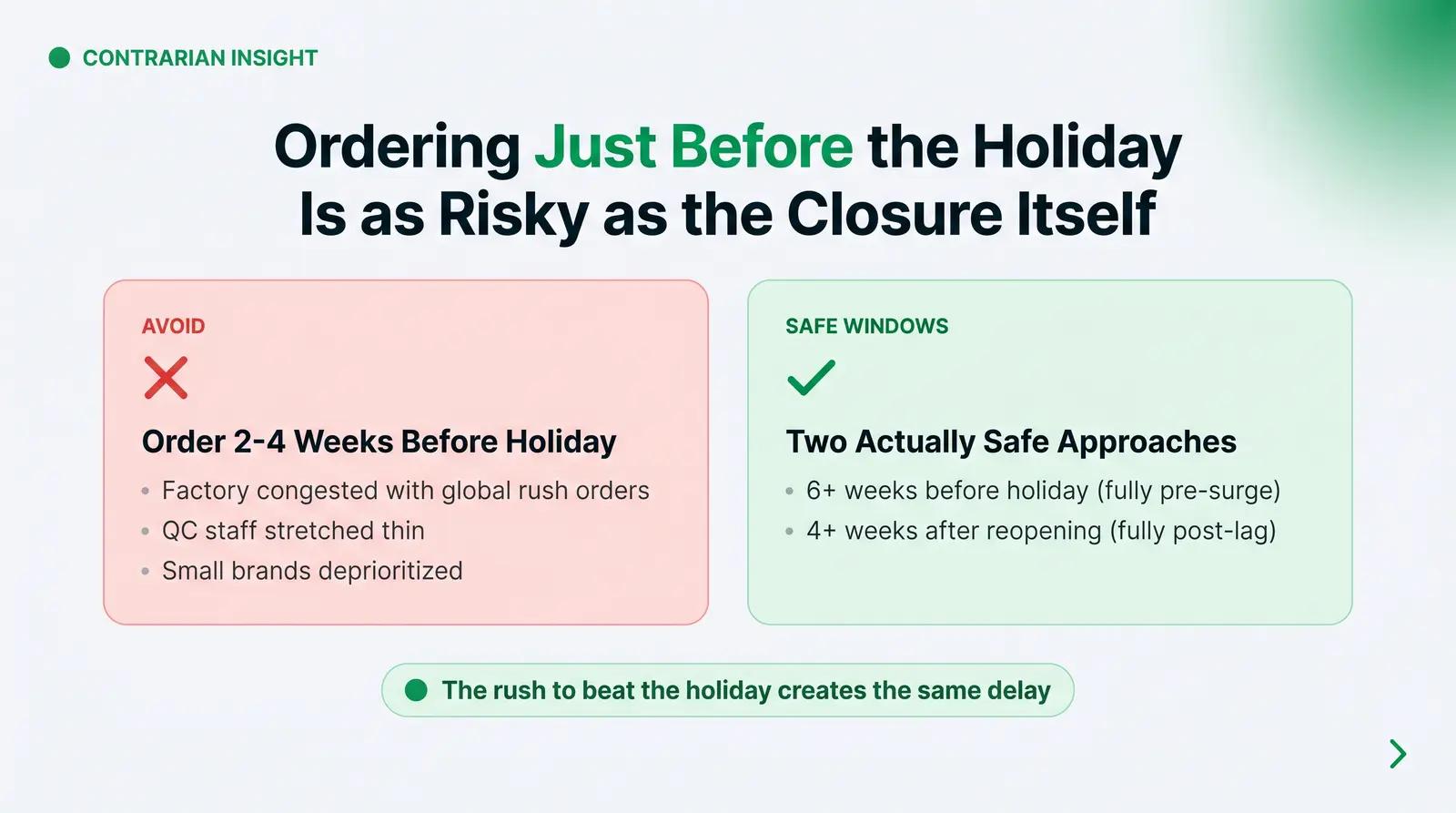
Most generic sourcing advice tells founders to "order before the holiday to beat the rush." The contrarian reality of cosmetic packaging manufacturing is that placing an order two to four weeks before Chinese New Year (or other major holidays) can be just as risky as ordering during the closure itself.
During the pre-holiday window, factories are severely congested with rush orders from major global brands. Quality control staff are stretched thin, and expedited requests from smaller brands are frequently deprioritized [2]. Founders who place "just in time before the holiday" orders often receive shipments that are delayed, incomplete, or suffer from higher defect rates due to rushed production [2]. The actually safe windows for sourcing are either fully pre-surge (placing orders six or more weeks before the holiday begins) or fully post-lag (waiting until four or more weeks after the factory has reopened and stabilized).
A Practical Annual Sourcing Calendar — Windows to Protect and Windows to Avoid
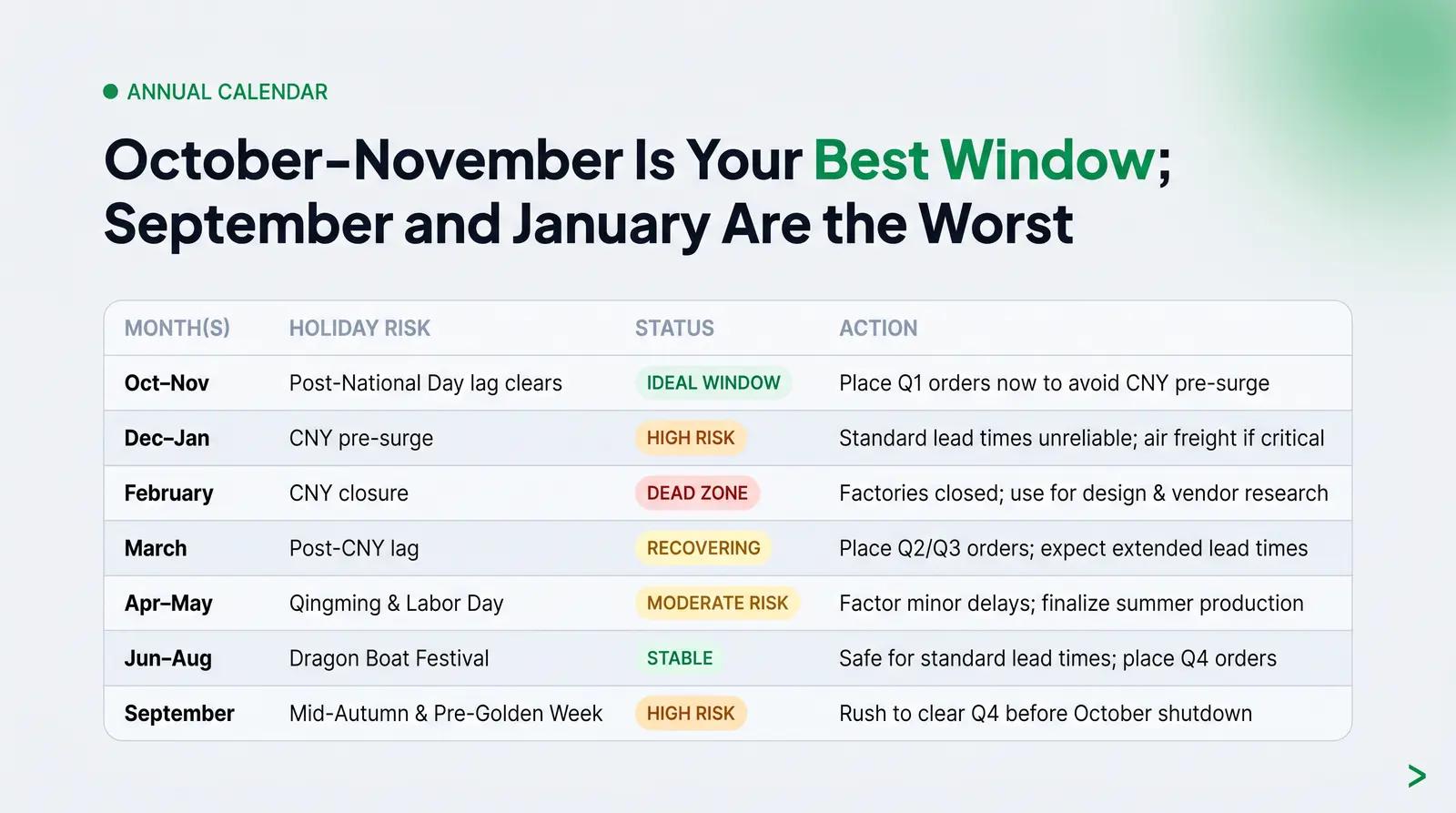
To maintain a smooth supply chain, founders should view the calendar year through the lens of sourcing safety. Note that lunar holidays shift annually; founders must verify exact dates each year using an authoritative source like the official government calendar [4].
| Month(s) | Key Holiday Risk | Sourcing Status | Recommended Action |
|---|---|---|---|
| October–November | Post-National Day lag clears | Ideal Sourcing Window | Place Q1 orders now to entirely avoid the Chinese New Year pre-surge. |
| December–January | Chinese New Year pre-surge | High Risk | Standard lead times are unreliable. Expedite critical shortages via air freight if necessary. |
| February | Chinese New Year closure | Dead Zone | Factories are closed. Use this time for design work and vendor research. |
| March | Post-CNY lag | Recovering | Place Q2/Q3 orders, but expect slightly extended lead times as factories ramp up capacity. |
| April–May | Qingming & Labor Day | Moderate Risk | Factor in minor delays; a good window to finalize summer production. |
| June–August | Dragon Boat Festival | Stable Window | Generally safe for standard lead times. Ideal for placing Golden Week/Q4 orders. |
| September | Mid-Autumn & Pre-Golden Week | High Risk | Factories rush to clear Q4 shipments before the October shutdown. |
What to Verify With Your Supplier Before Every Order
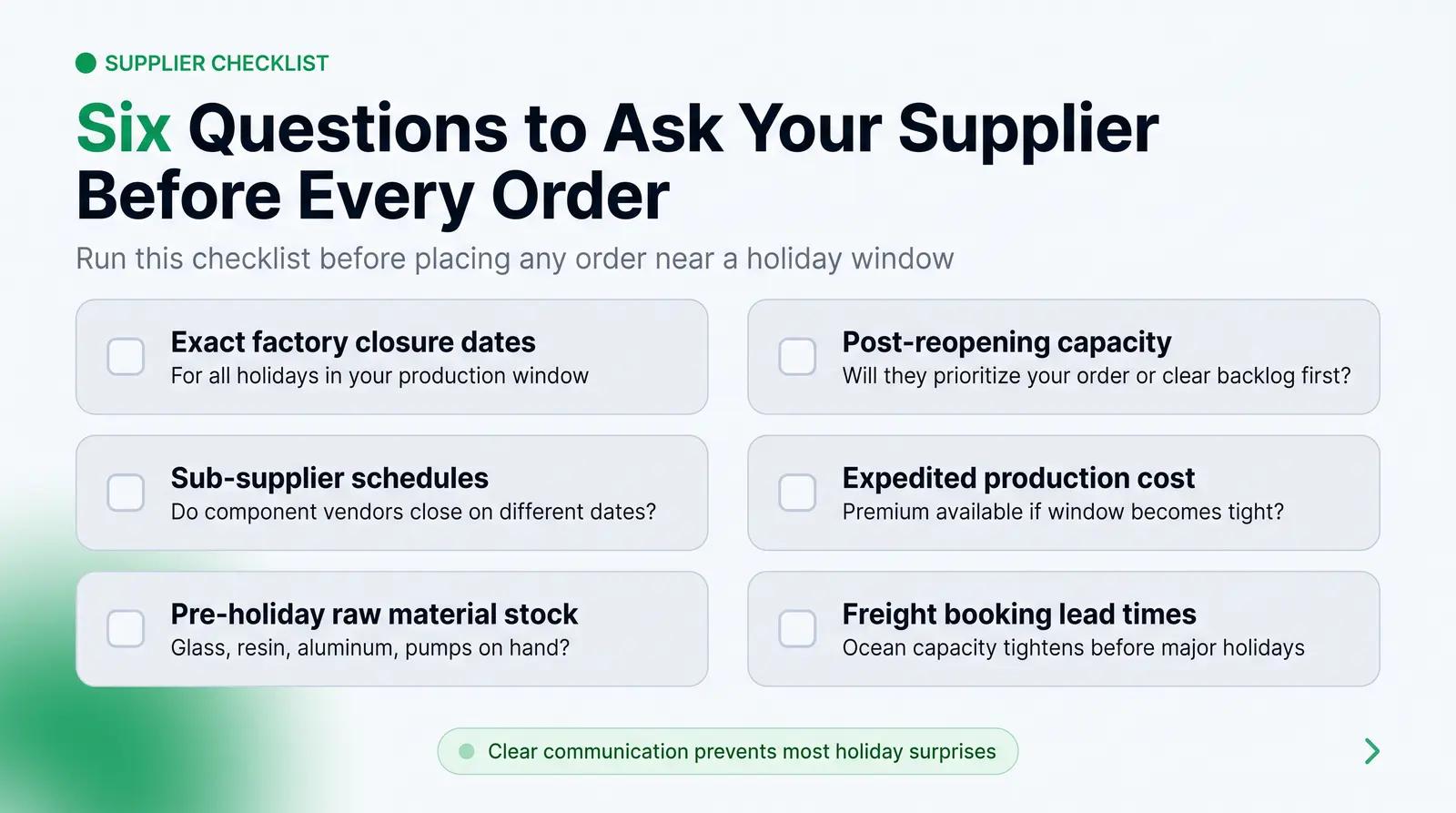
Even with a perfect calendar, clear communication is mandatory. Before placing any order, founders should run through a practical verification checklist with their manufacturing partners:
- Exact factory closure dates for all upcoming holidays that fall within your production window.
- Whether the supplier uses sub-suppliers or component vendors who may operate on different closure schedules.
- Whether the factory holds pre-holiday stock of your required raw materials (e.g., specific glass, resin, aluminum, or pumps).
- Post-reopening capacity: will they prioritize your order, or will they be working through a backlog first?
- Whether expedited production is available (and at what cost premium) if the delivery window becomes tight.
- Freight booking lead times, as ocean freight capacity tightens significantly before major holidays.
Managing these supplier calendars, verifying raw material stock, and scheduling quality control around holiday bottlenecks requires significant oversight. At Packfolio, production coordination, supplier communication, and quality assurance scheduling are handled on the customer's behalf. Customers receive clear updates on holiday-related timing and production milestones without needing to manage supplier calendars or negotiate pre-surge capacity themselves.
Browse Packfolio's curated cosmetic packaging catalog, build your order timeline with holiday windows already accounted for, and preview your custom design in 3D before committing — explore the catalog at packfolio.com/catalog →
Frequently Asked Questions
How long does Chinese New Year shut down packaging factories? While the official government holiday lasts roughly one week, most cosmetic packaging factories fully close for two to four weeks. Additionally, it can take up to a month after reopening for factories to return to full production capacity due to workforce turnover.
When should I place a packaging order to avoid Chinese New Year delays? To safely avoid delays, orders should be placed by late November or early December. Placing an order in January often traps it in the pre-holiday surge, resulting in the order sitting unfinished until late March.
What is the lead time for custom cosmetic packaging from China? Standard custom-decorated packaging typically requires six to ten weeks of production time. If your project requires a custom mold, the lead time extends to twelve to twenty weeks, assuming no holiday disruptions occur during the production window.
How does Golden Week affect cosmetic packaging orders? Golden Week, which occurs from October 1 to 7, shuts down factories for a full week and creates a rush of congestion in September. Founders should place Q4 packaging orders by July or August to avoid having their shipments caught in the pre-holiday backlog.
Can I get packaging orders expedited if I miss the pre-holiday cutoff? While you can pay a premium for air freight to speed up transit, you generally cannot expedite the actual manufacturing process during a pre-holiday surge. Factories are already operating at maximum capacity to clear their backlogs before the closure.
References
[1] [1] Seko Logistics. "Lunar New Year 2026: Complete Supply Chain Planning Guide for Asia Sourcing." 2026. https://www.sekologistics.com/en/resource-hub/knowledge-hub/lunar-new-year-2026-complete-supply-chain-planning-guide-for-asia-sourcing/ [2] [2] Insight Quality Services. "Chinese New Year 2026: How to Prepare for the Factory Shutdown." 2025. https://insight-quality.com/chinese-new-year-factory-shutdown/ [3] [3] Maersk. "Chinese New Year 2026: How to prepare your supply chain." 2025. https://www.maersk.com/logistics-explained/freight-seasons/2025/11/04/chinese-new-year-2026 [4] [4] State Council of the People's Republic of China. "China's public holidays for 2026." 2025. https://english.www.gov.cn/policies/featured/202511/04/content_WS6909c915c6d00ca5f9a074f7.html [5] [5] Advanta Sourcing. "China Holidays That Affect Manufacturing." 2023. https://www.advantasourcing.com/blog/china-holidays-that-affect-manufacturing [6] [6] Nicer Packaging. "[25.11.03] Differentiating Cosmetic Packaging Lead Time: Existing Molds vs. No Existing Molds." 2025. https://www.nicerpackaging.com/2025/25-11-03differentiating-cosmetic-packaging-lead-time-existing-molds-vs-no-existing-molds/


