
Factory vs Trader vs Distributor: Cosmetic Packaging Supplier Types Explained
Explains the differences between cosmetic packaging factories, traders, and distributors, helping beauty brands match the right supplier type to their current launch stage.
Supplier identity confusion is one of the most expensive traps in the beauty industry. Jump onto Alibaba, walk a trade show floor, or browse a supplier directory, and nearly every company you encounter will confidently self-identify as a "manufacturer" or "factory." The reality is far more complex. A significant percentage of these companies are actually traders, consolidators, or distributors who do not own a single injection molding machine.
For independent beauty brand founders, formulators, and sourcing managers, this lack of transparency is not just an annoyance. It is a financial risk. Misunderstanding who you are actually talking to can lead to unexpected minimum order quantities (MOQs), volatile pricing, communication breakdowns during custom tooling, and catastrophic delays when production issues arise.
This guide breaks down the actual supply chain structure behind cosmetic primary packaging. It explains how each supplier type operates, how to verify their true identity, and how to choose the right partner for your current launch stage. If you want to explore packaging options without navigating this complexity yourself, Packfolio handles all of it for you.
The Three Core Supplier Types in Cosmetic Packaging
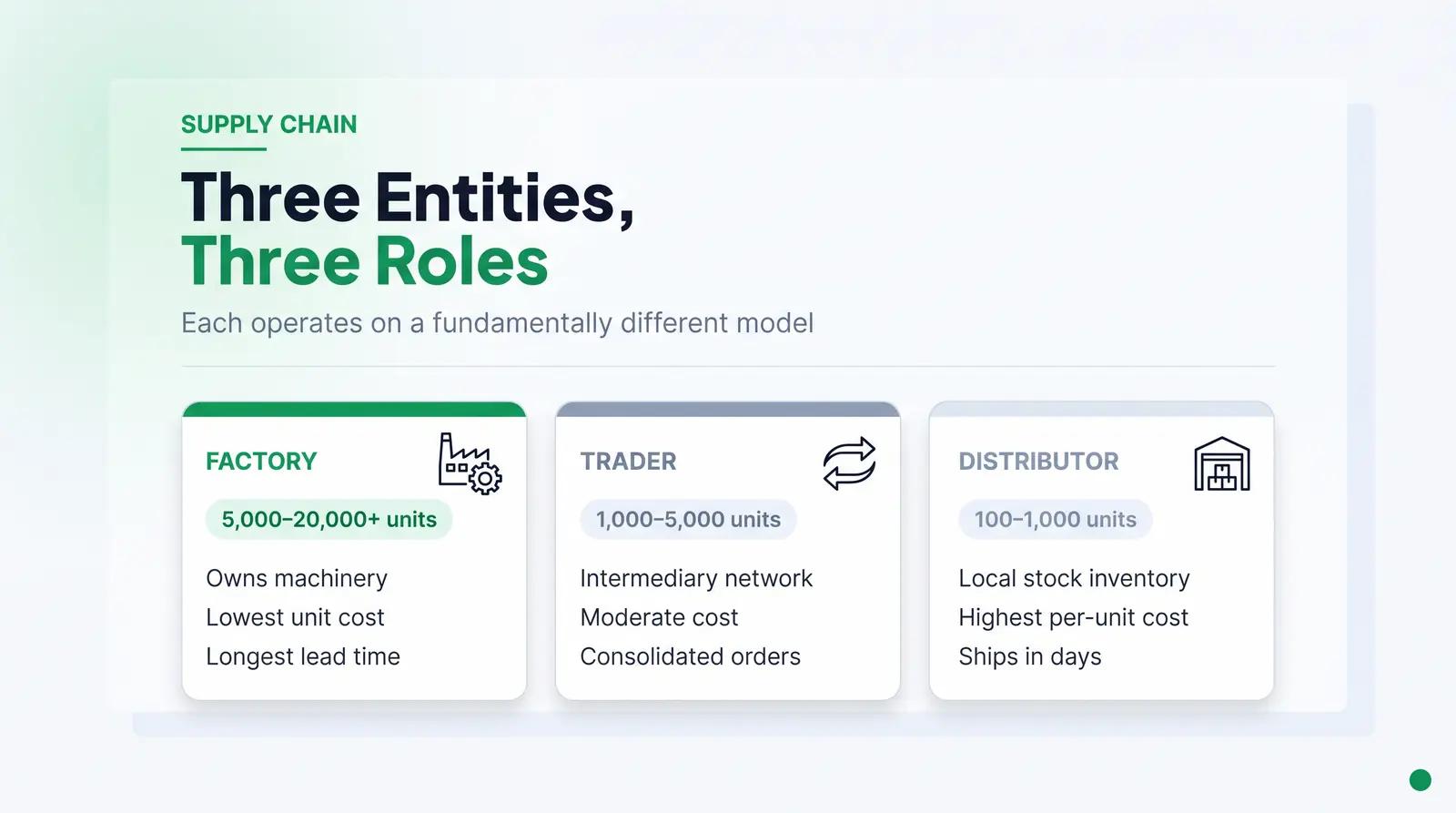
To make confident sourcing decisions, you need to understand the distinct operational models of the three primary entities in the cosmetic packaging supply chain: factories, traders, and distributors [1].
The Factory (Manufacturer)
A true factory physically produces the packaging. They own the facility, the production equipment (such as injection molding or blow molding machines), the tooling room, and the assembly lines. They purchase raw materials, like PET resin, glass sand, or aluminum, and transform them into finished packaging components [2].
Factories make their money on production efficiency and scale. They prefer large, predictable runs that minimize machine downtime and mold changeovers. Because you are dealing directly with the source, unit costs are typically the lowest available, and you have direct access to their engineering team for custom structural designs. However, their MOQs are often rigid and high, and their communication can be slower if they lack dedicated international sales staff.
The Trader (Trading Company)
A trading company is an intermediary that does not own manufacturing facilities. Instead, they act as the commercial bridge between buyers and a network of partner factories [1]. They source products, negotiate pricing, consolidate shipments, and handle export logistics.
Traders make their margin by buying at wholesale factory rates and selling at a markup. While they are often dismissed as mere middlemen, experienced traders provide significant value. They compress the complexity of sourcing multiple components, for example a glass bottle from one factory and a matching pump from another, into a single point of contact. They also frequently aggregate orders from multiple clients, which allows them to offer lower MOQs than a factory would accept directly [3].
The Distributor (Wholesaler)
Distributors operate by purchasing large volumes of finished, stock packaging from manufacturers and holding it in their own warehouses, often located domestically relative to the buyer. They serve as a localized fulfillment hub [2].
Distributors make their money on the convenience and speed of access. Because the inventory is already produced and imported, lead times are drastically reduced, often shipping within days rather than months. They offer the lowest MOQs in the industry, sometimes allowing purchases by the case. The trade-off is higher unit costs and severe limitations on customization. You are generally restricted to stock colors and shapes, relying on labels or secondary packaging for brand differentiation.
Comparing Supplier Types: A Side-by-Side Overview
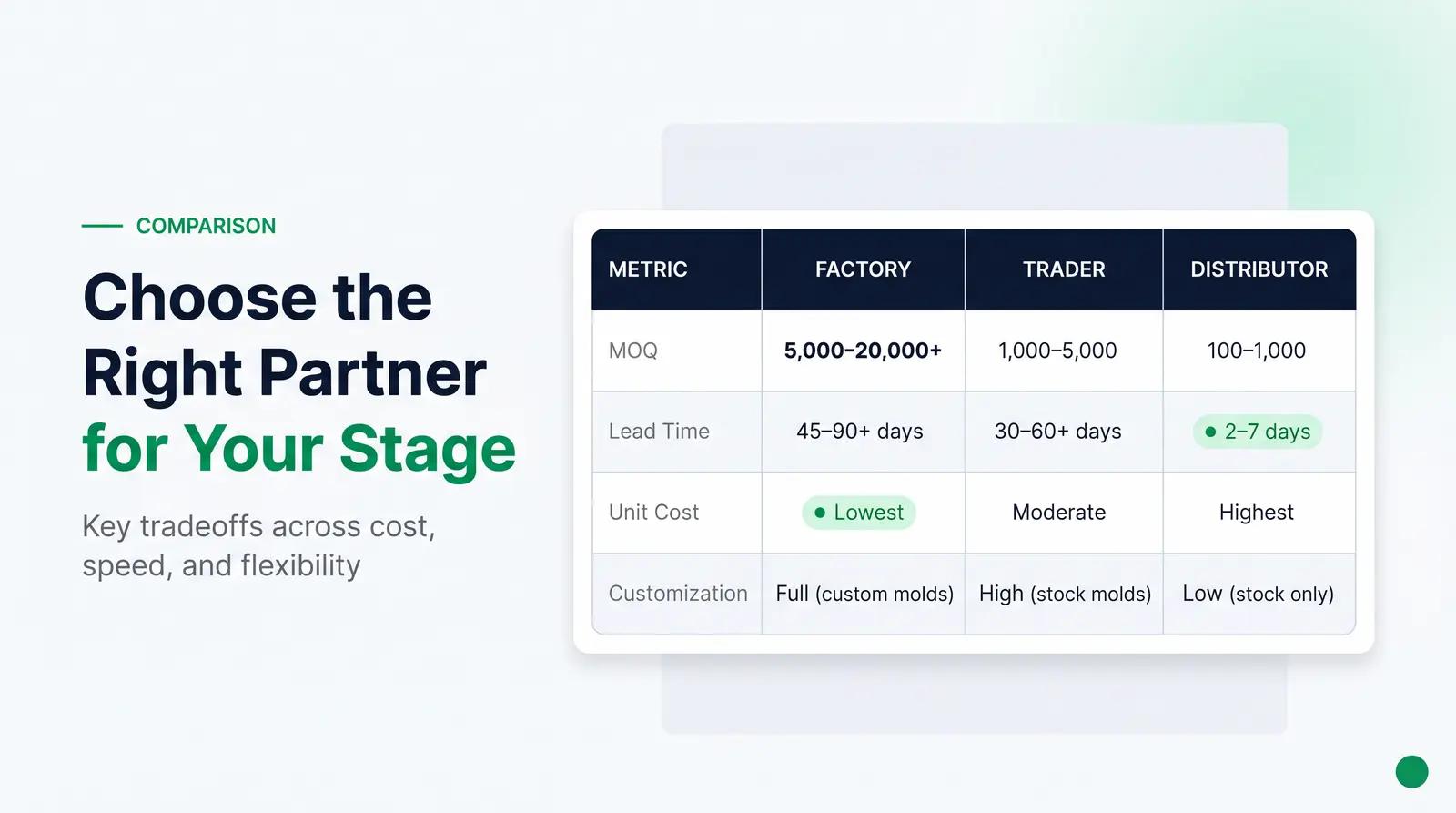
The table below outlines the typical operational realities for each supplier type based on industry norms [1] [2] [4].
| Supplier Type | Who They Are | MOQ Range | Price Level | Lead Time | Customization Ability | Verification Difficulty | Best Fit For |
|---|---|---|---|---|---|---|---|
| Factory | Direct operator of production machinery | 5,000–20,000+ units | Lowest | 45–90+ days | Complete: custom molds, materials, colors | Moderate | Scaling brands, custom tooling, high-volume repeat orders |
| Trader | Intermediary coordinating multiple factories | 1,000–5,000 units | Moderate | 30–60+ days | High: colors, finishes, printing on stock molds | High (often claim to be factories) | First production runs, multi-component sourcing, moderate customization |
| Distributor | Domestic warehouse holding finished stock | 100–1,000 units | Highest per unit | 2–7 days | Low: stock items only, limited color options | Low (generally transparent about their role) | Sampling, rapid launches, concept validation |
The Launch-Stage Sourcing Framework
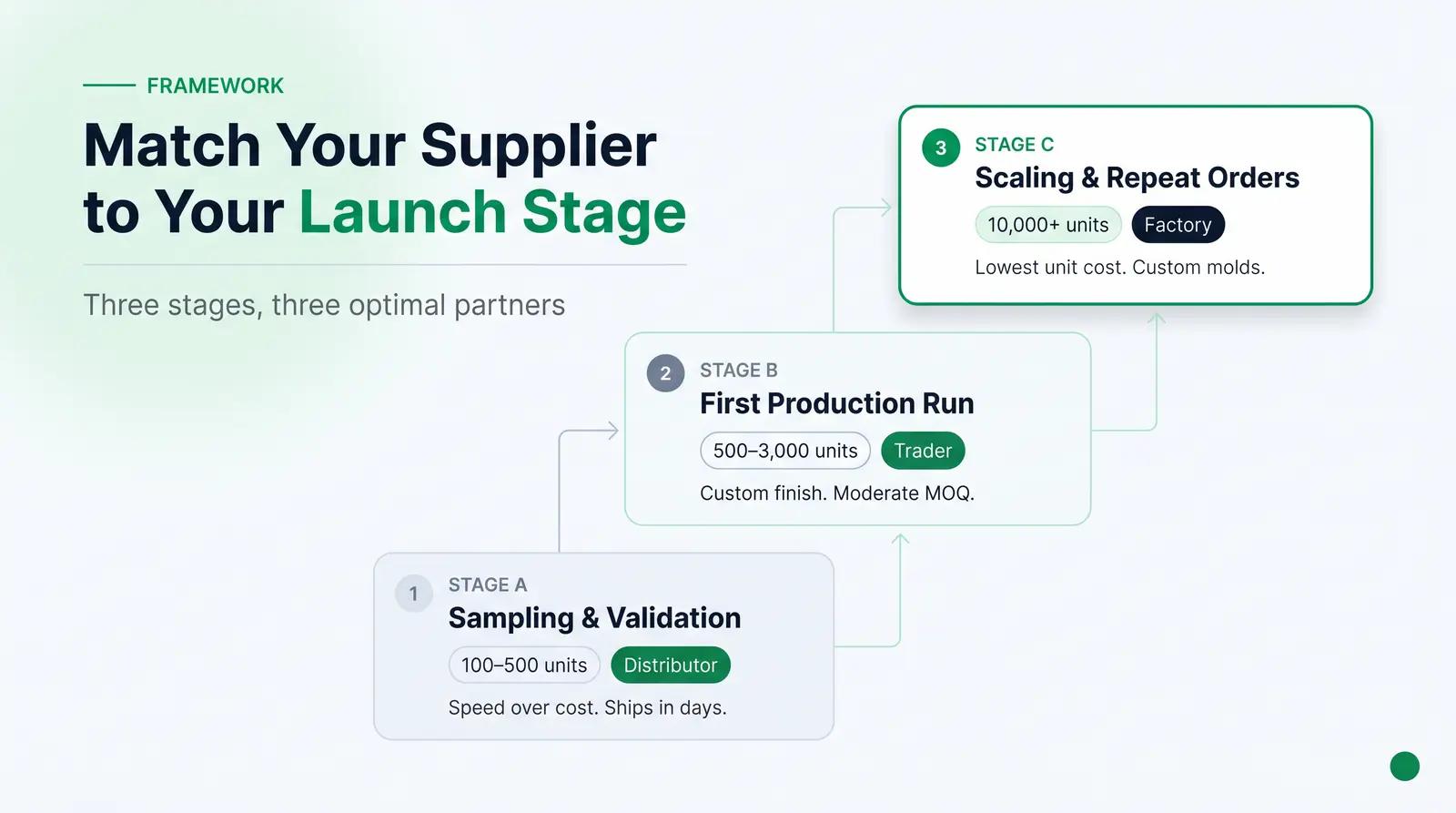
Matching your supplier type to your brand's current stage is critical. Sourcing directly from a factory too early can tie up essential capital in excess inventory. Relying on a distributor too late erodes profit margins. The Launch-Stage Sourcing Framework is a practical framework we recommend at Packfolio for aligning supplier capabilities with your immediate business needs.
Stage A: Sampling and Concept Validation
When you are testing a new formula, shooting initial product photography, or sending out press samples, speed and flexibility are your priorities. You need packaging immediately, and you only need a few hundred units.
Ideal Partner: Distributor
Distributors hold stock inventory domestically. You can order exactly what you need, receive it in days, and avoid the risk of a massive MOQ commitment for a product that has not yet proven its market fit [4]. Accept the higher per-unit cost as the price of speed and optionality.
Stage B: First Production Run (500–3,000 Units)
For a first official launch, brands typically need between 500 and 3,000 units. You want the product to look premium and customized, for example a specific Pantone color or a frosted finish, but you cannot justify the 10,000-unit MOQ required by a direct factory.
Ideal Partner: Trader
A skilled trader can leverage their consolidated buying power to secure custom finishes on stock molds at lower MOQs. They handle the complex coordination of matching components from different factories, allowing you to focus on marketing and launch logistics [3].
Stage C: Scaling and Repeat Orders (10,000+ Units)
Once a product is a proven bestseller and you are consistently ordering 10,000 to 50,000 units per run, unit economics become the dominant factor. You may also want to invest in a custom mold to create a proprietary silhouette.
Ideal Partner: Factory
At this volume, you have the leverage to negotiate directly with the manufacturer. You capture the lowest possible unit cost and gain direct access to their engineering team to refine tolerances, optimize material usage, and manage custom tooling schedules [2].
Worked Example: Sourcing a 30 ml Glass Dropper Bottle
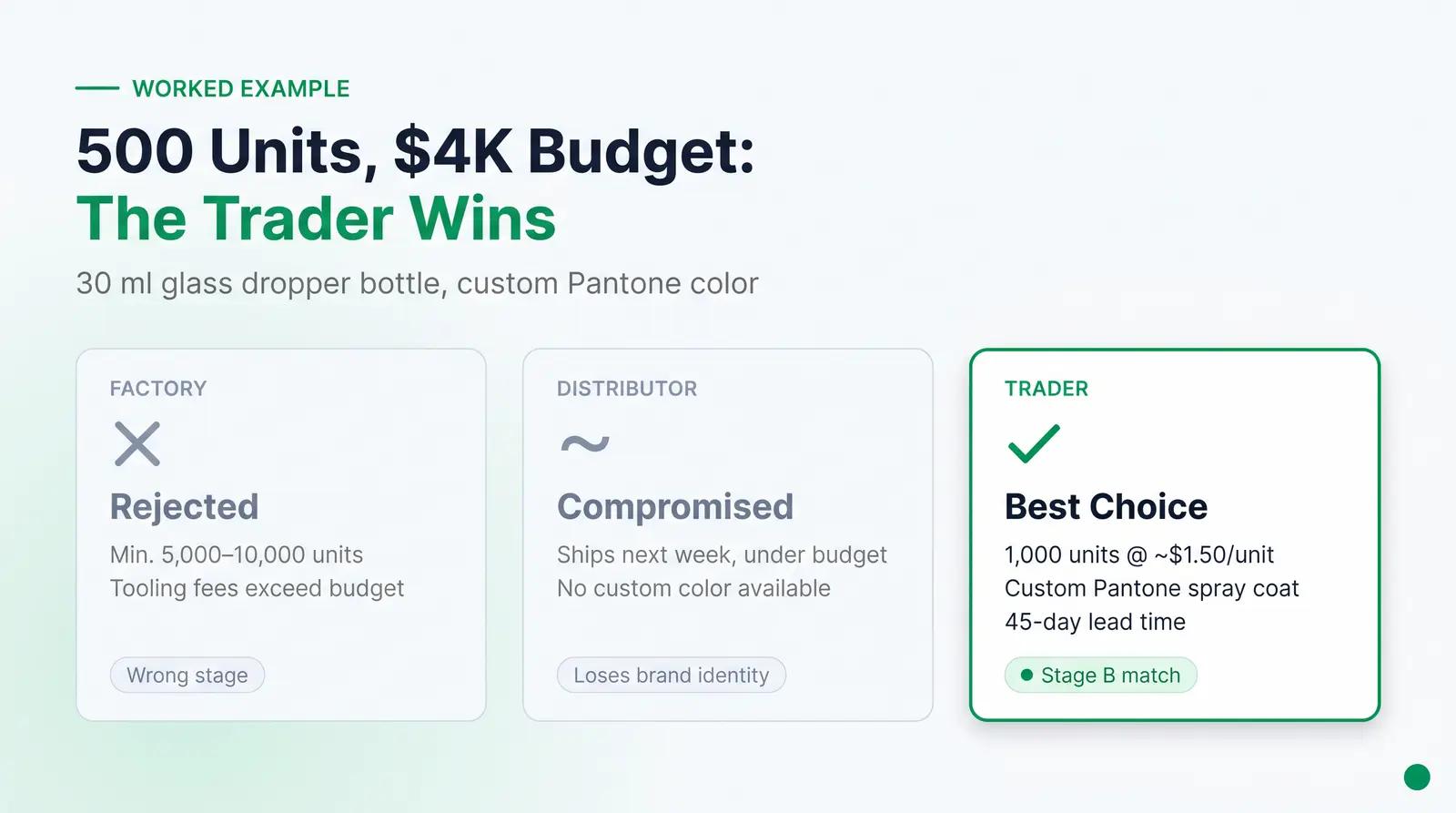
Consider an indie skincare founder launching a vitamin C brightening serum. She has a $4,000 packaging budget, needs 500 units for a direct-to-consumer (DTC) launch, and wants a custom Pantone color on a 30 ml (1 oz) glass dropper bottle to stand out on shelf.
If she approaches a Factory: They will likely reject the order entirely. Their minimum run for custom colored glass is typically 5,000 to 10,000 units. Even if they agreed to a smaller run, the unit cost at that volume would be exorbitant, and tooling setup fees alone could consume her entire budget. This is not the right stage for a direct factory relationship.
If she approaches a Distributor: She can easily buy 500 units within her budget, and they will arrive next week. However, she will have to compromise on her vision. The distributor only stocks clear, amber, and standard frosted glass. Her custom Pantone color is simply not available. She gets speed but loses brand differentiation.
If she approaches a Trader: She finds the middle ground. The trader aggregates her order with others at a partner factory. They can provide the custom Pantone spray coating on a stock 30 ml mold. The MOQ might be stretched down to 1,000 units. At roughly $1.50 per unit, she spends $1,500 on the packaging, secures her custom look, and stays well under her $4,000 budget. The trade-off is a 45-day wait for production and freight.
The right answer here is clear: a trader is the rational choice for Stage B. The factory is the right partner when she is reordering at 10,000 units.
How to Verify a Supplier's Actual Type
This is the step most sourcing guides skip entirely. Traders frequently present themselves as factories to capture buyers seeking "factory-direct" pricing [3]. Verifying a supplier's true operational model before placing a deposit is non-negotiable.
Why Self-Identification Is Unreliable
Self-identification on platforms like Alibaba is easily manipulated. A company profile might list "Manufacturer" as the business type, but this is a self-reported field with no enforcement mechanism. On Alibaba, distinguishing between trading companies and source manufacturers is not straightforward because some suppliers misrepresent their business type or claim to have both manufacturing and trading capabilities [3].
Questions to Ask
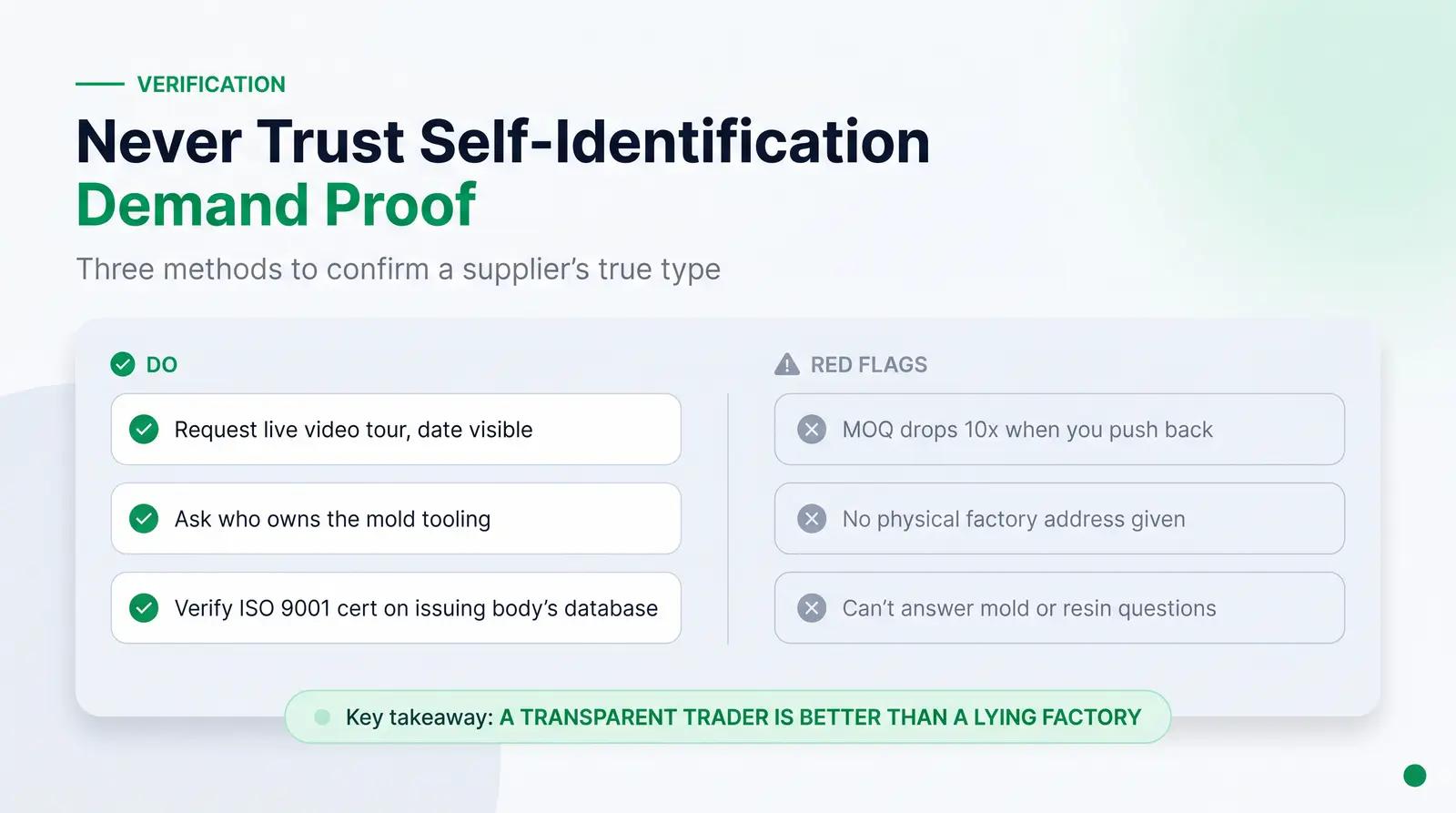
Ask for a live video tour of the production floor. Request that someone hold up a piece of paper with today's date and your brand name in front of the injection molding machines. A true factory will accommodate this easily. A trader will hesitate, deflect, or provide generic pre-recorded promotional videos.
Ask about mold ownership directly: "Who manufactures this specific mold, and do you own the tooling?" A factory will have an in-house tooling room or a direct exclusive partnership and can discuss technical mold details without delay. A trader will often have to "check with the engineers" and return days later with vague answers.
Ask technical production questions. A real manufacturer can tell you without hesitation the difference between PMMA and AS resin for a clear jar, or why a particular wall thickness affects drop testing. Trading companies tend to speak fluently about product availability and shipping terms, but go quiet when the conversation turns technical.
Documentation to Request
Request their business license and check the registered company name. In many Asian manufacturing hubs, the inclusion of words translating to "Trading" or "Import/Export" in the company name is a clear indicator of a trading company. Words translating to "Manufacturing" or "Industry" suggest a factory [3].
Request third-party audit certificates. Legitimate factories undergo rigorous third-party audits. Ask for their ISO 9001 (Quality Management System) certificate, or social compliance audits like SMETA (Sedex Members Ethical Trade Audit) or BSCI (amfori Business Social Compliance Initiative) [5] [6]. When they provide the certificate, do not just look at the photo. Verify the registration number on the issuing body's public database to confirm the certified entity matches the company you are contracting with [7].
Red Flags to Watch For
Watch for pricing that shifts dramatically when MOQ drops. If a supplier initially quotes a 10,000-unit MOQ, but immediately drops to 500 units when you push back, with a massive price hike, you are likely dealing with a trader shifting your order from a factory run to wholesale stock they hold elsewhere.
Be cautious of suppliers who cannot provide a physical factory address, who are unwilling to allow third-party audits, or who cannot answer basic questions about their production capacity and machine specifications.
The Contrarian Insight: Traders Are Not Inherently Inferior
Here is a point that often surprises new founders: discovering a supplier is a trader is not a reason to abandon the deal. Traders are not inherently worse partners than factories. For low-MOQ runs, complex multi-SKU orders, or brands that lack the internal staff to manage overseas quality control and logistics, an honest and highly competent trader is often the most rational and efficient choice [3].
The danger is not in using a trader. The danger is in using a trader who lies about being a factory, because that dishonesty will inevitably extend to production delays and quality issues. A transparent trader who clearly communicates their role, their factory network, and their service margin is a legitimate and valuable supply chain partner.
How Packfolio Removes This Complexity
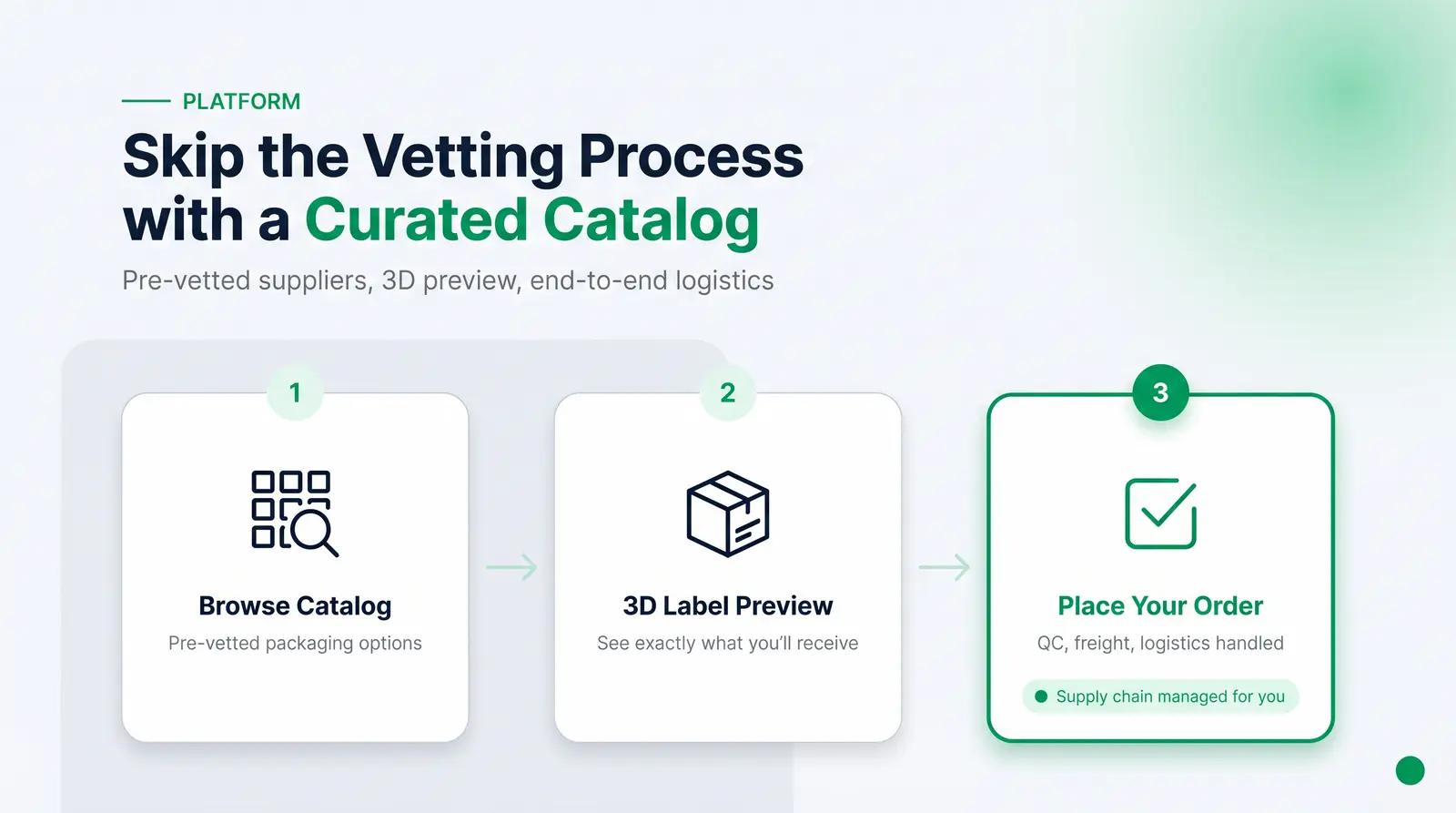
For founders who want to bypass this entire vetting process, Packfolio's curated catalog offers a streamlined alternative. Packfolio curates a vetted catalog of cosmetic primary packaging, handles all supplier coordination, quality control, and freight logistics. You preview your custom label on a photorealistic 3D model directly in the browser before ordering, so the supply chain complexity described in this article is managed for you, not outsourced back to you. What you see in the 3D preview is what you receive.
For a deeper look at how MOQ structures affect your packaging budget across different launch stages, see our guide at packfolio.com/blog/cosmetic-packaging-moq-guide.
Choosing the right packaging partner requires looking past the marketing copy and understanding the mechanics of the supply chain. By aligning your supplier type with your launch stage and rigorously verifying their capabilities, you protect your budget, your timeline, and your brand's reputation.
Browse Packfolio's curated cosmetic packaging catalog and preview your label in 3D before ordering. packfolio.com/catalog
Frequently Asked Questions
What is the difference between a cosmetic packaging manufacturer and a distributor?
A manufacturer physically produces the packaging from raw materials using their own machinery, typically requiring high minimum order quantities in the range of 5,000 to 20,000 units. A distributor buys finished packaging in bulk from manufacturers and holds it in local warehouses, allowing brands to buy small quantities with very fast shipping, but with limited customization options.
How do I know if a cosmetic packaging supplier is a factory or a trader?
You can verify their status by requesting a live video tour of the production floor with today's date visible, asking for their business license to check for "trading" designations in the company name, and requesting third-party audit certificates like ISO 9001. If a supplier struggles to answer technical questions about mold tooling or hesitates to show their facility on camera, they are likely a trader.
What MOQs should I expect from a cosmetic packaging factory vs. a distributor?
Factories generally require high MOQs, often ranging from 5,000 to 20,000 units, to justify the setup costs of their machinery and materials. Distributors, who sell from existing stock inventory, offer much lower MOQs, frequently allowing orders of 100 to 1,000 units, though at a higher per-unit cost [4].
Can I get custom cosmetic packaging from a distributor or trader, or do I need a factory?
Distributors generally only offer stock packaging with no structural or color customization. Traders can often secure custom colors or finishes on stock molds at moderate MOQs by leveraging their factory networks. For completely custom structural designs and new molds, you typically need to work directly with a factory.
Which type of cosmetic packaging supplier is best for small indie beauty brands?
For initial sampling and concept validation, distributors are best due to their low MOQs and fast shipping. For a first official production run requiring some customization at moderate volume (500 to 3,000 units), a reliable trading company is often the most practical partner. Direct factory relationships become the right choice once you are consistently ordering at scale.
References
[1] Panitsettakorn, W., Ongkunaruk, P., and Leingpibul, T. "The present state of the cosmetics supply chain in Thailand and the prospective role of Independent Quality Assurance Verifiers (IQAVs) within the supply chain." Heliyon, Volume 9, Issue 10, 2023. https://www.sciencedirect.com/science/article/pii/S2405844023081008
[2] Wright, M. "Packaging Manufacturer vs. Supplier: Choosing The Best Fit for Your Business." Specright, October 30, 2024. https://www.specright.com/blog/packaging-manufacturer-vs-packaging-supplier/
[3] thebuyhive. "Factory vs Trading Company & why factory isn't always better." Reddit r/Alibaba, April 2026. https://www.reddit.com/r/Alibaba/comments/1sgrbpz/factory_vs_trading_company_why_factory_isnt/
[4] Christina. "How Does MOQ Affect Cosmetic Packaging Costs (And What You Can Do About It)?" AH Packaging, October 15, 2025. https://ahpackaging.com/how-does-moq-affect-cosmetic-packaging-costs/
[5] Sedex. "SMETA, the world's leading audit." Sedex.com, accessed 2026. https://www.sedex.com/solutions/smeta-audit/
[6] amfori. "Small Producers Assessment: The Audit Solution for Small Suppliers." amfori.org, April 16, 2025. https://www.amfori.org/small-producers-assessment-the-audit-solution-for-small-suppliers/
[7] Jinhao XinYuan Group. "Packaging Certifications Decoded: FSC, ISO 9001, BSCI, Sedex (2026)." jinhaoxy.com, May 20, 2026. https://jinhaoxy.com/blog/packaging-certifications-fsc-iso-bsci-sedex/
[8] Preston, T. "Supply Chain Management Best Practices for the Cosmetics Industry." Specright, October 9, 2024. https://www.specright.com/blog/cosmetics-supply-chain-management/


