
Cosmetic Packaging Tariffs and HTS Codes: A Founder's Guide
This guide helps beauty founders navigate cosmetic packaging HTS codes, tariff rates, landed cost calculations, and sourcing strategies to avoid unexpected import duties.
Sourcing cosmetic packaging is one of the most exciting phases of launching a beauty brand. Translating a creative vision into physical bottles, jars, and pumps is the moment a concept becomes a tangible product.
But many beauty founders encounter a silent, margin-killing surprise long after they have approved their final pre-production samples. This surprise arrives at the port of entry in the form of unexpected import duties and complex customs regulations.
Founders who fail to research Harmonized Tariff Schedule codes before placing their packaging orders are often leaving significant margin on the table without knowing it. [1] A supplier quote that looks highly competitive on paper can quickly become financially unviable once import tariffs are stacked on top of the base cost. [2]
This guide provides a practical framework for navigating cosmetic packaging tariffs, HTS classification, and landed cost calculations. By understanding these regulatory mechanisms, beauty founders can make informed sourcing decisions, protect their brand margins, and build a resilient supply chain without needing a degree in trade law.
Primary vs. Secondary Packaging: Why the Distinction Matters
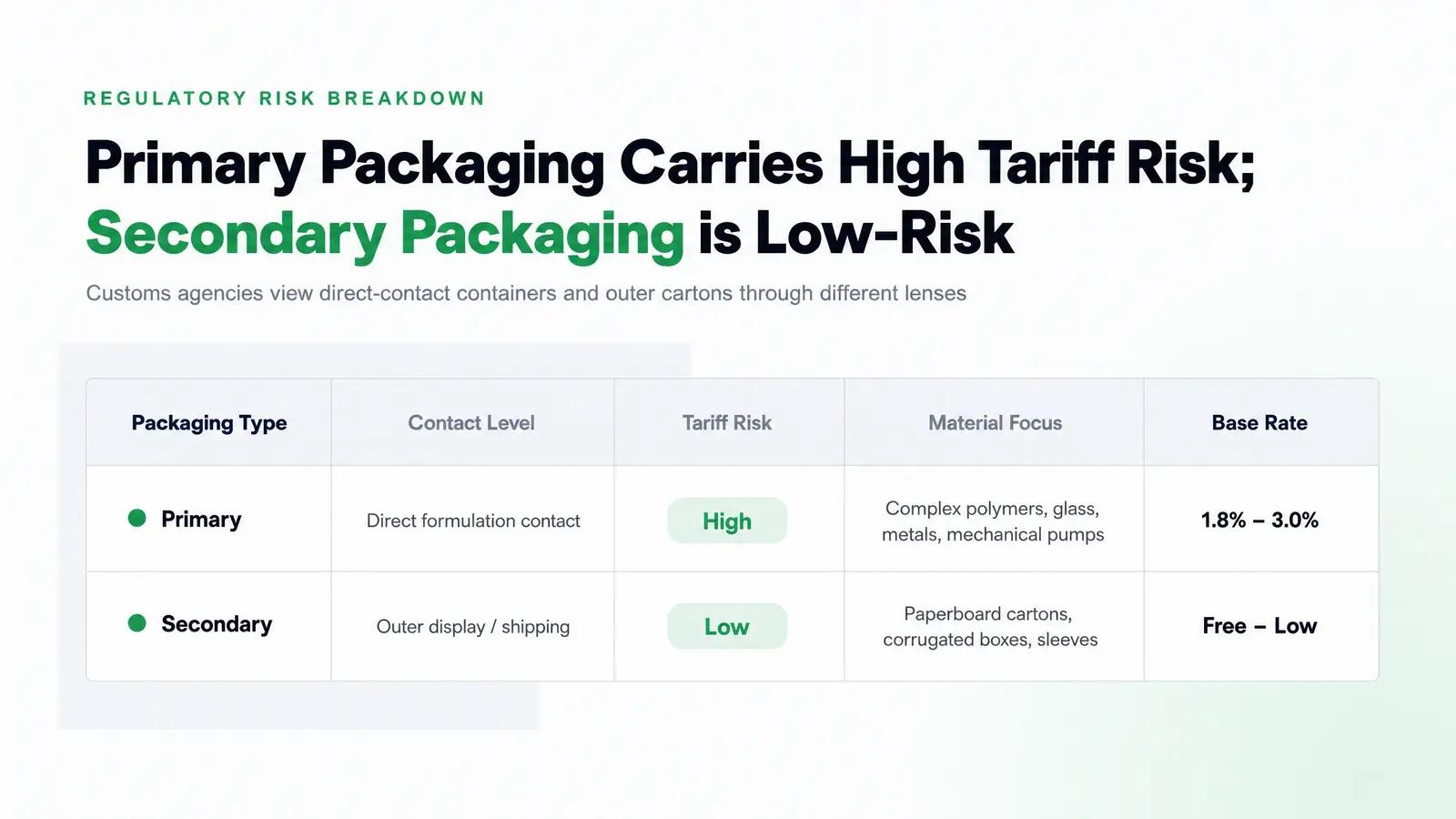
To manage tariff exposure effectively, founders must first understand the regulatory distinction between primary and secondary packaging. Customs agencies view these two categories through very different lenses, resulting in distinct tariff classifications and duty rates.
Primary Packaging: The High-Risk Zone
Primary packaging refers to any container or component that comes into direct contact with the cosmetic formulation. This includes bottles, jars, tubes, droppers, airless pumps, lip components, compacts, and closures.
Primary packaging carries the highest tariff risk and complexity for several reasons. First, these components are often made of specialized materials or complex material blends, such as acrylic, glass, aluminum, or multi-layer plastics, which trigger different tariff headings.
Second, primary packaging frequently incorporates functional mechanisms, such as spring-loaded pumps, fine-mist sprayers, or airless dispensing systems. These mechanical features often push the component out of standard packaging classifications and into more complex machinery chapters under the tariff schedule. [3]
Secondary Packaging: The Lower-Risk Zone
Secondary packaging consists of the outer boxes, cartons, sleeves, and shipping materials that protect the primary packaging during transit or display. This category includes paperboard cartons, rigid gift boxes, corrugated shipping boxes, and paper sleeves.
Secondary packaging generally carries much lower tariff rates and is far simpler to classify. Most paper-based secondary packaging falls under Chapter 48 of the tariff schedule, which typically carries low or zero base duty rates. [1]
Because secondary packaging lacks complex dispensing mechanisms or specialized material blends, it rarely triggers the high-rate additional tariffs that affect primary packaging.
The Sourcing Risk Matrix
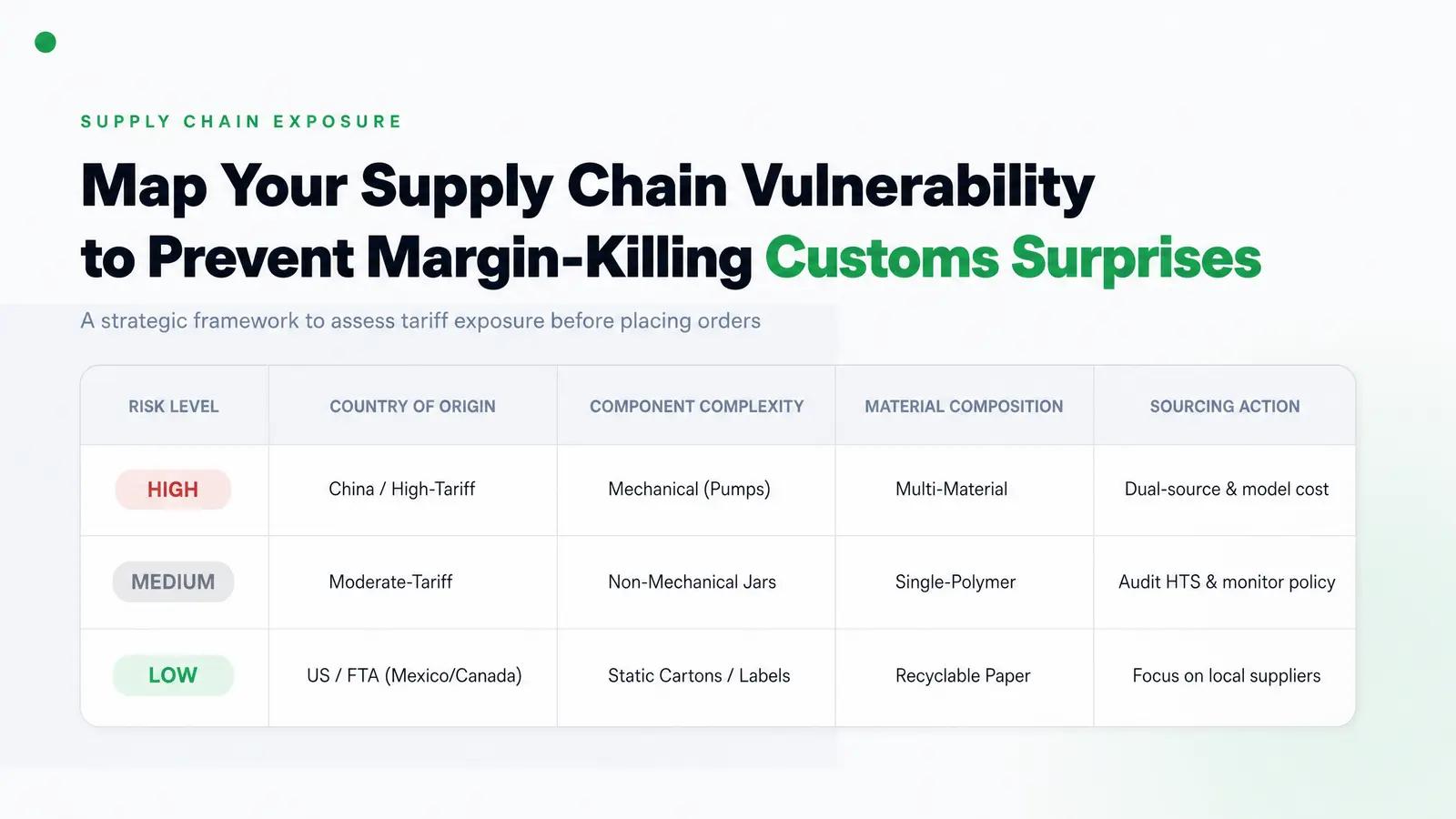
Before diving into specific tariff codes, founders should evaluate their current or planned supply chain vulnerability. The Sourcing Risk Matrix is a strategic framework designed to help beauty brands assess their exposure to tariff surprises based on three critical variables: country of origin, component complexity, and material composition.
| Risk Level | Country of Origin | Component Complexity | Material Composition | Sourcing Action |
|---|---|---|---|---|
| High | High-tariff nations subject to active trade enforcement, such as China [2] [4] | Mechanical components, such as airless pumps, fine-mist sprayers, or complex droppers [3] | Multi-material assemblies, such as glass bottles with metal collars and plastic caps [5] | Implement dual-sourcing, use transparent logistics platforms, and conduct rigorous landed cost scenario planning |
| Medium | Moderate-tariff nations, or countries with pending trade agreements or active monitoring [2] | Non-mechanical containers, such as standard screw-top jars, squeeze tubes, or simple pour bottles [5] | Single-material plastics, such as PET, PP, or HDPE, or standard soda-lime glass [1] | Verify country of origin documentation, audit supplier HTS classifications, and monitor trade policy updates |
| Low | Domestic manufacturers, or nations with active Free Trade Agreements, such as Mexico or Canada [6] | Static components, such as secondary paperboard boxes, shipping cartons, or simple labels [1] | Standard paperboard, cardboard, or highly recyclable single-polymer plastics [1] | Focus on local supplier relationships, optimize order volumes, and streamline domestic freight logistics |
By plotting each packaging component on this matrix, founders can identify which items require the most regulatory scrutiny. A glass bottle with a custom-molded plastic cap and a mechanical pump from China represents a high-risk scenario that demands precise classification and landed cost modeling.
Navigating HTS Classification for Cosmetic Packaging
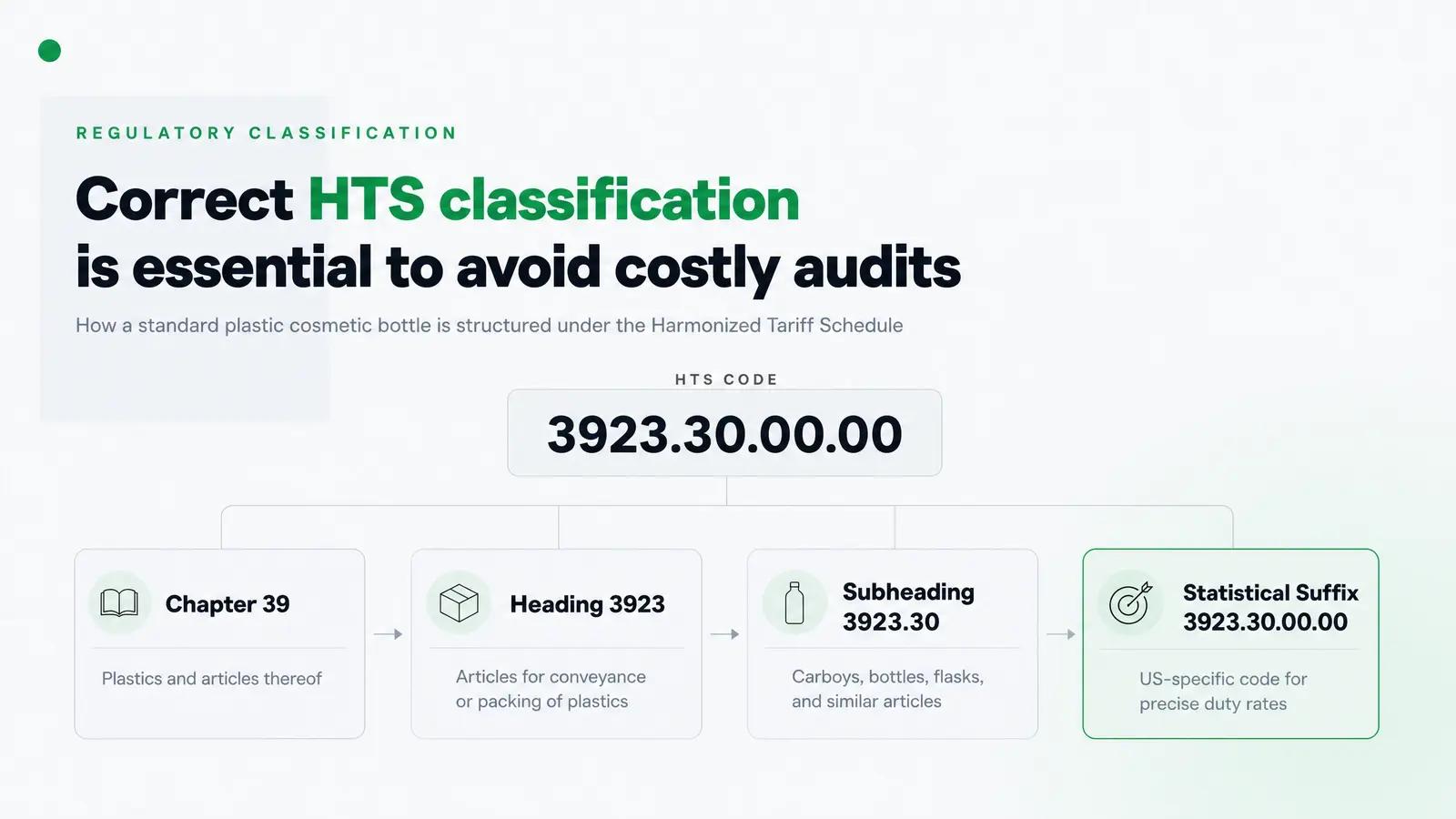
The Harmonized Tariff Schedule of the United States is the official system used by U.S. Customs and Border Protection to classify imported goods and determine their duty rates. [1] Every imported item must be assigned a ten-digit HTS code.
The first six digits of an HTS code are standardized internationally under the World Customs Organization, while the remaining four digits are specific to the United States. Classifying cosmetic packaging correctly requires navigating several chapters of this schedule.
It is important to note that while this guide outlines the standard classifications used by customs experts, it does not constitute formal legal advice. Founders should always consult a licensed customs broker or obtain a binding ruling from Customs and Border Protection for their specific components. [7]
How to Read an HTS Code
An HTS code is structured hierarchically, moving from broad categories to highly specific product descriptions. Consider the classification of a standard plastic cosmetic bottle:
Chapter 39 covers plastics and articles thereof. Heading 3923 covers articles for the conveyance or packing of goods, of plastics, and stoppers, lids, caps, and other closures. Subheading 3923.30.00 specifies carboys, bottles, flasks, and similar articles.
Misclassifying a component can lead to two equally damaging outcomes. Under-classifying can result in customs audits, retroactive duty bills, and financial penalties. [7] Over-classifying means paying unnecessarily high duty rates, quietly eroding profit margins on every production run.
The Cosmetic Packaging HTS Code Directory
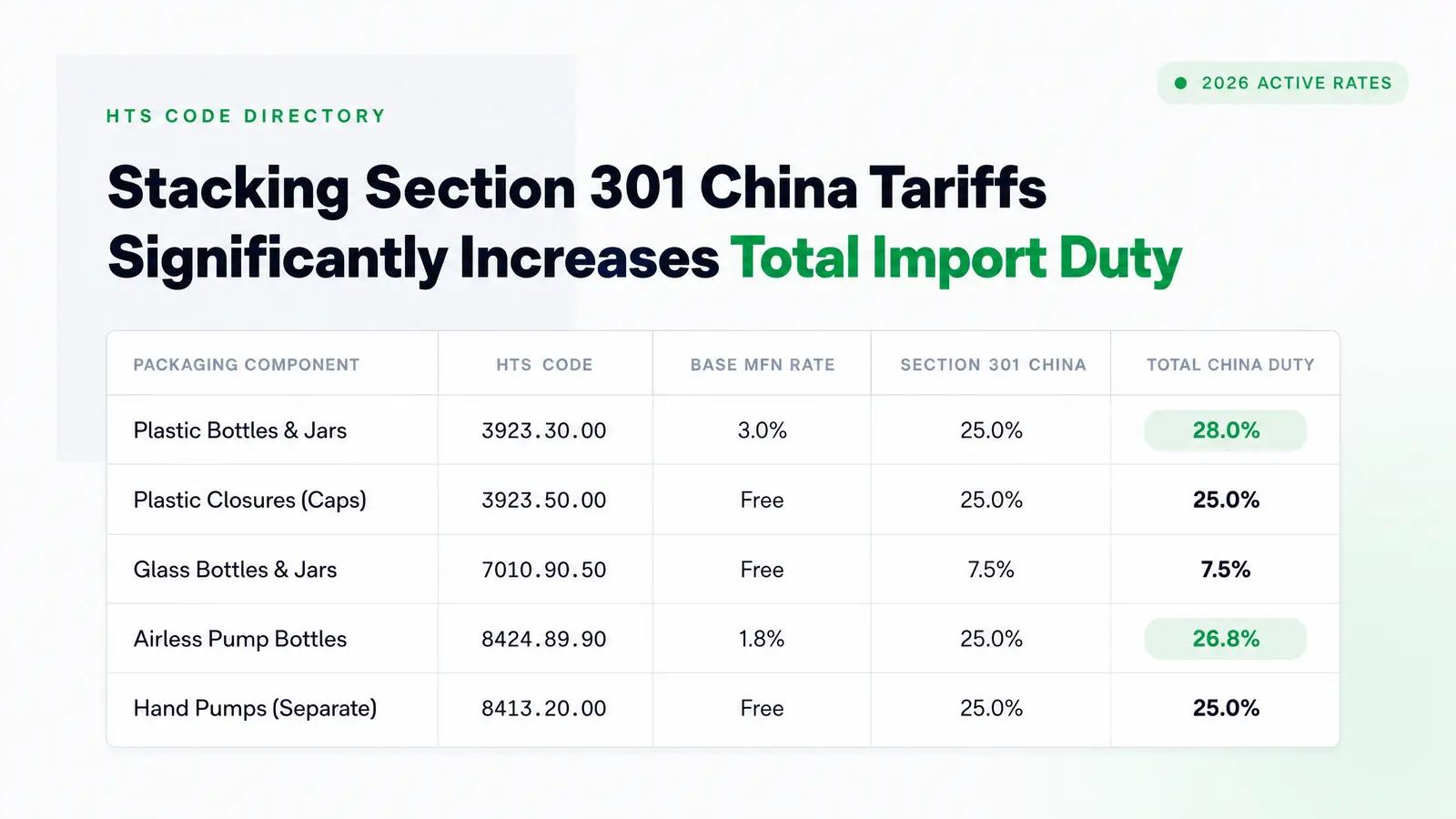
The table below compiles the standard HTS codes, base Most-Favored-Nation duty rates, and Section 301 additional tariff rates for the most common cosmetic packaging categories.
| Packaging Component | Standard HTS Code | Base MFN Rate [1] | Section 301 China Rate [4] | Total China Duty Rate |
|---|---|---|---|---|
| Plastic Bottles, Jars, and Flasks | 3923.30.00 | 3.0% | 25.0% (List 3) | 28.0% |
| Plastic Closures (Caps, Lids, Stoppers) | 3923.50.00.00 | Free | 25.0% (List 3) | 25.0% |
| Plastic Squeeze Tubes and Other Articles | 3923.90.00 | 3.0% | 25.0% (List 3) | 28.0% |
| Glass Cosmetic Bottles and Jars | 7010.90.50 | Free | 7.5% (List 4A) | 7.5% |
| Glass Stoppers and Closures | 7010.20.20.00 | 2.5% | 7.5% (List 4A) | 10.0% |
| Metal Closures (Aluminum, Steel Caps) | 8309.90.00 | 2.6% | 25.0% (List 3) | 27.6% |
| Airless Pump Bottles (Assembled Unit) | 8424.89.90.00 | 1.8% | 25.0% (List 3) | 26.8% |
| Hand Pumps (Imported Separately) | 8413.20.00.00 | Free | 25.0% (List 3) | 25.0% |
| Simple Piston Pump Sprays (Mist Pumps) | 8424.20.10.00 | 2.9% | 25.0% (List 3) | 27.9% |
Note: The total duty rates listed above reflect the standard stacking of base MFN duties and Section 301 tariffs as of 2026. These rates do not include temporary global tariffs or product-specific anti-dumping duties, which can change rapidly based on active trade negotiations. Always verify current rates at hts.usitc.gov. [2]
Key Classification Nuances to Watch
Founders must pay close attention to several critical nuances in the directory above. A complete airless pump bottle imported as a single, pre-assembled unit is classified under HTS code 8424.89.90.00 as a mechanical liquid-dispersing appliance, carrying a base MFN rate of 1.8%. [3]
However, if a founder imports the empty plastic jars and the pump caps in separate shipments, the components are classified individually. The empty plastic jars are classified under HTS code 3923.90.00.80 at a base rate of 3.0%, while the pump caps are classified under HTS code 8413.20.00.00 as hand pumps, which carry a base MFN rate of Free. [5]
These subtle classification shifts can significantly alter the total duty paid, demonstrating why checking HTS codes before ordering is a critical operational step.
The Landed Cost Formula: Stacking the Tariffs
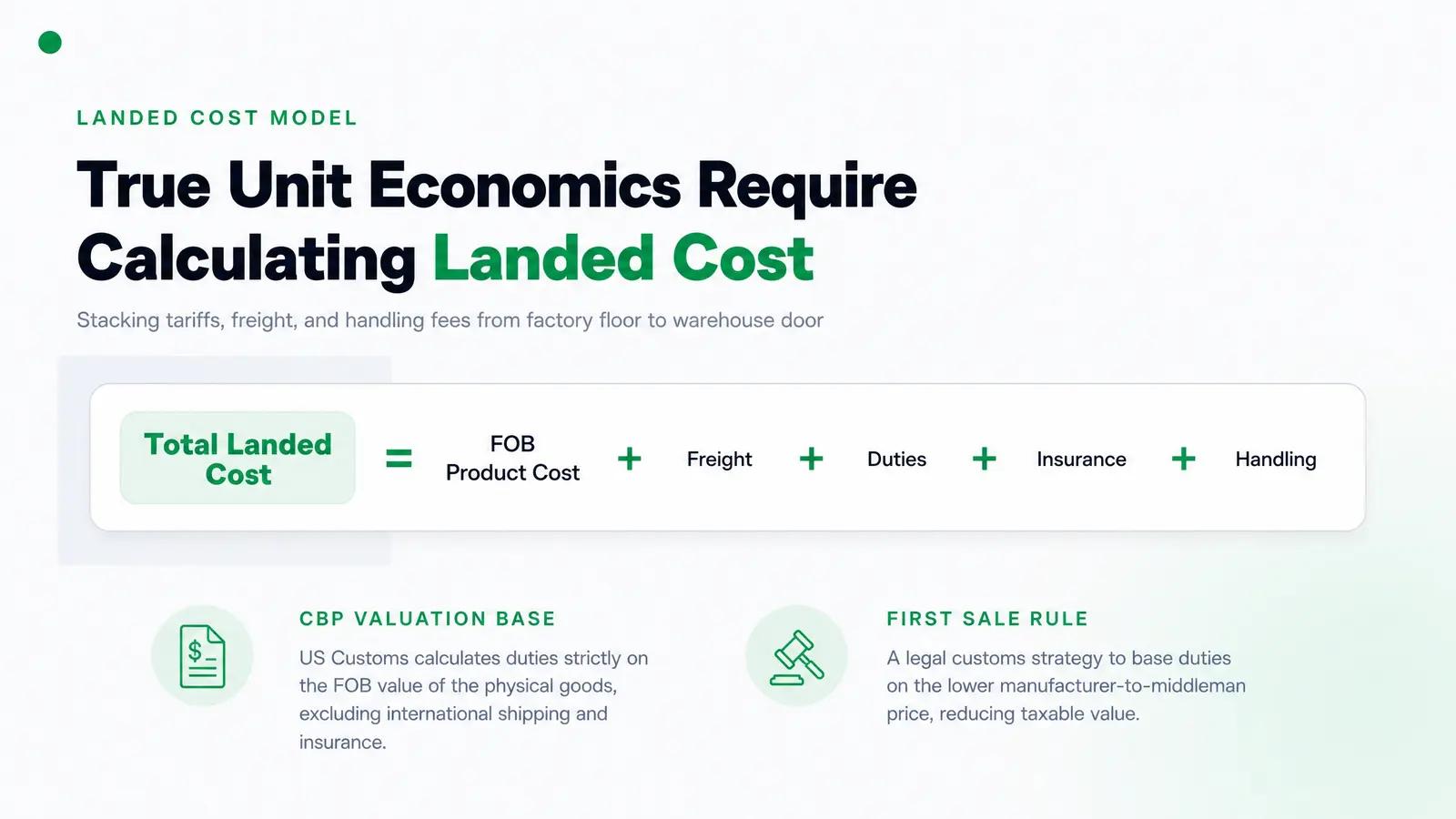
To evaluate the true cost of an import, founders must calculate the total landed cost. The landed cost represents the complete, all-inclusive price of getting a product from the manufacturer's factory floor to the brand's warehouse door.
The basic landed cost formula is:
Total Landed Cost = Product Cost (FOB) + International Freight + Customs Duties + Insurance + Local Handling
How CBP Values Goods for Duty Purposes
When calculating customs duties, the United States uses the Free on Board value of the goods. [8] The FOB value is the price paid to the supplier for the physical goods, excluding international shipping, ocean freight, and port-of-entry insurance.
This means that if a supplier quotes $1.00 per unit FOB, the customs duties are calculated strictly on that $1.00 unit cost. Tariffs stack additively. If a component carries a 3% base MFN rate and a 25% Section 301 China tariff, the total duty rate is 28%, and the customs duty per unit is $0.28.
The First Sale Rule
The First Sale Rule is a highly effective customs valuation strategy for brands utilizing multi-tiered supply chains. [9] If a founder purchases packaging through a middleman or sourcing agent who buys directly from the manufacturer, customs duties can legally be calculated based on the first sale price (manufacturer to middleman) rather than the second sale price (middleman to founder). [10]
This lower valuation base can lead to significant duty savings, particularly on high-volume packaging orders.
A Step-by-Step Worked Example: The Margin Impact
To illustrate how tariffs can quietly erode brand margins, consider a realistic sourcing scenario. An independent skincare founder is ordering custom-molded airless pump bottles for a new serum launch and receives a quote from a high-quality packaging manufacturer based in China.
Sourcing Scenario Details
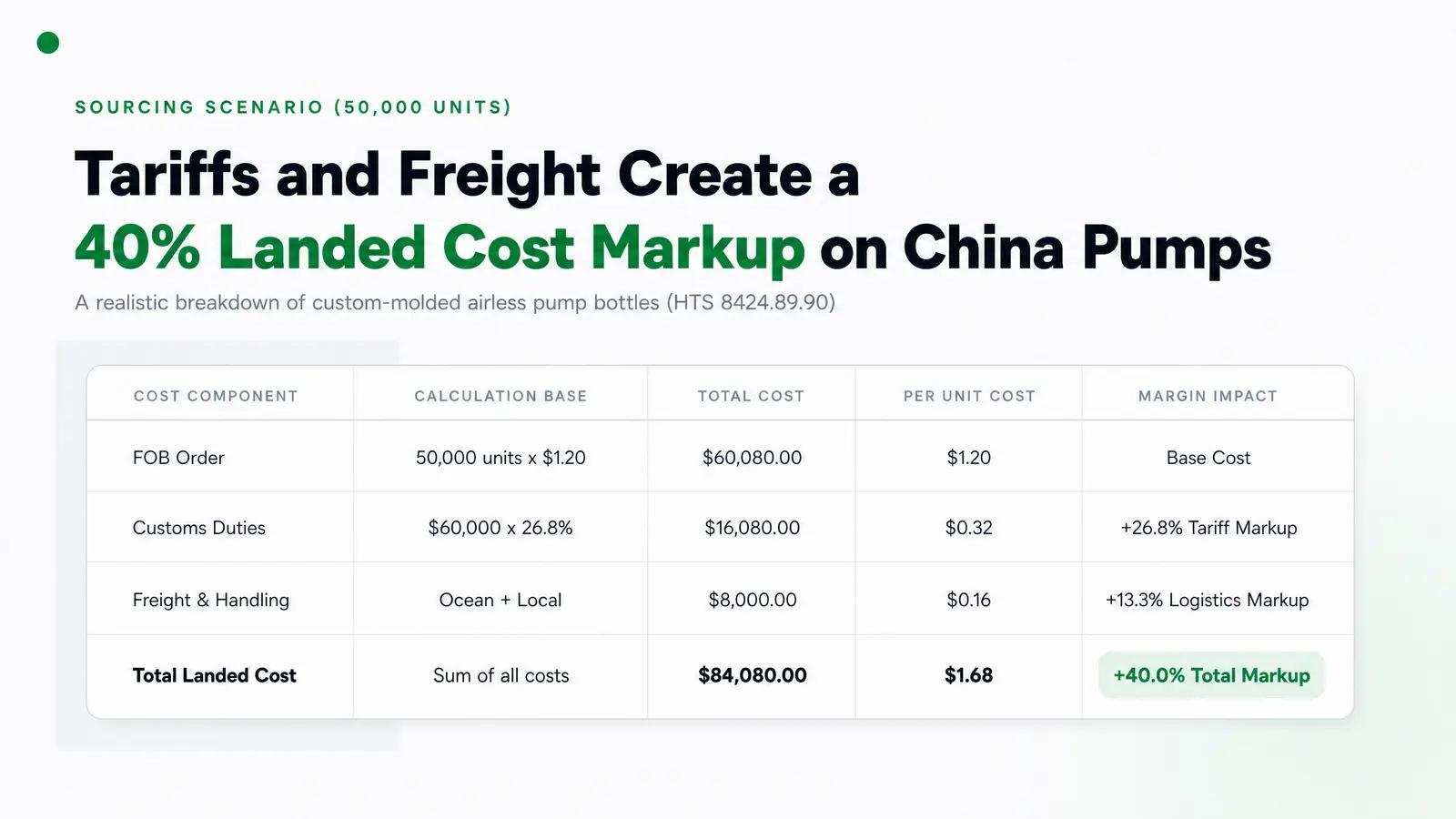
The order is for 50,000 units at a supplier quote of $1.20 per unit FOB China. The packaging type is assembled plastic airless pump bottles, classified under HTS code 8424.89.90.00. The base MFN duty rate is 1.8%, and the Section 301 China tariff is 25.0%, for a total stacked duty rate of 26.8%. International ocean freight and insurance total $6,500, and local port handling and domestic trucking total $1,500.
The Landed Cost Calculation
First, calculate the total FOB value of the packaging order:
50,000 units x $1.20 = $60,000.00 total FOB value
Next, calculate the total customs duties owed to Customs and Border Protection:
$60,000.00 x 26.8% = $16,080.00 in customs duties
Now, stack all costs to find the total landed cost of the shipment:
$60,000.00 (FOB) + $16,080.00 (Duties) + $6,500.00 (Freight) + $1,500.00 (Handling) = $84,080.00 total landed cost
Finally, calculate the true landed cost per unit:
$84,080.00 / 50,000 units = $1.68 per unit
The Financial Takeaway
The supplier's original quote was $1.20 per unit. The true landed cost is $1.68 per unit. This represents a 40% increase over the supplier's initial quote.
If the founder had priced their finished serum based on the $1.20 packaging cost, they would have faced an unexpected cash flow shortfall of $24,080.00 upon import. This example highlights why calculating landed costs before placing an order is an essential operational requirement.
How Country of Origin is Determined: The Substantial Transformation Rule
As trade tensions persist, many beauty founders look to source packaging from alternative countries, such as Vietnam, Taiwan, or India, to avoid the 25% Section 301 China tariffs. However, changing the shipping port does not automatically change the country of origin in the eyes of Customs and Border Protection.
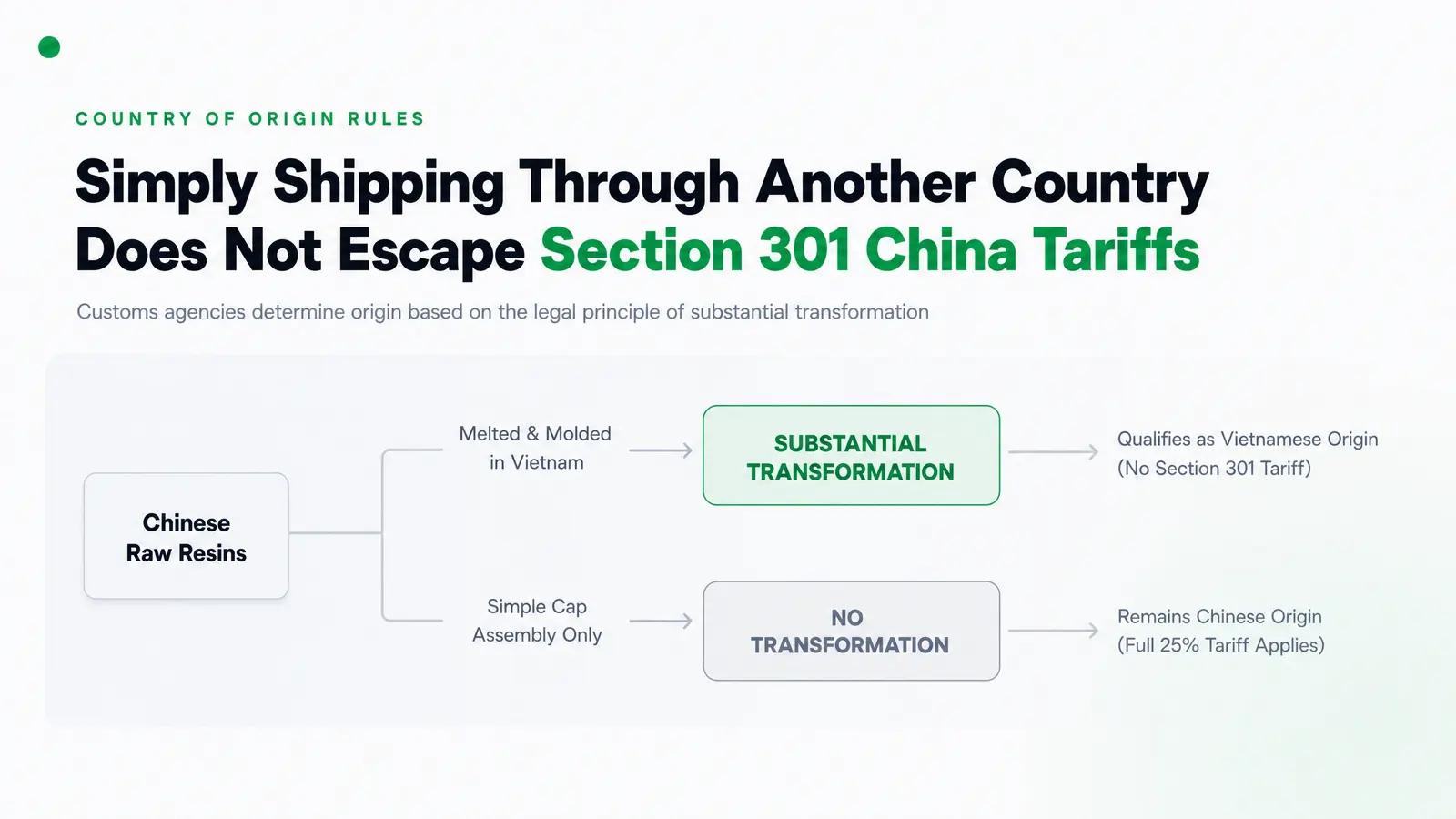
Customs agencies determine origin based on the legal principle of substantial transformation. [6]
The Substantial Transformation Standard
A substantial transformation occurs when a manufacturing process in a country results in a new and different article of commerce, featuring a distinctive name, character, or use. [6]
If a supplier imports raw plastic resins from China into Vietnam, melts them down, and molds them into cosmetic bottles on Vietnamese soil, a substantial transformation has occurred. The bottles legally qualify as Vietnamese-origin, escaping the Section 301 China tariffs. [12]
Simple Assembly Does Not Qualify
Simple assembly or repackaging operations do not constitute substantial transformation. [6]
If a supplier molds plastic jars in China, ships them to Vietnam, and simply screws on plastic caps that were also molded in China, no substantial transformation has occurred. U.S. Customs will still classify the entire shipment as Chinese-origin, and the importer will be hit with the full 25% Section 301 tariff upon arrival at a U.S. port. [5]
Founders must demand transparent manufacturing workflows from their non-China suppliers to ensure their packaging legally qualifies for lower tariff rates.
Supplier Quotes and Scenario Planning
To protect brand margins, founders must adopt a proactive approach to supplier negotiations and logistics management. This begins with understanding how suppliers structure their quotes.
Decoding Sourcing Quotes: EXW, FOB, and DDP
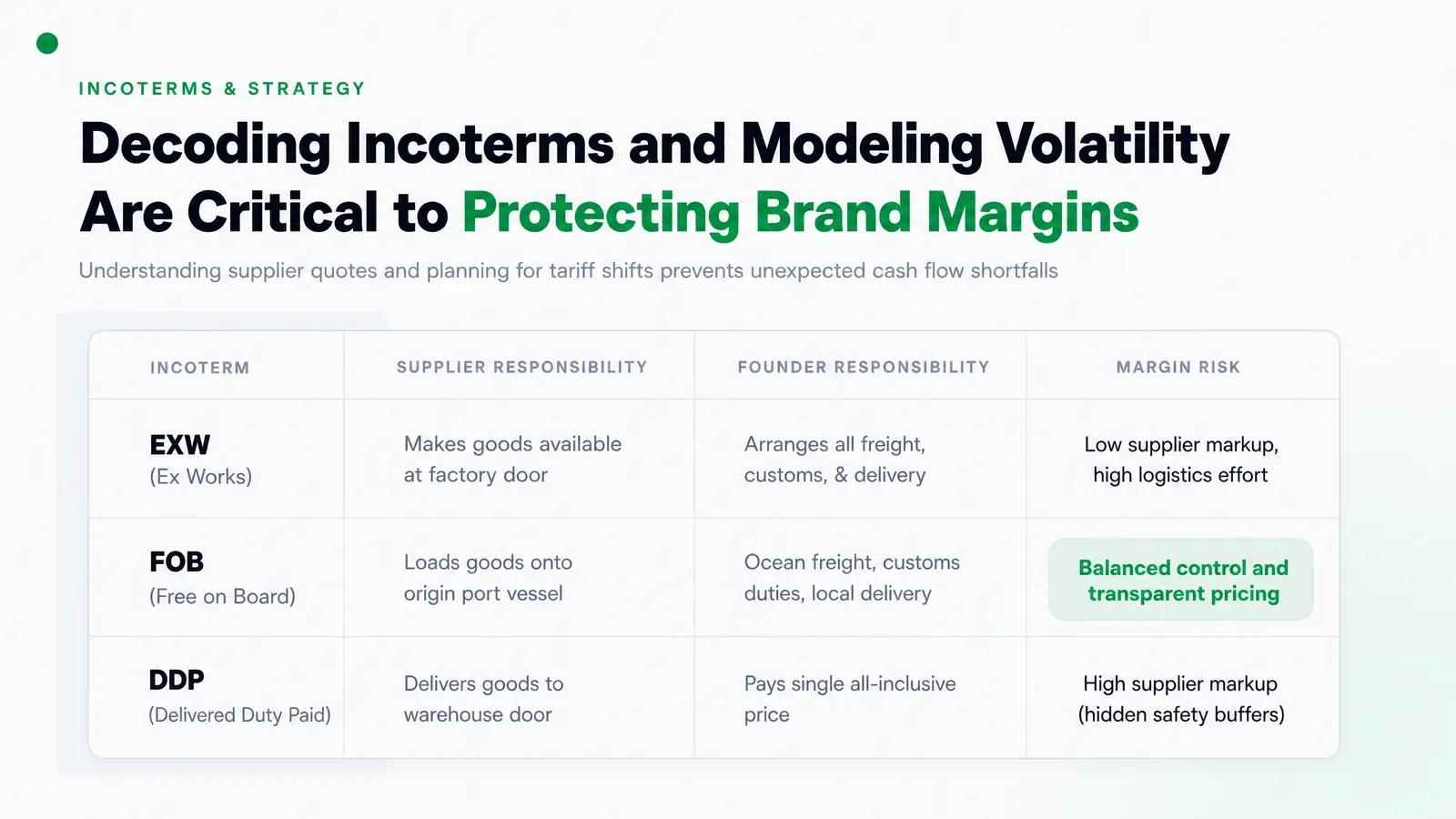
Suppliers typically quote prices using international commercial terms, or Incoterms. The three most common terms in packaging sourcing are:
EXW (Ex Works): The founder pays for everything. The supplier simply makes the goods available at their factory door. The founder must arrange all international freight, customs clearance, and domestic delivery.
FOB (Free on Board): The supplier covers all costs to get the goods loaded onto the cargo ship at the origin port. The founder is responsible for ocean freight, customs duties, and local delivery.
DDP (Delivered Duty Paid): The supplier handles everything, including customs clearance and import duties, delivering the goods directly to the founder's warehouse.
While DDP quotes can look appealing to busy founders because they eliminate customs hassle, they often hide inflated margins. Suppliers frequently build large safety buffers into DDP quotes to cover potential tariff fluctuations. Founders should always ask for a complete cost breakdown of a DDP quote, or request an FOB quote so they can compare the cost of managing freight and customs independently.
Scenario Planning for Tariff Volatility
Trade policies can change rapidly. To build a resilient beauty brand, founders should incorporate tariff scenario planning into their annual budgeting. This involves modeling how a 10%, 25%, or even 50% shift in tariff rates would impact their cost of goods sold and retail pricing. Having alternative sourcing options mapped out before trade policies shift ensures that a brand can pivot quickly without disrupting its product launch calendar.
Packfolio: Eliminating Sourcing Surprises
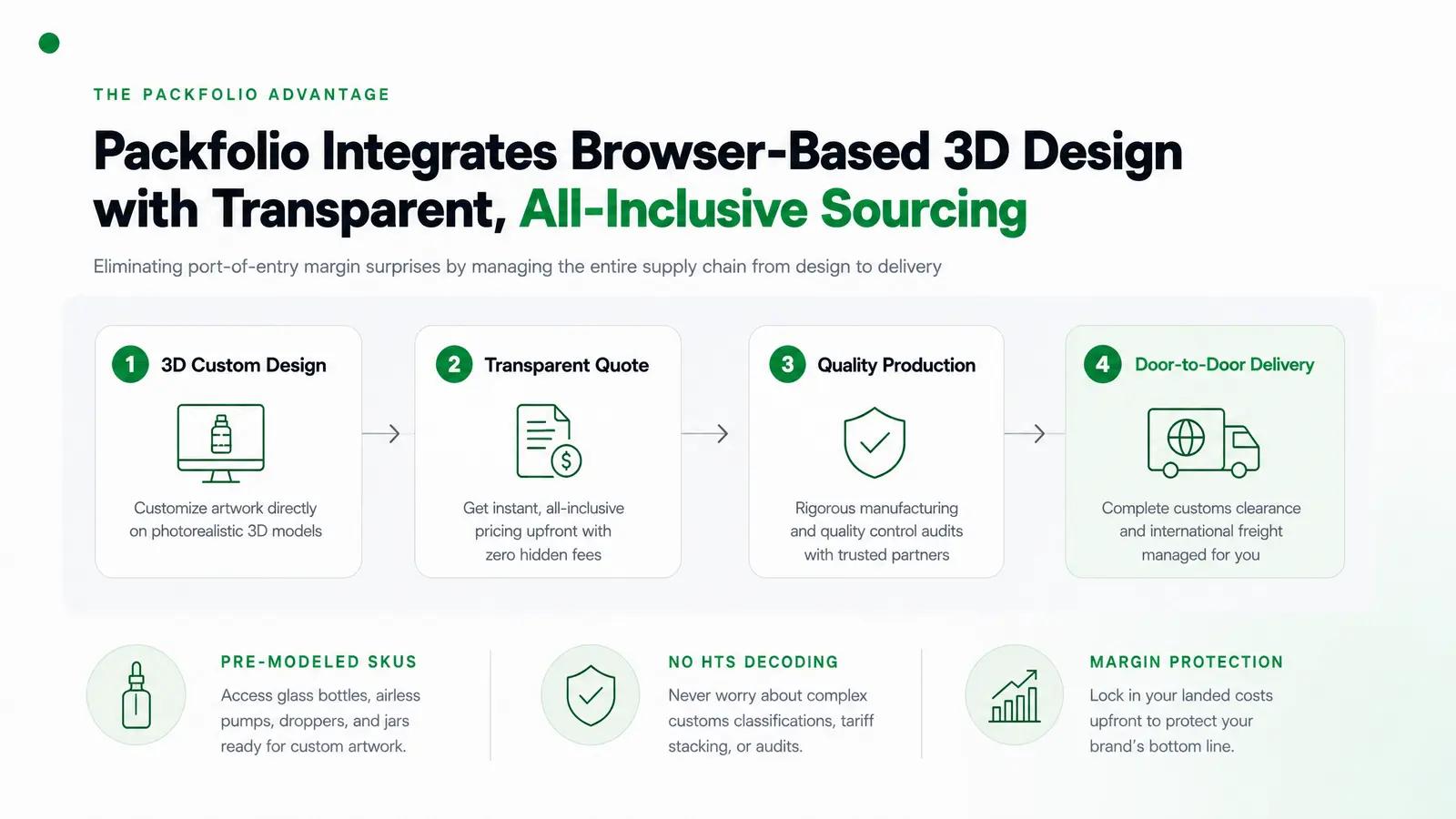
For independent beauty brands, managing HTS codes, substantial transformation audits, and international freight logistics can quickly become overwhelming. This is where Packfolio offers a transformative solution.
Packfolio is an on-demand, custom cosmetic packaging platform designed specifically to streamline the sourcing workflow for modern beauty brands.
A Curated, Pre-Modeled Catalog
Packfolio features a curated catalog of high-quality primary packaging SKUs, including glass bottles, airless pumps, droppers, jars, tubes, lip components, compacts, and closures. Every SKU in the catalog is pre-modeled in 3D with predefined, printable regions.
Founders can customize their artwork directly in a browser-based 3D design tool, previewing their designs instantly on a photorealistic 3D model. This eliminates the guesswork of traditional 2D flat dielines.
Transparent Sourcing and Logistics
Once a design is approved, Packfolio takes complete control of the supply chain. Packfolio coordinates production with trusted manufacturing partners, conducts rigorous quality control audits, and manages the entire international freight and customs clearance process.
Customers pay Packfolio directly and never have to contact overseas suppliers, decode HTS classifications, or negotiate with customs brokers. By providing completely transparent, all-inclusive pricing upfront, Packfolio eliminates the risk of port-of-entry margin surprises, allowing founders to focus on what they do best: building an exceptional beauty brand.
Conclusion and Action Plan
Sourcing custom cosmetic packaging does not have to be a source of financial anxiety. By taking a proactive approach to HTS classification and landed cost modeling, founders can protect their margins and build a highly efficient supply chain.
To ensure your next packaging run is free of unexpected costs, implement this three-step action plan.
First, audit your HTS codes. Request the exact ten-digit HTS classifications from your supplier before signing any production contract, and cross-reference them with the official USITC schedule. [1]
Second, calculate your landed cost. Use the additive landed cost formula to stack base duties, Section 301 tariffs, international ocean freight, and local handling fees. [8]
Third, partner with experts. If managing international logistics is pulling your focus away from brand growth, partner with a transparent sourcing platform like Packfolio to streamline your packaging supply chain from design to delivery.
Frequently Asked Questions
What is the difference between primary and secondary packaging for tariff purposes?
Primary packaging holds the actual cosmetic formulation and often carries higher tariff rates due to material complexity and mechanical dispensing features. [3] [5] Secondary packaging consists of outer boxes and shipping cartons, which are simpler to classify and typically carry low or zero duty rates. [1]
How do I know if my cosmetic pump is classified as a hand pump or a mechanical appliance?
If a pump is imported as an assembled unit with a container, it is typically classified under HTS code 8424.89.90.00 as a mechanical liquid-dispersing appliance. [3] If the pump cap is imported separately without a reservoir, it is classified under HTS code 8413.20.00.00 as a hand pump, which carries a base MFN rate of Free. [5]
Can I avoid Section 301 China tariffs by shipping my packaging through Vietnam?
Only if a substantial transformation occurs in Vietnam. [6] Simply assembling or repackaging Chinese-made components in Vietnam does not change the country of origin, and the shipment will still be subject to the full Section 301 tariffs. [5]
Who is legally responsible for paying customs duties on imported packaging?
The importer of record is legally responsible for paying all customs duties, taxes, and fees to U.S. Customs and Border Protection. [7] If you purchase packaging under FOB or EXW terms, your brand is the importer of record. Under DDP terms, the supplier or their logistics partner handles payment on your behalf.
How does the First Sale Rule help reduce packaging import duties?
The First Sale Rule allows importers to calculate customs duties based on the lower price paid by a middleman to the manufacturer, rather than the higher price paid by the brand to the middleman. [9] This reduces the taxable value of the goods, leading to meaningful duty savings on large-volume packaging orders. [10]
References
-
United States International Trade Commission. (2026). Harmonized Tariff Schedule of the United States (2026 Revision 9). https://hts.usitc.gov/
-
China Briefing. (2026). Breaking Down the US-China Trade Tariffs: What's in Effect Now? https://www.china-briefing.com/news/us-china-tariff-rates-2025/
-
U.S. Customs and Border Protection. (2017). Customs Ruling N284174: The tariff classification of a cosmetic container with airless pump from China. https://rulings.cbp.gov/ruling/N284174
-
Office of the United States Trade Representative / Federal Register. (2024). Notice of Modification: China's Acts, Policies and Practices Related to Technology Transfer (Section 301 Four-Year Review). https://www.federalregister.gov/documents/2024/09/18/2024-21217/notice-of-modification-chinas-acts-policies-and-practices-related-to-technology-transfer
-
U.S. Customs and Border Protection. (2021). Customs Ruling N322382: The tariff classification of an empty cosmetic jar with a pump cap from South Korea. https://rulings.cbp.gov/ruling/n322382
-
U.S. Customs and Border Protection. (2026). Marking of Country of Origin on U.S. Imports. https://www.cbp.gov/trade/rulings/informed-compliance-publications/marking-country-origin-us-imports
-
Office of the United States Trade Representative. (2026). China Section 301-Tariff Actions and Exclusion Process. https://ustr.gov/issue-areas/enforcement/section-301-investigations/tariff-actions
-
FedEx Small Business. (2026). What Is Landed Cost and How To Calculate It. https://www.fedex.com/en-us/small-business/articles-insights/what-is-landed-cost.html
-
U.S. Customs and Border Protection. (2026). First Sale Declaration. https://www.cbp.gov/trade/programs-administration/entry-summary/first-sale-declaration
-
Miller and Chevalier. (2025). Using the First Sale Rule to Reduce Tariffs. https://www.millerchevalier.com/publication/using-first-sale-rule-reduce-tariffs
-
International Trade Administration. (2026). Rules of Origin: Substantial Transformation. https://www.trade.gov/rules-origin-substantial-transformation
-
Beauty Independent. (2025). "This Is Insane": Beauty Brands Scramble To Assess Tariff Impacts And Mitigation Strategies. https://www.beautyindependent.com/this-is-insane-beauty-brands-scramble-to-assess-tariff-impacts-and-mitigation-strategies/


