
Cosmetic Tubes: A Guide to Squeeze Tubes, Laminates, and Applicators
This guide explains cosmetic tube construction, laminate barriers, applicator options, decoration constraints, and MOQ strategies to help founders match formulas to the right squeeze tube format.
Tubes are operationally different from bottles and jars — they behave differently on the fill line, impose unique decoration constraints, and demand compatibility thinking that jar and bottle guides simply do not cover. When you choose a tube, you are not just selecting a container; you are deciding how the product will be dispensed, how the tail will be sealed, and how the material will interact with your formula's solvent system. A founder sourcing cosmetic tubes for the first time quickly realizes that what works for a heavy cream in a jar might require a completely different barrier structure when squeezed through a narrow orifice.
How Cosmetic Tubes Are Constructed
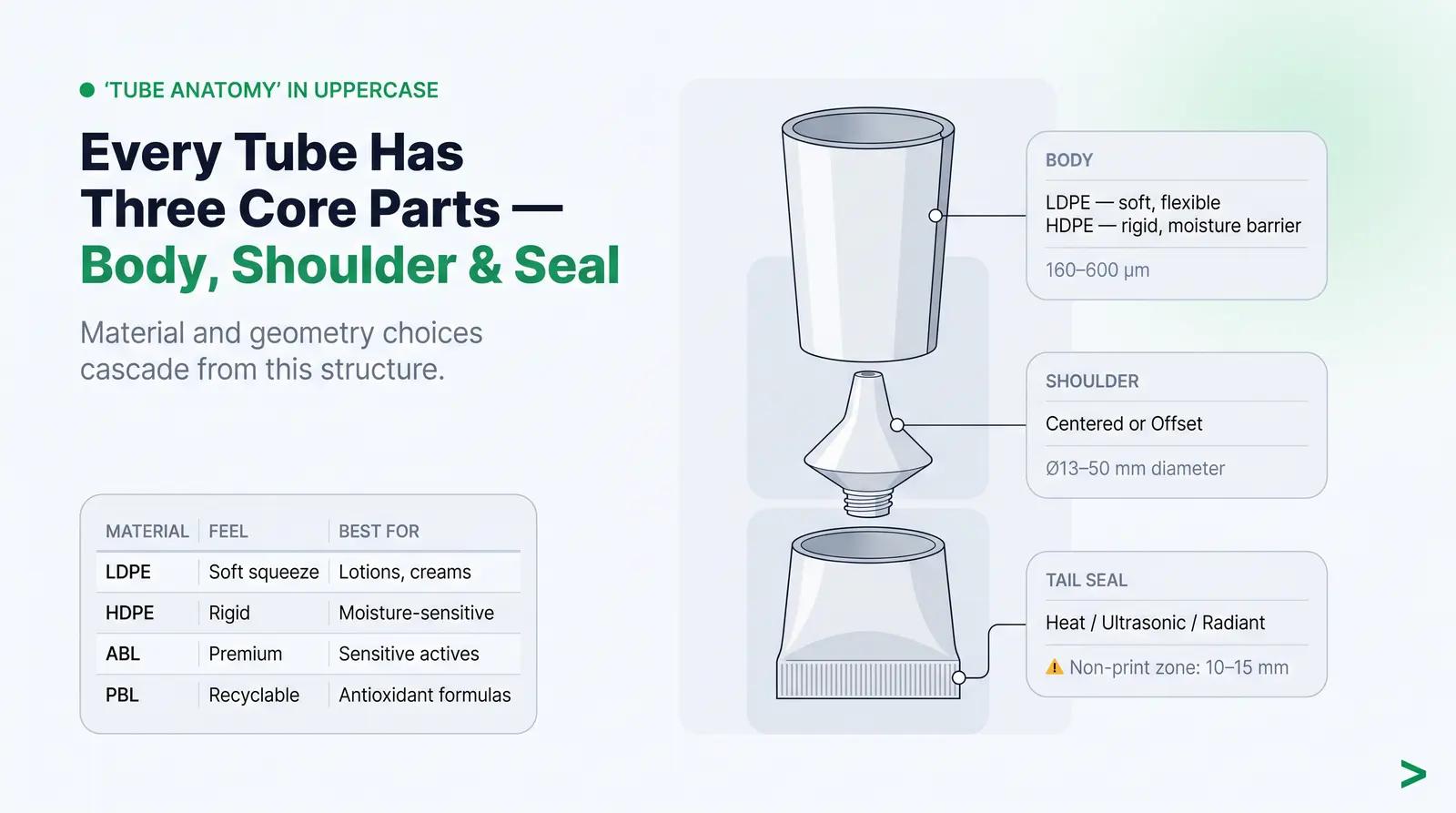
The construction of a cosmetic tube dictates its performance, feel, and compatibility with your formula. At the most basic level, a tube consists of a flexible body (the sleeve), a rigid shoulder, and a closure. The body is typically extruded as a continuous cylinder and then cut to length, or formed from a flat laminate sheet welded at a side seam.
Tube body materials fall into a few primary categories. High-density polyethylene (HDPE) provides rigidity and a strong moisture barrier, making it suitable for formulas that need to maintain their water content. Low-density polyethylene (LDPE) is softer and more flexible, providing the classic "squeeze" feel ideal for thick lotions and creams. Polypropylene (PP) is often used for the rigid shoulder and cap components due to its structural stability. For formulas requiring enhanced protection, laminate tubes combine multiple layers. Aluminum barrier laminate (ABL) incorporates a thin layer of aluminum foil between plastic layers, offering near-total protection against oxygen, light, and moisture. Plastic barrier laminate (PBL) replaces the aluminum with a high-performance plastic barrier like EVOH (ethylene vinyl alcohol), which blocks oxygen while maintaining recyclability [1]. Post-consumer recycled (PCR) variants of these plastics are increasingly available to meet sustainability goals.
Wall thickness plays a crucial role in the tube's functionality. Typical squeeze tube wall thicknesses range from 160 microns to 600 microns. A thicker wall provides a more premium, structured feel and better barrier properties but requires more force to squeeze. A thinner wall is more economical and easier to evacuate completely but may feel flimsy.
The shoulder of the tube connects the flexible body to the dispensing orifice. Shoulders can be centered, which is the standard configuration, or offset. Offset shoulders place the dispensing orifice to one side, which is often preferred for precise application of color cosmetics like tinted moisturizers or concealers. The diameter of the tube is a key specification, with standard cosmetic tubes ranging from 13 mm for lip products to 50 mm for body lotions and hair care.
Finally, the tail seal is how the tube is closed after filling. Tubes are filled from the open bottom (the tail), and then the tail is sealed using heat. Ultrasonic sealing uses high-frequency vibrations to melt the plastic, hot-air sealing blows hot air onto the inner surfaces before crimping, and radiant heat sealing uses heated jaws. The sealing method must be compatible with the tube material and the fill-line equipment.
Laminate vs. Plastic: When the Distinction Matters
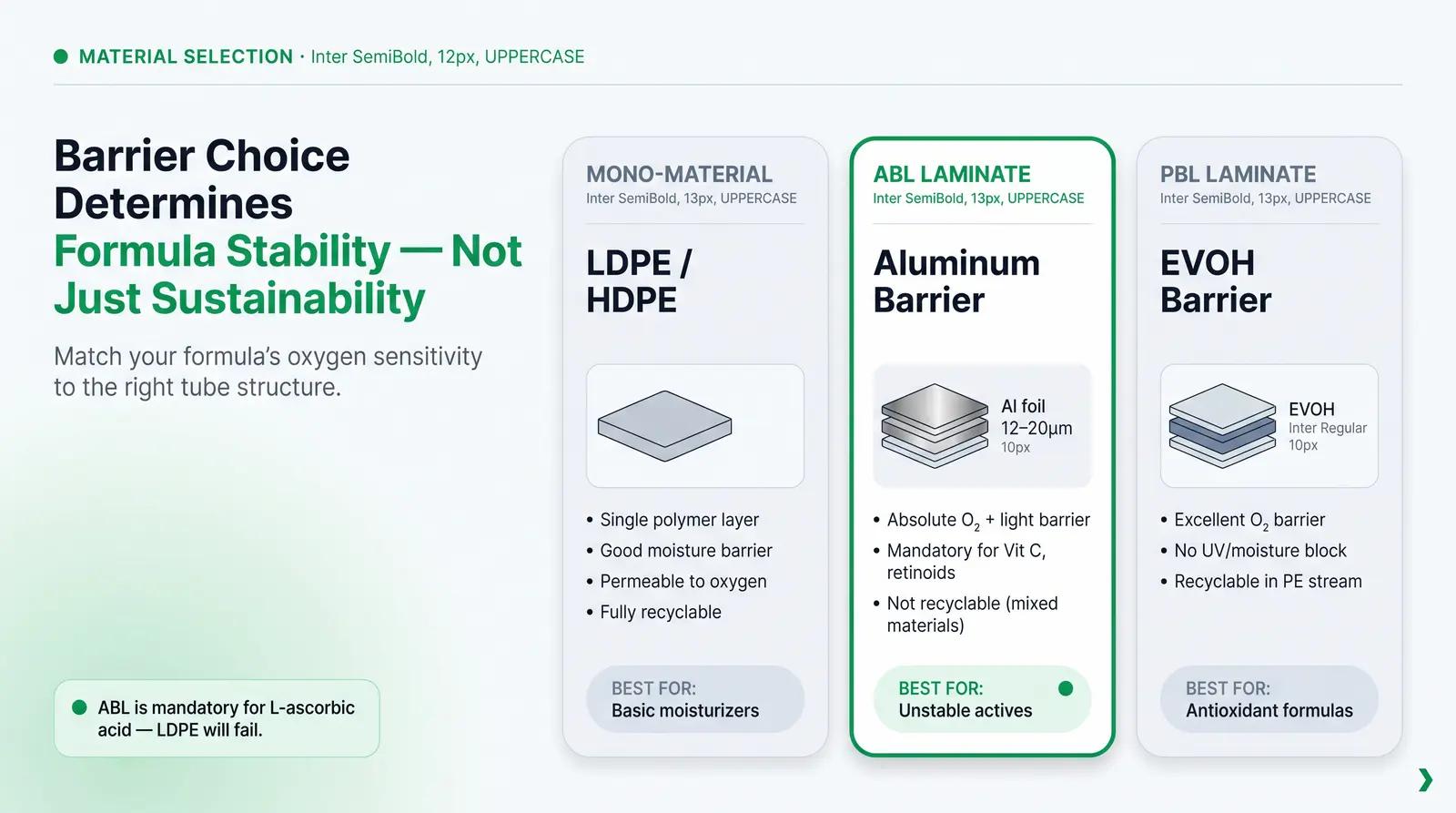
Understanding the difference between mono-material plastic tubes and multi-layer laminates is critical for formula stability. A mono-material plastic tube, typically extruded from LDPE or HDPE, is a single layer of plastic (or multiple layers of the same plastic family). These tubes are excellent for basic moisturizers, cleansers, and shampoos. They are cost-effective, offer good moisture retention, and have clear end-of-life recycling pathways because they are made of a single polymer type [2].
However, mono-material plastics are permeable to gases. Oxygen can slowly pass through the tube wall, and volatile compounds like essential oils can escape. This is where laminate tubes become necessary.
Laminate tubes are constructed from multiple layers of different materials to create a barrier. The two main types are ABL (aluminum barrier laminate) and PBL (plastic barrier laminate). ABL tubes feature a thin layer of aluminum foil (typically 12 to 20 microns) sandwiched between layers of polyethylene. This aluminum layer provides an absolute barrier against oxygen, light, and moisture [3]. ABL is the gold standard for highly sensitive formulas, such as those containing L-ascorbic acid (vitamin C), retinoids, or aggressive essential oils. The downside of ABL is its limited recyclability; the mixed materials (plastic and metal) are difficult for standard recycling facilities to separate [2].
PBL tubes use a high-performance plastic, such as EVOH, as the barrier layer instead of aluminum. EVOH provides an excellent oxygen barrier, protecting sensitive ingredients from oxidation, though it is not as effective as aluminum at blocking UV light or moisture [3]. The significant advantage of PBL is that, when designed correctly (with EVOH content below certain thresholds), it can be recycled in the standard PE stream [4].
The distinction matters most when balancing formula protection with sustainability. The assumption that ABL laminates are always the premium choice is not always correct. For many rinse-off or low-water-activity formulas that do not require an absolute oxygen barrier, a well-specified LDPE mono-material tube outperforms a laminate on sustainability metrics because LDPE has clearer end-of-life recycling pathways than multi-layer ABL structures [2].
Applicator and Closure Options
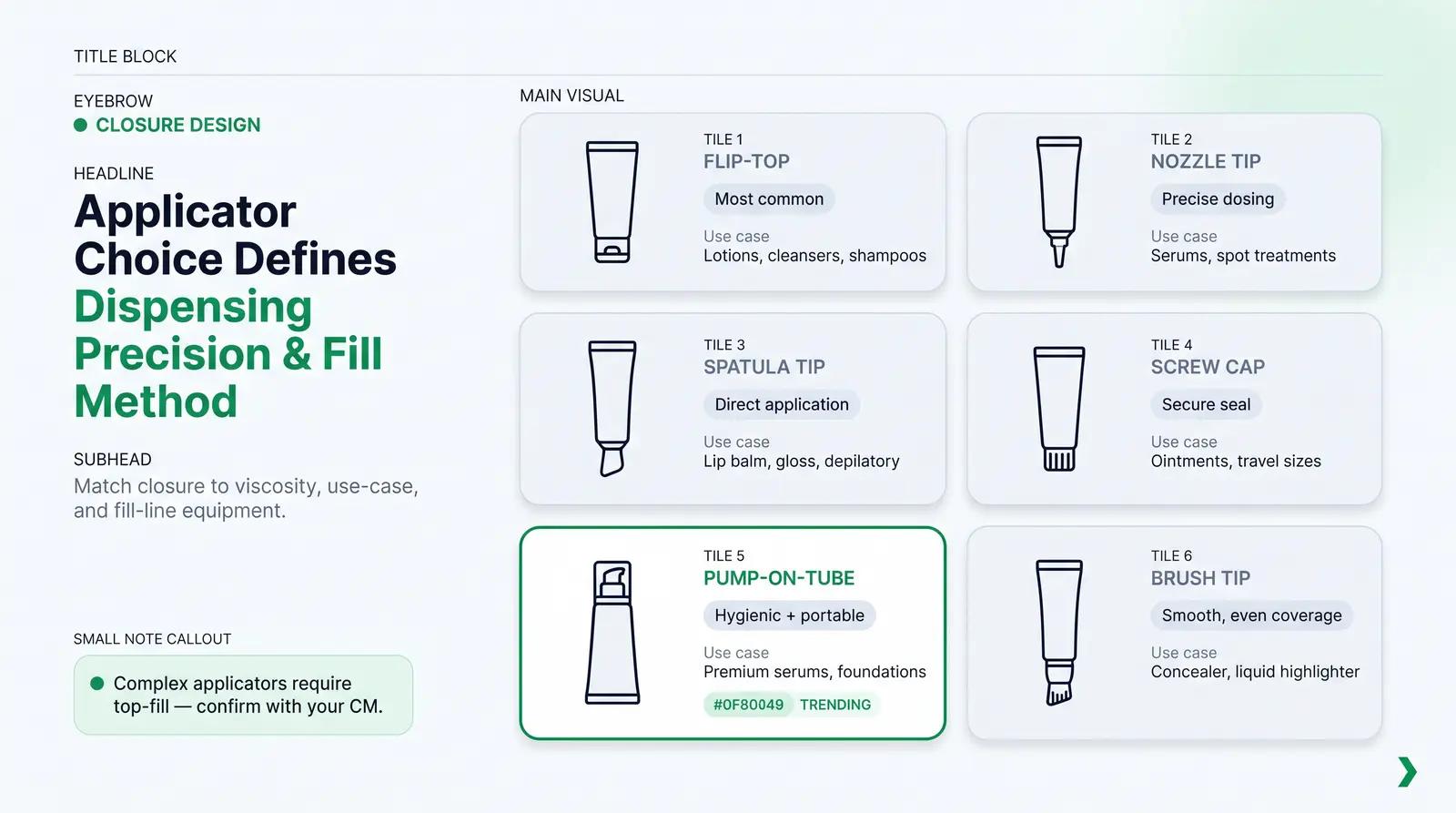
The applicator and closure define the user experience and must be matched to the formula's viscosity and intended use.
Flip-Top Caps: These are the most common closures for body lotions, facial cleansers, and shampoos. The cap stays attached to the tube, allowing for one-handed operation. They are ideal for medium-to-thick viscosities.
Screw Caps: A simple, threaded cap that must be completely removed. Screw caps are cost-effective and provide a very secure seal, making them suitable for travel sizes and highly viscous ointments or thick creams.
Nozzle Tips: Also known as ophthalmic tips, these feature a long, narrow dispensing channel. They are perfect for low-viscosity serums, spot treatments, and eye creams where precise, small-dose application is required.
Spatula Tips: These feature a flattened, slanted tip that allows the user to spread the product directly from the tube. They are commonly used for lip balms, lip glosses, and depilatory creams.
Pointed Tips: Often used for eye creams and targeted treatments, pointed tips allow for precise application directly to small areas of the skin. They are typically paired with small-diameter tubes (13 mm to 19 mm).
Brush Applicators: These integrate a brush directly into the tube head, allowing for smooth, even application of makeup products like concealers, liquid highlighters, or lip glosses.
Pump-on-Tube: This configuration attaches an airless or standard pump to the tube shoulder. It combines the precise, hygienic dosing of a pump with the portability and cost-effectiveness of a tube. This is increasingly popular for premium facial serums and foundations.
Each applicator choice impacts the fill line. For instance, tubes with complex applicators or pumps often require top-filling (filling through the neck before the applicator is attached) rather than the standard bottom-filling method, which changes the equipment requirements for your contract manufacturer.
Decoration Constraints and Print Techniques
Decorating a cosmetic tube involves unique constraints dictated by the tube's cylindrical shape, flexible material, and manufacturing process. Unlike flat labels applied to rigid bottles, tube decoration often happens directly on the curved surface before the tube is filled and sealed.
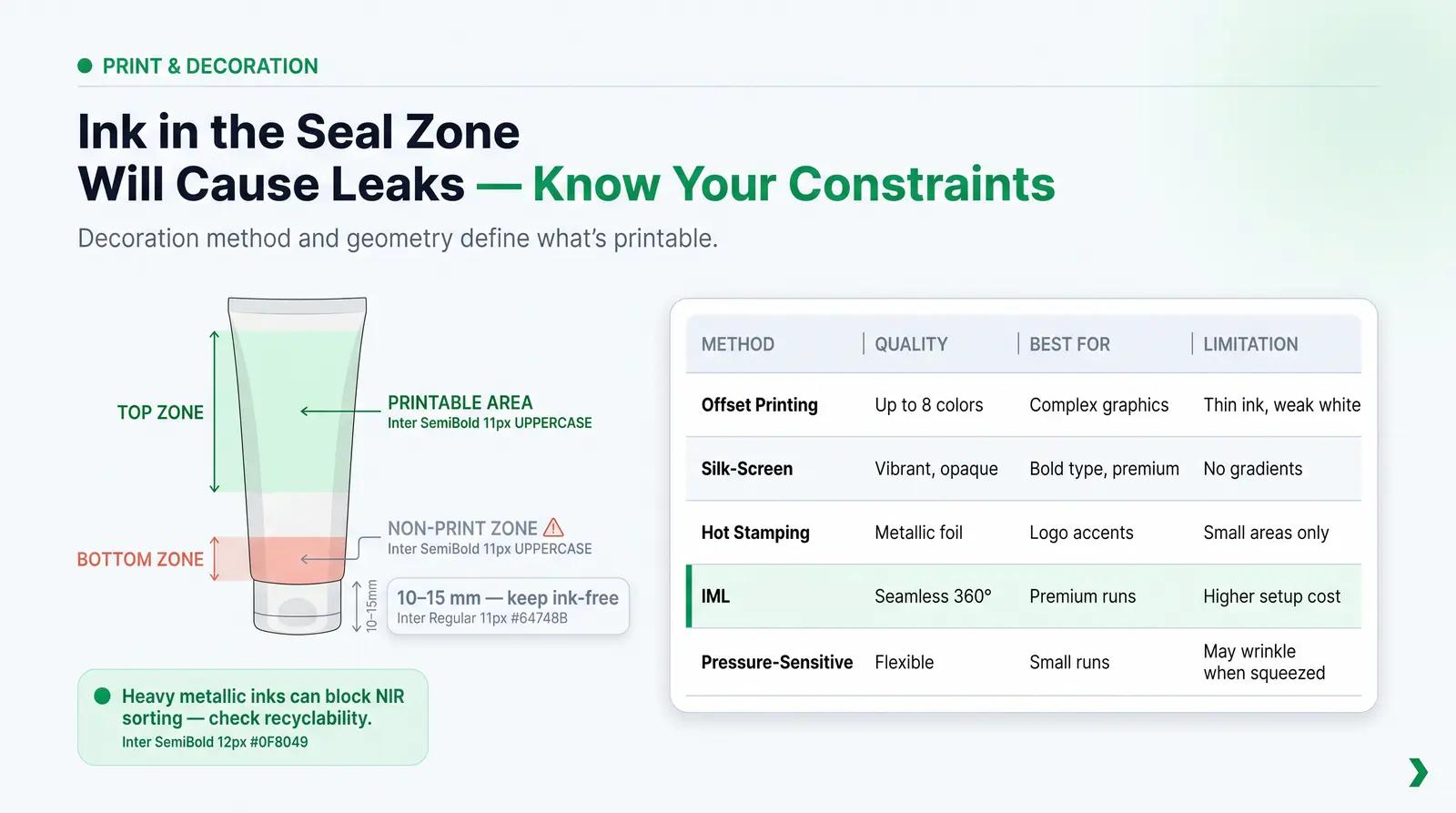
Offset Printing: This is the workhorse of tube decoration. It is fast, cost-effective for large runs, and excellent for printing complex graphics and gradients. Up to 8 colors can be applied simultaneously. However, the ink layer is very thin, meaning colors can appear less vibrant, and printing pure white on a dark-colored tube is challenging [5].
Silk-Screen Printing: This method presses thick ink through a mesh screen. It produces vibrant, highly opaque colors with a tactile, raised texture. It is ideal for bold typography and premium branding but cannot reproduce fine photographic details or gradients [5].
Hot Stamping: This technique uses heat and pressure to transfer metallic foil (gold, silver, rose gold) onto the tube. It adds a premium, luxurious finish but is typically limited to small areas like logos or specific accents due to cost and application constraints.
Labeling: While direct printing is common, applying a label to the tube offers flexibility. In-mold labeling (IML) fuses a pre-printed label into the plastic during the tube's formation, creating a seamless look with 360-degree coverage. Pressure-sensitive labels can also be applied post-production, which is cost-effective for smaller runs but can sometimes wrinkle as the tube is squeezed.
The physical geometry of the tube imposes strict decoration constraints. The tail seal area (typically the bottom 10 to 15 mm of the tube) must remain completely free of ink and varnish. If ink enters this zone, the heat seal will fail, leading to leaks. This non-print zone must be accounted for in the artwork design. Furthermore, the tube's diameter dictates the available circumference for artwork. A small 16 mm lip gloss tube has very little real estate, limiting the number of spot colors or fine-detail elements that are practical to print clearly.
Sustainability also plays a role in decoration. The choice between water-based, UV-cured, and solvent-based inks affects the environmental footprint. UV-cured inks are common for their durability, but heavy ink coverage or metallic foils can interfere with the near-infrared (NIR) sorting technologies used in recycling facilities, potentially rendering an otherwise recyclable PE tube unrecyclable [4].
Product-Category Fit: Matching Formula to Tube Format
Selecting the right tube requires matching the formula's chemistry and viscosity to the correct material and applicator.
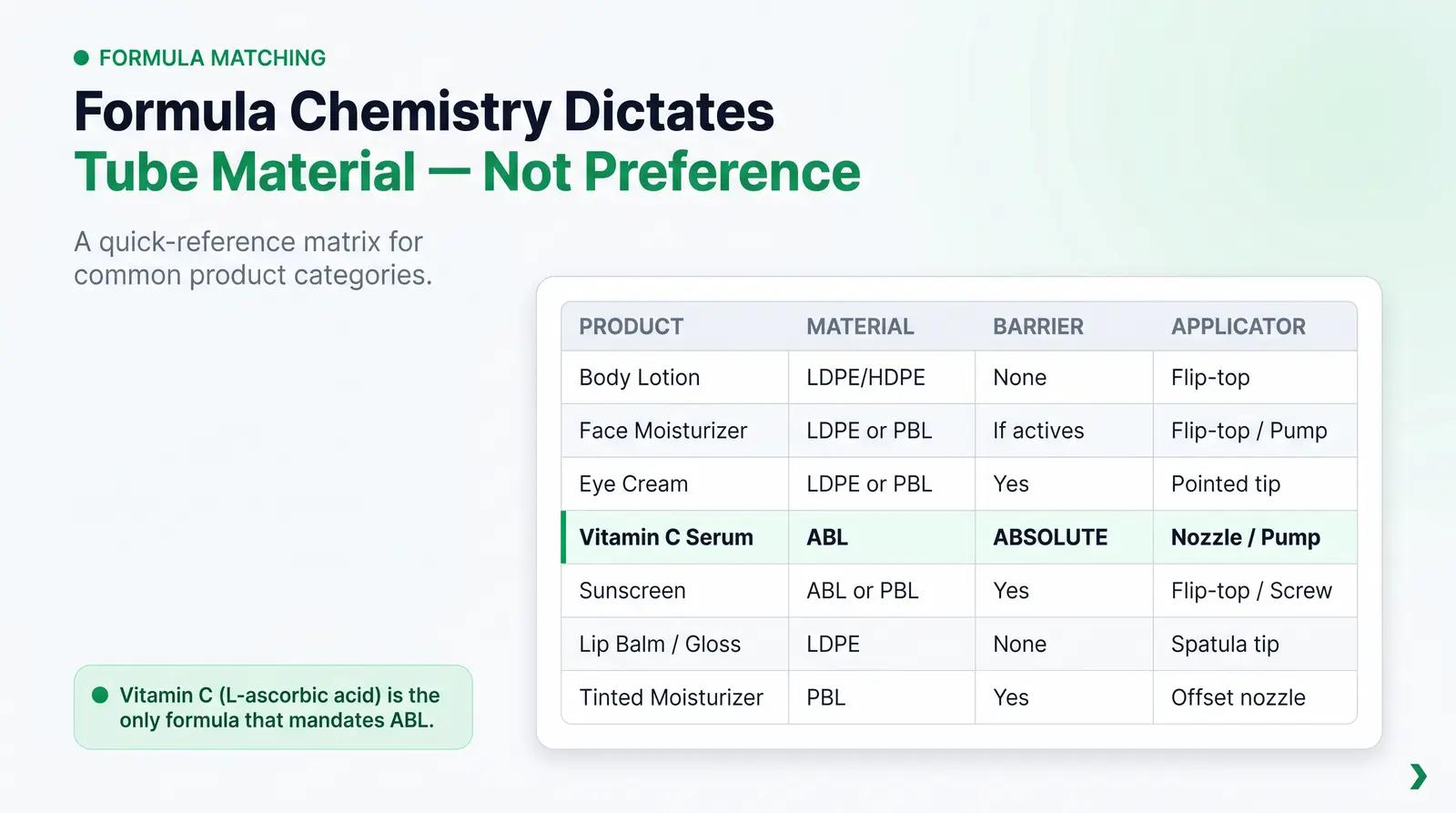
| Product Category | Recommended Tube Material | Barrier Layer Needed | Applicator / Closure | Notes |
|---|---|---|---|---|
| Body Lotion | LDPE or HDPE | No | Flip-top or Disc cap | Large diameter (35-50 mm) for generous dispensing; mono-material for recyclability. |
| Face Moisturizer | LDPE or PBL | Yes (if sensitive actives) | Flip-top or Pump-on-tube | Medium diameter; PBL (EVOH) preferred if formula contains antioxidants to prevent degradation. |
| Eye Cream | LDPE or PBL | Yes | Pointed tip or Rollerball | Small diameter (13-19 mm); precise applicator essential for delicate under-eye area. |
| Vitamin C Serum | ABL | Yes (Absolute) | Nozzle tip or Pump-on-tube | L-ascorbic acid requires maximum oxygen and light barrier; ABL is mandatory to prevent rapid oxidation [6]. |
| Sunscreen | ABL or PBL | Yes | Flip-top or Screw cap | UV filters can be aggressive; barrier required to prevent solvent migration and oxidation. |
| Lip Balm / Gloss | LDPE | No | Spatula tip or Doe-foot | Small diameter; slanted spatula tip allows direct application to lips. |
| Tinted Moisturizer | PBL | Yes | Offset-shoulder nozzle | Offset shoulder provides better control for applying color cosmetics to sponges or brushes. |
MOQ Realities and Launch-Stage Considerations
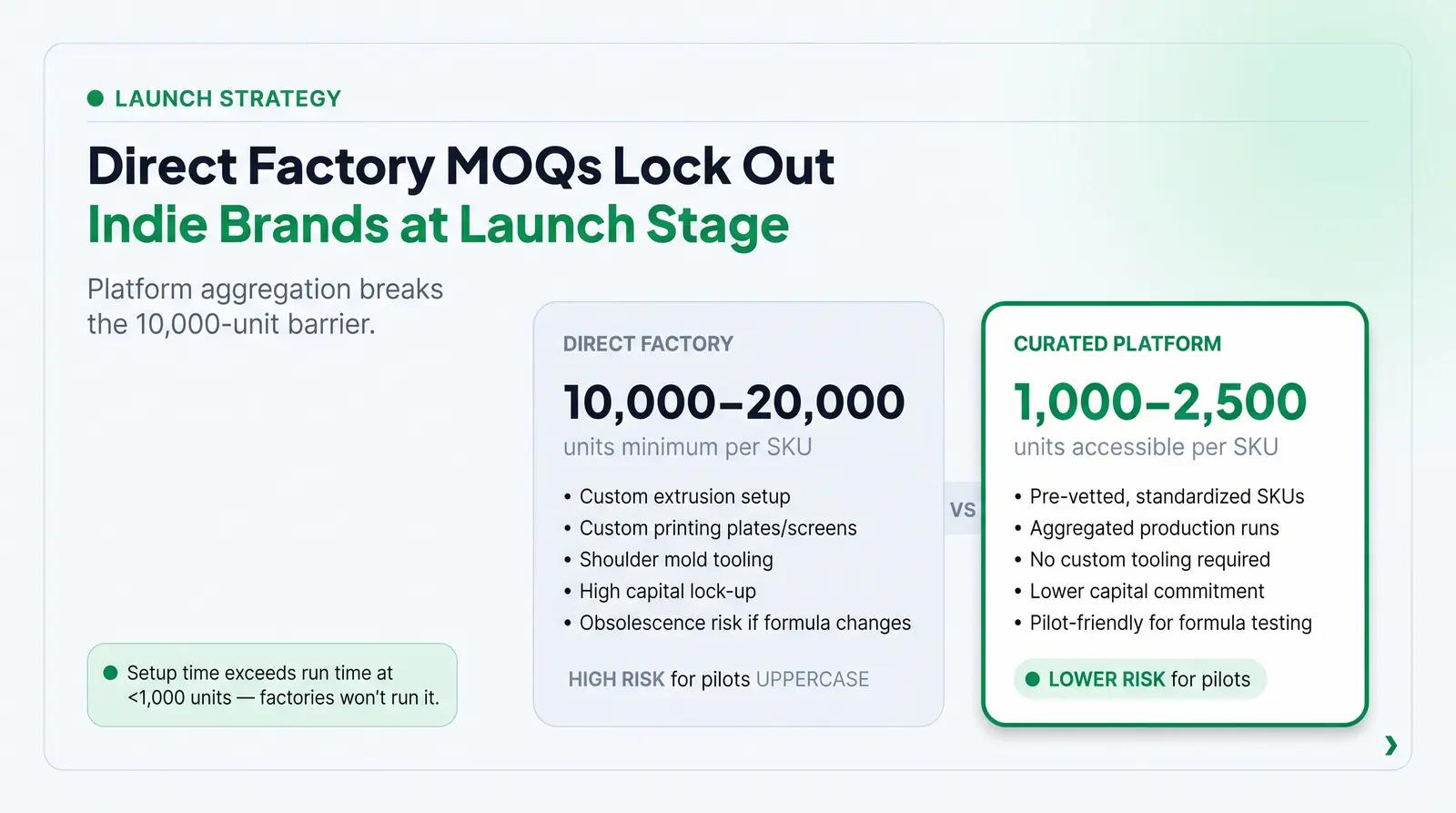
Minimum Order Quantities (MOQs) for custom cosmetic tubes are notoriously high, often shocking new founders. When ordering directly from offshore manufacturers, the MOQ for a fully custom-printed tube typically ranges from 10,000 to 20,000 units per SKU.
Tubes have high MOQs because of the setup costs involved in the manufacturing process. The extrusion lines must be purged and calibrated for specific resin colors, the printing presses require custom plates for offset or screens for silk-screening, and the tooling for the shoulder molds and tail-seal dies must be configured for the exact diameter and shape requested. Running a batch of 1,000 tubes is economically unviable for a factory because the setup time takes longer than the actual production run.
This creates a significant hurdle for independent brands at the launch stage. Ordering 10,000 units ties up capital in inventory and increases the risk of obsolescence if the formula needs tweaking.
This is where platform-aggregated ordering changes the calculus. By utilizing a curated platform, founders can access lower minimums. Platforms achieve this by pre-vetting SKUs, standardizing the tooling (diameters, shoulders, caps), and aggregating smaller orders into larger production runs. This structural difference allows a brand to order 1,000 or 2,500 units of a high-quality tube, mitigating risk during a pilot launch.
The Tube Selection Matrix
The framework we use at Packfolio to guide catalog curation helps match formula needs with packaging realities.
| Formula Category | Barrier Need | Recommended Tube Material | Applicator Type | Decoration Approach | Typical Direct MOQ Range |
|---|---|---|---|---|---|
| Basic Hydration (Lotions, Cleansers) | Low | Mono-material LDPE/HDPE | Flip-top cap | Offset printing (up to 6 colors) | 10,000 - 20,000 |
| Active Skincare (Niacinamide, Peptides) | Medium | PBL (EVOH barrier) | Pump-on-tube or Nozzle | Silk-screen for premium feel | 10,000 - 20,000 |
| Highly Unstable (L-Ascorbic Acid, Retinol) | High | ABL (Aluminum barrier) | Pointed tip or Airless pump | Offset with hot stamping accents | 10,000 - 20,000 |
| Color Cosmetics (BB Creams, Liquid Blush) | Medium | PBL or LDPE | Offset shoulder nozzle | IML or high-definition offset | 10,000 - 20,000 |
Worked Example: Launching a Vitamin C Serum-Cream
Consider a founder launching a 1 oz (30 ml) vitamin C face serum-cream hybrid. The formula has a pH of ~3.5, contains L-ascorbic acid, and has a high water activity. The brand plans a 500-unit pilot run.
The Material Decision: L-ascorbic acid is notoriously unstable and degrades rapidly when exposed to oxygen and light [6]. While a mono-material LDPE tube is more recyclable, it is highly permeable to oxygen. A PBL tube with an EVOH barrier offers better protection, but for a highly sensitive vitamin C formula, ABL (aluminum barrier laminate) wins. The aluminum foil layer provides an absolute barrier, ensuring the vitamin C remains active throughout the product's shelf life.
The Hardware: For a 30 ml volume, a 25 mm or 30 mm diameter tube is appropriate. Because it is a concentrated serum-cream, a nozzle tip applicator is selected to allow the user to dispense small, controlled drops rather than a thick ribbon.
The Decoration: Given the small 500-unit pilot run, traditional custom offset printing directly on the tube (which requires a 10,000 MOQ) is out of the question. The brand must opt for a blank, unprinted stock ABL tube and apply a pressure-sensitive label post-production. The label design must strictly avoid the bottom 15 mm tail seal zone to ensure the contract manufacturer can seal the tubes without the label melting or causing leaks.
What to Verify Before You Order
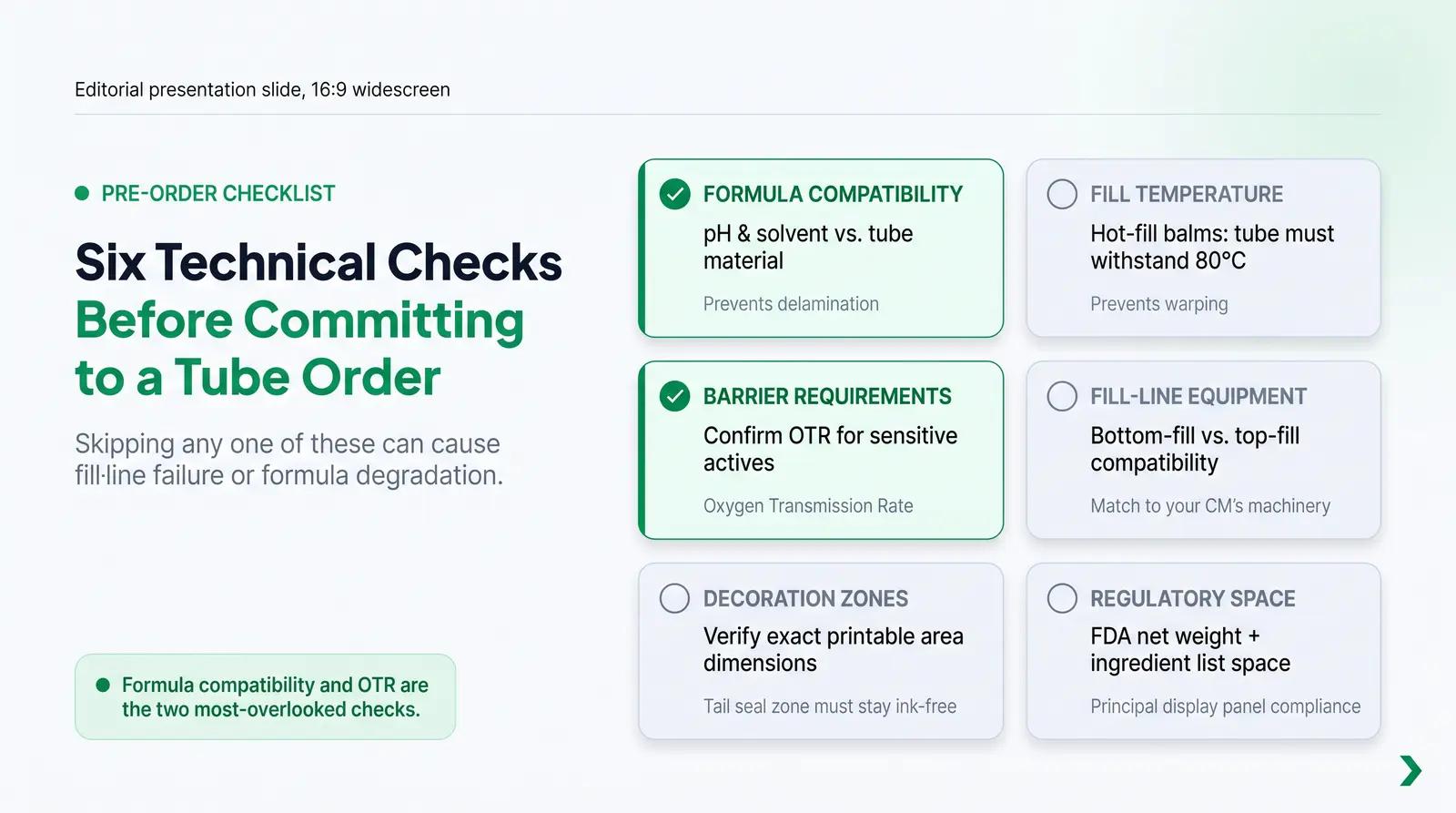
Before committing to a tube order, you must verify several technical specifications to ensure the packaging works flawlessly on the fill line and maintains your formula's integrity.
- Formula Compatibility: Verify the pH and solvent content of your formula against the tube material. Highly acidic formulas or those with aggressive solvents can degrade certain plastics or cause delamination in poorly constructed tubes.
- Fill Temperature: If your product requires a hot-fill process (e.g., thick balms poured at 80°C), ensure the tube material can withstand the heat without warping or shrinking.
- Barrier Requirements: Confirm the Oxygen Transmission Rate (OTR) of the tube if your formula contains sensitive actives.
- Fill-Line Equipment: Confirm whether your contract manufacturer uses bottom-fill or top-fill equipment, and ensure the tube's tail seal requirements match their machinery.
- Decoration Zones: Verify the exact dimensions of the printable area. Packfolio's catalog pre-specifies printable regions, material grades, and barrier options for each tube SKU — so founders can verify compatibility and preview decoration before committing to production, without contacting a supplier.
- Regulatory Space: Ensure your artwork design leaves adequate space for FDA-required elements, including the net weight declaration on the principal display panel and the ingredient list on the information panel [7].
Browse Packfolio's curated cosmetic tube catalog and preview your artwork on a photorealistic 3D model before ordering → packfolio.com/catalog
Frequently Asked Questions
What is the difference between ABL and PBL cosmetic tubes? ABL (Aluminum Barrier Laminate) uses a thin layer of aluminum foil to provide an absolute barrier against oxygen and light, making it ideal for highly sensitive formulas. PBL (Plastic Barrier Laminate) uses a plastic barrier like EVOH, which provides excellent oxygen protection while remaining fully recyclable in standard plastic streams.
What fill method is used for cosmetic squeeze tubes? The vast majority of cosmetic squeeze tubes are bottom-filled. The tube is supplied with the cap already attached, the formula is pumped in through the open tail, and then the tail is sealed using heat or ultrasonic welding.
What materials are cosmetic tubes made from? Most cosmetic tubes are made from polyethylene plastics, specifically LDPE for flexibility and HDPE for rigidity. For enhanced protection, they are manufactured as laminates combining these plastics with barrier layers of EVOH or aluminum foil.
What is the minimum order quantity for custom cosmetic tubes? When ordering directly from offshore manufacturers, the MOQ for fully custom-printed tubes is typically 10,000 to 20,000 units. However, curated platforms can aggregate orders to offer much lower minimums for independent brands.
Are cosmetic tubes recyclable? Mono-material tubes made entirely of HDPE or LDPE, as well as PBL tubes with a low percentage of EVOH, are generally recyclable in standard rigid plastic streams. ABL tubes, which contain mixed plastic and metal layers, are typically not recyclable in municipal systems.
References
[1] Perfektüp Ambalaj, "ABL vs. PBL Laminate Tubes: What’s the Best Packaging Choice for Your Product?", 2025. https://www.perfektup.com/abl-vs-pbl-laminate-tubes-whats-the-best-packaging-choice-for-your-product/ [2] Packaging Dive, "Plastic tube recyclability has ramped up rapidly, but not without some tumult", 2024. https://www.packagingdive.com/news/plastic-tube-recyclability-has-ramped-up-rapidly-but-not-without-some-tumu/715127/ [3] Steng Packaging, "Structure and Process of Cosmetic Tube", 2025. https://www.stengpackaging.com/structure-and-process-of-cosmetic-tube/ [4] Plastic Tubes Committee / Laminate Tubes Committee, "Position Paper on the Recyclability of Plastic Tubes", European Tube Manufacturers Association (etma), 2024. https://linhardt.com/wp-content/uploads/2024/09/Etma_position_paper_recyclability_of_plastic_tubes_revision_2024_final.pdf [5] ThreeBamboo, "Different Printing methods for cosmetic tubes: How Each Technique Boosts The Attractiveness of Products", 2025. https://www.threebamboo.com/different-printing-methods-for-cosmetic-tubes-how-each-technique-boosts-the-attractiveness-of-products/ [6] Yin, X., et al., "Chemical Stability of Ascorbic Acid Integrated into Commercial Products: A Review on Bioactivity and Delivery Technology", Antioxidants, 2022. https://pmc.ncbi.nlm.nih.gov/articles/PMC8773188/ [7] U.S. Food and Drug Administration, "Summary of Cosmetics Labeling Requirements", 2025. https://www.fda.gov/cosmetics/cosmetics-labeling-regulations/summary-cosmetics-labeling-requirements


