
Custom Color Cosmetic Packaging: Costs, MOQs, and Alternatives
Custom color cosmetic packaging requires high MOQs and capital. This guide compares resin pigmentation, spray coating, and metallization costs, then presents lower-MOQ alternatives like labels and shrink sleeves for launch-stage founders.
Founders frequently request a custom color on their primary packaging, assuming it is a simple finish option on a supplier's menu. They select a Pantone shade, request a quote, and are hit with a sudden realization: that single color choice has restructured the entire economics of their order. The MOQ has jumped from 1,000 units to 10,000. The per-unit cost has shifted. The lead time has extended by weeks to accommodate sample approvals, and the initial capital commitment has multiplied several times over.
Custom color is not just an aesthetic choice. It is a fundamental production decision that dictates how a component is manufactured, which factory line it runs on, and what the minimum viable volume is to turn the machines on. Understanding the mechanics behind these minimums is the only way to evaluate whether a custom color run is viable at your current launch scale, or whether a lower-MOQ alternative is the smarter path to market.
This article explains what is actually happening inside the factory when you request a custom color, why the economics shift the way they do, and what alternatives exist for founders who need a cohesive branded look without the capital commitment of a full custom color run.
Why Custom Color Is a Production Decision, Not Just a Finish
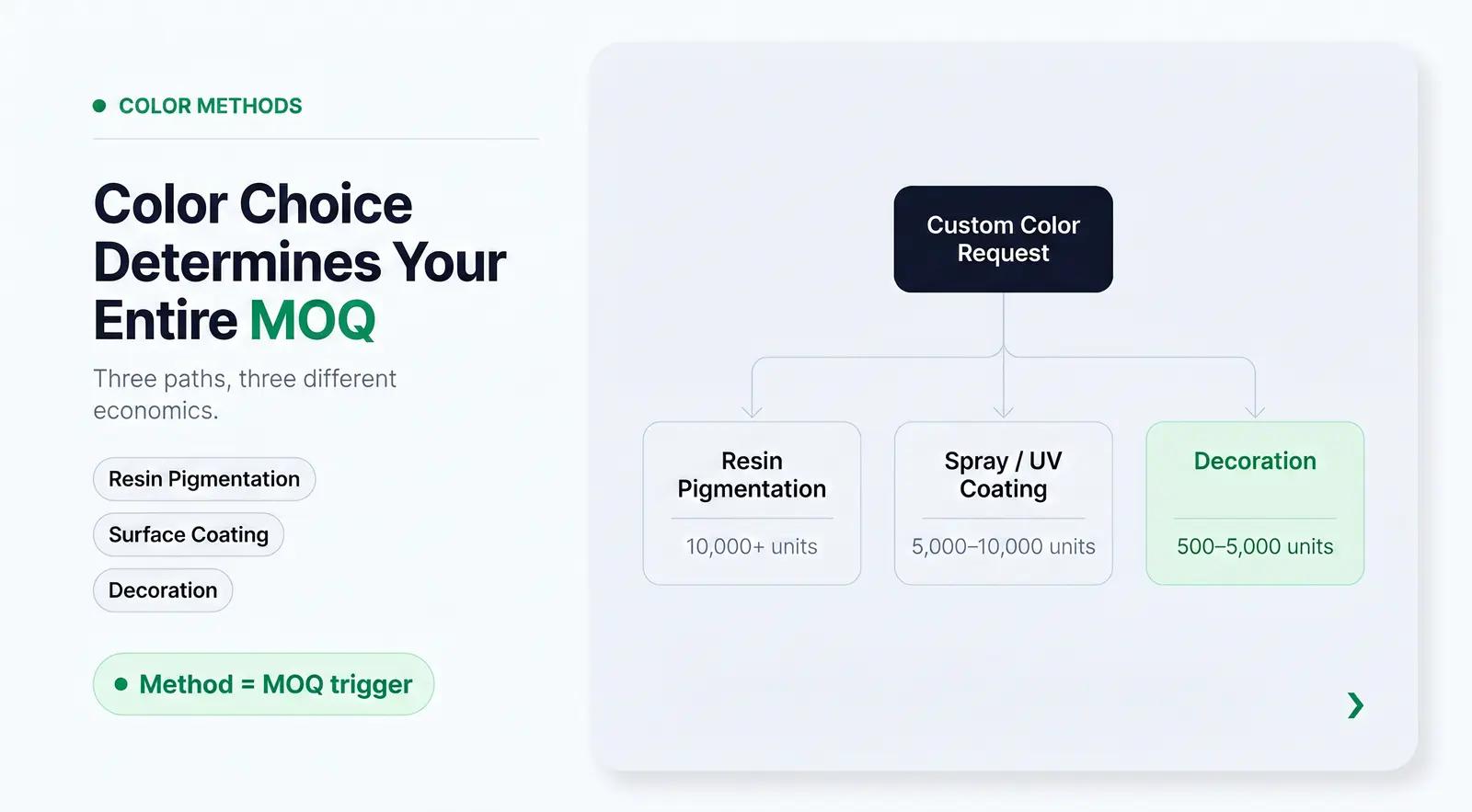
Color on packaging is not applied uniformly across all components or materials. It is achieved through one of three primary avenues: it is either inherent to the material itself (resin pigmentation), applied to the surface after molding (spray coating, UV coating, metallization, or electroplating), or added via decoration (shrink sleeves, labels, hot stamping, or screen printing).
Each of these methods carries different MOQ triggers, cost structures, durability profiles, and formula compatibility constraints. A founder specifying a "custom color bottle" is actually triggering a specific manufacturing process, and the method the supplier chooses—or defaults to—determines the economics of the entire run.
When a supplier receives a Pantone code for a plastic bottle, they must translate that ink-on-paper standard into a physical process. Pantone is designed for ink on coated paper, not for plastic injection molding. The same Pantone chip will appear differently on PETG versus PP versus HDPE, because each polymer absorbs and reflects light differently [4]. This translation is not trivial, and it is one reason why the sample approval process takes as long as it does.
The critical insight is this: the color method is not just a finish choice. It is a manufacturing decision that determines your MOQ, your total capital outlay, your lead time, and your formula compatibility risk. Understanding which method applies to your packaging component is the first step toward making an informed decision.
Color Methods Explained: How Each One Works and What It Costs
To understand why the economics shift, it is necessary to look at the production reality of each coloring method.
Resin Pigmentation (Color Masterbatch)
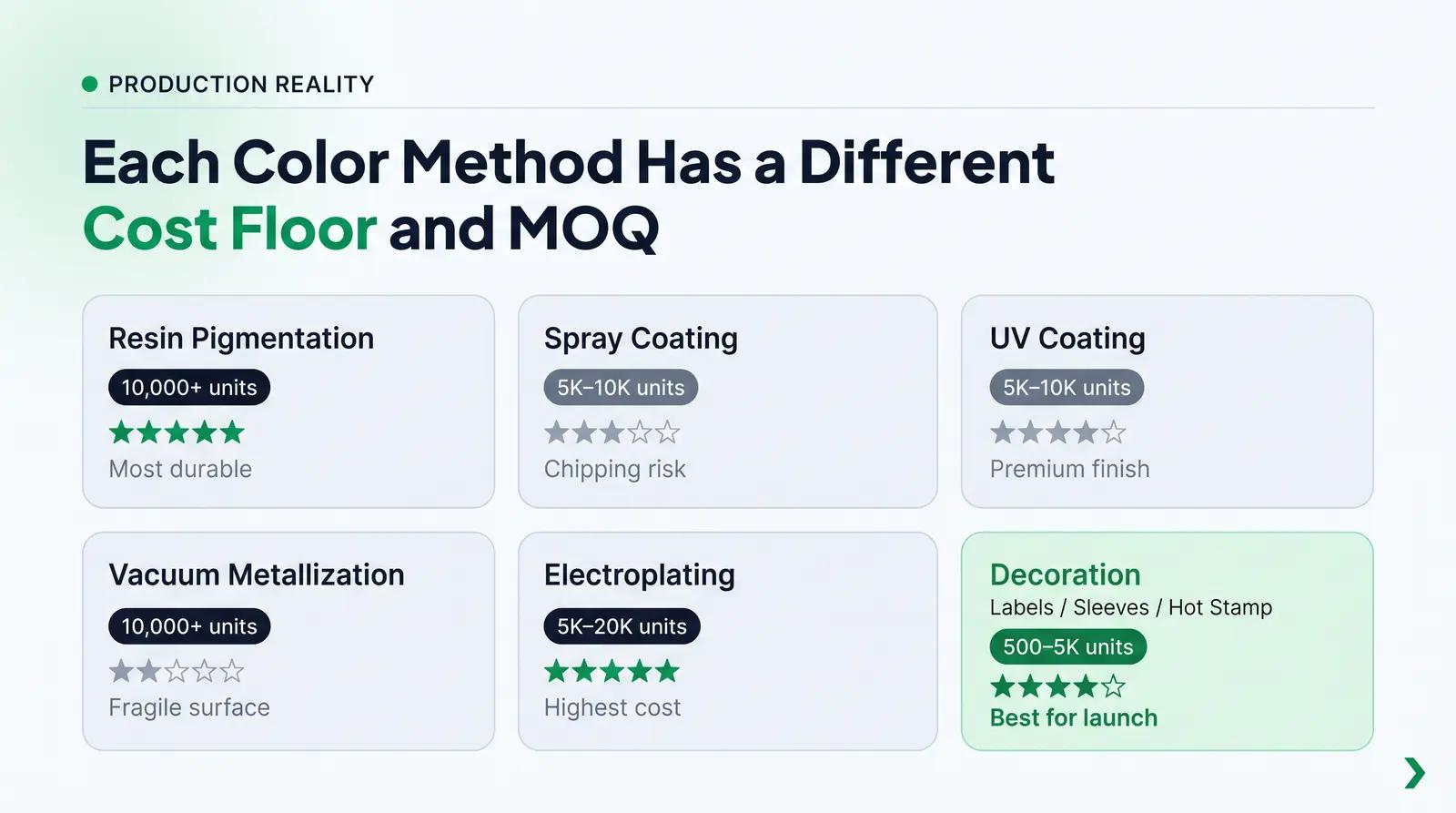
This process involves mixing color pigment, supplied as a masterbatch concentrate, directly into the plastic resin before the component is molded. The color becomes an inherent part of the material rather than a surface application. Because this requires a dedicated batch of resin to be formulated, mixed, and run through the injection or blow molding machines, it triggers the highest minimums in the industry, typically 10,000 units or more per SKU [1].
Pantone matching in resin is possible, but it requires lab iterations. The factory must formulate a custom masterbatch, produce test shots, and compare the result under standardized lighting. Variations in injection temperature, cooling speed, mold surface texture, and pigment loading rate can all affect the final hue [4]. Lot-to-lot color consistency is a genuine quality control concern: two production runs of the same color specification can produce a visible ΔE difference if process parameters drift.
The advantage of resin pigmentation is that it is the most durable and consistent method long-term. The color cannot chip, peel, or degrade from surface exposure. For a proven, high-volume SKU, it is the right call. For a launch-stage product, the capital commitment is often prohibitive.
Spray Coating and Lacquering
Color is applied to the surface of the component after it has been molded. A spray line is set up with the target color, and components are coated in a controlled environment. This method is more flexible than resin pigmentation for smaller batches, but it introduces its own minimums associated with spray line setup, color calibration, and thorough cleaning between color runs [2].
Spray coating offers a wide range of finish options: matte, glossy, soft-touch, frosted, and gradient effects. However, coated packaging carries durability concerns. The coating can chip at edges or high-contact points, and it carries compatibility risks with alcohol-based or oil-based formulas that can degrade the coating over time, causing delamination or discoloration [2]. For founders formulating with high-alcohol toners, facial mists, or oil-rich serums, compatibility testing between the formula and the coated surface is non-negotiable.
UV Coating and Specialty Coatings
UV coating is a premium surface option cured by ultraviolet light rather than air-drying. It offers enhanced durability, a high-gloss or satin finish, and better resistance to scratching and chemical degradation than standard spray lacquers. UV coatings are commonly used for premium skincare and fragrance packaging where a flawless, glass-like surface is part of the brand identity. The higher durability comes at a higher unit cost, and the specialized equipment requirements often push MOQs higher than standard spray coating.
Vacuum Metallization
Vacuum metallization, also called physical vapor deposition (PVD), involves vaporizing metal, typically aluminum, in a vacuum chamber and depositing it onto the packaging surface [3]. The result is a highly reflective, chrome, or mirror-like finish that reads as premium and luxurious. The deposited metal layer is extremely thin, typically 20 to 100 nanometers, which creates the reflective surface while minimizing material usage [3].
The limitations are significant for cosmetic packaging applications. The thin metallic layer is susceptible to surface scratching, and a protective topcoat is usually required to extend durability. Vacuum metallized surfaces can be incompatible with certain active formulas, particularly those with high acidity or oxidizing agents, and require careful consideration depending on the fill type. MOQs are driven by chamber capacity and the fixed cost of the vacuum setup cycle.
Electroplating
Typically reserved for metal components and closures, electroplating uses an electrical current to deposit a layer of metal onto a substrate via an electrolytic bath [3]. It offers higher durability and a heavier, more premium feel than vacuum metallization. The economics of electroplating differ substantially from plastic metallization: the process involves chemical baths, strict environmental controls, and complex setup, all of which drive higher costs and higher minimum volumes. There are also environmental and regulatory considerations around the chemical waste streams generated by electroplating operations.
Cap and Closure Color Matching: The Separate MOQ Problem
This is the production problem that most content on custom color packaging ignores entirely, and it is one of the most common sources of founder frustration.
Caps and closures are often sourced from different suppliers or manufactured on different production lines than the primary bottle or component. A glass dropper bottle and its plastic dropper cap, for example, are almost certainly manufactured in different facilities. Matching a custom color across two separate production runs, potentially using two different base materials (such as a PETG bottle and a PP cap), means managing two separate resin batches or coating runs, two separate color approval processes, and two separate MOQ commitments.
The ΔE tolerance between the bottle and the cap is a real measurement problem. A ΔE of 2.0 or less is generally considered the threshold for visual indistinguishability under standardized lighting [4]. Achieving this across two different materials, processed in two different factories, is technically challenging and often requires multiple rounds of iteration. When it fails, the result is a product where the bottle and cap read as slightly different colors, which consumers perceive as a quality control failure rather than an intentional design choice [5].
MOQ Reality Check: Where the Minimums Actually Come From
The jump in MOQ for custom color is not an arbitrary supplier markup. It is a reflection of factory physics and supply chain economics.
For resin pigmentation, the minimums are driven by the raw material supply chain. Pigment masterbatch is ordered in bulk from colorant suppliers, and injection molding machines require a minimum volume of material to purge the previous color, stabilize the new formulation, and produce consistent output. Running a machine for 1,000 units of custom resin is financially unviable for the factory because the setup cost is amortized across too few units. The typical floor for custom resin color is 5,000 to 10,000 units per SKU, with many suppliers requiring 10,000 as a hard minimum [1].
For surface applications like spray coating or metallization, the cost driver is setup. A spray line must be calibrated to the target color, run for a test batch to confirm color accuracy, and then thoroughly cleaned before the next color can run. This changeover cost is largely fixed, whether the production run is 2,000 units or 20,000 units. To keep the per-unit cost at a level that makes commercial sense for both parties, the factory enforces a minimum that spreads the setup cost across enough units.
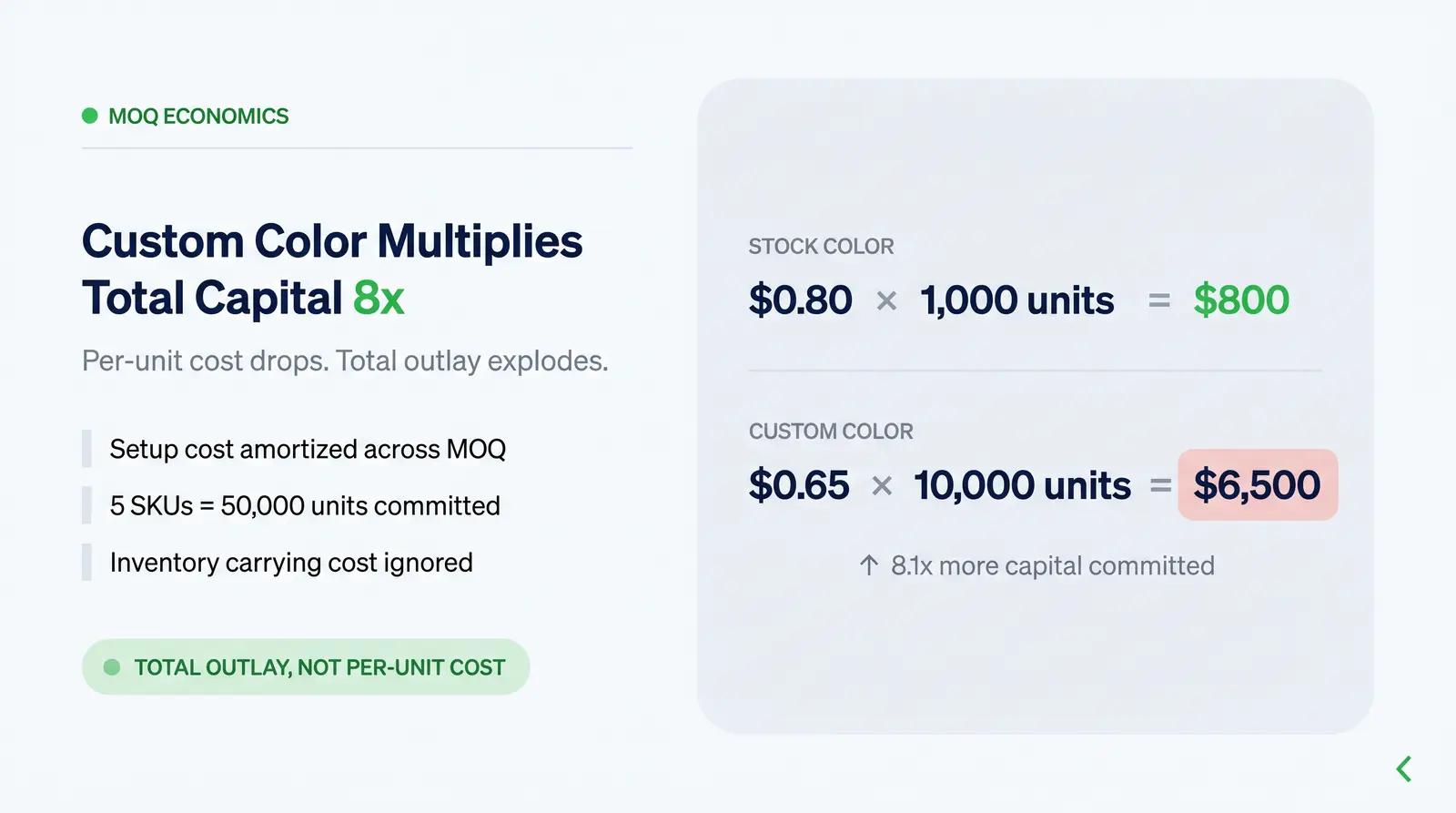
The relationship between MOQ, unit cost, and total capital commitment is where founders most often miscalculate. The mental model is typically: "custom color is more expensive per unit, so I need to budget for a higher per-unit cost." The actual model is: "custom color requires a higher MOQ, so my total capital commitment multiplies even if the per-unit cost is lower."
A stock bottle might cost $0.80 at a 1,000-unit MOQ, for a total outlay of $800. A custom color version of that same bottle might cost $0.65 per unit, but require a 10,000-unit MOQ, for a total outlay of $6,500—plus the cost of the sample approval process, plus the carrying cost of 10,000 units of inventory instead of 1,000. The per-unit cost went down. The total capital commitment went up by more than eight times.
For a 5-SKU line, this math compounds quickly. Custom color at 10,000 units per SKU means committing to 50,000 total units before a single product has been sold.
The Sample Approval Process (and Why It Takes Longer Than You Think)
A proper custom color sample approval process is rigorous and time-consuming. It rarely begins and ends with sending a Pantone code.
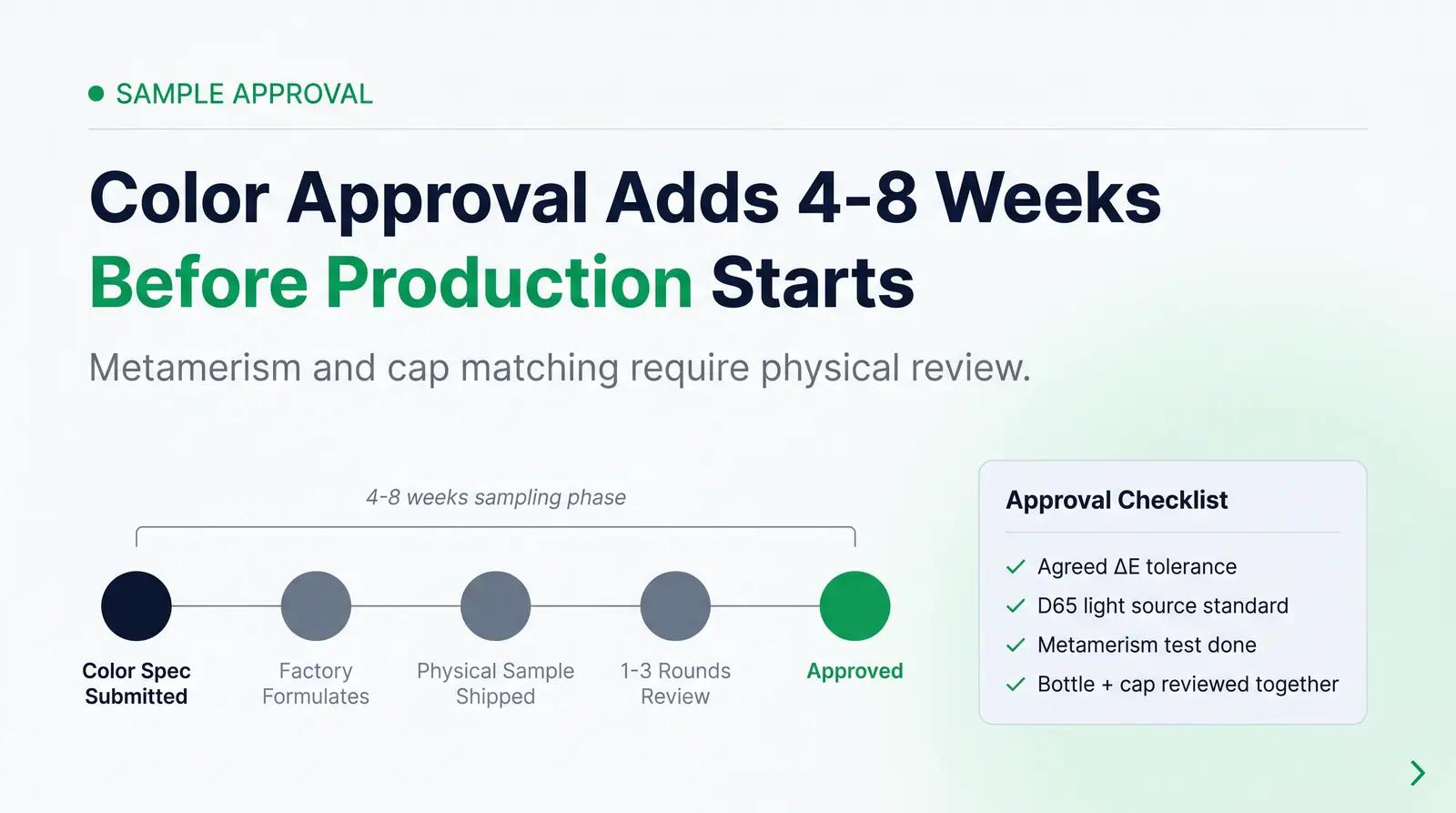
The process starts with a color standard submission. This can be a Pantone chip, a RAL code, a physical swatch, or a digital specification. The factory then formulates a match, typically producing a masterbatch color card or a coated sample, and ships it for review. It is normal to go through one to three rounds of iteration to dial in the hue, especially when translating a paper Pantone chip to a plastic substrate [4].
Physical sample review must account for metamerism: the phenomenon where two colors appear identical under one light source but shift relative to each other under a different light source [4]. A dusty rose that matches perfectly under a D65 lab light may appear more pink under warm indoor lighting and more grey under cool LED retail lighting. This is not a defect in the factory's color matching, it is a physical property of how the pigments interact with different wavelengths of light. Approvals done under a single light source without metamerism testing are a common source of production surprises.
The cap match delta must also be reviewed in physical form, not just digitally. The bottle and cap should be reviewed side by side under multiple light sources before approving the production run.
Before approving, founders should request documentation that specifies the agreed-upon ΔE tolerance, the light source standard used for the approval, and the lot number of the approved sample. This documentation becomes the reference standard for the production run and for any quality disputes that arise after delivery.
The full timeline from color spec submission to approved sample to production-ready is typically four to eight weeks for the sampling phase alone, before production begins. For founders with a fixed launch date, this timeline must be factored into the product development schedule from the start.
Lower-MOQ Alternatives That Achieve a Branded Color Look
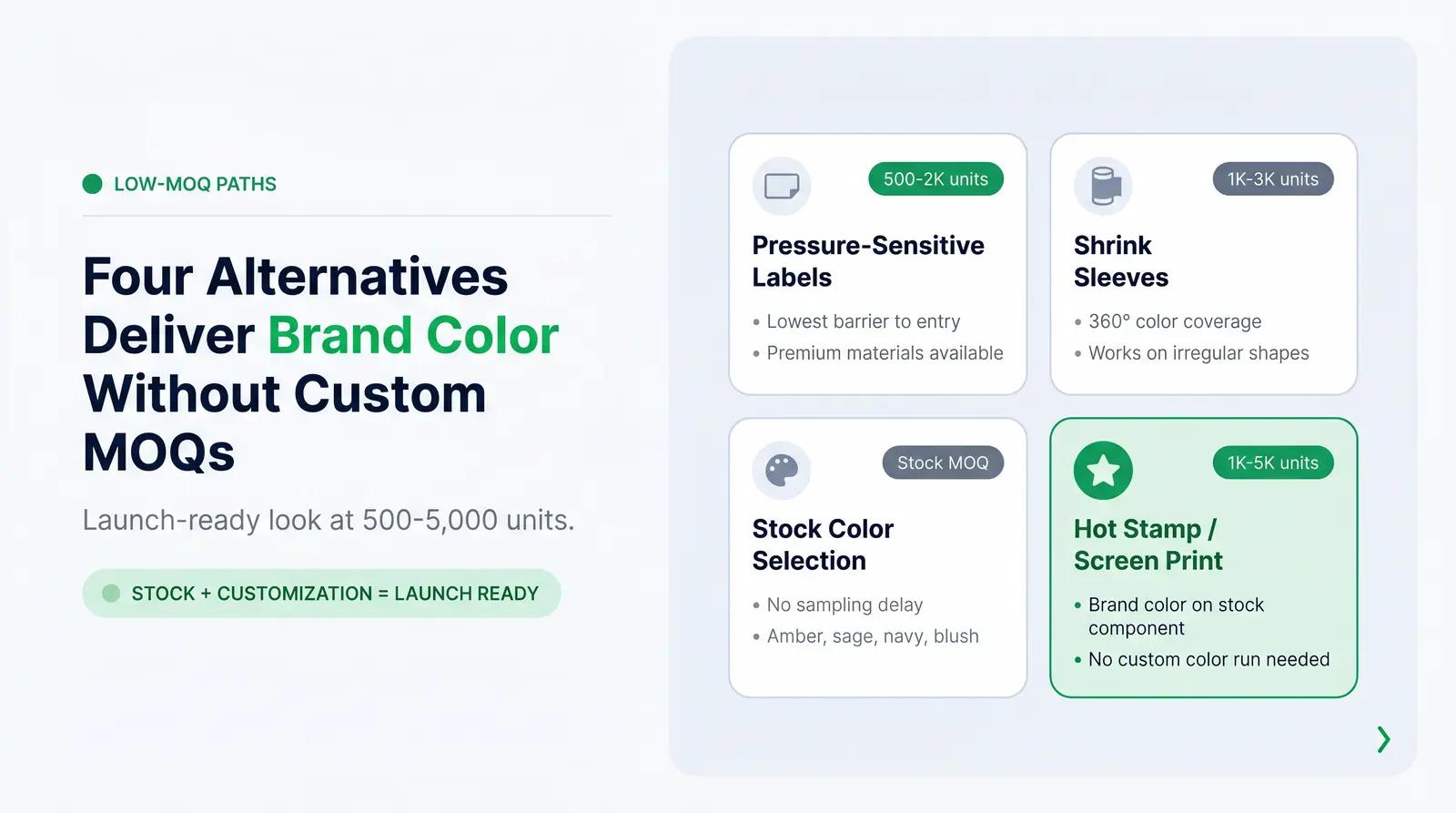
For founders who cannot meet custom color MOQs or absorb the extended timelines at their current stage, there are highly effective alternatives that achieve a fully branded look without the capital commitment of a custom color production run.
Shrink Sleeves
Shrink sleeves offer a full-wrap or partial-wrap 360-degree canvas printed in CMYK or spot colors. They are achievable at significantly lower MOQs than resin pigmentation or custom coating, often in the range of 1,000 to 3,000 units, and they work across a wide range of bottle shapes including irregular forms that labels cannot wrap cleanly. The printed sleeve can carry the brand's full color palette, including the signature color, across the entire surface of the component.
Limitations include the tactile feel of the sleeve material, which differs from a glass or plastic surface, recyclability considerations depending on the sleeve material and the substrate, and the need for application equipment at smaller production scales. For founders working with a contract manufacturer or co-packer, sleeve application is typically available as a service.
Pressure-Sensitive Labels
Labels present the lowest barrier to entry and the highest flexibility. Modern label materials include metalized films, textured papers, kraft stocks, clear films, and specialty materials that can achieve a highly premium look at MOQs as low as 500 units with digital printing. A well-designed label on a consistent stock bottle can read as more premium than a poorly executed custom color run, because the design execution is entirely within the brand's control and the label material itself can carry significant visual weight.
The key insight is that a label does not have to look like a label. A flood-coated label in a signature color, printed on a premium material and applied to a frosted or clear glass bottle, can achieve the color story the brand needs without triggering any of the custom color MOQ minimums.
Selecting Stock Colors Strategically
Many component suppliers maintain a palette of stock colors that goes beyond the standard clear, white, and black. Amber, frosted, sage green, navy, and blush options are available from multiple suppliers at stock MOQs. Choosing a stock color that aligns with or complements the brand palette is a legitimate and often overlooked strategy, particularly at the launch stage. It preserves low MOQs, eliminates the sample approval process, and delivers a consistent color that is already production-proven.
Hot Stamping and Screen Printing on Stock Components
These are decoration-only customizations that preserve the stock MOQ while adding brand color directly to the component surface. Hot stamping applies metallic foil using heat and pressure, creating a metallic finish or colored imprint. Screen printing applies ink directly to the component surface in one or more colors. Both methods work exceptionally well for caps, closures, and components with flat or cylindrical print surfaces, allowing for a brand color or metallic accent to appear on the component itself without requiring a custom color production run.
Here is a contrarian reality that many founders miss: a custom color bottle with a non-matching stock cap is often worse for brand perception than a stock-color bottle with excellent label design. Color inconsistency between components reads as a quality control failure to consumers [5]. A well-executed label on a consistent stock component reads as intentional design. Resin-pigmented color is actually the most consistent option long-term, but it requires the highest upfront MOQ commitment, making it the right call for proven SKUs and often the wrong call for launch-stage products. The goal is not custom color for its own sake. The goal is a coherent brand presentation, and that can be achieved through multiple paths.
How to Decide: A Framework by Launch Stage
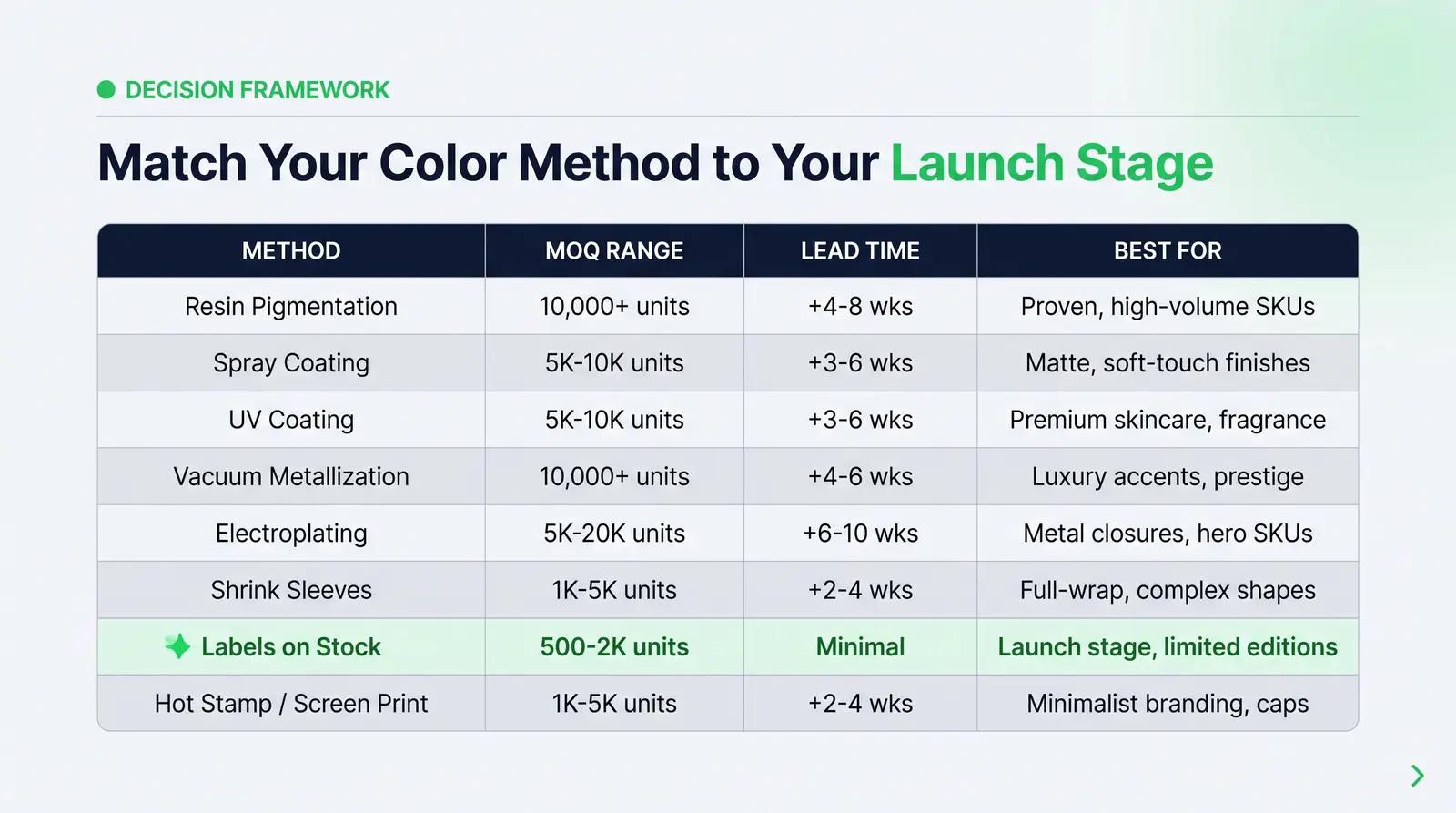
The following Color Method Selection Matrix is the framework we recommend at Packfolio for founders evaluating their color strategy. It maps each method against the key decision variables: MOQ range, cost tier, lead time impact, durability, and the stage at which it makes the most sense.
| Color Method | Typical MOQ Range | Cost Tier | Lead Time Impact | Durability | Best For |
|---|---|---|---|---|---|
| Resin Pigmentation | 10,000+ units | Low per unit, high total | +4-8 weeks (sampling) | Excellent | Proven SKUs, high-volume scaling |
| Spray Coating | 5,000 - 10,000 units | Medium | +3-6 weeks | Moderate (chipping risk) | Specific finishes: matte, soft-touch |
| UV Coating | 5,000 - 10,000 units | Medium-High | +3-6 weeks | Good | Premium skincare, fragrance |
| Vacuum Metallization | 10,000+ units | High | +4-6 weeks | Low to Moderate | Luxury accents, prestige lines |
| Electroplating | 5,000 - 20,000 units | Very High | +6-10 weeks | Excellent | Metal closures, hero SKUs |
| Shrink Sleeves | 1,000 - 5,000 units | Low to Medium | +2-4 weeks | Moderate | Full-wrap graphics, complex shapes |
| Labels on Stock | 500 - 2,000 units | Low | Minimal | High (material dependent) | Launch stage, limited editions |
| Hot Stamp/Screen Print | 1,000 - 5,000 units | Medium | +2-4 weeks | High | Minimalist branding, caps/closures |
The framework reveals a clear pattern: methods that produce the most consistent, durable, and premium color result require the highest capital commitment and the longest lead times. Methods that offer the lowest capital commitment and fastest time to market require accepting some trade-off in color coverage or surface feel.
For most founders at the launch stage, the Color Method Selection Matrix points toward labels or sleeves on stock components. For founders scaling a proven SKU with demonstrated sell-through, the matrix points toward resin pigmentation as the long-term, most consistent solution.
Worked Example: Launching a 5-SKU Vitamin C and Face Oil Line
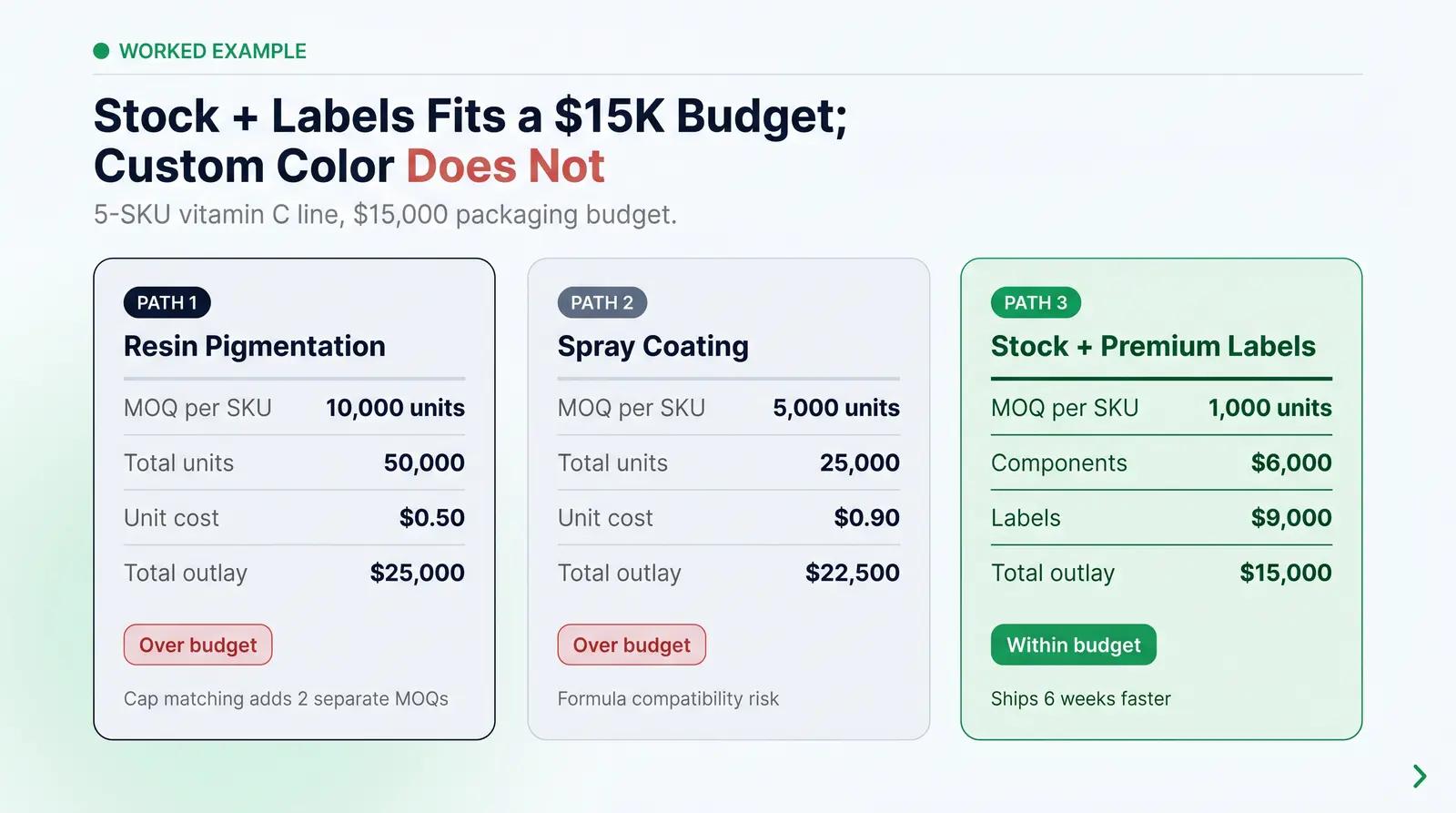
Consider a founder launching a 5-SKU vitamin C serum and face oil line. She wants a signature dusty rose color across all bottles and caps, and she has a $15,000 packaging budget for her initial production run.
Path 1: Custom Resin Pigmentation
If she pursues custom resin pigmentation for the dusty rose color, she faces a 10,000-unit MOQ per SKU. Across 5 SKUs, that is 50,000 total units. Even at a competitive $0.50 per unit for a glass dropper bottle, her total packaging commitment is $25,000, which exceeds her $15,000 budget before accounting for freight, customs, or the sample approval process. The sampling phase alone will add six to eight weeks to her launch timeline.
She also discovers that her dropper caps are sourced from a different factory than her glass serum bottles. Matching the dusty rose across a glass coating process and a plastic PP cap requires two separate approval processes, two separate MOQs, and introduces a meaningful risk of a visible ΔE mismatch between the bottle and the cap. If the match is off, the product reads as a quality control failure rather than a deliberate color story.
Path 2: Spray Coating
Spray coating the bottles reduces the MOQ to approximately 5,000 units per SKU, for a total of 25,000 units. At $0.90 per unit (accounting for the coating cost), the total outlay is $22,500, still over budget. The cap matching problem persists, and the compatibility risk with her vitamin C serum, which has a low pH and may contain alcohol, requires compatibility testing before committing to a coated bottle.
Path 3: Stock Components with Premium Labels
The smarter alternative path: she selects high-quality stock frosted glass bottles and white stock dropper caps at an MOQ of 1,000 units per SKU. At $1.20 per unit for the frosted glass bottle, her total component cost for 1,000 units across 5 SKUs is $6,000. She invests the remaining $9,000 in premium, textured pressure-sensitive labels in her signature dusty rose color, printed on a metalized film stock that reads as premium and intentional.
Her total packaging outlay is under $15,000. She eliminates the six-week color sampling delay. She goes to market with a cohesive, premium look at launch-appropriate quantities. And critically, the color consistency across all five SKUs is guaranteed because every bottle carries the same label design on the same stock component.
These figures are illustrative industry ranges, not guaranteed quotes. Actual pricing will vary based on component specification, supplier, and volume.
Packfolio's catalog includes premium cosmetic packaging SKUs, including bottles, jars, droppers, airless pumps, and lip components, available in stock colors with predefined print zones. A founder can achieve a fully branded look using label or sleeve customization, preview the result on a photorealistic 3D model, and order without coordinating directly with suppliers. For founders not yet ready for a custom color production run, it is a straightforward way to go to market with a cohesive look at launch-appropriate minimums. Explore the catalog at packfolio.com/catalog.
For more on how Packfolio approaches packaging sourcing and quality coordination, visit packfolio.com.
You are evaluating your color strategy before committing capital to a production run. Packfolio makes it possible to use a stock-plus-customization path, preview your exact design in 3D, and secure your packaging without managing supplier coordination.
Browse Packfolio's curated cosmetic packaging catalog and preview your label or sleeve design in 3D before ordering. packfolio.com/catalog
Frequently Asked Questions
What is the minimum order quantity for custom color cosmetic packaging?
For custom resin pigmentation or custom spray coating, the industry standard MOQ is typically 10,000 units per SKU, though some suppliers offer 5,000 units for specific components [1]. Lower volumes are generally not viable for true custom color production because the setup costs cannot be amortized across too few units. Founders who need branded color at lower quantities are better served by premium labels or shrink sleeves on stock components.
How do I match my brand's Pantone color to plastic packaging?
Pantone codes are designed for ink on coated paper, not for plastic. To match a Pantone color to packaging, the factory must formulate a custom color masterbatch or coating, produce physical samples, and iterate until the ΔE tolerance is acceptable under standardized lighting, typically D65 [4]. This process usually requires one to three rounds of physical samples and adds four to eight weeks to the development timeline. Providing a physical swatch in addition to a Pantone code improves accuracy.
Is spray-coated packaging safe for skincare formulas?
Spray coatings can degrade or delaminate when exposed to certain active ingredients, high alcohol content, or essential oils [2]. This is particularly relevant for vitamin C serums, alcohol-based toners, and oil-rich face oils. Compatibility testing between the specific formula and the coated packaging is required before committing to a production run. Request a coated sample from the supplier and conduct a stability test with your formula before approving.
What is the difference between metallized and electroplated cosmetic packaging?
Vacuum metallization deposits an extremely thin layer of vaporized aluminum, typically 20 to 100 nanometers, onto a component in a vacuum chamber, creating a mirror finish that is visually striking but relatively fragile [3]. Electroplating uses an electrical current to bond a thicker, more durable metal layer to the substrate, typically resulting in a heavier, more premium feel at a significantly higher cost and with more complex environmental controls required in production [3].
Can I get custom color packaging with a low MOQ?
True custom color, meaning pigmented resin or custom coating, is rarely available at low MOQs because the factory setup costs require a minimum volume to be financially viable. To achieve a custom color look at a low MOQ of 500 to 2,000 units, the most effective strategy is to apply a full-color shrink sleeve or a flood-coated premium label to a stock component. This approach delivers the brand color story without triggering custom color production minimums.
References
[1] AH Packaging. "MOQ for Different Packaging Types: Bottles, Jars, Boxes, and More." 2025. https://ahpackaging.com/moq-for-different-packaging-types/
[2] APG. "What types of spray coatings are used on cosmetic bottles." A Packaging Group. https://apackaginggroup.com/blogs/news/what-types-of-spray-coatings-are-used-on-cosmetic-bottles
[3] Sharretts Plating. "Comparing Electroplating to Vacuum Metallizing." 2023. https://www.sharrettsplating.com/blog/electroplating-vs-vacuum-metallizing/
[4] AH Packaging. "Why Is It So Difficult to Match Custom Colors for Cosmetic Packaging Bottles?" 2026. https://ahpackaging.com/why-is-it-so-difficult-to-match-custom-colors-for-cosmetic-packaging-bottles/
[5] Srivastava P, Ramakanth D, Akhila K, Gaikwad KK. "Package design as a branding tool in the cosmetic industry: consumers' perception vs. reality." SN Bus Econ. 2022. https://pmc.ncbi.nlm.nih.gov/articles/PMC9123395/
[6] Steiner K, Florack A. "The Influence of Packaging Color on Consumer Perceptions of Healthfulness: A Systematic Review and Theoretical Framework." Foods. 2023. https://pmc.ncbi.nlm.nih.gov/articles/PMC10648973/
[7] Lucas Ji. "Pantone Colors in Cosmetic Packaging: Best Practices and Tips." UKPACK. 2024. https://www.ukpackchina.com/pantone-colors-in-cosmetic-packaging/
[8] Synponh. "Three Methods to Add Metallic Finish to Packaging Materials." 2025. https://www.synponh.com/three-methods-to-add-metallic-finish-to-packaging-materials/


