
Dropper Bottle Sizes Explained for Beauty Brands
This guide explains standard dropper bottle sizes and provides a five-criteria framework to help beauty brands choose the right capacity for dosage, compliance, and brand positioning.
For independent beauty founders and formulators, selecting the right dropper bottle size often feels like a guessing game. The common confusion usually starts when a sample arrives: a "30 ml" bottle does not actually hold 30 ml of product when filled to the brim, the visual proportions look unexpectedly stout compared to the 3D render, and the label area is suddenly too small to fit the mandatory compliance text. This disconnect between nominal volume, fill volume, and physical dimensions leads to costly delays, artwork redesigns, and sometimes, packaging that undermines the perceived value of the formulation inside.
Choosing a dropper bottle size is not just a matter of picking a capacity from a supplier's catalog. It is a strategic decision that affects dosage behavior, brand perception, regulatory compliance, and reorder economics. This guide walks through the realities of dropper bottle sizing, providing the practical framework needed to make a confident decision before committing to a minimum order.
The Disconnect Between Nominal Volume and Reality
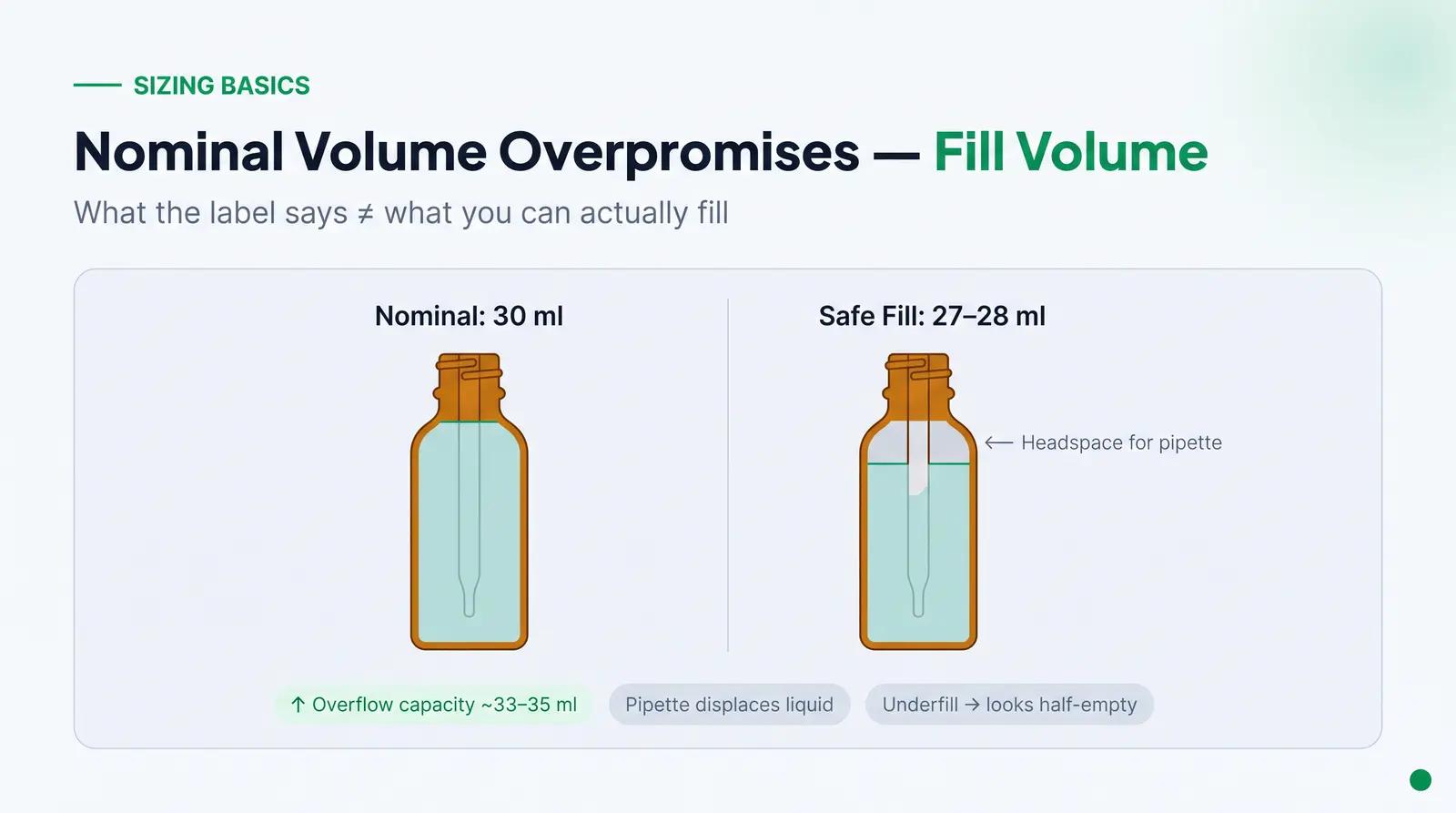
The most frequent source of friction in primary packaging selection is the difference between nominal volume and practical fill volume. When a supplier lists a 30 ml (1 oz) glass dropper bottle, 30 ml is the nominal capacity. However, the actual overflow capacity, the volume if filled to the absolute brim, is typically higher, often around 33 ml to 35 ml.
More importantly, a dropper bottle cannot be filled to the brim. The glass pipette displaces liquid when inserted. If a bottle is overfilled, inserting the dropper will cause the product to overflow and compromise the neck threads, leading to leaks and a poor user experience. Conversely, if a founder assumes a 30 ml bottle only holds 25 ml safely and underfills it, the consumer receives a package that looks half-empty. Understanding this headspace requirement is critical before finalizing formulation batches.
Beyond volume, visual proportions play a massive role in brand perception. Two 30 ml bottles can have entirely different height-to-diameter ratios. A tall, slender Euro-style dropper looks significantly different on a shelf or in flatlay photography than a classic, stout Boston Round. These physical dimensions also dictate the available label area, which becomes a severe constraint at smaller sizes when trying to fit an INCI ingredient list, directions, and net weight declarations.
Standard Dropper Bottle Sizes in Cosmetics
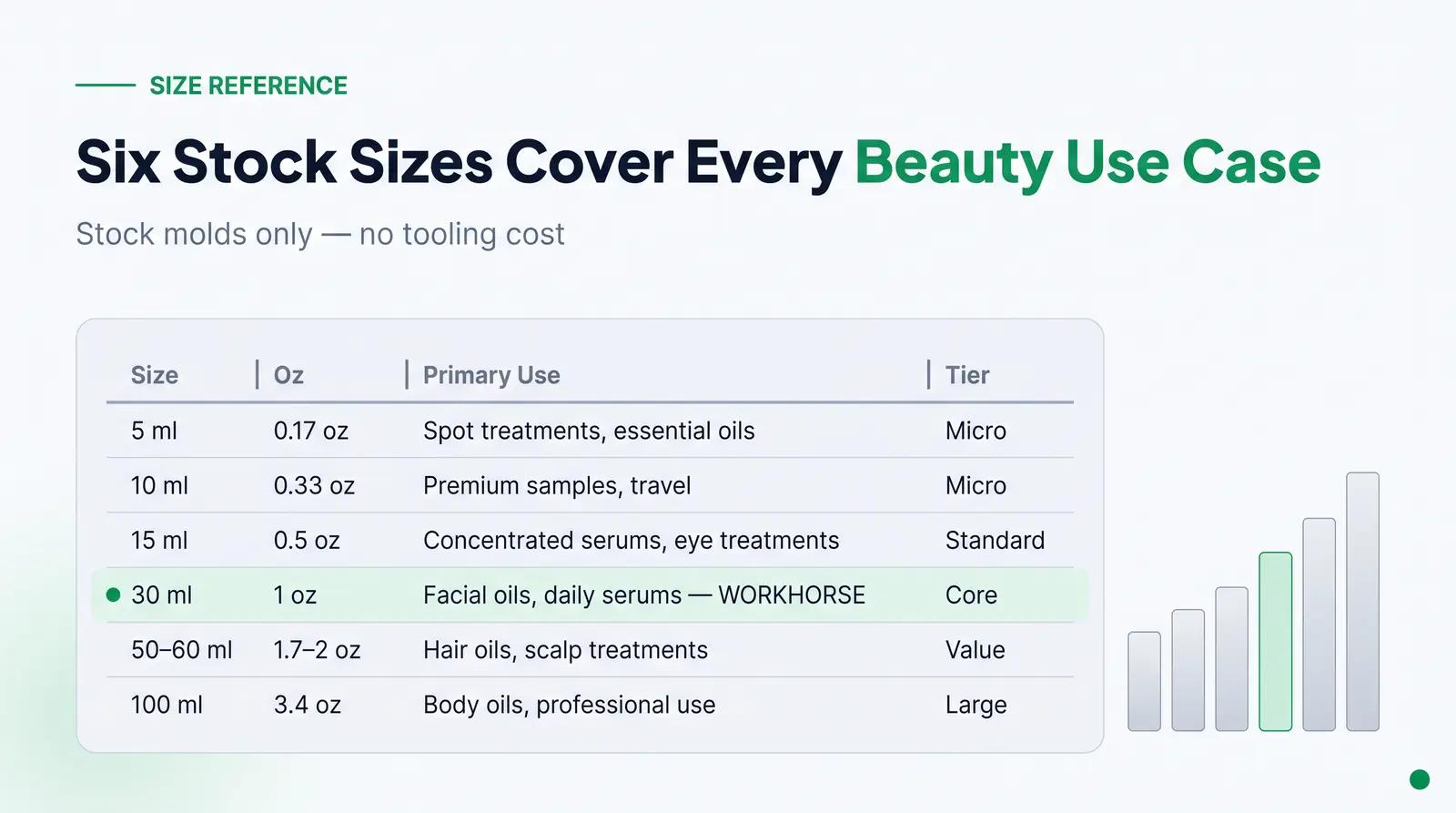
The beauty industry relies on a standard range of glass dropper bottle sizes, typically measured in milliliters (ml) with fluid ounce (oz) equivalents for the US market. While custom molds exist, most brands launch using stock sizes to avoid exorbitant tooling costs.
- 5 ml (0.17 oz) and 10 ml (0.33 oz): These are micro-sizes, primarily used for high-potency spot treatments, essential oil blends, or premium sample/travel sizes.
- 15 ml (0.5 oz): A standard size for concentrated facial serums, eye treatments, and active-heavy formulations where the daily dose is minimal.
- 30 ml (1 oz): The undisputed workhorse of the beauty industry. This is the most common size for facial oils, daily serums, and beard oils.
- 50 ml (1.7 oz) and 60 ml (2 oz): These medium-to-large sizes are typically reserved for lower-cost daily serums, hair oils, scalp treatments, and wellness tinctures.
- 100 ml (3.4 oz): The largest standard size, usually employed for body oils, massage blends, or professional back-bar use.
Matching Bottle Size to Product Type and Dosage
The most functional way to choose a bottle size is to reverse-engineer the decision based on how the consumer will use the product. Different formulations have different viscosities, which changes the size of the drop dispensed by the pipette.
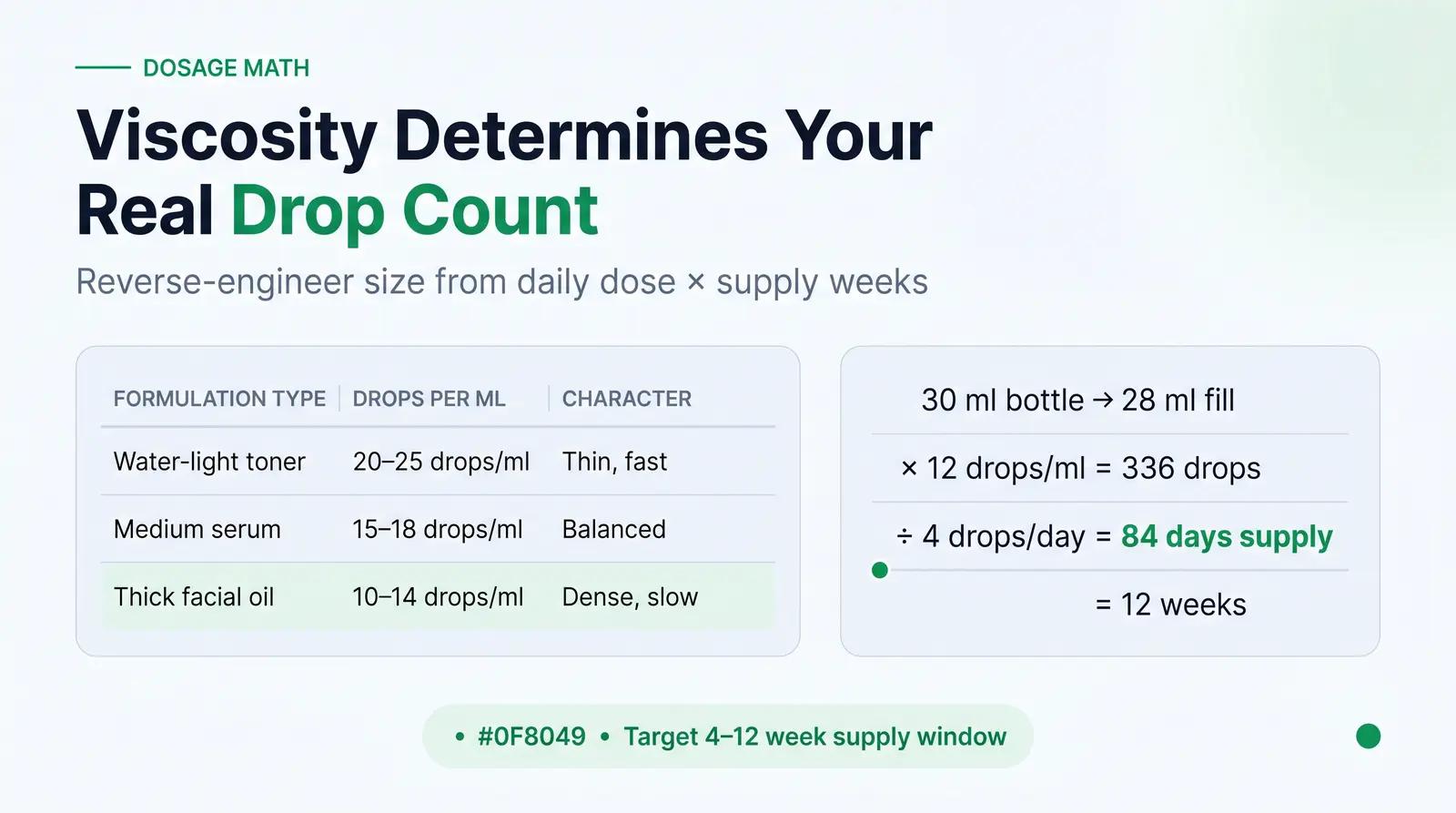
For a water-like toner or very light essence, a standard pipette dispenses about 20 to 25 drops per ml [1]. However, for a medium-viscosity facial serum, that number drops to 15 to 18 drops per ml [1]. For a high-viscosity facial oil or thick retinol blend, a single ml might only yield 10 to 14 drops [1].
Consider a thick facial oil packaged in a 30 ml (1 oz) bottle. Assuming a conservative fill volume of 28 ml and a yield of 12 drops per ml, the bottle holds roughly 336 drops. If the directed use is 4 drops per day, that 30 ml bottle provides an 84-day supply (about 12 weeks). If that same oil were placed in a 15 ml (0.5 oz) bottle, the supply drops to 6 weeks. Formulators must align the bottle size with the product's Period After Opening (PAO) and the desired repurchase cadence. A 100 ml bottle of a daily facial serum might last a consumer nearly a year, which stretches the repurchase cycle too far and risks the product oxidizing before it is finished.
Brand Perception and Shelf Presence
In the prestige beauty tier, packaging is a vehicle for brand communication. The physical weight of the glass, the height-to-diameter ratio, and the finish all contribute to the perceived value of the product, which in turn justifies the retail price point [2].
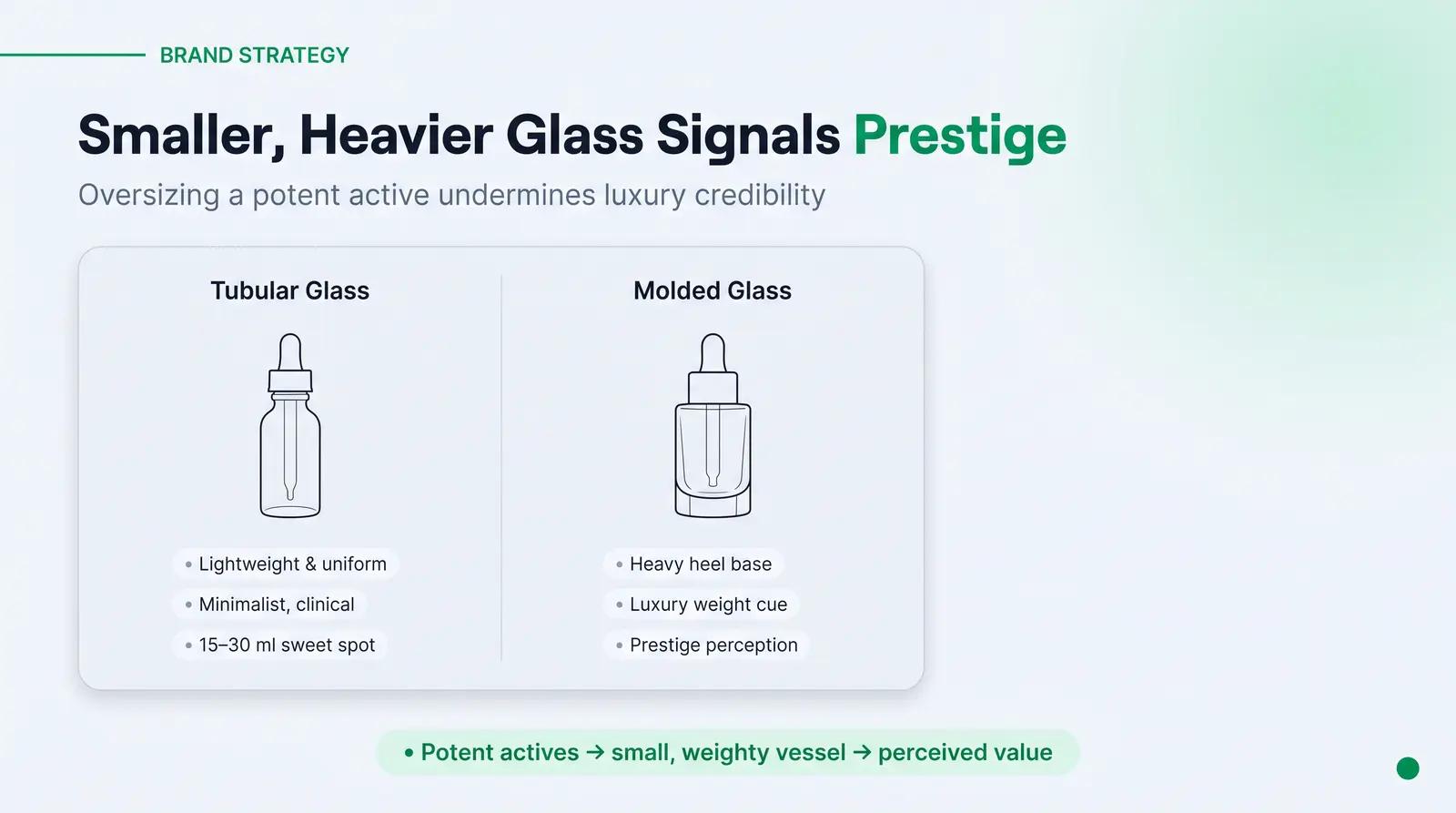
A 30 ml bottle in a tall, thick-walled tubular glass format feels entirely different in the hand than a 30 ml molded glass Boston Round. Tubular glass is often lighter and highly uniform, supporting a minimalist, clinical aesthetic [3]. Molded glass allows for thicker bases (often called a "glass weight" or "heel"), which adds physical heft. Consumers subconsciously associate this weight with luxury and high performance.
This is where the assumption that "bigger is better" fundamentally breaks down. In the prestige skincare segment, oversizing a product can actually undermine brand credibility. Consumers associate small, weighty glass bottles with potency, precision, and luxury [3]. A highly active, expensive ingredient like a 2% retinol or a complex peptide blend loses its prestige aura if it is packaged in a massive 60 ml or 100 ml bottle. The visual language of luxury dictates that potent actives belong in small, carefully engineered vessels.
The Label Area Reality Check
One of the most common late-stage crises in a beauty launch is discovering that the beautifully designed label artwork does not legally fit on the chosen bottle. The FDA requires specific elements on cosmetic labels, including the product identity, net quantity of contents, name and address of the manufacturer or distributor, and the INCI ingredient list in descending order of predominance [4]. The Modernization of Cosmetics Regulation Act of 2022 (MoCRA) further requires contact information for adverse event reporting [5].
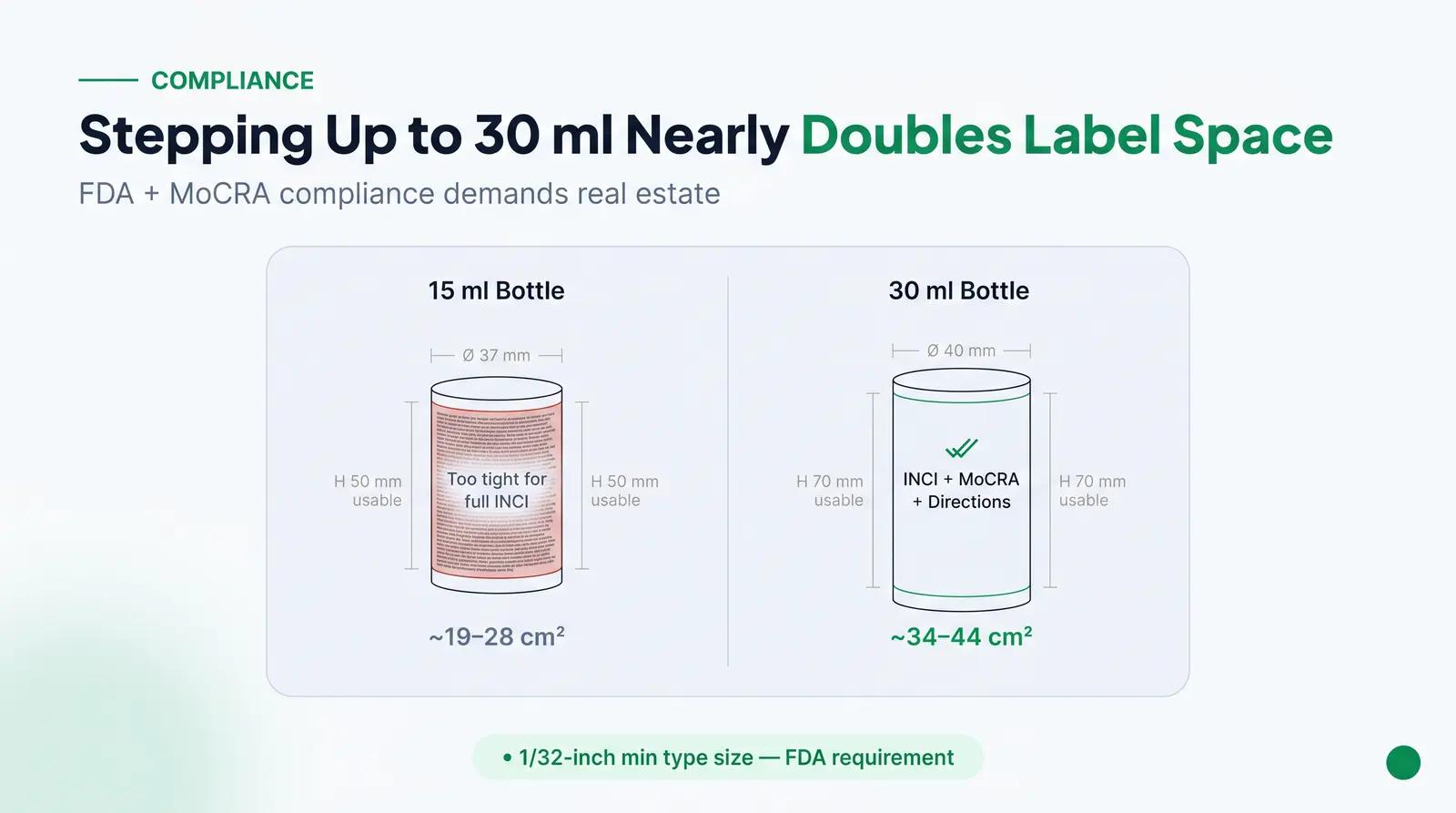
The available cylindrical surface area on small bottles is brutally unforgiving. A standard 15 ml bottle has a diameter of roughly 37 mm and a usable vertical height of perhaps 50 mm [6]. While the full circumference is about 116 mm, a practical wrap label might only offer 19 to 28 square centimeters of printable space. Trying to fit a 20-ingredient INCI list, directions for use, warnings, and mandatory MoCRA contact info onto a 15 ml bottle requires microscopic typography that often runs afoul of the FDA's 1/32-inch minimum type size requirement for small packages [4].
By stepping up to a 30 ml bottle, the diameter increases to roughly 40 mm and the usable height to 70 mm, expanding the practical label area to 34 to 44 square centimeters [6]. This seemingly small increase in volume nearly doubles the usable canvas for branding and compliance text.
Reorder Economics and Launch Stages
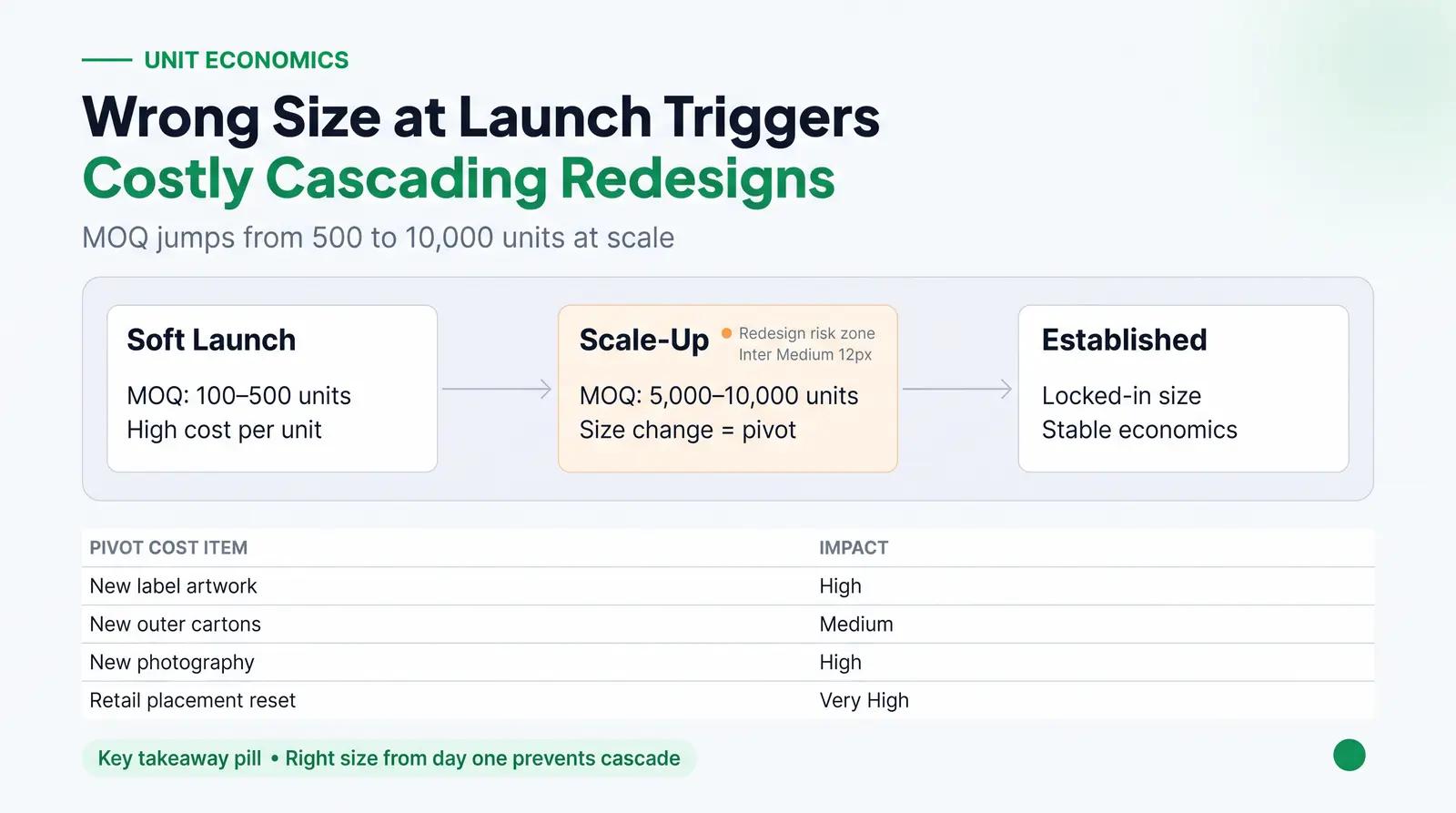
Unit economics and Minimum Order Quantities (MOQs) shift dramatically based on the launch stage and the chosen bottle size. When a brand is sampling or in a soft launch phase, they often rely on stock packaging from domestic distributors. In this phase, MOQs might be as low as 100 to 500 units, but the cost per unit is exceptionally high.
As a brand scales and moves to direct manufacturing, MOQs typically jump to 5,000 or 10,000 units. If a founder chooses a 15 ml bottle for launch to keep the retail price low, but later realizes the label area is too small or the consumer runs out too quickly, changing to a 30 ml bottle at the scale-up stage is an expensive pivot. It requires new label artwork, new outer cartons, new product photography, and potentially new retail shelf placement agreements. Choosing the right size from the start, even if it means a slightly higher upfront unit cost, prevents these cascading redesign expenses.
The Dropper Bottle Sizing Framework
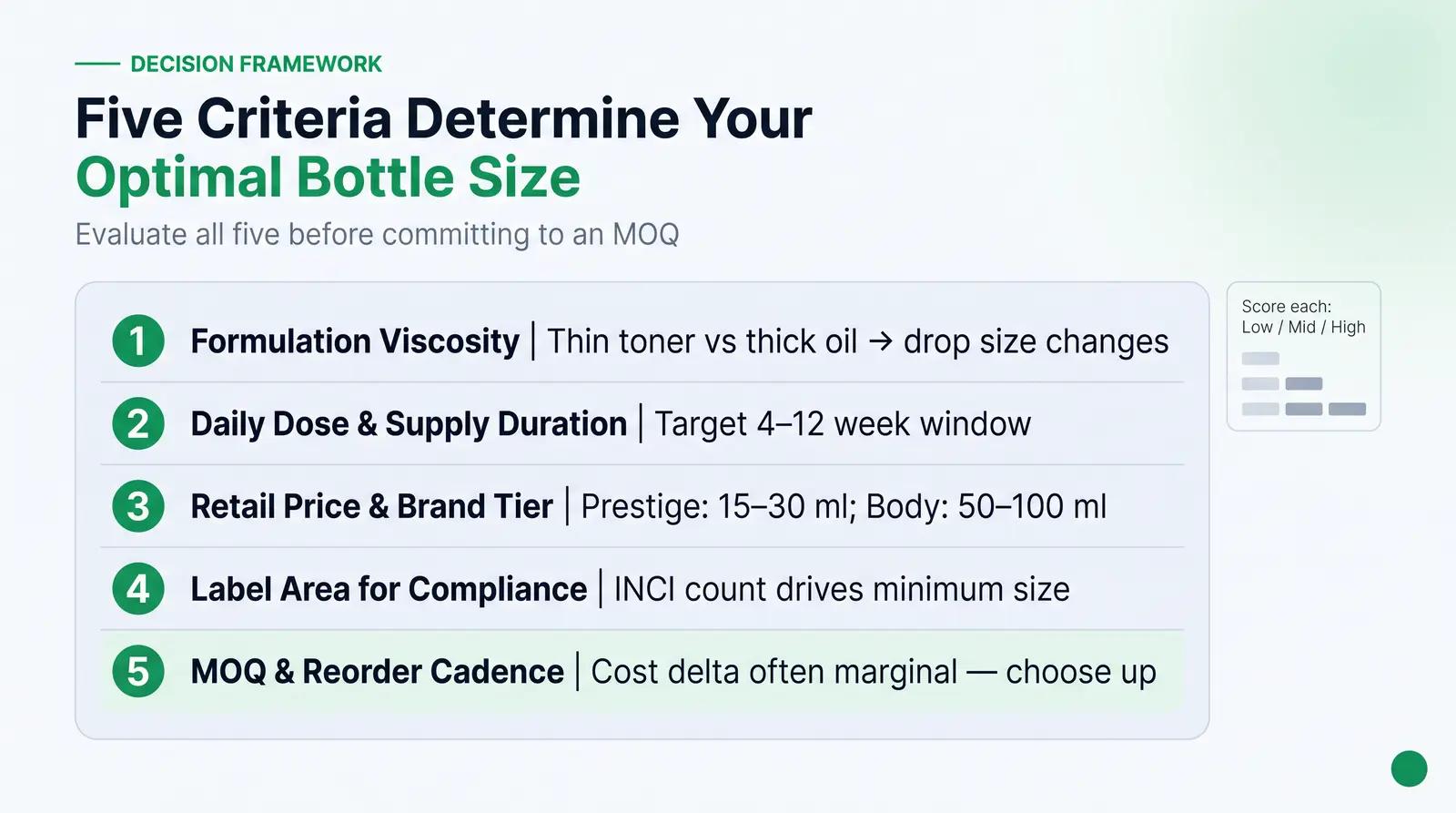
To navigate these variables, we use a practical framework at Packfolio to guide founders through this decision. The Dropper Bottle Sizing Framework evaluates five criteria to determine the optimal package size:
1. Formulation Type and Viscosity
Is the product a water-light toner, a medium serum, or a thick oil? High-viscosity products dispense fewer, larger drops per ml. Highly volatile or oxidation-prone formulations should be kept in smaller volumes to ensure the consumer finishes the product while it is still stable.
2. Target Daily Dose and Supply Duration
Calculate the exact drops per application and applications per day. Multiply this to find the daily ml usage. The bottle size should provide a 4-to-12 week supply. Anything shorter frustrates the consumer; anything longer delays reorder revenue and risks product expiration.
3. Retail Price Point and Brand Tier
Does the brand sit in the masstige, accessible luxury, or prestige tier? Prestige actives belong in 15 ml to 30 ml heavy-walled glass. Body oils or daily hydrators can push into the 50 ml to 100 ml range without losing credibility.
4. Available Label Area for Compliance
Count the number of ingredients in the INCI list and the length of the required directions and warnings. If the formula has a complex ingredient deck, a 5 ml or 10 ml bottle will likely require an outer folding carton to hold the compliance text, adding to the total packaging cost.
5. MOQ and Reorder Cadence
Evaluate the unit cost difference between sizes at your current MOQ. Often, the cost difference between a 15 ml and 30 ml glass bottle is marginal, but the 30 ml size allows for a higher retail price and better margin.
A Worked Example: Sizing a 2% Retinol Facial Oil
Consider a founder launching a 2% retinol facial oil. They are debating between a 15 ml (0.5 oz) and a 30 ml (1 oz) amber glass dropper bottle. Let's run this through the framework:
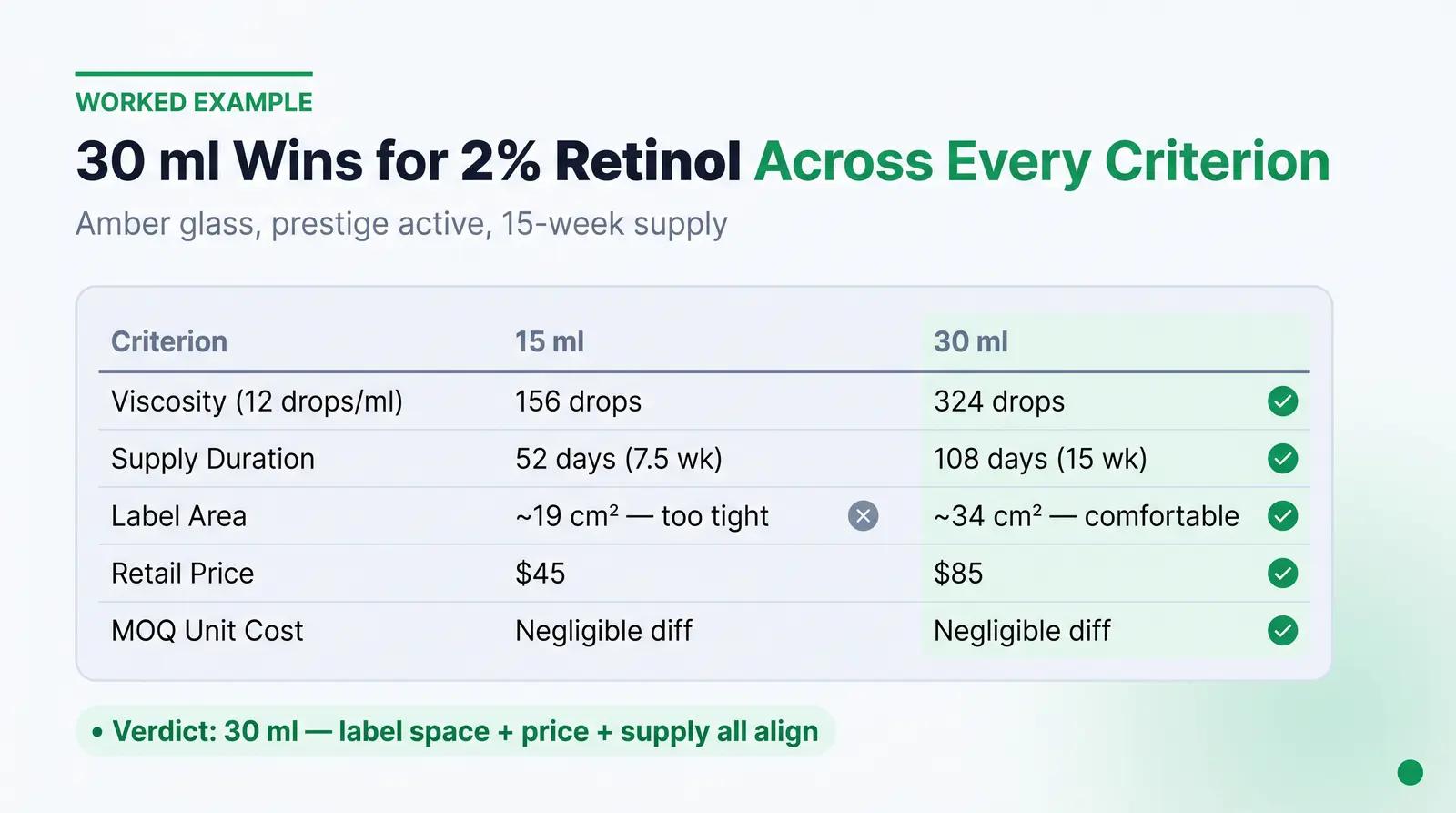
- Formulation: It is a high-viscosity oil. It yields roughly 12 drops per ml. Because retinol is highly sensitive to UV light and oxidation [7], it requires amber glass to block UV transmission below 450 nm [8].
- Dose and Supply: The directions call for 3 drops applied once daily (PM only). That is 3 drops per day. A 15 ml bottle (holding ~13 ml of usable liquid) contains ~156 drops, providing a 52-day (7.5 week) supply. A 30 ml bottle (holding ~27 ml) contains ~324 drops, providing a 108-day (15 week) supply.
- Label Area: A retinol product requires specific warnings about sun sensitivity and usage frequency. The 15 ml bottle offers roughly 19 cm² of practical label space, which is incredibly tight for this much text. The 30 ml bottle offers roughly 34 cm², providing comfortable breathing room for typography.
- Price Point: A 2% retinol is a prestige active. A 15 ml size might retail for $45, while a 30 ml size can command $85.
- MOQ: At a 500-unit launch MOQ, the unit cost difference between the two glass bottles is negligible.
The Recommendation: The 30 ml bottle is the superior choice. It provides adequate label area for the mandatory retinol warnings, supports a higher retail price point, and offers a 15-week supply, which is the sweet spot for a prestige active before oxidation becomes a severe risk.
Packfolio's catalog includes glass dropper bottles across this standard size range, each pre-modeled in 3D with defined print zones. Founders can verify their label area and preview their artwork on a photorealistic model before committing to an order. Packfolio handles the production coordination and freight, so the founder does not need to manage supplier relationships or guess whether their INCI list will actually fit on the glass.
Glass Color and Finish Options
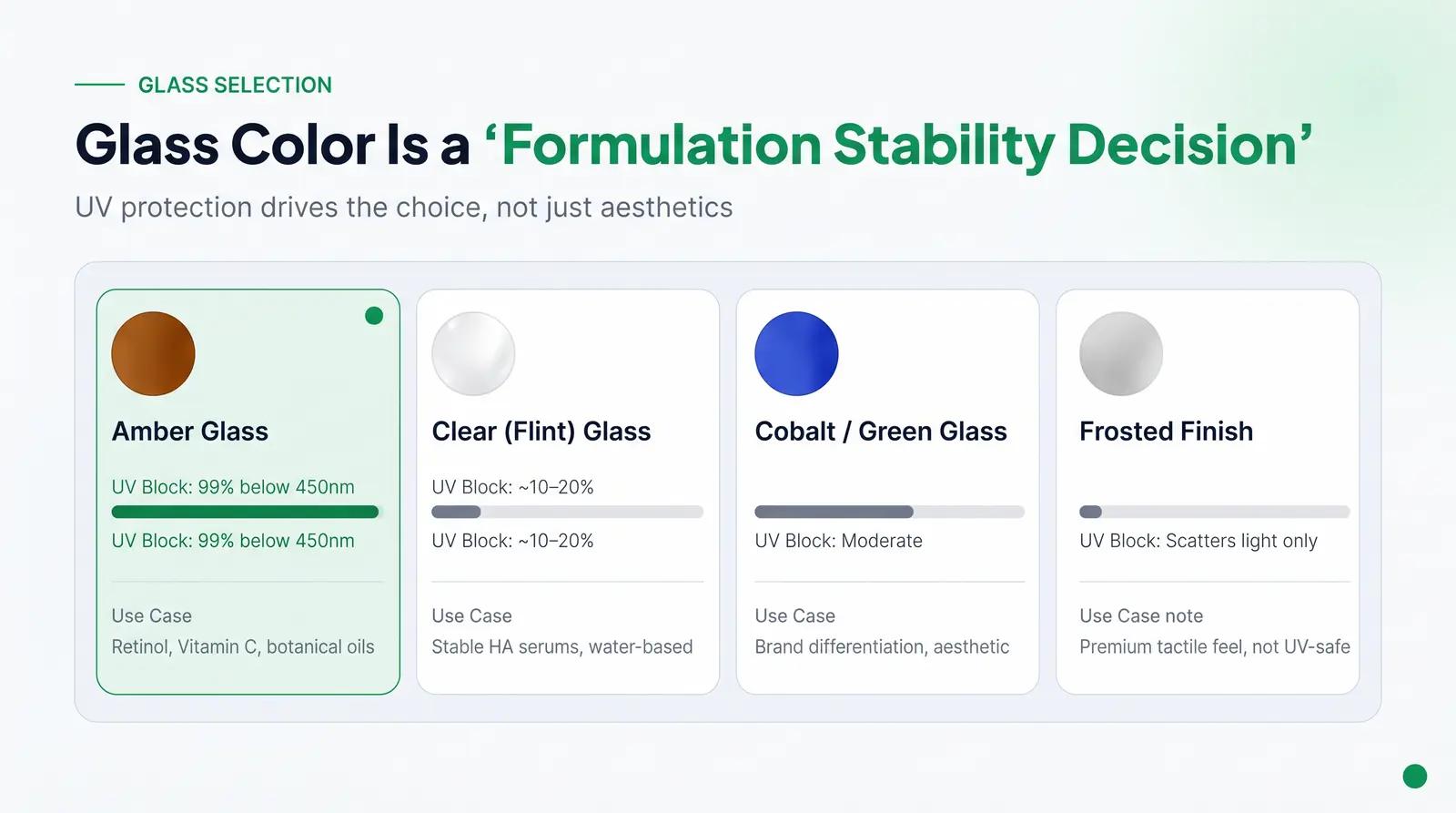
The color of the glass is not merely an aesthetic choice; it is a functional requirement for formulation stability.
- Amber Glass: The gold standard for UV protection. The addition of iron and sulfur during manufacturing allows amber glass to block up to 99% of UV rays below 450 nm [8]. This is mandatory for light-sensitive ingredients like retinol, Vitamin C (L-ascorbic acid), and certain cold-pressed botanical oils that suffer from rapid photodegradation [7].
- Clear (Flint) Glass: Offers maximum product visibility but minimal UV protection (allowing 80-90% UV transmission) [8]. Best for stable, water-based formulations like hyaluronic acid serums where the color or texture of the product is a selling point.
- Cobalt Blue and Green Glass: These offer moderate UV protection, better than clear glass, but significantly less effective than amber [8]. They are primarily chosen for brand differentiation and aesthetic appeal.
- Frosted/Matte Finishes: A frosted finish scatters light and reduces overall light penetration, but it does not replicate the specific UV-blocking chemistry of amber glass. It does, however, elevate the tactile experience and communicate a premium, soft-touch aesthetic.
Selecting the Right Dropper Type
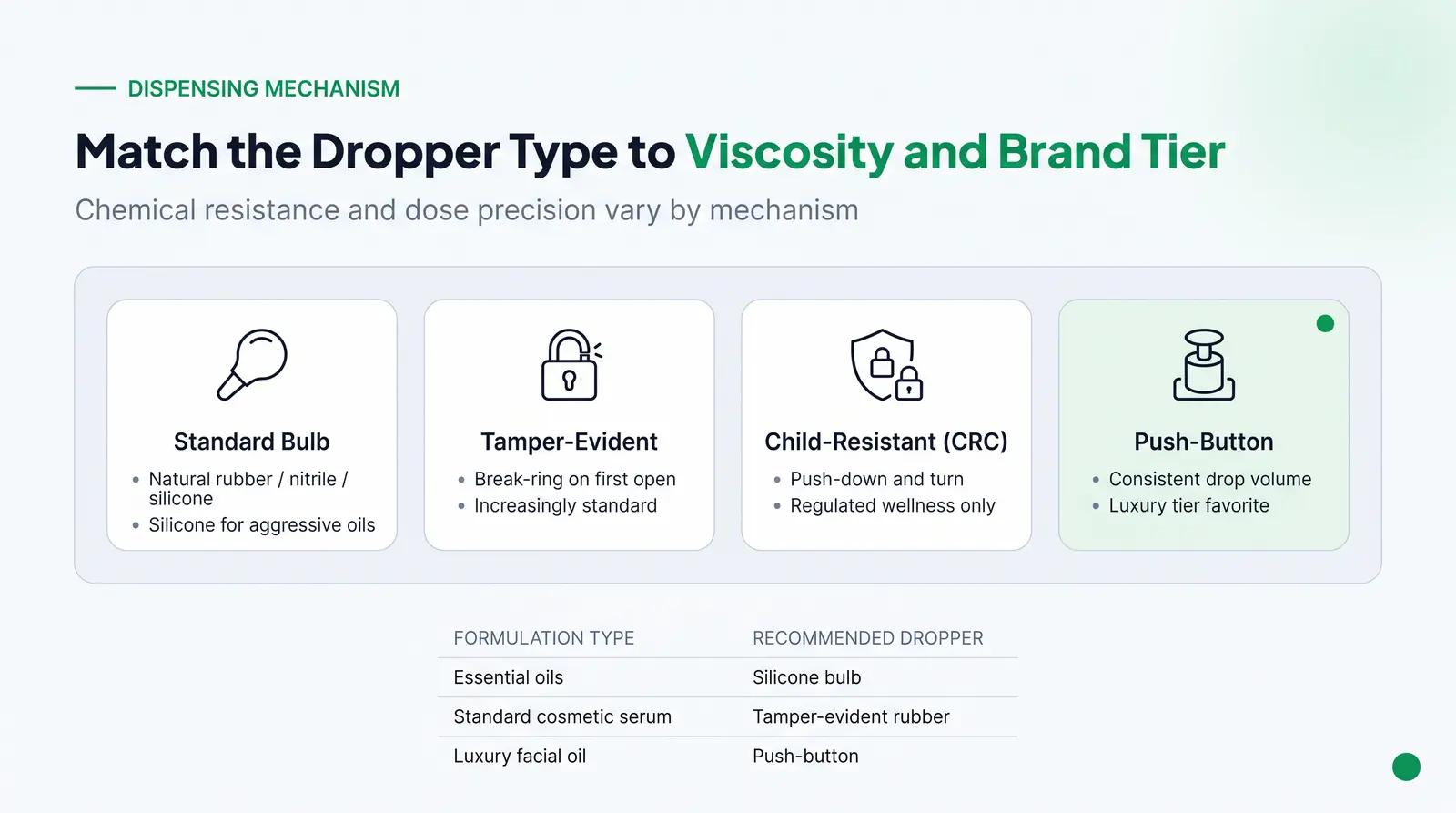
The dispensing mechanism must match the product's viscosity and the brand's positioning.
- Standard Rubber Bulb: The traditional choice. Natural rubber, nitrile, and silicone bulbs offer different levels of chemical resistance. Silicone is often preferred for aggressive essential oils that might degrade natural rubber over time.
- Tamper-Evident: Features a plastic ring that breaks upon first opening. This is increasingly standard for cosmetics to assure the consumer of product safety and integrity.
- Child-Resistant (CRC): Required for certain regulated wellness products (like high-concentration CBD or specific pharmaceuticals), but rarely necessary for standard cosmetics. They require a "push-down and turn" motion.
- Push-Button Droppers: Instead of a bulb, the user presses a mechanical button on the top of the cap to draw and release the liquid. This provides a highly engineered, modern feel and often delivers a more consistent drop volume, making it a favorite in the luxury tier [3].
Browse Packfolio's glass dropper bottle catalog, preview your label artwork on a photorealistic 3D model before you order, and leave the supplier coordination to us. → Explore the Packfolio catalog
Frequently Asked Questions
What size dropper bottle is best for a facial serum? A 30 ml (1 oz) bottle is the industry standard for facial serums. It provides enough volume for a 2-to-3 month supply with daily use, offers adequate surface area for mandatory label compliance, and fits established retail price expectations.
How many drops are in a 1 oz (30 ml) dropper bottle? A 30 ml bottle typically holds about 27 to 28 ml of usable liquid due to the headspace required for the pipette. Depending on the viscosity of the product, this yields between 300 and 600 drops total.
Does amber glass really protect skincare ingredients from UV light? Yes. Amber glass blocks up to 99% of UV radiation below 450 nm due to the iron and sulfur used in its manufacturing. This makes it highly effective at preventing the photodegradation of sensitive actives like retinol and Vitamin C.
What is the difference between a 15 ml and 30 ml dropper bottle for a beauty brand? Beyond holding twice the volume, a 30 ml bottle provides nearly double the printable label area compared to a 15 ml bottle. This makes it significantly easier to fit mandatory FDA and MoCRA compliance text without resorting to an expensive outer folding carton.
How much label area does a 30 ml dropper bottle have? A standard 30 ml Boston Round dropper bottle has a diameter of about 40 mm and a usable vertical height of 70 mm. A practical wrap-around label typically provides 34 to 44 square centimeters of printable space.
References
[1] How Many Drops in a mL: Precision and Variations with Cosmetic Droppers. Virospack. (2025). https://virospack.com/how-many-drops-in-a-ml/
[2] Package design as a branding tool in the cosmetic industry: consumers' perception vs. reality. SN Business & Economics. (2022). https://pmc.ncbi.nlm.nih.gov/articles/PMC9123395/
[3] Small Dropper Bottles: The Perfect Travel-Size Packaging for Serums, Oils and Active Skincare. Virospack. (2025). https://virospack.com/small-dropper-bottles/
[4] Summary of Cosmetics Labeling Requirements. U.S. Food and Drug Administration. (2025). https://www.fda.gov/cosmetics/cosmetics-labeling-regulations/summary-cosmetics-labeling-requirements
[5] Modernization of Cosmetics Regulation Act of 2022 (MoCRA). U.S. Food and Drug Administration. (2026). https://www.fda.gov/cosmetics/cosmetics-laws-regulations/modernization-cosmetics-regulation-act-2022-mocra
[6] Glass Bottles with Droppers: What Size Is Right for Your Product? Virospack. (2025). https://virospack.com/glass-bottles-with-droppers/
[7] Retinoid stability and degradation kinetics in commercial cosmetic products. Journal of Cosmetic Dermatology. (2021). https://pubmed.ncbi.nlm.nih.gov/33206444/
[8] The Science Behind Amber Glass and UV Protection. Container & Packaging. (2026). https://www.containerandpackaging.com/resources/the-science-behind-amber-glass-and-uv-protection/


