
Packaging for High-Viscosity Skincare: Creams, Balms, Masks, and Thick Serums
Match high-viscosity skincare formulas like thick creams, balms, and masks to the right packaging format using viscosity ranges, dispensing tests, and evacuation benchmarks.
Viscosity is the hidden variable that can make an attractive package functionally useless. When a beauty founder selects a container based purely on shelf appeal, they often overlook the physics of how a thick cream or heavy balm will actually dispense. The result is a beautiful bottle that clogs on the first pump, a tube that splits at the seam when squeezed, or a jar that exposes sensitive actives to rapid degradation. For high-viscosity skincare products, packaging is not just a vessel; it is an engineered dispensing system that must be precisely matched to the formula's resistance to flow.
In the cosmetic industry, viscosity is measured in centipoise (cP). Water sits at 1 cP, while heavy creams and balms can range from 30,000 cP to well over 100,000 cP [1]. Understanding where your formula falls on this spectrum is the critical first step before requesting a single packaging sample.
Why Viscosity Governs Package Selection
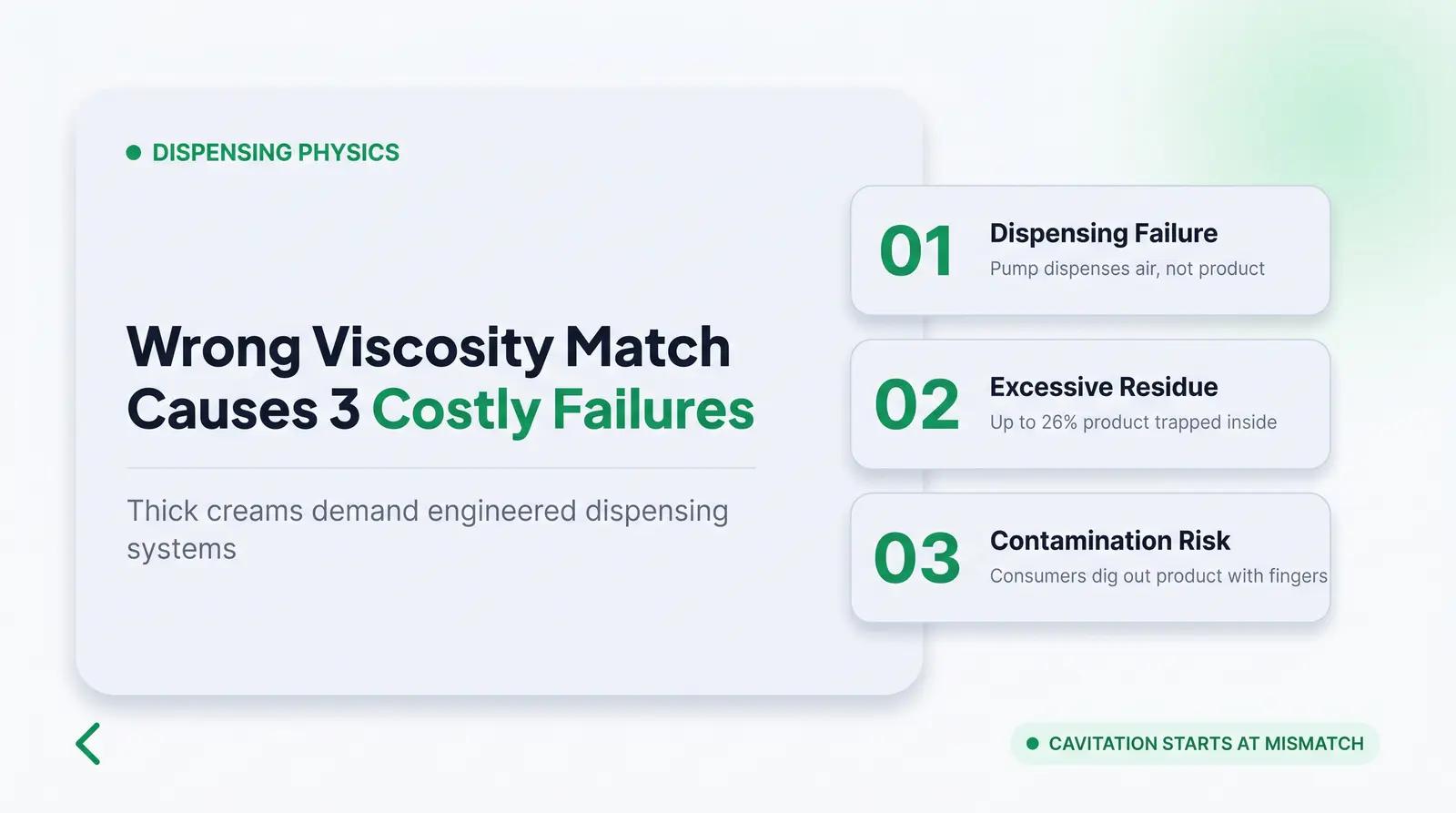
Viscosity dictates how a fluid behaves under pressure and temperature changes. If a thick night cream (around 50,000 cP) is placed in a standard lotion pump designed for a 5,000 cP fluid, the pump engine will struggle to draw the product up the dip tube. This leads to "cavitation"—the pump dispenses air instead of product because the thick cream cannot flow fast enough to fill the void left by the previous pump [2].
Ignoring viscosity leads to three common failure modes. First is dispensing failure, where the consumer must violently shake or pound the bottle to get the product out. Second is excessive residue; studies show that standard pump dispensers can leave up to 26% of a thick cream trapped inside the bottle, leading to significant consumer frustration and product waste [3]. Third is contamination risk. When a pump fails, consumers inevitably unscrew the top and dig the product out with their fingers, introducing bacteria and compromising the preservative system.
The Formula-to-Format Map
Matching a high-viscosity formula to the correct primary packaging requires evaluating the physical demands of the product against the mechanical capabilities of the container.
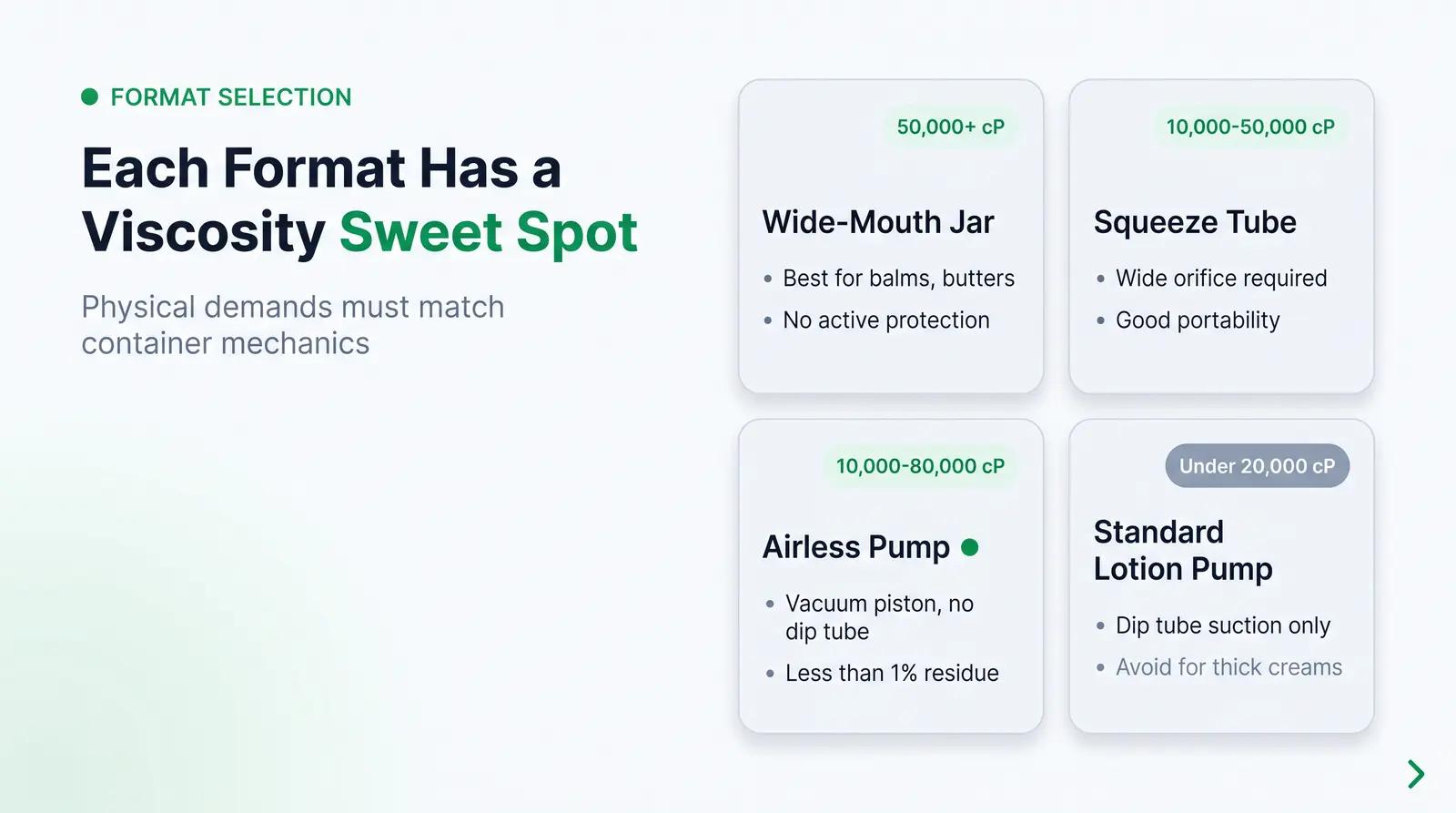
Jars (Wide-Mouth, Regular-Mouth, Double-Wall) Jars are the traditional default for high-viscosity creams, body butters, and solid balms (50,000+ cP). Their wide-mouth design allows unrestricted access to dense formulas that refuse to flow. However, jars expose the entire product surface to air and light with every use, making them unsuitable for formulas containing sensitive active ingredients like Vitamin C or retinol [4]. To mitigate hygiene concerns, brands often pair jars with cosmetic spatulas, though consumer compliance with spatula use remains inconsistent.
Tubes (Standard Squeeze, Wide-Neck, Laminated) Squeeze tubes are highly effective for thick gels, heavy lotions, and masks (10,000 to 50,000 cP). They protect the formula better than jars and offer excellent portability. For high-viscosity products, the tube's orifice diameter and wall thickness are critical. A thick cream requires a wider neck and orifice to dispense without excessive squeeze force. If the tube wall is too thin, the force required to extrude a thick paste can cause the tube to permanently deform or rupture at the crimp seal [5].
Airless Pumps Airless pumps utilize a vacuum and an internal piston to push the product upward, eliminating the need for a dip tube. This makes them exceptional for dispensing thick, active-rich creams and serums (up to around 80,000 cP) while providing near-total protection from oxidation and contamination [6]. Airless systems also boast excellent evacuation rates, often leaving less than 1% of the product behind [3]. However, they require careful testing, as extremely dense balms can still stall the piston mechanism.
Standard Lotion Pumps Standard dip-tube pumps are generally unsuited for high-viscosity products. While some "high-output" or "high-viscosity" pumps feature wider dip tubes and larger pump chambers, they still rely on the product's ability to flow and self-level. They are best reserved for products under 20,000 cP.
The Viscosity-to-Format Matching Framework
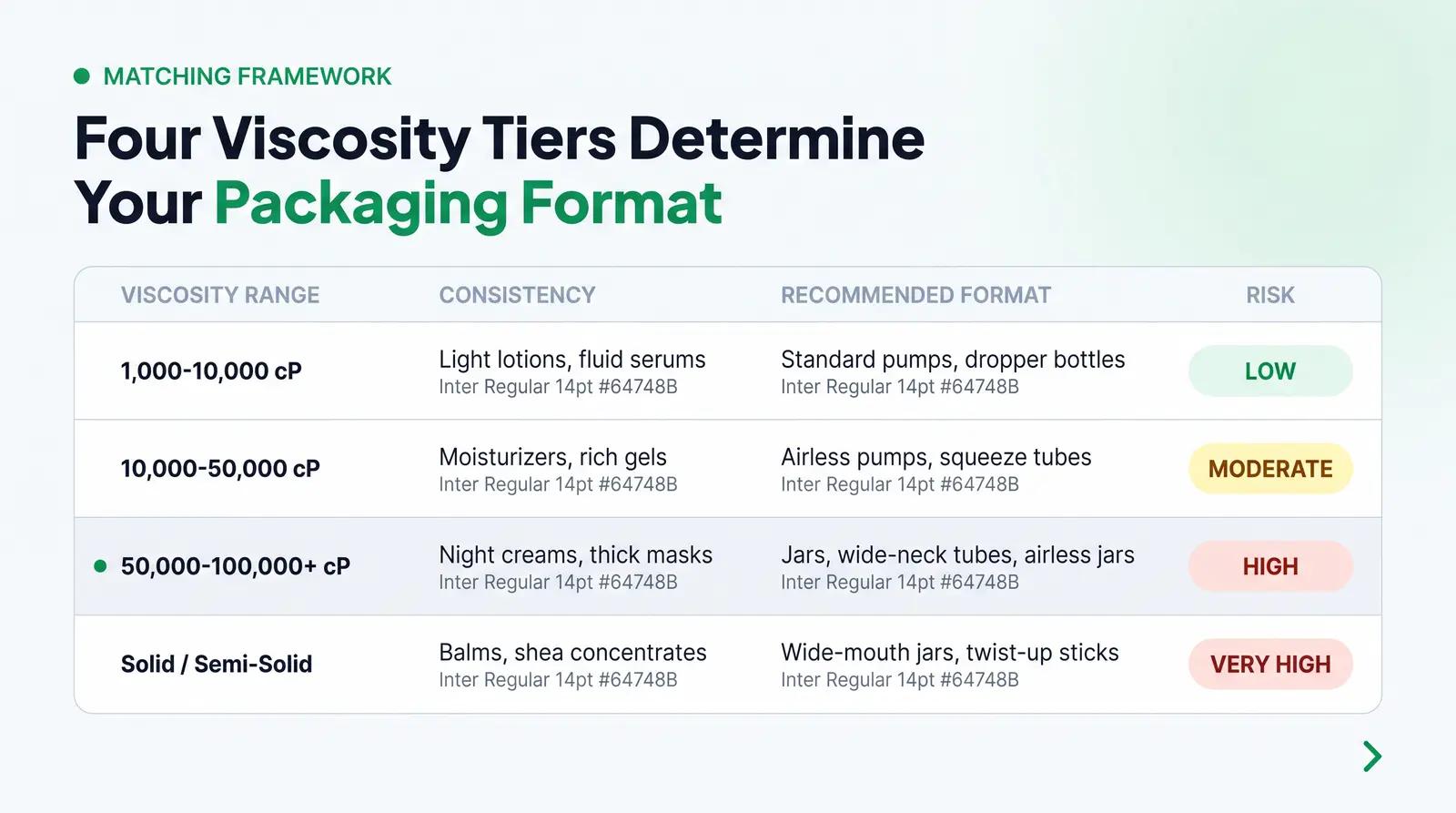
The framework we recommend at Packfolio helps founders align their formula's consistency with the most reliable packaging format.
The Viscosity-to-Format Matching Framework
-
Low to Medium Viscosity (1,000 – 10,000 cP)
- Consistency: Light lotions, fluid serums, gel cleansers.
- Recommended Format: Standard lotion pumps, fine-tip tubes, dropper bottles (for oils).
- Dispensing Risk Level: Low.
- Key Test Before Ordering: Verify pump output consistency and check for dripping or leaking at the orifice.
-
Medium to High Viscosity (10,000 – 50,000 cP)
- Consistency: Daily moisturizers, rich gels, standard sunscreens.
- Recommended Format: Airless pumps, standard squeeze tubes with medium orifice, high-output lotion pumps.
- Dispensing Risk Level: Moderate.
- Key Test Before Ordering: Prime the pump to ensure no cavitation occurs; test tube squeeze force and wall recovery.
-
Very High Viscosity (50,000 – 100,000+ cP)
- Consistency: Night creams, thick masks, body butters, ointments.
- Recommended Format: Jars (with spatulas), wide-neck tubes, heavy-duty airless jars.
- Dispensing Risk Level: High.
- Key Test Before Ordering: Verify evacuation rate (how much product is left behind) and ensure the fill process does not trap air pockets.
-
Solid to Semi-Solid (Temperature Dependent)
- Consistency: Cleansing balms, lip balms, shea butter concentrates.
- Recommended Format: Wide-mouth jars, twist-up stick components.
- Dispensing Risk Level: Very High (due to temperature shifts).
- Key Test Before Ordering: Conduct thermal cycling tests to observe how melting and resolidifying affects the product's fit within the container.
Packaging Formats Compared
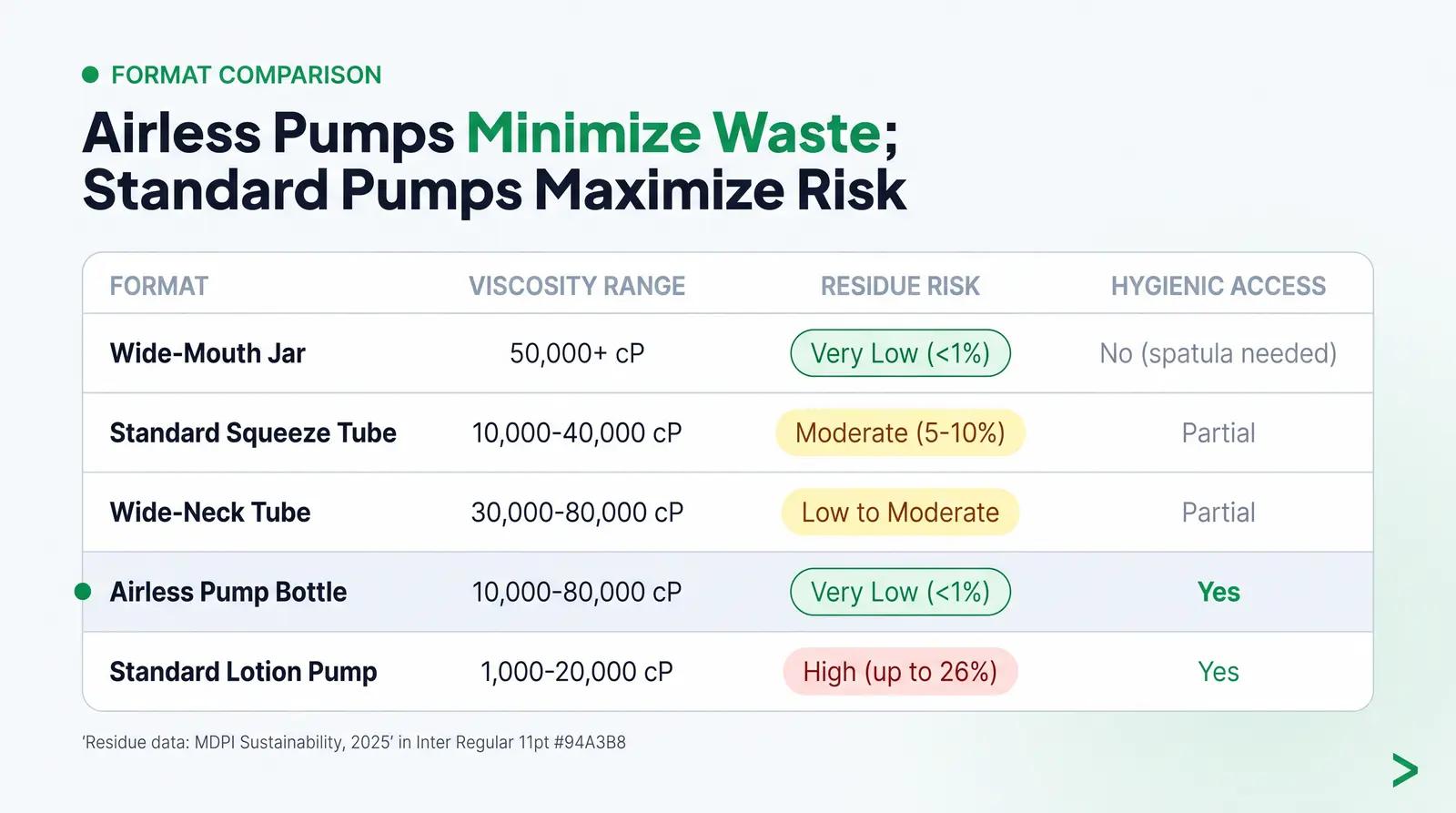
When evaluating formats for thick skincare, functional dimensions often outweigh aesthetics. The table below compares how different containers handle high-viscosity challenges.
| Format | Typical Viscosity Range | Dispensing Mechanism | Residue / Waste Risk | Hygienic Access | Consumer Experience |
|---|---|---|---|---|---|
| Wide-Mouth Jar | 50,000+ cP | Manual scoop / Spatula | Very Low (<1%) | No (unless spatula used) | Luxurious but messy |
| Standard Squeeze Tube | 10,000 - 40,000 cP | Manual squeeze | Moderate (5-10%) | Partial | Convenient, travel-friendly |
| Wide-Neck Tube | 30,000 - 80,000 cP | Manual squeeze | Low to Moderate | Partial | Good for thick pastes |
| Airless Pump Bottle | 10,000 - 80,000 cP | Vacuum piston | Very Low (<1%) | Yes | Premium, highly controlled |
| Standard Lotion Pump | 1,000 - 20,000 cP | Dip tube suction | High (up to 26%) | Yes | Frustrating if product is too thick |
Residue data sourced from MDPI sustainability studies on cosmetic packaging emptiability [3].
Dispensing, Residue, and Fill Line: What to Test Before Ordering
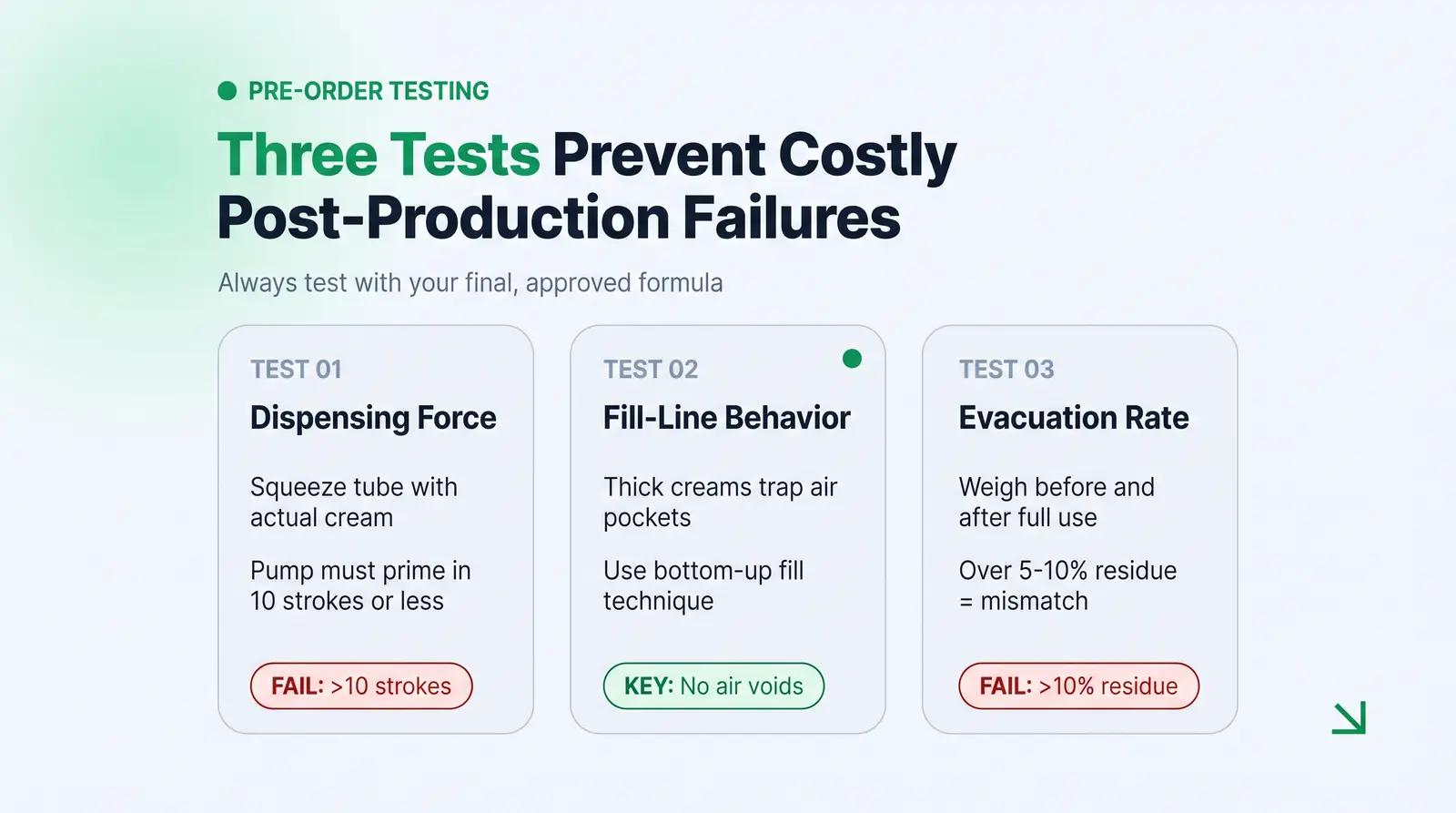
Never commit to a packaging run without rigorous compatibility and functional testing using your final, approved formula. Testing a "similar" base is a recipe for disaster.
Test the Dispensing Force: For tubes, fill the sample with your thick cream and measure the force required to squeeze it out. If the tube wall is too thin, it will permanently crease or buckle. If the orifice is too small, the consumer will struggle. For pumps, count how many strokes it takes to prime the engine. If it takes more than 10 pumps to get the first drop, the viscosity is likely too high for that specific engine [2].
Evaluate the Fill-Line Behavior: High-viscosity creams do not self-level. When filling jars or airless bottles on a production line, thick creams can trap large air pockets. In an airless bottle, an air pocket will cause the pump to sputter and fail mid-use. Work with your manufacturer to ensure your filling equipment can handle the density of the product without introducing voids [7].
Measure the Evacuation Rate: Weigh an empty package, fill it with a known weight of your product, and then use the product exactly as a consumer would until nothing more comes out. Weigh the package again. If more than 5-10% of the product remains trapped inside, you have a packaging mismatch that will drive negative reviews [3].
A Worked Example: The 15% Shea Butter Face Balm
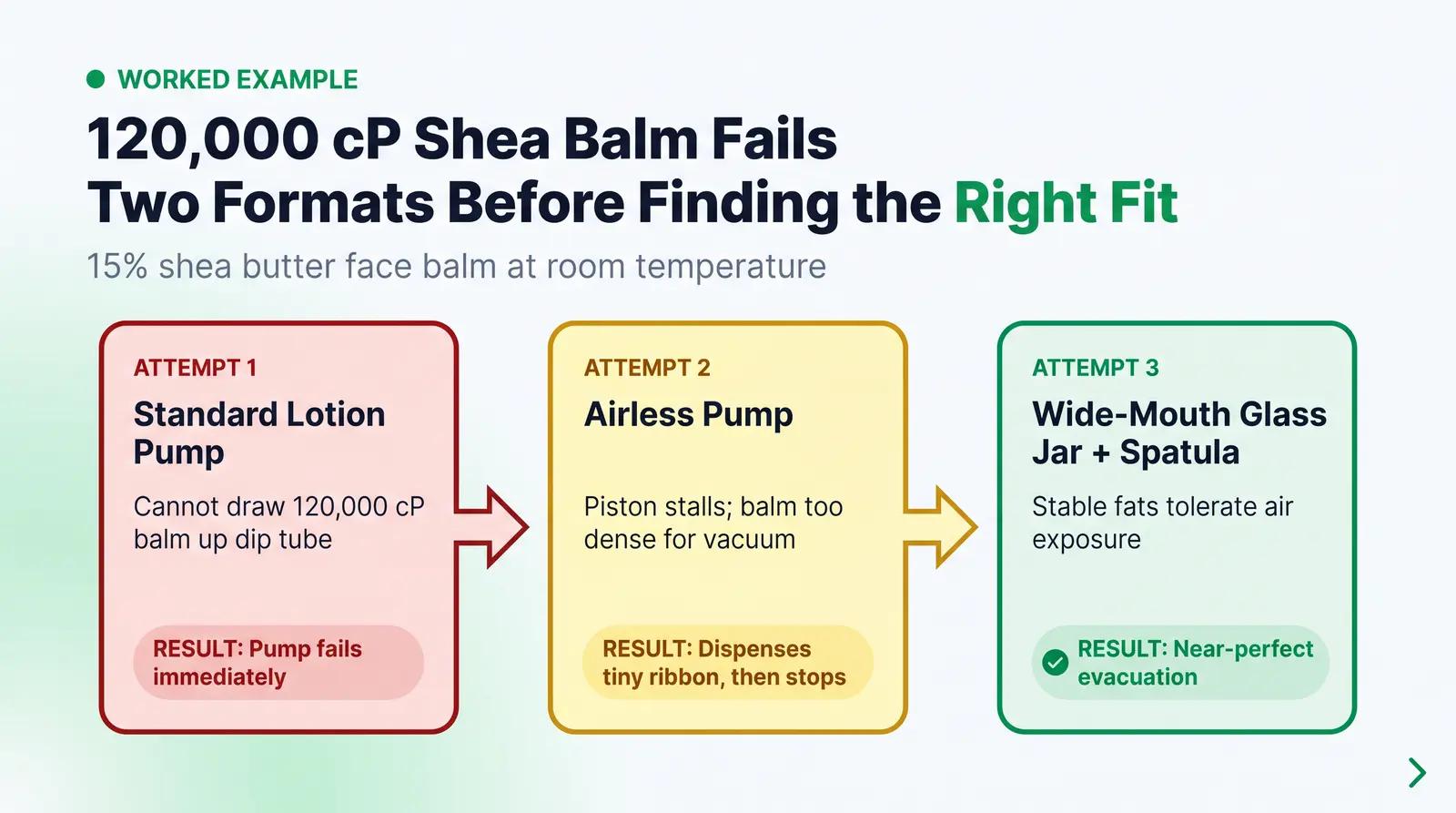
Consider a founder developing a restorative face balm featuring 15% shea butter. At room temperature, the balm is a semi-solid, resting at roughly 120,000 cP. The founder initially wants an elegant frosted glass bottle with a standard lotion pump for a clean, minimalist aesthetic.
During sampling, the failure is immediate. The pump cannot draw the dense balm up the dip tube. The founder pivots to an airless pump, hoping the vacuum piston will solve the issue. However, the balm is so thick that it resists the upward pressure of the piston; the pump stalls, dispensing only a tiny ribbon of product before failing.
The founder finally tests a wide-mouth glass jar paired with a custom metal spatula. Because the formula relies on stable, saturated fats (shea butter) rather than highly sensitive actives like Vitamin C, the air exposure from opening the jar is an acceptable trade-off [8]. The wide mouth allows easy access, the spatula provides a hygienic application method, and the evacuation rate is near perfect. The consumer experience shifts from frustrating to a luxurious, tactile ritual.
The Contrarian Insight: The Climate Vulnerability of Jars
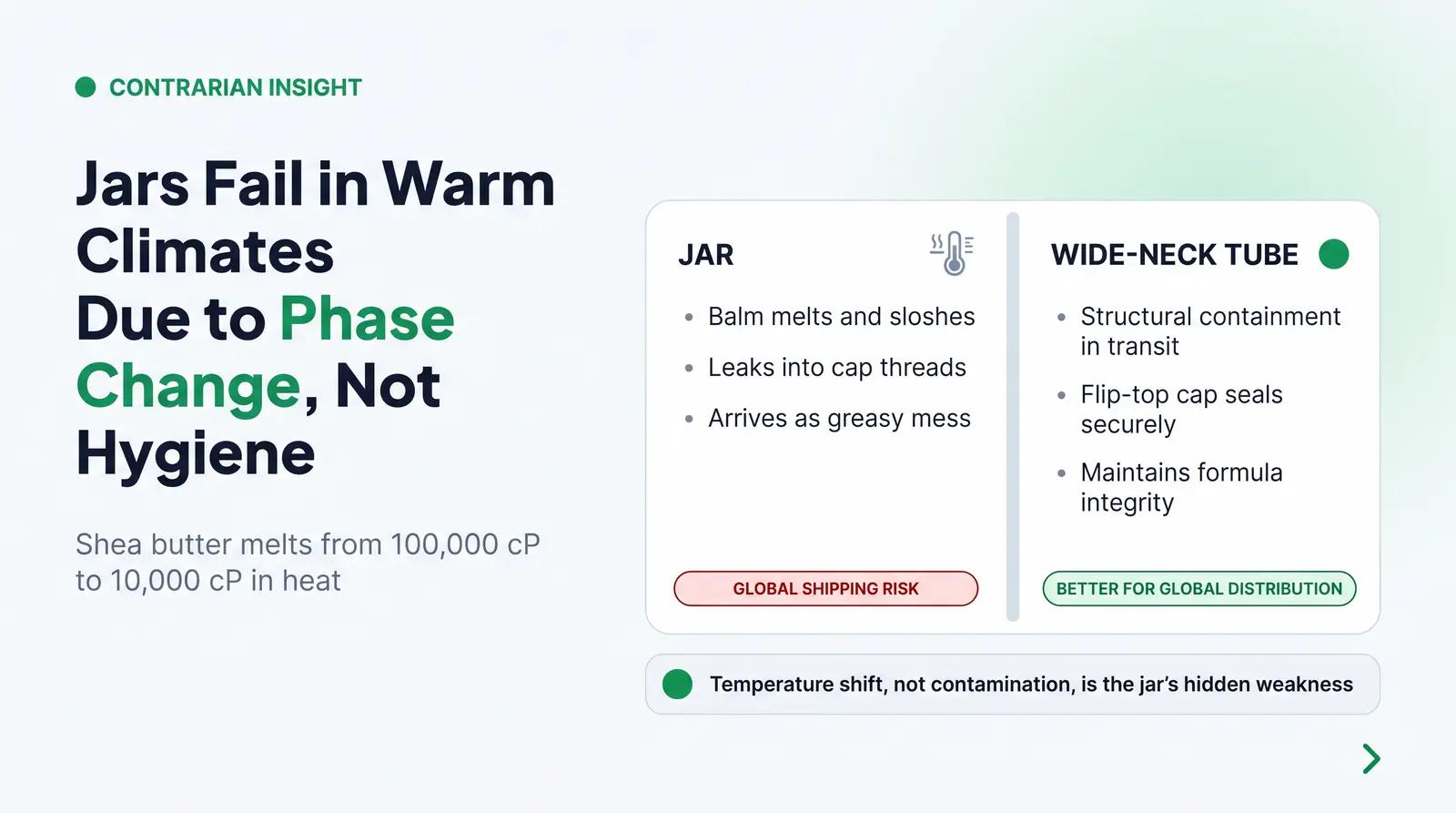
While jars are the mechanical champion for ultra-thick balms, they harbor a hidden vulnerability that has nothing to do with hygiene: temperature-induced viscosity shifts.
Jars underperform in warm-climate markets not primarily because of contamination, but because of phase changes. A thick balm formulated for a temperate climate can drop from 100,000 cP to 10,000 cP when shipped to a hot environment, as ingredients like shea butter melt [9]. In a jar, this melted product sloshes around, leaks into the cap threads, and presents to the consumer as a greasy, separated mess rather than a premium balm. If you are shipping a temperature-sensitive thick formula globally, a wide-neck tube with a secure flip-top cap often provides better structural containment during transit than a traditional jar, even if the jar feels more premium.
When you are ready to move from testing to sourcing, finding the right supplier can be daunting. This is where a platform like Packfolio streamlines the process. You can browse Packfolio's curated catalog of jars, tubes, and airless components, and actually preview your label artwork on a 3D model of the exact format before ordering. Because Packfolio coordinates the production, quality assurance, and freight, founders can focus on matching their formula to the right format without having to manage complex supplier relationships or factory vetting.
Browse Packfolio's curated jar, tube, and airless packaging catalog and preview your label in 3D before ordering → https://packfolio.com/catalog
Frequently Asked Questions
Can I use a standard pump for a thick body butter? Standard dip-tube pumps generally fail with thick body butters because the product cannot flow fast enough to replace what is pumped out, causing cavitation. You must use a specialized high-viscosity pump with a wider chamber, or switch to a jar or wide-neck tube.
Why does my airless pump stop working halfway through the product? This usually occurs when large air pockets are trapped in the thick cream during the filling process. When the pump hits the air pocket, the vacuum is broken, and the piston stalls. Proper bottom-up filling techniques are required for dense formulas.
Are cosmetic spatulas actually more hygienic than fingers? Yes, but only if they are cleaned properly after each use. Using a spatula prevents the introduction of bacteria and contaminants from the hands into the jar, which helps preserve the integrity and shelf life of the formula.
How do I know if my tube wall is thick enough for my cream? You must conduct a squeeze test with your actual formula. If the tube permanently creases, feels flimsy, or fails to spring back into shape after dispensing the thick cream, you need to specify a thicker wall or a different material structure, such as a multi-layer laminate.
Does packaging affect the shelf life of high-viscosity products? Absolutely. If your thick cream contains sensitive actives like retinol or antioxidants, exposure to air and light in an open jar will rapidly degrade the ingredients. In these cases, an opaque airless pump or airless jar is required to maintain efficacy.
References
[1] Smooth-On. "What is Viscosity? Complete Guide to Fluid Viscosity." Smooth-On, Inc. https://www.smooth-on.com/page/viscosity-scale/
[2] Jiaxing Glass Products. "Technical Guide to Lotion Pumps." Guangzhou Jiaxing Glass Products Co., Ltd., 2025. https://www.glass-cosmetic-bottles.com/info/technical-guide-to-lotion-pumps-103181799.html
[3] Klein, Michelle, et al. "Product Waste Resulting from Insufficient Emptiability of Cosmetic Packaging and Its Economic and Environmental Implications." Sustainability, MDPI, 2025. https://www.mdpi.com/2071-1050/17/3/1056
[4] Paula's Choice. "Why You Should Avoid Skin Care in Jars & Tubs." Paula's Choice, 2025. https://www.paulaschoice.com/expert-advice/skincare-advice/skin-care-how-tos/skin-care-packaging-matters-why-you-should-ditch-jars.html
[5] Othilapak. "How to Choose the Right Cosmetic Tube for Your Product." Othilapak, 2026. https://othilapak.com/blogs/technology-materials/how-to-choose-the-right-cosmetic-tube-for-your-product/
[6] Paramount Global. "5 Benefits of Airless Pump Technology." Paramount Global, 2023. https://www.paramountglobal.com/knowledge/benefits-airless-pump-technology/
[7] Airless Bottles. "Mono-Material Airless Bottles for High-Viscosity Creams and Lotions: A Guide!" The PKG Co., 2025. https://airlessbottles.com/mono-material-airless-bottles-for-high-viscosity-creams-and-lotions-a-guide/
[8] Morais, Joan. "Heat Sensitivity of Plant Oils and Butters in Cosmetic Formulations." Joan Morais Cosmetics School, 2026. https://joanmorais.com/heat-sensitivity-of-plant-oils-and-butters-in-cosmetic-formulations/
[9] Megnanou, Rose-Monde, and Sébastien Niamke. "Improving the optimized shea butter quality: a great potential of utilization for common consumers and industrials." SpringerPlus, 2015. https://pmc.ncbi.nlm.nih.gov/articles/PMC4631807/


