
MoCRA and Cosmetic Packaging: What Indie Brands Need to Know
MoCRA ties FDA cosmetic compliance directly to packaging labels, making label design a regulatory checkpoint indie brands must complete before production.
Picture a founder standing in a fulfillment warehouse surrounded by pallets of freshly manufactured vitamin C serums, ready for a major retail launch. Her phone rings. The distributor cannot accept the inventory. The primary bottle label is missing a physical US address for the responsible person, and the ingredient list on the packaging does not match the product listing submitted to the FDA. In a single phone call, a labeling oversight transforms a triumphant launch into a costly repackaging crisis.
This is not a hypothetical risk. Under the Modernization of Cosmetics Regulation Act of 2022 (MoCRA), it is a concrete compliance scenario that independent beauty brands face every day [1]. For decades, the cosmetics industry operated under a loosely regulated framework with minimal direct FDA intervention. MoCRA has fundamentally changed that dynamic, introducing mandatory facility registrations, product listings, safety substantiation requirements, and rigorous new labeling obligations [1] [2].
For indie beauty founders, formulators, and contract manufacturers, the most important shift is this: compliance is not an administrative task to complete after launch. It is a packaging decision checkpoint. Because what you print on your physical packaging is exactly what the FDA expects to see in your official product listing, your packaging decisions and your regulatory compliance are permanently linked from the moment you begin designing your label artwork.
What MoCRA Actually Changed
Signed into law on December 29, 2022, as part of the Consolidated Appropriations Act, 2023, MoCRA represents the most significant expansion of the FDA's authority over cosmetics since the Federal Food, Drug, and Cosmetic (FD&C) Act was passed in 1938 [1] [2]. The legislation was designed to bring federal oversight of the beauty and personal care sector more in line with other regulated categories, including drugs, medical devices, and food [2] [3].
Before MoCRA, cosmetic brands could launch products without notifying the FDA, without registering their manufacturing facilities, and without maintaining formal safety records. The prior framework relied almost entirely on industry self-regulation [1] [3]. MoCRA ended that era.
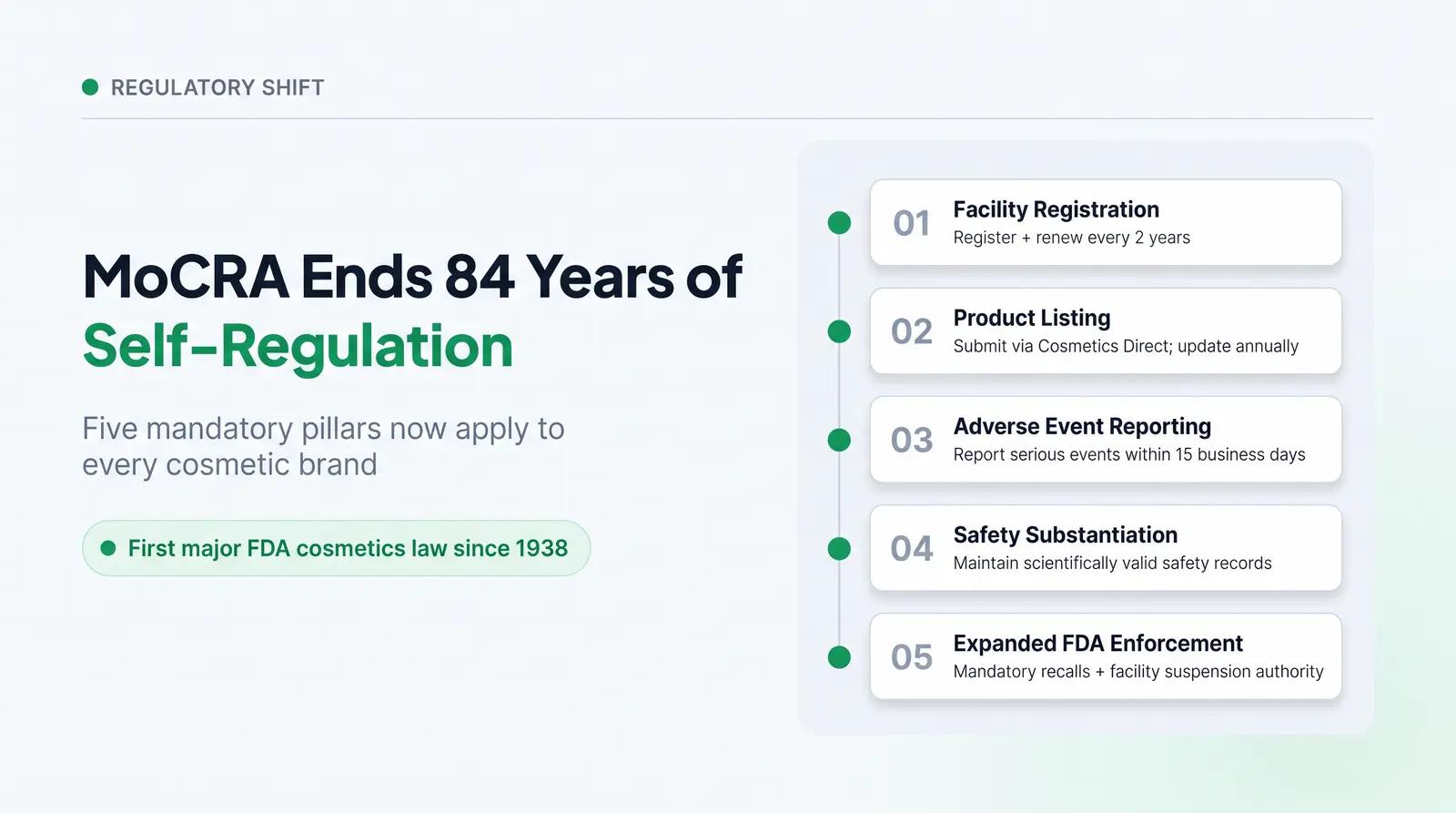
The law establishes five core pillars of compliance that every brand must understand:
Mandatory Facility Registration. Any establishment that manufactures or processes cosmetic products for distribution in the United States must register with the FDA and renew that registration every two years [1] [4]. Existing facilities were required to register by July 1, 2024, following a six-month enforcement delay granted by the agency [4]. New facilities that begin manufacturing after that date must register within 60 days of commencing operations [2].
Mandatory Product Listing. For every cosmetic product marketed in the United States, the responsible person must submit a product listing to the FDA that includes the product name, category, manufacturing facility identifiers, and a complete ingredient list [1] [4] [5]. Listings must be updated annually [1] [5].
Serious Adverse Event Reporting. Brands must report serious adverse health events associated with product use to the FDA within 15 business days of receiving information about the event [1] [2]. Each report must include a copy of the physical product label [1]. All adverse event records must be retained for six years, though qualifying small businesses may retain records for three years [1] [2].
Safety Substantiation. Brands must maintain scientifically valid records demonstrating that their products and ingredients are reasonably safe [1] [2]. The FDA does not mandate specific tests, but the evidence must be sufficient to satisfy qualified scientific review [1] [2].
Expanded FDA Enforcement Authority. The FDA may now access facility records during inspections, suspend facility registrations, and order mandatory recalls of products deemed adulterated or misbranded if a brand refuses to conduct a voluntary recall [1] [2] [6].
Small Business Exemptions and Their Limits
MoCRA provides exemptions from facility registration, product listing, and future Good Manufacturing Practices (GMP) requirements for small businesses with average gross annual sales under $1 million over the previous three years [1] [7]. These exemptions are not unconditional.
The exemptions are void for any brand that manufactures or distributes high-risk products, including cosmetics that regularly contact the mucous membrane of the eye (mascaras, eyeliners, eye shadows), injectable products, internal-use products, or products designed to alter appearance for more than 24 hours (semi-permanent brow dyes, long-wear lip stains, gel nail products) [1] [7]. If a brand sells even one product in these restricted categories, the entire business loses its small business exemption and must comply fully with all MoCRA requirements [7].
The Packaging-Adjacent Implications of MoCRA
Most regulatory guides treat MoCRA as an operational or legal task. The information gap that consistently goes unaddressed is this: MoCRA's most immediate and costly impact is felt in packaging design and label production. Your physical label is your primary compliance infrastructure.
Labeling as Compliance Infrastructure
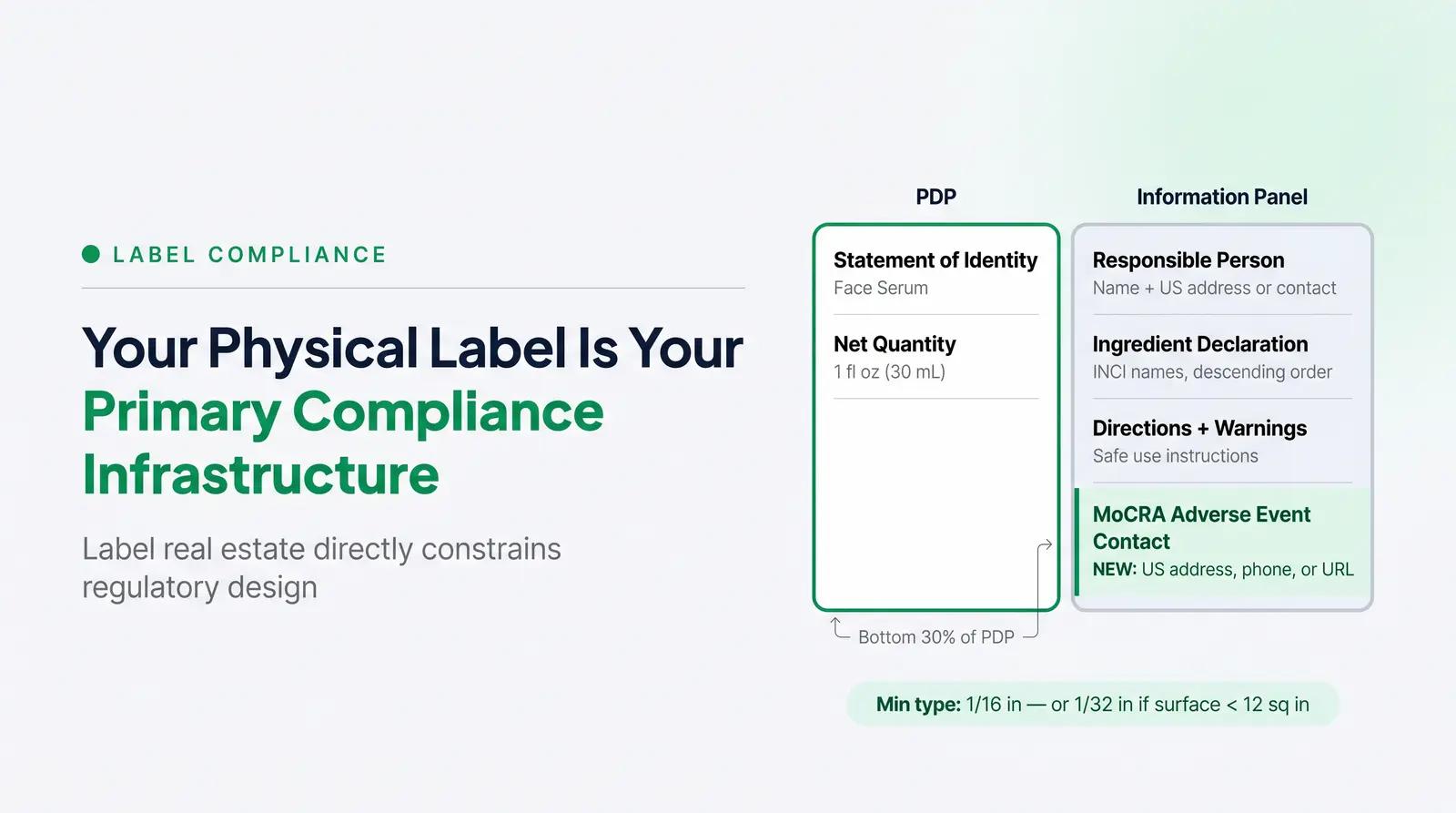
Under 21 CFR Part 701 and the Fair Packaging and Labeling Act, the FDA requires specific information to appear on cosmetic packaging in defined locations [8] [9]. This information is divided between two distinct areas: the Principal Display Panel (PDP), which is the front-facing portion of the label most likely to be seen by consumers at the point of sale, and the Information Panel, which typically occupies the back or sides of the container [8] [9].
The Principal Display Panel must display the Statement of Identity, which clearly defines what the product is (such as "Face Serum" or "Hydrating Toner"), and the Net Quantity of Contents, expressed in US customary units with metric equivalents in parentheses, such as "1 fl oz (30 mL)" [8] [9]. The Net Quantity must be placed in the bottom 30% of the PDP, printed in a line parallel to the base of the container [8].
The Information Panel must contain the name and place of business of the responsible person (manufacturer, packer, or distributor), a complete ingredient declaration listing all ingredients in descending order of predominance using their International Nomenclature Cosmetic Ingredient (INCI) names, directions for safe use where necessary, and any required warning statements [8] [9].
MoCRA added one additional mandatory label element that many brands have not yet implemented: a direct contact mechanism for consumers to report adverse events [1] [2]. This must appear on both the primary container and the outer packaging, and may take the form of a US mailing address, a US phone number, or an electronic contact such as a website URL or email address that links directly to an adverse event reporting mechanism [1] [2].
The Responsible Person Concept
MoCRA formally codified the legal definition of the Responsible Person (RP) [1] [2]. The RP is the manufacturer, packer, or distributor whose name appears on the physical label of the cosmetic product [1] [2]. The RP bears ultimate legal responsibility for compliance, including submitting product listings, ensuring safety substantiation, and reporting serious adverse events [1] [2].
For indie brands that use contract manufacturers or private-label suppliers, this distinction carries significant practical weight. If your brand's name is on the label, you are the Responsible Person. The name and address printed on your packaging must be your business name and a valid US contact address, not your contract manufacturer's address, unless your contract manufacturer is also the entity marketing the product [8] [9]. If the distributor is not the manufacturer or packer, the label must include a qualifying phrase such as "Manufactured for" or "Distributed by" [8].
A common misconception among private-label brands importing finished goods from overseas is that the foreign manufacturer bears the compliance burden. Under MoCRA, the importer whose name appears on the US label is the Responsible Person, and the foreign manufacturing facility must register with the FDA and designate a US agent [1] [4].
Label Real-Estate Constraints
Indie beauty brands frequently select their primary packaging based on aesthetics, shelf presence, or budget, often before their regulatory copy is finalized. This sequence is a recipe for compliance failure.
When you attempt to fit a 30-ingredient INCI list, a bilingual directions panel, the mandatory responsible person contact block, a barcode, and required safety warnings onto a 0.5 oz (15 mL) lip balm tube or a 1 oz (30 mL) dropper bottle, you encounter hard physical design limits.
The FDA requires that the ingredient list be printed in type no less than 1/16 of an inch (1.6 mm) in height [8]. If your package has a total surface area of less than 12 square inches (77.4 cm²), the type size may be reduced to 1/32 of an inch (0.8 mm) [8]. Even at this reduced size, the text must remain legible, with sufficient background contrast and no crowding from design elements [8] [10].
If your primary container cannot accommodate all required text, you must utilize outer packaging, such as a folding carton, to bear the ingredient list and detailed warnings [8]. If you sell the product without a folding carton, every required element must fit on the primary container, which may force you to select a larger packaging SKU or use an accordion-style peel-back label.
MoCRA Product Listing and What It References
The FDA's electronic submission portal, Cosmetics Direct, requires the Responsible Person to submit specific data for each product listing, including the exact product name, category codes, and a complete ingredient list [5]. The FDA also strongly requests that brands upload high-resolution images of the front and back of the physical product labels as part of the listing [5].
This creates an absolute sequencing requirement: your physical packaging labels must match your FDA product listing exactly. If your printed packaging lists "Fragrance" but your formulation contains specific allergens that will require individual disclosure under upcoming FDA rules, or if you modify your formula but continue using old packaging inventory, your product is legally considered misbranded [1] [2] [6].
Fragrance Allergen Disclosure (Pending Guidance)
Under MoCRA Section 609(b), the FDA is mandated to establish a list of fragrance allergens that must be individually disclosed on cosmetic labels, replacing the generic term "Fragrance" or "Parfum" [1] [2]. This rulemaking was required by June 29, 2024, but the FDA has not yet issued a proposed rule [11]. According to the FDA's Spring 2025 Unified Agenda, the proposed rule is now expected in May 2026 [11] [12].
Once finalized, this rule will require brands to list specific allergens such as Linalool, Limonene, Geraniol, or Citral individually on their labels, further reducing available label real estate. Brands using fragrances should audit their formulations now and monitor the FDA's rulemaking calendar closely. For a related guide to designing compliant cosmetic labels from the ground up, see our Cosmetic Labeling Guide for Indie Brands.
The MoCRA Packaging & Labeling Readiness Checklist
The following is a practical checklist we recommend at Packfolio for founders who are approaching the label-finalization stage. It is built from the requirements documented in FDA guidance, 21 CFR Part 701, and MoCRA statutory text. It is not a substitute for legal counsel, but it provides a structured starting point for verifying compliance before committing to a production run.
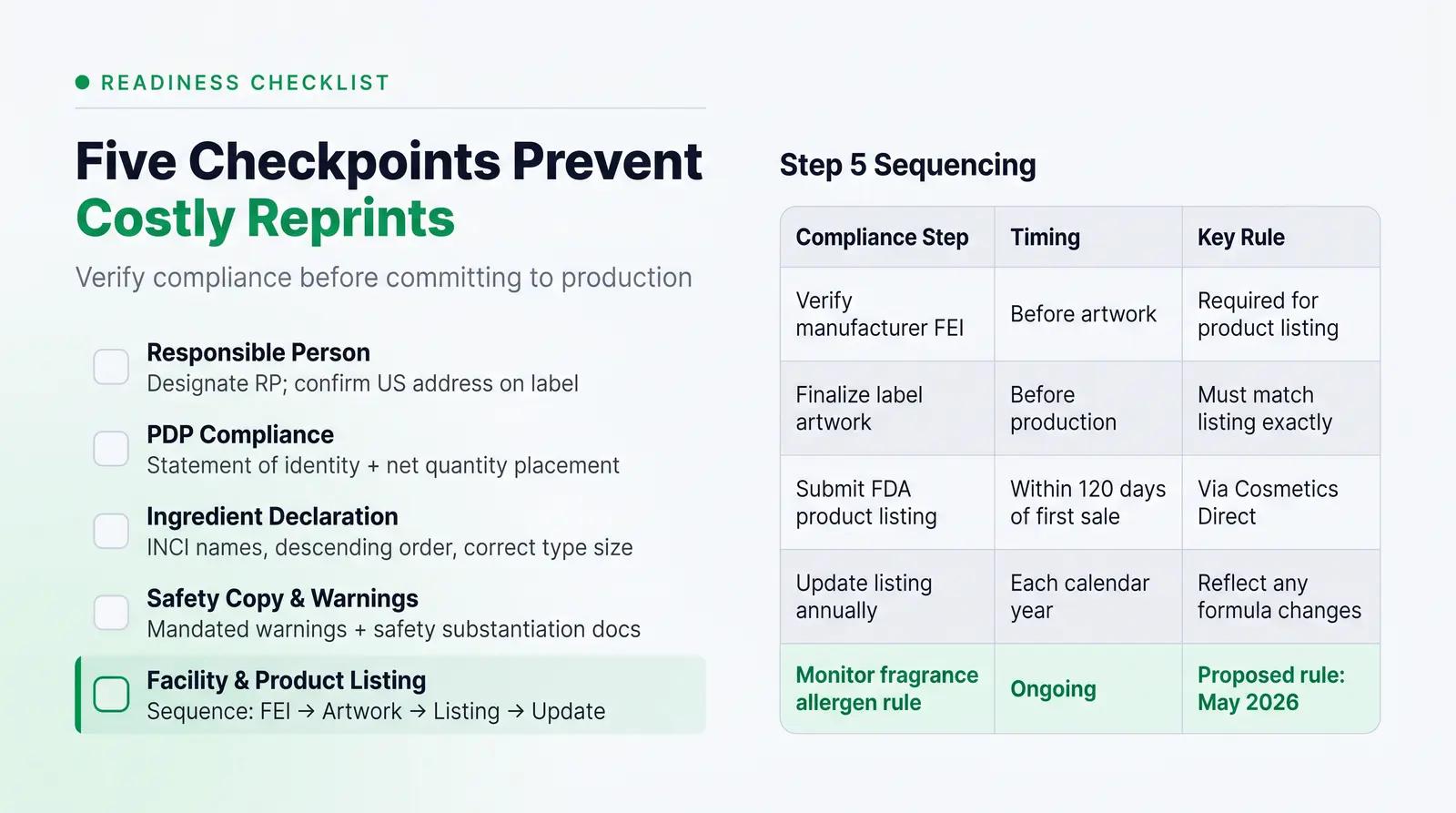
Step 1: Responsible Person Designation
- Identify the legal entity acting as the Responsible Person (RP) whose name will appear on the label.
- Confirm that the RP's name is prefixed with "Manufactured for," "Distributed by," or "Packed by" if the RP is not the actual manufacturer [8].
- Verify that a complete US mailing address, a US phone number, or a direct electronic contact (website or email) for receiving adverse event reports is printed on both the primary container and outer packaging [1] [2].
Step 2: Principal Display Panel (PDP) Compliance
- Confirm the Statement of Identity is printed on the front panel, parallel to the base of the container [8] [9].
- Verify the Net Quantity of Contents is placed in the bottom 30% of the PDP, in a line parallel to the base [8] [9].
- Confirm the Net Quantity is expressed in dual units: US customary (e.g., "1 fl oz") and metric (e.g., "30 mL") in parentheses [8] [9].
- Measure the PDP surface area to confirm that Net Quantity text meets the minimum type height requirements for your container size [8].
Step 3: Information Panel and Ingredient Declaration
- Place the complete ingredient list on an information panel of the outer packaging or the primary container [8].
- Verify all ingredients are listed in descending order of predominance, with color additives and sub-1% ingredients following in any order [8].
- Confirm all ingredients use official INCI names as recognized in the International Cosmetic Ingredient Dictionary [8].
- Check that ingredient declaration type size is at least 1/16 in (1.6 mm), or 1/32 in (0.8 mm) if the total package surface area is under 12 sq in [8].
- Ensure sufficient visual contrast between text and background, with no overlapping design elements [10].
Step 4: Safety Copy and Warnings
- Confirm that any FDA-mandated warnings for specific product categories (aerosols, foaming bath products, products containing alpha-hydroxy acids) are printed exactly as required by 21 CFR Part 740 [8].
- Verify that directions for safe use are clear, legible, and printed on the container or outer carton [8].
- Maintain a centralized, secure folder containing safety substantiation documentation, including toxicological risk assessments, stability testing, and microbiological testing records [1] [2].
Step 5: Facility and Product Listing Sequencing
| Compliance Step | Timing | Notes |
|---|---|---|
| Verify contract manufacturer's FEI and active facility registration | Before finalizing artwork | The FEI number is required for the product listing submission [5]. |
| Finalize label artwork with all required elements | Before production run | Artwork must match the product listing exactly [5]. |
| Submit FDA product listing via Cosmetics Direct | Within 120 days of first commercial distribution [2] | Use the exact product name, ingredient list, and facility FEI from the finalized artwork [5]. |
| Update product listing annually | Each calendar year | Any changes to formulation or labeling must be reflected in the annual update [1] [5]. |
| Monitor FDA fragrance allergen rulemaking | Ongoing | Proposed rule expected May 2026; finalization timeline unknown [11] [12]. |
| Establish adverse event reporting mechanism | Before first sale | Contact information must appear on the label; serious events must be reported within 15 business days [1] [2]. |
The Non-Obvious Insight: MoCRA Compliance is a Packaging Sequence Dependency
The most common compliance mistake made by independent beauty brands is treating MoCRA registration and product listing as post-launch administrative tasks. Most regulatory guides advise founders to develop their product, manufacture their inventory, launch commercially, and then list their products with the FDA within the statutory 120-day window [2] [4].
This approach is risky in a way that most guides fail to explain.
To list a cosmetic product in the FDA's Cosmetics Direct portal, you must provide the active FDA Establishment Identifier (FEI) of the facility where the product is manufactured or processed [5]. If your contract manufacturer has not registered their facility, or if their registration is suspended due to a compliance violation, you cannot legally list your product, and you cannot legally distribute it [1] [4].
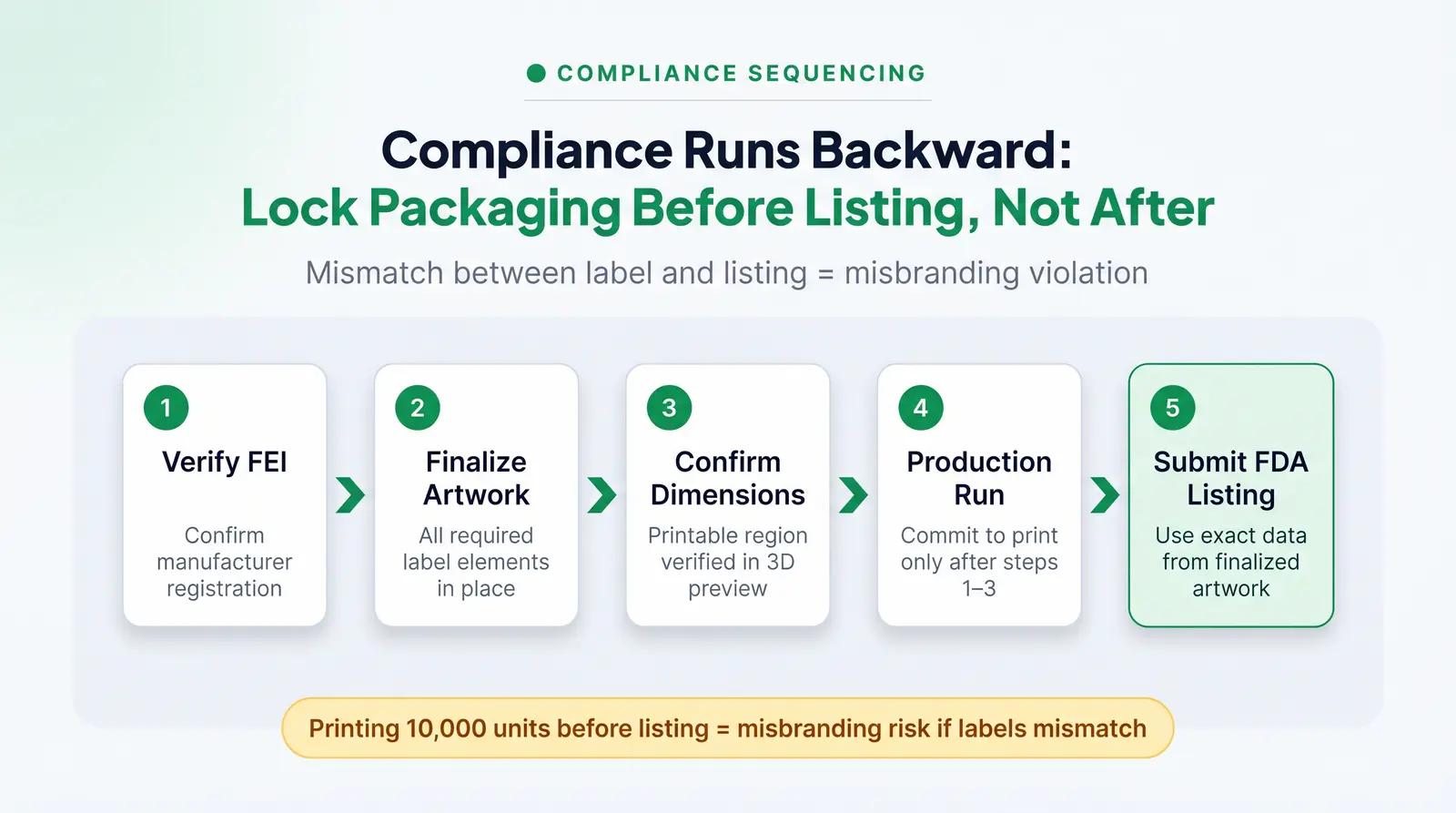
More critically, the product listing requires you to declare the exact product name and ingredients as they appear on your physical label [5]. If you finalize your packaging artwork, print 10,000 units, and then attempt to list the product, any mismatch between your physical label and your listing data can result in a misbranding violation [1] [2] [6]. If the FDA subsequently updates its fragrance allergen rules or flags an ingredient in your printed list, you cannot simply update your digital listing and continue selling. You must halt distribution, discard your printed packaging inventory, and reprint your labels to maintain alignment.
The compliance sequence therefore runs backward from what most brands assume:
- Verify the manufacturing facility's active FEI registration.
- Finalize the complete label artwork, including all required elements.
- Confirm label dimensions and printable regions in your packaging tool.
- Commit to a production run.
- Submit the FDA product listing, using the exact data from the finalized artwork.
MoCRA compliance is not a post-launch chore. It is a critical gateway that dictates your packaging design, sourcing, and printing timeline. Finalizing packaging early in the compliance sequence is exactly the kind of decision that Packfolio's 3D preview workflow is built for. You can confirm label placement and printable region dimensions before committing to production, so what you submit to the FDA and what you print are the same thing.
MoCRA Obligations by Brand Scenario
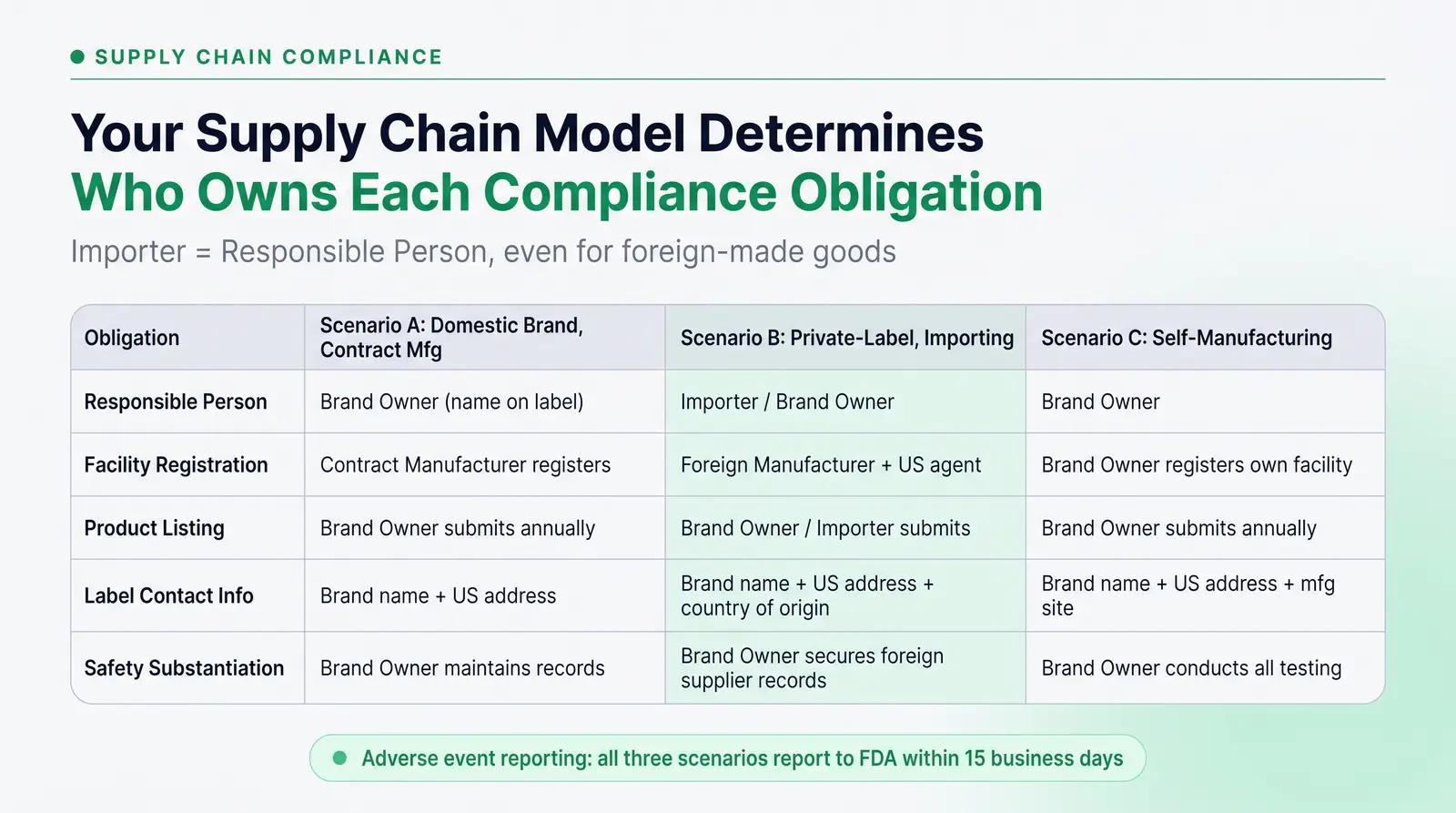
A common source of confusion is determining which MoCRA obligations apply to which party in the supply chain, particularly for brands that use contract manufacturers or import finished goods. The table below maps the key compliance obligations across three common brand operating models.
| MoCRA Requirement | Scenario A: Domestic Brand, Contract Manufactured | Scenario B: Private-Label Brand, Importing Finished Goods | Scenario C: Self-Manufacturing Brand |
|---|---|---|---|
| Responsible Person (RP) | The Brand Owner, whose name is on the label [1] [2]. | The Importer / Brand Owner, whose name is on the US label [1] [2]. | The Brand Owner, as both manufacturer and marketer [1] [2]. |
| Facility Registration | The Contract Manufacturer must register and renew biennially [1] [4]. | The Foreign Manufacturer must register and designate a US agent [1] [4]. | The Brand Owner must register their own facility [1] [4]. |
| Product Listing | The Brand Owner submits and updates listings annually [4] [5]. | The Brand Owner / Importer submits and updates listings annually [4] [5]. | The Brand Owner submits and updates listings annually [4] [5]. |
| Label Contact Info | Brand Owner's name, US address or contact mechanism [1] [2] [8]. | Brand Owner's name, US address, and country of origin [1] [2] [8]. | Brand Owner's name, US address, and manufacturing site info [1] [2] [8]. |
| Safety Substantiation | Brand Owner maintains records, typically sourced from the manufacturer [1] [2]. | Brand Owner must secure and translate safety records from the foreign supplier [1] [2]. | Brand Owner conducts and documents all safety testing [1] [2]. |
| Adverse Event Reporting | Brand Owner receives, records, and reports serious events to the FDA within 15 business days [1] [2]. | Brand Owner receives, records, and reports serious events to the FDA within 15 business days [1] [2]. | Brand Owner receives, records, and reports serious events to the FDA within 15 business days [1] [2]. |
A Worked Example: Launching a 1 oz Vitamin C Face Serum
To make these requirements concrete, consider a founder launching a high-performance brightening serum in a glass dropper bottle.
The Scenario
The founder has finalized her formula with a domestic contract manufacturer. The formula contains Water, Ascorbic Acid, Glycerin, Ferulic Acid, Tocopherol, Sodium Hyaluronate, Phenoxyethanol, Ethylhexylglycerin, and a natural citrus fragrance. She has selected a 30 mL amber glass dropper bottle from Packfolio's catalog. Her contract manufacturer operates out of a registered facility with an active FEI number. Her brand, Aurora Beauty LLC, is based in Seattle, Washington.
Physical Real-Estate Calculations
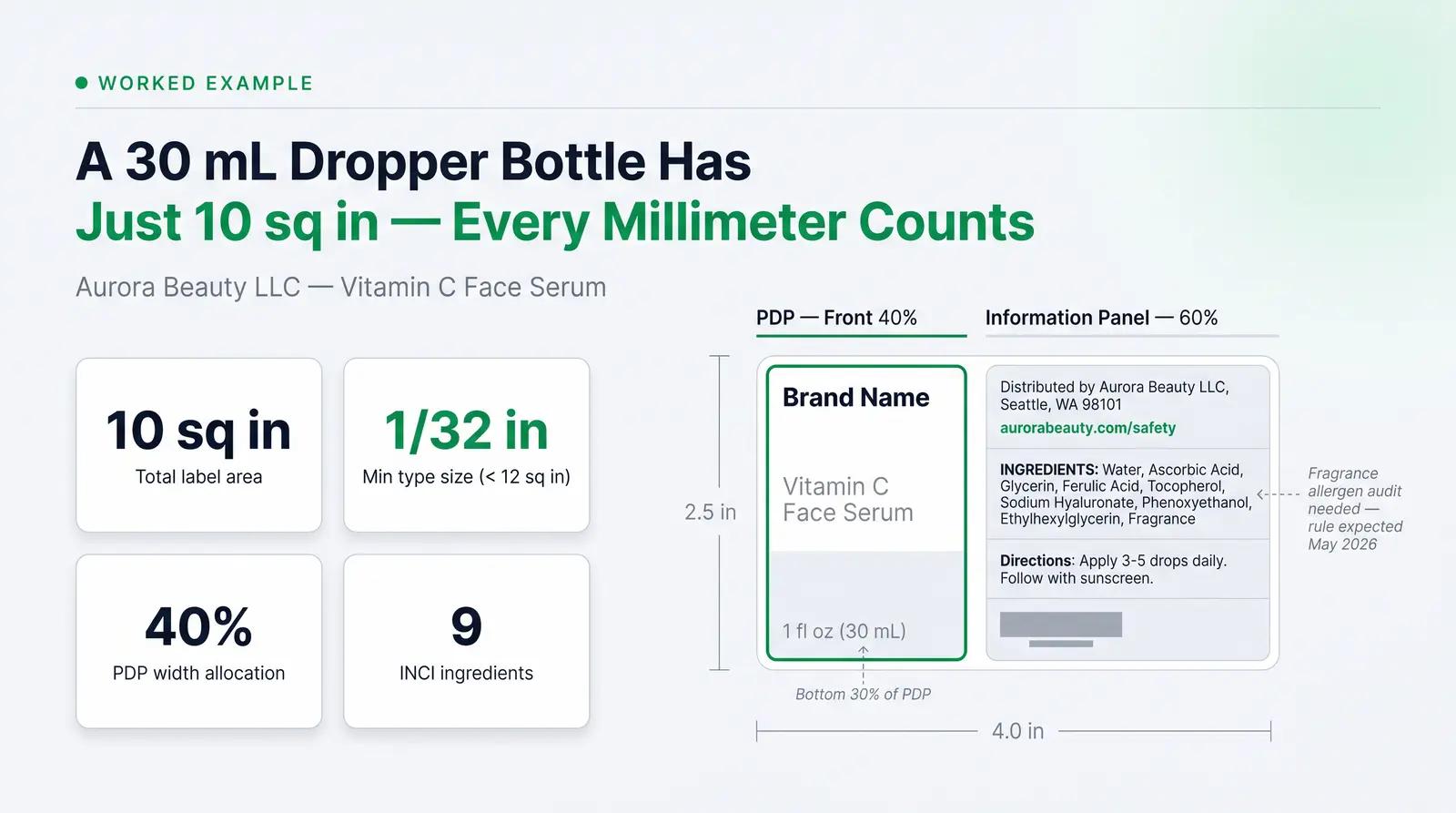
The 30 mL amber glass dropper bottle has a printable wrap-around label area of approximately 2.5 inches in height by 4.0 inches in width (63.5 mm x 101.6 mm), for a total label surface area of 10 square inches (64.5 cm²). Because this is under 12 square inches, the minimum type size for the ingredient declaration is 1/32 of an inch (0.8 mm) [8].
The label must be divided between the PDP (front-facing portion) and the Information Panel (back and sides). A practical allocation for this bottle is approximately 40% of the label width for the PDP and 60% for the Information Panel.
PDP (Front 40%, approximately 1.6 inches wide):
- Brand name at the top.
- Statement of Identity: "Vitamin C Face Serum" in a clear font, parallel to the base.
- Net Quantity: "1 fl oz (30 mL)" placed in the bottom 30% of the PDP, parallel to the base [8] [9]. Because the PDP area is under 5 square inches, the Net Quantity text must be at least 1/16 of an inch (1.6 mm) in height [8].
Information Panel (Remaining 60%, approximately 2.4 inches wide):
- Responsible Person Block: "Distributed by Aurora Beauty LLC, Seattle, WA 98101." Because Aurora Beauty is listed in a local business directory, the street address may be omitted, but the city, state, and zip code are mandatory [8]. Below this: "Adverse events? Visit www.aurorabeauty.com/safety" (the mandatory MoCRA contact mechanism) [1] [2].
- Ingredient Declaration: "INGREDIENTS: Water, Ascorbic Acid, Glycerin, Ferulic Acid, Tocopherol, Sodium Hyaluronate, Phenoxyethanol, Ethylhexylglycerin, Fragrance." Listed in strict descending order of predominance using official INCI names [8]. A note on Fragrance: the citrus scent can currently be listed as "Fragrance" under existing rules [8]. However, the founder's formulator should audit whether any citrus oil constituents (such as Citral or Limonene) will exceed future disclosure thresholds once the FDA's fragrance allergen rule is finalized [11] [12]. If so, those ingredients will need to be added individually to the printed label, further reducing available space.
- Directions and Cautions: "Directions: Apply 3-5 drops to clean skin daily. Follow with moisturizer and sunscreen. Caution: For external use only. Avoid contact with eyes. Discontinue use if irritation occurs."
The Design Challenge
At 1/32 of an inch type size, a nine-ingredient INCI list, a responsible person block, a directions panel, and a barcode can fit on a 2.4-inch information panel, but with very little margin. If the founder adds a second language, a certification logo, or a longer caution statement, she will likely need to either use a larger bottle or add a folding carton to carry the overflow copy.
For a deeper look at dropper bottle packaging specifications and printable region planning, see our guide to dropper bottle packaging for beauty brands.
The Compliance Sequence in Action
Before Aurora Beauty uploads her artwork to Packfolio, she completes the following steps:
- She requests the contract manufacturer's active FEI number and confirms its status in the FDA establishment database [4] [5].
- She secures the final, signed formulation sheet from her chemist, ensuring every INCI name on the sheet matches the printed label exactly.
- She uploads the label artwork into Packfolio's 3D design tool and rotates the photorealistic model to verify that the Net Quantity sits in the bottom 30% of the front view, that the 1/32-inch ingredient text remains legible against the amber glass background, and that the barcode does not wrap around the bottle's curve.
- Once the packaging is finalized and production begins, she submits Form FDA 5067 via Cosmetics Direct, using the exact product name, ingredient list, and facility FEI verified during the design phase [5].
Before You Finalize Your Packaging
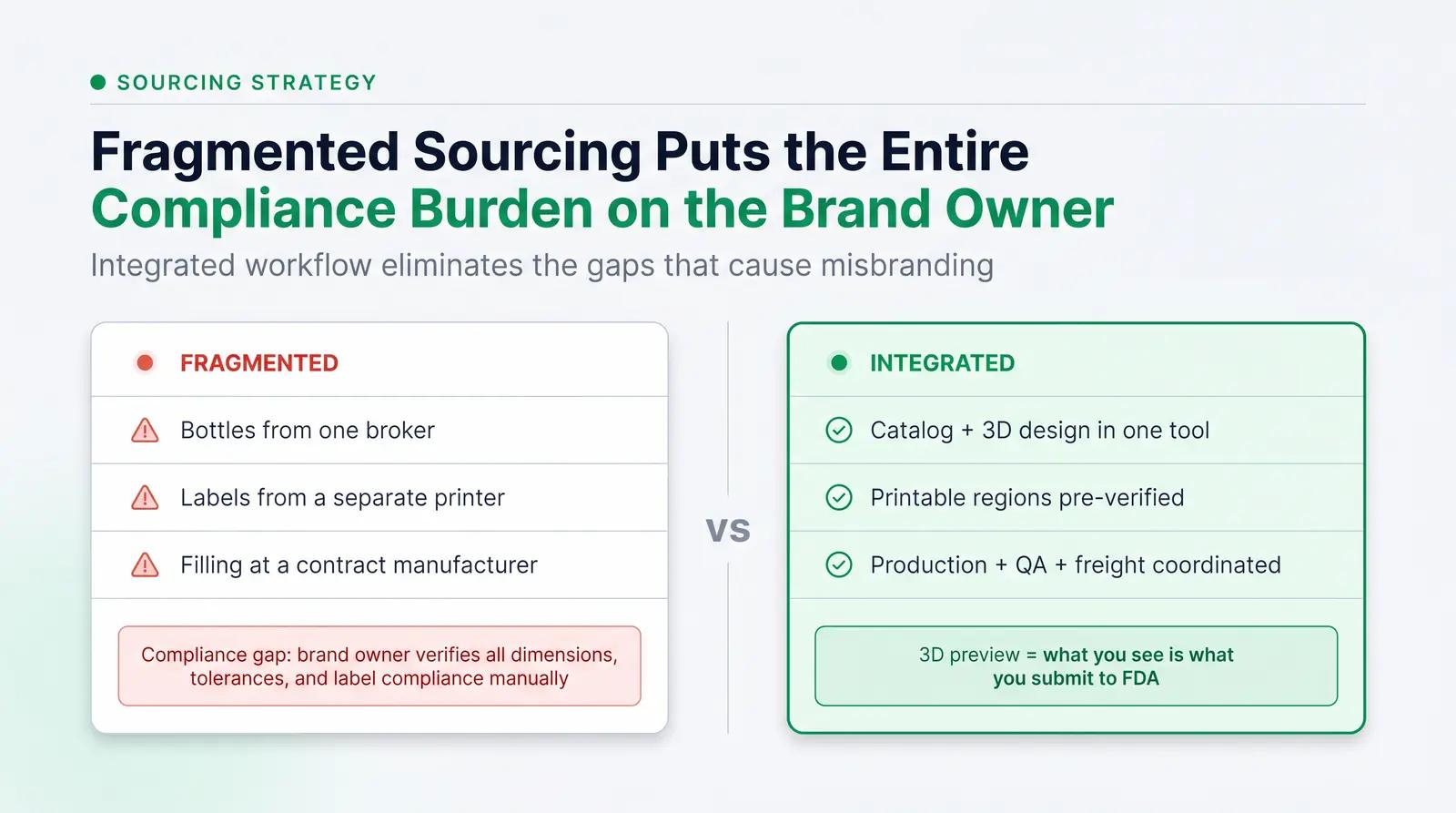
MoCRA has made compliance an active component of packaging design and supply chain management. Independent brands can no longer afford to treat packaging sourcing and regulatory compliance as separate processes. Sourcing through a fragmented supply chain, where bottles come from one broker, labels from a separate printer, and filling from a contract manufacturer, places the entire burden of verifying dimensions, print tolerances, and labeling compliance on the brand owner.
Packfolio simplifies this by integrating packaging procurement, custom design, and compliance verification into a single workflow. Our curated catalog of cosmetic primary packaging features predefined printable regions pre-modeled in photorealistic 3D, so you can upload your label artwork, verify every compliance element, and confirm that your design fits within the printable boundaries before committing to production. We coordinate production, quality assurance, and freight delivery directly with our vetted supplier network. Customers do not contact suppliers. What you see in the 3D preview is what you receive.
Browse Packfolio's curated cosmetic packaging catalog, confirm your printable regions in the 3D preview, and lock in your label layout before you finalize your FDA product listing. Explore the catalog →
Frequently Asked Questions
What is the deadline for MoCRA facility registration?
The statutory deadline for existing cosmetic manufacturing and processing facilities was December 29, 2023, though the FDA extended enforcement to July 1, 2024 to allow industry more time to comply [4]. New facilities that commenced operations after December 29, 2022 must register within 60 days of beginning cosmetic manufacturing activities [2]. All facility registrations must be renewed biennially from the date of initial registration [1] [4].
Who is the "responsible person" under MoCRA?
The responsible person is the manufacturer, packer, or distributor of a cosmetic product whose name appears on the physical label of the product [1] [2]. The responsible person bears ultimate legal liability for compliance, including submitting product listings, ensuring safety substantiation, maintaining adverse event records, and reporting serious adverse events to the FDA within 15 business days [1] [2]. For private-label brands, the importer whose name appears on the US label is the responsible person, not the foreign manufacturer [1] [2].
What information is required on a cosmetic label under FDA regulations?
Under 21 CFR Part 701, the Principal Display Panel must display the Statement of Identity and the Net Quantity of Contents in dual units [8] [9]. The Information Panel must display the responsible person's name and US contact information, a complete ingredient declaration in descending order of predominance using INCI names, directions for safe use, and any required warning statements [8] [9]. MoCRA additionally requires a direct contact mechanism for adverse event reporting on both the primary container and outer packaging [1] [2].
Does MoCRA apply to small indie beauty brands?
Yes, MoCRA applies to all cosmetic brands, though small businesses with average gross annual sales under $1 million over the previous three years are exempt from facility registration, product listing, and future GMP requirements [1] [7]. These exemptions are void if a brand manufactures or distributes high-risk products, including eye cosmetics, injectables, internal-use products, or products designed to alter appearance for more than 24 hours [1] [7]. Selling even one non-exempt product eliminates the small business exemption for the entire brand [7].
What is cosmetic product listing and when must it be submitted?
Cosmetic product listing is a mandatory submission to the FDA through the Cosmetics Direct portal, detailing the product's name, category, manufacturing facility registration numbers, and a complete list of ingredients [4] [5]. For products marketed before July 1, 2024, the listing deadline was July 1, 2024 [4]. For new products launched after that date, the listing must be submitted within 120 days of first marketing the product in interstate commerce, and all listings must be updated annually [2] [4].
References
-
U.S. Food and Drug Administration. "Modernization of Cosmetics Regulation Act of 2022 (MoCRA)." Last updated March 13, 2026. https://www.fda.gov/cosmetics/cosmetics-laws-regulations/modernization-cosmetics-regulation-act-2022-mocra
-
Covington & Burling LLP. "MoCRA Implementation: FDA Fall Unified Agenda Update." December 16, 2024. https://www.cov.com/en/news-and-insights/insights/2024/12/mocra-implementation-fda-fall-unified-agenda-update
-
Personal Care Products Council (PCPC). "Modernization of Cosmetics Regulation Act (MoCRA)." https://www.personalcarecouncil.org/public-policy/modernization-of-cosmetics-regulation-act-mocra/
-
U.S. Food and Drug Administration. "Deadline for Registration and Listing of Cosmetic Product Facilities and Products: What Does the Deadline Mean to You, and How is FDA Helping You Comply?" June 13, 2024. https://www.fda.gov/cosmetics/cosmetics-news-events/deadline-registration-and-listing-cosmetic-product-facilities-and-products-what-does-deadline-mean
-
U.S. Food and Drug Administration. "Form FDA 5067 - Cosmetic Product Listing." Last updated February 11, 2026. https://www.fda.gov/cosmetics/registration-listing-cosmetic-product-facilities-and-products/form-fda-5067-cosmetic-product-listing
-
Wiley Rein LLP. "Time's Up: Cosmetic Facilities Must Comply With FDA's New Registration Requirements by July 1." June 17, 2024. https://www.wiley.law/alert-Times-Up-Cosmetic-Facilities-Must-Comply-With-FDAs-New-Registration-Requirements-by-July-1
-
U.S. Food and Drug Administration. "Registration & Listing of Cosmetic Product Facilities and Products." Last updated April 14, 2026. https://www.fda.gov/cosmetics/registration-listing-cosmetic-product-facilities-and-products
-
U.S. Food and Drug Administration. "Cosmetics Labeling Guide." Last updated February 25, 2022. https://www.fda.gov/cosmetics/cosmetics-labeling-regulations/cosmetics-labeling-guide
-
U.S. Food and Drug Administration. "Summary of Cosmetics Labeling Requirements." Last updated November 18, 2025. https://www.fda.gov/cosmetics/cosmetics-labeling-regulations/summary-cosmetics-labeling-requirements
-
Electronic Code of Federal Regulations. "21 CFR Part 701 - Cosmetic Labeling." eCFR, up to date as of June 1, 2026. https://www.ecfr.gov/current/title-21/chapter-I/subchapter-G/part-701
-
Thomas Tobin and Evan Molineux. "FDA's Unified Regulatory Agenda: Key Updates for Food, Dietary Supplements, and Cosmetics." Perkins Coie LLP, October 22, 2025. https://perkinscoie.com/insights/blog/fdas-unified-regulatory-agenda-key-updates-food-dietary-supplements-and-cosmetics
-
Crowell & Moring LLP. "Cosmetics Under the Microscope: FDA's Expanding Regulatory Reach Under MoCRA." Client Alert, April 8, 2026. https://www.crowell.com/en/insights/client-alerts/cosmetics-under-the-microscope-fdas-expanding-regulatory-reach-under-mocra


