
Packaging SKU Consolidation: How Beauty Brands Can Reduce MOQ Risk
Beauty brands can consolidate packaging SKUs by standardizing neck finishes, bottles, labels, and materials to pool MOQ demand, reduce inventory costs, and free working capital.
Stock-keeping unit (SKU) sprawl is a silent cause of cash-flow pressure for independent beauty brands. It starts innocently enough: a custom frosted glass bottle for a new serum, a unique airless pump for a moisturizer, and a distinct soft-touch tube for a cleanser. Before long, a brand with just four core products is managing twelve different primary packaging components. The financial mechanics of this fragmentation are punishing. Capital becomes tied up in duplicate safety stock, reorder timing fractures across multiple suppliers, and minimum order quantity (MOQ) thresholds become impossible to meet because each component is unique to a single product.
This is not just an inventory management problem; it is a structural barrier to growth. When every product requires its own bespoke packaging ecosystem, the cost of launching new formulas increases, and the agility to respond to market demand decreases. Consolidation—the strategic reduction and sharing of packaging components across a product line—offers a way out. By rethinking packaging architecture, beauty founders can dramatically lower their MOQ exposure, simplify reorders, and free up working capital.
What SKU Sprawl Actually Costs
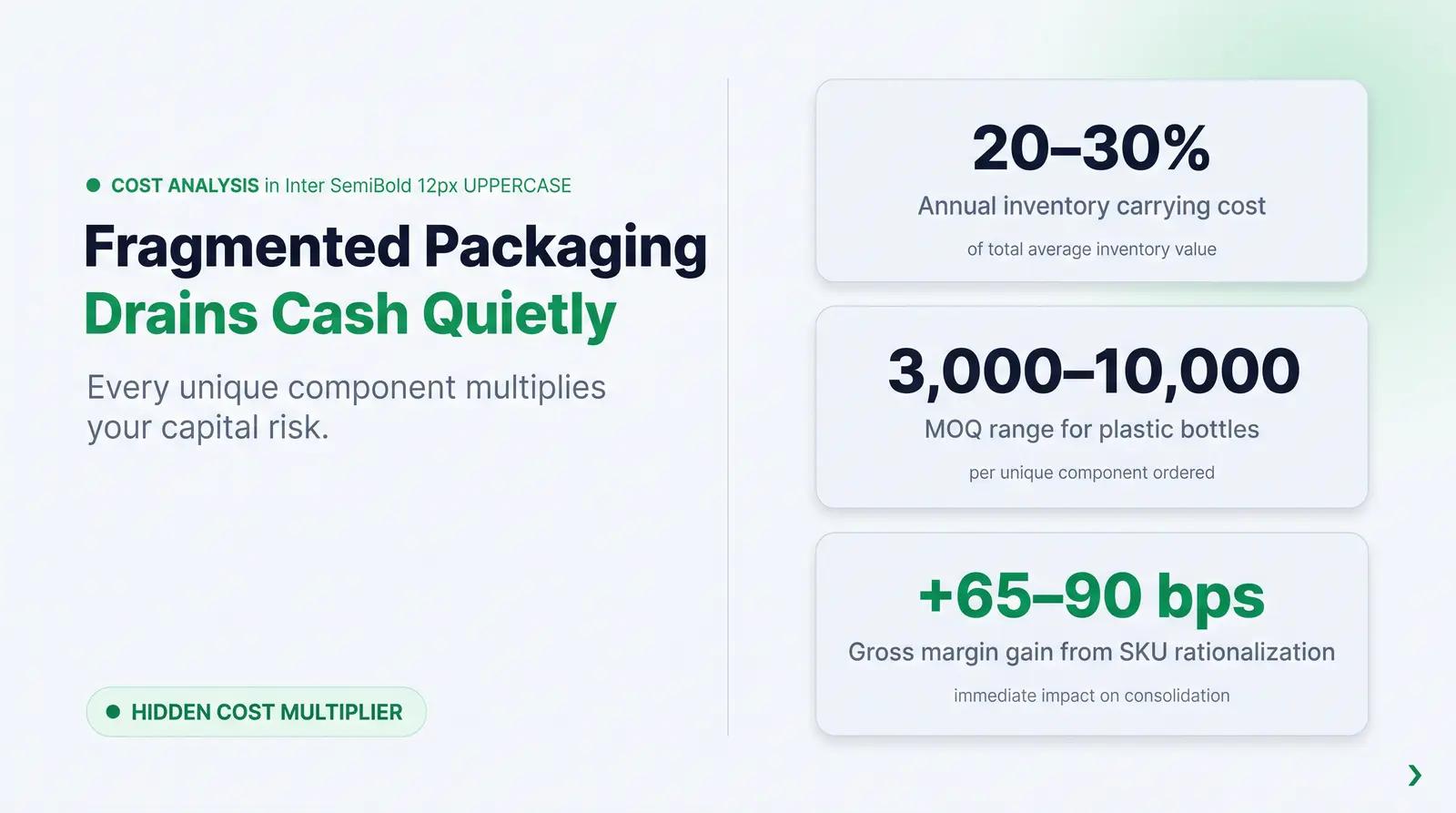
The true cost of a fragmented packaging lineup extends far beyond the per-unit price on a supplier's invoice. The most immediate impact is felt in inventory carrying costs, which typically range between 20% and 30% of a company's total average inventory value per year [1]. For a beauty brand holding $100,000 in unique bottles, closures, and cartons, that translates to $20,000 to $30,000 annually in capital costs, storage fees, insurance, and risk of obsolescence.
Furthermore, fragmented packaging creates severe MOQ traps during reorder cycles. Common MOQ ranges in cosmetic packaging can be daunting for indie brands: 3,000 to 10,000 pieces for plastic bottles, 1,000 to 5,000 pieces for glass containers, and up to 20,000 pieces for certain tubes [2]. If a brand uses a unique bottle for a slow-moving SKU, it may take years to sell through the MOQ, effectively locking capital in dead stock. Conversely, if a fast-moving SKU shares a bottle with three other products, the brand can easily pool demand to meet or exceed the MOQ, unlocking volume discounts and maintaining a leaner, more fluid inventory.
The financial benefits of addressing this complexity are substantial. Recent studies on SKU rationalization in the consumer packaged goods sector estimate that reducing SKU count can contribute an immediate 65 to 90 basis points to gross margins, with continued rationalization expected to add another 150 to 175 basis points over time [3].
The Five Consolidation Levers
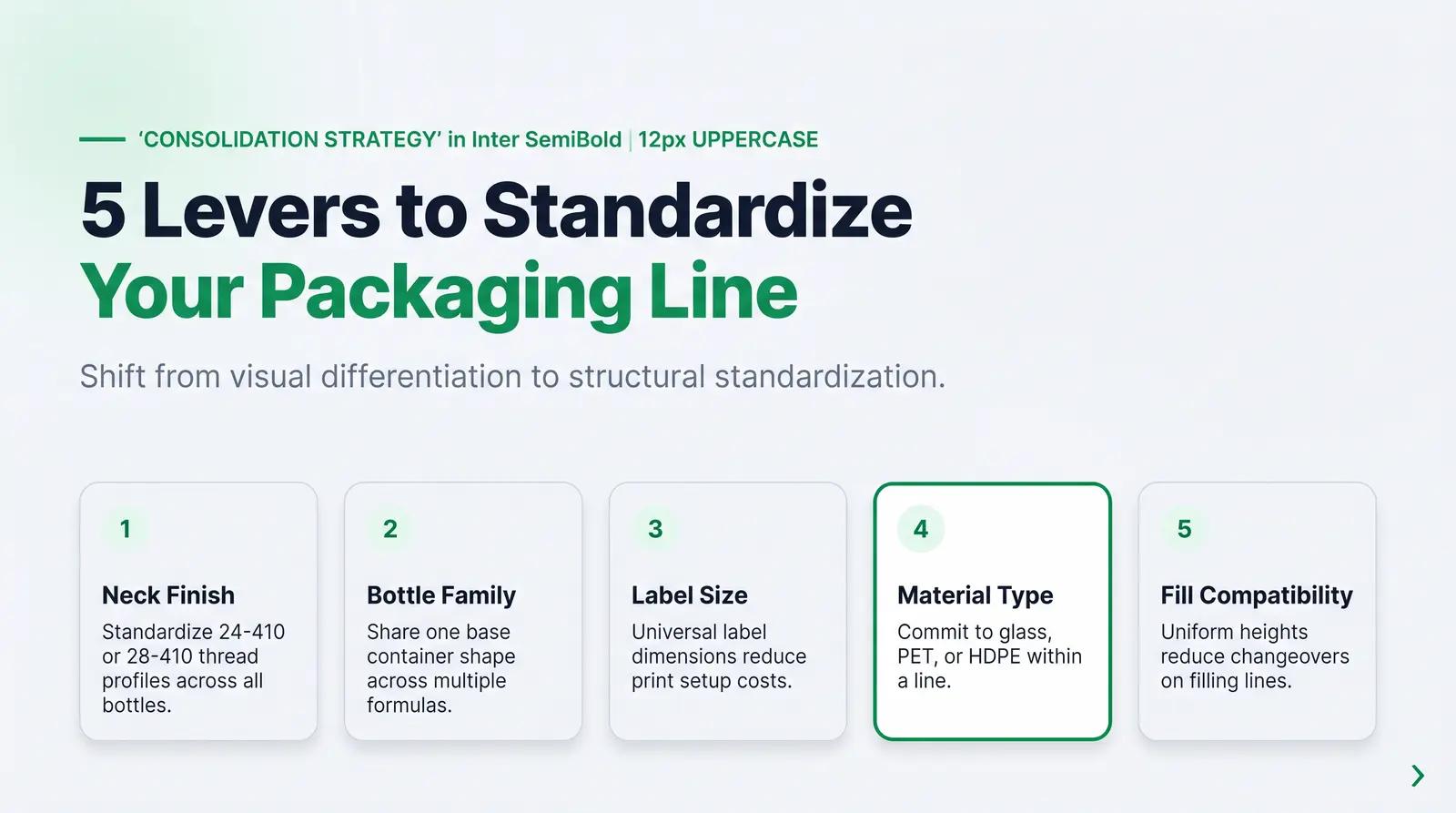
To dismantle packaging complexity, founders must look past visual differentiation and focus on structural standardization. There are five primary levers for consolidating cosmetic packaging.
First, neck finish and closure compatibility is the most powerful yet frequently overlooked lever. Industry standards established by the Glass Packaging Institute (GPI) and the Society of the Plastics Industry (SPI) define precise dimensions for thread profiles, such as the common 24-410 or 28-410 finishes [4]. Standardizing the neck finish across a product line allows a brand to use a single closure SKU—such as a specific dispensing pump or fine mist sprayer—across multiple bottle shapes and capacities.
Second, bottle family sharing involves using the same base container for multiple products. A single 30 ml (1 oz) glass cylinder can house a face oil, a vitamin C serum, and a liquid highlighter. Differentiation is achieved entirely through decoration and labeling, rather than structural tooling.
Third, label size standardization unlocks secondary consolidation benefits that compound over time. When a brand uses a universal label dimension across multiple products, it can utilize shared label stock and execute a single print run per reorder cycle, significantly reducing printing setup costs and MOQs [5].
Fourth, material consistency—committing to either glass, PET, or HDPE within a specific line—streamlines the supply chain. It simplifies compatibility testing, ensures consistent decoration application, and strengthens the brand's sustainability narrative by focusing on a unified recycling stream.
Fifth, filling equipment compatibility ensures that consolidated packaging moves efficiently through contract manufacturing facilities. Standardized neck finishes and container heights mean fewer changeovers on filling lines, reducing setup fees and accelerating production lead times.
The Packaging Platform Matrix
To transition from a fragmented lineup to a consolidated architecture, brands need a structured approach to audit their current inventory. The framework we recommend at Packfolio is The Packaging Platform Matrix. This tool helps founders systematically identify which components can be standardized across products to maximize MOQ pooling.
1. The Component Audit
List every primary packaging component currently in use or planned for launch. Categorize them by:
- Base Container: Material, capacity, shape.
- Neck Finish: Thread specification (e.g., 20-410, 24-410).
- Closure System: Pump, dropper, cap, sprayer.
- Decoration: Label dimensions, screen printing requirements.
2. The Standardization Score
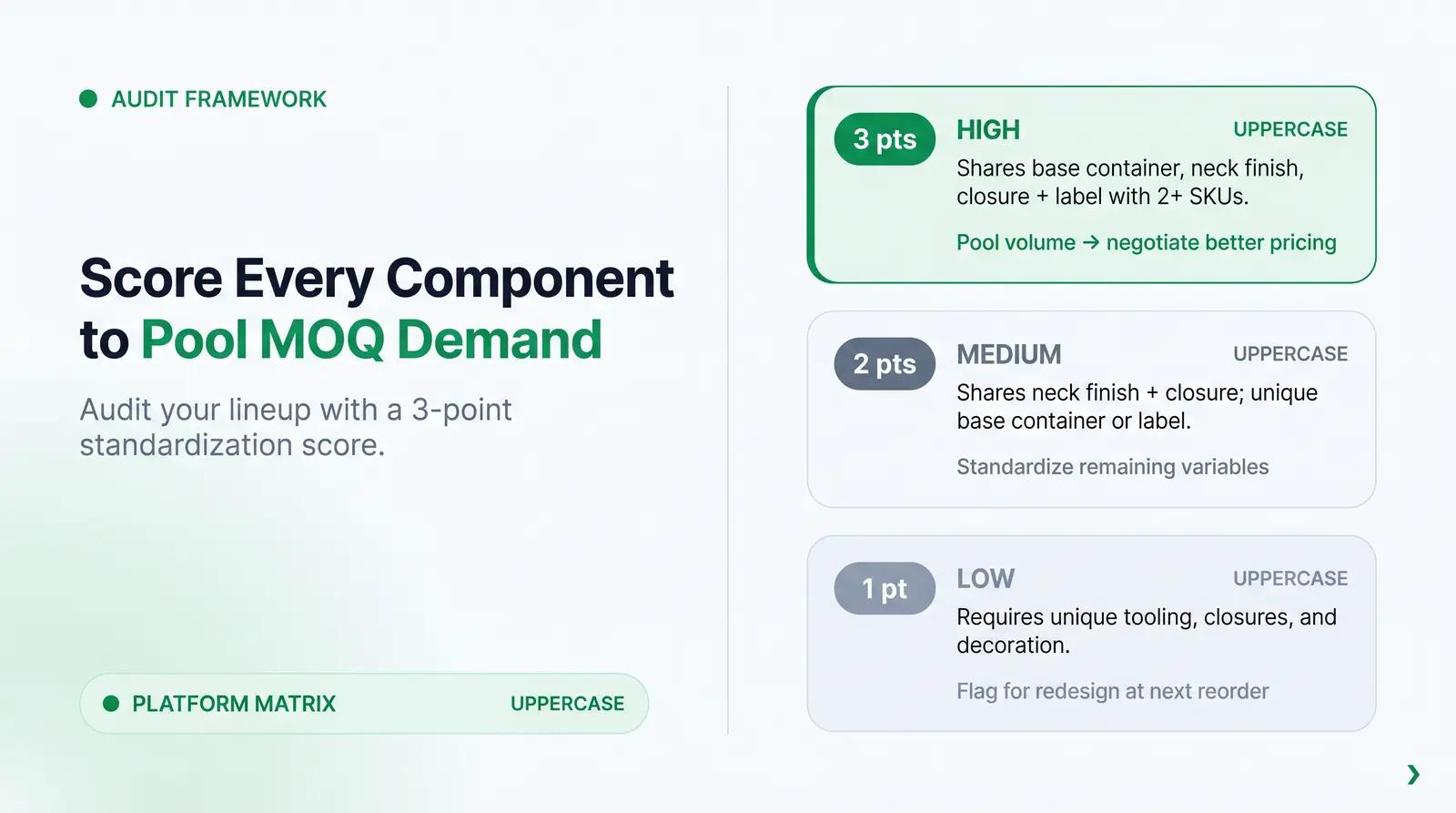
Assign a score to each product based on its ability to share components with the rest of the line.
- High (3 points): Shares base container, neck finish, closure, and label size with at least two other SKUs.
- Medium (2 points): Shares neck finish and closure, but requires a unique base container or label size.
- Low (1 point): Requires entirely unique tooling, closures, and decoration.
3. The Consolidation Action Plan
Based on the scores, map out immediate actions:
- Scores of 1: Flag for redesign or phase-out during the next reorder cycle. Evaluate if the unique component is strictly necessary for formula integrity (e.g., an airless pump for a highly unstable active).
- Scores of 2: Standardize the remaining variables. If the neck finish is shared, can the base container also be unified?
- Scores of 3: These are your core platform SKUs. Pool the volume of these products to negotiate better pricing tiers and lower MOQs with suppliers.
The Consolidation Paradox: A Worked Example
A common misconception is that consolidation must lower the per-unit cost of every single item. In reality, consolidation sometimes increases the per-unit cost on a specific hero SKU, but significantly decreases the total capital at risk across the entire product line. This is a nuance most MOQ articles miss.
Consider a founder launching a four-SKU skincare line: a cleanser, a toner, a serum, and a moisturizer.
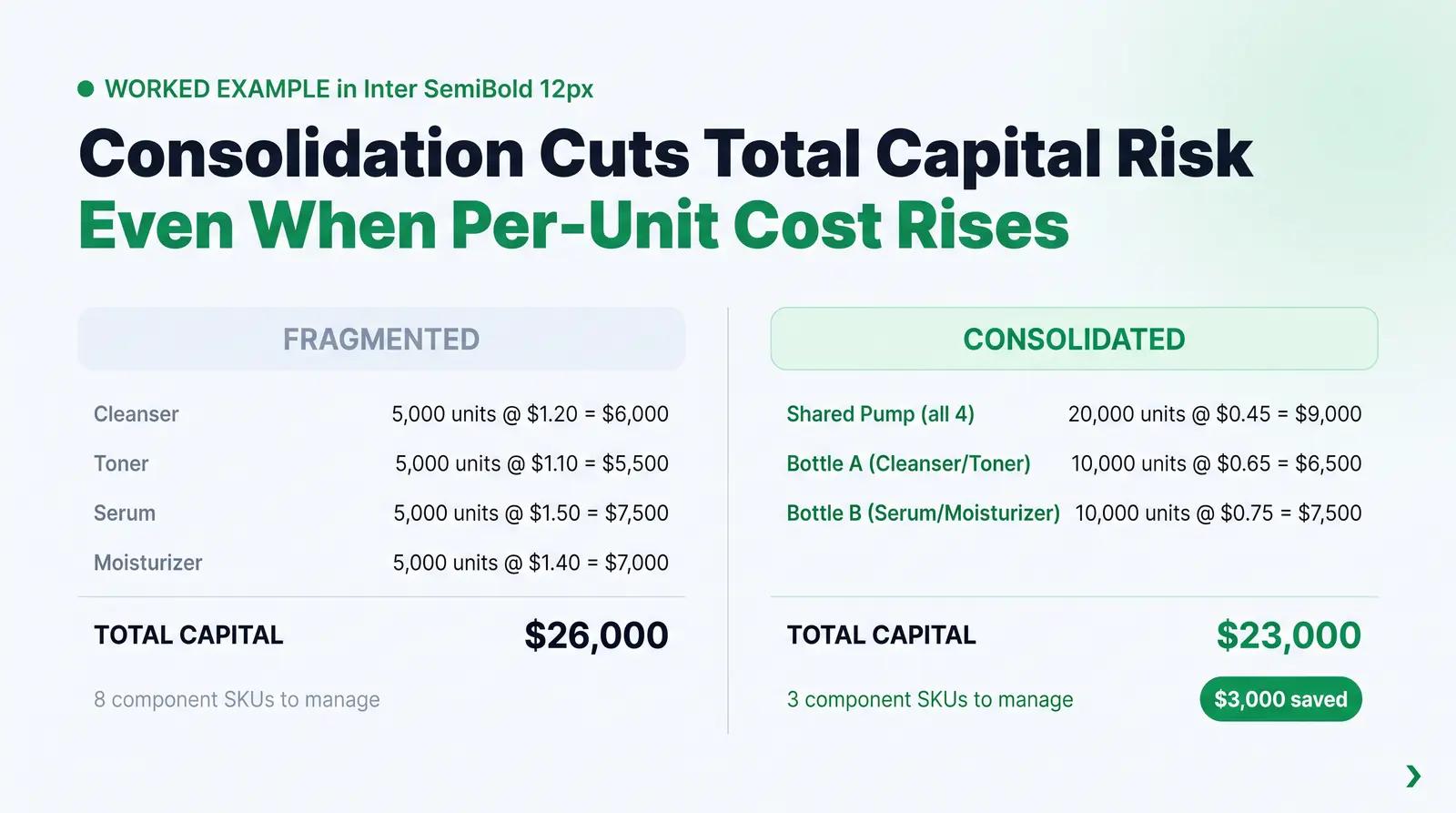
The Fragmented Approach: The founder selects a unique bottle, closure, and label for each product to maximize visual distinction. The supplier requires a 5,000-unit MOQ for each unique component.
- Cleanser: 5,000 units @ $1.20 = $6,000
- Toner: 5,000 units @ $1.10 = $5,500
- Serum: 5,000 units @ $1.50 = $7,500
- Moisturizer: 5,000 units @ $1.40 = $7,000
- Total Capital Required: $26,000 for 20,000 total units.
The Consolidated Approach: The founder standardizes the line using a shared bottle family (two sizes, but identical shapes), a universal 24-410 neck finish, a shared dispensing pump, and a uniform label template. By pooling the volume, the brand easily hits the 10,000-unit pricing tier for the shared components.
- Shared Pump (used on all 4): 20,000 units @ $0.45 = $9,000
- Shared Bottle A (Cleanser/Toner): 10,000 units @ $0.65 = $6,500
- Shared Bottle B (Serum/Moisturizer): 10,000 units @ $0.75 = $7,500
- Total Capital Required: $23,000 for 20,000 total units.
Illustrative figures.
Financial and Operational Comparison
| Metric | Fragmented Architecture | Consolidated Architecture |
|---|---|---|
| Total Upfront Capital | $26,000 | $23,000 |
| Component SKUs to Manage | 8 (4 bottles, 4 closures) | 3 (2 bottles, 1 closure) |
| MOQ Exposure per Product | High (must sell 5,000 to reorder) | Low (pooled demand across line) |
| Inventory Carrying Cost | High (excess unique safety stock) | Low (shared safety stock) |
| Reorder Complexity | High (multiple supplier timelines) | Low (synchronized components) |
While the per-unit cost of the toner might have increased slightly under the consolidated model to accommodate the higher-quality shared pump, the total capital outlay dropped by $3,000. More importantly, the brand only has to manage three component SKUs instead of eight, drastically reducing the friction of future reorders.
How to Design for Consolidation from the Start
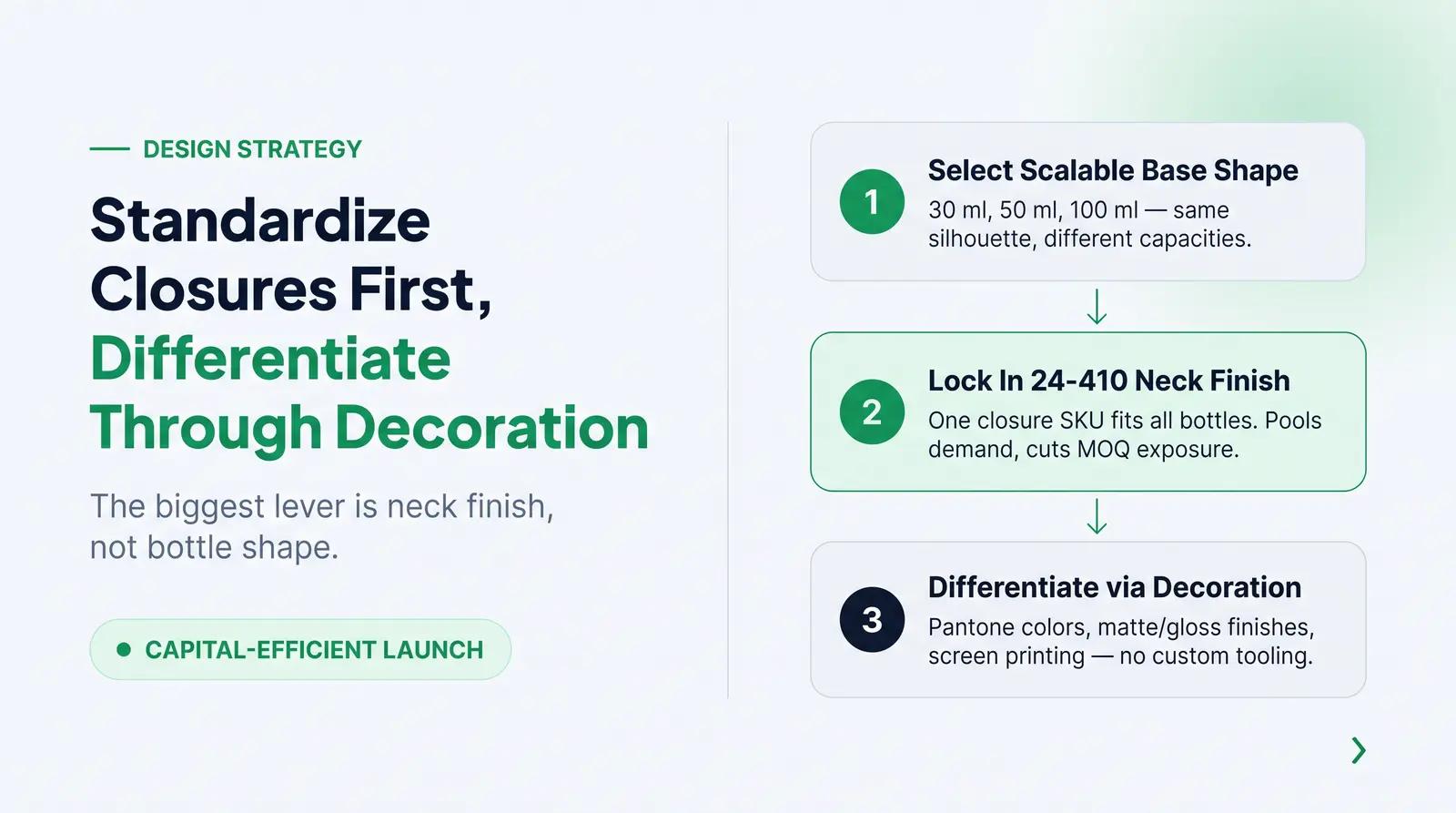
For founders who have not yet launched or are expanding their lines, designing for consolidation from day one is the most capital-efficient strategy. The biggest SKU consolidation lever is often not the bottle shape, but closure and neck finish standardization. Most founders overlook this in favor of visual differentiation, but industry standards make it the easiest win. Because GPI and SPI standards dictate thread profiles, a 24-410 closure from one supplier will fit a 24-410 bottle from another [4]. By standardizing the neck finish, a brand can order one high-volume closure SKU that serves multiple bottle SKUs, dramatically reducing MOQ exposure on the most mechanically complex part of the package.
This is where a curated approach to sourcing becomes invaluable. Packfolio's catalog is organized precisely around these component families, featuring shared neck finishes, predefined print zones, and a 3D preview that makes consolidation-friendly lineup building visible before a single order is placed.
When planning the initial product matrix, founders should select a base container shape that scales elegantly across different capacities (e.g., 30 ml, 50 ml, and 100 ml). Differentiation should then be shifted to the decoration layer. Using customized stock packaging—where standard components are elevated through specific pantone colors, matte or gloss finishes, and high-quality screen printing—delivers the aesthetic impact of custom tooling without the prohibitive MOQs [2].
How to Rationalize an Existing Fragmented Lineup
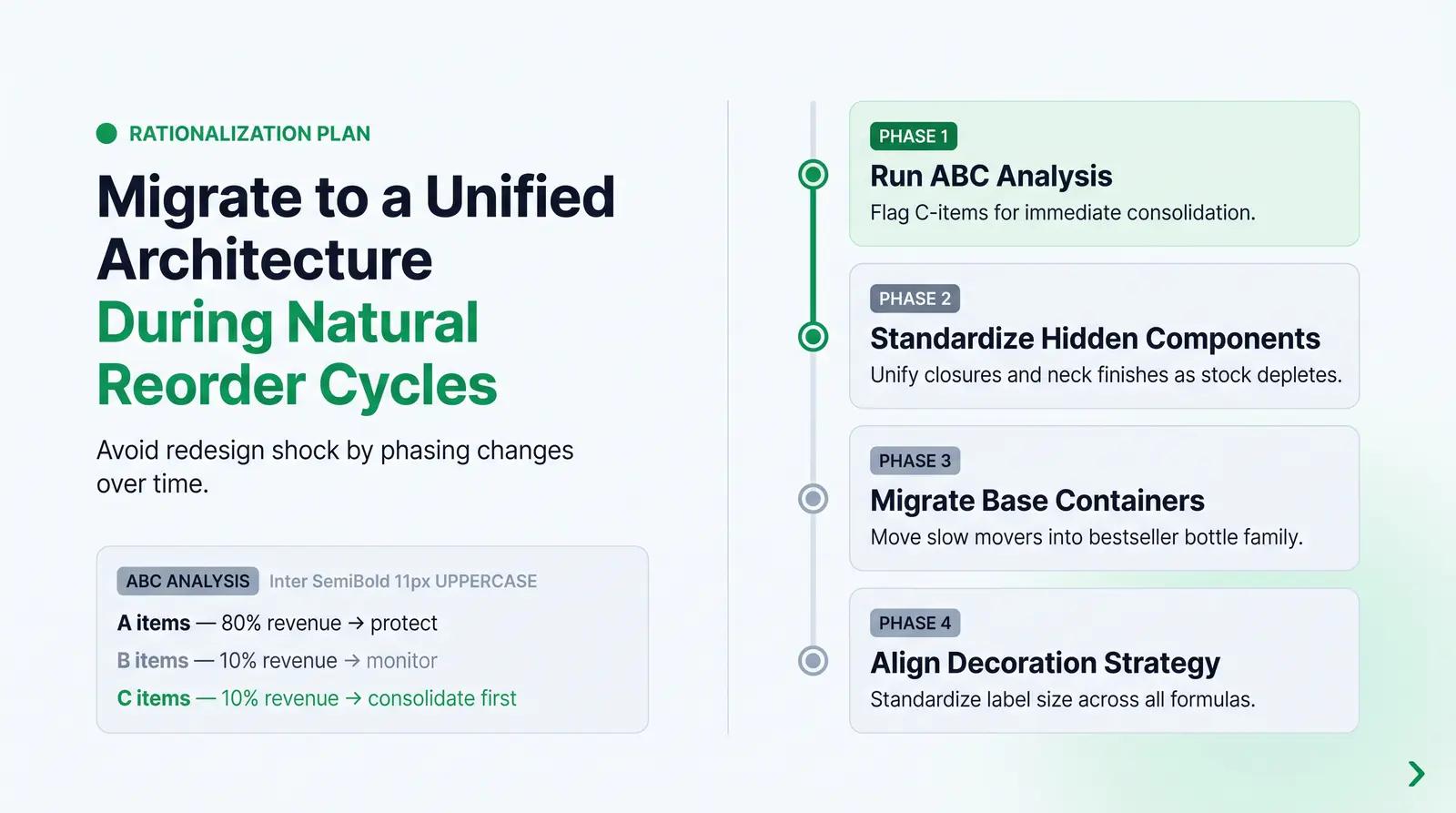
Rationalizing an existing, fragmented lineup requires a phased approach to avoid shocking the consumer or forcing a costly full-brand redesign. The goal is to migrate toward a unified architecture during natural reorder cycles.
The first step is a rigorous application of ABC analysis to the current inventory. Identify the "A" items (the top 80% revenue generators), the "B" items (the middle 10%), and the "C" items (the bottom 10%) [6]. The "C" items are prime candidates for immediate packaging consolidation. Instead of reordering unique components for these slow movers, transition them into the packaging architecture of the "A" items.
Next, focus on standardizing the hidden components first. Consumers rarely notice if a dispensing pump changes slightly, provided the new pump functions well. Standardize all closures and neck finishes across the line as current stock depletes. Once the closures are unified, begin migrating the base containers to a shared family shape.
Finally, align the decoration strategy. Transition to a standardized label size that accommodates varying text lengths for different formulas. This phased transition allows the brand to burn through existing inventory while steadily reducing the total number of packaging SKUs.
What to Verify Before Production
Consolidation only works if the components function together flawlessly. While platforms like Packfolio handle factory vetting, quality control, and supplier coordination, the underlying technical requirements must be precise.
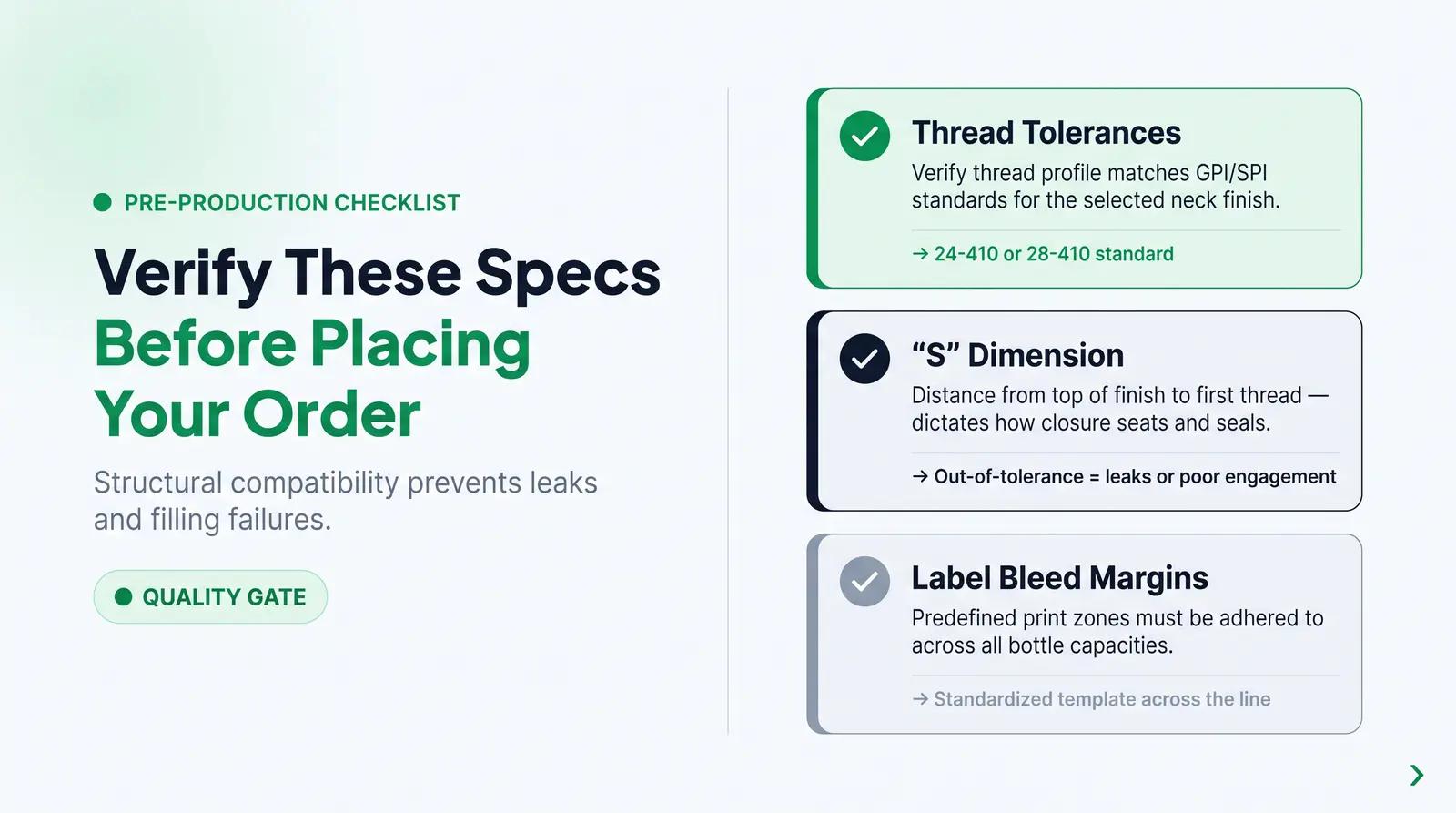
Key technical specifications to verify include thread tolerances and the "S" dimension (the distance from the top of the finish to the start of the first thread), which dictates how the closure seats and seals [4]. If these dimensions are out of tolerance, the consolidated closure may leak or fail to engage properly with the bottle. Additionally, label bleed margins and predefined print zones must be strictly adhered to when applying a standardized label template across different bottle capacities.
By centralizing these variables into a unified architecture, beauty brands can escape the cash-flow drain of SKU sprawl. Consolidation transforms packaging from a logistical liability into a scalable platform for growth.
Browse Packfolio's curated packaging catalog—filter by bottle family, closure type, or material—and preview your label in 3D before placing a consolidated order →
packfolio.com/catalog
Frequently Asked Questions
What is packaging SKU consolidation for a beauty brand? Packaging SKU consolidation is the process of reducing the total number of unique packaging components a brand uses by sharing bottles, closures, and labels across multiple products. This strategy lowers minimum order quantities, reduces inventory costs, and simplifies the supply chain.
How does standardizing neck finishes reduce packaging costs? Standardizing neck finishes (like 24-410) allows a brand to use a single type of closure across various bottle shapes and sizes. This pools the demand for that closure, enabling the brand to meet higher MOQs, secure volume discounts, and hold less safety stock.
Can I consolidate packaging without making my products look identical? Yes. Brands can share the same base container and closure while using different pantone colors, finishes, or label designs to clearly differentiate products. This customized stock approach provides visual distinction without the cost of custom tooling.
How do I transition my current packaging to a consolidated system? Start by auditing your inventory and applying changes during natural reorder cycles. Standardize hidden components like closures and neck finishes first, then gradually migrate slow-moving products into the packaging architecture of your bestsellers.
Why is MOQ a challenge for indie beauty brands? Minimum order quantities require brands to purchase thousands of units of a specific component at once to cover the manufacturer's setup costs. For indie brands with fragmented packaging, this ties up critical cash flow in slow-moving inventory.
References
[1] "Inventory Carrying Costs: How To Calculate and Reduce Them." Fishbowl Inventory, 2026. https://www.fishbowlinventory.com/blog/what-is-carrying-cost
[2] "How Does MOQ Affect Cosmetic Packaging Costs (And What You Can Do About It)?" AH Packaging, 2025. https://ahpackaging.com/how-does-moq-affect-cosmetic-packaging-costs/
[3] "Annual Packaging Study: What Happened to SKU Proliferation?" L.E.K. Consulting, 2024. https://www.lek.com/insights/paper-packaging/annual-packaging-study-what-happened-sku-proliferation
[4] "Guide to Bottle Neck Finishes, Thread Sizes, & Dimensions." Paramount Global, 2026. https://www.paramountglobal.com/knowledge/bottle-neck-thread-finish/
[5] "How to Reduce Cosmetic Packaging Costs Without Sacrificing Quality." Big Sky Packaging, 2026. https://bigskypackaging.com/blog/how-to-reduce-cosmetic-packaging-costs-without-sacrificing-quality/
[6] "The Food Business Guide to SKU Rationalization: Managing Your Packaging Inventory." Inline Plastics, 2025. https://www.inlineplastics.com/blog/the-food-business-guide-to-sku-rationalization-managing-your-packaging-inventory/


