
PCR Cosmetic Packaging: What Beauty Brands Need to Understand
Beauty brands can make credible PCR cosmetic packaging claims by understanding content tiers, demanding third-party certification, and writing precise, regulation-compliant label language.
Post-consumer recycled (PCR) packaging is no longer a niche sustainability move for indie beauty brands. It has become a baseline expectation across retail channels, and regulators on both sides of the Atlantic are now writing it into law.
For beauty founders, PCR offers a real and credible sustainability story. It diverts plastic from landfills, reduces reliance on virgin fossil-based resin, and gives consumers a tangible reason to feel good about their purchase. But the transition to recycled materials is not as simple as swapping one bottle for another. The regulatory environment for environmental claims is tightening fast, supplier documentation varies wildly in credibility, and the physical performance of PCR resins is not uniform across all packaging categories.
This guide covers what founders actually need to know: how to evaluate PCR content levels, what supplier documentation to demand, where performance tradeoffs show up by packaging type, and how to write claim language that holds up to regulatory scrutiny.
What PCR Actually Means
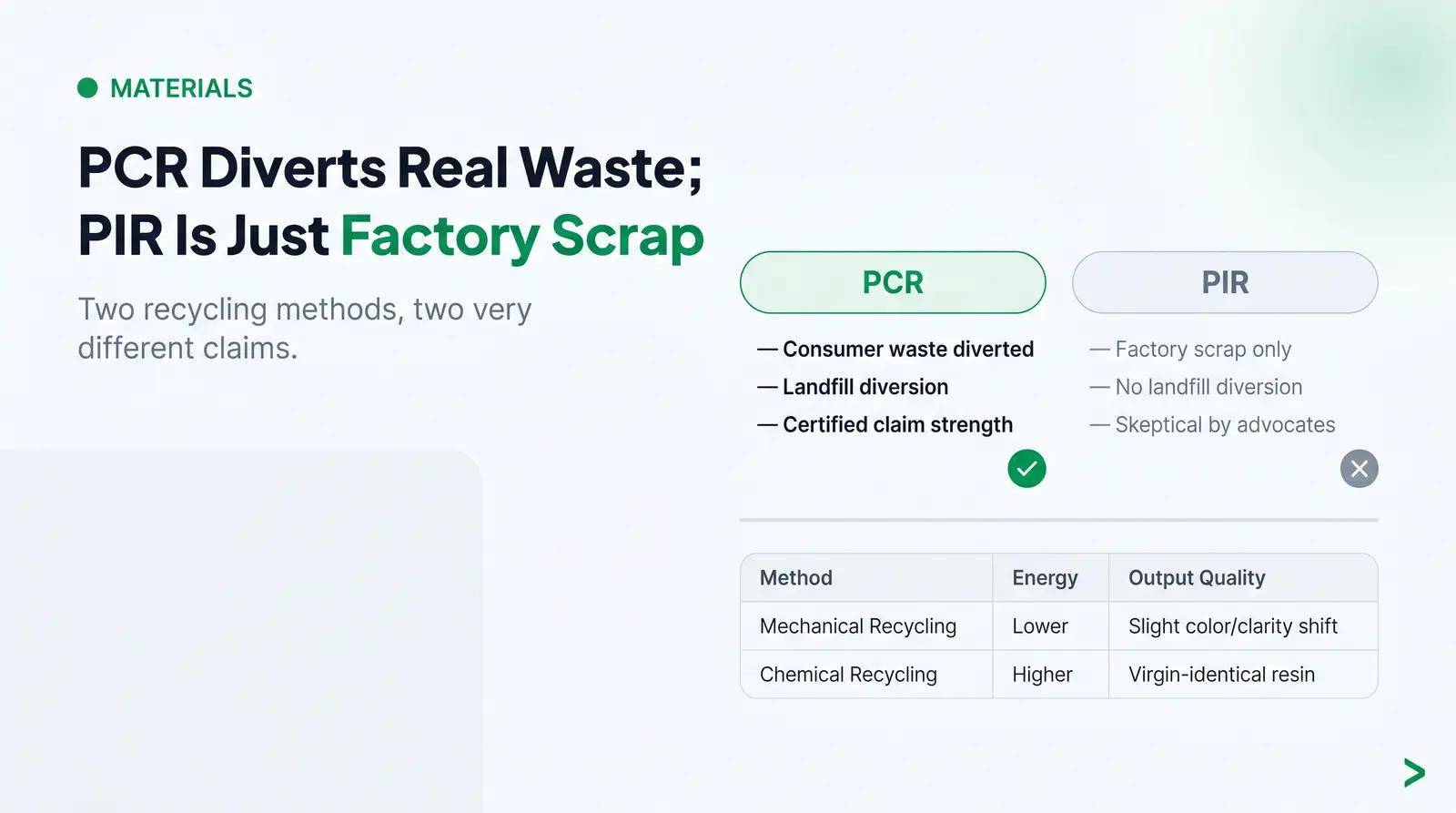
Post-consumer recycled (PCR) content refers to materials that have completed their lifecycle as consumer products, been diverted from the waste stream, and reprocessed into new raw materials. This is distinct from post-industrial recycled (PIR) content, which captures manufacturing scrap before it ever reaches a consumer [1].
The distinction matters. PCR diverts real consumer waste from landfills. PIR is largely an internal manufacturing efficiency measure, and sustainability advocates often view PIR-only claims with skepticism.
PCR materials are produced through two main methods. Mechanical recycling washes, shreds, and melts plastic waste into new pellets. It is energy-efficient and widely available, but it can introduce slight reductions in clarity, tensile strength, and color consistency. Chemical recycling breaks plastic down to its molecular components and reconstructs it, yielding resin that performs identically to virgin plastic. The tradeoff is that chemical recycling is more energy-intensive and far less widely available [2].
When a brand says a package is "made with recycled materials," the claim is often vague and may include PIR. A certified PCR content claim specifically quantifies the percentage of post-consumer waste used. Whether that number is 30%, 50%, or 100% represents materially different supply chain realities. These distinctions are formalized in ISO 14021, the international standard for self-declared environmental claims, which defines how recycled content must be calculated and disclosed [4].
The Claim Language: Navigating Regulatory Scrutiny
The rules around environmental marketing claims are becoming stricter, and beauty brands need to treat their label copy with the same rigor as their ingredient list.
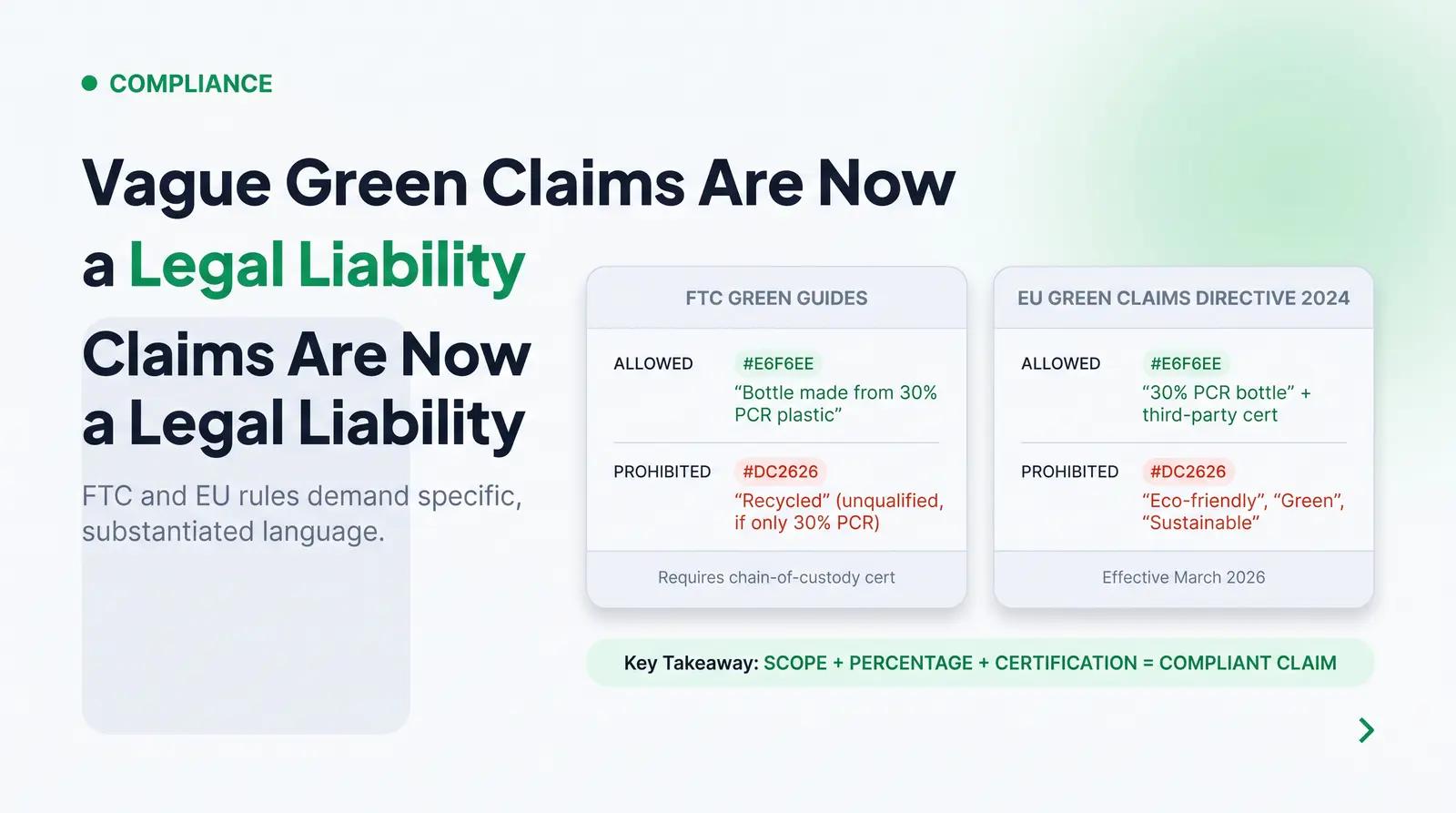
In the United States, the FTC Green Guides govern how brands can communicate environmental benefits. The FTC distinguishes between unqualified and qualified claims. An unqualified claim, such as "recycled," implies that the entire product and package are made from recycled material. If a bottle contains only 30% PCR, the claim must be qualified clearly: "Bottle made from 30% post-consumer recycled plastic" [5]. The FTC also requires that any claim be substantiated by competent and reliable evidence, which in the context of PCR means chain-of-custody documentation and third-party certification verifying the exact percentage.
For brands operating in or expanding to Europe, the stakes are higher. The EU Green Claims Directive (Directive 2024/825), which member states must implement by March 2026, explicitly forbids generic environmental claims such as "eco-friendly," "green," or "nature's friend" unless backed by recognized excellent environmental performance [6]. The directive also prohibits claims about the entire product when the attribute applies only to the packaging. A claim like "made with recycled material" on a product label, when only the bottle is PCR, would be non-compliant.
The practical upshot: standalone claims like "sustainable" or "eco-conscious" are legally risky. Brands must use precise, scope-limited language supported by third-party certification.
The PCR Readiness Rubric for Beauty Founders
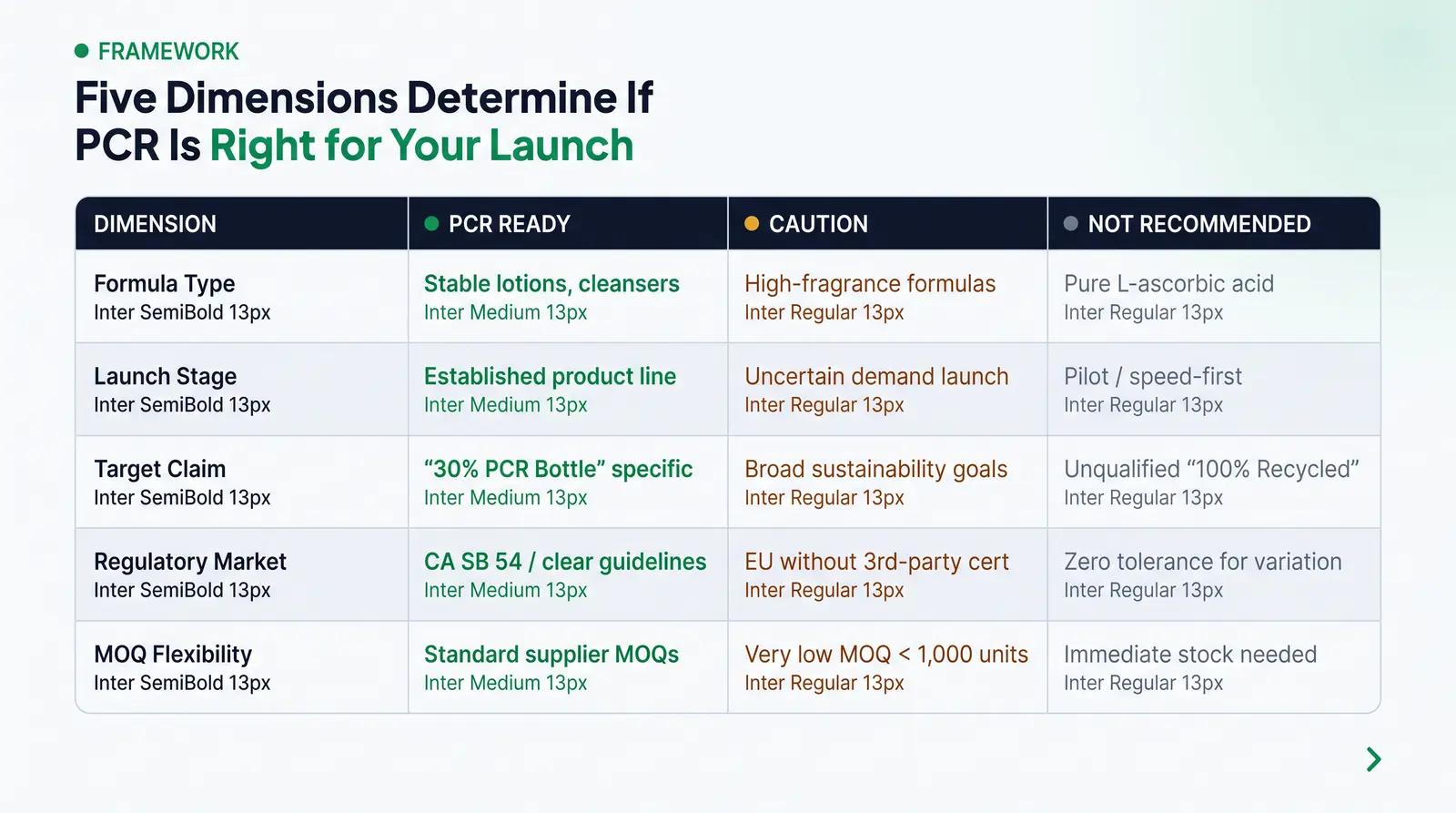
Evaluating whether PCR packaging is the right choice requires a nuanced assessment of the product, the market, and the brand's operational constraints. The PCR Readiness Rubric below is a practical framework for founders evaluating PCR options for a specific product launch.
| Dimension | PCR Ready | Proceed with Caution | Not Recommended |
|---|---|---|---|
| Formula Type | Stable formulations such as basic lotions and cleansers | High-fragrance or colorant-heavy formulas | Highly sensitive actives requiring extreme barrier protection, such as pure L-ascorbic acid |
| Launch Stage | Established product line with predictable volumes | Initial launch with uncertain demand | Pilot testing where speed and lowest cost are paramount |
| Target Claim | Specific, qualified claims such as "30% PCR Bottle" | Broad sustainability goals without specific targets | Unqualified claims such as "100% Recycled" without full component verification |
| Regulatory Market | Markets with clear PCR guidelines, such as California SB 54 | Expanding into the EU without third-party certification | Markets with zero tolerance for packaging aesthetic variation |
| MOQ Flexibility | Able to commit to standard supplier MOQs for custom runs | Requiring very low MOQs under 1,000 units | Need immediate stock with zero lead time |
Performance Tradeoffs by Packaging Category
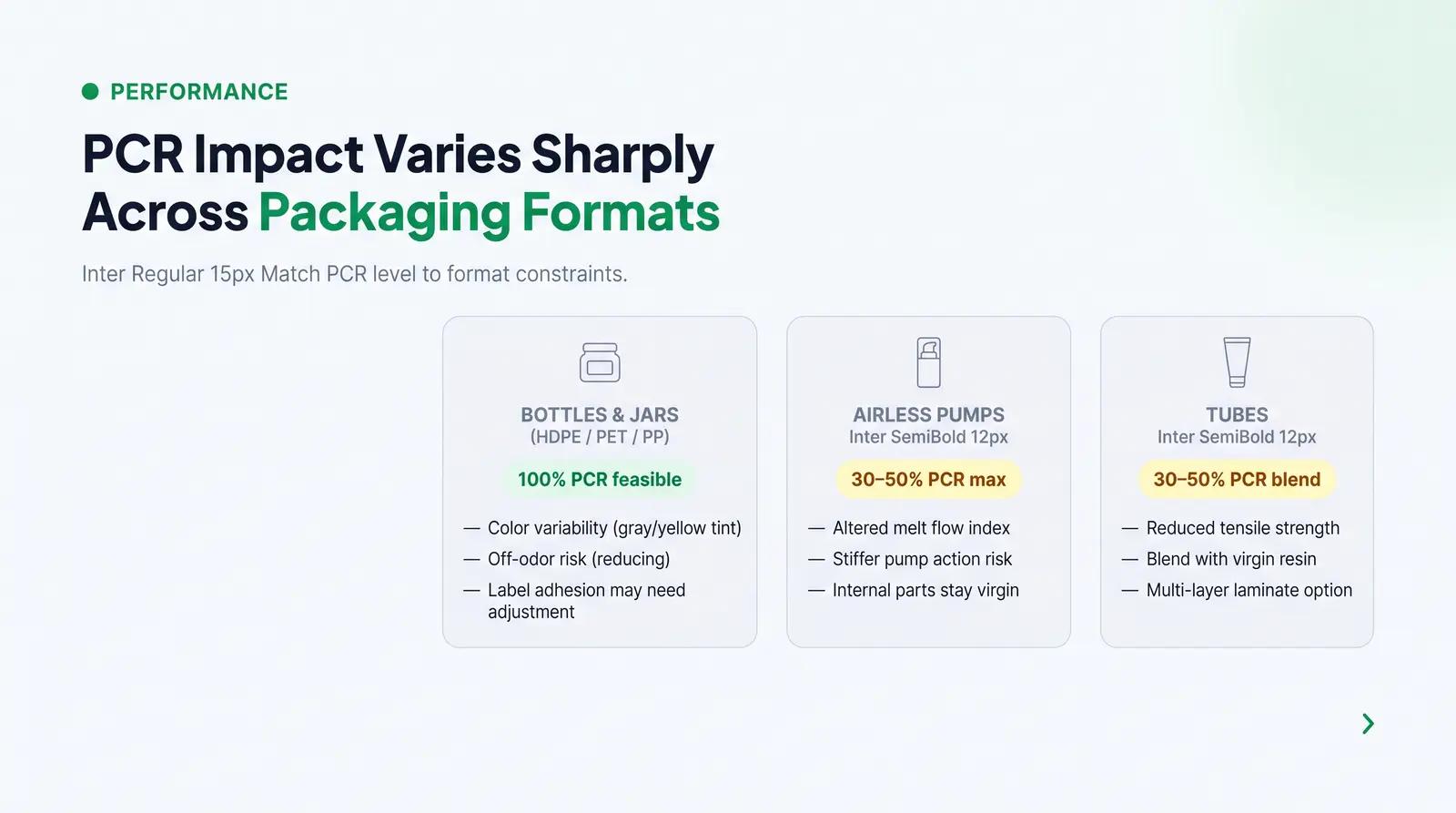
Integrating PCR content into cosmetic packaging is not a uniform process. The physical and aesthetic impacts vary significantly across packaging formats, and founders need to understand the specific tradeoffs before committing to a claim.
Bottles and Jars (HDPE, PET, PP). For rigid containers, achieving 100% PCR is technically feasible, particularly with PET and HDPE. However, high PCR content often introduces color variability, typically presenting as a slight grayish or yellowish undertone. There is also a risk of off-odors from the recycling process, though advanced washing and deodorizing technologies are reducing this issue significantly [7]. Surface finishes may be slightly rougher, which can affect label adhesion and require adjustments in decoration.
Airless Pumps and Droppers. Airless systems rely on precise mechanical tolerances to function correctly. PCR resin can alter the melt flow index and increase friction between moving parts, such as the piston and the inner wall of an airless bottle. This can result in a stiffer pump action or inconsistent dispensing [8]. Consequently, while the outer body of an airless bottle might incorporate 50% PCR, the internal functional components often remain virgin plastic to ensure airtight sealing and smooth operation. A realistic ceiling for PCR in functional components is typically 30 to 50% [8].
Tubes. Squeeze tubes require a careful balance of flexibility and durability. High PCR content can reduce tensile strength and alter squeezability. To maintain performance, manufacturers often use a hybrid approach, blending 30 to 50% PCR with virgin resin or using a multi-layer laminate structure where the PCR material is sandwiched between layers of virgin plastic [9].
For a broader overview of how material choices affect cosmetic packaging performance across formats, see our guide to cosmetic packaging materials.
PCR Content Tiers: A Comparative Analysis
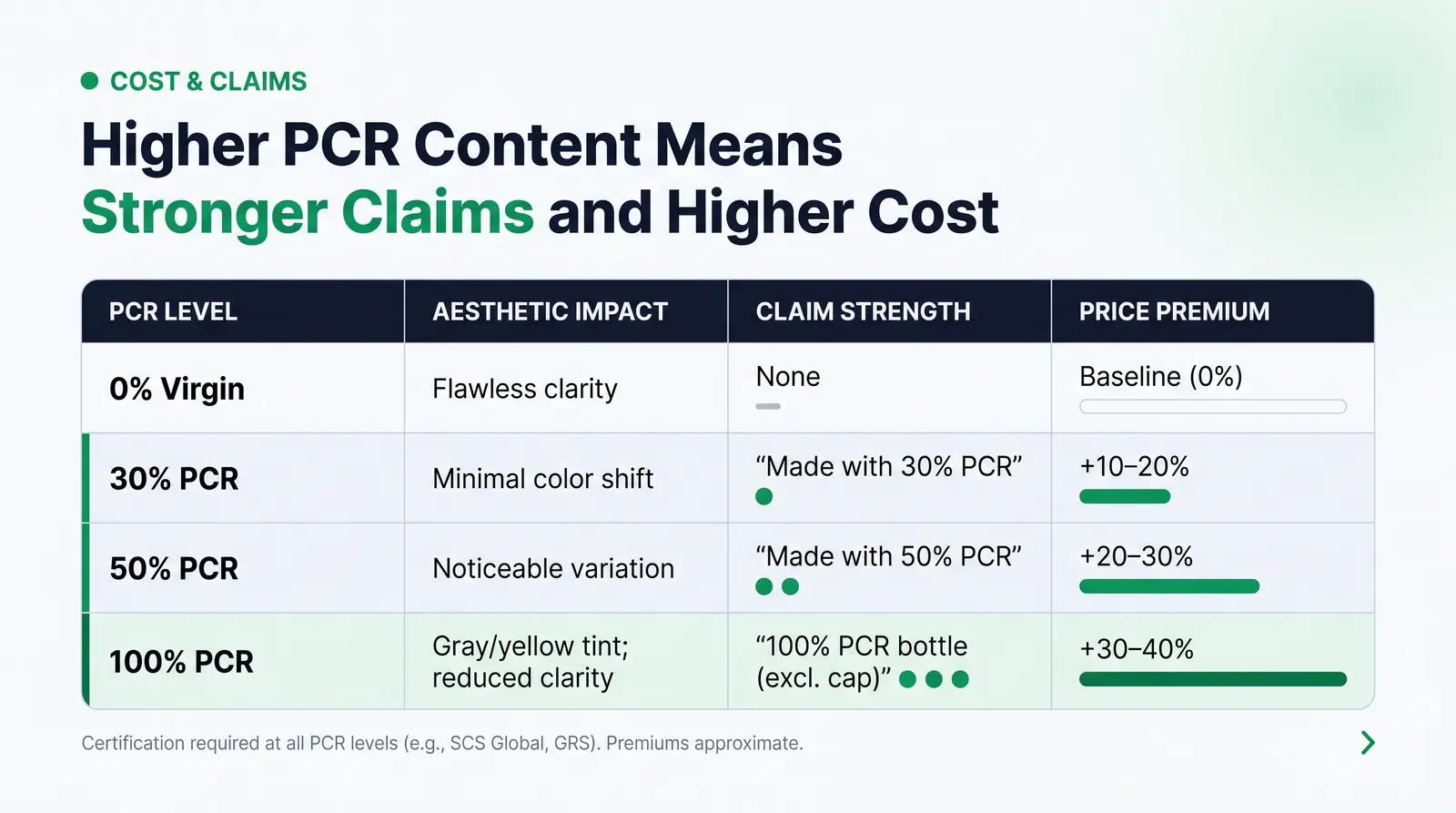
The decision of how much PCR to incorporate involves balancing aesthetic expectations, claim strength, and cost. The table below summarizes the key tradeoffs at each tier.
| PCR Content Level | Typical Availability | Aesthetic Limitations | Claim Strength | Price Premium vs. Virgin | Certification Required |
|---|---|---|---|---|---|
| 0% (Virgin) | Universal | None; flawless clarity and color matching | None | Baseline | N/A |
| 30% PCR | Widely available across bottles, tubes, and closures | Minimal; slight color shift possible in clear formats | "Made with 30% PCR plastic" | 10 to 20% premium [10] | Yes, e.g., SCS or GRS |
| 50% PCR | Common for rigid bottles and jars; less common for functional pumps | Noticeable color variation; potential for minor surface imperfections | "Made with 50% PCR plastic" | 20 to 30% premium [10] | Yes, e.g., SCS or GRS |
| 100% PCR | Available for specific PET/HDPE bottles; rare for tubes and pumps | Significant color tinting (gray/yellow); reduced clarity | "100% PCR bottle (excluding cap/pump)" | 30 to 40% premium [10] | Yes, e.g., SCS or GRS |
Price premiums are approximate and fluctuate based on global resin markets and specific supplier capabilities.
Supplier Documentation Checklist
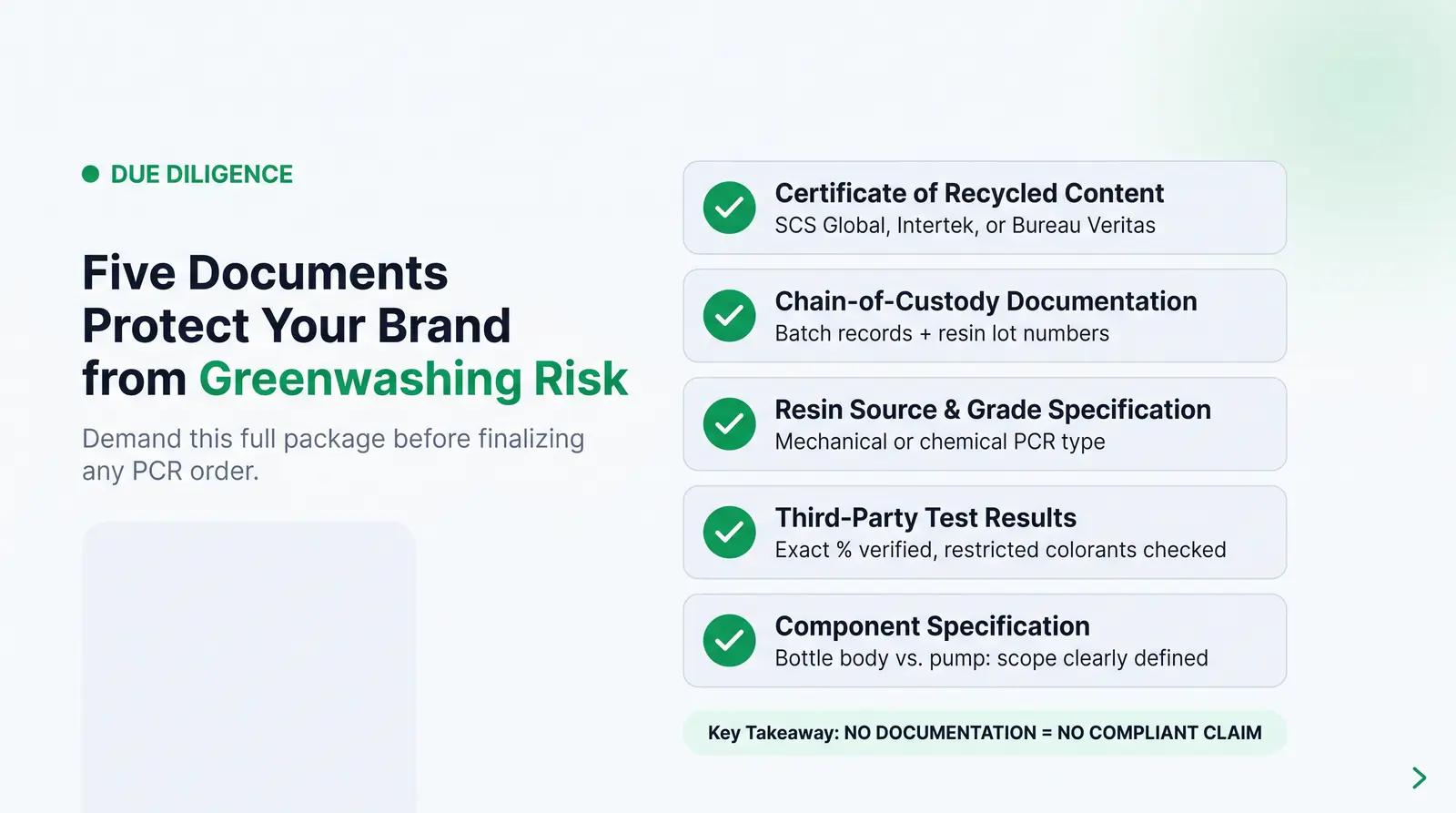
To substantiate PCR claims and protect the brand from greenwashing accusations, founders must demand rigorous documentation from their packaging suppliers. A complete documentation package should include:
Certificate of Recycled Content. Issued by a credible third-party certification body such as SCS Global Services, Intertek, or Bureau Veritas. SCS Global Services, which launched the first third-party recycled content certification program in 1989, requires a minimum of 5% recycled content for eligibility and evaluates manufacturing data, chain-of-custody procedures, and mass-balance calculations [11].
Chain-of-Custody Documentation. Detailed records tracing the recycled material from collection through processing and manufacturing, including batch records and resin lot numbers.
Resin Source and Grade. Specification of the exact type of PCR resin used, such as mechanically recycled PET or chemically recycled PP.
Third-Party Test Results. Independent laboratory results verifying the exact percentage of recycled content, absence of restricted colorants, and compliance with any applicable safety standards.
Component Specification. Clear delineation of whether the PCR content applies to the entire packaging assembly or only to specific components, such as the bottle body versus the pump mechanism.
At Packfolio, the sourcing and production coordination process is designed to ensure that supplier documentation and quality assurance protocols are in place before a 3D preview is finalized and an order is placed.
Worked Example: Launching a Vitamin C Serum
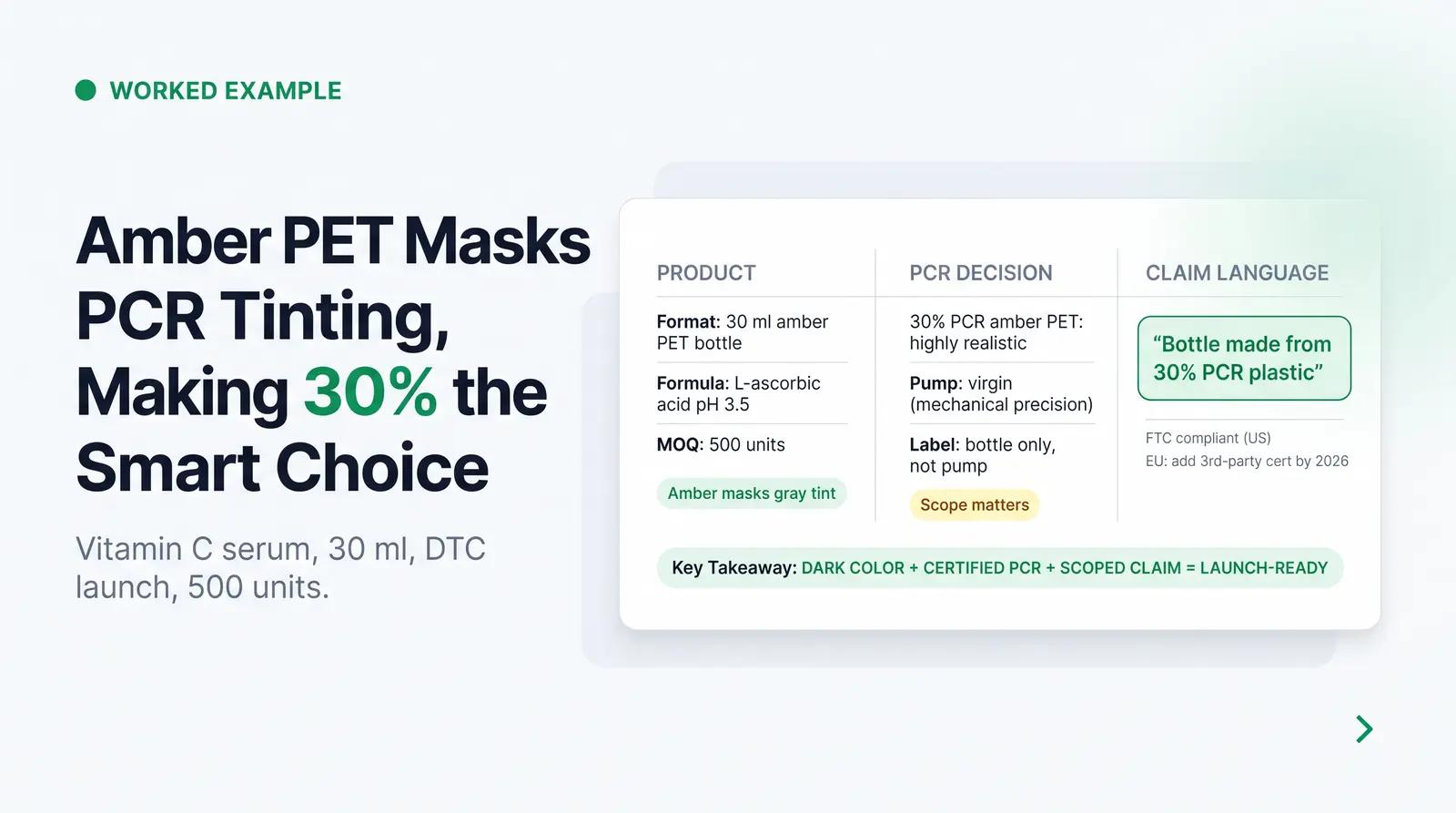
Consider a founder launching a vitamin C brightening serum, a water-based formulation at pH 3.5 with L-ascorbic acid, in a 1 oz (30 ml) amber PET bottle with a treatment pump. She wants to make a "30% PCR" claim on her label, selling DTC in the US initially, with EU expansion planned within 18 months. Her launch MOQ is 500 units.
At 500 units, sourcing custom PCR packaging directly from a factory is nearly impossible. Traditional manufacturers typically require MOQs of 10,000 units or more. A platform that aggregates demand or offers stock PCR components makes this achievable at lower volumes.
For a vitamin C serum, amber PET is an excellent choice because it provides necessary UV protection. Achieving 30% PCR in amber PET is highly realistic. The dark color effectively masks the aesthetic inconsistencies, such as gray or yellow tinting, that are common in recycled resins.
Before printing "30% PCR" on the label, she must obtain a Certificate of Recycled Content and chain-of-custody documentation from the supplier. Crucially, she must verify whether the 30% applies to the entire assembly or just the bottle body. Treatment pumps, due to their precise mechanical requirements, are rarely made with high PCR content. Her label must therefore accurately state: "Bottle made from 30% PCR plastic," explicitly excluding the pump mechanism to comply with FTC Green Guides [5].
Looking ahead to her EU expansion, the Green Claims Directive will require this 30% claim to be verified by a recognized third-party certification scheme [6]. Generic claims like "eco-friendly serum" on EU packaging are prohibited. The focus must be on the specific, substantiated percentage.
A non-obvious reality worth noting: for certain highly sensitive formulations, or for mechanical components requiring extreme precision like the internal piston of an airless pump, the functional compromises of mechanically recycled PCR can introduce real risks of product failure [8]. In those specific instances, using virgin plastic for the functional component, paired with a highly recyclable mono-material design for the body, may actually be the more responsible choice.
PCR packaging represents a credible, impactful sustainability move for beauty brands when the claims are meticulously substantiated, the required documentation is secured, and the material is appropriately matched to the packaging category. Browse Packfolio's catalog to explore vetted PCR-compatible primary packaging SKUs, preview your label in 3D, and order with the documentation already in place.
Frequently Asked Questions
What does PCR mean in cosmetic packaging?
PCR stands for post-consumer recycled plastic. It means the packaging is manufactured from plastic waste that has been used by consumers, collected, recycled, and reprocessed into new resin, diverting that material from landfills.
Is PCR packaging safe for cosmetic formulations?
Yes, high-quality PCR packaging can be safe for cosmetic use. Reputable suppliers use advanced cleaning and decontamination processes, and many mechanically or chemically recycled resins meet FDA compliance standards for direct product contact. For sensitive formulations, requesting migration test data from the supplier is a sound precaution.
How do I verify that my supplier's PCR claim is legitimate?
Request a Certificate of Recycled Content from a recognized third-party auditor such as SCS Global Services or a body certified under the Global Recycled Standard (GRS), along with complete chain-of-custody documentation tracing the material's origin from collection through manufacturing.
What percentage of PCR content do I need to make a recycled content claim?
There is no minimum percentage required to make a claim, but FTC guidelines require that the claim specify the exact percentage used, for example "Made with 30% PCR," unless the entire product and package are 100% recycled. The claim must also specify which component it applies to if it does not cover the full assembly.
Does PCR packaging cost more than virgin plastic?
Generally, yes. Due to the costs associated with collecting, sorting, and reprocessing post-consumer waste, PCR resin typically carries a price premium of 10% to 40% over virgin plastic, depending on the percentage and material grade [10]. Pricing is narrowing as recycling infrastructure improves, and some suppliers now offer PCR at near-parity for certain formats.
References
[1] Atlantic Packaging. "Deep Dive: PCR in Sustainable Packaging." September 2025. https://www.atlanticpkg.com/deep-dive-pcr-in-sustainable-packaging-a-closer-look-at-post-consumer-recycled-content-in-plastic-packaging/
[2] OthilaPak. "PCR Plastic Packaging: Choosing Between 30% and 100% Recycled Content." January 2026. https://othilapak.com/blogs/technology-materials/pcr-plastic-packaging-choosing-between-30-and-100-recycled-content/
[3] Visican. "What is PCR Cosmetic Packaging?" https://visican.com/blog/what-is-pcr-cosmetic-packaging/
[4] International Organization for Standardization. "ISO 14021:2016 Environmental labels and declarations." https://www.iso.org/obp/ui/#iso:std:iso:14021:ed-2:v1:en
[5] Federal Trade Commission. "Guides for the Use of Environmental Marketing Claims (Green Guides)." 2012. https://www.ftc.gov/sites/default/files/attachments/press-releases/ftc-issues-revised-green-guides/greenguides.pdf
[6] EcoMundo. "EU Directive 2024/825: Tackling Misleading Green Claims." 2024. https://ecomundo.eu/en/blog/eu-directive-2024-825-misleading-green-claims
[7] Di Cicco, F. et al. "The Smell of Sustainability: Understanding Consumers' Acceptability of PCR Plastic Packaging with an Off-Odor." MDPI Sustainability, 2024. https://www.mdpi.com/2071-1050/16/12/4896
[8] The Packaging Company. "PCR Airless Bottles: How Recycled Materials Impact Cosmetic Packaging Performance." April 2026. https://www.thepkgco.com/pcr-airless-bottles-cosmetic-packaging/
[9] Lisson Packaging. "PCR vs. Virgin Plastic Squeeze Tubes." February 2026. https://www.lissonpackaging.com/pcr-vs-virgin-plastic-squeeze-tubes.html
[10] Propacks. "Is Sustainable Packaging More Expensive?" May 2026. https://propacks.net/us/blog/is-sustainable-packaging-more-expensive
[11] SCS Global Services. "Recycled Content Certification." https://www.scsglobalservices.com/services/recycled-content-certification


