
Screen Printing vs Labels vs Hot Stamping for Cosmetic Packaging
Compare screen printing, pressure-sensitive labels, and hot stamping across cost, MOQ, durability, and brand tier to choose the best cosmetic packaging decoration method.
The exact moment a beauty brand founder transitions from formulation to physical production is often met with a sudden, expensive realization. The decoration method selected for a bottle, jar, or tube is not just a graphic design choice. It is a binding operational decision that locks in unit costs, minimum order quantities, manufacturing lead times, and the perceived luxury tier of the brand.
Choosing the wrong method can lead to catastrophic downstream issues. A label that bubbles and peels when exposed to facial oils can ruin a brand's reputation. An unexpectedly high minimum order quantity can drain a startup's entire launch budget. This guide breaks down the critical trade-offs between the three primary decoration methods: screen printing, pressure-sensitive labels, and hot stamping.
Why Decoration Method Is a Bigger Decision Than Most Founders Expect
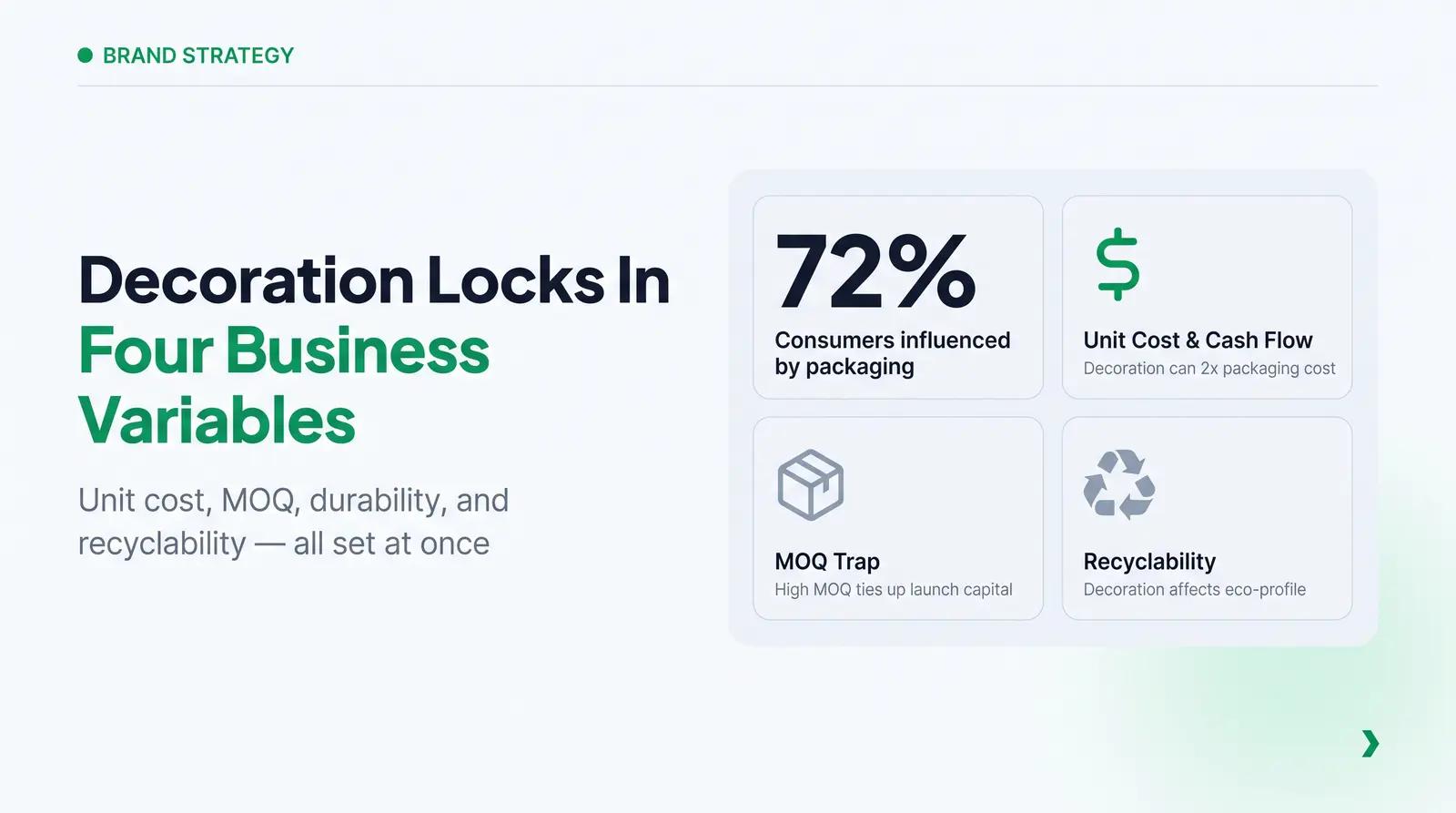
Packaging serves as the primary handshake between a beauty brand and the consumer. Research indicates that approximately 72% of consumers state that a product's packaging design directly influences their purchasing decisions [7]. In the retail environment, where similar products sit side-by-side, visual and tactile differentiation must be instantaneous. Over 80% of human brain processing is dedicated to visual stimuli, meaning the look and feel of a container does the heavy lifting at the point of sale [1].
However, many founders treat decoration as an afterthought. They select a container and send a design file to a printer, only to discover that their artwork is technically incompatible with the chosen method. Every decoration method introduces a unique set of constraints that affect the entire business model.
First, decoration directly impacts the unit cost and cash flow of a brand. For example, a custom glass container might have a low base price, but adding multiple colors of screen printing can double the cost of the packaging component [8].
Second, the choice of decoration determines the minimum order quantity, or MOQ. High MOQs can force early-stage brands to buy years of inventory upfront, tying up capital that should be spent on marketing [8].
Third, durability is a major factor in customer retention. If a shampoo bottle's lettering washes off in a wet shower, or if a luxury serum's gold foil flakes onto a customer's hands, the brand's premium positioning evaporates.
Finally, the decoration method affects the recyclability and sustainability profile of the packaging. As regulatory pressures and consumer expectations shift toward eco-design, brands must ensure their decorative elements do not prevent the container from entering the recycling stream [3] [6].
The Three Methods Explained
To make an informed decision, product developers must understand the technical mechanics, material compatibility, and economic profiles of each decoration method.
Screen Printing (Silkscreen)
Screen printing, also known as silkscreening, is a traditional method where ink is forced through a prepared mesh stencil directly onto the surface of a container [2] [5]. In cosmetic packaging, this process is highly automated. Cylindrical, flat, or slightly curved containers are fed into machines where a squeegee presses ink through the open areas of the mesh [5] [10].
The inks used in cosmetic screen printing are typically UV-curable or two-part epoxy inks [5]. UV inks cure instantly under ultraviolet light, which allows for high-speed production and excellent color consistency [5]. Epoxy inks are highly durable and are often used on glass containers because they form a permanent chemical bond with the substrate, though they require a longer thermal curing process [5].
The minimum order quantity for screen printing is historically high, typically starting at 5,000 units for custom production runs [8]. However, some specialty short-run printers offer services starting at 500 or 1,000 units, though at a significantly higher per-unit cost [5].
The setup fees for screen printing are charged per color, as each color requires its own film positive, screen exposure, and machine calibration [5] [9]. This makes screen printing highly economical for simple, minimalist designs with one or two solid Pantone colors, but cost-prohibitive for complex, multi-colored artwork [9].
In terms of durability, screen printing is the gold standard. The thick ink layer creates a slightly raised, tactile texture that resists water, essential oils, alcohol, and abrasion [5] [9]. This makes it the preferred method for products that live in high-moisture environments, such as body washes and facial cleansers.
Pressure-Sensitive Labels (PSL)
Pressure-sensitive labels are pre-printed stickers that adhere to a container's surface when pressure is applied [2]. Unlike screen printing, where ink is applied directly to the packaging, labels are printed on a carrier liner and then transferred to the bottle or jar either by hand or using automated labeling equipment [2].
Label materials vary widely to suit different brand aesthetics and environmental conditions. The most common film used in cosmetics is Biaxially Oriented Polypropylene, or BOPP [11]. BOPP is a plastic film that is stretched in two directions during manufacturing, making it incredibly strong, clear, and dimensionally stable [11]. It is highly resistant to water, oils, and acids, making it the default choice for bath, body, and skincare products [11]. Other materials include Polyethylene Terephthalate, or PET, paper, and metallic or holographic films [11].
Printing methods for labels have split into two main technologies: digital and flexographic printing. Flexography is ideal for high-volume runs of 10,000 or more units, offering low per-unit costs but requiring expensive printing plates. Digital label printing, on the other hand, requires no plates, making it highly cost-effective for short runs of 100 to 1,000 units [2]. Digital printing also supports unlimited color gradients and variable data, allowing brands to print multiple SKUs in a single run [2].
The durability of pressure-sensitive labels depends heavily on the face material, adhesive, and protective laminate or varnish [11]. A paper label on a shower gel will quickly disintegrate, but a BOPP label with a matte or gloss laminate will remain pristine throughout the product's life cycle [11].
From a sustainability perspective, standard pressure-sensitive labels can complicate the recycling process. When plastic bottles are shredded and washed, traditional label adhesives can contaminate the recycled plastic flakes [3]. However, modern adhesive technologies, such as wash-off or clean-release adhesives, allow the label to separate cleanly from the container during the recycling process, preserving the purity of the recycled material [3].
Hot Stamping (Foil Stamping)
Hot stamping is a dry printing method that uses heat, pressure, and a custom metal die to transfer a thin layer of metallic or pigmented foil onto a container's surface [12]. The process requires a heated brass or magnesium die engraved with the brand's artwork [12] [13]. A roll of stamping foil is positioned between the heated die and the container, and the machine presses the die down, activating the foil's adhesive layer and bonding it permanently to the substrate [12] [13].
Foil types include high-gloss metallic (typically gold, silver, or rose gold), holographic, matte metallic, and solid pigmented colors [12]. Hot stamping is widely used on lipstick tubes, mascara containers, compact lids, and premium glass perfume bottles because it achieves a mirror-like reflective shine that metallic inks cannot replicate [10] [13].
Material compatibility is a critical consideration for hot stamping. While it works beautifully on smooth, hard plastics like polystyrene and ABS, printing on glass requires an extra step. Because glass is chemically inert and often coated with protective lubricants, foil will not adhere directly to it [10]. To hot stamp glass, a specialized screen-printed primer or UV ink base must be applied first to act as an adhesive layer for the foil [10].
The minimum order quantity for hot stamping is generally tied to the container manufacturer's production run, often starting at 3,000 to 5,000 units [8]. The tooling costs are high, as custom metal dies must be engraved for each design [12]. However, the per-unit cost drops dramatically at high volumes, making it a standard finish for luxury mass-market cosmetics [12].
The durability of hot stamping is moderate. While it resists water and mild handling, it is more susceptible to scratching and chemical exposure than screen printing [12]. Under constant exposure to alcohol, essential oils, or heavy abrasion, foil can flake or wear away, meaning it must be carefully positioned on the container to avoid high-friction areas [12].
Original Comparison Table
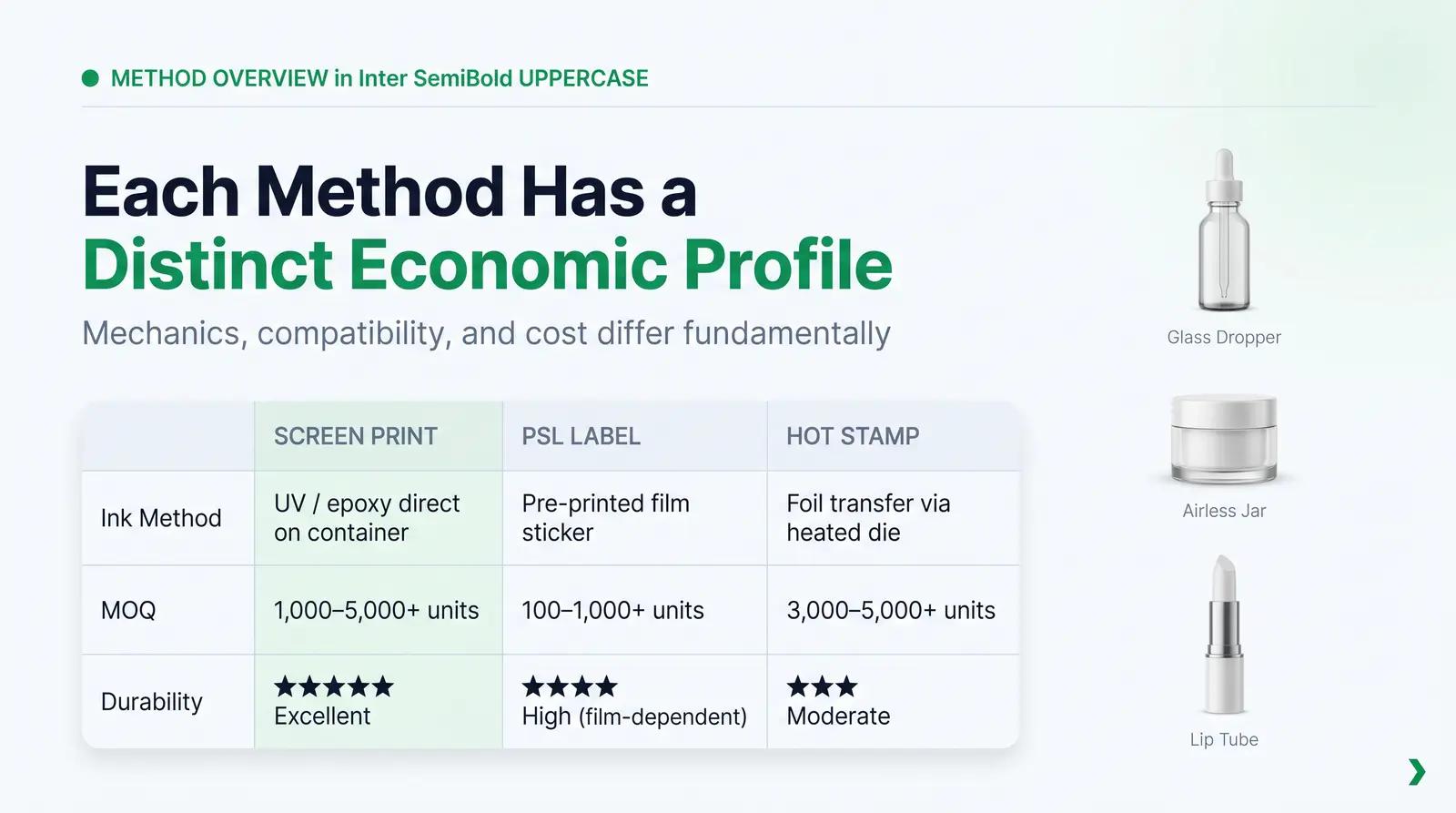
This table compares screen printing, pressure-sensitive labels, and hot stamping across key operational, financial, and technical dimensions.
| Dimension | Screen Printing (Silkscreen) | Pressure-Sensitive Labels (PSL) | Hot Stamping (Foil Stamping) |
|---|---|---|---|
| Setup & Tooling Cost | Moderate: $95 to $150 per color for screen exposure [5]. | Low to None: $0 for digital; Moderate for flexographic plates [2]. | High: $100 to $500 for custom engraved metal dies [12]. |
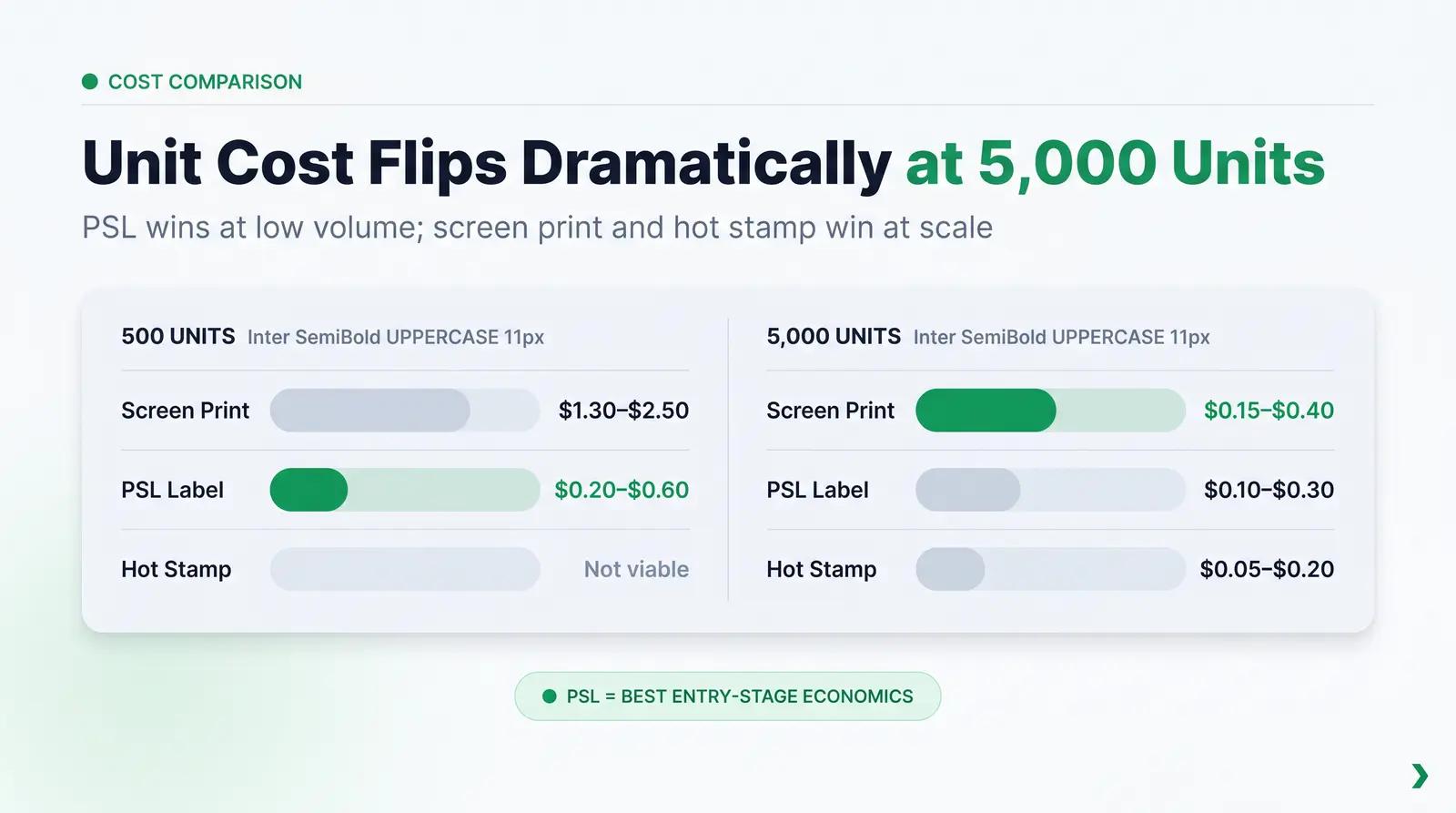
| Per-Unit Cost (500 units) | High: $1.30 to $2.50+ per unit due to setup amortization [5] [9]. | Low: $0.20 to $0.60 per label [2]. | Very High: Not economically viable due to tooling fees [12]. |
| Per-Unit Cost (5,000 units) | Very Low: $0.15 to $0.40 per unit [9]. | Moderate: $0.10 to $0.30 per label plus application labor [2] [9]. | Low: $0.05 to $0.20 per stamp [12]. |
| Typical MOQ Range | 1,000 to 5,000+ units [5] [8]. | 100 to 1,000+ units [2] [8]. | 3,000 to 5,000+ units [8]. |
| Substrate Compatibility | Glass, HDPE, PP, PET, and metal [5] [10]. | Universal: works on glass, plastic, and metal [2] [11]. | Smooth plastics, coated glass, and paperboard [10] [12]. |
| Color Range | Limited: 1 to 4 solid Pantone colors; no gradients [5] [9]. | Unlimited: full-color CMYK, gradients, and photographic prints [2] [9]. | Single color per pass: metallic, matte, or holographic [12]. |
| Finish Options | Matte, gloss, and raised tactile textures [5] [9]. | Gloss, matte, soft-touch, clear, and metallic [11]. | Ultra-reflective mirror metallic and holographic [12]. |
| Durability Profile | Excellent: highly resistant to water, oils, and chemicals [5]. | High: depends on film material and protective laminate [11]. | Moderate: susceptible to heavy abrasion and solvents [12]. |
| Sustainability Signal | High: no added plastic layer; container remains highly recyclable [3]. | Variable: requires wash-off adhesives to prevent recycling contamination [3]. | High: foil layer is less than 1 micron thick and vaporizes during recycling [4]. |
| Production Lead Time | 2 to 4 weeks after artwork approval [5]. | 1 to 2 weeks for digital; 2 to 3 weeks for flexographic [2]. | 3 to 5 weeks due to die engraving and calibration [12]. |
| Best-Fit Launch Stage | Mid-stage scaling or established brands with simple designs [9]. | Early-stage startups, multi-SKU lines, and complex artwork [2] [9]. | Luxury lines and established brands adding premium accents [10]. |
The Four-Filter Decoration Framework
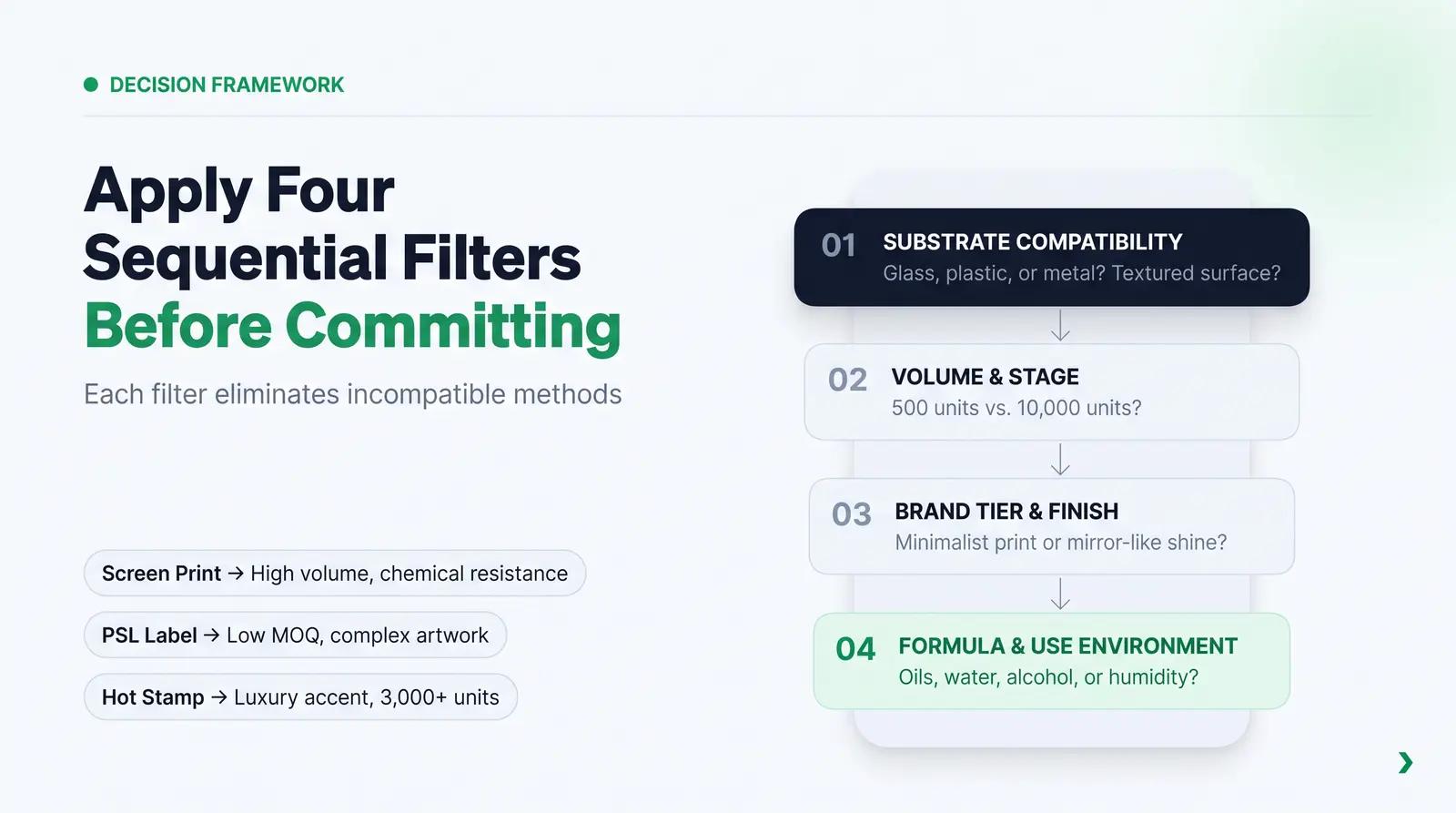
To help beauty brand founders navigate these complex trade-offs, we recommend a systematic selection process. This practical framework, used at Packfolio, applies four sequential filters to narrow down the correct decoration method for any product launch.
+-----------------------------------------------------------------+
|               The Four-Filter Decoration Framework              |
+-----------------------------------------------------------------+
|                                                                 |
|  [ FILTER 1: SUBSTRATE COMPATIBILITY ]                          |
|  Assess the physical material of the container.                 |
|  Is it glass, plastic, or metal? Is the surface textured?       |
|                                                                 |
|                               v                                 |
|                                                                 |
|  [ FILTER 2: VOLUME AND STAGE ]                                 |
|  Evaluate your launch quantity and budget.                      |
|  Do you need 500 units or 10,000 units?                         |
|                                                                 |
|                               v                                 |
|                                                                 |
|  [ FILTER 3: BRAND TIER AND FINISH ]                            |
|  Define the visual and tactile signals required.                |
|  Do you need a minimalist print or a mirror-like shine?         |
|                                                                 |
|                               v                                 |
|                                                                 |
|  [ FILTER 4: FORMULA AND USE ENVIRONMENT ]                      |
|  Test the decoration against the product chemistry.             |
|  Will it encounter oils, water, alcohol, or high humidity?      |
|                                                                 |
+-----------------------------------------------------------------+
Filter 1: Substrate Compatibility
The physical material and shape of the container dictate what decoration methods are technically possible.
Uncoated glass and certain plastics like polypropylene require specific surface treatments to accept ink or foil [5]. For example, polypropylene containers must undergo flame or corona treatment immediately before screen printing to raise the surface energy and ensure ink adhesion [5].
Textured or highly irregular surfaces are incompatible with hot stamping and screen printing, which require a flat or perfectly cylindrical plane to apply even pressure [10] [12]. If a container features complex curves or a textured finish, pressure-sensitive labels or pad printing are often the only viable options [10] [11].
Filter 2: Volume and Stage
The size of the initial production run is the most powerful financial filter.
For a startup launching with 500 units per SKU, screen printing and hot stamping are rarely financially viable. The amortization of screen setup fees or custom metal dies across a small run drives the per-unit packaging cost to unsustainable levels [5] [12]. At this stage, digital pressure-sensitive labels are the most logical choice, as they offer low entry costs and fast turnaround times [2].
As production scales to 5,000 or 10,000 units, the economics flip. The fixed setup costs of screen printing and hot stamping are spread across thousands of units, making the direct-to-container print significantly cheaper than purchasing and applying a high-quality label [9].
Filter 3: Brand Tier and Finish
The brand's positioning and visual identity must align with the capabilities of the decoration method.
If the brand identity relies on a clean, minimalist aesthetic with crisp, solid text, screen printing is highly effective [5]. It integrates the design directly into the container, avoiding the visible edges or air bubbles that can occur with transparent labels [9].
If the brand positioning is ultra-luxury and requires high-contrast, reflective metallic accents, hot stamping is the standard [10] [13].
For brands that require full-color photographic imagery, complex patterns, or multi-colored gradients, pressure-sensitive labels are the superior choice, as screen printing and hot stamping cannot achieve high-resolution color blends [2] [9].
Filter 4: Formula and Use Environment
The chemical composition of the formula and the environment in which the product is used represent the final, non-negotiable filter.
Skincare formulas containing high concentrations of essential oils, lipids, or active acids can act as solvents, dissolving standard label adhesives or causing inks to bleed [9] [11]. If a product is a facial oil or an oil-based serum, the decoration must be chemically inert. Screen printing with UV-cured or epoxy inks provides the highest chemical resistance, ensuring the branding remains intact even if the product drips down the side of the bottle [5] [9].
Similarly, the use environment must be considered. Products designed for the bath or shower are exposed to constant moisture and humidity. Under these conditions, paper labels will degrade, and poorly formulated adhesives will fail [11]. If a label is used on a shower product, it must feature a synthetic film like BOPP paired with a water-resistant adhesive and a protective laminate [11].
Contrarian or Non-Obvious Insight
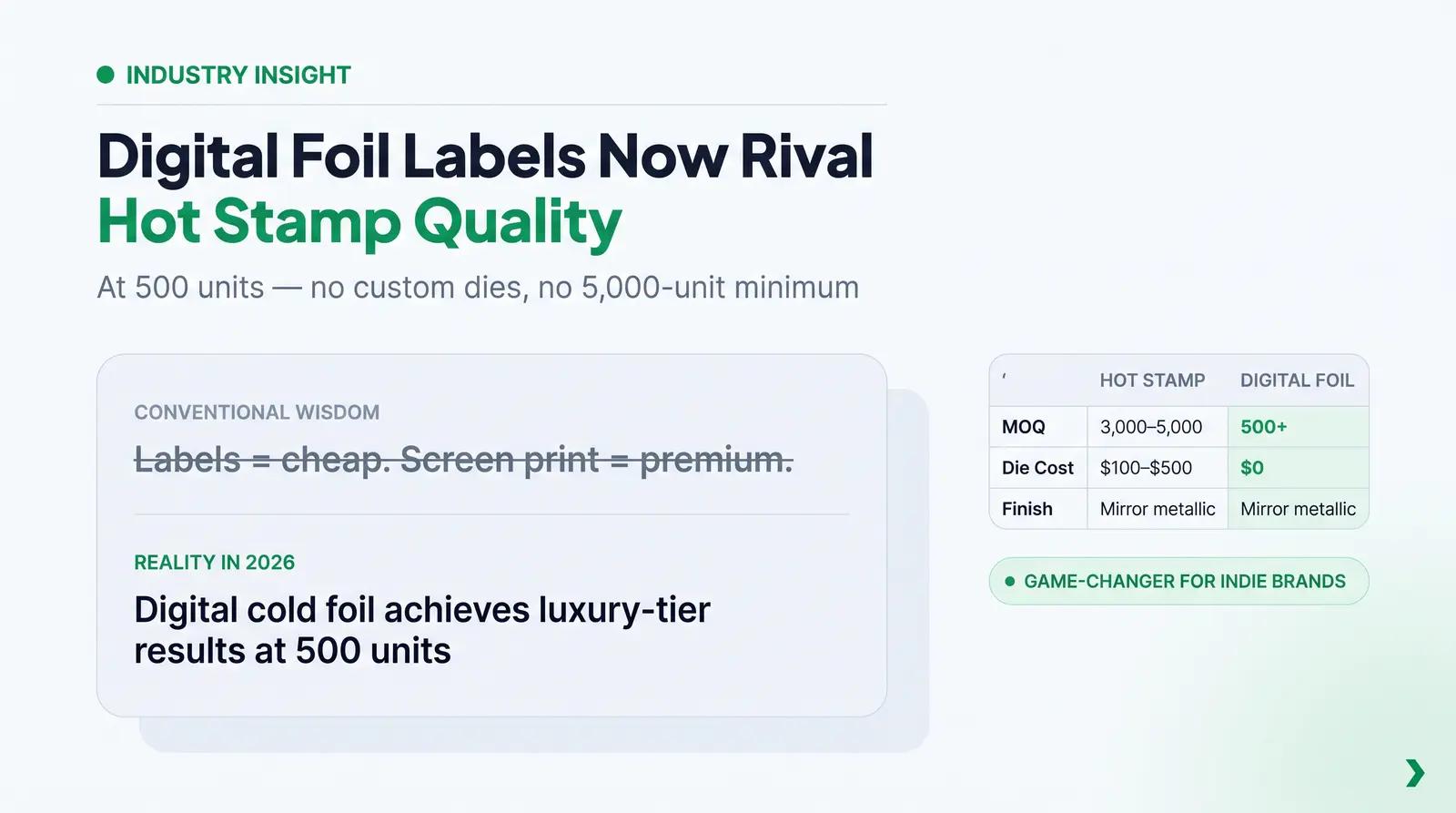
In the beauty industry, there is a long-standing assumption that pressure-sensitive labels are the cheap, entry-level option for indie brands, while direct-to-container screen printing and hot stamping are the exclusive domain of luxury packaging. This conventional wisdom is increasingly outdated.
Due to rapid advancements in digital printing technology, digital label printing combined with inline cold foil finishing can now achieve luxury-tier visual and tactile results at a fraction of the cost and MOQ of traditional methods [2] [4].
Historically, cold foil was flat and lacked the reflective depth of hot stamping [4]. Today, high-resolution digital embellishment presses can apply variable-height UV varnish directly to a synthetic film, followed by the application of a cold foil layer [2] [4]. This process, known as digital foil or digital metalization, creates a raised, 3D metallic effect that physically mimics the debossed texture and mirror-like shine of hot stamping, without requiring custom metal dies or high-temperature presses [2] [4].
For an independent beauty brand launching a premium skincare line, this technological shift is revolutionary. Instead of committing to a 5,000-unit minimum order run and spending thousands of dollars on custom brass dies for hot stamping, the founder can order 500 digitally printed BOPP labels with raised metallic foil accents [2] [4].
This hybrid approach allows the brand to project a luxury image on the retail shelf while preserving cash flow and maintaining the flexibility to update ingredients, regulatory text, or branding elements without discarding expensive pre-printed inventory [2].
Worked Example
To demonstrate the application of the Four-Filter Decoration Framework, let us analyze a realistic launch scenario for an independent skincare brand.
The Scenario
A founder is launching a premium glass vitamin C serum.
- Container: 1 oz (30 ml) clear glass dropper bottle.
- Formula: Water-based serum with highly active L-ascorbic acid and citrus essential oils.
- Brand Identity: Clean, minimalist, high-end apothecary aesthetic.
- Launch Volume: 1,000 units.
- Total Packaging Budget: $3,000.
Step-by-Step Framework Application
Step 1: Filter 1: Substrate Compatibility
The container is glass. Glass is highly compatible with both screen printing and pressure-sensitive labels [5] [11]. However, glass requires a specialized screen-printed primer to accept hot stamping foil, which adds complexity and cost [10]. The surface is smooth and cylindrical, meaning it can easily accept a wrap-around label or direct screen printing [5] [11].
Step 2: Filter 2: Volume and Stage
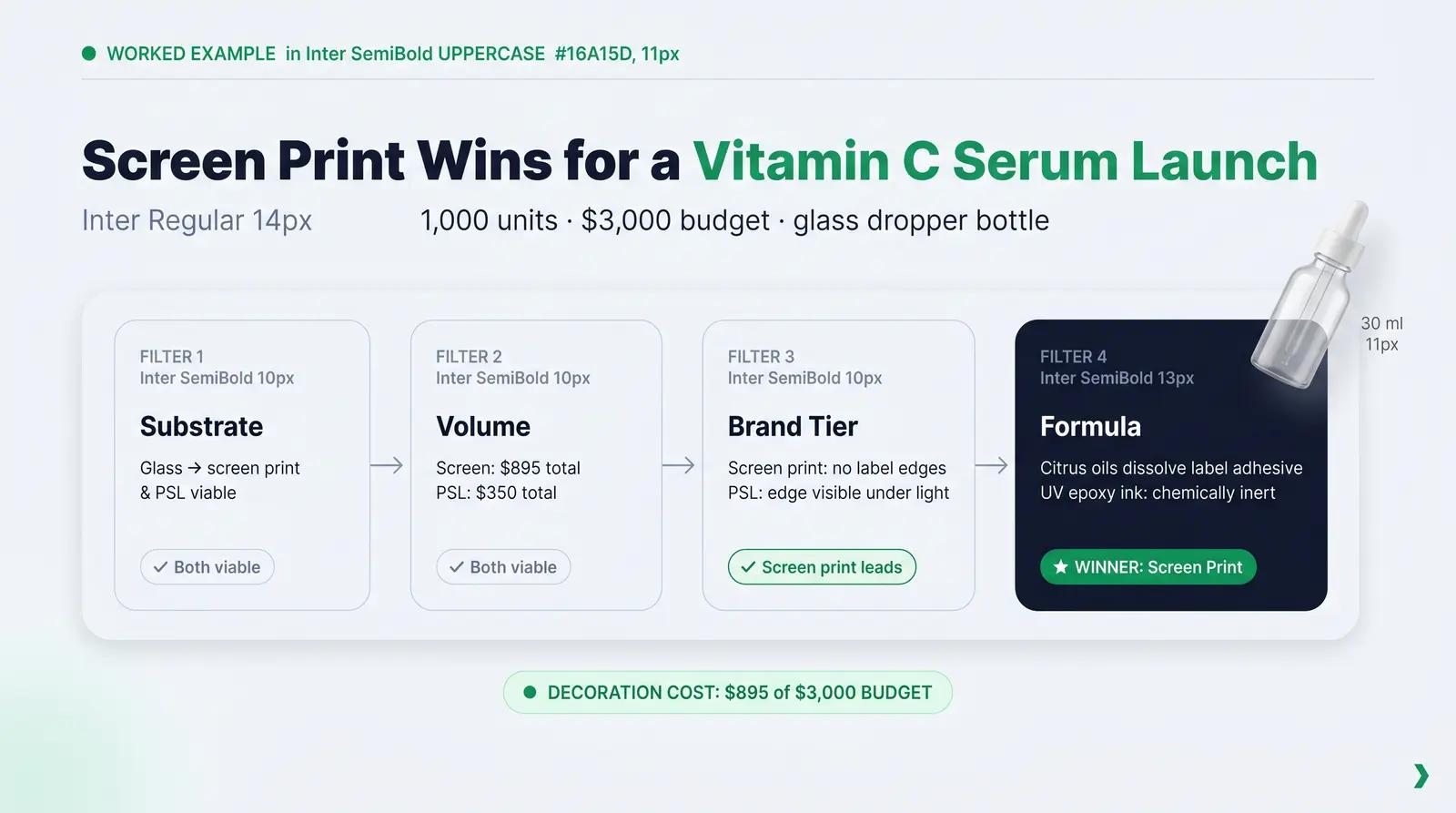
The launch volume is 1,000 units, and the total packaging budget is $3,000, which must cover the glass bottles, droppers, and decoration. This represents a target cost of $3.00 per completed packaging unit.
- If the founder chooses a 1-color screen printing run for 1,000 units, the setup fee is approximately $95, and the unit printing cost is roughly $0.80, resulting in a total decoration cost of $895, or $0.90 per unit [5].
- If the founder chooses a digitally printed clear BOPP label, the setup fee is $0, and the unit cost for 1,000 labels is approximately $0.35, resulting in a total decoration cost of $350, or $0.35 per unit [2].
- Hot stamping is eliminated at this stage, as the custom die fee of $250 plus the glass primer setup would exceed the decoration budget.
Step 3: Filter 3: Brand Tier and Finish
The brand identity is clean and minimalist.
- Screen printing achieves a premium, direct-to-glass finish with no visible label edges, which perfectly aligns with the high-end apothecary aesthetic [5] [9].
- A clear BOPP label can achieve a similar "no-label" look, but under retail lighting, the physical edge of the label film may be visible, which slightly detracts from the luxury perception [9] [11].
Step 4: Filter 4: Formula and Use Environment
The formula is a water-based serum containing active vitamin C and citrus essential oils. Vitamin C is highly prone to oxidation, and essential oils are aggressive solvents that can dissolve standard label adhesives [9]. If the serum drips down the side of the bottle during daily use, a standard label adhesive may fail, causing the edges to lift and bubble [9].
- Screen printing with UV-cured or epoxy inks is completely chemically inert and will not degrade when exposed to essential oils or active acids, ensuring the bottle remains pristine [5].
- To use a label safely, the founder would need to invest in a high-performance chemical-resistant adhesive and a protective matte laminate, which would raise the label cost to approximately $0.50 per unit [11].
The Winning Method
For this specific scenario, 1-color screen printing is the winning decoration method.
While digitally printed labels offer a lower upfront cost, screen printing provides the ultimate chemical resistance against the essential oils in the formula, guarantees that the minimalist branding will not peel or bubble during use, and delivers a superior, direct-to-glass luxury finish that aligns with the brand's premium positioning [5] [9].
At 1,000 units, the total cost for the screen-printed decoration is approximately $895, leaving $2,105 of the budget to purchase the glass bottles and droppers, which fits comfortably within the founder's $3,000 limit [5].
Contextual Packfolio Mention
For beauty brand founders navigating these technical decisions, visualizing how a specific decoration method will look on a physical container is a major challenge. This is where Packfolio simplifies the sourcing process.
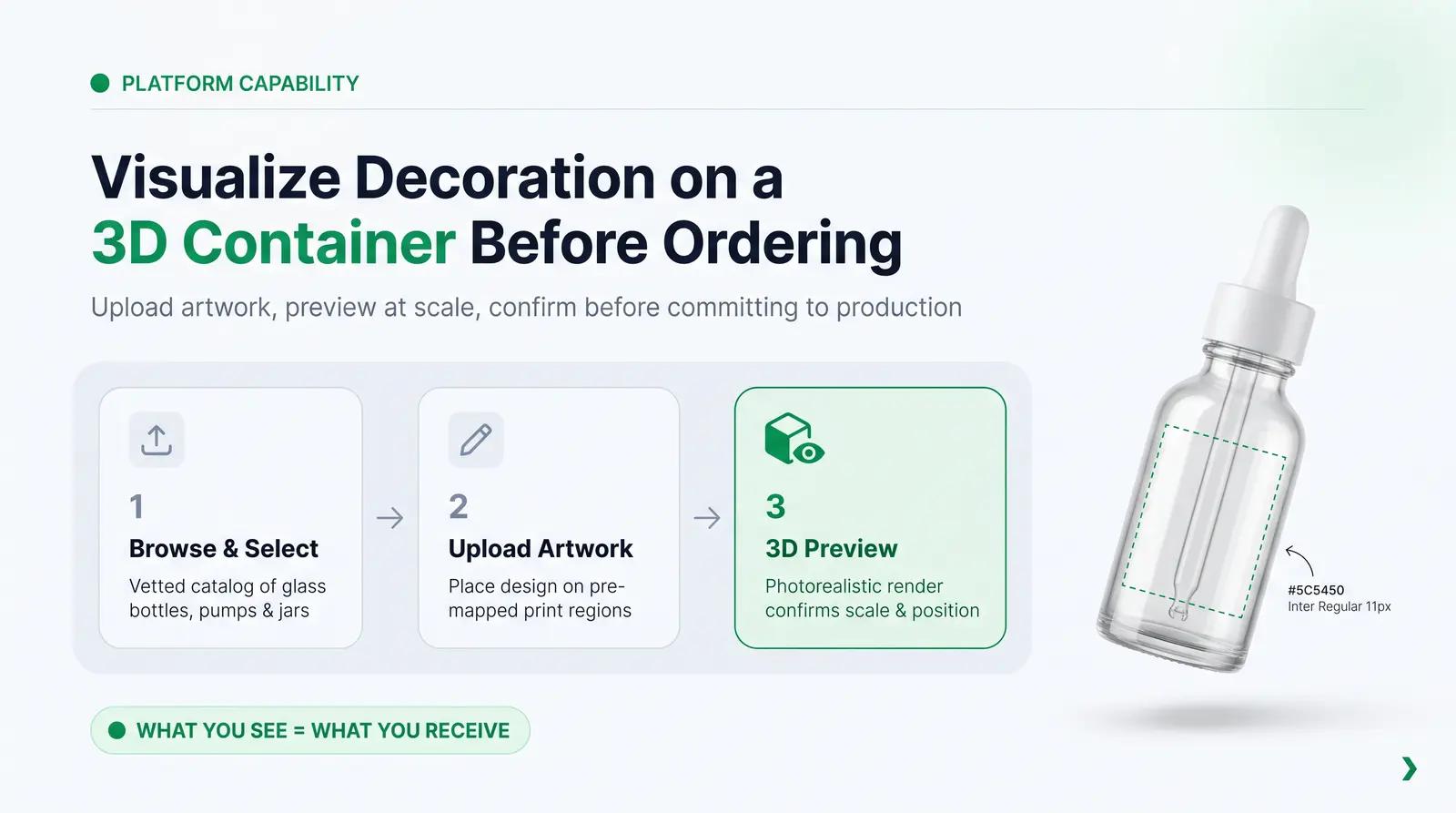
As an on-demand custom packaging platform, Packfolio curates a vetted catalog of cosmetic primary packaging SKUs, including glass dropper bottles, airless pumps, and jars, each pre-modeled in 3D with predefined printable regions.
Instead of guessing how a screen-printed logo or a metallic foil accent will align on a 1 oz (30 ml) glass bottle, founders can upload their artwork directly into Packfolio's browser-based 3D design tool. The platform renders a photorealistic 3D preview of the decoration on the selected SKU, allowing founders to verify the scale, positioning, and visual impact before committing to a production run.
Packfolio coordinates the entire production process, from factory vetting and quality assurance to final freight delivery, ensuring that what the customer sees in the 3D preview is exactly what they receive at their warehouse.
Closing CTA Block
Selecting the right decoration method is a critical step in building a durable, premium beauty brand that stands out on the shelf and withstands daily use.
Browse Packfolio's curated cosmetic packaging catalog and preview your decoration in 3D before ordering → packfolio.com/catalog
Frequently Asked Questions
What decoration method works best for glass cosmetic bottles?
Screen printing with organic epoxy or UV-curable inks is highly recommended for glass cosmetic bottles because it forms a permanent chemical bond with the substrate, offering superior resistance to water, oils, and scratching [5]. While pressure-sensitive labels can be used, screen printing eliminates the risk of visible label edges or air bubbles, delivering a cleaner, more premium direct-to-container finish [9].
Can you combine screen printing and hot stamping on the same package?
Yes, high-end cosmetic brands frequently combine screen printing and hot stamping on a single container to achieve a layered effect. Typically, the brand uses screen printing for the fine regulatory text and solid color background elements, and applies hot stamping over a specialized primer layer to highlight the brand logo with a mirror-like metallic shine [10].
What is the minimum order quantity for screen-printed cosmetic packaging?
The standard industry minimum order quantity for screen-printed cosmetic packaging typically ranges from 3,000 to 5,000 units per run [8]. However, specialized short-run decorators can accommodate smaller batches starting at 500 or 1,000 units, though the setup and screen fees will be amortized over fewer pieces, resulting in a higher per-unit cost [5].
Are pressure-sensitive labels recyclable on cosmetic packaging?
Pressure-sensitive labels can hinder the recycling process if they are paired with standard, permanent adhesives that contaminate the recycled plastic stream [3]. To ensure recyclability, brands should specify wash-off or clean-release adhesives, which allow the label to separate completely from the plastic container during the recycling wash phase, preserving the purity of the recycled material [3].
How durable is hot stamping on lip gloss tubes?
Hot stamping on lip gloss tubes is moderately durable but susceptible to wear over time due to the high-friction nature of makeup bags and frequent handling. To prevent the metallic foil from flaking or scratching, the design should be positioned away from the edges of the tube, and high-quality stamping foils must be selected to ensure strong adhesion to the plastic substrate [12].
References
[1] P. Srivastava, D. Ramakanth, K. Akhila, and K. K. Gaikwad, "Package design as a branding tool in the cosmetic industry: consumers' perception vs. reality," SN Business & Economics, vol. 2, no. 6, p. 58, 2022. [Online]. Available: https://pmc.ncbi.nlm.nih.gov/articles/PMC9123395/
[2] Star Label Products, "Why Choose Labeling vs. Screen Printing," 2023. [Online]. Available: https://www.starlabel.com/blog/choose-labeling-vs-screen-printing/
[3] N. Zhou, "The pivotal role of pressure-sensitive labels in eco-design," Avery Dennison APAC, 2024. [Online]. Available: https://www.averydennison.com/ap/en/industries/consumer-packaged-goods/resources/inspiration/trends-and-insights/the-pivotal-role-of-pressure-sensitive-labels-in-eco-design
[4] Dauxin Team, "Hot Foil vs Cold Foil: The Ultimate 2025 Guide for Designers," 2025. [Online]. Available: https://www.dauxin.com/blog/hot-foil-vs-cold-foil/
[5] Blue Line Labels, "Short-Run Silk Screen Printing Pricelist | Bottles, Jars & Tubes," 2025. [Online]. Available: https://bluelinelabels.com/short-run-silk-screen-printing-pricelist/
[6] S. Morel, G. Mura, M. Gallarate, and S. Sapino, "Cosmetic Packaging: European Regulatory Aspects and Sustainability," Cosmetics, vol. 11, no. 4, p. 110, 2024. [Online]. Available: https://www.mdpi.com/2079-9284/11/4/110
[7] Ipsos, "Five packaging design trends that make you want to buy," 2018. [Online]. Available: https://www.ipsos.com/en-us/knowledge/consumer-shopper/five-packaging-design-trends-make-you-buy
[8] C. Meifeng, "How Does MOQ Affect Cosmetic Packaging Costs," AH Packaging, 2025. [Online]. Available: https://ahpackaging.com/how-does-moq-affect-cosmetic-packaging-costs/ [9] Lumlun Skincare Packaging, "Screen Printing vs. Labeling: Choosing the Most Cost-Effective Finish for Your Skincare Line," 2026. [Online]. Available: https://lumlun.com/screen-printing-vs-labeling-cost-cosmetic-packaging-guide/
[10] ITW CER, "Glass Cosmetic Packaging: Direct Print vs. Labeling," 2024. [Online]. Available: https://itwcer.com/blog/glass-cosmetic-packaging/
[11] Avery Dennison, "BOPP Label Material Guide for Cosmetics and Personal Care," 2023. [Online]. Available: https://www.dauxin.com/blog/bopp-label-material-for-cosmetics/
[12] APG (A Packaging Group), "How Long Does Hot Stamping Last on Cosmetic Containers," 2024. [Online]. Available: https://apackaginggroup.com/blogs/news/how-long-does-hot-stamping-last-on-cosmetic-containers
[13] Omi Natural Packaging, "What's Hot Stamping Technology in Cosmetic Packaging Industry," 2025. [Online]. Available: https://ominatural.com/hot-stamping-cosmetic-packaging/


