
How to Make Stock Cosmetic Packaging Look Custom
Founders can make stock cosmetic packaging look custom by layering premium closures, surface finishes, specialty labels, and cohesive SKU family planning — without costly custom molds.
Reddit threads and indie beauty founder forums are filled with the same recurring tension: a founder finds a stock bottle they like, realizes it looks identical to a hundred other brands on the market, and then discovers that creating a custom mold requires a 10,000-unit minimum and a $15,000 tooling fee. They are stuck between generic aesthetics and unaffordable capital requirements. Posts in communities like r/startups and r/smallbusiness capture this frustration precisely. One founder described jumping from a 1,000-unit stock option to a 24,000-unit MOQ the moment they requested any customization from their manufacturer.
This tension is the reality of launching an independent beauty brand. Packaging drives consumer perception, but tying up tens of thousands of dollars in custom plastic before validating your formula is a dangerous game. Fortunately, the binary choice between "cheap stock" and "expensive custom" is a false one. This article provides a concrete, layered strategy for making stock packaging look unmistakably custom, without paying for custom molds.
Why Stock Packaging Gets a Bad Reputation (and Why That's Mostly a Fixable Problem)
The root cause of stock packaging's generic reputation is not the shape of the bottles themselves. The problem is that most founders use stock packaging in its absolute default state: undecorated, paired with whatever standard white or black closure came with the bottle, and lacking any system of cohesion across their product line. The result is a shelf presence that reads as provisional rather than intentional.
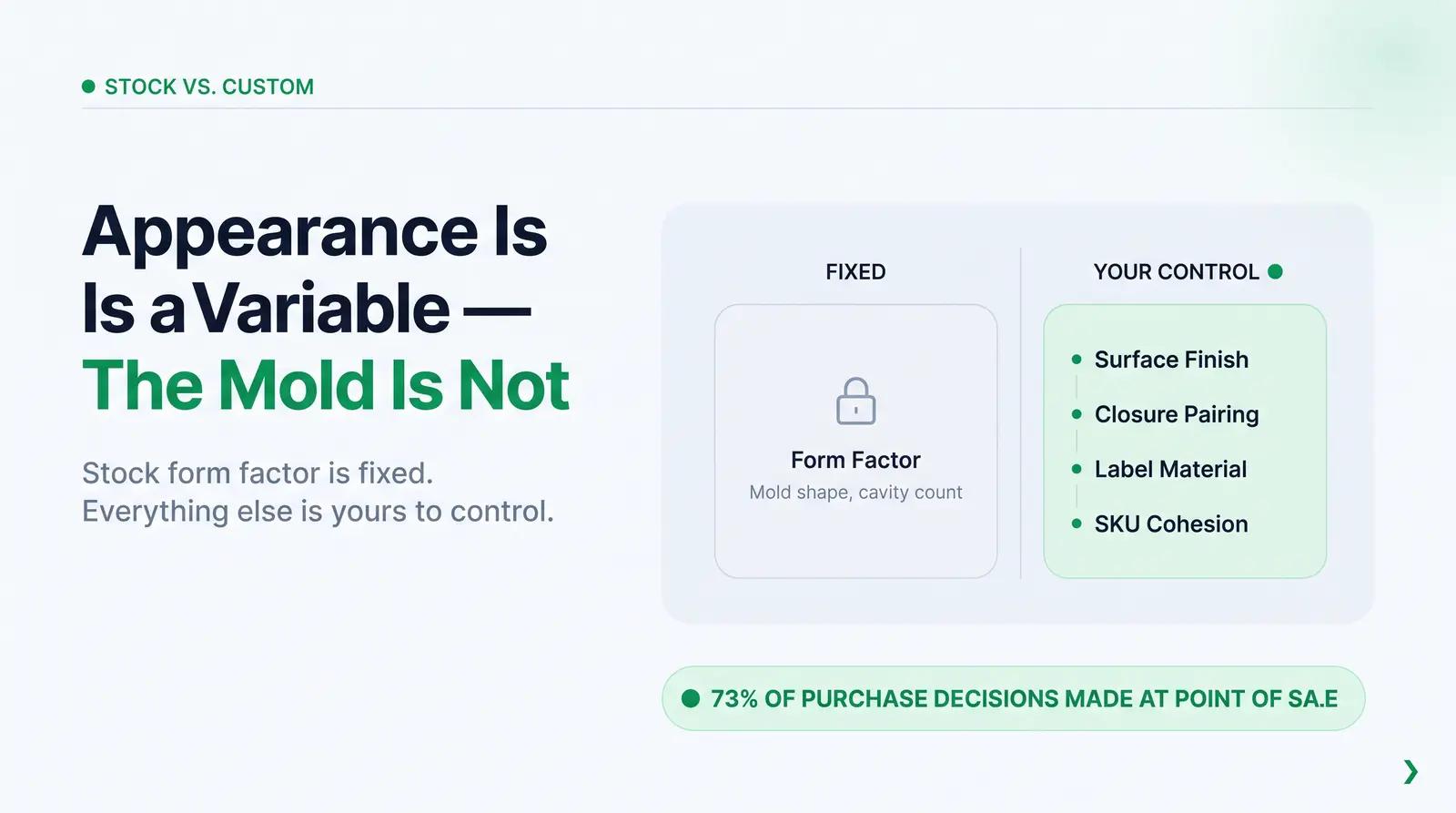
It is crucial to distinguish between a "stock form factor" (the actual mold or shape of the container) and a "stock appearance" (what decoration, closure, label, and finish choices produce). These are independent variables. The form factor is fixed by the mold. The appearance is almost entirely within your control. When research from Srivastava et al. published in SN Business and Economics found that around 73% of purchasing decisions are made at the point of sale, and that visual differentiation is the primary driver of that decision [1], settling for a default appearance is a missed opportunity. By strategically modifying the secondary variables, including finish, closure, label, and family cohesion, you can entirely transform how a stock form factor is perceived by consumers.
The distinction matters because it reframes the problem. The question is not "how do I afford custom packaging?" The question is "how do I engineer a custom appearance using the components that already exist?"
The Real Cost of Going Custom-Mold (and Who It Actually Makes Sense For)
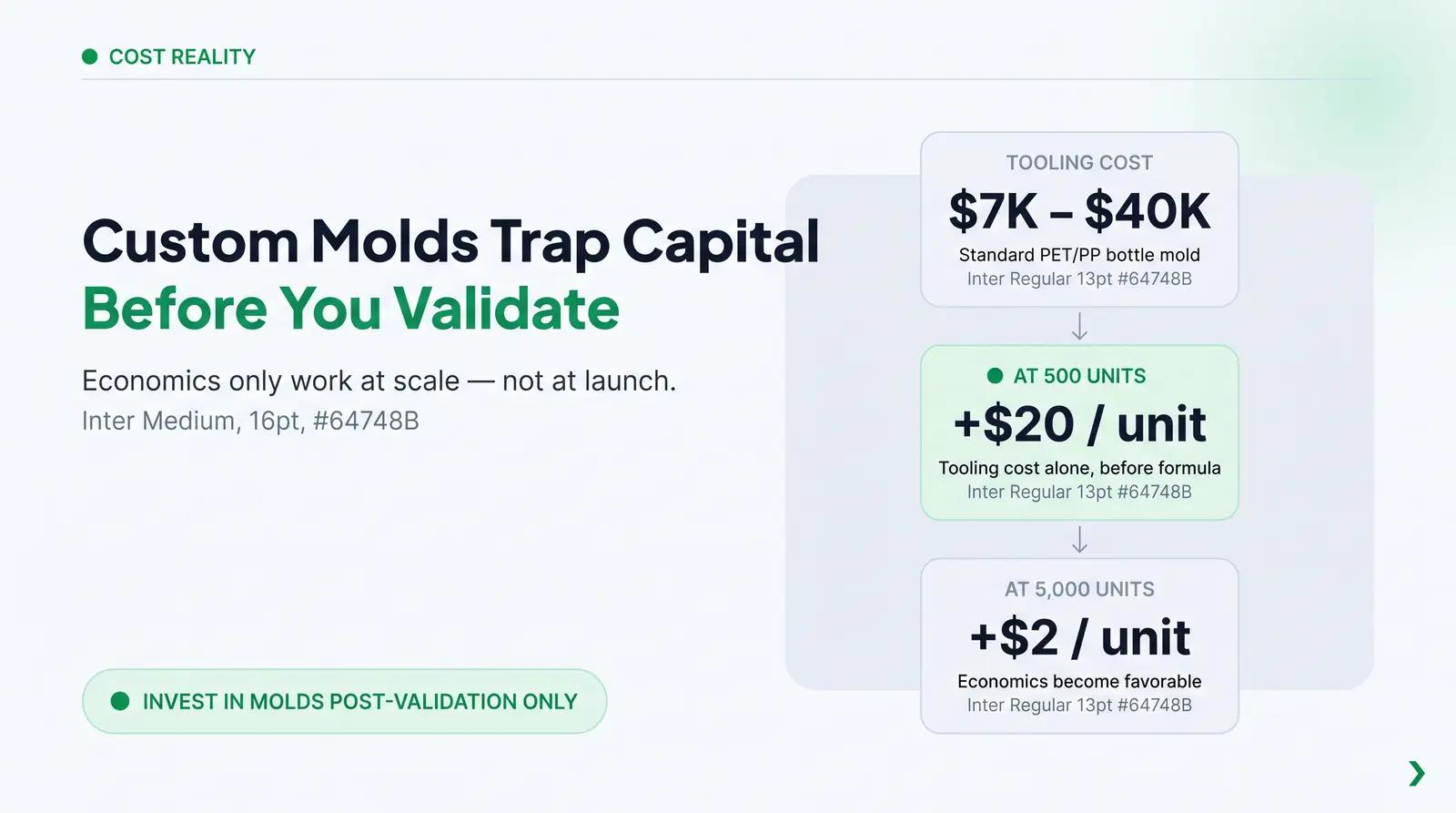
Custom injection molds are often positioned as the ultimate goal for beauty brands, but the financial reality is stark. For a standard PET or PP bottle, injection mold tooling typically ranges from $7,000 to $40,000 depending on complexity and cavity count [2]. If you are customizing a full dispensing system, such as a pump head with its collar, actuator, spring housing, and gasket seat, tooling costs can easily exceed $100,000 [2]. Furthermore, manufacturers generally require Minimum Order Quantities (MOQs) of 10,000 units or more for custom molds to amortize the setup costs [3].
Even at the lower end of the tooling range, the math is punishing for early-stage brands. A $10,000 mold amortized over a 500-unit launch run adds $20 per unit in fixed packaging development cost alone, before a single drop of formula goes in the bottle. At 5,000 units, that same mold adds $2 per unit. The economics only become favorable once volume is predictable and substantial [2].
Custom molds are highly appropriate for established brands that have validated a hero SKU, possess predictable sales volume, and have the capital to deploy for long-term margin improvement. For pre-launch and early-stage founders, however, they are often a capital trap. Tying up early funding in custom tooling restricts your ability to invest in marketing, formulation, and inventory flexibility. The right time to invest in custom molds is post-market validation, once repeat orders and market feedback are consistent [2]. Until then, the goal is to execute stock packaging at a level that makes the custom-mold question feel irrelevant.
The Layered Differentiation Framework
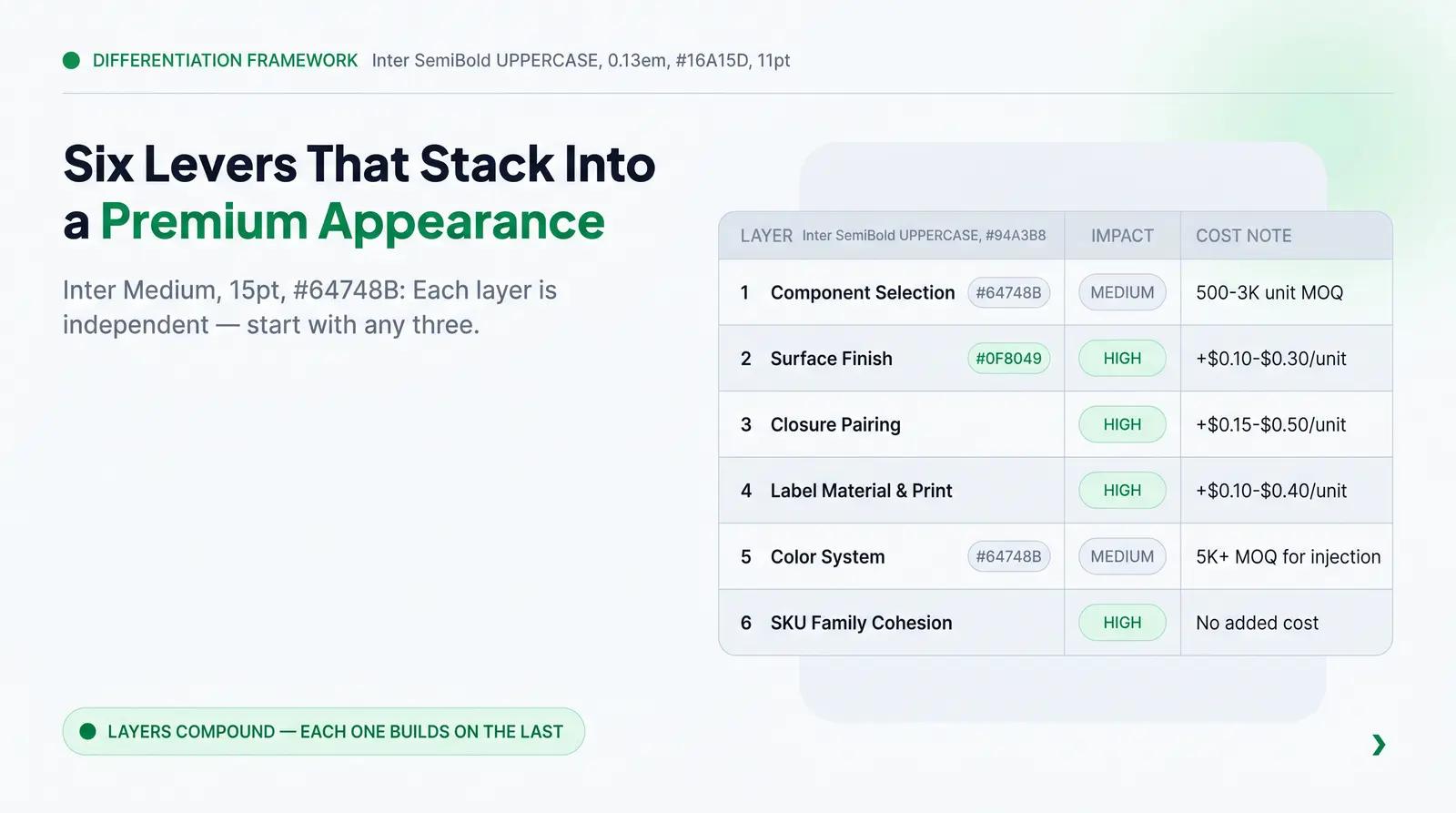
To systematically upgrade the perceived premium of stock packaging, we recommend a layered approach. The Stock-to-Custom Stack is a practical framework for systematically upgrading the perceived premium of stock packaging through layered decisions. Each layer represents a lever a founder can pull, from lowest cost and complexity to highest, with a compounding effect on perceived quality.
| Layer | Description | Differentiation Impact | Cost / MOQ Note |
|---|---|---|---|
| 1. Component Selection | Choosing a stock silhouette, material (e.g., heavy-wall PET or glass), and weight class that feels substantial in hand. | Medium | Base cost; standard stock MOQs often 500-3,000 units. |
| 2. Surface Finish | Applying a frosted, matte, or soft-touch spray coating to alter the tactile and visual texture of the container. | High | Adds approx. $0.10-$0.30/unit; factory spray coating may require 3,000+ unit MOQ [4]. |
| 3. Closure Pairing | Swapping default caps for premium alternatives such as aluminum overcaps, disc-tops, or surlyn closures. | High | Adds approx. $0.15-$0.50/unit; accessible at low MOQs with stock closures. |
| 4. Label Material and Print | Using clear BOPP for a no-label look, textured paper, soft-touch laminate, foil stamping, or digital embossing. | High | Adds approx. $0.10-$0.40/unit; digital printing enables low-MOQ access to premium finishes. |
| 5. Color System | Establishing a consistent color palette across components and labels, avoiding default white or black where possible. | Medium | Custom color injection often requires 5,000+ MOQ [3]; color via label and coating is more accessible. |
| 6. SKU Family Cohesion | Using a coordinated set of stock SKUs with compatible silhouettes so the range reads as a designed system. | High | No added per-unit cost; requires strategic sourcing and planning. |
Component Selection forms the foundation. A heavy-wall glass jar instantly feels more premium than thin-walled plastic, regardless of shape. The weight and material of the primary container is the first thing a consumer registers when they pick up a product. Surface Finish engages the sense of touch; research from California Polytechnic State University found that consumers preferred soft-touch tactile coatings over uncoated packaging, and were willing to pay a price premium for that preference [5]. Closure Pairing breaks the visual expectation of a standard bottle and is explored in depth in the next section. Label Material and Print elevates the branding execution from a basic sticker to an integrated design element. Color System unifies the presentation across every touchpoint, and SKU Family Cohesion ensures your brand looks like a deliberate collection rather than a random assortment of bottles.
The power of this framework is that each layer is independent. A founder on a tight budget can start with layers one, three, and six: better component selection, a premium closure, and a cohesive SKU family. Surface finish and specialty label printing can be added as the brand scales.
Closure Pairing: The Most Underrated Differentiation Move
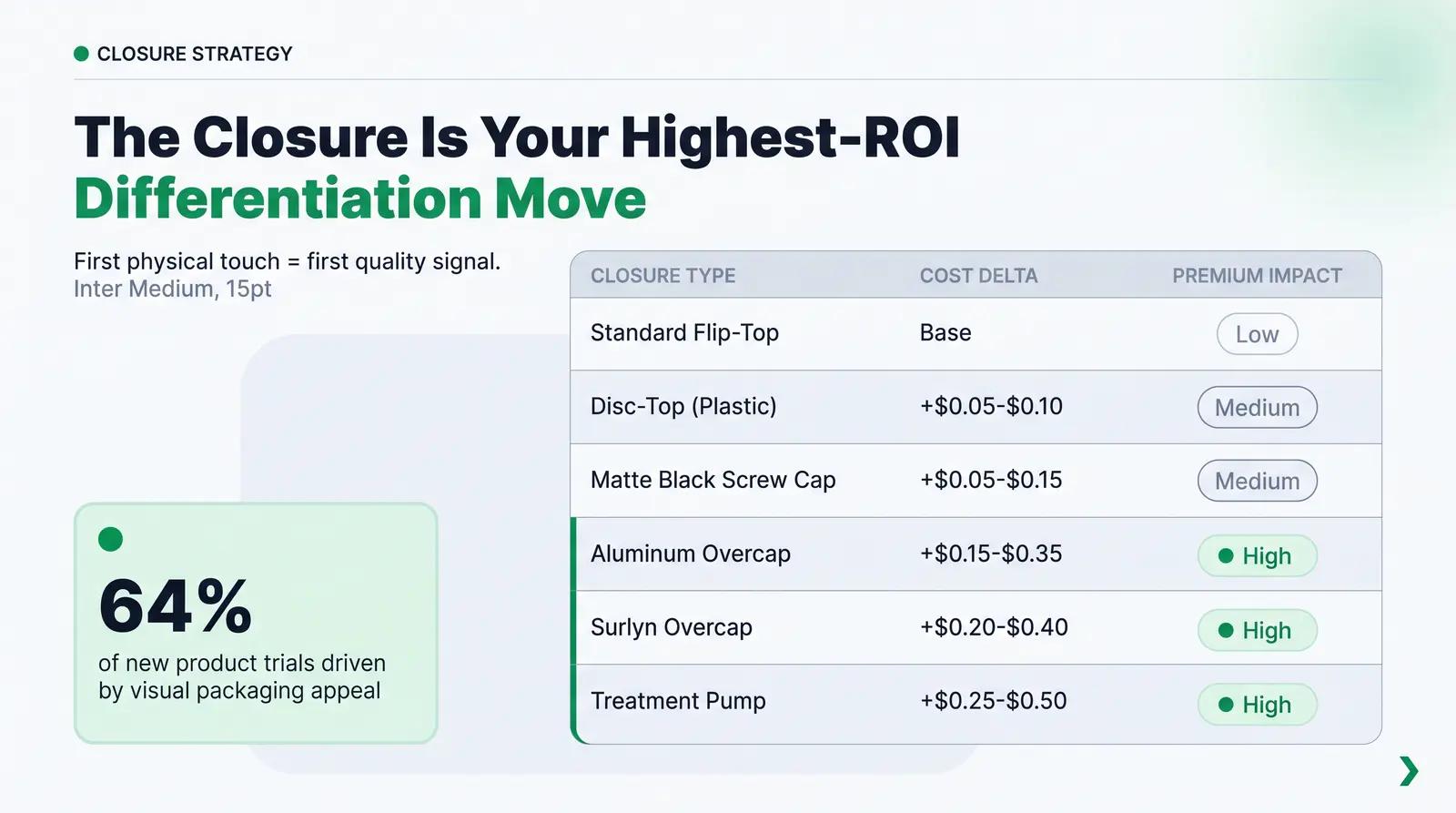
If there is one lever that provides the highest return on investment for differentiating stock packaging, it is closure pairing. The closure is the first physical interaction a consumer has with your product. It communicates quality, intentionality, and brand personality before a single drop of formula is dispensed.
Here is the contrarian insight worth sitting with: the assumption that custom packaging always signals more premium than stock is demonstrably false when closure choice, weight, and surface finish are optimized. A heavy stock glass bottle with a well-matched aluminum overcap offers a better tactile quality and premium perception than a lightweight, custom-molded plastic bottle produced at early-stage volumes. The premium signal comes from the material quality and the specificity of the pairing, not from whether the mold is proprietary. According to a Nielsen study cited by Berlin Packaging, 64% of consumer decisions to try a new product are influenced by the visual appeal of the packaging [6]. The closure is a primary contributor to that visual appeal.
| Closure Type | Approx. Cost Delta vs. Standard Plastic Cap | Best-Fit Use Cases | Perceived Premium Impact |
|---|---|---|---|
| Standard Flip-Top (Plastic) | Base Cost | Shampoos, body washes, basic lotions. | Low |
| Disc-Top (Plastic) | +$0.05 - $0.10 | Toners, premium body care, liquid exfoliants. | Medium |
| Matte Black Screw Cap | +$0.05 - $0.15 | Serums, cleansers, minimalist skincare. | Medium |
| Aluminum Overcap | +$0.15 - $0.35 | Serums, facial oils, luxury fragrance. | High |
| Surlyn Overcap | +$0.20 - $0.40 | High-end skincare, fragrance, heavy creams. | High |
| Treatment Pump (Fine-Mist or Lotion) | +$0.25 - $0.50 | Concentrated serums, eye creams, active treatments. | High |
(Note: Cost deltas are estimated industry ranges based on standard 1 oz (30 ml) to 4 oz (120 ml) components at 500-1,000 unit quantities.)
By intentionally pairing a standard bottle with an upgraded closure, such as a sleek disc-top on a simple cylinder bottle instead of a basic flip-top, or an aluminum overcap on a glass serum bottle instead of a plastic screw cap, you disrupt the visual pattern that consumers associate with commodity products. The mismatch between a familiar form factor and an unexpected premium closure creates the impression of deliberate design. Surlyn resin closures, for example, are typically associated with fragrance packaging but work equally well on high-end skincare, lending a jewel-like quality that no standard plastic cap can replicate [6].
Label Materials and Print Techniques That Close the Gap
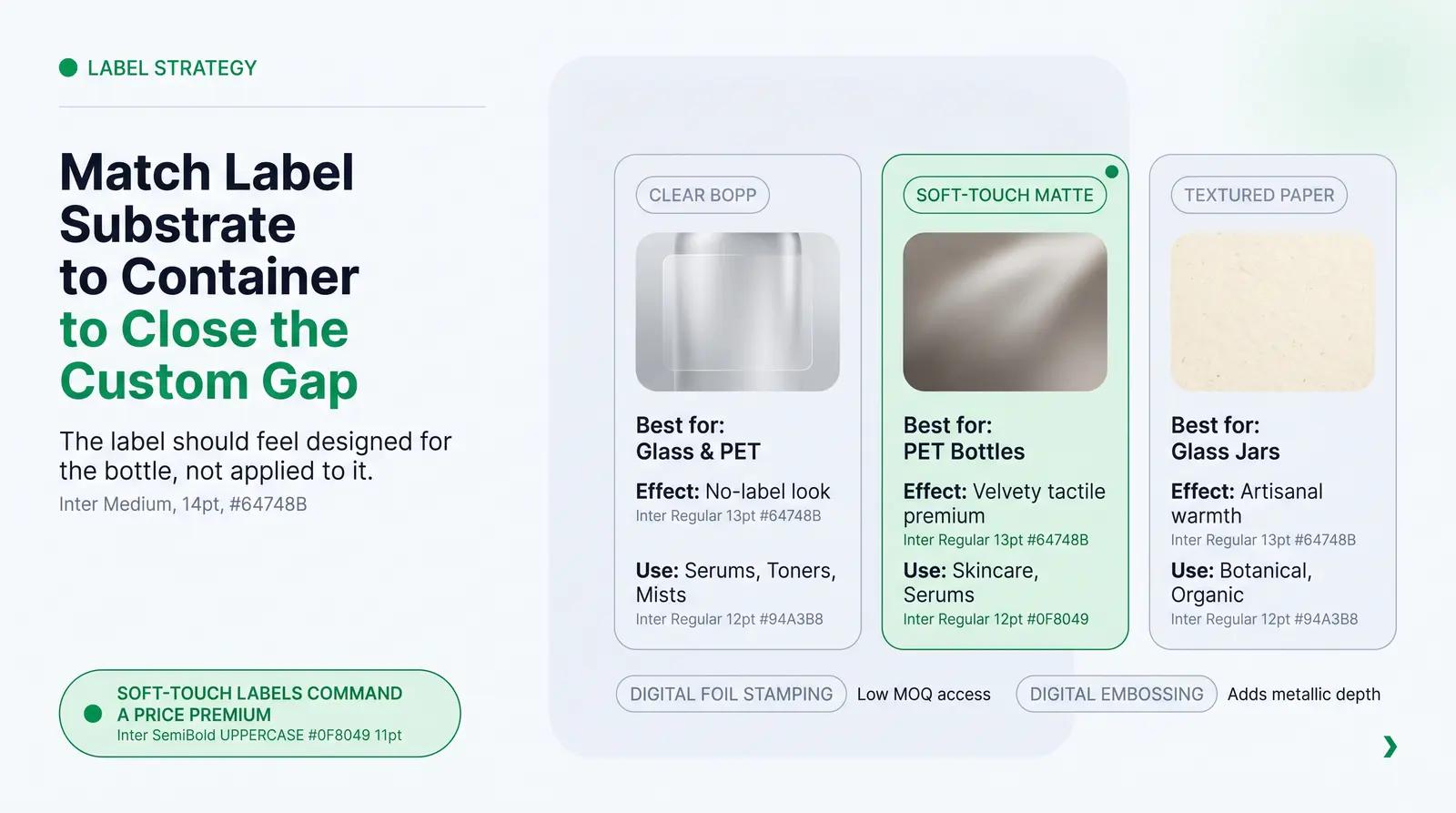
When custom silk-screening directly onto a bottle is out of reach due to high MOQs (typically 3,000 to 5,000 units minimum for direct decoration), the label substrate becomes your primary canvas for differentiation. The goal is to make the label feel integrated with the packaging rather than applied to it.
The "no-label look" is highly effective for clear or frosted containers. This is achieved using clear Biaxially Oriented Polypropylene (BOPP) film, which, when applied correctly to a smooth glass or PET surface, makes the graphics appear printed directly on the container [7]. The result is a clean, modern aesthetic that aligns with the apothecary and clinical-minimalist packaging styles that consistently drive purchase volume in the skincare category. Clear BOPP is particularly effective for serums in glass dropper bottles, toners, and facial mists where ingredient transparency is a core brand message.
For brands with a more artisanal or organic positioning, textured paper labels or uncoated stocks convey authenticity and warmth. These work best in dry-use contexts or when laminated for moisture resistance. Soft-touch matte laminate labels — a thin polypropylene film with a velvety coating — deliver a tactile experience that elevates perceived quality significantly. The Cal Poly study on tactile coatings found that consumers preferred soft-touch finishes over uncoated alternatives even when a price premium was attached [5], which suggests that the investment in a premium label substrate can be recovered through pricing power.
For luxury positioning, foil stamping and digital embossing add depth and a metallic sheen that catches light on the shelf. Traditional hot foil stamping requires a custom die (typically $100 to $500) and is better suited to mid-to-high volumes, but digital foil printing has made this technique accessible at lower quantities [7]. Extended content labels are worth considering for products with complex regulatory requirements, such as OTC sunscreens, where the primary container surface may not accommodate all required text under FDA labeling rules [8].
The practical rule of thumb for label selection is to match the substrate to the container material and the brand positioning. Clear BOPP on glass for clinical or luxury brands; soft-touch matte on PET for premium skincare; textured paper on glass for botanical or artisanal brands. The label should feel like it was designed for the bottle, not printed and applied as an afterthought.
Building a Cohesive SKU Family: The Brand Signal Most Founders Miss
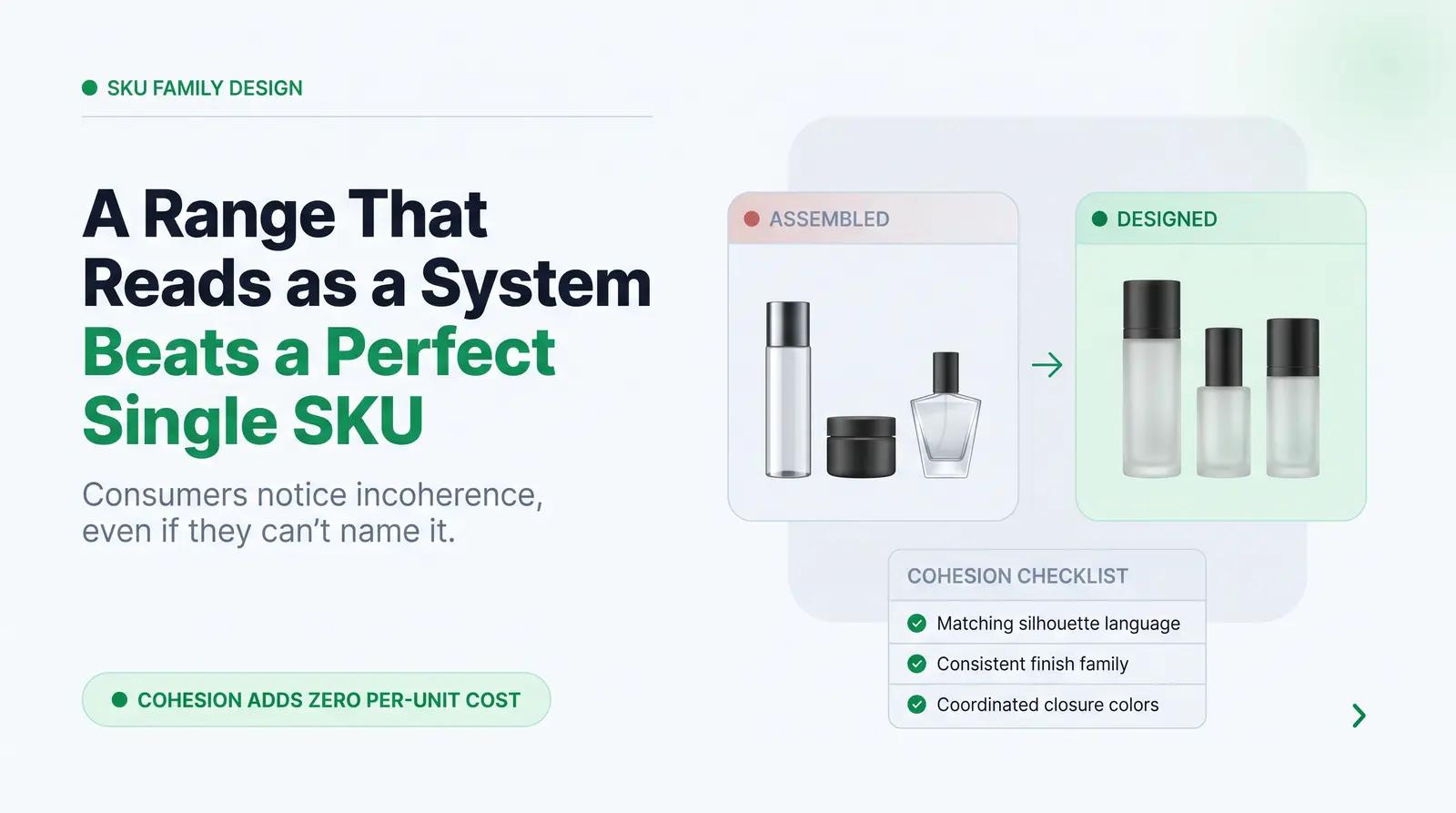
A single beautifully decorated bottle still reads as "indie" in the worst sense of the word if it sits next to unrelated components on a shelf or in a flat-lay photograph. The real power move is building a coordinated stock family. When a cleanser, serum, and moisturizer share compatible silhouette languages, weight classes, and finish families, the range reads as a deliberately designed system rather than a collection of individual products.
This is the brand signal that most founders miss. They invest significant effort in perfecting one hero SKU and then source the remaining products from whatever stock components are convenient. The result is a range that looks assembled rather than designed. Consumers notice this, even if they cannot articulate why.
Building a cohesive family requires selecting stock SKUs that look like they belong together. If your serum is a heavy-wall frosted glass cylinder, your moisturizer jar should ideally share that heavy-wall frosted aesthetic rather than being a lightweight glossy plastic tub. The silhouette language, whether cylindrical, tapered, or angular, should be consistent across the range. The weight class should be similar. The finish family, whether frosted, matte, or glossy, should be unified.
Packfolio's catalog is curated precisely around vetted SKU families where form factors are pre-matched, allowing founders to browse and build a cohesive range rather than assembling mismatched components from multiple disjointed suppliers. The 3D preview tool makes it possible to visualize how different SKUs look together before committing to production, which is a significant advantage when building a family system.
Worked Example: A Three-SKU Skincare Range Built from Stock
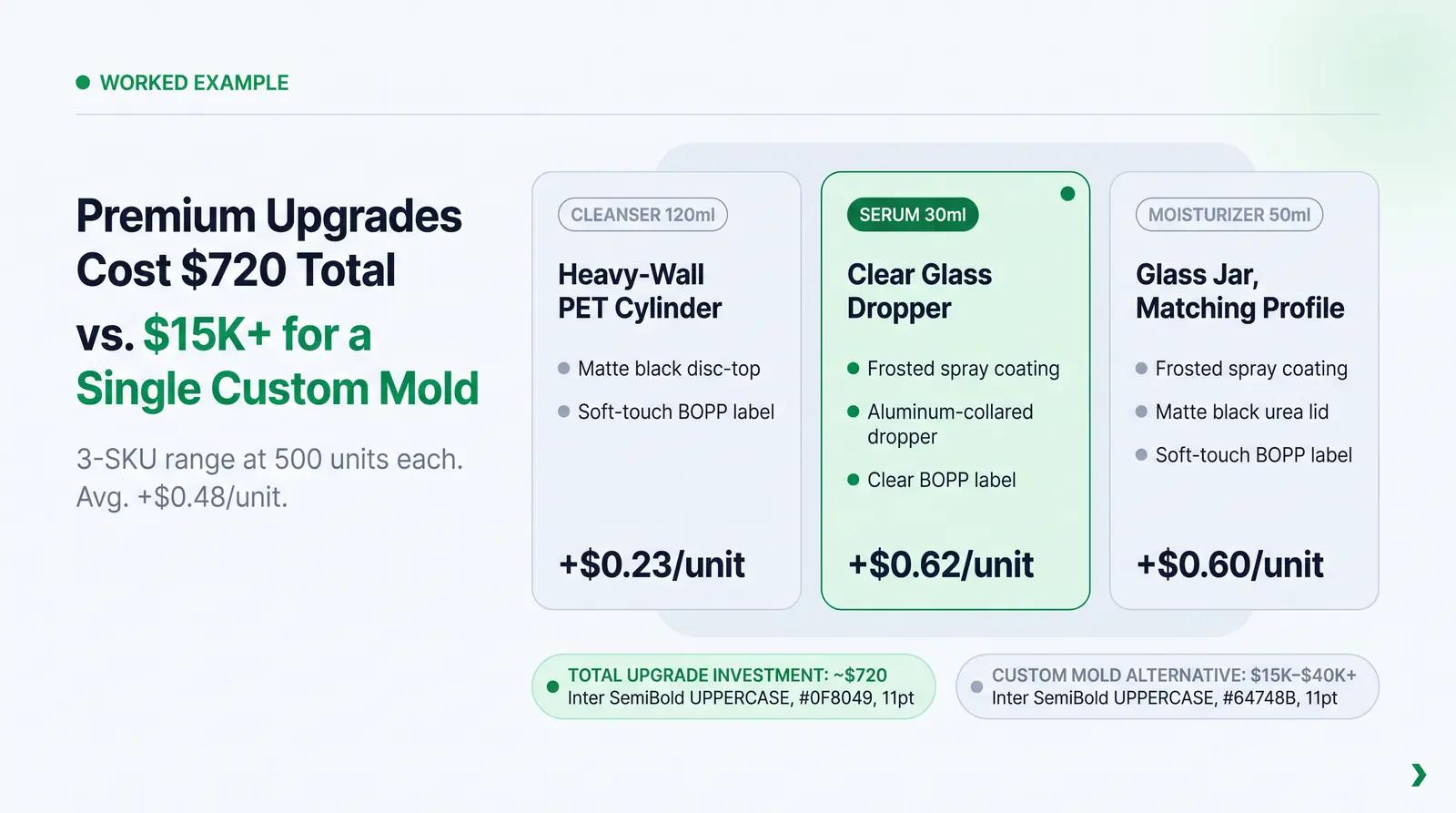
Consider a founder launching a three-product skincare range, a cleanser, a serum, and a moisturizer, at a launch volume of 500 units per SKU. This is a realistic early-stage scenario where custom molds are economically irrational, but a premium appearance is non-negotiable for the brand's positioning.
Cleanser (4 oz / 120 ml): Heavy-Wall PET Cylinder Bottle
The base component is a stock heavy-wall PET cylinder bottle, chosen for its substantial feel and clean silhouette. The default pump is replaced with a matte black disc-top closure, adding approximately $0.08 per unit. The label is a soft-touch matte BOPP film with a two-color design, adding approximately $0.15 per unit. Total upgrade cost over a bare stock bottle: approximately $0.23 per unit. The result is a cleanser that feels dense and intentional, with a velvety label texture that signals quality before the product is even opened.
Serum (1 oz / 30 ml): Clear Glass Dropper Bottle
The base component is a stock clear glass dropper bottle. A frosted spray coating is applied to the exterior, adding approximately $0.20 per unit. The standard plastic dropper assembly is replaced with a silver aluminum-collared glass dropper, adding approximately $0.30 per unit. A clear BOPP label with white ink provides a no-label look over the frosted glass, adding approximately $0.12 per unit. Total upgrade cost: approximately $0.62 per unit. The result is a serum that reads as a premium product at a price point typically associated with custom-molded glass.
Moisturizer (1.7 oz / 50 ml): Glass Jar with Matching Profile
The base component is a stock glass jar selected to match the cylindrical profile of the cleanser and serum bottles. The same frosted spray coating is applied, adding approximately $0.20 per unit. A heavy matte black urea lid — matching the disc-top color on the cleanser — tops the jar, adding approximately $0.25 per unit. A soft-touch matte BOPP label consistent with the cleanser's label design adds approximately $0.15 per unit. Total upgrade cost: approximately $0.60 per unit.
Across the three SKUs, the average upgrade cost is approximately $0.48 per unit. At 500 units per SKU, the total additional investment in premium upgrades is roughly $720 for the entire range — compared to the $15,000 to $40,000+ that a single custom mold would require [2]. The range reads as a designed system: consistent frosted finish, coordinated closure colors, and a unified label language. These figures are estimated ranges based on industry norms for small-batch decoration at 500-unit quantities [4] [7].
What to Verify Before You Order Stock with Decoration Upgrades
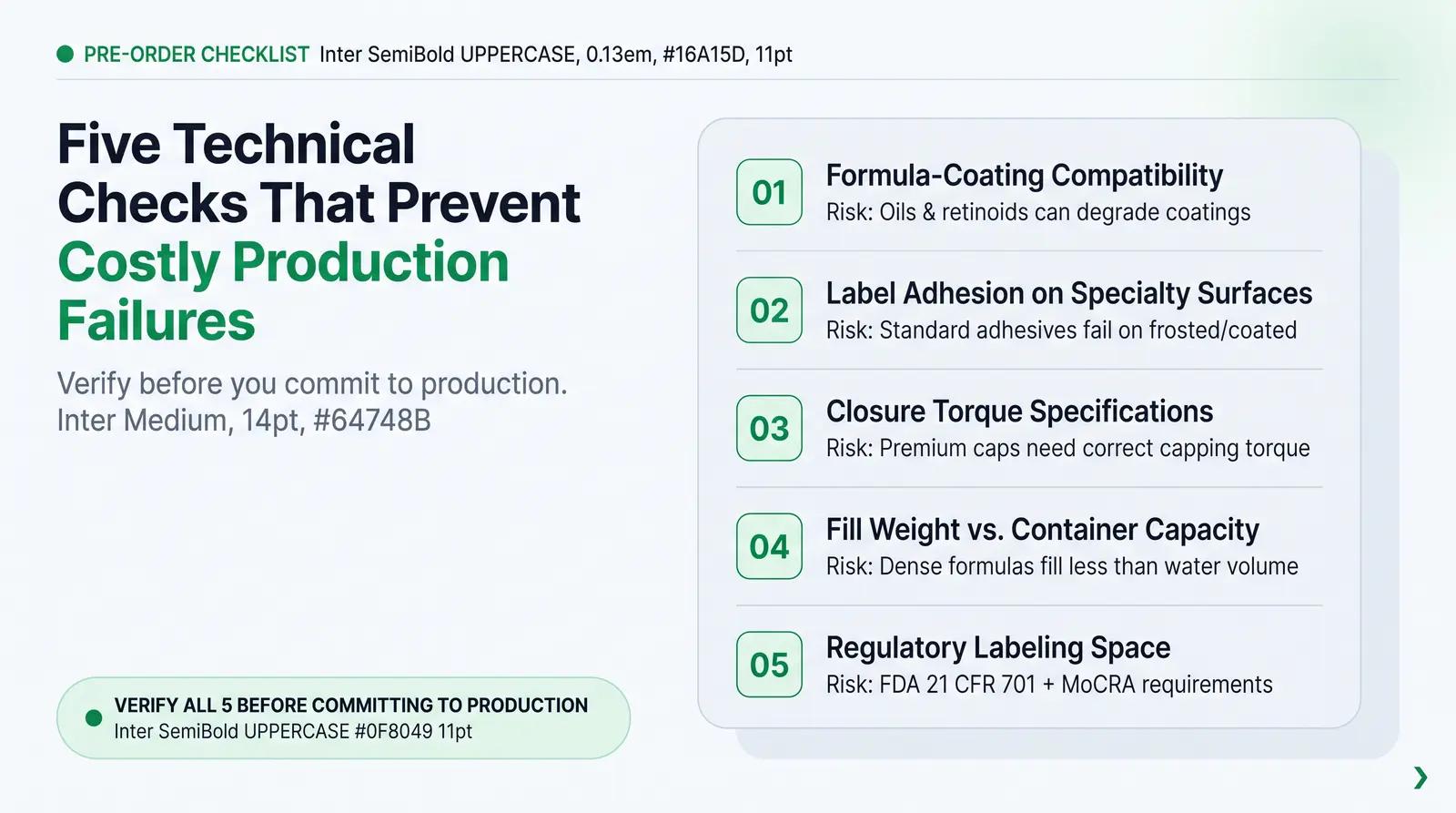
Upgrading stock packaging requires practical due diligence that goes beyond aesthetics. Several technical factors can undermine an otherwise well-designed system if they are not verified before production.
Formula-coating compatibility is the first priority. Certain active ingredients, particularly high-concentration essential oils, retinoids, and vitamin C derivatives, can degrade soft-touch spray coatings or cause frosted finishes to cloud or peel over time. Request compatibility data from your coating supplier and, where possible, conduct a short-term stability test with your filled product.
Label adhesion on specialty surfaces is a common failure point. Standard pressure-sensitive adhesives perform well on smooth glass and PET but may fail on heavily frosted, soft-touch, or UV-coated surfaces. Specify your surface treatment when ordering labels and request an adhesive recommendation from your label printer. A label that peels at the edges after two weeks in a bathroom environment is worse than no label at all.
Closure torque specifications must be verified against your fill line's capping equipment. A premium aluminum overcap that requires a specific application torque may not seat correctly with standard capping tools, leading to leaks or damaged closures. Request torque specifications from your closure supplier and confirm compatibility before ordering.
Fill weight versus container capacity is a straightforward but frequently overlooked check. Confirm that your formula's specific gravity aligns with the container's stated fill volume. A container rated for 1 oz (30 ml) of water may accommodate less of a denser formula.
Regulatory labeling space is a compliance requirement that must be built into the design phase. Under FDA regulations codified at 21 CFR 701, cosmetic labels must include the product name, net quantity of contents, ingredient declaration, and the name and address of the responsible party [8]. Under MoCRA, labels must also include contact information for the responsible person. Ensure your label design allocates sufficient space for all required elements, particularly on small containers where the available surface area is limited.
Managing these technical details across multiple suppliers is where many projects stall. Packfolio's order flow is structured so founders can see exactly how decoration choices render before committing to production. The 3D preview step lets you visualize your complete SKU family, including closures, finishes, and label placement, before a single unit is produced. Packfolio handles the production coordination, quality assurance, and supplier management, ensuring that upgraded closures fit correctly and labels adhere as expected, rather than leaving those verification steps to the founder. Browse Packfolio's curated packaging catalog to explore pre-vetted components that support these upgrades.
Ready to build your range? Browse Packfolio's curated packaging catalog and preview your label in 3D before you order at packfolio.com/catalog. Packfolio coordinates production, quality assurance, and freight delivery so you can focus on building your brand, not managing a supply chain.
Frequently Asked Questions
What is the minimum order quantity for stock cosmetic packaging with decoration upgrades?
Stock packaging with decoration upgrades — such as frosted coatings, premium closures, and specialty labels — is typically accessible at 500 to 3,000 units, depending on the supplier and the specific technique. Factory spray coatings often require a minimum of 3,000 units, while digital label printing can be ordered in quantities as low as 250 to 500 units. This is substantially lower than the 10,000-unit minimum typically required for custom molds [3].
Is stock cosmetic packaging cheaper than custom-mold packaging?
Yes, for early-stage brands. Stock packaging avoids the $7,000 to $40,000-plus upfront tooling fees associated with custom injection molds [2]. Adding premium closures, surface finishes, and specialty labels increases the per-unit cost of a stock bottle by approximately $0.23 to $0.62 per unit in the examples above, but this remains far more cost-effective than amortizing custom mold tooling across a 500-unit production run.
How can I make my cosmetic labels look premium on stock bottles?
Using clear BOPP film creates a no-label look that mimics direct silk-screening by making graphics appear printed directly onto the container [7]. Soft-touch matte laminates add a velvety tactile quality that consumers associate with premium products. Digital foil stamping and embossing are accessible at low minimum quantities and add metallic depth and visual complexity. The key is matching the label substrate to the container material and ensuring the adhesive is specified for the surface treatment applied.
Do different closures really change how a product is perceived?
Yes, significantly. The closure is the first physical interaction a consumer has with a product. Swapping a standard plastic flip-top for an aluminum overcap, a heavy surlyn cap, or a sleek disc-top immediately elevates the tactile experience and visual weight of the product. Research cited by Berlin Packaging indicates that 64% of consumer decisions to try a new product are influenced by the visual appeal of the packaging [6], and the closure is a primary contributor to that first impression.
What should I check before ordering frosted glass or coated packaging?
Verify that your label adhesive is specified for frosted or coated surfaces, as standard adhesives may fail to bond correctly. Confirm that the coating method, whether spray coating, acid etching, or sandblasting, is compatible with your formula's active ingredients to prevent degradation over time. Also verify closure torque specifications and ensure your label design allocates sufficient space for all required regulatory information under FDA and MoCRA requirements [8].
References
[1] Srivastava, P., Ramakanth, D., Akhila, K., and Gaikwad, K.K. "Package Design as a Branding Tool in the Cosmetic Industry: Consumers' Perception vs. Reality." SN Business and Economics, 2022. PMC9123395. https://pmc.ncbi.nlm.nih.gov/articles/PMC9123395/
[2] AH Packaging. "The True Cost of Custom Molds in Cosmetic Packaging: Explained with Real Numbers." AH Packaging, May 2025. https://ahpackaging.com/the-true-cost-of-custom-molds-in-cosmetic-packaging-explained-with-real-numbers/
[3] Next Pangaea. "How is MOQ Determined in Cosmetic Manufacturing?" Next Pangaea, February 2025. https://www.nextpangaea.com/post/how-is-moq-determined-in-cosmetic-manufacturing
[4] AH Packaging. "How Does MOQ Affect Cosmetic Packaging Costs?" AH Packaging, October 2025. https://ahpackaging.com/how-does-moq-affect-cosmetic-packaging-costs/
[5] Keif, Malcolm G., Stoneman, Andrea, and Twomey, Colleen. "Consumer Perception of Tactile Packaging: A Research Study on Preferences of Soft Touch and Hi Rise Coatings in Cosmetic Packaging." California Polytechnic State University, Graphic Communication Department, 2015. https://digitalcommons.calpoly.edu/cgi/viewcontent.cgi?article=1050&context=grc_fac
[6] Berlin Packaging. "Captivating Closures Are Becoming Beauty Packaging's Feather in the Cap." Berlin Packaging, August 2025. https://www.berlinpackaging.com/insights/perspectives/captivating-beauty-closures
[7] Printing Blue. "Beauty and Skincare Labels 101: What Every Cosmetics Brand Should Know." Printing Blue, December 2025. https://www.printingblue.com/knowledge-center/posts/cosmetic-labels
[8] U.S. Food and Drug Administration (FDA). "Summary of Cosmetics Labeling Requirements." FDA, November 2025. https://www.fda.gov/cosmetics/cosmetics-labeling-regulations/summary-cosmetics-labeling-requirements
[9] Made by Genie. "The True Cost of a SKU: What It Actually Costs to Manufacture a $25 Facial Oil." Made by Genie, December 2025. https://www.madebygenie.com/blog/cosmetic-manufacturing-cost-per-unit-breakdown
[10] Cosmetic Packaging Now. "What Is the Cost of Custom Cosmetic Packaging?" Cosmetic Packaging Now, September 2025. https://www.cosmeticpackagingnow.com/blogs/learn/how-much-does-cosmetic-packaging-cost


