
Stock vs Custom Cosmetic Packaging: What Founders Should Choose First
Founders should match packaging tier to launch stage, starting with stock or semi-custom to preserve capital and upgrading to fully custom only after validating demand.
The Real Question Isn't Design. It's Risk.
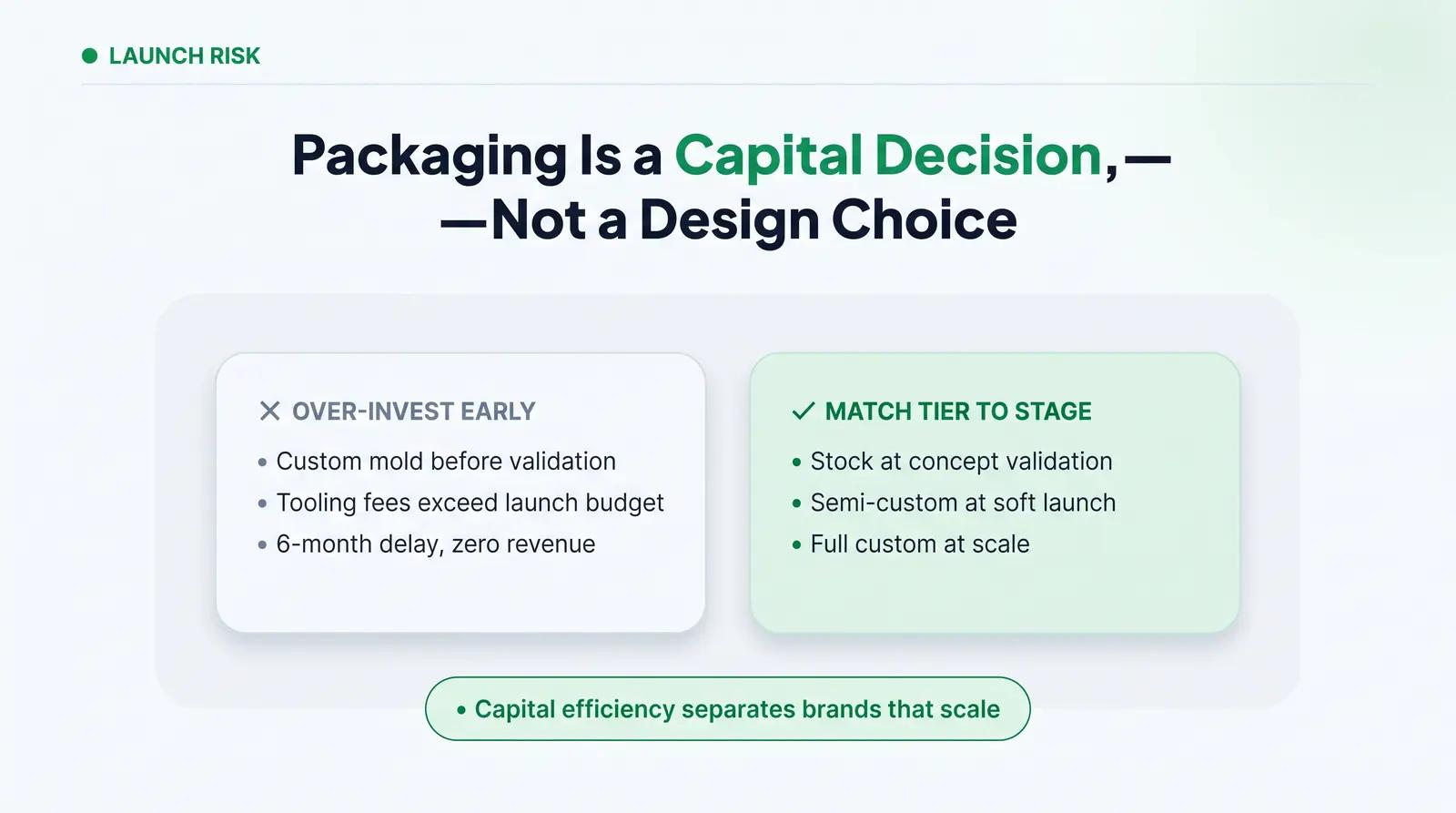
Packaging is not a branding exercise. It is a capital allocation decision, and at the pre-launch stage, it is one of the highest-risk bets a founder can make.
When a beauty founder commits to fully custom packaging before validating demand, she is locking up thousands of dollars in tooling fees and minimum order quantities before a single customer has confirmed the product is worth buying. That is not a design choice. It is a financial gamble with the entire launch budget on the line.
The beauty industry is fiercely competitive, and capital efficiency separates brands that scale from those that shutter. Industry consultants and investors consistently identify insufficient funding and capital mismanagement as the primary reasons independent beauty brands struggle, even when the broader market is growing [1]. Packaging decisions made too early, at too high a tier, are a textbook example of capital mismanagement. The brands that survive their first two years are not necessarily the ones with the most distinctive packaging. They are the ones that preserved enough runway to iterate, market, and reorder.
This article frames the stock vs. custom packaging decision as a launch-risk tradeoff, not a design preference. It provides a practical framework, real numbers, and a worked example so founders can make an informed, stage-appropriate choice this week, not in six months after a supplier has already invoiced them for a mold deposit.
Three Packaging Tiers, Defined
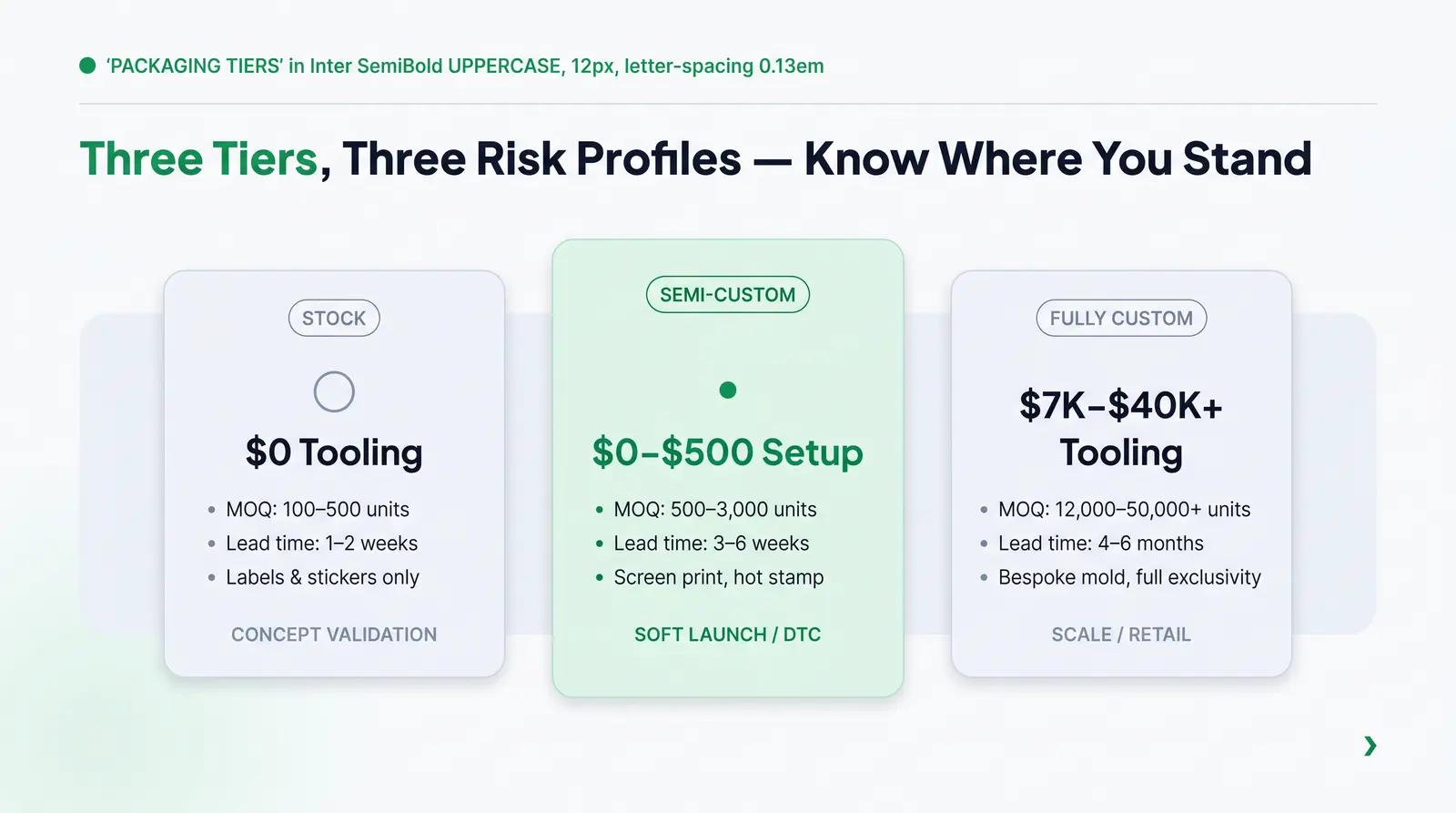
The packaging market is not binary. There are three distinct tiers, each with a different financial and operational profile. Understanding where each tier sits on the risk spectrum is the prerequisite for any intelligent packaging decision.
Stock packaging refers to off-the-shelf components manufactured in standard shapes, sizes, and materials. No tooling investment is required because the molds already exist. Brands apply their identity externally via labels, shrink sleeves, or stickers. This tier offers the lowest minimum order quantities (MOQs) and the shortest lead times, making it the most accessible entry point for any launch. The tradeoff is limited structural differentiation: the same bottle silhouette may appear across dozens of competing brands.
Semi-custom packaging uses stock structural components but applies custom decoration directly to the surface. This includes screen printing, hot stamping, custom color matching, and precise label placement within predefined zones. The brand identity is built on the surface of an existing form, not through a new mold. The Packfolio model operates in this tier and in stock, enabling founders to achieve a premium branded look without the capital burden of proprietary tooling. Semi-custom is the tier most founders underestimate. Done well, it produces packaging that reads as fully custom to the end consumer.
Fully custom packaging involves engineering a bespoke mold or component from scratch. This tier requires substantial upfront tooling investment, extensive sampling and validation cycles, long lead times, and high MOQs to amortize manufacturing costs. It delivers total structural exclusivity, but demands a level of capital commitment that is rarely appropriate before product-market fit is established. Fully custom is the right choice eventually, for the right brand at the right stage. It is rarely the right choice at launch.
Head-to-Head Comparison
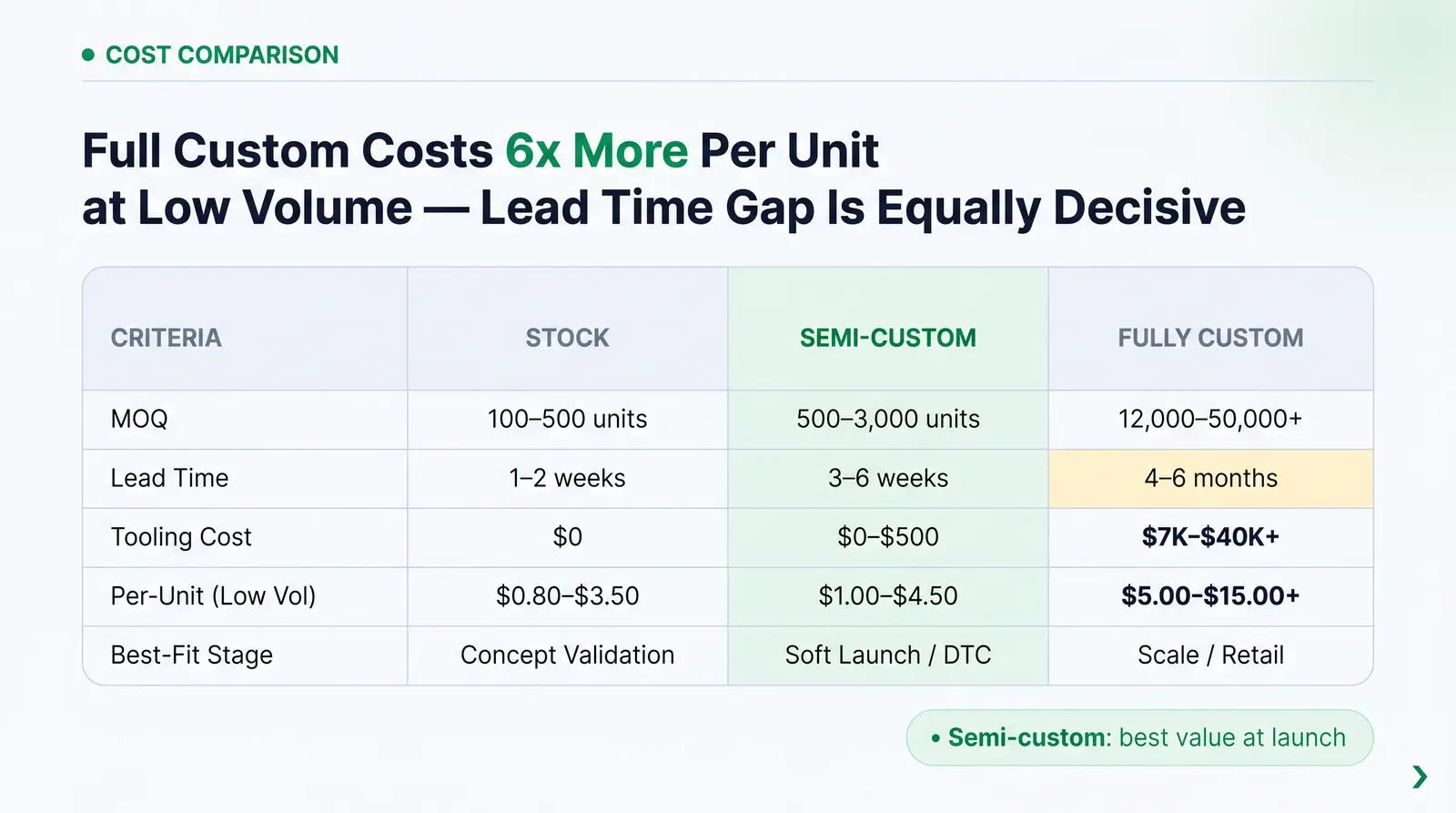
The following table compares all three tiers across the criteria that matter most at launch. Figures reflect typical industry ranges [2] [3] [4].
| Criteria | Stock | Semi-Custom | Fully Custom |
|---|---|---|---|
| MOQ | 100–500 units | 500–3,000 units | 12,000–50,000+ units |
| Lead Time | 1–2 weeks | 3–6 weeks | 4–6 months |
| Tooling Cost | $0 | $0–$500 (setup fees) | $7,000–$40,000+ per component |
| Per-Unit Cost at Low Volume | $0.80–$3.50 | $1.00–$4.50 | $5.00–$15.00+ |
| Per-Unit Cost at Scale | $0.30–$1.20 | $0.50–$1.80 | $1.00–$3.00 |
| Sampling Complexity | Very Low | Moderate | Very High |
| Brand Differentiation Potential | Low | Moderate to High | Very High |
| Best-Fit Launch Stage | Concept Validation | Soft Launch / DTC Pilot | Scale / Retail Readiness |
The per-unit cost inversion at scale is worth examining closely. Fully custom packaging becomes cost-competitive only at very high volumes, precisely because tooling costs are spread across tens of thousands of units. At the low volumes typical of a first production run, it is dramatically more expensive per unit than either alternative. A founder ordering 500 units of fully custom packaging is essentially paying the entire mold cost herself, with no volume to spread it across.
The lead time gap is equally significant. A 4-to-6-month timeline for fully custom packaging means a founder who decides on her packaging in January may not receive her first shipment until June or July. That is six months of delayed revenue, delayed customer feedback, and delayed iteration. Stock and semi-custom packaging compress that timeline to weeks, not months.
The Launch-Risk Packaging Matrix
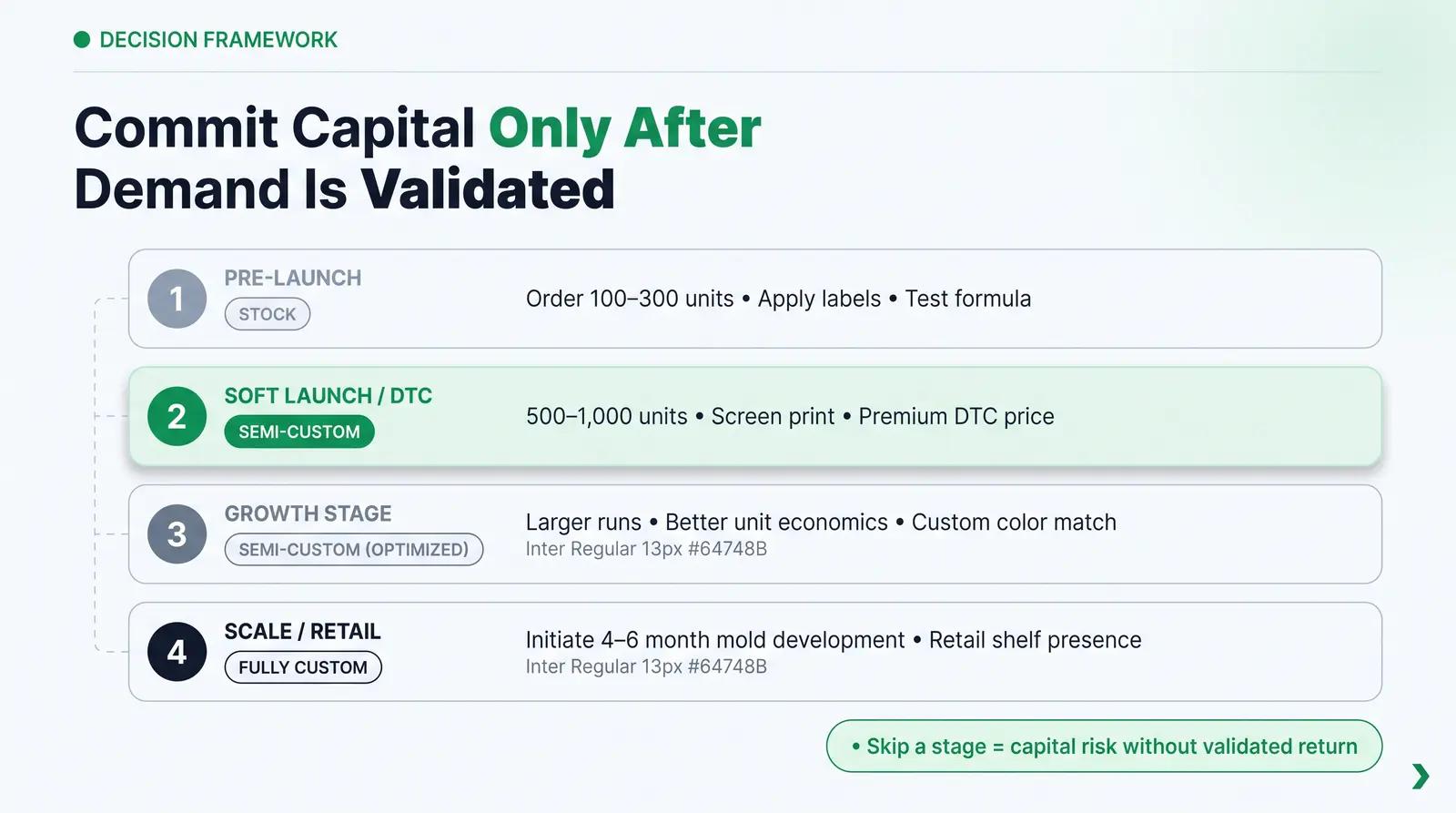
A practical framework we recommend at Packfolio for matching packaging tier to launch stage is the Launch-Risk Packaging Matrix. The core principle is straightforward: the level of capital committed to packaging should be proportional to the level of demand that has already been validated. Committing more capital than the current stage justifies is the definition of launch risk.
| Stage | Recommended Tier | Capital Risk Logic | Practical Action |
|---|---|---|---|
| Pre-launch / Concept Validation | Stock | Zero tooling exposure; maximum iteration speed | Order 100–300 units, apply labels, test formula stability and user experience with a beta group |
| Soft Launch / DTC Pilot | Semi-Custom | Low tooling exposure; sufficient brand differentiation for premium DTC pricing | Select a vetted stock silhouette, invest in custom screen printing or decoration, launch with 500–1,000 units |
| Growth Stage | Semi-Custom (optimized) | Flexibility to expand product lines quickly while maintaining brand cohesion | Negotiate better per-unit pricing on larger semi-custom runs; explore custom color matching on stock components |
| Scale / Retail Readiness | Fully Custom | Tooling costs amortized across high volume; structural differentiation supports retail shelf presence | Initiate the 4-to-6-month mold development process for a signature component that embodies the brand |
The matrix is deliberately conservative. Moving to a higher tier before the current stage is complete increases capital risk without a proportional increase in validated return. A founder who skips from concept validation to fully custom packaging is not investing in her brand. She is betting on it.
It is also worth noting that the matrix is not a one-way escalator. A founder who reaches the growth stage and realizes her formula needs reformulation may need to step back to stock packaging temporarily while she retests. The flexibility of lower tiers is a feature, not a limitation.
Worked Example: A Realistic Founder Scenario
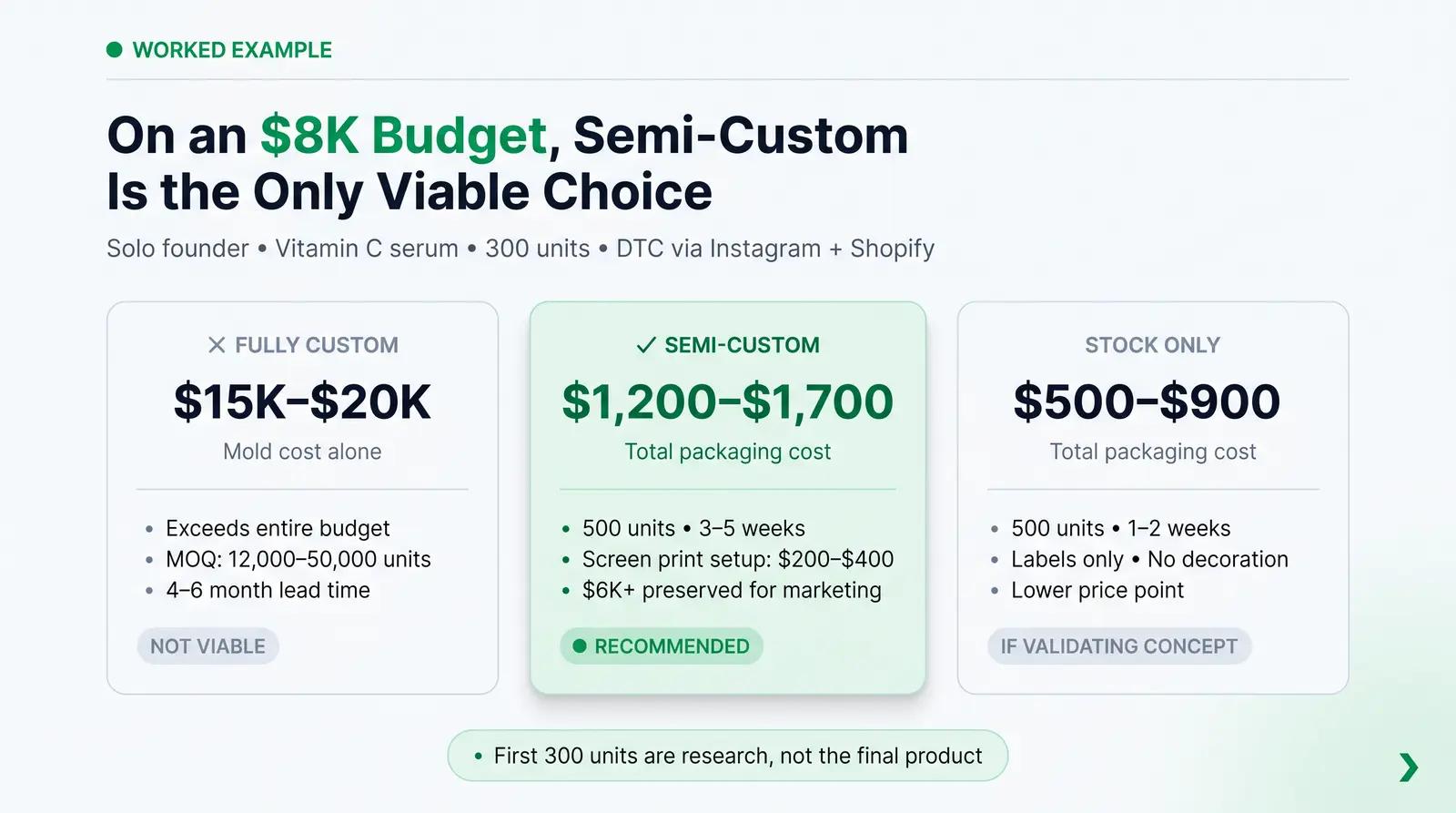
Consider a solo founder launching a vitamin C brightening serum, targeting direct-to-consumer sales via Instagram and a Shopify store. Her total budget for the first production run is $8,000, and she is aiming for 300 units to test the market.
What fully custom would cost her. A single airless pump mold typically runs $15,000 to $20,000 [3]. The supplier MOQ for private mold packaging is 12,000 to 50,000 units [3]. Her tooling cost alone would exceed her entire launch budget, before a single unit is produced. Lead time for mold development, sampling, mass production, and freight is 4 to 6 months. This option is not viable at this stage by any reasonable measure.
What semi-custom stock packaging would cost. A high-quality 30ml stock airless pump bottle in plastic or glass might cost $1.50 to $2.50 per unit. A screen printing setup fee runs approximately $200 to $400, with a per-unit decoration cost of $0.30 to $0.80. For a 500-unit minimum run, total packaging cost would be approximately $1,150 to $1,650. Lead time is 3 to 5 weeks. Capital at risk: roughly $1,200 to $1,700.
What stock-only would cost. A stock bottle without custom decoration might cost $0.80 to $1.50 per unit. Adding 500 custom labels costs approximately $80 to $150. Total for 500 units: roughly $500 to $900. Lead time is 1 to 2 weeks.
The decision she should make. Based on the Launch-Risk Packaging Matrix, she is in the Soft Launch / DTC Pilot stage. Semi-custom is the appropriate tier. It provides the brand elevation needed for a premium DTC price point, preserves $6,000 to $6,800 of her budget for formulation, marketing, and fulfillment, and delivers a credible branded experience to her first customers. Stock-only is acceptable if her price point is lower or if she wants to run a true concept validation first.
What she should revisit after her first 300 units sell. If the product generates consistent reorders and positive reviews, she has validated demand. At that point, she can increase her semi-custom run size for better unit economics, explore custom color matching, and begin planning the timeline for fully custom tooling if volume projections support it. The first 300 units are not the final product. They are the research.
What Semi-Custom Actually Gets You (And What It Doesn't)
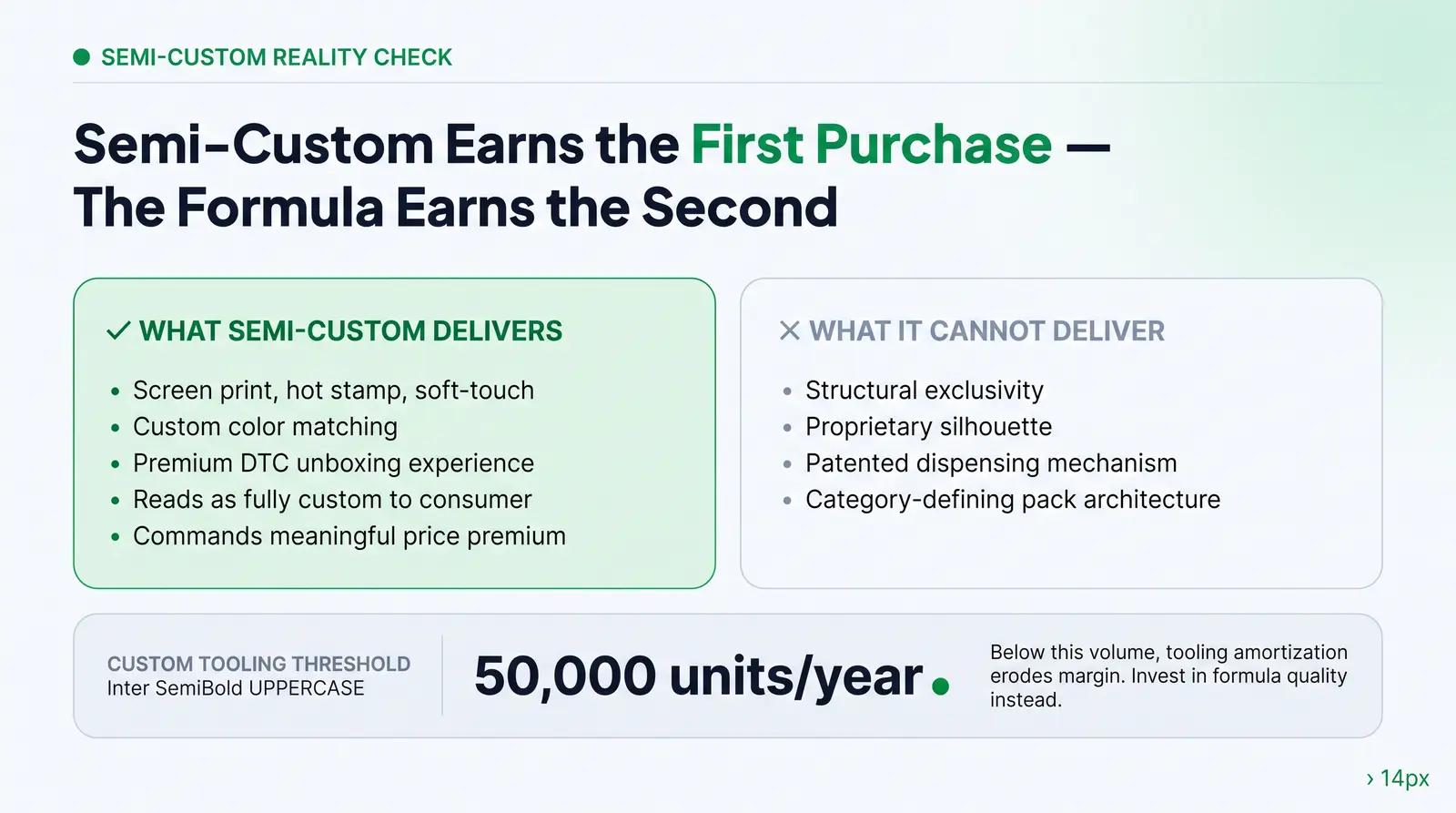
Semi-custom packaging can deliver a compelling brand identity. High-quality screen printing, soft-touch finishes, custom color matching, and hot stamping on a well-chosen stock silhouette can produce packaging that reads as premium to the consumer. For a DTC brand selling through social media and a Shopify store, where photography and unboxing experience drive perception, this level of decoration is often sufficient to command a meaningful price premium. The structural form of the bottle matters far less in a flat-lay photograph than the color, finish, and label design applied to it.
Where semi-custom falls short is structural exclusivity. If a brand's identity depends on a unique physical form, a proprietary silhouette, or a category-defining pack architecture, stock components cannot deliver that. A fragrance brand built around a distinctive bottle shape, or a skincare line with a patented dispensing mechanism, will eventually need fully custom tooling to realize that vision. The question is whether that investment is appropriate now or later.
The investment in full custom tooling generally makes financial sense when sustained annual volume exceeds 50,000 units [3]. Below that threshold, the per-unit cost premium of custom packaging, combined with the high tooling amortization cost, typically erodes margin rather than building it. A brand producing 10,000 units per year and paying $15,000 in tooling is adding $1.50 per unit in tooling cost alone, before any per-unit manufacturing premium.
Here is the non-obvious insight: at the early DTC stage, packaging differentiation may matter less than founders assume. Research on cosmetic purchasing behavior indicates that product quality and reasonable pricing are among the primary drivers of purchase decisions alongside packaging aesthetics [5]. A founder who deploys a clean, functional semi-custom pack and invests the savings into formula quality and customer acquisition is often better positioned than one who over-invests in a bespoke silhouette before proving the product. The reviews that drive repeat purchase are about what is inside the bottle, not the mold it was poured into. Packaging earns the first purchase. The formula earns the second.
What to Verify Before You Order Any Packaging Tier
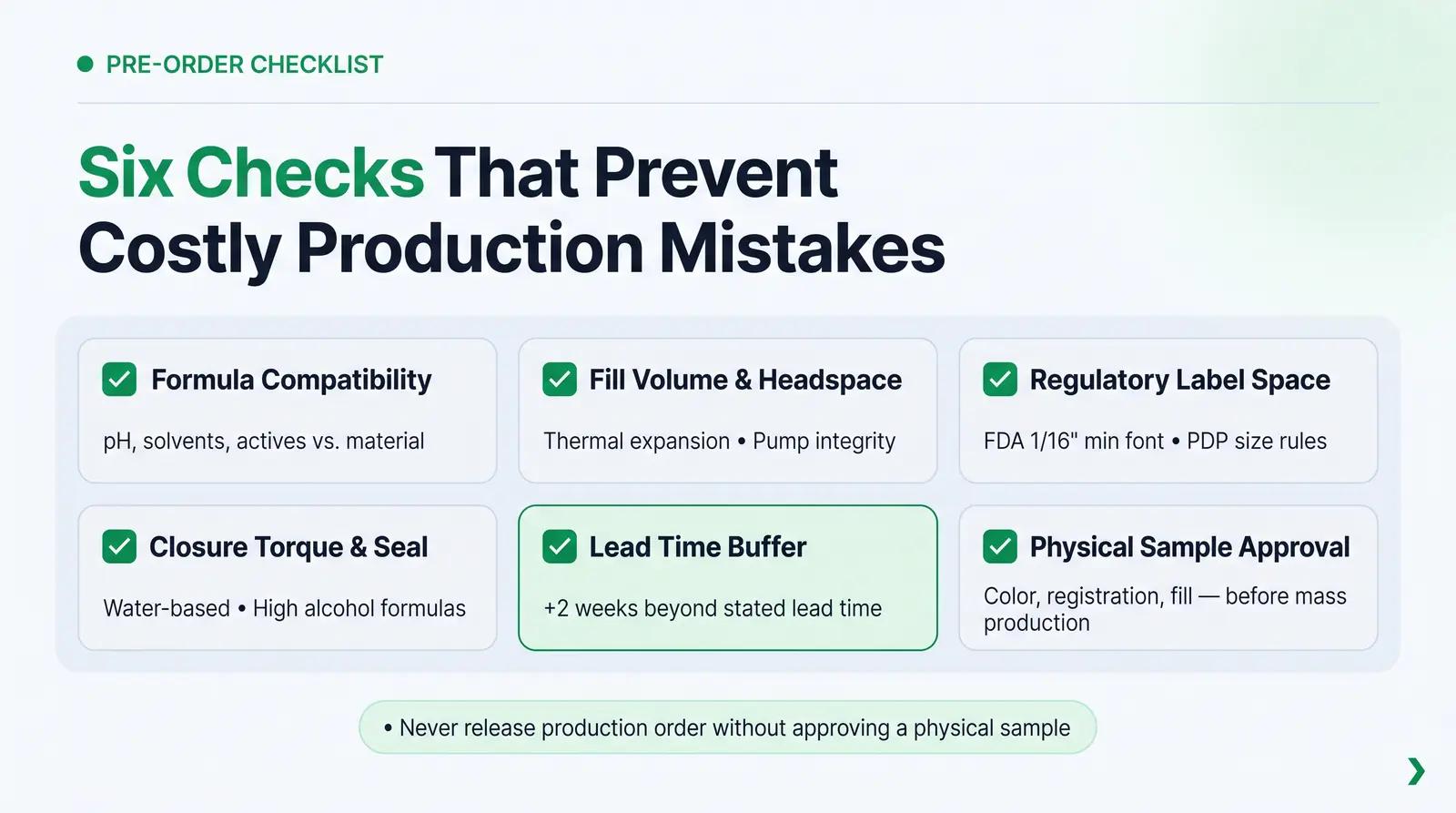
Packaging selection does not end at aesthetics and cost. Before committing to a production run at any tier, founders must validate the following:
- Formula-material compatibility: Confirm that the formula's pH, solvent content, and fragrance load are compatible with the chosen packaging material. Certain actives, including high-concentration vitamin C and essential oils, can degrade or leach from specific plastics. A compatibility test with the actual packaging material is essential before committing to a production run.
- Fill volume and headspace: Verify that the chosen component accommodates the intended fill volume with appropriate headspace for thermal expansion. Overfilling an airless pump can compromise the dispensing mechanism.
- Regulatory labeling space: FDA regulations require that ingredient declarations appear in a minimum font height of 1/16 inch, and that the principal display panel (PDP) meets specific size requirements based on container geometry [6]. For OTC drug-cosmetic hybrids, such as SPF products, additional labeling space is required [7]. Confirm that the chosen component provides sufficient printable area before finalizing the design.
- Closure torque and seal integrity: Test that the closure provides adequate seal for the formula type, particularly for water-based serums and products with high alcohol content. A leaking shipment is a customer service crisis and a brand reputation problem.
- Lead time vs. launch date buffer: Build in a minimum 2-week buffer beyond the stated lead time for any customs delays, inspection holds, or decoration rework. Suppliers' stated lead times are estimates, not guarantees.
- Sample and pre-production approval: Never proceed to mass production without approving a physical sample. Confirm color accuracy, decoration registration, and fill performance before releasing the production order.
Packfolio's catalog pre-vets these compatibility factors into each SKU, and the 3D preview step confirms label placement before production, so founders aren't managing supplier back-and-forth on these details themselves. The 3D model reflects the actual printable region of each component, meaning what the founder sees in the preview is what arrives in the shipment.
Closing CTA Block
The packaging decision is not something to defer until the rest of the brand is built. It shapes your cash flow, your launch timeline, and your ability to iterate. Start with the tier that matches your current stage, validate demand, and upgrade deliberately. That is how capital-efficient brands are built, and it is how packaging decisions stop being a source of launch risk and start being a source of competitive advantage.
Browse Packfolio's curated packaging catalog and preview your label in 3D before committing to a production run: packfolio.com/catalog
Frequently Asked Questions
What is the minimum order quantity for custom cosmetic packaging?
Fully custom packaging requiring private molds typically demands an MOQ between 12,000 and 50,000 units [3]. This high threshold exists because manufacturers must recover tooling, setup, and machine calibration costs across the production run. Semi-custom packaging using stock components with custom decoration carries a much lower MOQ, typically 500 to 3,000 units, making it far more accessible for early-stage brands.
How long does it take to get custom cosmetic packaging made?
Developing fully custom packaging from concept to delivery typically takes 4 to 6 months. This timeline includes 25 to 45 days for mold engineering and sampling, followed by mass production, quality assurance, and freight [3] [4]. Semi-custom packaging using stock components with custom decoration usually ships within 3 to 6 weeks, which is a critical difference for founders working toward a specific launch date.
Can small beauty brands afford custom packaging?
Most early-stage brands cannot absorb the $7,000 to $40,000 or more in tooling costs required for fully custom molds, in addition to the high MOQs [3]. Semi-custom packaging provides a practical alternative, delivering brand differentiation at a fraction of the capital commitment. Full custom investment becomes viable once sustained annual volume supports the amortization of tooling costs, typically above 50,000 units per year.
What is semi-custom cosmetic packaging?
Semi-custom packaging uses existing, off-the-shelf structural components but applies custom decoration directly to the surface. Decoration options include screen printing, hot stamping, custom color matching, and precision label placement within predefined zones. It offers meaningful brand differentiation at lower MOQs and without tooling investment, making it the most practical tier for DTC launches and early-stage brands seeking a premium aesthetic without prohibitive upfront costs.
When should I switch from stock to custom packaging for my beauty brand?
The transition to fully custom packaging is most appropriate at the Scale / Retail Readiness stage, when sustained annual volume exceeds roughly 50,000 units and the brand is entering retailer conversations that require structural differentiation [3]. Before that threshold, the capital is typically better deployed in customer acquisition and formula development. The decision to invest in custom tooling should be driven by validated volume, not by the desire for a distinctive silhouette before demand is proven.
References
[1] Rachel Brown, "If Beauty Is Doing So Great, Why Do Many Indie Beauty Brands Feel Like They're Struggling?" Beauty Independent, December 2023.
[2] Christina, "How Does MOQ Affect Cosmetic Packaging Costs (And What You Can Do About It)?" AH Packaging, October 2025.
[3] Sindebella, "Custom Cosmetic Packaging Mold Development." Typical industry ranges for tooling costs and MOQs.
[4] HJ Packaging, "Cost, MOQ and Lead Time." HJ Packaging Knowledge Center, February 2026.
[5] Pragya Srivastava et al., "Package design as a branding tool in the cosmetic industry: consumers' perception vs. reality." SN Business and Economics, May 2022. PMC9123395.
[6] U.S. Food and Drug Administration, "Summary of Cosmetics Labeling Requirements." FDA.gov, updated November 2025.
[7] U.S. Food and Drug Administration, "Cosmetics Labeling Guide." FDA.gov, updated February 2022.
[8] U.S. Food and Drug Administration, "Modernization of Cosmetics Regulation Act of 2022 (MoCRA)." FDA.gov, updated March 2026.
[9] Personal Care Products Council, "Ingredients." PCPC.org.
[10] Joanna Cosgrove, "Low MOQs? No Problem." Beauty Packaging Magazine, November 2019.


