
UPC Codes and Barcodes for Beauty Product Packaging
Beauty brands need GS1-registered UPC barcodes sized and placed correctly on packaging artwork to ensure retail readiness and avoid costly reprints.
A beauty brand founder who just Googled "barcode generator" often finds themselves staring at generic tools, wondering what they actually need before their product can go on a retail shelf or into a wholesale order. The generic advice skips the reality of the beauty industry: a missing or incorrect barcode can block a retail purchase order, delay a direct-to-consumer launch, or cause a retailer's system to reject a product entirely. The critical gap is understanding how barcode decisions affect packaging artwork before that artwork is finalized and sent to production.
This guide bridges that gap. We will cover where barcodes fit in the packaging workflow, what founders should research, and how to prepare barcode-ready artwork.
The Barcode-Ready Packaging Checklist
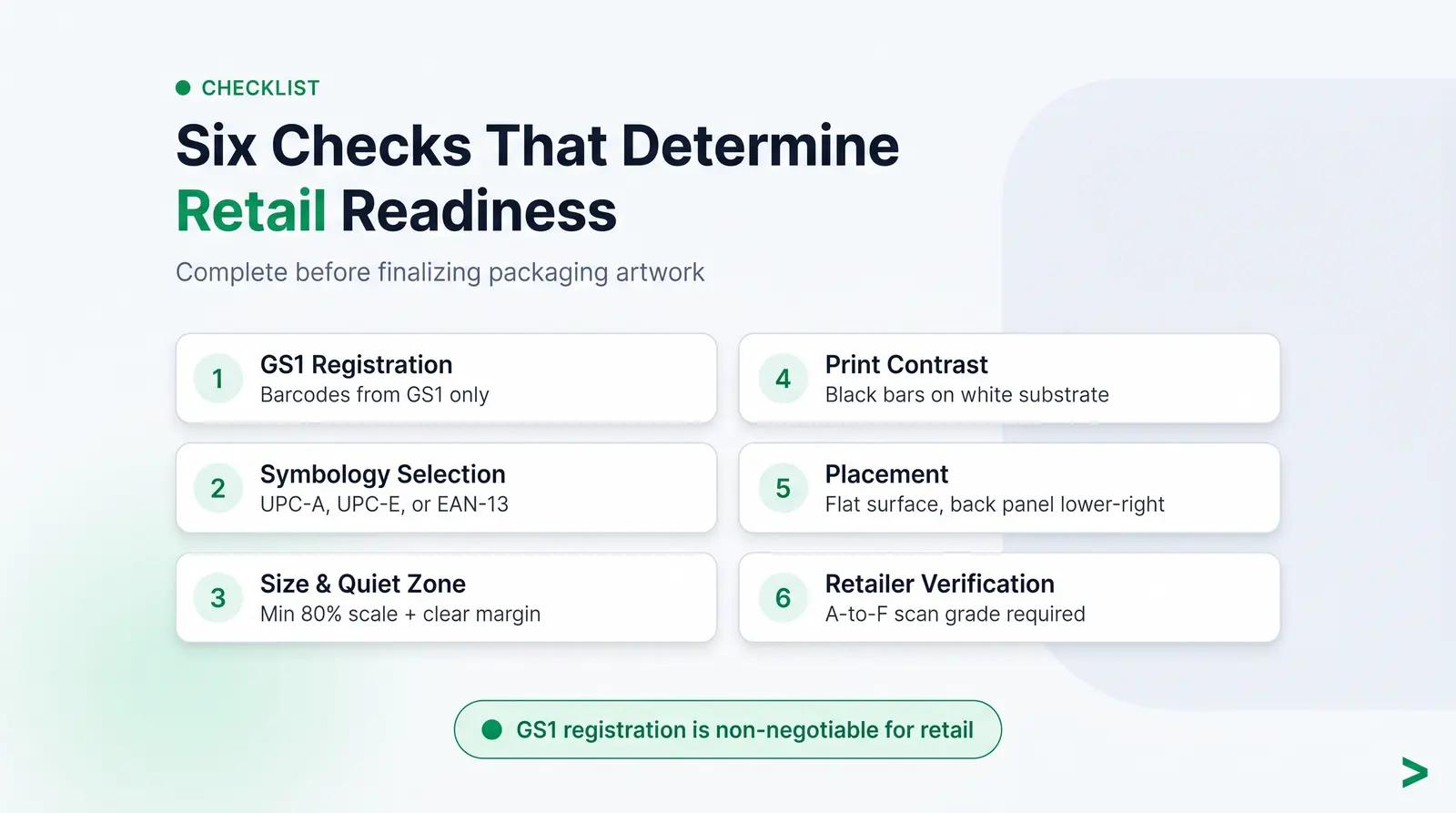
A practical framework we recommend at Packfolio involves checking these dimensions before finalizing your packaging artwork.
1. GS1 Registration Status
The foundation of retail readiness is obtaining your barcodes directly from GS1. While third-party resellers offer cheaper, recycled barcodes, major retailers and marketplaces like Amazon verify barcodes against the GS1 global registry [1]. If the barcode does not match your brand name in the GS1 database, your product listing can be rejected or your account suspended.
2. Barcode Symbology Selection
Choosing the right symbology depends on your product size and sales channels. The UPC-A is the standard 12-digit barcode for North American retail [2]. The EAN-13 is the 13-digit international standard [3]. For small cosmetics like lipsticks or concealers where space is limited, the 6-digit UPC-E is often necessary [4].
3. Size and Quiet Zone Requirements
A standard UPC-A barcode at 100% magnification is 1.469 in × 1.02 in (37.29 mm × 25.93 mm) [5]. It can be scaled down to 80% (1.175 in × 0.816 in) or up to 200%. Every barcode requires a "quiet zone"—a clear margin on the left and right sides. For a UPC-A, this quiet zone must be at least nine times the width of the narrowest bar [6].
4. Substrate and Print Contrast Requirements
Scanners rely on high contrast. The ideal combination is black bars on a white background [7]. Because barcode scanners use red lasers, red or reddish-brown bars are invisible to the scanner and will fail [7]. If your label is dark, you must print a white background block for the barcode and its quiet zones.
5. Placement on Packaging
The barcode must be placed on a relatively flat surface to ensure readability [7]. Wrapping a barcode around a tight curve, like the side of a lip balm tube, can distort the bars and cause scanning failures. For checkout items, the lower right-hand section of the back panel is standard [7].
6. Retailer-Specific Verification Requirements
Many retailers require a GS1 barcode verification scan test before accepting a product [8]. This test grades the barcode from A to F based on contrast, modulation, and decodability. Designing the barcode correctly from the start prevents costly reprints.
UPC vs. EAN-13 vs. QR Code: Which Does Your Beauty Product Need?
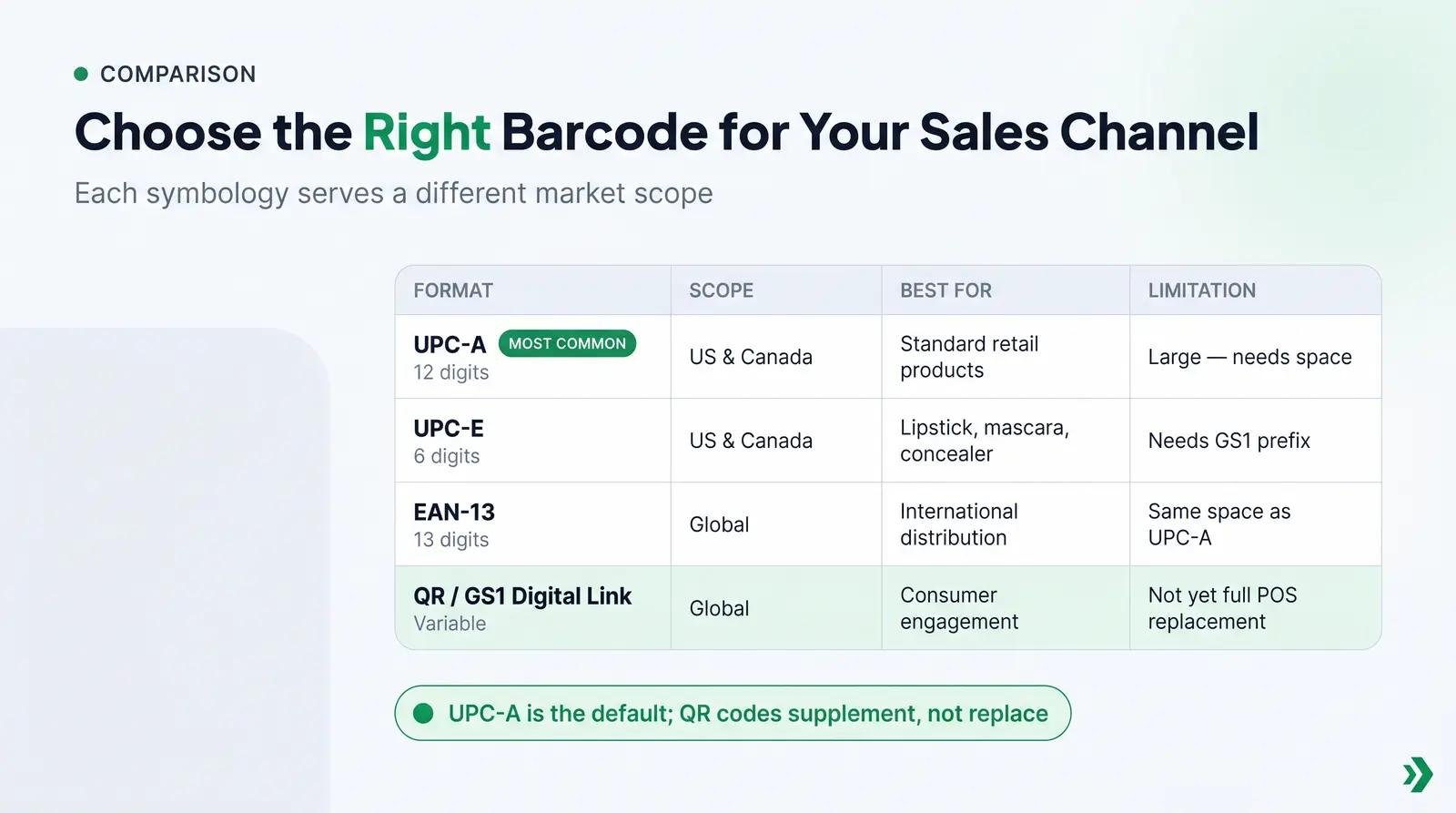
| Symbology | Digit Count | Geographic Scope | Retail Scanner Compatibility | When Beauty Brands Use It | Key Limitation |
|---|---|---|---|---|---|
| UPC-A | 12 | Primary in US/Canada | Universally accepted in North America | Standard retail products (lotions, serums, palettes) | Takes up significant space on small packaging |
| UPC-E | 6 | Primary in US/Canada | Universally accepted in North America | Small cosmetics (lipsticks, mascara, concealers) | Requires GS1 Company Prefix to generate |
| EAN-13 | 13 | Global (International) | Universally accepted globally | Products intended for international retail | Same space constraints as UPC-A |
| QR Code (GS1 Digital Link) | Variable | Global | Transitioning (Sunrise 2027 initiative) | Connecting consumers to tutorials, ingredients, or brand stories | Cannot fully replace UPC at all retail POS systems yet |
A Realistic Packaging Scenario
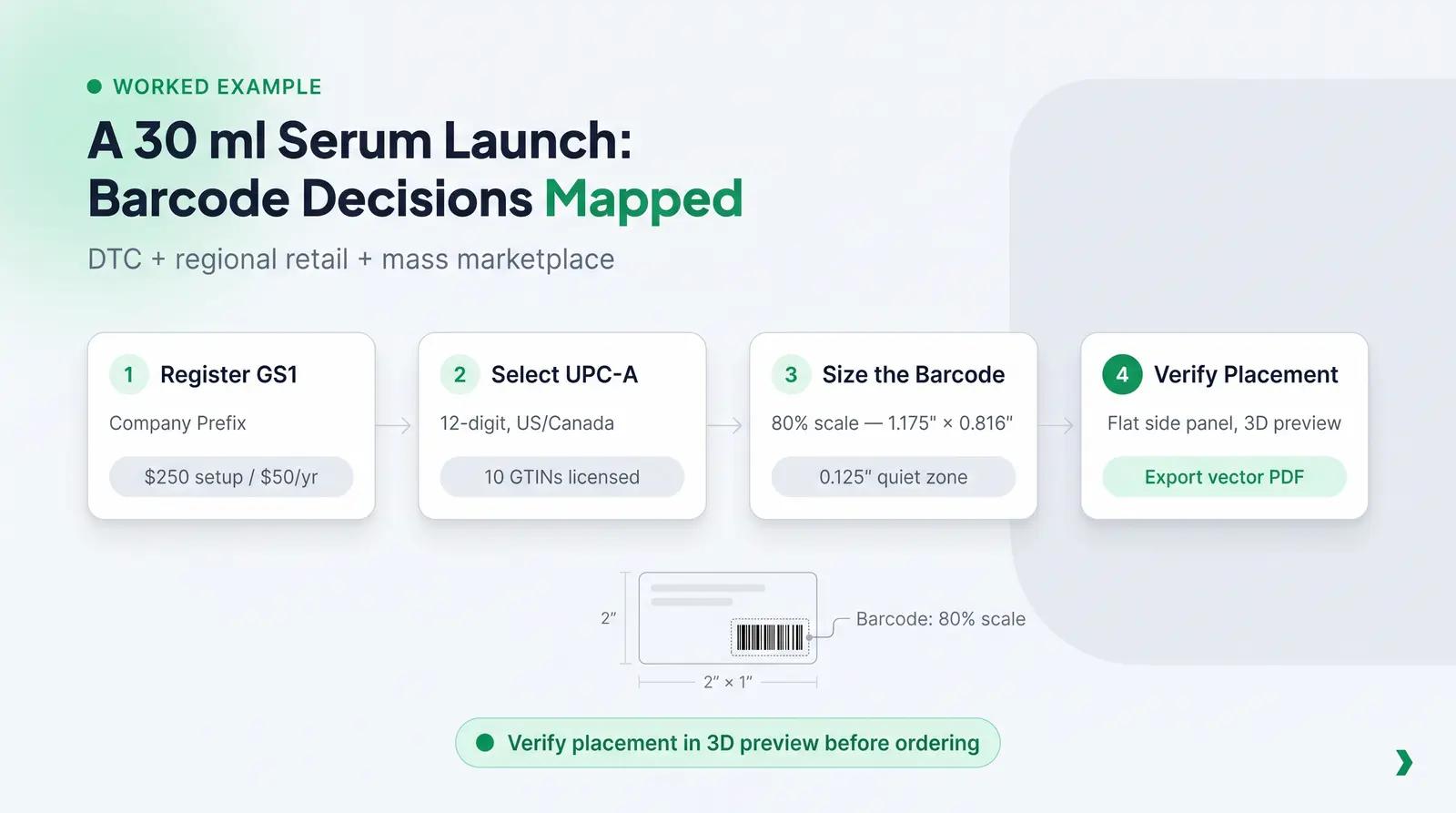
Consider a founder launching a 1 oz (30 ml) vitamin C serum. The product will sell on her DTC website, be pitched to a regional natural-beauty retailer, and eventually be listed on a major mass-market retailer's online marketplace.
First, she needs a UPC-A barcode because her primary markets are the US and Canada. She registers with GS1 US. Since she plans to launch a full skincare line, she licenses a GS1 Company Prefix for 10 GTINs, which costs $250 initially and $50 annually [9].
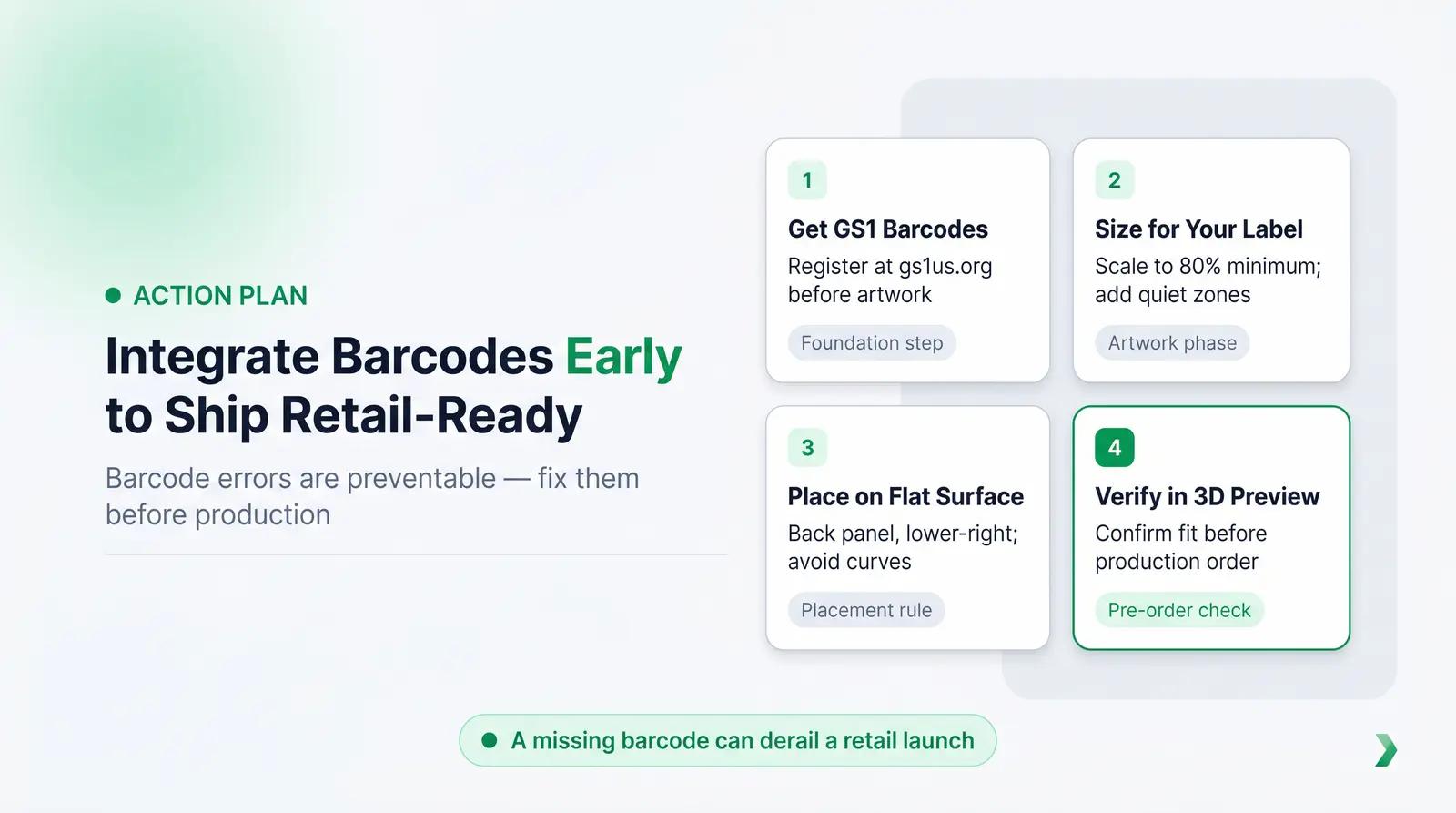
Next, she works on the label artwork. Her serum bottle label is 2 in × 1 in (51 mm × 25 mm). A standard 100% UPC-A (1.469 in × 1.02 in) will not fit. She scales the barcode down to the minimum 80% size (1.175 in × 0.816 in) and ensures a 0.125 in quiet zone on each side. She places the barcode vertically on the flat side panel of the label to avoid wrapping it around the bottle's tightest curve.
When ordering through Packfolio's catalog, each SKU has predefined printable regions visible in the 3D preview. This allows founders to confirm barcode placement and label dimensions before the order is placed, rather than discovering a sizing conflict after production.
Finally, she exports the label artwork as a high-resolution PDF, embedding the barcode vector file to ensure the bars print crisply without pixelation. For more details on preparing artwork, review our guide on print-ready files.
The Hidden Risk of Resold Barcodes
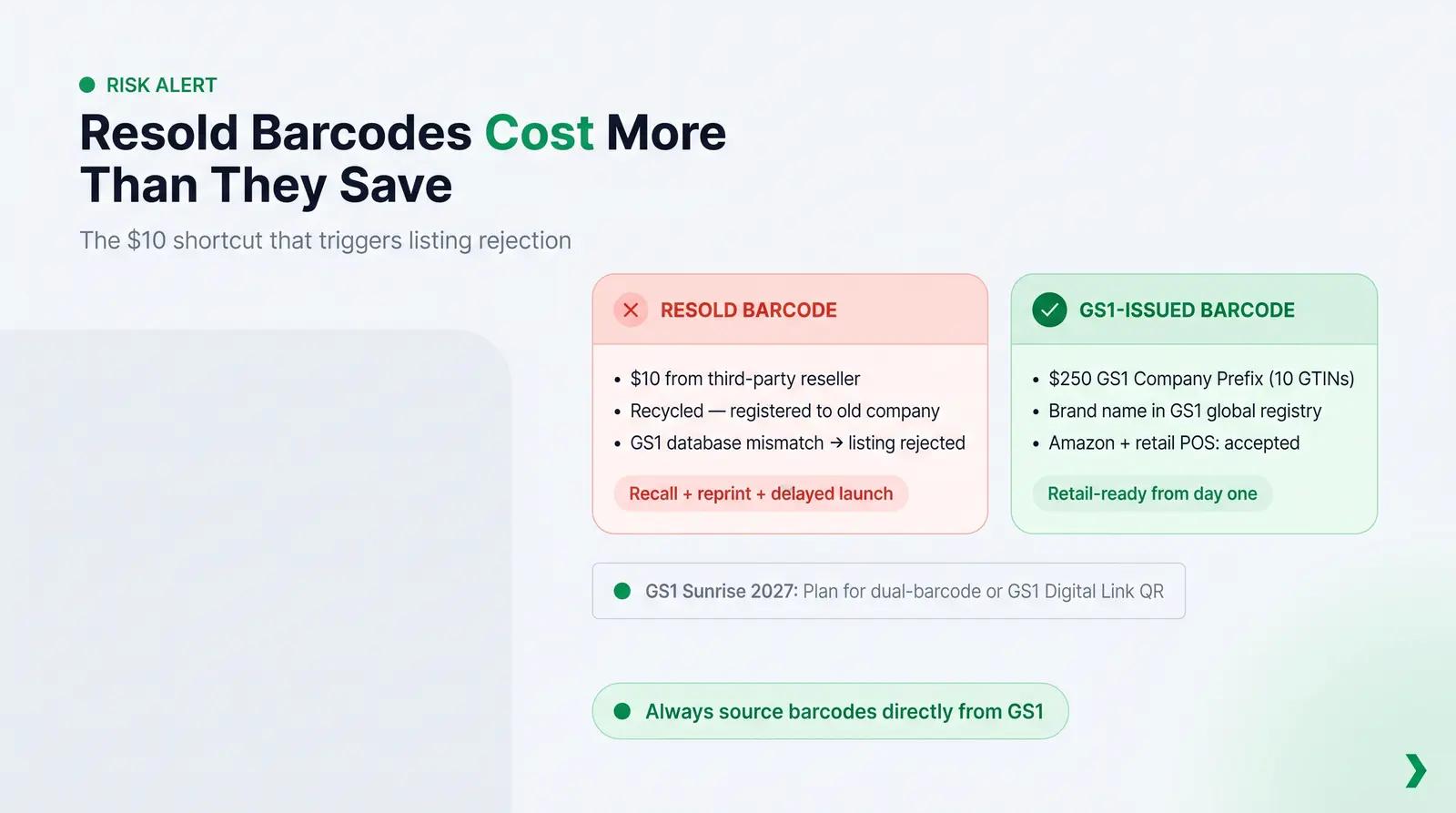
A common assumption among new founders is that buying a single barcode from a third-party reseller for $10 is a smart cost-saving move. This is a contrarian insight: those resold barcodes are often recycled numbers originally registered to other companies decades ago [1].
When you list a product on a major marketplace like Amazon, their system pings the GS1 database. If your brand name does not match the company registered to that prefix in the GS1 database, your listing will be rejected [1]. The initial savings evaporate when you have to recall products, reprint thousands of labels, and delay your retail launch to fix the error.
Furthermore, while the industry is buzzing about the GS1 Sunrise 2027 initiative—which aims to transition retail point-of-sale systems to read 2D barcodes like QR codes [10]—a QR code alone is not a substitute for a UPC today. During this transition period, beauty brands should plan for dual-barcode packaging or ensure their QR codes are formatted as GS1 Digital Links to future-proof their packaging [11].
Next Steps for Your Packaging
A missing or unreadable barcode is an unforced error that can derail a successful product launch. By integrating barcode specifications into your packaging design workflow early, you ensure your products are retail-ready from day one.
Browse Packfolio's curated cosmetic packaging catalog and verify your barcode placement in 3D before ordering → packfolio.com/catalog
Frequently Asked Questions
Do I need a GS1 barcode or can I use a free barcode generator for my cosmetics?
You must use a GS1-issued barcode if you plan to sell in retail stores or major online marketplaces like Amazon. Free barcode generators are only suitable for internal inventory tracking and will be rejected by major retailers.
Where should I place a barcode on a cosmetic product?
Place the barcode on a flat, scannable surface, typically the lower right-hand section of the back panel. Avoid placing it over tight curves, seams, or edges, as this can distort the bars and prevent scanning.
What size does a UPC barcode need to be on product packaging?
A standard UPC-A barcode is 1.469 in wide by 1.02 in tall. It can be scaled down to 80% (1.175 in × 0.816 in) for smaller packaging, but you must always include a clear "quiet zone" around the barcode.
Can I use the same UPC code for different shades or sizes of a product?
No. Every distinct product variation—including different sizes, colors, shades, or scents—requires its own unique UPC code to track inventory and sales accurately.
What is the difference between a UPC and an EAN barcode for beauty products?
A UPC is a 12-digit barcode used primarily in the United States and Canada. An EAN is a 13-digit barcode used internationally. Both are widely accepted, but EAN is necessary for global distribution outside North America.
References
[1] Choosing the Right Barcode: GS1 Barcode vs. Unauthorised Options, GS1 Hong Kong, https://www.gs1hk.org/get-a-barcode/choosing-right-barcode-gs1-barcode-vs-unauthorised-options
[2] Guide to UPCs, GS1 US, https://www.gs1us.org/upcs-barcodes-prefixes/guide-to-upcs
[3] EAN Numbers and UPCs, GS1 US, https://www.gs1us.org/upcs-barcodes-prefixes/ean-vs-upc
[4] Barcodes for Cosmetic Products, GS1 US, https://www.gs1us.org/upcs-barcodes-prefixes/barcodes-for-cosmetic-products
[5] Barcode Basics: What to Know About Barcodes and UPCs for Product Labels, Blue Label Packaging, https://www.bluelabelpackaging.com/blog/barcode-basics-what-to-know-about-barcodes-and-upcs-for-product-labels/
[6] Create a UPC-A Barcode in Data Hub, GS1 US, https://www.help.gs1us.org/work-with-my-upc-a-barcode
[7] Place Barcodes on Products, GS1 US, https://www.gs1us.org/upcs-barcodes-prefixes/how-to-use-your-upc-barcodes/place-barcodes-on-products
[8] Barcode verification, GS1 New Zealand, https://www.gs1nz.org/services/verification
[9] Get Your UPC Barcodes from GS1 US, GS1 US, https://www.gs1us.org/upcs-barcodes-prefixes/guide-to-upcs
[10] Start Unlocking the Benefits of 2D Barcodes, GS1 US, https://www.gs1us.org/industries-and-insights/by-topic/sunrise-2027
[11] Brands & Retailers Are Bullish on GS1 Digital Link 2D Barcode, Packaging Digest, 2025, https://www.packagingdigest.com/smart-packaging/brands-retailers-are-bullish-on-gs1-s-digital-link-2d-barcode


